
Preface
For all their simplicity, giants capture the imagination in ways even dragons cannot. Something so much like us yet still so alien in all their forms, they inspire both awe and dread, and invite us to ask questions about how we are perceived by creatures just as trifling and minuscule. And although Elden Ring has hardly the most unconventional giant designs in FromSoftware‘s catalogue, I still appreciate the effort to distinguish them from other gargantuan men of various mythos. In some ways mundane, in others out of this world; that is always the balance to strike, and it adds so much to the history of this setting.

A Discord of Ice and Fire
Although the area is known as the Mountaintops of the Giants, the fire giants weren’t always the rulers of Flame Peak. The description to Borealis’s Mist reveals that they first drove out the ice dragons. The northeastern summit, standing taller than any other, also sits closest to Farum Azula, making it a natural perch for wyverns who left the nest. There, they could look over the world while enjoying the contrast to their beating hot hearts. But somewhere down the line, the giants came and defeated them in battle. Afterward, the dragons flew to the safety of the Consecrated Snowfield down the mountaintops. A dragon’s corpse trapped in the frozen river overflowing into the Cave of the Forlorn presents proof of their presence in the area. There is also Theodorix resting at the foot of the frozen waterfall. Since wyrms are byproducts of devouring dragon hearts, the great wyrm must be there because it harbored hearts to hunt. More powerful dragons might still risk lingering nearby, like Borealis at the Freezing Lake. But overwhelmingly, they appear to have avoided the peaks.


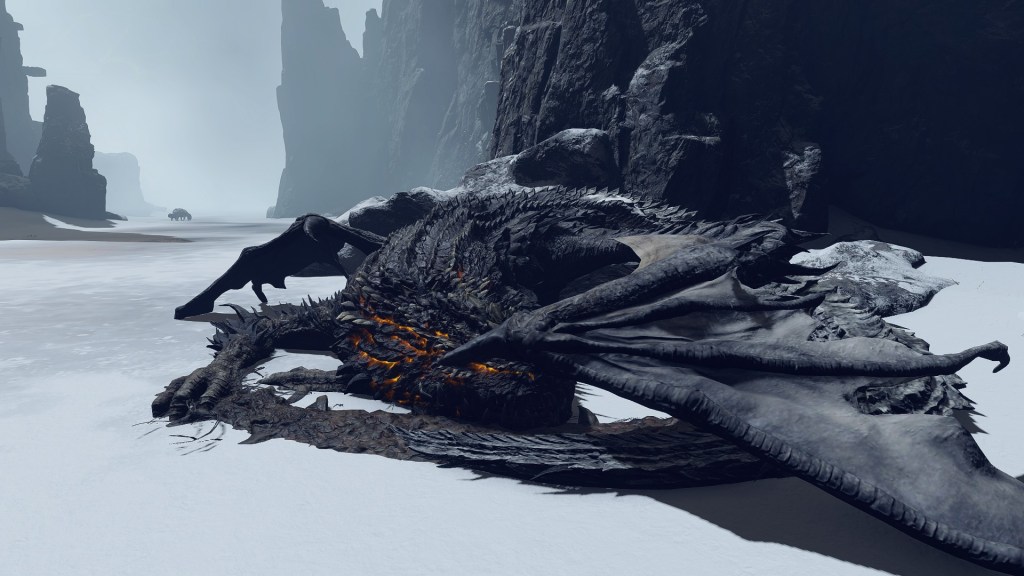

Superior one of the dragon-dining prayers. Skill brandishing the power of Borealis, the Freezing Fog.
Transforms own form into a dragon and breathes ice breath from the skies. Extends duration of breathing the breathe with charging and can also be used while jumping.
It is said that, in ancient times, the ice dragons who were masters of the mountaintops lost to the fire giants and were driven out of the summit.
Map fragment of the Mountaintops of the Giants, eastern part.
The eastern part of the mountaintops overlooking the Flame Summit to the south lies in the highest lands at the furthest ends of Between.
But for the fire giants to take over the mountain summit, they must have come from somewhere else. As it so happens, we do see signs of their presence in another land: Caelid. Both the lands north and south have giant skeletons embedded in the earth, signaling the history with large people living and dying on that earth. In the case of the Mountaintops, the skeletal remains are only exposed on the Flame Peak and the Forbidden Lands at that mountain’s foot, so their equal prevalence across Caelid is notable. And beneath its Wailing Dunes, Mohgwyn Palace summons giant skeletons, which likewise appear in similar numbers atop the northern mountains. Another shared element between them are giant hemicycliums. Most larger than the standard size for humans belong to manmade castles where they may serve in formal ceremonial contexts. But out in the wilds belonging to the random wanderer, we can find these big stargazer platforms in only two locations — one in Caelid by the Church of the Plague, and another in the Mountaintops on Flame Peak. Once again, this points to giants existing in both regions.


The final indication comes from the fauna. Caelid is home to giant dogs and crows, with heads far outsizing their bodies. Some fans blame this on mutations from the Scarlet Rot, but the creatures clearly have a longstanding history in the land. The merchant isolated in the shack at Greyoll’s Dragonbarrow sells a beast-repellent torch, with which the original owner likely pacified the giant dogs in the surroundings. Said canines roam the slope, each with its own flock of sheep, save for the two red-eyed dogs on the fringes — rabid beasts that presumably ate theirs. Altogether, it suggests that the rundown hovel belonged to a native shepherd who utilized these large beasts as sheepdogs, special incense taming their wild will to fight. The owner may have since perished thanks to the Rot, but the dogs remaining appear to have always been so fearsome. Like wolves, they come in grey and white fur varieties, with similar pack dynamics. And we can see that they and the giant crows are also native to the Flame Peak. (Elden Ring: Nightreign includes the First Peak as well) Why, unless the giants brought them over as “small” pets?


Torch that burns special incense along with oil. Its aroma decreases beasts’ fighting spirit.
It is said that those hiding treasure in caves use it in order to repel the beasts settling in them.
Put simply, the fire giants originated from Caelid, following a general trend. Besides dogs and crows, there are also gigantic dragonflies, land squirts, and scarabs in the area. The first are already giant in the freshwater ponds and lakes where they breed, yet the species can get even more massive at the Swamp of Aeonia. The same can be said for the land squirt. Unlike naturally large aquatic creatures such as prawn or crabs, this shallow-water variation of a sea squirt almost exclusively consists of the smaller variety. Exceptions lie in a few places, like Aeonia. An additional example hides inside the Giants’ Mountaintop Catacombs, so liable to be another pet displaced from its natural habitat. Humongous scarabs, meanwhile, loiter throughout the Caelid region, with one more on Flame Peak and yet another disguising itself as small on the bridge leading to the mountains. A mid-sized variety also roams the snowy caps and fields, perhaps from imported pets breeding with the native small bugs. Suffice to say, Caelid produces a disproportionate amount of megafauna. Giant men were just another manifestation of that.


In light of this, why would the bipedal race suddenly decide to migrate to the far-off northern mountains, bringing whatever they owned with them? The obvious explanation is that they wished to stand closer to the stars, much like the human stargazers who established a village on those same mountains. The hemicycliums confirm that the race has had an interest in the cosmos since before they migrated. There is also the fact that the giants have made contact with the supernatural. Item descriptions clarify that the Fell God harbors within both flame and the giants who wield that flame. Their incantations conjure this flame of the Fell God, which looks slightly unique compared to standard fire. Their arts likewise generate a magic sigil of the one-eyed god’s — a sun-like star’s — movements in orbit. Most importantly, we can see the Fell God’s red-bearded face formed in every giant’s torso, spouting the flames which they pull out from its scorched throat to perform their arts directly.
This fire of the Fell God giving the giants their moniker is without a doubt responsible for the red hair growing over their entire body. The description to the flame whip fashioned from one such thick tuft of hair frames the color as a giant’s curse, which fits for beings in some manner possessed by an “evil” deity. However, these negative connotations of an “evil” or “false god” (悪神) are owed to the current Erdtree kingdom, where worship of Marika as the one true god holds predominant appeal in the Lands Between. For those who worship this Fell God, the “curse” of red hair might instead be perceived as a blessing. And for the fire giants to retain the Fell God inside their own bodies, using its power for prayers of faith, they undeniably are its worshipers; even wearing cuts of their fire-imbued braids as bracelets. Therefore, they most likely encountered the Fell God through stargazing and accepted the blessing of its flame, becoming red-haired behemoths churning that flame within themselves.


Thick whip weaving together the burning-like red hair of a fire giant.
The giants all uniformly have red hair, and it is said that Radagon despaired at his own red hair. Was it a giant’s curse?
Battle art that burns the red-hair whip with the giant’s flame and sweeps a wide area continuously, flowing-like.
In that case, it is easy to see the community in Caelid deciding to move to higher ground in order to better make contact with their deity through stargazing. It didn’t matter that the ice dragons had already made the tallest summit their roost — the giants were resolved to take that peak and continue communing with their god. The skeletons in the Forbidden Lands submit that they faced resistance from the moment they began climbing the mountains after crossing Farum Azula. However, the red magic wisps wafting in the frozen air indicates that their flames thawed whatever cold the dragons could buffet them with. And once they had taken over the Flame Peak, they gave it its name by constructing the Forge of the Giants. This cauldron at the precipice, on the same side of the mountain as the hemicyclium, contains the giants’ flame, so exists as a vessel for that purpose. Details like the draconic figures as its handles reinforce how it was built in the aftermath of this conflict with the wyverns. This bowl seemingly carved out a stone spire was the fruit of their efforts to contact the god.
As to what this accomplished, the cauldron’s flame is indestructible, regarded as a Flame of Ruin for its own destructive power. However, the giants probably wished to use it not for destruction but creation. After all, everything but the most basic of metalworking requires flames in order to shape the metal, let alone refine it into new forms. The description to the hammer considers blacksmithing to be the giants’ age-old art, the immense strength required for humans to meaningfully strike hard material with heavy stone coming easy to the larger race. The Troll’s Hammer further claims in its text that smithing is a work of god in that older era. Historically, blacksmiths were considered to touch on something divine with their manipulation of the earth’s elements, but the giants actually relied on flame provided by their deity. What use would obtaining that flame be if they only used it to kill their enemies? Fire has countless applications, from cooking food to shaping tools. It is arguably as important as the hands that wield it in the construction of civilization. And the giants used theirs to herald an end to the neolithic era.


Hammer with a great stone affixed at the handle’s tip. A tool originally used by blacksmiths.
Blacksmithing is said to have been the art of giants long ago. This weapon’s blows are very heavy.
Born to Burn
As a vessel of flame, the giants’ cauldron was used as a crucible for the material forged into crafts. The long crack on one side conveys the sudden flareups from working with such intense heat. One of its four handles likewise look to have melted off in one of these mishaps. Considering that the entire interior of the bowl is similarly scorched and melted, the damage to the exterior must be caused by spillover, meaning that molten material was contained within. This is more consistent with a crucible than a simple brazier, giants throwing in mineral ores to melt and mix into bronze, iron, or other metals. The Fell God does occasionally spill molten material from its mouth, even belching a rain of explosive rocks like a volcanic eruption, so the ruinous heat can break down mineral outright. Concept art goes so far to depict the Forge more like a cooking pot, with a stone lid building up the heat of flames coming from a “stove” underneath. Evidently, it served as more than just a container, becoming the platform for creative destruction which giants could then freely reshape.
This is notable since the race apparently didn’t care to construct for themselves any cities on the Flame Peak. Their most obvious constructs are the one hemicyclium and the Forge, both made of stone and don’t require more than carving and cutting with basic tools to accomplish. The one benefit the flame to forge served was creating the bronze medals and hair accessories used to tie and decorate their braids. Perhaps the giants recognize that there wasn’t enough rock and metal in the Lands Between to make houses their size. The flame drawn out from within made it easy for their bodies to survive the cold snow, so it wasn’t needed to keep warm. In fact, their flames seem to have kept any of the standard trees or bushes from growing in the peak’s vicinity. The only thing the Forge added was more sparks on the summit, some spreading across the wider mountain range where they produce flowers which almost burn up their petals with the firepower they retain.


Smoldering flower half-turned to ash. One of the materials used in item crafting. Blooms on the Mountaintops of the Giants.
Flower growing in the sparks of the Destructive Flame’s cauldron, which lies at the Mountaintops’ summit.
There were practical applications for their smithing. Around the Mountaintops, many of the large conifers — transformed into white phantoms like the wildlife — eerily float over ridges. These trees also appear at vastly different elevations, often far above or below the current ground line. It suggests that large parts of the cliffs and mounds these trees grew from have since collapsed. This comports with the description to the Roar Medallion, the bronze empowering roar and breath attacks with a fire giant’s image as they once laid waste to nature. Roars causing avalanches or whipping up flames into firestorms explain the missing land. It also justifies forging the ginormous chains linking the peaks of their summit, which we use as bridges but primarily serve to stabilize their territory when causing the mountains to shake. (in Nightreign, the same chains hold together the First Peak) Naturally, the Forge received the most protection, tying the last tether in extra knots after the other three broke down with the rest of the support structure. Doubtful the cauldron would still be standing if not for metal.
Bronze medallion modeled on a roaring giant. Enhances roars and breaths.
In the Old Age, giants were the Golden Tree’s mortal enemies. It is said that their thundering roars laid waste to nature, caused avalanches, and turned flames to storms.
But this solves a problem of their own making. It doesn’t explain the choice to go and acquire the cauldron’s flame atop less stable mountains to begin with. Why study the stars to learn metalworking then? One reason may simply be because it was a vessel for so much power. Being indestructible, the flames in the cauldron always leave embers which can be revitalized at the user’s notice. Every fire giant with the Fell God’s face might die, but the Flame of so-called Ruin will live on. Creating the cauldron to contain the flame safely in its spot as a separate source of fire also allowed for endless experimentation without fear of its loss or their exhaustion. More importantly, the act of metalworking itself served as a form of worship. The Troll’s Hammer is an old ritual implement as much as a smithing tool, the wood shaped to resemble the swirls in the Fell God’s eye. It is hard enough for breaking bedrock and retains the power to burn those it strikes, so giants surely used it to reenact their god’s circulation of its essence; fire flowing from cauldron to tool to, finally, material being heated into shape.


Tool that stonedigger trolls break bedrock with.
It is said that trolls are descendants of giants and that this is an old ritual implement and smithing tool. In antiquity, smithing was a work of god.
However, that begs a more fundamental question about their fixation on flame. In truth, this obsession might be less about fire itself and more the nature of life. As the flowers show, the Flame of Ruin is capable of producing life with its destructive power, making the cauldron not unlike the Elden Ring at the root of golden life. Fire in general does appear to produce smoldering butterflies, their red wings forever burning at the singed edges. And while not all life combusts like fire blossoms or butterflies, it does produce heat as a byproduct of its processes — the bigger the organic lifeform, the more heat generated by the body. Giants, naturally, generate the most heat of any organism, so much so that it could even make their bodies more conducive to receiving the Fell God inside of them. And if heat serves as the spark for life of even a deity incarnate, then the giants who studied the stars and prayed to the god they saw possibly possessed the most life in potential, prompting the divine response.
We can find further support for this in the Talisman of All Crucibles. According to its description, this giant mass blending all the various aspects of red-gold individually seen in related talismans had once generated in the body of giants. In other words, the giants of old possessed so much power of life that they manifest some combination of scale skin, head bumps, feathered wings, or even insectoid wings among presumably other traits. Since none of those features survive in their modern kin, they were probably ancillary mutations and so not inheritable, similar to the multiple heads unique to Placidusax when compared to subsequent generations of ancient dragons. Nonetheless, even such minor expressions prove that a giant’s vigor was seething from inside the body, and that “heat” likely did get passed on to the progeny, which can be traced to the later clan of fire giants.


Giant mass blending all of the various aspects of the Crucible.
Reduces damage of fatal blows and headshots and enhances evasion of rolling and backstepping, but also always greatens damage taken.
It is considered to have generated in the body of giants once and is called the mother of the Crucible in the tower’s mythology.
The Arteria Leaf is name the Latin for “artery” due to the way the dark red leaf’s thick veins subtly pulsate to resemble blood veins. In fact, they are liable to grow from blood-soaked earth. Most arteria appear randomly across the Lands Between, leaves only rarely sprouting in small patches. However, we find their numbers plentiful around the giant skeletons on Flame Peak. Even in Caelid, consumed by the Scarlet Rot, we encounter a leaf patch growing between the bones of a giant skeleton by Caelem. The clear inference is that these older giants are the source of arteria, the blood spilled in death growing into new leaves. This thereby insinuates that the race were once more widespread, their bodies potentially buried all throughout. Cut content does show plans for giant, smoldering stone heads to appear sporadically in Limgrave, at least. It may be that Caelid isn’t the only place to produce megafauna so much as preserve it, with giants roaming every corner of the lands before that. Only after their numbers dwindled to just Caelid did the ancients begin looking to the stars.
Dark red leaves with thick, swollen veins. One of the materials used in item crafting. Can seldom be seen.
It is faint, but it is pulsing, so causes blood to seethe and brings an uplift.
This eventual curiosity about the cosmos is significant because of the arteria leaf’s connection to both life and flame. Ingesting the foliage causes the blood to seethe with excitement, lifting up one’s spirits and morale with a sense of exaltation. Ancient giants, more than anyone, felt alive, and that is reflected in the Exalted Flesh. The recipe asks that we wrap a lump of flesh around a hefty beast bone, then marinate it in medicinal fluid from rowa fruit mixed with an arteria leaf for some added spice. Spiciness is traditionally associated with a hot sensation, and the menu graphic shows the spiced animal meat almost burning with fiery heat. That gives warriors a boost to their physical might, but the underlying implication remains the same: the life power in arteria invigorates by producing latent flame. This affirms the preexisting fire affinity harbored within giants, meaning that the race was probably looking to the stars for answers about their vigor which led them to embrace a god of fire.


Why the curiosity at only this juncture? It might have been brought on by a loss of life and flame for later generations, hence why we don’t see more skeletons with arteria leaves outside Flame Peak. In accepting the Fell God and gathering around the indestructible flame of their Forge, the race seemed to regain some of that boiling in their blood. This already has precedent in the draconic races, wyverns possessing less power than their ancient dragon forebears despite retaining plenty of heat in their gravely hearts. That flame in the dragon heart similarly traces back to the Elden Ring’s red gold, which also caused odd mutations in the early generations. The relevant difference between dragons and giants is that the latter appears more biological with no signs of stone in their body, which would explain why their mutations involve more varied animal traits — without the mineral to inhibit chaotic golden life, it can mold bodily matter into whatever shape. That conversely hints to weaker retention of such heat over the generations, leading to descendants with less flame faster.
The idea of a god restoring some of their internal flame isn’t so absurd either. While miners generally rely on pickaxes to dig through the various tunnels, some also perform blast mining using explosive stones. Their description indicates that the crafting recipe for these rocks has been lost, but we can infer the means from the specific enemies. The stones are carried on their backs in the same baskets as the bedrock shards other miners dig up. And patrolling in the area is always one or more miners with special lanterns. Compared to the small lamps worn on workers’ waists, this handheld variety has been modified into a flamethrower, heated gases destabilized with a few ground taps. Their owners most likely have the duty of spraying the rock collections to infuse them with flame, which soon become unstable themselves as witnessed when igniting the whole basket. If miners can work out a method for small-scale mineral, then a god of flame should be capable of applying the same principle to organic giants. By making them partial avatars, the Fell God could reinvigorate their existence with a literal fire in their belly.


Small stone hiding smolders inside of it.
Throw at enemies to explode and deal fire damage.
A tool for bedrock blasting that stone-diggers use. Its recipe has already been lost.
Another angle to consider is why the giants’ numbers would be reduced to mainly their weaker descendants in Caelid. Perhaps that overwhelming sense of vitality made their forebears across the lands complacent regarding death. The Ancient Meteoric Ore Greatsword is the fragment of an arrowhead excavated by one of the ruined forges at the center of the Lands Between. Because the arrowhead was so massive, the fragment is processed into a colossal sword — though retaining its pointed, aerodynamic qualities which make it ideal for running foes through like in a lance charge. It isn’t alone either, as we find countless similar weapons all around these ruins, presumably all derived from pieces of old meteoric iron whittled into more barbs. Based on the size, the whittlers were giants of a sort, which fits with their choice of materials; for them, digging a meteors out of the earth would be like retrieving a stone or pebble. War may have therefore be what killed off the fire giants’ ancestors.


One of the smithing ruins’ hidden treasures. Greatsword of old meteoric iron, sharpened to a point.
A weapon of the old gods that was excavated. It is manufactured from a fragment of their arrowheads, so excels in thrusting and charge attacks.
Some fans might object on account of the greatsword’s description, which claims that such meteoric iron weapons belong to old gods. However, anything can be revered as a god regardless of inherent divinity, and the giants undoubtedly received such worship. The Talisman of All Crucibles identify the various aspects all generating in giants as part of a “mythology” (神話) in its description, the kanji meaning a “story of god” more literally. This suggests that the giants of old were the gods of these tales, opening the avenue for them to be the deities shooting meteor arrows. Those arrows’ burial at specifically the center of the lands further supports the notion. No arteria leaves grow there, so it is unlikely that giants were using the region to carve their arrowheads. But if they were shooting arrows at each other from the peripheral lands, then we would expect a disproportionate number of shots missing their mark to land at the center, with any others buried beneath the ocean. Together, it paints a consistent picture of conflict between neolithic giants, deemed divine by peoples in the past.
These Stone Age giants would be contemporaries with both Farum Azula and the saint civilization, their shared use of meteorites reinforcing the latter connection. The lands they inhabit also appear to overlap with followers of the saint, the lack of arteria leaves in the crumbling ruins in the sky discounting the prospect of a firm presence in the east. Both humans and giants thus lived alongside one another separate from the dragon capital, developing their own separate societies in the north, south, and west. With the relative ease that giants could dig up the earth, the two peoples might have even collaborated in the construction of the Divine Towers and associate elements, justifying the sheer scale of these megastructures. For their assistance, they would share in the knowledge of meteors, and their later war with fellow giants could even be responsible for the collapse of that human culture, caught up in the collateral damage of their cataclysmic clashes.
The destruction from these battles shouldn’t be understated. A fissure in the old meteoric iron allows us to unleash the power of white light in an electric blast with the greatsword, so their missiles would be just as devastating to the lands as to the giants. It was that destructive power which assuredly convinced the race to use meteors instead of simple stone for their weapons. The Divine Towers may be proof of this. Although the towers themselves remain relatively intact, each is covered extensively in a peculiar rock, generally right of the entrance — though the Isolated Divine Tower mistakenly has it on the left at distances beyond Greyoll’s Dragonbarrow. The mineral itself resembles feldspar, while the heights point to some sort of impact uplift. The amount of molten rock required can be justified by a meteorite landing slightly off course in the water, the “splatter” surging then cooling. But was this brought on by a summoner in the tower, or by a giant raining arrows upon the region? If the latter, then it is easy to imagine the devastation when they made landfall.


Considering how fire giants are able to shape the earth with the tremors of their voice, the ancients might destroy their surroundings in any number of ways. And like any war, heroes would emerge, showcasing strength which would cause further devastation at their scale. It is no surprise if human civilization would be wiped out, Farum Azula probably spared only thanks to never having the giants to become a proper battlefield. The dragons and beasts just watched by the sidelines as their neighbors brought the ruin of meteors upon themselves. After the oldest and strongest finished slaughtering each other, the survivors would have little of the culture and history to inherit. What they did pass down through oral tradition would be fragmentary, so descendants would see their overflowing vigor slipping without knowing why. A simple tribe turned to studying their surroundings like ancient man and found a being that seemed to answer their questions: they just weren’t petitioning for more flame from the right party. That entity from the stars became the god they worship so slavishly.
However, the fire giants may have come to a mistaken conclusion. As noted earlier, the existence of organic life overflowing with power resembling the Elden Ring’s reddish gold draws parallels to the ancient dragons and their descendants. If the dragons are the common ancestor to the various organic beasts as well as mankind, then where do the giants fit in? The fact that the ancients channeled their life into animal aspects rather than just fire breath indicates that they lacked even the stone skin of astral races like the Onyx and Alabaster Lords, and we don’t see any giants emerge from meteors. The most likely source of their humanoid form then is actual humans. And to be children of men with so much life, they must be close to the source of that life: the ancient dragons. Certainly, the original creatures wouldn’t be out of place in a world of megafauna, and we see that size and stone element disappear over time as life divides while lives multiply, especially when it involves the human race.

In short, giants were probably born to ancient dragons and Numen or their immediate progeny, the loss of life a natural consequence of entropy rather than a lapse in worship. Their kind would appear alongside the smaller human races, proof of inheriting the fire and life of the draconic parent to an extra degree. Their gigantism itself can be justified as a consequence of so much vigor. In the case of Greyoll, the ancient dragons produced a “mountain” larger than most of them, with enough life power to not only radically shift from the standard physiology but also produce an endless brood — potentially asexually. A man growing hundreds of times the size of a Numen parent isn’t that unusual, and with enough of these giants among men, they would naturally congregate to form their own tribes as both they and the smaller men spread all across the Lands Between. If this is true, then it is ironic how the fire giants pass Farum Azula by on their way to the snowcap mountains, ignorant that it is their birthplace as they clear out dragons to build a kind of shrine to their new god.
Warm Gospel, Cold Steel
Despite all the snow, the heat from the Forge has permanently changed the mountaintops underneath. Fire blossoms are the most obvious example, with even a large number of the flowers looted off a corpse in the Consecrated Snowfield below where we actually see them grow. The only thing stopping entire fields of these flowers is that they require existing foliage as a catalyst, the smolders blooming overwhelmingly in the midst of mundane shrubs. However, the rock these flowers grow upon doesn’t have such limitations, splotches of red staining the grey down to the farthest ends of the snowfield. Its nature is reaffirmed by the random smoldering butterflies spawned from no obvious source of flame on the mountaintops. Naturally, the collective fire power from all these sparks and embers has influenced the local smithing stone, too. The large stones have partially vitrified, their glassy sheen a probable product of intense heat like with actual glass. This has only enhanced their quality. If the Fell God wanted them to smith as a form of worship, the giants had plenty of material available to throw into their cauldron.


But if blacksmiths were god’s will, then it would behoove the giants to share their art. A number of glass smithing stone can be looted from corpses at the edge of Greyoll’s Dragonbarrow atop one of the giant skulls. A scarab rolls up another closer to the Divine Tower of Caelid, and many more are rewarded with the defeat of the fallingstar beast born from the meteor in Sellia Crystal Tunnel digging beneath the barrow. Altogether, it suggests that either the fire giants were already marginally influencing local smithing stone before they departed for the mountaintops, or did so after the fact in regular visits to those northern parts. As to why return, it is possible that giants still had friends and family in Caelid, a population which never elected to migrate for the faith. The fire zealots’ goal back home may thus have partially been to spread the art of smithing to their now distant relatives. That population of late adopters was potentially small, but it would be an easy sell to an accessible party to experiment with smithing alongside them.
They might well have done the same closer to home. The Sword of Night and Flame is a prized treasure of Caria Manor, the blade requiring both faith and intelligence to unleash the fire and sorcery it contains. Its description notes how the astrologers and giants in the distant mountains were neighbors, implying a connection. This invites the insinuation for the weapon to be the product of a collaborative effort between the two, each party contributing their own power and expertise. Granted, the sword’s ornate and intricate design doesn’t suit either humble people, fitting more with the royals who own it. Indeed, in an earlier iteration of the text, the silver-and-gold sword was expressly forged to celebrate the Carian queen’s marriage to Radagon, the flame and red crystal in the hilt symbolizing his red hair. We can therefore disregard these details as artistic license, the overall artisanry conveying how close and cordial the stargazer village and Flame Peak were. Part of that relationship perchance included learning the giants’ art.
Battle art that assumes stance with sword at level and connects to sorcery. Fires magic power as night comet with normal attack and sweeps wide area ahead with flames with strong attack.
Treasured sword prized in the Caria Castle Manor. One of the “legendary weapons”.
It is said that the beginning of the stargazers, who are the predecessors to sorcerers, was in the distant high mountaintops near the sky, and the fire giants were their neighbors.
The secrets of smithing were definitely utilized by the village’s descendants, as the homemade wood and iron marionette soldiers serving sorcerers elsewhere exemplify. More notable is what memory of the fire giants these disseminated astrologers seem to inherit. While the small dolls appear avian, consistent with their desire to fly free of their flesh and touch the stars, the “giant” puppets all have red beards arbitrarily added to an otherwise cheap manufacture. On top of this, they have hollow abdomens where they pull out their weapons and fire pots, making it look like they retrieve flames from inside them. Both of these traits bring the giants of the mountaintops to mind, so sorcerers have unquestionably modeled their larger marionettes on that race. Hurling flames from their nonexistent guts and protecting their scrawny masters with superior physical strength, we can see the impression stargazing brethren left in the northerners’ minds. The giants were living tools that astrologers could appreciate, their discoveries with flame adding to the humans’ own astral research.


Another friendly neighbor was Farum Azula. Perhaps it was thanks for allowing the giants to pass through their land, but the beast capital was the first to share in the secrets of smithing. This is expressed in the beastmen’s dull iron swords, curved with a sharp edge like a predator’s fangs yet weighing heavier than an entire jaw — and incredibly balanced to wield despite this. It is this bizarre way of forging weapons which makes the beastmen’s knowledge far surpass mankind. The incomprehensible techniques involved is something reliably cultivated as a result of their civilization’s exceptional age, but that would still require them to learn how to smith before the humans. Accordingly, the fire giants must have taught the first beast blacksmiths, allowing the furry race to temper metals into arms and armor instead of continuing to rely on stone or meteoric iron. This had a cascading effect on the culture, from their jewelry, doors, and adornments, to beyond.
The ancient dragons have always used lightning as their weapon, likely shaping electric charges from the clouds into spears since early on; Placidusax’s explosive example takes the wild shape resembling a plasma bolt, and even later ancient dragons conjure down spears with two prongs like stereotypical forked lightning. They looked to nature, mimicking what they saw their bodies generating in the sky. But we also see dragons like Lansseax form lightning into the shape of a glaive — specifically a naginata (薙刀) — and wield it like a more traditional sword. This bears little resemblance to any natural lightning, so it is probably an art that the dragons developed from observing the beastmen forge similar curved blades out of metal. The liable reason it is considered a polearm, despite the short “pole” they grasp, is the fact that they otherwise only had their lightning “spears” for reference. For those unable to specialize in hurling bolts, the glaive presented a new avenue to master for combat.


Meanwhile, the beastmen continued experimenting with their forging techniques until their weapons found the perfect balance of weight and tractability for a thick iron that simultaneously retained its sharp edge. From there, they could get creative with the fencing technique, merging lethality with their cultural fixations. The Beastman’s Curve Sword, Cleaver, and throwing sickles heavily incorporate twirls into their swordplay, bringing the tornadoes of Placidusax’s storm to mind. Even as they were capturing a beast’s claw or bite, the warriors of Farum Azula were also longing to whirl like a dragon, something which became sensible with hard metal supporting the strength of their weaponry. In that sense, the fire giants were helping advance the beast nation’s longtime preoccupation with their evolutionary past.


It was likely during this same period of research and development that blacksmithing was passed onto the ancient Numen who became the Nox, their knowledge lost to the wider world with their descent underground where it developed in its own direction. After that, no humans would learn how to manufacture weapons with flame until much later, leaving Farum Azula with its more advanced knowledge. That, once again, highlights the unique relationship between the beasts and fire giants, as old as it was enduring. Never did the tribe on Flame Peak fear that their neighbor would take those secrets and use it against them — this was purely a beneficial arrangement. With how the Sword of Night and Flame is so small, the giants were more interested in forging weaponry for the smaller races than themselves, continuing to rely instead on the Fell God’s flames for protection. Regardless of their faith, making friends was paramount to safety. Fortunate for them, there were few reasons to want their deaths, especially if they were willing to share more secrets in the future with further advancements in their craft.
Not all were welcoming the fire giants, of course. The Zamor live in their own town at the foot of Flame Peak, knights still patrolling the ruins to this day. Even with the destruction of their homes, they retain their pride as residents of the region, and for good reason. Despite their light dress, the armored warriors feel perfectly comfortable in the cold, descriptions to their armor even noting the tribe’s long lives as demonstrated by lengths of grey hair and atrophied skin. They are, in fact, masters of the chill, warriors wrapping their bodies and weapons in cold wind unleashed from within. With this latent power, they can breathe cold gusts to form ice crystals on the ground or in the air, even whipping up storms at will. This internalization of winter was apparently a form of worship, with the knights’ sabers modeled on a frozen wind which they wield with a flowing combat style as elegant as it is deadly. Dancing like a snowstorm, it is unsurprising that they hate flame, enough to consider the giants their mortal enemies.


Mask of the Knights of Zamier, famed as heroes of the Giant War.
It is said that they who are wrapped in cold wind and possess long lives were the fire giants’ mortal enemies since ancient times.
Choice weapon of the knights of Zamier, famed as heroes of the Giant War.
The saber modeled on frozen wind is said to be worshiping winter. It is wrapped in the strong power of chill.
Ice sorcery handed down in the town of Zamier.
Stab staff into the ground and generate chill storm in surroundings. Enhanced with charging.
The knights of Zamier are wrapped in ice storms and have continually challenged the fire giants since ancient times.
The feud with the human tribe, in all likelihood, began from the moment the fire giants took over the peak. Looting a corpse in the town, we can acquire a sorcery text for Zamor Ice Storm, similar to the skill the knights perform without a staff or other catalyst until infusing their saber mid-battle. Considering the proximity, the Zamor are apt to be another breakaway tribe from the sorcerers of the stargazer village. Ice crystal is still crystal, so it was inevitable for some among the astrologers to focus in on that specific aspect of their magic. The move to another peak further south was probably for closer observation of the ice dragons, who internalized the cold before them. By mimicking their mastery of the element, the Zamor became a distinct people, extending their lifespans with a chill known only to stars of the cold vacuum of space. How would those sorcerers feel then when those ice masters were driven out by another race wielding flame? Furious, no doubt. And so, the knights of Zamor were born, warriors upholding the ideals of their people as they defended the cold from these fiery invaders.


All else aside, Zamor has been assailing the giants since ancient times. More specifically, the descriptions to their armor use the term taiko (太古) instead of oofuru (大古) like Zamor Ice Storm, which is presumably a typo given the kanji’s similarity. Even so, the meaning is more or less synonymous, with the additional humor of the former’s association with the Archean period (太古代) that saw the first glaciers spread across the earth. We can hence be certain that this took place in the same general era as the Nox descending underground and the fire giants taking over the mountaintops. Yet despite facing constant assault, the giants seemingly did nothing about the Zamor. Neither side was wiped out, so the interlopers didn’t consider the humans much of a threat. And try as they might, the knights’ cold couldn’t overcome a much larger race with the flame to melt blizzards. And so, the giants left the town alone like one would a hive of gnats, swatting at whatever nuisance came their way before forgetting about it.
Once more, this stresses the peacefulness of the fire giants since migrating to the mountains. The fact that the Zamor own metal weapons and armor implies that they too, ironically, learned how to smith with the flame they so hated. That requires either the giants still teach them or, more likely, that these sorcerers learn from someone else, such as the stargazers of their old village. The giants didn’t hold this spread of knowledge against that party. Their one concern really was the manipulation of flame for forging, not what it could be used for. Maybe memory of their ancestors made them averse to war, assuming that it wasn’t necessary for the worship of their deity or self-preservation. But if they could defrost the winter coming their way with a titanic breath, it obviously wasn’t worth making a fuss. The reality for the giants was that they had greater anxieties to consume their attention, religion their sole weapon to fight against the relentless march of entropy.

Hearts Flicker and Flare
Despite the fire giants molding the earth in god’s image, they continued to lose heat with time. From their descendants emerged the trolls, still large for humans but far smaller than the average giant; which already enjoys a wide variance. Although modern trolls lack their god’s face, the gaping abdominal cavity denotes how this wasn’t always the case. Their kind did revere the Fell God, per the Troll’s Hammer, with one boss troll performing giant flame incantations. In fact, they were probably more obsessed, given the fate of Milos. Named the ancient Greek for a spinal cord, “Myelos” (ミエロス) had a greatsword for man to wield made from his backbone, which was only possible because he was undersized for a giant. This deficiency apparently tormented him in life and death — the sword’s skill causes the wielder to shriek on his behalf, flailing the spine wildly while briefly possessed by the flames of his vengeful spirit. Clearly, giants have a complex concerning stature, and thereby the life and heat which comes with it. This confidently extends to trolls, who pick arteria leaves of their titanic ancestors on the summit.
Ominous greatsword said to have been made from a giant’s backbone. The spines on the left and right are whittled down to be thin and sharp and injure enemies like an irregular sawblade.
It is said that Myelos was undersized for a giant and became terribly, uglily corrupted.
Those trolls still living on Flame Peak are a prime example. Unlike their brethren encountered in more temperate parts, these lesser giants have black skin almost entirely covered in white fur like stereotypical yeti. Contrast this to the hairless variety suffering the Consecrated Snowfield’s blizzards in just a hooded cloak. They haven’t simply grown a new coat, so it is more likely that the Peak’s trolls preserve a trait which their kin lost, living so long in warmer climates. In other words, even when born with the face of their god, trolls lacked the flame necessary to stay warm without evolving extra adaptations — perhaps even the red hair. With no eye or ears in the chest and armpits, that divine visage appears incomplete. It would explain why no giant but the troll generates a sigil with prayer; they were never able to borrow the god’s power directly, so they alone required a magical aid. This further distinguishes them from the standard fire giants. To that point, another boss troll holds onto the Roar Medallion with his forefathers’ face, yearning to be as great and booming in voice as well as other aspects.


The perception was no doubt shared with their larger cousins, which might have manifest in ugly ways. Although indestructible, the Flame of Ruin can be reduced to mere embers without fuel to feed it. As to the kind, we see that it requires special kindling, such as when Melina offers up herself to burn the Erdtree on our journey. This isn’t enough to revive the fire in the cauldron, but it does show how the Fell God’s gift responds to life — and the god dwells in that gift. The most powerful of the giant’s incantations is Flame of the Fell God, which conjures a fireball that slowly floats toward the living target much like how the eye of the actual deity always remains fixed on us in battle. Once in close proximity, the raging orb explodes violently to burn everything in the area, capturing the astral entity’s sheer enthusiasm to incinerate life on earth. While it may devour mineral, the evil god sustains itself on vitality, and with its seemingly bottomless hunger, the flame demands a steady diet.
The giants know this all too well, as demonstrated by their last survivor. After his enfeebled leg snaps under his own crushing weight without support, the boss opts to tear off the limb and raise it as a burnt offering using the flames already in his hands. This improvised ceremony rouses the god’s dormant face, allowing the giant to borrow more power in the fight against us. This suggests that the full power of the race’s flames is contingent on their deity receiving regular sacrifices of flesh. And if a giant’s lower leg is needed for just the one face’s aid, how much to keep their Forge alive? Looking at the size of the ashes piled inside what is supposed to be a crucible, a giant’s body at minimum. That is likely the original purpose of the large tray the survivor carries. While the boss currently uses it to shovel snow, the material and Fell God imagery implies a more ceremonial use. That use wasn’t burning flame on it, since the bronze looks unscorched. Rather, it better functions as a platter to dump dismembered offerings into the cauldron to be burned, serving a god its meal.


Put simply, the fire giants must have performed countless “human” sacrifices with their own. When the Forge was first established, these offerings were probably more evenhanded, maybe even selecting from the best among them. But over time, why would they continue offering up their best when their worst could serve just as well? Perhaps a giant with weaker life power wasn’t of the same fuel quality, but that was solved by offering more of them. And so, it is logical for the elites of fire giant society to substitute themselves with the dregs, sacrificing the lives of lesser giants — including eventually the trolls. By weaponizing their self-hatred, those giants’ sacrifice could be recast as the most noble act for their waste of vigor. The troll community’s place in wider giant society would likely even be dependent upon cooperation, access to their treasured flame limited to labor as blacksmiths or prayer and only after reaffirming their faith through offerings. For possessing incomplete divinity, the lesser giants were punished with eternal subservience, the reward for repenting just a peek at the flame hiding inside of them. As a result, the society promoted enmity all around.
Not every giant has stayed to stew in his own deficiencies. One of our face options belongs to people from the North, a desolate place which demands a harsh lifestyle of its rugged residents. From their pale skin and light hair at default, these northern lands have similarly polar climates, perhaps akin to the tundras of Nordic and Russo countries. That would explain a giant’s choice to migrate there, the humans allegedly descending from such larger race. If so, then one or more fire giants chose to abandon their faith and depart the mountaintops, crossing the sea of fog to a continent further north where they might share relations with native humans. There are lands visible on the horizon from Consecrated Snowfield, so giants could climb down and later decide to move further after noticing the relatively short distance across the water. Whether because the Forge ultimately failed to justify the cost or because they longed for freedom from the responsibility, these giants preferred to live in a different frosty environment, with only the flame they carried within them for however long that would last.

North Face
Look of people of the desolate North. It is also said that they are descendants of giants.
Still, all of this points to fractures in giant society, the cauldron solving none of their underlying problems. When generations continued to decline in their eyes, they created a culture of disdain for those newer members of the tribe rather than reconsider their faith. When numbers began leaving to found new lives elsewhere, they doubled down on their zealotry instead of explore alternate options. At no point has all their hammering of metals restored their people to the peak of life passed down in tradition. But the Fell God was the only thing they could cling to, so the majority remained slavishly devoted to this entity from the stars. In some ways, the fire giants were prisoners of their faith, choosing to believe comforting lies for happiness than accept the grim reality of their transient nature. And for those not blinded by flame, the deity’s secrets were a powerful tool which changed the trajectory of civilization, the fires of new warfare someday to sacrifice its creators on the altar.

