
Preface
The Ashes of Ariandel DLC holds a special place in my heart. Painting worlds have been deeply entwined with meta narrative since the original Dark Souls, (DS1) but this is the first time that they became vehicle for commentary. The exploration of Ariandel is a dive not only into the history of one world, but also the main plot of the other. It is a side story fostering a silent discussion between developer and audience, making the closing argument for the franchise’s core message after three games. This reflection on the story within the story is a natural escalation. What started out as an in-joke still became key to major events, so only fitting that the meta elements be taken even more seriously. And because it occupies such a unique capacity, the “painted world” makes for a perfect capstone, and summary, on this final entry in the trilogy.
Hidden Landscape
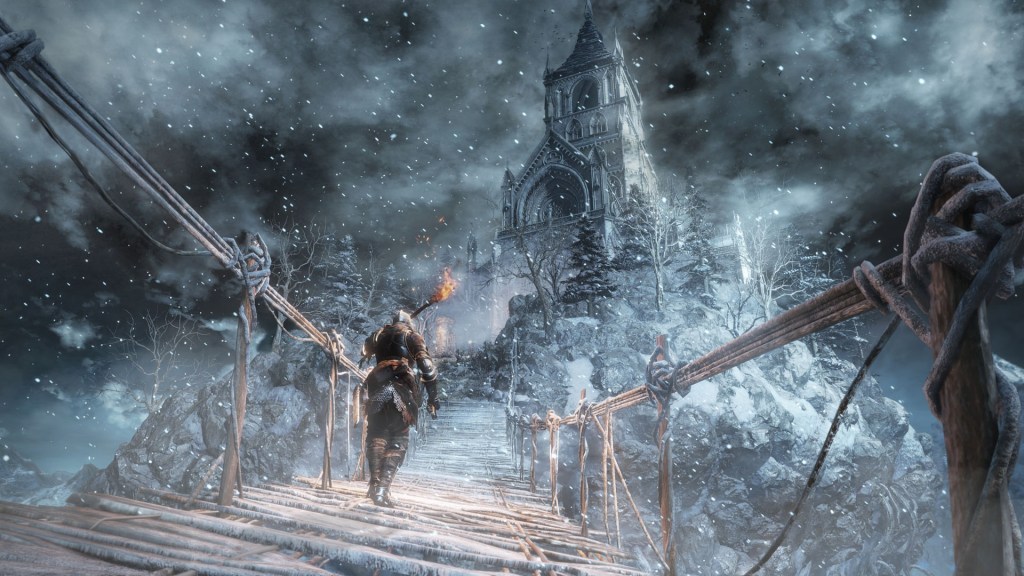
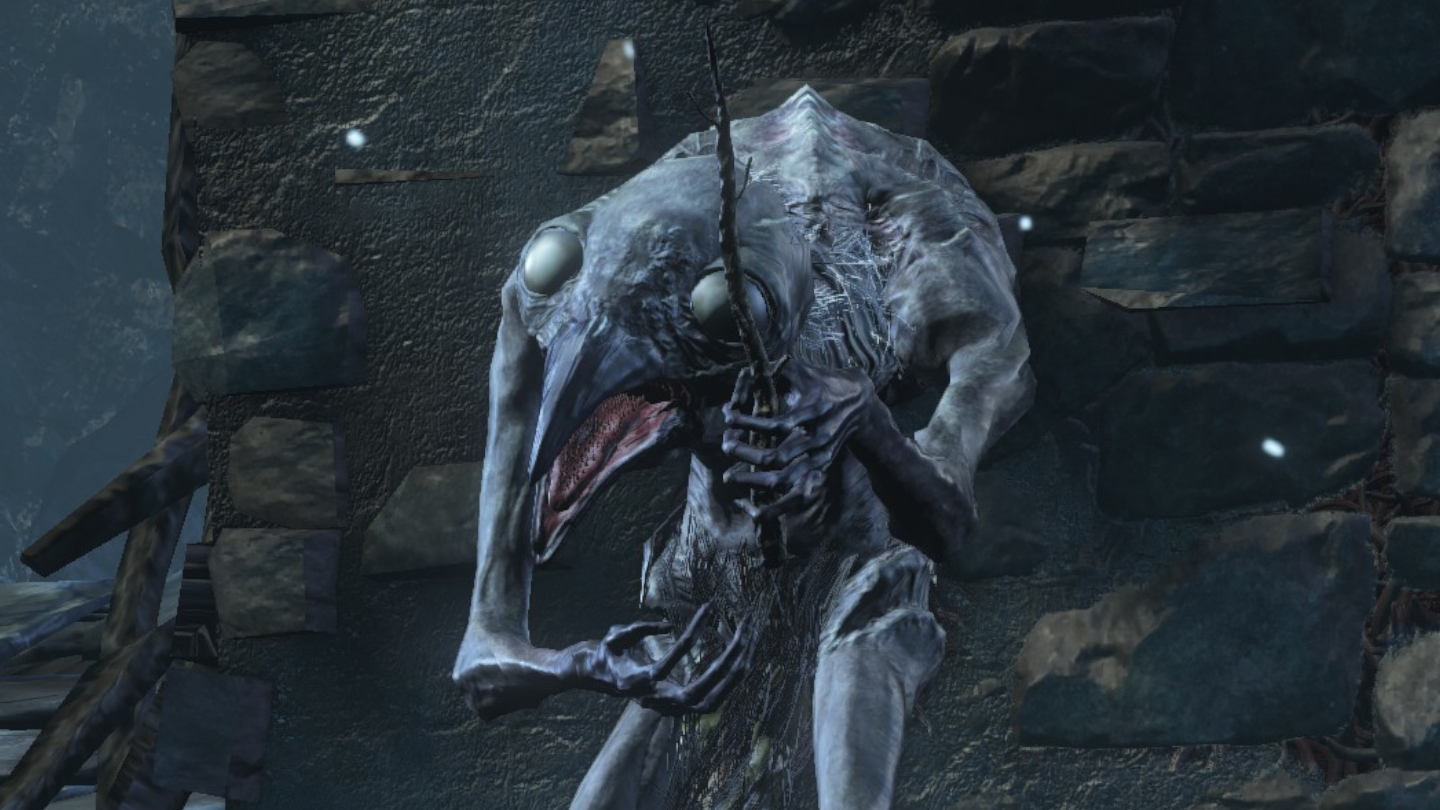
It goes without saying that the Painted World of Ariandel is connected to the Painted World of Ariamis from DS1. Aside from both being snowy painting worlds, the tower which housed the half-dragon Priscilla in Ariamis is buried at the very bottom of Ariandel. The corvians residing in Ariandel are likewise the same “crow men” (鴉人) encountered in the previous games, despite the lack of wings in their new design — corvian knights even perform the same pecking grab attack. And just as how Ariamis was the name of the original painter, Ariandel is the name of the painting’s restorer. That such a grand art piece had begun to decay in the interim since DS1 isn’t surprising. Neither is it unexpected for someone to restore it, painting over the old, damaged parts with something new. This would explain why Priscilla’s tower is the only part of the old Ariamis temple we can spy, half-buried in the depths of the “new” painting as it is; everything else has received a complete makeover in the literal sense. Now, that small temple on an isolated mountain is an entire mountain valley covered in forests and crags.
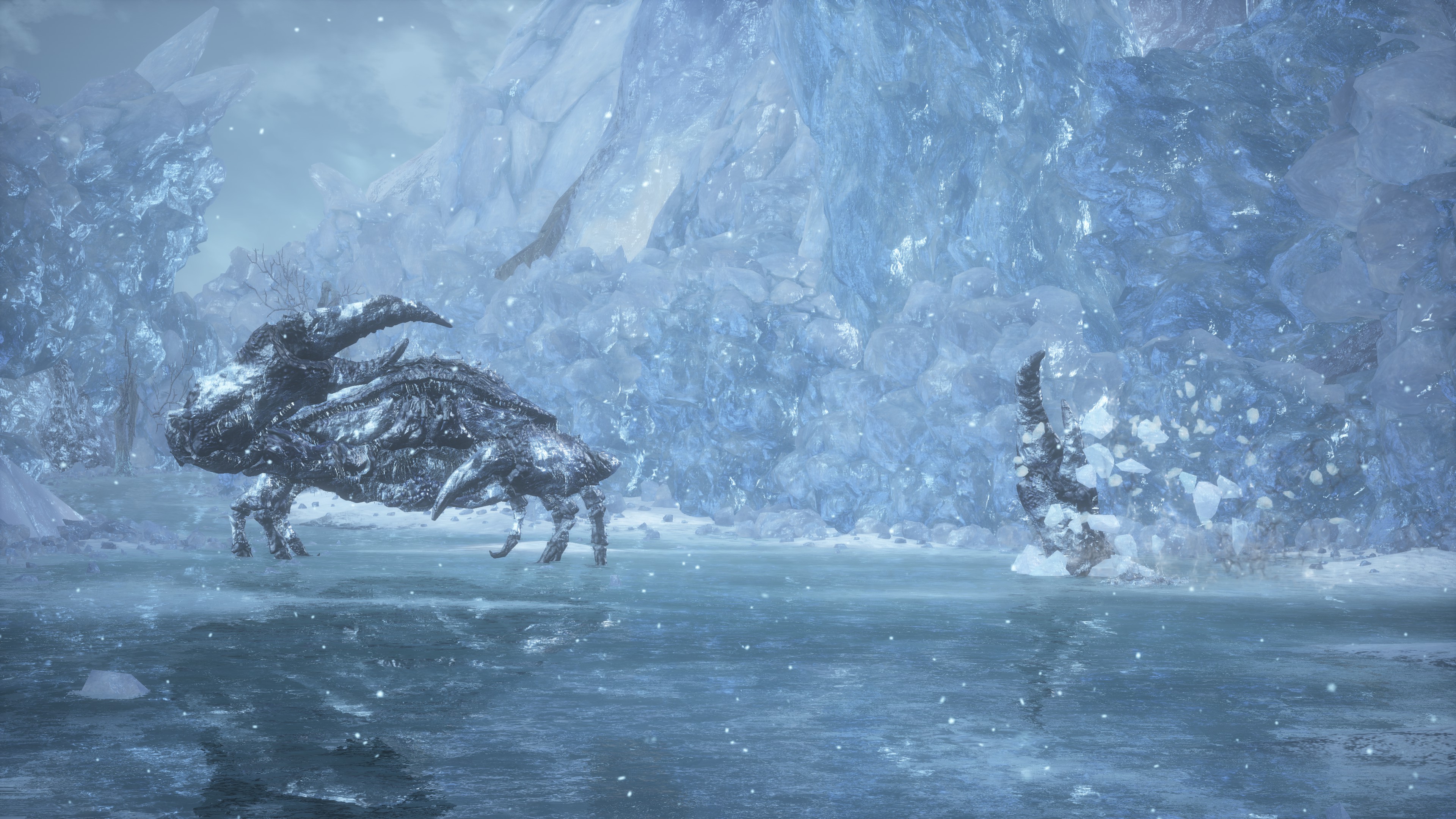
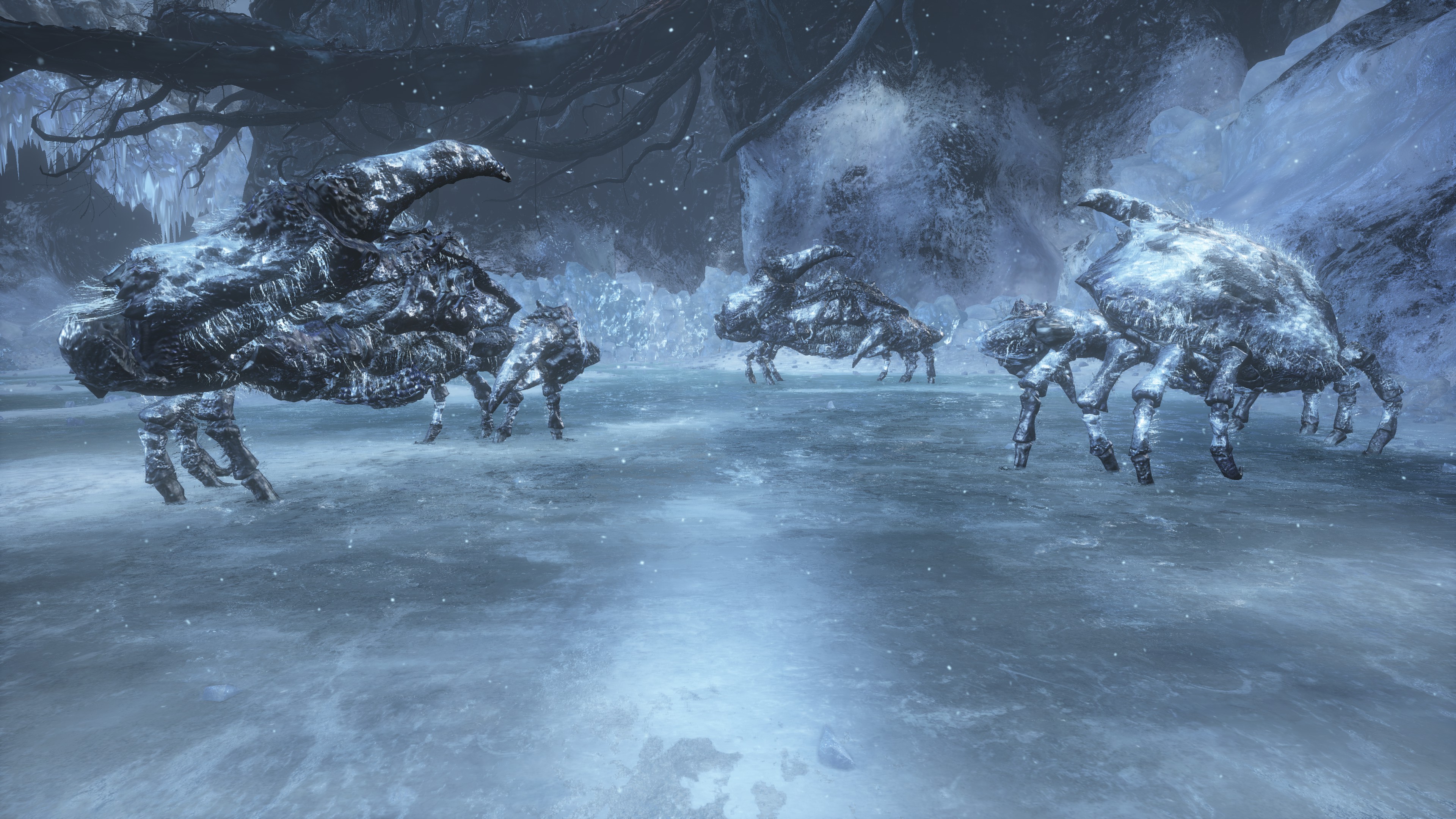
Even so, the essence of the painting world remains the same. Giant crabs burrow out of the frozen river at the valley bottom. Their size is indicative of their long lives compared to the average small crab, meaning that they have called this river home for potentially just as long. And unlike the giant crabs seen in the outside world, these ice crabs carry crystal gems. Such precious stones are the products of titanite interacting with something in its environment, hence they can be used to similarly alter the nature of weapons. In the case of the crystal gem, it adds magic damage that scales with intelligence, which is fitting in light of crystallization’s historic association with sorcery. But in this circumstance, the gem apparently formed in the icy river the crab digs through. Indeed, ice resulting from cold weather is typically crystalline, with rock wall assets along the river retextured to look like ice crystals. Add all the snow piling on top, and the frozen water’s power might be dense enough to crystallize titanite buried with it. And the nature of that power is revealing. This ice is, at its core, magic.

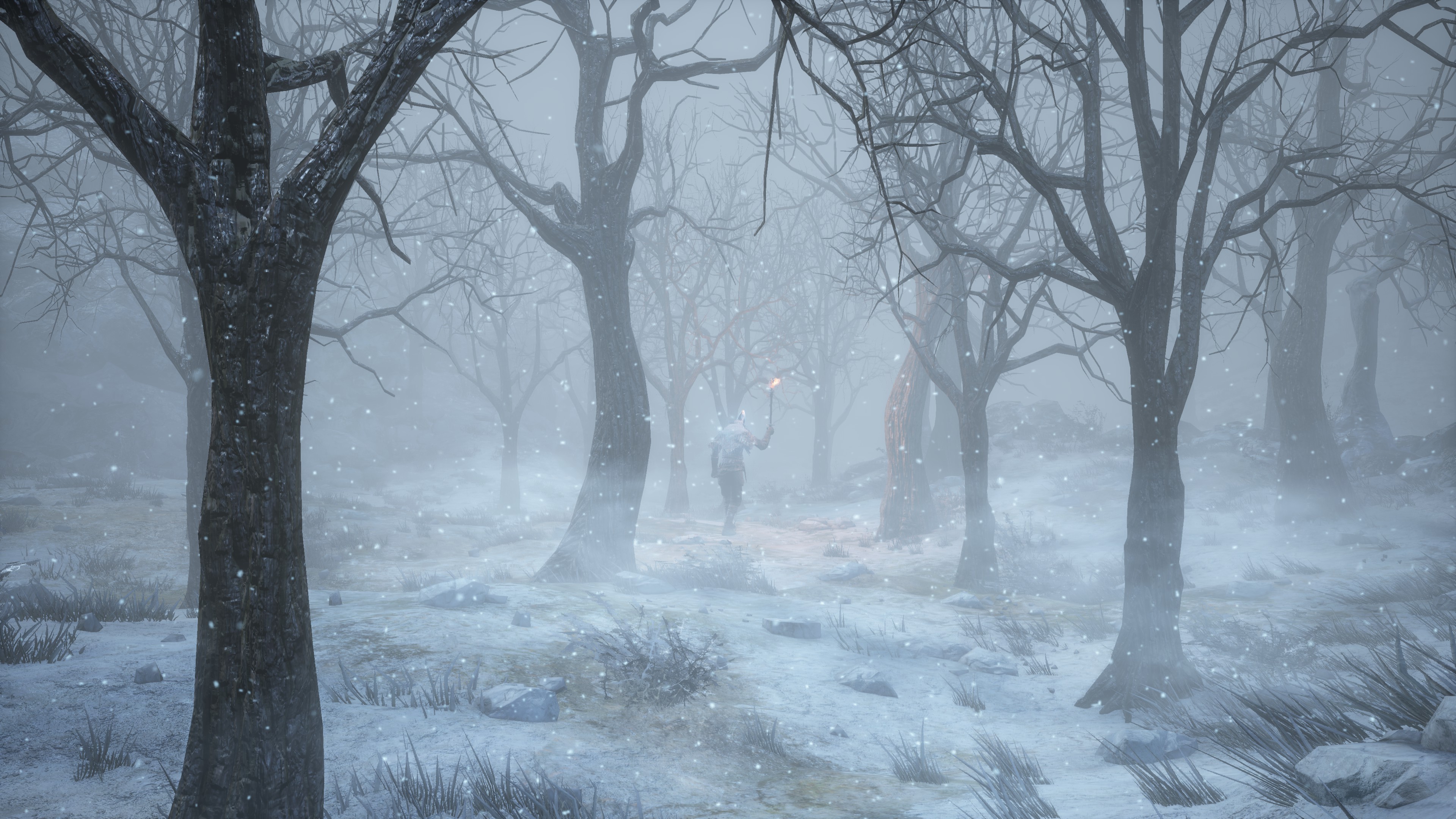
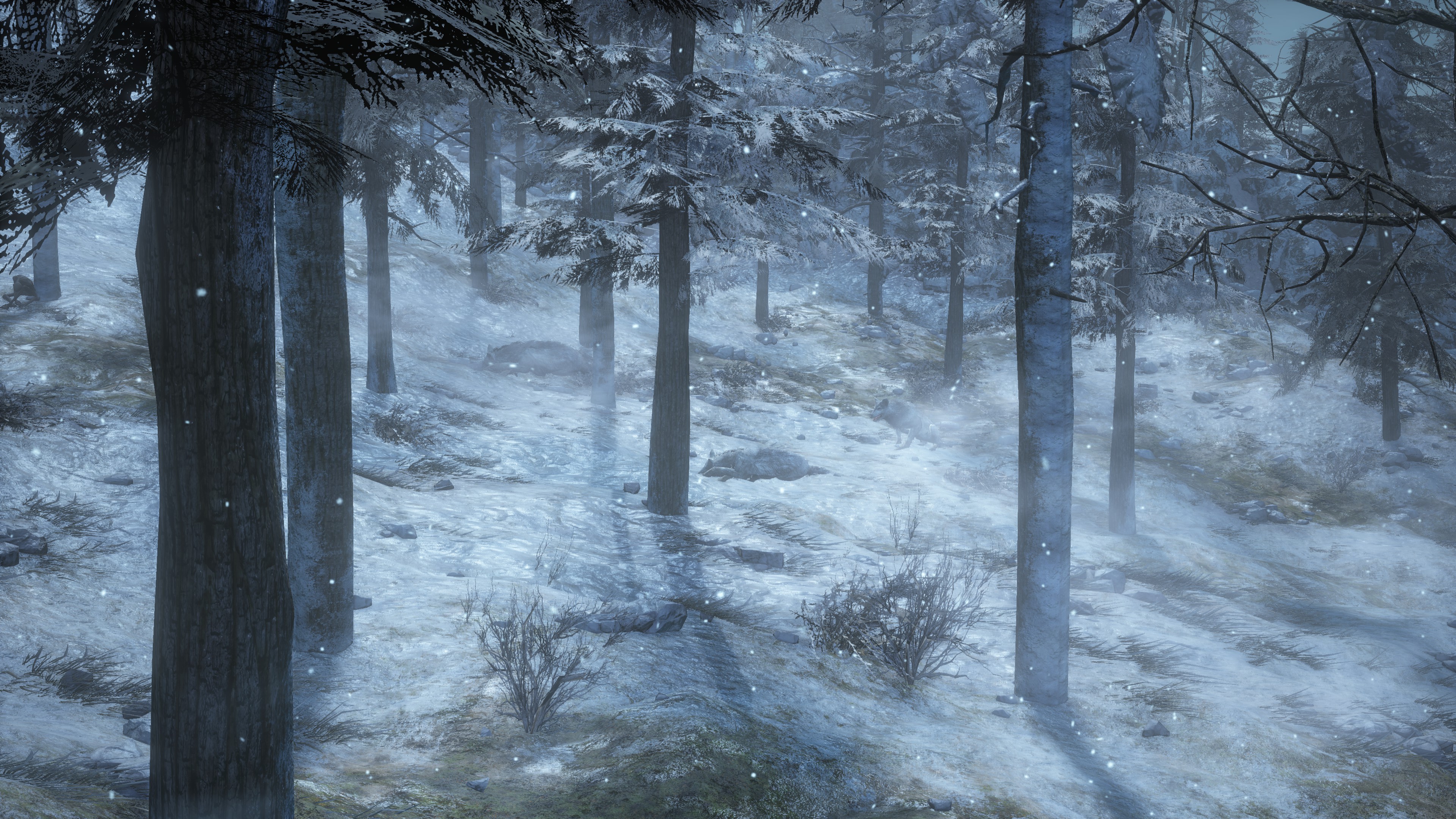
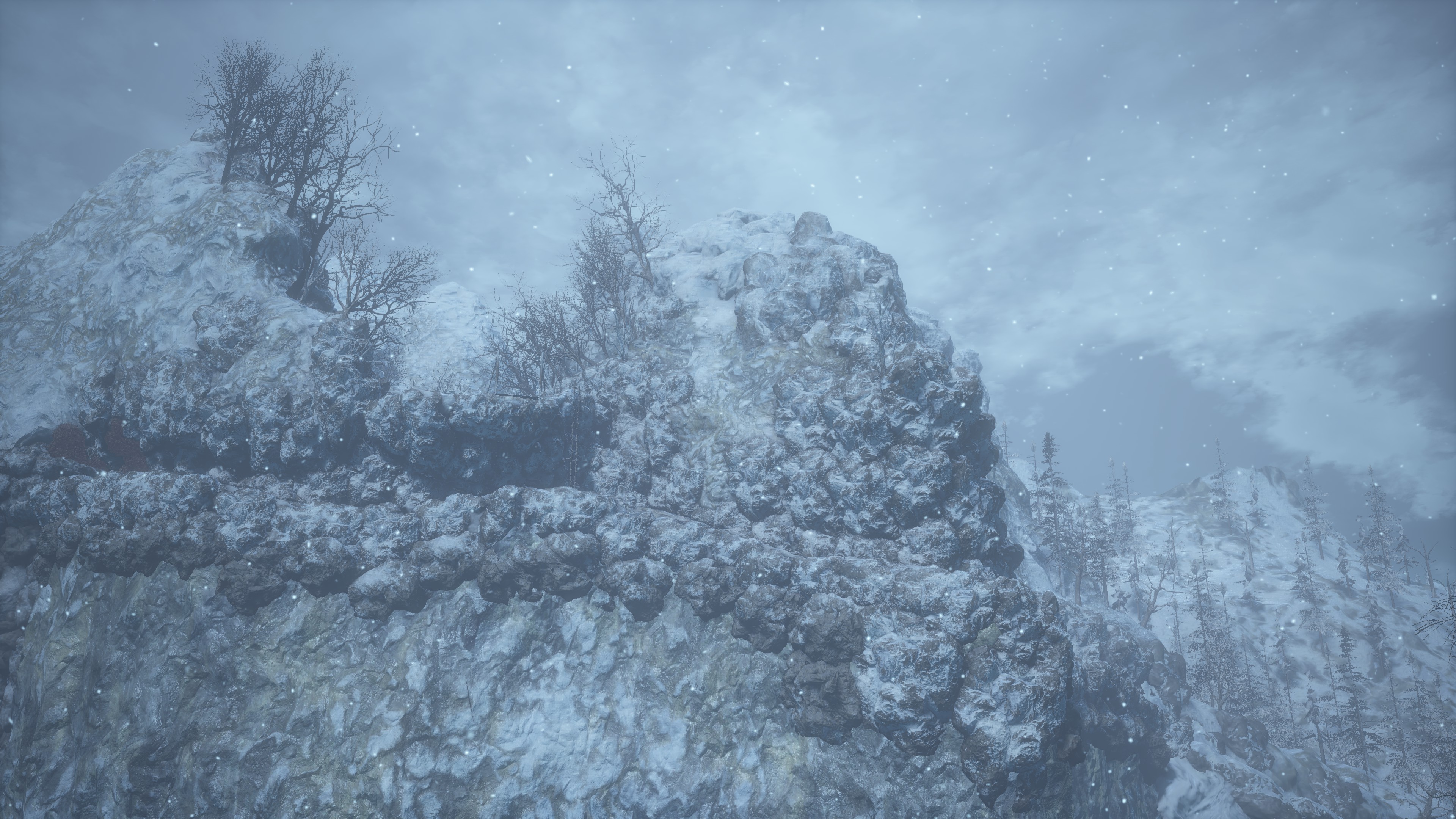
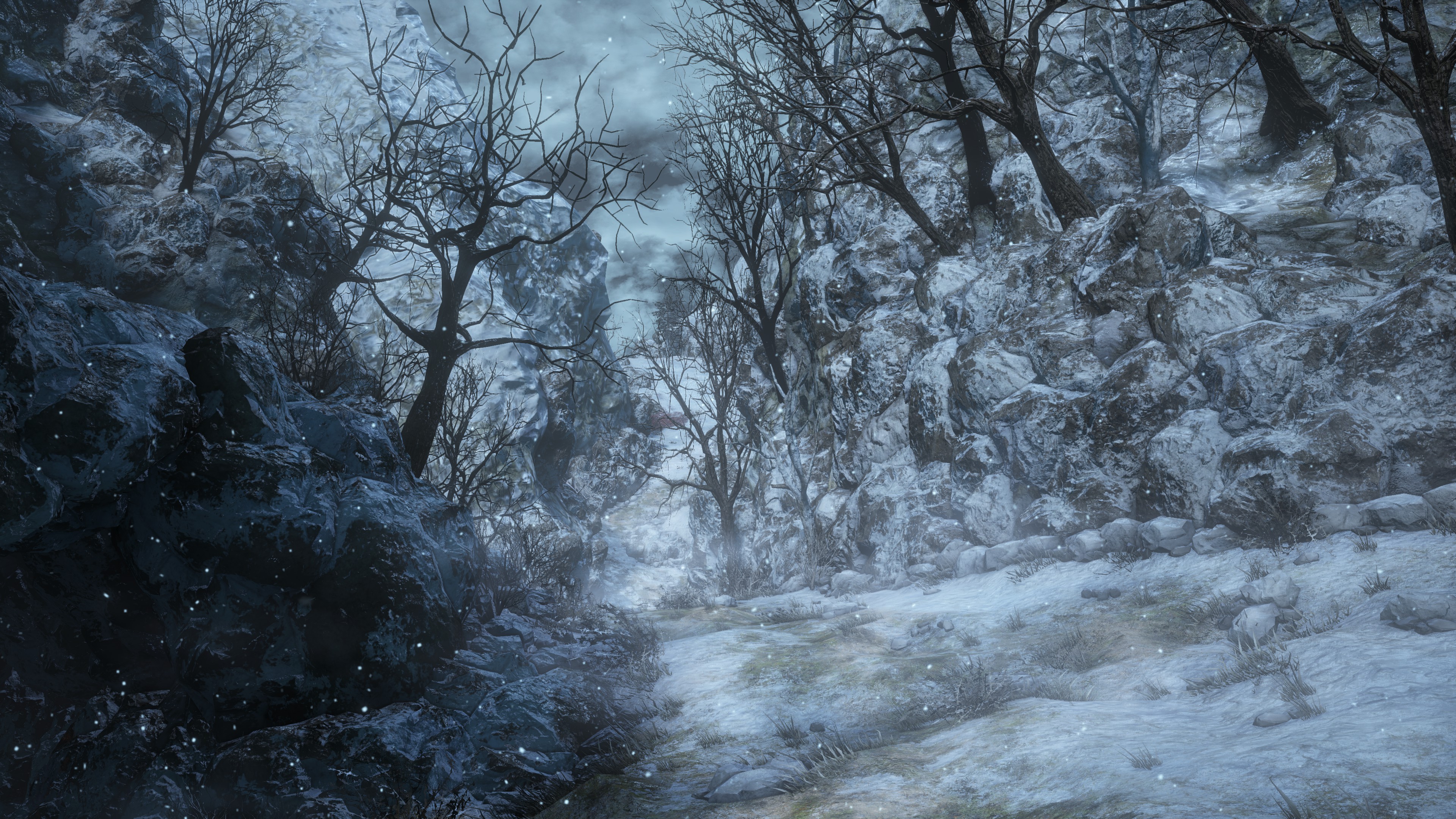
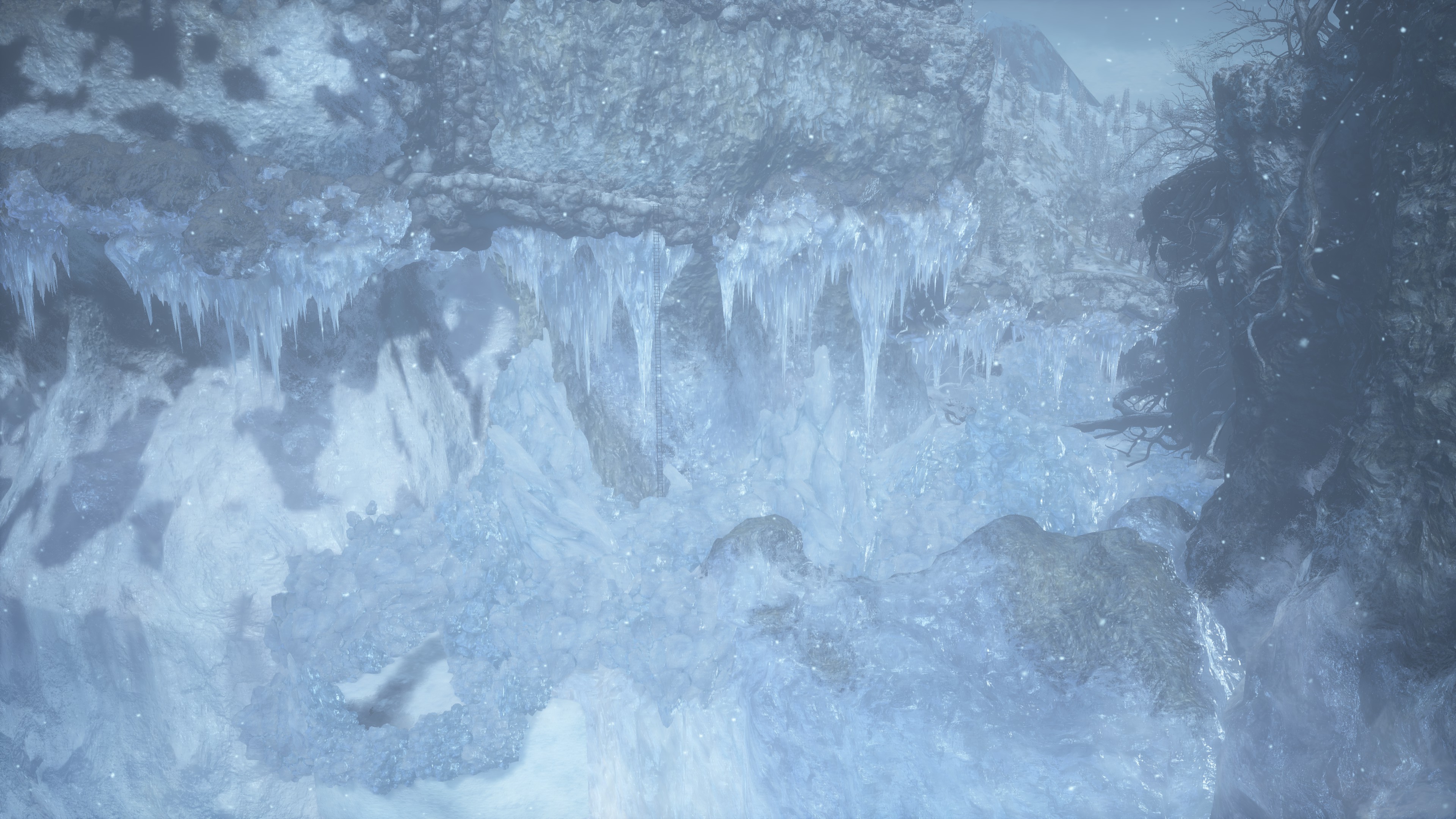


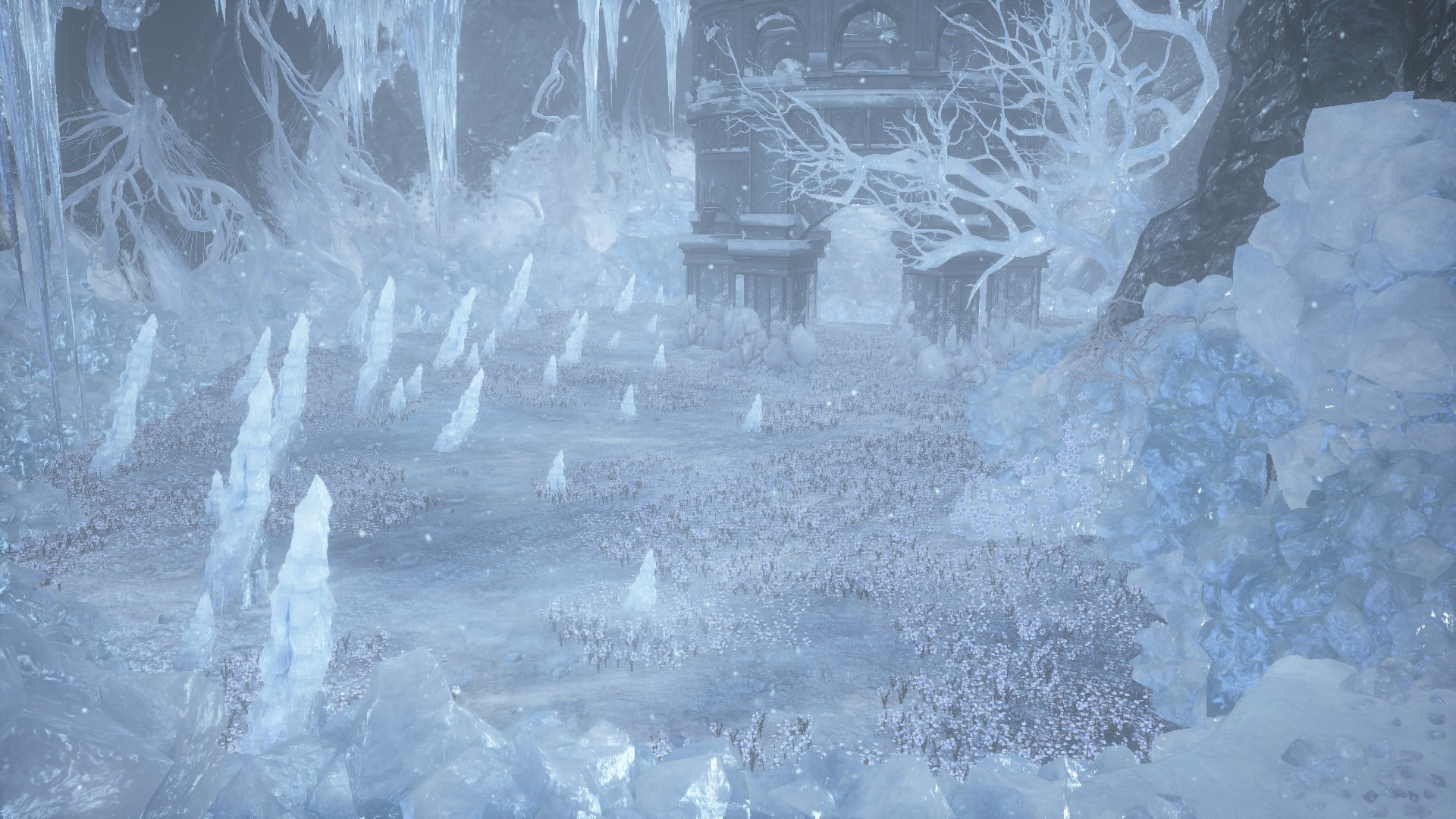


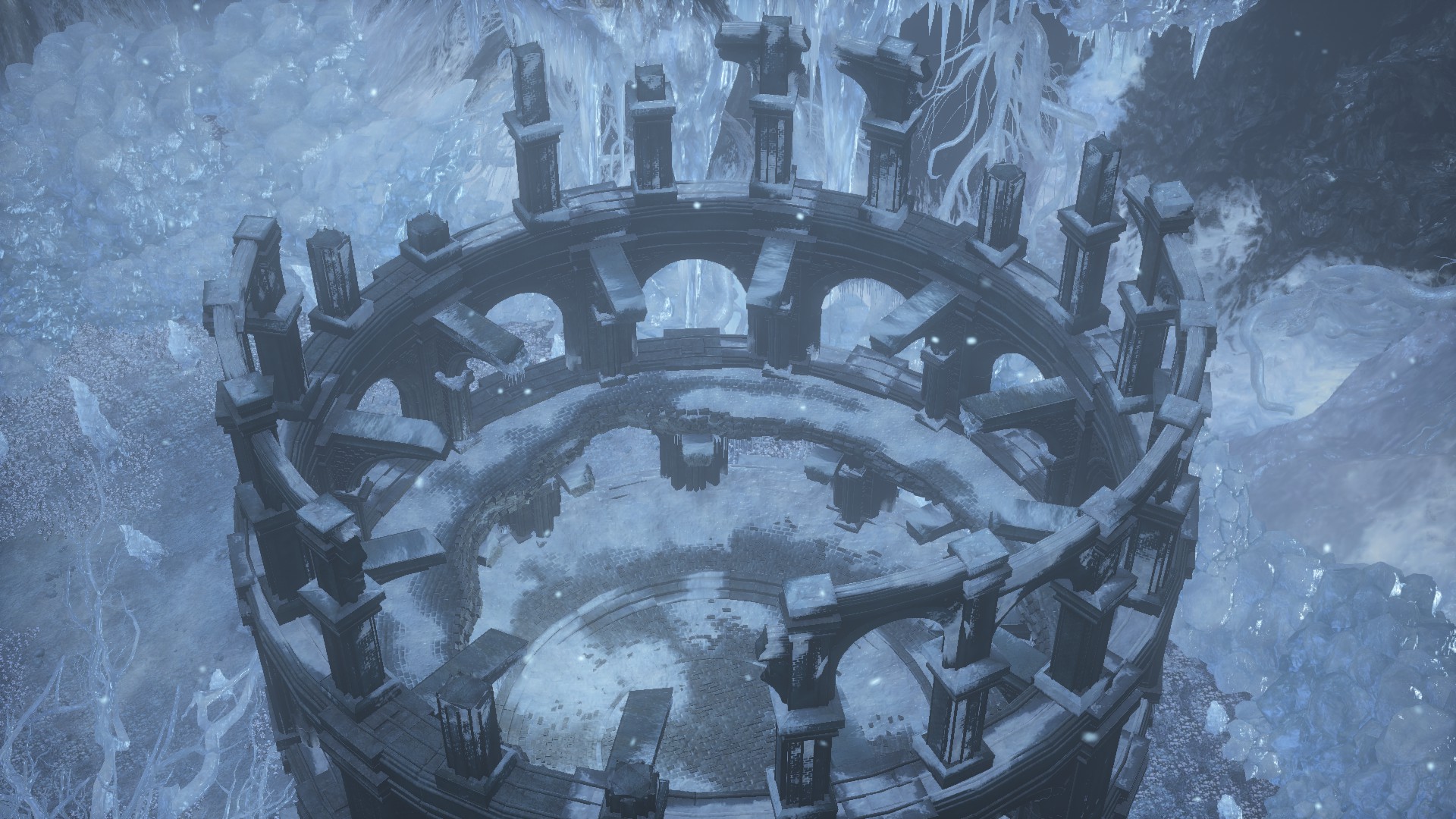


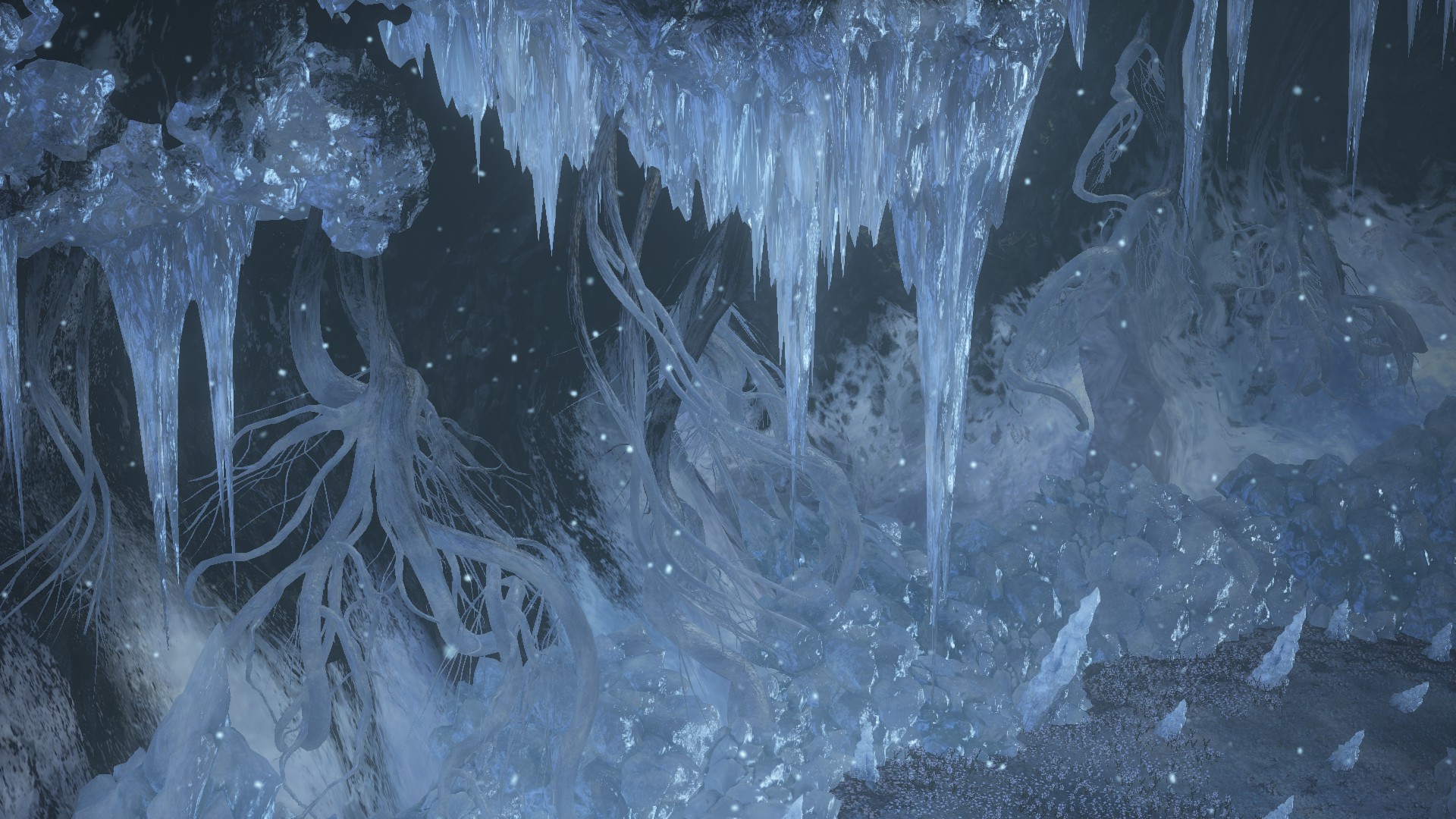

No matter its shape, the painting world is still a transdimensional space using oils on canvas as its medium. Magical power is inherent to the process, hence why the painting doubles as a portal to the dimension. Everything in that world not brought in from the outside is an artificial facsimile of the real thing, indistinguishable to the naked eye but fundamentally of different substance. Put another way, it is similar in concept to illusion magic. only with its presence anchored in a physical medium at the root. As to the magic imbued into that physical paint, DS1 implied Ariamis to be a medial of Anor Londo employing his kind’s power of sunlight. The light of the First Flame, of course, holds dominion over time and thus space, whereas fire has shown the potential to generate various forms of matter as exhibited by pyromancy. Ariandel reinforces these implications with its native wildlife.
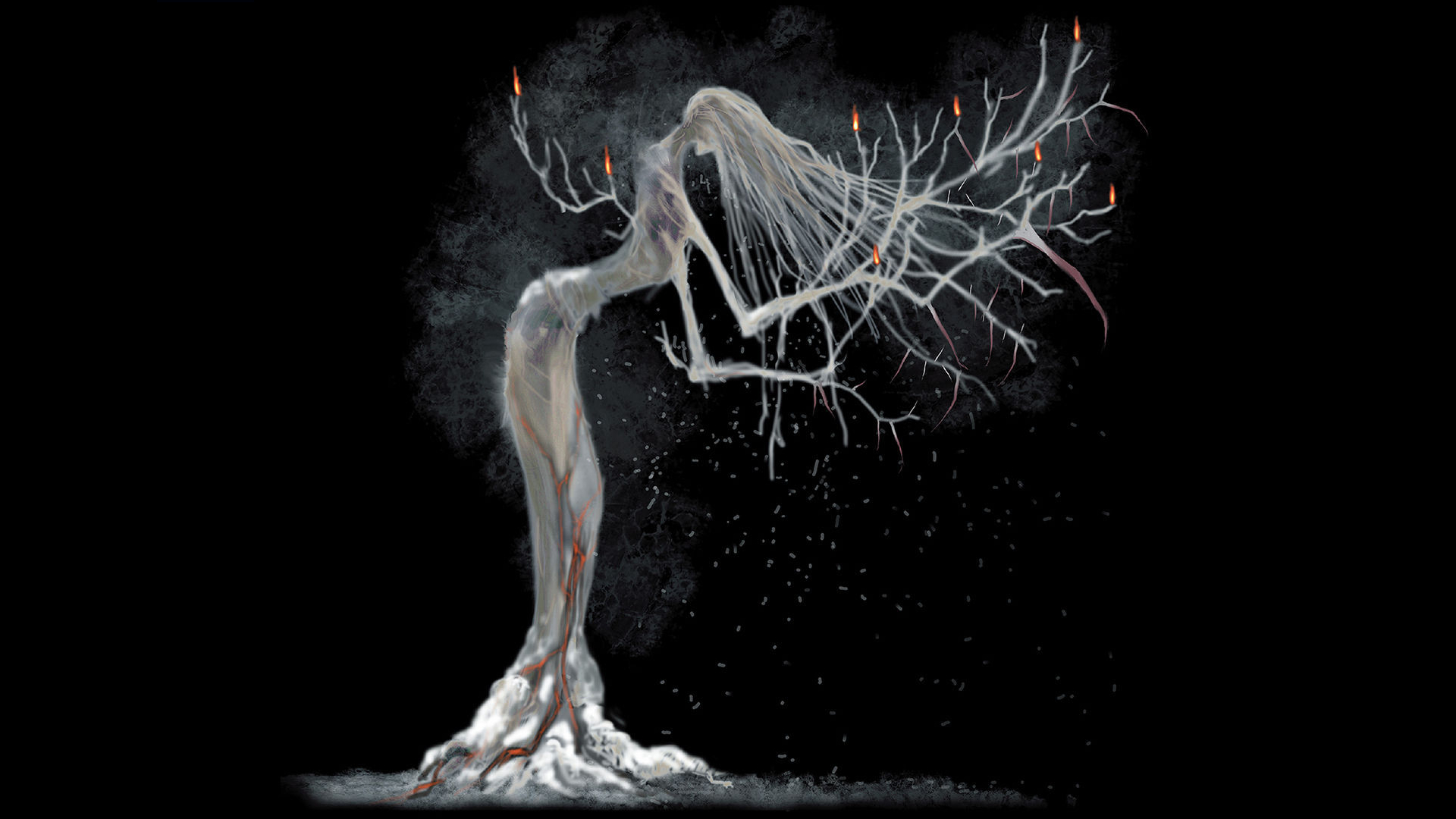
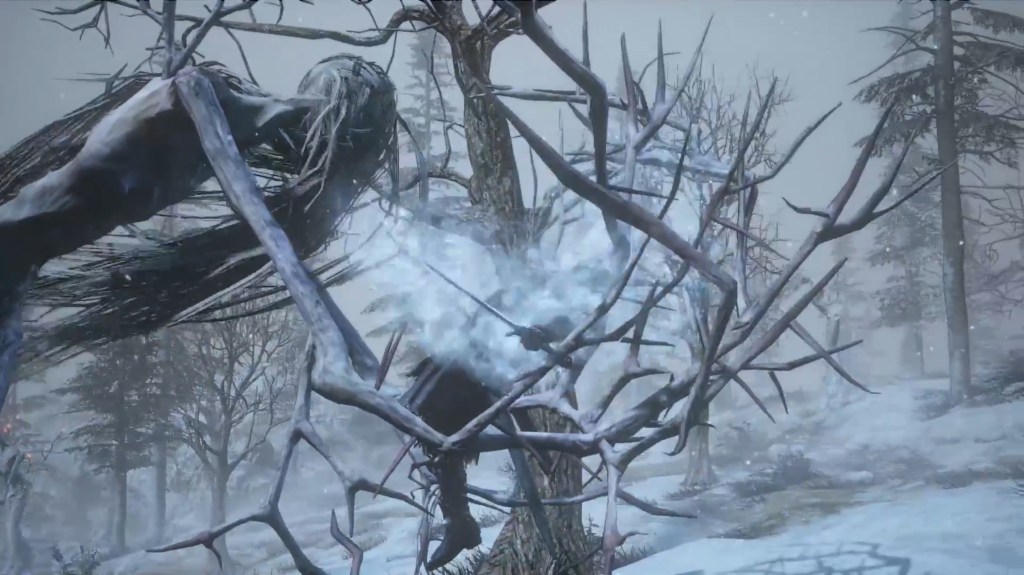
The white tree women dotting the forests are peculiar, not least because some emit fire from the tips of their branches — in fact, they all have the ability to produce these small flames and rain them down on foes. It isn’t as if they are immune to flame either; they have a worse reaction to being burned than any enemy we encounter, human or plant. If fire can still cause them such pain, then the fire they do produce must be quite precisely controlled, which would explain why their rain of fire has such a slow velocity. More than likely, the branch tips release excess heat used to stay warm — their grab attack does prove that they breathe in quite a bit of cold. And where would their bodies be drawing out this fire power except the land where they have taken root? Concept art reaffirms this proposition, depicting streaks of red rising up the bottom from the roots while the tree woman releases flame at the top. Their power of fire is absorbed directly from the world of Ariandel, and we see this manifest in other aspects of their physiology.


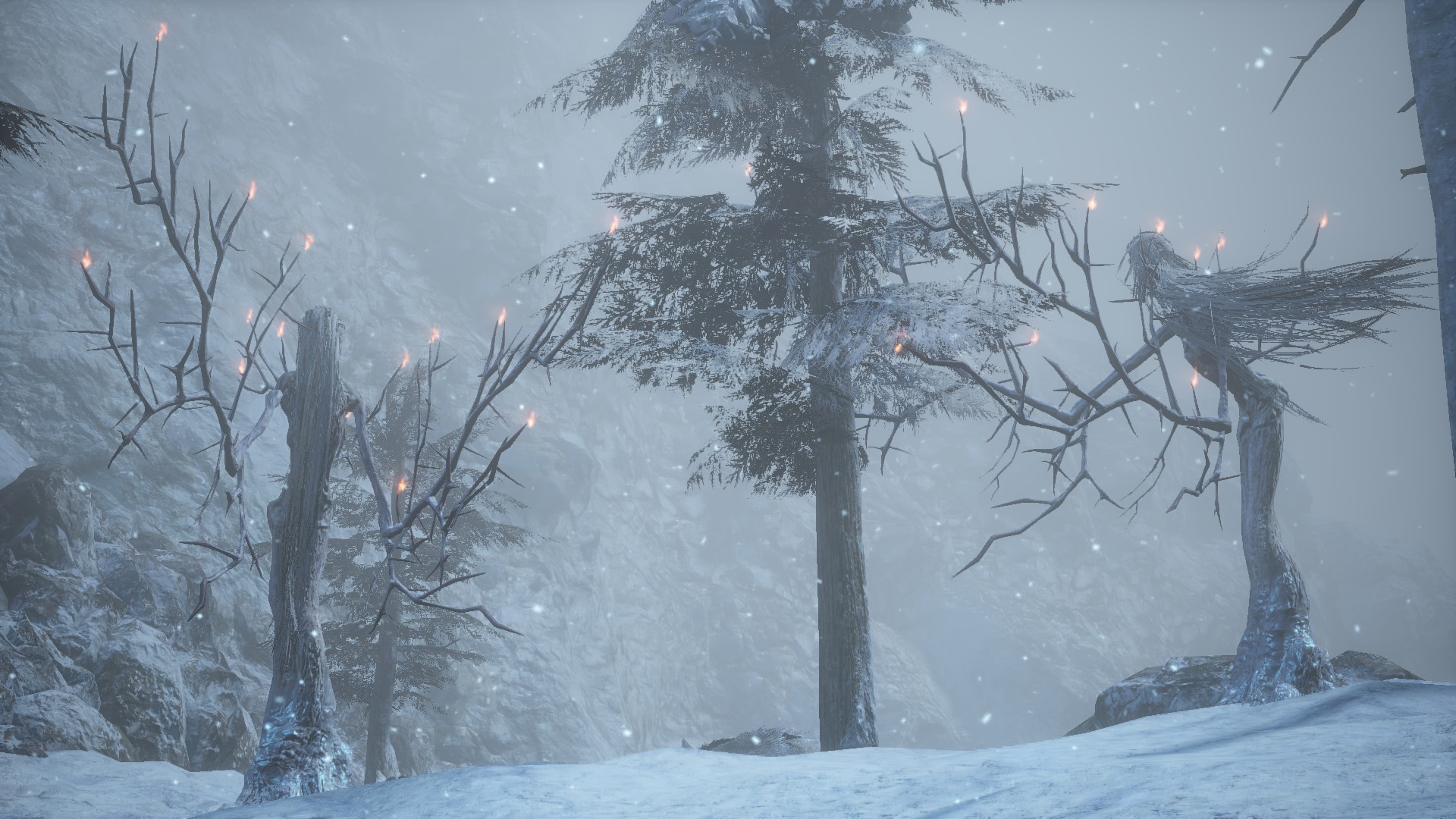


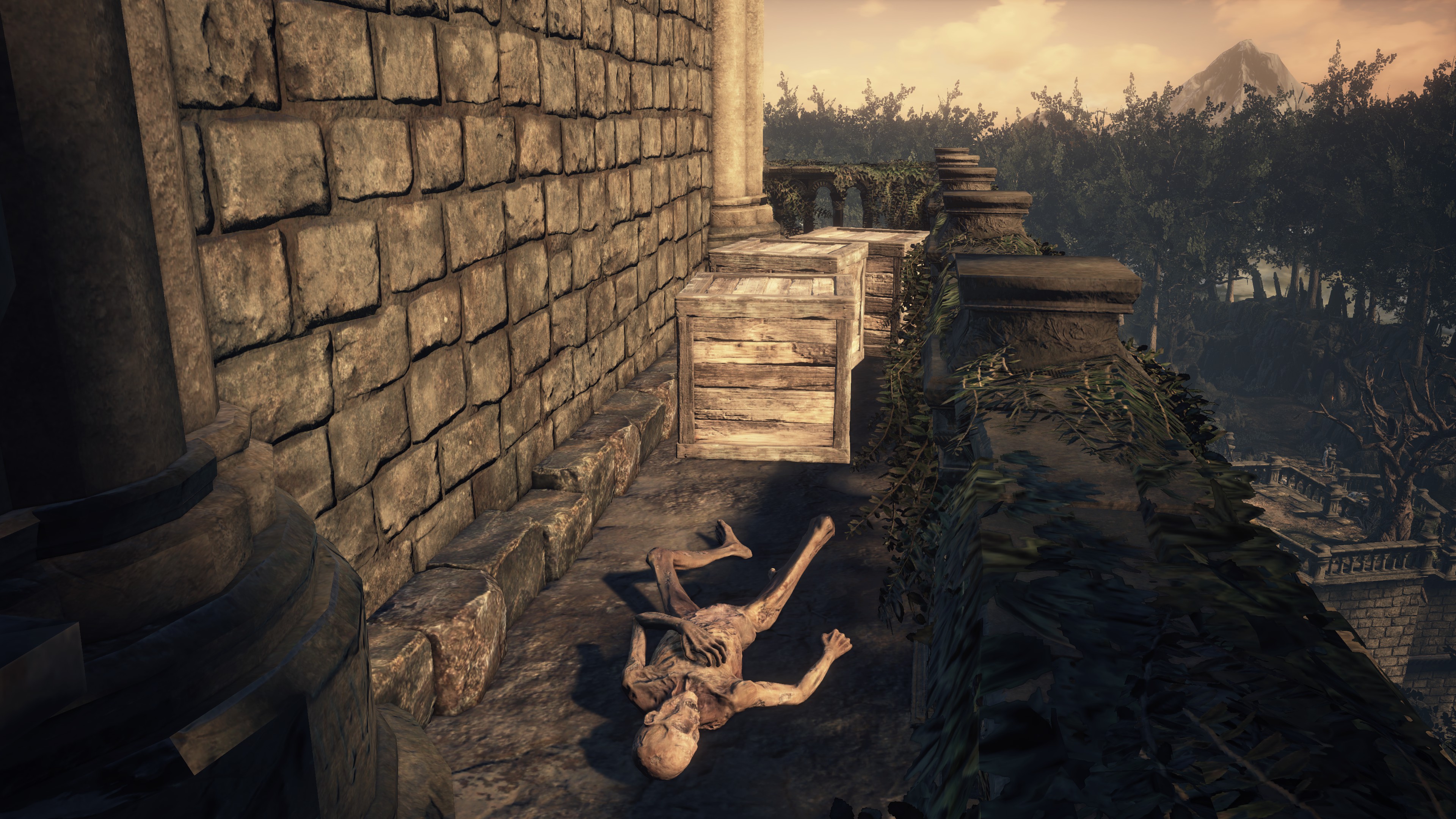
On the crow village library grounds, a group of white tree women surround a corpse carrying a Young White Branch. This item’s text suggests a connection to the white trees used for Oolacilian sorcery staves, hence its mimicry effect akin to Oolacile’s Chameleon spell. But while we do find this branch beneath trees matching that description throughout the game, none of them exist in Ariandel — nor do we find hide or hair of Oocilians present. In short, the odd branch stands out as likely a piece off another white-barked tree: the white tree women surrounding its holder. If the young branch does belong to them, then their unexpected gang-up on this passerby is understandable. Visitors to the library could normally trust at least these trees to stand as mere background scenery, but this is essentially one of their children, to be protected at all costs. And if that “child” came from them, then it implies that they too can manifest the same powers as Oolacilian light sorcery derived from Anor Londo’s sunlight magic; it would explain the similar white bark.
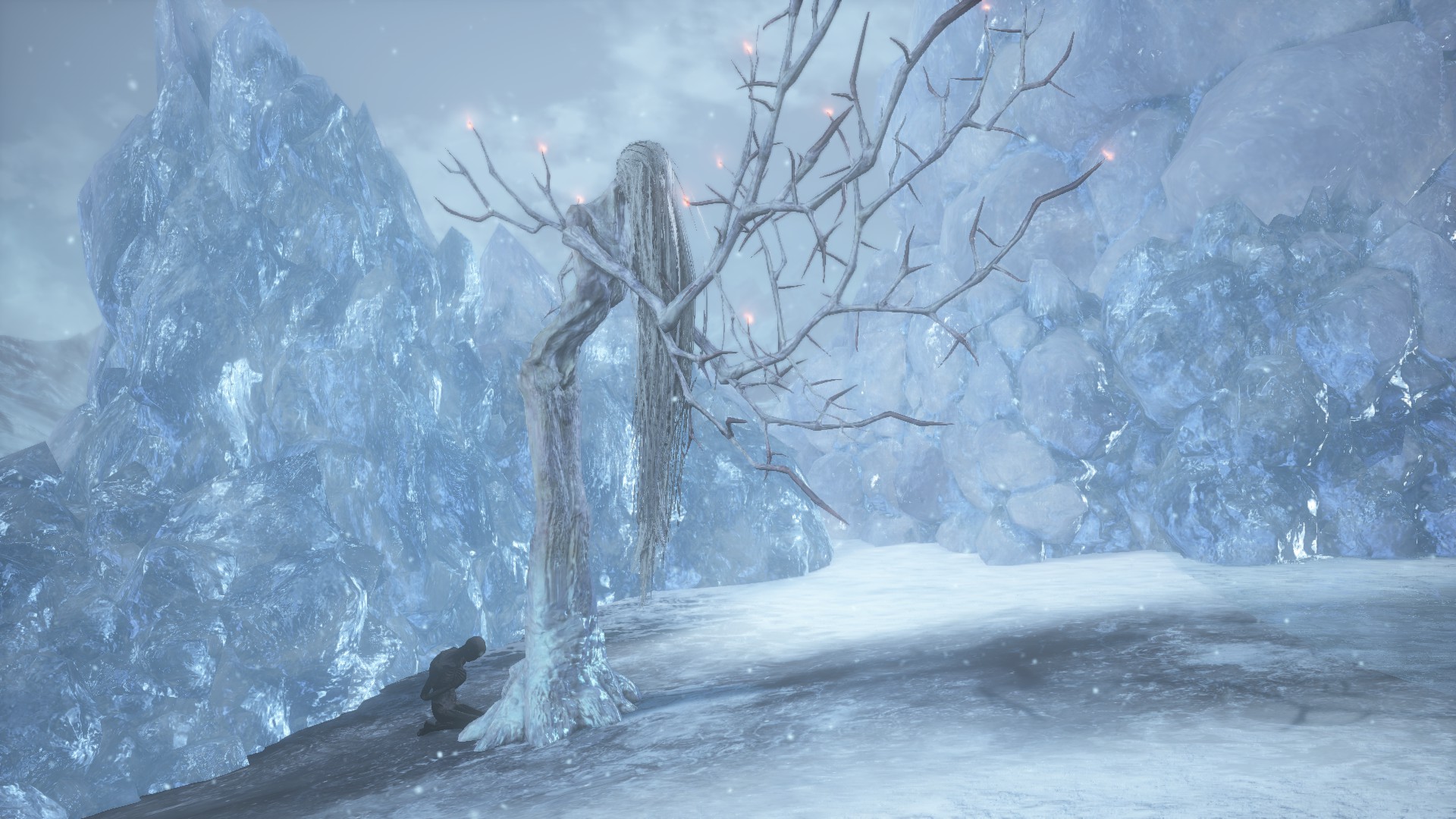
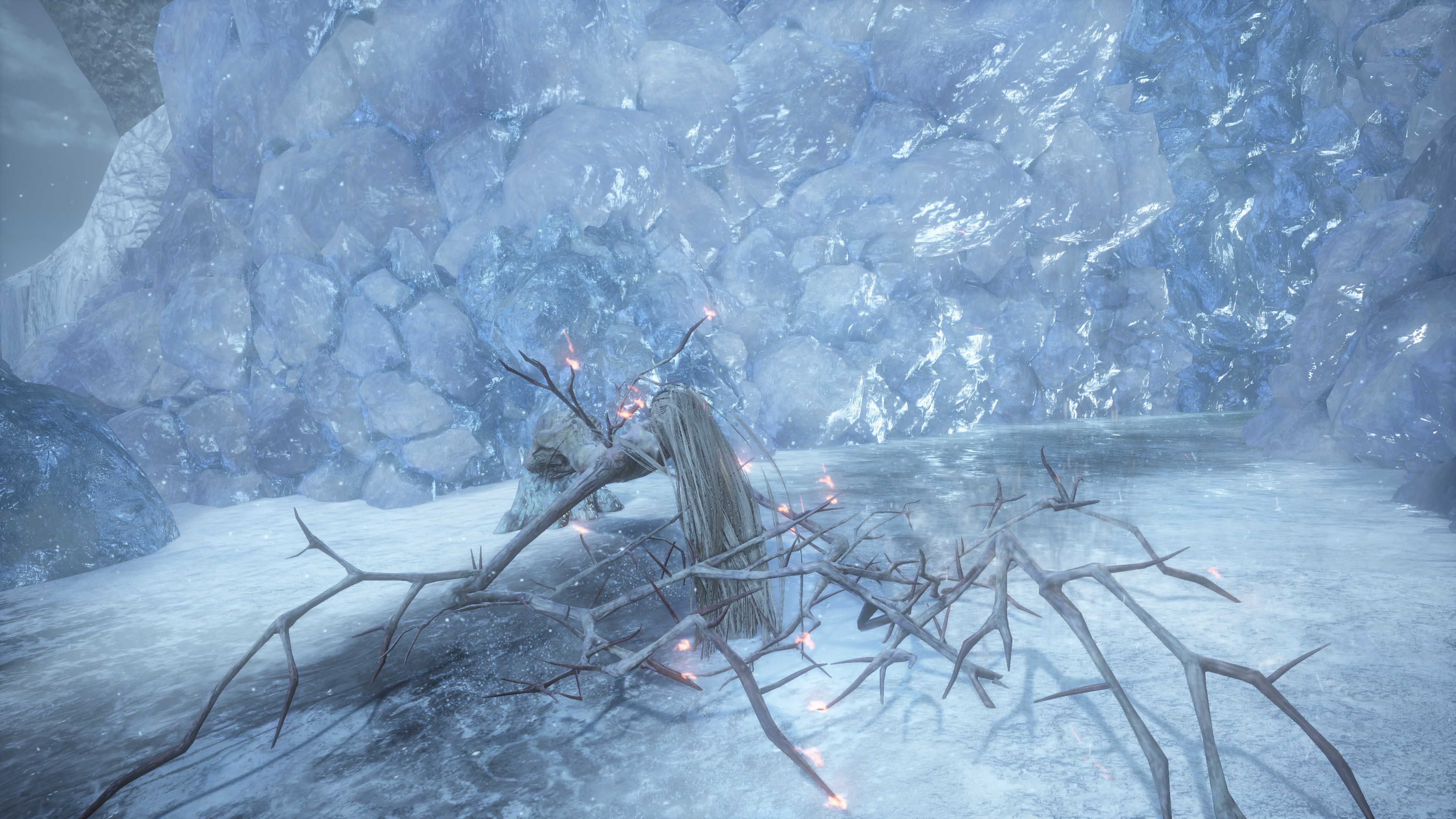
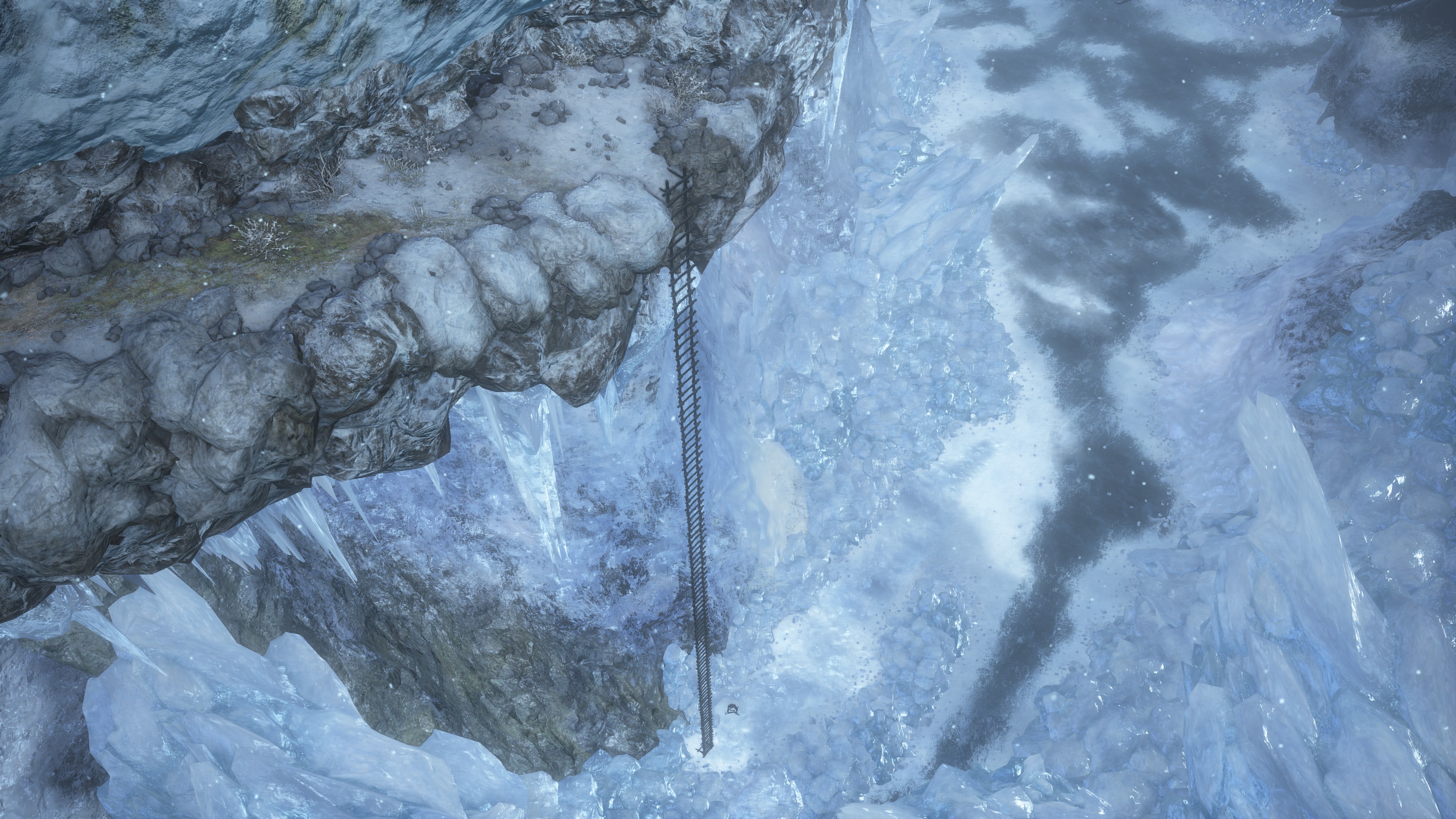
All of this is reaffirmed by one particular tree woman. She cries all by her lonesome in front of a corpse at the waterfall end of the valley river. The reason for the cadaver becomes obvious upon approach when she goes berserk, wildly flailing to the point of crawling after us. Cut dialogue confirms plans for a crying mother to assume us responsible for her missing child. While the mother refers to her child as “he” in English, the Japanese script only uses the gender neutral “you” (貴方) until her death throes, where she instead uses the feminine “you”. (貴女) This makes sense since a tree woman’s child would presumably be another tree woman. But whether or not the loss of a child motivates her tears in the final product, her death is nevertheless revealing. Once the enemy is killed, a ladder out of the valley will fade in with a supernatural sound, indicating that she had cast some sort of magic to hide it from our sight and thereby use — wouldn’t want the child or kidnapper to escape, after all. In other words, she cast an illusion or invisibility spell typically associated with Oolacilian sorcery.
Where have you gone, my dear child… The outside will be cold, will be cold… Where have you gone… I’m here, my dear child. It’ll be cold. Your place to belong is nowhere. Because you’re my dear child after all. So, please, come home.
Please return her! Return her! Where have you hidden her! My dear child! I won’t forgive you! You thief!
The meaning is clear. The tree women have evolved to channel the magic power of their habitat, the light of fire which imbued Ariamis’ paints as he committed them to his vast canvas. But just like fire, oil paints eventually degrade, and the painting needed restoration. That entropy is reflected in the painting world, though it isn’t one-to-one. Gael presents us just a scrap of the once grand canvas, but it is able to draw us into the complete dimension, nonetheless. Rather, the painting’s rot foretells the world’s consumption by fire. The land was created with fire, stabilized through its medium. When that medium is reduced to nothing, either naturally or because the magic power burns through it, what is left for that magic to feed on? Therefore, the fire fuels itself with itself. Much like the First Flame, the power the painting’s flame unleashed becomes its own kindling, which will inevitably burn up the entire space it formed. To prevent that, new medium was added as substitute, resulting in the brand-new world of Ariandel.





A New Coat of Blood
The transition from Ariamis to Ariandel was neither quick nor painless. Dark Souls II (DS2) confirmed that the great painting was among the elements of Lordran brought over to Drangleic thanks to the drift. This was something the residents could not ignore, even sequestered in their dimension. DS1 had already presented them as prisoners who survived their wardens, leaving them truly liberated for the first time since being brought to this world. Now their painting was also stranded in another part of the globe, isolated from any gods; even the guardians keeping the inhabitants in and non-inhabitants out would need to reevaluate their role. What was the path forward in this brave New World? For some, it was reintegration. DS2 established that at least some corvians as well as individuals like Jeremiah entered the lands outside, where they either died or sired new generations who inevitably lost track of their own history. But not everyone followed suit, evidently. Based on the crow village, some of the prisoners chose to rebuild their community within the confines of the painting.
This divide between those unafraid of the outside world and those wishing to remain inside is understandable. Ariamis had become a place to belong for those without one, driven out of mainstream society for one reason or another. Even if this New World was friendlier to their kind than the old one, there was no guarantee that the strangers there wouldn’t eventually manifest the same prejudices — as DS2 revealed, that is exactly what happened. There was definitely a case for staying hunkered down within the painting. At the same time, they couldn’t just hide away behind the canvas forever. Their cold but fiery world would one day burn up, forcing them to find a new home eventually; why not start now? This question could be put off initially, but not indefinitely when the art piece was gradually succumbing to age. But before the remainers need make their decision, Ariandel came in to buy them more time.
The man hunched into a ball was nowhere near the same caliber of artist as Ariamis. Instead of magical paints, he used his blood for the restoration. Recall that blood is the medium of the soul and can possess a similar viscosity as oil. This makes it a viable, if crude, substitute for feeding the flame undergirding the painting world. Ariandel did take some creative liberties with his restoration reshaping the landscape, but his blood gave the painting a new lease on life, regardless — having the piece renamed after himself was no doubt justified. But then, who was Ariandel to step in during its world’s hour of need? Most likely, another inhabitant who was already present and so aware of the art piece’s true nature. He is a corvian, with a black hunchback and talons like the rest, and blood painting for magical ends is consistent with the Bloodshield found at Ariamis in DS1. Ariandel might be that legendary shield’s creator, locked away in the painting along with it to be forgotten for the ominous use of people’s blood. Even if only a student of the actual creator, this rather large corvian assuredly had the expertise to bridge the gap with Ariamis the painter.

Existing within the painting since before the events of DS1 also explains Ariandel’s motive. He loved his new home and would do anything to preserve it. If that meant brushing up on an old taboo like blood magic, so be it. The corvian just didn’t want to let go of their place to belong. Such devotion is made apparent in his present-day vocation as pastor of the new crow village. The denizens all refer to Ariandel as “Father” (教父) in the same sense as the Church Fathers in Christianity, and the Rose of Ariandel derived from his soul doubles as a miracle catalyst. After restoring the painting, the hero to its residents became their spiritual leader, which in all likelihood doubled to serve as the village head. The local parish sits in a fancy fenced enclosure at the back of the settlement on the highest elevation, betraying its paramount importance for the settlers. This is all to be expected, given that religious fervor is central the very nature of a corvian.
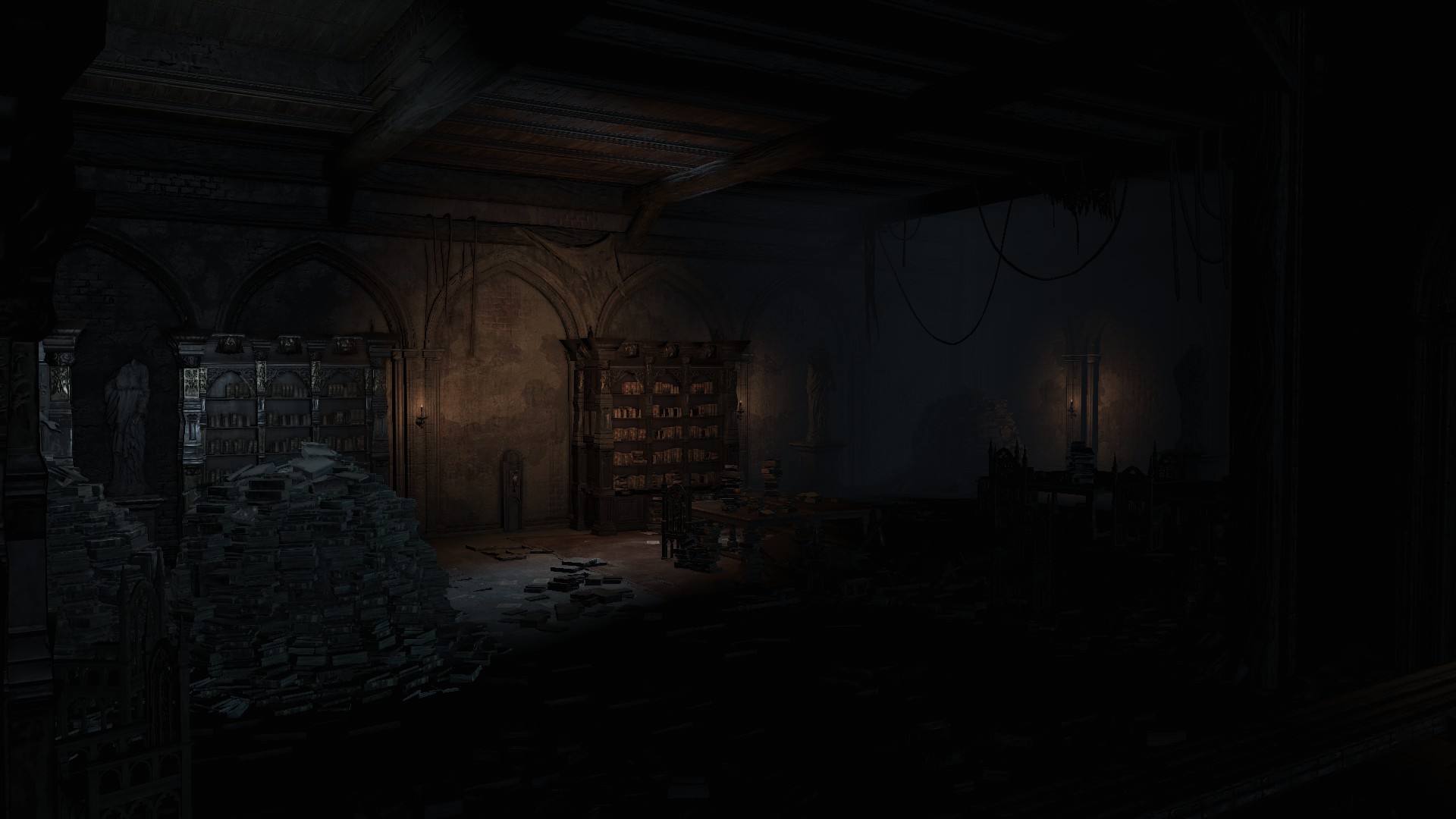
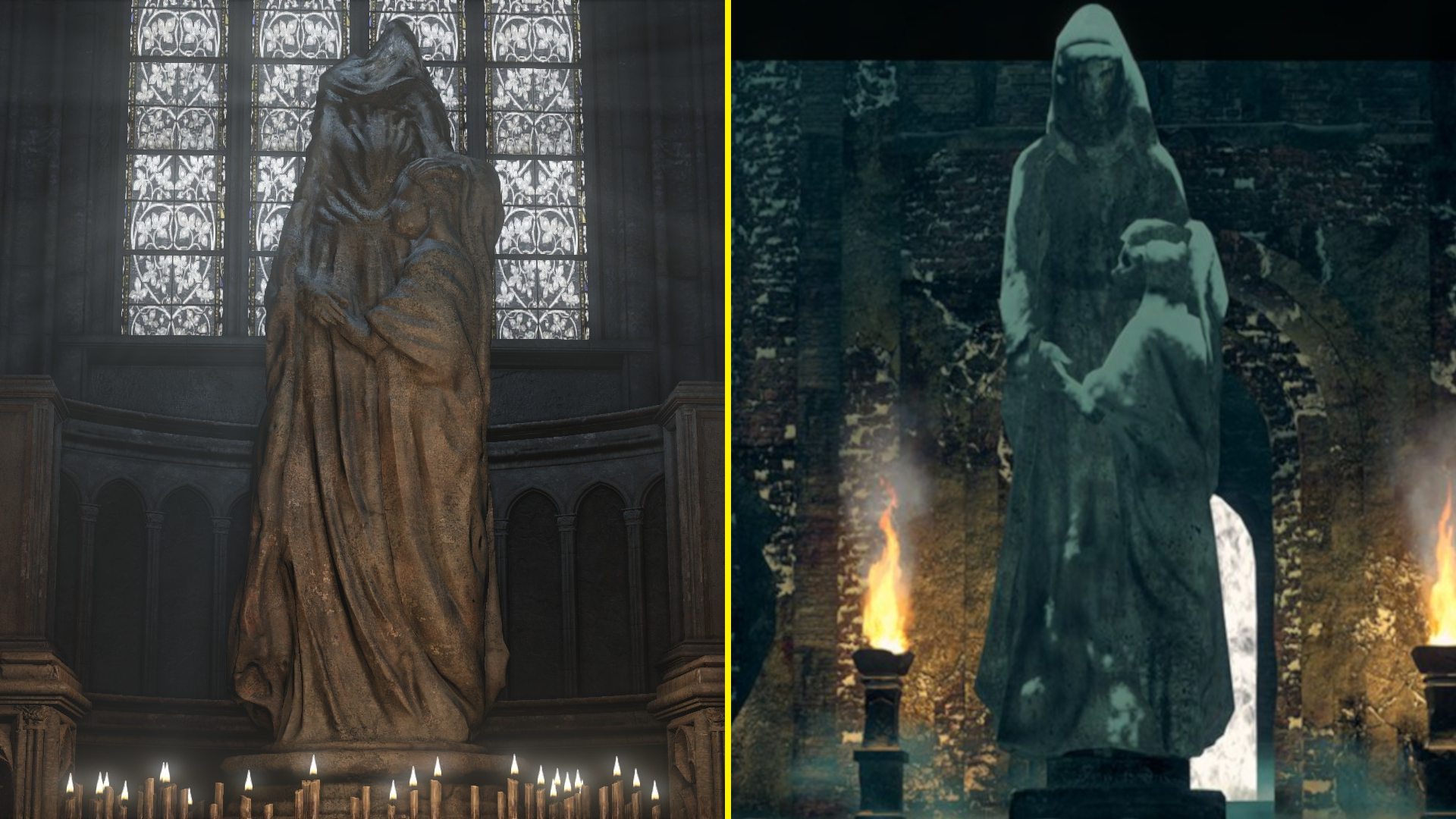
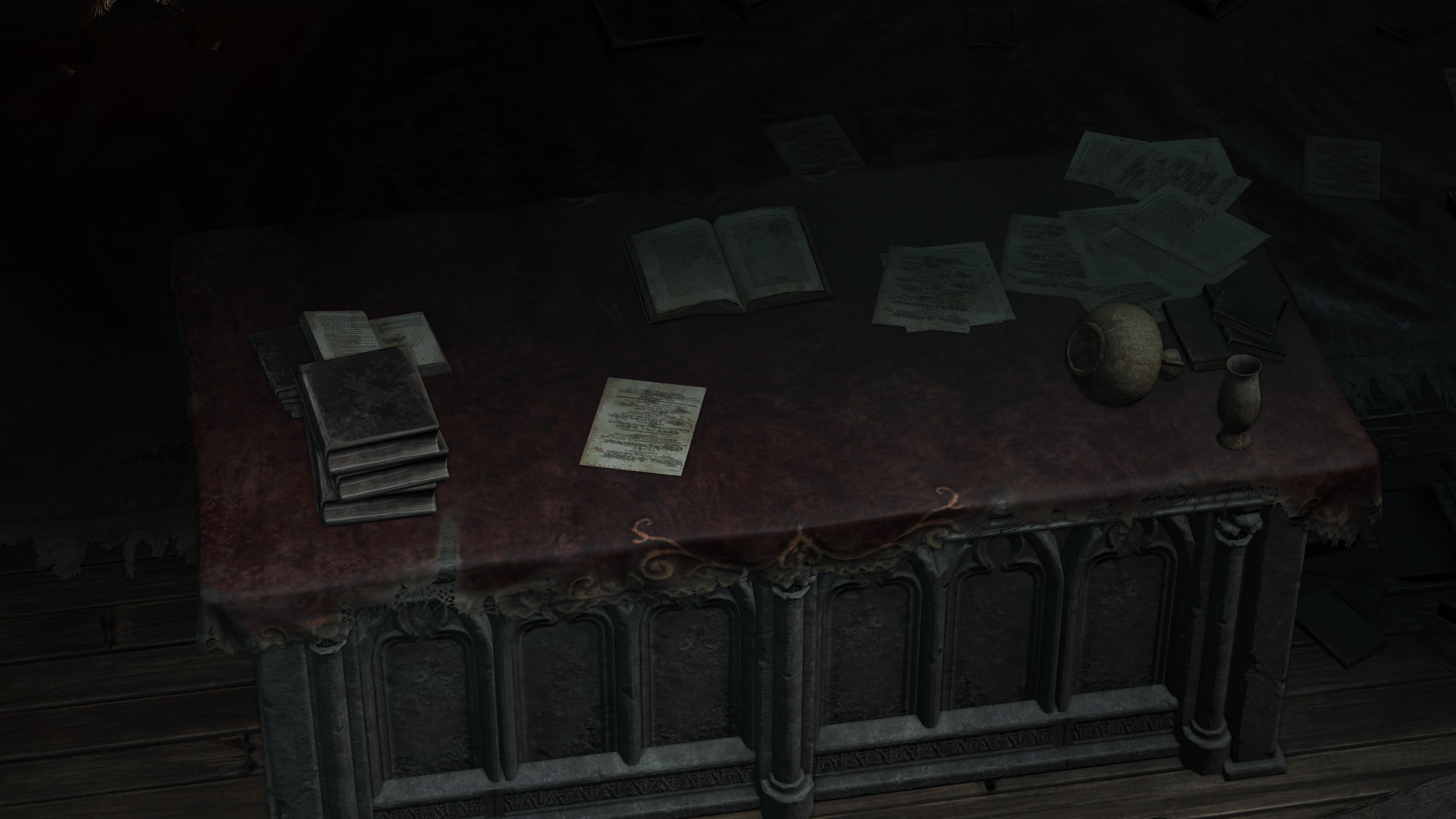
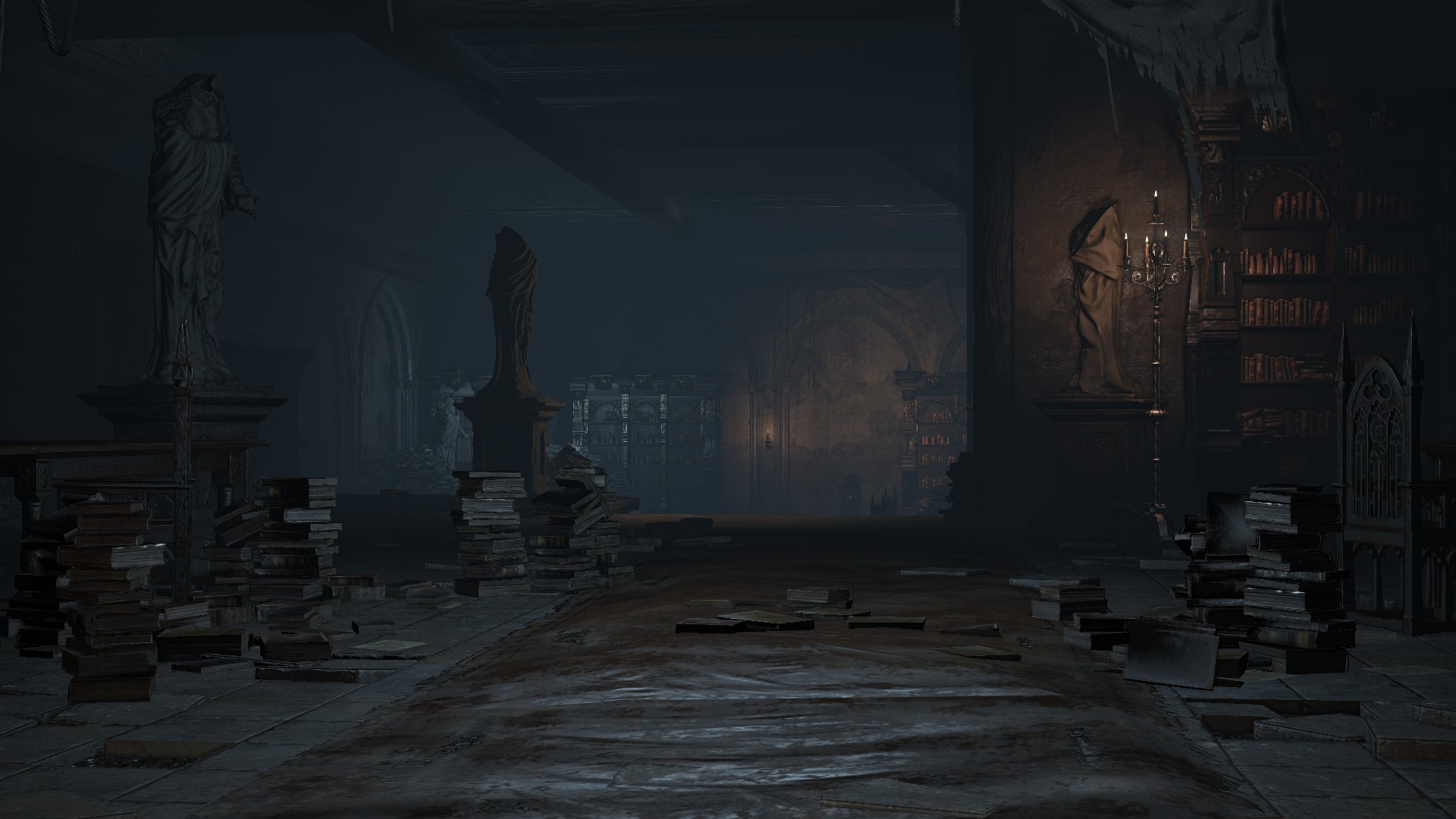
Recall in DS1 that corvians were specifically the crow men of Velka, twisted into their avian forms by their profound reverence for her. The Goddess of Sin oversaw their world as prisoners and continues to inspire their faith. One resident of Ariandel, Gael, prays to a goddess whom he calls a “mother” of the forlorn, or “undesirables”, (忌み者) with “no place to belong” — the same terms used to describe the half-dragon Priscilla in DS1. As added complement, the same statue of Velka with her abominable child erected in Ariamis is enshrined in a chapel in Ariandel, though it has since been defaced. Meanwhile, the village church’s idol is strangely absent from its shrine, though books otherwise cover every element of the pulpit. Ariandel preached not with scripture but treatises, presumably borrowed from the neighboring library. And this archive — receiving the finest furnishings — does enshrine similarly defaced statues. The DLC model reuses assets from areas in Lothric, but the image of a hooded woman welcoming visitors to a place of knowledge befits an intelligent witch like Velka.

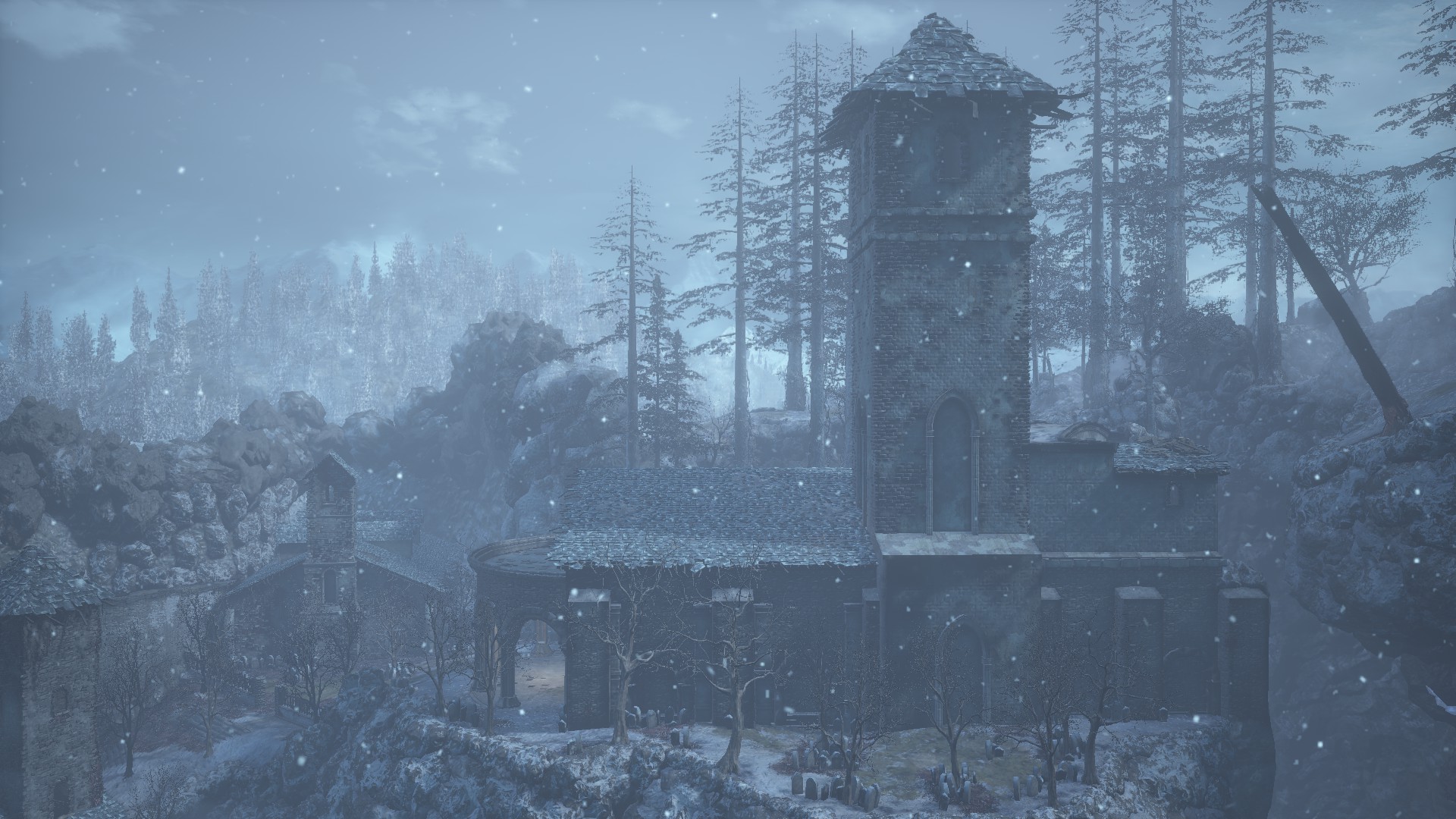
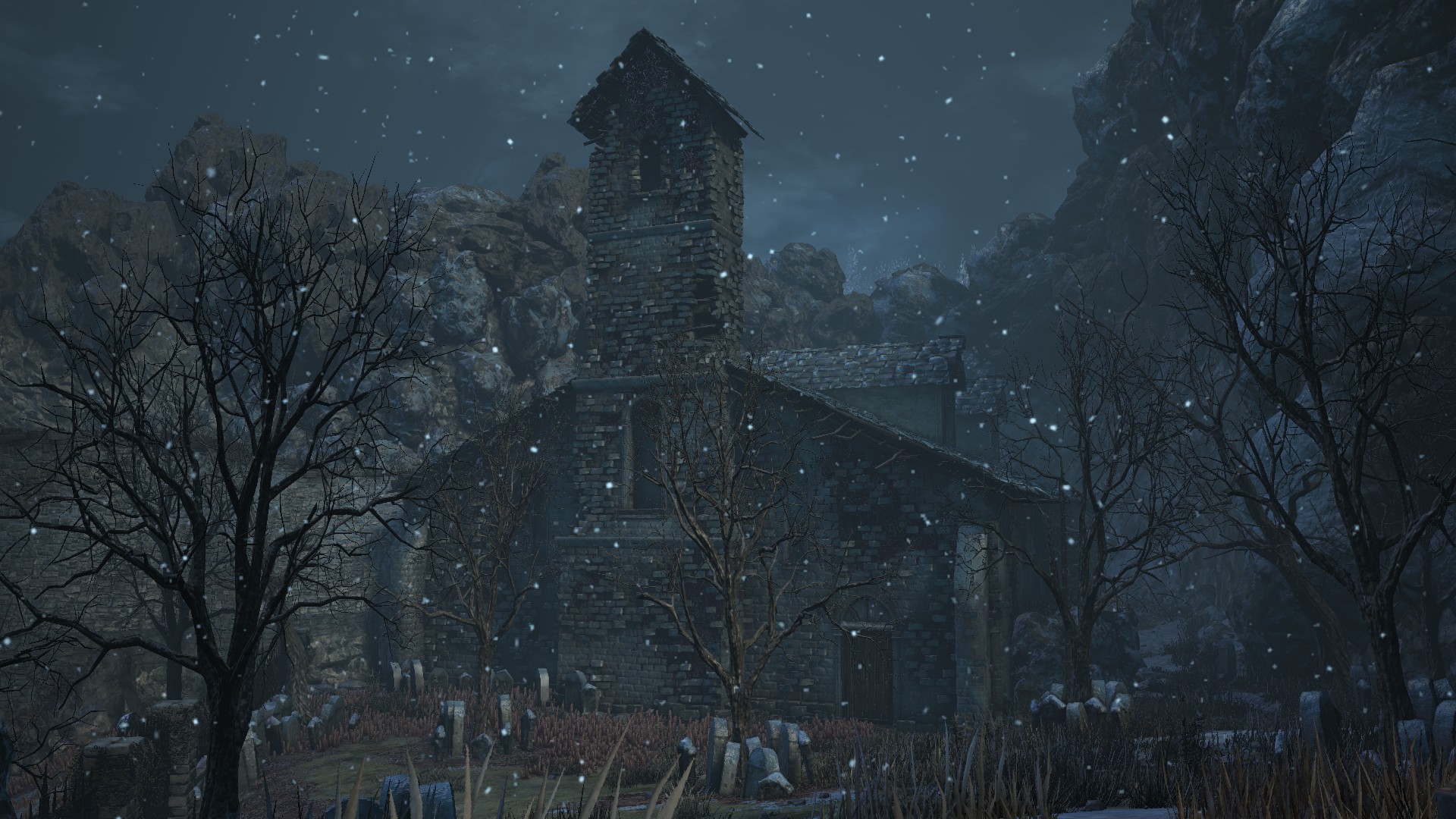

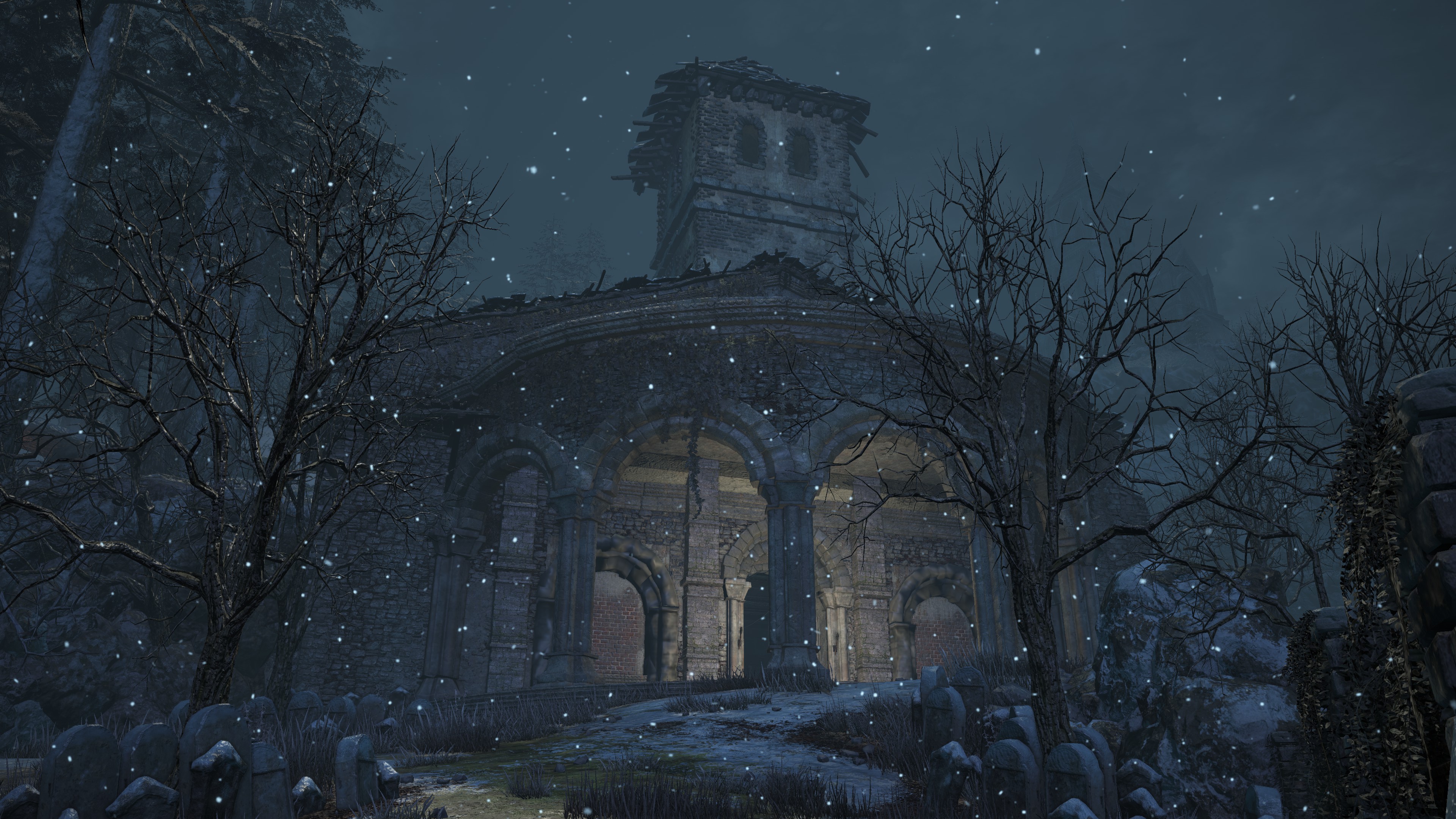






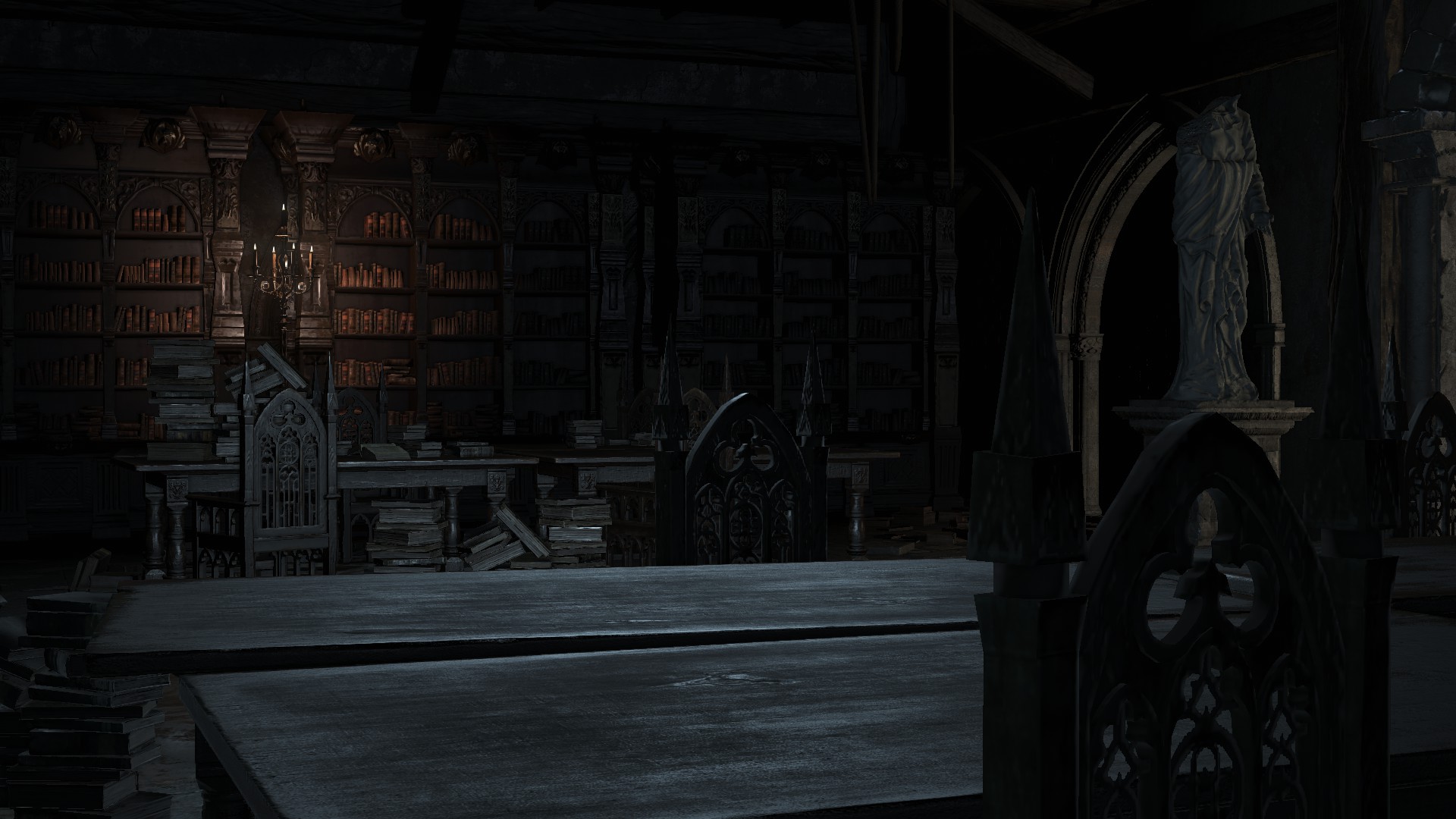
… Oh, goddess. Mother of the undesirables with no place to belong.
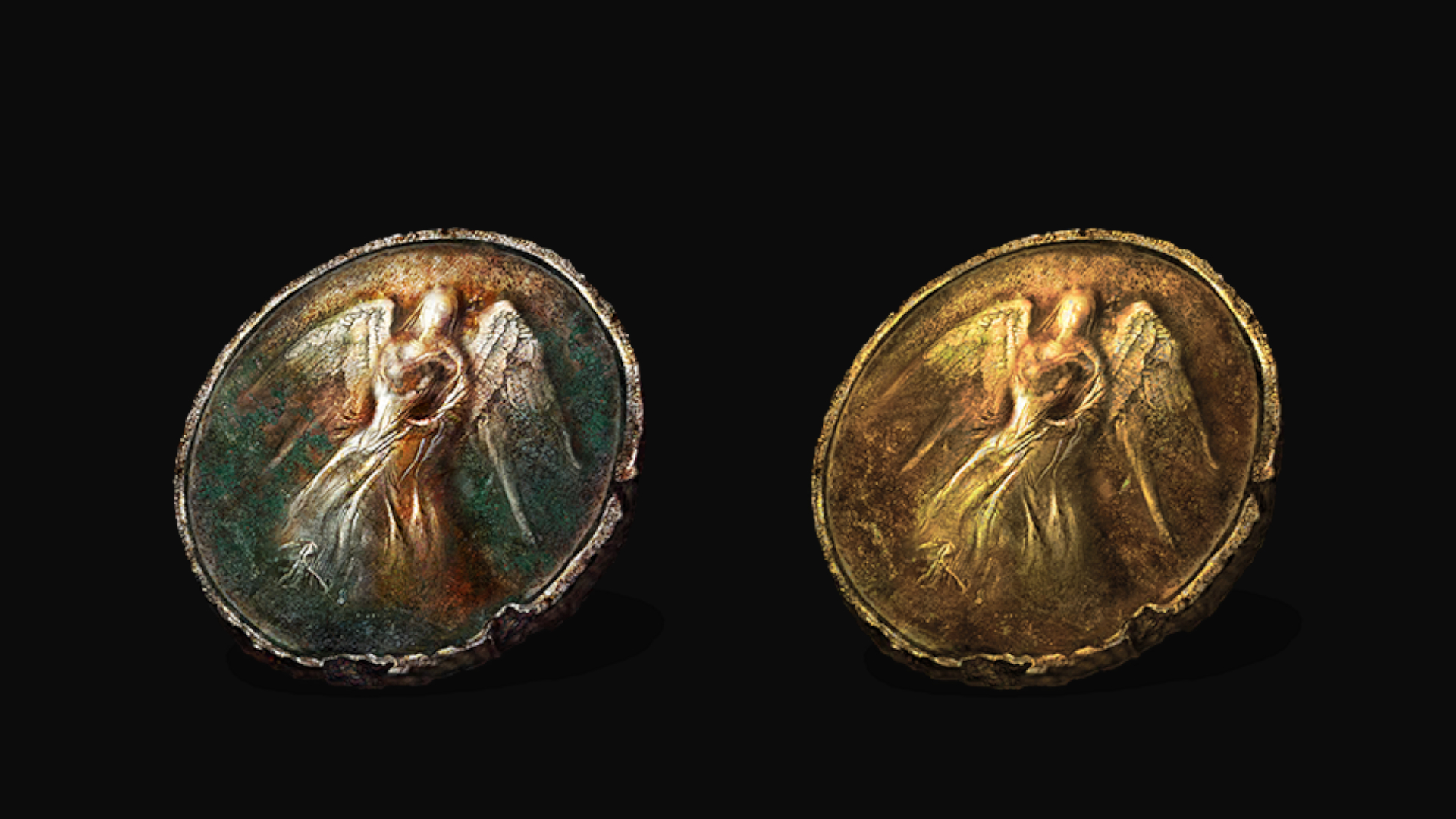
The rusted coin reinforces this impression. This item from Drangleic seems to have been adopted as the regional currency, hence receiving a handful of gold variants as a possible burial gift. But more importantly, the coins still depict the angel identified with Velka in DS2. In fact, many of the corpses carrying this coinage appear to have been placed by the developers with this in mind. The first is found before the dilapidated bridge in the Undead Settlement, which leads directly to a statue of Velka. One more lies after our first clear look at a statue in the Cathedral of the Deep, the same goddess statue Gael prays to in the Cleansing Chapel nearby. A gold one sits in Farron Keep next to a relief of the Four Kings, whose country the god patronized in DS1. For the DLC, the first lies in the middle of the snowfield, the cold painted world which the goddess also presided over. Another lies in the middle of her worshipers’ village, gold coins fittingly enough. And the last sits outside the library where those statues of “Velka” stand. Judging by the pattern, these locations are a playful nod by the developers to the angel’s subtle connections.
Admittedly, there are a lack of miracles related to the goddess inside the painting. Certain corvians in the village do perform simplified versions of Soul Arrow and Homing Soulmass with meager twigs, doubtless self-taught using the library’s resources. But if Velka was central to their collection of knowledge, why are we seeing sorcery and not her actual works? The obvious answer is because all her actual priests inside Ariamis had perished, leaving none to carry that torch in Ariandel. And while Velka and her followers aren’t allergic to miracles and faith-based magic, her sphere emphasizes knowledge and so lends itself to arts which require intelligence to cast. We already saw this with the sorcerers in New Londo religion, so it isn’t surprising to see the same pattern develop among an eclectic group united only by dedication to the witch goddess. Without pardoners to guide them, the painting’s inhabitants have created their own traditions, following in Velka’s footsteps if not her miraculous tales.


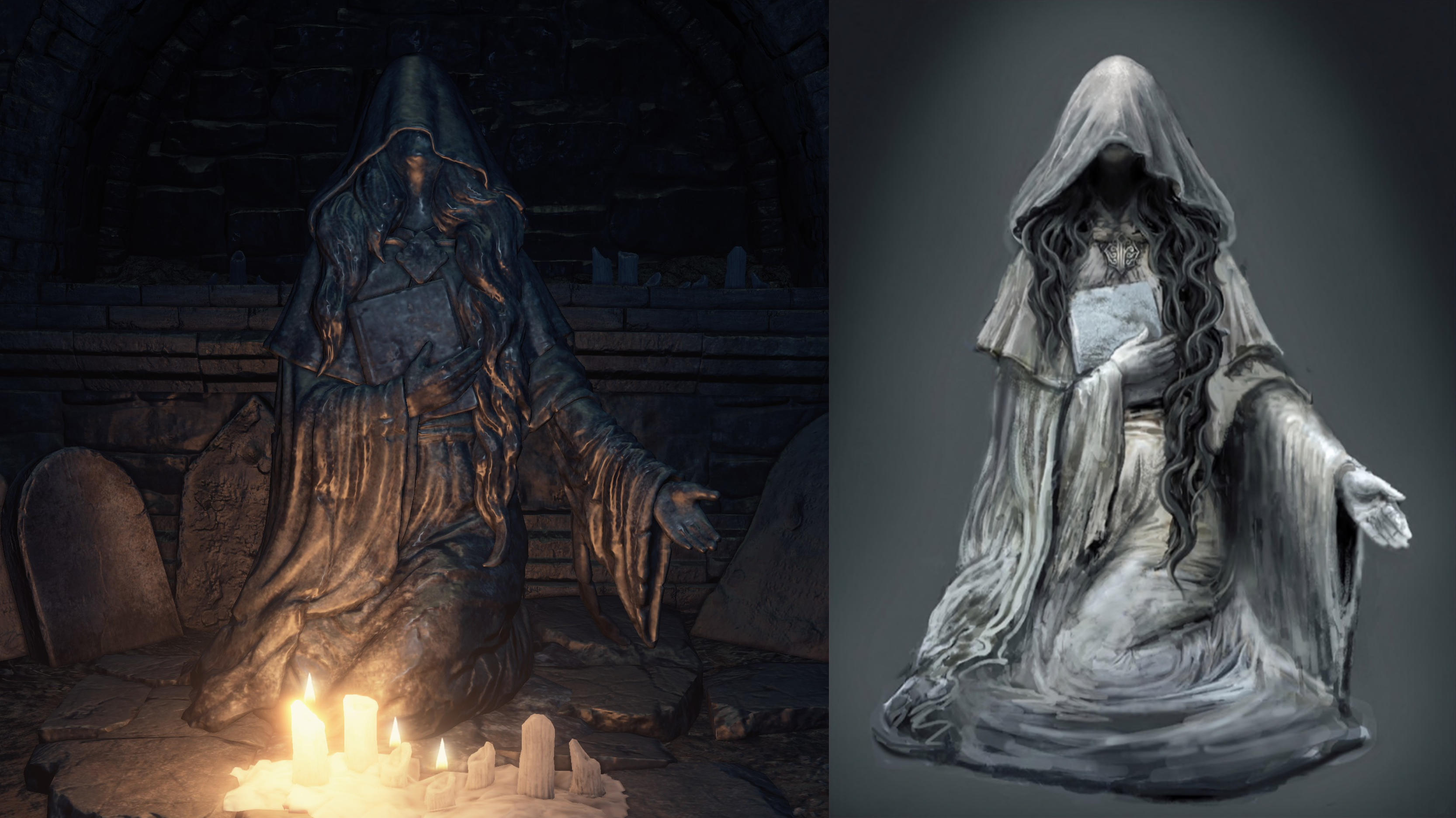

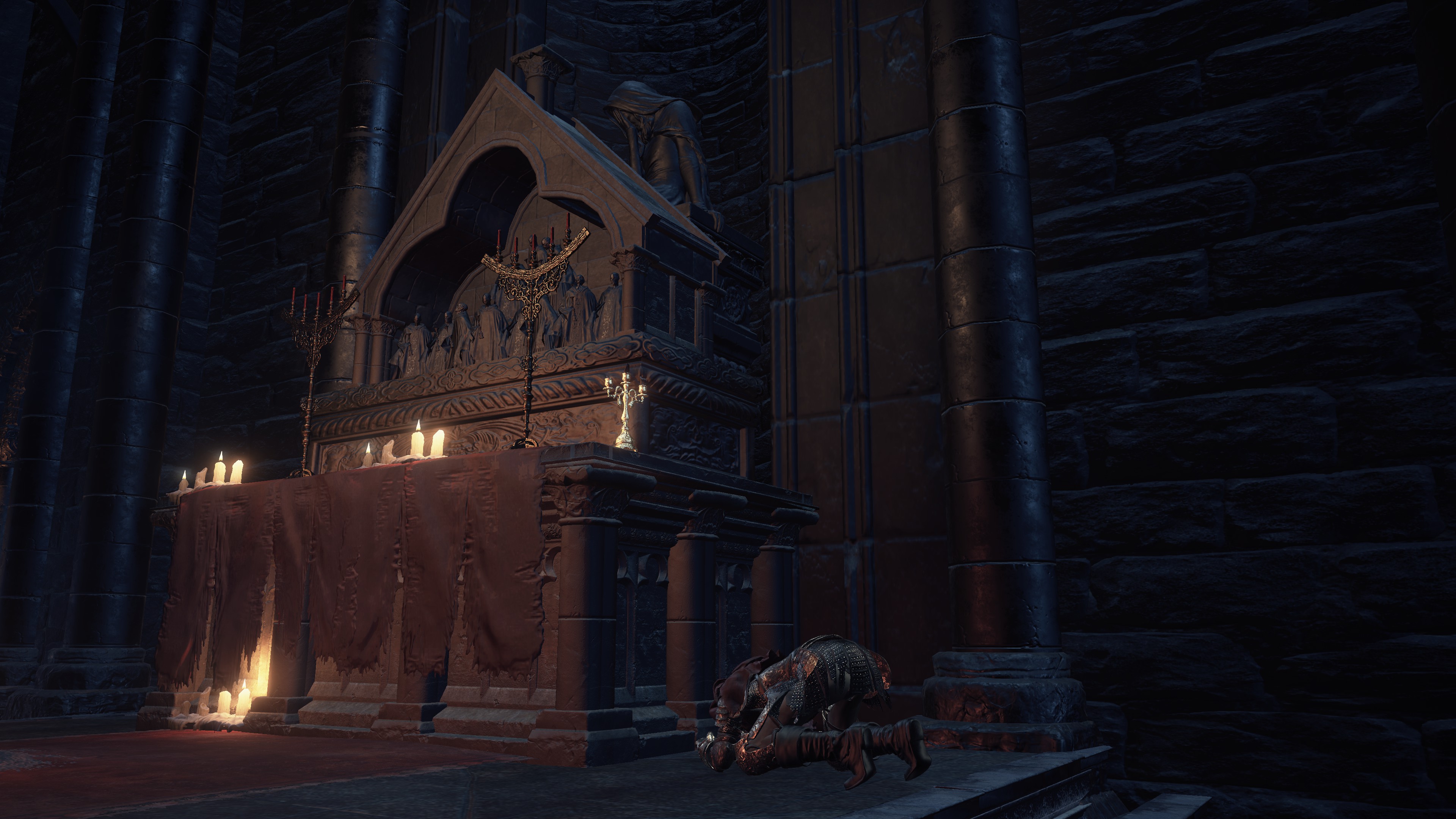
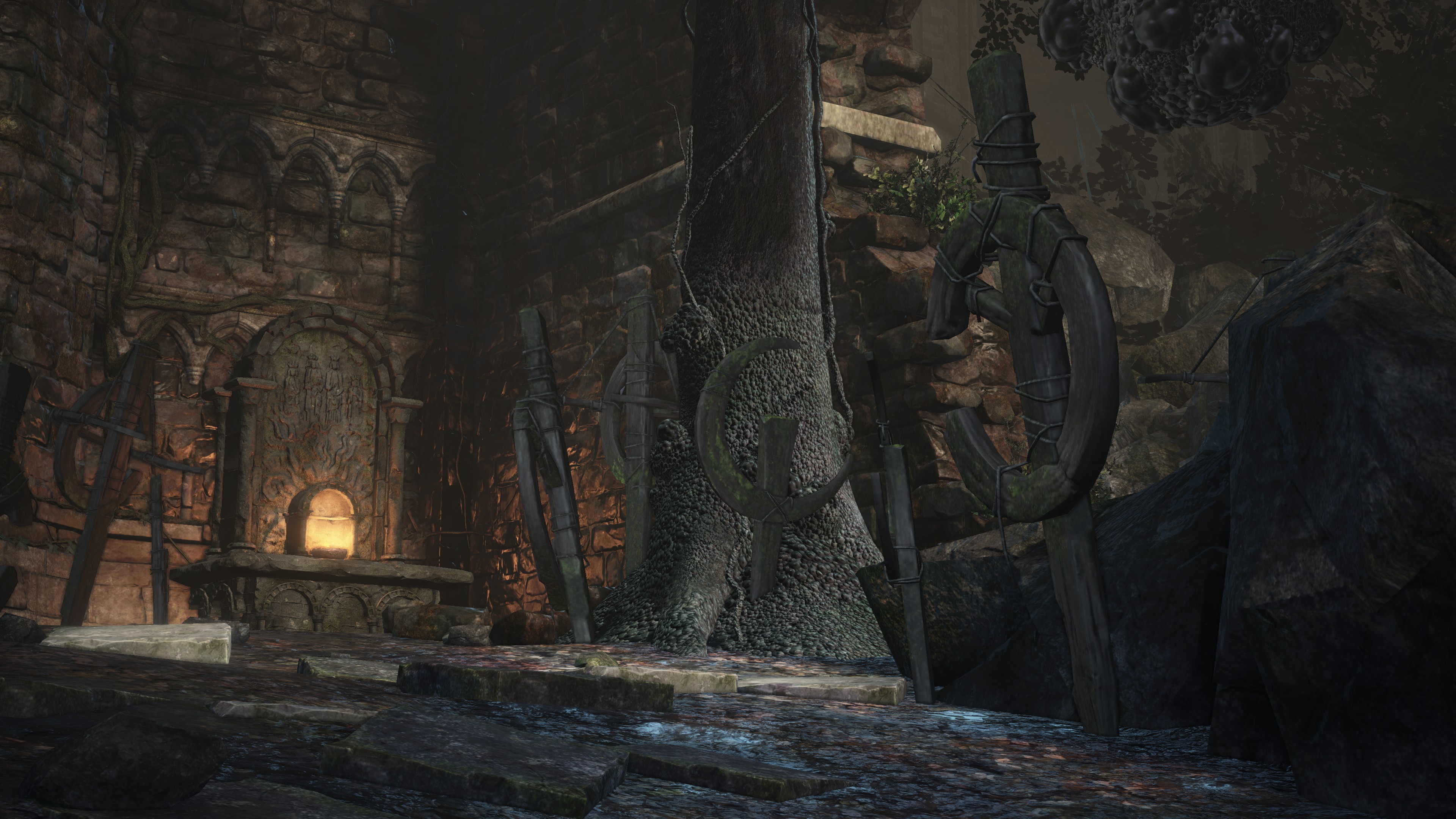

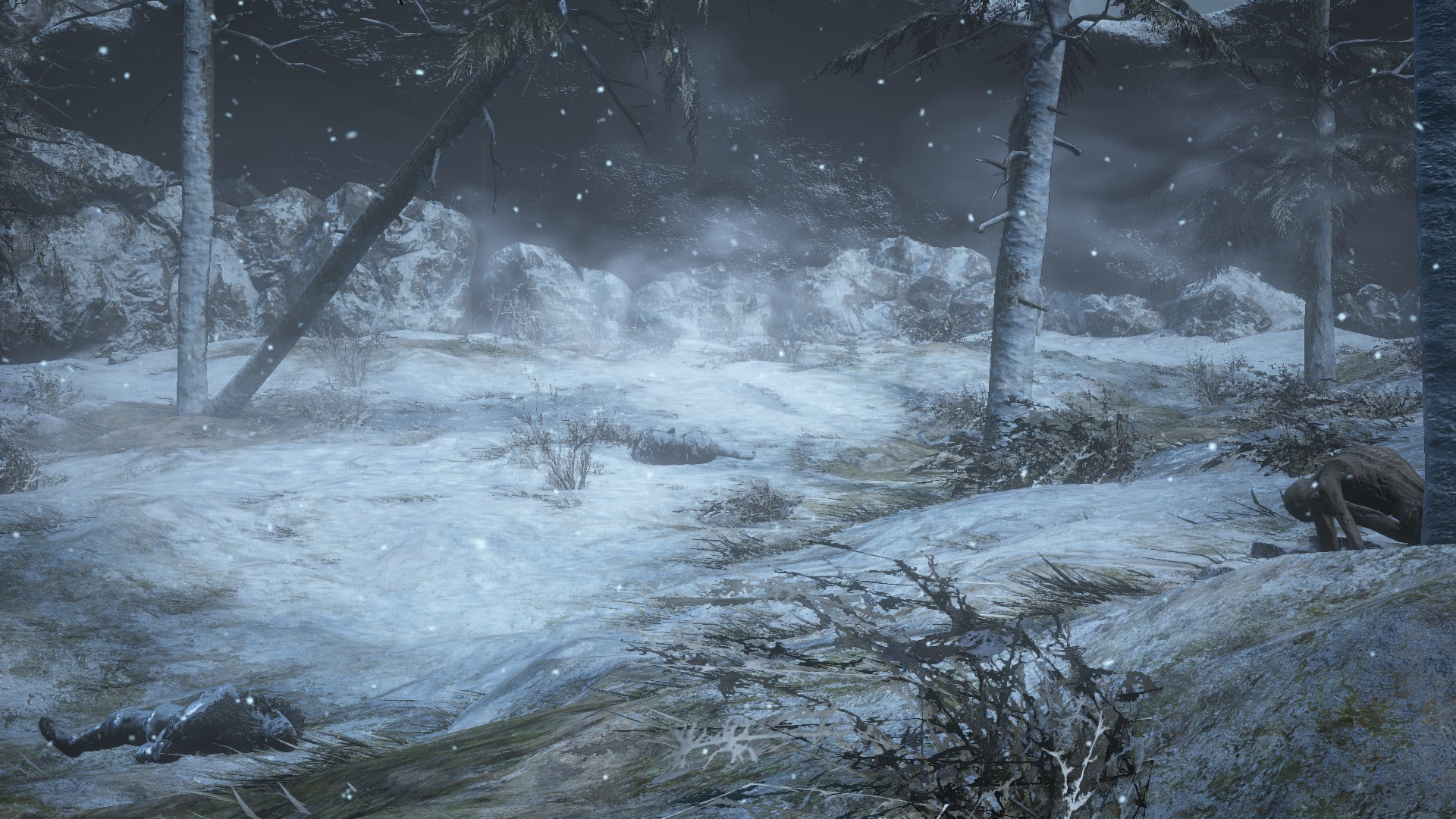
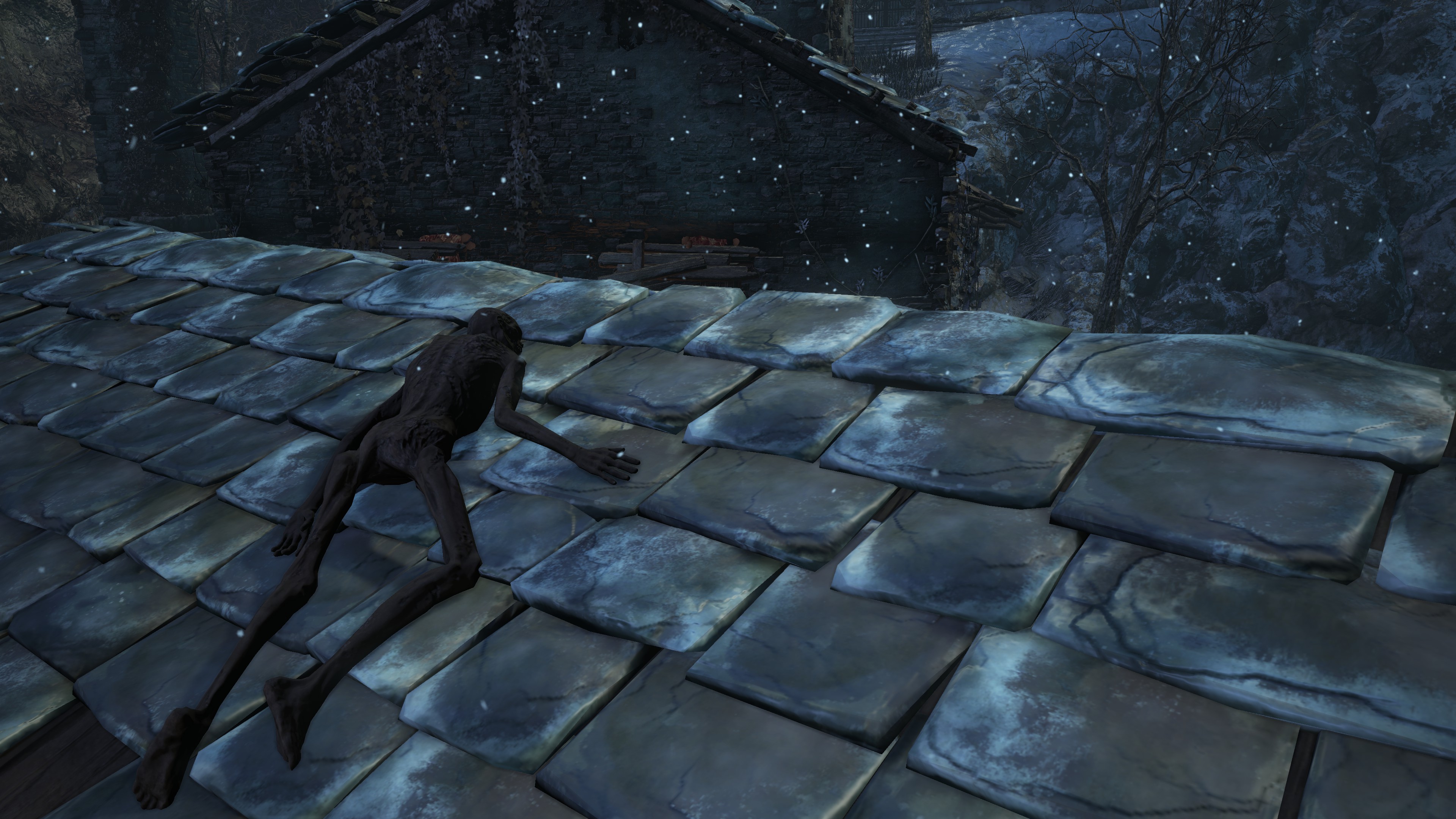



In that case, there is no reason to question that the figure venerated in Ariandel is the Goddess of Sin. Just as she was a loving mother to Priscilla, Velka has become a mother to all those detested and driven out of mainstream society. Even if their devotion doesn’t rise to the level of corvian transformation, they have her protection in the painting and so have continued to pay her respects. Ariandel the man saved her world, so it is only natural that he become their pastor. Whether or not the goddess actually gave him her blessing, he established the teachings of this loose faith around Velka as preacher of a new church. And if he well predates the painting’s displacement to the New World, then his devotion to the goddess had also been longstanding, if only because the graying corvian so appreciated their place to belong. How that translated to policy was probably preserving the current order; we do find a miracle of the orthodox god Lloyd in his church. With such a small and insulated country, maintaining it had likely driven every one of Ariandel’s decisions, and this includes their relations with outsiders.
Come This Way
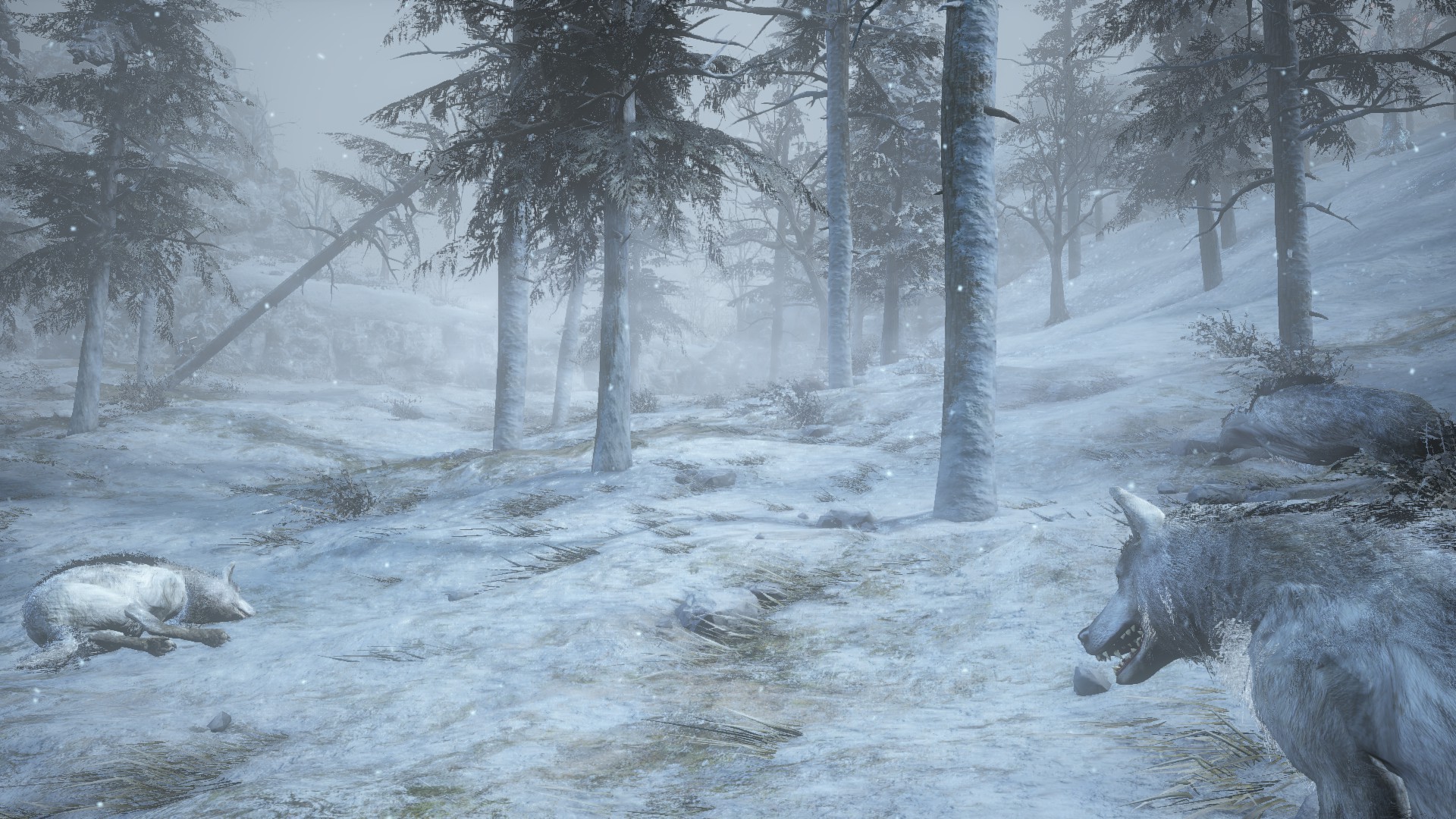
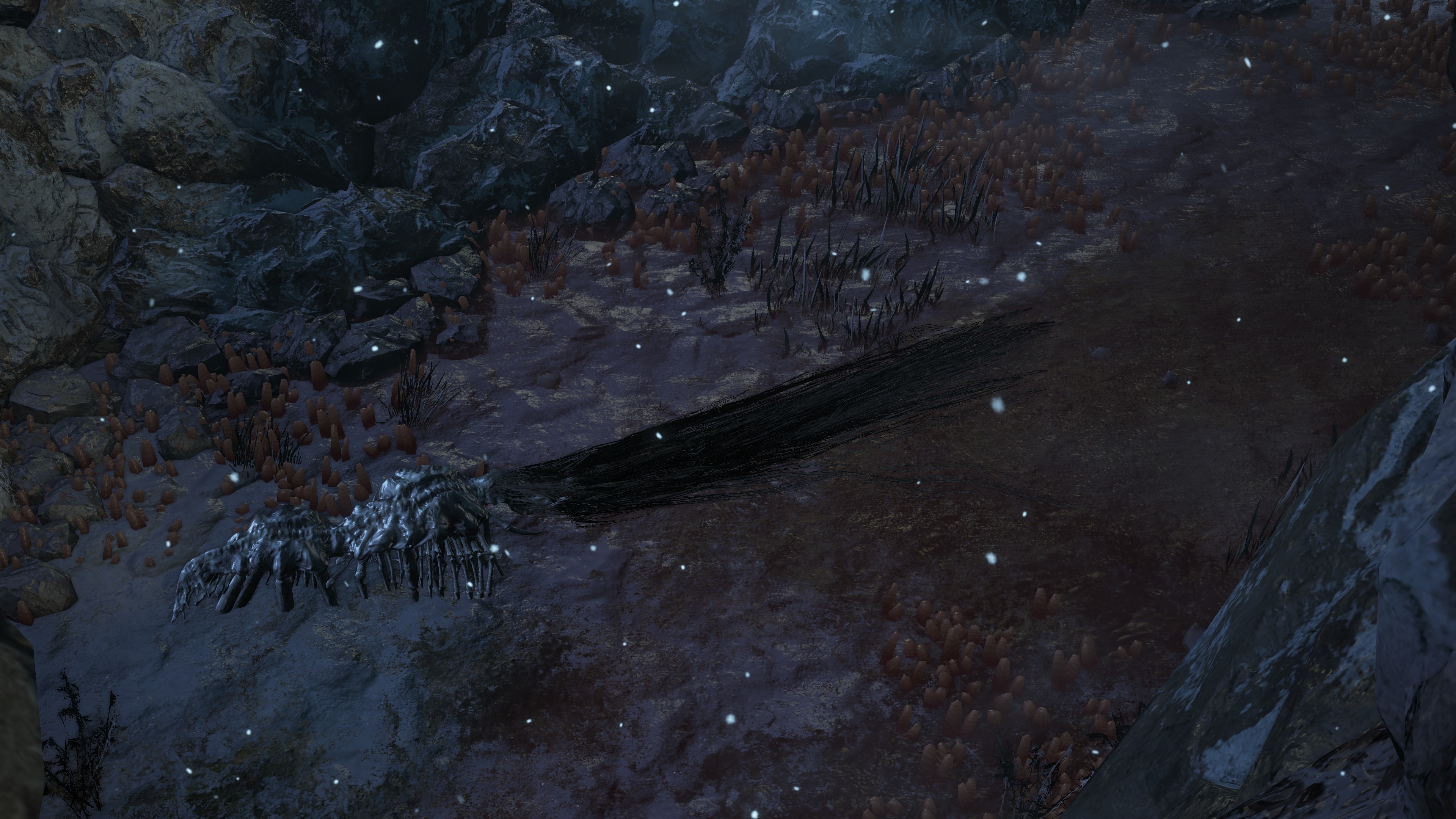
Even after the drift, entering the painting is as easy as coming too close to the canvas — even just a scrap, as Gael demonstrates to us. With how many have entered the painting since the events of DS1, the Peculiar Doll required to enter that game appears to have been more a prerequisite for the narrative than a literal key. Regardless, these many new inhabitants range from people to animals. For the latter, we see ordinary creatures suited to a snowy environment like the ice crabs and wolves. There are also sewer centipedes in the village’s open drainage canal, their toxic spew demonstrating the creature’s capacity to filter through the sewage for nutrients. All this fauna exists outside the painting as well, so these other world denizens may have ended up drawn in by accident and simply adapted; the wolves in particular are possible holdovers from Ariamis, considering the ambient howls audible back in DS1. The only one even slightly unusual is the centipede, which resembles a drowned woman while digging in to feed with its body-long mouth in shallow water. But, in the end, they are hardly outcasts.




Plant life isn’t excluded from this scenario either. The Budding Green Blossom is a variant of the Green Blossoms harvested from Lordran in DS1. While still growing in waterfronts, the new breed sprouts white flowers in chilly water. Likewise, the Rime-blue Moss Clump is a variant of the other “moss balls” (苔玉) first seen in the Old World, having evolved to retain heat despite the cold. Both plants evolved specifically to thrive in an environment strained for warmth and energy. The description for “moss ball fruit” (苔玉の実) indicates that this potential has always existed within at least the highly adaptive moss. But regardless, these are plainly products of a natural evolution, hence their presence in Ariandel and beyond. Moreover, none of these are traits to earn them scorn. Flora or fauna, these things all still have a place to belong in the world outside. The same cannot necessarily be said for the other newcomers.
Green weed like a large flower. Small white flowers have bloomed.
Temporarily greatly raises stamina recovery speed.
The flowers of the Green Flower Weed are illusory flowers. It is said that they only bloom on cold yet unfrozen waterfronts.
Blue-colored moss ball that has a warming effect. Reduces chill accumulation and removes frostbite status.
Chill accumulates and, if it fills up, you receive damage, and also it becomes the frostbite status. Frostbite lasts for a while and lowers cut rates and stamina recovery.
Weapons clad in chill are very rare, and it said that many of them are from the Cold Valley.
Small fruit of a moss ball.
Temporarily boosts bleeding, poison, chill, death by curse, all resistances.
The fruit of a moss ball is the same regardless of its color, so harbors the effects of all the colors.
Although since adapting to Ariandel, the white tree women probably weren’t always native. Flora resembling bipedal fauna to varying degrees is nothing new, but the tree women differ in a few key ways. One is the fact that they breathe; cut dialogue indicates that they can even talk, an ability otherwise only seen with the mushroom men in DS1. But unlike the fungi, the tree women have a visible mouth from which they eject air. Even stranger, we can loot Alluring Skulls from their bodies, implying that these human-looking craniums filled with souls belong to them. Put simply, a solid-bark plant has an animal skeleton, at least for the upper half. Was their progenitor a woman who became more like a tree, or a tree who became more like a woman? Whatever the case, this bizarre evolution is unprecedented. The tree women don’t comfortably fit in with either people or plants and so would be driven out from both camps. Indeed, their sobbing member’s cut dialogue affirms that her child would have nowhere to belong in the “cold” outside. Their only home is the painting.


Then there is, of course, the Undead. Aside from the various Hollows wandering the wilderness, the village is home to slave knights like Gael and another found dead on the premises. We also come across signs of pyromancers, Darkwraiths, and more within the painting. Their exact reasons may differ, but all of these bearers of the Darksign were ultimately driven from their homelands and could find refuge in this place. As one corvian puts it, this world is the haven, literally “resting place”, (安息地) sought by the undesirable — now that we have arrived, he encourages us to find a “bed” to rest upon. Those shunned outcasts simply want reprieve from the harsh gazes of society, which Ariandel provides. And as the corvian acknowledges, this is the same for everyone there, Undead or no. Together, they can form a cold country of castaways far and away from the prejudices of those “normal” people.
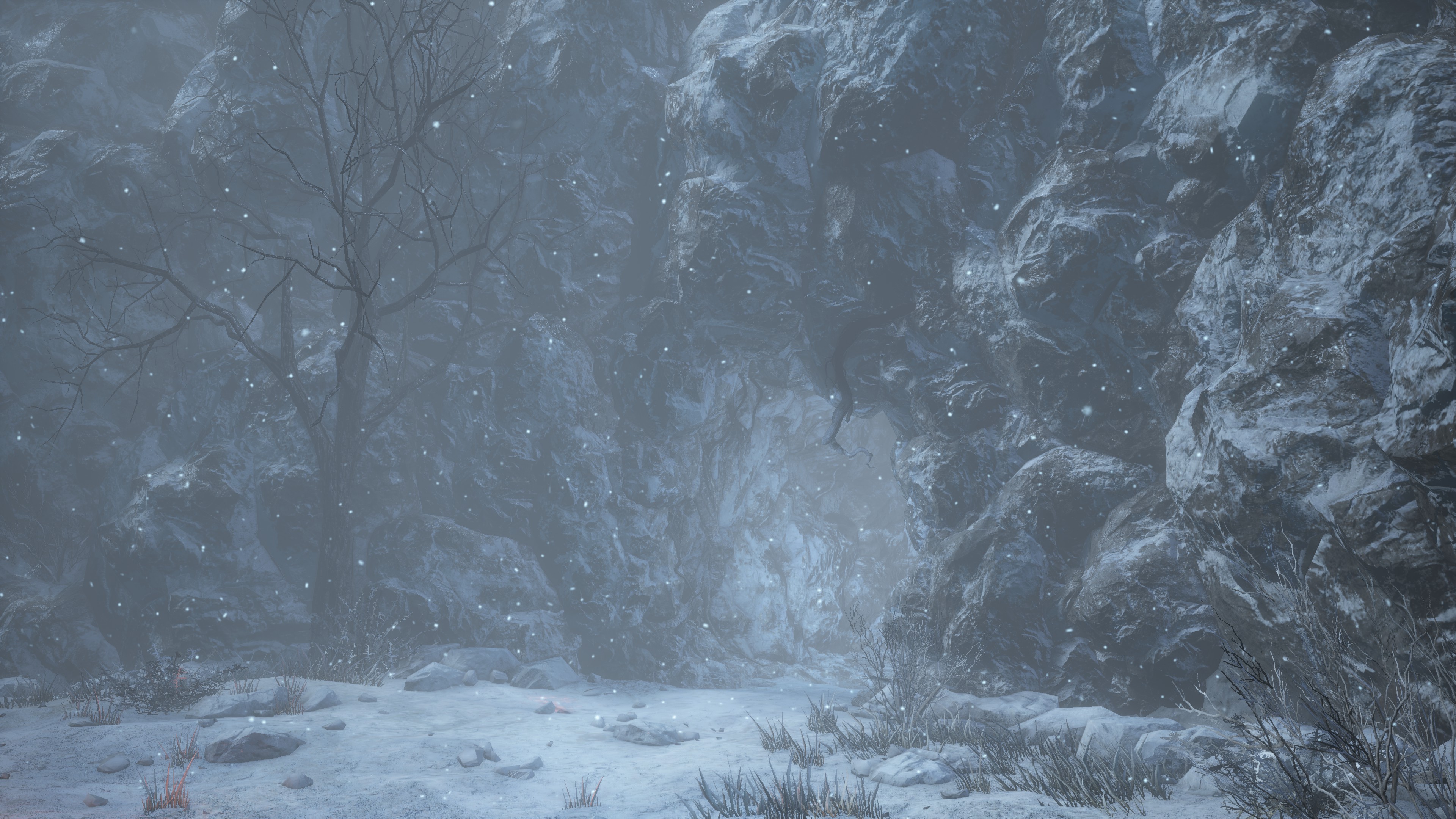
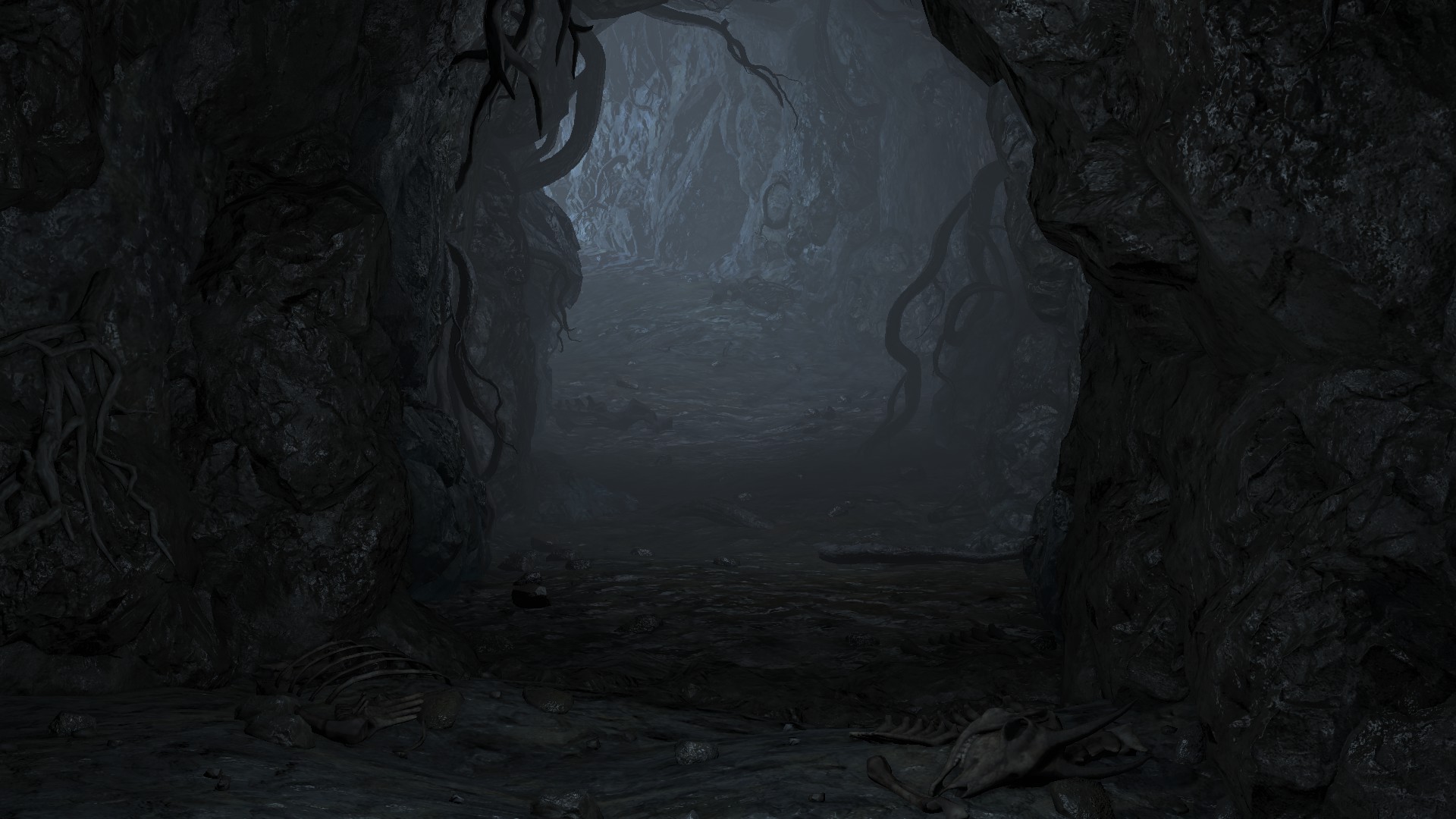
But accepting just any visitor with open arms would just be begging for trouble; who is to guarantee that the person is friendly or even an undesirable? At best, the person might be some ignorant sap who unintentionally strayed into the painting, such as the case with the Chosen Undead in DS1. At worst, the person might have come to intentionally do harm to the inhabitants, again, not unprecedented. For that reason, the corvian village needed some form of buffer to protect themselves and filter out the bad apples. The side of the village not given natural protection from the steep cliffs does maintain a fortified wall, but that would be the last resort. Despite the changes to the painting between games, our starting point remains the same: on the outskirts of the explorable world. The aforementioned corvian already sits in the cave we start in, evidently a newcomer from his dialogue. Many of the corpses in the proceeding snowfield leading up and into the village likewise harbor the souls of travelers. So, if they wanted to stop these migrants, they best set up shop closer to the border.
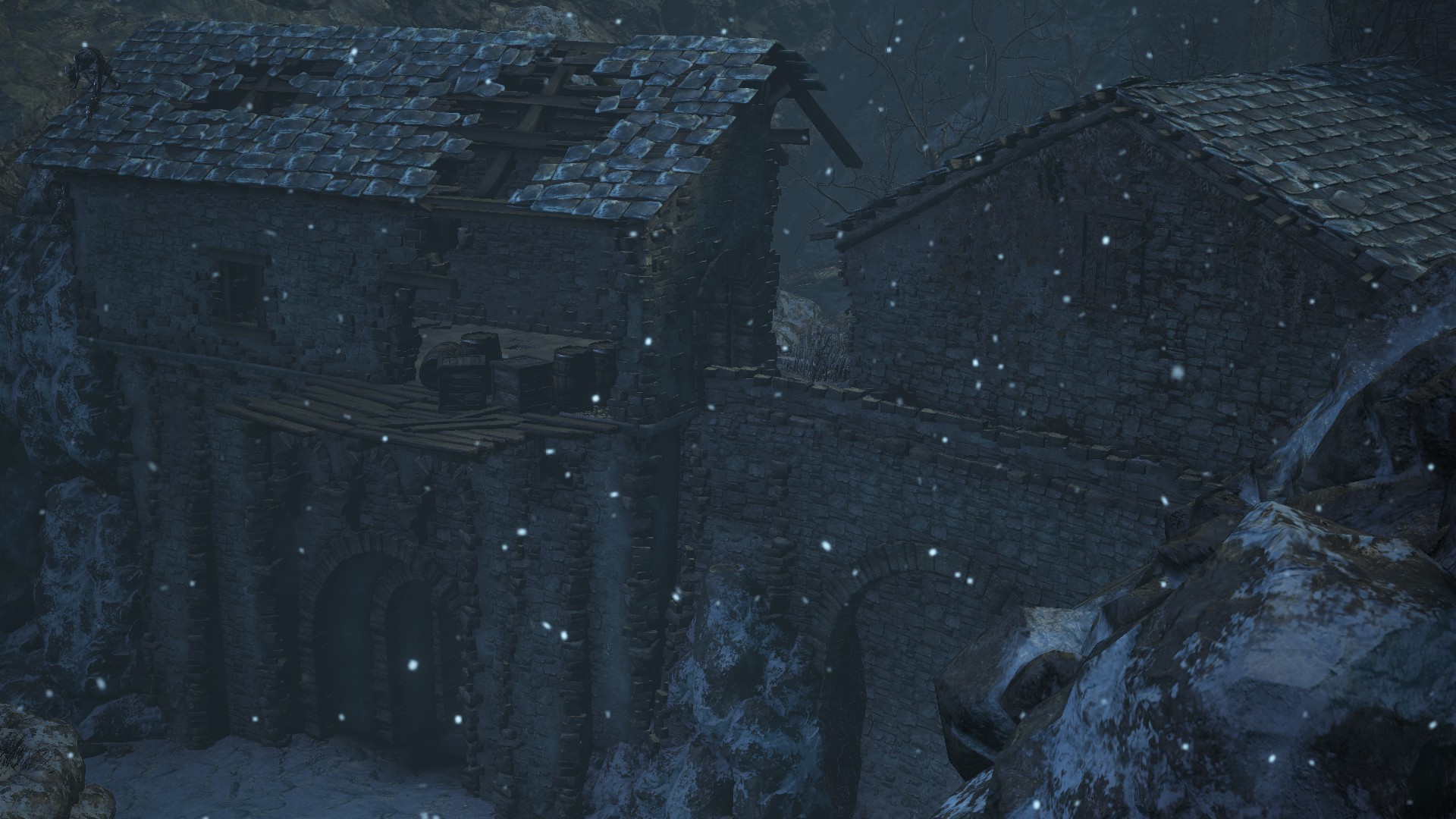
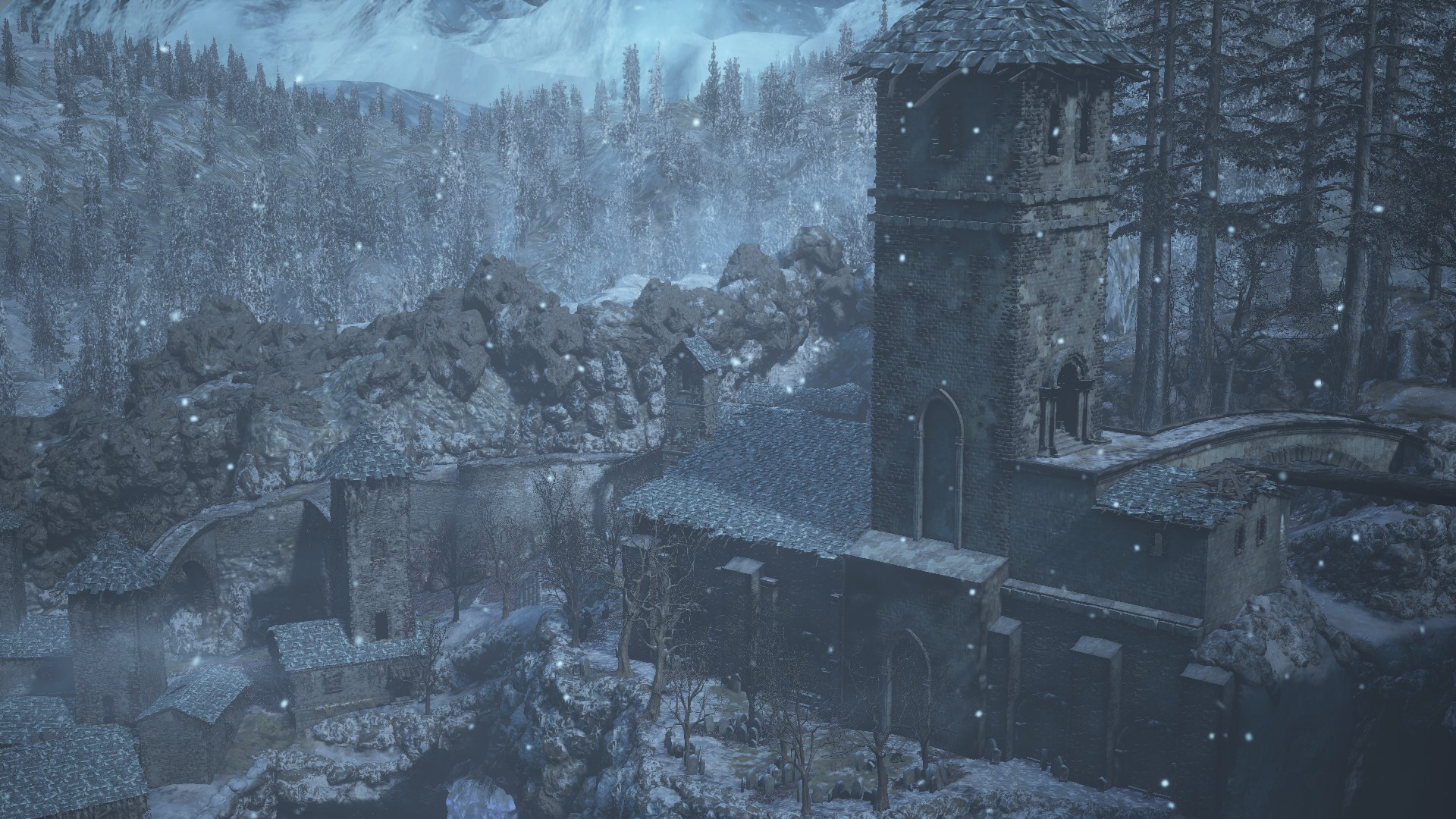
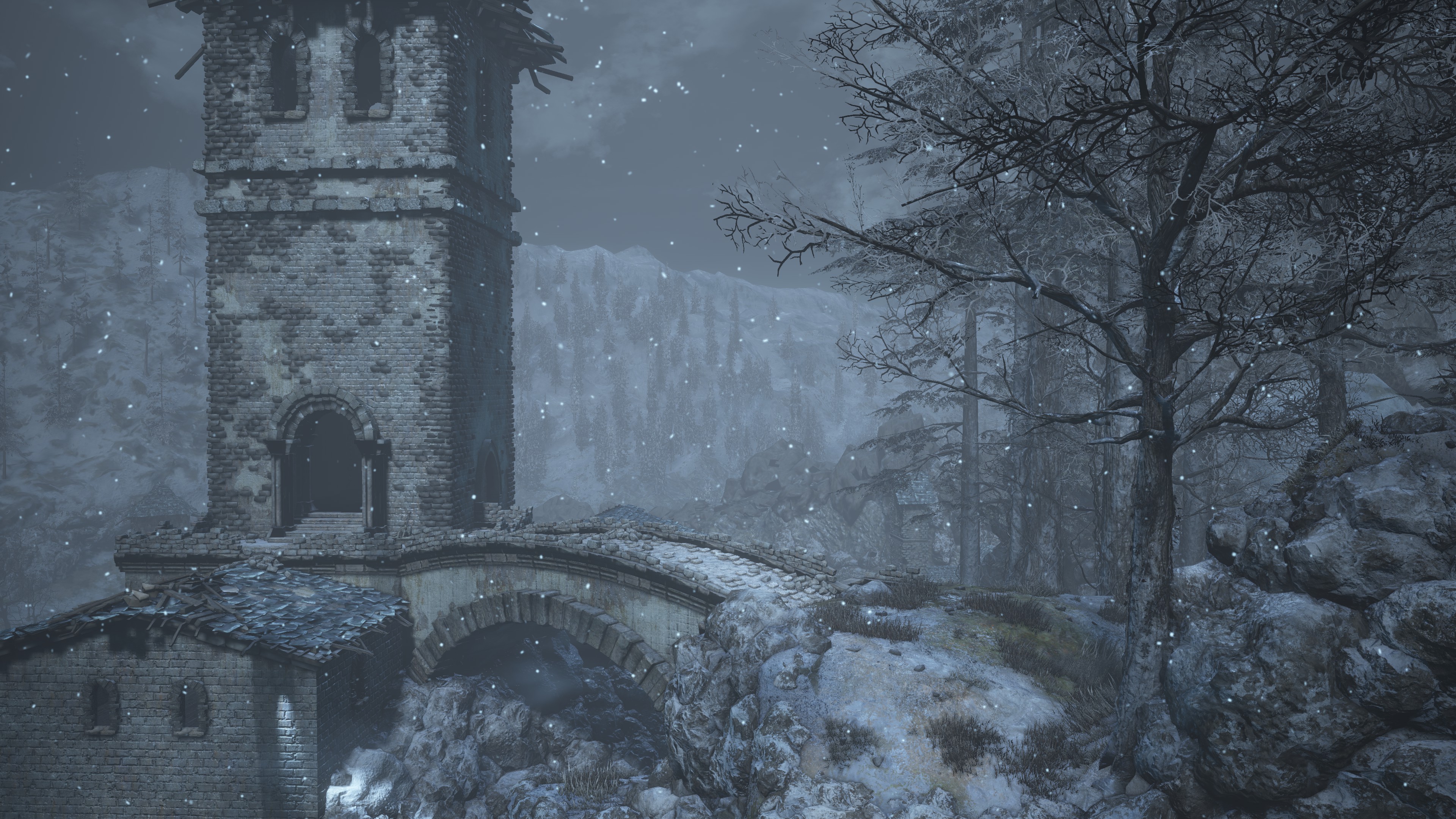
Out in the snowfields, we can come across the remains of a stone settlement, well-fortified if the large watchtower still standing is any indication. The ruins are now the dwelling of the Millwood Knights, but why would the village allow them, or any party, settle the land beside themselves? More likely, this settlement in the wilderness was established by the village, creating an outpost to quickly intercept and process visitors. Not everyone would necessarily be an unexpected guest, however. Vilhelm questions how we have strayed into the painting when no “bell tolls”, implying that some were guided inside by a bell within. We do see the watchtower overlook the chapel sitting across the valley, its tower designed to house a large bell — and said bell is found half-buried in the woods between the chapel and the village. The outpost would thus have received a clear signal for when to expect visitors. Once it confirmed the proper migrants and their sincerity, they would be allowed to assimilate.




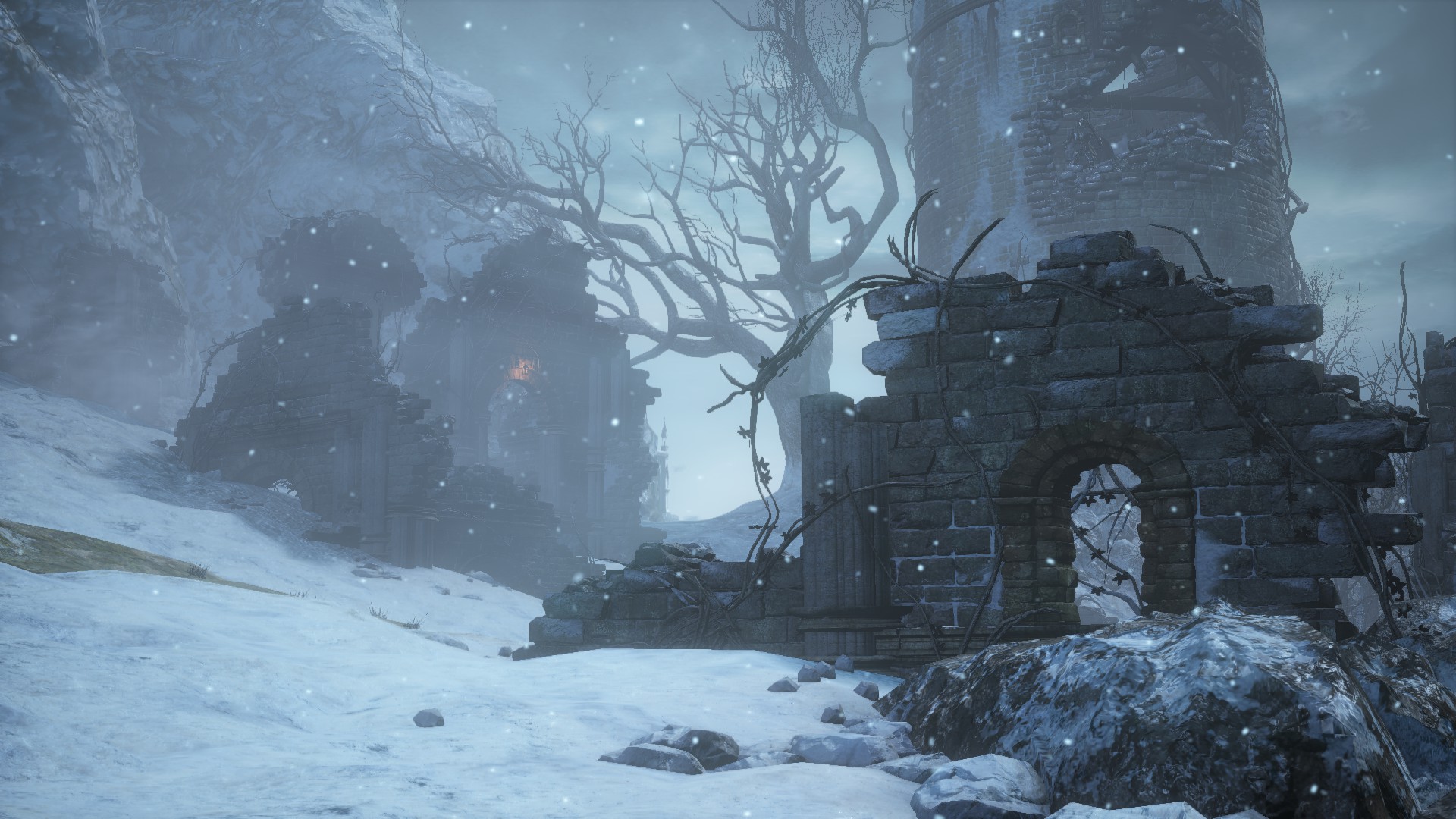
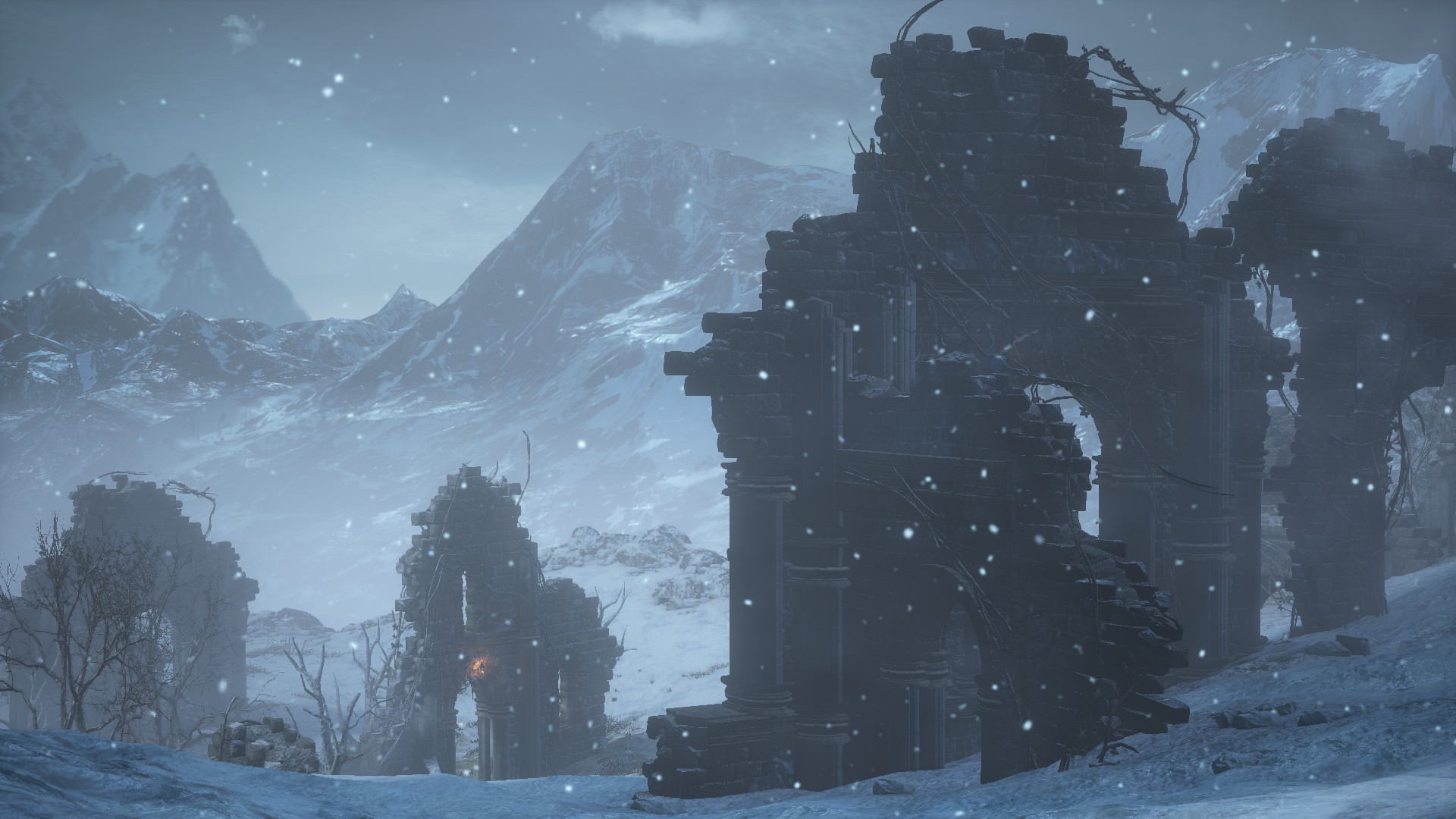


… Oh, you…… A fireless ash. Probably not the sound of the bell, so how come you have strayed into the painting?
As to who staffed this outpost, it may have been professionals. Descriptions for the painting guardian set reveal legends about abominations being guided to within the painting when they had no world to belong to. Aside from echoing Priscilla’s legend, this new tale implies that the guardians who emulate the white half-dragon with their robes were the guiding hands. As added evidence, the Japanese text for the equipment refers to them not as the painting “guardians” like past games but “envoys”. (使者) They were emissaries acting on the Ariandel residents’ behalf, their mission to bring more lost souls into a place where they could belong. Just as their idol found salvation from a loving lead, so too would they provide that experience for others. These representatives would be the perfect garrison for the painting’s outpost, having previously operated out of the walled monastery in Ariamis. And if necessary, they could still act as the painting’s defenders.
Apparel of the painting’s envoys, whose forms are recited in heretical legend.
A dimly white, smooth hood. Strong against magic.
The legend’s hunched-backed storytellers recite: “Only the undesirables who don’t have a place to belong anywhere in the world are nevertheless guided inside a cold painting.”
Even as envoys, the painting guardians wield their unique flat-tipped swords. The weapon isn’t necessarily included in the legends of the painting as the localization for its description claims, only the owners. Nonetheless, it would be pulled out should the men in white face something other than a forlorn spirit in need. Their job was originally to keep out anyone not sanctioned by the gods in charge, after all, so the only change would be who they considered hostile and where they spent their time off-duty. If the chapel bell portends a visitor, it is possible that the envoys had a means to communicate with their superiors at the chapel, prompting them to ring the bell and alert the garrison to be ready to process new arrivals they approved for entry. If so, then the sophistication to Ariandel’s security measures show how much this small country valued its safety. They wanted to save as many who had suffered like them, but they refused to risk their own futures. And as always, the painting guardians took the initiative to be their first line of defense.
Weapon of the painting’s envoys, whose forms are recited in heretical legend.
Possesses a unique, flat-tipped shape.
Granted, the painting they defended hasn’t remained whole, Gael possessing one of implicitly many scraps of the restored canvas. Whatever the specific events leading up to this outcome, it is demonstrable that the painting has been through much turmoil since arriving to the New World. Perhaps the painting guardians failed to save it from direct assault, perhaps natural disasters or freak accidents inflicted unexpected damage, or perhaps the change of hands and seasons simply took their toll. In the end, none since Ariandel have preserved the great painting. Fortunately for the residents, tattering the canvas doesn’t affect the painting world’s integrity; we can enter all the same, with Ariandel’s explorable area still far larger than the mountaintop temple of Ariamis. If anything, fragmenting the painting allows for more access points inside, making it harder for the guardians to defend outside yet easier for the detested to find their new home. Whether or not that trade-off was preferable, it was another variable that the inhabitants had to plan around.

Much of this does look to have been plotted out in advance. The Corvian Settlement stands out for its slightly warmer climate. While the whole of Ariandel is blanketed in snow, the area in and around the village lies the most exposed, with vibrant greenery consistently throughout; foliage even growing on buildings. The existence of unfrozen water channels in town and a well behind the church likewise contrasts with the ice encasing the valley below. It appears that Father Ariandel had deliberately painted a hospitable spot for them to build their settlement even in the familiar cold. By that same token, he was the one to hide this Eden behind the peaks and valleys, the sheer cliffs offering natural protection. In short, the future pastor may have already accounted for new entrants, the canvas piecemeal or whole. Everything about his landscape’s design lends itself to the filtration system they ultimately created, at least. From fortress to chapel to village, the corvians opened a pathway for new arrivals to assimilate, so that they too may enjoy the painting’s protection from the rigid world outside.
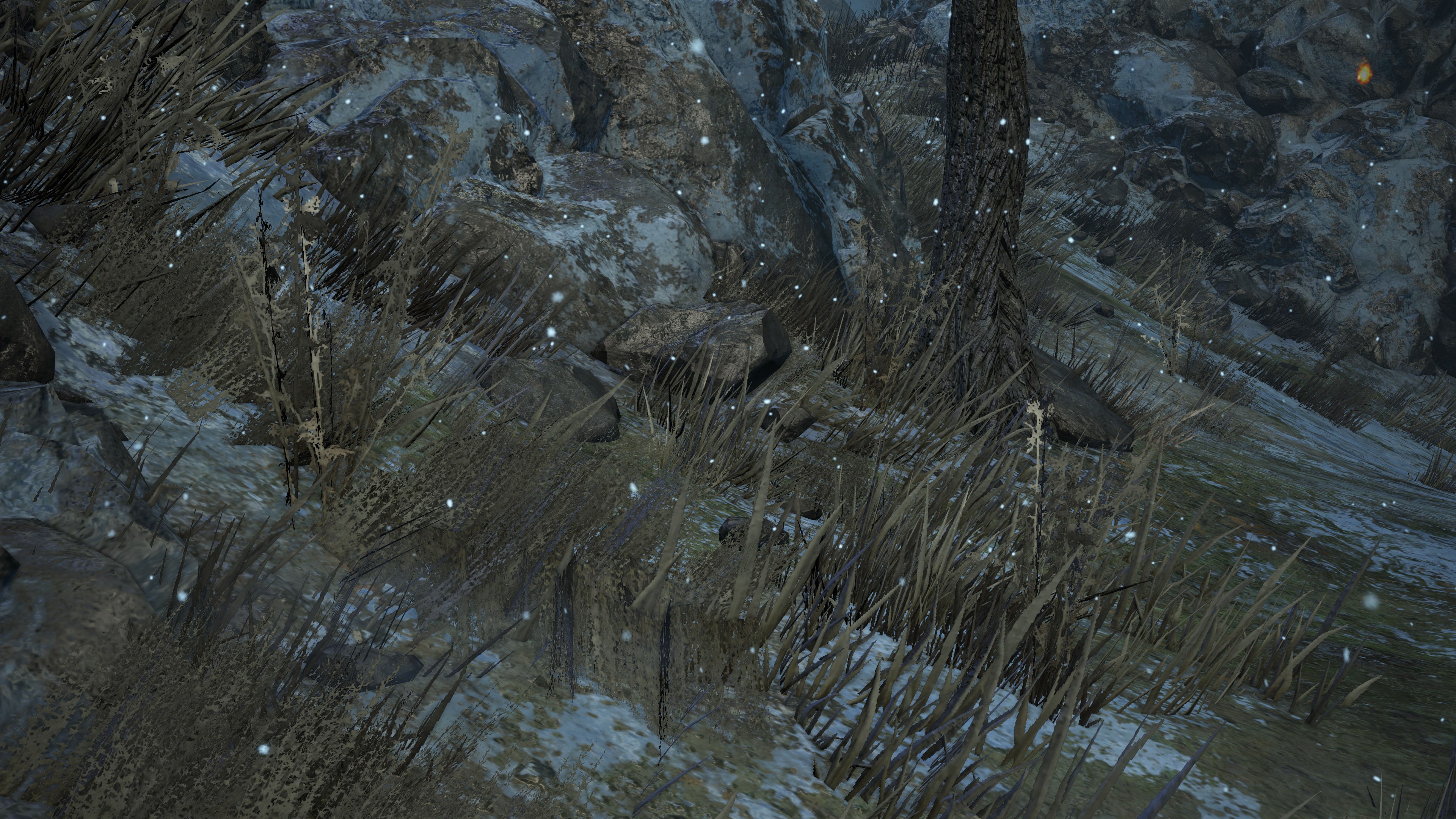
On that front, the land of Ariandel appears to be truly isolated. Despite its perpetual existence, the painting world shows no signs of the stagnation plaguing the outside. The closest example of the phenomenon is the grass used throughout Ariandel, the same model sprouting from the Dark’s stagnation throughout Lothric. But so plentiful is it in Ariandel’s forests and snowfields — by itself and occasionally in clumps — the model is undoubtedly intended as generic grass. The model was originally used for tall grass in Bloodborne, so employing it as such for the DLC is easy to fathom. But given how starkly this contrasts with its limited appearance in the rest of the game, there is little chance of a connection to the traditional stagnation. And with nothing inside dendrifying, petrifying, or cinefying, the painting seems immune to the cosmological effects of the world it exists in. Considering that the painted world is a magical construct, this is reasonable. This world follows its own logic, determined by the magic; so long as that magic holds up, the world will remain a bubble.
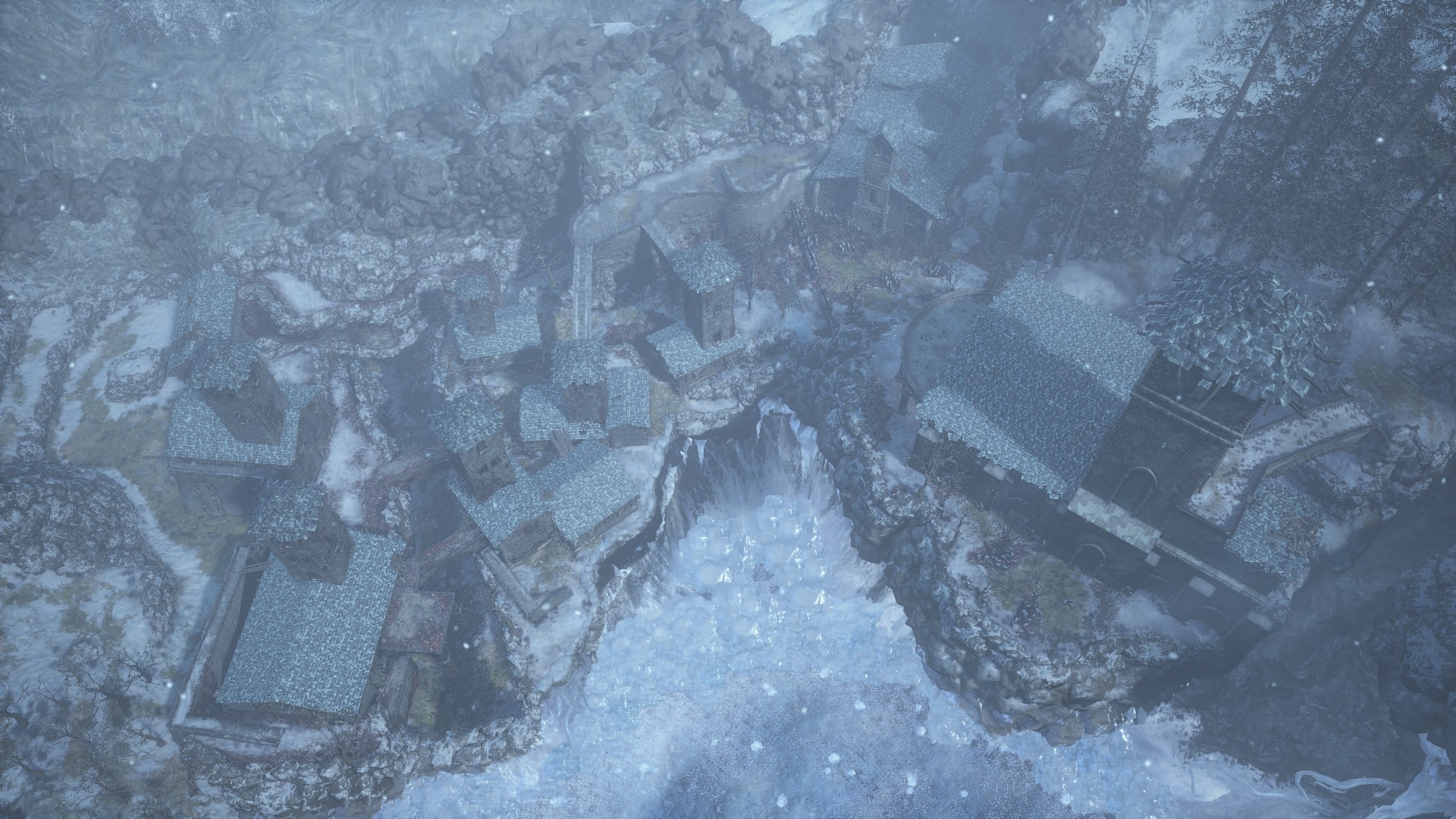


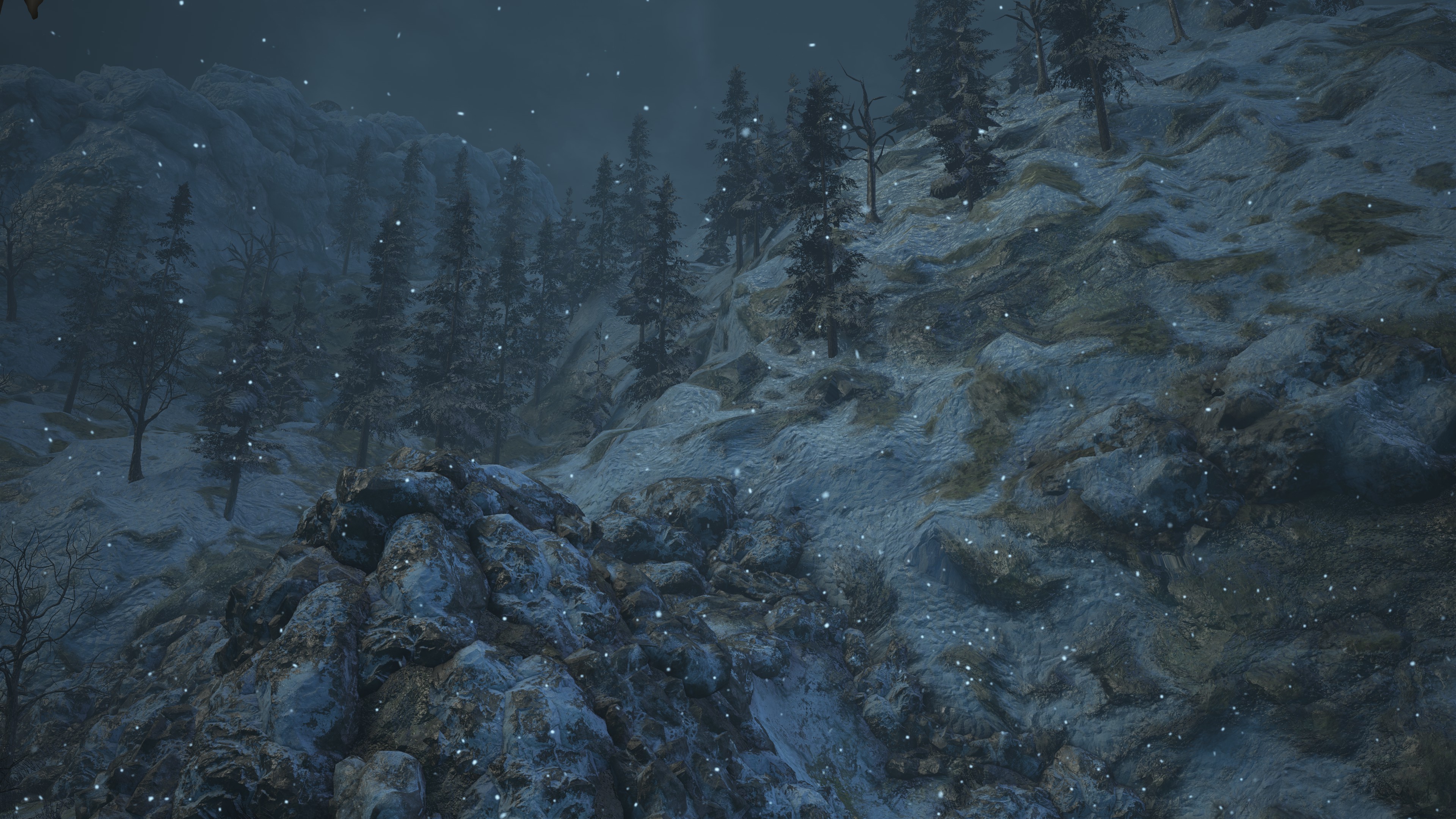




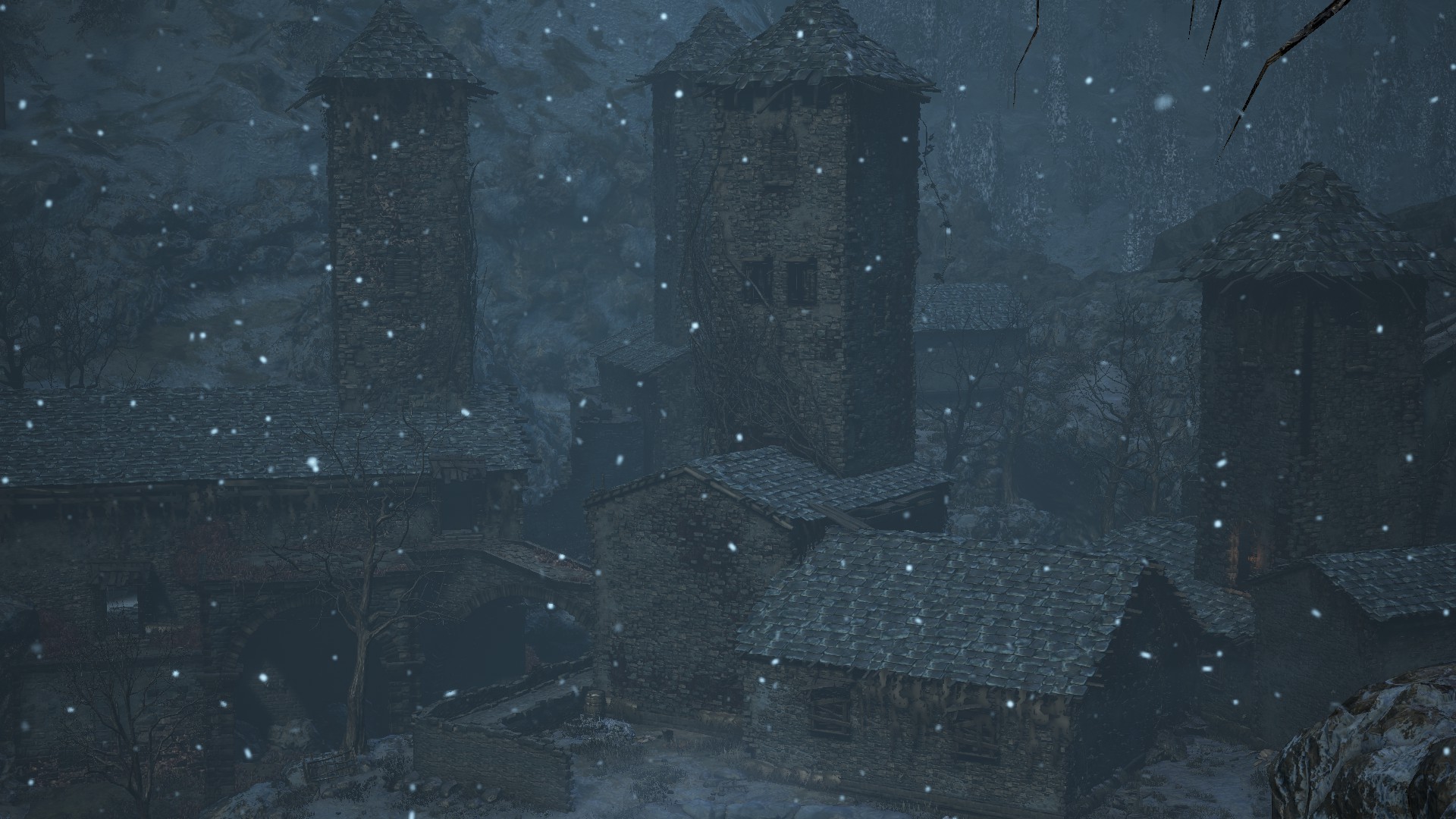
New entrants are thereby exempt from further stagnation whilst inside the painting, giving more incentive to stay. And once accepted into the larger community, there was no reason to go back, especially if you became a corvian. The village enjoyed stone homes with wooden roofs over their heads. Ignoring the church, each building has a tall tower, likely to simulate a crow’s nest for corvians to roost in. Add to that amenities like a communal mess hall to gather and eat, open channels to dump sewage, a well for ground water, and village life seems comfortable. Never was retreating into a painting dimension such a smooth transition, and it was all thanks to Father Ariandel and the painting guardians. Under this new system, everyone felt warm, loved, and protected, just as the first among them ought to have been.







Pure White to Darkest Black
The deepest part of the Ariandel Chapel hides a peculiar shrine. The wooden effigy set up in the back wall is a woman’s head atop a string of cylindrical blocks strung together by a rope. This is obscured by a scaly tail skin sleeve overlayed with a fur cloak. The white color to both these adornments automatically brings to mind Priscilla, who bore traits of her white dragon father and wore an iconic white fur coat. Even though that coat included a special sleeve obscuring the details to her tail, this is assuredly Priscilla’s tail skin dedicated as part of a memorial to the half-dragon. This becomes even more obvious looking at the lead-up to this effigy. In order to access the shrine, we must turn a crank in the crypt beneath the chapel. This activates the mechanism turning the statue of Velka directly above to face the shrine’s direction, the altar thereupon opening the way leading straight to it. All of this is highly reminiscent of the means to reach Priscilla in DS1, only the figure greeting us at the end of the long passage is instead a proxy. The crossbreed died in the painting she had lived in for so long.


With Priscilla’s apparent death, there comes the question of when and how did she die. For the former, one possibility is that she was slain by the Chosen Undead during the events of DS1. Although slaying the crossbreed god was possible, she was ultimately an optional boss, so secret that defeating her was one of the few game achievements involving bosses. Another to receive this treatment was Gwyndolin, who was yet one more optional and easily missed encounter. And yet, item descriptions affirm that the God of the Darkmoon has been devoured by Aldrich, one of the Lords of Cinder in the present era. In other words, Gwyndolin survived well past the lifetime of the Chosen Undead, making his death in the boss battle impossible. He never came into conflict with the hero of DS1, possibly never even meeting. Therefore, the same might be true of Priscilla. Of course, DS2 proved that at least some optional bosses were victims of the Chosen Undead. But Priscilla is unlikely to be among them given her legacy.
Yorshka is a dragon crossbreed as well as Gwyndolin’s younger sister. This fact alone has caused fans confusion since item descriptions in DS1 consistently claimed the deity to be Gwyn’s lastborn, while the one analogous reference in Dark Souls III identifies him as just the youngest son. However, both games are actually using the same term meaning “youngest child”, (末子) so there is no discrepancy. It is impossible for Gwyn to have sired Yorshka since Gwyndolin was his last. Thus, the two are half-siblings sharing a mother, not a father, and Yorshka’s relation to Priscilla is apparent. Aside from both bearing physical traits of white-scaled dragons, the girl is self-admittedly ignorant of the world as if having lived her life contained in an isolated area, long before her current imprisonment. And when pondering how we managed to reach her atop her tower, she considers the possibility that we be a dragon or a crow — both flying creatures she considers “nostalgic” and which did exist within the painting in DS1. Yorshka is unquestionably Priscilla’s daughter, born and raised in the painting, and she wasn’t alone.
The painter girl in Ariandel covers herself in heavy robes, but close inspection reveals white scales all over her body. On top of that, she sports white hair and yellow slit pupils. All of these traits are shared with Priscilla, suggesting that the painter is another child of the crossbreed. The villagers do address the girl as ojou-sama, (お嬢様) denoting a young daughter of wealth or status; as the daughter of their god, Priscilla and her family would be treated like societal elites in the village. Moreover, the painter shows incredible maturity despite her child-like appearance and, in some ways, behavior, speaking with great eloquence and formality; if she had dragon heritage, then it is only natural for her age to be misleading due to a longer lifespan. Combined with a respectful mention of her mother, and there is no reason to doubt that Ariandel’s resident artist was born to Ariamis’ beloved half-dragon, making her Yorshka’s sister and Gwyndolin’s half-sister.

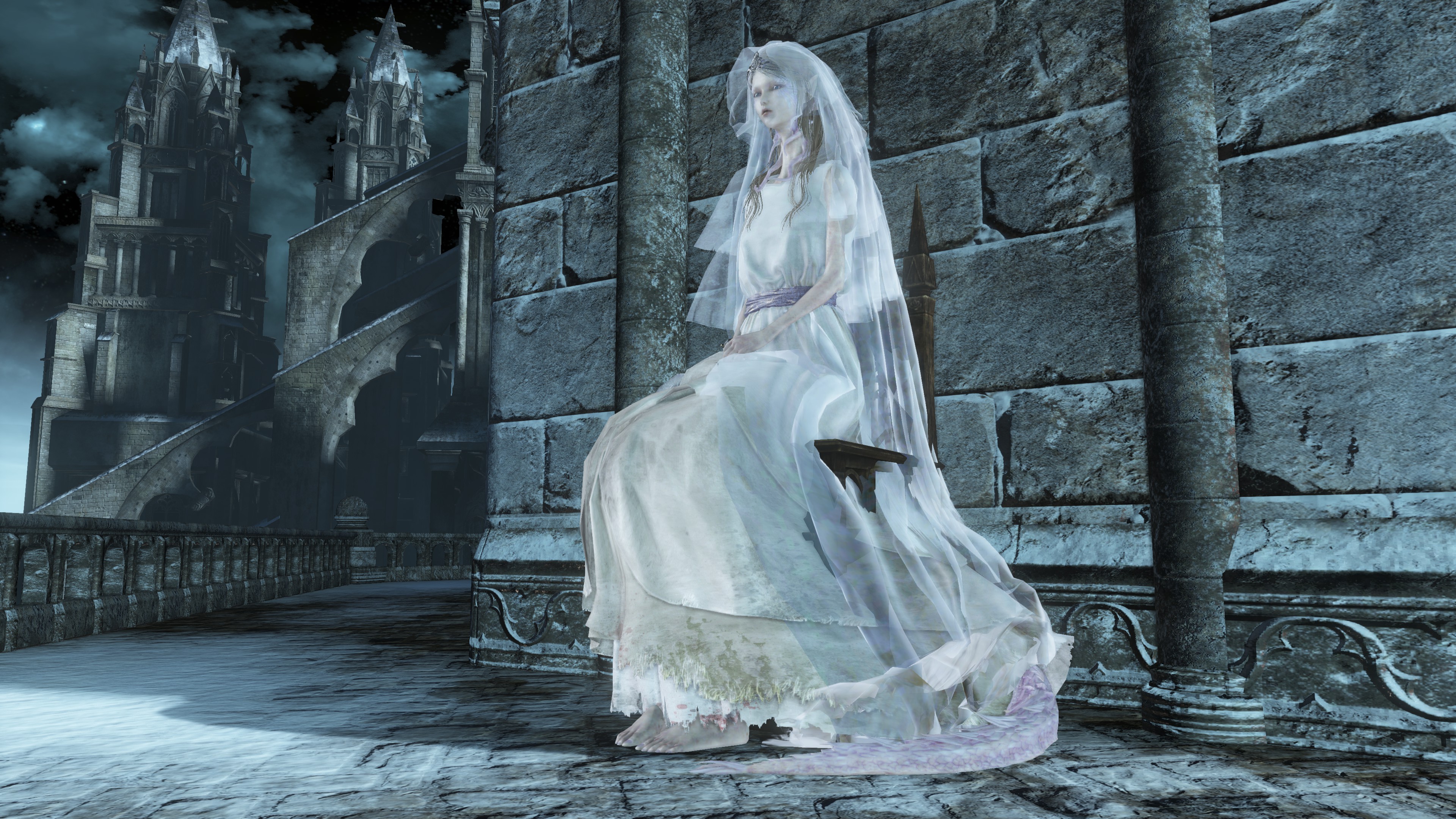


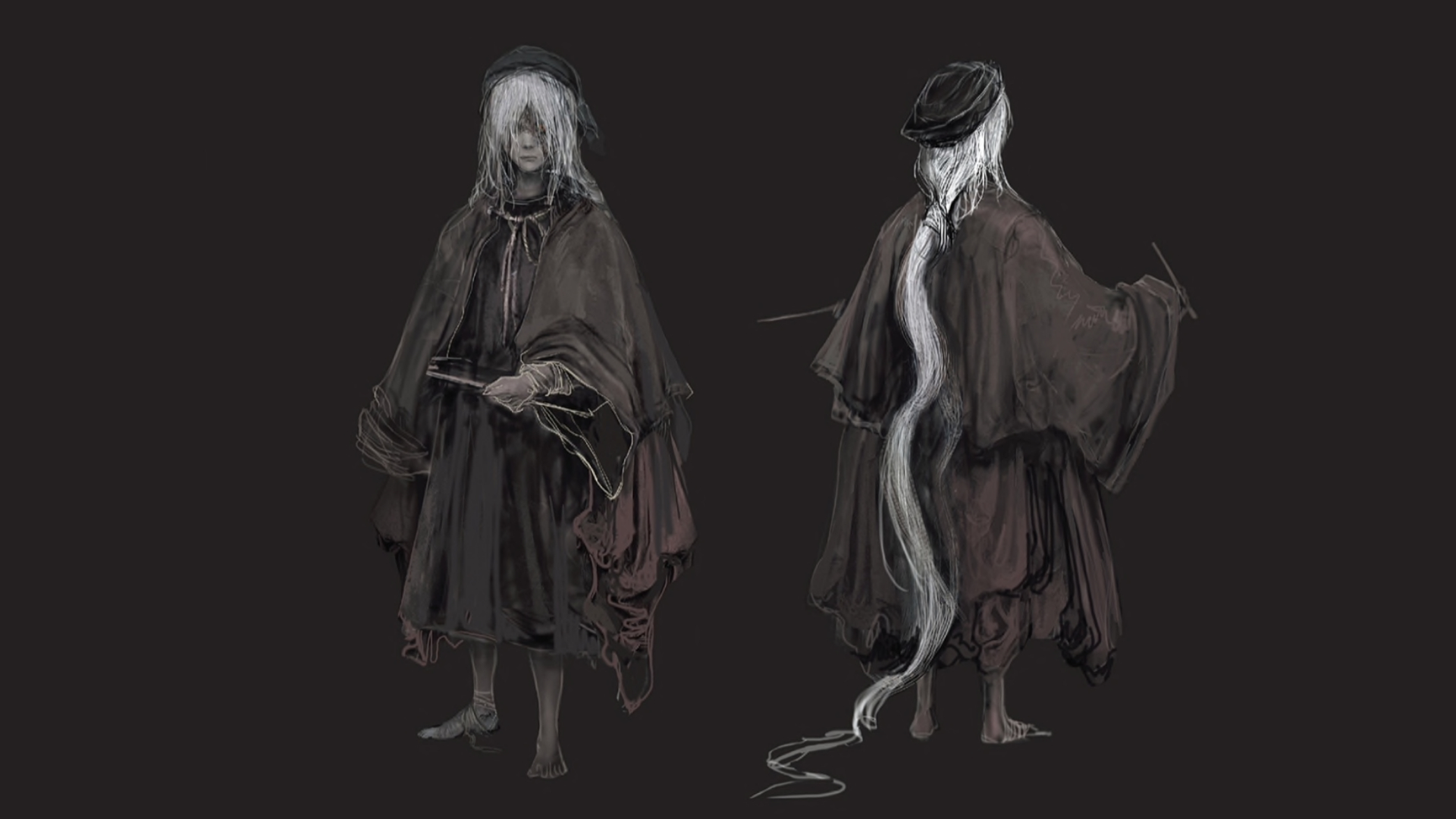
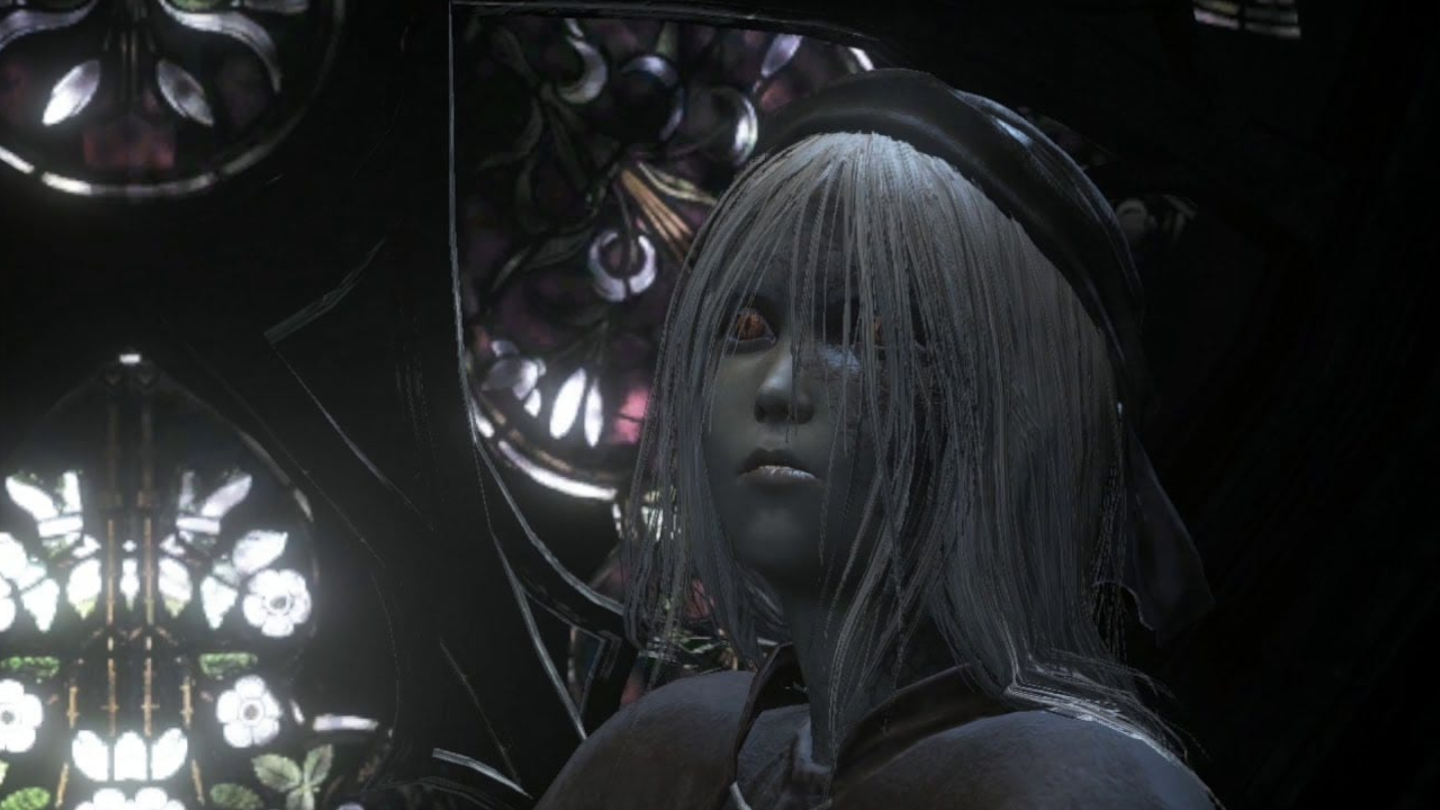


Aside from reaffirming implications about Gwyndolin’s heritage from DS1, this reveals that Priscilla had taken the time to raise a family. Her children were probably not born during the events of the original game, however. Recall in DS1 how Ariamis had been a functional prison up until recent events, leaving the prisoners to restore order until forming the society we see in Ariandel. This tumultuous time within the painting leaves little opportunity for romance, and Priscilla’s impression of her fellow residents as “kind” precludes the possibility of anyone resorting to less romantic means — they took her security seriously, especially given the odious nature of her first birth. That being the case, we can be certain that Priscilla survived any hypothetical encounter with the Chosen Undead. She gave birth to her daughters at some point after the events of DS1 and raised them to the point where the painter could remember her words before her death.
The father is liable to have been an unremarkable man. Outside of perhaps Yorshka’s brown hair and blue eyes, there are no traces of his soul influencing their children, and his absence in the present era plus the silence surrounding it betrays his demise long ago. All things considered, this implicates him as an ordinary resident of the painting. Because the denizens mainly consisted of Hollows or those who forsook humanity in DS1, it is possible that Priscilla’s beloved wasn’t even part of the painting community until after the shift to the New World. Whether or not he did join later on, he still managed to woo the crossbreed’s heart and start a family with her. And if he was an unqualified mortal, then it is only natural that he perish long before her. In fact, we may have passed his grave unknowingly.
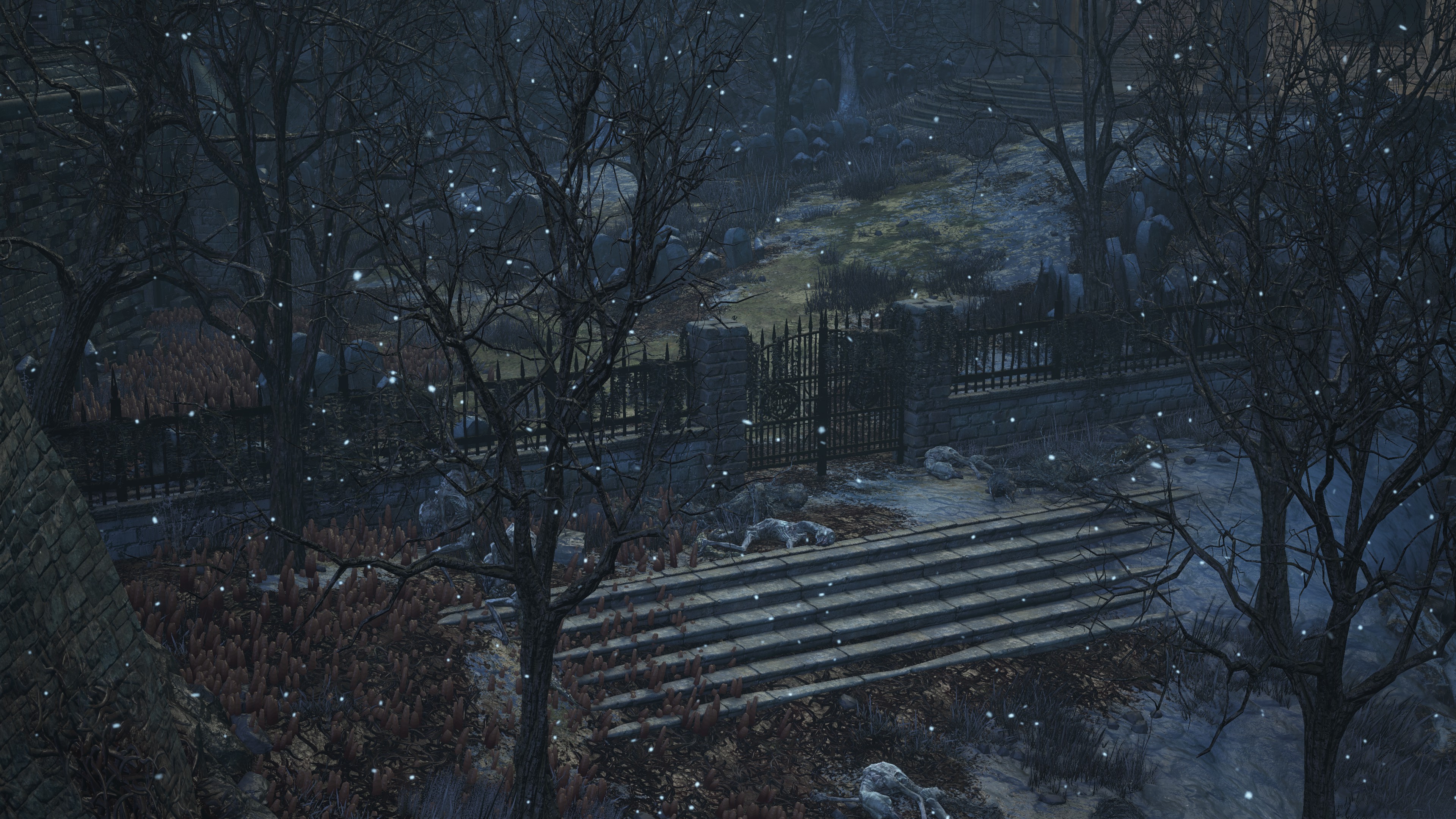
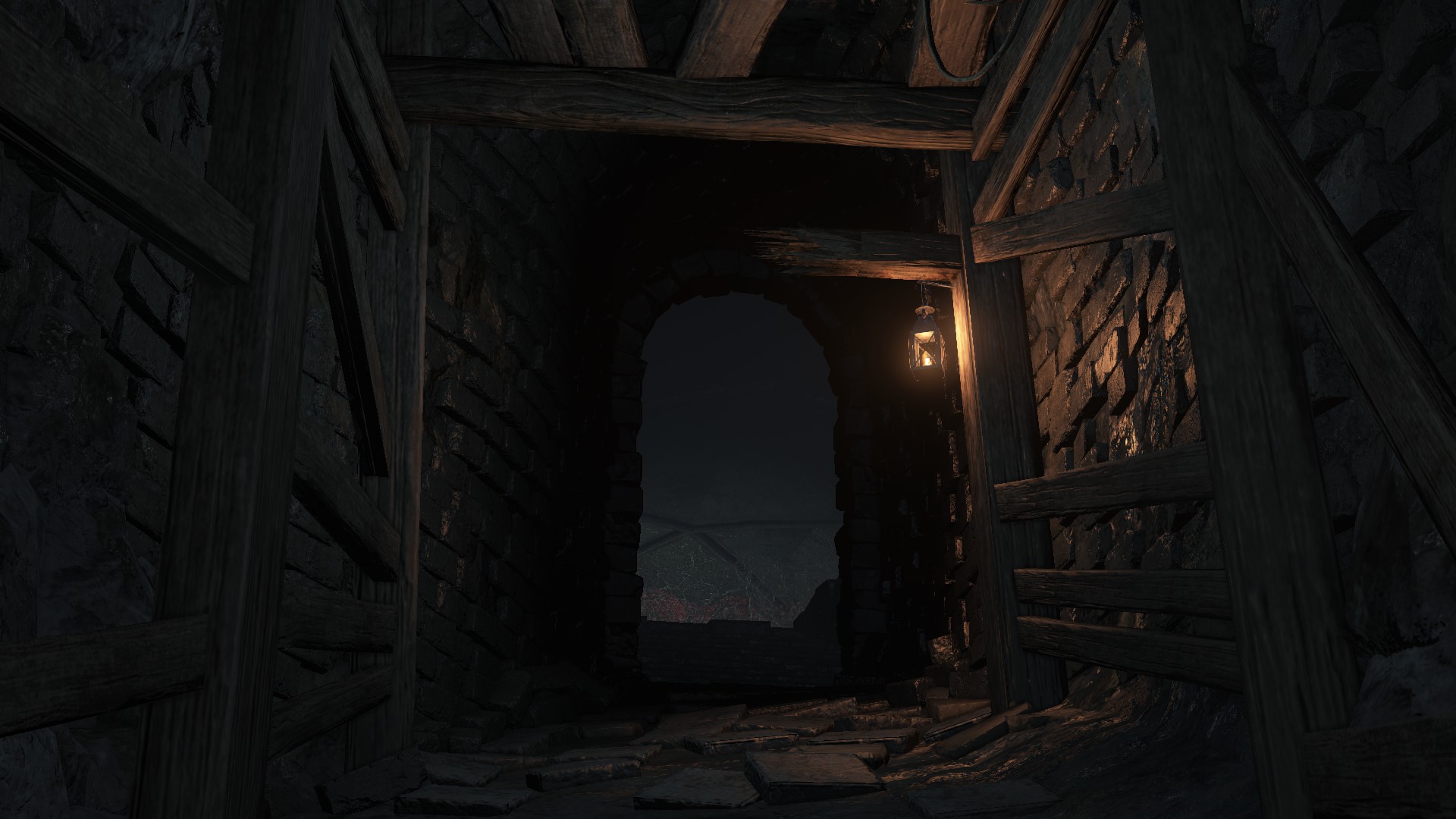
The corvians’ parish maintains a churchyard where all villagers would have been buried by Father Ariandel. Then there is the crypt beneath the chapel, which looks to inter far more bodies by comparison. Most likely, this is the older of the two burial sites, or at least houses older bodies than the church cemetery. Recall that the painting originally featured a ruined church with its own boneyard for those condemned to die in obscurity within the chilly prison. Following the jailbreak in DS1, even more needed to be buried eventually, and still more were sure to die off going forward. By the time Ariamis was restored as Ariandel, there were surely plenty in need of transfer to better tombs, now that the old church was buried under a fresh coat of paint. If the newly established village held any respect for the dead, they would move the bodies, resulting in the crypt below the chapel on the valley peak. This explains the back entrance to the crypt, accessed from a rundown tunnel past the forest behind the parish, not to mention the exit to what remains of old Ariamis. Construction of the crypt and settlement went hand-in-hand.


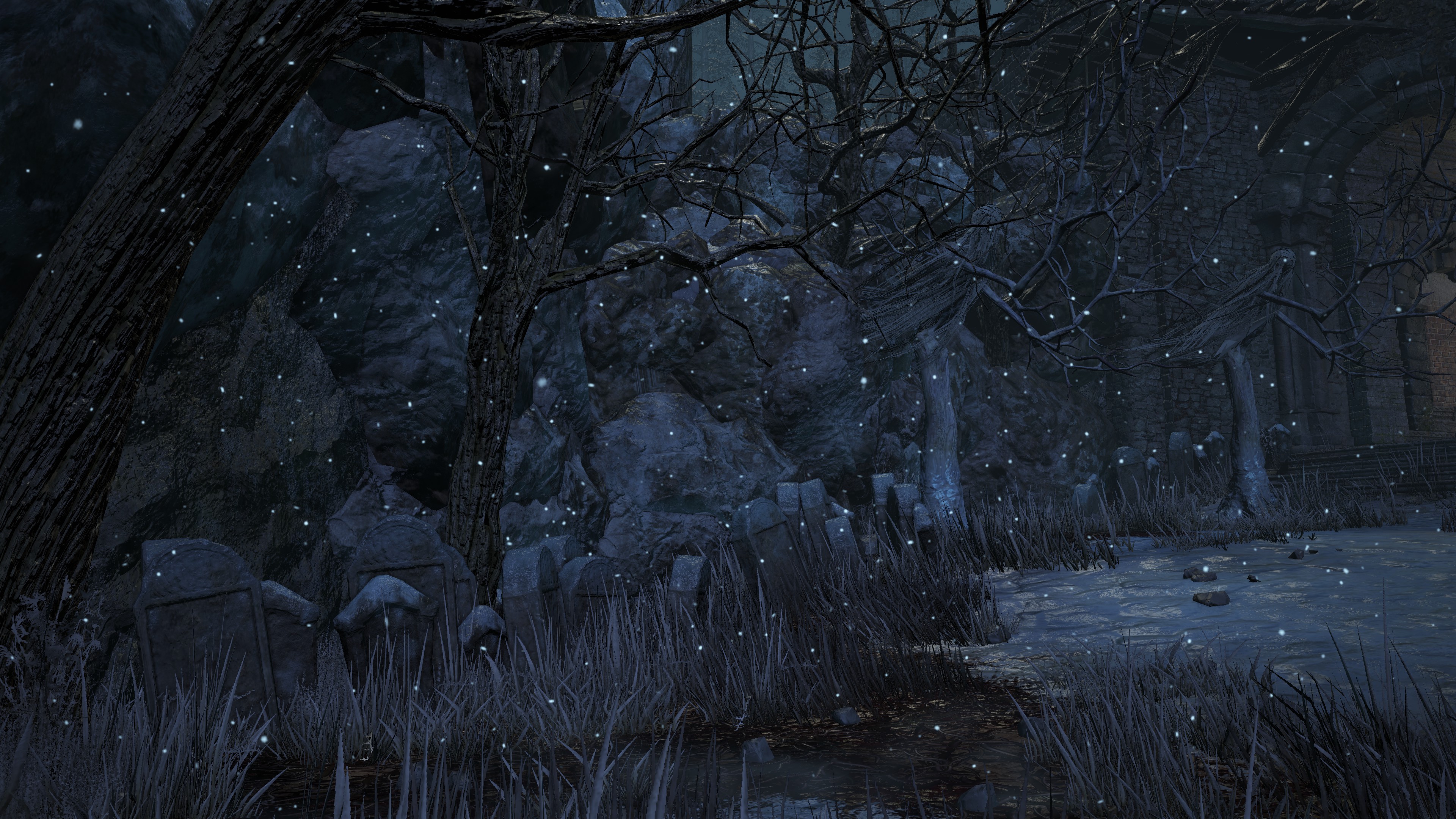


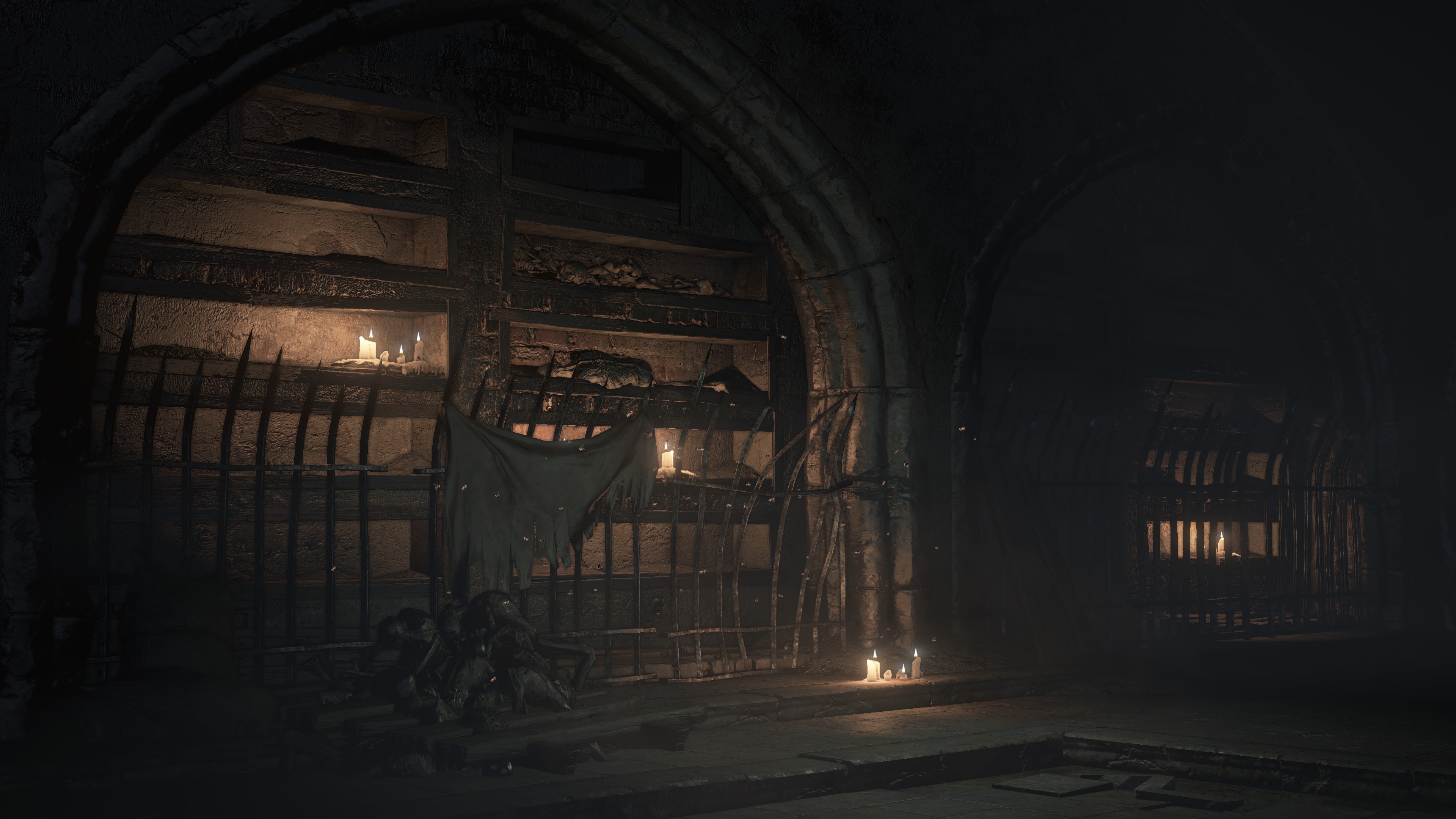


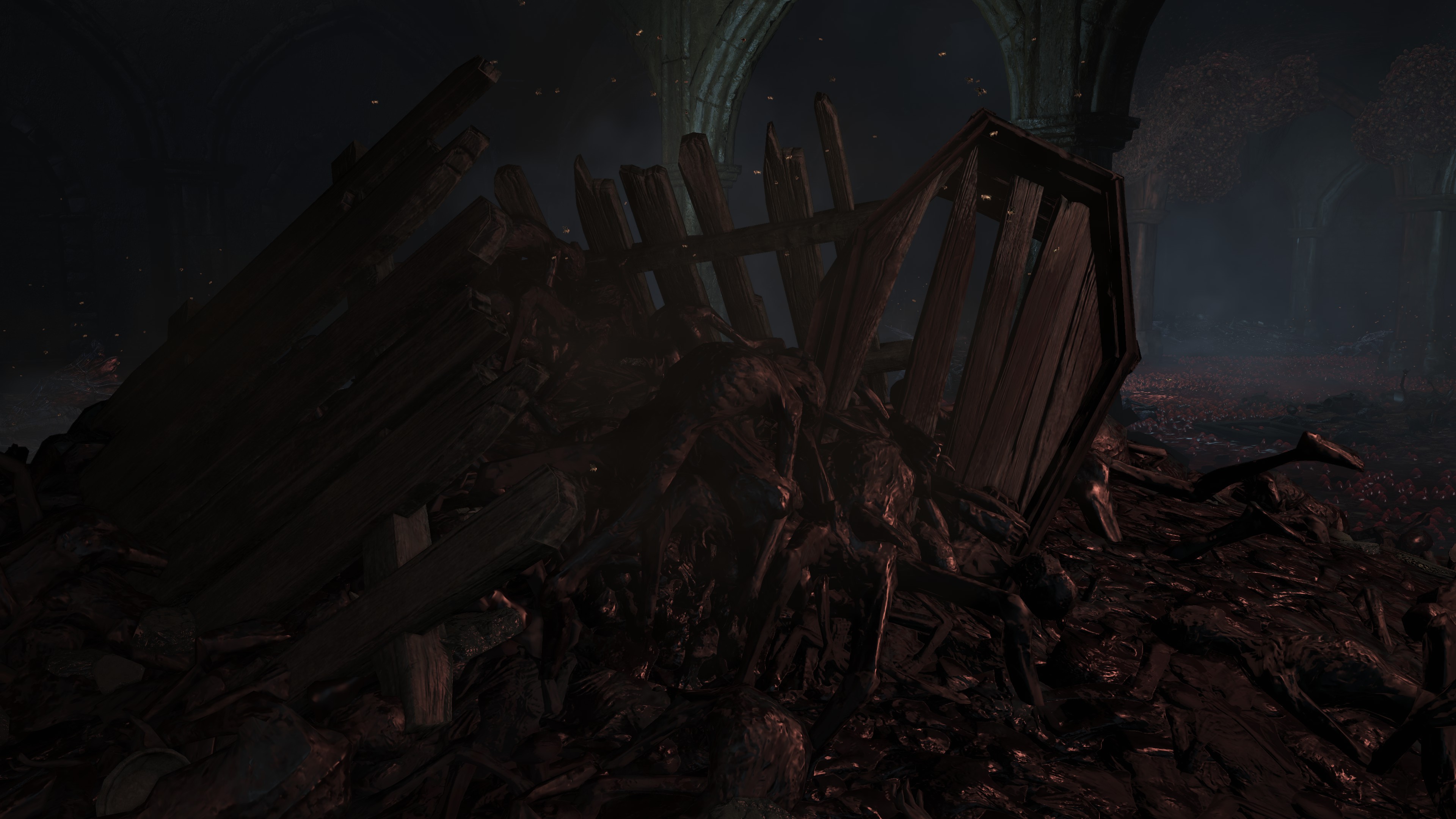

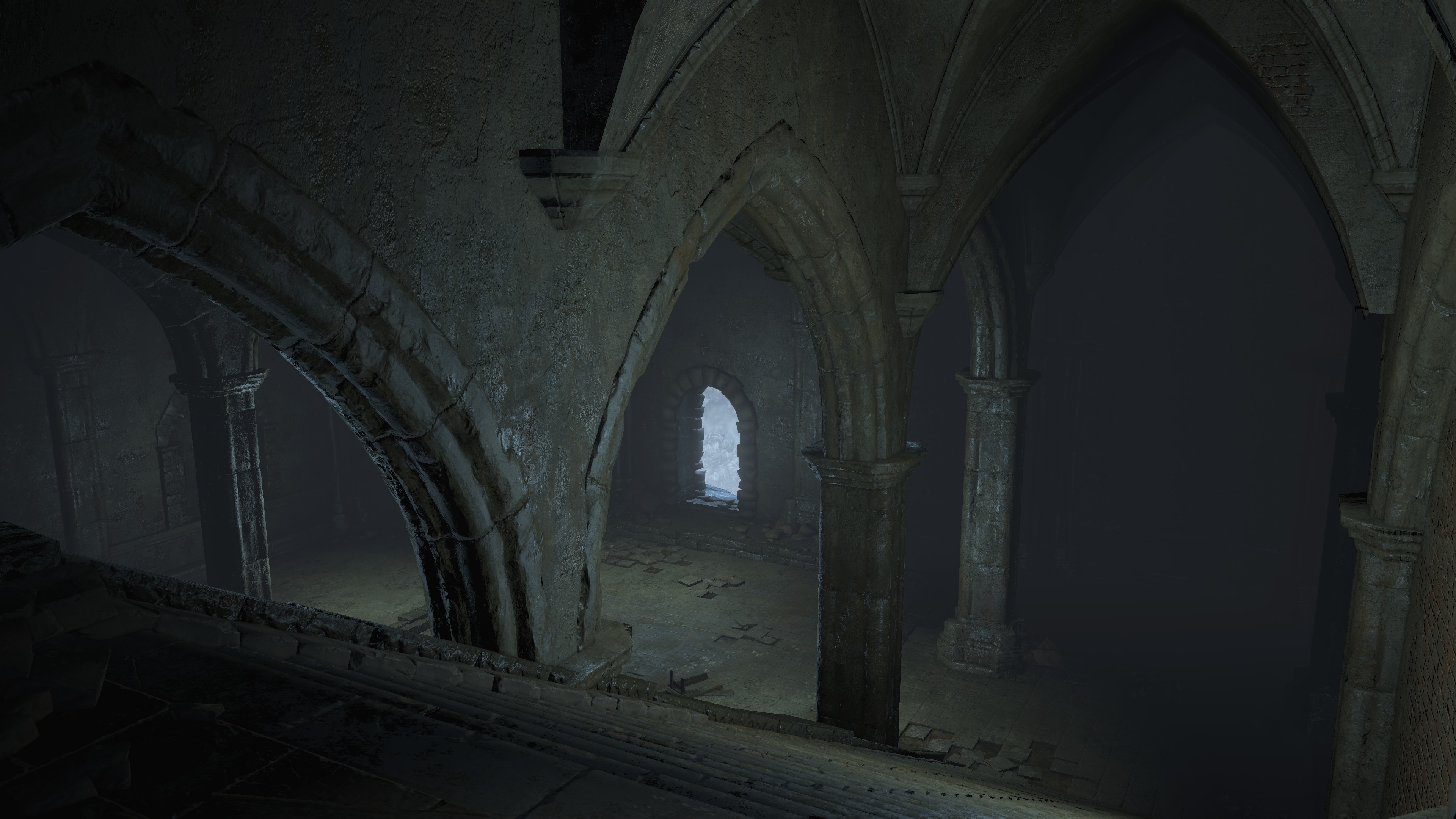


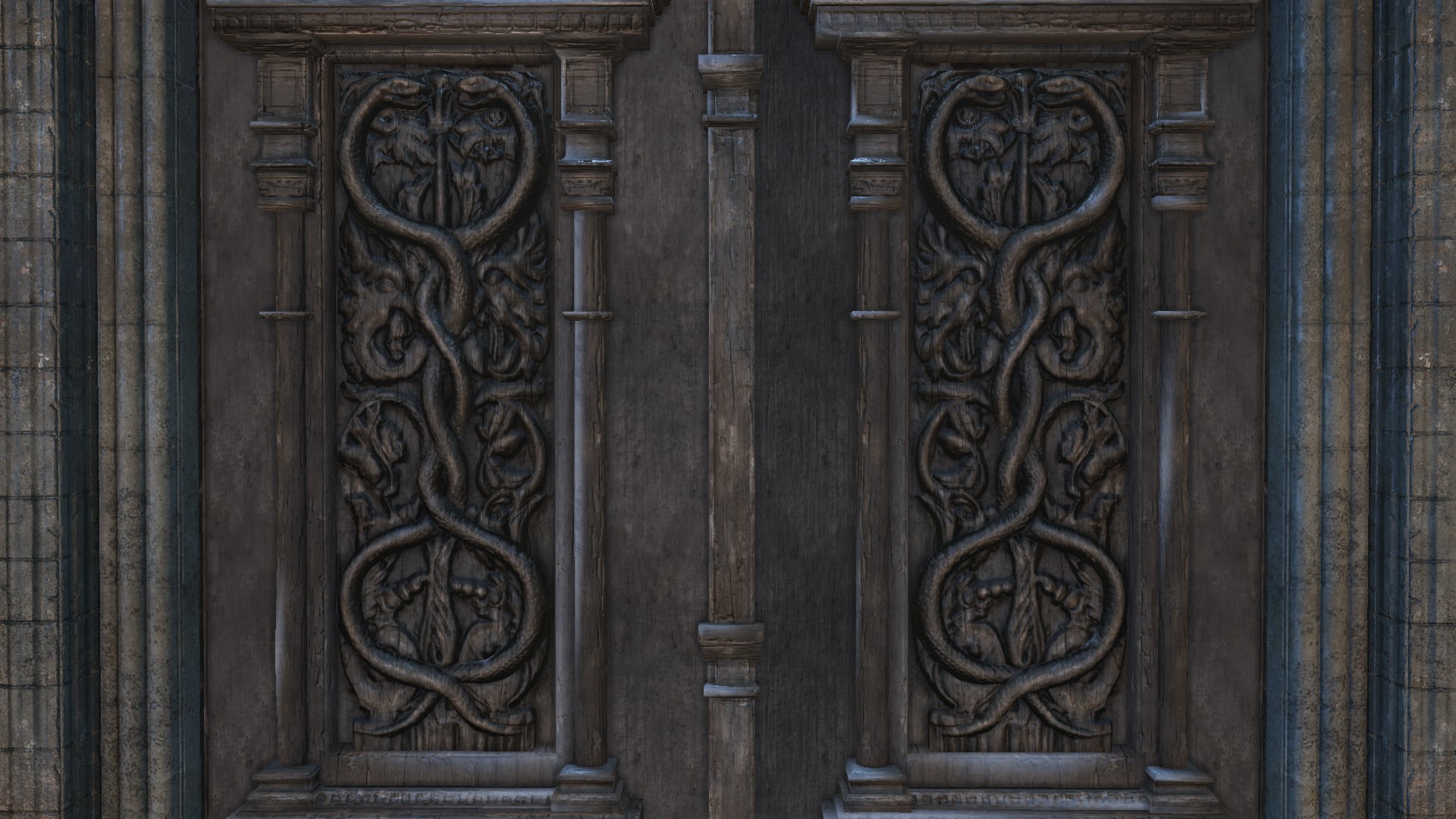
All of this is to say that Priscilla having more children with a different father is no surprise. The man in question was simply too low-profile to receive the same attention in death as the painting’s beloved half-dragon god. She was the matriarch to lead the civilization emerging at the ruined monastery, maintaining that role uncontested up through Ariamis’ decline where Ariandel then rose to similar prominence. From that point on, Priscilla took a backseat, letting the good father minister the flock while she and her family lived quietly in the chapel. The building already mirrors her old dwelling, and serpents — the common symbol of imperfect dragons — decorate the doors and walls; her painter child even uses the attic as an atelier. It is the perfect place for the crossbreed to remain, especially when so many of the people she knew growing up had probably already passed. As the steward, she could care for those she dearly missed, while Ariandel nurtured the generation trickling in.
From this position in the chapel, Priscilla had been charged with managing the influx of migrants, in all likelihood. Because of the god’s importance to the painting, it was only natural that she be the one to greet visitors. This, of course, exposed her to greater risk, but it wasn’t as if the community was reckless with that possibility. The painting “envoys” were still filtering travelers, reducing the risk profile. Furthermore, the metal gate to the chapel’s premises demonstrates some consideration for security, and they could always just cut the precarious robe bridge required to cross the valley if the outpost signaled an emergency, just as we do to climb down the cliffs. While a hypothetical menace was focused on a chapel across an insurmountable gorge, the crossbreed and her family could discreetly smuggle themselves out to the more fortified village via the crypt, aided by the library’s convenient back entrance. Everything was accounted for, leaving Priscilla free to meet many people in the course of these duties. One man got the reclusive god to open up, but he too came and went from her life, humbly buried like the rest.
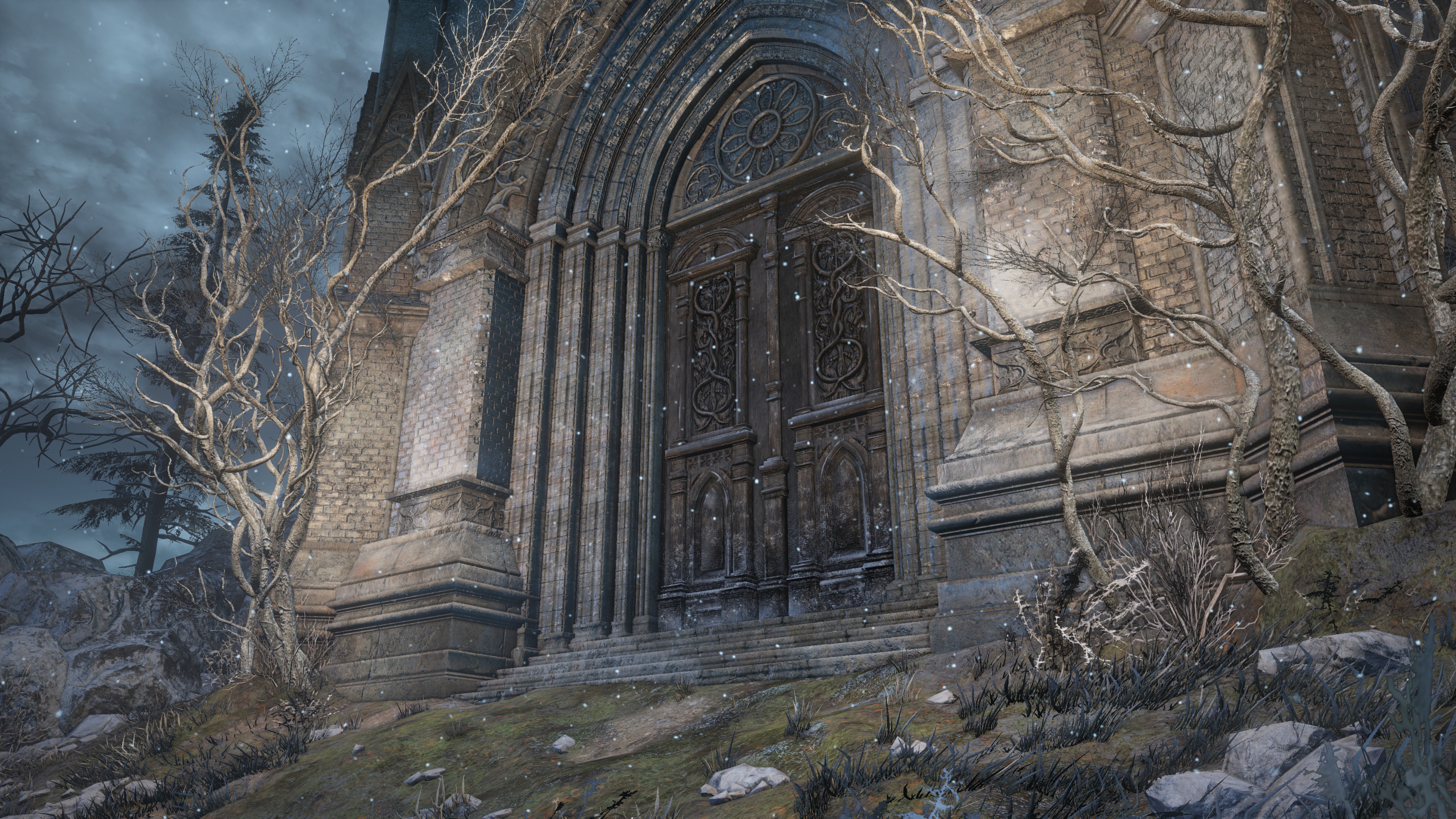



In the end, Priscilla was left with two daughters to remember her beloved by. If he was a later arrival, then the dragon god more than likely raised these offspring all on her own, with help from the community. Building upon this point, another reason to believe that these sisters were born following the creation of Ariandel is the quirk both share. Indeed, neither Yorshka nor the painter received a name upon their birth. The former received hers from Gwyndolin, implicitly in the outside world where we meet her. Meanwhile, the latter lingers in the painting and still remains unnamed, sympathizing with us should we claim the same. The world of Ariandel is obviously no stranger to the concept of names; it is only the children who are unique in this regard. But why would any loving parent not name their children? To answer, we need only consider how others in this land might view the action.
Listening to the painter’s dialogue, Priscilla was receptive to her daughter creating a new world for them to inhabit. That was presumably her position since before Ariamis was restored. But as one of the villagers elucidates, their community only more recently resolved to burn the old world in order to make way for a new one. The undesirables were, understandably, attached to this one place they could call home, and so wouldn’t easily part with it. If Priscilla ever expressed her response to the rotting canvas, she was almost certainly met with panic and outrage. Then, Ariandel demonstrated restoration as another option, earning him favor over the crossbreed. Suddenly, the half-dragon found herself in an unenviable position. With her stance on the matter already revealed, how could they trust that she wouldn’t go ahead with forsaking “them” anyway? What if she tried to sabotage them behind her backs? This might have been the first time that she had ever seen the residents act anything but peaceful and kind to her. The pressure would feel overwhelming.
With all that established, Priscilla had clearly stepped back from sole leadership and left her children unnamed in order to pacify the mob. Ariandel, and Ariamis before him, named their masterpiece after themselves. In that case, what better way to signal her intent than by ensuring her legacy wouldn’t have a name to carry on the tradition on her behalf? Even after the old god and master was gone, no descendant would inherit her idea, at least in theory. Combined with ceding control to Ariandel and retreating from public life, the half-dragon did what she could to let the new village feel secure in their revitalized home. Still, that didn’t change her opinion on the matter, as the painter’s vocation intimates. After seeing her daughter’s talent, mother dearest most likely began prepping her in secret. She alone recognized that the need for a new canvas wasn’t a choice, but an eventuality.

According to the painter, Priscilla taught that one cannot paint the world without knowing fire but that becoming captivated by fire is disqualifying. The use of “captivated” is a clear-cut reference to DS1’s opening cinematic, where gods were drawn to the flame and found the Lord Souls with which they painted the outside world in their metaphorical colors. They certainly knew fire and used it to dominate the world, but their preoccupation with it above all else arguably also destroyed their grand kingdoms. The crossbreed knows from experience, having suffered under those same gods for her Life Hunt ability — just because it was the antithesis of that fire they slavishly clung to. Fire was the tool to shape the world but always a temporary stopgap for the Dark to follow. To Priscilla’s mind, the Lords lost the right to rule when they rejected reality to drown in denial. And now, those rejected by that same world the gods created perversely cling to a world of fire which would always be temporary. Just like Gwyn and his ilk, Ariandel’s forlorn souls were refusing to see reason.
… Those who don’t know fire cannot paint the world. Those who are captivated by fire lack the qualifications to paint the world… It’s all right. I haven’t forgotten, mother…
Priscilla therefore acted behind closed doors. Knowing that they couldn’t prevent the painting’s decay forever, and likely foreseeing the long-term consequences of delaying the inevitable, what else could she do? Love her fellow undesirables as she might, she wouldn’t let them make the same mistakes as the gods who tormented her. And maybe she wouldn’t live to see the consequences, but her children certainly would, and she wasn’t going to leave them helplessly unequipped for the situation when the moment of crisis invariably arrived. Perhaps she hoped that everyone would come around to her thinking by that point, seeing what their decisions had wrought — and from the words of that one corvian villager, she would be right. Contrast to the outside, they now accept that burning one rotten world to make way for the next is the decent thing to do. At last, they choose stagnation no longer.
But before the villagers resolved to let their painter know fire and accept a new home, their precious dragon god had passed away. Given the circumstances, it is suspicious. All she had been doing was welcome new migrants and care for the dead. What could have killed her? Old age? Unlikely. Even assuming that the crossbreed lacked a dragon’s immortality, she should still be long-lived, especially with medial blood. The woman was far younger than most of the gods, and some of them are still around. How about illness? She should have received the best of care, and if the painting didn’t filter out plague victims, then the community would have been wiped out long ago. That leaves either a tragic accident or foul play — and with the stakes at hand, there was ample motive. Even in DS1, Priscilla was always hesitant to weaponize her powers against others, despite past experience. That passivity could easily backfire, as her boss fight showcased. If the painter’s hobby were to be discovered, that would lead to a confrontation, and anything can happen with tensions high.
Put simply, Priscilla was probably martyred for her position, whether or not that was the perpetrator’s intention. After all, she should still have been loved and respected by Velka’s worshipers; assassination was doubtless too extreme. Maybe the incident was due to an unruly mob getting out of hand when voicing their grievances to her in person. Alternatively, no one found out save for one individual. If we were to pin it on a single culprit, Father Ariandel is the obvious choice. He was the one most invested in the current painting and most liable to meet with Priscilla and her family on a regular basis. Add to that, the man has a mean temper, flying into a violent rage when overwhelmed with emotion during our boss battle. Combined with his imposing physique, it is possible that the corvian got too aggressive in a heated argument about the crossbreed’s “betrayal” and inadvertently killed her. Shoved to the ground and cracked her skull, smacked into a wall and crushed her lungs, throttled until her throat snapped — it would only take a single thoughtless act from seeing red.

Specifics aside, the fact remains: Priscilla died, and the village was all but guaranteed at fault. No doubt Ariandel and the others felt some measure of guilt from what had occurred, hence the shrine. Even if it was unintentional, we would expect disquiet among the populace from losing their biggest mainstay; they could have even started playing the blame game. Father Ariandel, too, might have spun events to absolve himself of responsibility, but the continued respect for the pastor affirms that no suspicion fell on the corvian regardless. Some may have even argued, in the back of their minds, that it was for the best that the god passed when she did, before she could threaten their precious painting world. Ultimately, no amount of consternation would translate into punishment for this inarguable failure. Retribution instead had to come from the outside world, in more ways than one.
Fanning the Flame
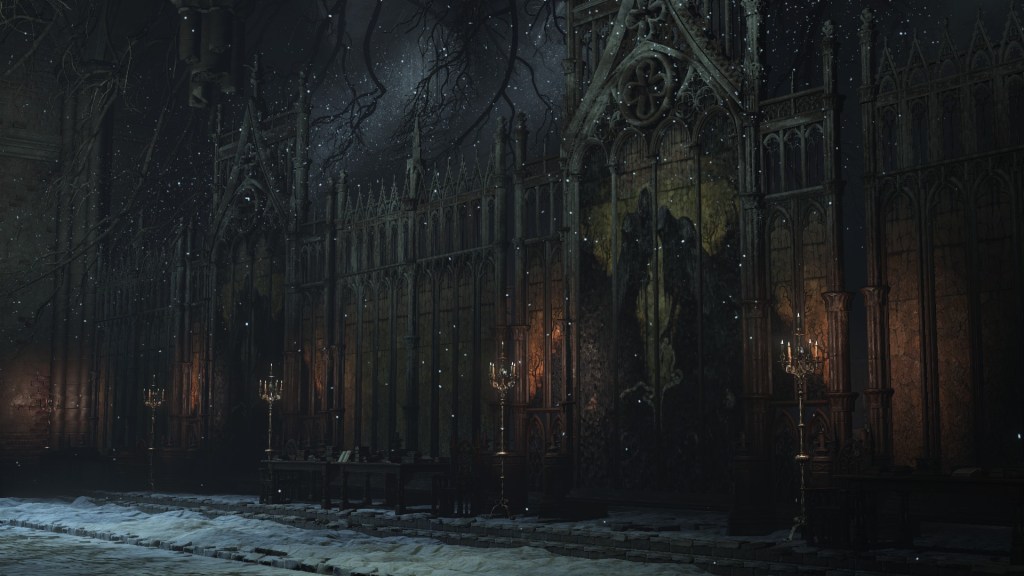
In time, a prophecy appeared. Gael and Father Ariandel both quote this forecast of two ashes producing a flame, which they recognize as Ariamis’ special flame burning up the painting once two unkindled come together in the painted world. This oral tradition ties into Priscilla’s death based on the rood screens accenting her memorial. Each screen portrays two large figures with pale faces and embered arms at the center of a burning land. One stabs a white snake with a sword while the other crushes an identical snake with his or her bare hands, hence the label “stabber and crusher” (刺す者と握りつぶす者) in the mural’s texture file. These are clear allusions to the two unkindled causing the painting to burn, the two snakes with black blood representing Priscilla’s surviving daughters — their deaths signaling the total destruction of the old regime and the true end of the white dragon’s legacy with the painting. None of this seems appropriate for the chapel’s inner sanctum unless it bears some relation to the crossbreed’s own demise. She is dead, and now prophetic words answer questions of her legacy.


“Someday, ash will be two, and they will rouse fire.” Fire really does suit you, ash…
I have a favor to ask you, a fireless ash … My lady’s in a cold country called Ariandel. I want you to show her fire. A special fire that’ll burn down the rot. If you’re ash, you seek fire, don’t you…?
… I see. That’s regrettable. I’ve already been waiting all this time. For the remaining of the two ashes in tradition, those who will burn Ariandel… Ah, if only. If only you were the other ash…
This begs new questions about the identity of the soothsayer. The prophecy certainly wasn’t welcome to Ariandel. The village hadn’t resolved to burn the painting until not long before we, the alleged second ash, entered the snowy world. The screen mural likewise depicts the two ashes in black cloaks, their faces obscured by hoods like some terrible Grim Reapers, the trees burning behind them dead as autumn while the residents burning beneath them pleading like the damned in hell. Nothing about the image paints the tradition in a positive light, only reminding visitors to Priscilla’s memorial that they will be helpless as these augured ushers of change destroy the last of what they love right before their eyes. The powers that be, chiefly Father Ariandel, must be reluctant to acknowledge this future to the restored painting. Who then could convince the village that the prophecy is not just legitimate but unignorable? The answer lies behind the same mural.
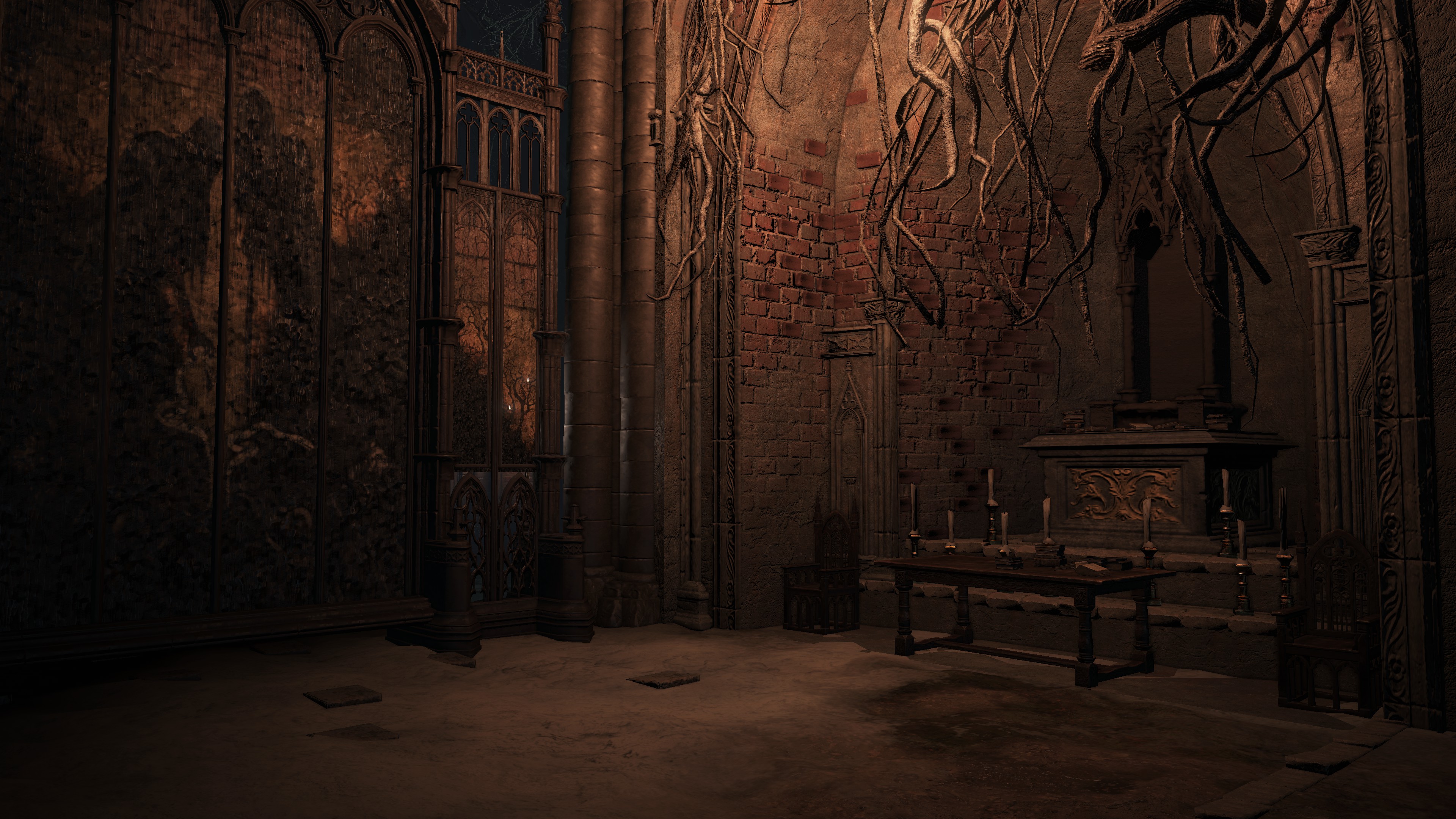
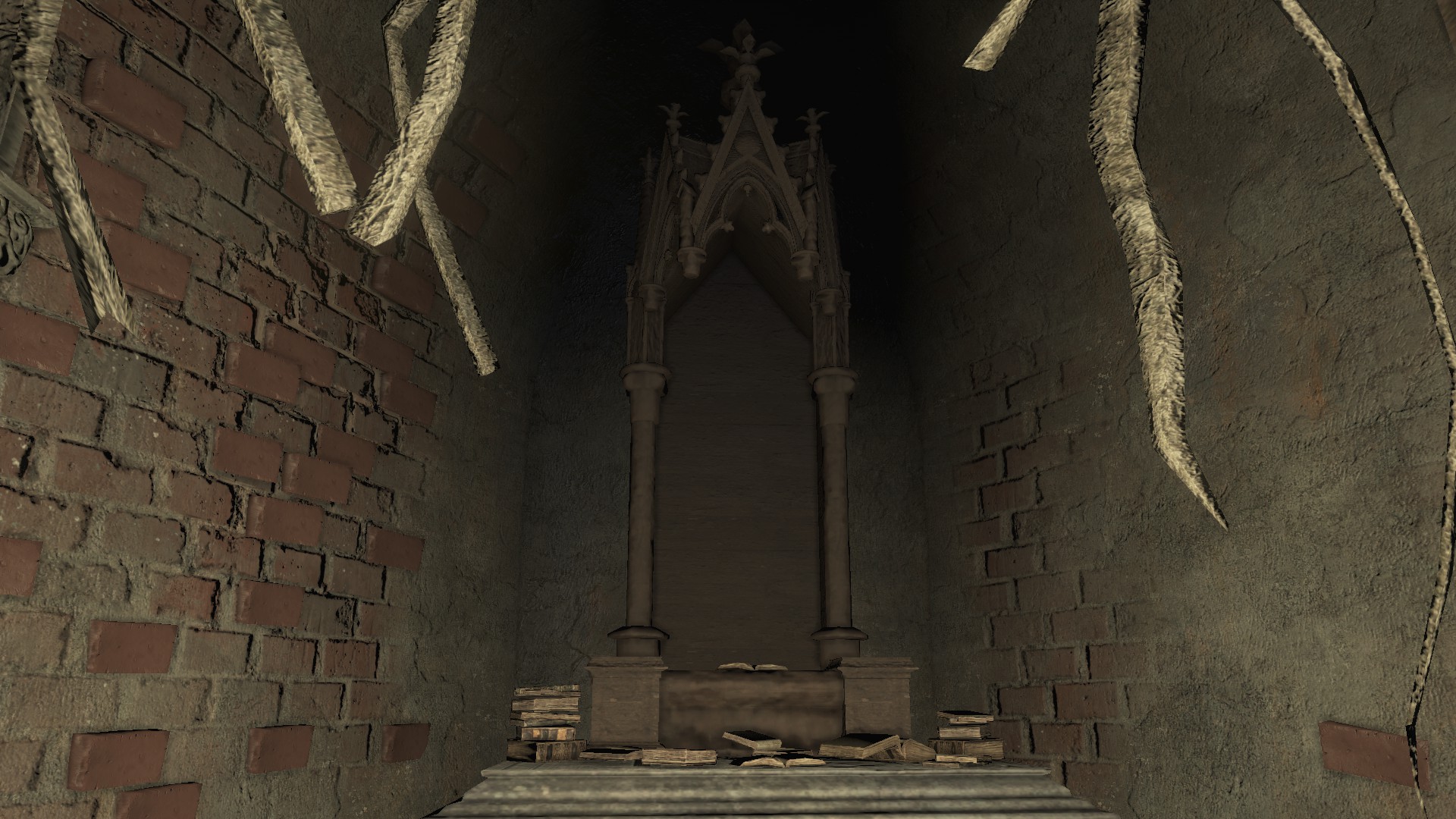
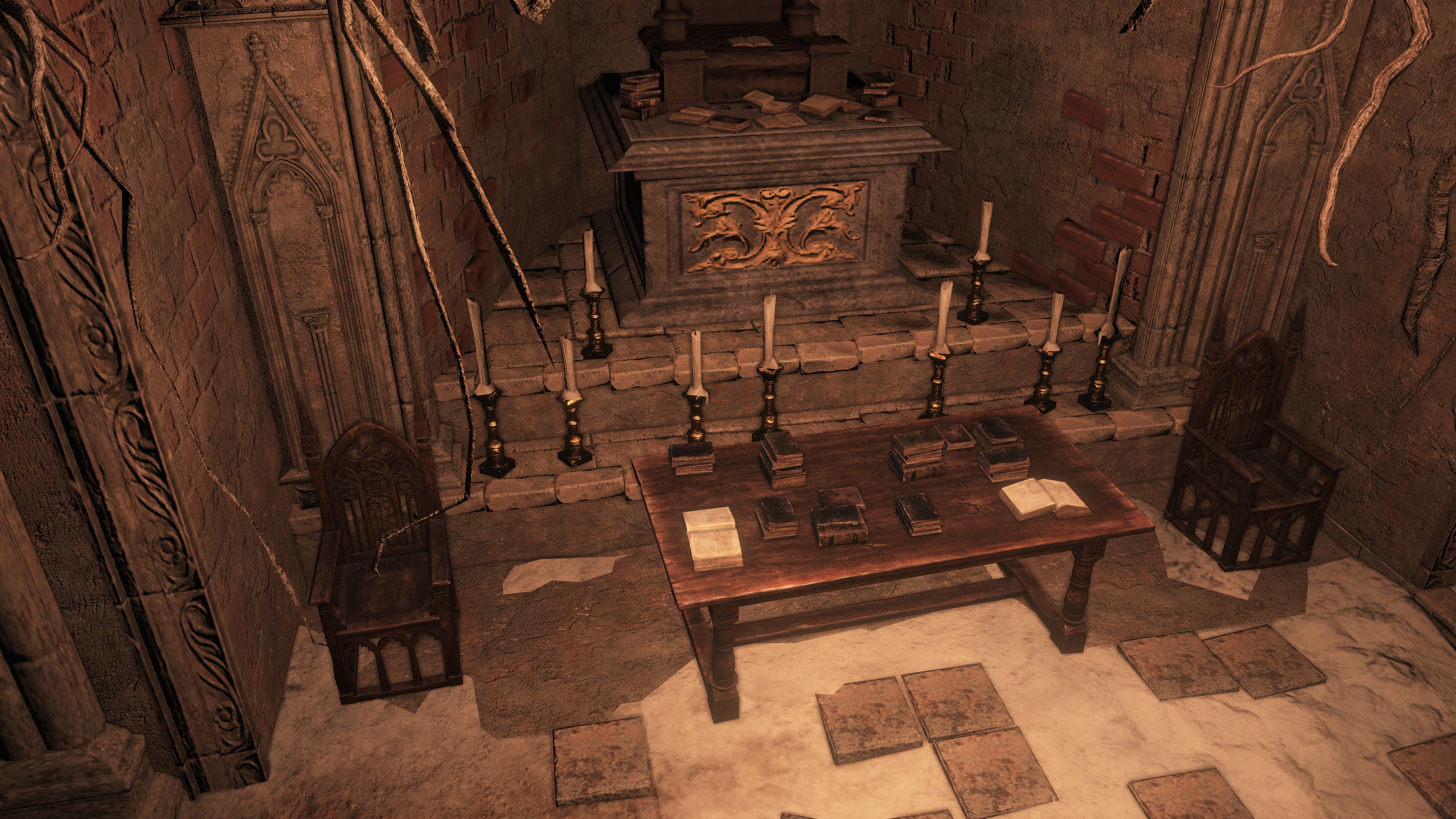
A rood screen serves to partition the laity from the altar during religious service, and we do find altars in the four corners of the room behind both screens. Like the shrine to Priscilla, each altar is relatively small. And while the above niche is missing its idol, we can infer who was dedicated from the copious books laid upon the actual altar, just like in the village church. Tables and chairs with yet more books precede the altars and screens, the village library’s statues spanning the walls in between. This was evidently another shrine to Velka, a place where those fearful of the prophecy or guilty about Priscilla’s death might come to pray for forgiveness. Indeed, the Goddess of Sin was certain to learn about what had transpired, through their appeals to her idols or otherwise; given her associations, one might wonder if the crows circling the chapel overhead are her familiars. Regardless, the mother of the forlorn would be angered to hear of her one true daughter’s premature death under their protection. That is the one sin she will never forgive — and was it not her duty to mete out the punishment for sin?





In short, Velka is the most likely source for the oral tradition, a goddess whom the painting’s worshipers cannot disregard. One might question how she was able to accurately predict Ariandel’s future, considering the specificity. However, if there is anyone to legitimately possess powers of prophecy, it would be the witch knowledgeable of all magical arts. Maybe she peered into the Abyss to briefly see across time and space, or maybe she utilized just Ariamis’ flame. Whatever her method, the god made a reliable and, more importantly, credible assertion about Ariandel’s fate. As the games have established, history can be distorted, but the past itself cannot be changed, so sharing the facts wouldn’t affect the outcome. And even if the events would come to pass regardless, sharing them served as a condemnation for the people’s sins, to know that their resistance which brought about the half-dragon’s demise cursed them with the awareness of its futility. Priscilla died for nothing, and now no one would comfort them in the meantime.
Velka’s involvement further explains the painter’s immortality. When killed, the girl appears to perish like any other NPC, except she will return without change after refreshing at a bonfire. From her “post-mortem” dialogue, the crossbreed can’t truly die, allegedly because she is to paint the next world. In other words, someone must have cursed her with such miraculous resurrection as a safeguard against those poised to prevent the village from embracing a new home at any cost. There are only two individuals with motive: Priscilla and Velka. But if the mother could foresee her child’s death and thwart it, why not do the same for herself and the rest of the family? That leaves the grandmother, who has both the knowledge to impose such a curse and the incentive after seeing how the village failed Priscilla. She couldn’t trust Father Ariandel and the others to sit idly by as the prophecy was fulfilled, and so the witch cast a spell to deny them the chance to stop a new painting when the hour did arrive.
The curse probably relates to the painting of Ariandel itself. Every curse of immortality has a source, whether it be the owner’s soul or some external concentration of power. In her case, what better way to safeguard her life from the painted world’s inhabitants than to bind her soul to that same dying world? This would fit with why the painter has never left her cold homeland like Yorshka has; she physically can’t so long as she is tied down inside of the dimension. It could similarly justify her adolescent appearance compared to her sister, the body frozen in time even as the mind continued to mature. Moreover, this makes it impossible for anyone to destroy the painter without also destroying the painting. Until the snowy land has burned up entirely, she is safe from lasting harm and impossible to remove from the equation.

In that scenario, the corvian village has no choice but to accept the prophecy and the inheritor of Priscilla’s will as their deliverance. Velka’s judgment is absolute, thus the sinners could only repent as they awaited the ash to arrive. They still dreaded this inevitability, so it was an apt punishment, not to mention a way to honor the crossbreed’s will from a mother who also failed to save her beloved child. Did the goddess still care to listen to the painting world’s prayers after that? If so, maybe it was only to laugh at their desperation. Even so, the crow men’s worship continued, piling on guilt and regrets as they held out hope for their precious Ariandel’s survival. But Priscilla was still dead. Nothing could remain the same. Embracing a fantasy for as long as possible, they had yet to realize that sobering reality.
Spread Word of Bird
The loss of Priscilla left a hole which just kept growing. It was presumably at this point that the outpost was abandoned to become the ruins we know at present. In all likelihood, the painting guardians on staff followed Yorshka out of said painting. We can only acquire the guardians’ equipment in vicinity of the daughter, with no sign of them inside Ariandel. This makes sense, since the painting’s protectors worshiped Priscilla, their white robes and dance-like swordplay embodying her elegant form. With their idol dead, what point was there to remaining as the painting’s protectors, filtering who came in? Clearly, their screening didn’t change anything. Because the painter is safely immortal, the only remnant of Priscilla still in need of guarding is Yorshka, especially if she was departing for the outside world she never knew. Therefore, they too had probably abandoned Ariandel to its fate.
This didn’t stop undesirables from stumbling into the painting. As we can see, entire groups like the Farron Followers or Millwood Knights have found their way inside, though they have chosen to roam the wilds as Hollows rather than integrate into corvian society. Other late arrivals may have opted to become part of the village — the final destination for these travelers’ souls — but it was no longer an organized system as before. While this surely exposed the village to more dangers, the community seems to have retained the view of their homeland as a haven for outcasts like them. Keeping that in mind, they sought to continue adding to their number, saving as many as possible. To facilitate that, they needed new envoys to bring in those fresh faces. And, naturally, the religious body stepped up to the plate.
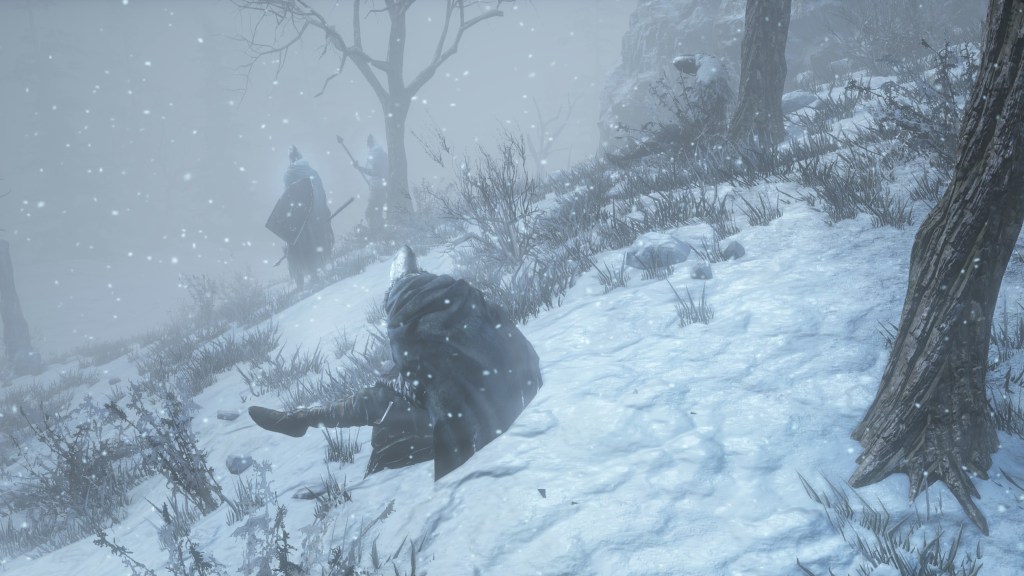
Certain corvians have taken it upon themselves to spread the good word of Ariandel. These so-called storytellers share the legends of Priscilla, the painting, and its guardians to other undesirables in the outside world with the obvious promise that they too can find salvation in the land of Velka. To no one’s surprise, their heretical message finds sway among the poor, pitiful, and desperate. Whether preaching or supervising, the storytellers are always found guiding a small congregation of fellow corvians. Unlike the Ariandel villagers, these crow men look more human, their only uniquely avian quality being their scaly, taloned feet in digitigrade stance. Still, they do have the same blackened skin and hunched backs, so we can infer that these congregates are simply at an earlier stage of transformation on account of their more recent conversion to Velka worship. In fact, we bear witness to these crows sprouting their wings as they deepen their devotion to their new mother. Until not too long ago, these corvians were human, specifically Undead.
The storytellers typically possess hollow gems, titanite altered in absorbing the Undead curse. In comparison, their flock possess shriving stones. This “forfeit stone” (喪失石) resembles shed insect skin; sickly white, cracked open, and hollowed-out. That is why the altered titanite is also called a “husk stone”, (抜け殻の石) and the name gives the impression that the corvians have similarly cast off something from their bodies. Indeed, the stone has lost any special effect it once had other than bonding, making it the perfect receptacle for the unique powers of weapons it is hammered into. We thus use shriving stones to remove any weapon enhancements from other gems, but then wouldn’t that make those stones husks themselves? Put simply, the shriving stone implies that the corvians were similarly sucked dry of power, namely their humanity at the heart of the Undead curse. The storytellers help with casting out their human nature, like an exorcism. And the result is hollow gems, not dark gems, because the preachers’ worshipers are specifically bearers of the Darksign.


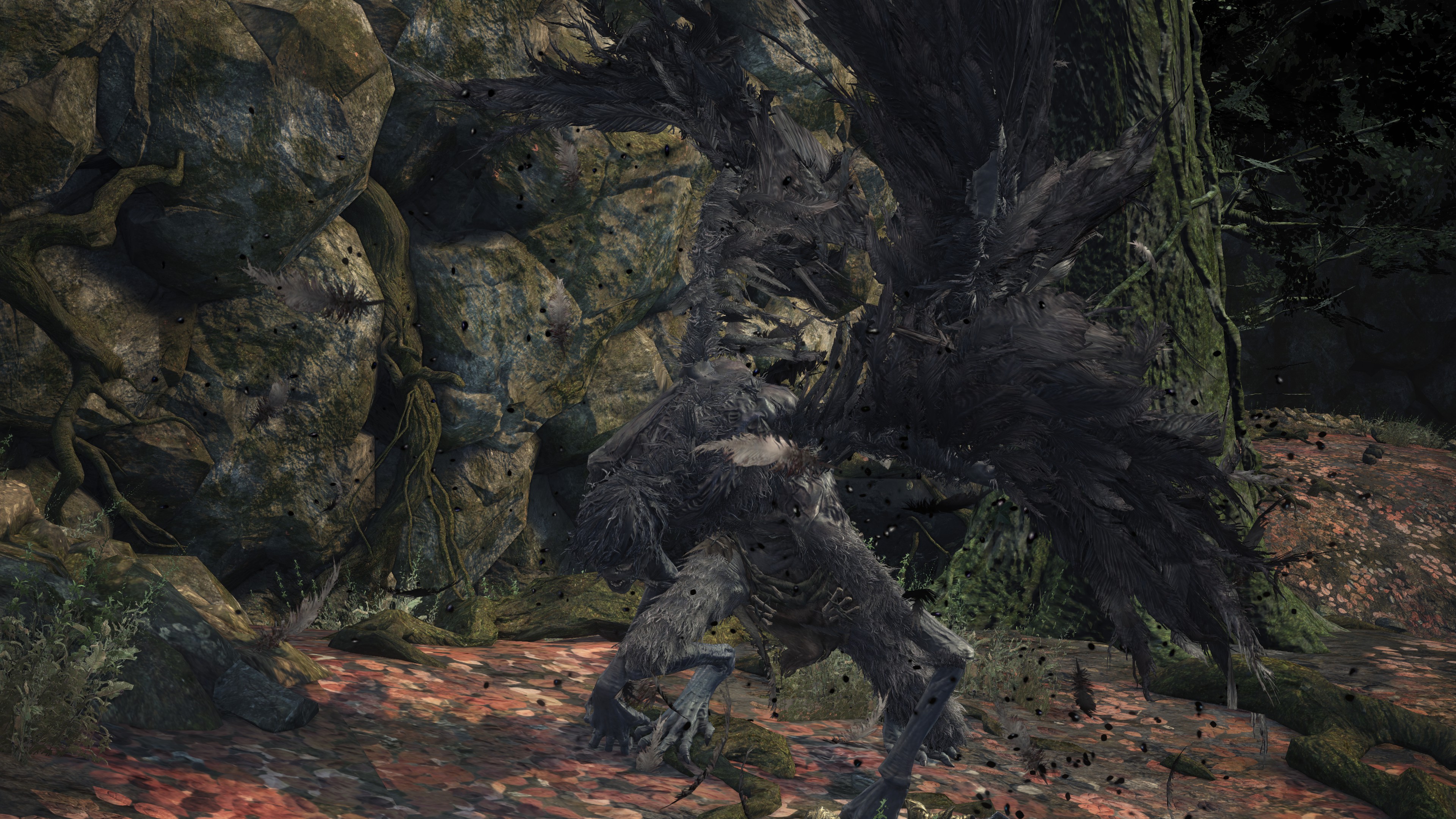


Lothric is currently a land rife with cursed cast out of decent society, so the corvian storytellers would find no shortage of Undead looking for a place to belong. We see this in the behavior of the converts. Many craft especially large daggers to defend themselves with, but the description acknowledges this to be the bluff of a pathetic soul scared at our simple approach — like a cornered animal, these trembling and evasive creatures suddenly lash out wildly, desperate to survive; the stress might even be why their transformation advances at that exact moment. Furthermore, trading in their shriving stones to Pickle Pee nets us the I’m Sorry Carving. These corvians are traumatized by the scorn of others and see Ariandel as their escape. We do find more praying for sanctuary in front of the chapel; the corvian in the cave is another such example. Next to him kneels a corpse clutching a Rime-blue Moss Clump close to the chest with a smile, happy to have finally reached the cold. For all of them, this is the place to be.
Dagger of the undesirables, guided by heretical storytellers.
It is large for a dagger and has high attack power, but this largeness is likely a manifestation of their fear. It is a pitiful bluff.
The storytellers have been proselytizing effectively, without question, and the depth of their flock’s knowledge proves equally as impressive. Some of these corvians have crafted reapers’ scythes, each possessing a lacerating slice. Despite the localization claiming that the bleeding is so profuse that it “splatters” on the wielder, the text actually echoes Lifehunt Scythe in the deadly bleeding effect simultaneously rebounding on the user. Much like that weapon crafted with Priscilla’s soul in DS1, the corvians’ scythe possesses the incredible capacity to reap life while acknowledging their own vulnerability to that power. This plus the description’s reference to the painting’s master affirms that they are trying to imitate Priscilla. The storytellers inform the faithful about every little detail concerning the legendary half-dragon, which shouldn’t be astonishing when these missionaries wield a sorcerer’s staff. Befitting Velka’s worshipers, they rely on detailed facts to animate their tales, lending credence.
Great scythe of the undesirables, guided by heretical storytellers.
The great scythe is said to be the choice weapon of the master of the painting. Its attacks force massive bleeding, but it will also rebound on the user.
Helping along with this credibility is firsthand experience. The storytellers themselves are undesirables who have yet to fully transform. More than likely, they consist of previous pilgrims to the painting, where they begged for sanctuary, received an audience, learned from the chapel, then returned to the outside world to bring in more like them while deepening their faith — until they finally complete their transformation into a crow and can be welcomed as a proper member. That explains why they alone possess wings before the flock engages in battle, as well as how they get around far and wide across Lothric. They have definitely been to the painting first, since they have the ability to spew fire from the tip of their staves — the wood of the staff presumably born from the flame power of Ariamis and the painting. They have confirmed the truth to the legends with their own eyes, making their message all the more appealing.
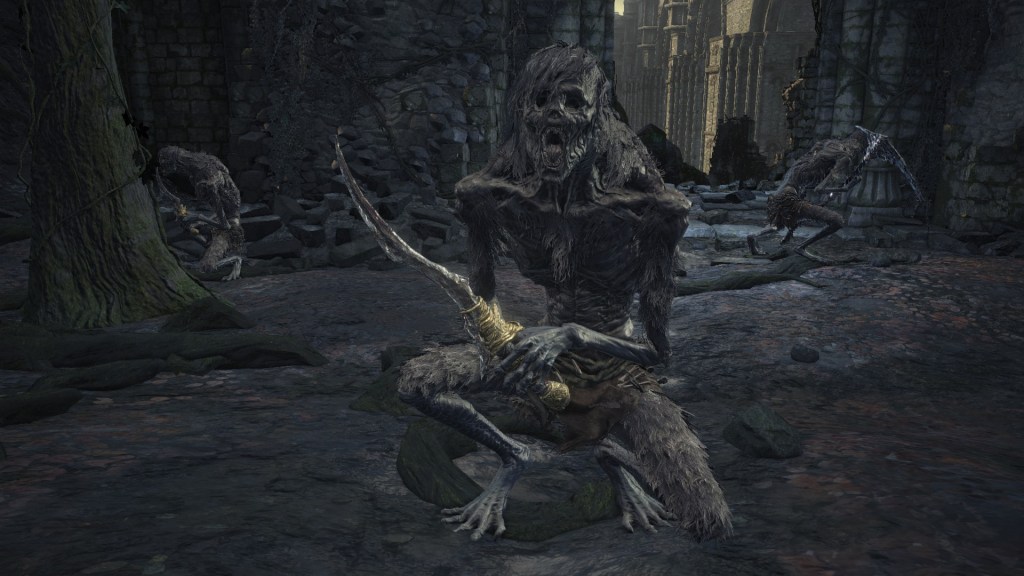
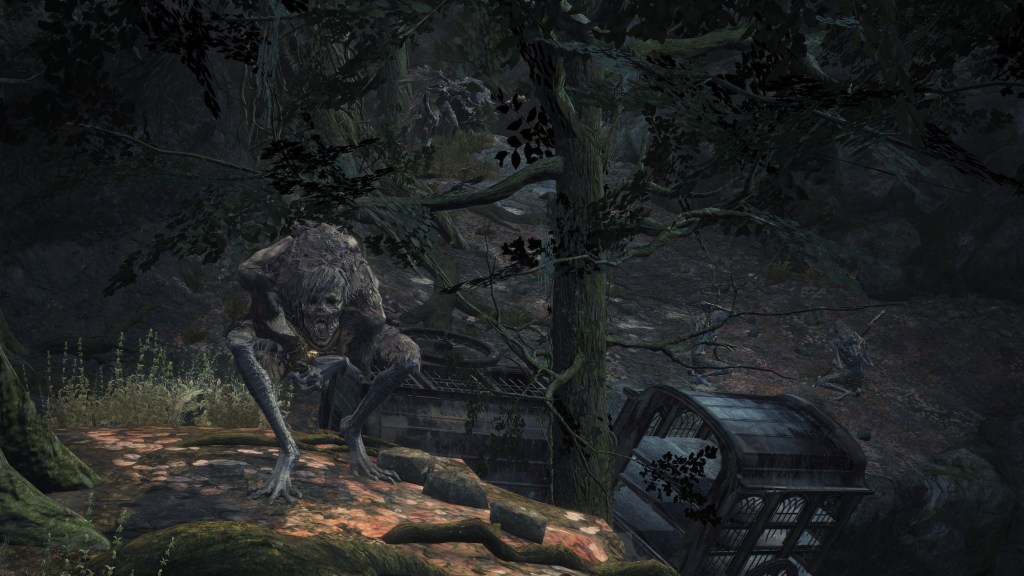
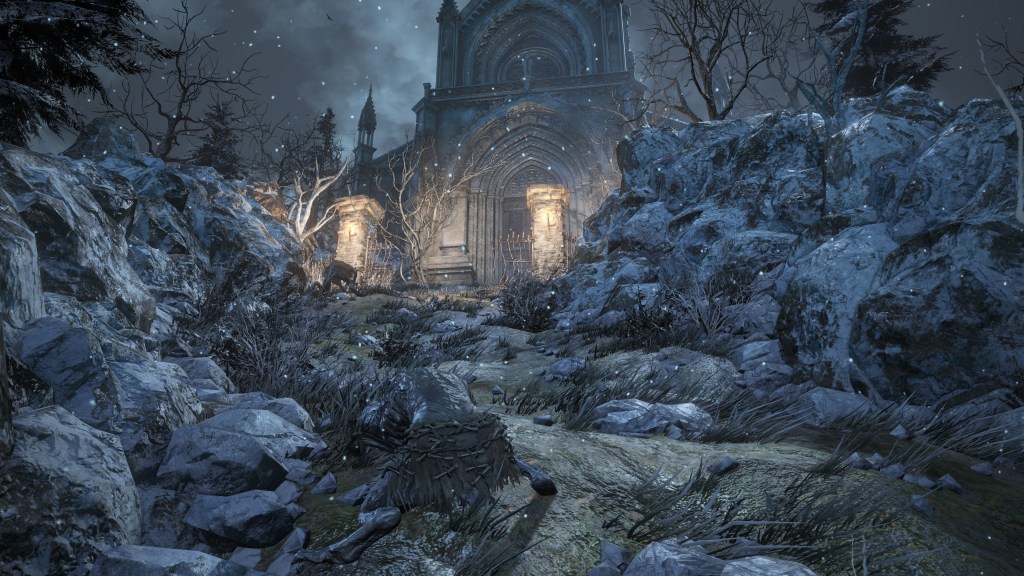
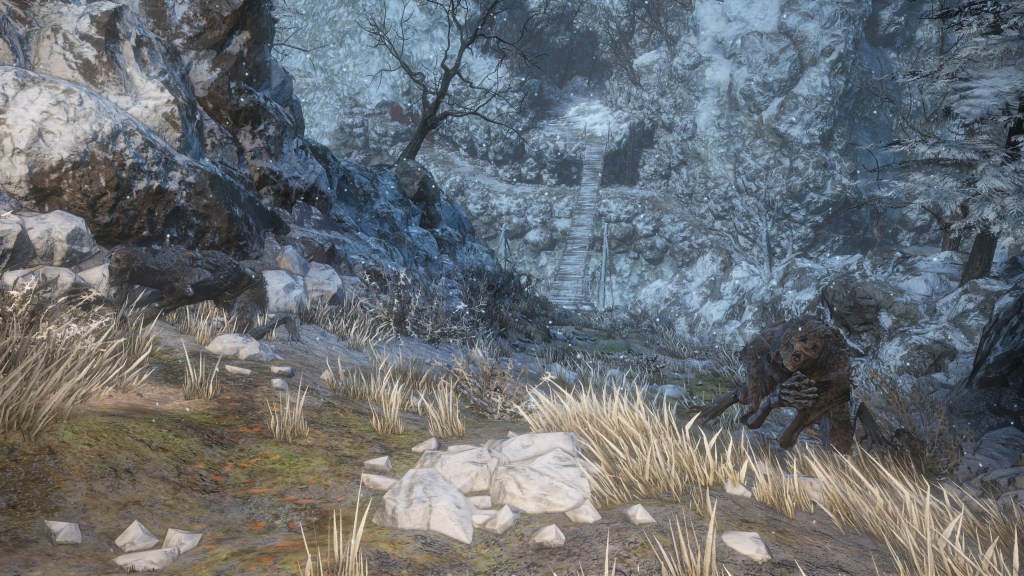

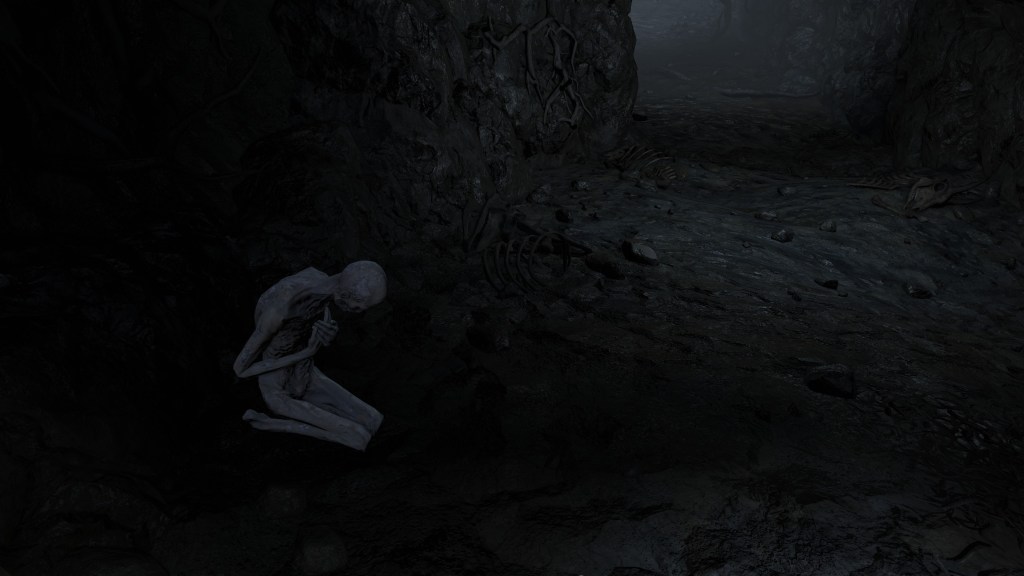
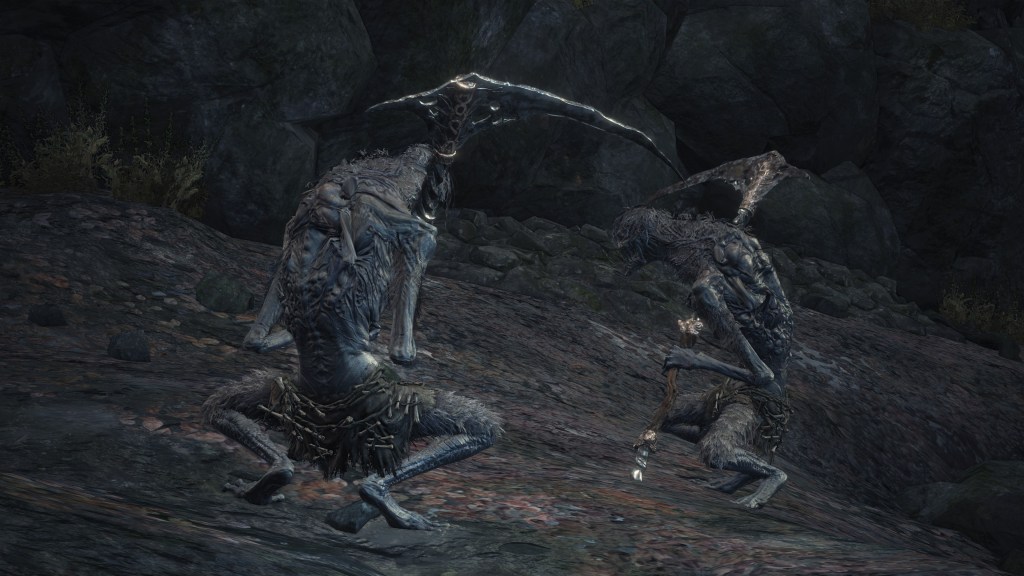
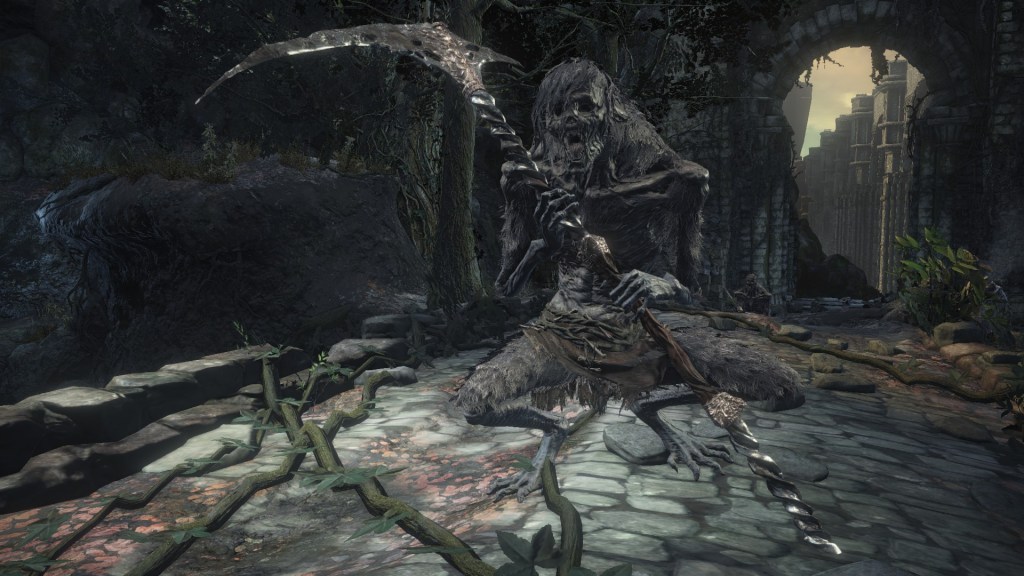


It is no wonder that a storyteller commands so much respect from his audience. In his esteemed position, a single screech can send the while flock into a frenzy, rushing to their preacher’s aid following their winged transformation. The only question is how long they must listen to him regale them of the old tales before they are sent off to find that paradise for themselves. Perhaps they are directed to a piece of the canvas kept safely tucked away somewhere, or perhaps they are simply expected to wander until stumbling upon it. It might even be that they are asked to wait until they hear the toll of the bell to beckon them. Whatever the specifics, those undesirables we encounter on the outside are yet in the early stages, hanging onto their teacher’s every word. And although advertising the painting to the rejected and downtrodden has seen overwhelming success, the storytellers’ honeyed words downplay an ugly truth as of late: these witnesses to the haven, like their staves, have been corrupted by rot.
Staff of heretical storytellers, who recite the painting’s legend to the undesirables.
They themselves are undesirables with no place to belong. Their bodies, their souls, and their staves are wholly corrupted.
Infestation Illustration
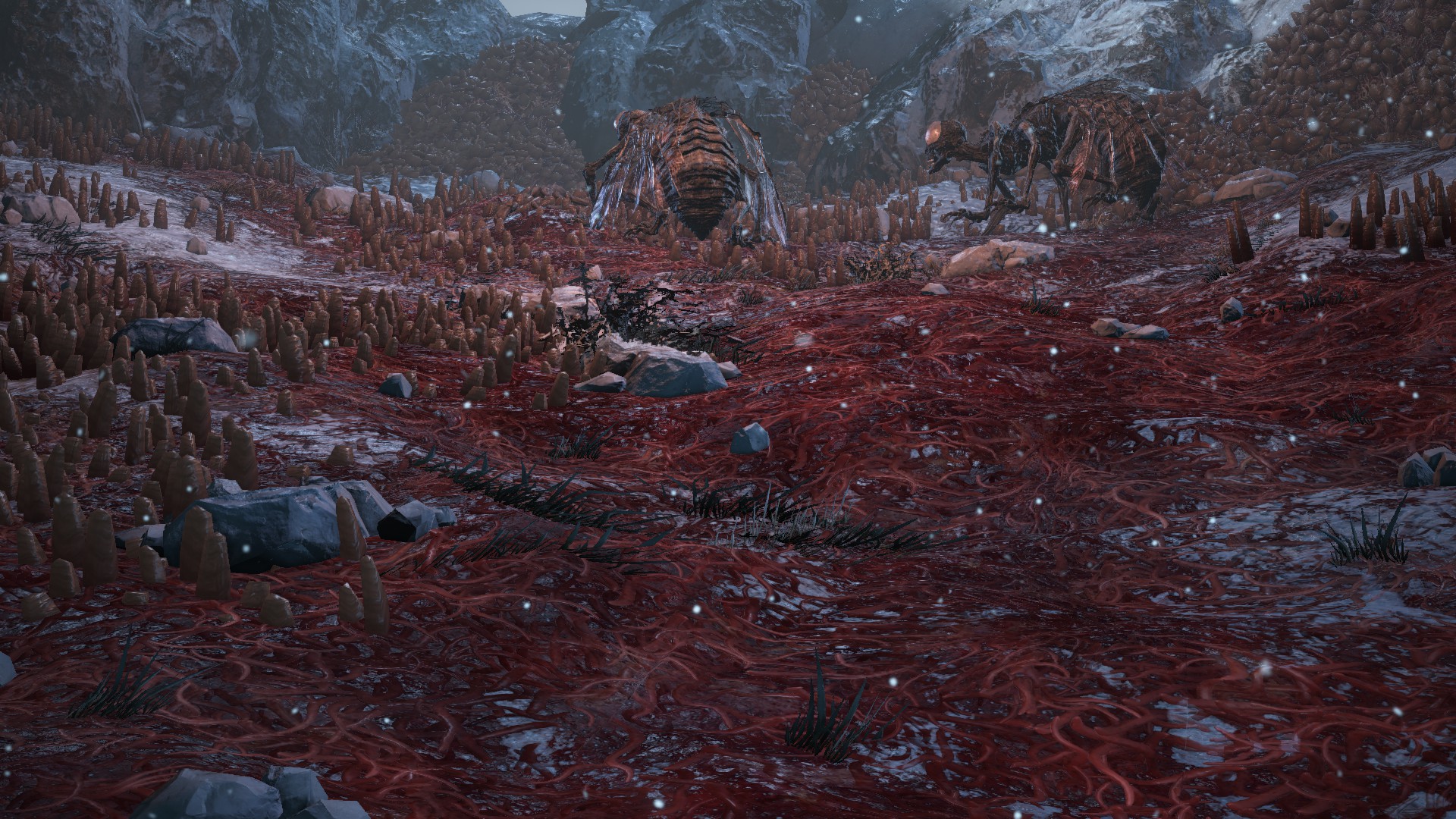
All across Ariandel, we witness patches of the painted world covered in anomalies. Upon closer look, it appears to be a kind of fungi. The corvian of the cave identifies this with the rot, and it is consistent with what we learn from the storytellers. Fungi have similarly “parasitized” their wooden staves, the corruption unleashed as noxious spores. There are disparities. The painting’s corruption tends to resemble the xylaria polymorpha or scleroderma species of fungi, whereas the staff appears covered in more common polypore and mushroom species; the painting species are also consistently colored blood-red while the staff fungi is unambiguously bleached. The discrepancies may be due to evolutions of the concept between the game’s launch and the release of the DLC when Ariandel first became accessible. At the same time, the staff’s description acknowledges the “variety” in the corruption, so the differences aren’t irreconcilable. To that point, the rot even takes on non-fungal forms.
Battle art is “Poison Spores”. Spew spores that have the poison attribute from the variety of things of unknown nature that have parasitized the staff.
The corvian village is the area most infested with the rot’s corruption, and that includes the corvians themselves. Each villager drags around solidified dung hanging out of the rear like a tail, hair-like growths emergent from the filth. In more severe cases, the crow man’s entire body is sprouting roots, and will vomit not just filthy but toxic blood. These crows aren’t healthy, and the only explanation for their condition is the rot. You are what you eat, as the saying goes, and what have the villagers been feeding on in their mess hall if not produce of the painting — in other words, the painting itself. After years and years of assimilating Ariandel’s substance, that substance is now rotting the corvians from the inside out. Not even the storytellers, with their relatively brief sojourns, have been immune to this corruption, their bodies and souls apparently sullied even if they have yet to show visible symptoms. With no other notable irregularity to be found within the painting, we can be certain that the storytellers wield not just the painting’s flame but also its rot.
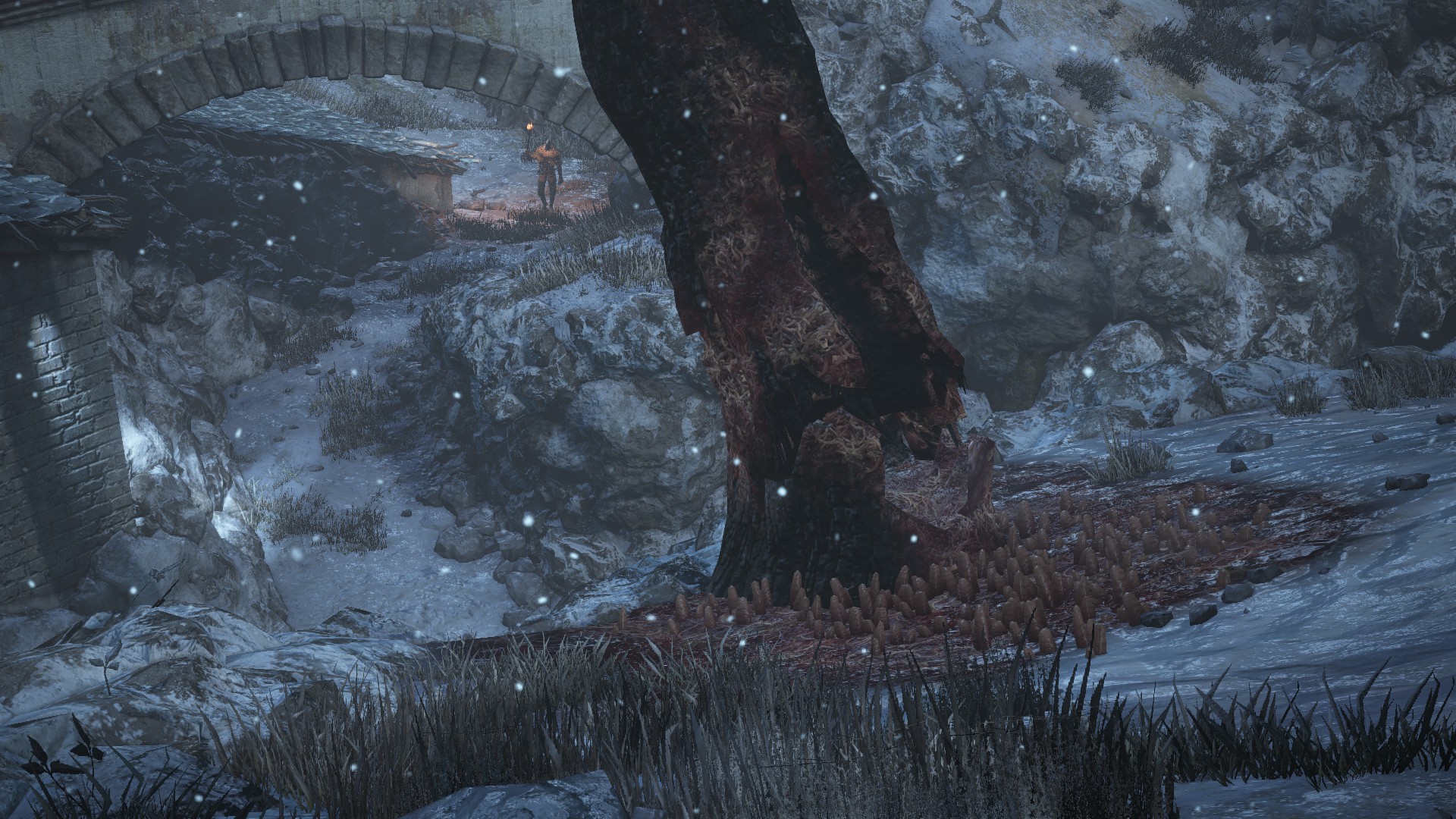

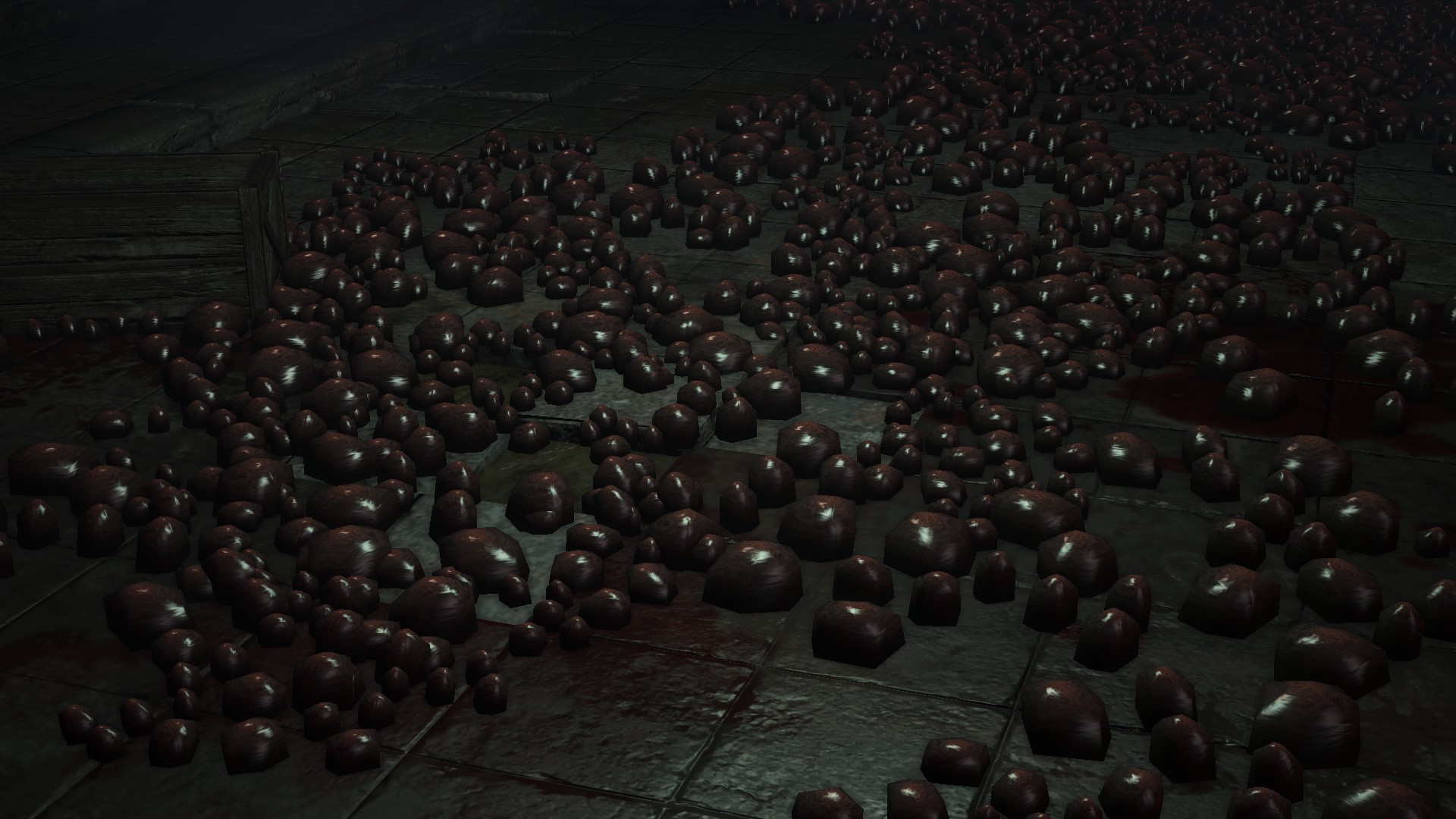
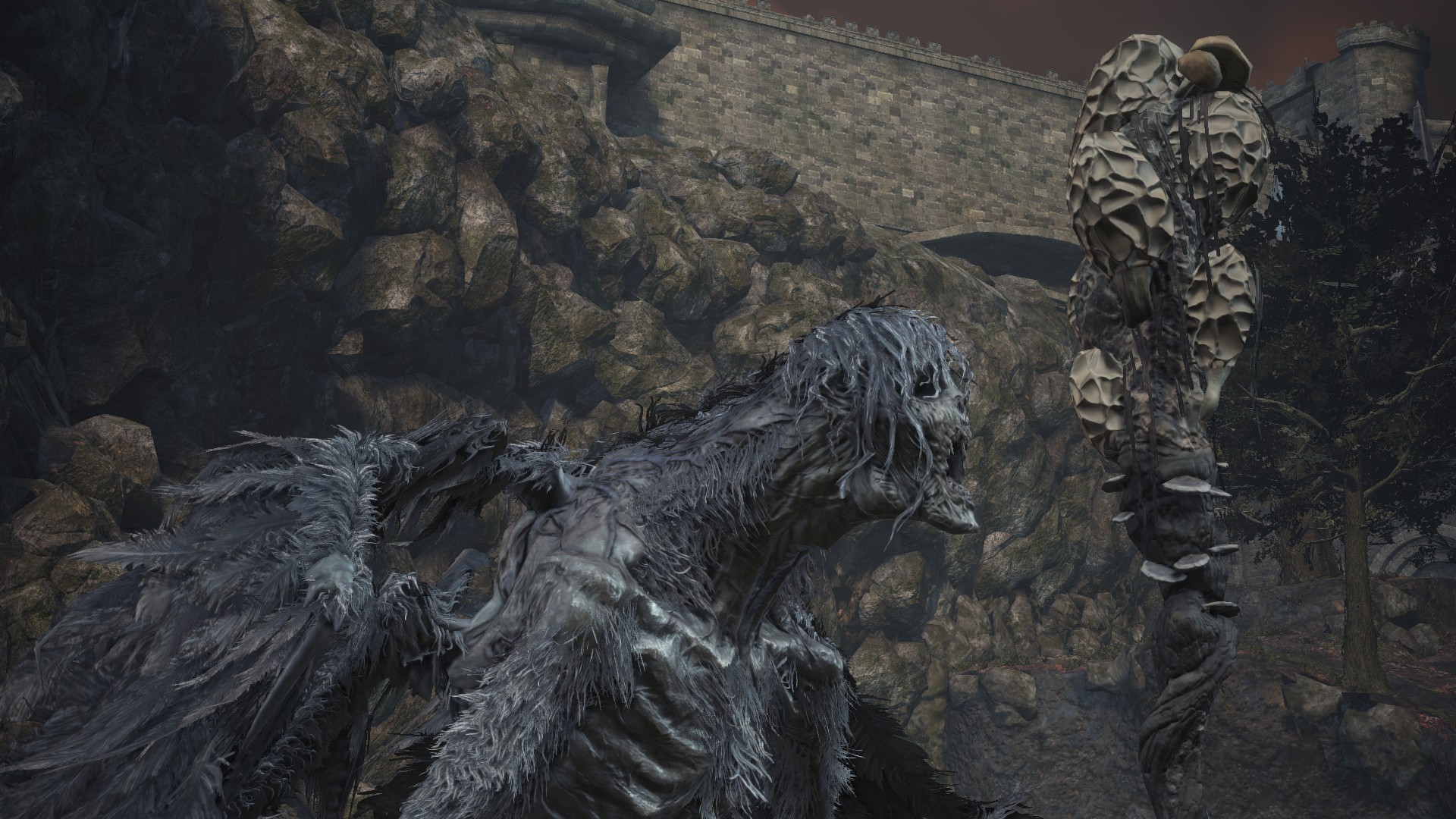
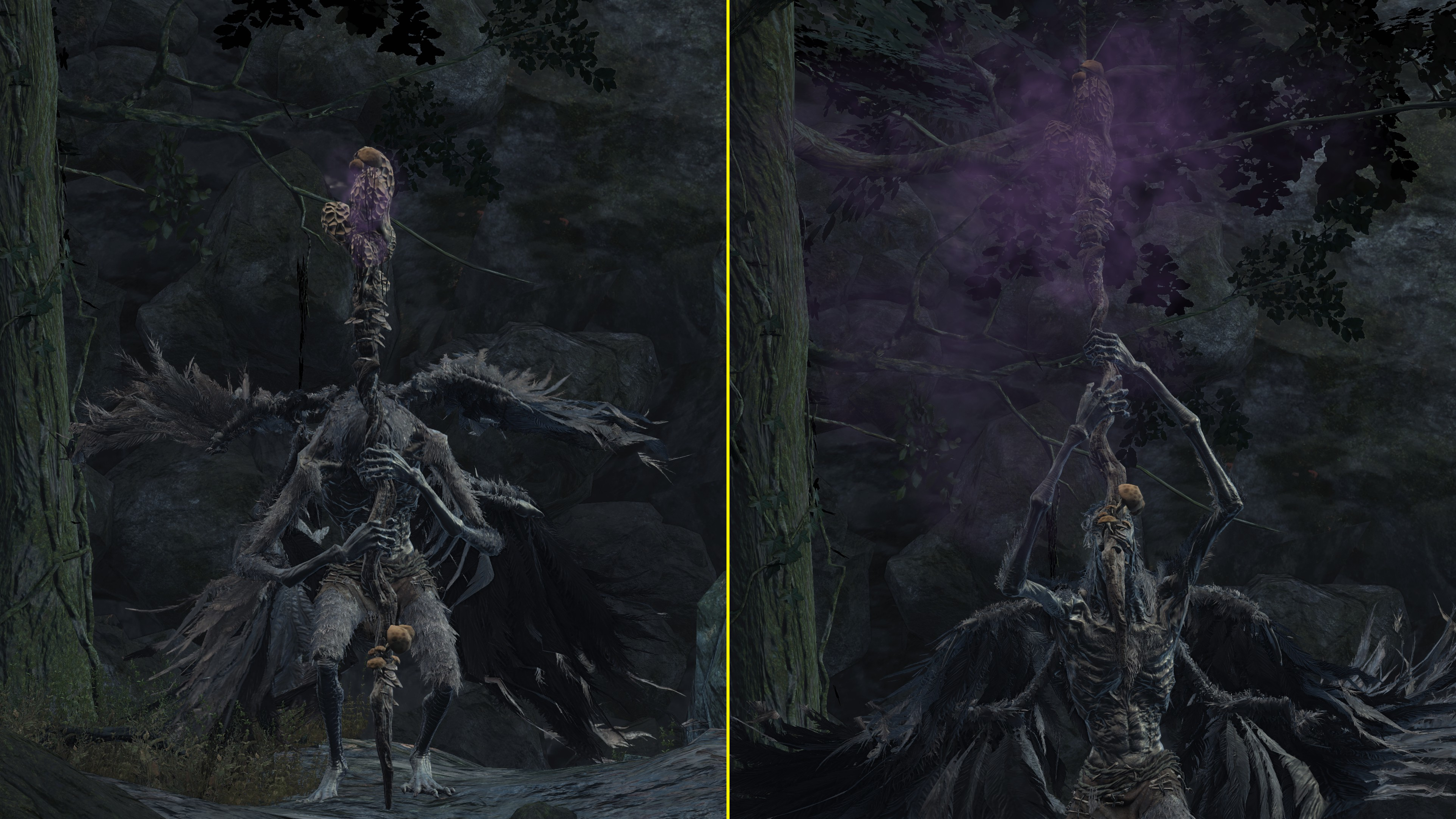
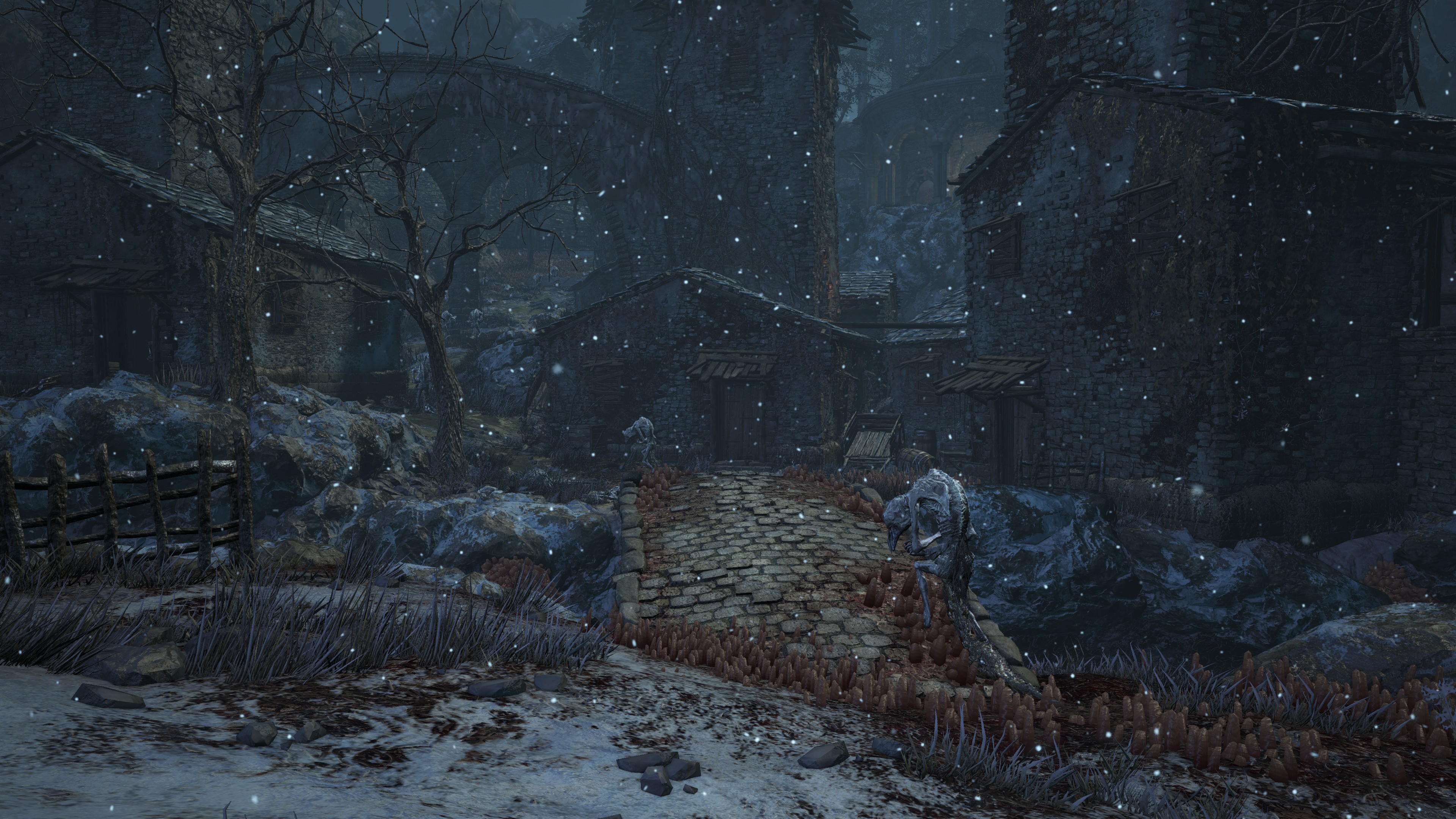
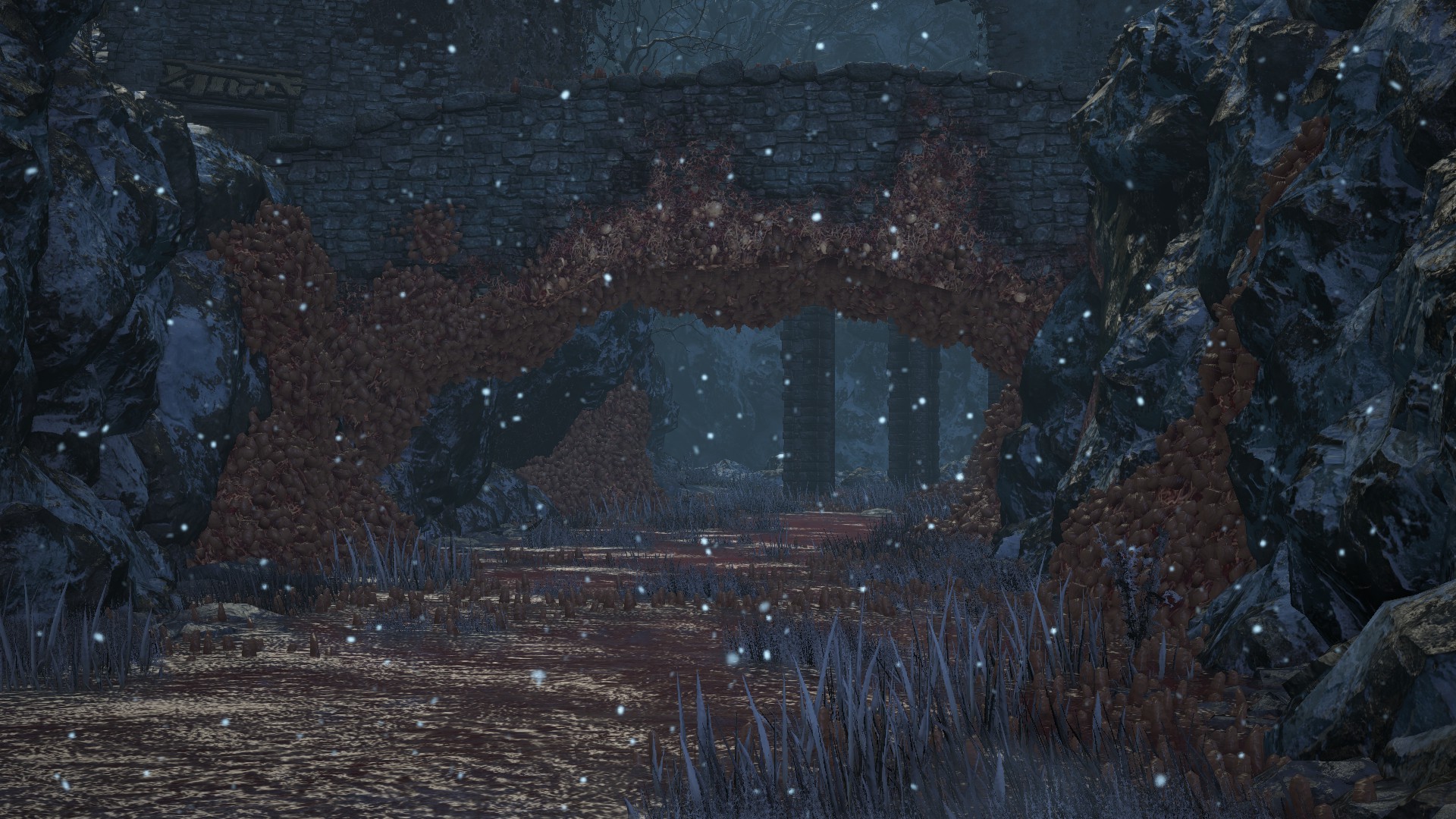
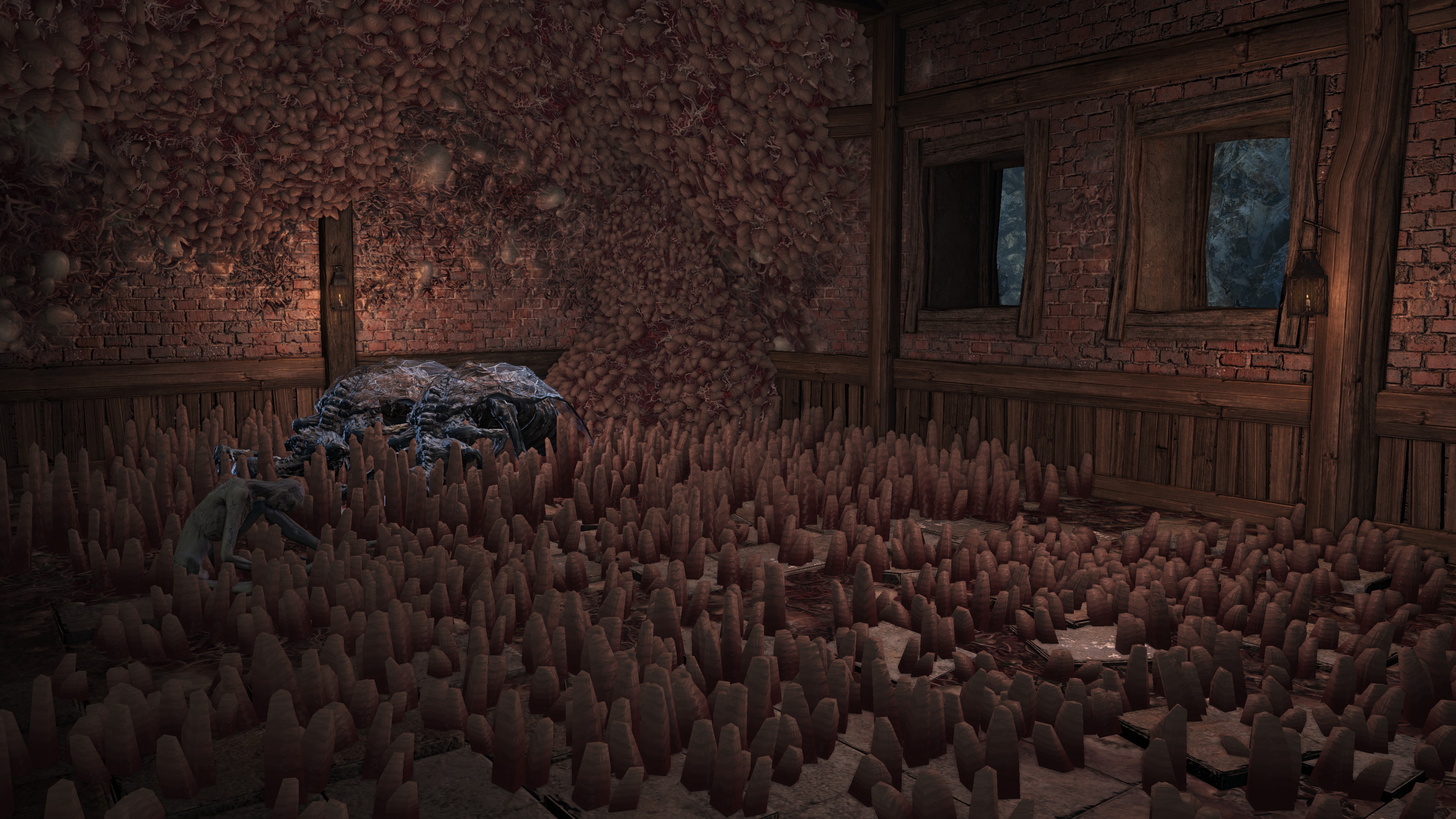


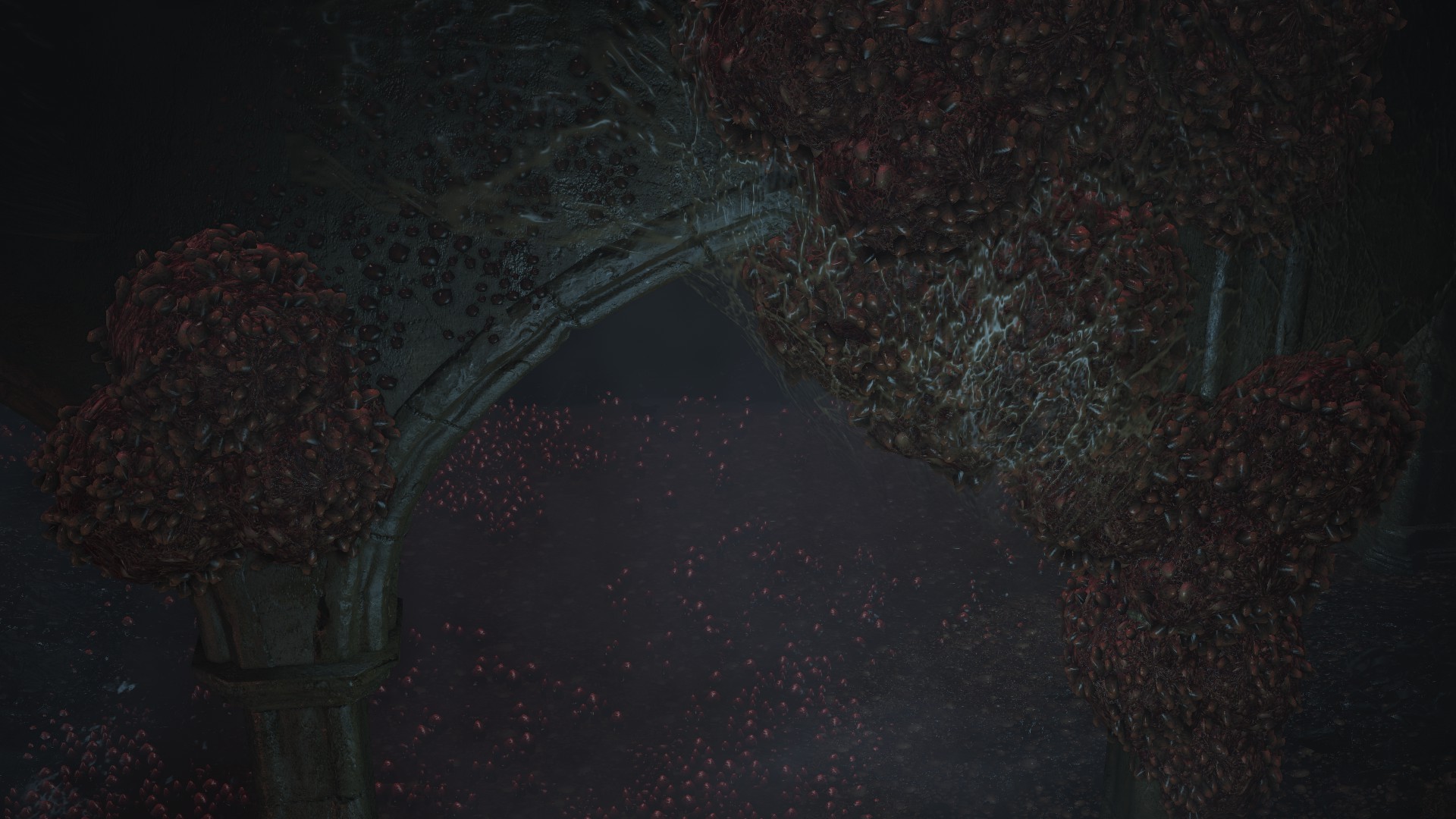
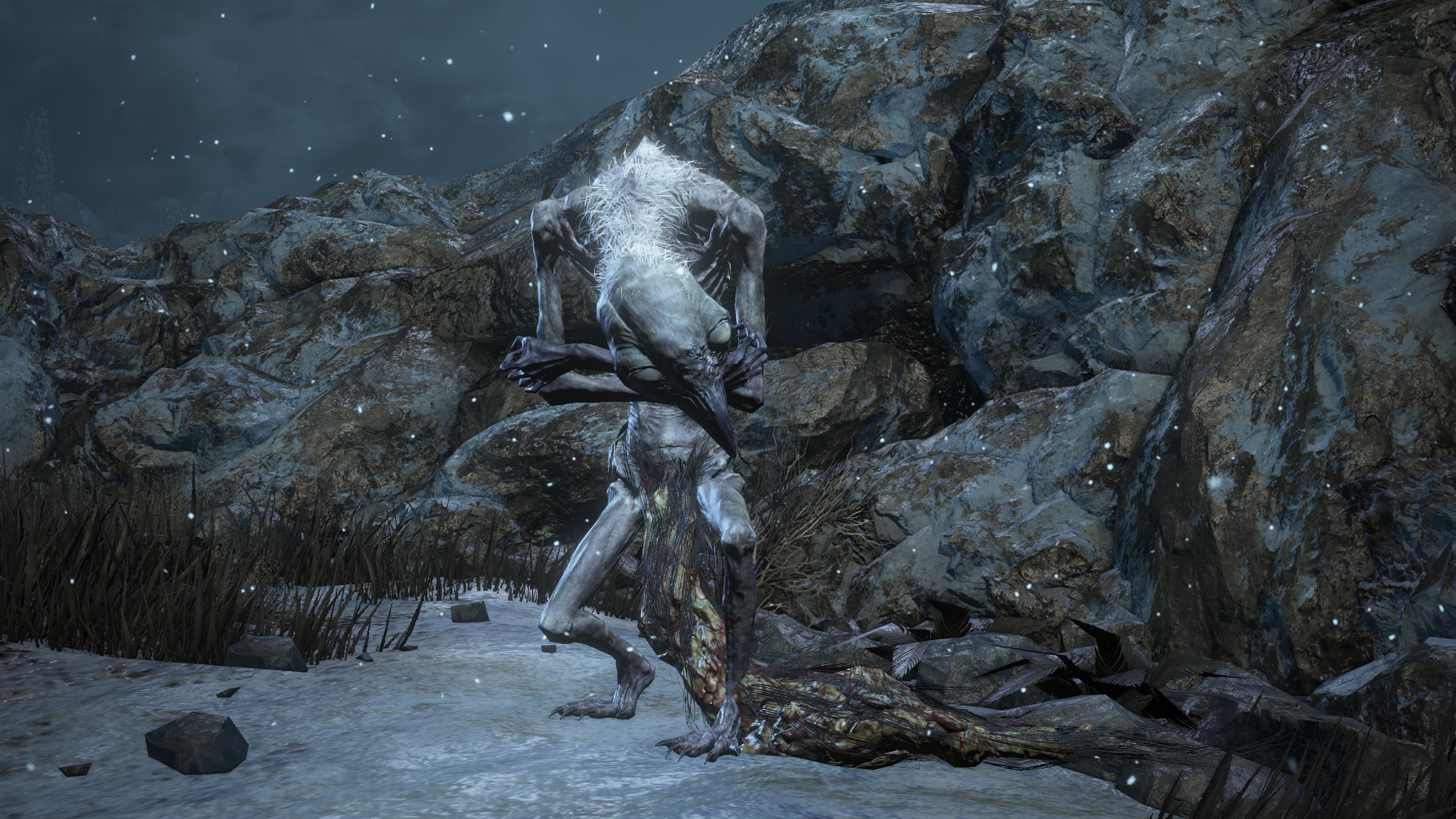
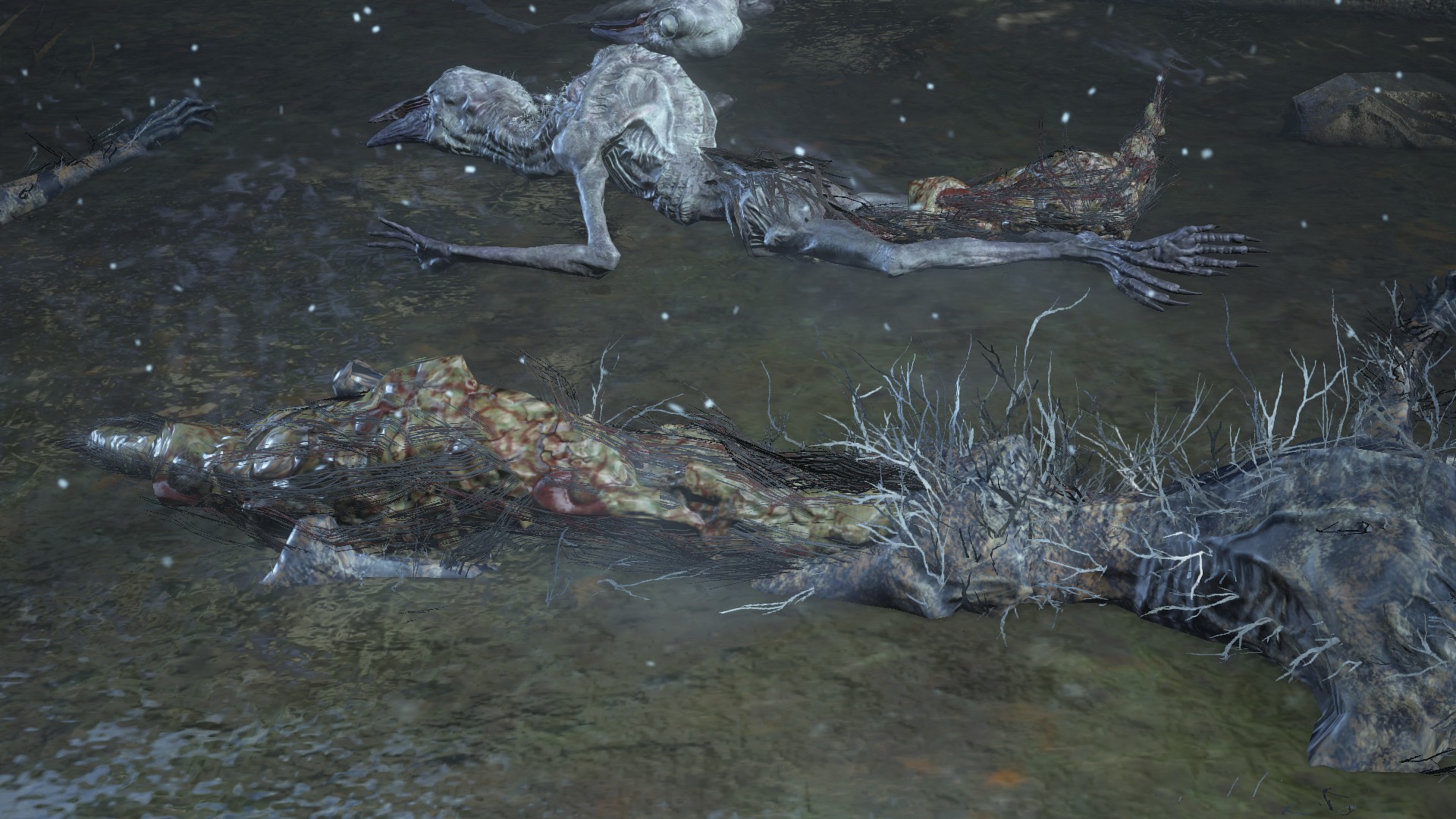
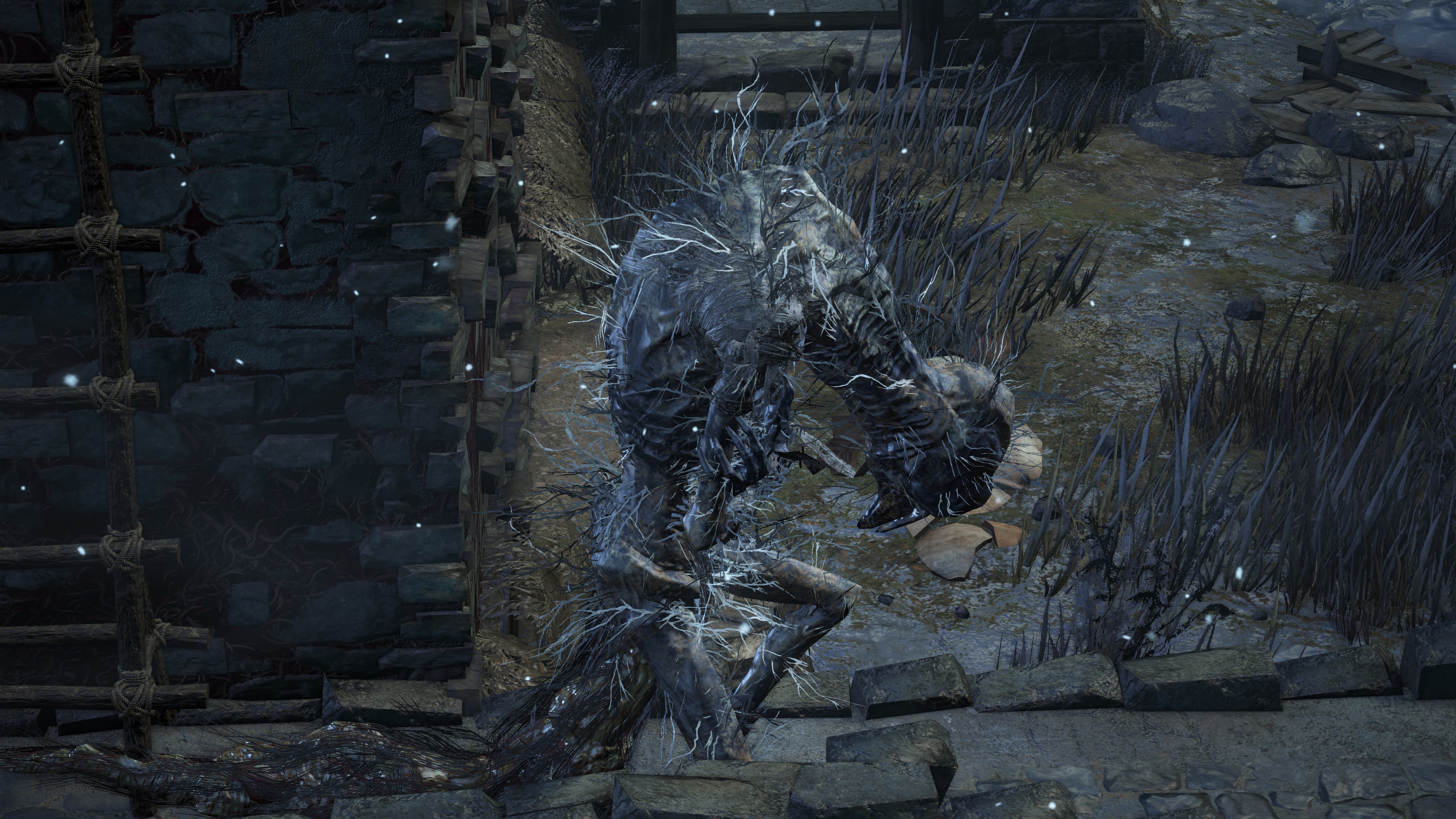
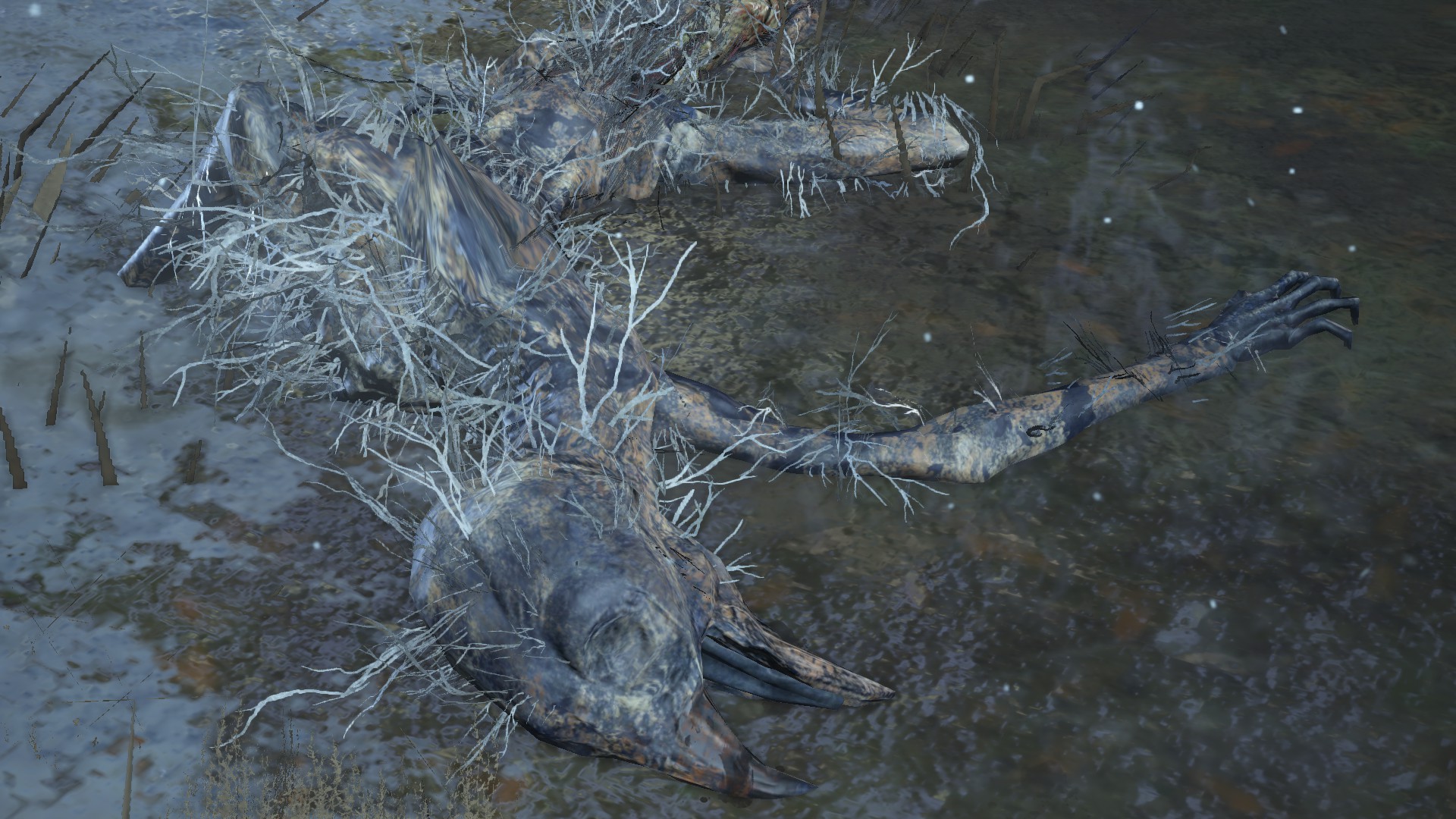


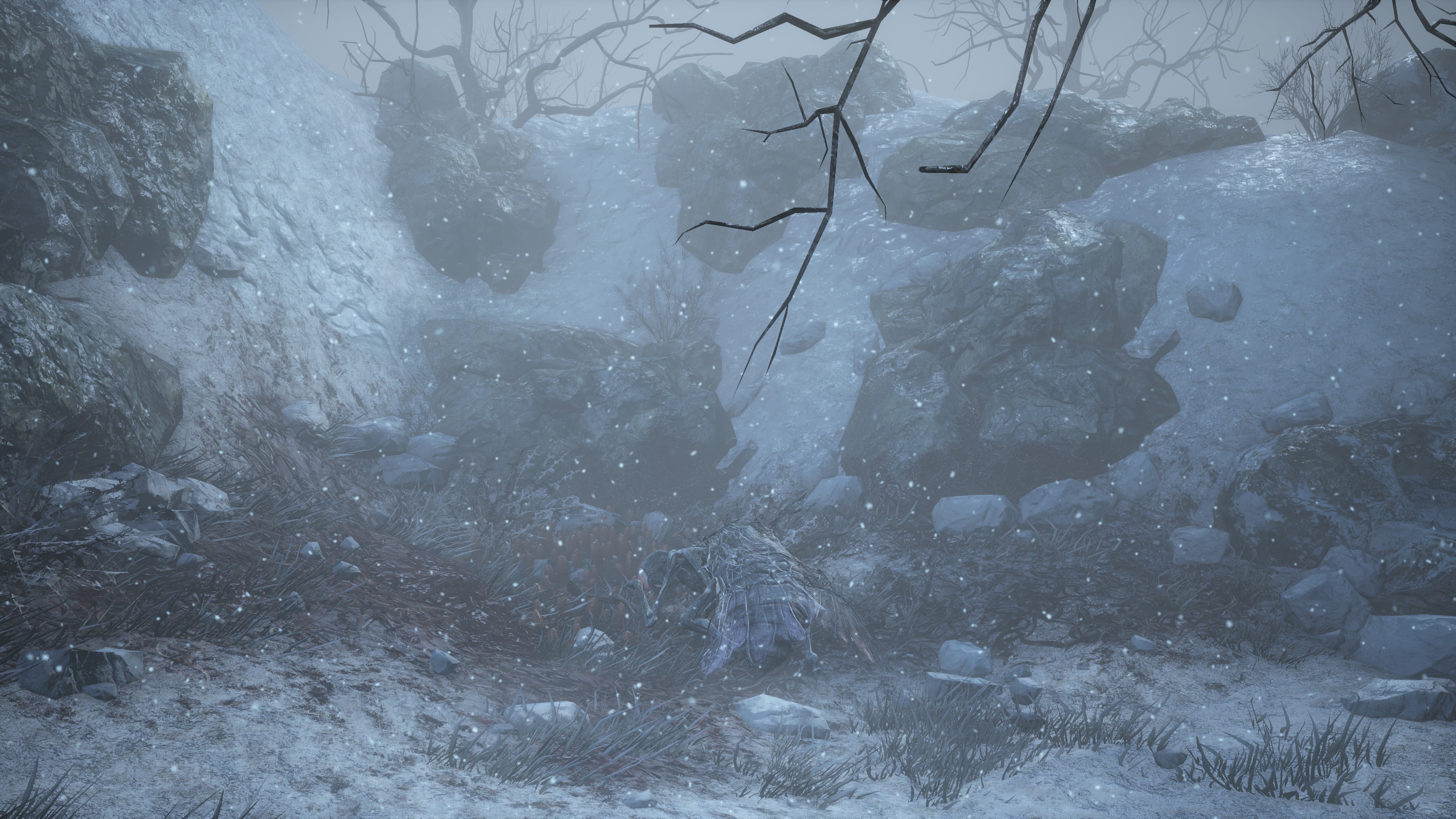
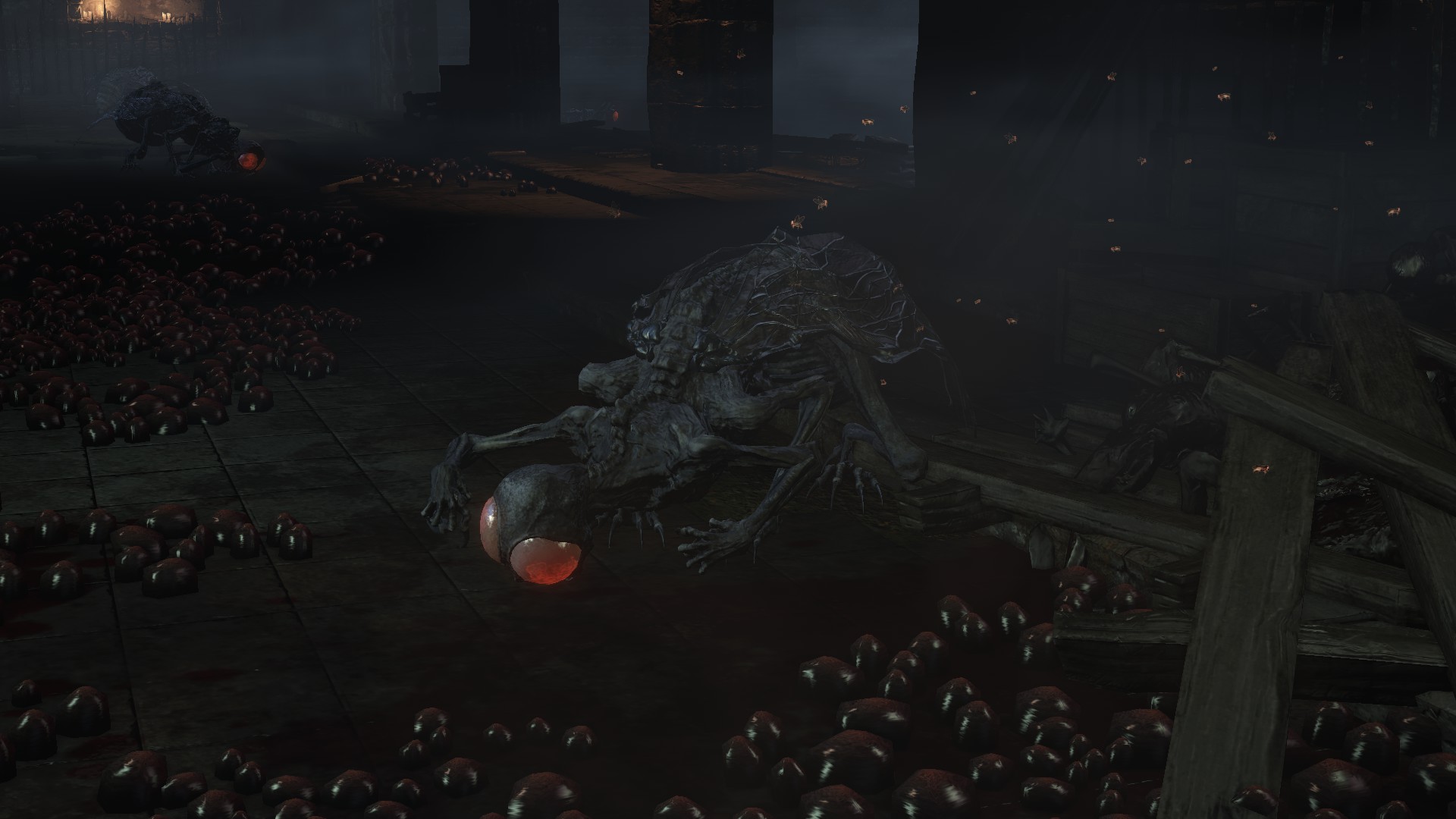
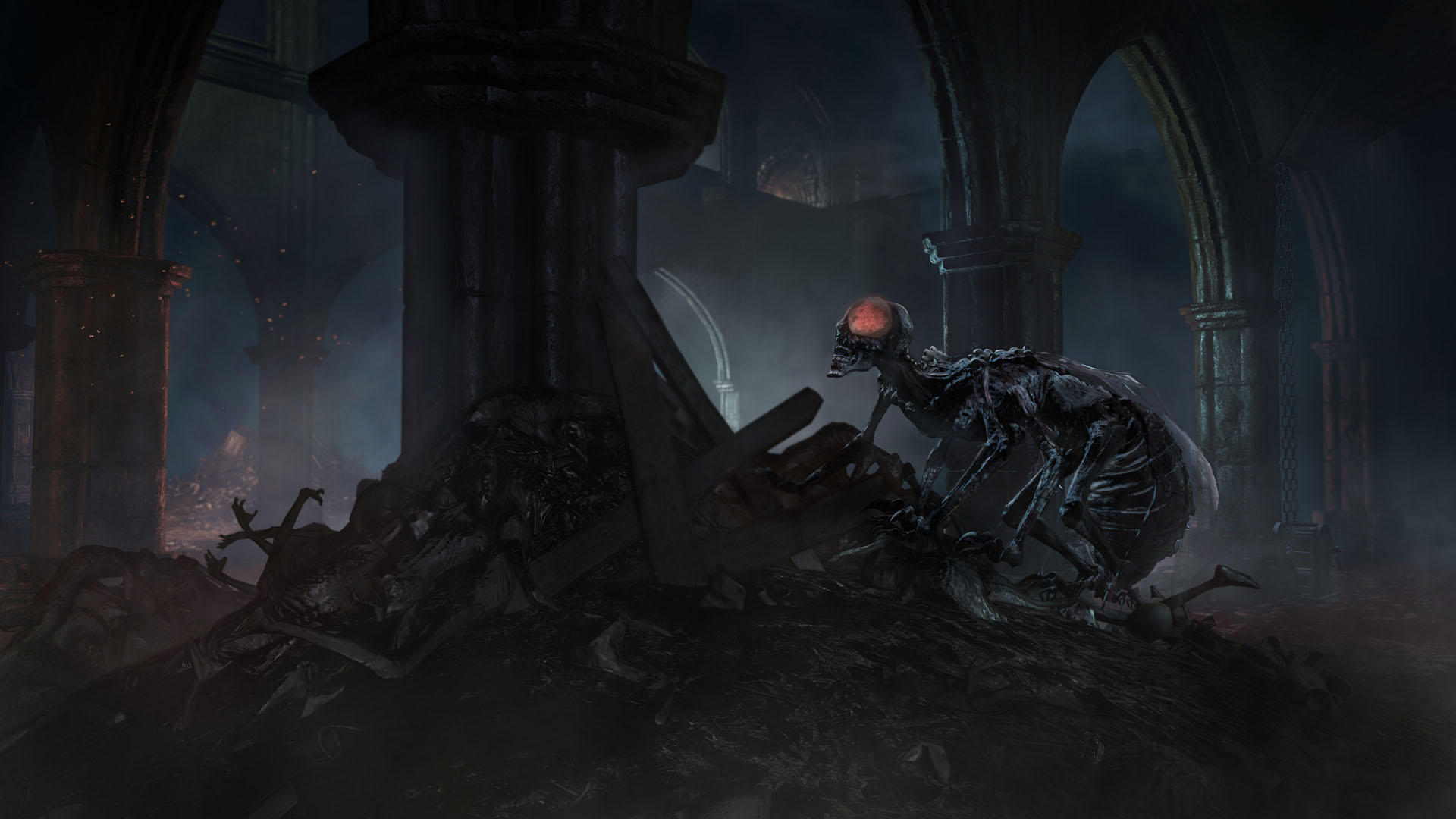
The parasitic element to the rot becomes still more clear-cut inside of the painted world. Spreading alongside the fungi is a mess of worms, probably akin to maggots. This is because the rot is often accompanied by giant humanoid flies feasting amidst the corruption. These “painting corroders” (絵画の腐食者) are, as the name suggests, agents of the rot. The term “corrosion” itself (腐食) combines the kanji for “rot” and “eat”, explaining their voracity. The rot well and truly eats away at the canvas, and as we can see how the process develops to maturity. The man-flies use their throat and abominable segment to either eject or inject their spawn, the burrowing worms slowly bleeding us dry as they devour our bodies. If the infestation is left uncleansed, it is plain as day that the maggots will become more corroders. Hovering around rot in the chapel crypt are man-flies the size of actual flies, so they do grow from the worms’ scale. In that case, both the fungus and the fly they spawn produce living manifestations to further spread the rot, literally and figuratively feeding into each other.
This hasn’t stopped the influx of migrants to Ariandel; as the corvian of the cave highlights, most are just happy to have a place to go and rest their heads, even if the “bed” is rotten. Still, why does the painting’s corrosion with time take these various forms when it should be flame that emerges from the natural decay? Because, this time, it is not the rot of Ariamis, but Ariandel. From the flies, we can nonetheless loot Human Pine Resin, which primarily consists of man’s rotted bodily fluids. These fluids are of a Dark nature, hence the item’s ability to augment weapons with such power once coated in the viscous substance. This would imply that the rot has a connection to the Dark, not fire. And yet, the man-flies aren’t affected by the Wolf Knight’s Greatsword, which was designed to disproportionately harm the Dark’s spawn or similar agents. Therefore, the corroders’ connection to the Abyss must come from a less direct source of humanity than, say, the pus of man. The answer then would be the bodily fluids of the man which currently comprise the painting, the blood of Father Ariandel.


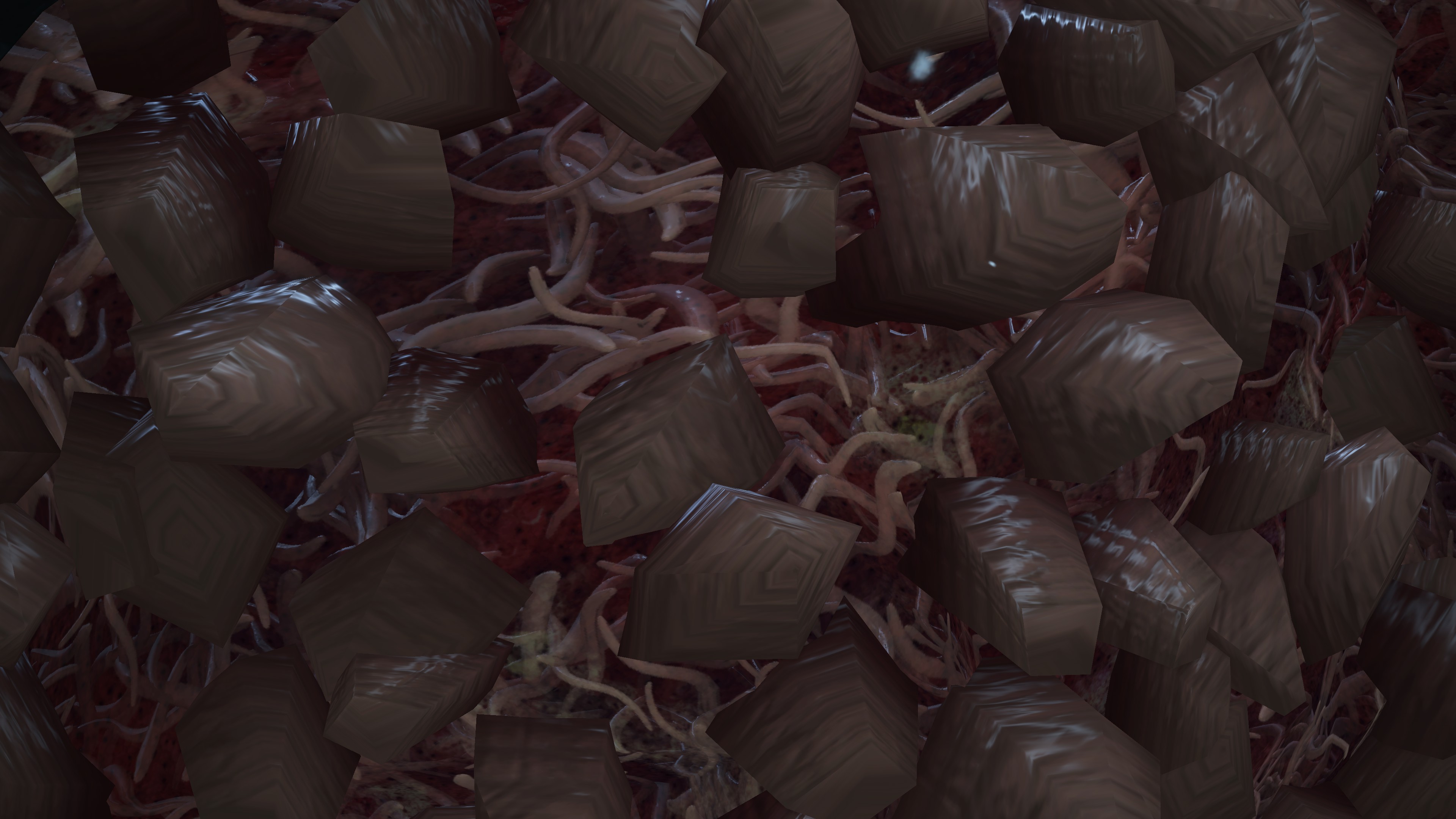
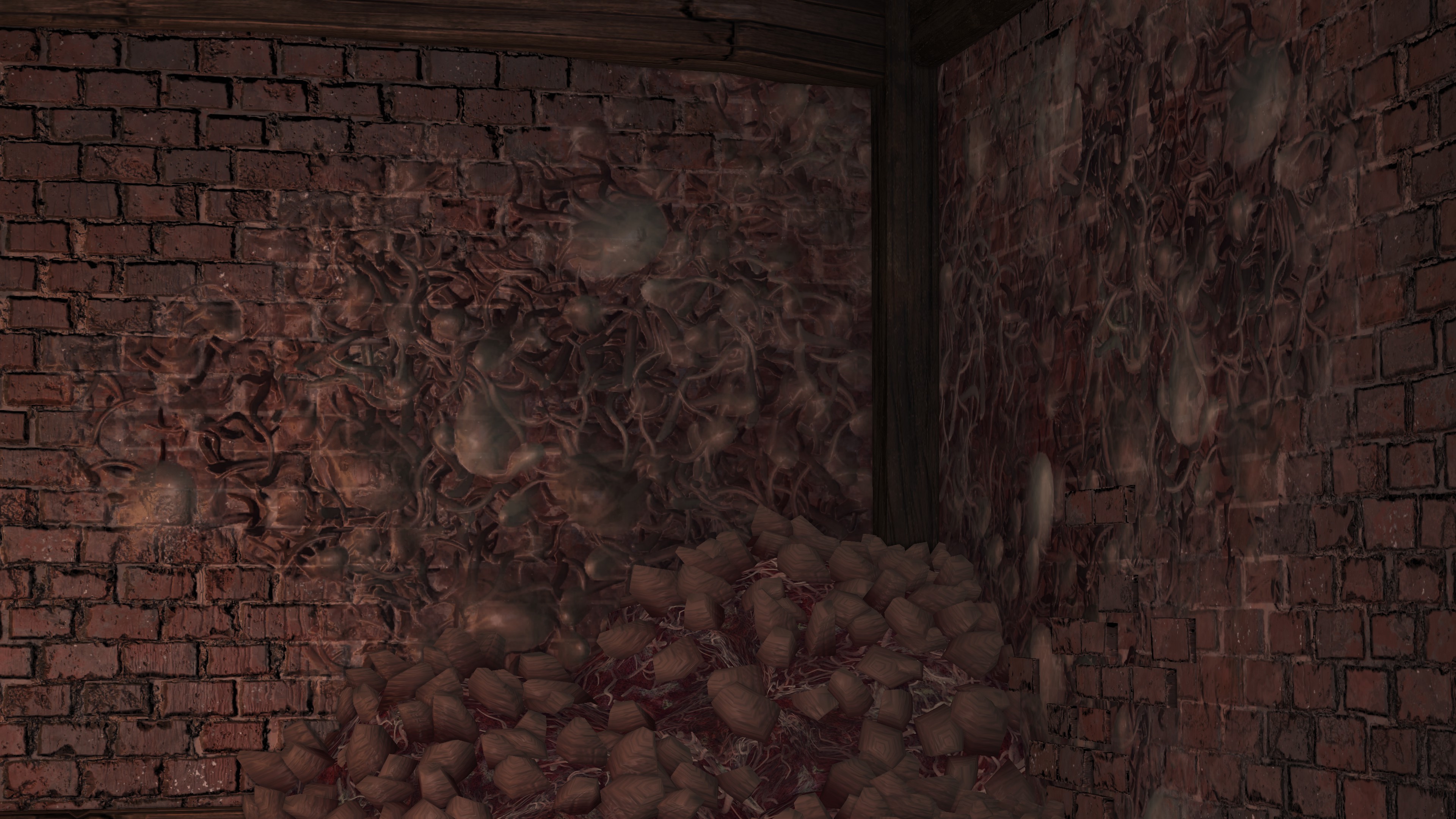




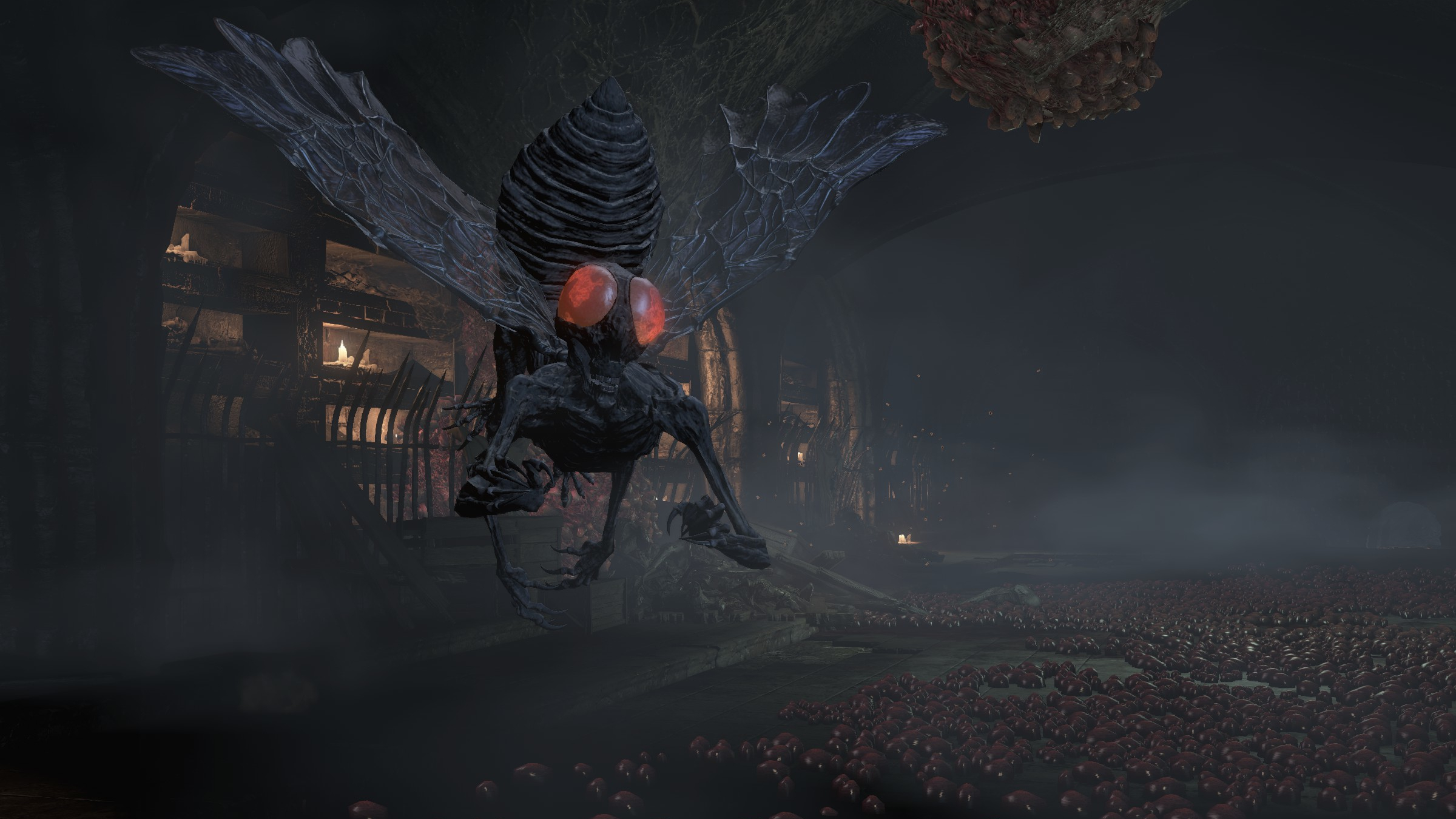

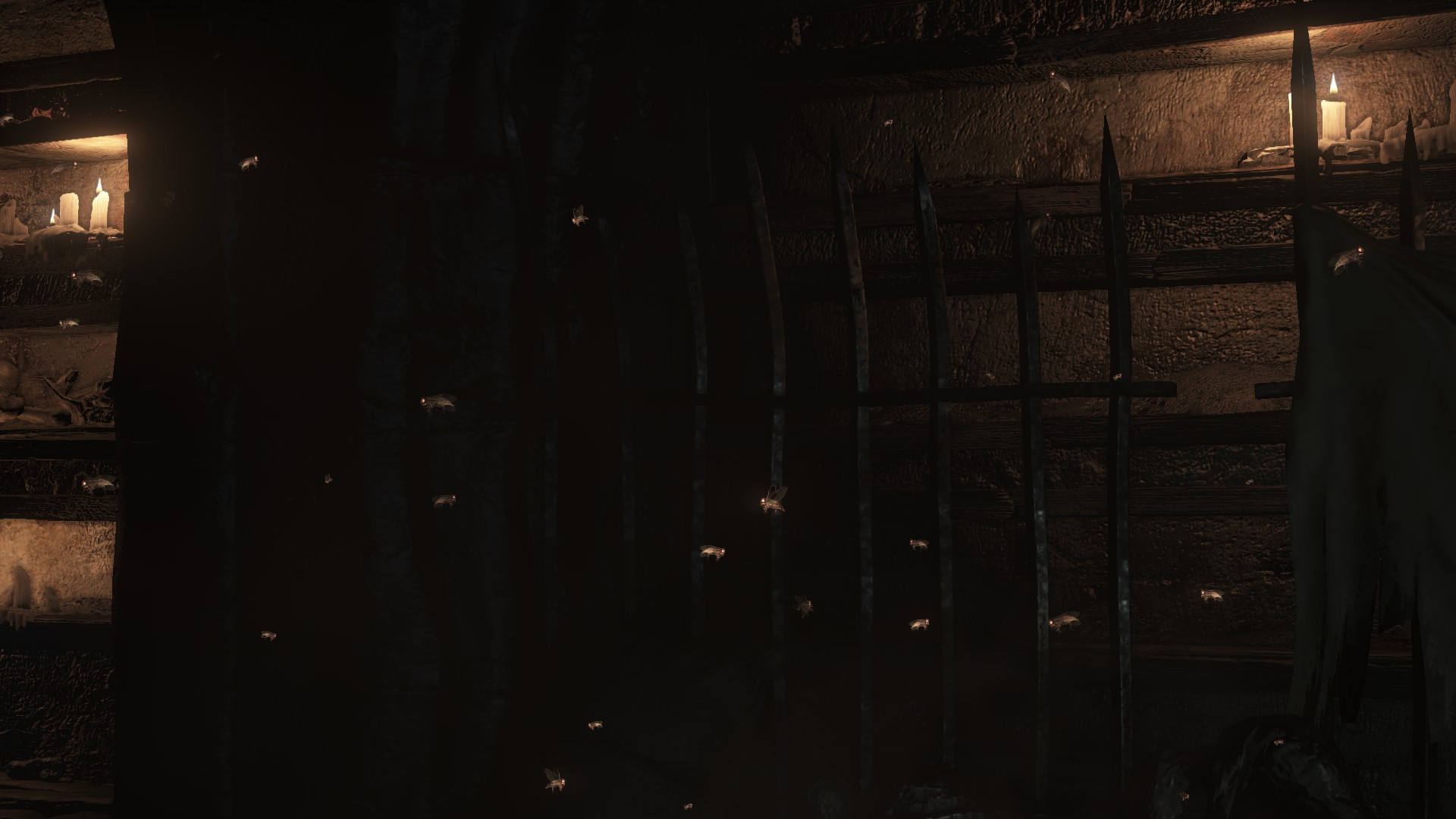
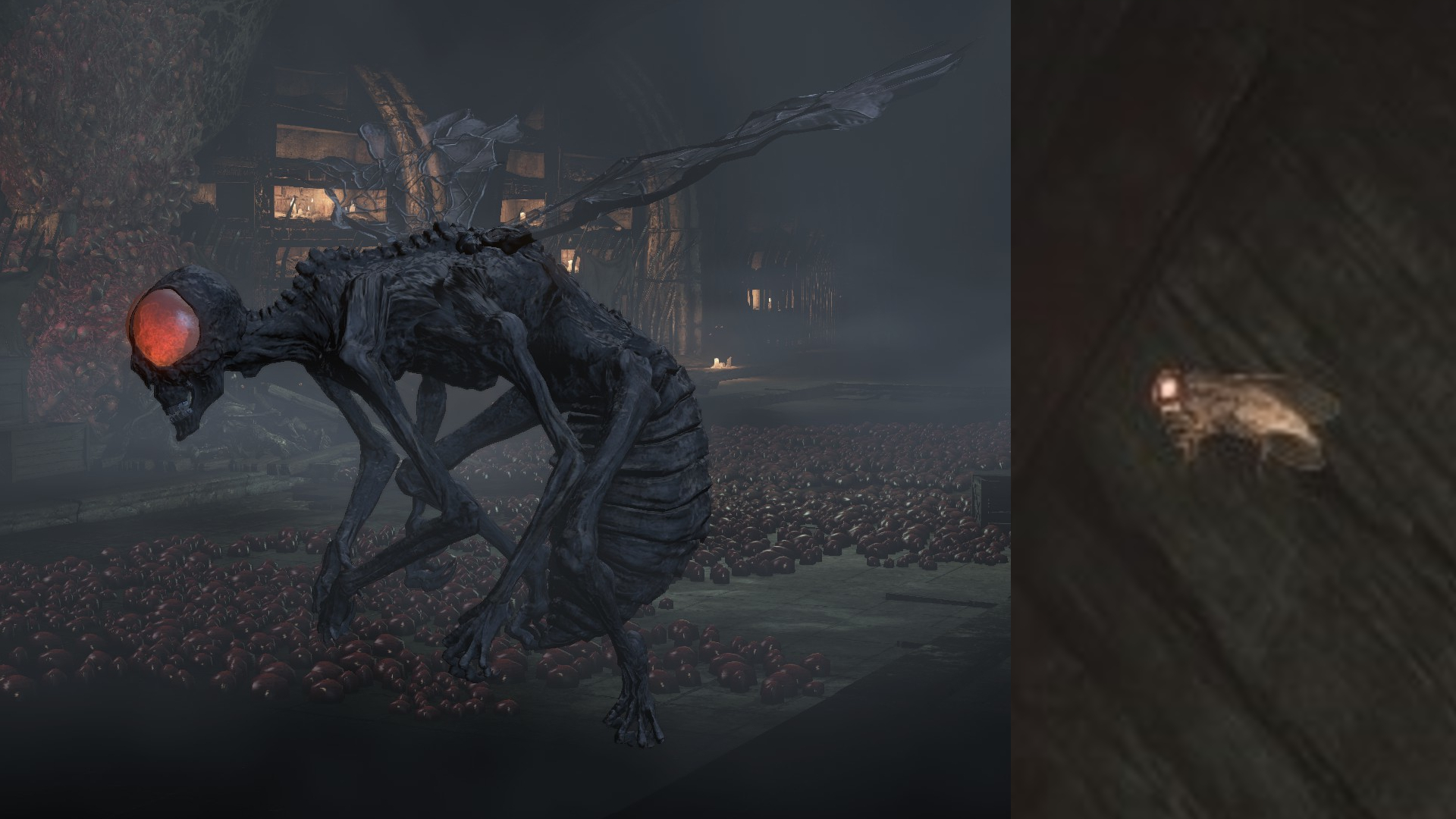

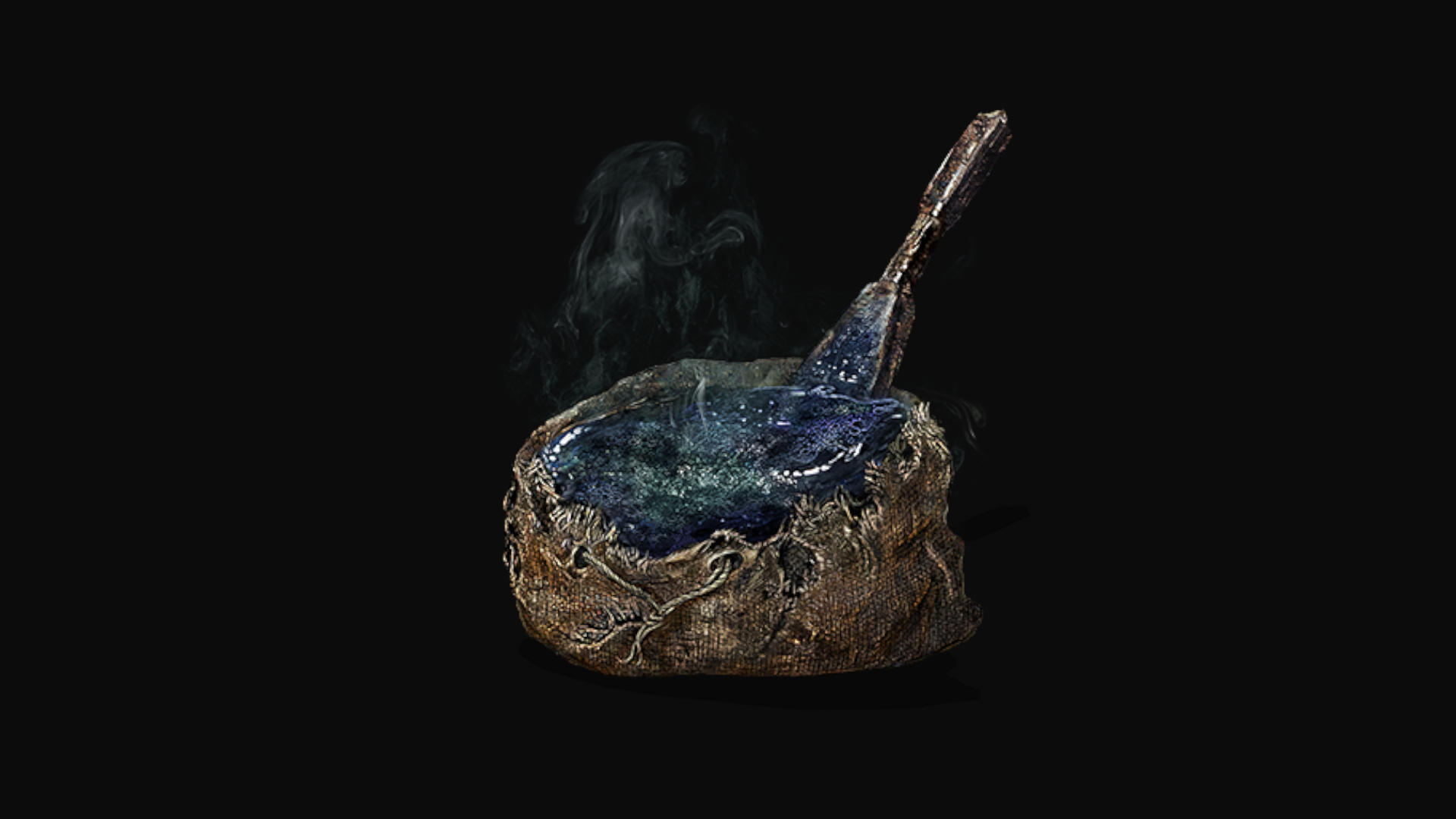
Your bed that’s been sweetly rotting all this time…
Subtly supporting this idea, the rot is commonly juxtaposed with corpses carrying various altered titanite. Together, they serve as hints to the underlying nature of this corruption. In one case, it is a poison gem, due to the hazardous nature of the rot already mentioned. Then there is a blood gem, because it comes from blood; a blessed gem, because the blood is sourced from a holy man; a dark gem, because that holy man is tied to Velka; a simple gem, because it was through magic that he restored the painting; and finally, a shriving stone, because that holy man of Velka with magical expertise is a corvian. Taking this all into consideration, the rot’s ravenous appetite may, in part, come from human blood in touch with its humanity as part of the transformation into a crow. The spontaneous generation of flies is similarly consistent with dark souls — maggots appearing in rotten meat serve as stereotypic evidence of that concept, even. Regardless, the pastor is the only character to embody all of these elements. Factor in the corruption’s red color, and the painting’s corroders are, without a doubt, derived from Ariandel’s handiwork.
The horrifying results are to be expected. Just like Ariamis’ flame-born pigments, the blood of Ariandel inevitably suffered entropy. And once the power of his soul could no longer subsist on itself, it instinctively began eating into its own construct. The magical dimension revitalized by the painting’s restoration is now victim to its very own building blocks in the form of a more aggressive rot. The corpse with a dung pie, hanging over innumerable corroders feasting upon the mountains of bloody bodies in the crypt, captures the image perfectly: the life born of blood are a toxic waste product. One might argue that this was always the case. While it may be coincidence, the widespread appearance of grass connected to the Dark’s stagnation potentially signals how a land painted with blood partially mixed with humanity produces inherent stagnation — not from beyond the painting’s confines, but from within. That in itself evidently wasn’t a problem for the world, but the non-Dark element creates a Disparity which the greedy Dark naturally preys upon. The end result is Ariandel’s masterpiece eating itself.
The rot being what it is, there is no simple solution other than abandoning the painting. As creatures of Dark and Ariandel’s rot, both the flies and their maggots are especially vulnerable to fire, the latter purged by merely holding a torch. The decay of old Ariamis can ironically cleanse the world and potentially its inhabitants of their affliction. But that might only occur if the flame is no longer smothered by blood. As is, the rotted “pigment” is festering but not evaporating, slowly but surely sustaining itself on what has yet to decompose. Maybe one day it will begin to eat into the fiery framework of this dimension, but that is only after both rot and flame finish gorging on that unspoiled sustenance. In the meantime, the people endure a pox on their home, with the fire on hand falling well short of ridding them of this red plague. Now more than ever, they need the unkindled of the prophecy. The only problem is that these fireless ash born on the outside must be aware and willing to cooperate. And on that front, the promise of a witch wouldn’t be so straightforward.

A Wolf in Dragon’s Clothing
The first unkindled ash to arrive was Elfriede. After entering Ariandel, the woman from Londor became a nun at the chapel, reinventing herself as simply Friede. Perhaps because this was a dreaded moment for the painting’s inhabitants, “Friede” did everything she could to appear harmless, and much more. For one, she adopts a form according to their wishes, Priscilla’s form specifically. The swordswoman covers herself in a thick dress, wears no shoes despite the cold, wields a scythe, and uses the chill of the painting coating it to make herself invisible — all consistent with the crossbreed’s portrayal in DS1. Her warrior past still bleeds through, weaponizing the cold to a far greater extent than her predecessor ever did; even her second scythe is just a hilt with chill magic forming the blade. All the same, becoming a sister of the cloth, healing the needy with miracles, was all part of filling the hole the half-dragon left in that chapel; anything to emulate Priscilla since that was who the village of undesirables dearly missed. And Friede became a kindly surrogate mother to not just the residents but the painter as well.


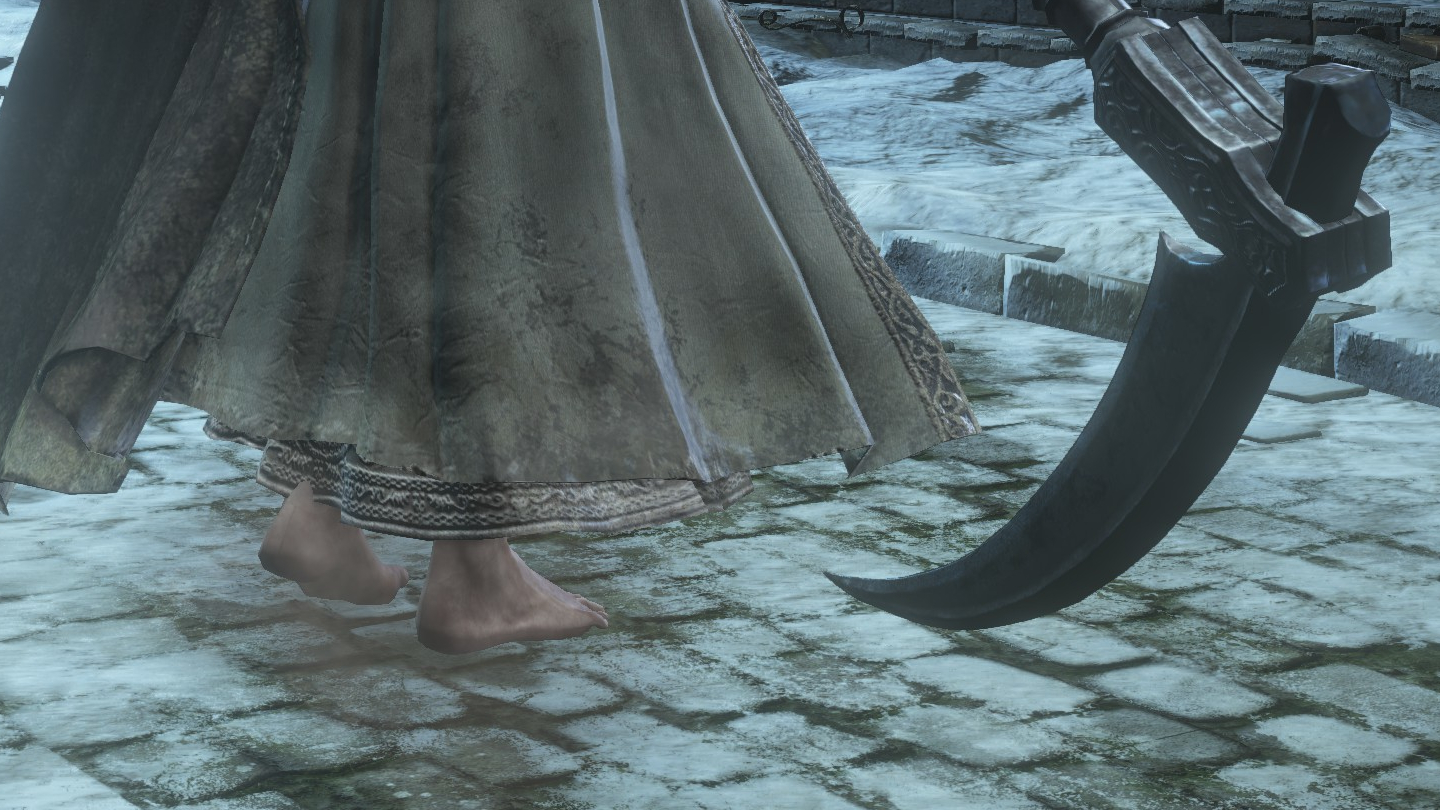


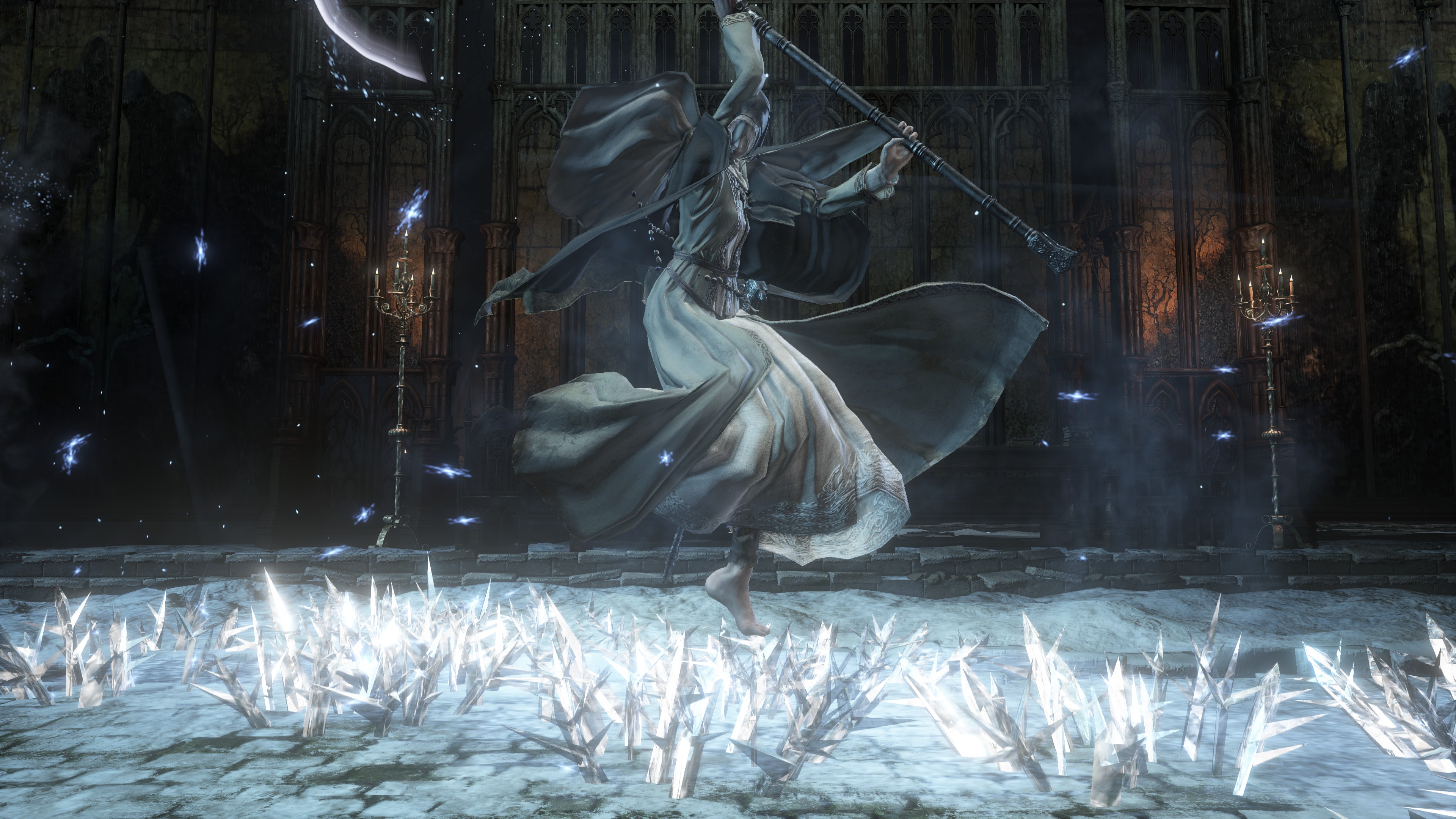

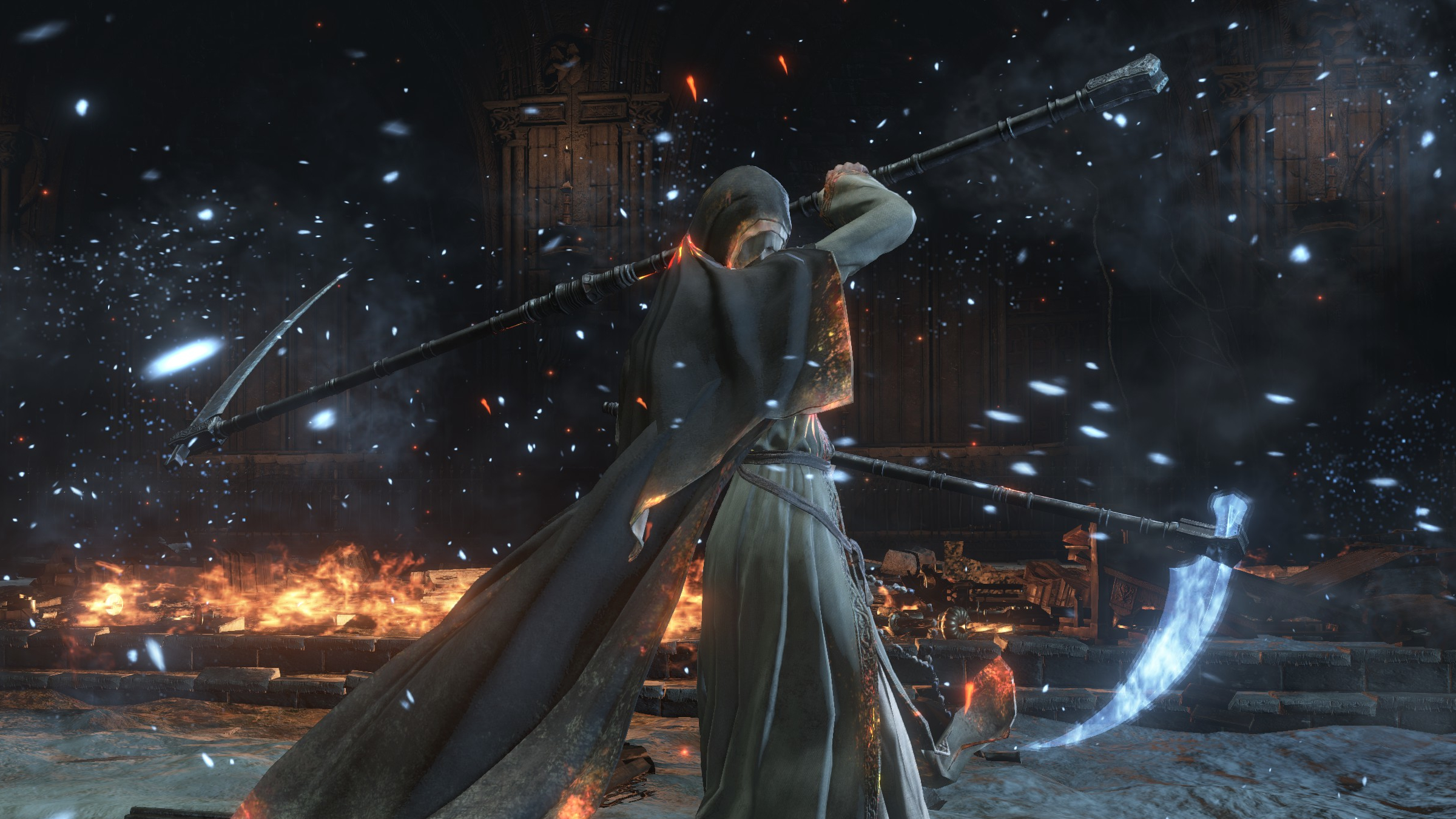
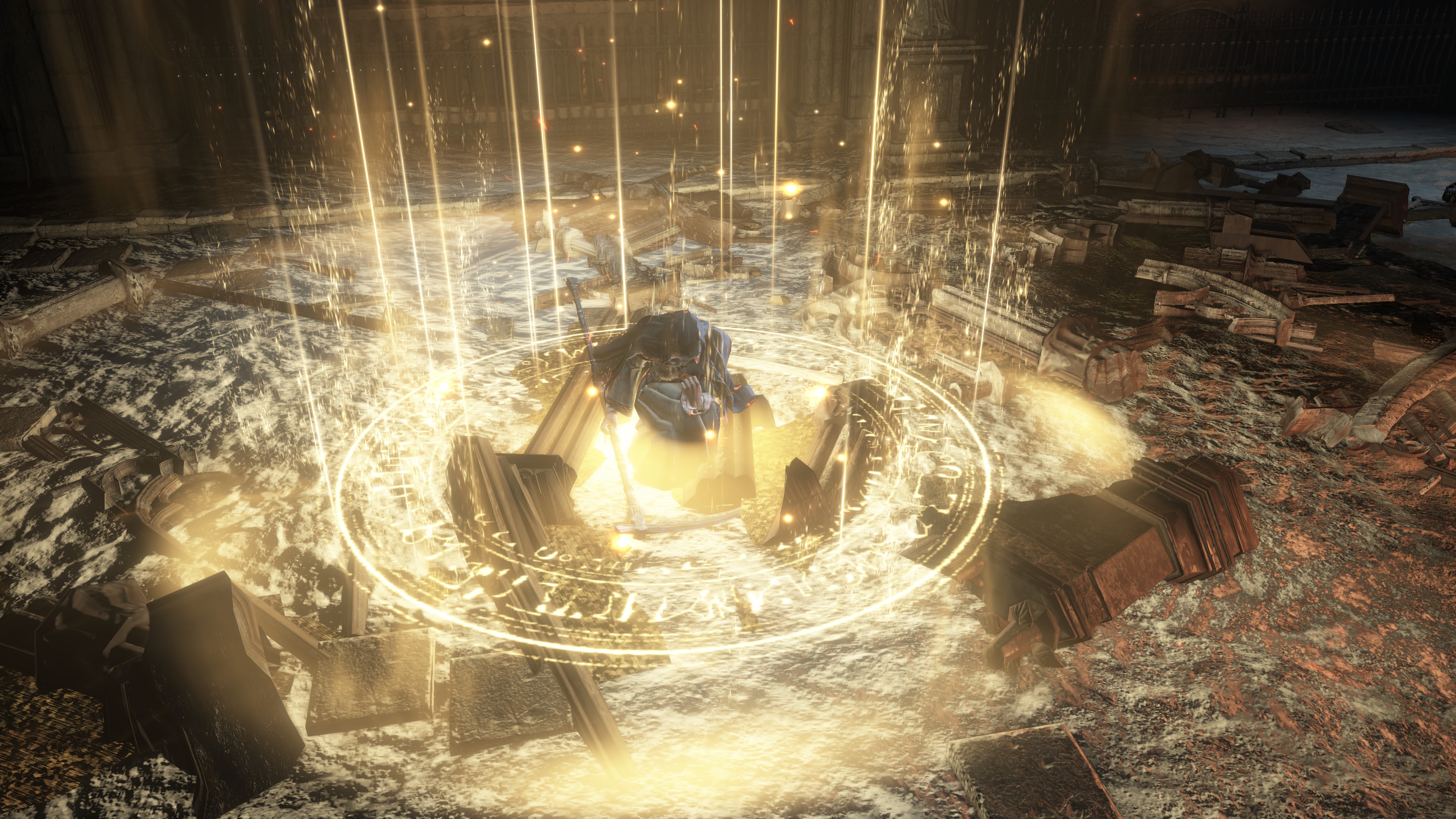
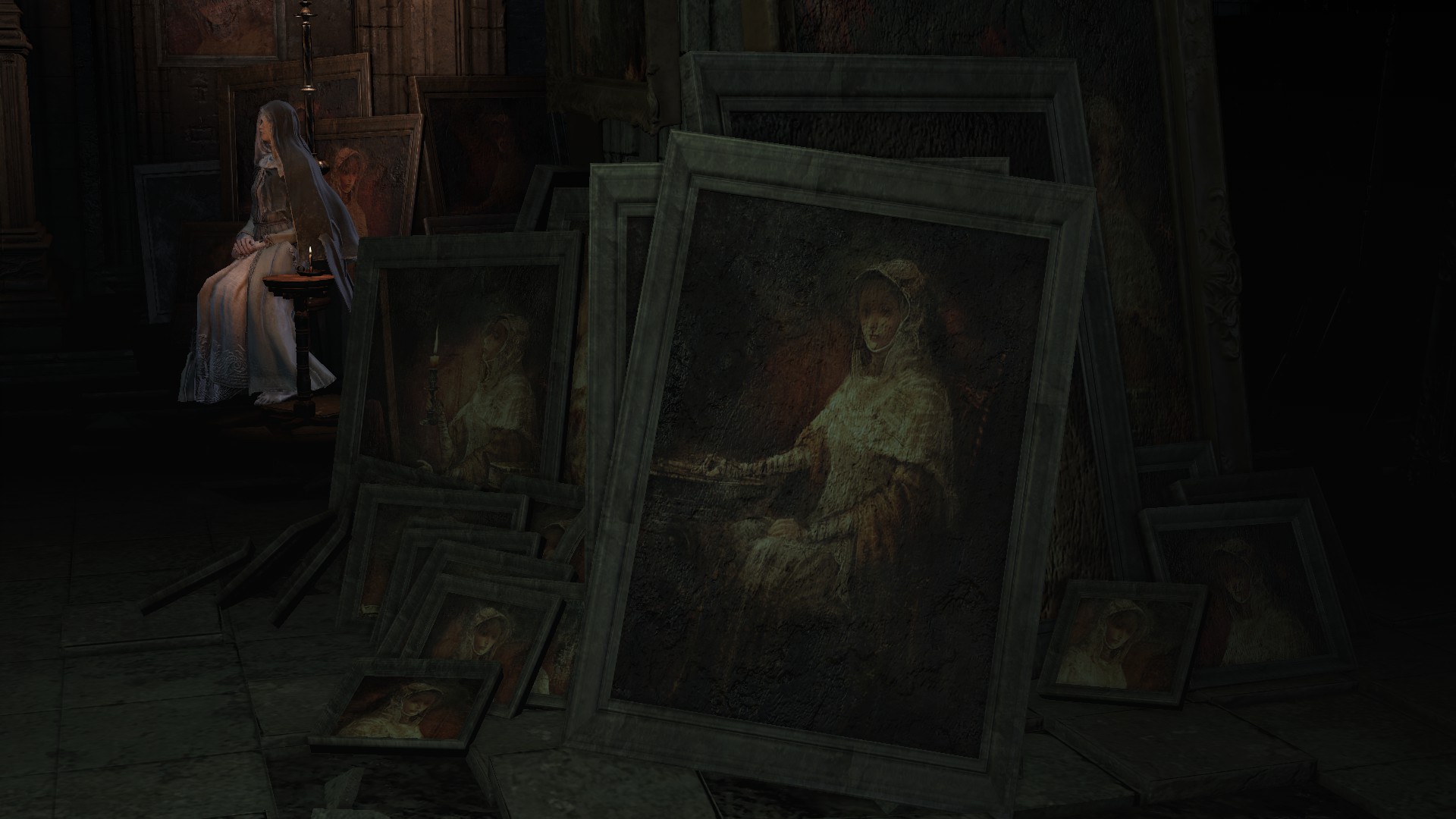
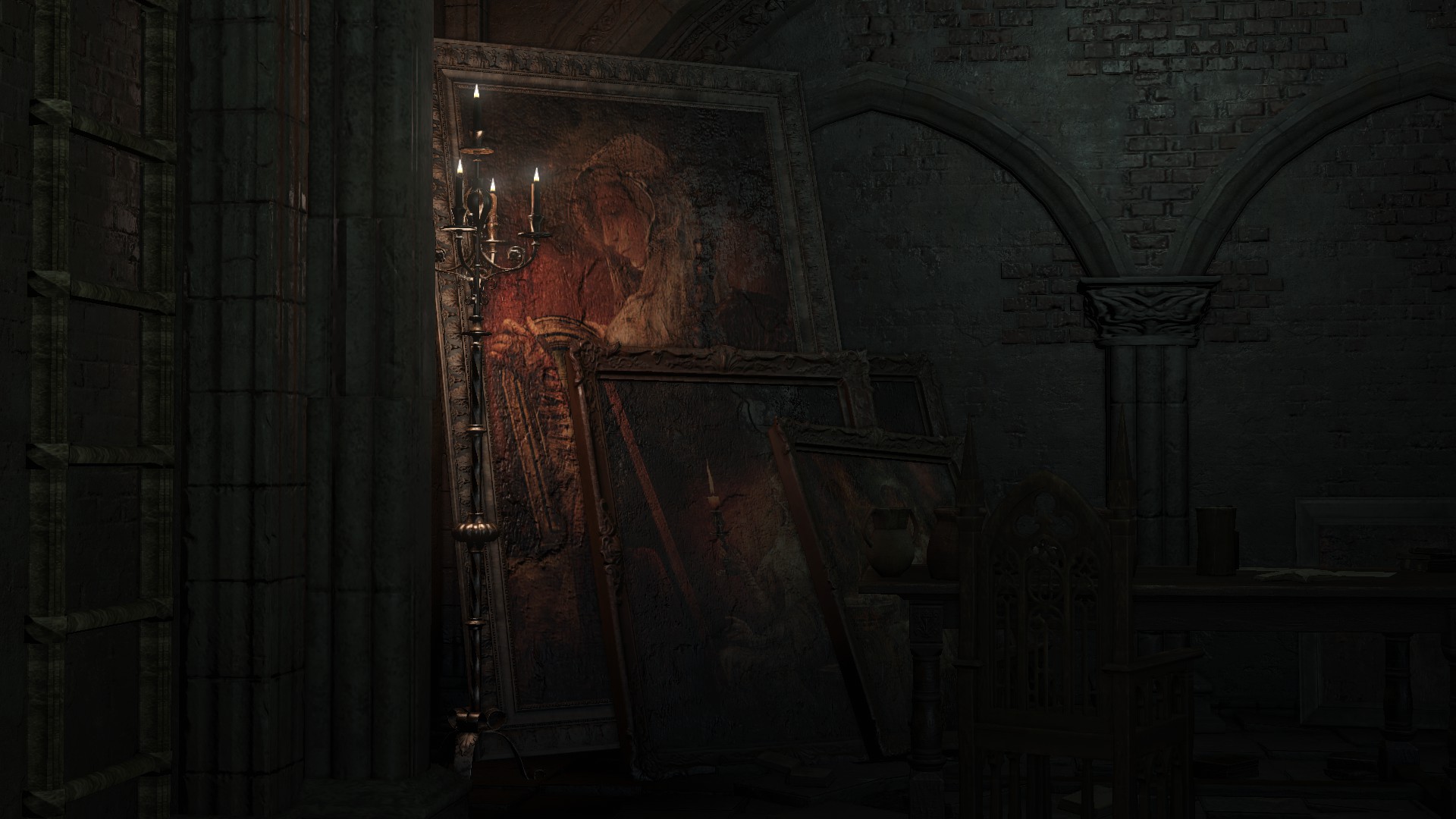
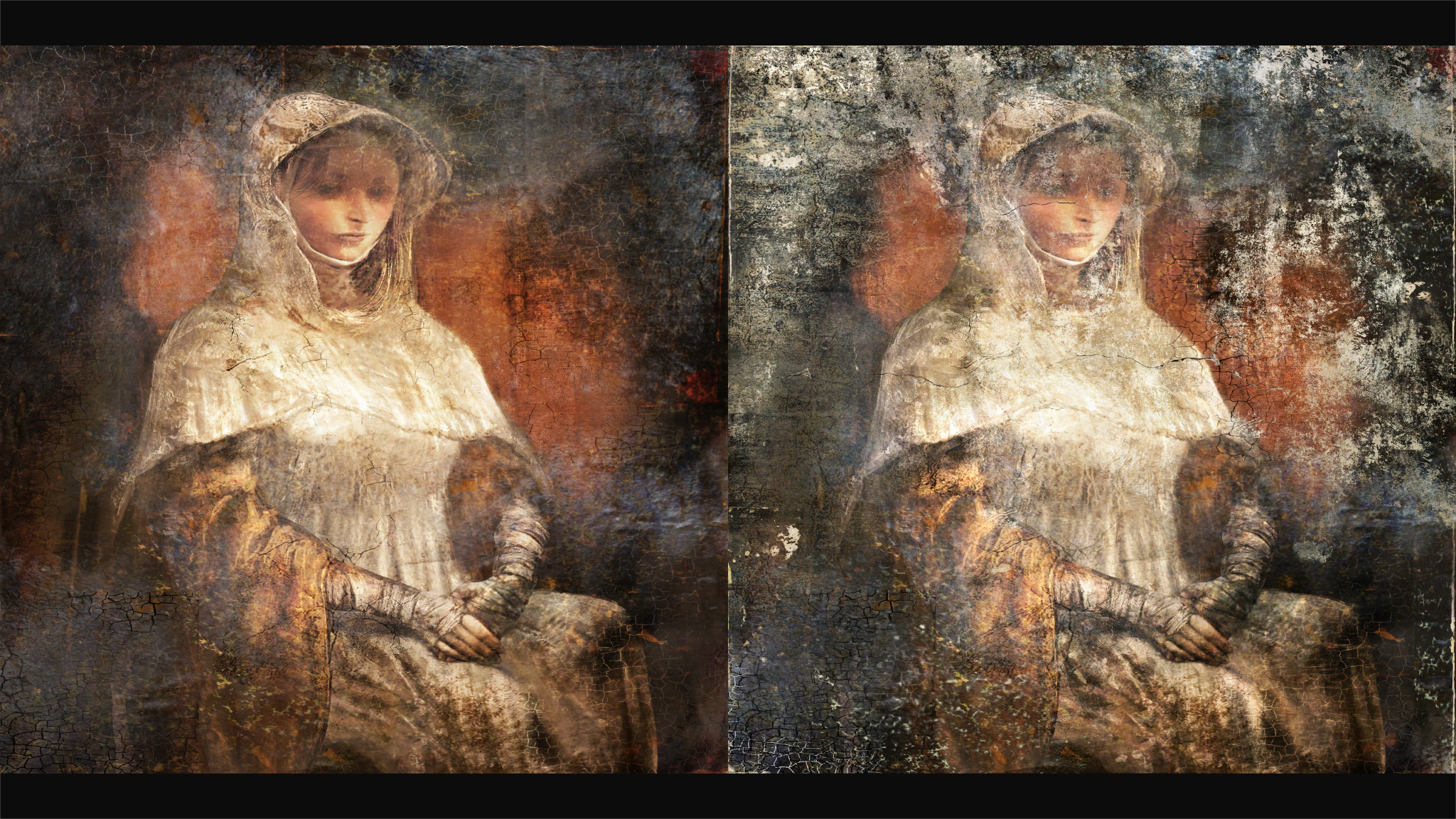
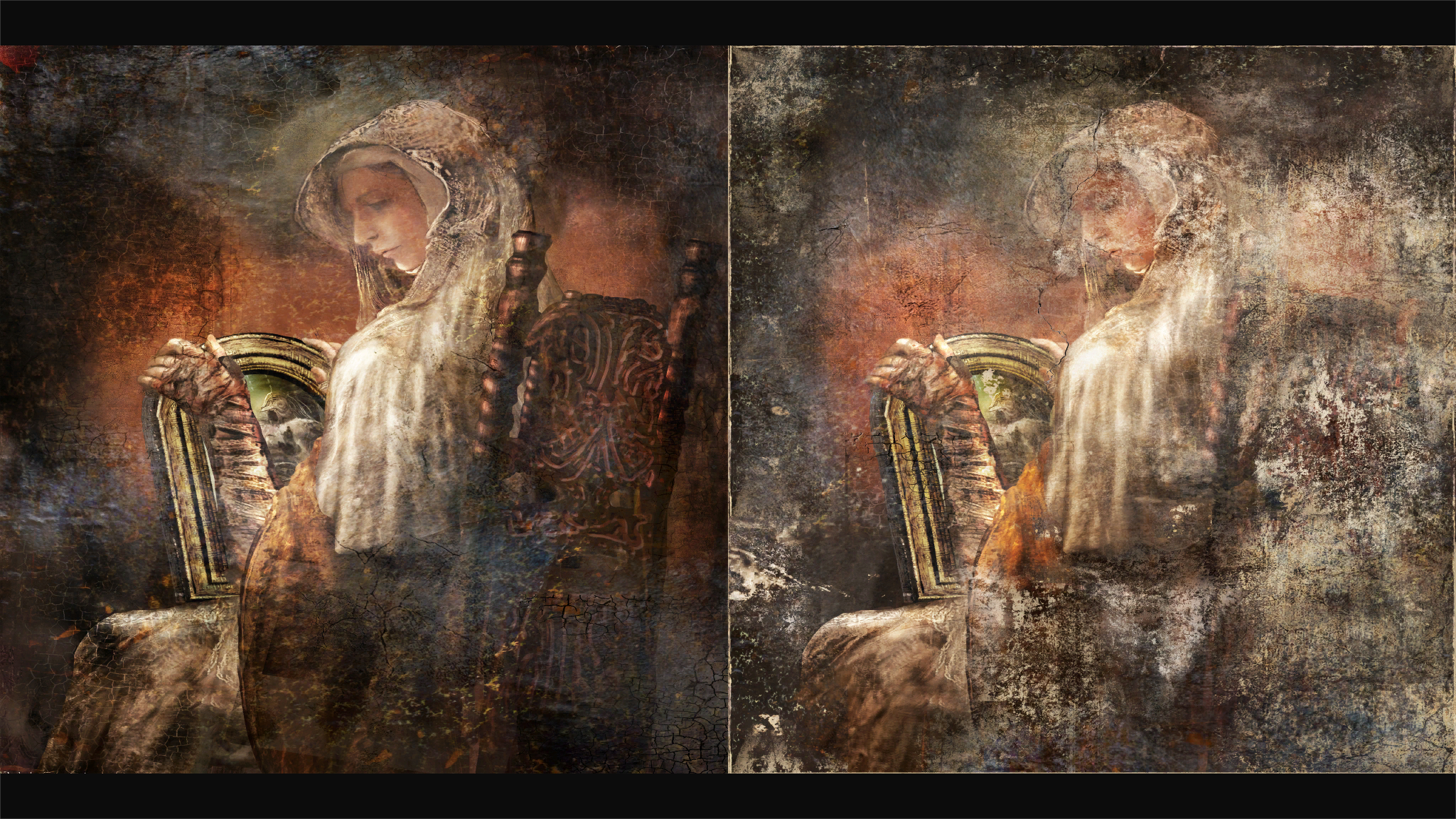
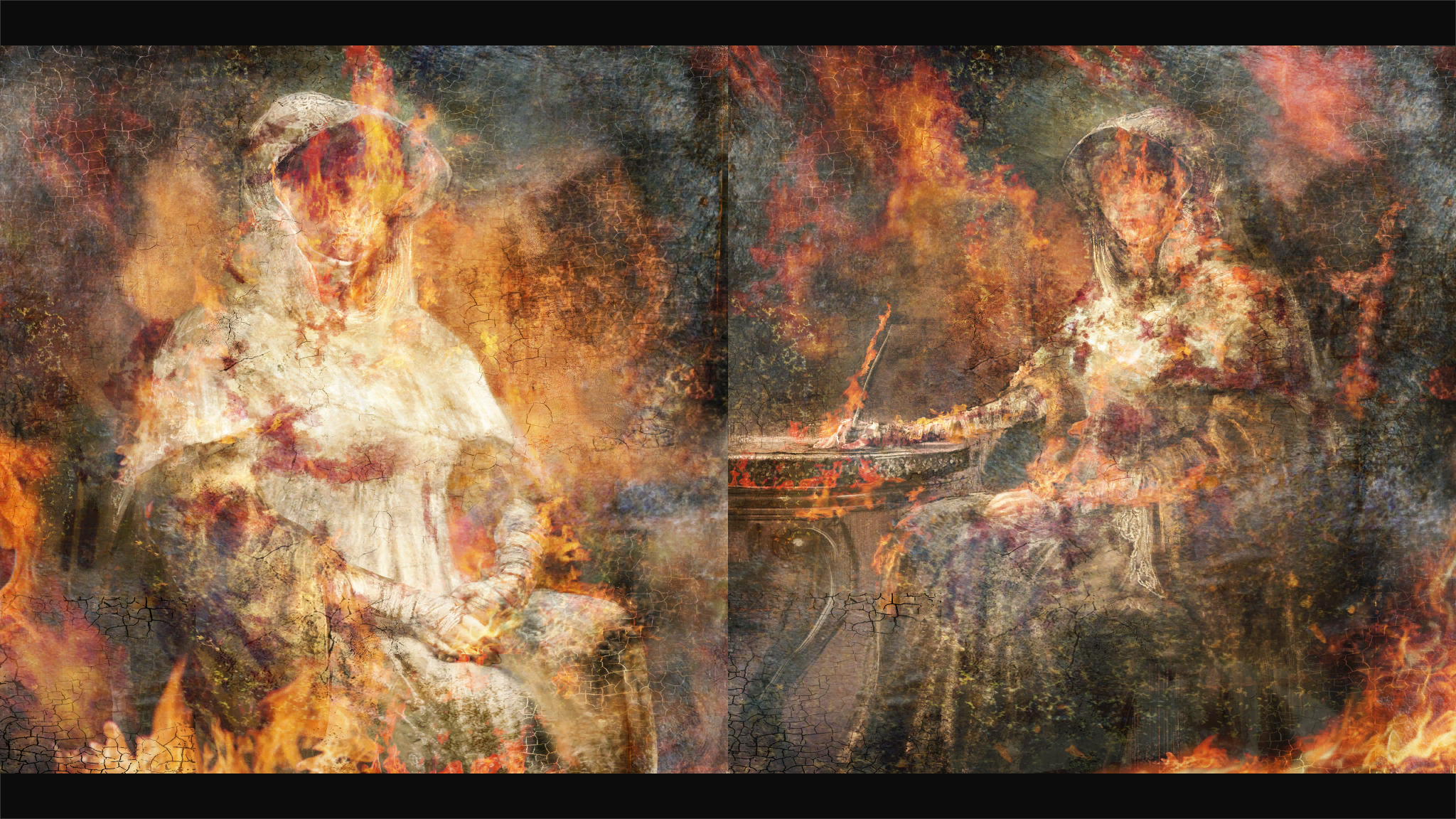
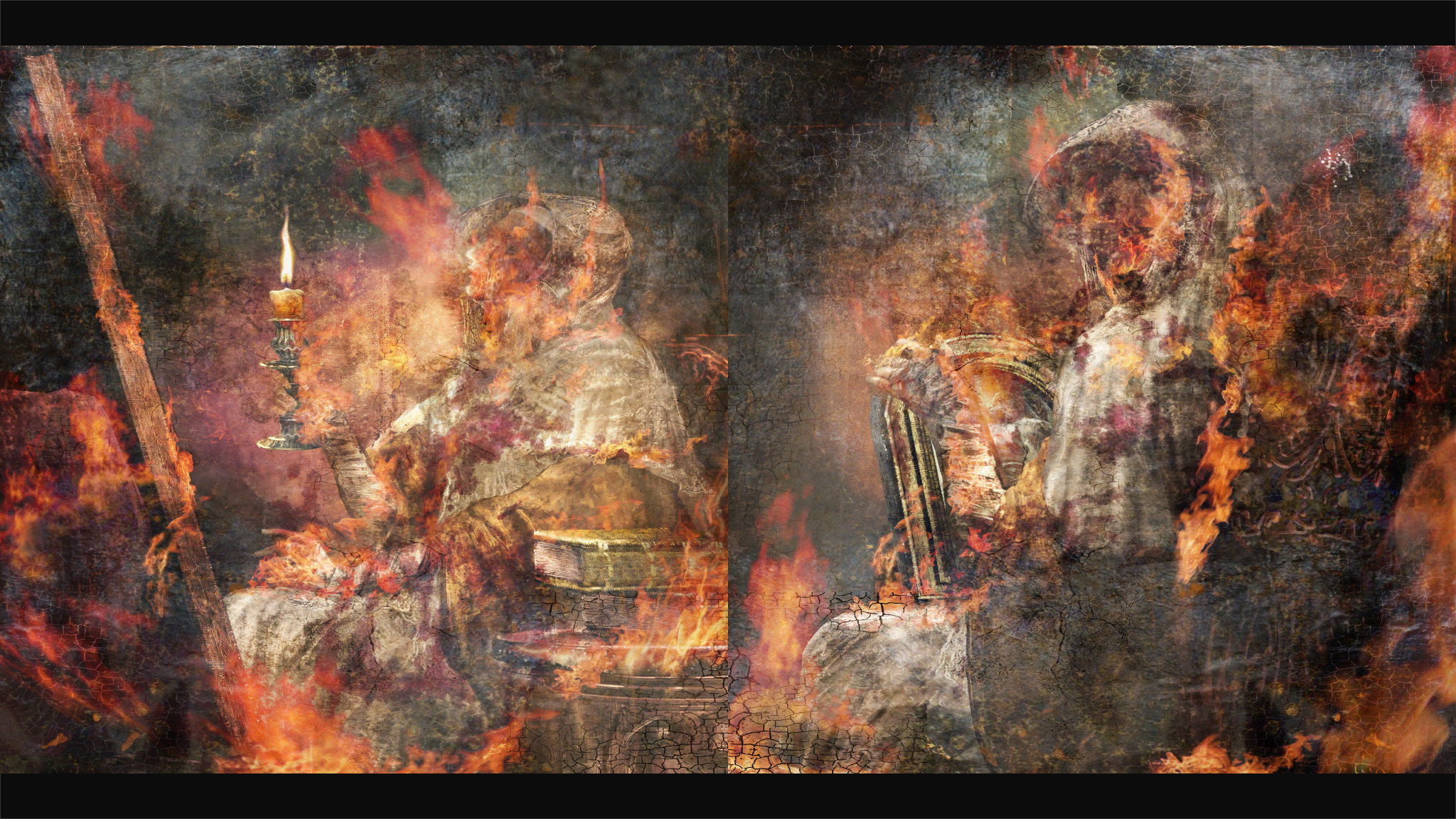
Portraits of a nun dressed, naturally, in pure white like Priscilla fill every corner of the chapel’s main chamber. Although missing the facial scar Elfriede hides beneath her hair and black hood, it is obvious an idealized portrait of her. We see the painter constantly trying to draw, even when not in front of her canvas; when deprived of all her tools, she just tries to scratch her mental image into a table. This many paintings below her atelier is assuredly her work, in which case her choice of subject is rather revealing. Sometimes it is Friede posing for the picture, sometimes it is while she is busy examining other paintings, and sometimes it is her noticing mid-examination. Clearly, the painter had a compulsive desire to make the unkindled her muse, loving to draw the nun as the pure, maternal figure she strived to be in absent of the girl’s real mother. It is a telling sign of their peaceful life together in that chapel, which went on for quite a long time since some paintings are markedly older than others.
Eventually, however, the newer paintings began to take on an additional motif: Friede’s image consumed by blood and flame. Perhaps this was the painter no longer able to contain her anticipation as the hour of the prophecy drew ever nearer. Nevertheless, it highlights that Friede’s true role soon hung overhead in their relationship. For the painter, this apparently wasn’t a source of stress. In the end, the girl makes no mention of the nun standing in for her mother, nor shows desperation over the rot slowly consuming her people. Her lack of concern with everything around her invites a surreal air, in fact. Maybe she just feels secure in knowing the future and her role in it, but there is never a question in the girl’s mind whether she will perform and succeed. Everything else is secondary to Priscilla’s wish for her, and Friede was never going to supplant that. In short, the unkindled’s feelings were irrelevant. It thus comes as no surprise that the painter seems unbothered by how the prophecy came to spoil their relationship.







Even if they might as well not exist to the painter, the villagers of Ariandel were suffering. Faced with the consequences of their decisions, the undesirables have had a change of heart. Predictable as that is, the reasons appear more nuanced. The one talkative crow villager fears his slow rot, not because of the anguish or horror of his situation, but because it means that they are no different from the outsiders who detested them and they detest in turn. The village realized all too late that they had, ironically, made the same mistakes as the outside world — clinging to a world long past its expiration date, leaving it to fester and rot worse than any unknown future that awaits them. Only after experiencing the full consequences do they realize the wisdom of Priscilla’s words, the words they foolishly disregarded. Seeing that they are wretched sinners, through and through, it is only right that they rectify their transgressions. And so, they resolved to go through with burning the painting before the second ash had even arrived. Regardless of the tradition’s veracity, they would no longer evade the issue.
Say, you, please. I’m afraid. Of slowly rotting. After all, we’d be the same as they of the outside, wouldn’t we…?
… Ah, you, thank you. I already hear the sound of fire from here. The sound of our homeland, the painting of Ariandel, burning… We burn the rotten world. For the sake of the next world. That alone is the decent thing to do, isn’t it; more than they of the outside.
But while they may have been ready to make way for the next painted world, Freide was not. According to our friendly villager, she hid the fire from them all, robbing the village of their resolve in the process. The nun purportedly accomplished this by tricking Father Ariandel into cooperating. From the earliest we can visit the chapel, we will hear the periodic sound of the pastor self-flagellating, as shown in the DLC’s announcement trailer. Strapped to a chair secured in place within the inner sanctum, he endlessly draws blood from his back with a cat o’ nine tails. Although the localization refers to this weapon as a flail, it is more accurate to call it a “rose whip”, (バラ鞭) hence the name Rose of Ariandel. Like certain medieval clergy, flogging oneself with this can induce a spiritual “awakening”, in our case increasing the strength of our miracles. But Ariandel isn’t trying to just deepen his faith, but to drip blood into the large metal bowl before him. As the corvian relates, he needs his whip to keep the fire from flickering in the basin and eventually overflowing.
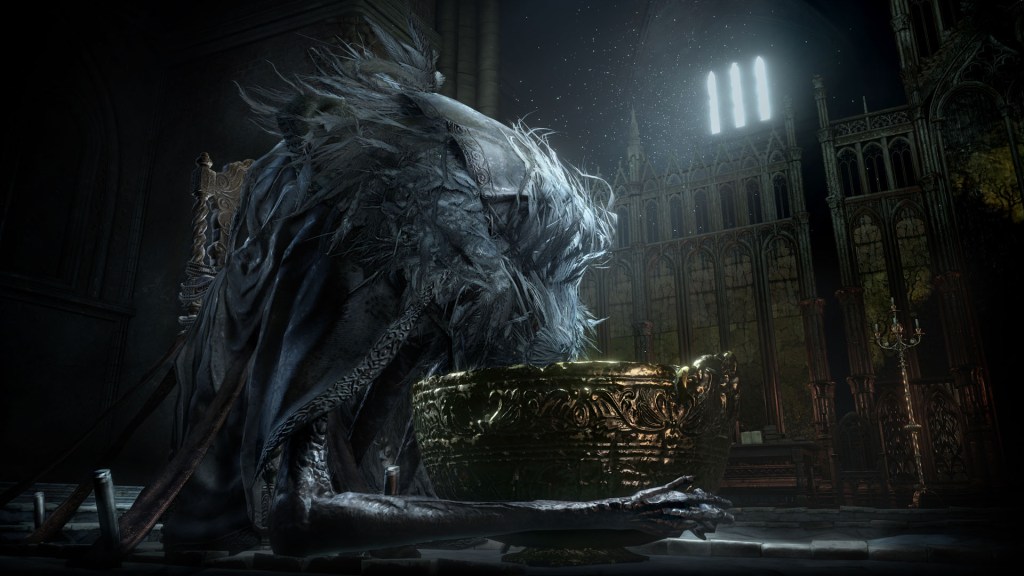
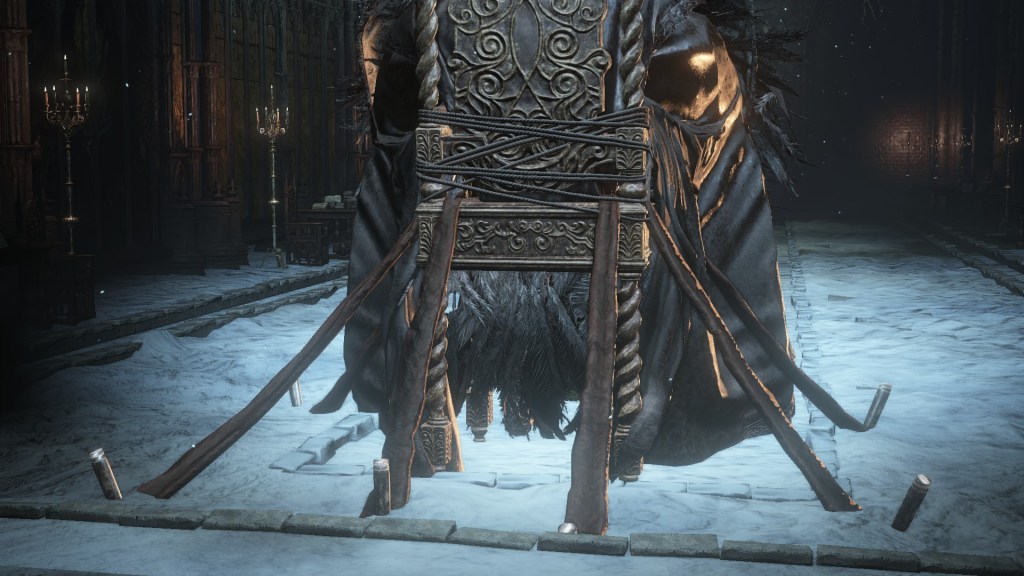

You probably saw it. This world has already rotted. But that woman tricked the Father and hid the fire. Took away our readiness…… So, please. As the tradition says, burn down this world. And please show fire to my lady.
Rose whip the ball-like Father of the painting world used in order to appease the flames with his blood. It is a miracle catalyst alongside being a weapon.
Ariandel, who is the painting’s restorer, knew that it was painted with blood, so again used blood in order to protect it.
Battle art is “Awakening”. Strike self strongly to prompt an awakening and temporarily boost the might of miracles. This is probably the original way the Father used the rose.
I see fire. Fire is flickering again… Surely, there’s not enough blood… The whip, bring me the whip… Oh, Friede. You hear me, don’t you…? Please, please bring me the whip…
Indeed, the embers buried at the bottom underneath all the blood betray the bowl as a source of fire, which Ariandel is later able to unleash. Considering this function plus the basin’s resemblance to the Lordvessel from DS1, it was most likely one of the tools Ariamis used to paint his world back in Anor Londo. Maybe it was originally a mixing bowl for the pigments. Either way, all the fire power in the painting is being channeled through this magic bowl as if it were a portal. This allows an individual to monitor flareups caused by the pigment’s decay and react accordingly, before the flame spills over into the painting dimension. Ariandel presumably retrieved this from the original Ariamis world before making his restoration and kept it in his custody thereafter. Now, in captivity, he applies his “paint” not to the canvas but the fire power directly. With his original blood rotting, new feed is required to keep the first layer of magic paints from breaking down as well. The basin makes this simple, as Friede’s blood merely touching the base seems to calm flickers and consequently clue in the corvian absorbed in angst to her defeat.
This is Friede’s plan to prevent the prophecy, to have Ariandel continuously supply blood to appease the flame. From that one spot, those two can keep suppressing the fire indefinitely. The only issue then is the emergence of the second ash. But to prevent the world of Ariandel from drawing any attention to itself, the chapel’s bell was quietly removed and discarded; which worked, as according to the corvian in the cave, we are the first newcomer in quite a while. No unkindled would be drawn to an unassuming scrap of canvas and enter their world unprompted. And even in the unlikely scenario that ash were to stumble into the painting, Friede seems to have set up an Undead bonfire in the chapel to guide them right back out before they learn of the oral tradition. Acting as the secret gatekeeper to Father Ariandel, the nun redirects any disturbances to the pastor’s private meditations. She has certainly arranged everything to isolate the man from anyone who might dissuade him. The old crow likewise acts hopelessly dependent upon her. However, that ignores Ariandel’s part in this plan.
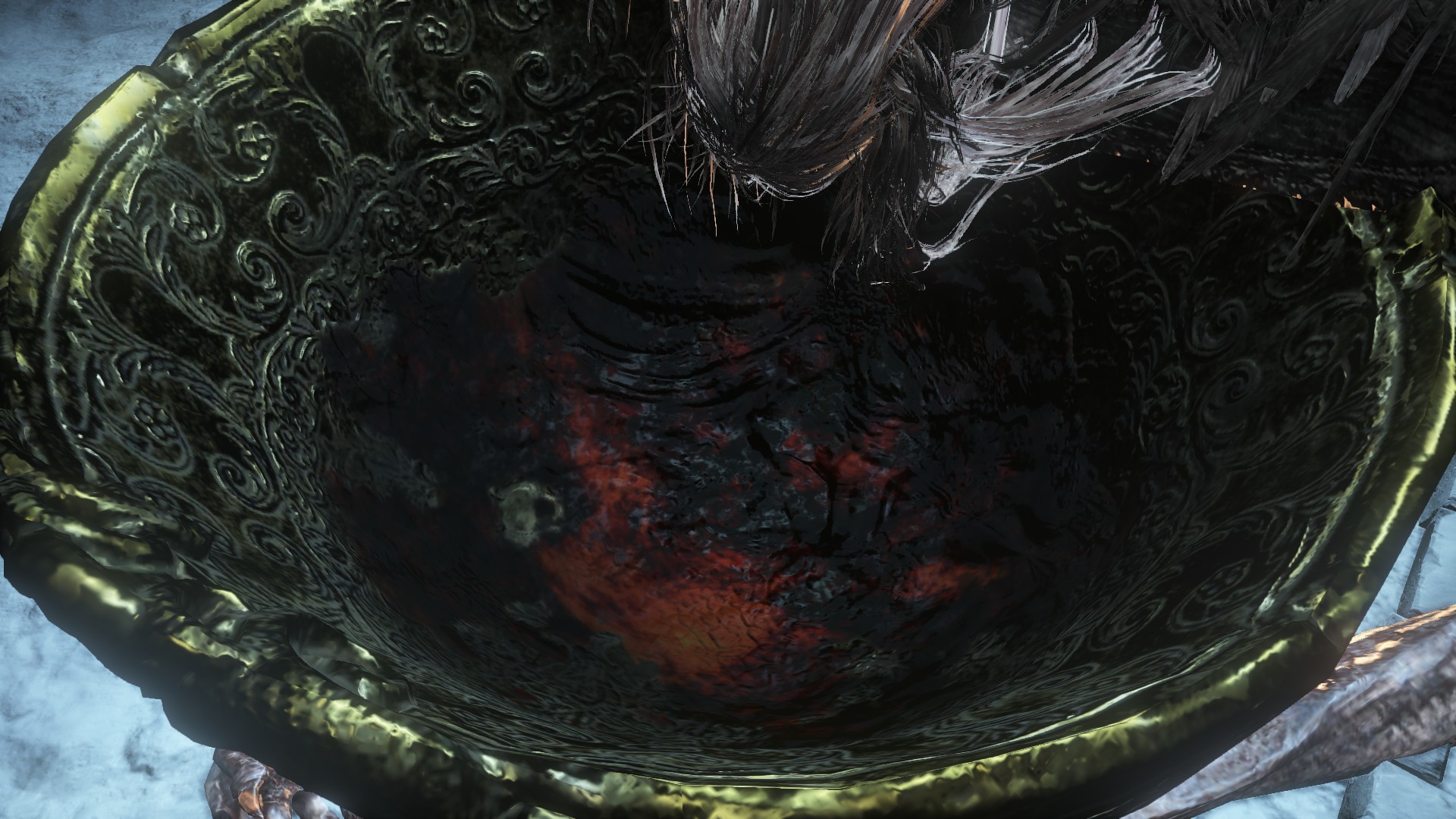
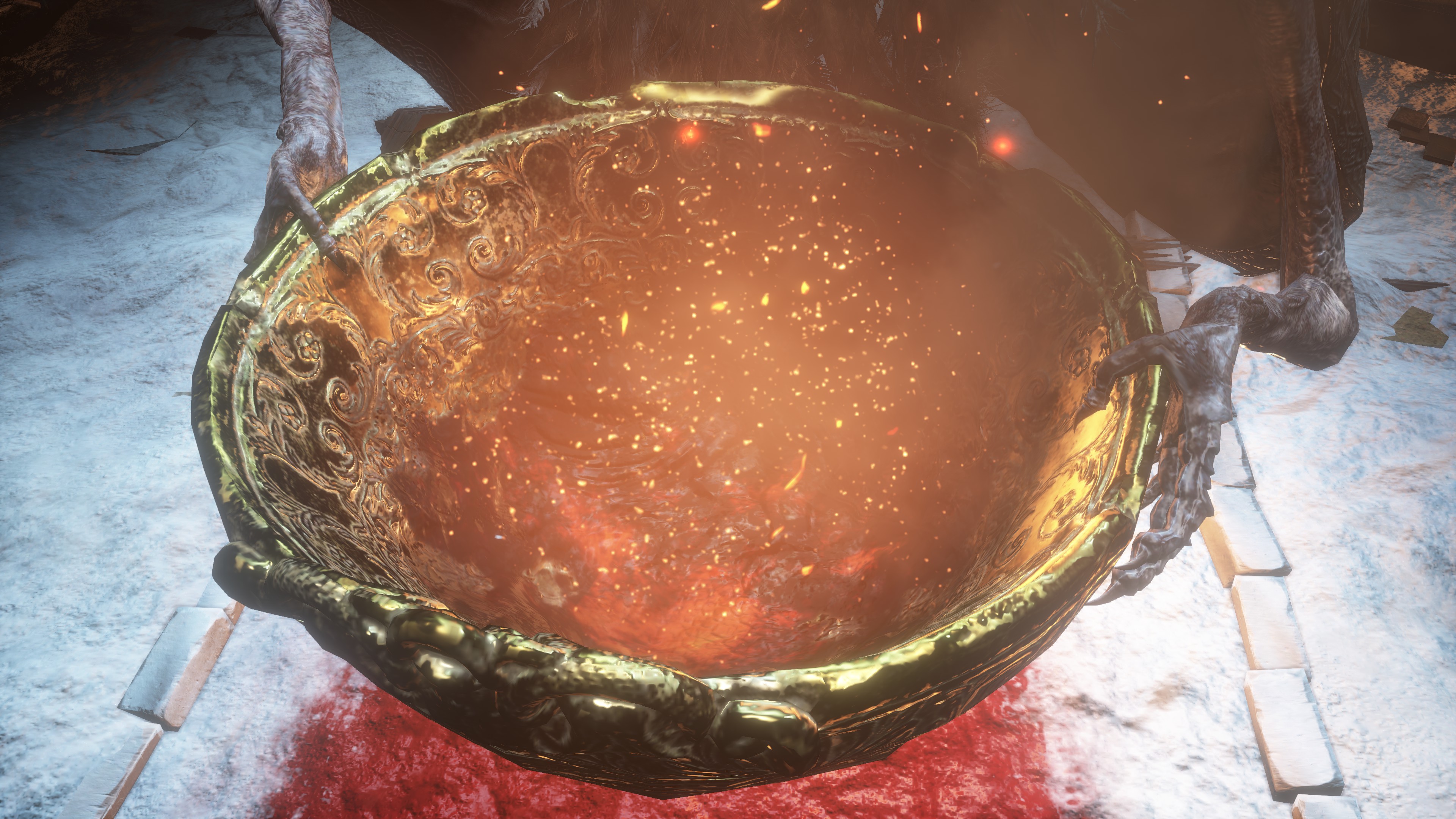


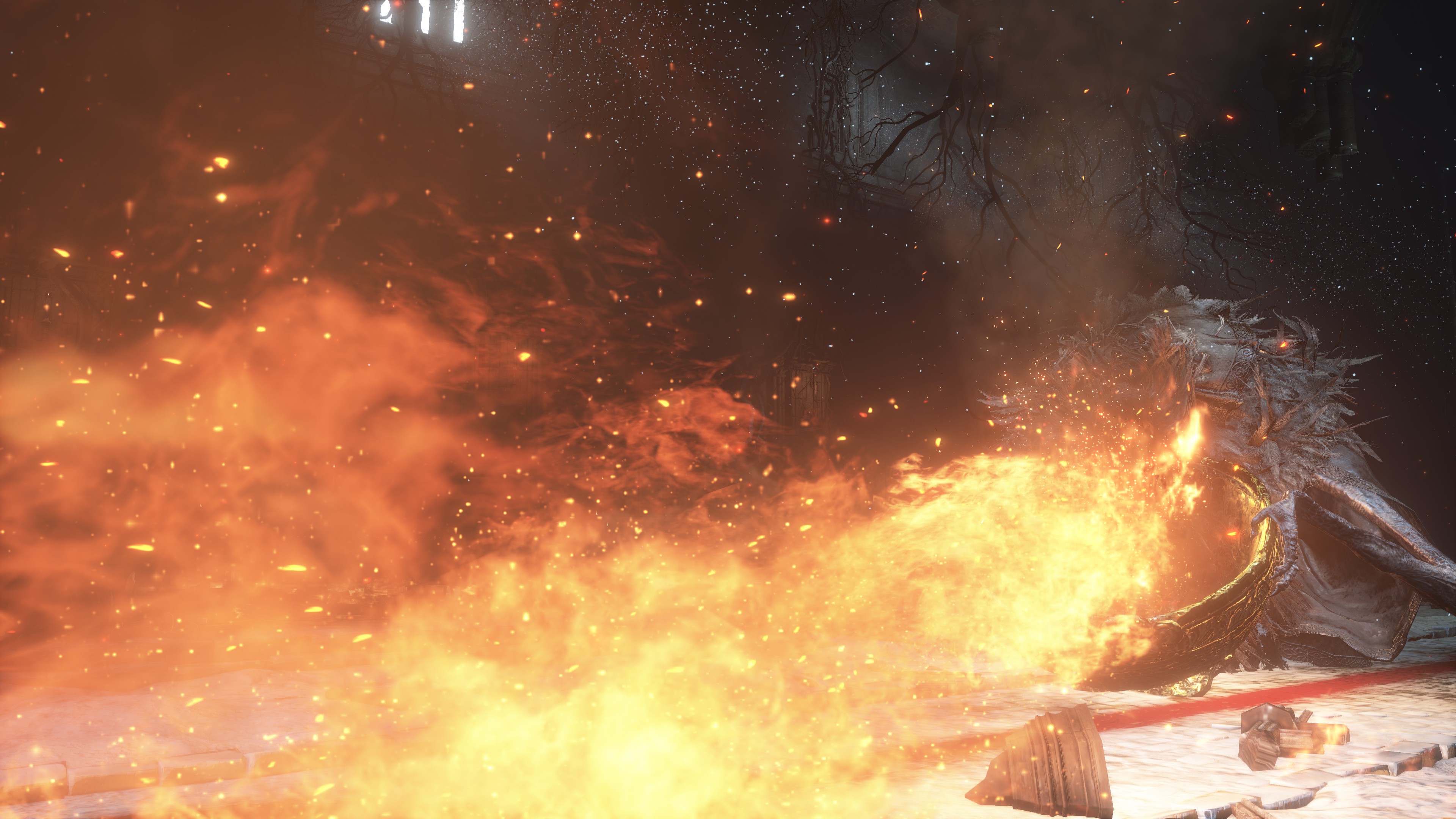
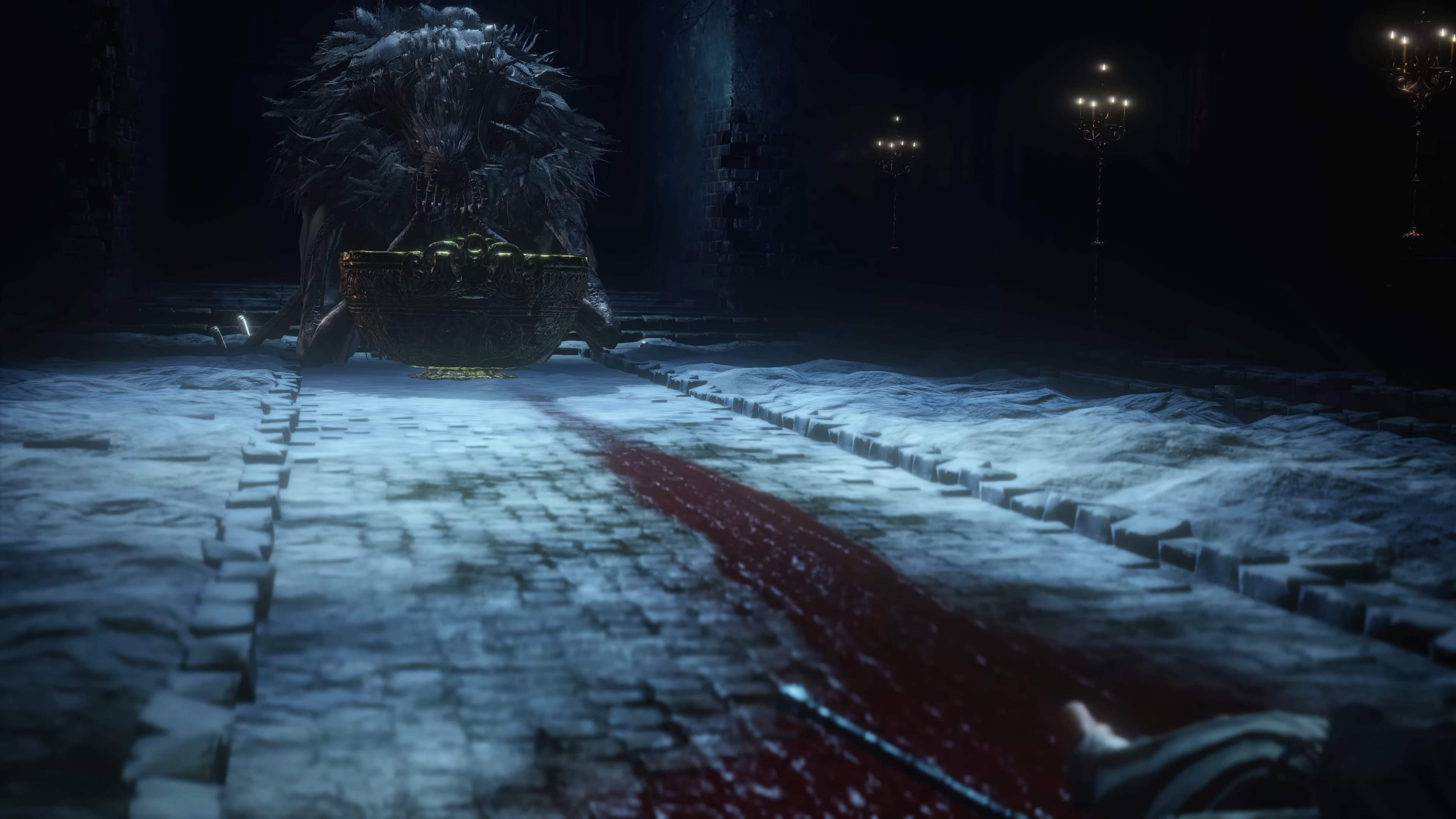
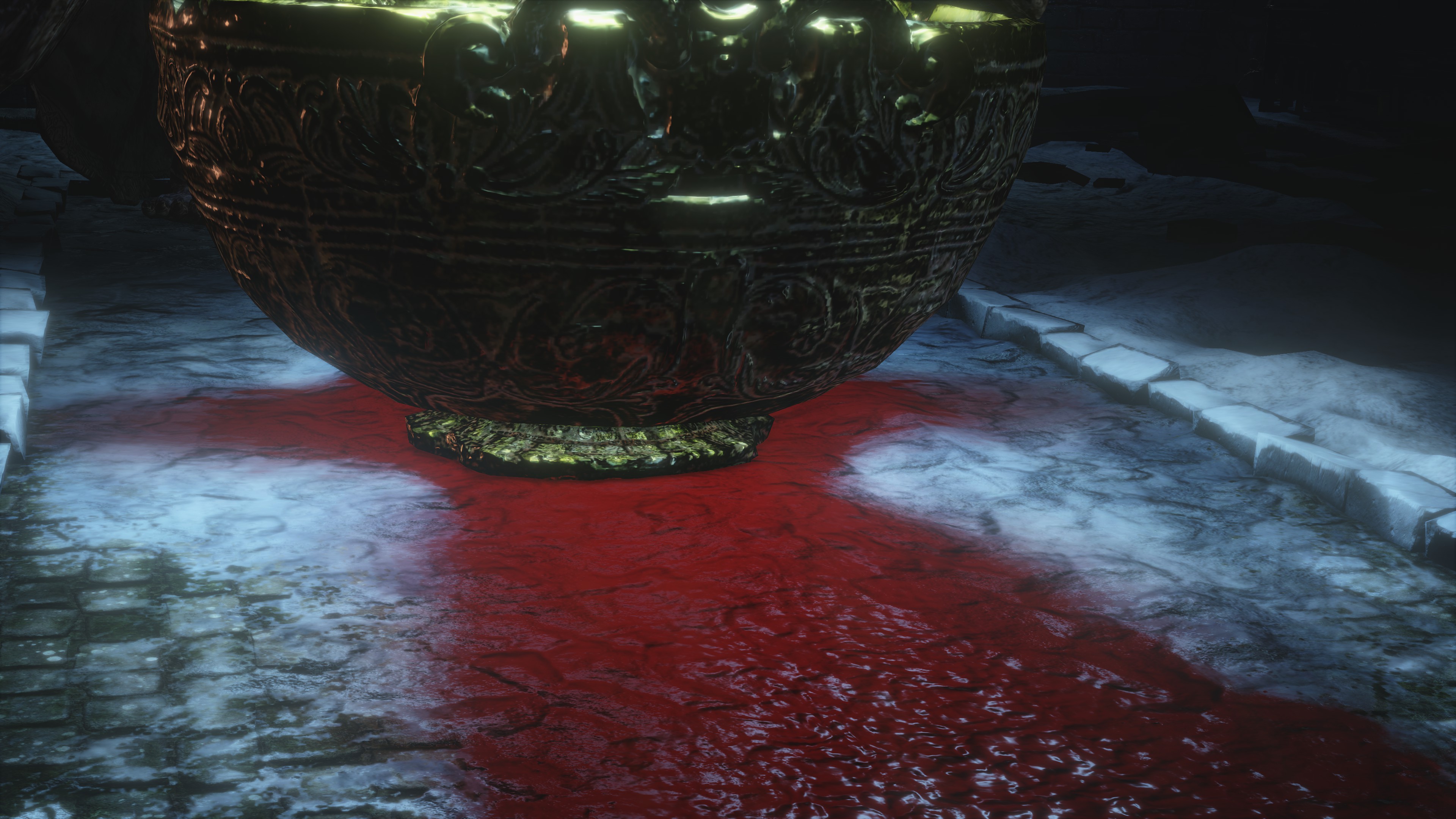


… Oh, are you a newcomer? How unusual. It’s been quite a long time.
Welcome to the Painting of Ariandel. I am Friede. I am the one ever with the Father and all of the undesirables… But, an undesirable you are not. O fireless ash, I know not how you strayed into the painting, but you have a mission, and it is not here… Return to your place to belong. Surely, you have seen it? The bonfire in this room? Currently, it is already going out, but it will guide you, nevertheless.
According to the description for Friede’s soul, they chose rot over flame together, and his whip’s text implies that he in particular concocted the means to suppress the flame. For sure, it is Ariandel who demands Friede return his flail as he notices flame begin to stir again within the basin. He is fully aware that his actions go against the prophecy, yet commits to it wholeheartedly. The crow man also showcases the capability to break free of his restraints; the straps serve as little more than a formality. Much like Anastacia in DS1, the pastor’s confinement appears self-imposed, a disincentive to give up as he endlessly subjects himself to pain. There was no trick when it comes to getting the man to spill his own blood — as the restorer, it is only right that he completes this duty to the end. Cut dialogue does have him implore Friede burn everything with his final breath, but this is framed as Ariandel giving up on his precious painting at the very end, which may be why it was scrapped. By all indications, the pastor is just as dedicated to stopping the painting’s self-immolation as Friede is.
Soul of the nun Friede. One of the atypical souls tinged with power.
Can either use to acquire a vast amount of souls or extract its power via molding.
Friede, who visited the painting as the first ash, nevertheless chose rot, not fire, together with the Father.
Ah, you, call Friede. You see, don’t you? The fire is flickering again. It’ll overflow soon enough…
Ahh, ahh, kind Friede… Let it all burn, already…
Thus, under closer scrutiny, the good Father doesn’t appear to have been deceived at all. Insofar that he was tricked, it is that Friede played into his existing biases to bring him on side. The corvian was already attached to his restoration and naturally reluctant to see it go. How much would it really take to push him into defying his gods as they approached the finish line? Self-flagellation is traditionally performed as a form of penance, for the devout to alleviate guilt for their sins — and Ariandel has much to feel guilty about. In a twisted sense, he is sinning to deny fate with the blood and suffering inflicted to pay for it; the flail even comprises of corvian talons, as if his flock were doing the punishing. That kind of contradiction insinuates Ariandel as a tortured soul, knowing what he does is wrong yet compelled to persist with it. And such selfishness, masked by shame and religious fervor, makes a person easy to manipulate into indulging further. Put another way, Father Ariandel’s behavior may be genuine but is still performative, a rationalization for his mind to justify betraying his conscience.
Of course, Friede’s success was probably due as much to her similarity to Priscilla as to Ariandel’s weakness in character. It is seeing her lying seemingly dead in a pool of her own blood that shakes the man to his core, literally trembling. In that moment, did he see the god killed so long ago? Reliving the trauma which first wracked him with guilt would explain the surge in emotion. Faced with the same sight, he couldn’t let it happen again, even if it meant forgoing everything including his prior stance on flame. That explains the pastor’s raw desperation to ember the unkindled’s blood and body, thereby bring “her” back to life. All this time, Ariandel has seen Priscilla in Friede, the one person who might still sway him. From the inner sanctum, the corvian has the half-dragon’s memorial constantly staring through his soul from behind, an endless reminder of his failings. Yet her memory drives him on, not to carry out her will, but to bury it. Why? Because if he doesn’t, what did she die for?
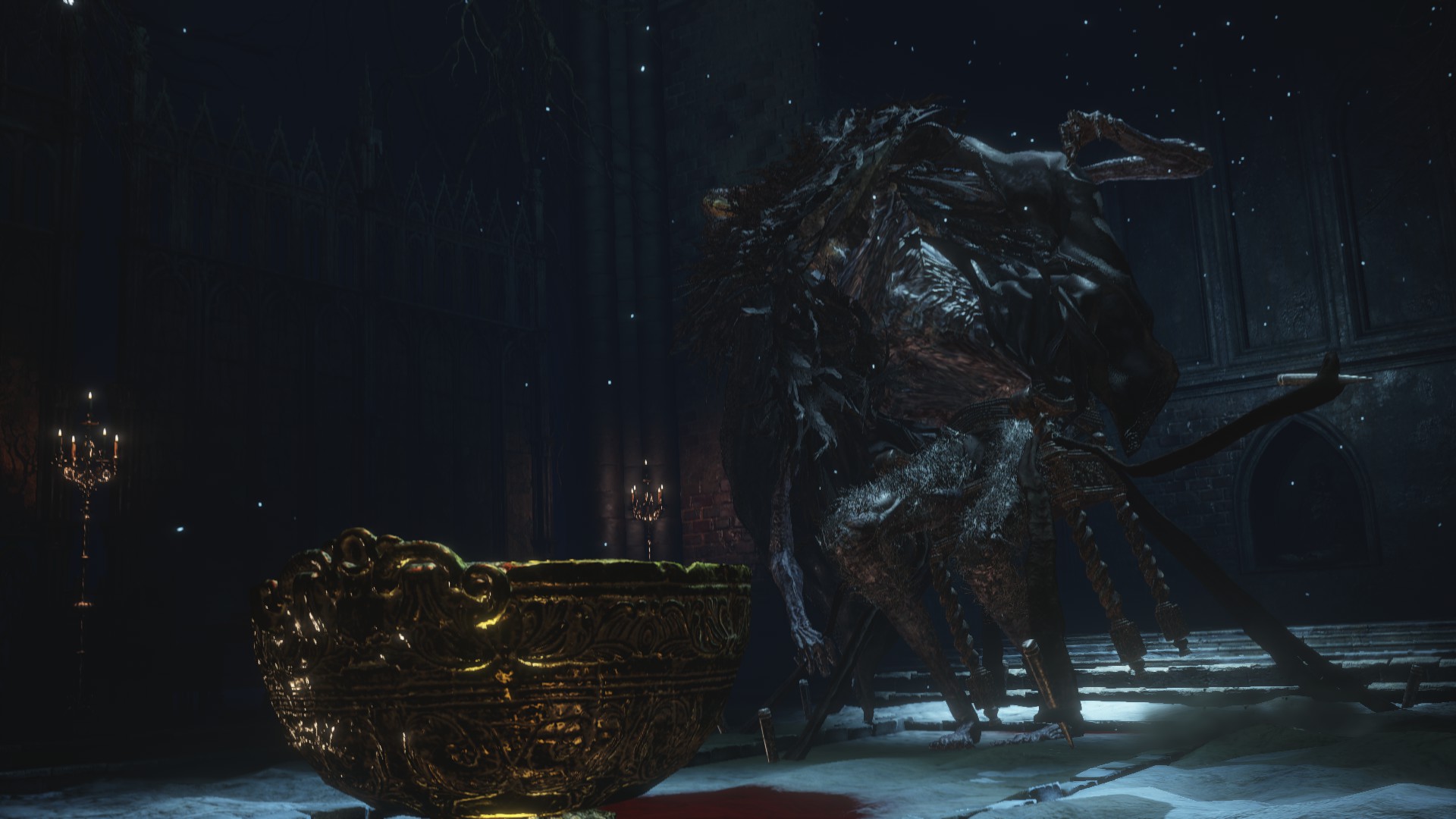

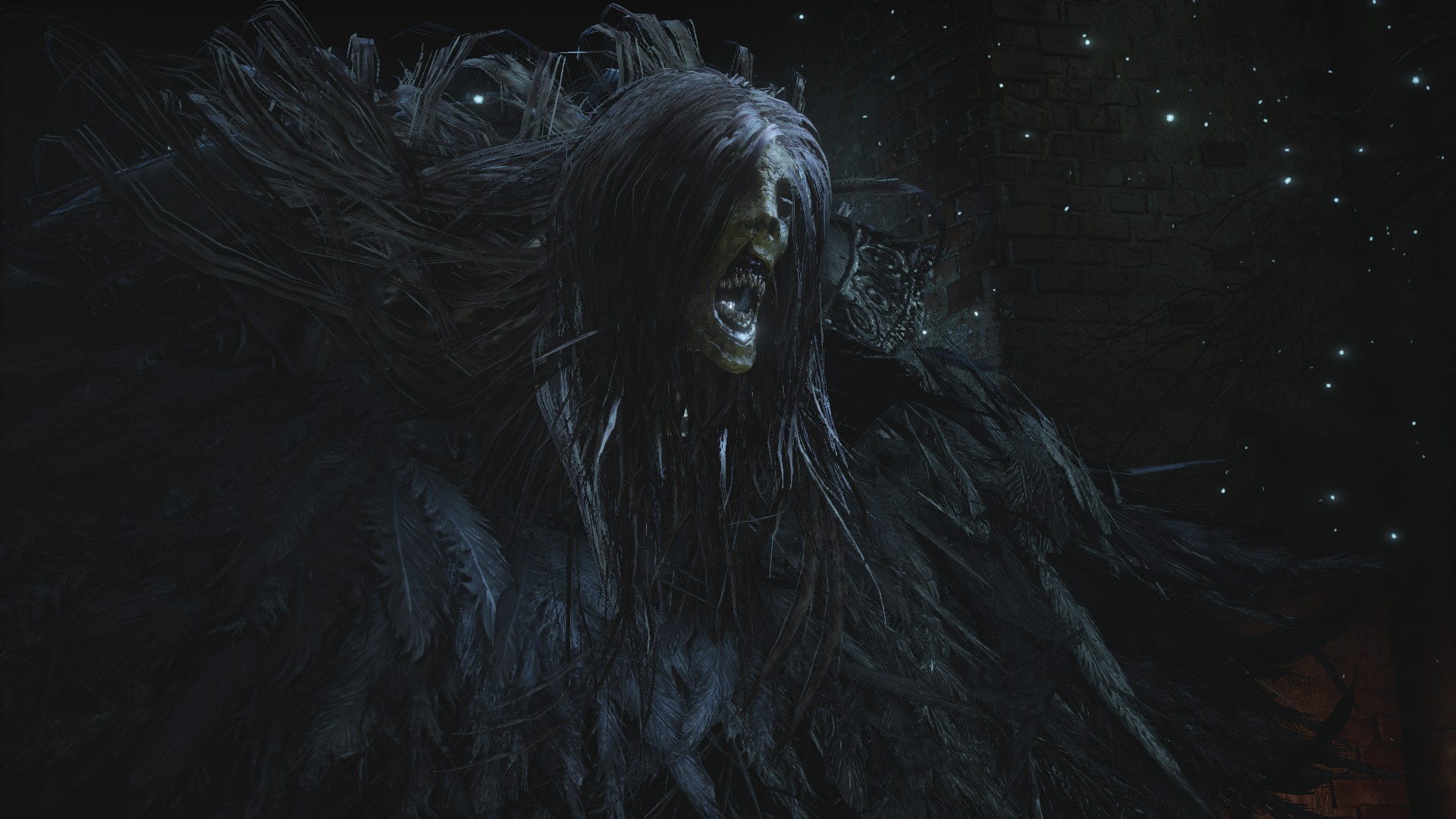

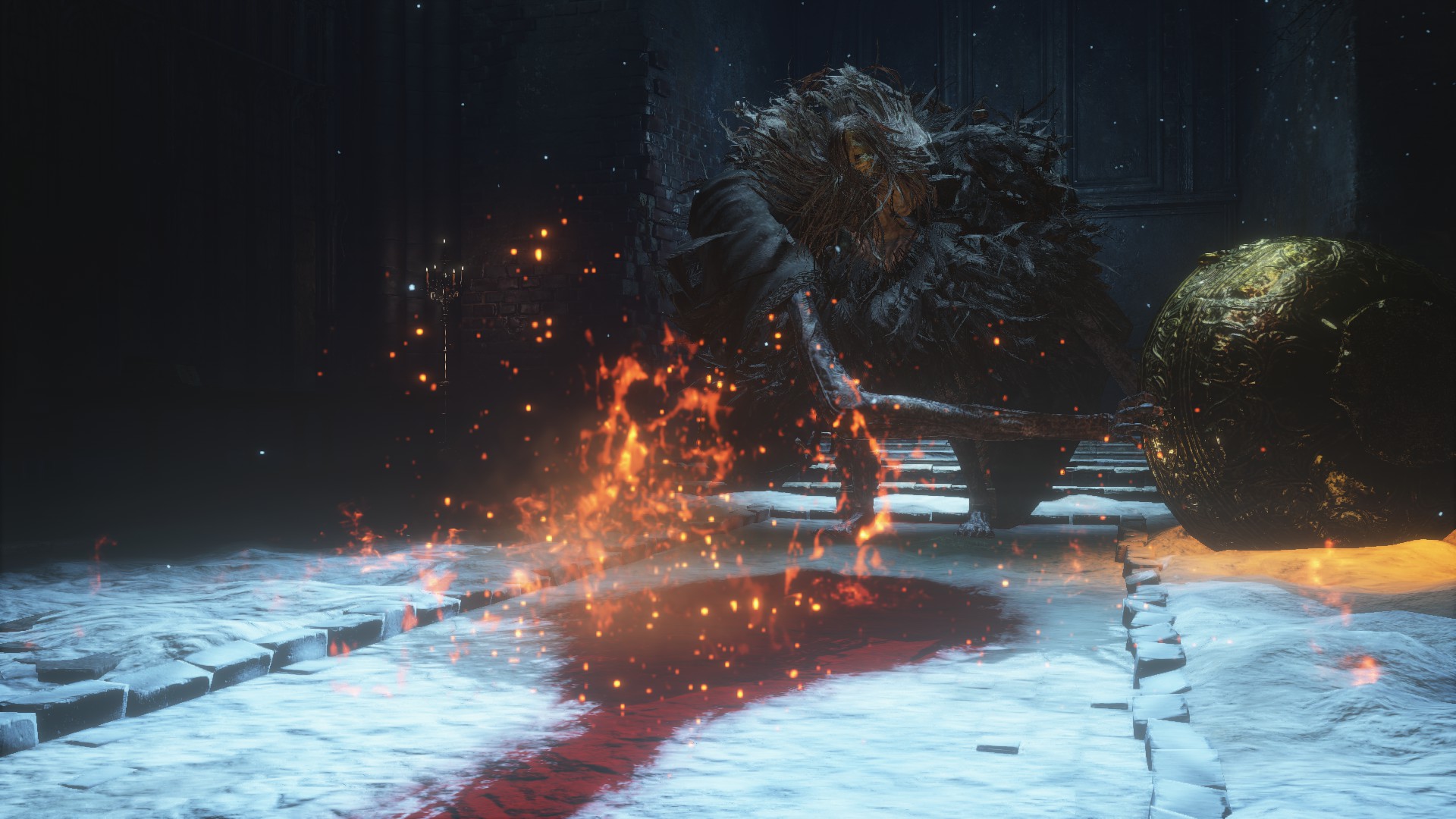


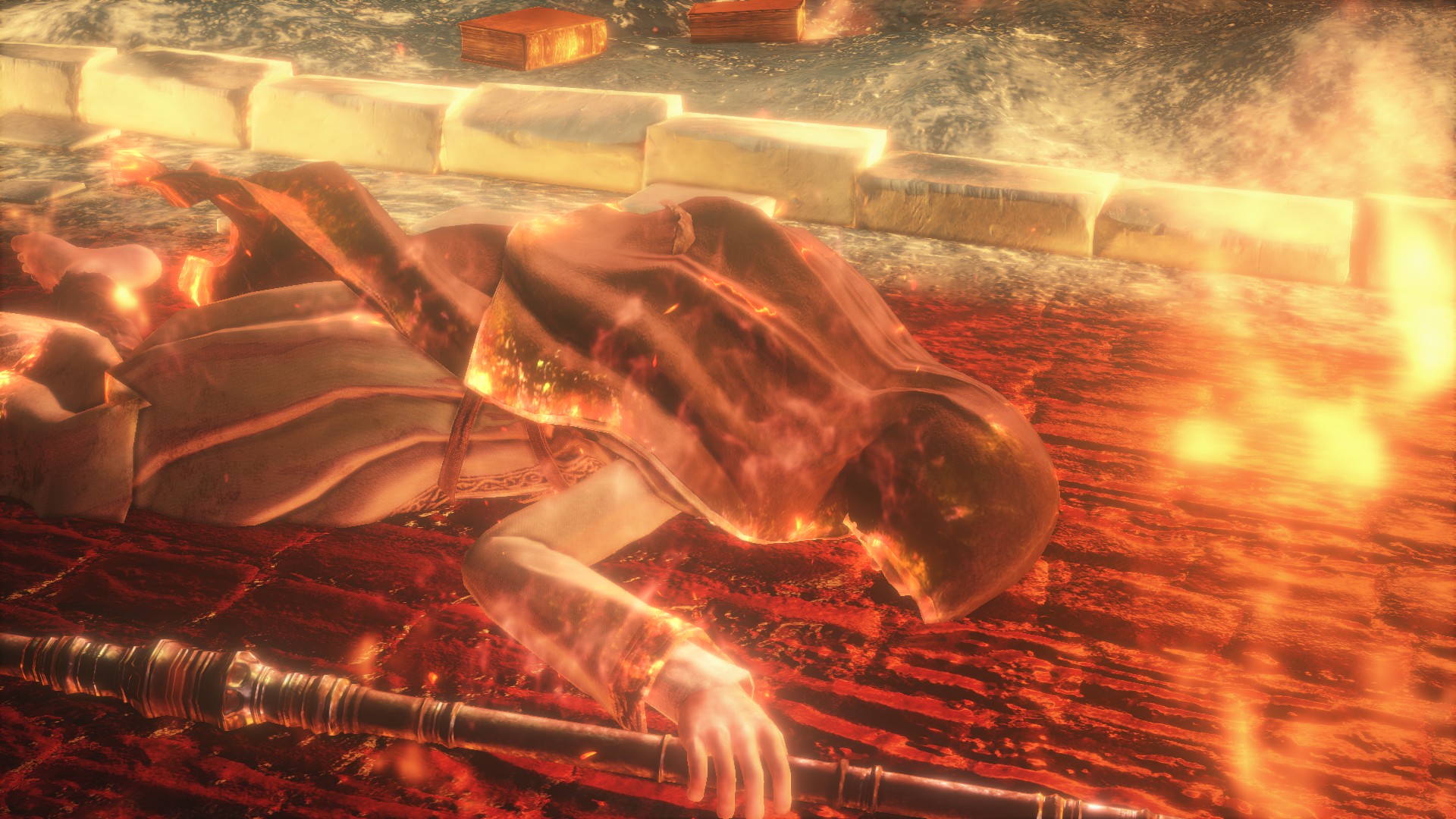
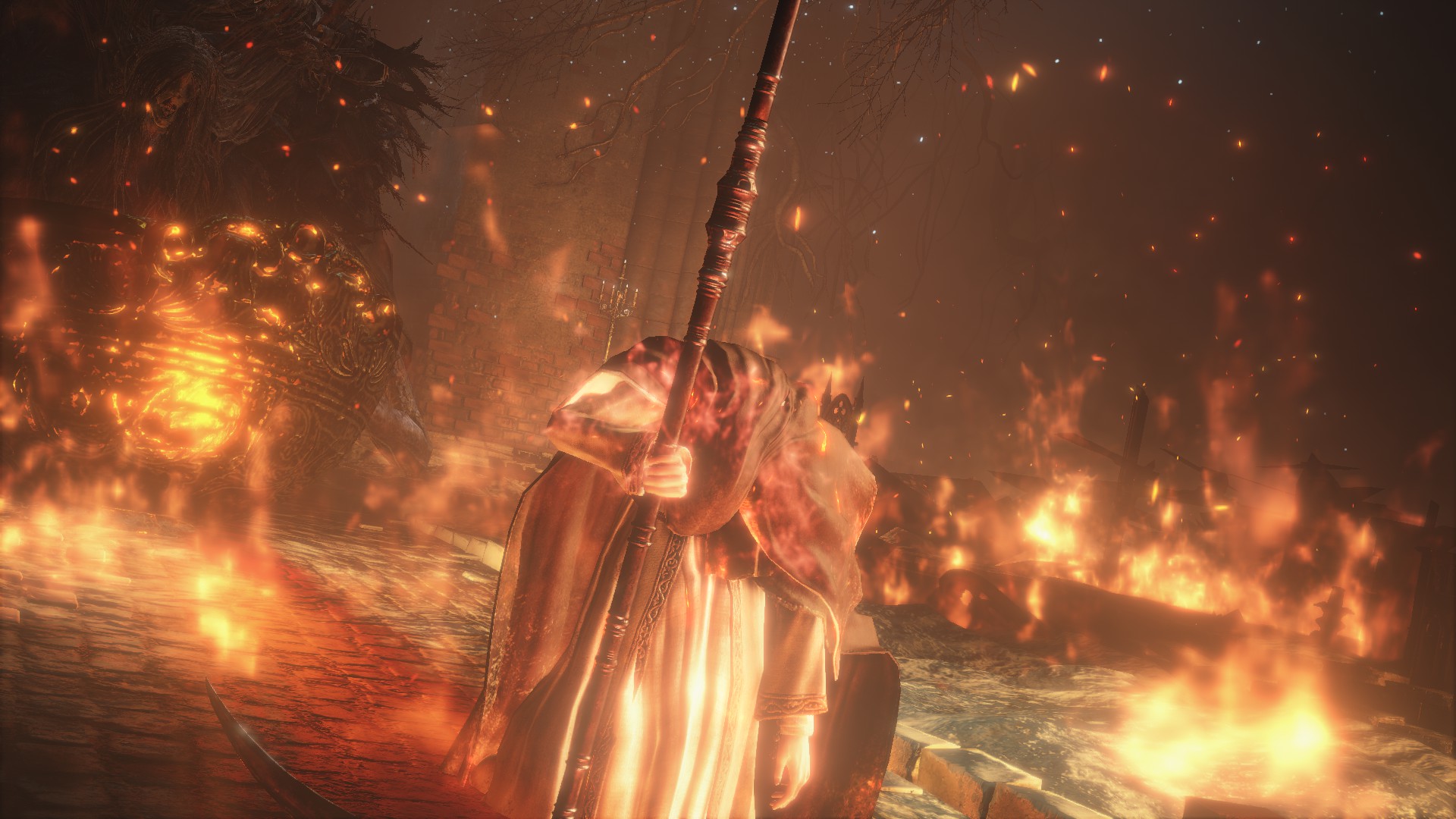
Consider Ariandel’s perspective: he doesn’t want to see the painting he restored abandoned, yet deeply regrets letting that sentiment rob them of the loveliest god they had ever known. As a result, he feels powerless against the will of fate, so lets events take their course. Yet lingers still that nagging sentiment: if this is fate, Priscilla’s death was unnecessary — simply his sin to bear. But then Friede, a girl so similar to Priscilla, steps in and tells him that it is okay to want this world preserved. This “Priscilla” encouraged him to pursue his wants, to not let his sins be in vain. God’s death has to mean something; to give up on the painting now is to accept the tragedy of his actions. If his foolishness is to serve anyone, he must persevere, not turn back. Even knowing it is a sin, he will bear it, so long as it balances out. Haunted by such complicated feelings for Priscilla, it is easy to see how Ariandel twisted himself into this self-serving position, using Friede as much as she is using him.
All that said, the villagers prefer to lay blame on solely Friede. Perhaps this is, in part, because she is the outsider, but it is impossible to escape the narrative when you make yourself the face of the opposition. Those corvians who adore the nun have become her knights, encased in armor from head to toe. As Elfriede was once a fencer, these warrior seem to have received their training from her, though their fighting style remains distinctly avian. The Corvian Knights prefer to wield claws or rapiers modeled on feathers and talons, even spreading the rows of blades between their fingers like wings. And with that swordplay, they execute their fellow crow man, or anyone who threatens the safety of the painting. Where did she procure the Undead bones to create the bonfire, or the corvian talons to fashion Ariandel a flail? From the very start, the nun resorted to violent oppression to keep the flame away, and her knights were proof positive to who was the mastermind.

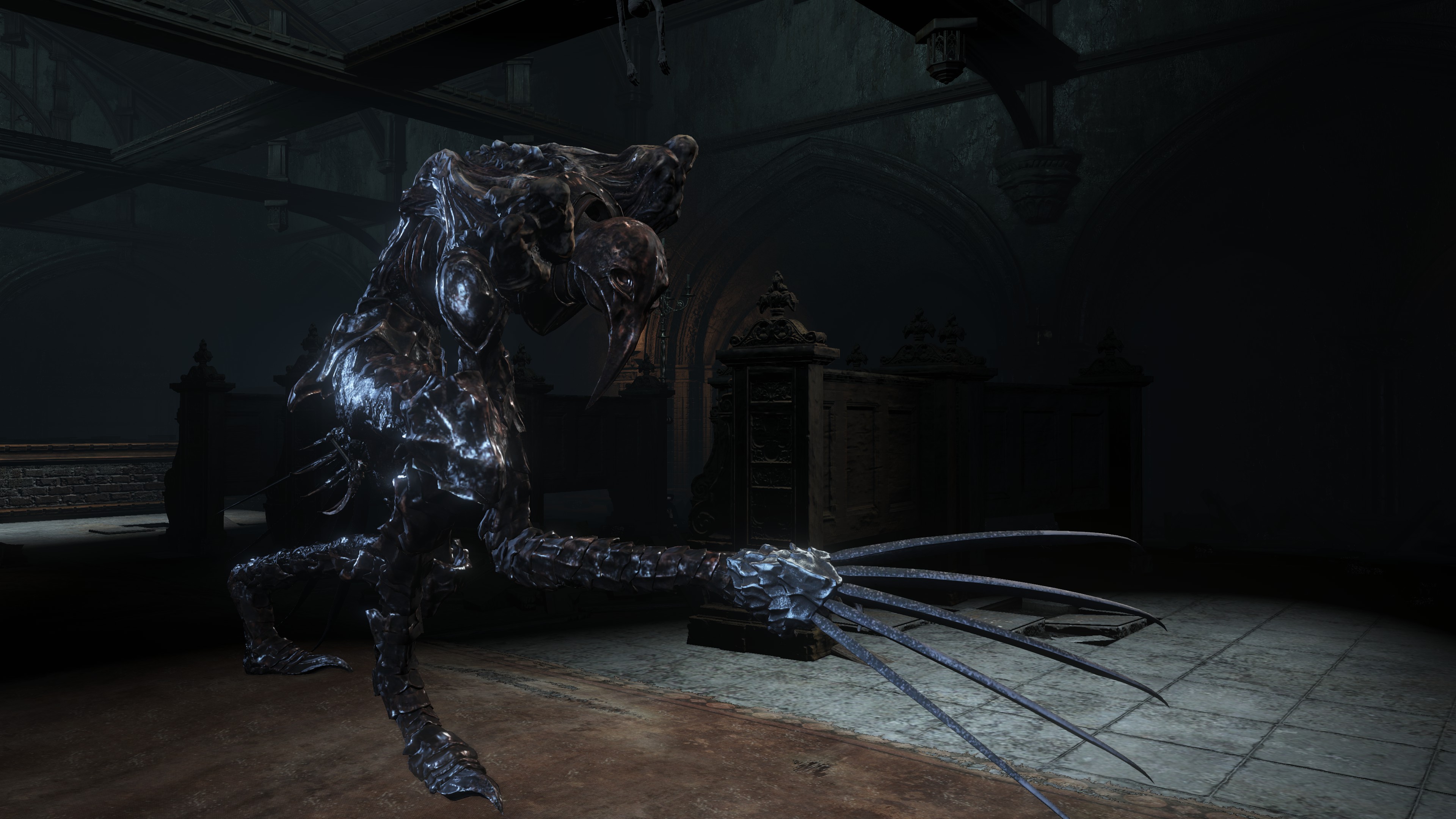


Thrusting sword utilized by the corvian knights, one of the special twin blade weapons.
When twin-blades, it possesses four blades in the left hand.
They who adored Sister Friede became executioners of their brethren for the sake of protecting the painting from fire.
Obviously, the nun had been plotting her tyranny for some time if she was training troops and equipping them appropriately. In all likelihood, she had discreetly recruited knights from among the most recent members of the community. Not everyone was so close to the nun. The painter and Gael immediately recognize the scent of ash on us, while the one villager willing to converse doesn’t notice and can be fooled by our denials as a result. This makes sense if the former spent a lot of time around Friede at the chapel while the rest of the settlement did not. The only villagers to see her to any significant degree would be regular mourners or new migrants. Being newer arrivals would also explain how the Corvian Knights aren’t severely affected by the rot like the others; they haven’t subsisted in the painting long enough to show signs of corruption, similar to the corvian storytellers. All in all, Friede must have relied on people with less of a history within the painting for her secret police.
… You smell of ash… Surely you’re the human Grampa Gael talked about… The human who’ll show me fire…
The knights’ background certainly explains why any true corvian would abandon Velka’s prophecy. After all, they were people who didn’t personally know Priscilla. These men only became crows as part of assimilating into a community of Velka followers. For them, the Goddess of Sin and her crossbreed daughter were stories and legends, not tangible persons. The one giving substance to the legends was Friede, embodying that image which first drew them into the painting. Without memory of the actual crossbreed, it isn’t surprising to see Elfriede wholly replace her in their hearts. She was the master of the painting in front of them, her love material. Why should they side with some long dead goddess? She was the one they truly adored, and if protecting this rotting world was her decision, then they would do everything to support it, even betray their gods and kin.
The knights’ motives aside, these developments were evidently not a knee-jerk reaction to the community’s sudden call for fire. Elfriede must have either foreseen the coming consensus or placated the masses long enough to delay their action. Whatever time the woman was afforded, she made use of it to coax Father Ariandel to her cause, build an army of loyalists, and swiftly impose a crackdown. House’s windows have been boarded up, and knights appear to enforce a strict curfew. While based in the village church, Friede’s warriors hang from towers, bridges, and rafters all throughout town, always listening for dissent before leaping into action. Predictably, worship of Velka was banned. Larger statues were defaced while smaller idols were outright removed, even from worshiper’s homes — we can spy the one corvian still giving praise to an empty homestyle altar. And when villagers do attempt to protest, they are killed off at random, silencing the rest. Under this new regime, no one may leave or interfere with Friede’s judgment. She is to be their new goddess of sin.


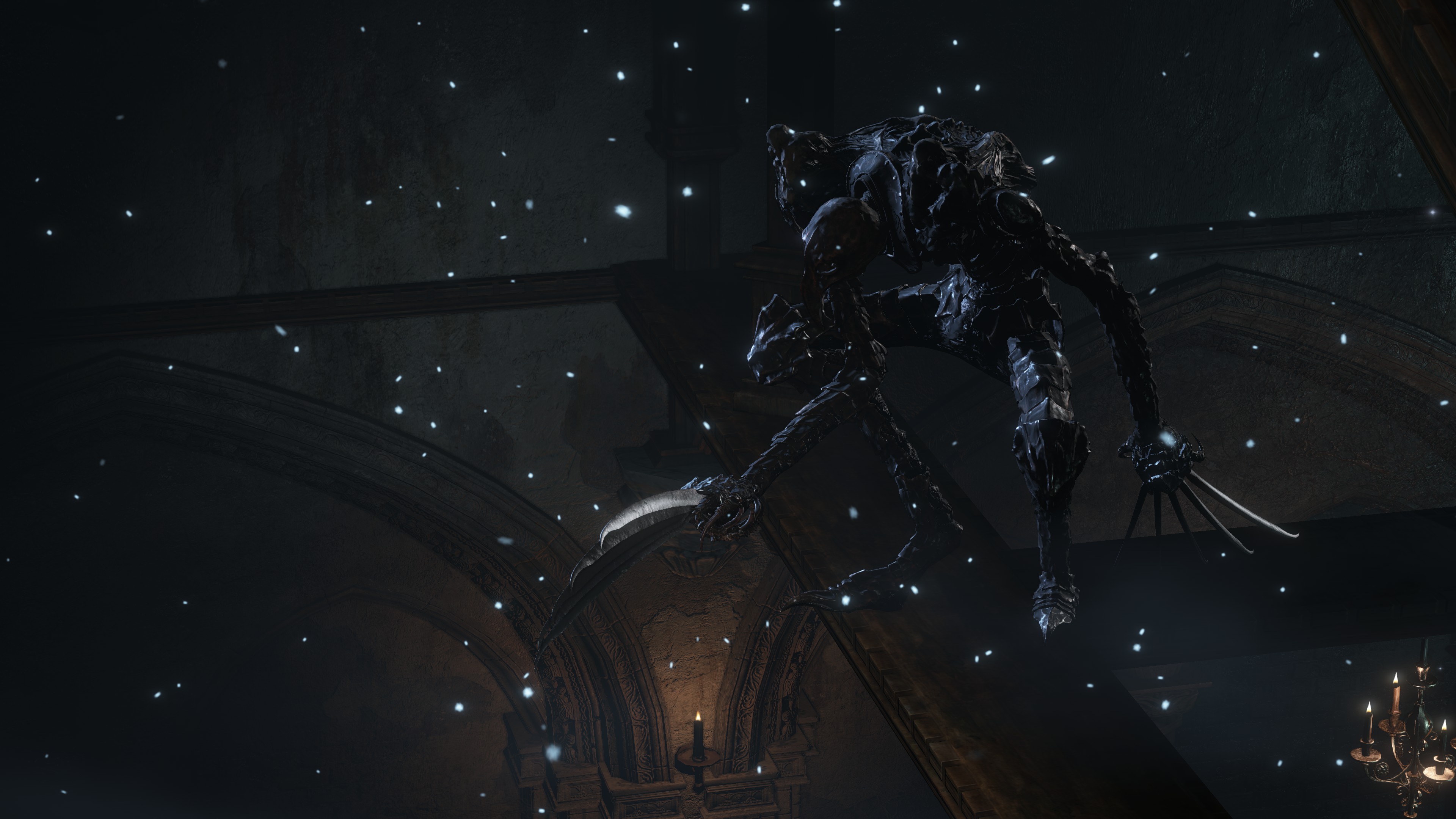


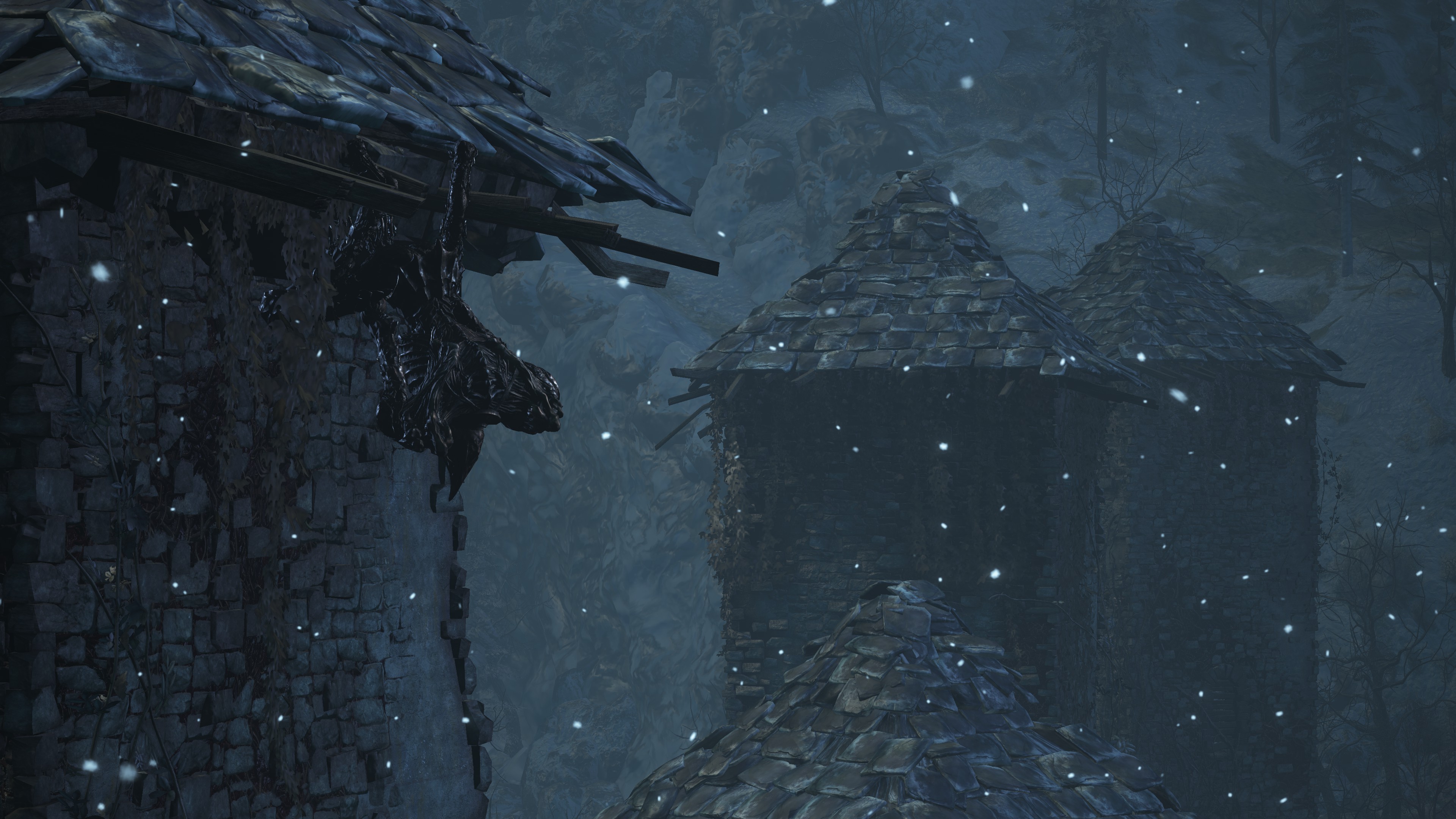

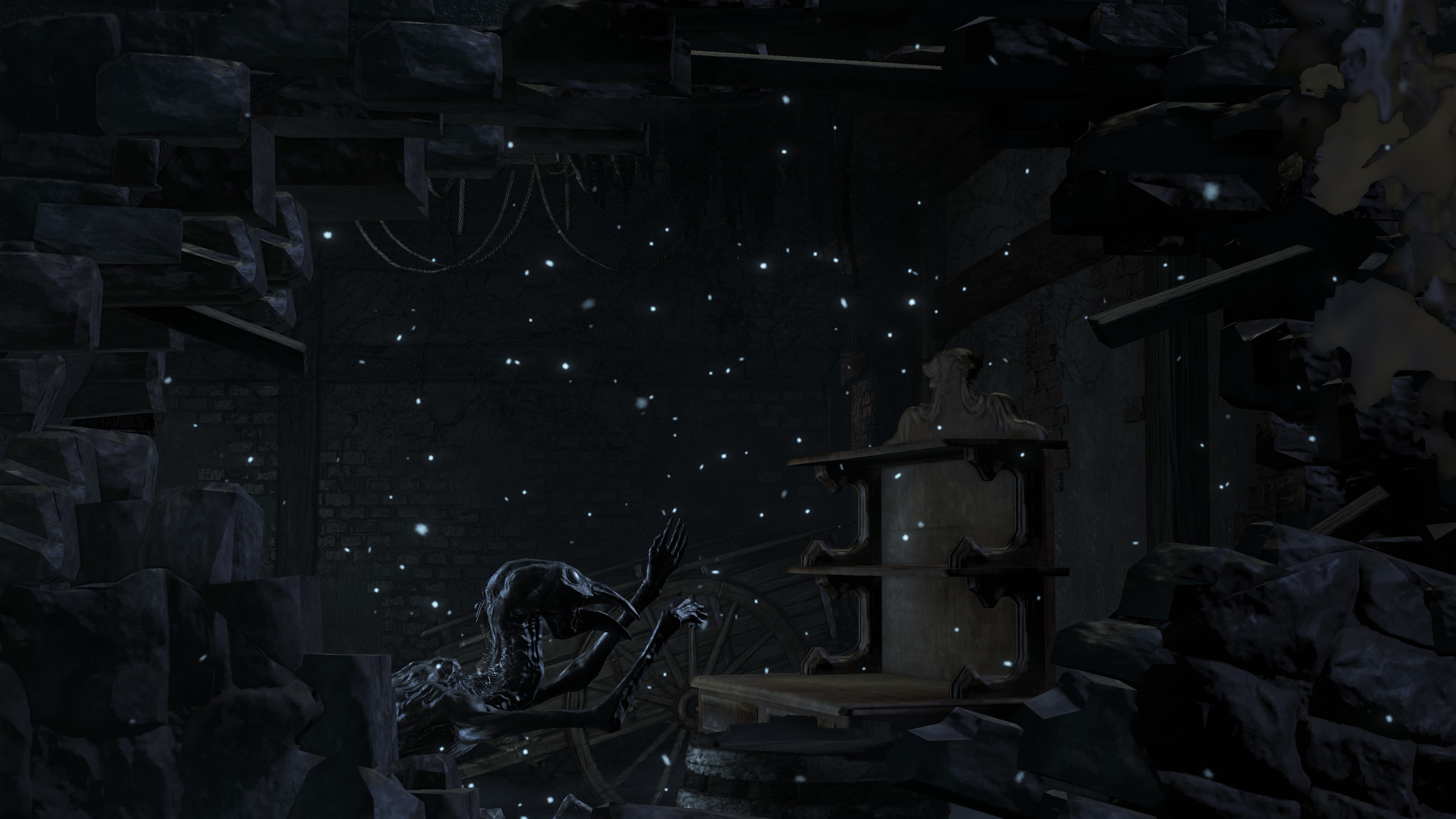
Such autocracy is the reason Ariandel accepts the people’s wrath in the form of his rose whip. The irony that black roses symbolized eternal love and commitment in Japanese flower language — for Ariandel so loved the painting world, he gave up his only people and even his blood so that it might find salvation. And as “they” claw at his back, he persists with his madness to keep their dying world alive just a bit longer. In so many ways, the painting’s continuation has been paid for in blood, so Father Ariandel can’t let it go to waste. With Friede’s encouragement, every additional sin is considered another excuse to soldier on, through the physical and emotional anguish. But making himself the victim doesn’t change the futility of their situation. New blood will only exacerbate the rot over time, and this world will eventually become uninhabitable. The stagnation only guarantees a more tragic end for everyone, but neither Friede nor Ariandel care. They cling to illusions of the past, and it will take more ash before they realize flame.
Breakdown
It was during all this that Gael left the lady he served to find the second ash and procure the appropriate pigment. Based on the painter’s dialogue, he explained his intentions beforehand, and the girl in turn promised to paint the picture upon bearing witness to flame and receiving the material. After he left, Vilhelm took her to the village library and locked her in the attic where she remains until we slay the knight and reopen it. The logic is sound — if she cannot be killed, then imprisoning her is the next best option. Now that her servant and bodyguard is absent, Vilhelm could easily hide the painter away in the parish secured by Corvian Knights. The girl could have climbed down to the side of the building using the convenient makeshift platforms accessible from the balcony like we do, but the blasé crossbreed is either incurious or aware that it is more dangerous than simply awaiting Gael’s ash to rescue her. Once free, she does eventually return, on her own, to her atelier back at the chapel and patiently await the flame and pigment she needs before she can start painting.


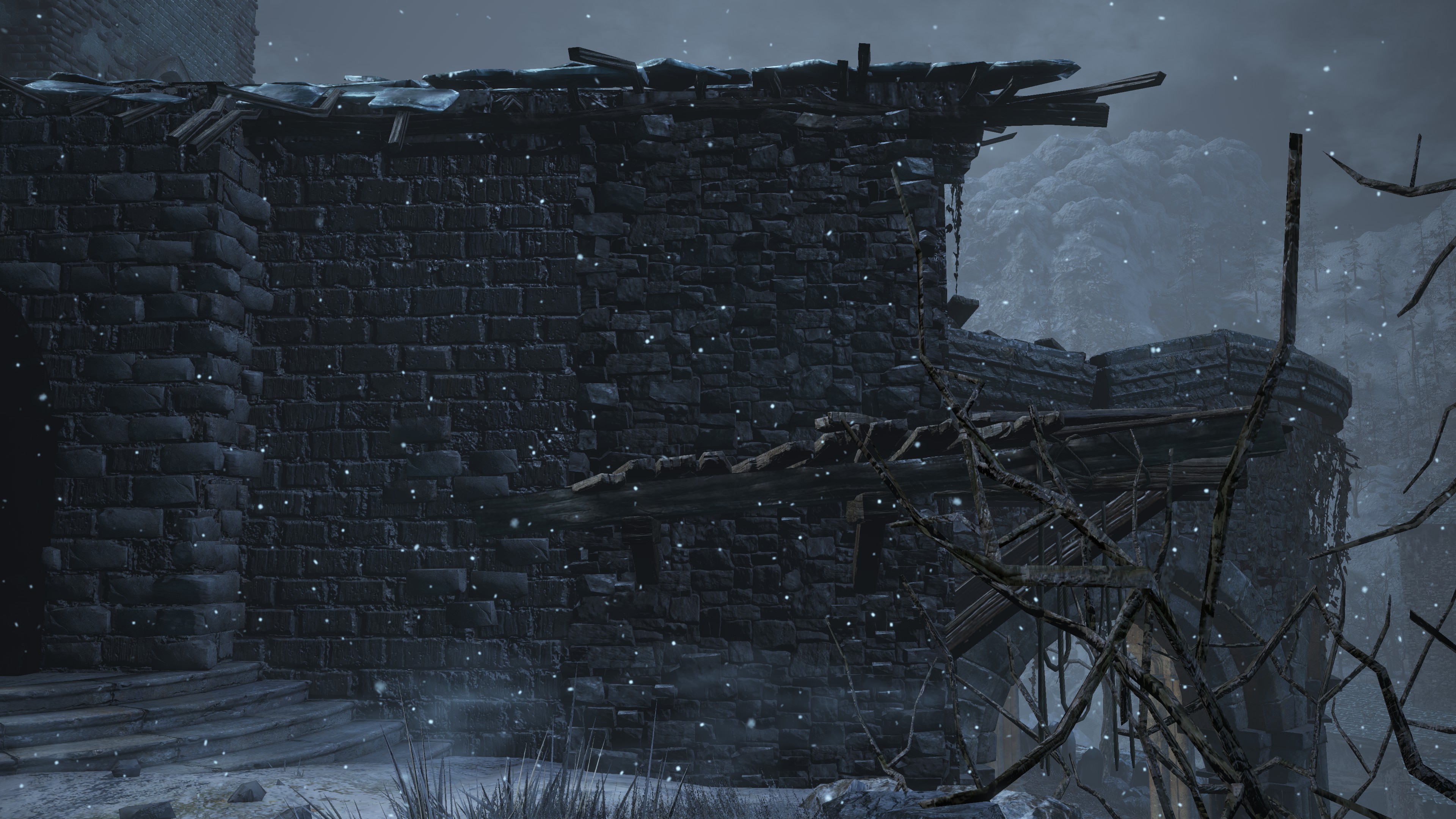
Apparently, the medium for her masterpiece was to be the dark soul of man. Whether this was her mother’s idea or the girl’s independent decision, the choice of “paint” is logical. Ariamis was based on fire, which was doomed to one day fade. The Dark, by contrast, is eternal, making for an immortal world. On top of that, the Dark is cold by nature, complementing the kind of world the inhabitants are familiar with. And unlike blood of a corvian that is only partially mixed with a dark soul, a pure dark soul should never rot even if it stagnates. The only question is the strength of the power to create a sustainable dimension, which is presumably why Gael specifically seeks out the souls of pygmy lords. Regardless, the land of kindness the undesirables seek for belonging should ideally be a world painted in the Abyss’ colors. But before that, she wants to see the flame which created the old world, to know what she will be missing and why it must remain missing.
Thank you, Person of Ash. I’ll see fire very soon… And then Grampa Gael will get the pigment. I wonder if he’s already found it? The dark soul of man…
… Thank you, human of ash. I will draw it without fail. A forever cold, dark, and very kind picture… Surely, it’ll someday be someone’s place to belong.
During that long wait, the rest of the village suffered. Between the rot infesting the very walls and the knights constraining their every move, the village is quite literally falling apart. The very walls are crumbling, and countless bodies look to have dropped dead in the streets, some falling into the drainage canals or within their homes. Many of them prove to still be alive, even if reduced to crawling on the ground, but the fact that they even lie alongside actual cadavers speaks to the village’s dire predicament. Yet despite Friede’s attempts to quell dissent, the people’s will remain unchanged. If anything, as the rot slowly worsened, their resolve has only strengthened. Exemplifying the village’s fortitude, one corpse in the corner of his home clutching, protecting, an ember item. Another corpses carries the same humanity lit aflame in the communal mess hall, with our one friendly villager seating himself fittingly next to the unlit ovens. No matter how much Friede may wish to break them, they will not give up on seeing flame. Instead, her Corvian Knights have only managed to escalate tensions.


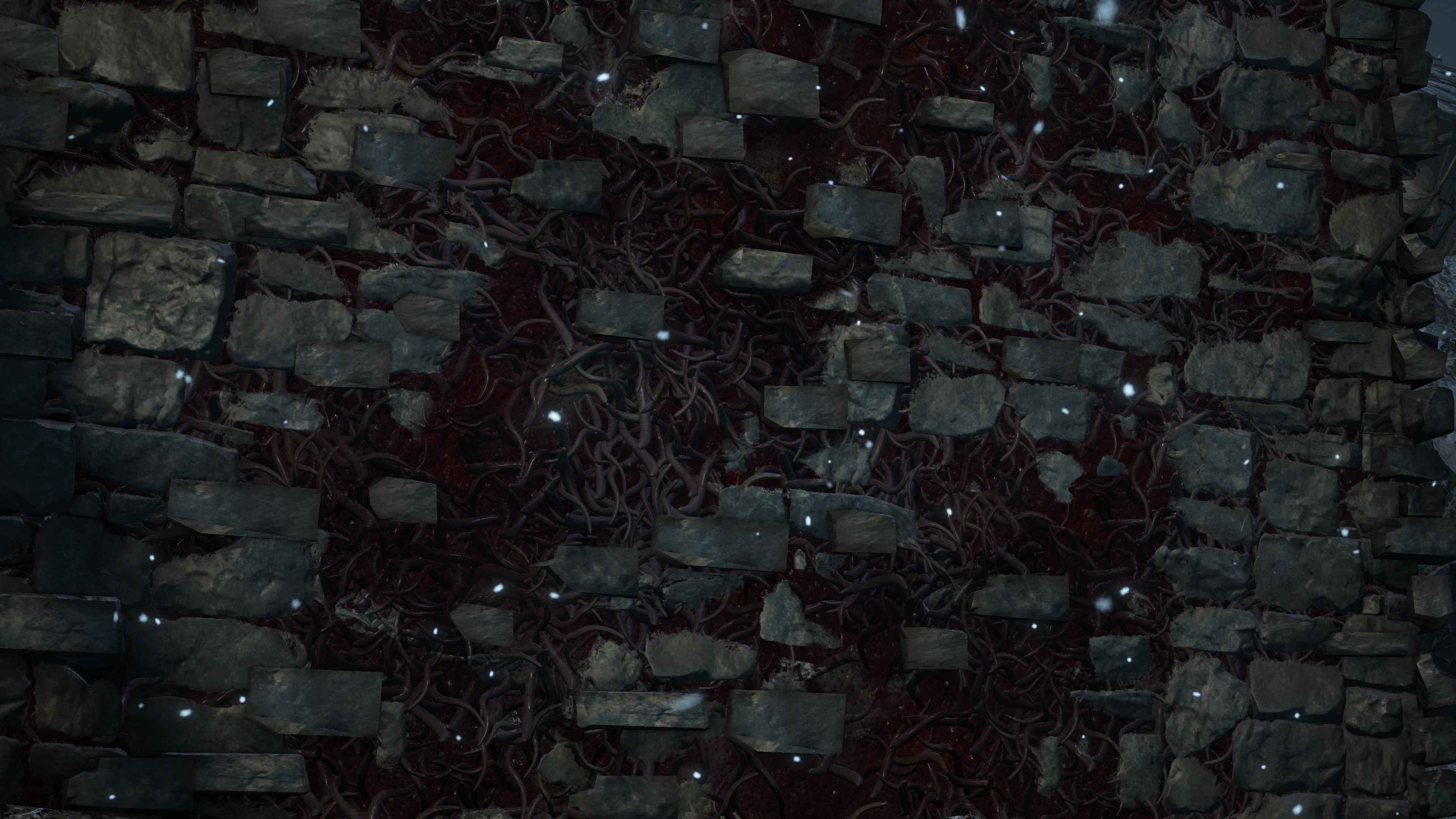
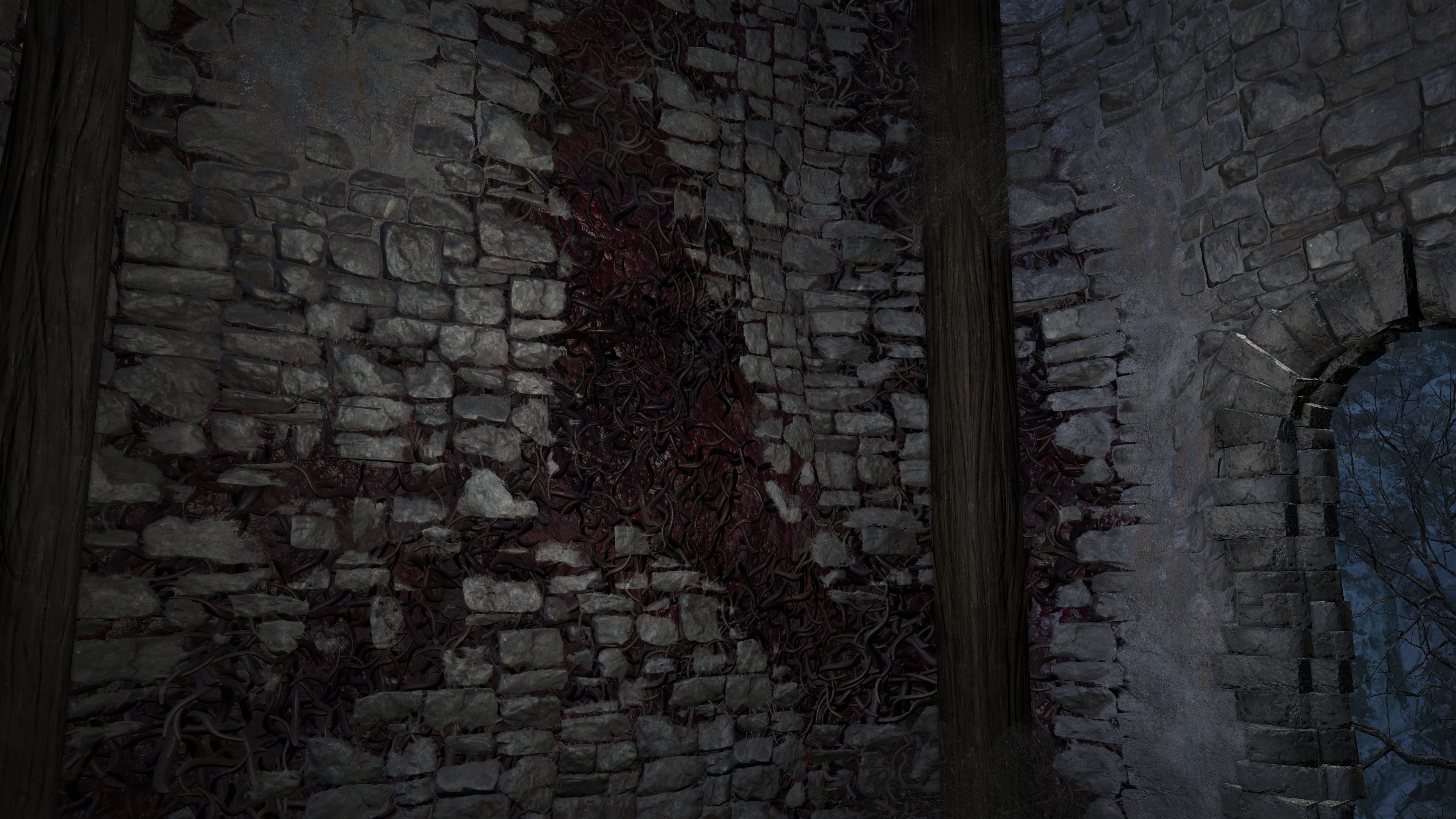
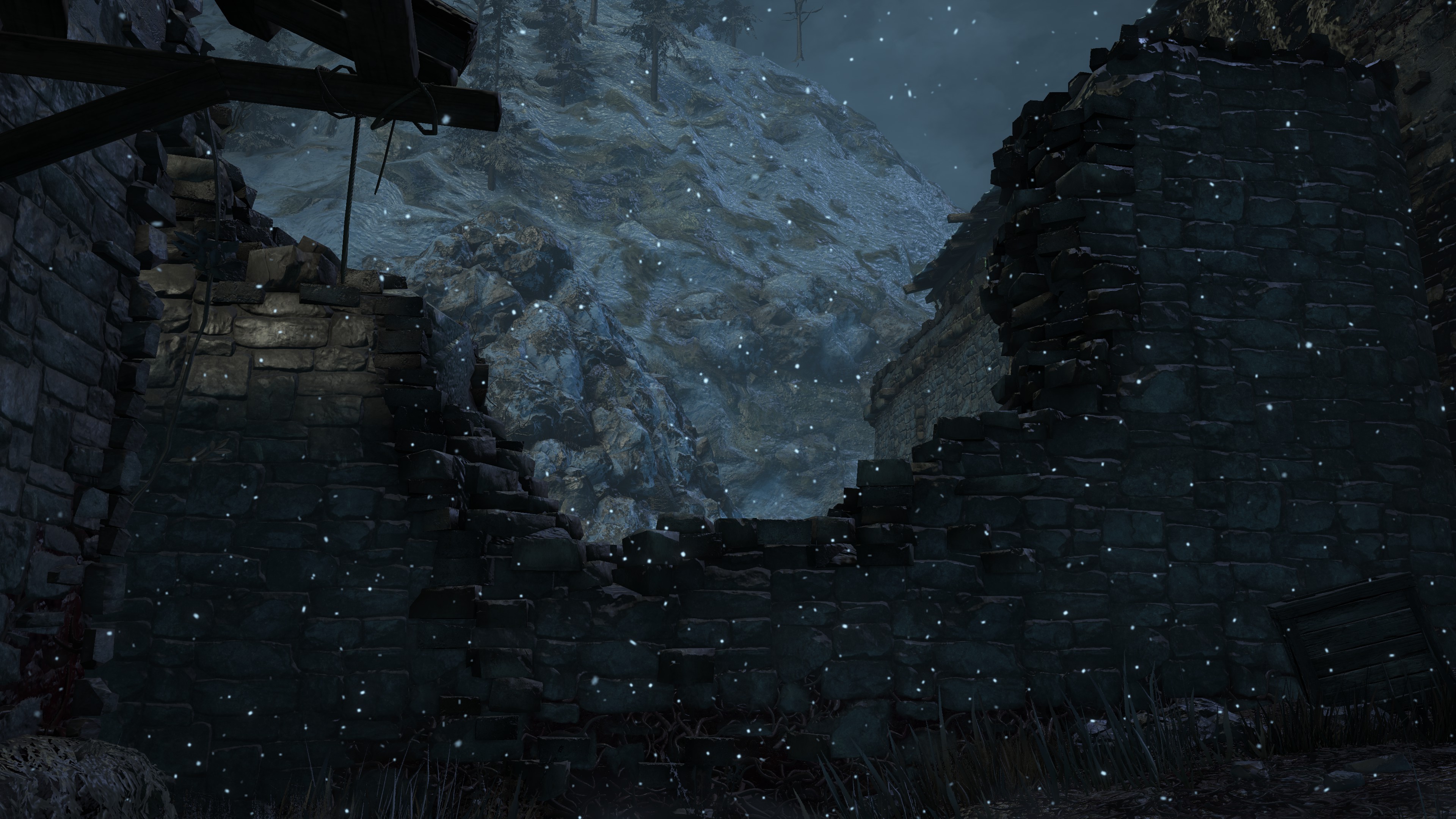
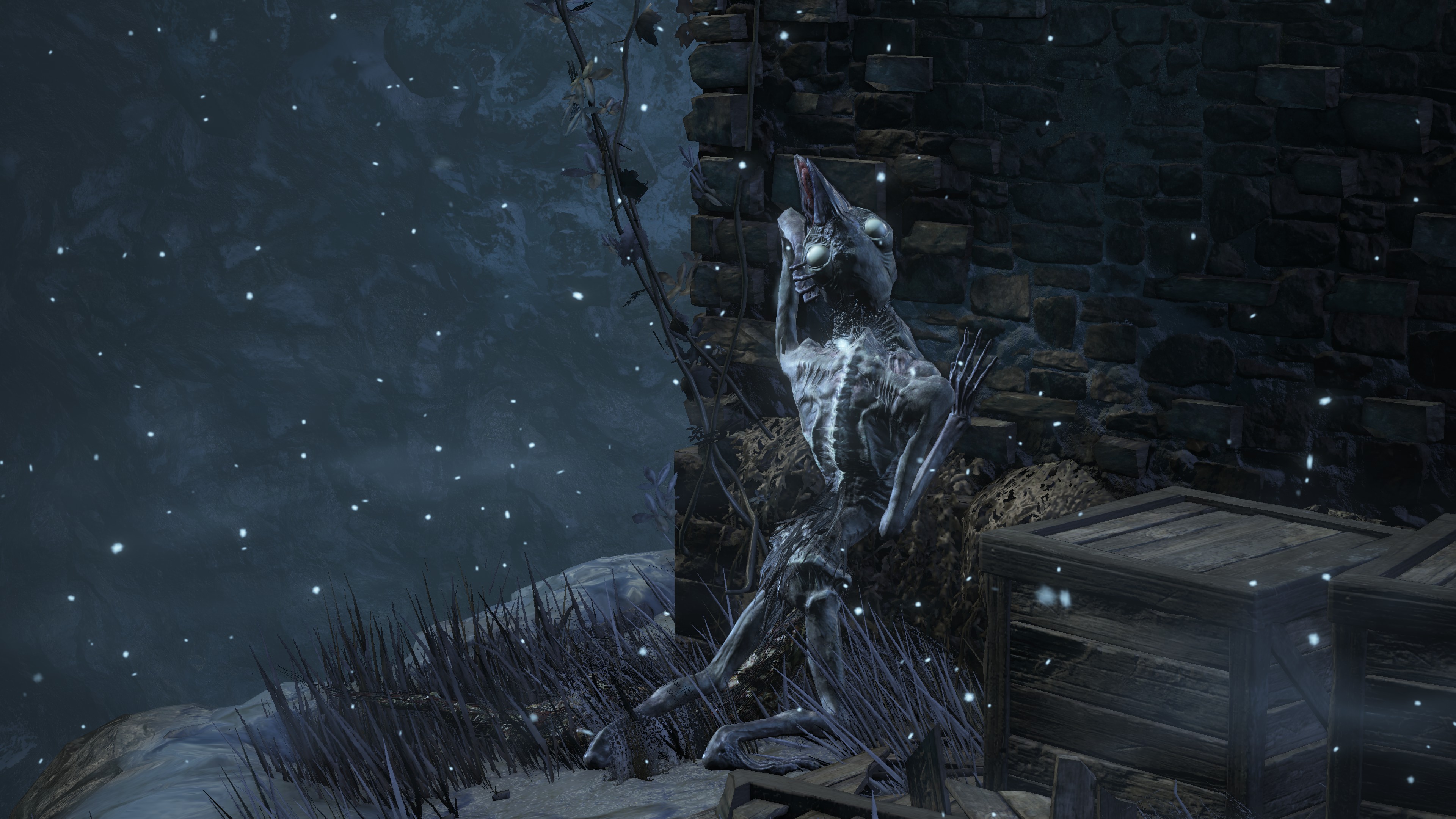
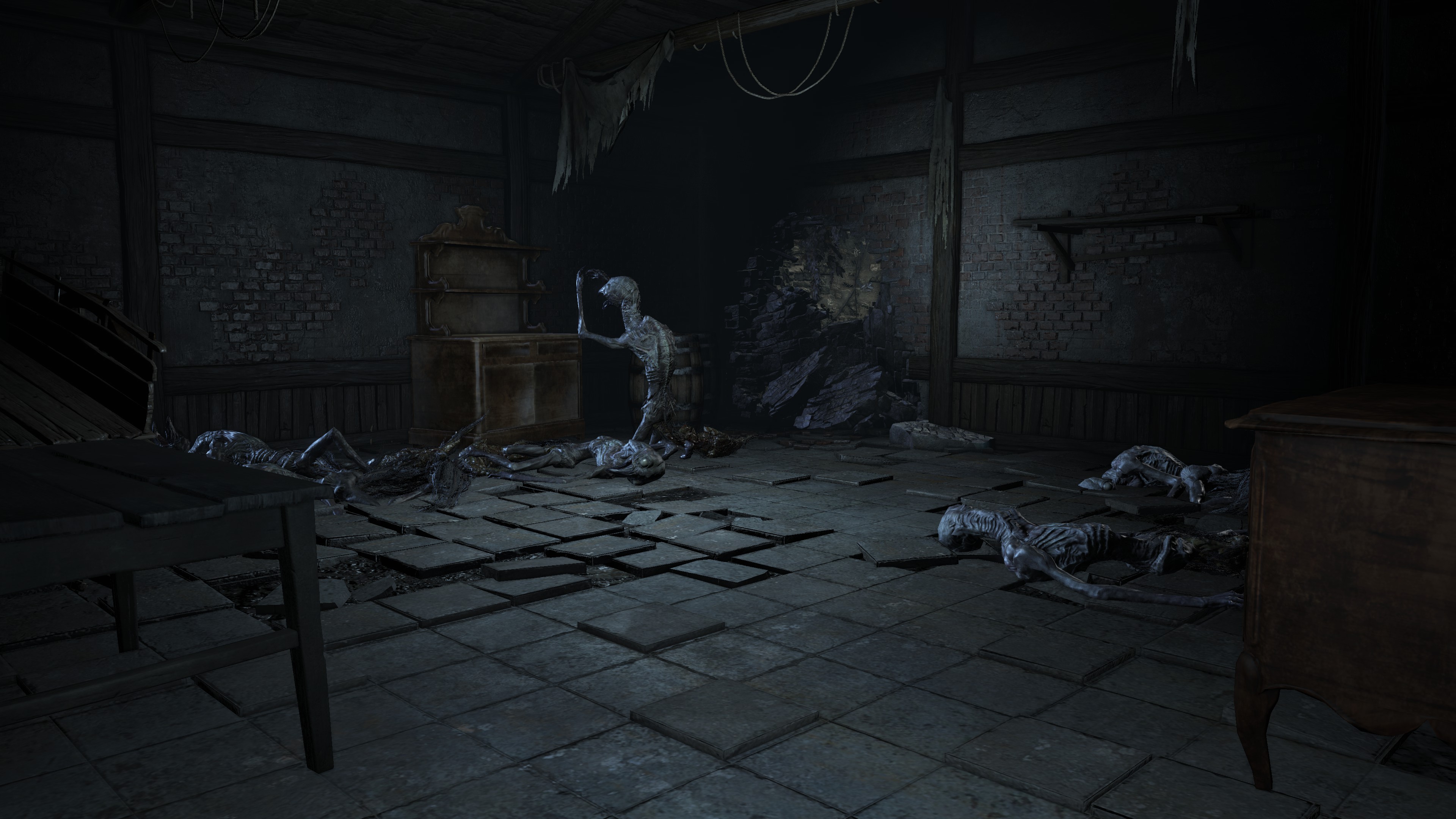


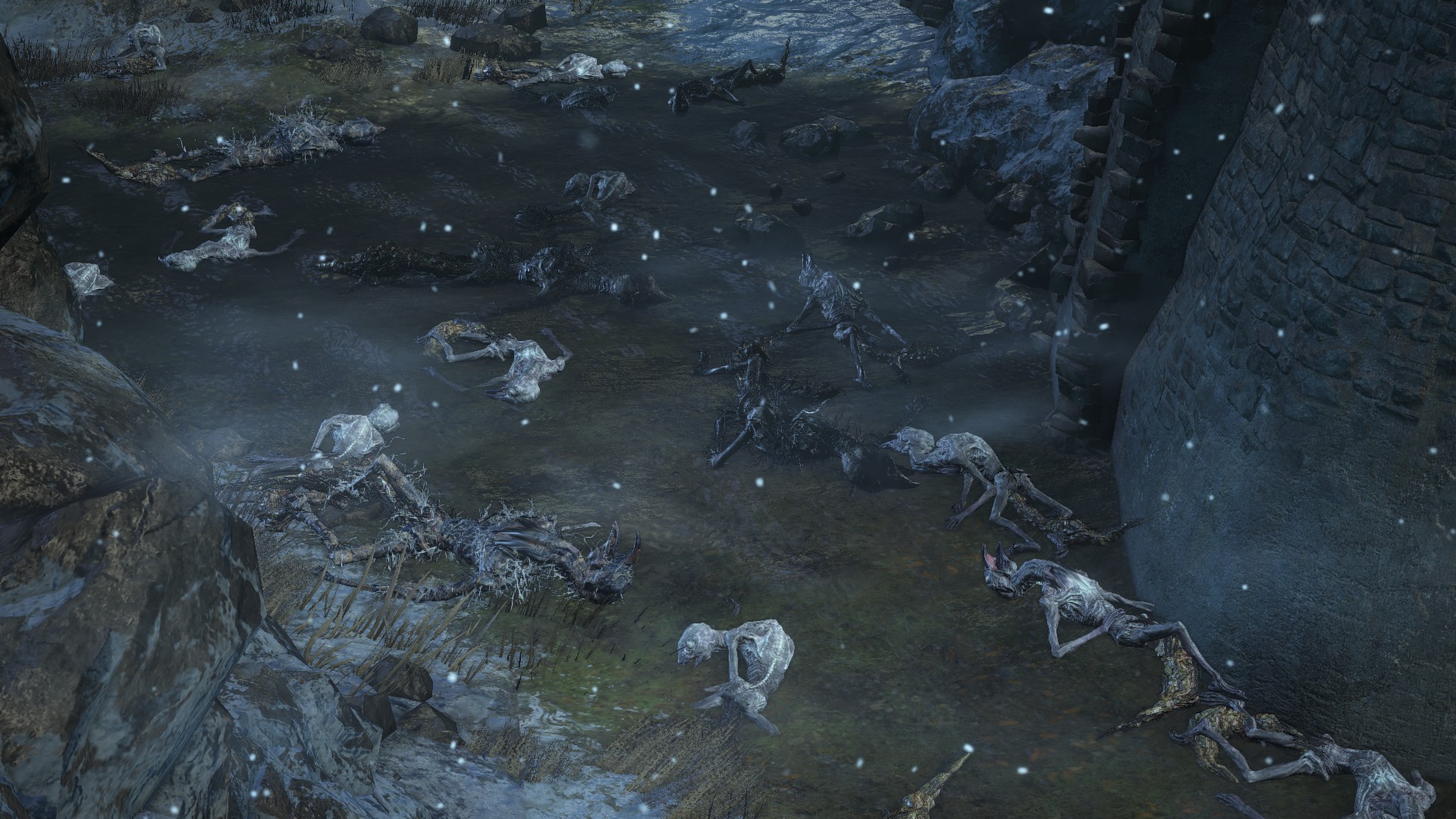

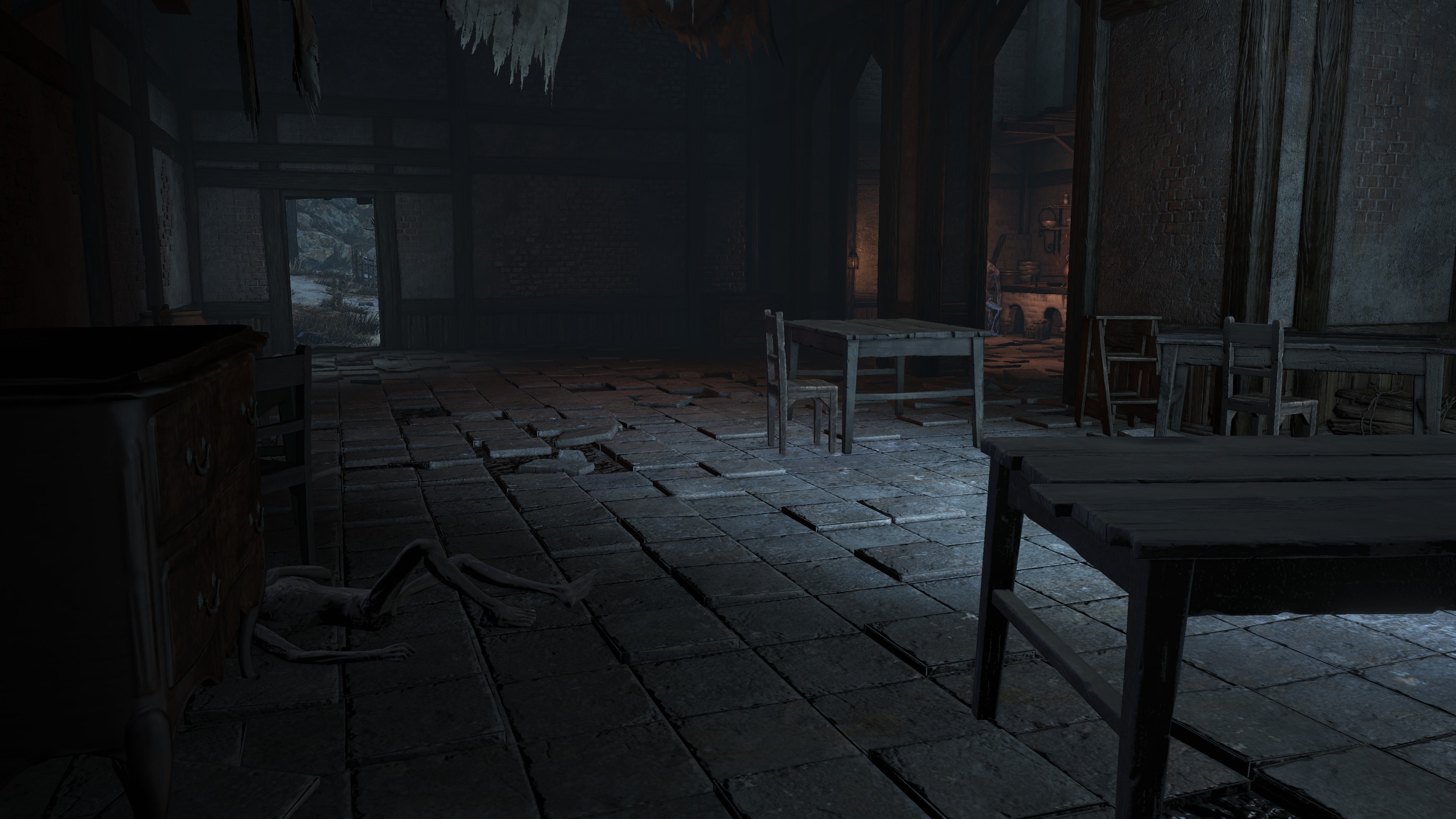
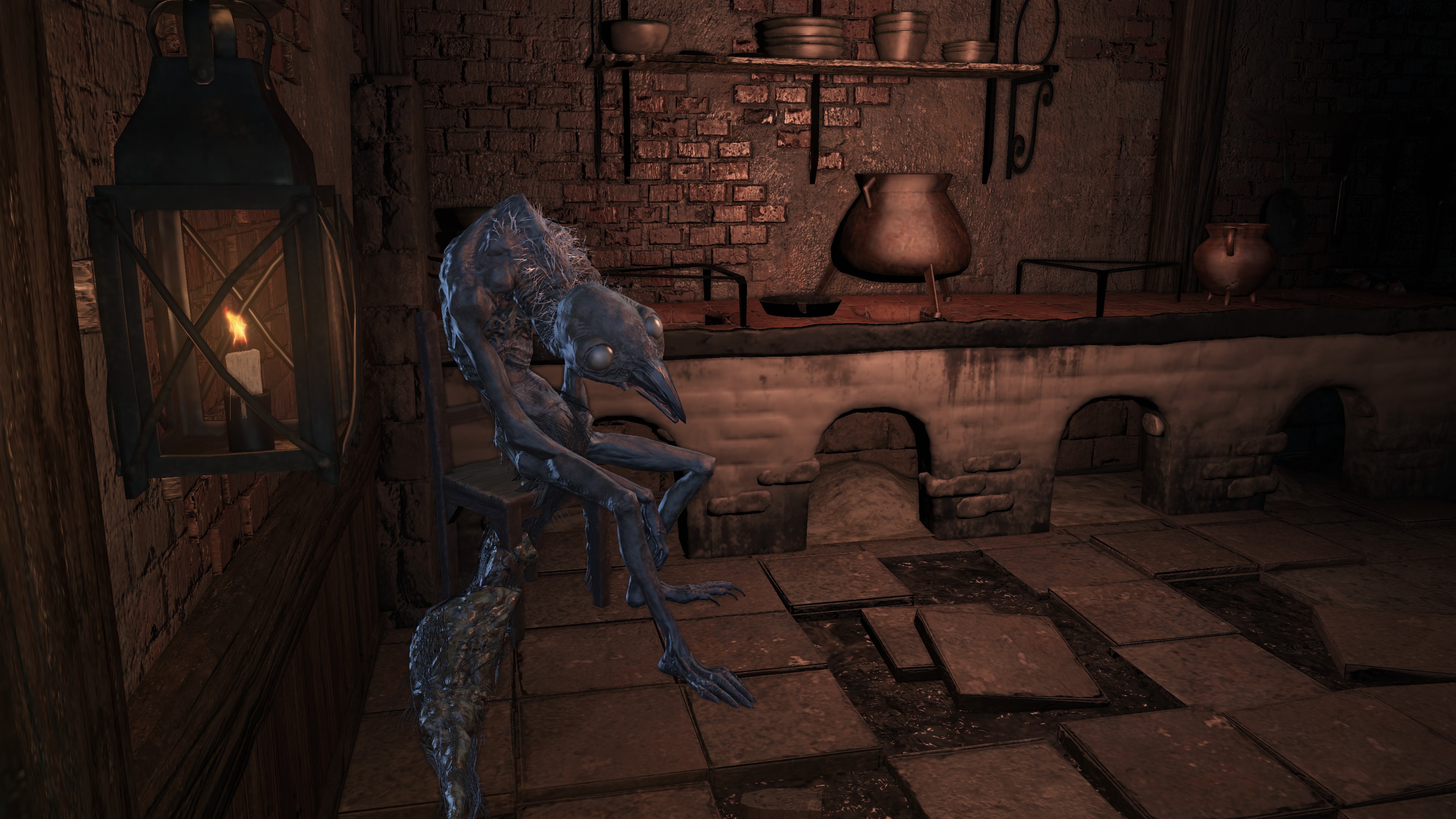
When we first arrive to town, a procession marches from their homes to the parish gates, united against their oppressors. Such a loose uprising is still weak, a single knight causing the whole lot to panic and scatter with little effort. But not every clash with authorities has been so lopsided. We can find the corpse of, implicitly, a knight with his Crow Talons atop the mess hall surrounded by corvian sorcerers, who have taken to the rooftops to resist along with unarmed ambushers. Another corpse smiles while clutching his Crow Quills close to the chest on an “island” in the drainage outfall, similarly encircled by the minefield of bodies piling up outside town. With the knights we encounter total numbering less than a dozen, losing any is a huge blow to their total force, and already some have clearly been overwhelmed by the rabble-rousers. Holed up in the parish, one can argue that the knight stepping in to break up the protest is, in fact, proof that they are on the defensive.
Friede’s regime is under siege to some extent. The corpse of a warrior leans against the church chimney, the poor soul seeming to exhaust all strength to infiltrate the parish from the high ground like we do. This weary warrior isn’t the only infiltrator, as a group of corvian civilians seem to have also made their way in through the waterways, one still climbing out of the well while the other two behave similarly exhausted. It has taken great pains, but the settlement is beginning to turn the tide against the knights, who likewise have begun to buckle from within. Inside the church building, the corpse of a heartbroken knight hanging onto the rafters. Perhaps realizing that Friede would never return his adoration, this knight wavered in his duties and was likely killed by his fellows there. Only the strongest and most dedicated are fit to serve, and the remaining knights won’t allow any loss of heart when the going gets tough.
Both sides are becoming deeper entrenched and are fast approaching a breaking point. The chapel is faring little better. Because of the ban on Velka worship, Friede refuses to open her doors to any new corvians seeking refuge. Their pleas have not always been easy to ignore, however. The fact that the metal gate to the premises has been broken down from the outside shows the amount of pressure imposed by the crowd, wanting only an audience — they may well have got it, at the end of a scythe’s edge. Now, there are only a few beggars in the cold, careful not to trespass. But what happens when another influx of crow men, charmed by the legend of Velka and Priscilla, come knocking? So long as the storytellers continue propagating their message, the chapel might find more than a few vagabonds distracting her. Sure, they may serve as little more than a nuisance, but could she afford that when the village is already slipping through her iron grip?


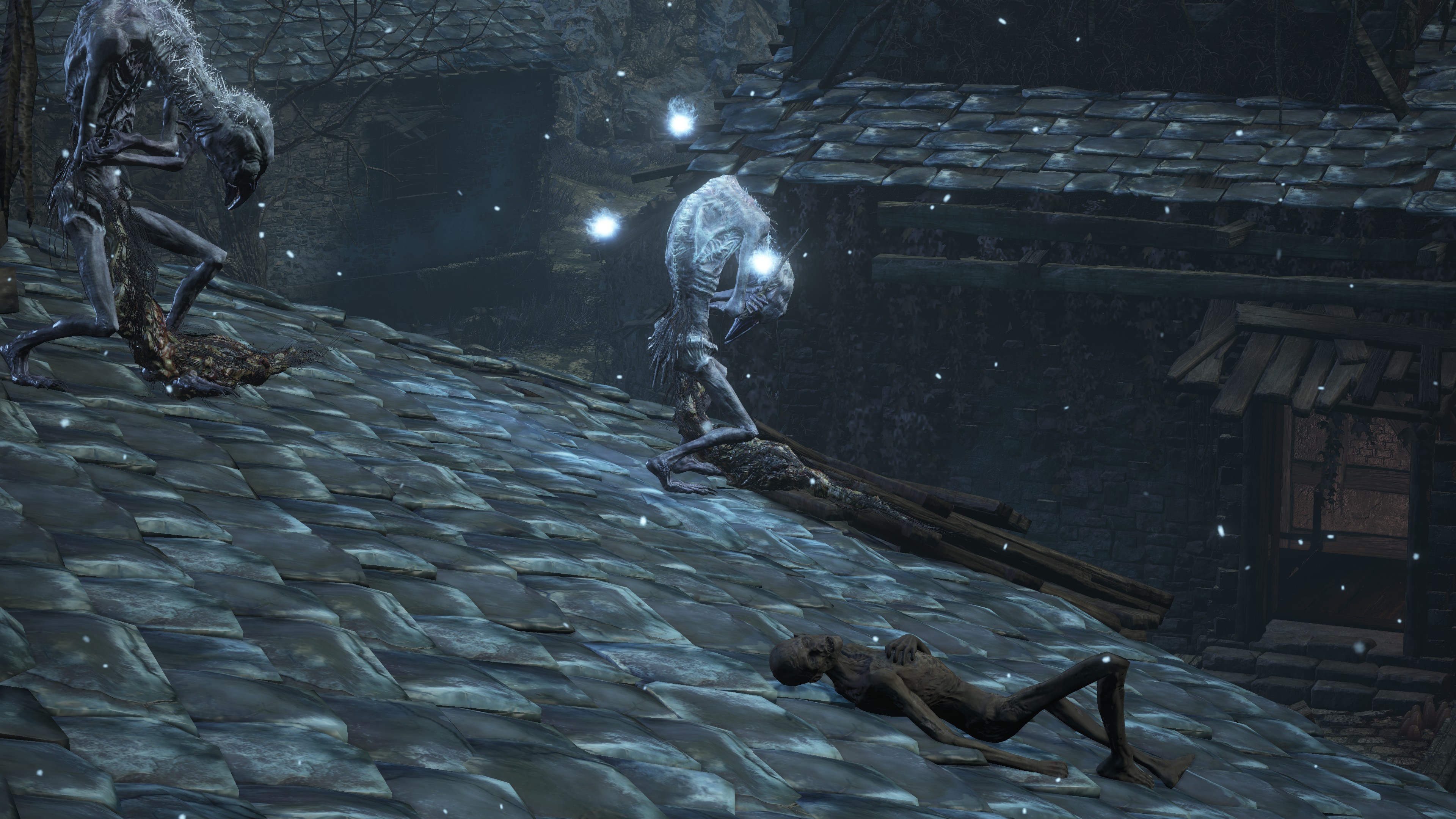
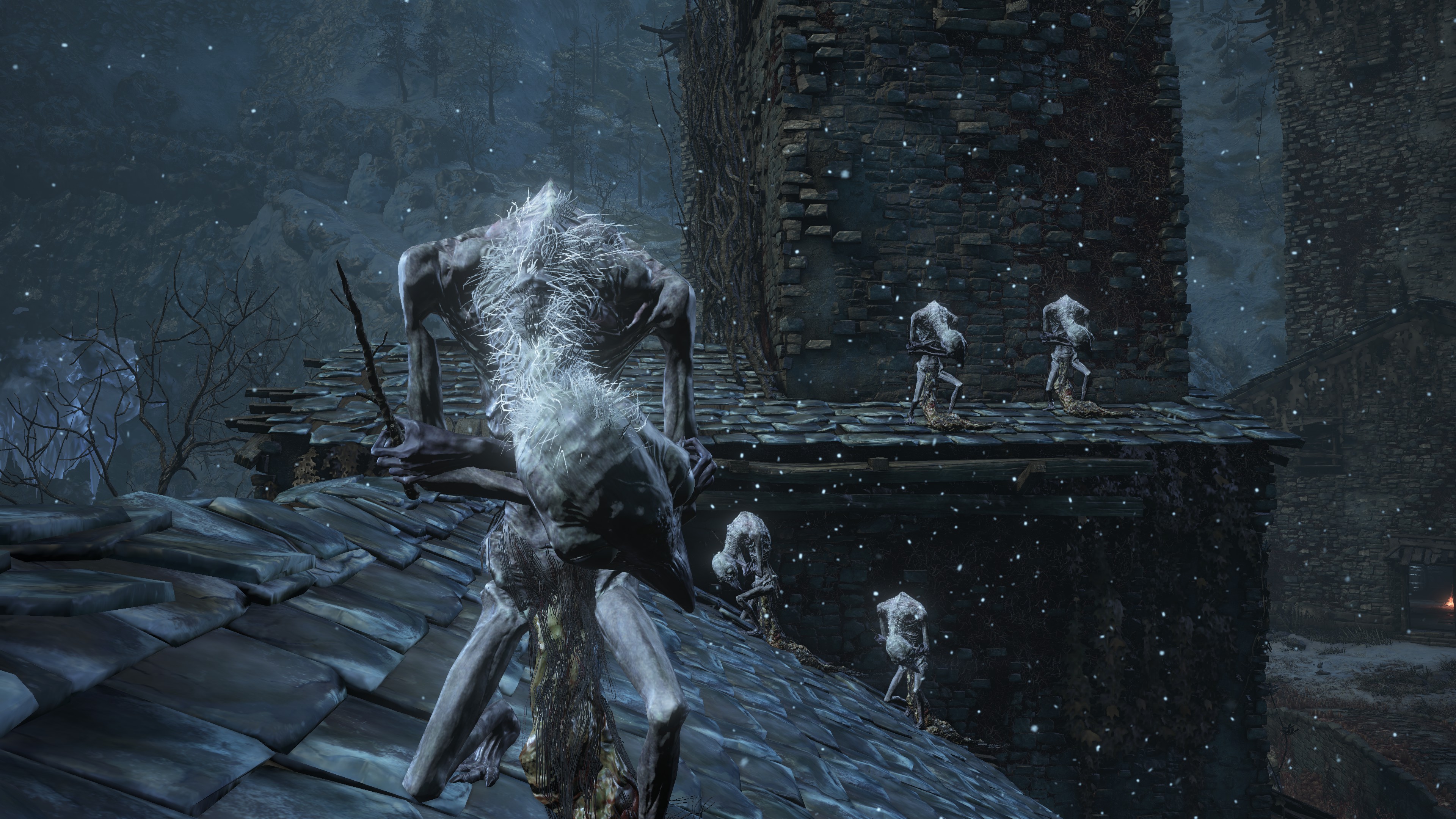

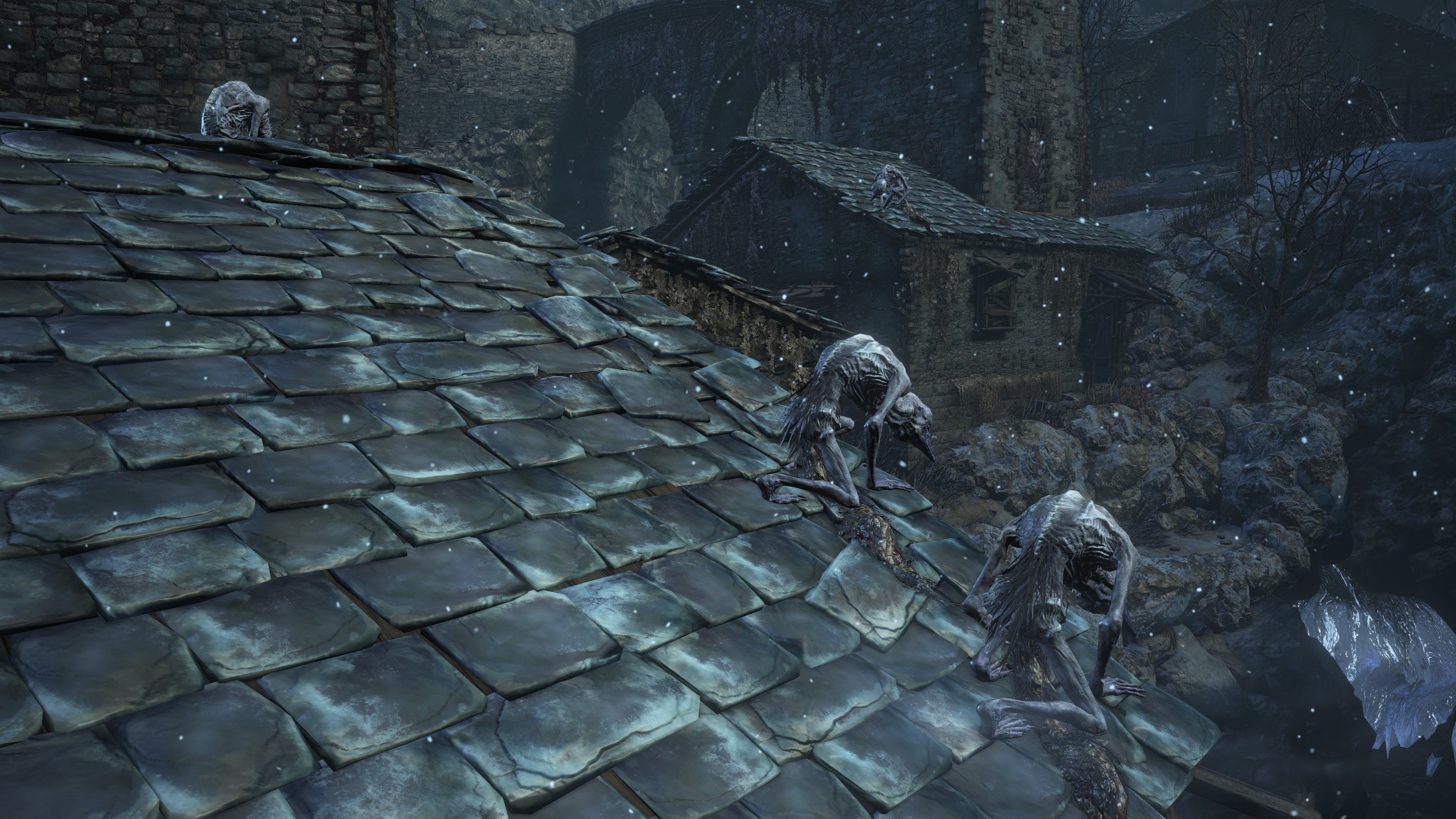


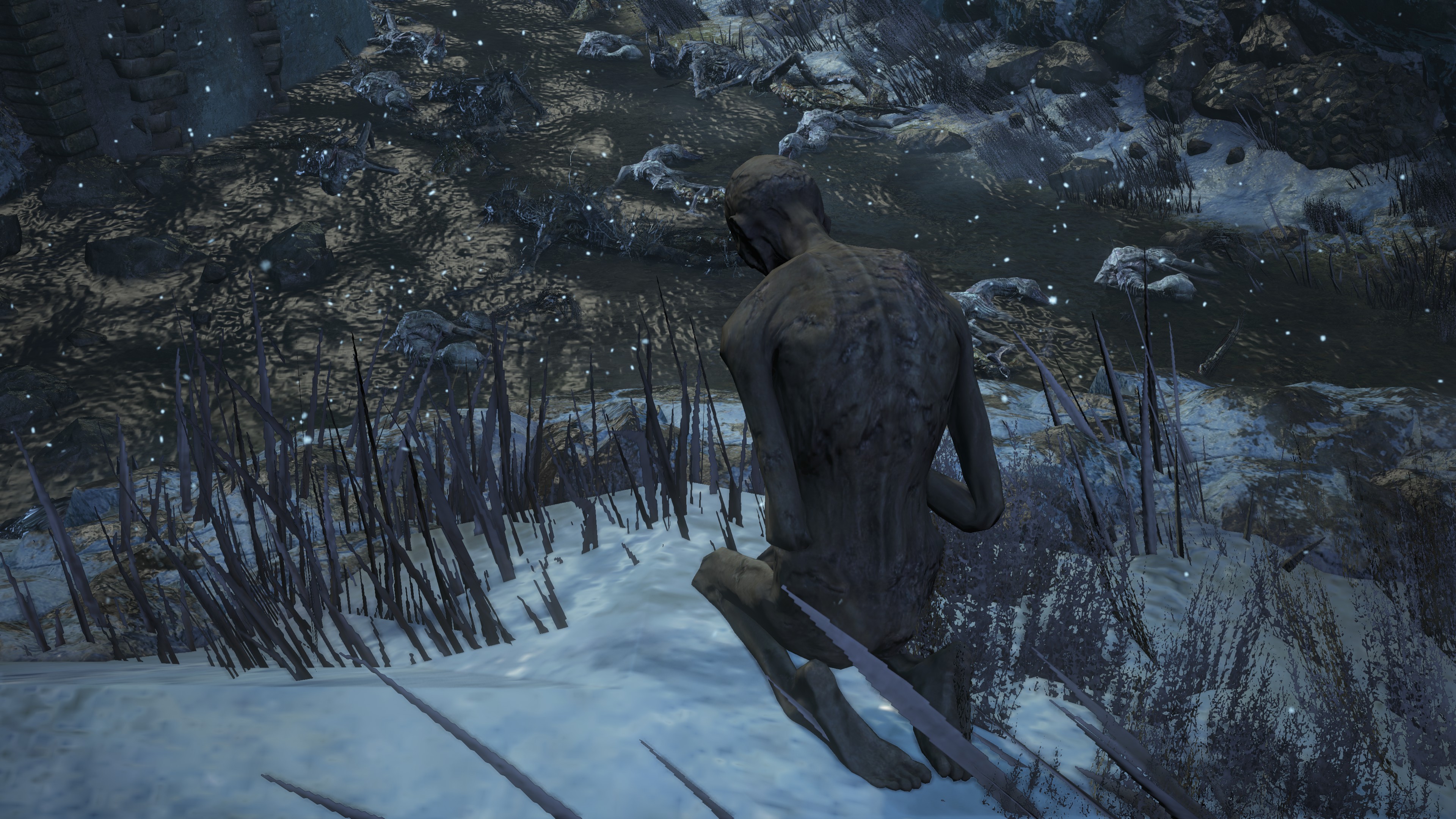


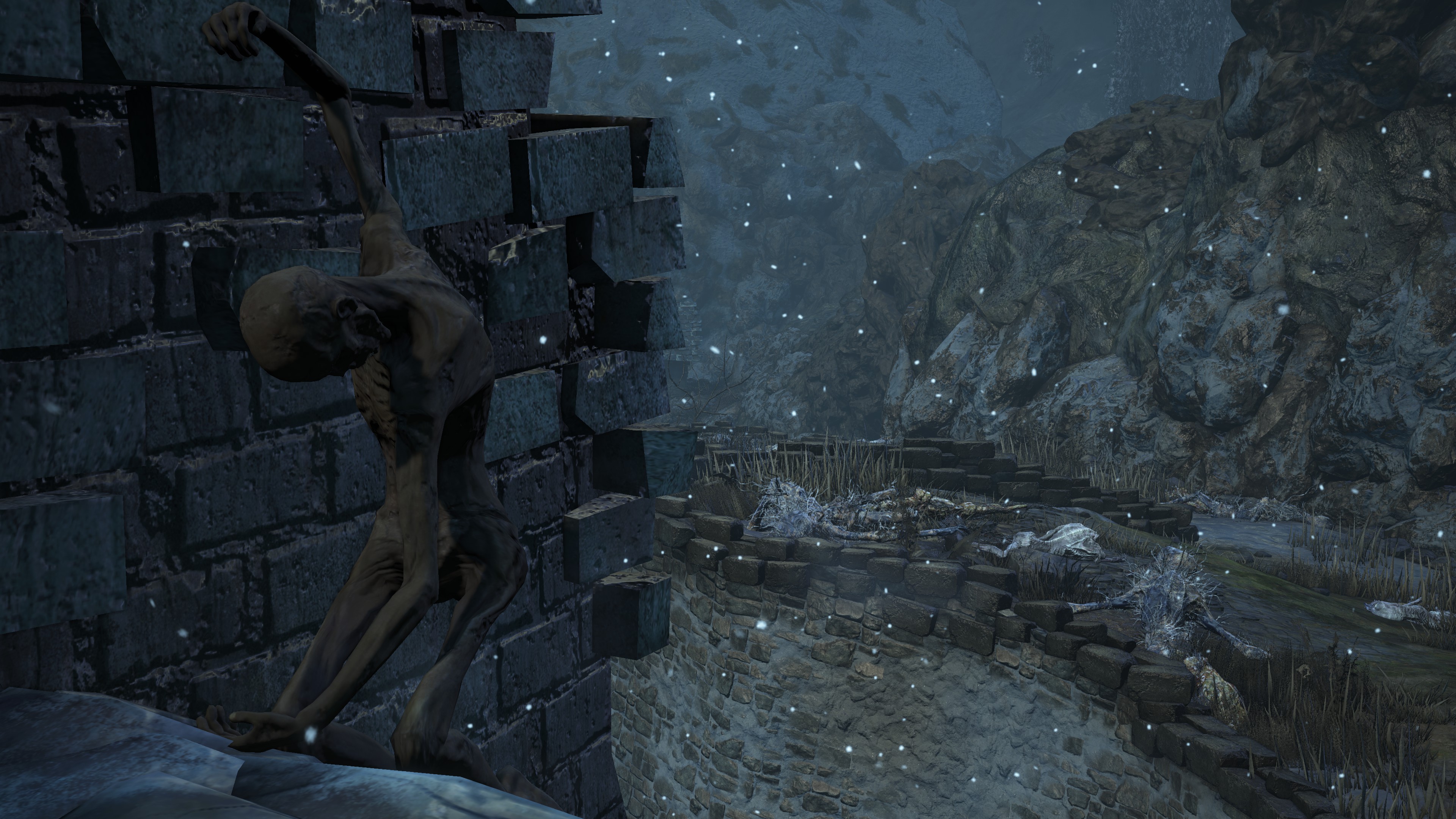


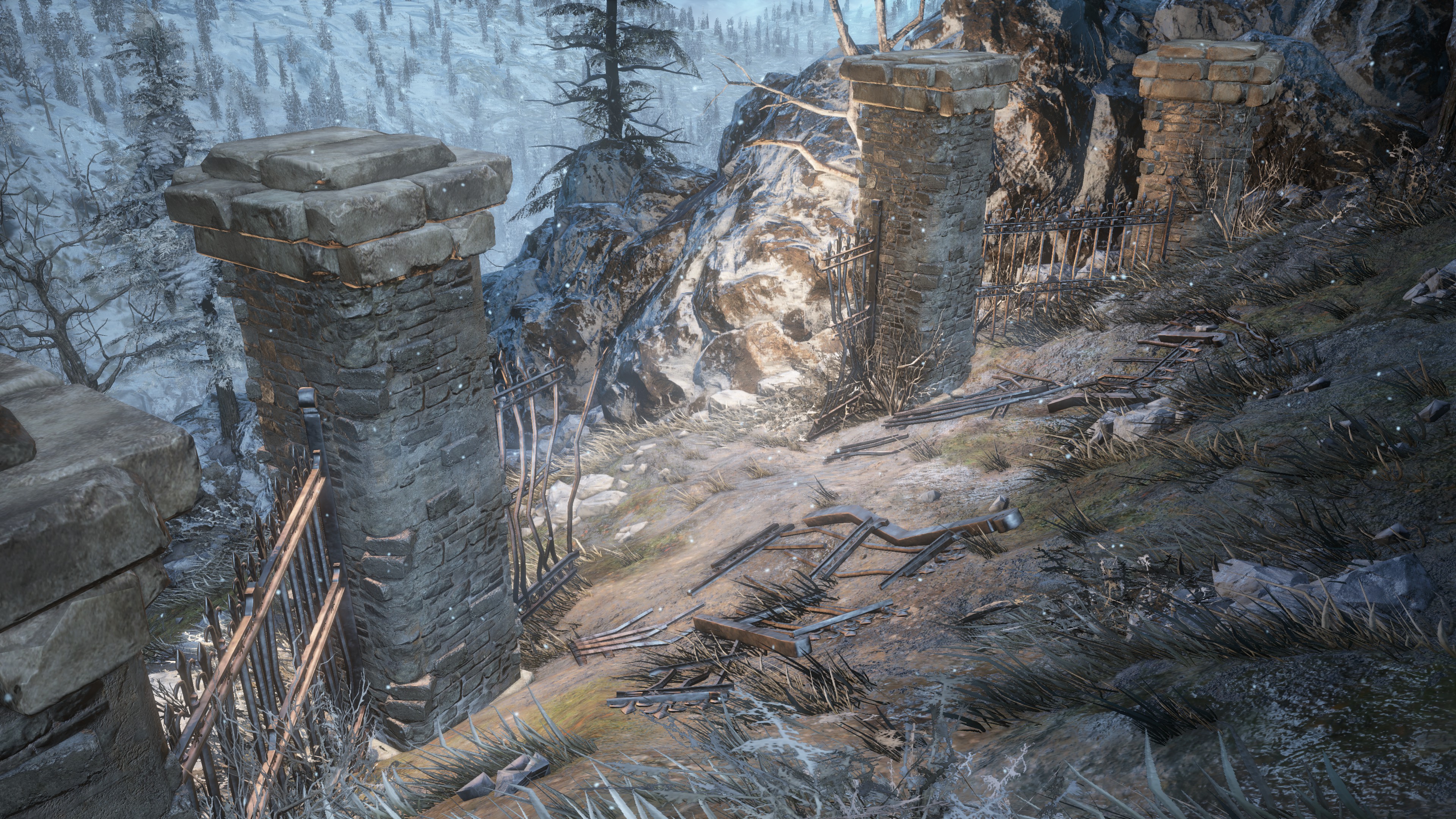

The settlement hangs onto whatever strand of hope they can so as to never lose sight of their goal. But as we can see in the one villager’s excitement, their only hope is that the second ash will finally arrive at fulfill the prophecy. Even after we free the painter and put an end to Friede, the conflict with the Corvian Knights continues. Neither side wishes to relent, at least while the fire we unleash is still only burning the chapel. The talkative villager, however, is happy to gaze up at our handiwork. However events play out, change is coming to the painting. After confirming fire with her own eyes and receiving her humanity paint, the painter rewards the person who provided her both these things, naming the painting after us or simply “ash” should we claim to have no name. Befitting our unkindled mission, we become the foundation for a new world. Meanwhile, the world outside carries on with its madness.
 Lokey Lore