
When some of the Tarnished who left with Godfrey established churches dedicated to the Two Fingers, they obviously were spreading their religion in preparation for when Marika summoned them back as promised. After untold generations of building up support and resources, the church’s prophesy was finally fulfilled, and its clerics contributed their own to the cause. Although the localization labels them confessors, these Tarnished priests don’t hear out sins and provide absolution in the traditional sense. It is more accurate to call them “secret agents” (密使) for the church, servants of the Two Fingers who specialize in covert operations — chiefly assassination. That is why these nominal clergy dress in hooded black robes and adopt the image of a sword enwreathed in the Fingers as their crest. They are to become blades, secretly hunting their master’s foes from the shadows. And a blade never betrays, so the Two Fingers trust in the confessors’ ability to act as its enforcers.
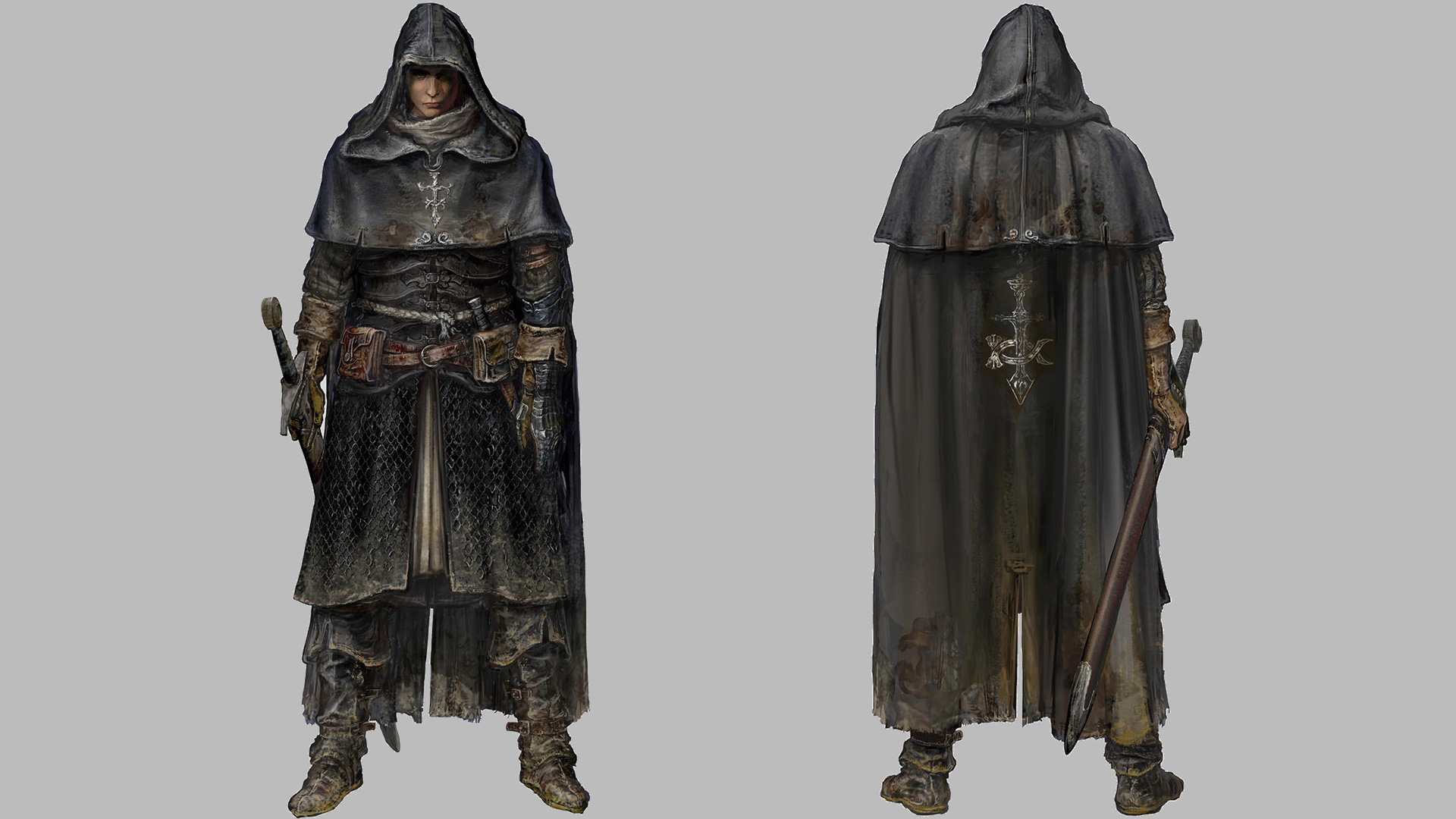
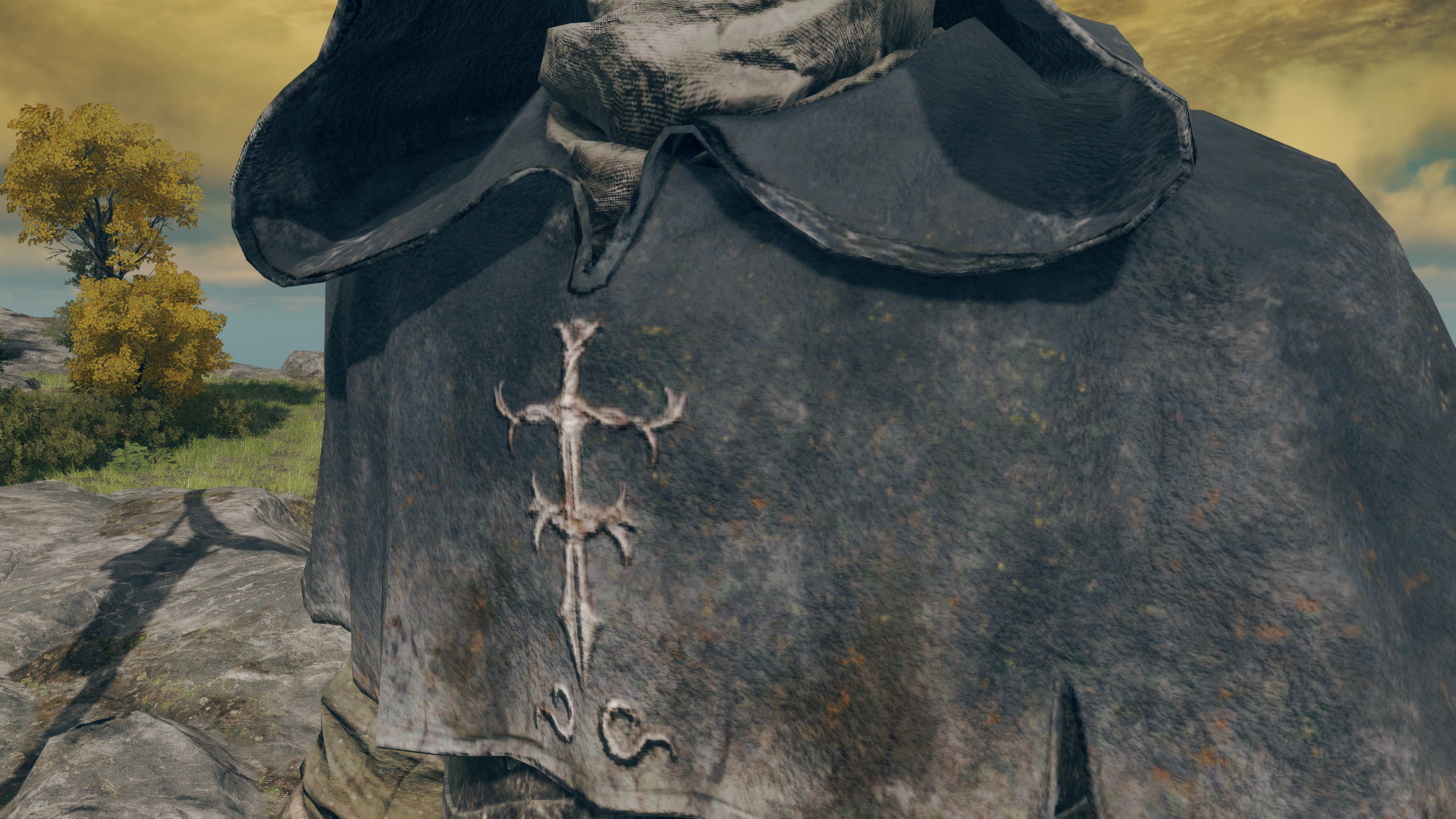
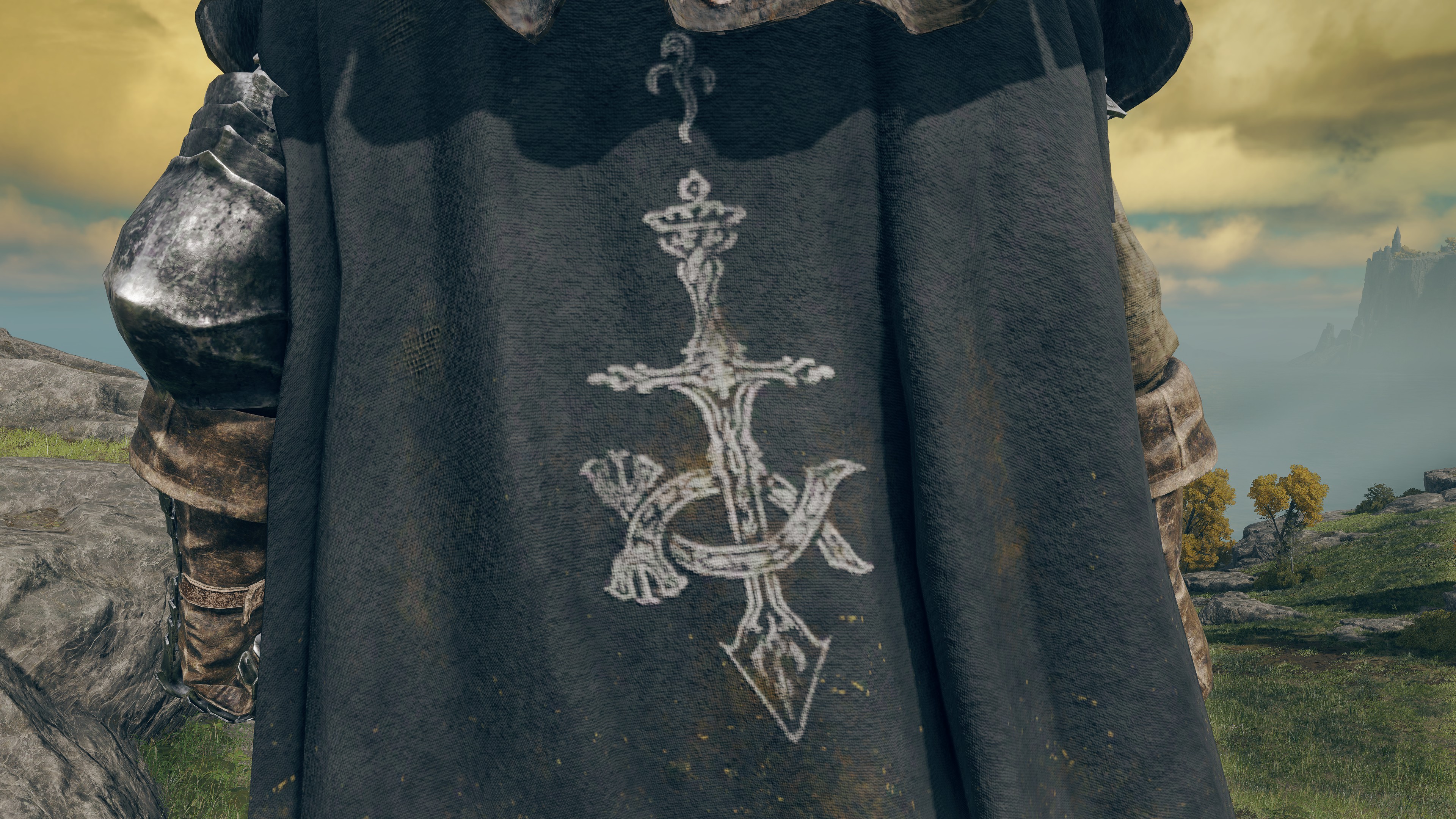
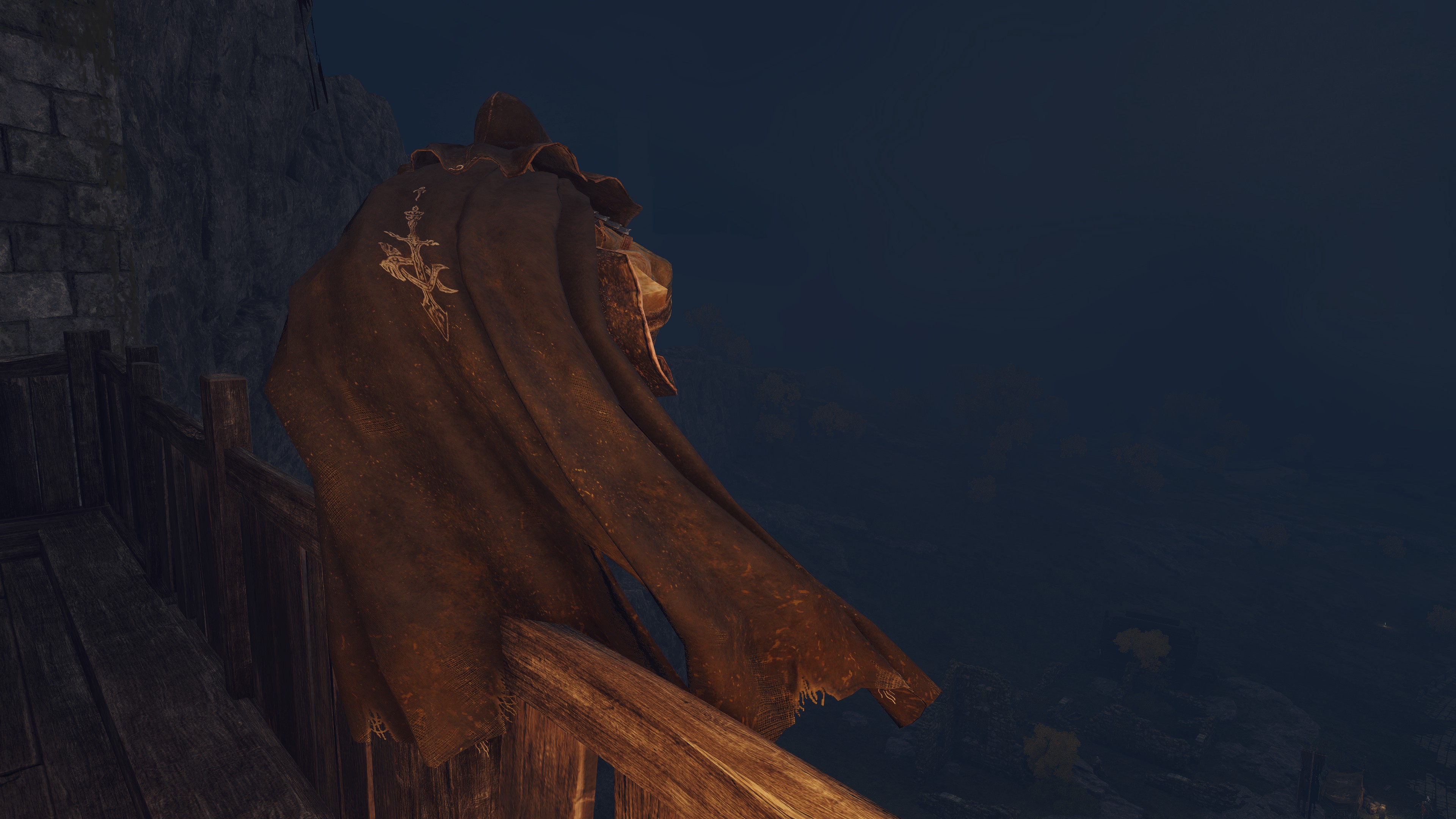
Black hood that blends into the dark. Equipment of church secret agents.
The church that imparts the Two Fingers teachings outside Between sends secret agents off to the guidance of grace.
As servants who will never betray the Two Fingers. And as blades who secretly hunt its enemies.
As to the need for secrecy, it is evident when considering their original mission. The assassins hunt not just any enemy, but specifically Tarnished. Those who fall off the path grace guides them along, going against the will of their gods, is the sin they absolve with death. They remain clandestine so that none might recognize an agent when he or she does execute the operation, a cordial stranger met on the road possibly raising a dagger when the traitors turn their backs. That is even assuming that they see the confessor’s face. The description to Crepus’s Vial notes how even silence frightened these apostates, the vague knowledge that past traitors were punished only adding to their distractions which an agent might use to his or her advantage. The best case scenario was that the clerics dispose of the Tarnished quickly and quietly, leaving no sign of who or how so that they may always have the initiative against the next target.
Prayer of those who once served the Two Fingers as the dark side of the Round Table.
Completely erases the caster’s footsteps. Also, reduces fall damage and fall sound. Can be used without stopping movement or even while crouching.
A disposer of the Tarnished who fall outside the guidance. That was the duty of the dark side.
At the same time, the aforementioned vial indicates that the Two Fingers didn’t try to hide the existence of secret enforcers of its will. Given the nature of our Tarnished mission, it was predictable that there would be those uninterested in the guidance from the start or lacking the conviction to continue through the hardships. In that case, knowing that noncompliance meant certain death would serve as an excellent motivator to dissuade apostasy — one thing to lose the perks of grace, another to be punished unavoidably for it. The Two Fingers thus used fear of its covert assassins for deterrence, though these boogeymen were no less human. Indeed, just as their enemies lose sight of the guidance of grace and its immortality, so too do the confessors. However, they commit to their mission knowing of this inevitability. After dawn is dusk, darkness guaranteed to arrive at the end of day. The radiant light of gold is something they are ready to put behind them, for it is in the darkness that they find the duty they seek.
Prayer of those who once served the Two Fingers as the dark side of the Round Table.
Covers surroundings in darkness, causing one to lose sight of the caster. Can be used without stopping movement or even while crouching.
The dark side were Tarnished who lost sight of grace. For in graceless darkness, they sought a mission.
The darkness, in this case, isn’t just metaphorical. Crepus’s Vial contains actual darkness, which the description clarifies is arcane in nature. Confessors are permitted the secrets of the gods, using the shadow of gold to silence their movements. This is what made the quiet moments still so unsettling for apostates, never knowing if someone actually wasn’t there. Even the eyes can’t be trusted, as agents perform an incantation to cover the caster in darkness with the surroundings, making them impossible to track. This and other arts, combined with their black attire, made the Two Fingers a dangerous foe for Tarnished to contest. Whether or not the Fingers themselves made the order, the agents were there watching and waiting to jump into action at the slightest sign of absconding.

Arcane vial sealing a mist of darkness.
Completely erases sound made by the equipper.
Magic tool that the dark side of the Round Table are said to have used. Tarnished who fell outside the guidance were once scared of silence.
As to who would agree to this fate of hunting their fellow man, the confessors are most likely recruited from clerics of the church, already people of faith inheriting the Fingers’ teachings and thus easy to indoctrinate into its utterly loyal servants. However, the only incantation we start with as a confessor, besides Assassin’s Approach, is Urgent Heal, meaning that we know stronger Two Fingers prayers as a prophet — who outclasses the former in both faith and arcane. Granted, the confessors also possess more physicality and intelligence, so our life experience is much more well-rounded in comparison. In that case, confessors may not be clergy for long, the church purposefully seeking out men of verifiable Tarnished descent to train as agents. This would naturally bring in people from all walks of life: off the streets, poor hamlets, even battlefields. Those with ability but little prospects might be sold or willingly enter the ministry, developing their faith and skills until they finally perish and receive grace as we do. No one will miss them, and they will feel at home in the darkness.
Crepus was probably the first of these agents, as he was their leader and doubtless pioneered many of the techniques other agents use today. There is, of course, the vial bearing his name, the darkness presumably a gift from the Fingers along with its blessing to be gold’s shadow. There is also his “black-key” crossbow, designed for him to snipe targets. The name it bears along with the agents’ crest seems to convey his intent to fill the gaps in the white keys of the metaphorical piano, completing the Fingers’ sonata as it plays them all. He is just the blade, a single key awaiting the hallowed hand to press him into action. And that action with this crossbow is a special bolt for drilling into the flesh and injecting the enemy with Scarlet Rot, the ensuing screams its music. Certainly, it is a devious but effective way to ensure the Tarnished dies, with suffering as the added bonus. Crepus was the perfect Tarnished to lead this group of assassins, sharing what he learned exploring lands like Caelid with later arrivals.
Black-colored crossbow possessing a long stock. Used for sniping so has long range.
It was the choice weapon of Crepus, leader of the secret agents who served the Two Fingers as the dark side of the Round Table.
Bolt used in “Crepus’ Black Key”. Assassination tool like intricate silverwork.
The intricately twirled arrowhead pierces deeply and injects the sealed-up Scarlet Decay within the body.
Not everything was necessarily left to Crepus, of course. Late arrivals still used the Two Fingers’ teachings, sometimes to invent their own arts. A prime example is Shadow Bait. The name “shadow sendoff” (影送り) references the phenomenon where an afterimage is created in the sky after staring at a shadow for long. In this case, the caster projects a pale gold shadow with this prayer, appearing like an entity any other onlooker hates so much that they can’t resist attacking even in the middle of combat against the caster. This makes for an effective distraction when trying to angle a backstab or evade pursuit, suitable for a secret agent. Variants of this incantation have been applied to ritual pots to throw a shade physically, substituting faith for certain materials. Combining an Albinauric bloodclot with a bunch of human bone shards produces a white shadow which generally only distracts foes out of combat. Mixing beast blood and hefty beast bones, however, attracts dumb predators to a red shadow regardless. The assassins adapt themselves to every situation.


Prayer of those who once served the Two Fingers as the dark side of the Round Table.
Sends off a pale gold shadow ahead, attracting the people sort and inviting attacks. Has effect even in combat state and can be used without stopping movement or even while crouching.
It is said that the shadow looks like a hated foe.
One of the crafting items using a ritual pot. Applied with a dark side prayer.
Consumes FP to throw and generate white shadow.
The shadow attracts the people sort not in combat state and invites attacks. It is effective against demi-humans even in combat state.
One of the crafting items using a ritual pot. Applied with a dark side prayer.
Consumes FP to throw and generate red shadow.
The shadow attracts only beasts and invites attacks. Its efficacy doesn’t matter regardless of being in combat state.
Naturally, the confessors headquartered themselves with the Fingers in Leyndell’s castle manor. In particular, they appear to have preferred operating as the literal underbelly of the Round Table. In Roundtable Hold, the dining room and adjoining kitchen are both under imp statue seal. The first room holds a chest containing their crossbow and bolts; the second, their black leather-bound prayerbook detailing their assassin arts. And looking at the corresponding rooms in the Fortified Manor, we find more black-key bolts left behind in place of the dining room chest. That “basement” was clearly where they operated until Morgott sought to expel the Tarnished, moving headquarters to the duplicate dimension created by the Two Fingers’ priestesses. There they continued to act as the “dark side” (暗部) of the Round Table, at least until recently.


Prayerbook of those called the dark side of the Round Table.
Item descriptions consistently note how the confessors “once” served the Fingers and scared their brethren with silence, insinuating that this is no longer the case. The church continues to send agents like potentially ourselves, but there is no assassin guild leader to receive us and organize our next mission. We can only assume that Crepus is dead and others who survive have vacated their old base, leaving their tools locked behind the seals. For all intents and purposes, the Fingers no longer have enforcers. Why is this? In all likelihood, it is because of Gideon. As our self-proclaimed senior leader, the All-Knowing pretends to be one of the few still following the words of the Fingers, yet he and his information network endlessly pursue knowledge for knowledge’s sake. The fact that he can pay lip service to the Roundtable’s cause for so long, even whilst giving refuge to others without guidance, proves how Crepus and his crew no longer cull the apostates for the Two Fingers. How then did the confessors lose their place at the table unless Gideon made moves to replace their information network with his own?
When the All-Knowing was building his own spy army, one of his interests was surely the assassins who threatened them all. With the help of double agents or exceptional spies of spies, Gideon could track down Crepus and have him cornered and killed in the right scenario. And while the confessors fell into chaos by the unexpected loss of their leader, the lord of knowledge could step in and fill the gap, arguing to the Fingers that he was better positioned to succeed Crepus as its servant and manage the affairs with a new direction. Once Gideon gained control of the non-aggression pact, he could save or condemn whoever he wanted in the Roundtable, the confessors included. That would leave them no choice but to scatter to the wind, avoiding the Roundtable like the plague if they wanted to survive — they sure hadn’t been making friends with their fellow Tarnished. The Fingers is outwardly satisfied with this arrangement, and with that, Gideon’s underhanded coup was complete.
Despite all this, the confessors remain in the Lands Between, continuing to operate without their leader. This fact is best embodied by Rileigh the Idle, a uniformed agent with an epithet more accurately rendered as “lingering twilight” (暮れなずむ) in obvious reference to Crepus — the Latin crepusculum means “twilight” in Latin. Just as the head confessor represents their foot in both the light and dark of gold, Rileigh shows how slow they are to simply disappear into total darkness, especially on shining Altus where we find him. Members may no longer have free reign of the Round Table, but they can still contribute to the cause in their own way. For that reason, we find evidence of their movements across the Lands Between beyond Rileigh, seemingly still engaged in some cloak and dagger. Robbed of their primary role as assassins, these Tarnished secret agents have shifted their focus to subterfuge.
A clear-cut sign is the Twinblade Talisman tucked away in a tower at the rear of Castle Morne. The talisman features a confessor with the weapon, the description noting how the sword technique is their closest-guarded secret. Apparently, the dexterity and swordplay to wield a twinblade properly is part of the church’s training. Although we never witness it ourselves, agents become adept at overwhelming opponents with a consistent flurry of attacks twirling both ends with two hands before finishing them off with the final decisive blow, using the flow to keep building momentum for that deadly climax. High skill level aside, it implies that a confessor has taken refuge in that sequestered tower. Perhaps the agent simply believes it is the best place to hide out, in the farthest corner of the frontier. But more likely, this spy has been pulling the strings behind events at the castle.


Talisman modeled on a secret agent with double-edged sword. Enhances final attack of successive attacks.
The doubled-edged swordplay handed down to secret agents makes not killing the momentum of the attacks its closest secret. Thus, that final attack is dangerous.
Double-bladed sword with blades arranged at both ends of the hilt. A difficult-to-handle weapon that demands high dexterity.
Can be wielded with one hand but demonstrates its true value with attacks that make full use of spinning by holding with both hands.
Indeed, how convenient that on the day that the Misbegotten at Castle Morne decided to rebel, so did all the other hybrids across the Weeping Peninsula, even in isolated areas like Morne Tunnel. To coordinate a slave revolt of this scale takes time and planning, which the slaves don’t have working for abusive taskmasters. Unless Edgar was completely incompetent, basic safeguards should be in place to keep slaves from coming together to organize or pass information between each other across such distances. Put another way, the Misbegotten required a third party to coordinate the plan to the disparate groups, possibly even provide the resources for their crude armaments. This is within means for a confessor, and so it liable that one or more agents have been the secret backers of the peninsula’s rebellion. We may not encounter them in person, but the shadows have undeniably made their presence known.
A more subtle sign is the actual twinblade found in the Dragon-Burnt Ruins. While the residents were looking up to the sky for Agheel, a confessors looks to have sneaked under their noise and slipped into one of the basements. A burnt-out ruin coming under flooding is certainly an excellent hiding spot, but the main perk is the other basement with the warp chest to Sellia Crystal Tunnel. This quick and easy shortcut to Caelid is valuable for the spies, as not only has it presumably been their historical source of Scarlet Rot, it is another area where they can sow chaos. To illustrate, we loot some of their rot-filled bolts off a corpse in the Sellia Gateway, no doubt killed unexpectantly by the suddenly apparating ghosts blocking way to the Swamp Lookout Tower. Perhaps it is for the best, for the location suggests the agent’s intention to free the tower’s prisoner and potentially cause a repeat of the Astel incident with Eternal Darkness in Sellia. They therefore have plentiful reason to remain invested in this region.
There was still work to be done in Limgrave, however. The merchant of Mistwood selling a nomadic warrior’s recipe for Beastlure Pot tells more than just what reduced old Eochaid to ruins — it affirms that a confessor had a hand in it. Considering the circumstance, the Fingers’ agents were probably once again secretly backing rebellion, this time from the lord of Fort Haight. As Kenneth secretly recruited his forces for overthrowing Godrick, the agents were there in the Mistwood helping arm and organize the troops. Unfortunately, the Tarnished barbarians, desperate to emulate their Warlord, mishandled the pots the spies shared, leading to the destruction of this rebel army along with the village. Whether or not the confessors themselves were caught up in the runebear’s devastation, it is unsurprising that they leave Kenneth to his fate when Stormveil Castle comes knocking.


Onto Mt. Gelmir, we have the nomadic merchant selling the clothes picked off a confessor, meaning that one fell on this battlefield everyone has turned to scavenging. Given the merchant’s exact location amongst the series of ladders up to the ninth camp, that agent maybe tipped off Volcano Manor of Leyndell’s covert flank attempt, hence why it ended in such utter failure. If so, the goal would be to prolong the fighting as this endless battle drains both sides. While the agent on the outside forces Morgott to devote more resources, another on the inside has focused on undermining Rykard. We collect a nomadic warriors’ cookbook off a corpse in the narrow passages behind the guest room walls, the recipe for Alluring Pot detailed. Clearly, a confessor infiltrated the castle intent to eliminate key figures. The corpse’s location behind the illusory wall to Carmaan’s room indicates that the spy had specifically considered using the depraved perfumer to this end, pointing him at the Serpent King while his mind is still more man than beast.
The state of both confessors suggest that these machinations on the mount haven’t worked out so well, and Tanith has no problem targeting the assassins for assassination. One confessor she invites us to kill is Rileigh, who we invade just outside the premises of Shaded Castle. The Scorpion Stinger the agent wields implies a close relation with the resident lord of House Mareigh. In that case, Rileigh doubtless facilitated the castle’s downfall, promoting Malais’ mad obsession with Malenia that led him to the scorpion god’s corpse parts in the Lake of Rot. One benefit to this collaboration was securing a new source of the Rot for their bolts, which we see another agent has already begun exploiting form the black bolts left with the corpse floating in the lake. However, this once again puts a burden on Leyndell’s Grace-Veiled Monarch, with the revenant followers running wild across his territory from the castle.




The confessors certainly haven’t helped to assuage Morgott’s paranoia. The Black Bow is a suspicious item to find in the royal capital of gold, especially on a body atop the roofs of the Lower Quarter recently eradicated for an uprising. The weapon’s description doesn’t explicitly connect the it to the confessors, but neither does the twinblade. In reality, the wood has been carved to resemble a twinblade with edges at both limbs and requires almost the exact same strength and dexterity to handle. On top of that shared difficulty to master, it is a longbow designed for long-range sniping yet lightweight and loose enough to be handled like a shortbow, including using their standard Barrage skill for rapid-fire shots. This is ideal for accumulating status ailments such as Scarlet Rot, making it worthy for confessors uninterested in Crepus’ crossbow. It thus appears as if another agent is involved in a revolt, covertly fueling ill sentiment until tensions boiled over. Maybe the sniper planned to execute a false flag to kick off the violence if not for Morgott answering the rile-up with a massacre first.
Longbow carved blade-like with black wood. One of the most difficult bows to master.
The blade’s stave is light and also tears through wind, so can be handled like a shortbow despite being a longbow.
Fomenting rebellion certainly seems to be their modus operandi, and it wouldn’t be the last attempt in just the capital either. Heading beneath the Lower Quarter and into the Subterranean Shunning-Grounds, there is the corpse sitting before the holy woman statue, holding onto the prayer text for Shadow Bait. Keeping in the mind who the royal Omen lurking down there hate, this was an agent’s transparent attempt to gin up resentment against the citizens on the surface. The sewer dwellers would be whipped up into a fervor in the hopes that the mob will break confinement and rampage through the streets of Leyndell. It didn’t work, evidently, and the confessor has become bait for an Omen to ambush us instead. Still, it highlights the creative lengths the agents have gone to add to the king of Leyndell’s concerns.
Further north upon the snowy mountains, we find wolves “playing” with an invisible scarab in the Consecrated Snowfield, the bug rolling up the ash of war for White Shadow’s Lure. The name and effect are a dead ringer for the assassins’ “lure” pot, only the prayer is made to the sword to produce the shade. This was unquestionably all that remains of a Tarnished in black making way across the fields — failure equally unsurprising, in light of the white shade needing to be spotted in a white backdrop. Poor choices notwithstanding, the agent’s implicit destination was the town of Ordina and the Haligtree beyond. This was an attempt to infiltrate the Empyrean twins’ domain; maybe to secure a third source of Scarlet Rot, maybe to drive a wedge between Miquella and Malenia’s armies. In the end, none of those plans would be realized as the confessor become one more in the trail of bodies paving the sacred path to the tree.


Battle art that prays to the weapon, generates a white shadow ahead, attracts the people sort not in combat state, and invites attacks. It is effective against demi-humans even in combat state.
In all of this, we see the consistent through line: undermine the shardbearers. From instigating insurrections to sabotaging campaigns, it is obvious that the confessors’ ultimate targets are the demigods, forcing their armies to fracture and spread thin until they finally collapse. It doesn’t matter if one incident succeeds or fails, so long as it piles on the stresses slowly breaking the factions down. Put simply, confessors have shifted strategy from candidate retention to trial streamlining, aiming to smooth the future Elden Lord’s journey as candidates challenge the rulers to pieces of their crown. It is all they can do in their current circumstance, but they have been willing to sacrifice their lives to destabilize those regimes. The exception has been Mohg, whose very existence is the most enigmatic, so it isn’t surprising that the confessors haven’t reached his dynasty’s location. Their eyes remain trained on the shardbearers most accessible to them and the Tarnished as a whole.
Suspiciously absent from their target list is Rennala. The only possible evidence of agents in Liurnia is the merchant by Bellum Church selling the Blue Crest Heater Shield, whose paint job looks black despite the name and thus complements our attire when choosing a confessor background. This might hint to the group’s involvement in the Cuckoos of Bellum Highway switching sides to Morgott, but this only adds a roadblock to facing the Grace King, the clear priority for any Elden Lord. The shield already pokes fun at the forest-and-river environment, and it is otherwise as generic as the broadsword we similarly wield as a confessor, the weapon sold by another merchant by Coastal Cave with even fewer reasons to posit a connection. Taken together, we can conclude that the Two Fingers’ agents haven’t made any significant movements in Liurnia, secret or otherwise.
This disregard for just the one region is more than likely because Rennala isn’t part of the original mission for Tarnished. Recall that the Two Fingers only directs us to kill the demigods and rob them of their Great Runes, the mad queen of Caria never once singled out as a master of the shard in her possession. It is only Gideon who considers her another shardbearer, proposing the academy’s prisoner as a target alongside actual claimants from the Shattering. His assessment is consistent with the guidance of grace, but this may not have always been the case, and in the end, the confessors follow the commands of the Two Fingers. Perhaps they would also pursue Rennala if she wasn’t secure behind Raya Lucaria’s magic seal, but the group overall has stuck to those forsaken by the Greater Will as the Fingers proclaim. Us Tarnished may swoop in to claim the Great Runes, but we can thank those working behind the scenes for how easy parts of the journey have been.

