
Preface
What does it mean to have freedom or slavery? Bloodborne‘s director, Hidetaka Miyazaki, has admitted that the game was influenced by his own experience having a kid. Bringing a new life into the world with another shackles couples in many ways. Bound by lineage, commitment, responsibility, convention, man and woman arguably can’t come out the other end without feeling the weight of the decision. And yet, for all its limitations, many would attest that raising a baby is liberating. Perhaps it is that peculiar dichotomy which was on Miyazaki’s mind in developing Pthumeru. The area draws out such questions regardless, so maybe it is just one of those happy little accidents.
They Will Bear Fruit Later
A majority of the Chalice Dungeons we explore belong to the country of Pthumeru, to the point that the underground ruins’ population of “Pthumerians” enemies are each labeled as “Dungeon Man” (ダンジョン人) internally. The name Pthumeru, or Tumer, (トゥメル) is an obvious combination of the English “tomb” (トゥーム) with Sumer, (シュメル) the oldest known example of human civilization. This is fitting, since the preceding country of Isz can be considered “the gods’” civilization. Whether or not other civilizations preceded them both, Pthumeru is the oldest country of “men” featured throughout the entire game. This begs the question of its origin. The nation’s royal capital, Pthumeru Ihyll, is located at Depth 5 like Isz, suggesting that the state was established at least before Isz became buried in many more layers of dirt. The Pthumerian culture also generally consists of gravekeepers, the most common enemies patrolling the tombs as “protectors”, or “keepers”. (守り人) How does a civilization dedicated to watching over the slumbering Great Ones emerge in seemingly their immediate wake?
In truth, the circumstances behind Pthumeru are easy to imagine. The ones disproportionately reaping the benefits of Isz’s research would have been the researchers themselves as well as their sponsors, the societal elite able to devote the time and resources to apotheosis. But Isz needed a working class to function, the lower rungs of society that kept civilization going while their betters indulged in frivolous pursuits of hyper-evolution on the backs of their labor. They were the ones least likely to join the stars by the end of this insanity. Indeed, someone had to take care of the gods’ human bodies as they enjoyed eternal rest. Alongside them would be the victims of Isz’s experiments or the monstrosities created in said experiments. When there were no more Great Ones departing for the heavens, there were still the servants left to pick up after them, converting their capital into a necropolis. These gravekeepers were the last remnants of a country which had otherwise collapsed.
The Watchers had a model to follow. Exploring the dungeons, we inevitably come across the Watchdog and Keeper of the Old Lords. Despite the similarity to the Watchers’ name as grave “keepers”, the latter is more accurately a “watchman” (番人) to complement the watchdog and reaffirm their close association. Official websites clarify this Watchdog of the Old Lords to be the oldest in the ruins, with descriptions to the watchman’s equipment similarly noting them to be the oldest. It is clear that their analogous names serve to designate them both as the predecessors to the Pthumerian gravekeepers. A relation to the “Old Lords” thus implies service to the Great Ones back when they were still citizens of Isz, and the official websites do claim that the “inhuman” ones resting in the ruins “personally” left these watchmen with their duties. They were the first to begin protecting the stars’ graves, back when Isz was still a functional nation with people concerned about their legacy on earth.
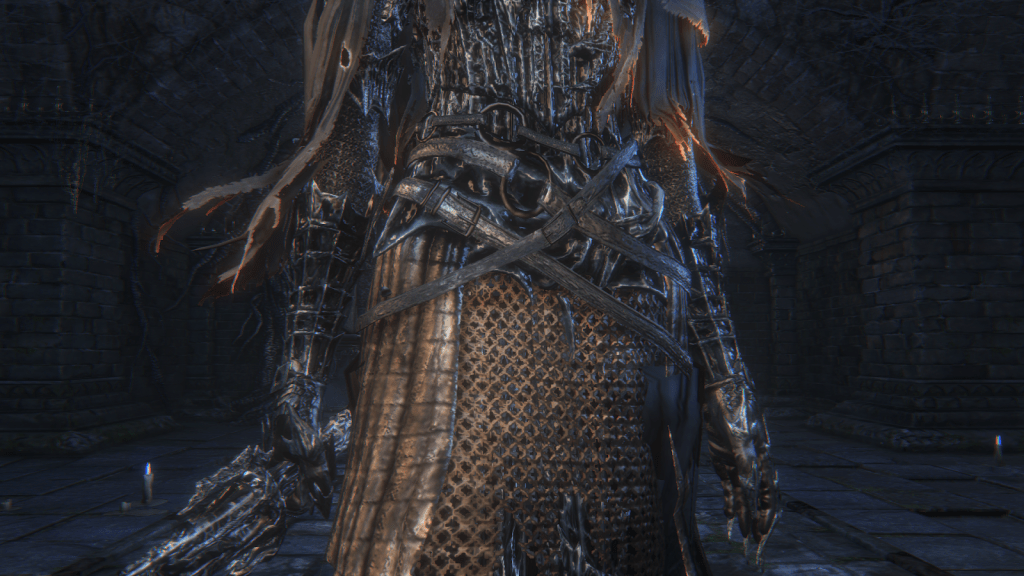
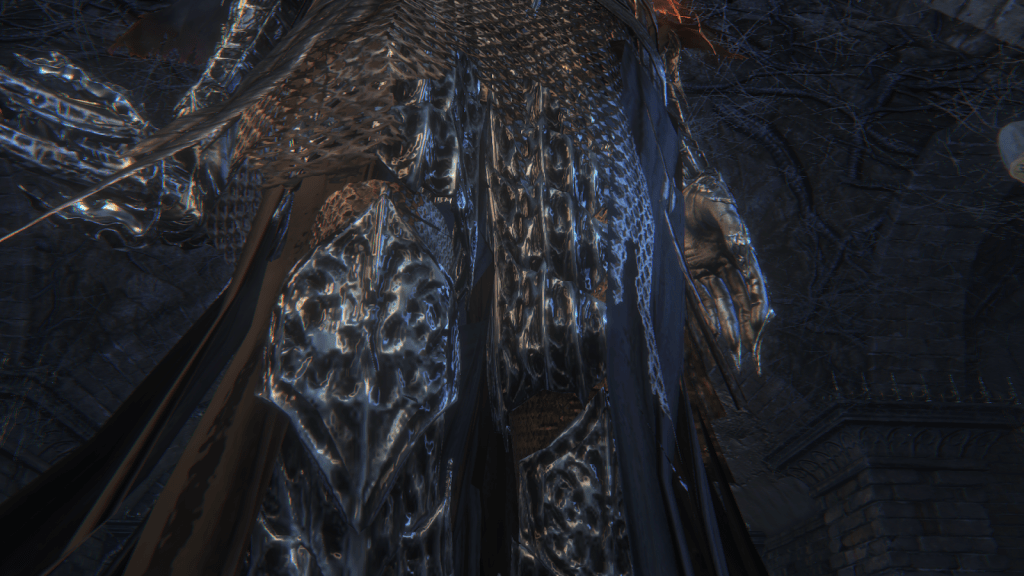
These gravekeeping duties are eternal, for the watchmen themselves are special on account of the power of flame they possess. The Watchdog’s connection is more straightforward. From the blazing flames covering the entire body inside and out, the gargantuan canine has become a corpse-like withered fossil, with no blood to bleed when hit. Doubtless, a pet was experimented upon to become such a fiery monstrosity. As for the Keeper of the Old Lords, this watchman was baptized in hellfire, body and soul reduced to charcoal. They still have blood to bleed and vials to inject, curiously enough, but their actual bodies are little more than bone turned to ash and then fashioned into armor — the skeletal mask a reminder that these are golems of death, not unlike Undead Giants. That white and sinewy armor blackened from scorching is too frail for man, but concept art depicts the watchmen with fire burning from within like the watchdog, and they exhibit a certain mastery of conjuring flame from their hands in battle. They are the products of “lost arts” with the arcane which no modern man has replicated.
Bone ash armor of the oldest watchmen.
It is said that the watchmen who protect the Higher Ones’ sleep burn theirs souls into that form with hellfire, and acquired long lives as ash.
Thus, their armor is no more than white, brittle, sinewy armor, but nevertheless preserves the mysteries of the lost arts we don’t comprehend.
Fire serves as a means of purification, so burning them was probably intended to stop them from becoming beasts. Reinforcing this point, Keepers of the Old Lords are often accompanied by their hounds. The Keeper’s hunting dogs look more like your typical canine, except they possess demonic horns and long tongues. These obviously started becoming beasts. But the transformation seems to have halted, with the loyal dogs capable of breathing fire. They are just another experiment which Isz provided to help their watchmen. Together, the different kinds of immortal guardians secure the Great Ones’ graves at every waking moment, their creators never fearing their blood’s eventual degeneration into beasthood. Even now, we can encounter both varieties as bosses or roaming enemies in practically every dungeon, mindlessly extending their duty to every tomb in the labyrinth. They are constant guiding lights for others to aspire to. And it is clear that the proto-Pthumerians were following the old watchmen’s lead in becoming gravekeepers.





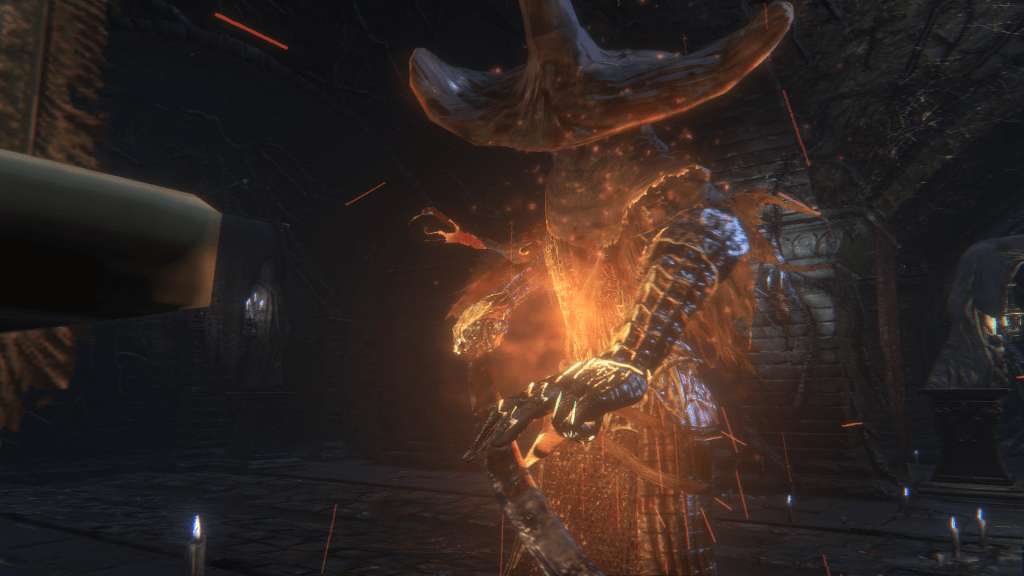
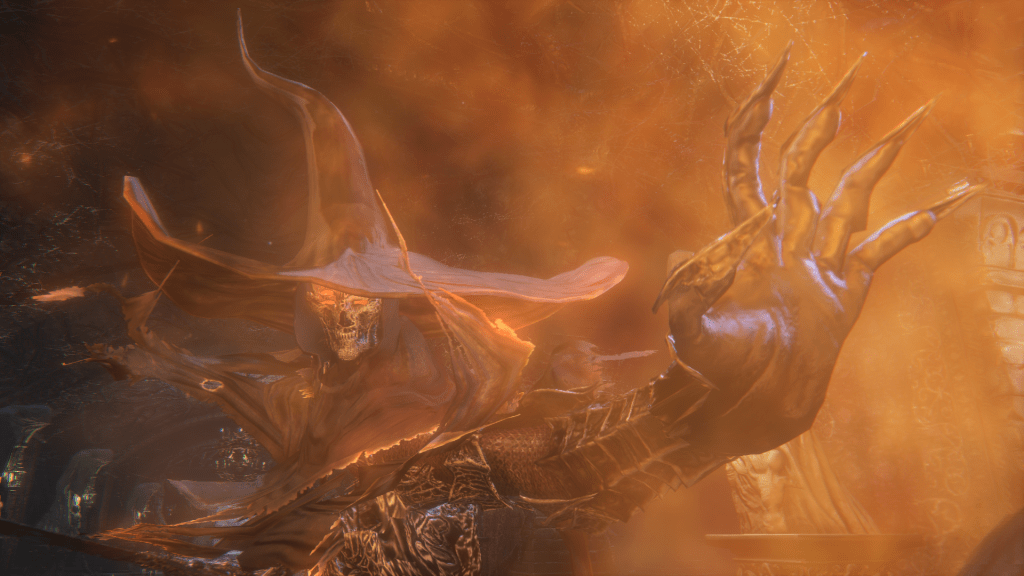

While that deep connection explains why both cultures drink from “great” chalices, it doesn’t satisfy the question of their enthusiasm — for what reason did the proto-Pthumerians remain so dedicated to burying bodies in the ruins of an old home yet populated by monsters? The answer lies in how they “enshrined” the bodies in eternal rest as gods. The burials were a form of worship. It was fear and awe which kept them loyally serving, a religious devotion to former men. Perhaps those ideas were imposed on them by the Isz elite, or perhaps the proto-Pthumerians reached their own conclusions about their divinity. Whichever was the case, it was still this lasting belief in the stars above being gods on earth which kept the Pthumerians willing to appease them for generation after generation. The new clan of gravekeepers continued interring bodies whilst fending off the vermin seeking to defile them, especially when those bodies belonged to their gods.
Eventually, however, the Watchers tired of their role. Their masters may have become gods among men, but those men still wanted to live for themselves. The description to the Great Pthumeru Ihyll Chalice admits as much, the royal capital serving as proof of “at least” an attempt to have a king for their tribe. This king is customarily a woman, so any actual king would be consort to the reigning queen of a matriarchy. Nonetheless, she was the ruler of all Pthumerians, based in a new city established alongside the Isz Gravestone. No longer would they be mere stewards of a dead civilization, but architects of a living one along with a dynasty. Naturally, this capital for the queen shared the name of her title in their language: Pthumeru Ihyll. This was essentially their statement to the gods above, the only one who would understand their language assuming that it is a carryover from the Isz tongue. If Pthumeru was to be the name for themselves and ihyll the word for their ruler, then they had declared their final separation from the old homeland as part of crafting a sovereign identity.
One of the Holy Grails that lift a seal on the underground ruins. Great Holy Grails in particular open secret parts of the ruins.
Pthumeru Ihyll denotes the king of the Pthumeru people or the royal capital. It is probably proof that the descendants of the Pthumeru civilization who enshrine the Higher Ones’ rest at least tried to crown their own king.
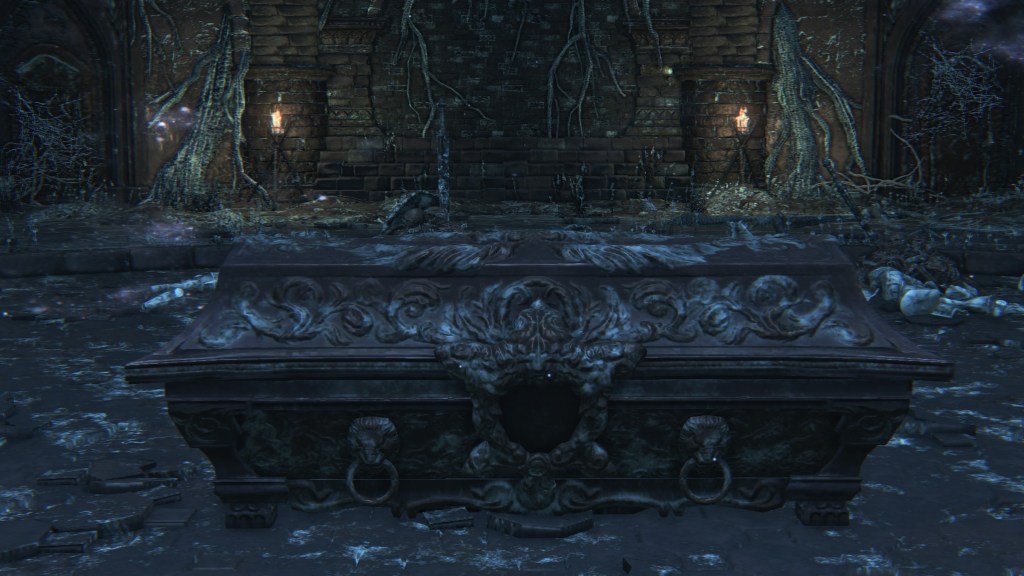
Of course, this was hardly a rebellion against the Great Ones. Their reverence for the gods is showcased in their continued service as gravekeepers. Even the royal city is a tomb, no different from Isz. The Pthumerians incorporate many affectations of urban infrastructure throughout the labyrinth, including artistic decorations. However, the metropolis is nonetheless built out as another necropolis, with gravestones and coffins of all sorts filling practically every chamber. The Watchers weren’t forsaking their duties to their ancestors, just carving out a time and place for them to pursue their own interests. As eons passed and the dirt piled up, the Pthumerians continued building upon their capital, with new tombs ascending up the tower layer after layer, until we reached the Pthumeru ruins at Depth 1 in the modern day. Isz and Pthumeru Ihyll both became a secret, buried so deep under all that earth and stone, to even the most daring dungeon diver. And yet, Pthumerians continue to honor their transcendent forerunners.
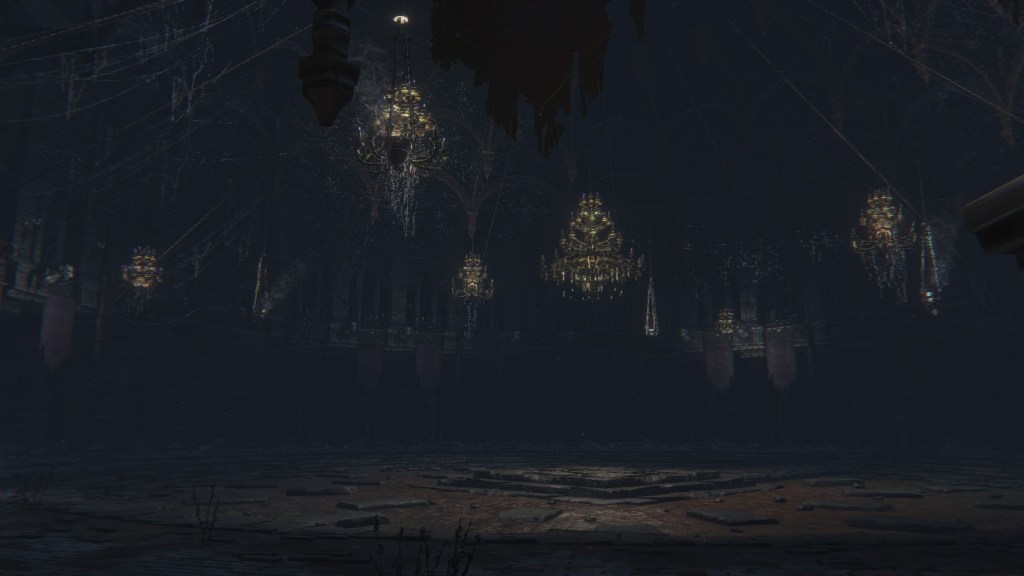

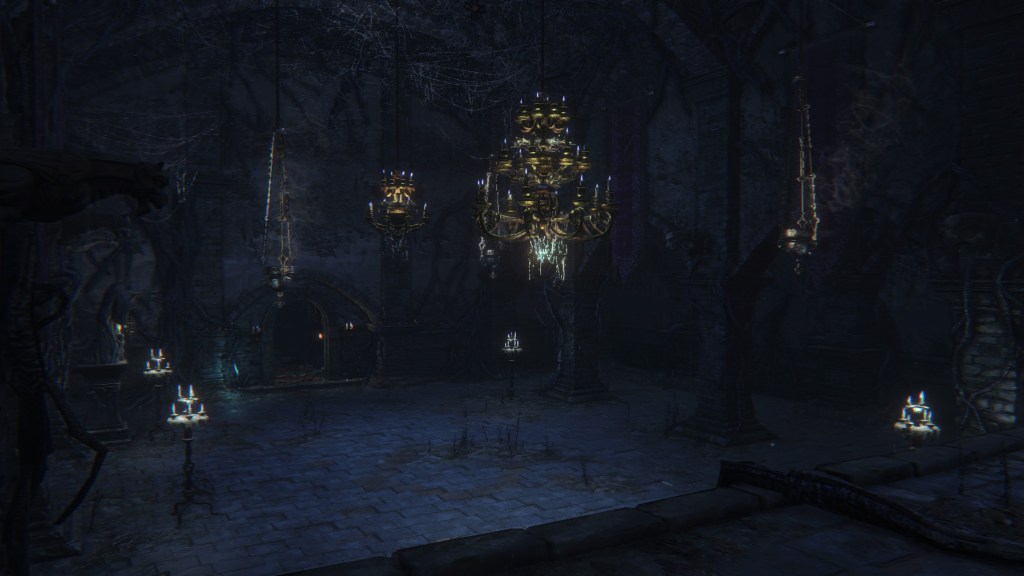


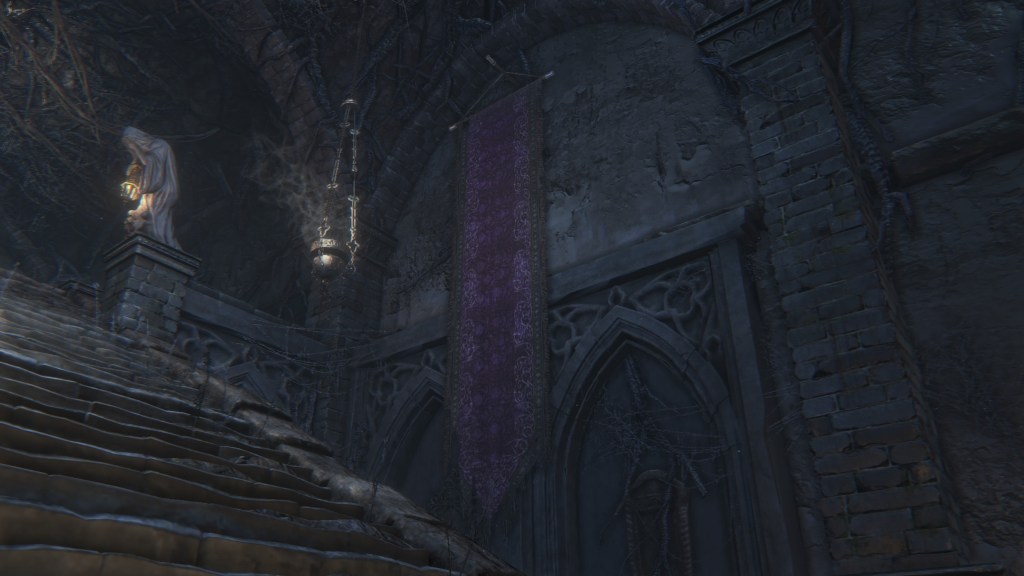

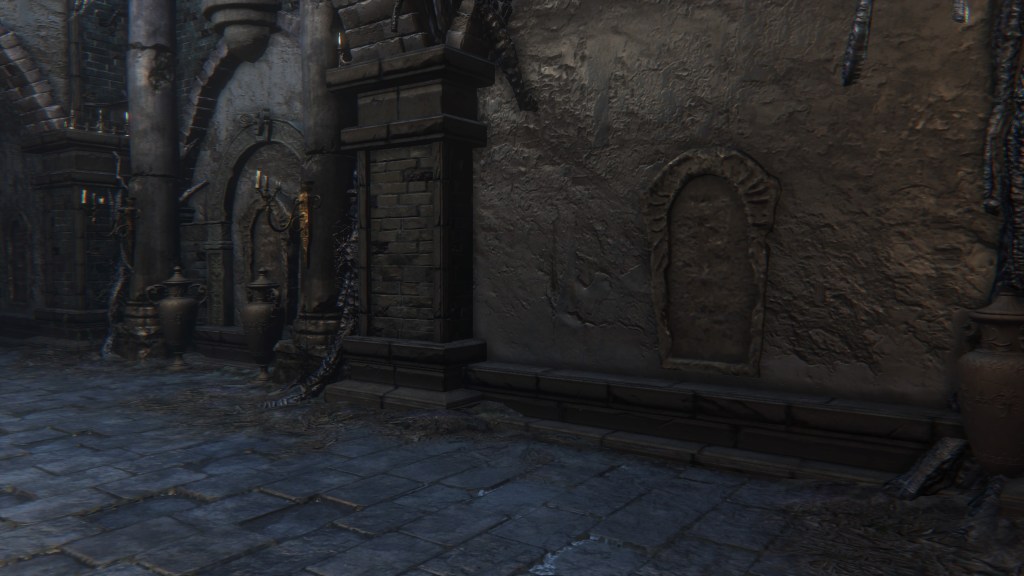
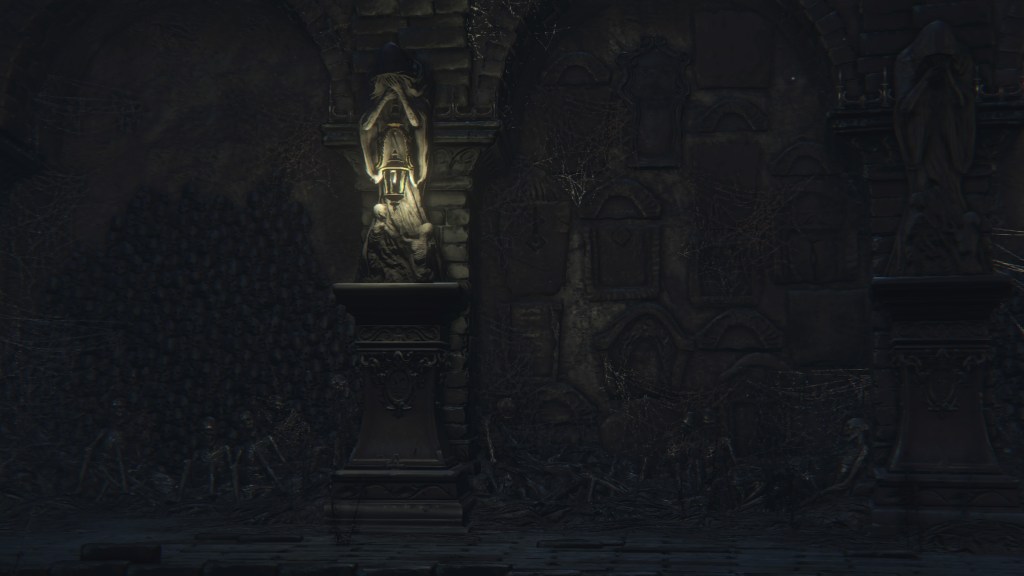
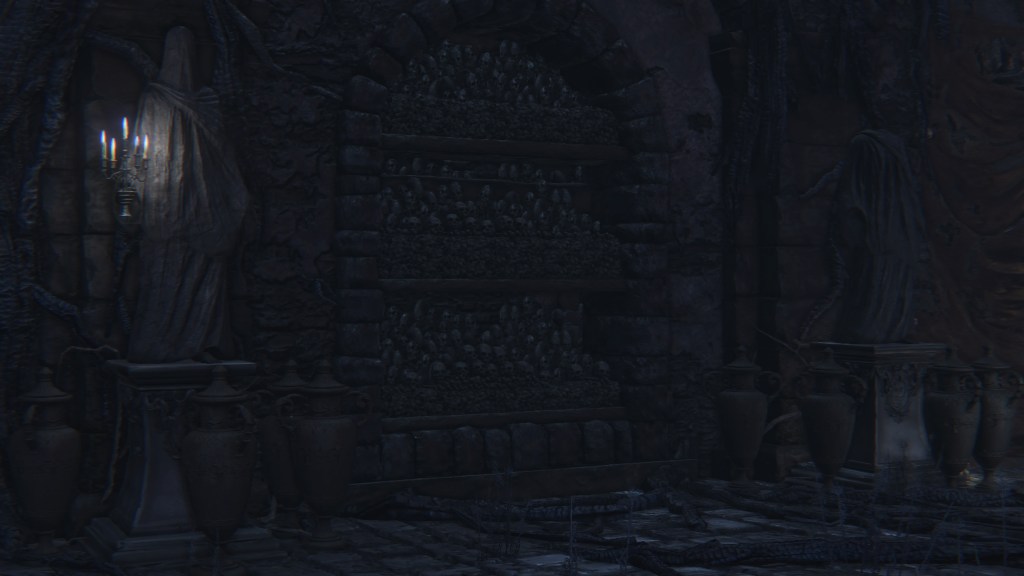
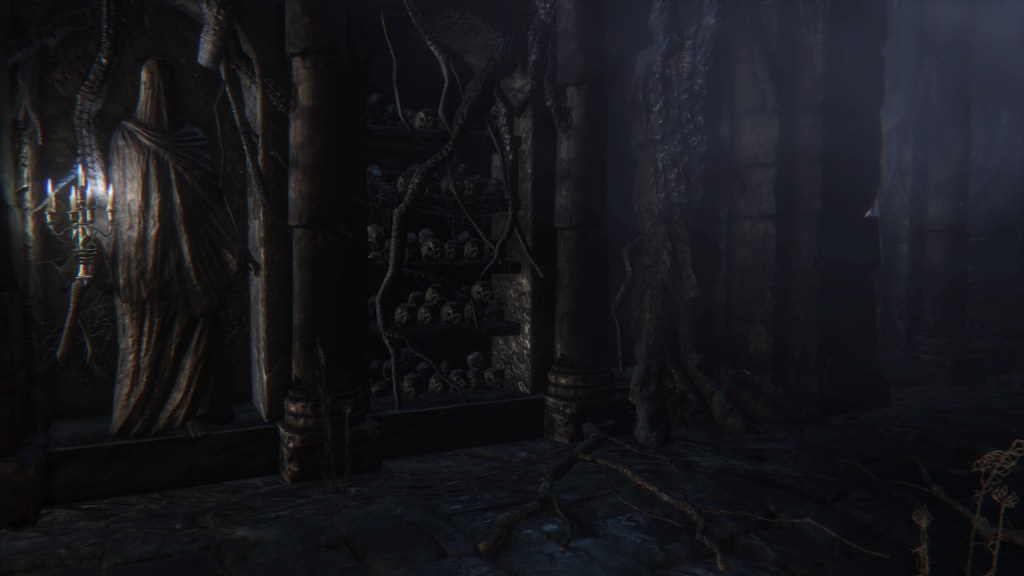
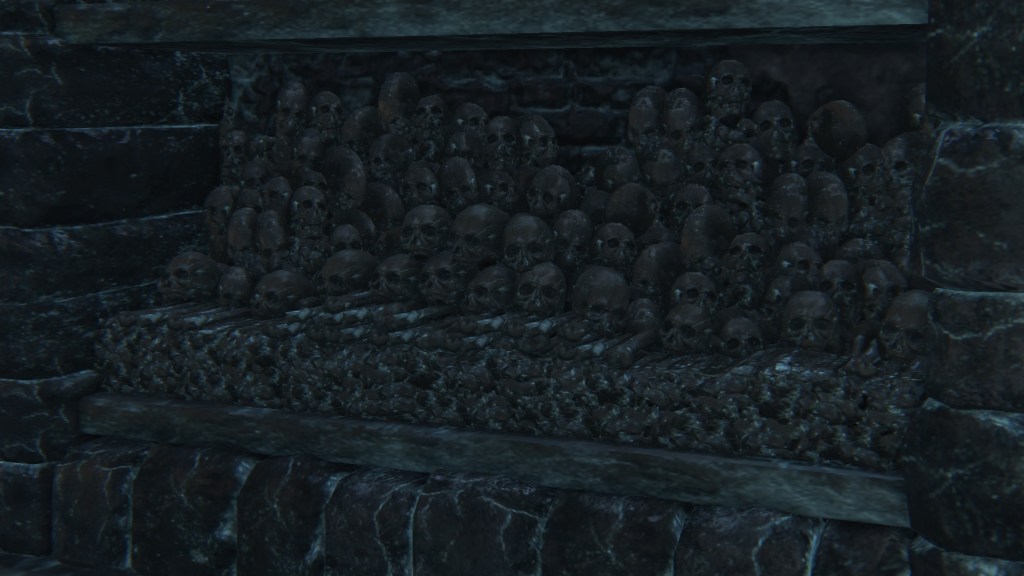

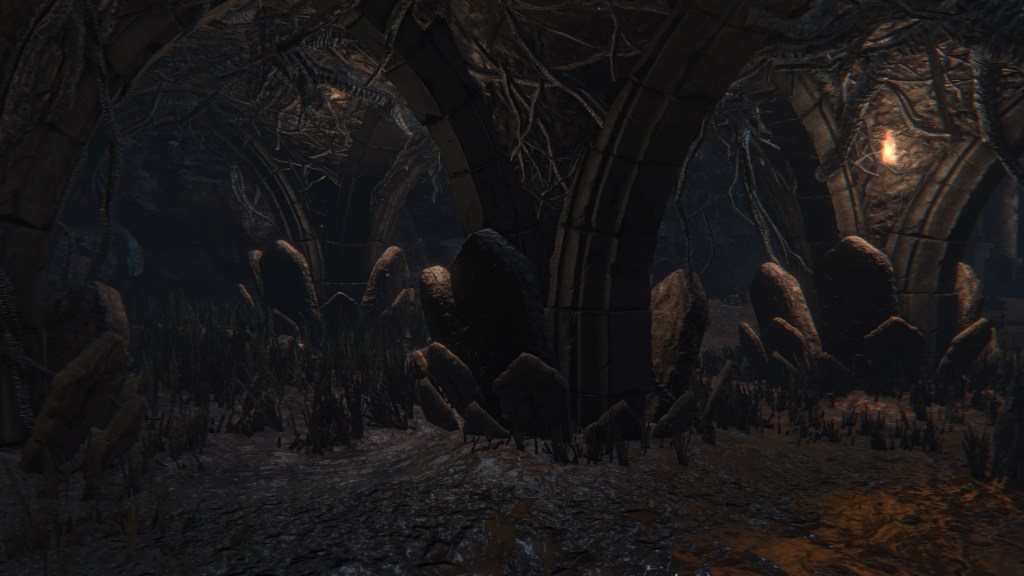


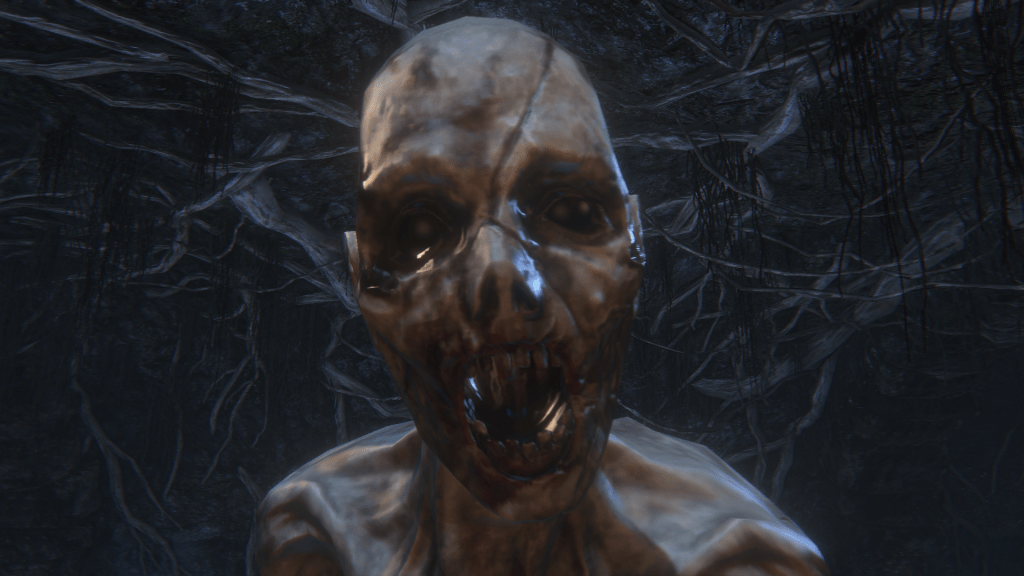
As a result of their long history underground, Pthumerians have changed from normal humans. Official websites point out how pale their cold, damp skin has become, untouched by the sun, while their eyes have degenerated into large and sunken black irises to better suit the low-light conditions. When not bald, they almost invariably possess silvery grey hair, seemingly irrespective of physical aging. The Pthumerian enemies we encounter similarly come in all sorts of shapes and sizes, some far larger than the average man. It is possible that most larger examples are artistic license, but the inclusion of “giants” does affirm the potential to grow to such hulking proportions. Nonetheless, the doorways and more are made for our size, so we can infer that the vast majority are tall and lanky but ultimately still human in stature. The gradual transformation makes them appear inhuman despite very much remaining human at their core. Granted, that “inhumanity”, as with the Great Ones they worship, has its perks.
One of the pan-Holy Grails that lift a seal on various parts of the underground ruins. “Holy Grail Dungeons” which have their seals lifted via a pan-Holy Grail ritual are known to change their appearance with each ritual.
Furthermore, Pthumeru is the name of the old race who built the underground ruins, and it is said that they were inhuman humans who possessed mysterious wisdom.
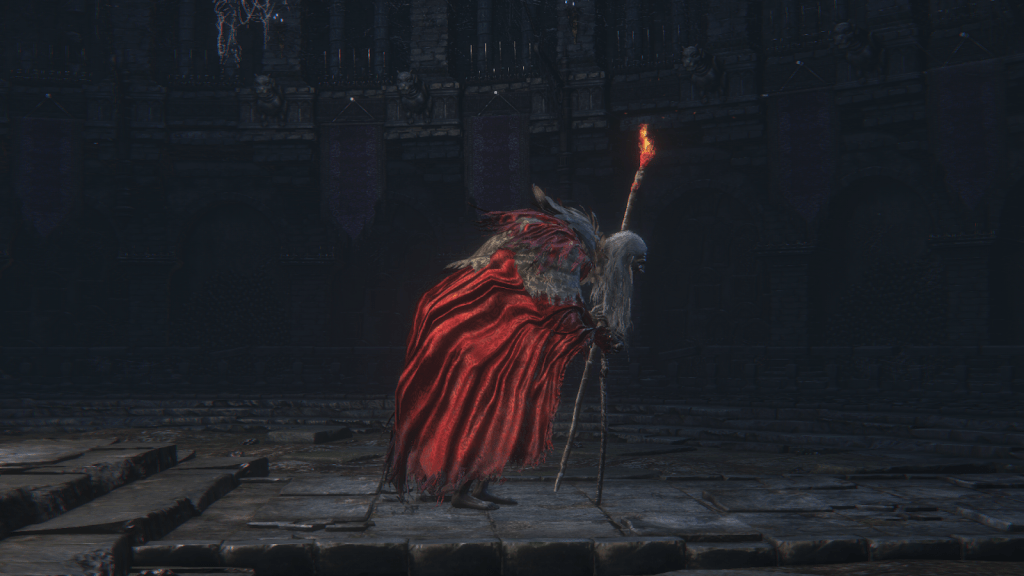
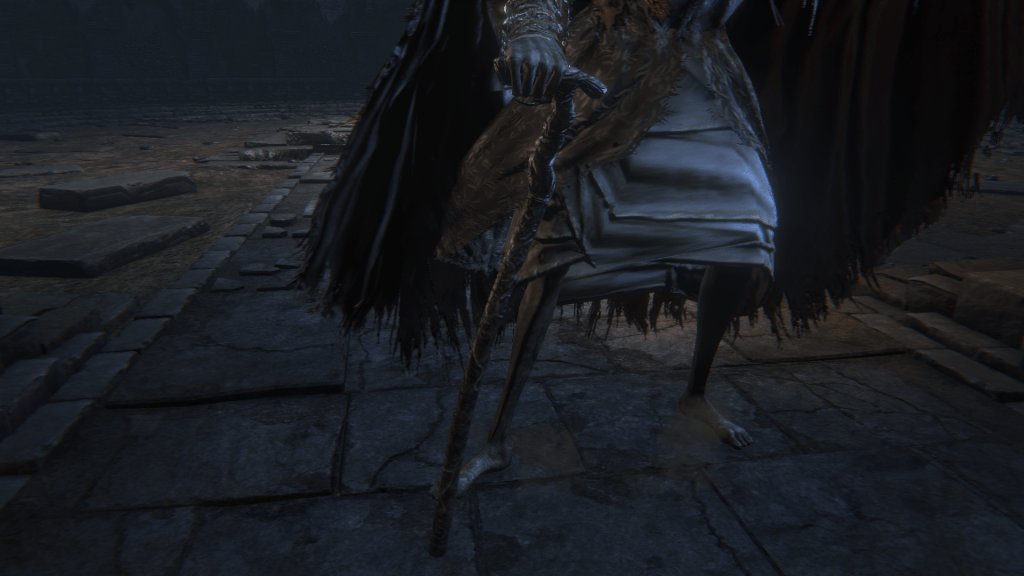
Although the Pthumerian Descendant and Elder look identical, the latter wields a cane and performs less physically demanding feats. If they are both old men as they appear, then the different names must simply highlight how old, the Elder perhaps being one of the original generations during the transition to a proper polity. And if there is that big an age disparity between the Descendant and Elder, then the only conclusion to draw is that Pthumerians are long-lived, their lifespans far surpassing that of the average of man on the surface, which by all implications is no different than on planet Earth. Perhaps these extended twilight years are limited to only certain members of the race, but it still highlights how Pthumerians can enjoy life for all its boons more than most. Long-lived members also enable a greater continuity across generations. It may be because of that continuity that this civilization built up over eons has survived, depth after depth. Such are the complexities of Pthumeru.



Songs are the City’s Diviners
Although the labyrinth is regarded as an underground ruin, it is clear that a living, breathing society still exists and is constantly expanding. At every level, we can find gravediggers working to add onto existing tombs with each swing of their pickaxe, when not guarding the premises on the standard Keepers’ behalf. There are always renovations to be made to the “cities” that the Pthumerians have established in their towering labyrinth. The Hintertomb is the most ambitious example. Existing only at Depths 2 and 3, this section of the complex is relatively recent in Pthumerian history, though not existing as part of the core labyrinth. Rather, the name “Remote Graves” (僻墓) denotes the Hintertomb as the frontier, with the kanji presenting additional connotations of a rustic quality. If the various Pthumeru dungeons are the urban center, the Hintertomb dungeons are the rural outskirts. Descriptions to their chalices note how the Watchers continue to expand this section, building out horizontally as they wait for the earth to build up vertically. Civilization is only accelerating.


One of the Holy Grails that lift a seal on the underground ruins. The Remote Graves denotes the underground ruins’ frontier.
It is a sparsely-ritualized section of graves and death, and it is said that the keepers continue the expansion of the Remote Graves even now.
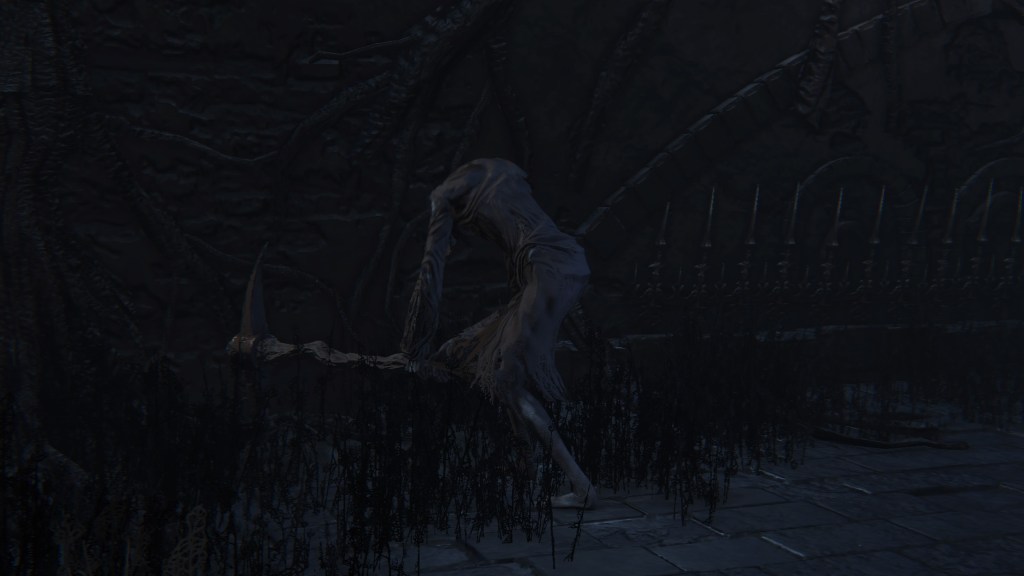
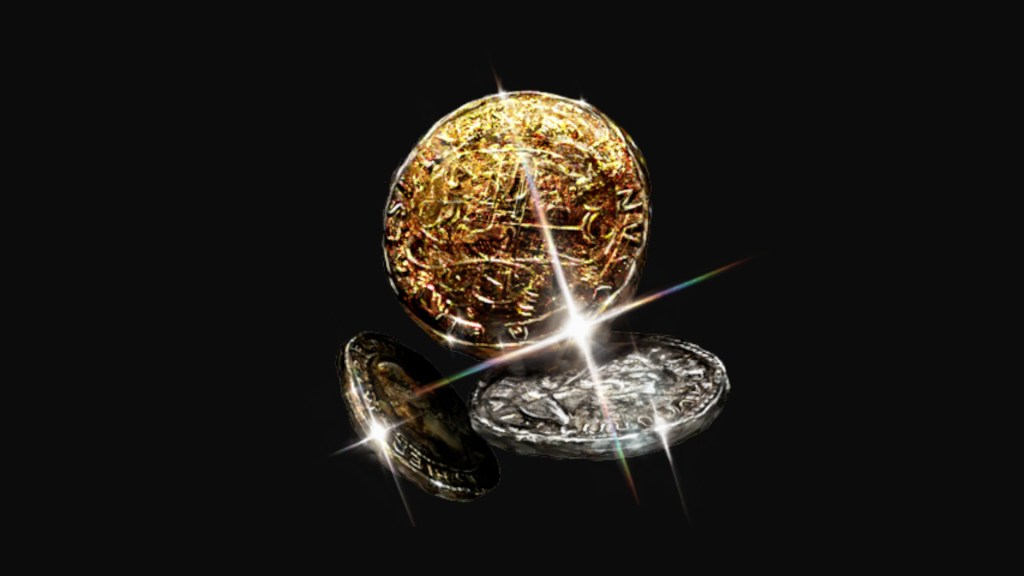
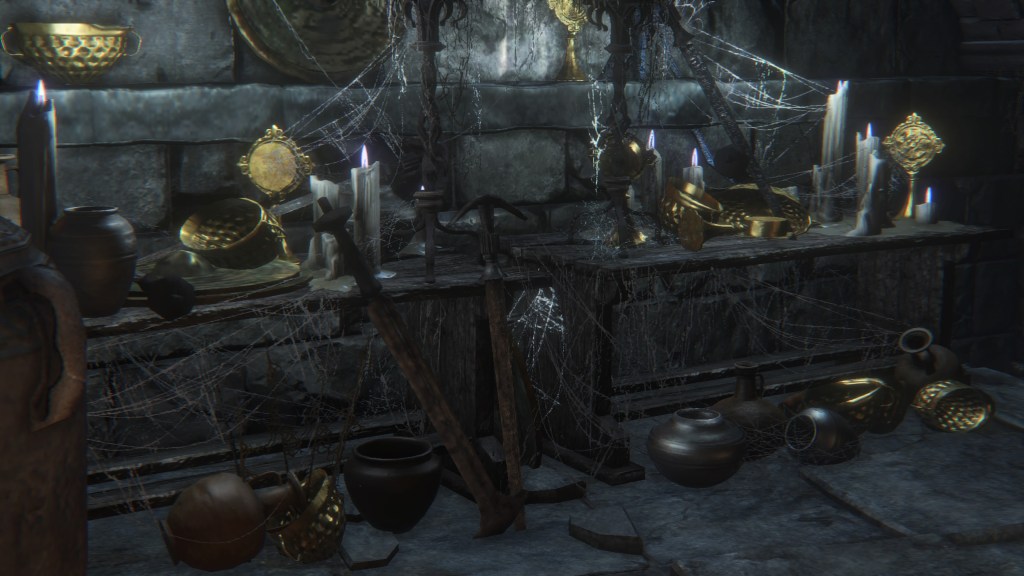
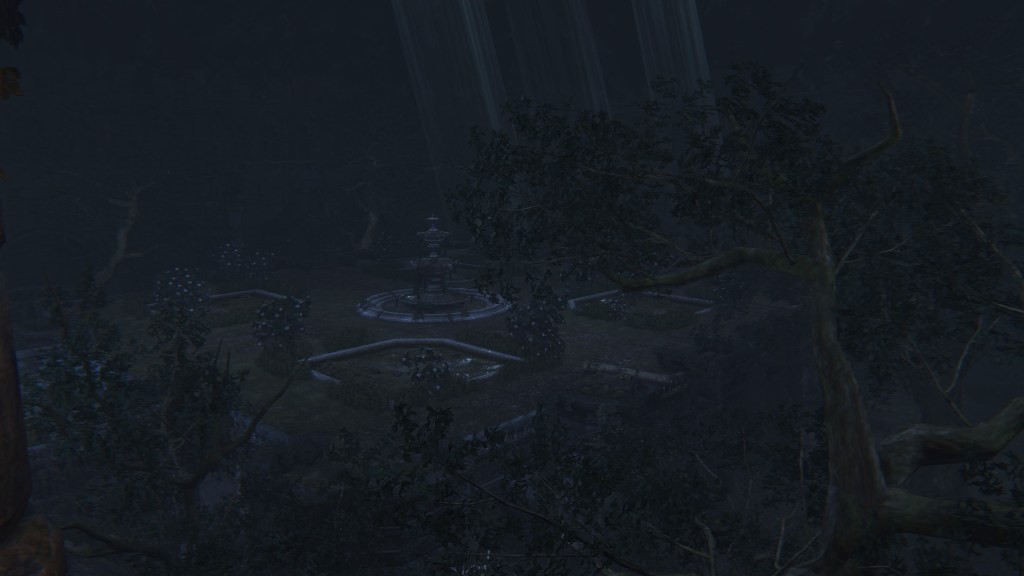
Beyond the infrastructure, there is also economy. The shining coins collected in tombs confirm the existence of hard currency based on rare metals, with treasure vaults filled with gold wares. Considering how they spend so much of their time digging through the earth, it shouldn’t come as a surprise that the Pthumerians have gathered plenty of valuable metals and gems. Naturally, much of this wealth is collected in the royal capital, with Pthumeru Ihyll providing the most coins of any story dungeon. Conversely, the fact that we cannot collect these coins in the Hintertomb outside select enemies betrays the relative poverty in rural areas compared to that urban center. The coins reflect the concentration of power, with the queen controlling the flow of capital to invest into her city but also the labyrinth at large. We likely see this in projects like the various massive gardens preserving a semblance of the greenery on the surface, growing plants as exotic as fluorescent flowers. The gravekeepers needed their luxuries, and public parks was just one way to satiate the crowd while showing off the crown’s coffers.
Of course, the queen cannot do all this alone. Alongside her in affluence were a noble class. Pthumerian Descendants and Elders, combined, can be encountered in almost every root dungeon. Both bosses share a model of a grey-haired man in ornate and assuredly expensive dress, conveying status and luxury carrying him into old age. Internally, these dungeon men are labeled as “lord”, (ロード) so there is no doubt that they are the equivalent to feudal lords in medieval societies. The queen bestows certain individuals and their families with nobility and assigns them a holding across her ever-growing dominion. In governing the land, they are the ones to lay claim to any mineral wealth found in their territory, amassing fortunes which only partially must be paid to the royal coffers and improving their territory. The most successful and prosperous aristocrats worm their way into the capital, where they wine and dine whilst building a power base to affect politics and further enrich themselves. The Pthumerians seem to follow this all-too-common pattern for the elite.






Nonetheless, the nobility serve at the behest of the queen and do exist in almost every section of the labyrinth, time seeming to be the deciding factor. We see that the most recent layer of Pthumeru has not been assigned any lords. Pthumerian Elders and Descendants likewise only appear in the Lower Hintertomb, the more recent Hintertomb left to the rabble. Perhaps there are simply fewer lords needed to govern the boonies, but the Pthumeru dungeon, at least, insinuates that a labyrinth needs to first develop its infrastructure and economy over a lengthy period before any new regional governors are assigned to help manage it as an independent province. Whatever the specifics behind the selection, the aristocracy filled the temporal role in leading the people, leaving the spiritual role to fall to someone else.
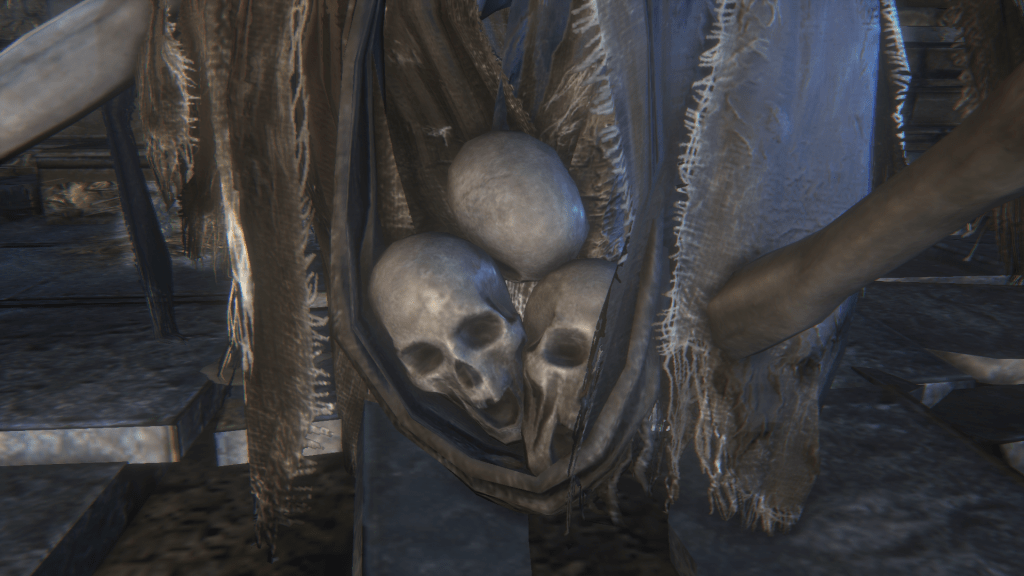
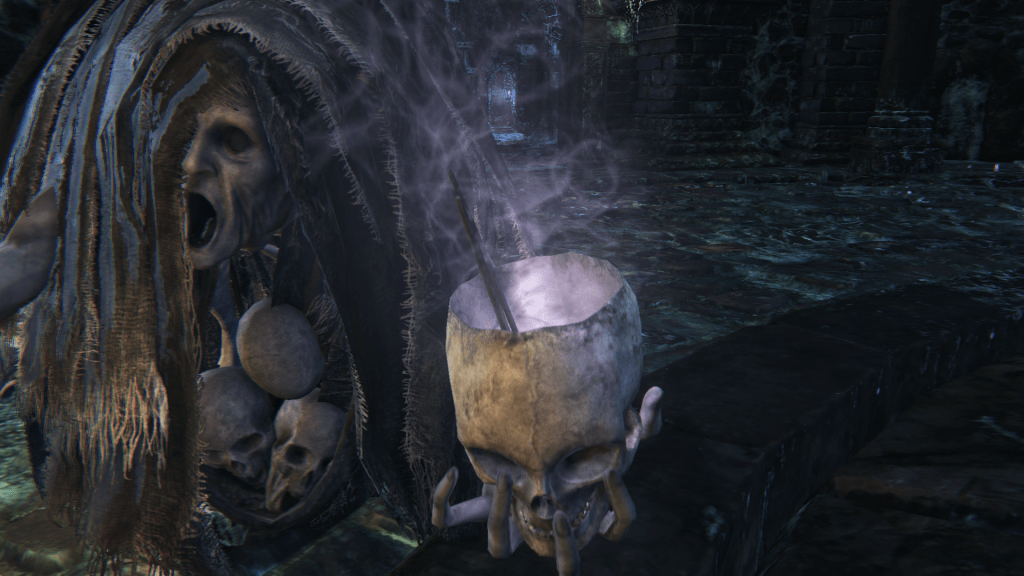
Pthumeru naturally has its cleric class. “Ritualists” (祭祀者) appear diminutive in size, but the robes are deceptive; if not for their bizarre hunched-over stance, they would stand taller than most, as shown when they do deign to stretch those legs. True to their name, these men have toiled away at learning sacred rites, the nature of which are fittingly macabre. Each ritualist holds a severed hand as a candle holder and an open skull as a mixing vessel, from which the cleric conjures fire magic or arcane energy. These make them dangerous range attackers, but their rituals primarily serve to build up society’s knowledge and facilitate communion with the gods. They are the brains of the elite, keeping low to the ground to better examine corpses for their research. Ritualists are the ones typically crafting the “Shaman” Bone Blade, taking the bones and cerebrospinal fluid of the occasional brainsucker to create a mind-controlling tool for their ceremonies — no doubt to further study beasts and kin up close and personal. Their esoteric ways contribute greatly to the culture, so they ignore the various body parts they take.




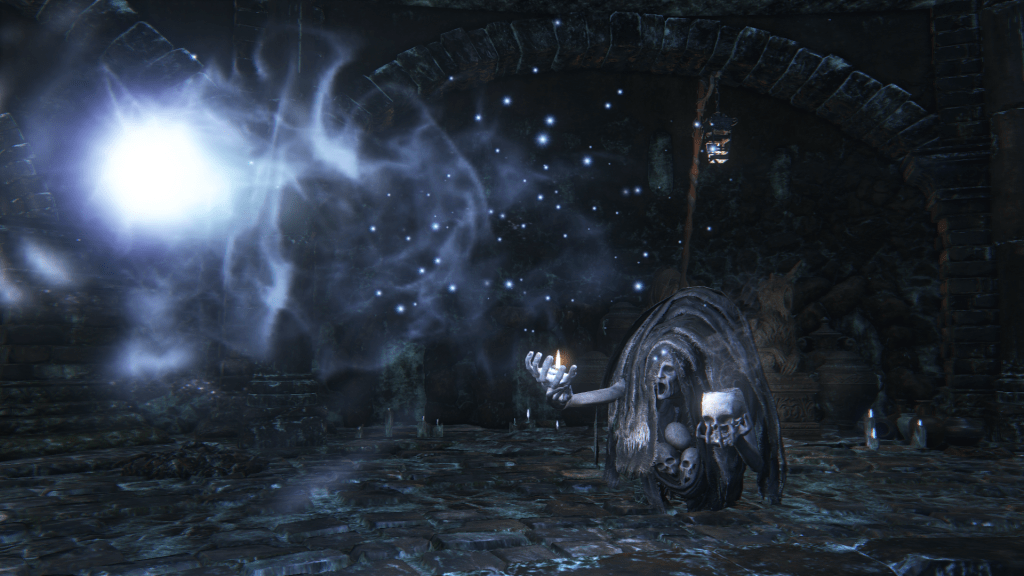


Bone blade coated in dubious cerebrospinal fluid. Ceremonial item that keepers of the underground ruins, ritualists in particular, use.
That green-colored cerebrospinal fluid induces temporary paralysis of cognition and causes the target slashed to fall into unconsciousness.
Maybe because it wasn’t originally used for combat, that blade is dull, so requires deep slashing, and will also break once performed.
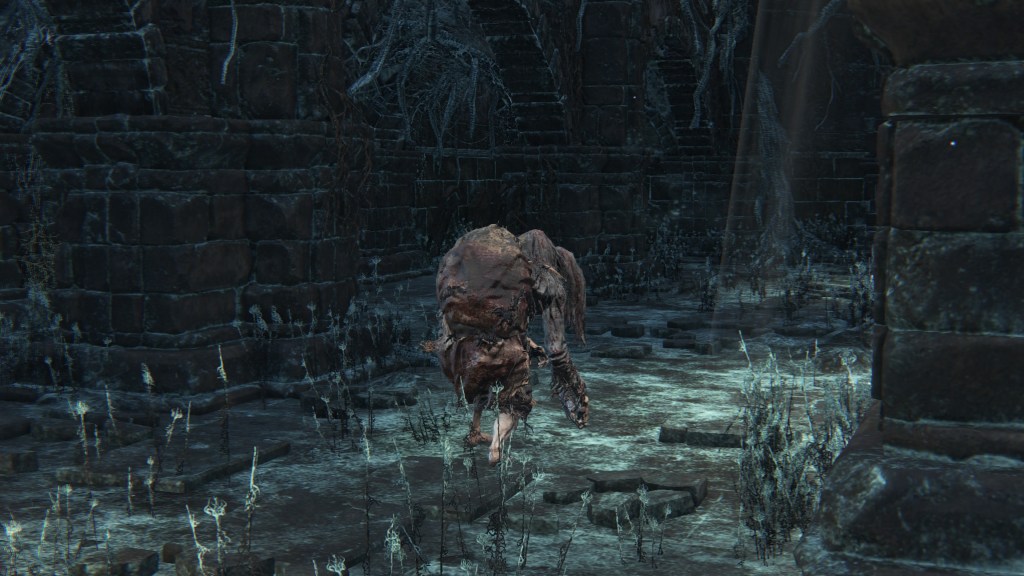
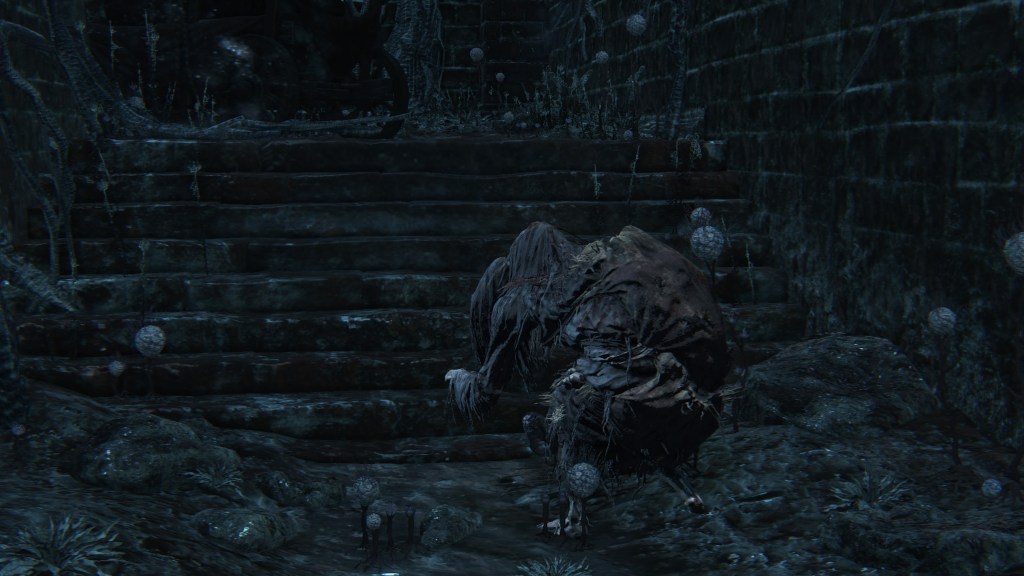
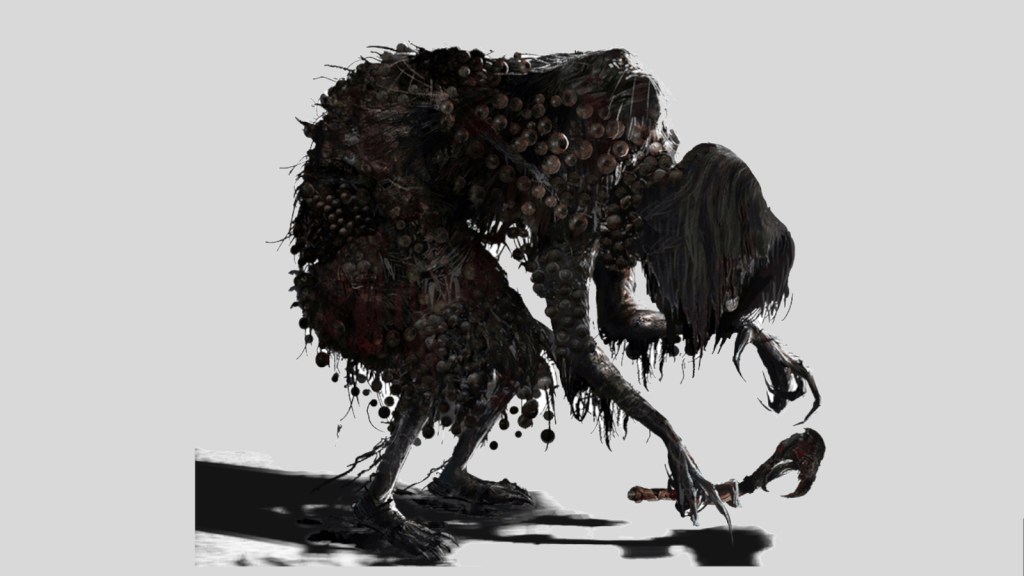
However, the description to Hintertomb Chalices make clearly that the remote graves are “sparsely” ritualized. The clerical class gives little attention to these newer sections far from the concentration of people. Instead, the rural types have developed their own religious practices. The Short Ritual Root Chalice acquired after defeating a Pthumerian Elder in the Lower Hintertomb demonstrates the “informal” (略式) nature of such ceremonies even among local nobility. When the mainline orthodoxy isn’t asserting cultural pressure, it was inevitable for residents to gradually drift from the mainstream, with peculiar customs. Besides the glass cup for simplified rituals, there are also eye collectors. These hunchback women in raggedy robes go around carving out bloodshot eyeballs from, preferably, those still living. Their obsession is so strong, they even collect pebble should they resemble eyes. While brutal, we see the results with the variant covered in eyeballs, capable of conjuring arcane arts. Their work is practical.
With story dungeons featuring eye collectors in the Hintertombs and ritualists in Pthumeru tombs to the exclusion of the other, we can infer that the former fill in the gap left by the clergy. These female clerics embody a belief in the power of eyes, likely because they connect them to insight. Indeed, besides the Hintertombs, eye collectors only appear in Isz root dungeons, barring additional rites. Isz also placed emphasis on the eyes for insight, the quality of which apparently attracts some Pthumerian women to come and collect. They must believe that amassing such eyeballs will lead to enlightenment, though it is presumably more their bloodshot nature which makes them so valuable for deriving powers of the arcane. However this same folk belief developed in the Hintertombs secluded far above, it is the heterodox practice of the clergywomen there, a plurality of rural citizens placing their faith in them over the male priests likely because they are women and thus fill the role of the queen in this matriarchal culture. Admittedly, female clerics are commonplace throughout the labyrinth.

A Pthumerian madwoman constantly rings a bell to summon enemies around her. The way the endless horde rises from portals in the ground with a red glow flowing across their body suggests that they are souls reconstructed from blood. When the summoner is killed, so are the summons, reinforcing how their life force is tied to hers — most likely, because they are quickly conjured up by simple ritual. We can assume her madness to be the product of a deep immersion in arcane forces. Bells also features in dungeons, larger ones hanging from the ceiling individually or in an arranged cluster. Pthumerians understood sound’s ability to cross planes, this bell ringer showcasing that full potential when combined with the power in her own blood. And with how she strolls around in her fancy dress, absentmindedly summoning, indicates noble or clerical status, potentially both. Adorning major doorways are figures of a kindly woman watching over a grave, with similar hood. The bellringer might be the equivalent of an itinerant monk, traveling around to deepen her and others’ spirituality through action.


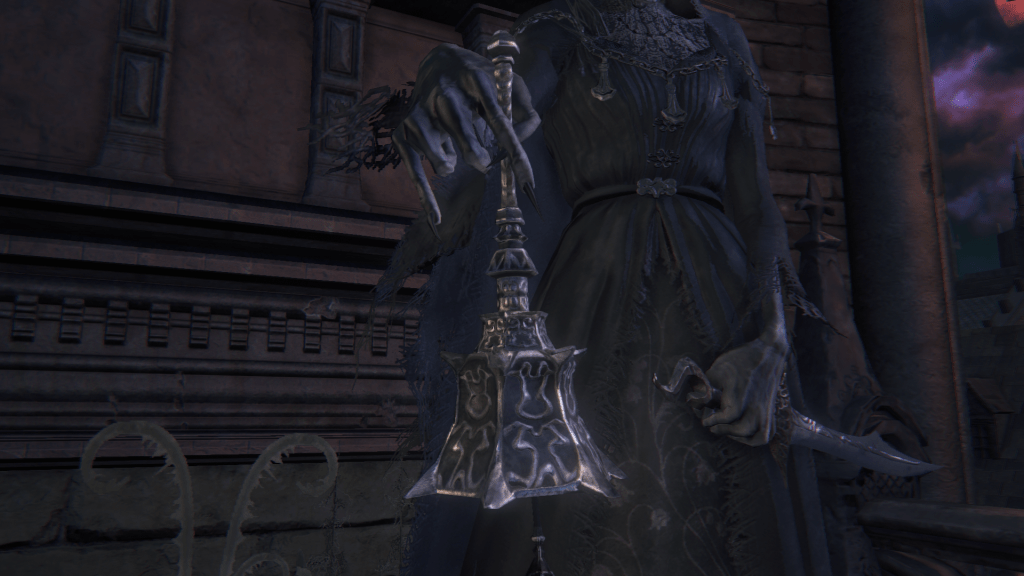

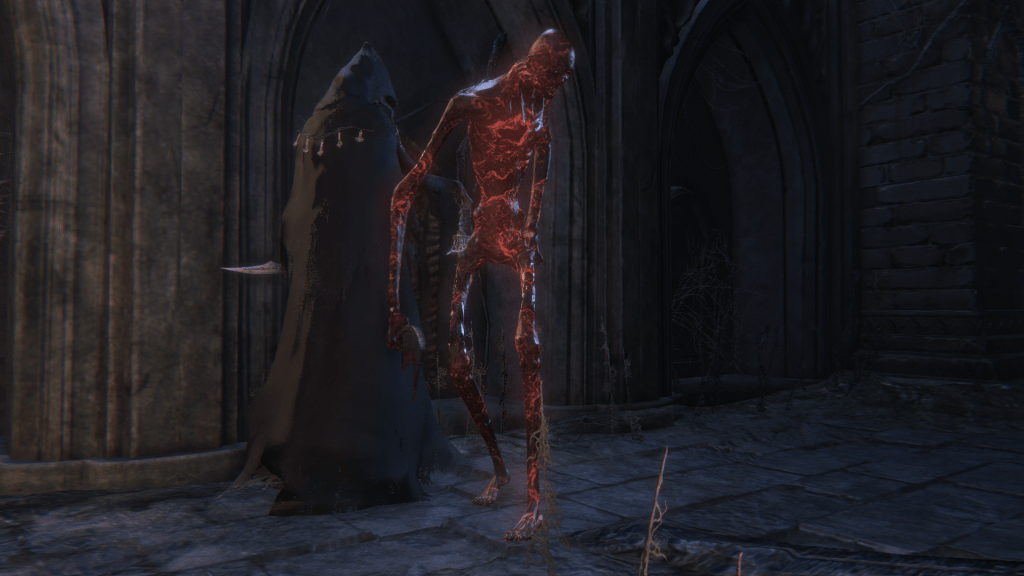


The reality was that the supernatural was very natural in a place like Pthumeru. Descriptions of the country’s chalices detail its people’s “wisdom” concerning arcane forces, which is expressed in something as mundane as the blue flames lighting much of the tombs. Pthumerians didn’t require much in ways of proselytization — the divine mysteries weren’t much mysteries to them. What they needed was confirmation of that powers’ connection to the gods in the natural world. All these arcane rites, beyond their practical value for gravekeeping, were needed to reinforce that the Keepers’ duties were serving a grander purpose, the stars valuing their thankless work and rewarding those efforts with their secrets. Contact with the Great Ones wasn’t something just anyone could accomplish, as we can see from the occasional scene of basic Watchers reaching for the heavens or shaking their heads in the dirt due to madness. Without liaisons to convey their deities’ intent, how can they know the benefits of worship? But if they can’t trust the clergy, it is up to them to confirm that their idols exist.
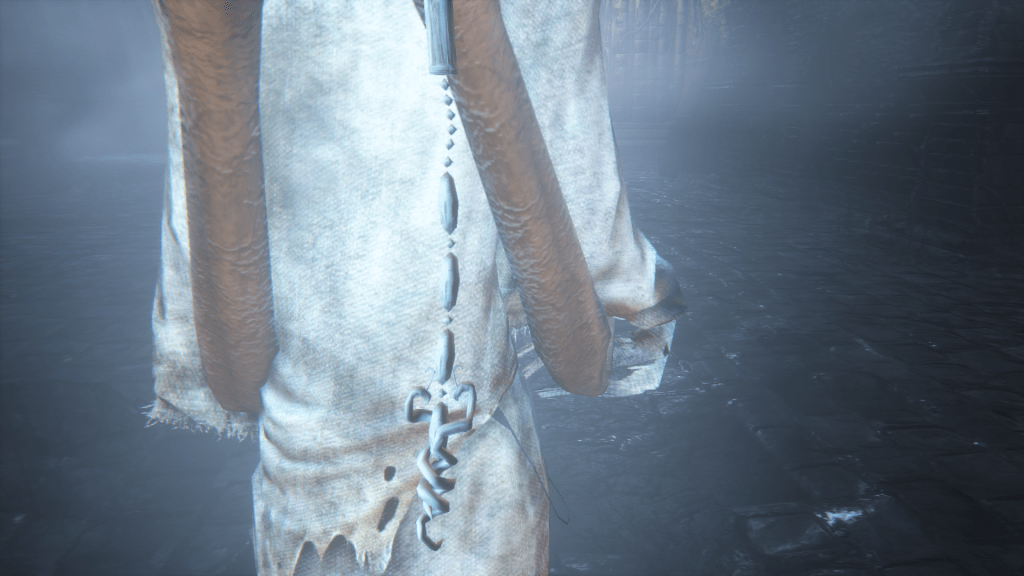
Pilgrims holds prayer beads and sometimes a walking stick as they make their long journey. We only encounter one inside a single story dungeon, his place in the uppermost Pthumeru labyrinth pegging him as a local just starting on his pilgrimage. Root dungeons confirm that this takes them down deep to holy sites such as Isz, the birthplace of their gods. Faithful from all over head to the bottom of the towering labyrinth to confirm the history of their grand civilization, willing to weather the risks of setting out in this world full of monsters. Although largely harmless, these pilgrims can defend themselves. Upon noticing a threat, their bodies begin to glow a ghostly white, casting a small arcane explosion to keep the attacker away before returning to their pilgrimage. Their faith has been rewarded with at least basic understanding of their gods’ power, simple as the arts might be. But they are nonetheless feeble citizens, ill equipped for a plunge to the deepest depths where we find the real horrors.
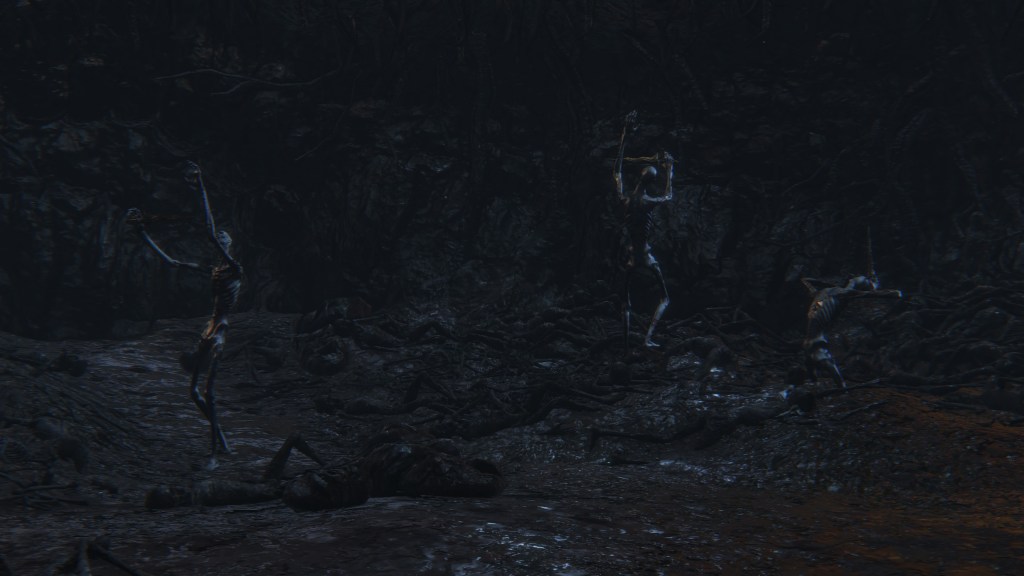

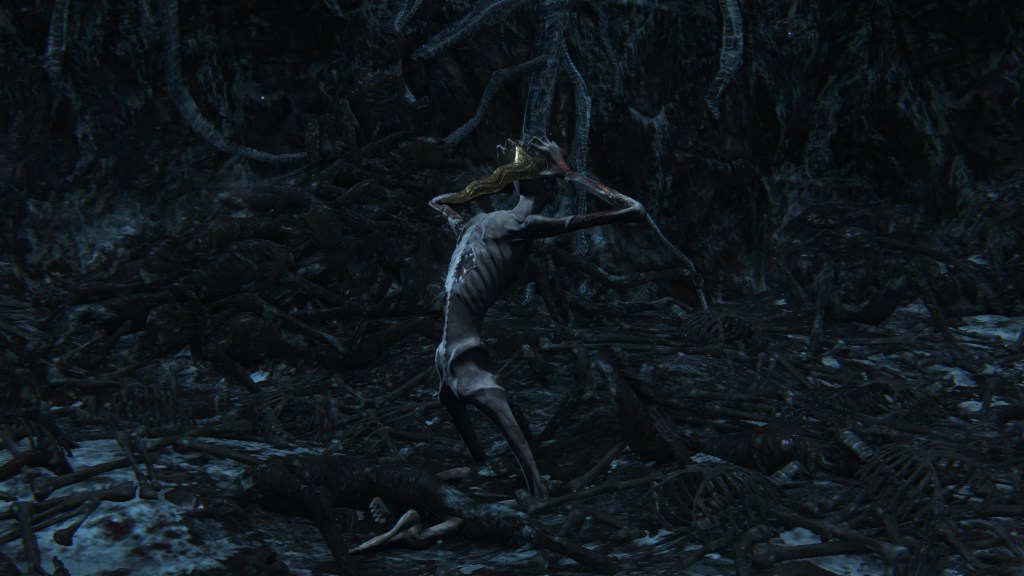

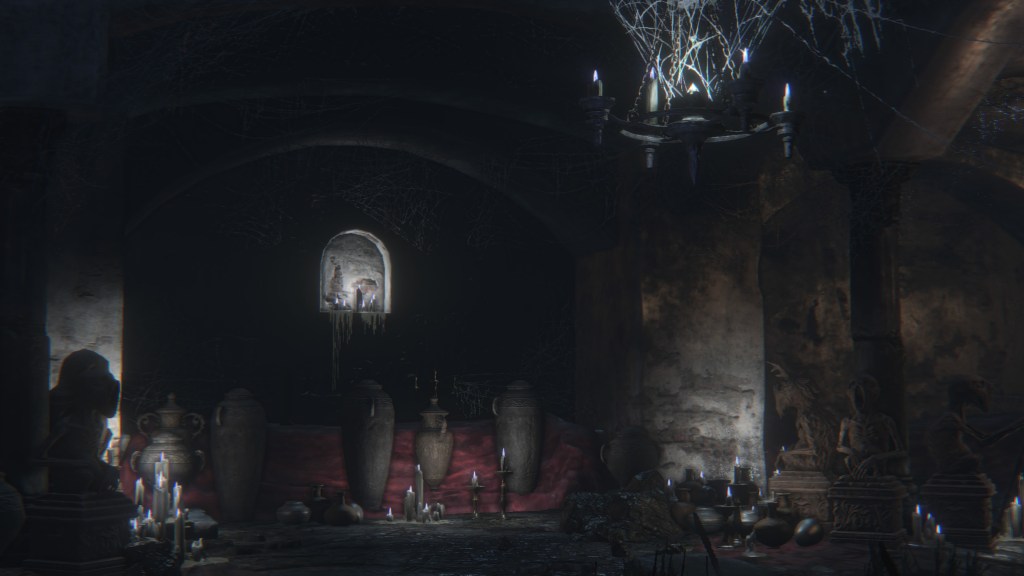


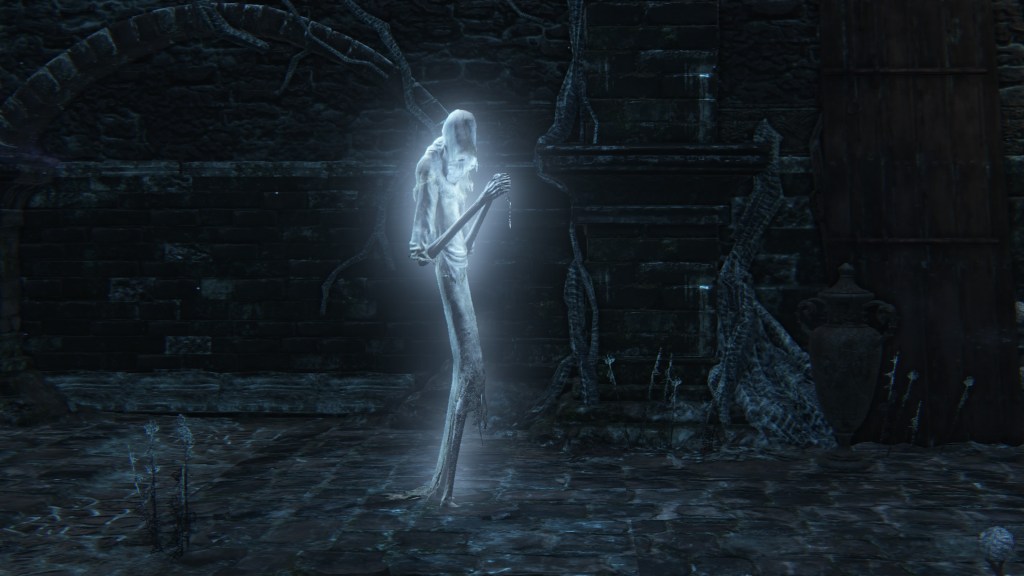
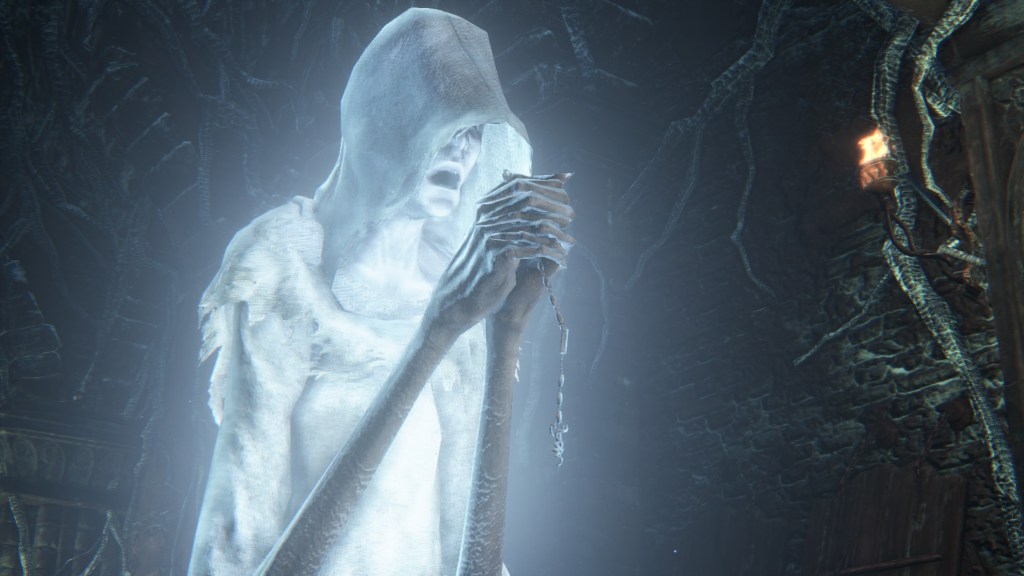
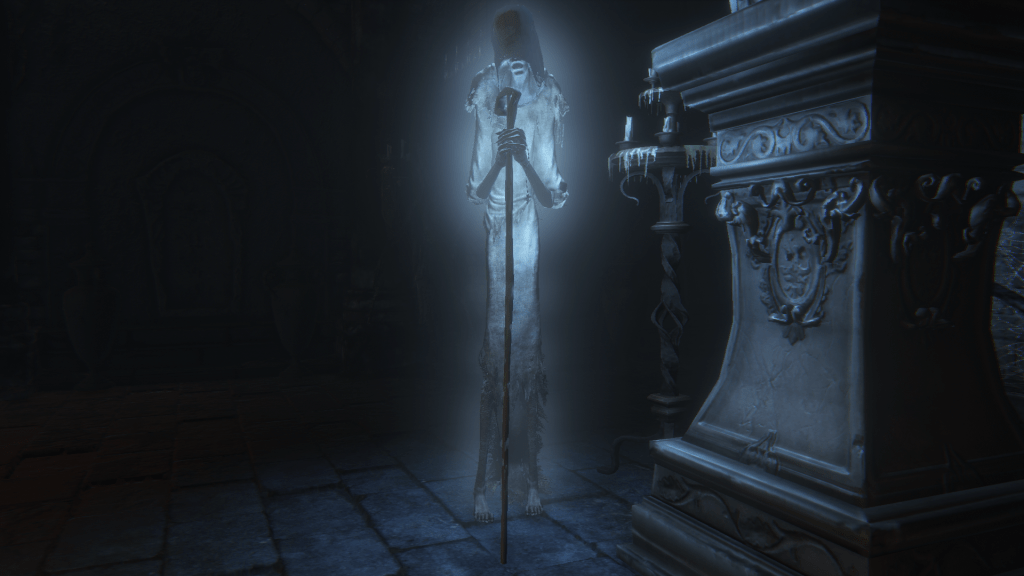
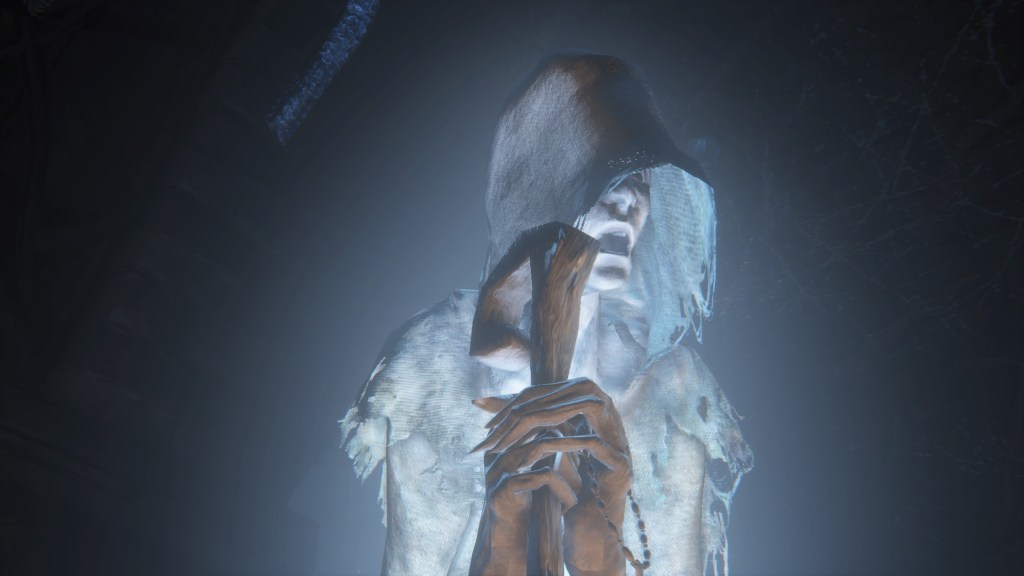
Overall, veneration of the Great Ones went hand-in-hand with gravekeeping, so developing their spirituality and understanding of the arcane was just as important to the Pthumerians as building a secular government. Defending the tombs was chiefly to honor them, after all. They were the ancestors who achieved miraculous power and longevity, where even death was merely resting rather than resting in peace. Their bodies were essentially sacrosanct. The clerical class and customs were a natural outgrowth of the Watchers’ core beliefs about the so-called gods. Whether this became the state-sponsored religion or relies on private alms, the clergy must hold a similar level of influence to the aristocracy in society. The ritual blood, however, alludes to a third pillar undergirding Pthumeru’s foundation: blood drinking.
My Drink is a River
Part and parcel to a Pthumerian ritual was blood. We see that ritualists freely handle the quality blood used in those rites, and all their congregants probably participate. Every Pthumeru dungeon has its own chalice, the cups for blood become larger and fancier in size as we descend down. The capital’s idea of “great” grails may have been borrowed from Isz, which did the same with its chalices. But the drinking of blood itself was widespread, from lowliest commoner to loftiest aristocrat. According to official websites, the gravekeepers subsist on blood and carrion, implicitly taken from the graves they guard if not the robbers they stop. We do see a deformed head center among the offerings in their treasure rooms, a single sacrifice more valuable than all the gold and weaponry. And when using the heads and hands of “saints” in additional rites, the resulting dungeon empowers enemies or even replaces them with foes like successful eye collectors or ritualists. The fetid smell of death for a saint’s blood clearly excites Pthumerians, drawing in clergy especially to get their hands on it.
The stimulation also implies that the race will do anything for blood, even visit sections of the labyrinth they otherwise avoid. Concept art does depict “merciless” Watchers covered in bloodstains, especially on the hands. These Pthumerians in particular have fattened up on the ritual blood they possess. Without a doubt, beyond any stipend they might receive for their service, more and better blood is the measure for a gravekeeper’s diligence in his work. Rewarding this is what motivates the whole to be unrelentingly cruel killers, not letting a single threat get away. We can see how merciless Watchers will group up in small parties, headed by a “chieftan” (長) who is more accurate to call a squad “leader” or “captain” in this context. The three-man squads roam the labyrinth, searching for threats to put down so that they may gorge upon more blood. The only place they apparently won’t go is Loran dungeons. Otherwise, they are on the hunt for blood, in every sense of the phrase. Not every Pthumerian might have the skills to gorge on such a prize, but it is the universal incentive.


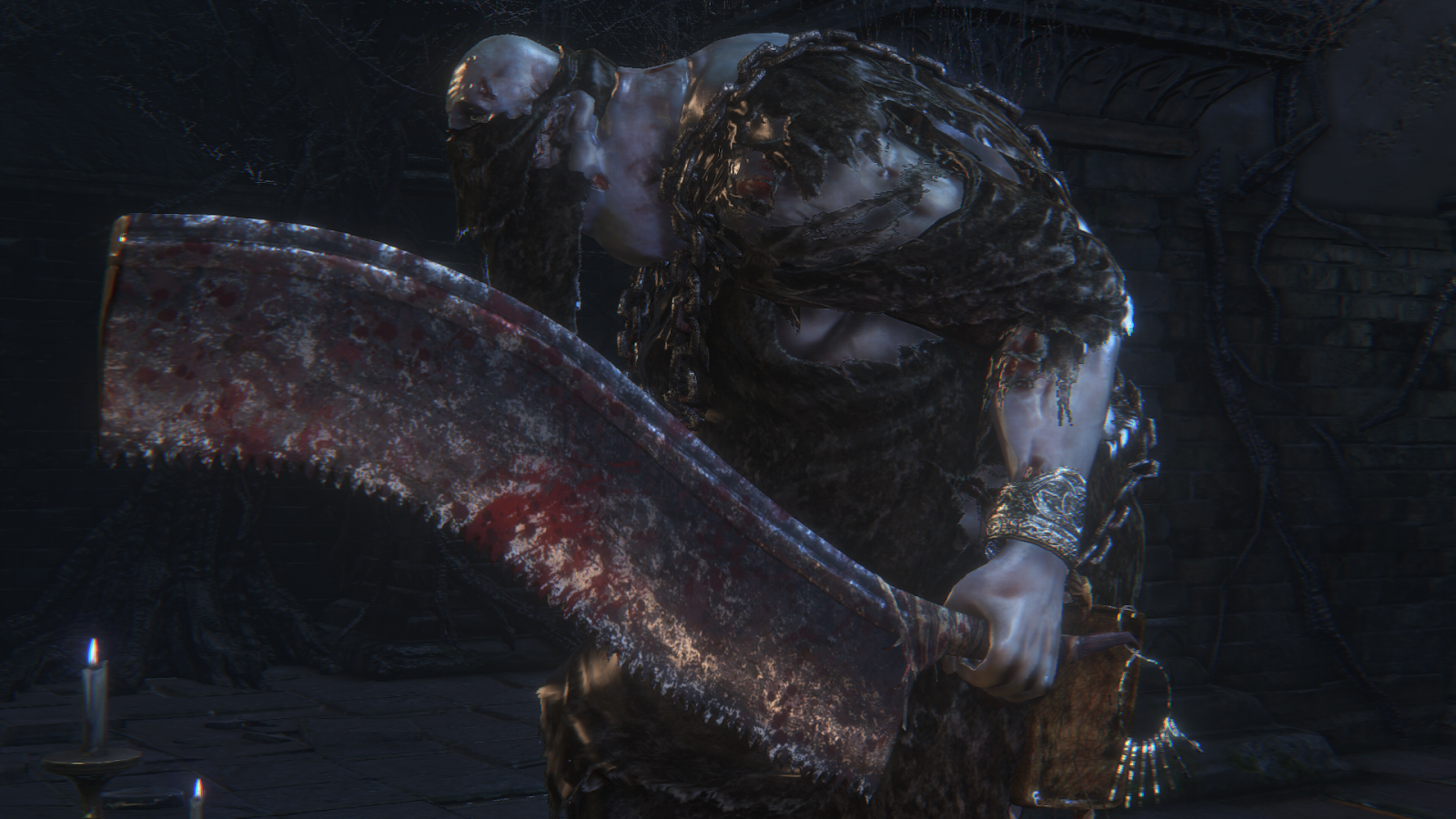

Of course, elites should take the higher priority when it comes to blood of the maximum quality. Besides the clerics, the nobility must also amass a wealth of blood, with the royalty enjoying the luxury greater still. In Pthumeru Ihyll, we collect the strongest Caryll Runes related to obtaining more blood. There is Communion, which increases the maximum blood vials we can carry, and also Heir, which increases the number of blood echoes from visceral attacks. Most probably source their “wine” from the graves they keep, but tearing out fresh blood and viscera by hand was evidently a pastime for high society, and the quality of the blood mattered just as much. Formless Oedon and Oedon Writhe exact the most amount of quicksilver from blood for us to carry or obtain from visceral attacks. It wasn’t just about imbibing blood but getting to the enlightened essence within the blood, as seen with certain merciless Watchers who provide quicksilver for bullets whilst possessing no firearms. In fact, that idea of blood “purity” seems to hold far too much currency in capital society.
When creating Pthumeru Ihyll dungeons, there is a fixed chance that the dungeon will receive a poison modifier, causing random enemies and liquid pools to inflict the slow-acting poison status. While it is not a guaranteed chance like in Hintertombs, the obvious implication is that poisons have infested a significant portion of the royal capital. These poisons include disease, as demonstrated by the “white pill” (白い丸薬) functioning as an antidote for poison when the description details its use treating disease. It is all too fitting that Pthumeru “Ill” (イル) be a city plagued by illness. The gravekeepers have even made use of the pathogens, burning the poisonous material with their incense to instead create noxious gas. But the question remains: why does the capital struggle with random diseases more than the average “city” in the urban core above? The problem clearly isn’t a lack of resources compared to the poorer areas. That just leaves the constitution of the residents themselves. If the city consists of a disproportionate number of the upper class, then they must be the draws for disease.

The insinuation isn’t surprising. Rigid caste systems invariably put inordinate emphasis on lineage, the privileged bloodlines refusing to marry “down” and intermix with the unwashed masses whenever possible. The result is “purer” blood for nobles who only share relations with fellow nobles. Blood quality may well be the key factor when deciding who will receive a noble title and become the latest provincial lord. For a culture obsessed with the taste of good blood, surely, they would believe that those with good blood are superior, specimens most worthy of the responsibilities coming with privilege. “Nobility” in itself implies a certain virtue embodied by the aristocratic class, virtue which Pthumerians would identify with the silver in blood. That only reinforces society’s belief in keeping the high-class blood pure by marrying into similar families. And in the city where power and money is concentrated, the many nobles doubtless prefer to marry each other for political alliances and hefty dowries.
Put simply, Pthumeru Ihyll likely suffers from a severe case of inbreeding, the relatively small gene pool causing higher instances of sickliness from the rest of the population. This is likely made worse by their decadent lifestyle, the luxury isolating their immune systems from the same tests the rugged rabble experience every day surviving in the dirt and hardship. The result is an explosion of epidemics which then become endemic to the city itself and thereby all its residents. While it is impossible to confirm germ theory from just our observation of the setting, the source of disease undoubtedly has proliferated in this section of the labyrinth, and the reason is because the upper class made themselves prime vectors for breeding illness. On that basis, we can say that the capital’s obsession with blood has come to their detriment, but still the people persist with the blood drunkenness. Whether or not they realize the connection between purebloods and pathogens, blood is already core to the culture. No Pthumerian will give up drinking the stuff, and all understand that it begets ailments.
This fact is widely expressed in Pthumeru’s art. For every relief of bearded men with books, clearly representative of wisemen studying and teaching about the arcane, there are countless more statues of figures covered up from head to toe — shrouding their face, hiding the symptoms and blemishes of disease ailing them. While it may not be as severe as in the capital, all of Pthumeru recognizes a prevalence of sickness amongst them, sickness tied to blood in particular. Cut content suggests that the “main grave” (主墓) for the Chalice Dungeons was originally planned to be called not Pthumeru, but “Gremia”, (グレミア) combining the English “grave” (グレイブ) with the medical suffix “-emia” (エミア) denoting a condition related to blood. And when it comes to blood conditions related to graves there, none stands on the same pedestal as the beast scourge.


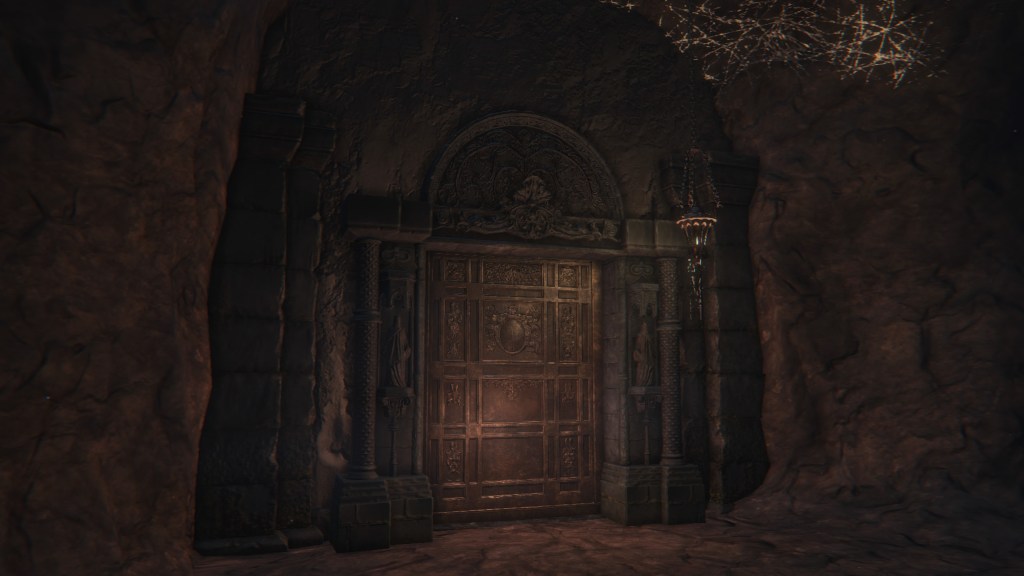


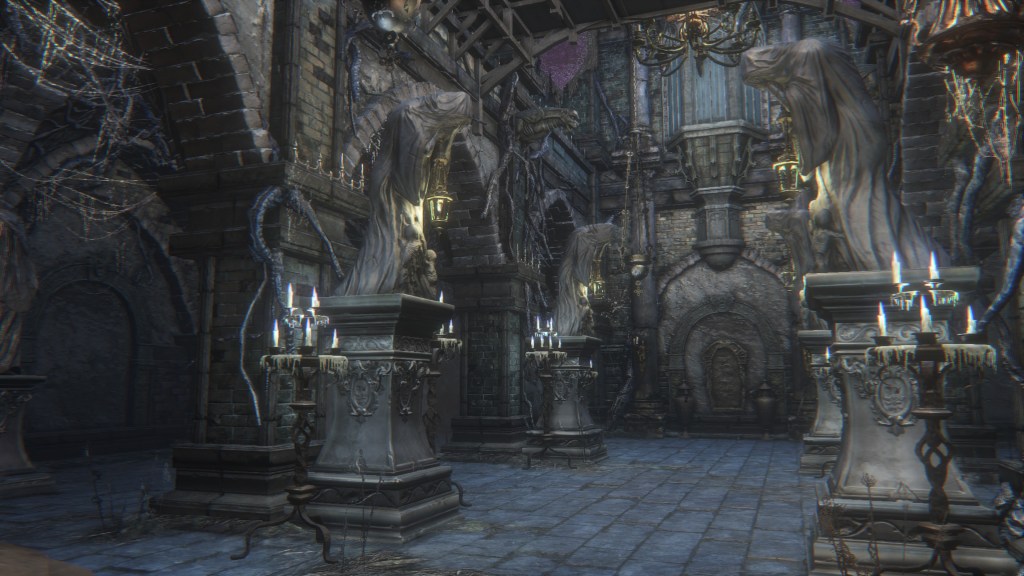


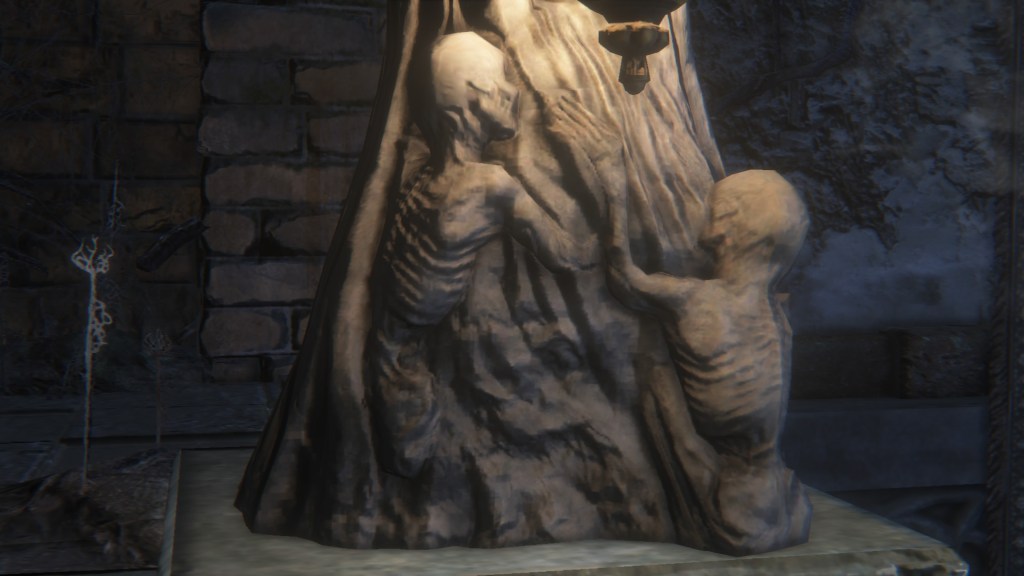
More than anything, blood addicts in Pthumeru are doomed to a plague of beasthood. It didn’t matter how high the quality of blood they imbibed; if anything, robbing from the old graves just made matters worse. No matter where in their civilization you look, it is the universal problem, impossible to ignore. Yet that is a reality they accept as part of life in the underground. In fact, the solution to any bestiemia appears to have been more blood. Blood vials are plentiful loot from the dead, with practically every Watcher keeping the health tonic on hand. Perhaps this practice was a carryover from Isz. Regardless, it was easy for Pthumeru Ihyll to view man’s life force as the invigorating treatment to their various illnesses, which then trickled down to the rest of Pthumerian society built up over the ages. Now, treating injury or ailment with a quick transfusion is standard practice, further feeding their addiction. That meant more beasts, but that is arguably public policy.
The Clockwise Metamorphosis rune obtainable in Pthumeru Ihyll says it all: the Pthumerian hierarchy welcomes the “dream” of evolution which blood brings. Perhaps it is because it can extend their debilitated lives, given how the rune boosts HP. Still, they aren’t troubled by the beasts created in pursuit of evolving their race. Once again, they are likely taking notes from Isz. Didn’t their old masters experience those same growing pains, working through waves of beasts before finally arriving at the arcane truth? They didn’t shirk the blood or beasts to reach the heights of higher beings. Ebrietas derives her name from Latin to mean “inebriation” in obvious connection to this. If they wanted to be like some of their gods they could still witness on earth, then drink blood to intoxication. Just as the Metamorphosis runes look like a vortex which can suck you right in, Pthumeru fell into the abyss of beasthood, hoping to come out the other end of that whirlpool as stars in the sky. And some doubtless have shared in Isz’s success, becoming new gods to venerate in death. Most were not so fortunate, however.

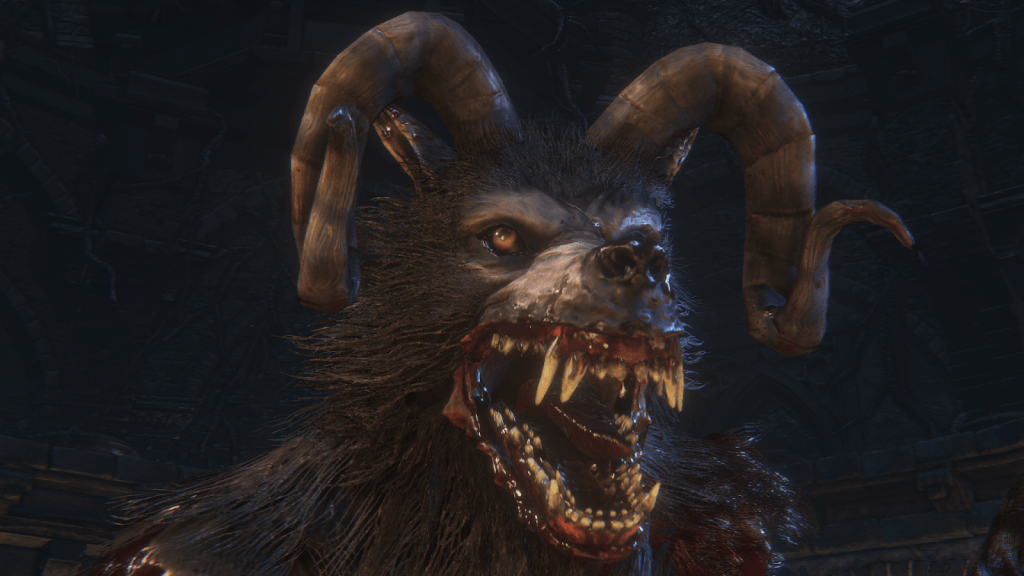
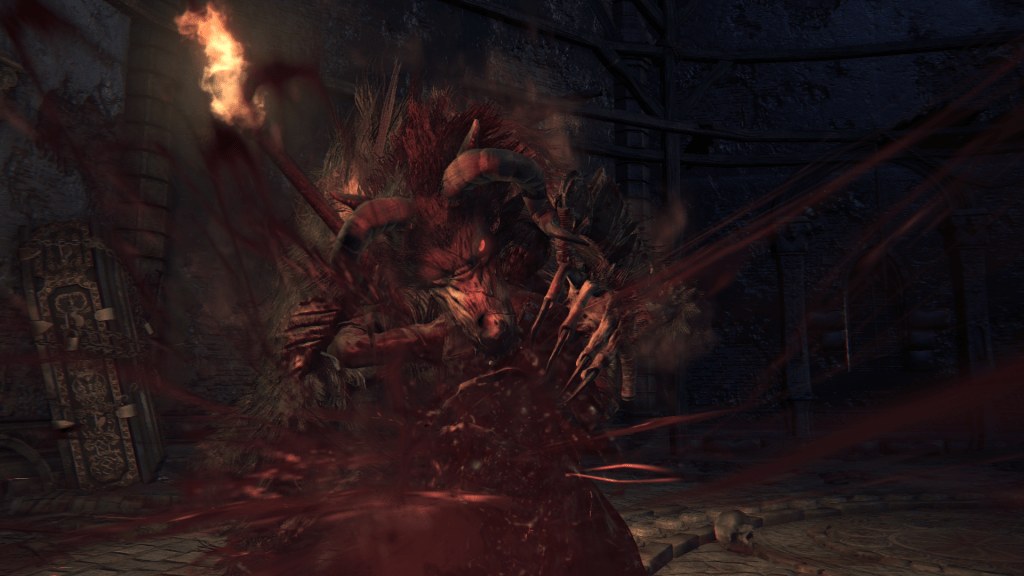
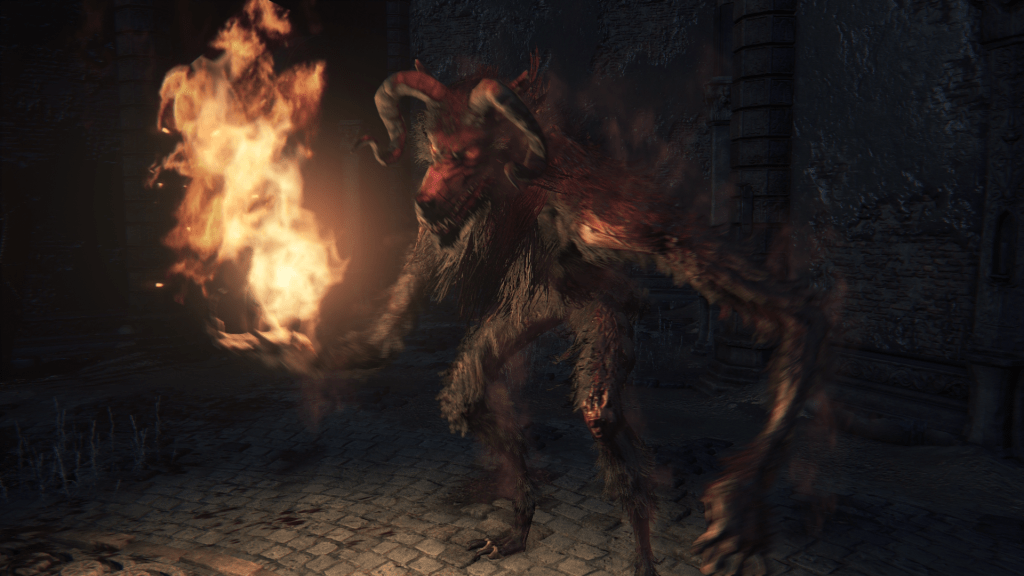
The beast-possessed soul is a possible boss in all but Isz and standard Hintertomb dungeons, but it also randomly appears in any part of the labyrinth, like the Watchers. The horned lupine is thus an example of the kind of beasts the Pthumerians become, which we see represented in the ruins’ decorative grotesques. Another example is the bloodlicker. This enemy isn’t uniquely vulnerable to the same weapons as most beasts, but that is presumably due to its unconventional physiology. The pale-white creature looks human save the disjointed limbs and spine, crawling around with its whip-like tongue ready to lap up any blood. The way it fattens its belly, grows small hairs, and jumps around like a flea, it is undoubtedly a human transformed into a bloodthirsty monster. And this creature has a chance to crawl out of hiding in most dungeons, after killing a foe with a visceral attack. While we continue to explorer, the licker follows the scent of blood to scavenge the splatter. Much like the beast-possessed soul, the enemy seems to be one of the forms Pthumerians take after indulging their addiction for too long.
The difference lies in the nature of what they imbibe. Despite their ubiquity, bloodlickers appear to be more prevalent in the capital; in rare instances, a small group roam Sinister versions of Pthumeru Ihyll. This coincides with the unique recurrence of another beast-like enemy in that city. The lost child of antiquity possesses the body of a bat but the head of an elderly man. It also owns a similar weakness ratio to fire versus arcane or bolt damage as the standard beast and can perform similar stunning roars and blood-sucking bites. While it doesn’t share the same weapon weakness as well, this can be attributed to its nonstandard physiology, same as the bloodlicker. It is safe to classify both as a unique kind of beast. “Lost child” is just a more literal rendering of otoshigo, (落とし子) which historically referred to a noble’s bastard but commonly denotes any kind of negative consequence — such as a monster emergent from blood-drinking. This makes “spawn of old” (古の落とし子) a more accurate label, and it, too, proliferates at the heart of Pthumerian civilization. Why? Because of all the nobles, of course.


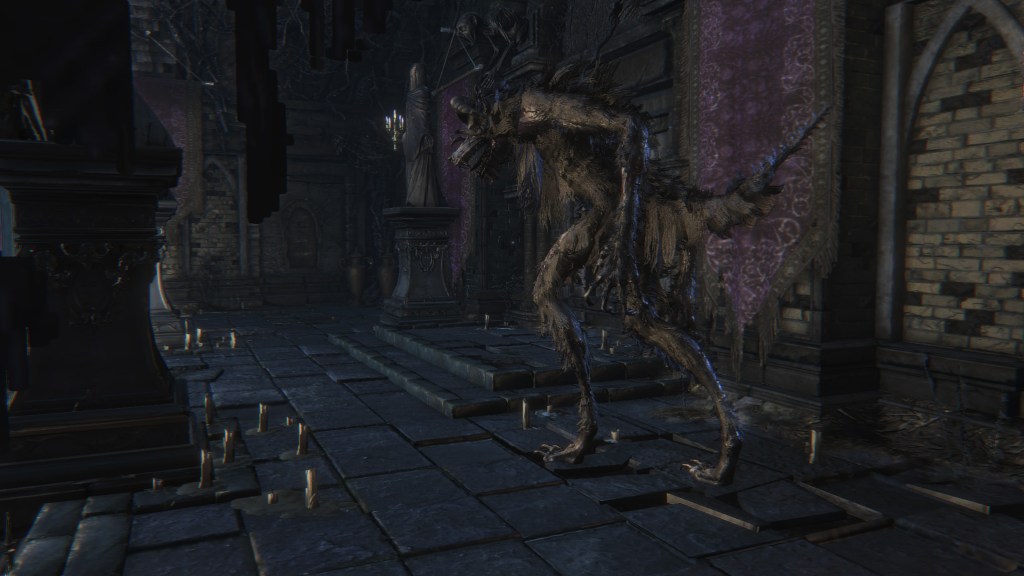


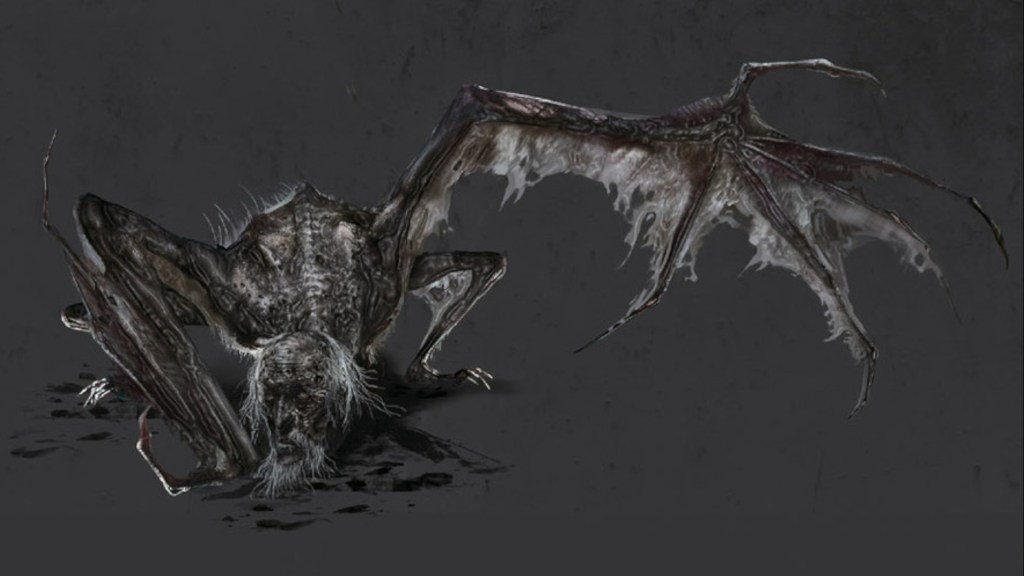
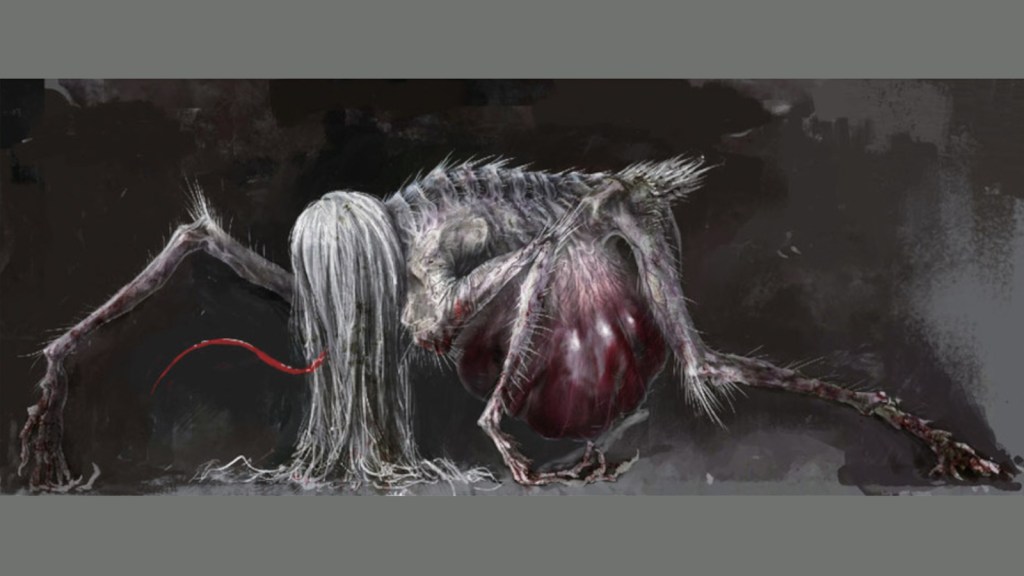
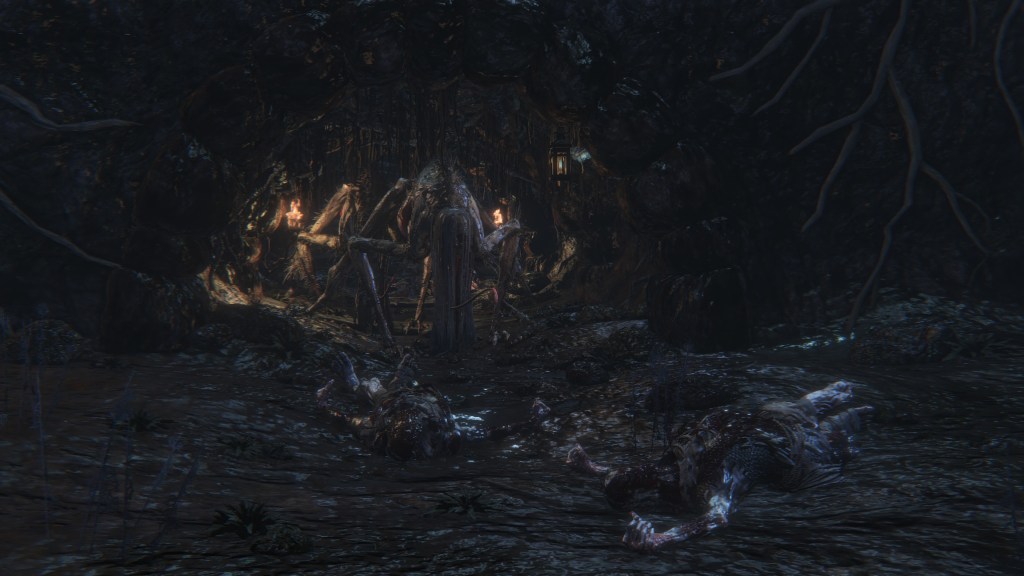
Only the number of nobles, circulating the “best” blood amongst solely themselves, majorly differentiate Pthumeru Ihyll from the rest of the labyrinth. The heightened bizarre manifestations of the beast disease must thus be another byproduct of their blood’s purity — though “impurity” might be more accurate. Both the bloodlicker and spawn of old enemies suffer especially from the “righteous” damage of silver weapons. What makes them so unrighteous? For at least the licker, presumably the copious blood it continues to absorb, particularly from those who have been brutally killed and are likely to hold a serious grudge. We can see this in the lost Wheel weapon acquired in Pthumeru Ihyll, covered in blood which causes the trick weapon to retain powerful grudges. It is very telling about the ill intent of local hunters’ prey, no ordinary will in blood breeding such strong resentment with other beasts. Perhaps the human shape of the grudges indicates that the Wheel hunted those yet human. Nevertheless, a great amount of “evil” is clearly cultivated in the blood of the capital’s residents.
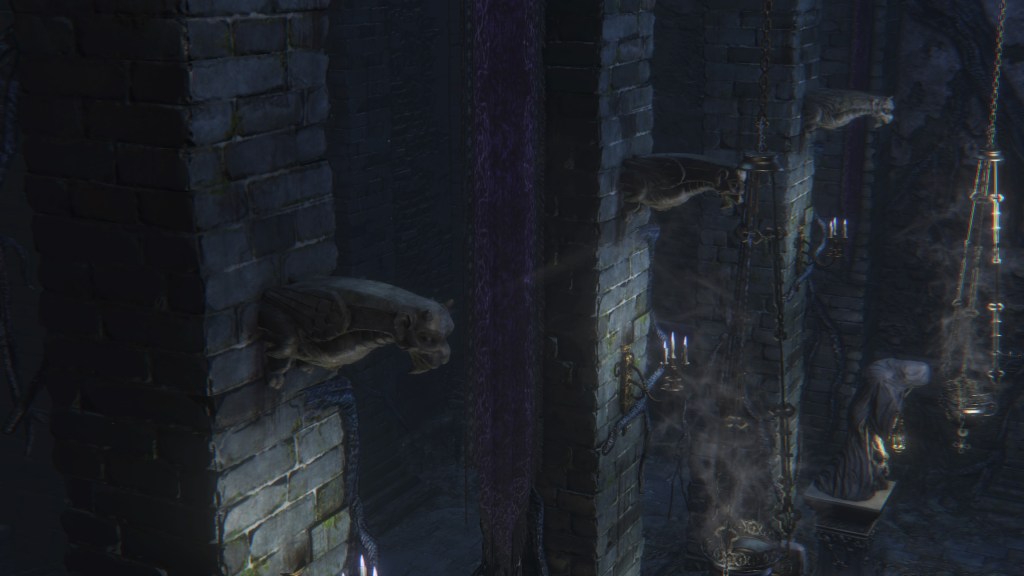
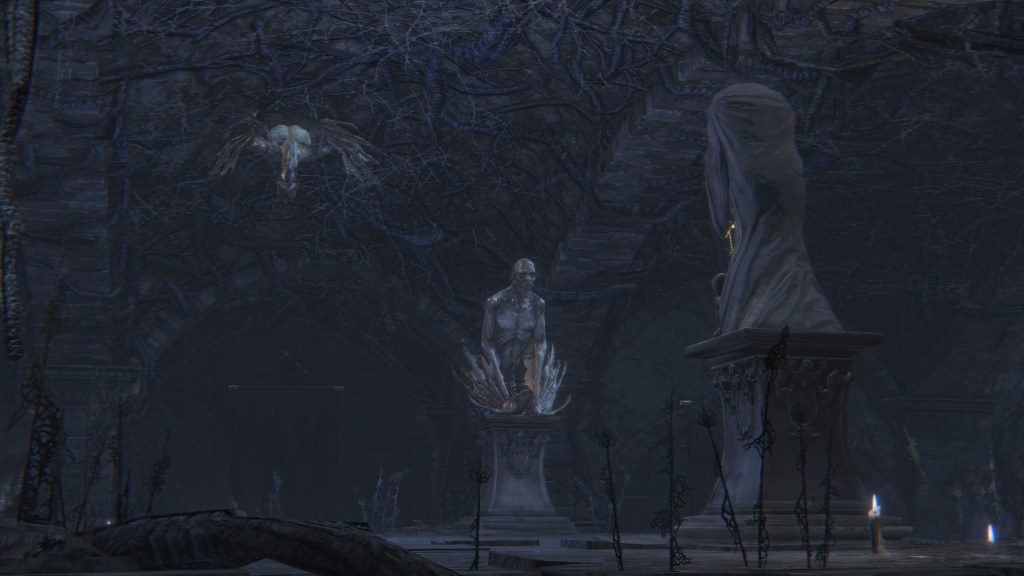
Malice is, of course, present in every will to some extent. But the amount of high-quality blood served in Pthumeru Ihyll builds up that much more within its imbibers, compounded by the inbreeding. As a result, nobles of the capital carry with them a larger percentage of ill will than the average citizen, leading to more instances of bloodlickers and even the creation of bat spawn when they do succumb to beasthood. The lickers and evil spirits roaming other sections of the ruins confirm that this level of maliciousness is possible elsewhere, but it is straightforwardly systemic to the capital’s decadence. This leads to more trouble long-term. The spawn of old seems to survive for so long thanks to their flight capability and heightened intelligence — the enemy is always clinging high up on ceilings or blending in with the statues to lie in ambush or evade extermination. But no part of Pthumeru was immune to the degenerative consequences to blood-drinking. And those who did not become new stars to bury became beasts to hunt.
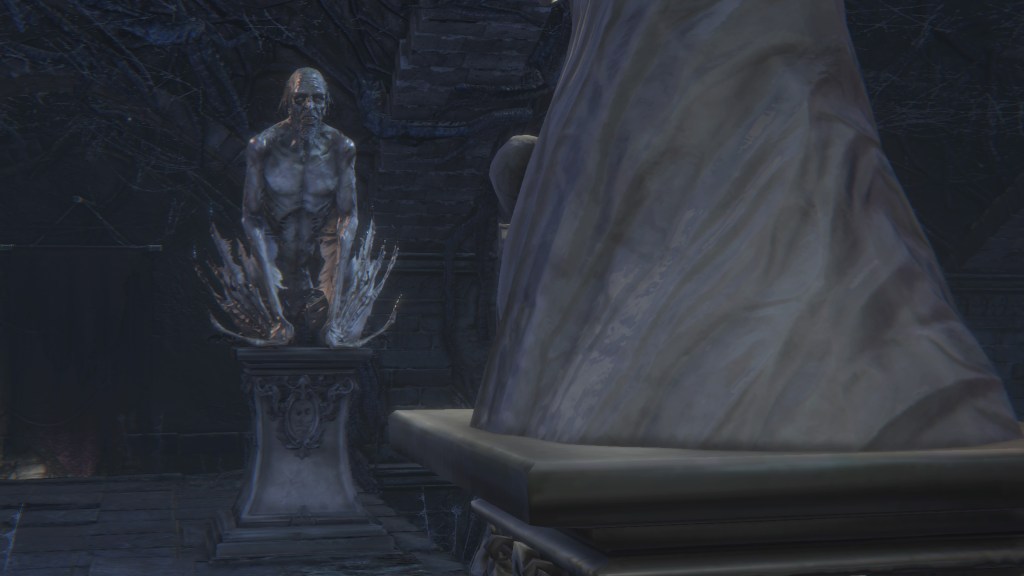


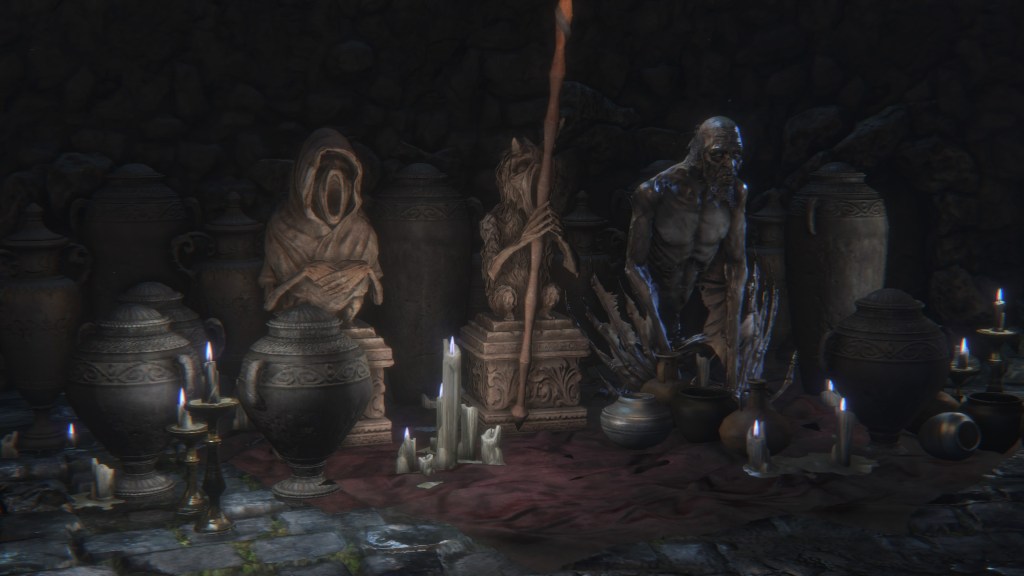
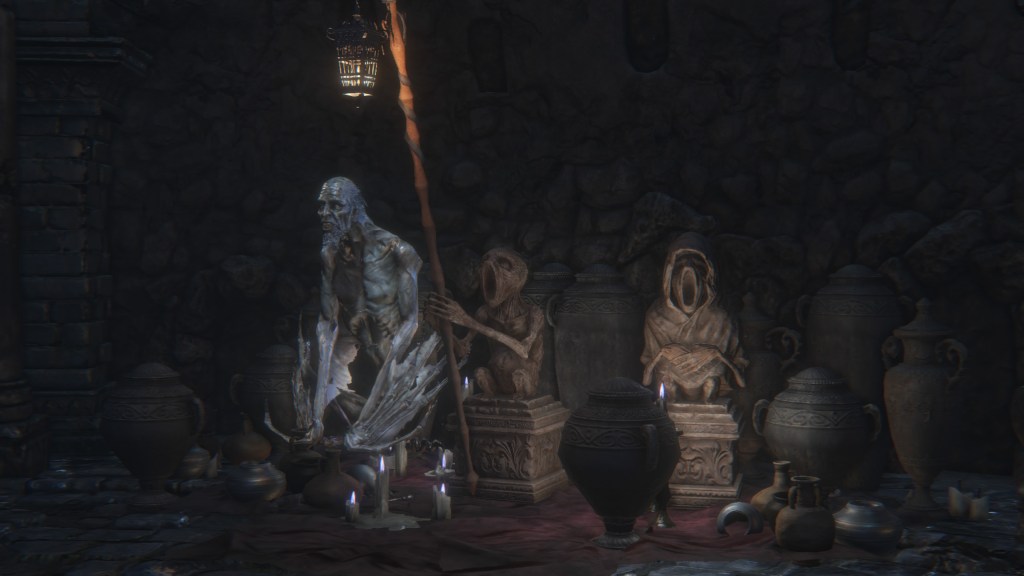
Fate is a Dog
Pthumeru’s beast hunts seem to be about as old as its religion and blood-drinking. Two of the weapons acquired in Pthumeru Ihyll are Blade of Mercy and Burial Blade, both which were crafted with meteoric iron. With the size of the iron too large for the standard “bullets” of arcane art, this implies that actual meteors fell in their area before that original layer of civilization became buried with time. This may be coincidence, but considering how meteors are typically the Great Ones’ angered response to attempts at contact, it is more likely the result of praying to their gods in hard times; with a life spent guarding graves as their fellow man turns into beasts, the blood addicts were sure to have plenty to beseech their transcendent ancestors. Evidently, the proto-Pthumerians took the deities’ “answer” as a sign to hunt the beasts plaguing them with the special iron with which they forged an arsenal. Now that the people have become subterranean, they no longer receive such “blessings”, but the determination to hunt remains.
One rune in particular came to be associated with the “Hunter” at Pthumeru. Whether or not that was the meaning the Great Ones communicated, the “hanging” rune resembling an upside-down man was adopted as a core symbol, iconography plastered on walls and gravesites all across the labyrinth. It is easy to see why the shape struck a chord. In Tarot, the Hanged Man represents self-sacrifice for a greater good, suspension awaiting new insight, a new perspective focused on the spiritual, and wisdom obtained through trials of hardship — all things consistent with Pthumerian religion so far as their blood-drinking and beast epidemic are concerned. If the beast was just a growing pain, then they saw their tribe at a critical juncture in the transition between man and god. The rune embodies that purgatory as they strive for heaven, and its increase to stamina regeneration encourages action. The gravekeepers couldn’t be passive on the road to enlightenment; they needed to take hold of their own fates. And the hunter is a manifestation of that ethos, their avatar of change pointed against regression.


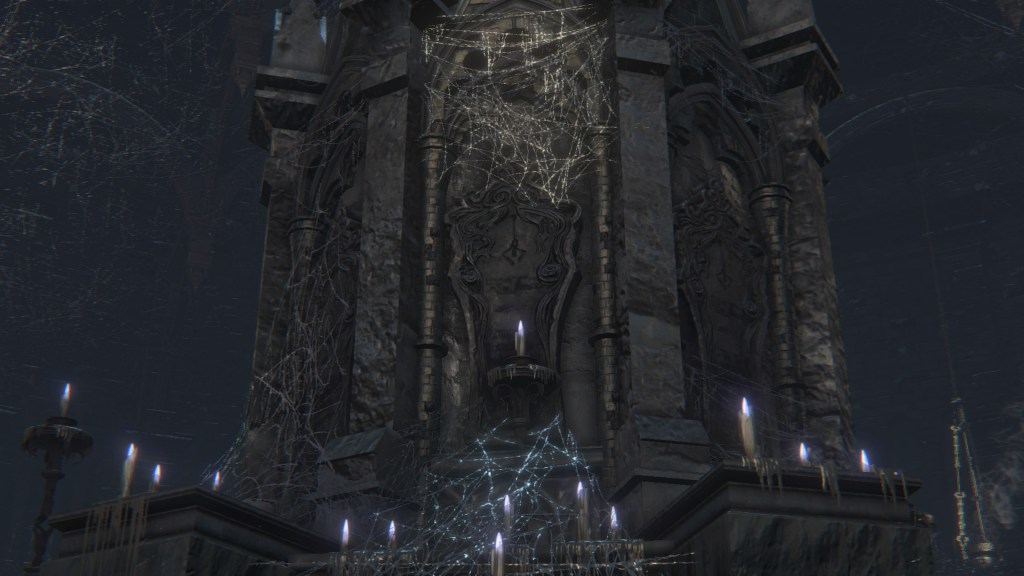
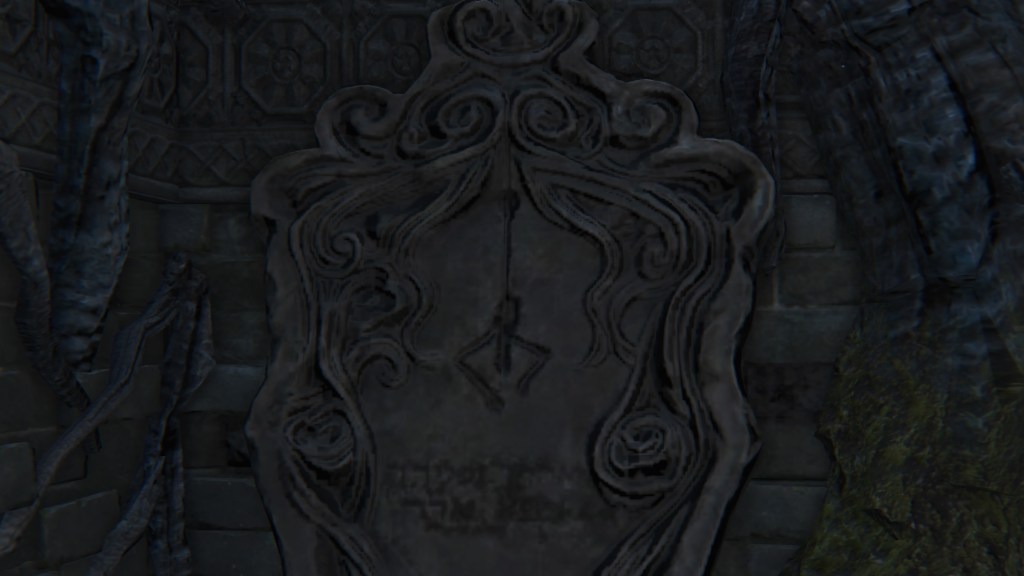

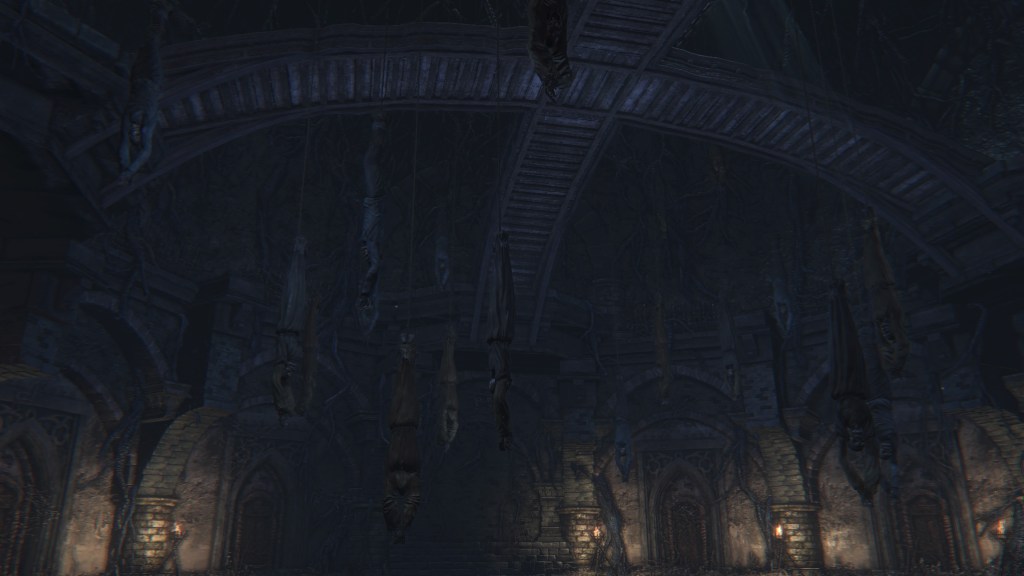


This usage of the Hunter rune likely goes back to Isz, the rotted corpse enemy carrying Bold Hunter’s Marks even in the Isz story dungeon. Hunters would be the most terrified to see themselves regress, choosing death over becoming a beast — albeit, too late in the enemy’s case. Even the citizens of Isz surely saw the occasional beast as an inflection point for their own enlightenment. This was just another legacy which Pthumeru is carrying on in some form. Maybe they simply inherited the cultural mark following Isz’s collapse, or maybe they had rediscovered the rune in the course of praying for salvation. The end result was the same: widespread adoption for the purposes of the hunt. We see countless human corpses hung upside down in emulation of the rune, surely victims of hunters who saw early signs of the beast scourge in them. The message couldn’t be more clear: you beasts are holding us back from greatness, beware. With that faith in one day reaching the stars, the gravekeepers do not tolerate small-minded fools disturbing the gods’ rest.
The means to effectuate a beast hunt was varied. Besides trick weapons, Watchers commonly wield hooks, cleavers, daggers, halberds, and axes. Hunters of the underground ruins have likewise adopted a number of tools. A handful utilize arcane lanterns to help keep watch, alerting all the nearby gravekeepers of intruders with the wild “ring” of the flame like a bell. Simple Keepers may also throw poison bombs, though we actually loot the knife equivalent from their bodies. Since this method is slow, others prefer firebombs, and fire in general, bringing jugs of oil to pour whole pools to ignite. Indeed, the countless instances of weapons clad in flame thanks to fire paper is likely why the beast-possessed soul can shoot flame from its hands — the pyromaniacs loved wielding the stuff so much on the hunt, the power became internalized when they transformed into a beast. While that makes the beast a bigger threat, the risk was obviously worth it.
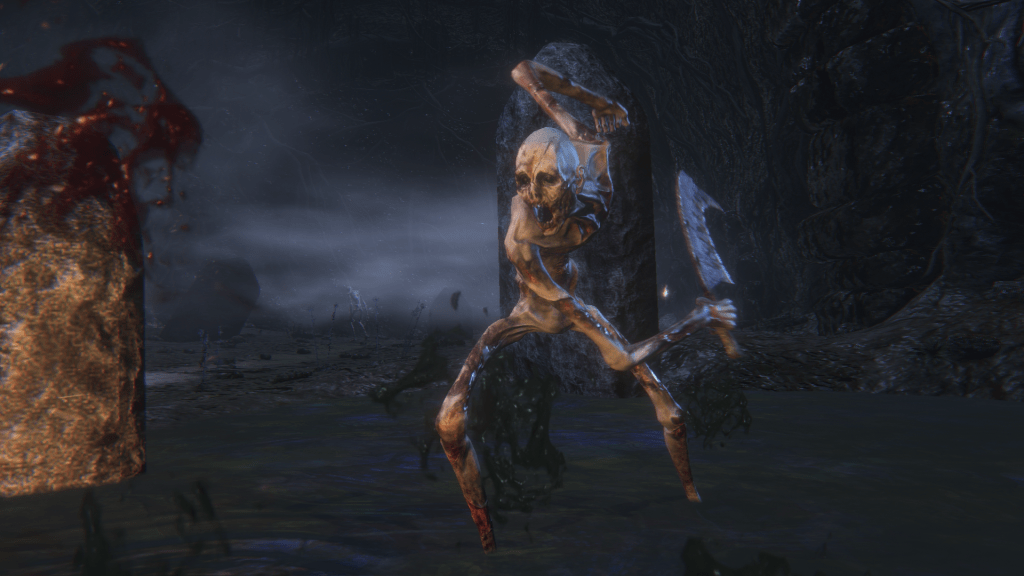


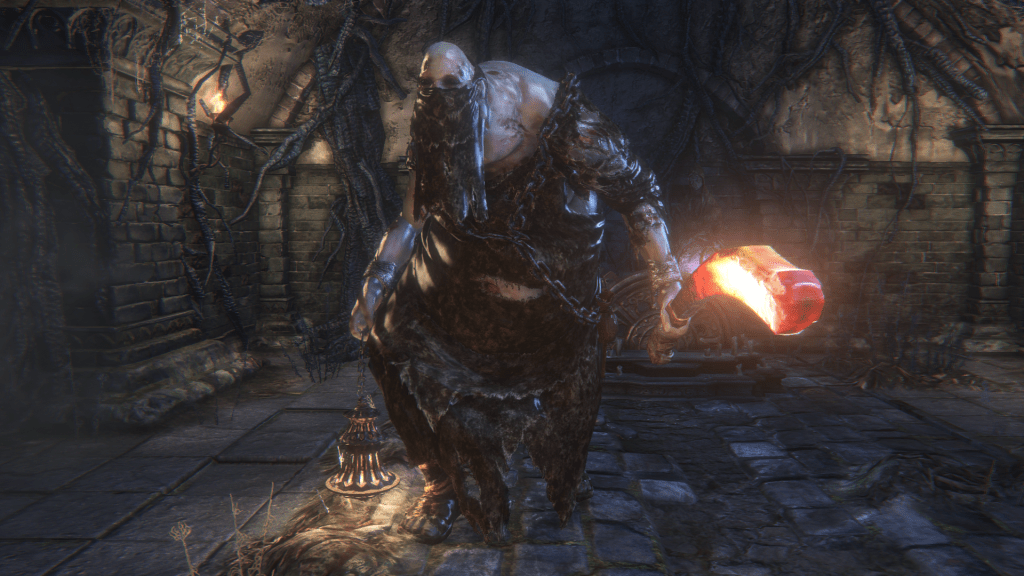


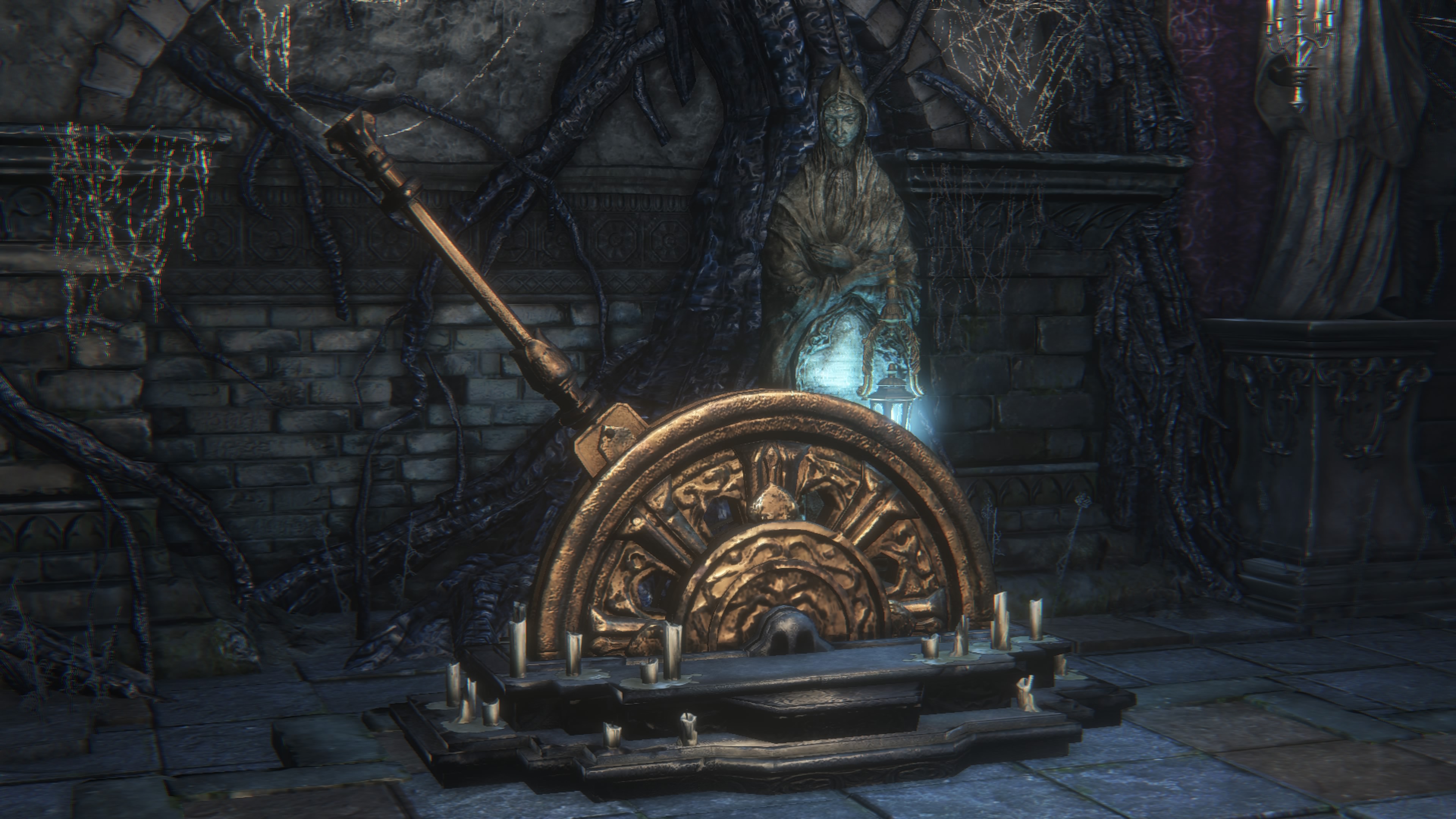
Just as well, the gravekeepers had plenty of indirect ways to deal with both man and beast. For one, they set up traps all throughout the labyrinth. Swinging scythes, giant guillotines, rolling stone balls, burning wood balls, fire arrows, there was a huge variety of hazards to navigate. If someone made a misstep on an easy-to-miss button, it might not be a deadly mechanism but an arcane ritual being triggered, blood enemies instantly summoned to ambush. There were even ritual setups, messengers dragging us into the circle of candles we step into before teleporting us to a potentially more dangerous part of the dungeon. The latter, like illusory walls, were limited to the deepest dungeons hoarding the arcane wisdom, but it shows how Pthumerians aren’t lacking for creativity. When all else fails, they could always lock down that section of the labyrinth, mechanisms operated by a large lever hidden elsewhere sealing the major doors for progression through the dungeon. If they couldn’t stem the outbreak, they could at least contain it with a quarantine.
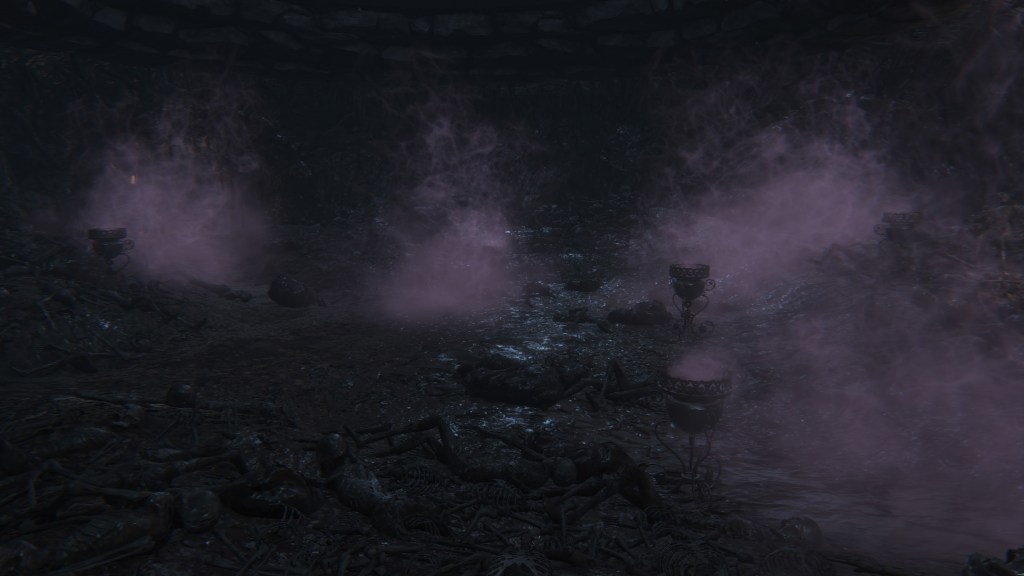
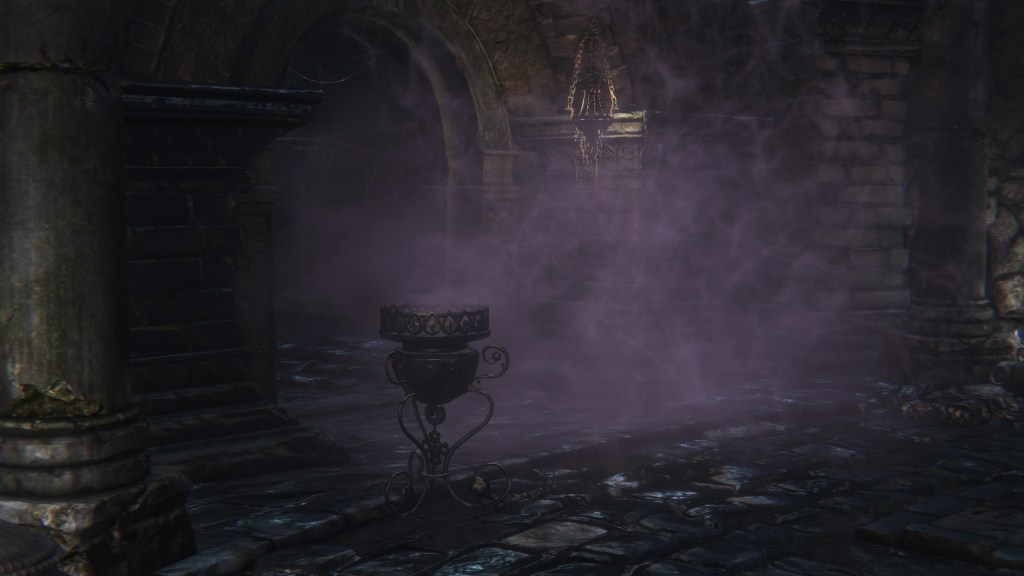
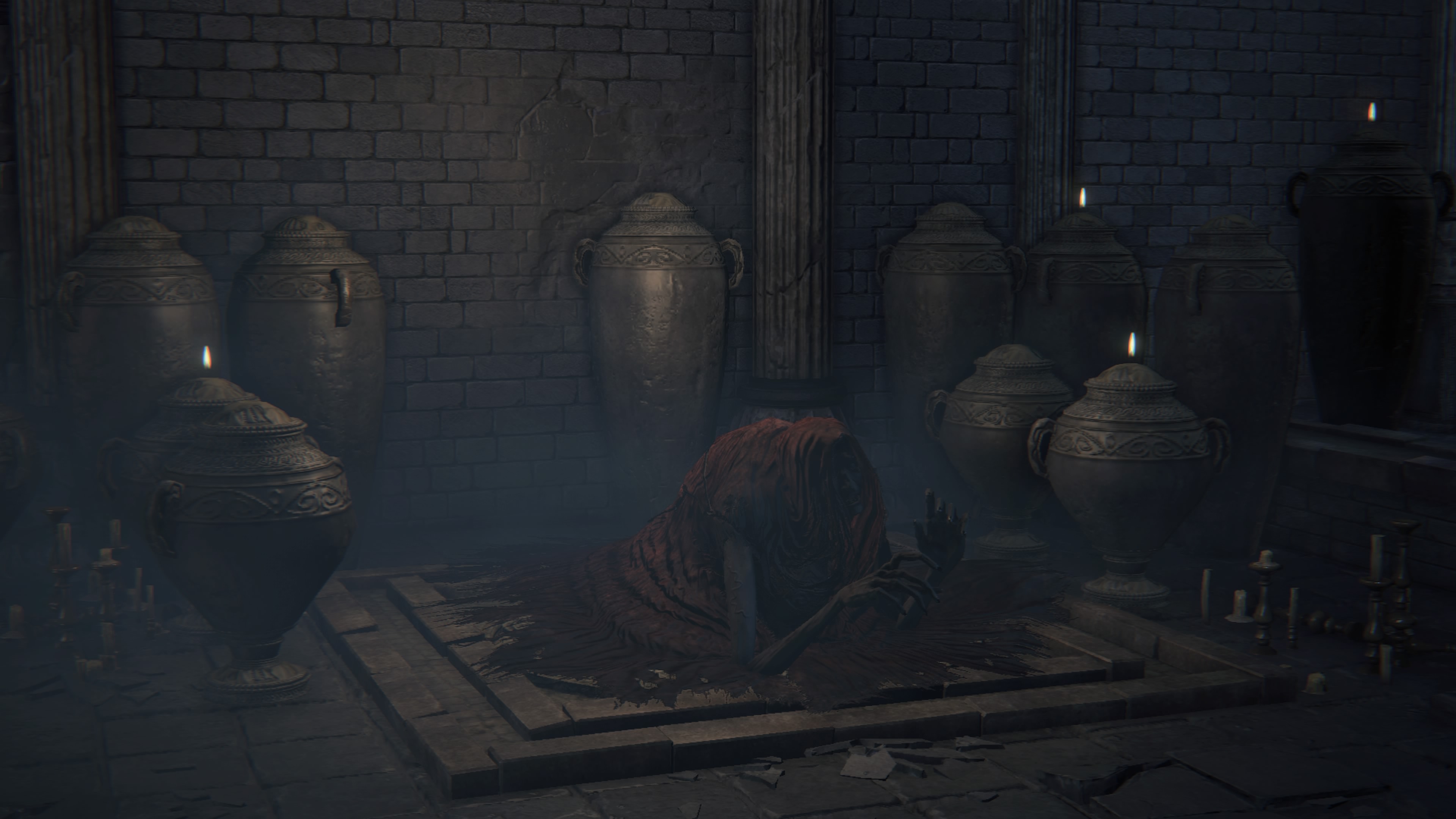
Another ubiquitous tool is incense. The Oedon Chapel Dweller mentions using incense as beast repellent, and we do see curious urns alight in the chapel. Elsewhere, these urns are surrounded by piles of human bone and ash, so we can be certain that they burn people’s remains to produce those fumes, at least in part. This makes sense for warding off beasts, since the smell of burning blood and blood marrow are sure to offend their senses — it will hardly sate their bloodthirst. This probably makes it difficult for a beast to focus while traveling through an area thick with the incense, though areas with it don’t actually hinder beasts in terms of gameplay mechanics. And we see these same urns for burning beast repellent within the underground ruins, incense burners lit in various ruin halls and chambers. The fumes come from burning remains, which Pthumerians have in abundance, so they have plenty to spare. Almost everything was at their disposal for hunting the beasts, including the dead.


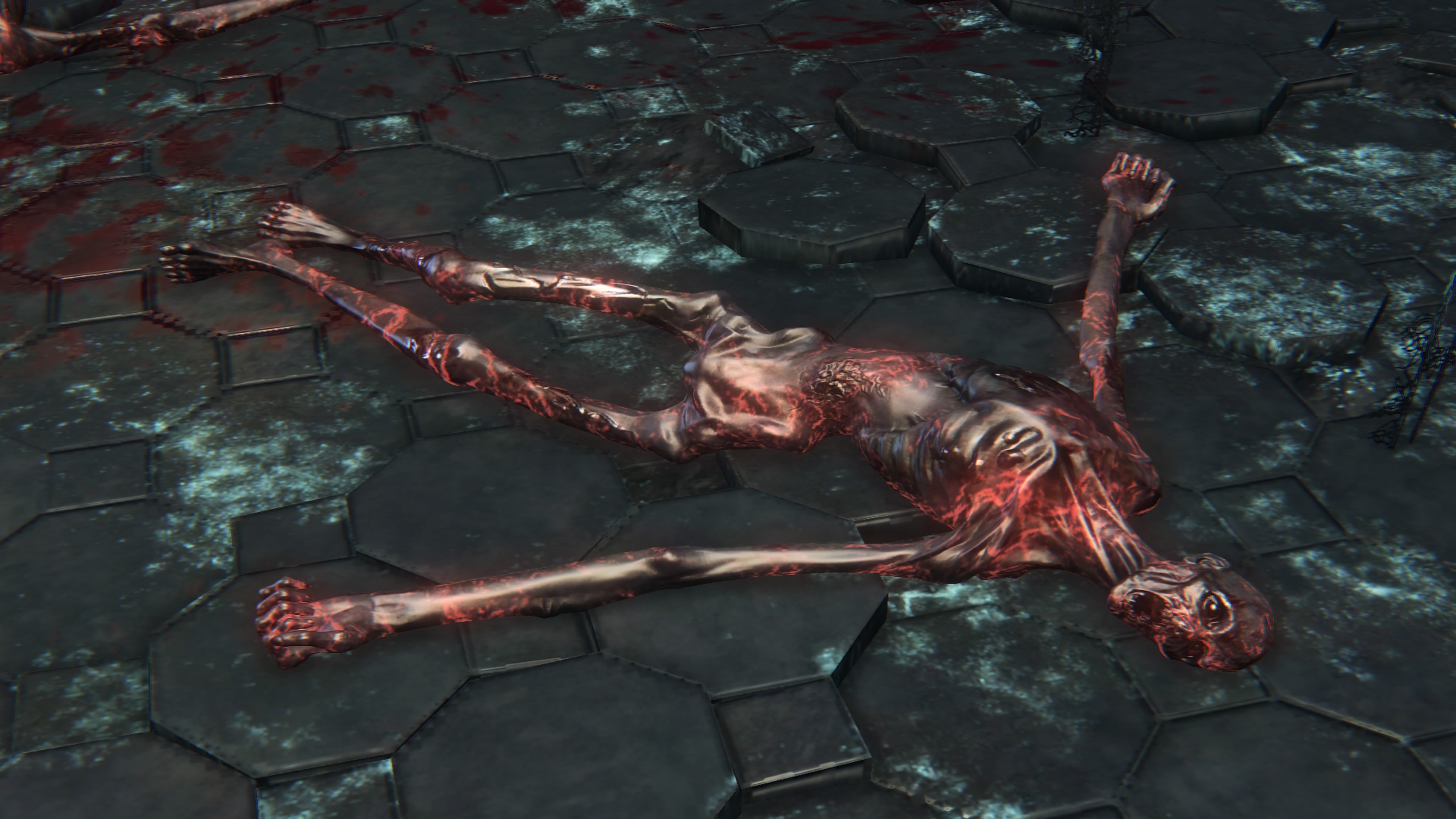



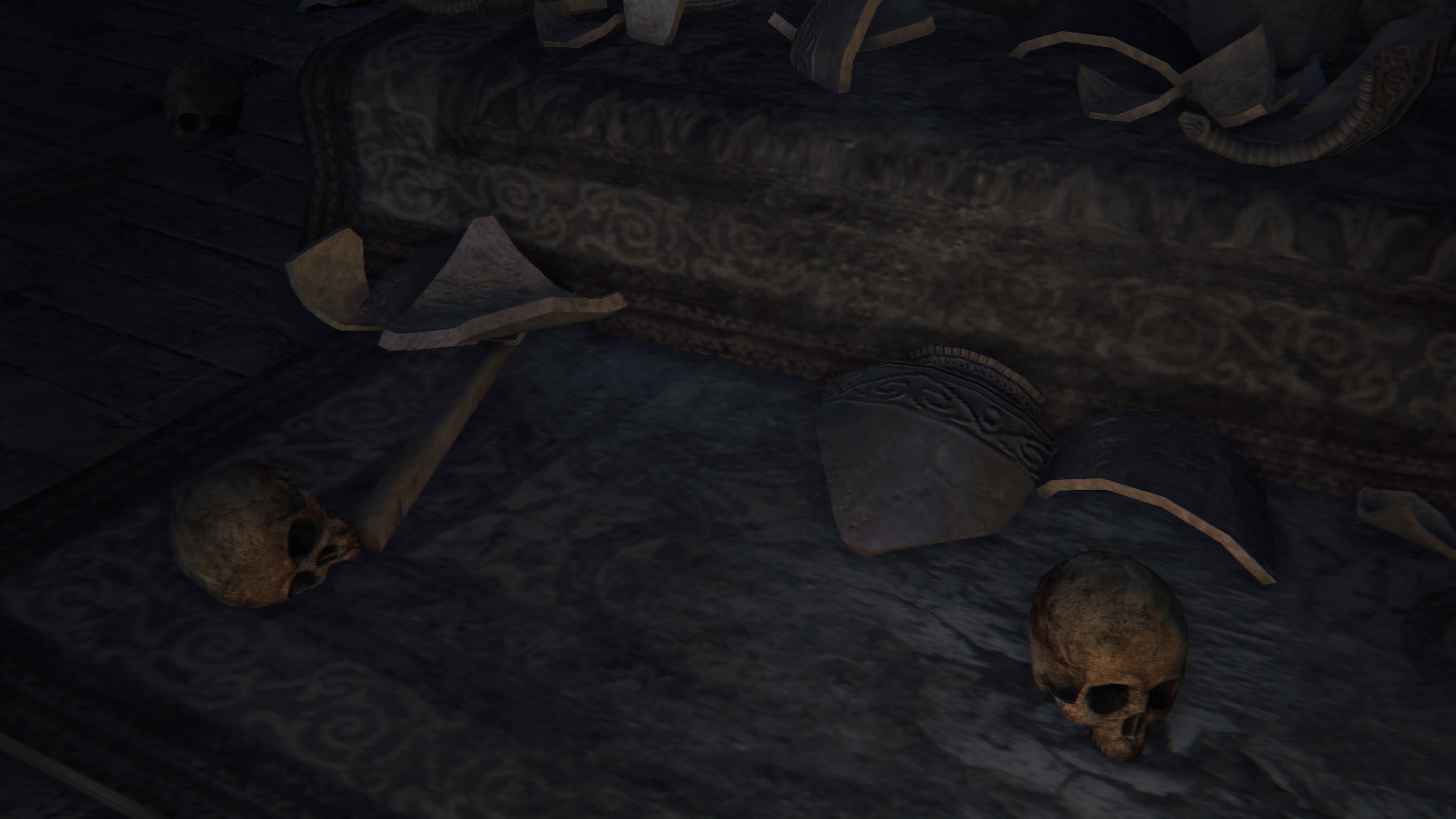


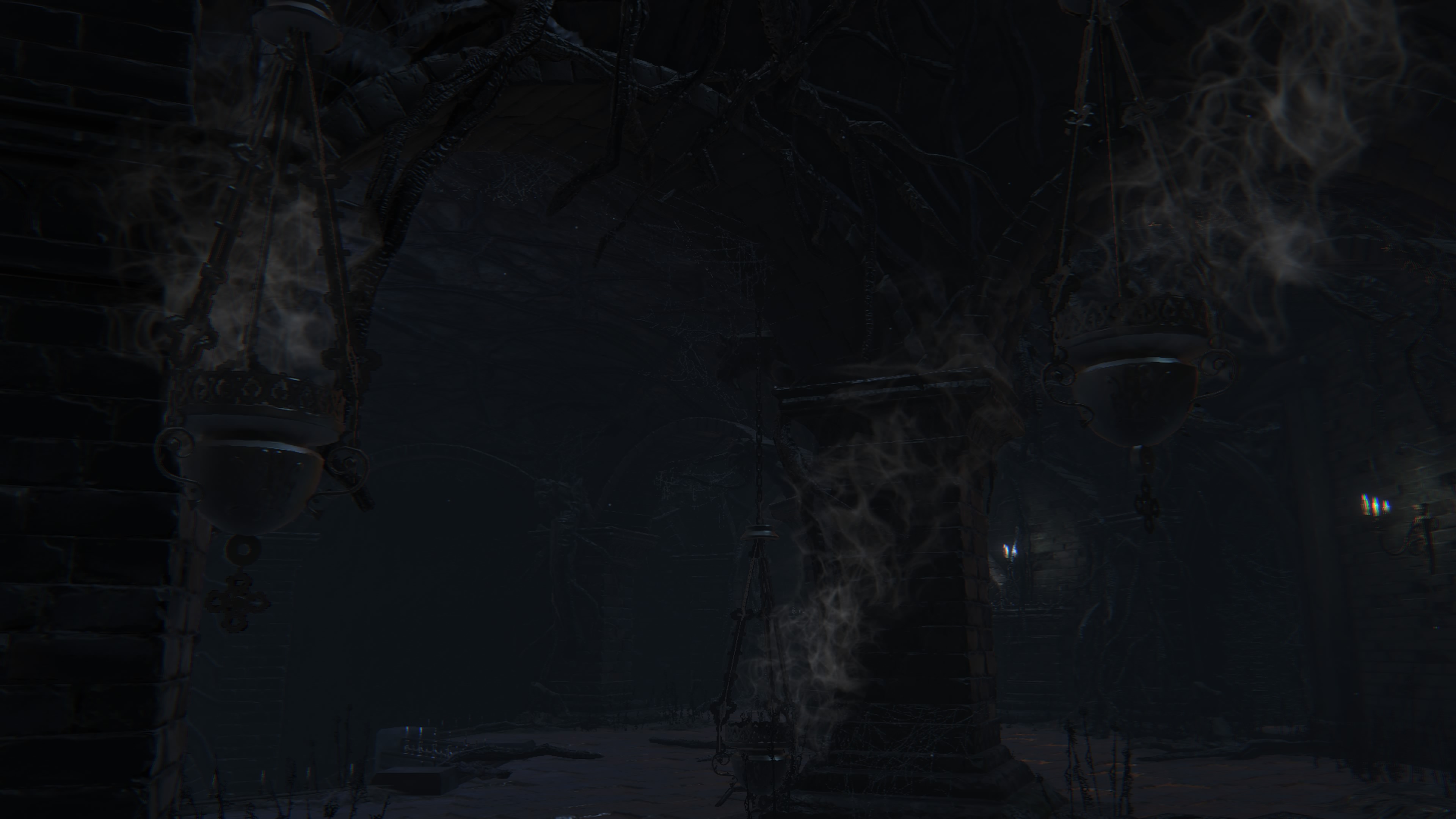
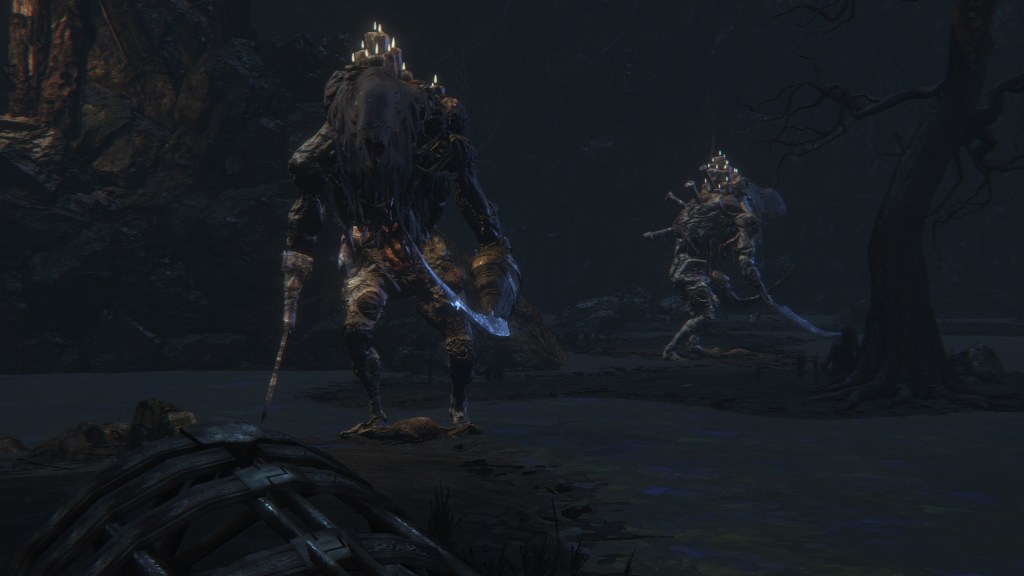
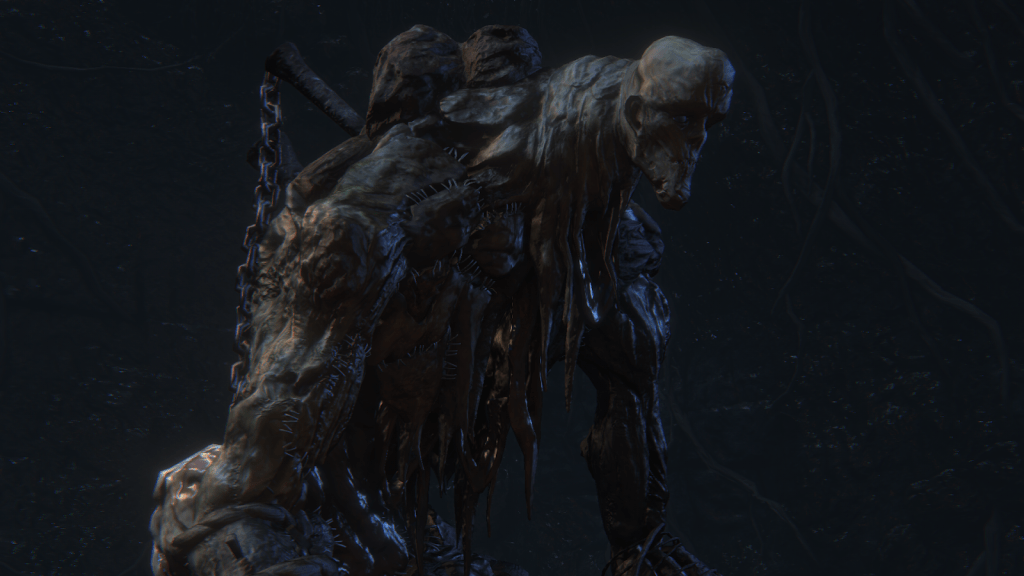
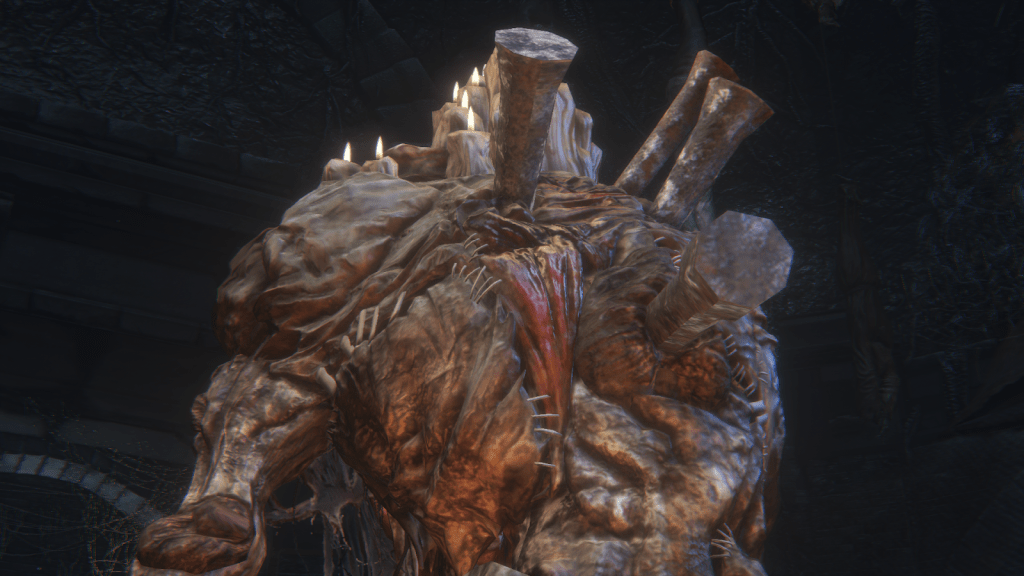
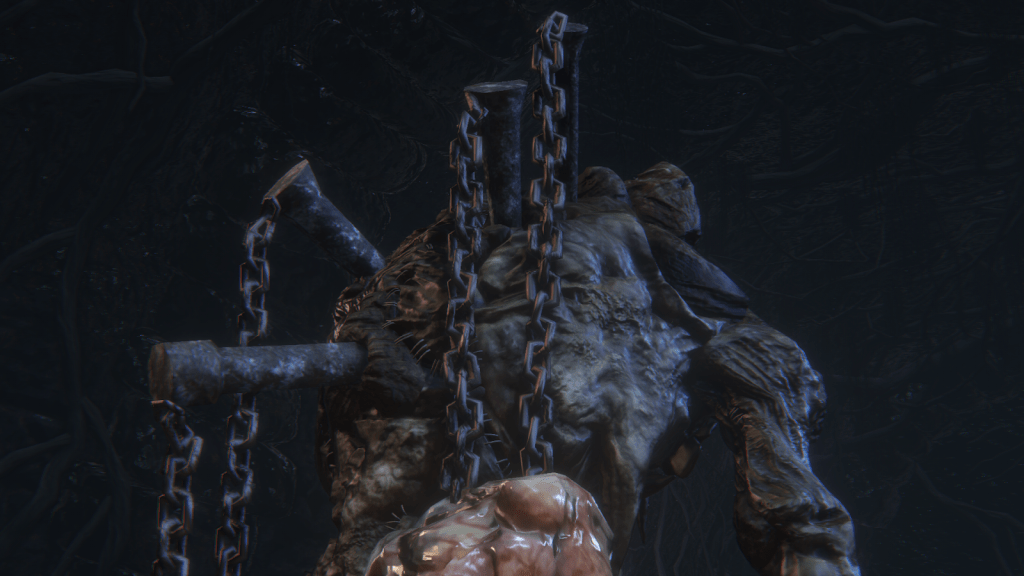
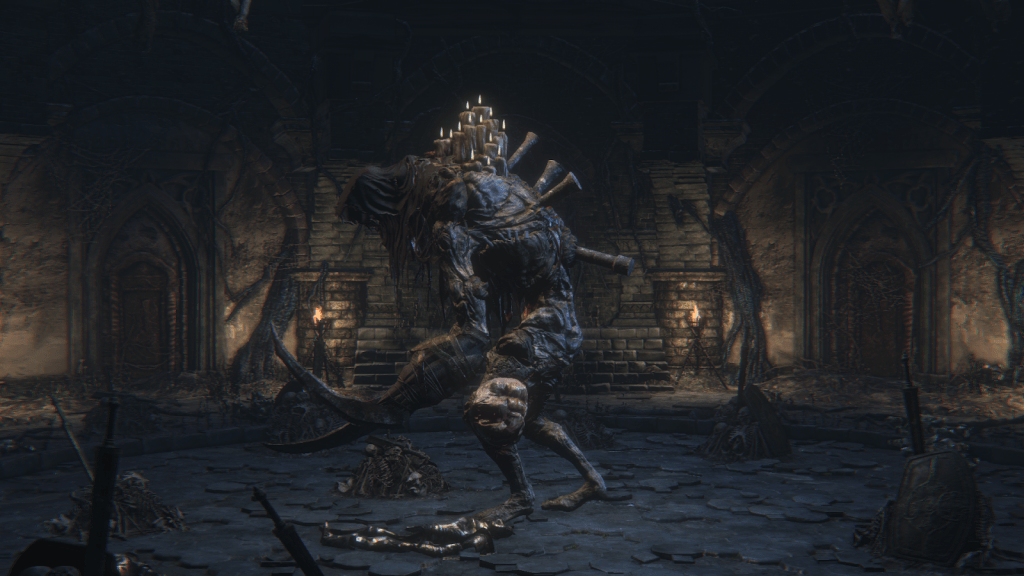
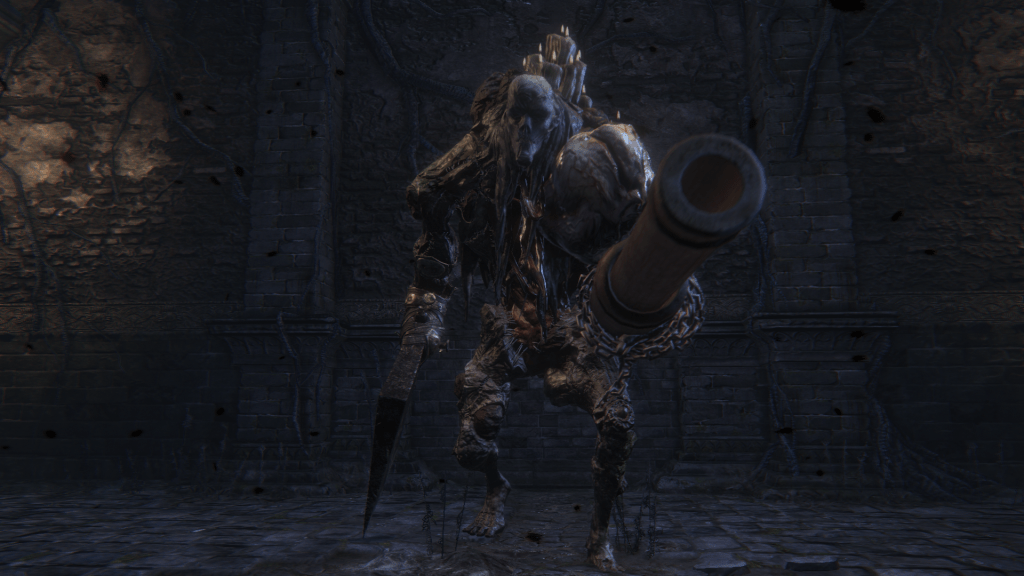
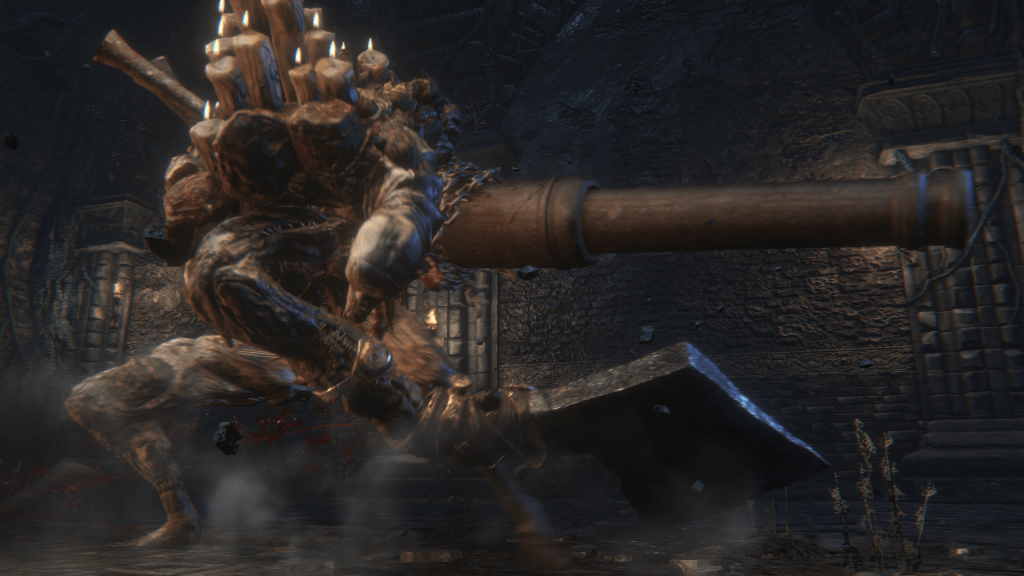
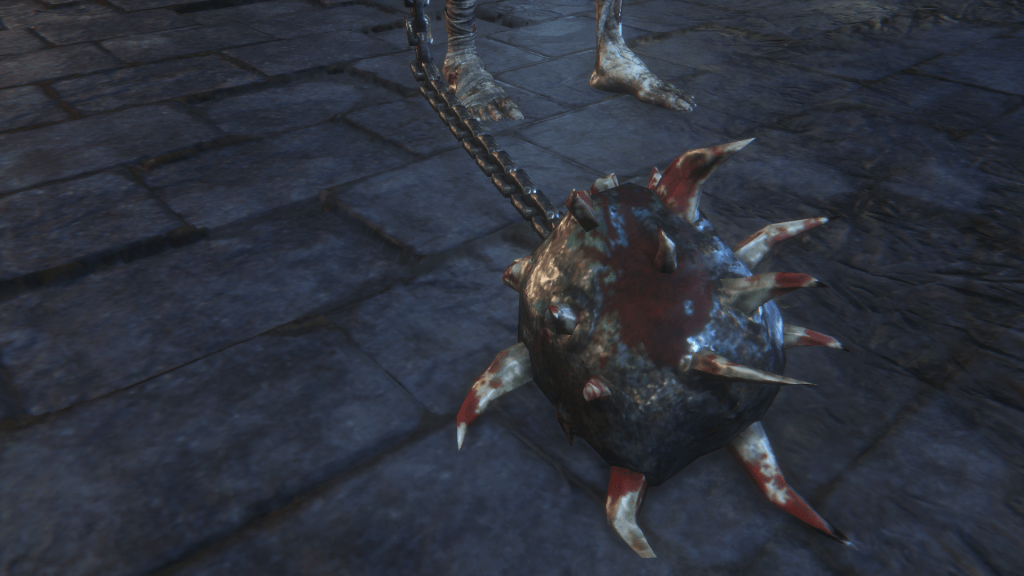
“Corpse Giants” (死体の巨人) are, as the name suggests, gargantuan dead Pthumerians whose rotten flesh yet lives. More than likely, they are the product of experiments with blood, which congests into large pustules on random parts of the dead body to form massive vulnerabilities. It highlight the importance of blood in their reanimation, the lit candles on one variation’s back indicating the additional role of ritual in their creation. The stitchings barely holding the giants’ bodies together further pegs them as Frankenstein monstrosities, with parts sourced from multiple individuals. This comports with their internal name as “flesh golem” (フレッシュゴーレム) and helps explain why they are apparently so hard to control, many impaled through the back with balls and chains plus heavy weights to make them more manageable — from how they swing them around, it doesn’t work. The only purpose to creating a simpleminded and violent golem from corpses is to make it an unliving weapon. To that end, hooks, hatchet heads, clubs, and cannons have been crudely grafted on to make the monster more deadly.
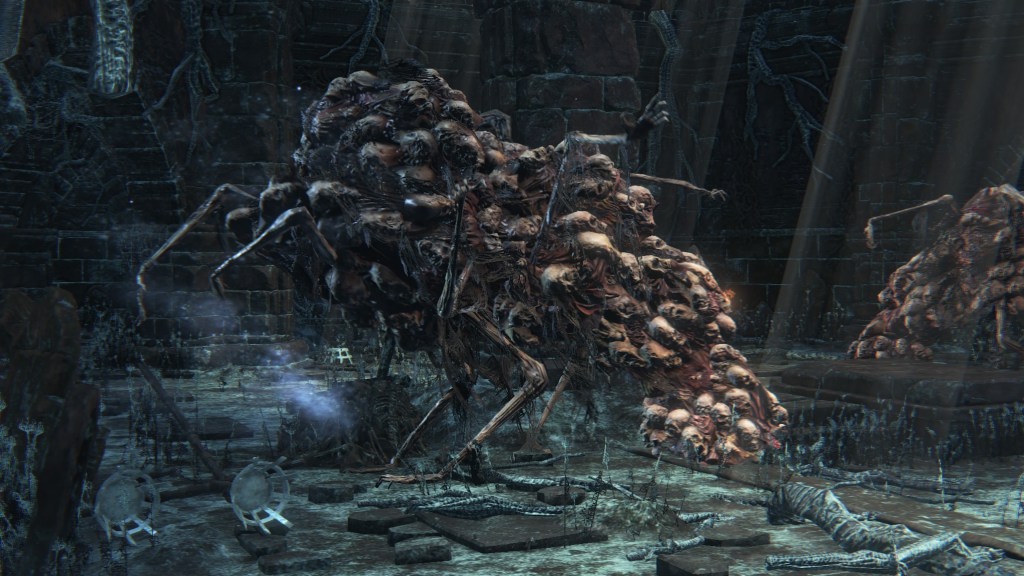
This wouldn’t be the only example of cobbling together a monster from corpses and setting it loose in the labyrinth. One enemy is regarded as a cramped casket, but in the dungeons, there is no casket, simply a legion of corpses amassed together. This dense mash-up of flesh is happy to absorb more bodies into the whole, as seen when it grabs us, and it is just as willing to eject them as hazardous projectiles. With so many found in groups, they are no doubt an artificial creations like the undead giants. In rare instances, we will even encounter “puppeteered remains”, (操り骸) individual corpses whose severed parts are loosely held together through arcane power; making it easier to claw at foes. That last example may need to be discounted due to the glitchy nature to the parts rising up as hostiles on top of the rarity. However, the overall pattern makes clear that Pthumerians frequently resort to necromancy to bolster their numbers. Beast hunts were simply that dangerous an affair. They couldn’t afford to waste anyone or anything.



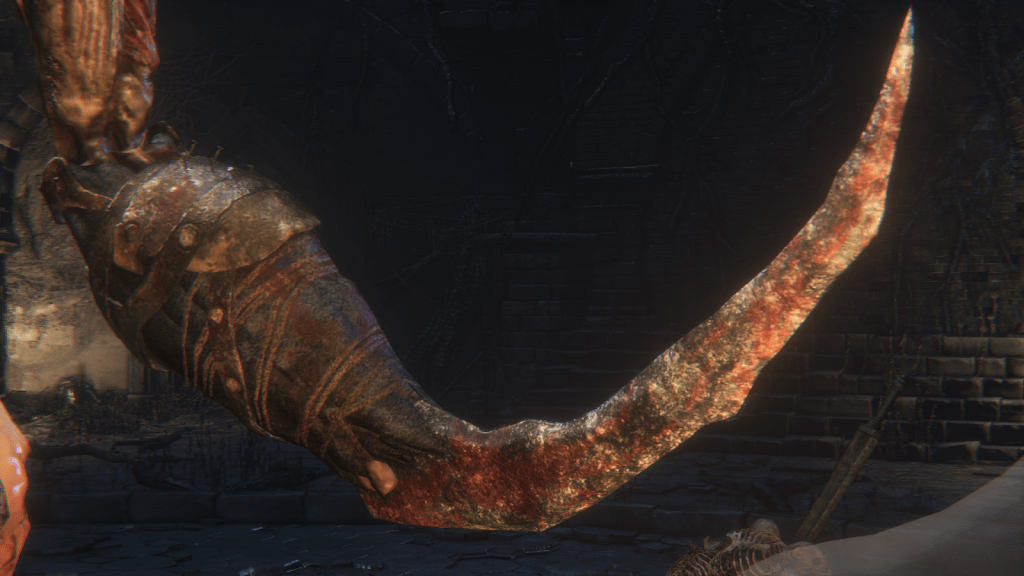

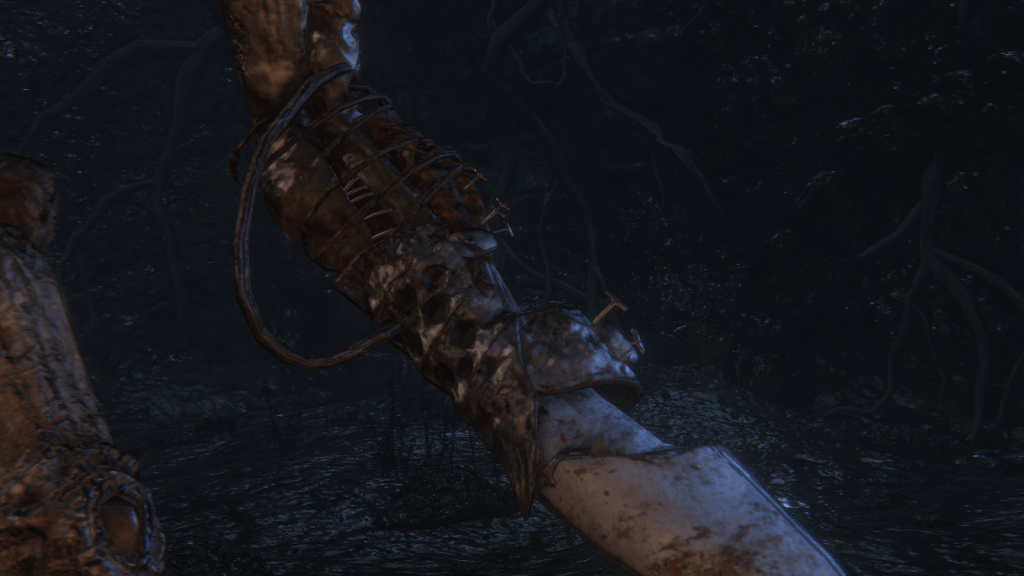

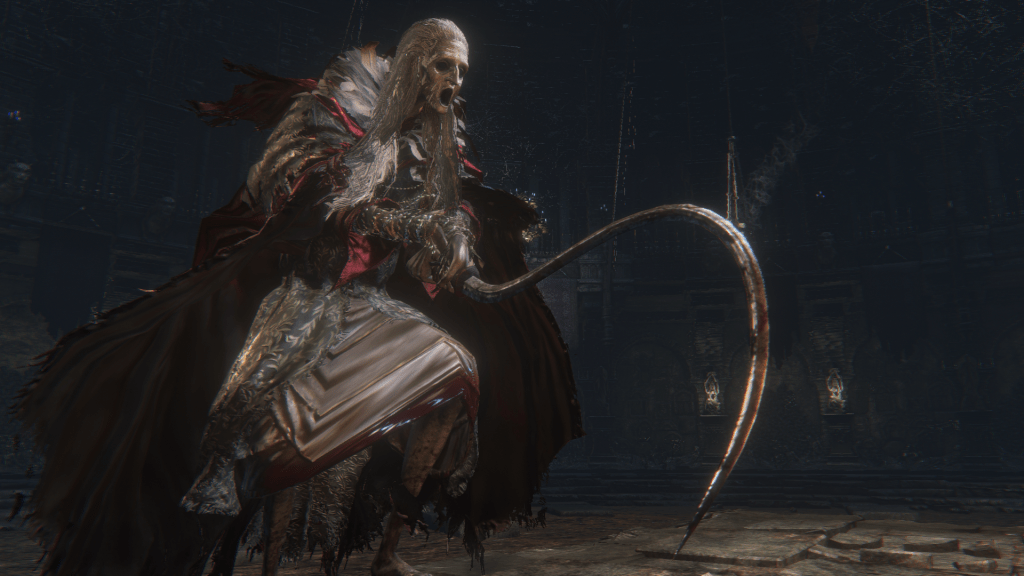
Naturally, the noble class eventually took the lead on these efforts. Historically, elites proved their physical capacity to govern through hunting, and it was no different in Pthumeru. If the country had any sense of noblesse oblige, the aristocrats couldn’t afford to let beasts run roughshod over their subjects — especially if it brought them lording over the territory into question back in the queen’s court. As a result, we can spy high-class Pthumerians meandering about the dungeons. Thanks to their affluence, they could afford the best weapons and training, and that extends to trick weapons. The Pthumerian Descendant wields a shotel which can split in half for dual wielding, the boss deftly throwing both around like boomerangs in spite of old age. There was no worry that a noble couldn’t handle himself in the field, assuming that he was able-bodied. Even then, aristocratic hunts had plenty of ways to bridge any gap in physical strength.
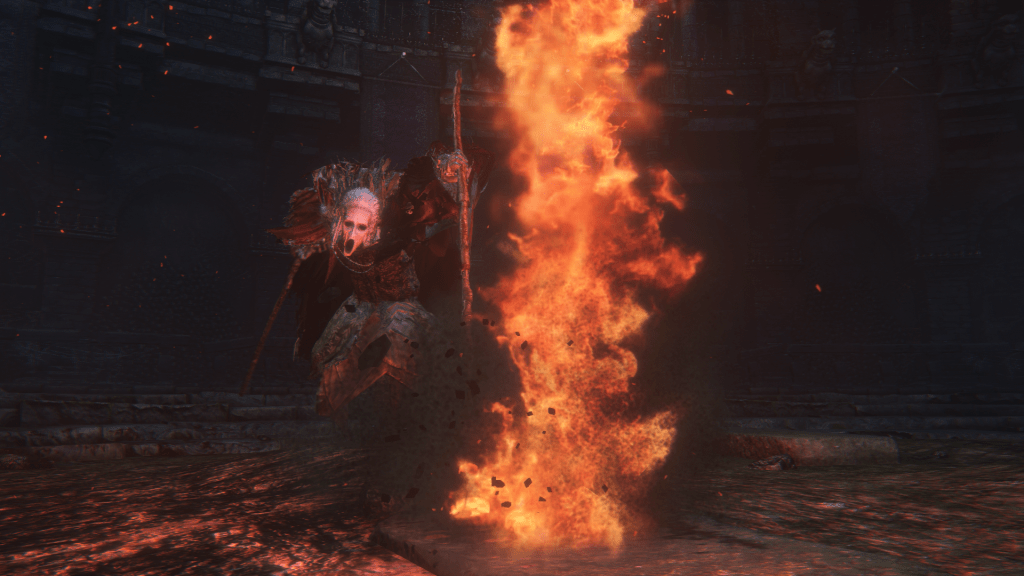
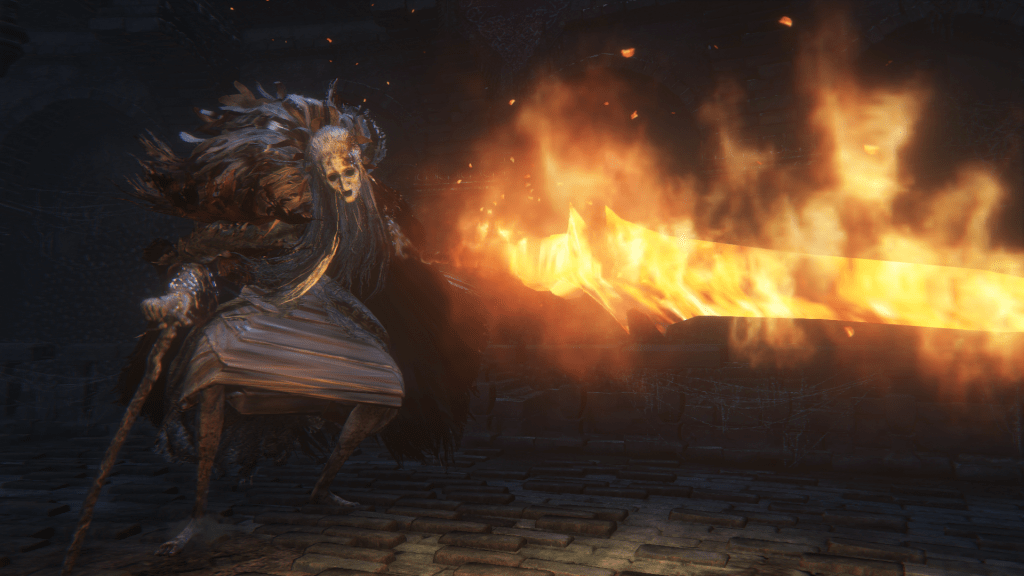
The Pthumerian Elder chooses to wield a staff instead of the trick shotel. With the tap of his cane, the old man can instantly teleport a short distance, with the orange crystal at the tip of his staff acting as a catalyst for fire conjured in the shape of various weapons; hooks, spears, lances, scythes, morning stars. The noble has obviously mastered arcane arts, infusing the power of fire into a gem to create a tool for sorcery. At full power, he can create waves or explosions of flame with each swipe of his “arsenal”, ram the staff into the ground and impale targets from underfoot, or simply hurl the standard fireball. This is what allows the Elder to hunt beasts without needing to sprint and jump around lugging around heavy metal like the Descendant — though the old dog does show that he can still make the occasional flashy twirl into the air before an attack. Given the gap in age between the Elder and Descendant, these are probably ancient magics developed early in Pthumeru civilization, perhaps passed on from Isz.
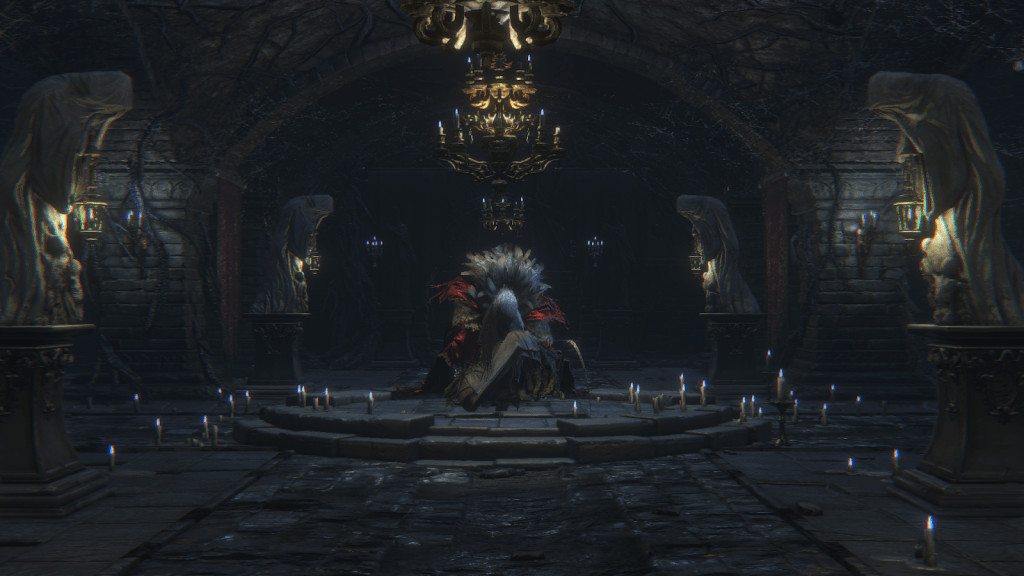





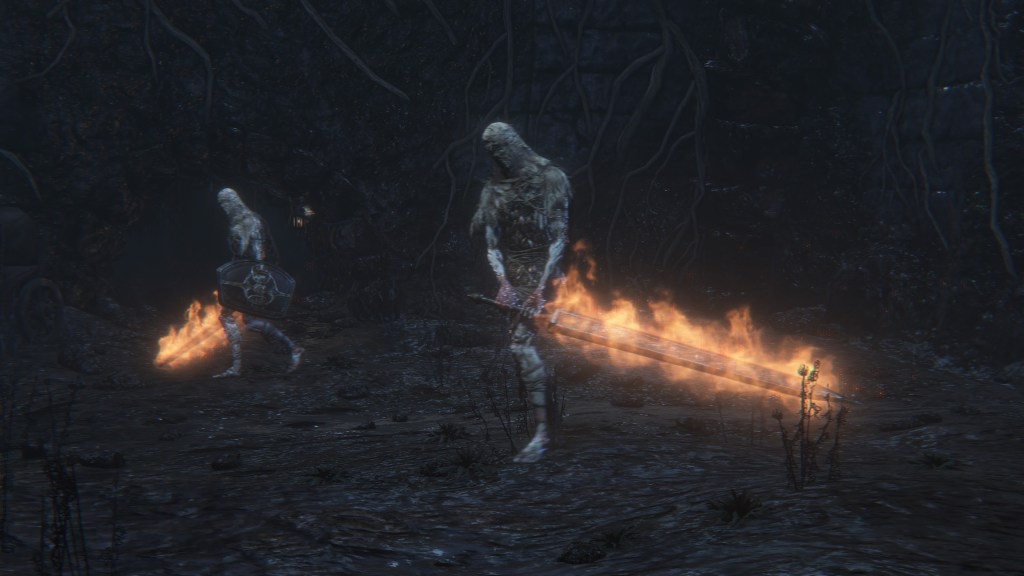
Joining them was their armies. Warriors of the ruins patrol the tombs alongside the gravekeepers. Their chain mail and scale armor confirms that they were better equipped than the Watchers, though it has been reduced to a tattered remnant now. They also wield a soldier’s armament, carrying swords and shields, greatswords, or morning stars. But their war is currently against beasts, the army men looking to use beast teeth for their morning stars and commonly employing flame weapons. These veterans of battle are covered in serious injuries, which explains why we can loot the highest number of blood vials of any Pthumerian from them. That likewise explains the yellow backbones and inflicted organs we can acquire, these grey-haired veterans suffering from the beast scourge more than most. That must also be why they covered their zombified faces with full cowls, like in statues; preventing comrades from noticing the signs of disease in their eyes. The fact that they are still human, at their age, is impressive.
One of the warriors shoots a crossbow, which stands out when most Pthumerians are employing some manner of firearm. The only other example of this is the Elder, the crossbow included among his repertoire of antiquated melee weapons to form from flame sorcery. This implies that the soldiers are of similar age to the Elder, the crossbowmen just too set in their old ways to adopt a rifle or blunderbuss; it is no wonder that the warriors look so tattered and drained. But that also implies that earlier Pthumerians didn’t have guns. Despite all the quicksilver available for bullets, there is no indication of Isz adopting firearm technology. Guns were probably only developed later in Pthumeru, albeit still much earlier than on the surface as seen today. Seeing the potential to injure beasts with silver, the silver bullet and tool with which to fire it were pioneered along with all of Pthumeru’s other silver arms. The Wheel acquired in Pthumeru Ihyll hints that this began early on, as do the capital’s additional trick weapons.
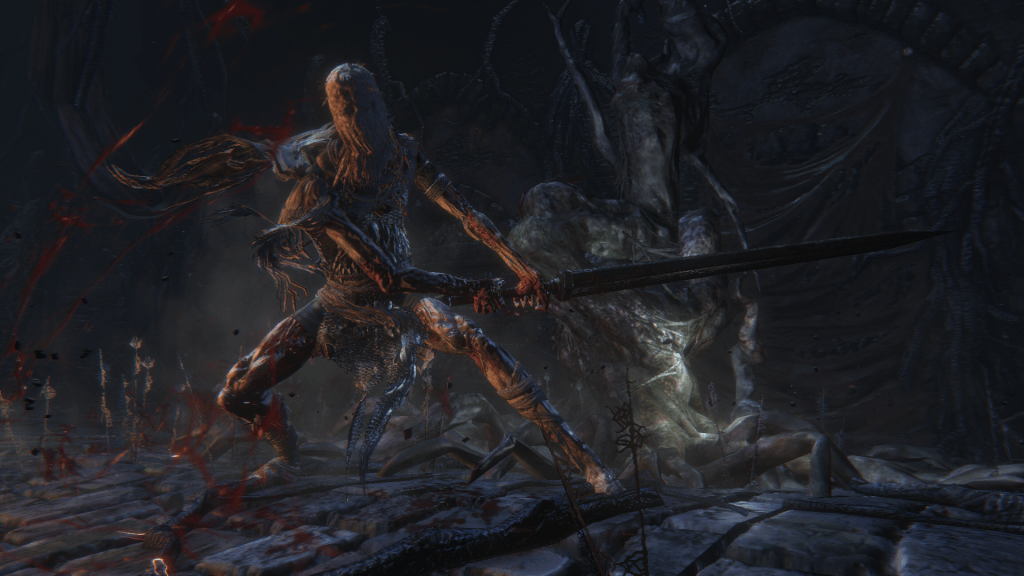
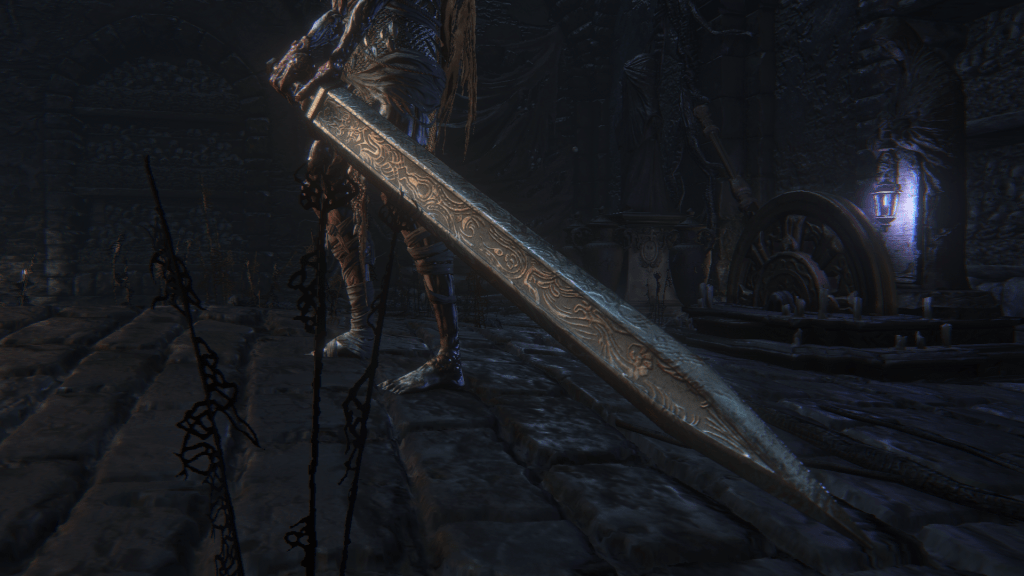
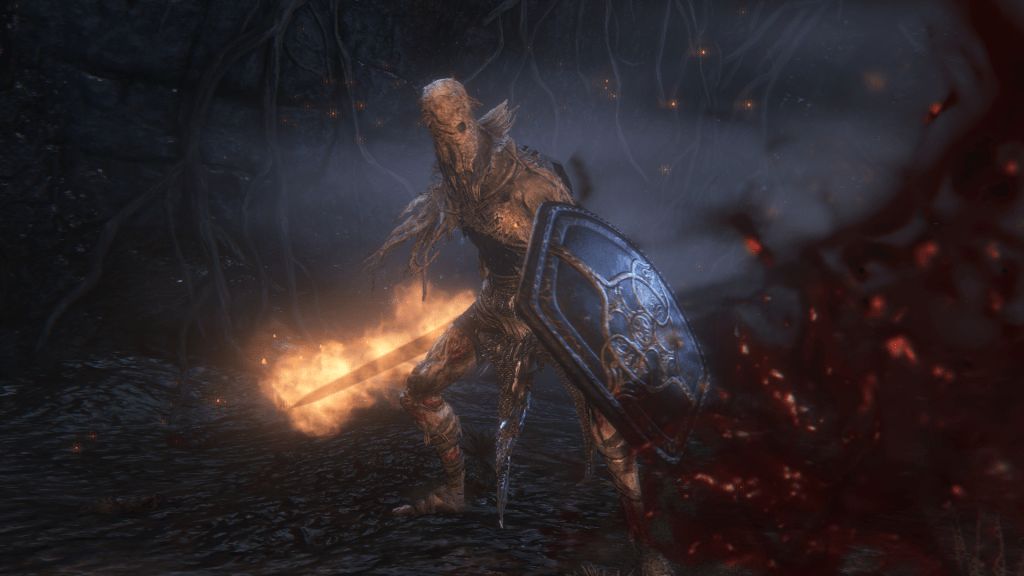
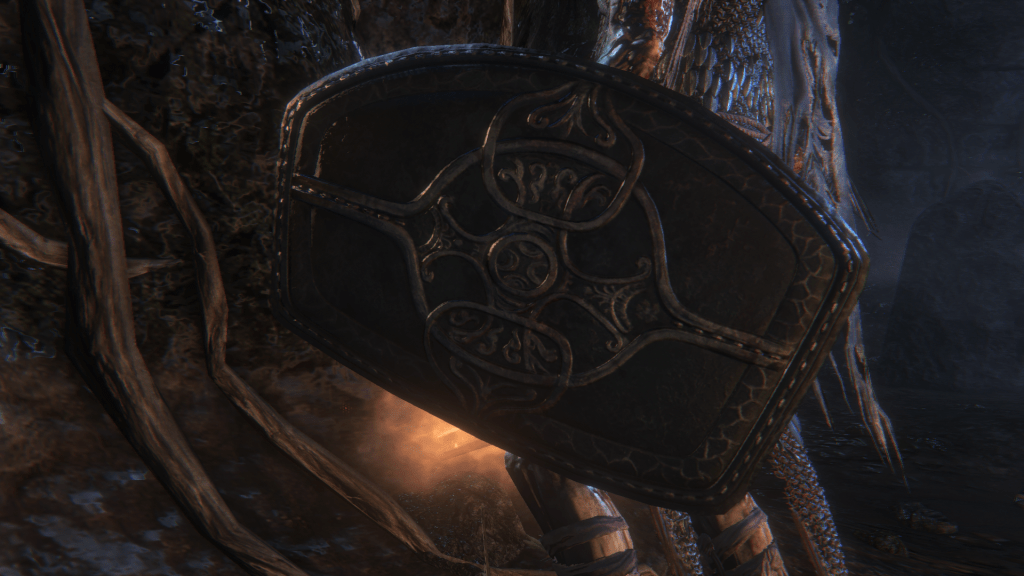




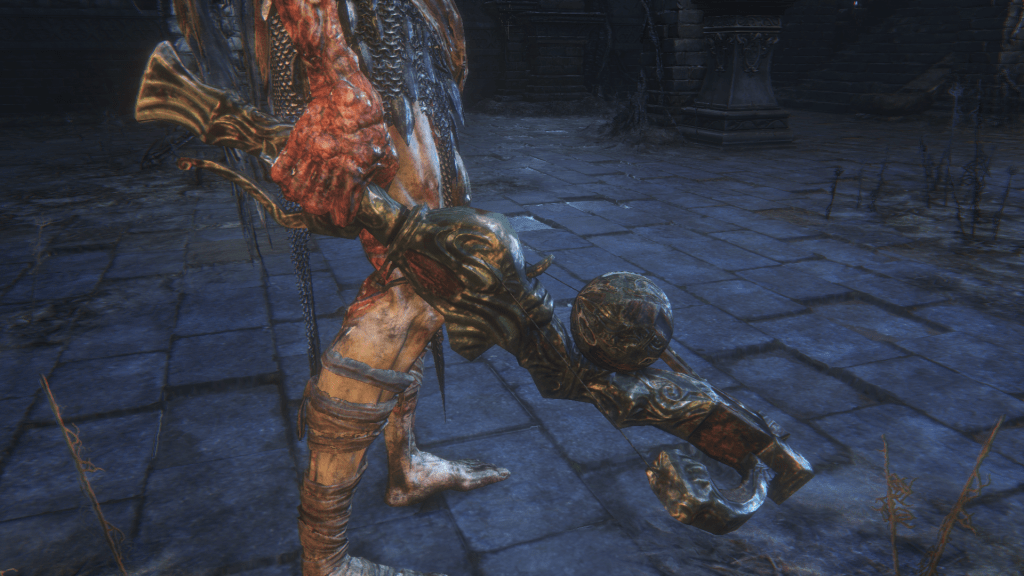
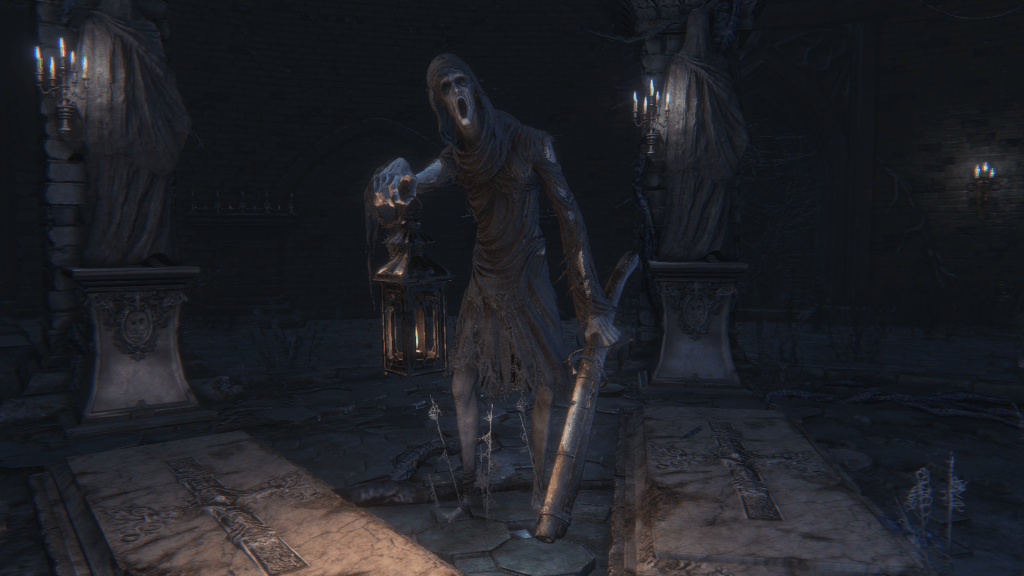


Besides being a callback to Armored Core: For Answer, a game Miyazaki directed before Bloodborne, the Reiterpallasch combines the principles of swords and firearms into one. The result is the ability to dual wield guns without compromising melee at close range. The trick weapon relies heavily on the wielder’s bloodtinge, so only the capital’s nobles with their high-quality blood would realistically wield it. The weapon’s description further suggests that it is the weapon of knights, which is also true for the Chikage. Down there in Pthumeru Ihyll, the weapon is merely regarded as a “Blood Blade”, (血刀) using the blood from slicing the palm as the weapon is sheathed to coat it when subsequently unsheathed. Once coated, the blade becomes more deadly, assuming that you possess the appropriate bloodtinge. The one qualifier is that this art is a curse which drains the wielder’s life force, taking more with each additional coat of blood applied for strong attacks. The nobles leverage their vile blood for sword and gunplay, a practice which dates back to fairly early on in Pthumeru civilization.
The history of the hunts have subtly changed with the passage of time. Just above the capital, in Cursed Pthumeru Defilement, the continued incidence of Chikage and Reiterpallasch betray the noble hunters still concentrated nearby. These types continue to use silver weapons like Logarius’ Wheel as well as Ludwig’s Holy Blade, reinforcing the sense of chivalry among this group. This isn’t too odd, since they were Pthumeru Ihyll’s first line of defense — of course the royalty entrusted knights to guard their home. To that point, it is there where we can acquire Blood Rapture, a rune expressly associated with those serving the queen in its description. That dungeon is also where we may find the Lake rune, which highlights this idea of being a barrier of protection from physical threats. The noble lords of Pthumeru in Depth 4 were a living rampart. The added “defilement” lends more importance to the retainers’ presence, as evidenced by the Wheel smothered in vile blood.
But things continue to change as the hunters branch out with each additional expansion to the labyrinth. From Lower Pthumeru on up, citizens begin resorting to cruder weapons like Saw Spears and Cleavers, though they haven’t given up on silver; the knight’s sword simply replaces the massive Holy Blade with the stone Kirkhammer. With regards to quicksilver, the Rifle Spear similarly borrows the principles of the Reiterpallasch, commoners imitating nobles from the tombs they migrated from. By the time we reach Central Pthumeru, the knight’s weapon has evolved to a gentleman’s cane. Even that Threaded Cane has fallen by the wayside as of the most recent layer.
The Hintertombs go through their own developments. The lower tomb is where we find the Stake Driver, a creative if crude invention much like the Rifle Spear just one depth below. It plus the Hunter Axe in the above Hintertomb indicates a subtle shift in rural thinking, treating the beasts like men. After all, the axe is the classic executioner’s weapon, with stakes similarly employed for impalement. Frontier hunters therefore have a tendency to slay their prey as if they are criminals, sinners, even. We can see this in the local runes found in the Lower Hintertomb. By themselves, Deep Sea and Stunning Deep Sea might have reflected the citizens’ desire for protection from the frenzy and poison around them. But, when combined with the inclusion of Great Lake and Great Deep Sea, there is clearly a fixation on the body of water dividing man from the Great Ones. The hicks, with their eye-collecting priestesses and chalices adorned with radiant white gems, probably look to the cosmos for insight, similar to Isz, and view the beasts as an impediment, a barrier to communion with the unseen gods.

This unique perspective on beast hunting in the secluded tombs is reinforced by the labyrinth madmen. By all appearances a Pthumerian warrior, the “Keeper madman” (守り人の狂人) is nonetheless susceptible like a beast, those sharp nails occasionally forgoing a weapon for a corpse to munch on. With speed and strength to match, the gravekeeper must have become one in all but superficial form, hence the madness plaguing him. But that madness can also be a sign of insight. Despite every variety employing melee, the enemy provides quicksilver for bullets, and we may also loot the Sage’s Hair and Wrists. He has what constitutes sacred, enlightened, blood for Pthumerians despite the beasthood, likely in large part because they managed to remain outwardly human while mentally degenerating. And even though this kind of enemy is common in most root dungeons, the madmen are especially common in the Hintertombs among the story dungeons. Without a doubt, Pthumeru’s fringe promotes this kind of transformation, encouraging residents to become anything but a hairy beast for divine inspiration.
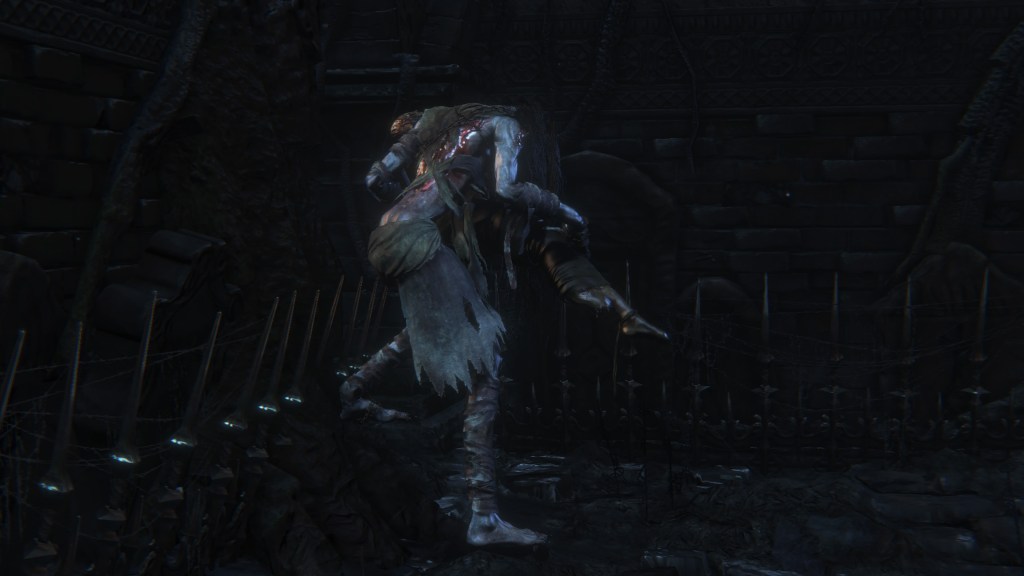
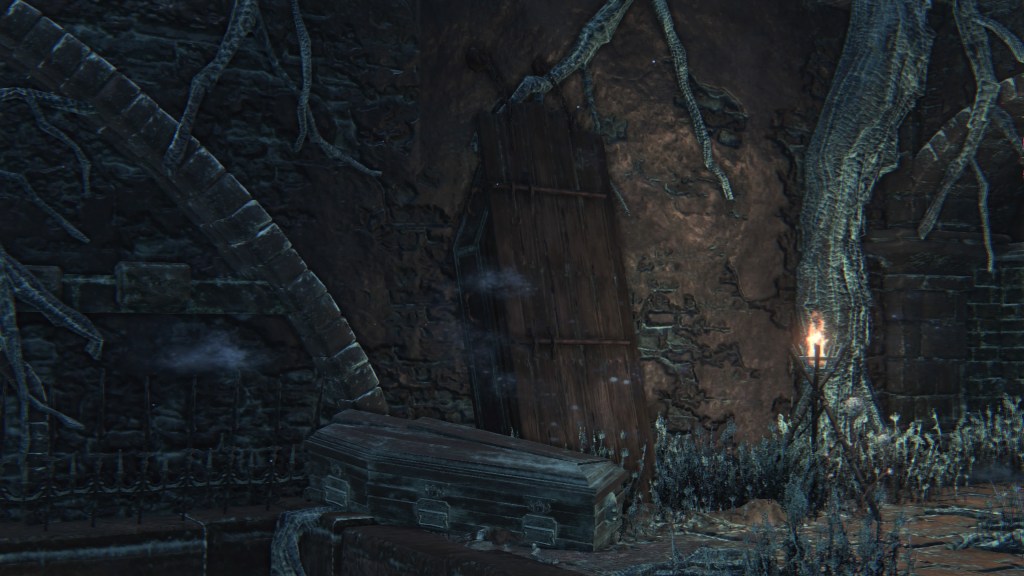
Religiosity and superstition aside, hunting was a core function to every part of the ruins, as ubiquitous as blood drinking. The result was death being another universal constant. Even ignoring the graves, there are plenty of coffins laying around the ruins, ready to inter either hunter or prey. On that subject, many use large, reinforced wood boards in place of the normal lids, presumably to secure the casket against the beast occupying it. When sealed and placed into carts, these coffins are inevitably tied down with rope to keep the things from moving too much, so the Watchers are definitely anticipating the possibility of the corpse coming back to life. The fact that so many empty coffins are just lying around, Watchers hiding in the things to ambush intruders like us, speaks to how widespread the beast hunt became. To celebrate with blood one night and hunt or be hunted the next day — that was the Pthumerian way.







Possessions are Flying Birds
Death may have always been around the corner, but life was more than just hunting beasts. We never get to witness a proper Pthumerian home, but they must have private interactions, and relations, with each other to keep society afloat. Since we never receive a glimpse of this, we can only imagine the day-to-day troubles of the gravekeepers when off duty. Does the constant expansion of the tombs everywhere create property line disputes? Does payment in coin lead to robbery, or taxation? Does the hunt demand they find their own meat to feed their families? Much of our experience in the Chalice Dungeons is tailored to the public face of the ruins’ culture. Even then, we can surmise that it wasn’t always beasts for the Pthumerians to contend with. The public gardens gave the Watchers a break from repetitive tombs, and there were other things to experience for both their thrill and alarm, such as the various wildlife.
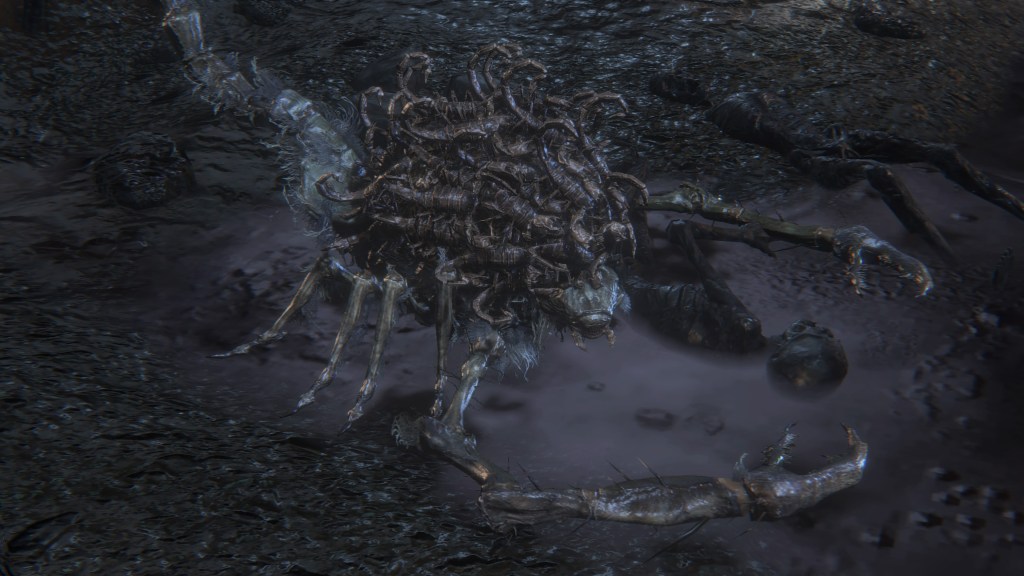
The gravekeeper scorpion is perhaps the most peculiar. This arachnid is bursting with venom, yet also capable of launching fireballs. This raises eyebrows, since the “gravekeeper” name seems to come from how the enemy looks like a Keeper transformed into a scorpion, with patches of beast fur along its entire body. But the creature itself isn’t a beast, and the “gravekeeper” aspect covers just the top of its shell; the scorpion has its own mouth and eyes, with those of the supposed Pthumerian appearing superficial rather than true body horror. We also see mother scorpions with tiny young on their back, each and every one ordinary. Taken together, the species seems to be just a scorpion. Perhaps the creature simply evolved to look like a half-beastified Pthumerian to lure in prey on the hunt for bodies to slay or bury. Alternatively, feeding on the gravekeepers causes their form to manifest on the exoskeleton, organs filtering out the “poison” in the blood and flammable elements they wield. You are what you eat, as the saying goes, and there are sure to be plenty of hunted Keepers to scavenge in the labyrinth.

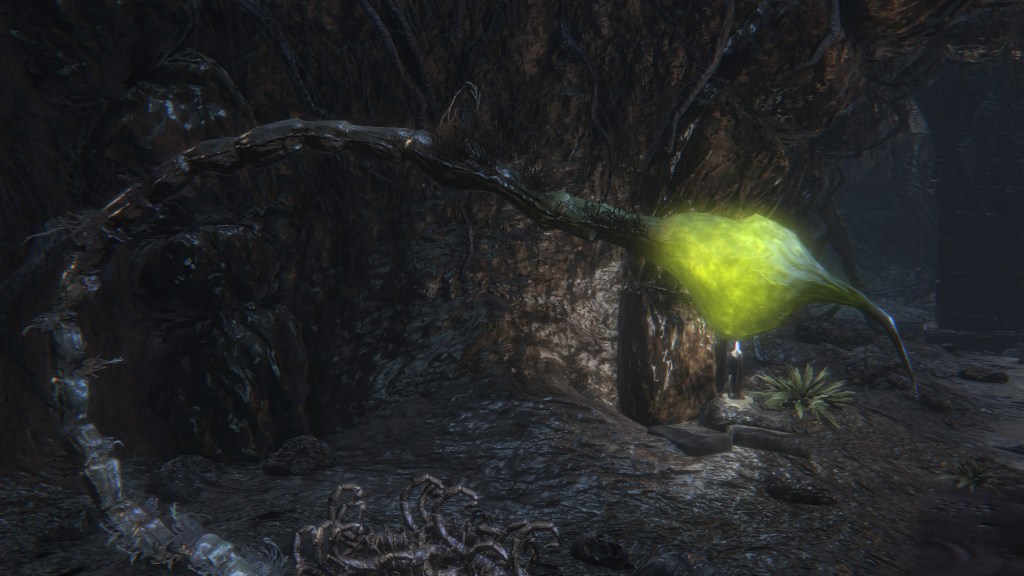



Another bizarre case of fauna is the hole digger. Rarely, we will come across holes in the wall of the dungeons creating burrows, sometimes with the burrowers still inside. The slug-like entity with miniscule arms at each end use its acidic bile to melt its way through the earth while its elastic mouth tentacles help whip and ultimately drag prey into its gaping maw. Some of that dense, melted rock gets devoured along with the flesh and blood, the lead in the rock apparently extracted as an elixir from the body we loot. More impressive, however, is how the head uses the body almost like a skin suit, capable of pulling itself through the insides and popping back out the rear end to attack any predators coming up from behind in those narrow tunnels. There is simply nothing like this hole digger, and like the scorpion, it is no doubt a pest for the Pthumerians to exterminate.
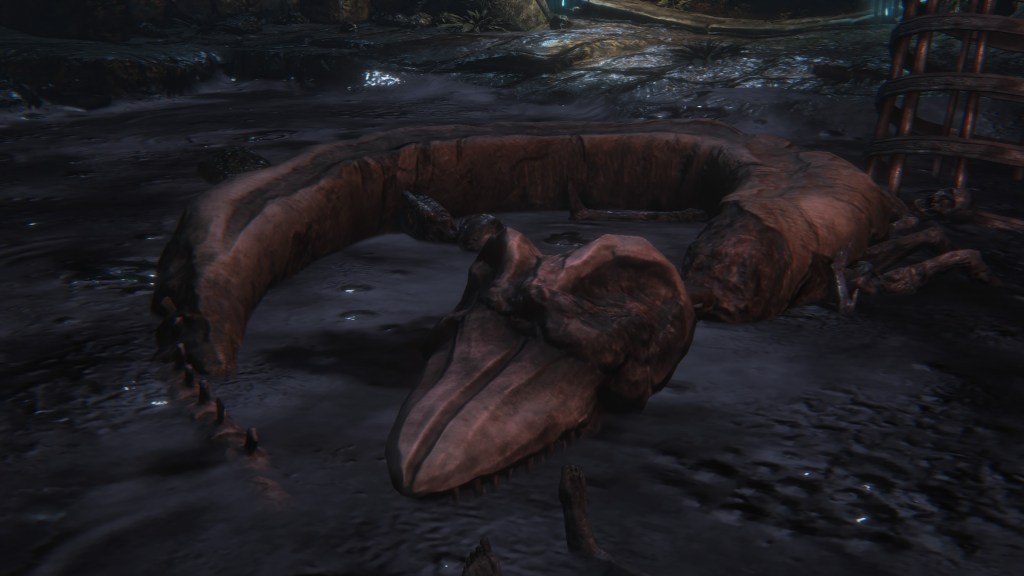
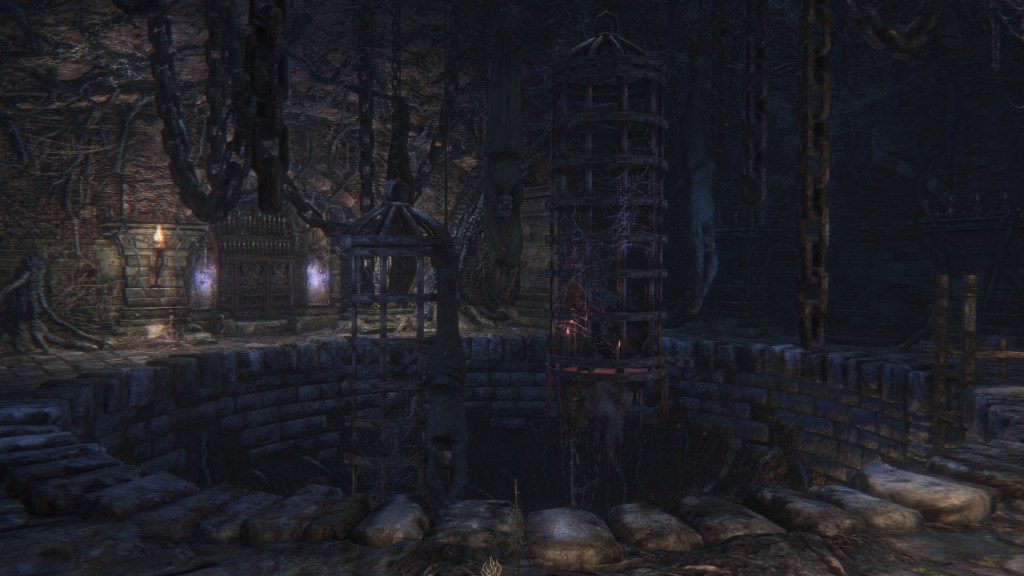
The waters weren’t safe either. Whenever we explore the sewer lines, it isn’t uncommon to come across the skeletal remains of some large, eel-like creatures. These cryptids are almost nowhere on the surface. Therefore, it appears as if the marine animals have been the result of arcane influence, exposed to Great Ones or kin from its watery habitats or at least feeding on some part of them. Whether this transformation made the creatures themselves some kind of kin, it mustn’t be too dangerous if we can only find remains in shallow waters. With a head fit for ginormous eyeballs and a long horizontal beak to open wide in one case, it is certainly fit to pick up any small fish or refuse that might flow through the pipes. Maybe that beak would be more dangerous for gravekeepers assigned to patrol the sewers or beasts escaping down them, but we only explore the shallow drainage chambers with the rotten remains, so we have only the hanging cages placed over the drains and canals to confirm the water’s threat.






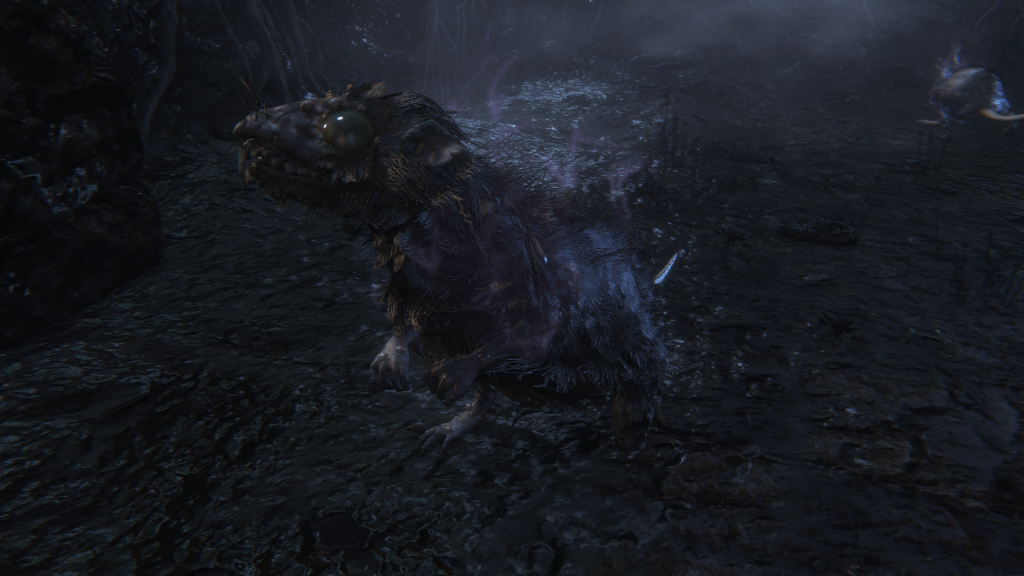
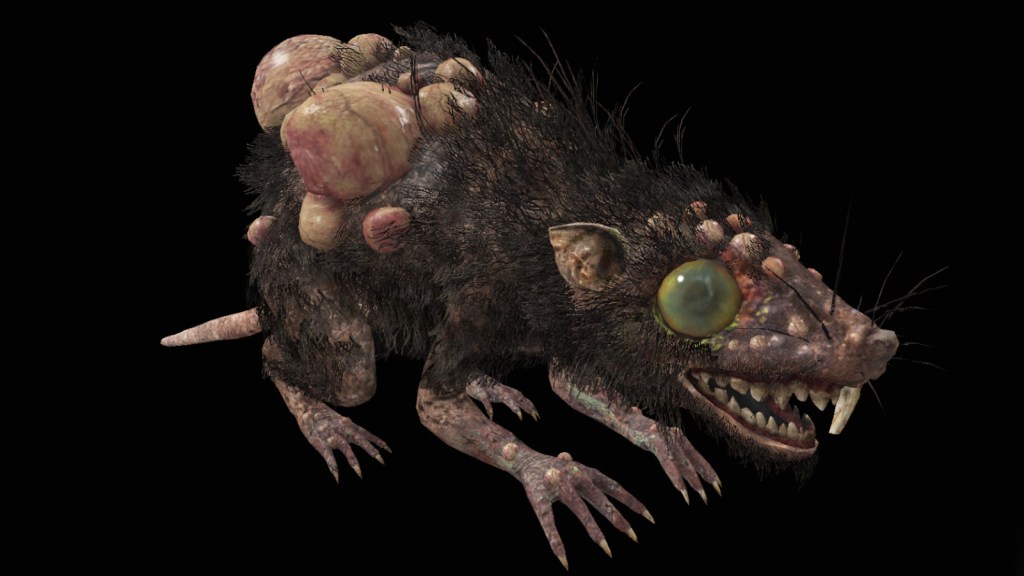
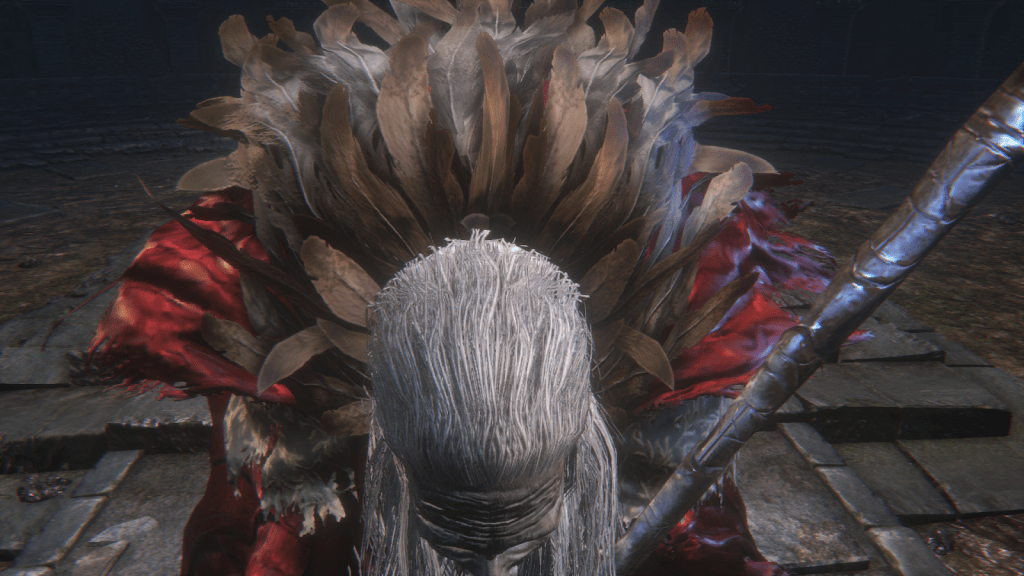
Granted, not everything was so deadly down there in the labyrinth. Large rats covered in tomb mold and diseased pustules are hazardous, but ultimately just vermin that tend to lurk in the sewers. Along with them were smaller critters we only seen as cadaver, such as miniature wild canines or other kinds of rodents which Pthumerians apparently like to grill and eat. Being deep underground, we can encounter nothing avian, though the horned grotesques adorning the tombs do possess feathery wings like birds. Such angelic wings might just signify transcendence, an angel symbolizing the link between man and god as a divine intermediary. But at least some element of society must be familiar with birds, since the nobles have plumage collars. In all likelihood, bird feathers are a rare commodity that aristocrats import from the surface, sending Pthumerians out hunting.
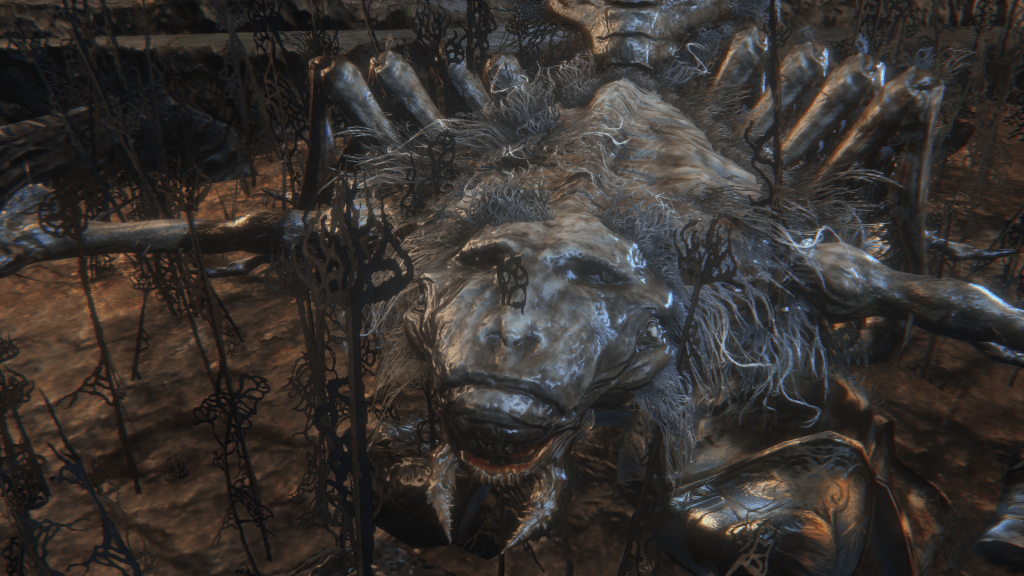
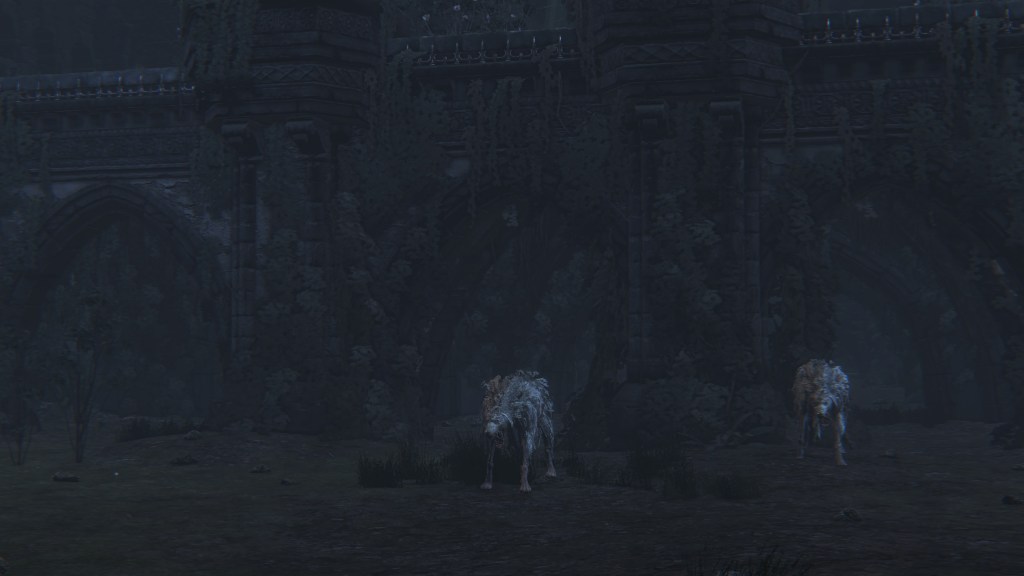
Indeed, for all their seclusion underground, Pthumerians weren’t strictly avoiding sunlight. Life as gravekeepers simply didn’t demand burrowing beyond the layer of earth overhead, though cut content opens the door to facilities above ground under the right circumstances. The state arguably needed to keep up to date with happenings on the surface in order to steer future civil development. That also means Pthumeru Ihyll engaging in diplomacy when possible. Exploring the story dungeon, we come across a Watcher with a fair number of dogs, breeds otherwise exclusive to Hemwick and Yahar’gul. It is possible that some noble is importing them for a menagerie, showing off the exotic animals he could purchase from the surface. We do see more of the Yahar’gul dogs in deeper depths of this dungeon and root dungeons in general, commonly escorting the gravediggers as they search for new parts to expand. The Hemwick dogs likewise appear, if more rarely, in Pthumeru Ihyll. Without a doubt, the Pthumerians are trading for canines and using them for their purposes.




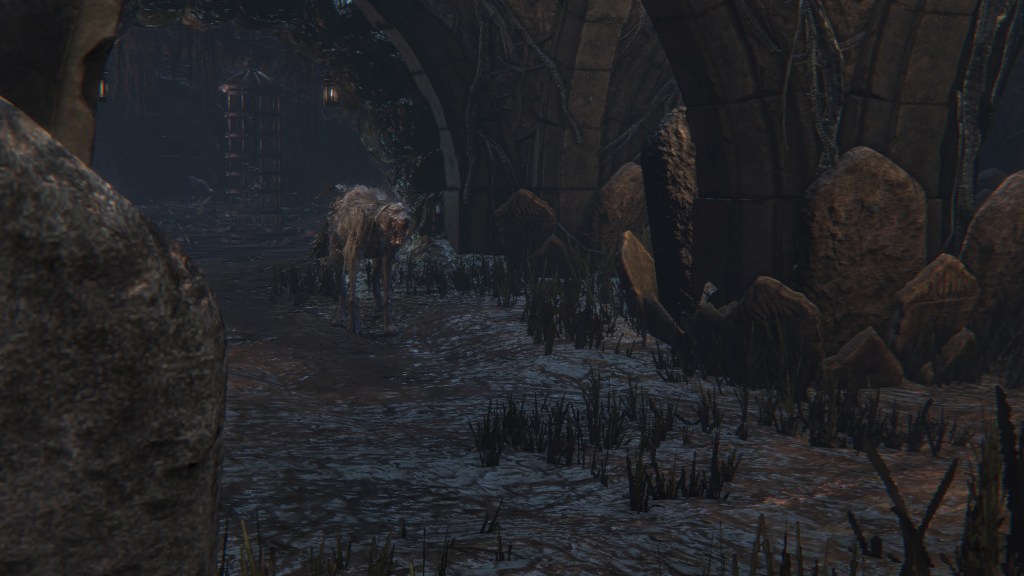
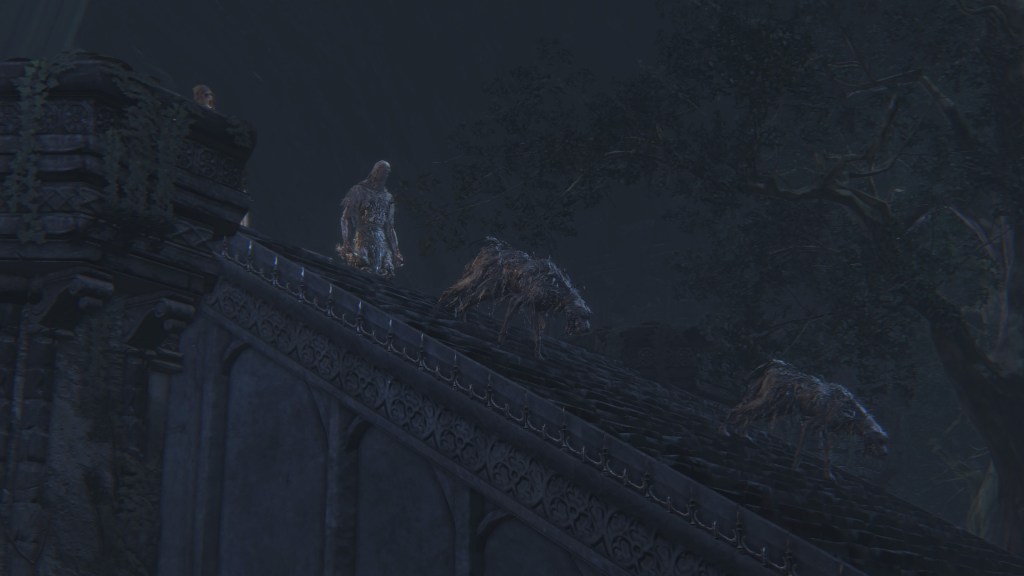
Of course, first-hand experience tells us how the Watchers are generally hostile to outsiders’ presence, but that would be a decent society’s response to any invader. No Pthumerian is going to appreciate would-be graverobbers, and their insular nature guarantees that they would be extra suspicious of foreign visitors. Only through careful interactions between the underground and the surface does this alien culture do business. But still, that shows a willingness to build relations. When it comes to hostility, Pthumerians are just as vicious with each other. Throughout the dungeons, we will come across chambers littered with dead knights or piles of bones and armaments, specifically the arms of the labyrinth warriors. Add in the accompanying cannon set ups in many cases, and we get a sense that there are traces of long-past battles the Pthumerians fought amongst themselves. With such a rigidly conservative society in constantly dire straits, it is no surprise that Pthumeru is plagued by infighting also.
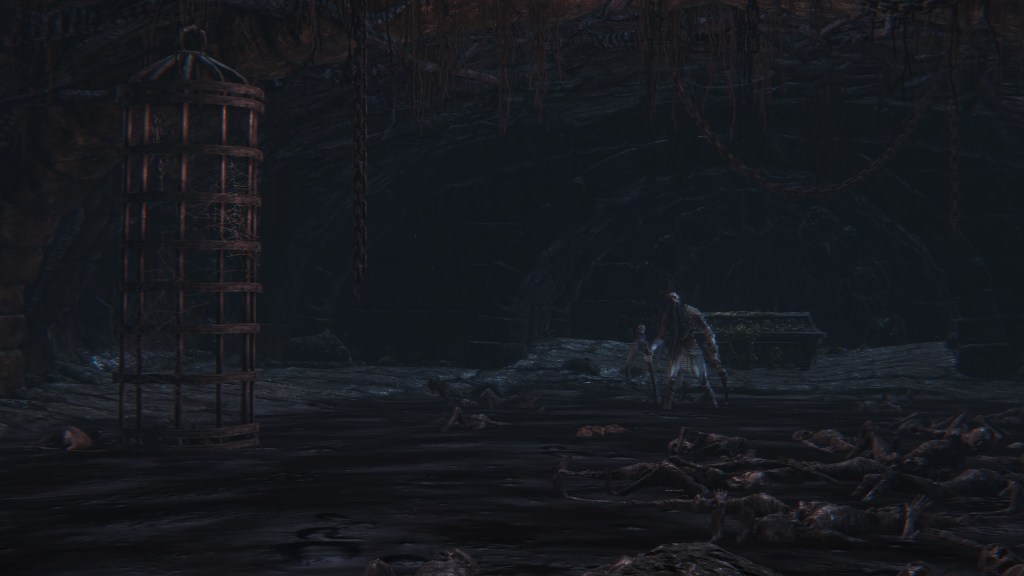
The death toll beggars belief with how many litter each dungeon, whole piles crowding corners, victims often appearing horrified. They at least have a place amongst the graves. In the sewers, we encounter masses of “gel” which crawl around the floors or ceilings, ready to ambush passers-by. Taking basis from the Dark Souls’ crawling carrion, the enemy seems to be the byproduct of the human corpses, their bones and shining coins mixed up in the black mass. The amorphous form is highly resilient to physical attacks, but not burning, electrocution, or the arcane. Based on the color, it might be a grudge specifically, the collective wills in the blood pooling together in the body pile coagulating into that dark matter twisting itself into all sorts of shapes to tear apart the living. Bodies left to die and be forgotten in a grimy sewer, never to receive a proper burial, would understandably irritate the blood. And with how improper burial are common cause for resentful earthbound spirits in Japanese folklore, it may not require all-consuming malice to persist after death, just a sense of injustice.


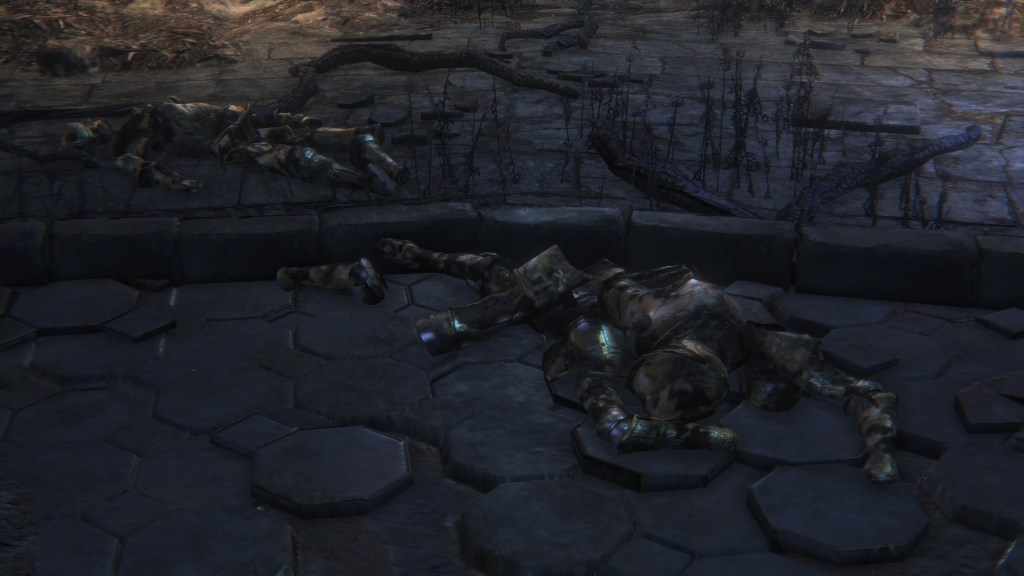
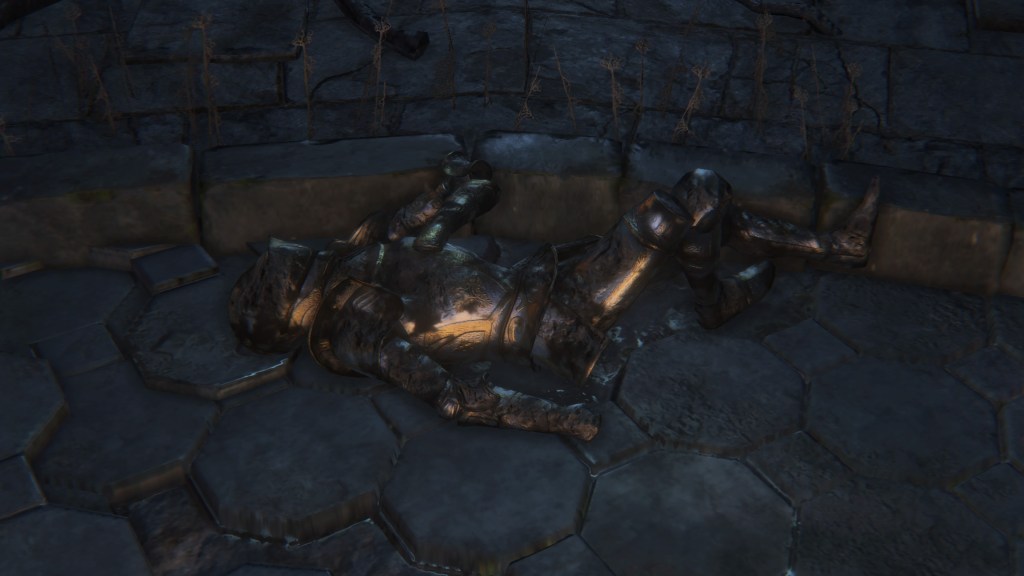


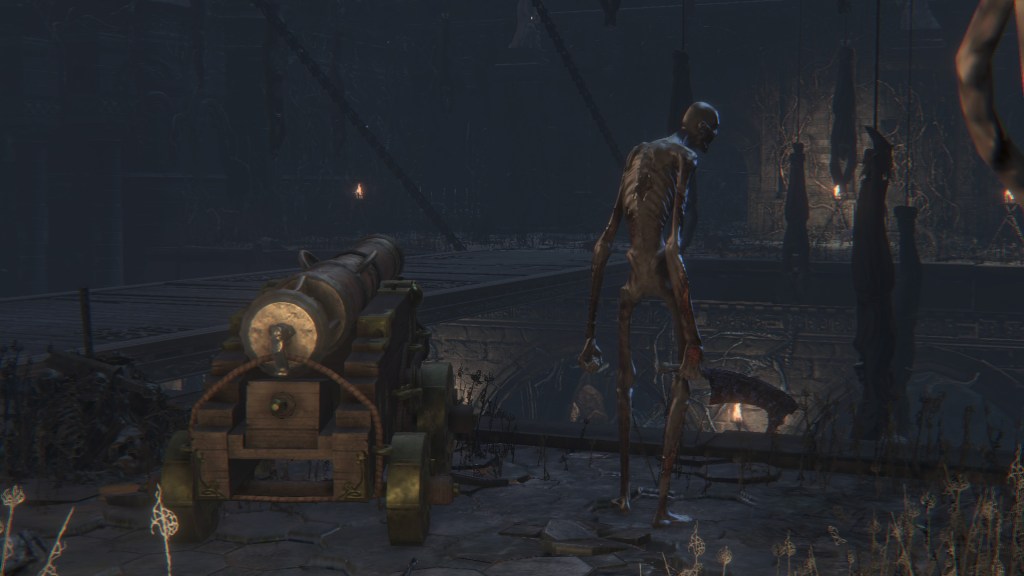

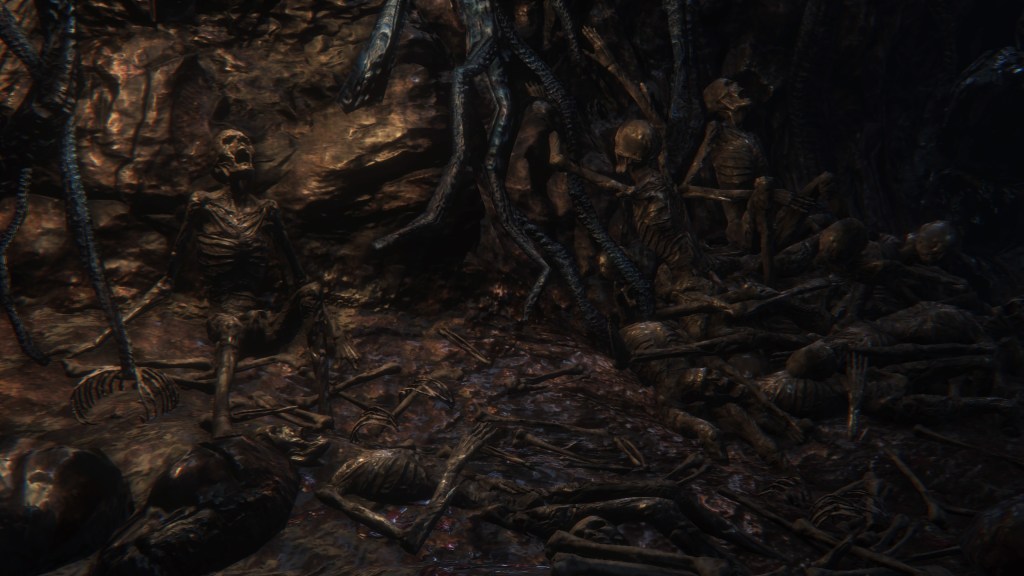
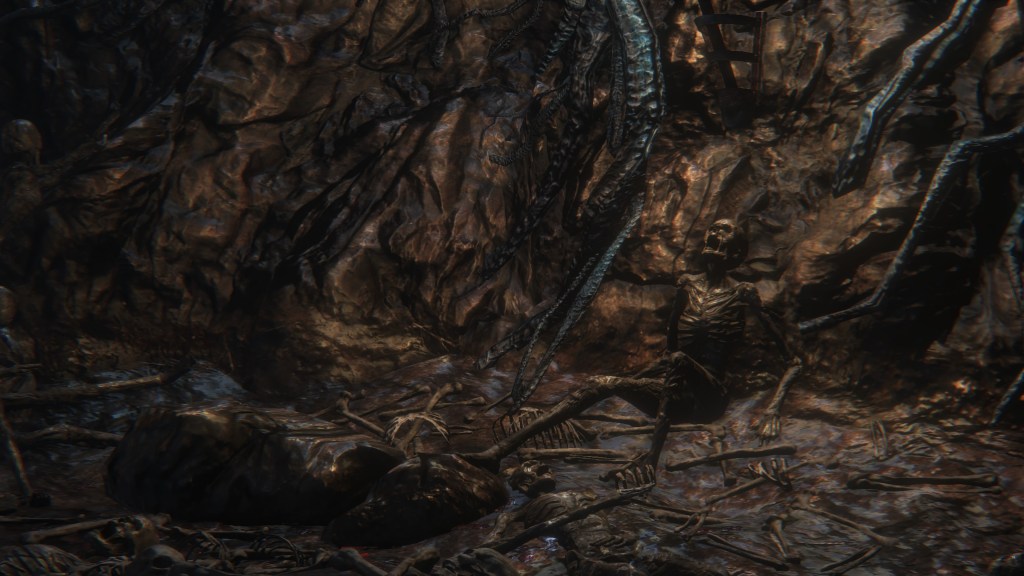


Between all the death and overgrowth, outsiders can hardly be blamed for thinking this civilization a ruin. Despite the attempt to make cities out of tombs, they are still just that: tombs. It is hardly an encouraging life for a gravekeeper. Not everyone wants to slavishly protect long-dead gods for seemingly no gain. Only reason that Pthumeru has held together for so long is the strong respect for tradition, perpetuated in part by the long-lived nature to many of its elite. In fact, the hoarding of the most arcane blood is likely the cause for that longer life. They are happy with the current arrangement, so nothing changes. But when the commoners try to express their grievances and resist, they are always too weak to overthrow their sated masters. It is a deep legacy of futile infighting that discourages any major deviations from the status quo. Pthumerian civilization is simply dysfunctional. And that regular unrest reveals the limitations of its queen.
Having a Child is Divine
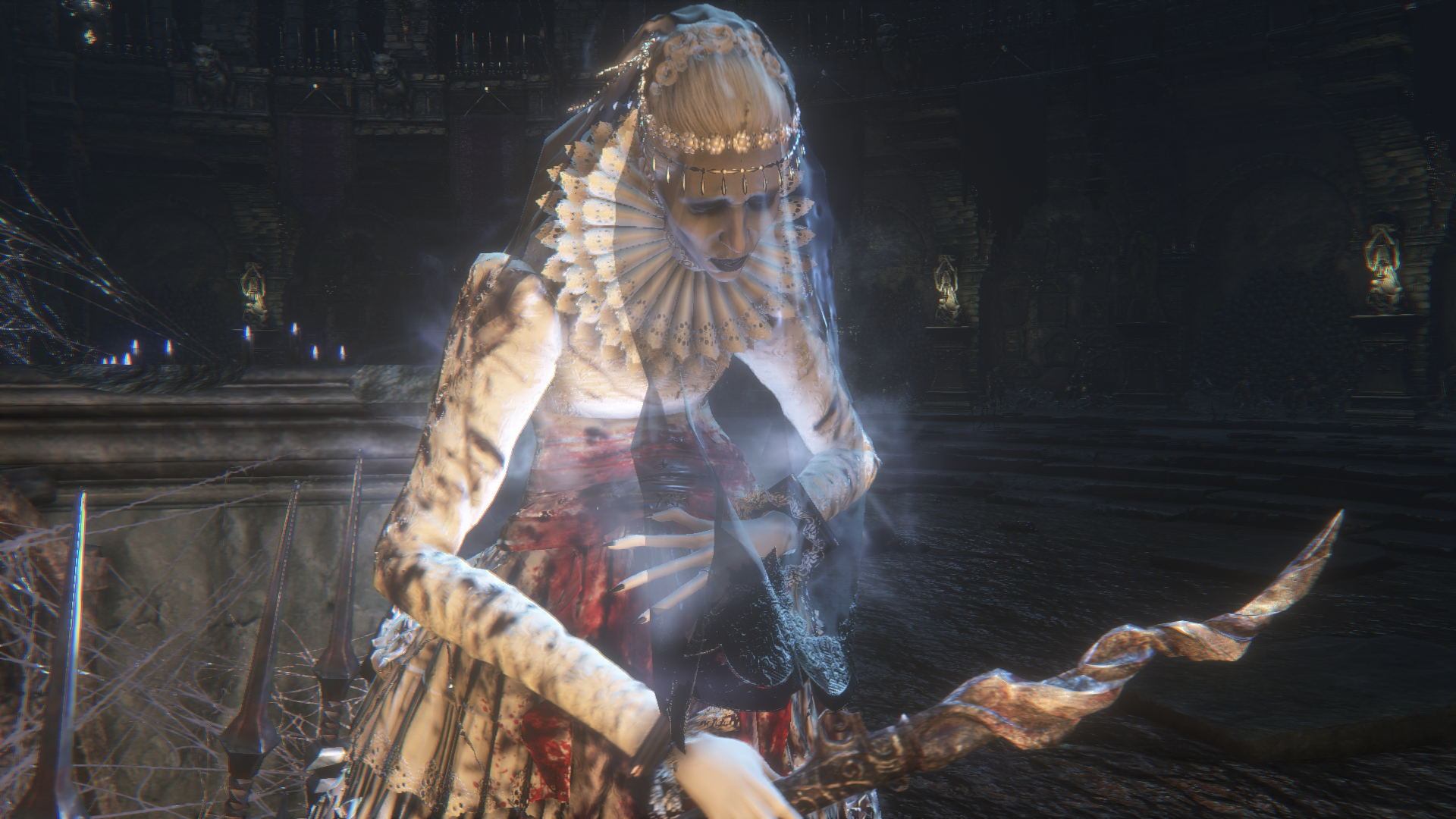
From her place in the royal capital, we see the Pthumerian Queen spends her time attending to the graves, praying to one of the especially large monuments when we walk in and disturb her. This is to be expected, since she is essentially the chief gravekeeper. What isn’t expected are the wooden hand stocks the boss wears. She isn’t a prisoner; early into our battle, she recognizes that we are a serious threat and breaks the stocks with little effort, arming herself with a large dagger on hand. If someone intended to restrain her, they would have accounted for her immense strength and deprived her of her weapon, both combined allowing her to fly across the battlefield in order to close the gap with a deadly strike. Rather, the shackles were clearly a symbolic gesture, something the royal head acquiesced to during safety. Why choose to put on the binds of a convict or slave? Because it sends message, but to whom?
When we encounter the queen in the story dungeon, she is visibly pregnant, and the baby can be heard crying throughout the proceeding boss fight. The child’s periodic wails always precede arcane energy binding us momentarily. For one attack, the queen lurches and quickly rubs her belly as that power builds up in her womb. What follows is a circle of energy rising all around them, lifting dirt, rocks, and eventually us into the air. And after telekinetically spinning us around briefly while the boss lurches even lower, we get slammed into the ground and she returns to normal. All of this is clearly done by the unborn baby, not the queen. The fetus is upset at our hostility and trying to protect its mother. Being a baby, its attempts are mild and crude, but it is still an immense show of power for a fetus in the womb, enough to overwhelm the mother with the quickening. Combine with the fact that we can hear the baby crying from inside the womb, and there is no doubt that this is an infant Great One, and we can surmise who.



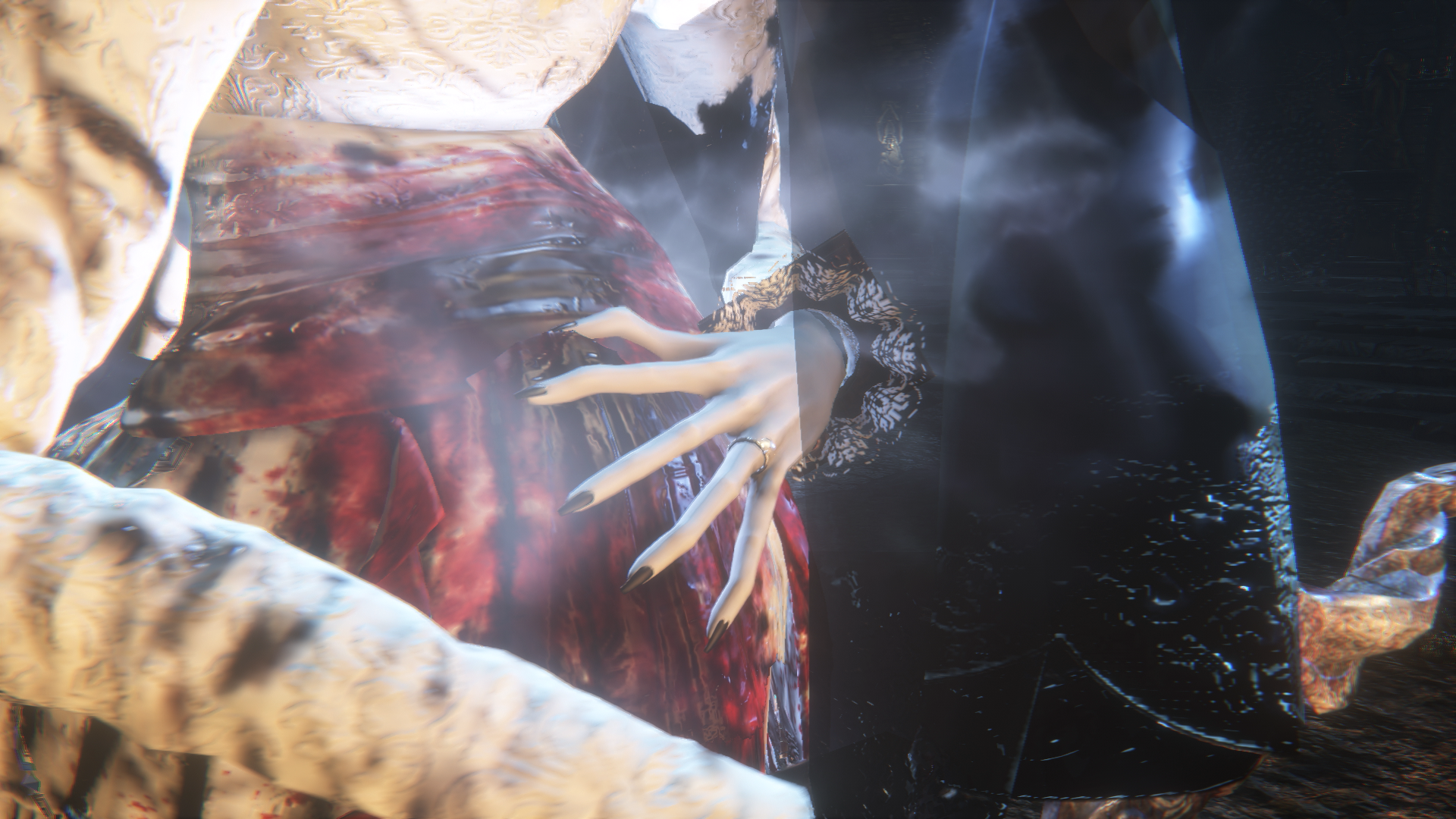
From the start of our journey through the city of Yharnam, we can hear the same baby cries faintly in the background, assuming that we possess extremely high insight. We eventually track these cries to within a baby carriage inside the Nightmare of Mensis, where we almost immediately encounter Mergo’s Wet Nurse. The obvious implication is that the baby is Mergo, currently under the hostile Great One’s care. And before we take lift up the tower to these two, we come across the queen, praying while looking up to the boss room. In this instance, she isn’t visibly pregnant, and returning to her once the Wet Nurse is defeated and Mergo stops crying prompts the Pthumerian to bow before leaving. Add on top that, we cannot perform the ritual with the Great Pthumeru Ihyll Chalice until we acquire the Living String, a unique item solely available in the Nightmare of Mensis before crossing the queen and Mergo. Without a doubt, Mergo is the child harbored by the boss in the dungeon.
Pthumerian royalty has conceived a Great One, and this isn’t the only attempt. Like in Isz, we can acquire red jellies revealing experiments to engineer Great One babies in Pthumeru Ihyll. The royal capital has a particular fixation on this practice, and it is surely because they have both the means and motivation. If their gods lose children in general, then Pthumeru’s elite probably intend to supply them the lost children, if only to remain in good standing with the divine. And if their queen can conceive a child, then they likely hope to improve upon the method or success rate as a form of self-advancement in high society. As the red jellies showcase, consistency has not been achieved. Why then has the queen succeeded where so many have failed? It isn’t from a Great One blessing her womb. Blood Rapture mentions serving a queen who harbors a “Blood Baby” in the description. This suggests that the child born was produced from the monarch’s blood, not necessarily a god. If so, then her blood must be unique among high society.
Blood Rapture is proof of the special quality to the queen’s blood, her servants utilizing the vitality from the blood obtained with the rune as a substitute for it. She also weaponizes this blood of hers in battle. From the start, she performs arts to fire her it as spears from the palm. Once she takes up her dagger, she begins using it like a Blood Blade, stabbing her own palm to shoot up the blood spears from underneath targets. She can even use this to cover the blade in blood and extend “its” length into a proper sword. Stabbing this blood sword into the ground causes bloody geysers to gush all around her. Even on the defensive side, she instantly collapses into blood with a prayer to teleport a short distance or summon clones of herself. These are arcane abilities unique to her, and every single attack inflicts a rapid poison effect. She has blood more malicious than any other, malice sweet enough to enrapture her vassals and kill a drunkard. This must have been cultivated from a diet of the highest quality blood in the labyrinth, something only the queen could claim priority for.
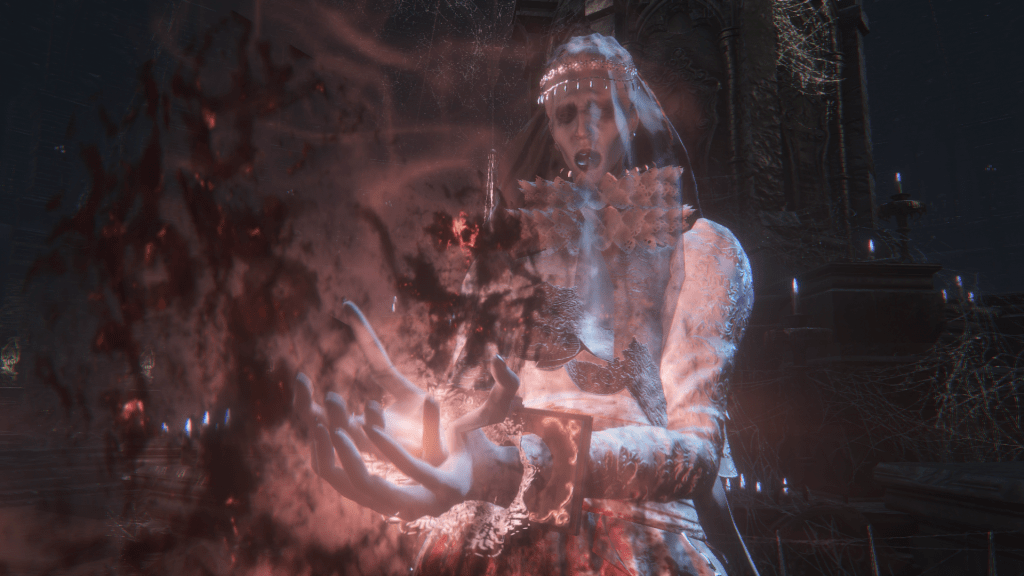

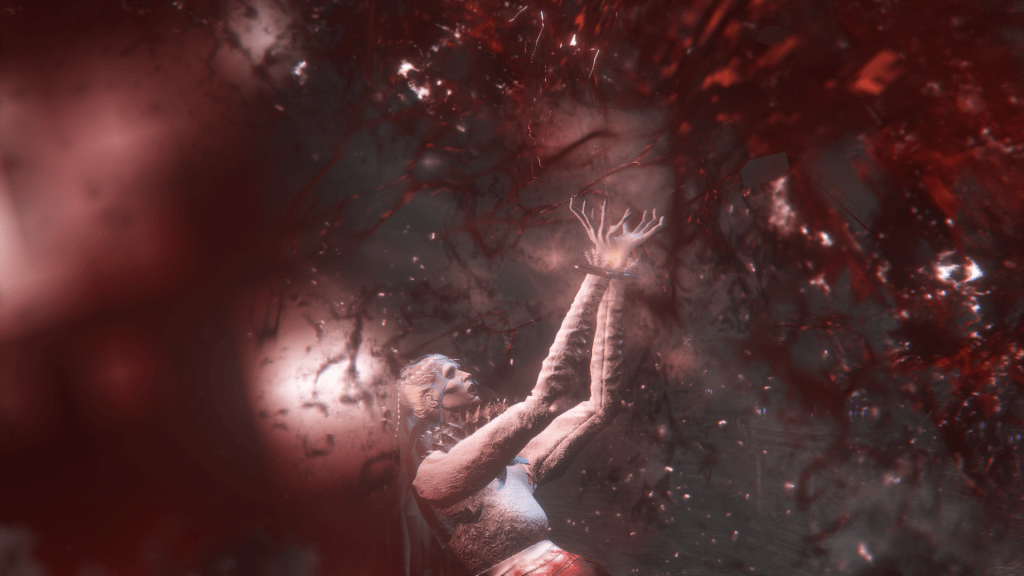

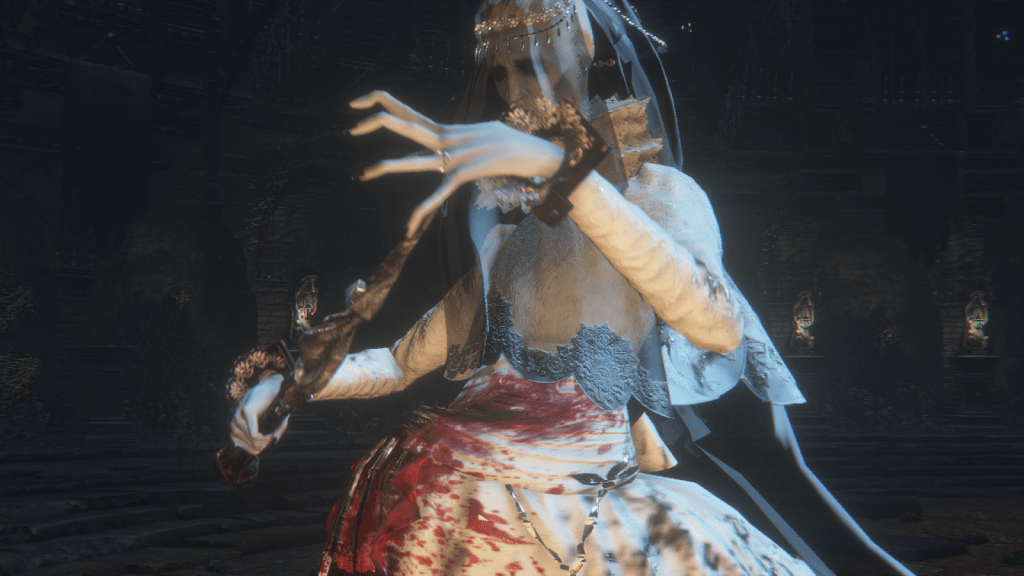


One of the Karel runes which phoneticize inhuman voices. “Blood Rapture” is a form that discovers the raw pleasure in the warmth of blood and recovers HP due to visceral attacks as a dark aspect of hunters.
This rune is also well acquainted with those who serve the Queen to harbor a Blood Baby. For those who yearn for the Queen’s blood discover “compensation” for it in Blood Rapture.
We can see that the effects of this special blood extend beyond just a virgin birth. The description for the Yharnam Stone obtained after the queen’s defeat reveals that her consciousness is only resting. We do encounter her in dream worlds, with any damage suffered causing her to hold her head before collapsing. It appears that her will is lucid dreaming similar to the Great Ones, allowing her to persist after death. Her fragile state as, effectively, a ghost with more cognizance leaves her unable to endure combat in her dream form. But if she has collected more ill will in the blood than any noble in the capital, then a kind of immortality should be possible, as evil spirits of the labyrinth demonstrate to a lesser extent. That will inherited from others rather than cultivated by her own would also explain why she shows capabilities otherwise only exhibited by Great Ones while not becoming a Great One herself. It is borrowed insight sustaining her vitality, not her malice and certainly not her enlightenment. And because of that, it can conceive an enlightened baby within her.
Holy relic left by Yharnam, Queen of Pthumeru.
Now that the Queen is deceased, her repulsive consciousness rests. But it is only resting…
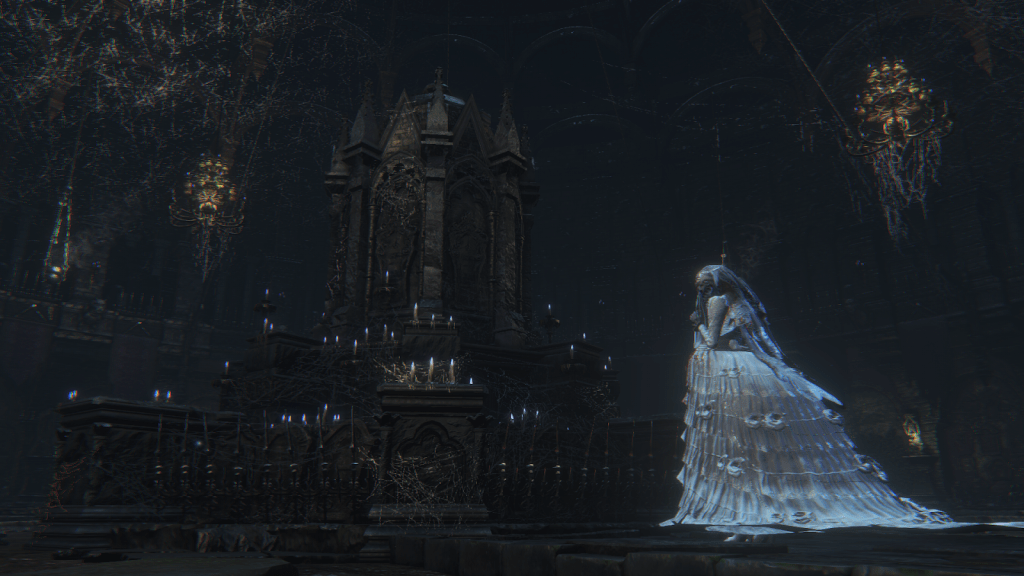
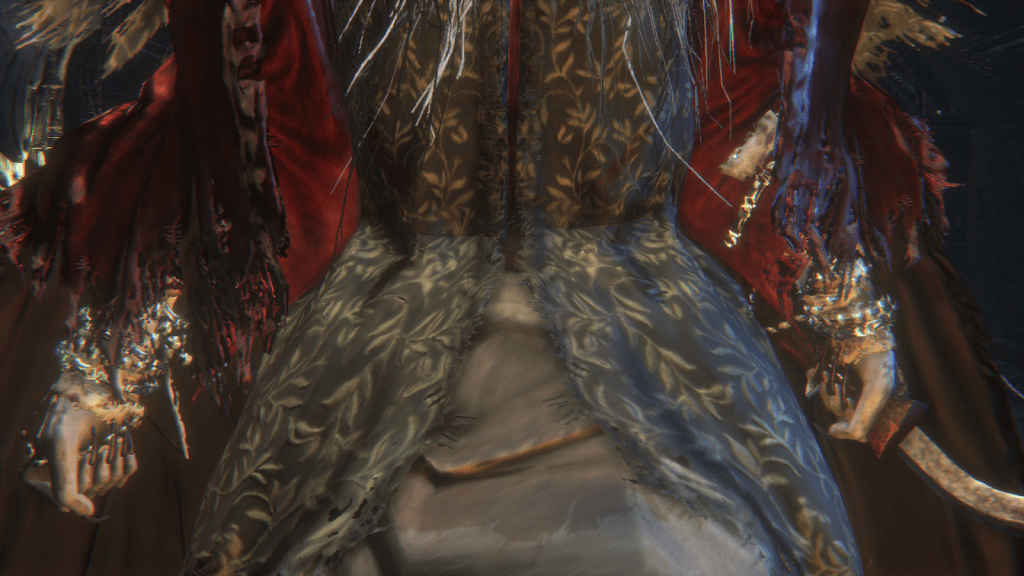
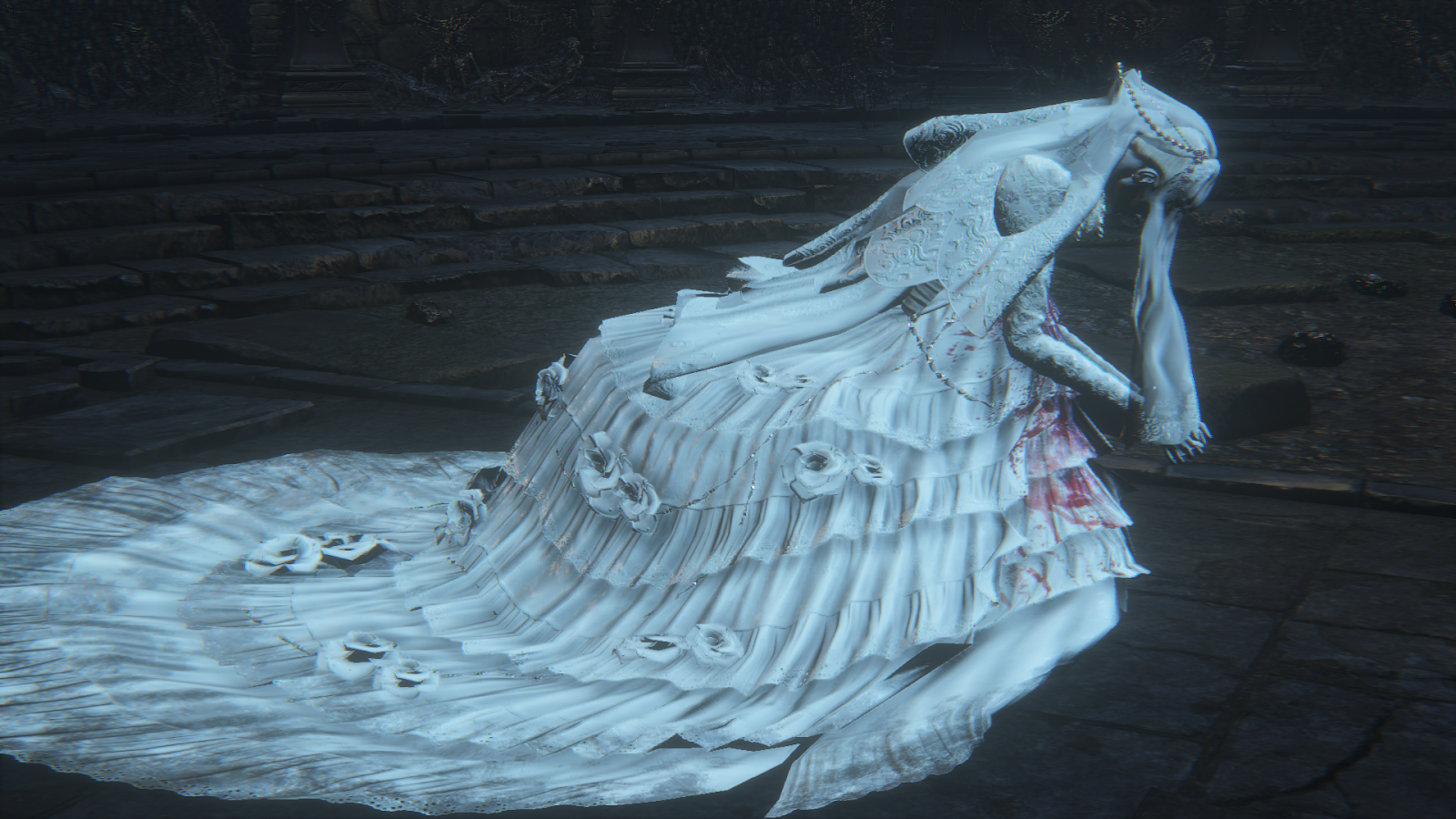
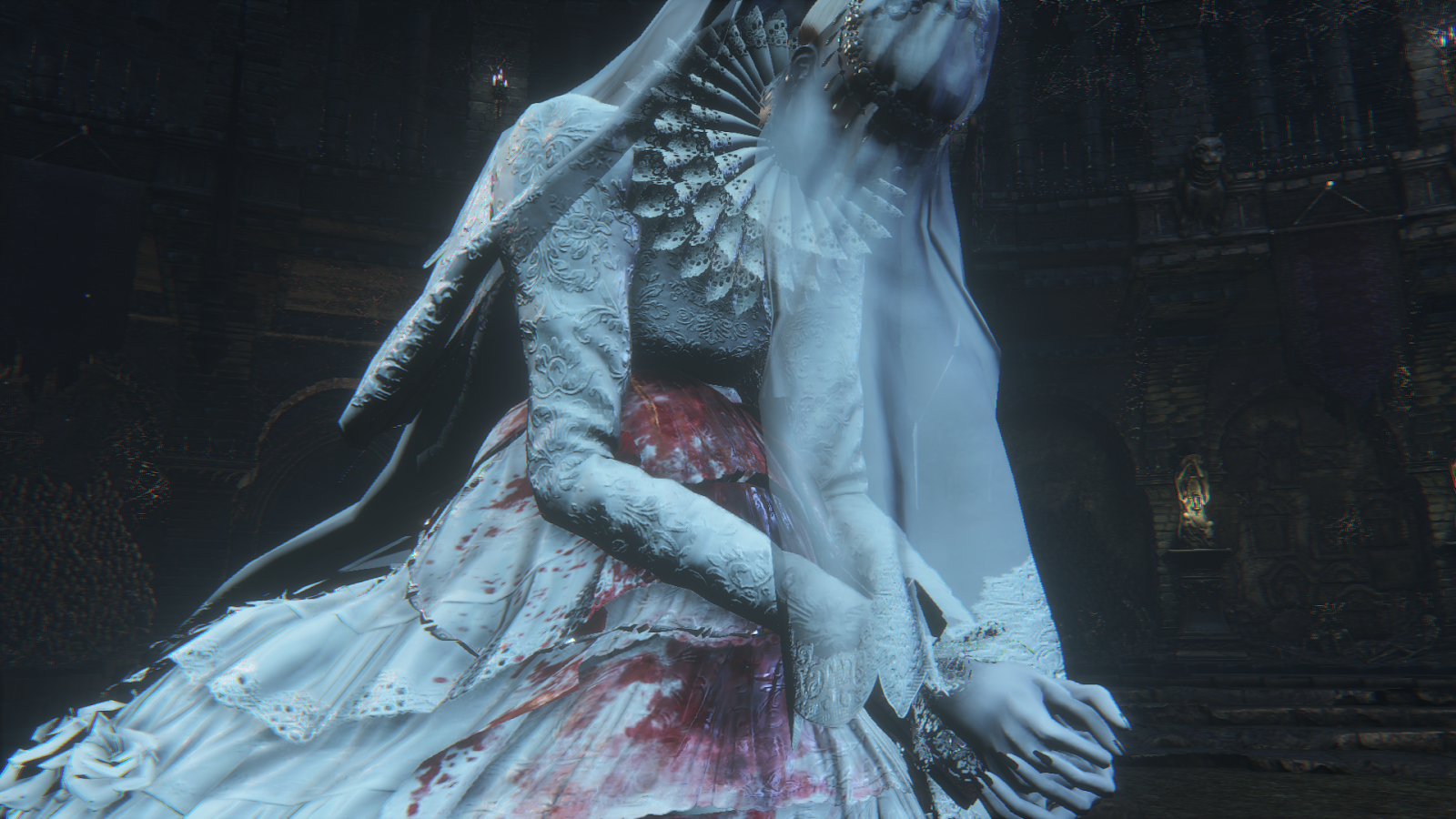
In short, Pthumerian society is structured so that the queen may imbibe the most malicious blood in the dungeon until she achieves a state where a Blood Baby is conceived from the collective will. Mergo is just the latest Great One born of this process, with Pthumeru Ihyll planning to offer the child to the gods for favor. In that sense, the queen is the mother of god, similar to the Virgin Mary in Christianity. That more intimate relation with the Great Ones is reflected in her clothing. The monarch’s white dress takes obvious inspiration from the depiction of the vampire Lucy Westenra from Francis Coppola’s film adaptation of Bram Stoker’s Dracula, befitting a blood-drinking superhuman woman with corpse-like pallor. But besides giving this “vampire” queen that apparitional aura after her death, the clothes match a Victorian wedding dress with Elizabethan ruff. The Pthumerian monarch presents herself as the Great Ones’ bride, carrying their child. This sends a message to, at minimum, society of her contribution to the cause and legitimacy by divine right. More broadly, it may inform the gods.
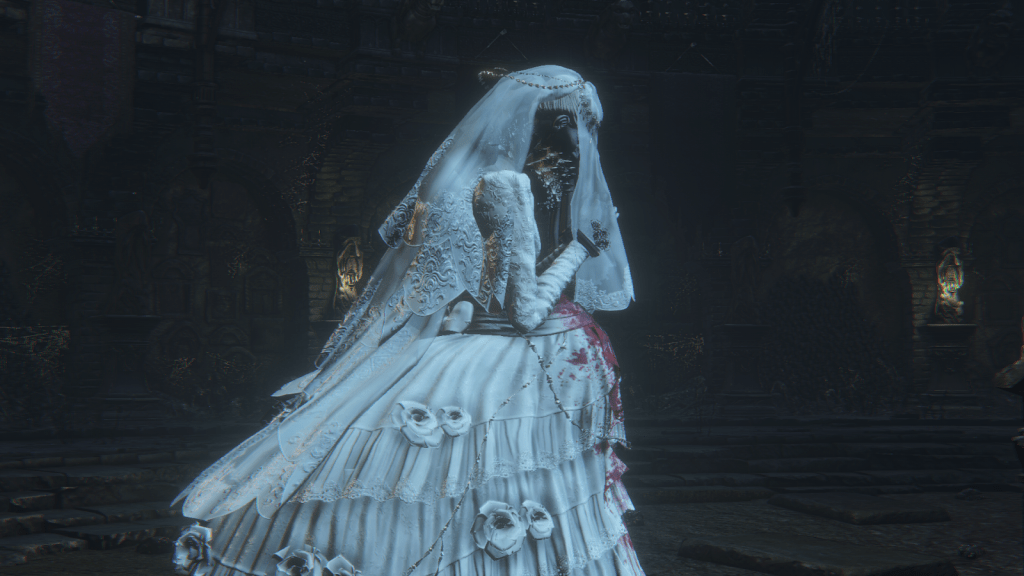

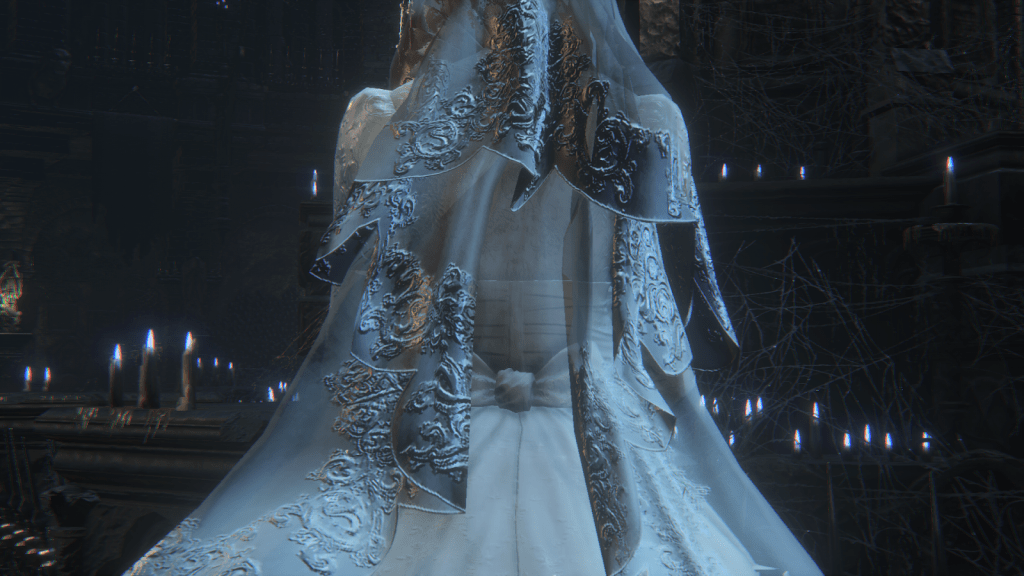
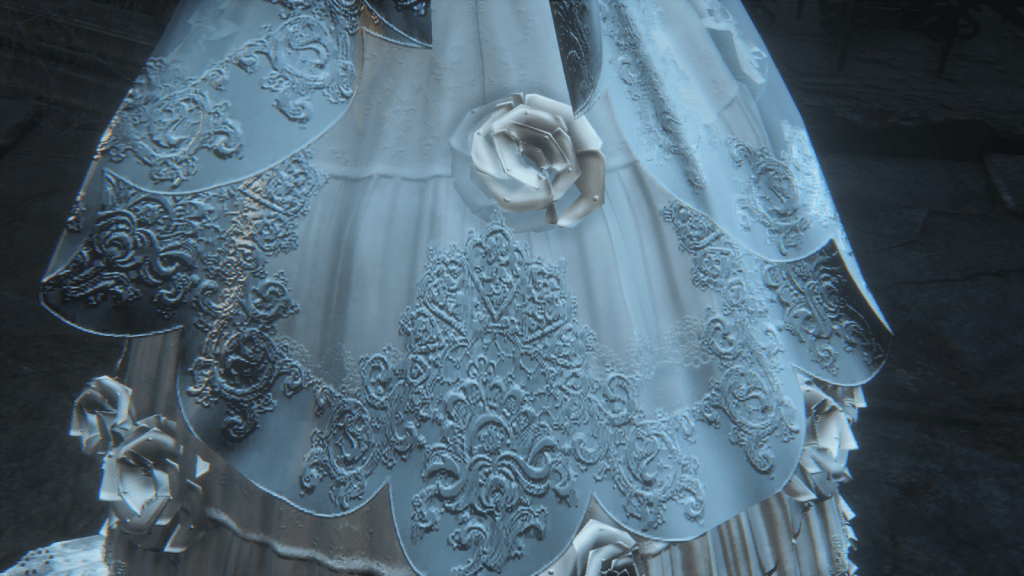

Essentially, Pthumeru wants to garner the Great Ones’ attention after acquiring the desired baby. This would explain the choice for every Pthumerian queen to inherit an “old name” (古い名) generation after generation, which our exploration of Pthumeru Ihyll’s story dungeon reveals to be Yharnam. The Japanese katakana for Yharnam (ヤーナム) is an anadrome rendering of the Sanskrit munayah, (ムナーヤ) meaning “the saints” — more specifically, sage aesthetics who achieve enlightenment through self-realization rather than by reading scientific or religious texts, such as the Buddha. The terminology perfectly encapsulates the ethos to transcendence, with the holy men becoming the great gods high above. But in the context of Pthumeru Ihyll, “Yharnam” likely holds some significance in the old Isz language, translating to “bride” or “mother of God” or some other expression of her readiness to provide the Great Ones a child. Whatever the exact meaning behind the name, the consistency across generations of queens places greater emphasis on what the queen represents more than her individual identity.
One of the pan-Holy Grails that lift a seal on various parts of the underground ruins. “Holy Grail Dungeons” which have their seals lifted via a pan-Holy Grail ritual are known to change their appearance with each ritual.
It is said that the king of Pthumeru was traditionally a woman and inherited an old name for generations.
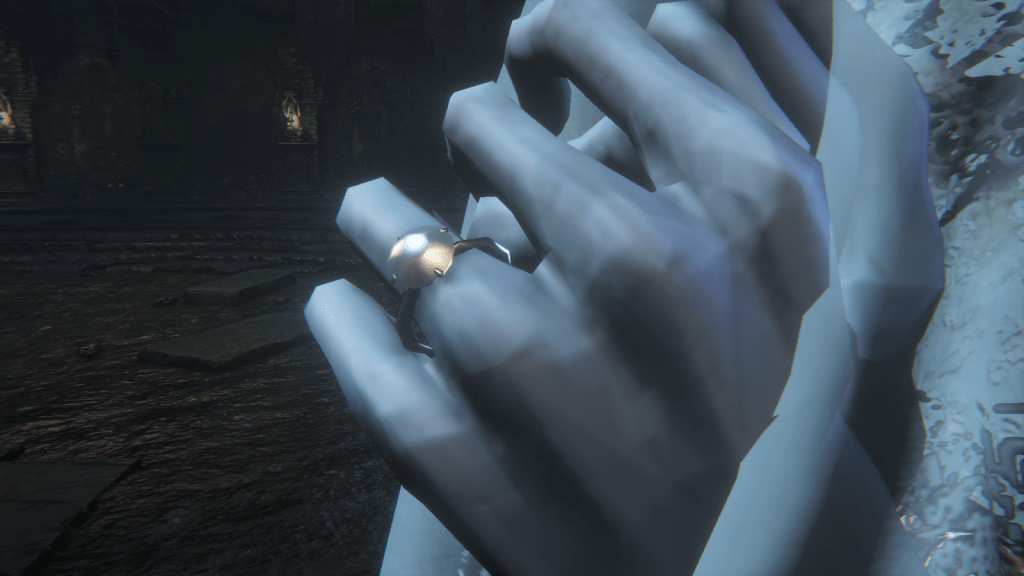
Taken together, the queen wears shackles because it shows her submission to the gods in becoming their bride, conceiving for them offspring. The meaning probably runs much deeper than that, in fact. The Ring of Betrothal is looted from a chest in Pthumeru Ihyll root dungeons, suggesting that the capital inherited the practice of blood covenants from Isz along with it. Yharnam already wears a similar ring, proof to the gods that she will harbor the special child to gift them per the covenant. And recall that this marriage contract demanded a special blood for the special baby — a Blood Baby, if you will. Taken together, and Queen Yharnam has repeated the experiment which Isz had ultimately formulated in the age of old. Seeing the spider kin around Pthumeru Ihyll, as well as most dungeons, the royals and nobles almost certainly sought transcendence, which an infant Great One could be used to bargain for. Just as the old gods, yet human, created children to receive a share of their predecessors’ insight into greatness, so too would Pthumeru. And the shackles harkened to the gravekeepers’ role model.
Symbolizing Keepers of the Old Lords for outsiders is not the mask but the hat they don atop it, no other piece of apparel worn around the empty armor quite capturing their image. But according to the mask’s description, that iconic element serves as a sign to others that they are some kind of sinner. This would make eternal guardianship of their bodies a kind of punishment of imprisonment from the Great Ones, but for what crime? The answer may lie in the fact that the watchmen are all specifically watchwomen. Besides the generally feminine silhouette, the Keeper’s symbol is the stereotypical pointed hat worn by witches. The kanji for majou (魔女) literally renders witches as magic, evil, or demonic women, which complements the notion of sinners. One of the enemies we encounter is also a bone ash hunter using a female player model, internally named Carla (骨炭の狩人、カルラ) — which derives from Germanic to ironically mean free woman. (Dark Souls III would later reuse this name for Karla, a prisoner and bona fide witch) Whatever the Keepers’ crime, it appears limited to only the fairer sex.
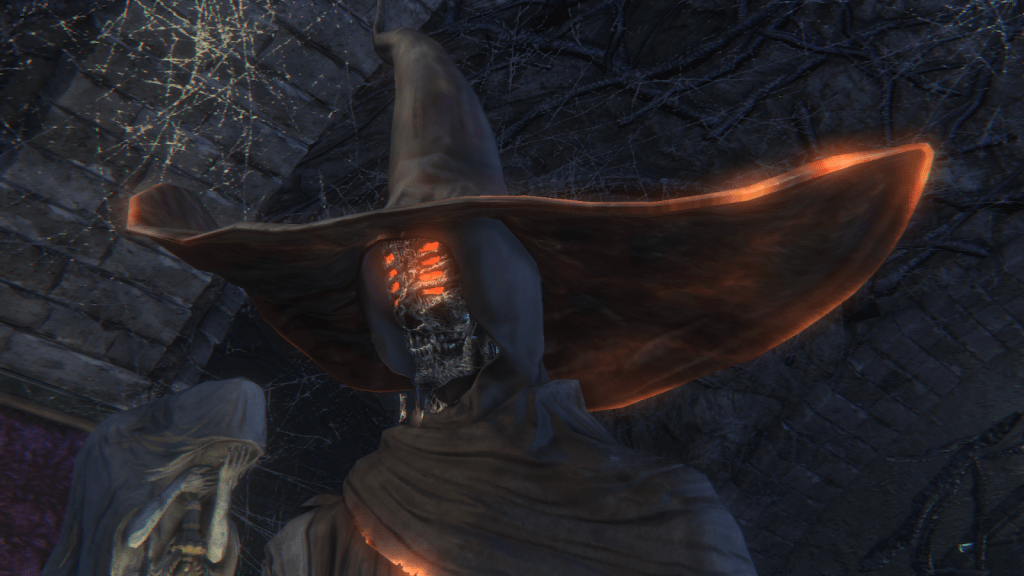

Bone ash mask of the oldest watchmen.
It is said that the watchmen who protect the Higher Ones’ sleep burn theirs souls into that form with hellfire, and acquired long lives as ash.
The large hat tapering to a point is a symbol of the old watchmen and considered to be proof that they were some kind of sinners.
With that in mind, there is only one crime related to casting “magic” that is unique to women and of primary concern to Isz. The Keepers of the Old Lords are liable to be the women who broke the marriage contract with their husbands. The men of Isz commoditized their women on the promise of their blood’s potential to produce a special child which families could use to bargain with their radiant predecessors for the secrets of transcendence for them all. If those women failed to deliver a Blood Baby, then it was a waste of everyone’s precious time — can’t become a god if death takes you first. What better punishment for this “sin” than to purge the women’s “impure” blood with flame? If those “witches” can’t help them become Great Ones, they can eternally sniff out graverobbers for after they did. The fact that this is a duty left otherwise to their dogs speaks to how much Isz looked down upon not performing during these arcane blood rituals. In that sense, the brides were slaves to their civilization.
And with that, the full picture of Pthumeru’s origin comes into focus. Everything the proto-Pthumerians did was because they observed that it was what their masters wanted from them. Why become gravekeepers? Because the Great Ones left watchmen to protect their corpses. Why make their king a woman with special blood? Because the Great Ones used women to conceive Blood Babies. Why dress the queen as a shackled bride? Because the Great Ones treated their contract wives as slaves. Why call every queen the same name? Because the Great Ones recognized the meaning from their human days. It is no wonder that descriptions emphasize how the Watchers “tried” having their own ruler — in the end, the most they could muster for independence was choosing a woman with the best blood for pleasing the Old Lords to make decisions. This entire time, the tribe’s thinking has revolved around their masters. They don’t want true independence, just their gods’ attention. They want to join them in heaven, finally be free of their burdens of gravekeeping.
All of this is the source to Pthumeru’s dysfunction. Declaring the existence of a king as the name of the capital wasn’t an act of rebellion but declaration of subservience. They have never been a proper country, just an organized cult dedicated to escaping this earth. Whenever anyone tries to break free from the collective, the elites who primarily benefit from the dependency quash it. It is faithful service for selfish ends, drunk on a dream, no different from Ebrietas. This is all at the core of their civilization, starting from their monarch. Even as generations and time passed, the Pthumerian queen, the Pthumeru Ihyll, continued to preserve the culture by inheriting an old name. Much might change under every queen’s reign, but their roots would stay the same. In some respects, Yharnam was a figurehead, the power invested in her conditioned on her capability as childbearer. She could never escape this fate if she wanted to retain a hold on power. Thus, the blood banquet can never end.

But even if a new queen was installed based on her blood quality, that still made her invaluable to the culture, and thus she is afforded the best protection. The Shadows of Yharnam dress in tattered black robes with skin the same color of darkness, obscuring their features. This wraith-like appearance, reminiscent of the Nazgûl from Peter Jackson’s film adaptations of The Lord of the Rings, is more than just an artistic liberty by the developers. During our first encounter with three of them as a boss, the Shadows begin stretching their limbs to unusual degrees much like the spider skin encountered in the dungeons. Their appearance thus seems to be a result of transformation through arcane means into an entity of cosmic darkness. The reason to sacrifice their humanity is so that they can better fulfill their duties as royal bodyguards. Defeating the boss rewards us Blood Rapture, implying that the so-called Shadows of Yharnam are servants to the Queen Yharnam harboring a Blood Baby.
Their role as her royal guard is obvious from their locations. Just as she surfaces in the royal capital for the story dungeon, they crop up occasionally in Pthumeru Ihyll root dungeons. The boss encounter takes place in the Forbidden Woods, the Shadows making their entrance out of an unsettling fog from the gate to Byrgenwerth. At Byrgenwerth, we enter the Moonside Lake where we will first meet Queen Yharnam after another boss fight with Rom. And before we can see the queen again in the Nightmare of Mensis, we must first get past a small army of Shadows. Like her shadow, they follow wherever she goes, sweeping the general perimeter for threats. This is why they wield basic armaments, medieval maces and katana, and use candlesticks to perform simple fire arts. They are Pthumerians, dedicated to protecting their queen. This is in large part because they are enraptured with her blood, compensating with a rune while they await their next “payment” for service. However, the Shadows failed their duty. They are nowhere to be seen when we face Queen Yharnam, which proves far too consequential.
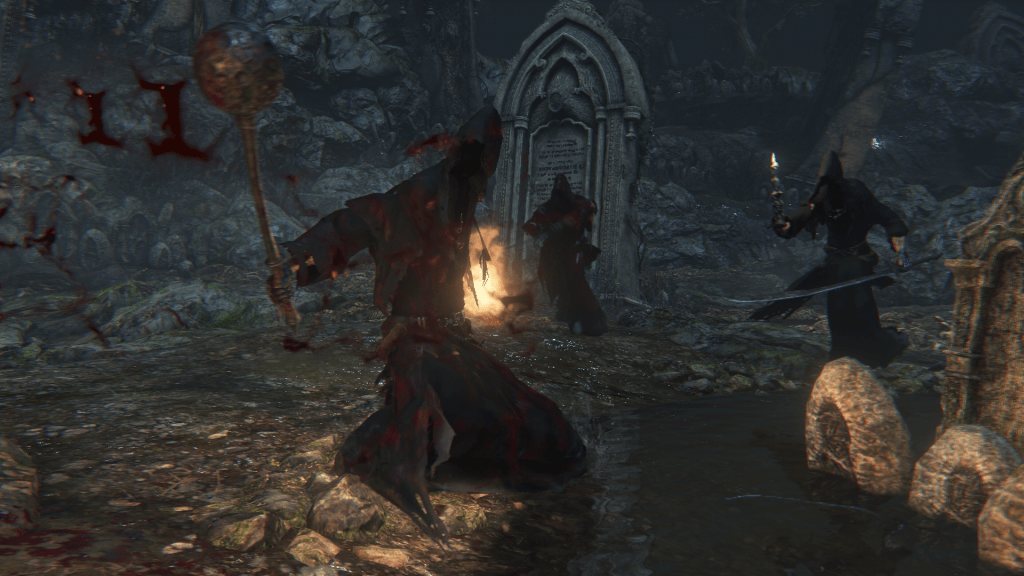


She Cannot Rise Again
We don’t need to challenge Pthumeru Ihyll alone. A possible ally for the Chalice Dungeon, including the final floor, is a hunter summon simply called Queen Killer. There are many identical hunters we can encounter throughout the deepest root dungeons, but this one nameless man is identified as such for presumably committing regicide. The only story dungeons in which we can use a bell to summon him are the Pthumeru dungeons at Depths 4 and 5. And while both instances take place before we face Queen Yharnam, both are also simulations of the past. If the man became a queen killer, it took place before our experience in the dungeon regardless. In that case, the hunter most likely earned his “name” from hunting the same Pthumerian queen that we do, potentially with his help. Put simply, in the actual events where we weren’t present, “Queen Killer” hunted Yharnam there in her capital.
With her death also came a separation from the baby in her womb. One might think that this would lead to Mergo also perishing, but this doesn’t seem to be the case. The Yharnam Stone looks like a porous mass of solidified blood, similar in nature to blood stones and crystals. But upon closer inspection of the menu graphic, it is easy to make out the shape of a fetus within the supposed rock. This brings to mind a lithopedion, or “stone child”, (石児) formed when a fetus dies before birth and calcifies during an abdominal pregnancy. We do see bloodstains on the queen’s dress consistent with profuse bleeding from the abdomen during a miscarriage or similar fetal complication. Cut dialogue further reveals plans for the priest in the Fishing Hamlet to mistake Yharnam’s stone for the baby of another Great One, Kos. Without at a doubt, during the development of The Old Hunters DLC, this was intended to be a Great One child. It would thus appear that Mergo was already dead, at least in one sense.

… Ah, the baby of Ghos returns to the sea… There’s no bottom to a curse and the sea, thus they accept all.
Indeed, a Blood Baby should have its form manifest from the combined wills in the mother’s blood, creating a new life with a new will and new blood. This presumably is what allows the unexperienced fetus to emerge with transcendent thinking. But because this isn’t a normal pregnancy, there are bound to be more risks of error even if the blood does generate the child. In Mergo’s case, the body couldn’t develop to the stage of full viability, instead hardening like we see with blood stones in blood after death. This leaves the baby in the awkward state where it never consisted of a proper body to die with but cannot progress past the point of just living blood either. Factor in the fact that Mergo’s will reaches Great One status, and we have a vigorous soul manifest in a static vessel. The Latin mergo does mean to “sink” or “drown”, so it is easy to see how the instant transcendence and unconventional origin caused the developing baby to be consumed by the blood it was forming in.
Whatever the reason for this faulty fetal development, Mergo is effectively both alive and not alive. The crying we hear is an arcane projection of the child’s internal voice, hence occurring even while still within Yharnam’s womb. Even as a stone, Mergo is aware of its surroundings to some extent and can exert incredible power in conjunction with its mother. However, the fetus will never come to term in its current state. This doesn’t concern Queen Yharnam. The fact that she hasn’t forcibly terminated the pregnancy after showing the bloody signs on her dress speaks volumes about her position on the matter. Perhaps it is simply her desperate denial, praying to the gods resting in those graves for salvation so that she doesn’t lose face as a failure. But more likely, it is simply the love of a mother for her unborn child. The infant Great One demonstrates a protective affection for its mother, constantly crying while separated from her in the Nightmare of Mensis, and Yharnam in turn pursues Mergo. Clearly, the queen was satisfied if the two continued life together in their peculiar arrangement.
But fate had other plans. Yharnam was killed, her consciousness lingering in the cosmic realm. Despite stemming from her blood, her Great One child doesn’t appear to possess the same degree of immortality. After we defeat the queen in the dungeon, we are able to claim the Yharnam Stone without consequence. The child is, in the best case scenario, forced into a catatonic state upon the mother’s death; in the worst case, we have slain them both. Either way, Mergo’s appearance in the Nightmare of Mensis must simply be the stone body that wasn’t killed by Queen Killer, hence we never properly see the baby in the carriage. And whether or not the child did fall into regular dormancy, the baby was deprived of a mother and lacked the ability to prevent itself from ending up in the Nightmare of Mensis, where it most certainly regained the awareness to cry incessantly. Hearing her baby’s distress draws Yharnam’s consciousness to the location, setting her on the journey where we cross paths.

With her own body inoperable, she and her guard traverse the dream realms to Byrgenwerth before us. When we catch sight of the queen at Moonside Lake, she had likely been peaceably beseeching Rom to reveal the Nightmare hidden from everyone in the cosmic realm. At an impasse, she weeps inconsolably whilst continuing to pray for salvation, even as we arrive to kill the spider. By the time we take notice of her presence, she herself notices the red moon arrive. We are then warped to the entrance to Yahar’gul, text directing us to find the baby of the nightmare now that the secret has been revealed. It is possible that this is a message from the queen, as she is the only one around to teleport us out of the Moonside Lake. Yharnam does have the motivation to send us after the child in light of her helplessness. She is also presumably coordinating with her guards on earth via cross-planar telepathy, similar to the Great Ones communicating runes. Assuming that the text reflects only the general sentiment, the monarch may well be using her limited power to aid us for her own sake.
The rituals’ concealment is broken. Find the Nightmare’s baby.
Regardless of how we transition to Yahar’gul, the queen and her guard enter the Nightmare of Mensis and reach Mergo’s tower before us. The queen once more can only pray for a proper hunter to slay the Great One blocking access to her child. Defeating Mergo’s Wet Nurse and silence the baby’s cries, the queen gives us a final deep bow of gratitude before fading away, her consciousness maybe read to rest in peace. We can only imagine how Pthumeru has reacted in the meantime. Her Shadows are still loyal to the queen, but that might be out of guilt for allowing an assassin to slay their ruler on their watch. It is possible that the country has collapsed into infighting again, or that a new ruler has already taken the last Queen Yharnam’s place and begun working to birth another Blood Baby. Whatever the exact circumstances, history informs us that Pthumeru is unlikely to see radical change. They are a nation forever inheriting the will left by their ancestors, by no one’s choice but their own.

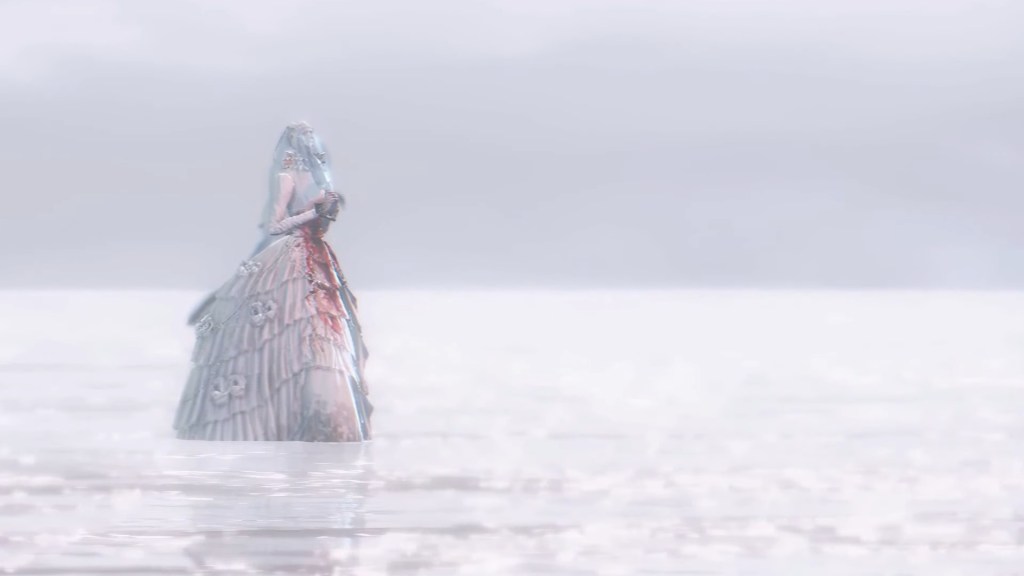
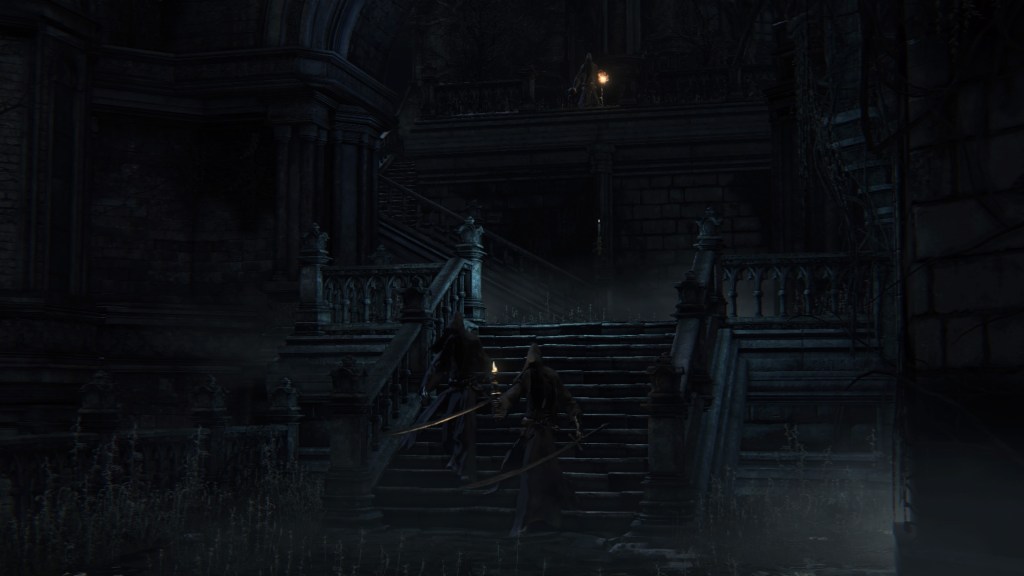
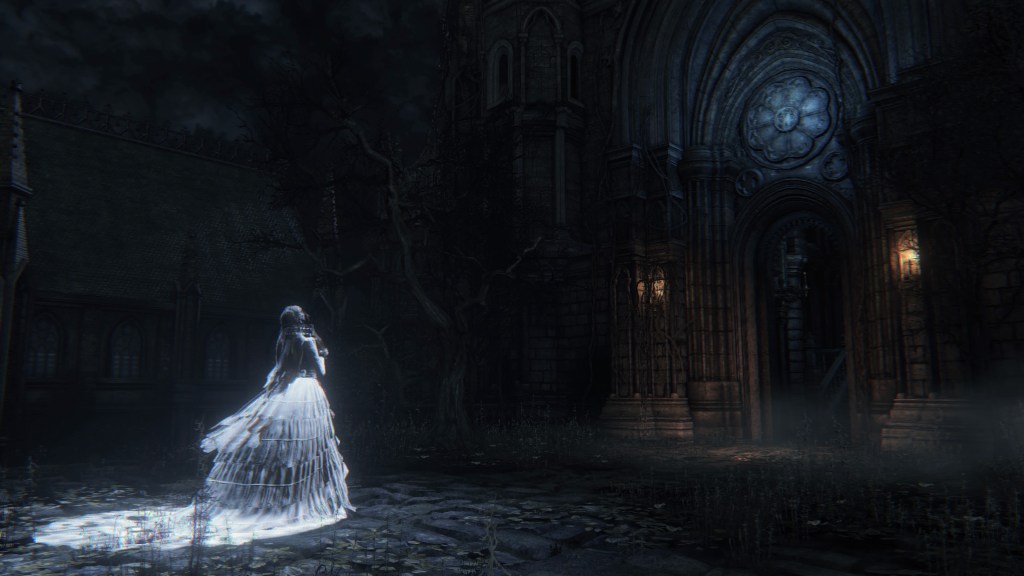

 Lokey Lore