
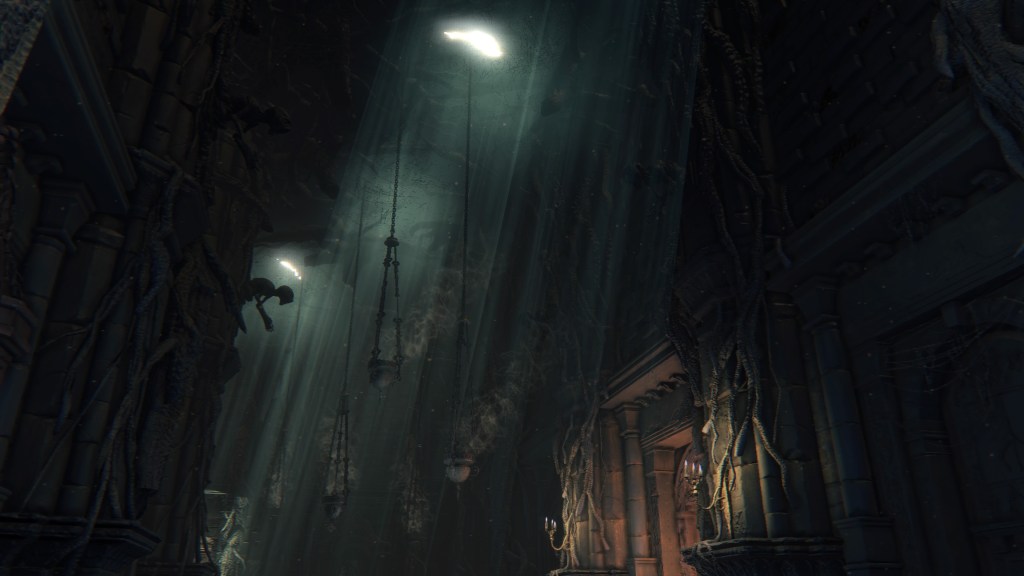
Several characters mention the tomb of the gods beneath Yharnam. Although we cannot reach this graveyard by conventional means — through some path in the cityscape available to us — we are still able to explore the place via the Chalice Dungeons. These dungeons, drawing upon the concept common to fantasy RPGs rather than strictly a prison, are part of a labyrinth called the “underground ruins” (地下遺跡) with some manner of burial marker around practically every corner. Those are the gods’ graves or at least include them amongst the crowd. As we collect “keys” to unlock more dungeons, we can discover more tombs where the divine are laid to rest. The dungeons are divided into five difficulties defined as “depths”, which correspond to the relative depth to the given ruin underground; the higher the number, the deeper the ruin. Pthumeru, Central Pthumeru, and Lower Pthumeru are categorized as depth 1, 2, and 3, respectively, and abyssal blood gems growing only in deep parts of the ruins are exclusive to depth 5. We therefore descend the tombs as we ascend the difficulty.
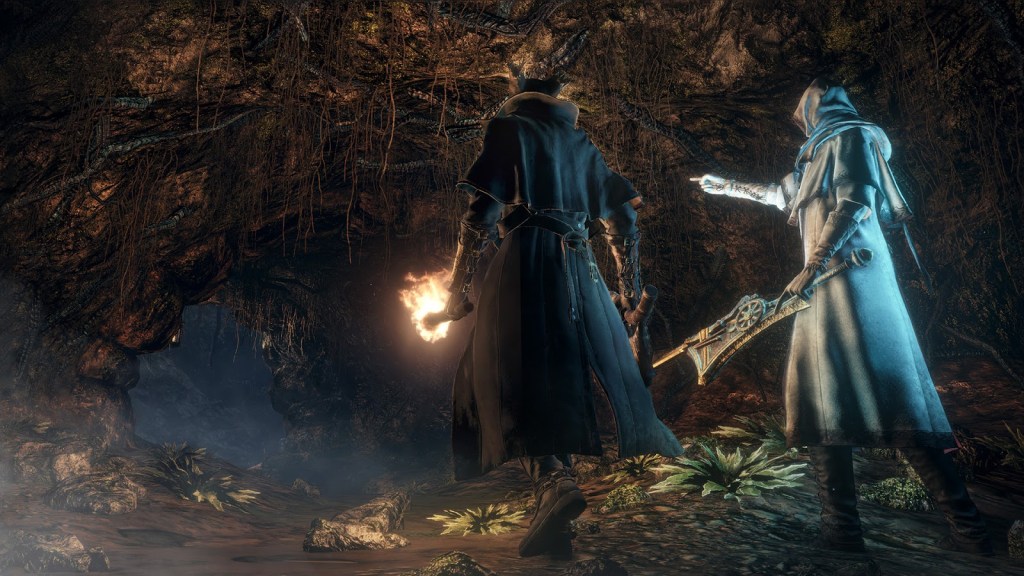
Ritual Holy Grail that had been enshrined in the Holy Grail Church. If you perform a ritual at the grave altar in the Hunter’s Dream, a seal on the underground ruins will be lifted.
The Holy Grail opens the gods’ graves, and their blood becomes provisions for hunters… For you receive the Holy Body…
All of this seems straightforward. However, there are oddities about the Chalice Dungeons which make them distinct from the typical catacomb. For one, we can only enter a standalone slice of the tombs with each dungeon, the section comprising a few layers connected by lifts with no exit into the supposedly larger complex. We, as a hunter, achieve this by placing a chalice belonging to the area on an altar, filling it with certain blood and arcane haze, and adding an assortment of offerings somehow related to the place in question as part of a ritual. Chalices come in several varieties, one specified as “root” cups. Befitting the “pan-” prefix to these chalices, (汎聖杯) each lifts the seal on various parts of its associated ruin, allowing the dungeon to take a different shape every time we perform the ritual — in other words, we gain access to theoretically every part of the ruin using this variety of goblet. The new area layout also brings a different setup for enemies and items depending on the specifics to the ceremony.
On their own, these details aren’t so out of place. The disjointed exploration can be justified as simply gameplay limitations, with the chalice ritual serving as our means to instantly reach a specific destination through cross-planar transportation. Even root chalices can arguably bear differences which afford them a wider application in rituals than standard chalices, though their menu graphics are identical. However, this isn’t considering how we can also redo the standard ceremony to reset the same dungeon over and over, allowing us to loot items we have previously collected and challenge bosses we have already defeated. This, too, might be handwaved as simply game mechanics — analogous to generic enemies respawning when we die or return from the Hunter’s Dream — if not for unique dungeon bosses like Rom, whom we can possibly defeat at Moonside Lake before our encounter in Lower Pthumeru and vice-versa. How can a boss be in two places at once, or alive when dead?
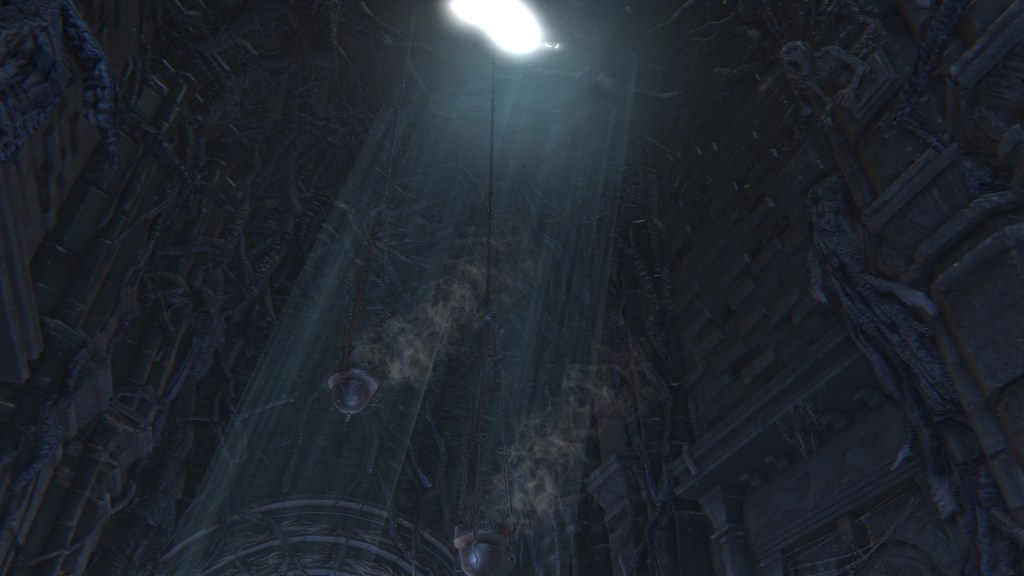
For even less explicable peculiarities, we can use cursed chalices or offerings to additionally modify the dungeon we enter or the enemies encountered within. The latter makes sense in abstract, some offerings exuding an odor meant to attract foes who otherwise wouldn’t be drawn to that part of the ruins. But how do enemies in ruins underground smell an offering laid upon a grave altar in the Hunter’s Dream, another dimension? This must also take into consideration the actual parts of the dungeon we explore, the Loran and Isz dungeons each featuring a large canyon with the sun pouring in from high above. This is a strange landmark when no such gorge is visible anywhere in the vicinity of Yharnam, let alone multiple with colors differing depending on the dungeon. How then can it be part of the gods’ tomb situated directly underneath, even assuming that the complex extends beyond the city limits?
All this casts doubt on us visiting a physical place operating on the same plane as Yharnam. At the same time, there is no denying that these ruins exist beneath the capital. From the Forbidden Woods, we can enter a cavernous aquifer. The hollow takes us just below ground level, yet we find tomb mold growing down there. Admittedly, the corpse-ridden cave replicates the conditions to grow this fungus associated with the divine graveyard, but there are also raggedy church giants meandering about, not too dissimilar from the undead giants we can encounter in the Chalice Dungeons. Joining them are the exact same parasitic insects crawling around certain dungeons. Taken altogether, the cavern most likely possesses some unseen connection to the underground ruins, an opening in the earth from which the mold spread and stray enemies wandered out. While the game doesn’t permit us to climbinto the labyrinth from this same hypothetical opening, its location must lay just below the subterranean aquifer’s level. And by heading up a long ladder, we exit the cave for Iosefka’s Clinic in Yharnam.


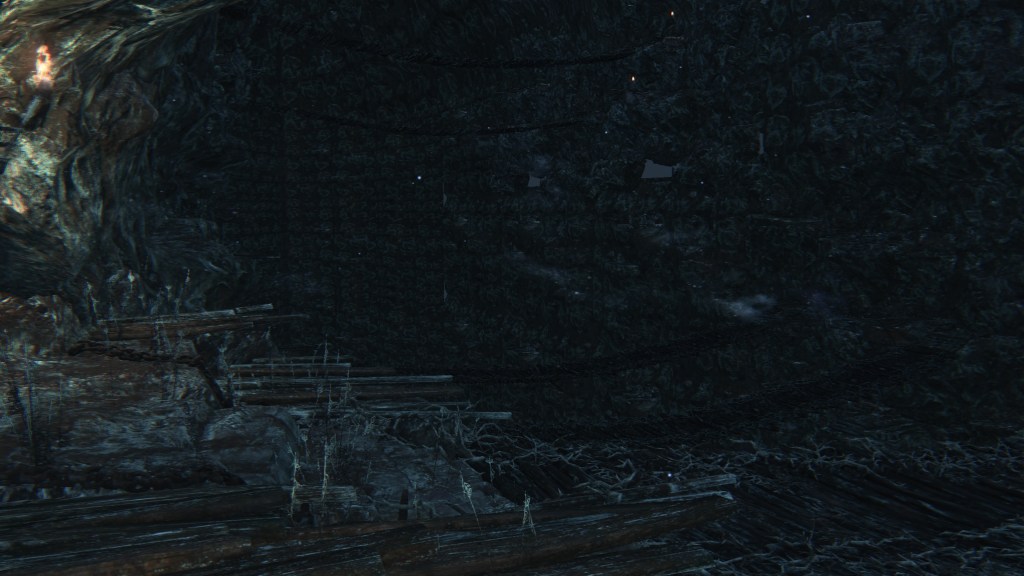

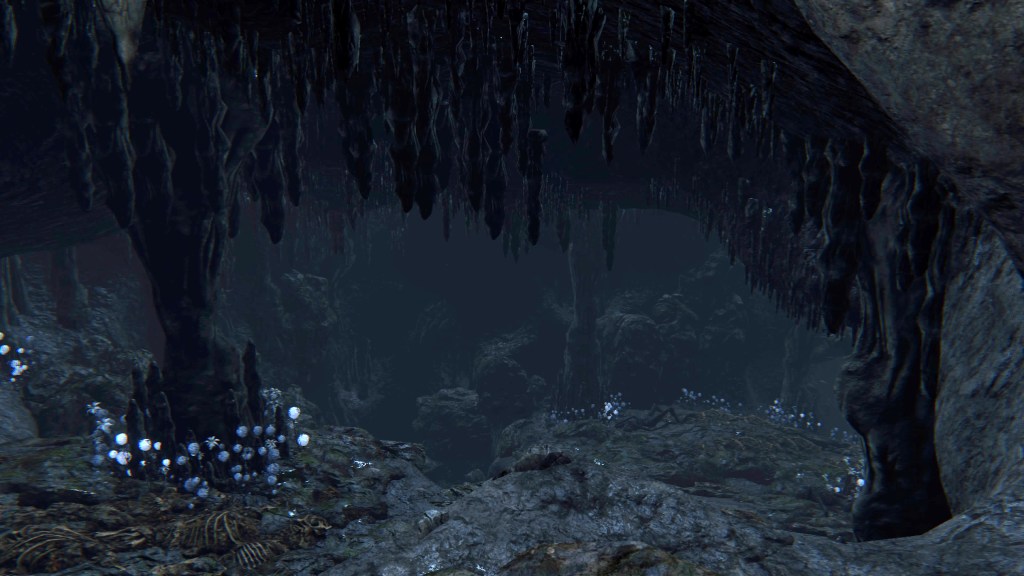
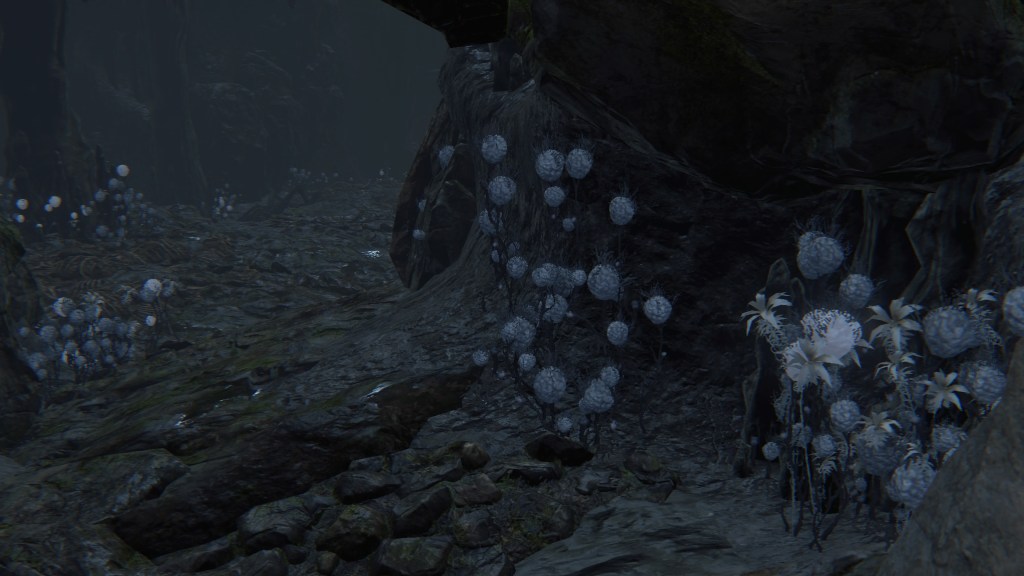
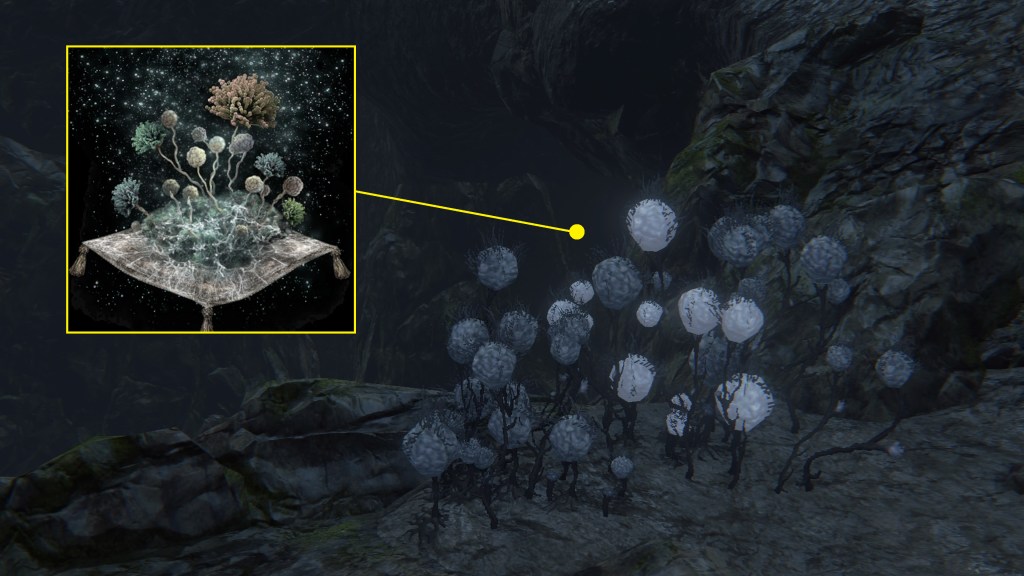
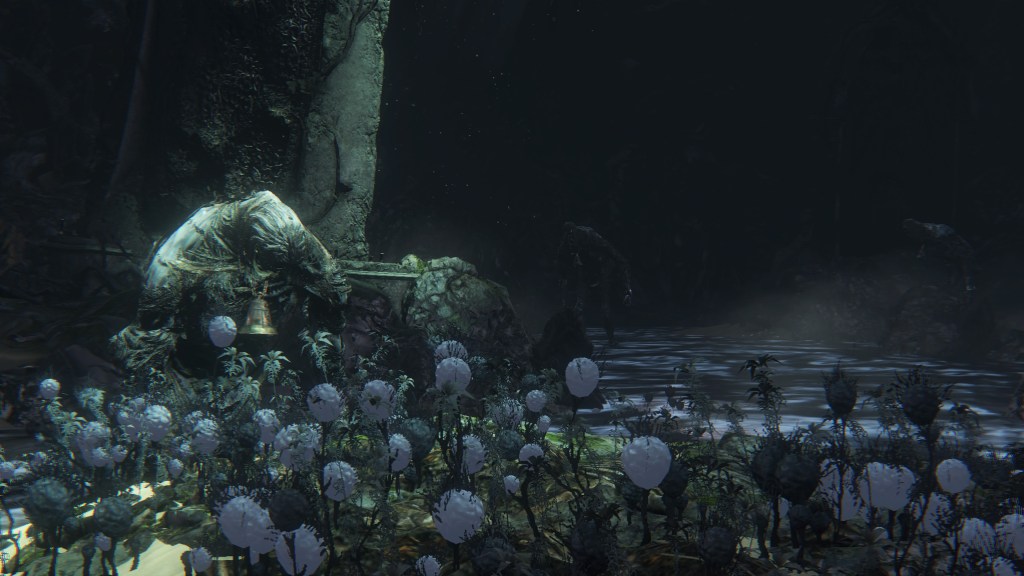

In short, there are the same divine tombs in the world we explore outside the Chalice Dungeons, tombs which anyone could theoretically uncover and enter like any buried ruin. This makes sense, since the chalices break a “seal” on the ruins we explore upon every use — how could anyone outside the labyrinth acquire a cup if the given ruin couldn’t be accessed physically? The chalice rituals only lift the seal on our accessing those ruins, because the game precludes us from any other mode of exploration without the appropriate cup. Essentially, the chalice rituals are purely for our convenience, not narrative necessity, and their supernatural quality opens up more radical possibilities for the dungeons. For example, the appearance of the same unique bosses across multiple, different dungeons can be attributed to them exploring the ruins like us. Put another way, the dungeons aren’t necessarily concurrent with our journey through Yharnam; they may be pockets of the past we insert ourselves in, hence meeting bosses who should already be dead. Each dungeon might thus capture a different point in time.
Granted, time travel alone doesn’t explain how we are able to kill these bosses in the past and still meet them in the present. Moreover, our venture through time can only take us a limited period back. One could reasonably date the aforementioned canyons to a more ancient era long before Yharnam was built, explaining the discrepancy. After all, Loran disappeared into the sands which litter its ruins, but no desert exists in Yharnam today. It is perfectly feasible for climate change to reshape the landscape over eons, turning mountains and valleys into desert and eventually a more temperate region with lush forests and vast bodies of water. And yet, the names and equipment of the various hunters we can summon within the dungeons invariably traces them to modern times, with many appearing insane in those same ruins. Some of these hostile doppelgangers might be generic stand-ins for their faction, since multiple occasionally exist within a single dungeon, even a single chamber. But obviously, if they are alive to explore the various parts of the labyrinth until going mad, then the events we witness can only be from the recent past, mere decades at most.
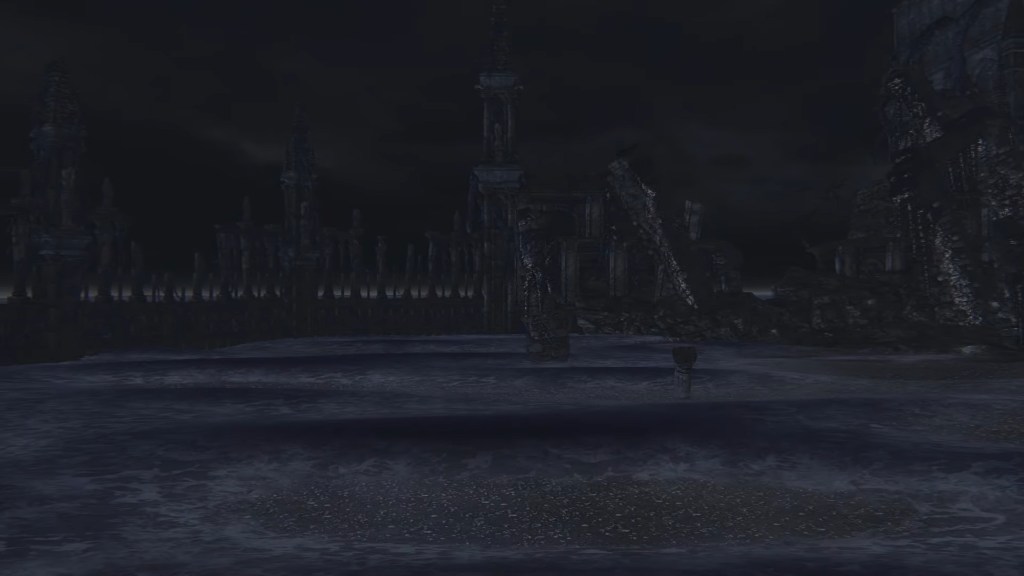
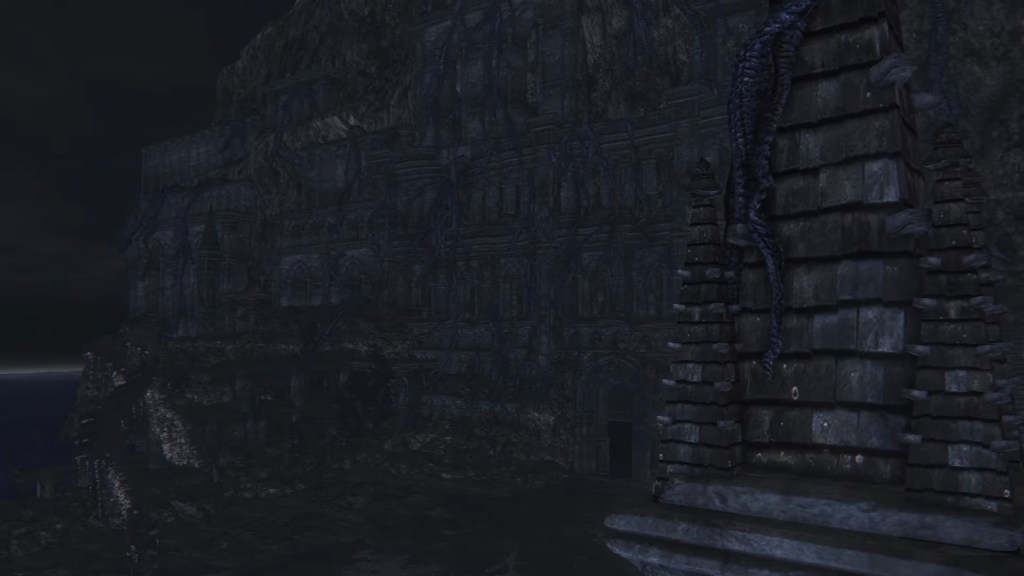
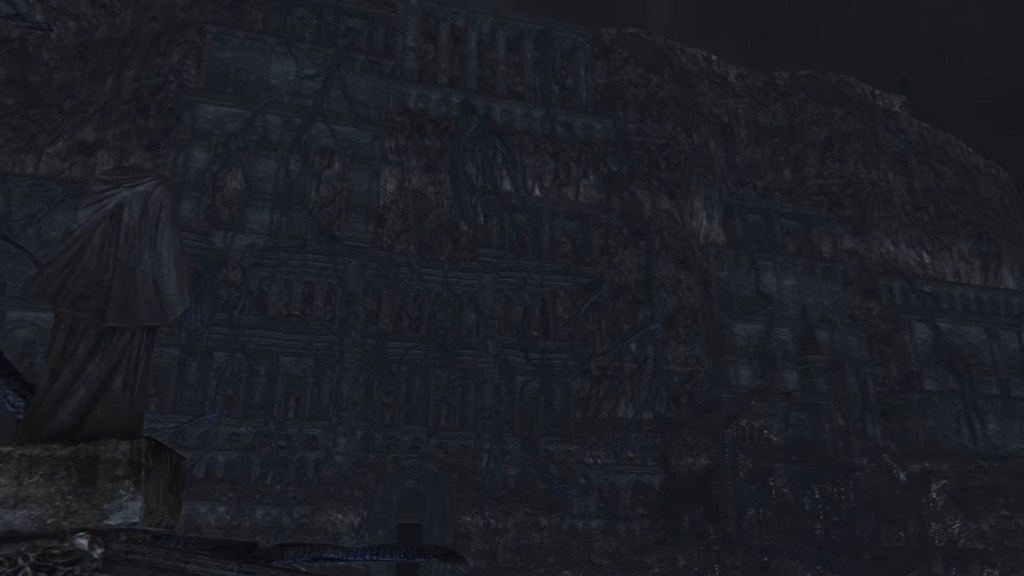
Indeed, some of these oddities with the Chalice Dungeons can be blamed on turbulent development. Cut content indicates that FromSoftware struggled with their implementation. Director Hidetaka Miyazaki admits that they even sparked interest in procedurally generated content in a Future Press interview, which fits with their limited pool of assets. The result is the dungeons lacking variety, many portions only slightly differentiated in a handful of cases — whether we are at depth 1 or depth 5, sunlight somehow pours in through cracks in the ceiling. It is therefore possible that the original concept was to explore a more ancient past to individual dungeons, which finds further support in one of the scrapped boss rooms. This area would have us exit the underground to a part of the ruins located outside, overtaken by the ocean waves; the labyrinth behind us built into a small mountain. Undoubtedly, there was no expectation for the dungeons to lie buried under layers of history and dirt. Ideas changed, but the developers lacked the time or resources for new assets, leading to the inconsistencies.
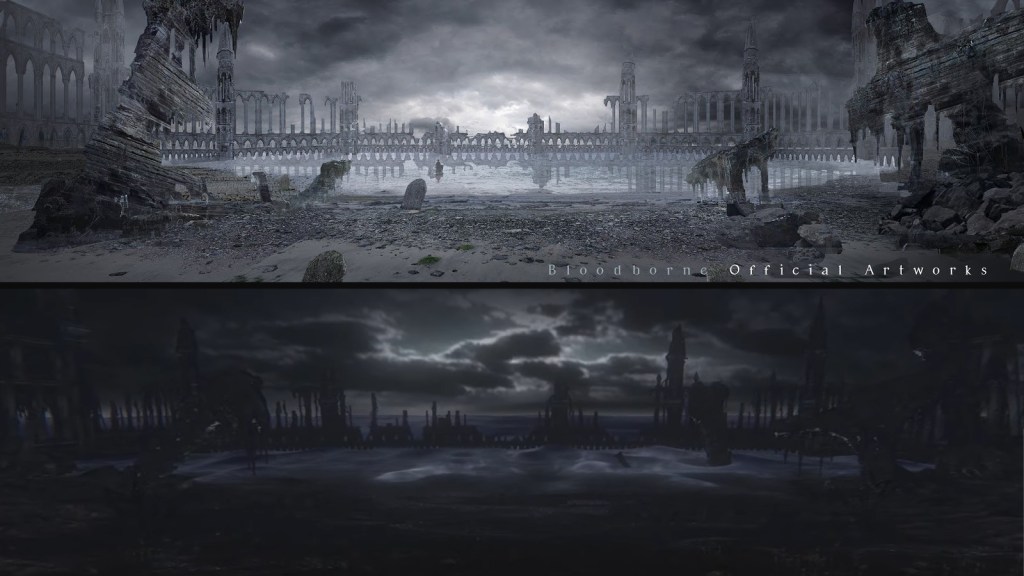
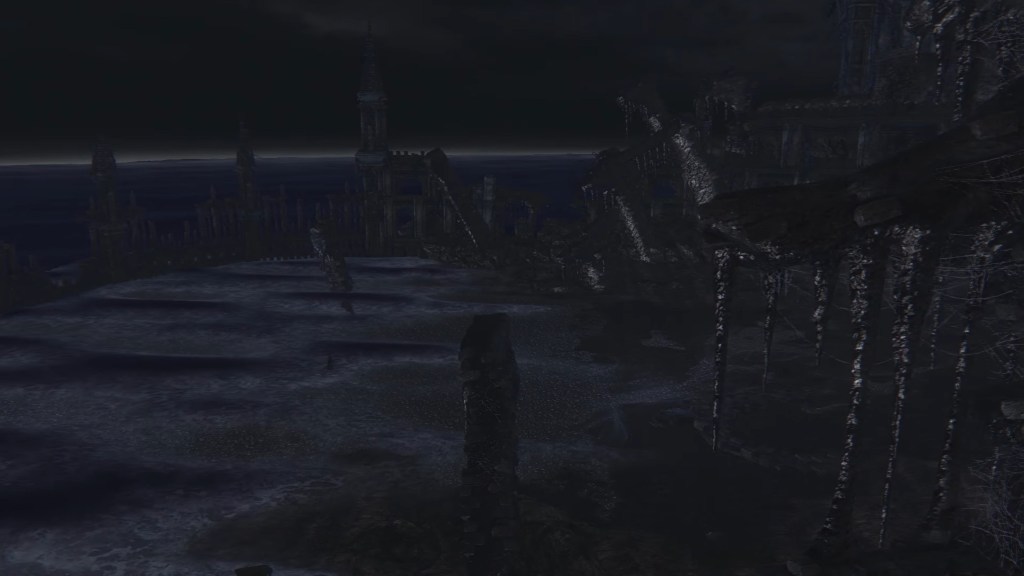


Put simply, the Chalice Dungeons are likely not the tomb of the gods currently beneath Yharnam, but a glimpse into its past going back less than a century. The obvious explanation to how a chalice ritual accomplishes this is that they are dream dimensions simulating the tombs during those different periods. Why can we manipulate the dungeons’ setup with special offerings? Because we are influencing the construction of the dream which need not perfectly replicate events. Why can we encounter foes previously slain? Because their soul data recorded in the cosmos is infinitely recyclable. Why can we only explore a narrow slice of the dungeons with each ritual? Because a single small ceremony can only generate so much with our equally limited knowledge on how to shape dreams. Everything falls into place with this understanding of the Chalice Dungeons as recreations of the physical place. We never explore the “real” tomb of the gods, only experience a parallel reality constructed in the dreamscape.
Despite being a separate plane, there is still much that we can learn about the labyrinth from the dungeons. The five depths, for instance, allow us to map out a rough blueprint of the ruins and derive the history behind both when each ruin was built and how they relate to other dungeons at similar depths. The same holds true for the items contained therein. Robbing the graves, we can particularly loot trick weapons. This is significant because they differ from the arms acquired on the surface. These bear different configurations for blood gems and are prefaced as either “lost” or “uncanny” — more accurately, “alien” (異質) — in their name. Based on their location, this is due to originating in the tomb of the gods. They are similar inventions made before the versions that hunters employ above ground, any contemporary identifiers removed from the Japanese names. This results in differences from the design we are familiar with, though the menu graphics and models remain identical. And since they became buried with the ruins underground, they are “lost” technology which modern man has reproduced, knowingly or not.
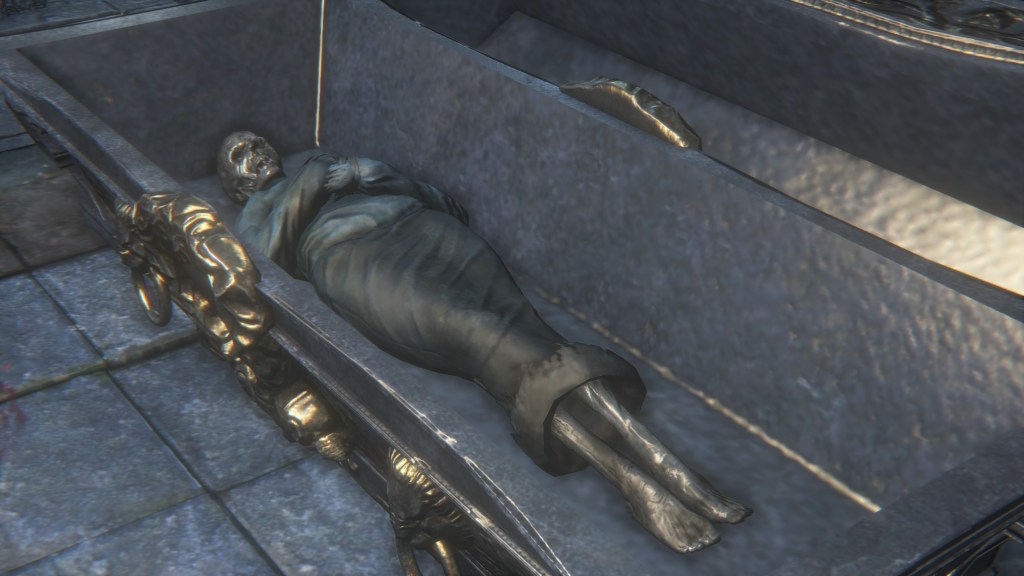
This presents plenty of opportunity to glean more about the history and culture of the dungeons, and that isn’t even considering their population. Bosses, and to a lesser extent certain enemies, likewise only appear in a variable number of dungeons specific to each. From this, we can infer where they normally roam and — in the case of singular characters — where they had traveled before perishing, going mad, or leaving the tombs for above ground. This holds especially true for the dungeons created with standard chalices; their consistent layout, items, and enemies indicates a particular narrative that FromSoftware wanted to convey before we acquire the corresponding root chalice. Despite the repetitive assets’ limitations to environmental storytelling, we can consider such “story” dungeons a stricter presentation of past events, while all others encapsulate a myriad of generic possibilities filling the gaps in between — barring further modification on our part. Both should touch on an accurate account of the recent past, but one is clearly given more narrative weight over the other.
There are a total of ten of these story dungeons across the five depths. Despite the amount, all of them fall under one of three separate civilizations: Isz, Loran, and Pthumeru. Although the interconnected nature of the underground ruins leads to overlap with their layout, each of three is still distinct enough to identify as its own nation once upon a time, and it is easy to see why they are all part of the same complex of catacombs at present. After one civilization rise and falls, its abandoned remnants become buried by time while another builds atop it, as is so often the case in history on Earth. The only difference in this game is that those ruins are converted to tombs somewhere in the process, integrating all three civilizations into one unified labyrinth. The five depths thereby convey the layers of history, more or less, in ascending order, with Yharnam simply being the latest layer in this tower of sophisticated constructs. Perhaps it too will join the tomb of the gods after the city seems to perish in the final leg of our journey. But before the dirt adds another depth, we may still uncover the existing grave sites.
 Lokey Lore