
Fundamental to any discussion of a sequel is its relation to its predecessor. In the case of Dark Souls II, it is clearly not a direct sequel to the original Dark Souls. (DS1) Embarking on a new adventure with a new Undead protagonist, we explore the seemingly new land of Drangleic in the hopes of finding a solution to our curse. However, along the way, we are liable to come across some familiar sights from DS1. Indeed, many veritable items from the previous game return with new descriptions, and sometimes appearances. While the latter can be chalked up partially to the new art direction, the text makes it obvious that many weapons and armor have weathered with the passage of time or been recreated based on surviving records. Some descriptions will even allude to optional events from the last game, such as slaying the black dragon Kalameet. Whether or not the Chosen Undead committed every action available, we can at least assume that this numbered sequel follows the events of the past title.

On that note, the fanservice begs a fair question of if this “Drangleic” could be Lordran from DS1. After all, we venture north to reach the land, just like Lordran. There is also a country to the far East resembling medieval Japan, known for the unique weapons it specializes in like katana if nothing else. Then there is the steel set, whose description mentions its famed owners from the prior game — the Berenike Knights — existing in “this land” at one point. When last seen, the “strongest” chivalric order had all turned Undead and ended up in Lordran where most hollowed. Therefore, the fact that we can acquire their armor in Drangleic lends credence to a name change. Additional identifiers include the various mimic chests we encounter. In DS1, the greedy were exclusive to properties of the gods or their close vassals in Lordran, but we encounter them every which way on our journey through Drangleic. The same might be said for titanite, gold pine resin, or repair powder; all explicitly or implicitly absent outside Lordran. We are obviously meant to draw a connection between the two settings.
Heavy steel helmet.
An order of knights lauded as the strongest existed in this land once, and this helmet is imparted as having inherited their equipment.
At the same time, there is no denying that Drangleic isn’t the Lordran we are familiar with. Characters of universal fame from DS1 like Logan, Gwyn, or Rendal might be remembered as their titles but not their names, and lesser recognizable figures like Andre or Shiva are lucky if they have anecdotes to go with their relics. There are even cases where such stories are doubted despite evidence. To use the earlier example of the greedy, their cursed heads are proof of their existence with all that implies, but the description insinuates that someone simply modeled the magical box brand on the legend of the gods-turned-glorified security chests, as if the very belief in them was absurd. Worse, we have figures straight-up misremembered like Frampt and Kaathe, the Watchdragon Parma imagining the world serpents as abstract watchmen of fate divided into a white and black duality — an obvious distortion of these “legless dragons’” mutual opposition to the other despite their shared connection to the Dark, which has ties to luck and thereby item discovery as the shield demonstrates. Nothing has been properly recorded.

Head of the greedy mimicking a treasure chest. Raises soul absorption amount and item discovery power, but HP gradually dwindles.
There is also a peculiar legend saying that the hideous greedy was a god long ago. Did someone believing that make this?
Shield depicting intertwined dragons.
It is said that the design divided into white and black represents the continually changing fate of all Creation, and the two legless dragons are its watchmen.
The one who possesses this shield has unforeseen good luck in battle.
If Drangleic is Lordran, how did memory of its own history become so distorted? Part of this can be attributed to time. The Crescent Axe is another item first seen in DS1, an already old weapon implicitly created by Anor Londo and kept by the Way of White in the world of man. However, its Japanese description affirms that it has lost much of its holy power as a result of the “many years” since it first received that blessing. From this, the text infers that the people responsible are also long dead, meaning that the present era must be even farther removed from the events of DS1 than those events were from the Crescent Axe’s original creation — in the prior millennium. Director Yui Tanimura confirms in the Dark Souls II Design Works interview that countries have risen and fallen with new kings to lead them for several hundred years at least. Titanite alone was buried in an ancient layer of earth before rediscovery thanks to erosion, implying an even longer time before civilization noticed. If hundreds or even thousands of years more have gone by, then plenty would change. The gods certainly have.
Distinctive copper axe with crescent-shaped blade. Has long handle and excellent reach.
You faintly feel sacred power. But, most of it seems to have been lost as a result of the many years.
Are the ones who blessed this gone now, too?
Original of the bond stones used in equipment enhancement. Enhances equipment up to +10.
Bond stones were discovered in an old, buried layer and are also said to be relics of the gods from their power. One of those serving as the wellspring of all bond stones.
It is said that they were born in order to forge the god weapons of far old.
The Name-engraved Ring details how many of the gods have been lost in its description. Even those still worshiped to this day are possibly known by different names from what we are familiar with in DS1. For sure, none of the names for the ring can be recognized as a god from the previous game. In the case of Evlana, the god of the hunt, we are even told her true identity as the human hunter Pharis — apparently, tales of the heroic bowwoman from DS1 gradually morphed her into a goddess in the retelling. This isn’t for lack of evidence of her human past; we can acquire her iconic black bow and long-brimmed hat like any other relic in Drangleic. Rather, the truth about Pharis has become murky in spite of the surviving evidence, gone ignored or lost in the interim since her obvious death. This leaves no guarantee that any god named is one of the medials previously worshiped, or even genuine for that matter. Despite traces of them still existing in the land, their memory has been warped at best and entirely forgotten at worst.

Special ring that the gods’ names can be carved into. Becomes easier for the equipper to connect with the worlds of those who have chosen the same god.
In the land of Drangleic, there are numerous traces of gods fallen by the wayside. Even the current gods may have once been called by different names.
Leather hat with a long brim. Favored by hunters who favor bows since long ago.
The god of hunting Evlana was once human and a hero who excelled with the bow, but as the ages passed, she was gradually deified.
This brings forth another conundrum. If Drangleic is just Lordran farther in the future, where are all the gods? Recall in DS1 that many of Anor Londo left for the world of man where one of their number, Lloyd, had already established a foothold. Even in old age, the medials demonstrated the ability to live for yet more centuries if not millennia. Add in cosmopolitan institutions like the Way of White with their written miracles, and there should have been a continuity across generations to prevent these kinds of distortions in the pantheon. Instead, we find no mention of any country where these deities and organizations were located. Places like Thorolund, Carim, Astora and more have also simply disappeared like their gods, leaving scant evidence behind no different from secular cases; descriptions struggle making items’ connection to the famous Vinheim Dragon School or infamous Earl Arstor. For all this to just fade from the collective memory, something cataclysmic would have to occur.
One of those called Bite rings due to its unique design. Boosts bleeding resistance.
Did someone with power make it? There exist several rings with the same mold. Although it gives a somehow ominous impression, its effect is definite.
In fact, this is as much a problem for the land of Drangleic. As we explore the various parts, we can identify many markers relating the places back to areas in DS1. But the areas explored in Lordran were compact within a relatively small region, many stacked along a vertical axis. By contrast, our journey around Drangleic has us head through its areas in largely linear fashion, across five different directions along a more horizontal axis. Almost all of these locations can be pinpointed on a map, so it must be acknowledged that, if they are past areas, they are far-flung from their original locations. This doesn’t even account for geography. The Brigand Hood confirms that a mountain range surrounds Drangleic from three sides in its description, with the official map illustrating how it extends across the east, south, and west parts of the landmass. The map likewise captures a sea shaping the land to the north, south, and west. It is a separate continent from the lands we hail from, and a far-cry from Lordran where no ocean was visible and no mountain on the horizon was explorable.
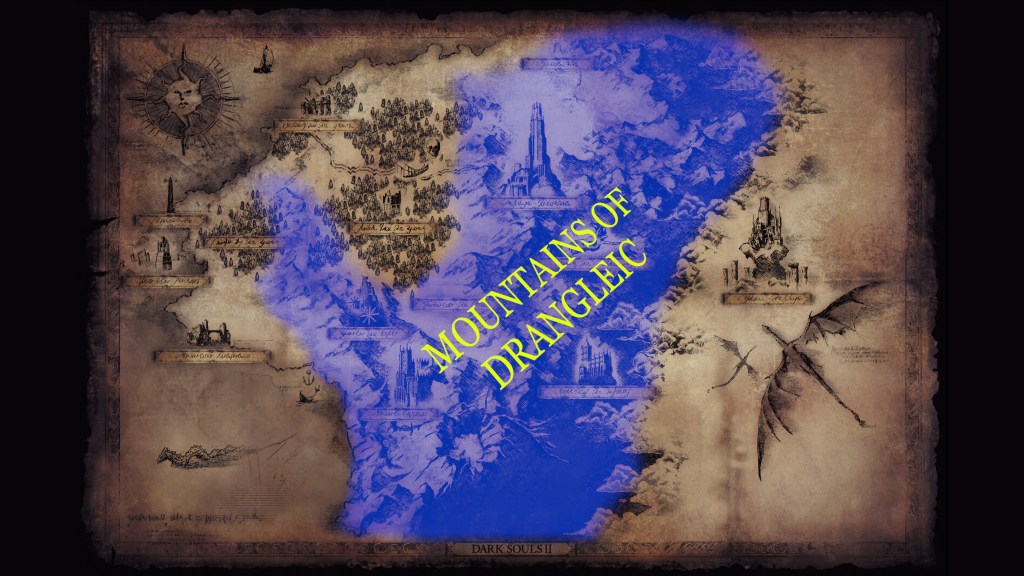
Hood of bandits who attack and plunder adventurers.
Many bandits live in hiding in the mountainous region encompassing three sides of Drangleic, so most of those aiming for this land lose their lives there.
Put simply, the onward march of time can’t be the sole explanation for this radical change in topography and culture. In order to justify the scenario, most gods would need to have suddenly died in some worldwide catastrophe that reshaped the land, leaving the nations to collapse or gradually drift away over the eons until they became unrecognizable. Once societal memory was twisted, fragmented, or just forgotten without a constant, rediscovering relics from the old civilization would be meaningless. But such an apocalyptic scenario doesn’t account for the consistency to the far East. If some kind of terrestrial restructuring did occur between events of the two games, it was seemingly localized, which opens up other possibilities much smaller but also larger in scale. Indeed, more fundamental than the question of Drangleic and Lordran is whether we are even in the same world, or part of the world, as DS1.
On that front, FromSoftware leaves us no mystery. Although allowing that it is the same world as DS1 in a 4Gamer interview, the game’s initial director, Tomohiro Shibuya, later confirms that the two settings are separate in a Polygon interview, analogizing their locations as opposite poles on the planet. Granted, he acknowledges some connection between them. The former director reaffirms the same in a Siliconera interview, alongside the game’s supervisor and DS1’s director Hidetaka Miyazaki — Miyazaki himself explaining that decisions with the story and world were being left largely with the series’ new director. Due to turbulent development, the director was later changed to Tanimura, but he only reiterates the point in a Dengeki Online interview, saying that the land is a “completely different” time period and setting even within the same universe. Fire Whip confirms as much, the description claiming a separation of both time and place for Quelana’s pyromancy from DS1. We can thereby infer that the developers’ intentions never changed.
Original pyromancy handed down from yonder of a distant time. Generates flame ahead of the caster and sweeps it like a whip.
It is said to be the origin of flame pyromancy, but because it demands skilled maneuvering, few get it mastered.
In short, Drangleic is not Lordran despite bearing connections to Lordran. This in itself isn’t a surprise. DS1 implied there to be a larger world beyond the lands we hear about by name, the country in the far east presenting just one example. Despite being the mainstream religion, the “world of man” the Way of White dominated was limited to a collection of countries south of Lordran, other countries in “remote regions” outside its sphere of influence. No one would assume that the church had a leading presence in places like the far East, but this fringe included countries bordering the mountains of Lordran like Catarina. Therefore, we can presume untold numbers of humans live all around the globe, descendants of the original pygmy tribe’s diaspora but completely oblivious to Anor Londo religion — because, as already stated, of so much time elapsing in isolation. The peoples have their own histories, developed their own beliefs, and continue subdividing into their own cultures. Drangleic and surrounding lands are just another slice of this larger world of man DS1 never explored.

And yet, all the connections demand some kind of territorial displacement regardless. This leaves us with one option. Lordran, or at least a significant chunk of it, was somehow instantly displaced along with its population, but to a foreign part of the world where the gods’ influence didn’t reach. Fragments of the different areas ended up in random portions of the new continent, interspersed nowhere in relation to each other. With no way to communicate their situation, anyone stranded in this “New World” was forced to rebuild with only bits of the knowledge and culture amassed from all the Undead who previously traveled to Lordran in DS1. Between the passage of time and collapse of countries, collective memory became only more fragmentary, facts lost along with any significant technological advancements as Tanimura ruminates in the Design Works interview. And then, those fragments began to spread outside Drangleic, entering nearby lands as folklore and legend until the twisted legacy permeated the entire region.
In other words, Drangleic both is and isn’t Lordran. Various parts of the gods’ homeland have been teleported to another continent in the “north” disconnected from where the gods were last seen to reside. Because it appears to still be about equidistant from DS1’s far East, this continent must be situated somewhere either far north or south of the Old World. (Dark Souls III [DS3] indicates north) But whatever its exact location on a globe, it was nowhere people left behind in that Old World would think to look after the sudden disappearance. The old gods didn’t exert a greater influence on the forgetful generations because they were never there to survive them. The humans in surrounding lands didn’t exert stronger pressure on Drangleic’s memory because they had already long forgotten them. Lordran civilization didn’t maintain longer longevity because it first arrived as partial ruins. Every oddity about the setting is explained by this “great shift” from one end of the world to another.
To best illustrate this peculiar development, we can look at the Dark set. Its description confirms that the Darkwraiths from DS1 are still remembered, though their origins are unknown. And yet, old legends of foreigners accurately identify them. Who are these foreigners? Peoples from outside Drangleic, or from outside the region as a whole? Either way, it is odd that the land where we actually acquire pieces of this armor needs foreign accounts to inform inhabitants — Darkwraiths had evidently arrived there, so shouldn’t it be Drangleic disseminating such tales? Of course, if their homeland of New Londo was left behind in a Great Shift, that would leave only stray Darkwraiths and their armor to be remembered by. DS1 already implied the existence of isolated Darkwraiths out and about following their country’s destruction, “mere shadows of their former selves” as the old legends allude, so some getting picked up with other parts of Lordran is feasible. All the stranger then that more is known in foreign lands. But if “foreigners” refer to peoples beyond the known setting, it isn’t so strange.
Mask of knights who fell to the Dark.
The origin of they who were said to freely operate the power of Dark is unknown. According to old legends of foreigners, they are mere shadows of their former selves who desired the art of Spiritsucker.
Recall in DS1 how the Darkwraiths terrorized the world of man, and their invasions might not have been strictly limited to the Old World. Even if they were, the countries victimized would still continue to pass down their infamous memory in legend, at which point their stories may spread to neighboring lands. That being the case, those foreigners can easily be peoples bordering the limits of both the Old and New Worlds, close enough for individuals to come and share their legends but too far to have a greater impact on the region’s culture; much like the far East. The Dark set thus gives the sense of scale dividing the two games’ settings, hence why they have failed to reestablish contact even after so much time. (a possibility later explored in DS3) If you were a Darkwraith, your focus was on surviving more than preserving your legacy or returning home, and the same was presumably true for everyone subjected to the Great Shift. Everything set the stage for the familiar yet alien setting of our journey.

We are then simply left to question the cause of this phenomenon. Warping across time and space is typically related to the power of fire, as seen when we transport ourselves between Undead bonfires via simple ritual. Thus, the most likely culprit behind this radical change in setting is the First Flame, whose presence already segregates Drangleic within a stagnant flow of time. The overlapping “worlds” amidst this stagnation showcase how time and space are inexorably linked — if the separate dimension enables multiples times to exist in the same space, then what stops multiples spaces from also existing in the same time? In short, the fading Flame had probably warped itself to the land of Drangleic, dragging arbitrary portions of the land within its time bubble along for the ride. The capricious selection justifies their random overlap with existing land within the bubble’s new perimeter. This didn’t occur for at least the thousand years of darkening before the events of DS1, so we can expect that it wouldn’t occur again for another thousand or more, allowing the current setting to come into being.
Fire’s involvement highlights the key points of continuity between the two games. At the end of DS1, the Chosen Undead had the option to succeed Gwyn as Lord of Cinder, revitalizing the First Flame, or become the Dark Lord, ending the Age of Fire. We are presented with these same options, though the game cuts to black before we actually commit to either choice. The circumstances haven’t changed; the fire is still fading, and the world is still at a crossroads between light and Dark, the Undead curse persisting. And if this game follows all necessary events of its predecessor, then the Chosen Undead most likely chose to link the fire. One of the two options is required to complete the journey, and only inheriting the flame allows it to continue existing into a sequel, keeping the coming Age of Dark in perpetual limbo. DS1 already gave reason to doubt that firelinking would have any effect on undeath, despite the proclamations of its proponents. Therefore, it shouldn’t come as a surprise to see Gwyn’s successor have as little success at restoring the Age of Fire to its full glory.

Some fans may posit alternative possibilities, such as that the Chosen Undead became the Dark Lord while another powerful hero — like Solaire — still linked the fire. This is feasible when looking at just DS1, though the circumstances with Solaire require the Chosen Undead have a specific background. In light of the sequel, however, that scenario is suspect. If someone with the ability and will suddenly appeared to inherit Gwyn’s mantle under the Dark Lord’s nose, then the Chosen Undead should have simply slain the new Lord of Cinder the same as the old one; the hero’s journey left no rivals in combat, including Solaire. DS1 was also designed so that an extreme minority of players would choose the Dark Lord ending, which is reflected in public statistics of in-game achievements. If a canonical route must be established, then it makes more sense for FromSoftware to follow up on the popular path. This explains the decision to stop short of us facing the current Lord of Cinder, which would define the Chosen Undead’s appearance and fighting style when that was so much more variable.
Suffice to say, nothing of import has changed save for the setting. The Chosen Undead and required bosses notwithstanding, the fates of characters met in the past game have been left mostly ambiguous. (many later to be clarified in DS3) With so much time elapsed, we see more the effects of the wildlife than people on Drangleic. For instance, the green blossom that grew on waterfronts in Lordran apparently flourished once introduced to Drangleic. The weed’s characteristic bitterness kept people from ingesting it often, but once merchants learned how it promoted stamina, they began picking large quantities just like in DS1. Unlike the previous game, however, these harvestings weren’t controlled to match the green blossom’s annual cycle, leaving very little of the plant still out in the wild according to its description. Even when people don’t survive, nature finds a way — even if it has to adapt to the new habitat.
Green weed possessing broad leaves. Temporarily raises stamina recovery speed.
This weed, which was avoided due to its unique bitter taste, was completely picked by merchants once its efficacy was realized. What now remains is only a very small amount of natural weed.
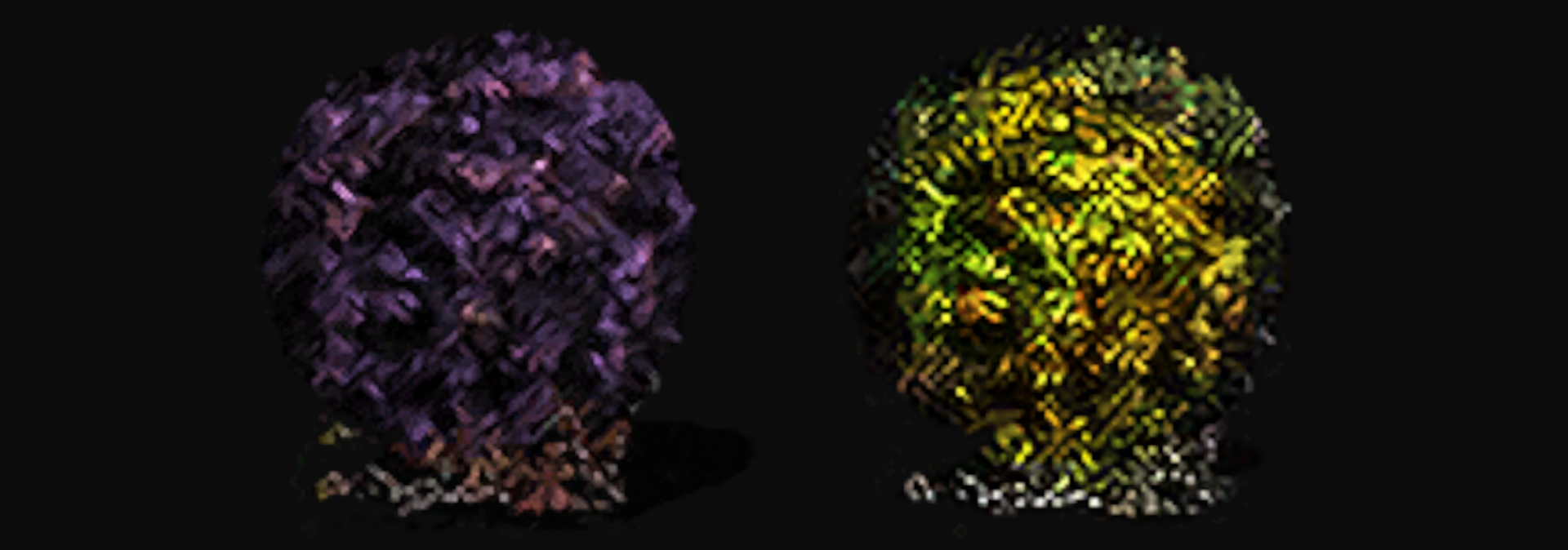
For another example, there is the moss which also thrived in the humidity of Lordran’s forests. Because it was adept at absorbing poisons from its environment, a certain species of moss clumps excelled at detoxifying the body when ingested, the weak poisons it already collected doubling to build up resistance for a body about to be poisoned. However, what we acquire is not the “poison purple moss ball” (毒紫の苔玉) of DS1 but a green “poison moss ball” (毒の苔玉) instead. The moss’ color appears to have changed with the poisonous substances it is removing, purple evidently not the color to associate with poison in the New World — there are exceptions, but cut content suggests that this is because of a decision to change the color scheme late in development, Tanimura confirming concerns about purple overlapping with the newly added dark damage type in the Design Works interview. Although this is not always the case, universal items will transform to meet their circumstances.
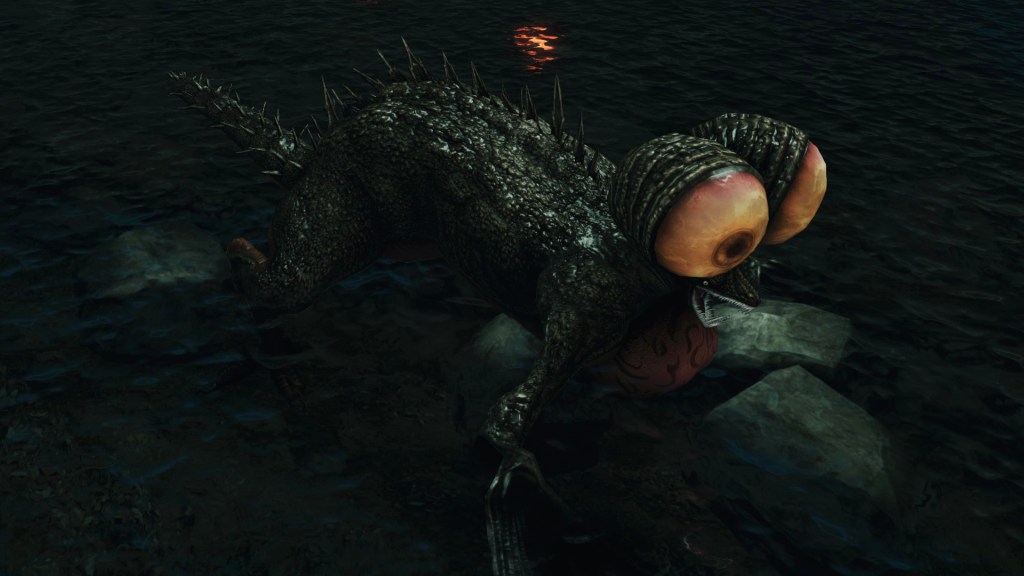
The same holds true for animal life. The petrifying basilisks make an unwelcome return, generally appearing in humid locations as was their preference in DS1. Some of the lizards have grown far larger than any encountered in the prior game, but this can be attributed to their longevity, as was seen with the great grey wolf Sif in DS1. Less reconcilable are the basilisks encountered in dry areas, namely Tseldora. Unlike their counterparts in wetland, this variant lacks the comically large vestigial eyes for disarming prey. Instead, the bulbous ornaments have shrunk to accommodate the creatures’ attempt to ambush prey after burying their bodies in the sand. Clearly, the basilisks’ freedom to spread across Drangleic begot a new species, beasts changing with the time and place. Who knows how many organisms caught up in the Great Shift have since evolved into forms unrecognizable or gone extinct.
Indeed, these creatures from Lordran weren’t operating in a vacuum but instead competing in never-before-seen ecosystems. Take for example the flame butterfly, whose body fluids ignite when coming in contact with the air to protect it from predators. This defense mechanism makes it handy to carry around in a bottle, ready to light a torch while on the go. But that is as an individual corpse, the living butterfly able to cause dangerous conflagrations in a swarm, liable to destroy entire habitats along with their populations. While not as dangerous, brightbugs are of a similar nature, this specimen emitting just light. Their abdomens shine all the brighter when approaching death, not unlike how a flame shows a flash of strength before fading away — as the Lord of Cinder from DS1 ought to have demonstrated. We can thus briefly channel this great power by gulping them down whole, increasing our might and resilience until the light bug expires. Nonetheless, it showcases another unprecedented trait for life to act around.


Bottle filled with the corpse of an unusual red butterfly. Can discharges a small flame and light a torch on the spot if stimulated.
The body fluids of this butterfly possess an ignition property by coming in contact with the air and thereby protect it from natural predators. It is handy as a simple ignition agent, but they seldom become great swarms and cause a conflagration.
DS1 never indicated anything close to this existing in the Old World. Unsurprisingly, the New World presents a wide variety of wildlife, from red leeches ready to bleed you dry to snakes which can petrify you like basilisks with their third eye. We don’t actually get to see any of these creatures roaming about, but we can acquire pills rolled up from their crushed remains to improve our resistances. Plants shouldn’t be discounted either. For just one instance, a certain kind of shrub only produce its fruit once in a few years, seeming to use the build-up of elemental power it absorbs along with its nutrients from the soil or weather. If the land is rich with flame or magic, then the fruit is liable to become orange or blue; if the sky is regularly stormy, then the berries could become yellow. Regardless, this entices hungry creatures who seek greater protection from those particular powers, more primitive people even using the berries in protective charms cast once upon a time. This isn’t even the most unusual greenery man has benefited from.
Small, blue-colored berry. Temporarily boosts magic defense power.
It is a shrub that produces fruit all at once every few years, so the fruit’s color and effect differ according to the soil or weather. It was even used in charms, long ago.
The Twilight Herb (暁闇草) is more specifically named for the dark before dawn. In a cosmological sense, this refers to the world before the First Flame — the sun — arose, where everything was ashen rock in the Age of Ancients. It befits the herb’s grey color and growth on tall mountains, though the obvious dangers have led to certain regions forbidding harvest. Meanwhile, the Amber Herb (黄昏草) is more accurately named for “sunset” when the evening sky yellows, much like its bright leaves. The allusion is also because this is before the annual plant buds tiny white flowers, which appropriately bloom on moonlit dusks. And despite inconsistency from the localization, the Withered Dusk Herb is that “sunset” herb which has produced flowers at nightfall; the tarnished leaves perfectly symbolic of the sun’s departure while the flowers prove equally as transient as the pale moon. All three herbs possess the power to restore our will to perform spells when ingested, the amber herb going from weakest to strongest with exposure to moonlight. It is no wonder that they are popular among sorcerers.

Ash-colored herb that quietly grows on the rock face of high mountains. Recovers number of spell uses.
A not small number are willing to take risks searching for the precious herb, so picking it is forbidden by region.
Annual herb possessing brightish leaves the color of the evening sun. Slightly recovers number of spell uses.
The sunset herb is misunderstood to not bloom with flowers, but it produces small white flowers on evenings which have the moon.
Withered and tarnished sunset herb. Greatly recovers number of spell uses.
A sunset herb which has produced flowers greatly increases its utility. But, attaining one in this state is considered remarkably difficult, for the flowers fall off and it will end up rotting in the blink of an eye.
With each of these cases, there is a new utility coinciding with the new organism, suggesting that it is more than just coincidence or selective bias for why such plants or animals never appeared in some form during the previous game; FromSoftware never intended for these to have existed in Lordran, even retroactively. Perhaps some of these peculiar forms of life are descendants of the moving trees, twin-headed lizards, or bitter acorns previously native to that part of the world, in which case their radical change stresses the pressures of the different environment. But even if they had all evolved independent of one another before the Great Shift, the underlying point still stands: life familiar to residents of Lordran was the minority in this sudden change of circumstance. The result? Whatever was part of the Old World has folded into and, in most cases, been overtaken by “Drangleic” with all its longstanding flora and fauna.
When it comes to ordinary people, nothing has reached that level of improvisation. At most, it is a change in dynamics with regards to purely human conceptions. Take the relation between the familiar schools of magic. Despite its traditional separation as an art and philosophy, pyromancy is now considered almost synonymous with sorcery, pyromancers either simply called sorcerers or additionally casting the all too familiar blue-hued magic. Disconnected from their roots in Lordran, the two schools of magic are no longer exclusive to their individual cultural lineages. It is possible that their introduction to the New World predates the Great Shift, since there were already pyromancers inventing new arts on the fringes of the Old World in DS1. But now that Lordran has brought its arts to Drangleic, even the rarest spells have all mixed freely without the cultural prejudice. More civilizations employ at least one or two of the Old World’s magic than ever witnessed in the previous game. Sorcery in particular seems to owe its success to the arrival of souls to Drangleic.
The power of sorc, the power of souls, sleeps in this land. It is the perfect place to boost my sorcery. We’ll be able to master new sorceries if it’s in this land. Even I, Callion, am still far from the profound mysteries of sorcery. Let’s diligently study together, my apprentice.
To that point, Drangleic is the only land known for its concentration of souls, which are apparently an alien concept to vast swathes of the New World. Never did DS1’s Crestfallen Warrior feel the need to explain something so banal, but his named counterpart Saulden certainly does. If the country or region doesn’t use soul sorcery or pyromancy, then they likely have no grasp on the power inherent to every living thing, unlike in the Old World where the Lords and their Lord Souls is the universal myth. If it wasn’t for Lordran arriving with the First Flame and a plethora of souls in tow, then Drangleic probably wouldn’t be considered special in this regard. The oblivion extends to dark souls, humanity no longer used to alleviate the Undead curse. Instead, we reverse hollowing by staring at human effigies, small constructs — perhaps instinctively — made to resemble the true soul of man. The meditative act seems to resonate with our humanity, our white soul freed from its jaws in that moment of inner unity. But this elaborate ritual wouldn’t be needed if we knew to perform a simple sacrifice at the bonfire.

Do you know about the so-called soul? I don’t know much either. Still, I have heard that the soul is something close to the source of life. All living things and their actions have a soul, they say… The root of what we call a “curse” also lies in that soul. You understand? Living… being alive… that is, in other words, none other than the true state of a curse. We are Undead, beings who cannot die. It is hopeless now…
Warm, soft dark-colored figure like a shadow.
Returns to the living from a Hollow if used. Also, thins the connections to others’ worlds and limits invasions and cooperations for a while.
If one looks closely at this statue, the form of man comes to mind. It is said that its form varies depending on the looker.
That highlights another paradigm shift, this time apropos to the Darksign. Without the Way of White, undeath no longer inspires the same religious fervor. The curse is treated as a tragedy or calamity, but no one labels us a heretic for failing to die. To the New World, the Undead simply appear one day with no consensus on the cause — not even the religious institutions try to skew public opinion toward a certain narrative. Granted, the world of man’s primary concern is handling their immediate threat, which it answers with extermination or exile just like in DS1. But because the Old World’s insight regarding humanity hasn’t been inherited, a Hollow’s existence and behavior seem random to outsiders. Neither are the Darksign’s bearers equipped to live with their curse in a more formalized manner; their only hope is to stave off hollowing with souls left in ruined lands, hence why they have become currency in Drangleic. Despite the promulgation of miracles and other stories about the gods, knowledge concerning the curse they demonized has plain diminished.
This isn’t to say that no belief or custom has survived the Shift; the Black Separation Crystal continues to see use as a goodbye gift even with the past becoming so clouded. However, anyone can surmise that we are thrown into a totally different setting that has, at best, been influenced by events in the preceding game — which hold dramatically less relevance the closer things approach the present day. This is the world of man without the old gods there to guide their ways, after all. It is their nations to build, their stories to weave. As a new bearer of the curse on a new journey in a new land, it is our mission to find the answers reached by all those who built upon the ashes of the First Flame’s whimsy. Only then, after sifting through the chaos, might we see what has become of the Old World’s legacy.
Proof of separation handed down from a past unknown.
Can return summoned spirits to original world and also return to original world from another world.
Whether the outcome is hope or despair, encounters are crucial. You shouldn’t use this lightly.
 Lokey Lore