
Mirrah is a nation shaped by its geography. Located to the far east of Drangleic, it is constantly beset by invasion from its neighbors — an existential threat that the country has to contend with every single day. Because of this, Mirrah’s military is its most valued asset, resulting in it becoming a country of knights. According to Lucatiel, your average child of Mirrah isn’t recognized as an adult until he or she has joined an order of knights and earned a reputation on the battlefield. So much of the populace has been needed to defend its borders that participation has basically become a formality. It is proof that you played your part in preserving the nation and protecting your friends and family, that you had the power to stand on your own two feet and hold your own against any adversity. And if you weren’t an aristocrat or someone of similarly high wealth and status, you were basically forced to join the army and risk your life every day in the hopes of success carrying you to a better position down the line anyway. It isn’t an easy life in Mirrah, but its people have pride in surviving so far.
My country, Mirrah, is a country surrounded by various others and always simply in the midst of wars. So you’re recognized as coming of age by joining an order of knights and distinguishing yourself on the battlefield.
Most seem to start as standard light infantry for their local lord from a very young age and spend most of their youth training their technique or fighting on the front lines. If they survive a few battles and earn some achievements in the process, they can be promoted to the lord’s knights. While this may seem relatively easy to accomplish, the training leading up to it likely prepared them for this advancement. In order to master this traditional order’s unique sword technique, recruits must meet a high skill cap, so all of them either have the talent or put in the effort to earn their vows to the feudal lord. The Mirrah Knights are the elite, glorious defenders armed with both the strength and experience to hold back the enemy. And as their shields decorated with what appear to be blazing flames signify, they have not only the power to survive but the resolution to die for their country. Rising through the ranks in Mirrah doesn’t automatically better your chances at survival, but it does afford you some glory and luxuries that your common peasant in the army couldn’t ever dream of.

Shield given to the glorious traditional Knights of Mirrah.
In the land of Mirrah possessing an unceasing history of war, this knight’s shield is proof of power as well as the resolution to die for the country.
The knights wear finely-sewn hats and vests and the like while off the battlefield. Such fancy clothes are just for pure pomp and etiquette, but they still show off the knights’ riches and status. Mirrah knights live better than anyone born among the poor — the rewards for their merits, loyalty, and everyday hazards of the job. It also doubles as a lure for the able but needy wanting to escape destitution, though exceptionally few manage to succeed. In terms of style, the clothes resemble renaissance Spain, which is the intent. According to game director Yui Tanimura in the Dark Souls II: Design Works interview, Lucatiel’s design had originally been intended for a Don Quixote-type character before the idea was scrapped and recycled during the game’s turbulent development. This distinctly Spanish flair could be why the name Mirrah (ミラ) resembles the Spanish word mirar (ミラル) meaning “to look” or “watch” — fitting for a country always on guard against enemy invasion. And this culture certainly goes beyond just Lucatiel, for the rapier forged by a Mirrah blacksmith is dubbed Espada Ropera — the formal Spanish name for rapiers meaning “dress sword”, complementing the knights’ fancy clothes.
Vest used as a knight’s travel clothes. Property of Lucatiel of Mirrah.
The glorious traditional Knights of Mirrah only grant certification to be its member to owners of definite ability who have achieved merits on the battlefield.
Those of impoverished birth in that land aim for the Knights in order to escape their dire circumstances, but meeting that aim is truly one in a million.
On the subject, the famed blacksmith Llewellyn, or Lind, (リンド) makes this rapier and other simple but excellent products from geisteel, or “gran steel” (グラン鋼) in possible reference to the Spanish grande meaning “big”. True to its name, the steel is a rare and hard to produce but excellent alloy invented in Mirrah and used in creating its weapons and armor. Considering this, it is probably used in the creation of the Mirrah Knights’ armor, though we are provided no examples of what such armor even looks like let alone is forged with. The closest example is the equipment worn by Creighton, a knight of Mirrah who has slightly modified his armor. This leads to the description questioning if it is actually an elaborate fake, but Cale confirms that Creighton was a bloodthirsty killer who had become a “pariah” of the Mirrah Knights and thus was once a real member. (item descriptions in Dark Souls III [DS3] reaffirm his membership) His equipment is therefore unquestionably authentic if somewhat different from the standard armor worn by the Mirrah Knights. So, what are the differences?
Dagger made with rare gran steel. The blade is long for a dagger.
Gran steel is an excellent alloy invented by the eastern country of Mirrah, so its method of manufacture has long never been brought outside it. Chancellor Bellager, by order of King Vanclad, hired the master craftsman who knew the manufacturing method, Lind, with a high salary, and it has been handled in this land too ever since.
Iron mask made from an unusual technique. Personal effect of Creighton the Wanderer.
The design of the eastern country of Mirrah’s order of knights is seen, but were original improvements made? Its appearance is somewhat different from the regular one. Might be an elaborate fake.
Crieghton’s iron mask and chain mail are said to be made using an “unusual technique” befitting armor of elite soldiers, though there is no mention of the iron being geisteel. With that in mind, these alleged modifications may be referring to his cape and the actual mask since the helmet and chain mail themselves resemble those worn by Cale, a Mirrah light foot soldier. They at least can’t be referring to the distinct image of a blue stag’s head adorning his surcoat, as this exact same image is emblazoned on the surcoat of Benhart — the deer’s antlers are also depicted on the warrior of Jugo’s old parma. This well-worn and slightly smelly armor is equipment that Benhart picked up during his travels because he took a liking to them, so Creighton can’t be wearing a Jugan crest at the very least. It is thus more than likely the crest of Mirrah. (a fact later made explicit in these items’ descriptions in DS3) Stags often symbolize pride and protection, and Buddhism considers deers to be symbols of peace, harmony, and longevity — making it is the perfect coat of arms for a country like Mirrah.

Armor of somewhere unknown. Personal effect of Banholt of Jugo.
Apparently something he attained touring various lands. The origin isn’t well known. The person in question took a liking to it, and maybe because he has worn it all this time, it smells a little.
While none of this clarifies if geisteel was used in forging the knights’ weapons or armor, it does emphasize their importance to the country. And so, Mirrah established specialized orders of knights beyond the traditional one. One such chivalric order are known as the “wizard knights” in English, but are more accurately called the “Magic Knights”. (魔法騎士団) This subtle difference is important since they were not practitioners of sorcery or similar schools of magic. Rather, the Magic Knights share a Mirrah knight’s pride in sword duels despite learning magic — all because the magic they learn is miracles, namely Magic Barrier and its far more advanced counterpart. Much like the spells’ creator, the knights want to level the playing field so that they can compete with sorcerers and the like, who generally have an advantage at range against heavily armored knights. They are simply fighting fire with fire, learning the minimum amount of magic their pride will allow in order to counter all others. The order is thereby closer to holy knights than wizard knights, which says a lot about their culture.
Miracle which covers the whole body in a membrane of magic protection. Boosts resistance to magic, fire, lightning, and dark.
This miracle, imparted to be able to acquire one a “rock-like” body, is widely imparted to the Magic Knights of Mirrah.
The Holy Water Urn is a vessel filled with clean water from a secret spring located within the “old capital” of Mirrah, implying that it like most countries in the setting is actually a city state. More importantly, the spring it hides has had divine properties since long ago, hence why it is holy water that heals the skin of most while burning the skin of cursed Hollows. The pots are proof that this water is in fact harvested and shared with others, though they are hard to come by because the nation has been entrenched in war. And assuming that this holy water functions similar to that of Gwynevere’s Divine Blessings, it also explains how Mirrah has managed to hold out for so long with enemies on all sides. Even the most serious injuries can be cured with this blessed water, which would drastically reduce the mortality rate and thus prevent the country from collapsing due to attrition. Mirrah’s location made it perfect for fighting in defensive wars, but it may also be the underlying cause of them.

The fact that both the holy spring and the metropolis are described as fairly old suggests that the latter was founded upon the former. Perhaps a god like Gwynevere had at some point blessed a previously ordinary spring — there is a god of blessings called Hanleth as well as a god of tears associated with water and a distaste for death called Caitha. Or maybe it was blessed by institutions worshiping the Anor Londo pantheon like the Way of Blue. The water might have even somehow naturally accrued the power of sunlight while underground. Whatever the case, the potent powers of the spring make for a solid basis for Mirrah as a city and nation. The country certainly recognizes the value of the spring considering they have managed to keep its location secret, though not its existence based on the Holy Water Urns’ description. And knowing that there is a massive water reservoir that can heal any injury gives plenty of incentive for neighboring peoples to try conquering the city hoarding it. The holy power Mirrah possesses is thereby a curse plaguing its citizens as much as it is a blessing protecting them.
Bottle filled with pure water. It, which was originally water for healing, is a taboo for Hollows and burns their skin.
The water which gushes forth from a secret spring that is in the old capital Mirrah is imparted to have retained divinity from long ago. It isn’t easy to acquire since that country has been smeared in war.
And so, it is unsurprising to discover that miracles are the most widely accepted form of magic in this proud country of knights. Reverence for the divine lies at the heart of Mirrah, so if a knight stoops to practicing any magic, it will be from sacred texts. This is at least true for the Magic Knights, but they are not the country’s only order. Aside from the traditional knights, there is also the Shadow Knights, an order whose existence is only known through old tales due to the secretive nature of their work. Unlike most Mirrah knights, these “shadows” hide in the dark of night and cast sorceries that let them fall greater distances or silently sneak up on unsuspecting foes. In other words, they serve the same role as the sorcerer spies of Vinheim, expert assassins of society’s seedy underbelly who will use any means to fulfill their all too often unsavory assignments that are best left unknown to the general public. This goes against the fundamentals of the code of chivalry, of course, but the shadows don’t care.
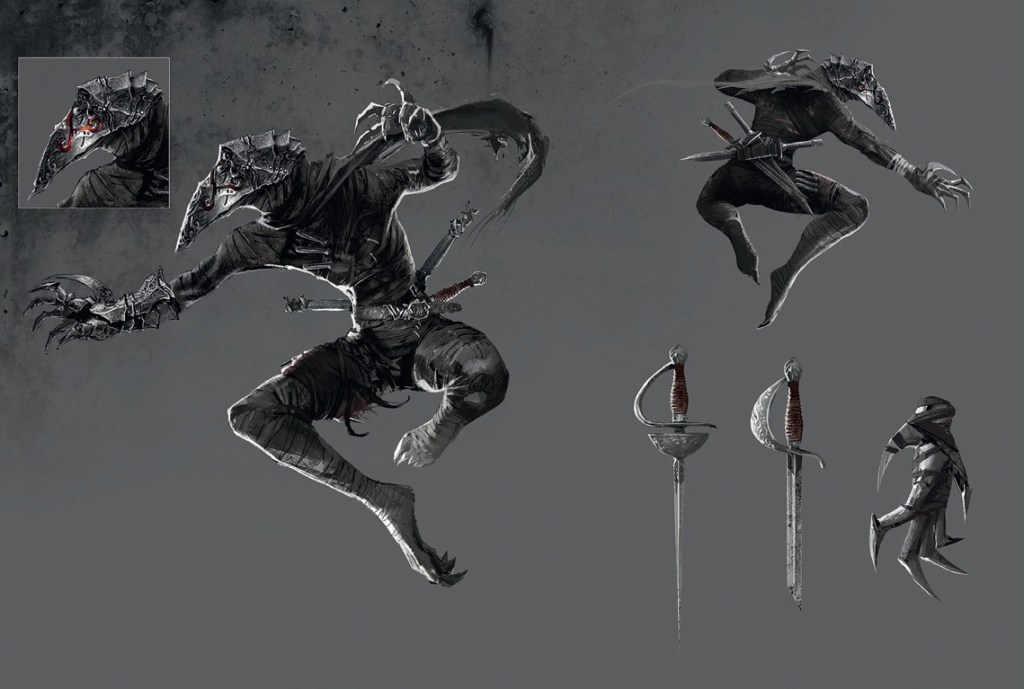
The Shadow Knights’ short daggers are long swords whose blades were snapped off near the hilt, an obvious sign of their disregard for the dignity of a knight. The best of them even stoop so low as to sell their services to the highest bidder, mercenary work that would be unbecoming of a knight with any sense of pride in serving his or her country. And perhaps that is ultimately for the best. The Shadow Knights are simply willing to do what the rest of Mirrah’s orders will not. Their continued existence indicates that they have become an essential part of foreign espionage and domestic politics, so even those who sell out their country for enemy coin evidently haven’t brought their homeland to ruin. The benefits of assassinating without ceremony or process outweigh the risks of an occasional turncoat. Consider that Mirrah is at risk of being subjugated on a daily basis. No matter how proud they are of their survival up until now, everyone has to make compromises to stay the course. The Magic Knights do so to deal with the reality of magic, and the Shadow Knights do so to deal with the reality of people.
On that subject, Mirrah’s constant war for survival made the Undead curse all the more crucial to address. At first glance, the state treated their immortals no different from other countries. Both Lucatiel and her older brother came from the lower class, hence throwing themselves into training to become knights. Although she never defeated him in their practice duels, the girl was obsessed with serving as a lord’s official retainer on her own merits, even owning the Ring of Steel Protection from Knight King Rendal. And after a few battles, she earned her knighthood. But at some point, the young woman seems to have fallen short of Mirrah’s enemies, now ranking among the Undead. The fear of losing her mind has brought her to Drangleic seeking the fabled “soul” for a cure, a fate she infers that her brother shares. Indeed, we meet this brother as confirmed in the Dark Souls II Collector’s Edition Guide, Aslatiel wielding her same arms and armor. By all accounts, both knights were driven out despite their dedication to the homeland, typical fare.
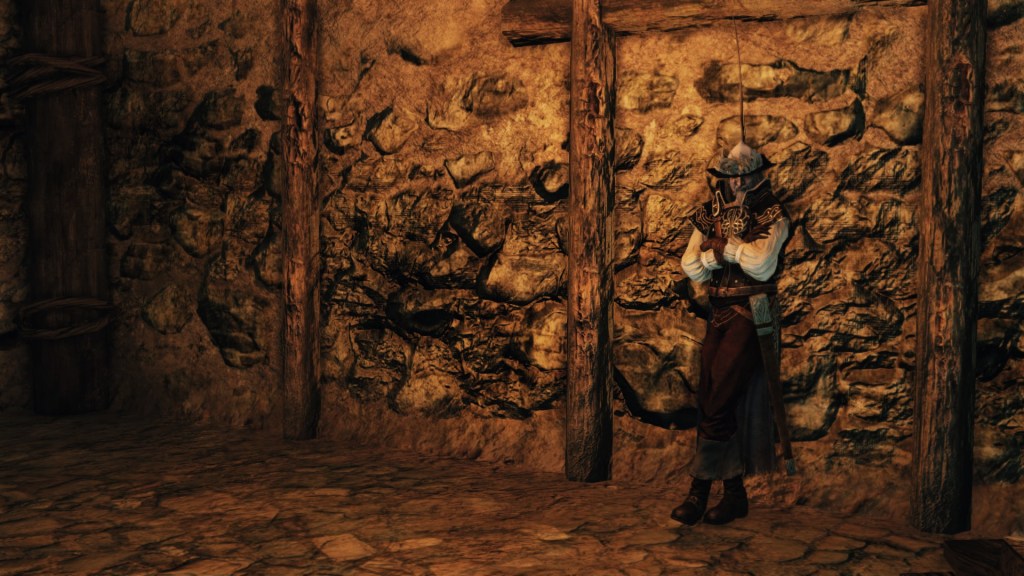
However, a few oddities stand out upon closer examination. For one, Lucatiel knew nothing of her brother’s undeath until becoming one herself. He simply disappeared one day, the sister learning nothing in trying to find him. The unique age of his Mirrah Greatsword indicates that he was significantly older than her when starting his training, the blade’s slightly lower damage and durability compared to hers highlighting the man’s war record. According to Lucatiel, he did demonstrate the best swordplay in the country, though that may be her humility talking; she also believes her knighthood was undeserved at the time. Perhaps Aslatiel did simply meet his match on the battlefield. Nonetheless, it is strange that no one in her lord’s domain could inform about his death and subsequent undeath and exile. Was he not an accomplished young knight who earned recognition from the public? What reason was there to hide the grim reality? Warriors of Mirrah are sure to die and be gone forever all the time. Undeath is just as universal. Even a soldier like Cale seems to be in the two’s same situation.
Stranger still is their garb. Both siblings dress in traveling clothes for primarily ceremonial functions. But the only ceremony which would require Mirrah’s busy knights to travel any great distance away from home is a diplomatic mission — escorting envoys tasked with ending a war on one border so they could shift focus to the one restarting on another, formalities of that sort. (Dark Souls III later confirms that these knights’ travels did come with a mission) And yet, Lucatiel and Aslatiel not only received this attire but were allowed to change into it before being driven out? All while letting no one they loved to know about their circumstances? Lucatiel claims that she has avoided people for a long time on account of her curse, not talking to anyone besides us since presumably her exile; her “strange” senior man mask supposedly helps with this. Even so, she managed to hear rumor of the “soul” in Drangleic as her one chance to escape hollowing. Moreover, she assumes that her brother followed the same rumor from solely her own experience. What makes her so certain?
Taken together, one possibility emerges: Mirrah sends its Undead on a secret mission to find a cure for hollowing, promising to accept them back should they succeed. Curse or no, Mirrah’s elite warriors are too valuable to simply throw away. If there was a chance to keep their random immortals from becoming mindless monsters, it would behoove the assailed country to jump on it. And so, the feudal lords likely share the rumors about Drangleic with the knights and provide them the clothes to make it official. If they fail, it is just a fancy banishment. If they succeed, it is the single greatest contribution to their country. This would explain Aslatiel disappearing without explanation — if none know he is cursed, he can come back with no one the wiser. The secrecy affords the knights the best chance to reintegrate into normal society after they are finally free of the Darksign. Whether or not Mirrah believes in their odds, that possibility to return is what gives them hope. This duty might even extend beyond knights since Cale also came to Drangleic due to his curse originally, though memory fails him.

Indeed, as the knight siblings prove, not many are able to handle such a mission regardless. For Aslatiel, we see him invade as we enter Aldia’s Keep, seeming to act as the manor’s first line of defense. While that sort of behavior is expected for a knight of Mirrah, it suggests that the older brother is affiliated with the researchers there. Considering that Aldia’s studies pertain to the Undead curse, the knight has likely already realized that the “soul” alone won’t solve his problem, thereby aligning with a party who might. Both he and Lucatiel engraved a promise with each other into their swords, presumably from their training days; likely a pledge to both become great knights, maybe fight side-by-side one day. If he wants to fulfill that vow, he needs to make it back home — if only he knew that his little sister too is there, sharing his fate. Last we can see of her in person, she is resting in the shack in the manor’s front yard, already at the end of her rope.
Greatsword given to the glorious traditional Knights of Mirrah. Property of Lucatiel of Mirrah.
Because it requires a unique sword technique, high dexterity is demanded to handle it.
Small characters are carved into the blade. They seem to be words of a promise with someone.
Thanks in part to her self-denigrating nature, Lucatiel has struggled far more with her mission. The woman’s mask hides her partially hollowed face, her memories already slipping away. As her aimless wandering of Drangleic progresses, so does her curse and coinciding fear of losing herself. She has clung to the rumors but refuses to open up to others, hurting her investigation in the process. The result is her slow spiral down into anguish and confusion when the desperation isn’t necessary. During only our second encounter, she gifts a human effigy for our small talks, not realizing that it is a means to reverse hollowing. Perhaps she first grabbed it instinctively feeling a connection, but the knight failed to meditate on it. Instead, she asks that we remember her before forgetting everything entirely. Tragic as it is to see, it also speaks to Aslatiel and Mirrah in general. They keep looking for an external solution, when the answer has always lied internally. In battles of the body and mind, the adage is the same: when you are up against the wall, you can only rely on yourself.
 Lokey Lore