
Wearing a dark mask in the shape of a skull with long dreadlocks and equally ominous armor, the mysterious warriors bear a striking contrast to most knights. Even more curious is the question whether they are knights at all. They do belong to a foreign country, their armor’s description insinuating one of the varying that Vendrick relied on for mercenaries during his pursuits against the Undead curse. However, the country isn’t recognized, so their land is either far removed from mainstream New World society or long destroyed — possibly both. Most likely, it was situated somewhere close to the far East. The country inspired by Japan also goes unnamed for its location at the very fringe of the known world, only some of its products or people occasionally making their way over to Drangleic. But unlike the original Dark Souls, (DS1) eastern weapons like the Uchigatana aren’t traced to that land; even a samurai like Alonne is just treated as a peculiar knight. Compared to the Old World, knowledge of the land to the far east seems to be basically nonexistent, much like with this other foreign nation.
Mask of a foreign country of unknown origins.
King Vanclad collected various powers from various lands in order to resist the curse. This may have been one of these.
Katana of unknown history. An extremely different and refined technique has been used.
The sword boasts excellent sharpness due to its keen blade. However, the blade is easy to nick because of its delicateness. Caution in handling is needed.
Adding to the similarity, the dark-armored warriors wield their own katana, a weapon previously unique to the far East with few exceptions. For instance, the Chaos Blade was originally forged with the soul of Quelaag in DS1, whereas Ornifex uses the Old Witch’s Soul. This change is logical, since the sword embodies the Chaos qualities present in both mother and daughter. And those same chaotic qualities are what make the blade take the shape of an eastern-style sword for witches in a western setting. Meanwhile, Darkdrift originally belonged to Nito, its effect perfect for a god who wished to operate while avoiding the spotlight. But although the Gravelord has dabbled with various inventions, the choice of a katana might not have been his. With their past collaboration, it is possibly a gift from Velka, who is known to craft peculiar magic tools using her vast knowledge. And given her heterodox nature, an unconventional sword with a spatially-manipulated blade wouldn’t be out of the question. Nito then changed ownership of the blade to one of his servants at the Undead Crypt who would make more use of it.

Katana of unknown history. If it inflicts harm on an enemy, you are also eaten away at.
The strange pattern borne on its blade tells how it is undoubtedly a cursed sword. It is ominous, and also lonely in some respects.
Suffice to say, a weapon made with the radically different yet refined techniques of the far East must have equally unique circumstances. That said, our mysterious warriors are probably not from that land of the rising sun. Their katana are uncharacteristically thick, which appears to have come at the cost of bearing the shortest blade. Nonetheless, it shows the opposite mentality of creating longer, thinner blades as seen with the Washing Pole. Moreover, the blade bears no inscription — not the name of the sword, its owner, its maker, or its origin place — despite that being common practice in feudal Japan. Their creators are thus unlikely to be genuine Easterners. Rather, odds are that the similarly foreign country instead picked up their style of swords from proximity to the far East. They learned how to craft katana owing to their outstanding sharpness, but modified it to suit their needs or preferences.
Katana of a berserker.
The thick blade with black luster possesses outstanding sharpness. There is no inscription, and its owner is also unknown. It has simply been called by this name since some time ago.
This kind of cultural diffusion isn’t unprecedented. Twinblades are a new weapon type, not present in DS1. Having a sword at each end of the hilt requires a unique technique to swing proper, making it far from commonplace. Most twinblades, in fact, expressly belong to the Kingdom of Drangleic; even the Red Iron Twinblade is acquired from a corpse in the Shrine of Amana, where many Drangleic knights seem to have fallen. But that heavy, bloodstained doubled-bladed sword notes a peculiar detail in its description: it copies a weapon of foreign origin. This seems to be a reference to the Curved Twinblade, whose appearance, bleeding effect, and low durability all indicate a far Eastern origin specifically. We acquire it as a member of the Brotherhood of Blood, so the armament has been passed around in the west since maybe Alken’s time. This makes it reasonable for the succeeding kingdom to make the eastern design its own. If Drangleic can do it, why not a country further east? Not adopting other cultural elements like the naming practice might even show a lack of civility on its part.
Without any indication from their appearance or weapon, the mysterious swordsmen are identified as “berserkers” or “mad warriors” (狂戦士) for presumably how they behaved in battle. Rather than introduce themselves, they instantly go for the kill with a bestial ferocity — the skull mask certainly implies a fixation on death. Perhaps the culture is very bellicose and brutal by nature, which would fit within the region’s larger context. Feudal Japan is famed for civil war during the Sengoku period, and all the other known eastern countries have been in seemingly perpetual conflict with each other, the berserker nation potentially warring with countries like Forossa and Mirrah; latter knows it needed another neighbor joining the fray of constant invaders. Regardless, the reflexive hostility would explain why so little is known about the country in the present era even though it was within Drangleic’s sphere of influence. Like Forossa, the constant fighting might have led to the berserker country’s precipitous collapse, its knights and soldiers forced to find new ways to survive in their hostile world.
In the end, a number ended up in Drangleic under Vendrick’s employ — wouldn’t be the first time the king brought in a so-called mad warrior. But unlike Vengarl, the berserkers didn’t fight and die facing the giants. Instead, they were brought on much earlier, when the monarch was dealing with the curse. Specifically, they joined in his investigation of the Old Iron King. One berserker can invade in Iron Keep, with many more “wandering ones” (彷徨う者たち) invading us at Brume Tower. Apparently, when Vendrick decided to abandon his inquiry and seal the tower, they chose to stay behind. Why give up a lucrative livelihood to hang out in some dangerous old ruins for so long, even after evidently turning Undead? The only explanation is that there is something about these remnants of the Iron King’s kingdom which has caught these ruthless killers’ interest, enough to betray their employer.
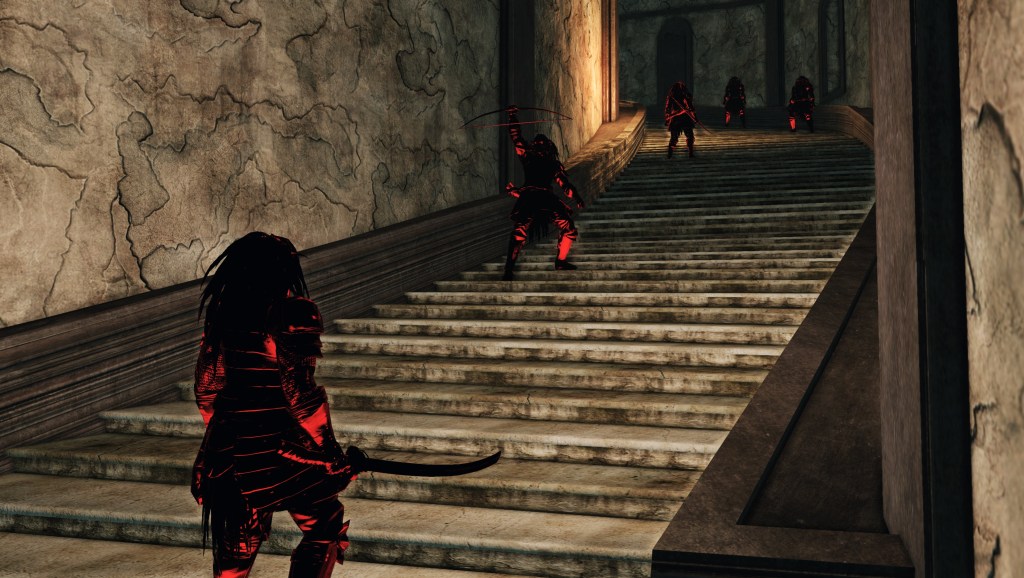
Perhaps they are motivated by the Alonne Knights and their model, wielding katana like them. The berserker of Iron Keep specifically invades if we have joined the Bell Keepers at Belfry Sol, while those roaming Brume Tower invade as we ascend to Alonne’s equipment enshrined beneath the Smelter Throne. Moreover, Alonne’s Bewitched Blade shares the same moveset as their far shorter swords. In their own crude way, the berserkers may have been spending these years investigating the history of this ruined land, hoping to garner why their knights wield such familiar weapons and armor. Indeed, seeing the similarities with their own situation, their hearts might have resonated with Alken’s fate. With no home and no future, what care do they have for coin? Better to live for themselves than be someone else’s mad dog. If they can learn from this fellow katana-wielding nation, all the more.
 Lokey Lore