
Preface
As the last DLC before the Scholar of the First Sin edition, Crown of the Ivory King had to juggle its own story with the remaining loose threads the original Dark Souls II had left for it tie up. In contrast to its predecessors, this was met with mostly success. It is the only DLC which remained unaffected by the big fix. This can be credited in large part to its humbler roots, Eleum Loyce bearing far less importance to the main story and setting than the kingdoms of Shulva or Alken. But because this story is so much more self-contained, it also has room to tell a more eccentric narrative for this dark fantasy: a true romance. And that, I think, is why it stands out in the hearts of so many.
The Legacy Still Burns
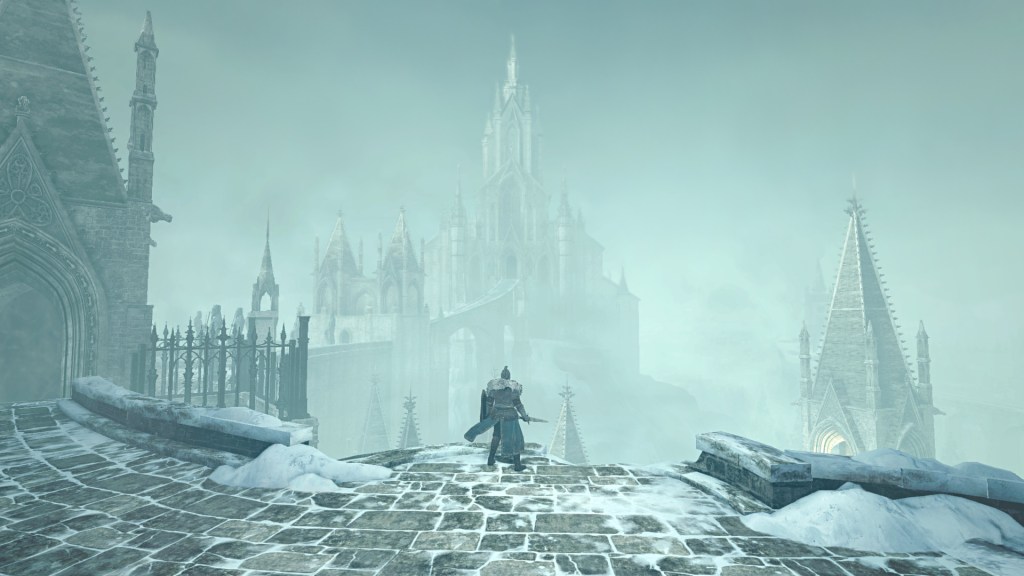
Before founding Eleum Loyce, the Ivory King was Forossa’s most accomplished knight, explaining why he possesses a soul rivaling other powerful kings. While the king’s name is forgotten to history, he no doubt participated in many battles for his nation, earning him the pinnacle of elite status for a warrior. And after all those victories, he left his homeland to establish a kingdom in the far reaches out west. The description to his crown indicates that the man built up this country at the “northern limit”, (北限) which is consistent with the Northwarders visiting later. Since Eleum Loyce is still subject to a stagnant flow of time, we can be certain that this northern limit lies somewhere within vicinity of Drangleic. There are plenty of snowy mountains visible east of Dragon Aerie, and we spy similarly mountainous terrain in the snow-draped area. Add in Forossa’s remote situation further east, and we can confidently locate Eleum Loyce somewhere east-northeast of the Aerie.
Extra-large sword of the White King who controlled Eleum Loyce.
The White King is said to have been the highest rank knight coming out of the country of the war god, Forozza. His sword was always swung for his land, his subjects.
The land seems to be called the northern limit because it is situated at the limits of human civilization, similar to the area of the same name in Demon’s Souls. It is a no man’s land, far north of where people historically settled in Drangleic. And even if there were frontiersmen who would explore that far into the mountains, Alsanna affirms that they were immediately kept away by the “Old Chaos” cursing the land. Hiding beneath the earth, this ancient fire is evidently the same Flame of Chaos from the original Dark Souls. (DS1) The subterranean cavern is a sea of lava endlessly flowing down into a “drain” at the center. Giant tree roots stretch out from the ground on either side of this lava pit, converging at the center to shoot straight up — just like how the roots forming the Bed of Chaos did to eventually grow a massive tree. Moreover, we fight on surviving Izalithian architecture, the ruins somehow still afloat on the cascading lava. Without a doubt, this is where parts of the ruined capital of Chaos ended up.


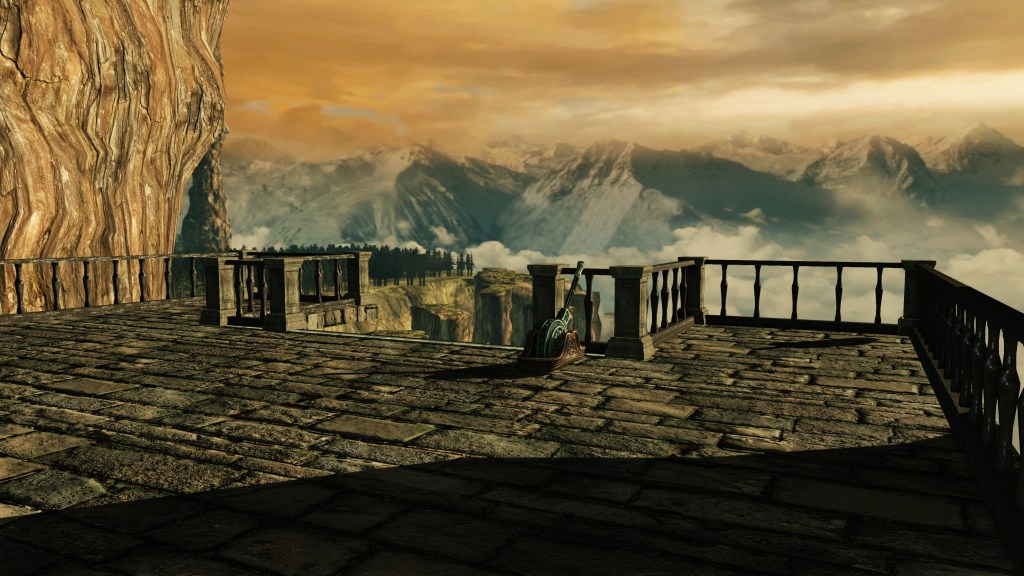

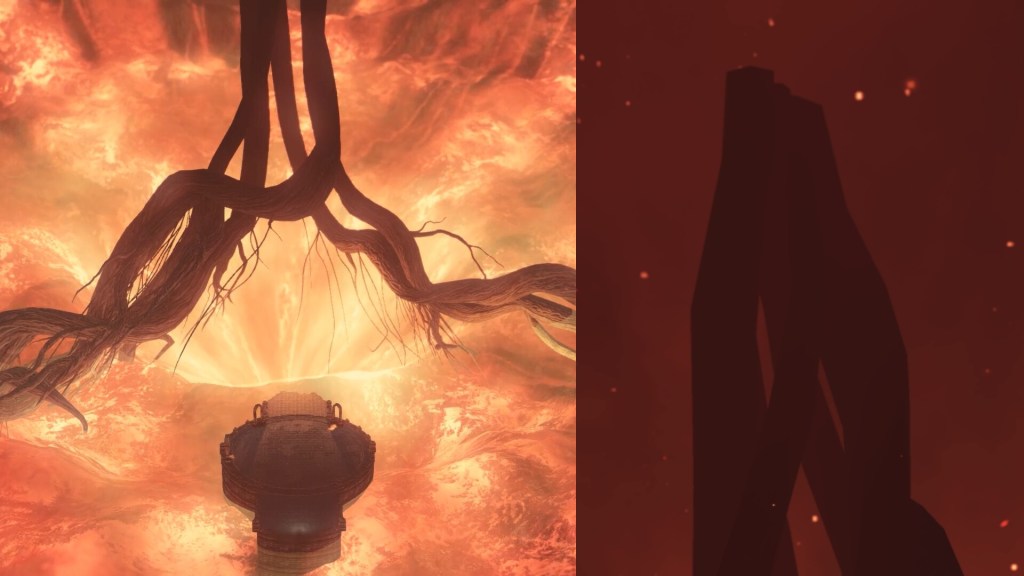
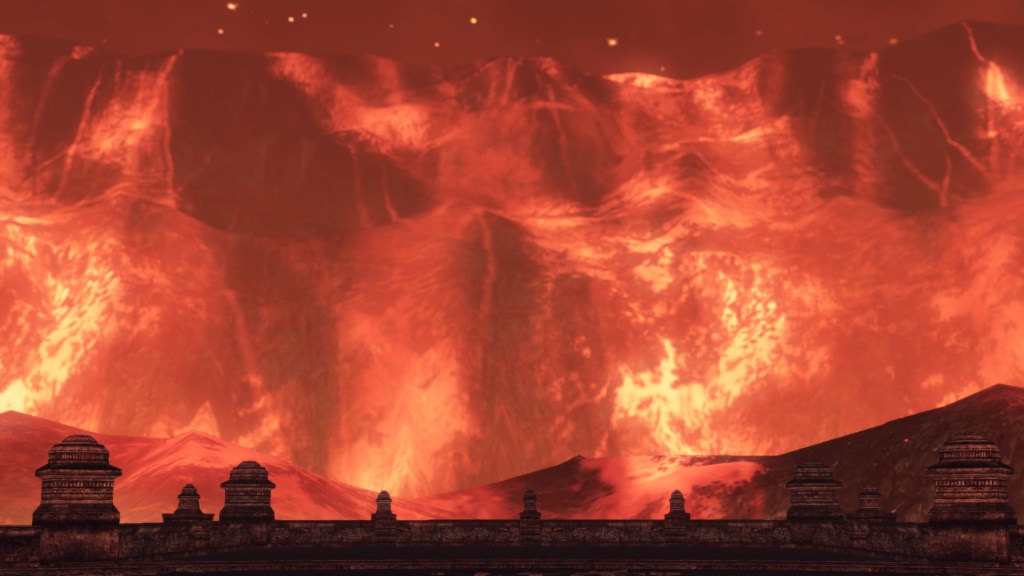


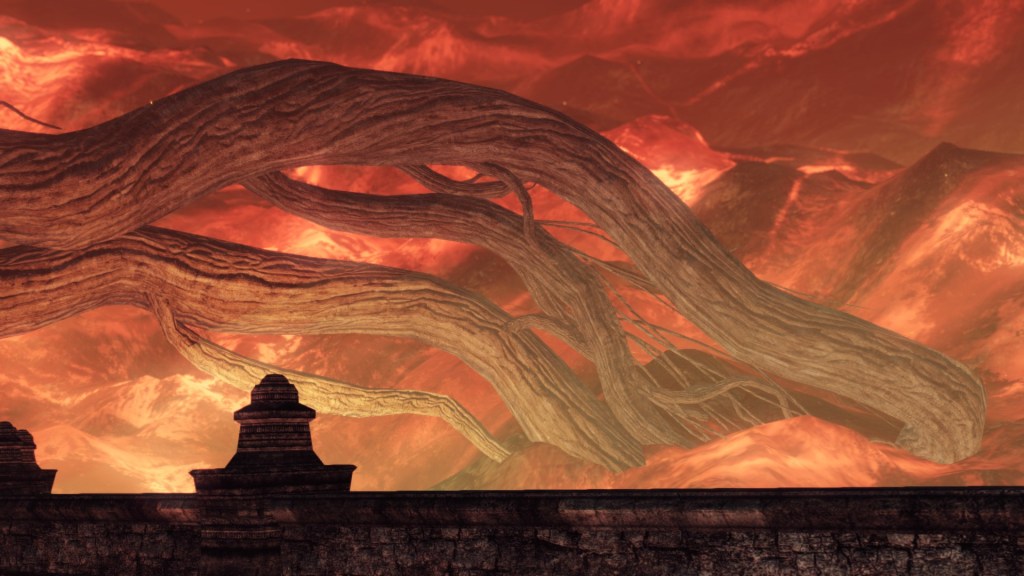


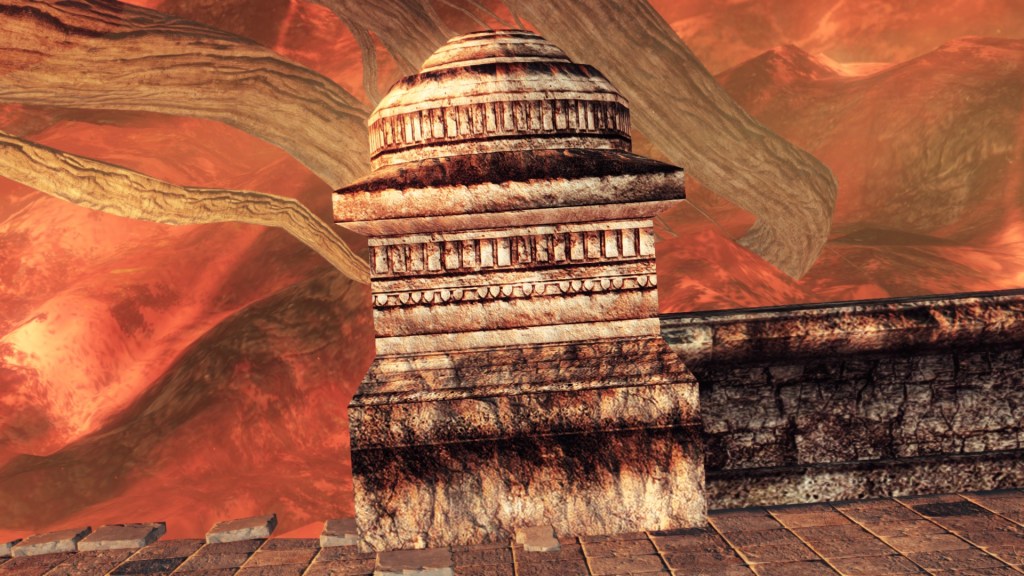
There is nothing in this land. This place became a land cursed by the “Old Chaos”. Chaos birthed warped life and kept everything away. Until my sovereign, the King of White, appeared.
The fact that remnants of the demon ruins have carried over to the New World isn’t a surprise. However, it is peculiar to see the Chaos Flame alive and well after the events of DS1. The Lord Soul aligned with life might allow the Witch of Izalith’s strong will to reconstitute her bug form after death. But the Chosen Undead still took that “seed” from the bed sustaining the flame. The Flame was also undeniably defeated along with the Bed of Chaos. With the seedbed slain, how is it that Chaos is still alive, let alone strong enough to wreak havoc across any land? The answer lies in its underlying nature. Chaos is ultimately a living soul, the flame an expression of that soul; a kind of transient body. Although the fire wresting itself free of Izalith’s control was clearly affected by the death of its host, the parasite was always distinct from the insect or her tree avatar. And even bereft of external feed, the Flame of Chaos would still be burning Disparity it had already swallowed. The First Flame didn’t die the instant it lost Gwyn as Lord of Cinder. Therefore, Chaos Flame could theoretically survive with a fraction of the Life Soul.
You seek what in this ruined capital? Leave. Do not touch the flame warped by the “Old Chaos”.
The question then is how long a starved flame can subsist on the existing energy being digested. In the case of the Old Chaos, the power of life which birthed it apparently granted a long leash. The Chosen Undead dealing the final blow to the source of the tree avatar undoubtedly forced it into a level of dormancy. But by the shift to the New World, the Flame was active again. The reason for its rampage is obvious. Beyond its wild and uncontrolled nature, the Flame of Chaos is likely desperate for souls. Contrast to the First Flame, which is entirely reliant on outside intervention, the living Chaos is capable of reaching out to draw in more Disparity with its existing power. Furthermore, the fire of life must know that it is dying and actively seek to perpetuate its existence per the nature of life. The Flame’s overriding concern was thus to find a soul which could stabilize its prospects long-term. But like a child drowning at sea, Chaos could only wildly flail in hopes of latching onto anything solid. In the process, it created many byproducts.
It is possible that chaos demons were brought to the New World with the ruined capital of Chaos. Chaos pyromancies have spread beyond the witches of Izalith, at least. We can even acquire the Demon’s Great Hammer owned by DS1’s Asylum Demon, the description insinuating that their kind remain in legend. If the hammer last seen at Northern Undead Asylum just outside Lordran is present, then some spawn of Chaos from Izalith might have roamed Drangleic once upon a time, only to have all died out one way or another. However, Alsanna implies that the Old Chaos was giving birth to new demons at the time. This is curious, since the original chaos demons were born from incidental or conscious transformation of entities with the Flame. Their birth at the northern limit suggests that Chaos did the same to local wildlife, maybe the occasional human explorer — either deliberately to help it collect more souls or inadvertently in the rush for them. Whether or not Chaos was wasting precious energy, that gluttony for souls is reflected in its spawn.

Great hammer made with materials never before seen. It looks like both rock and wood.
The origin of its name is unclear, and it is too heavy to believe in human handling. Is it dedicated to the demons who remain in legend?
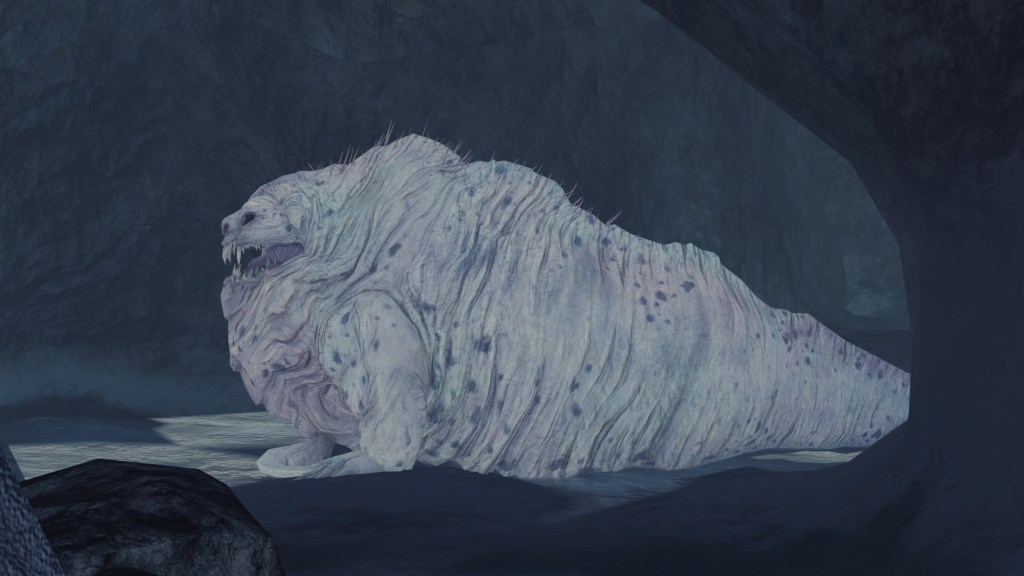
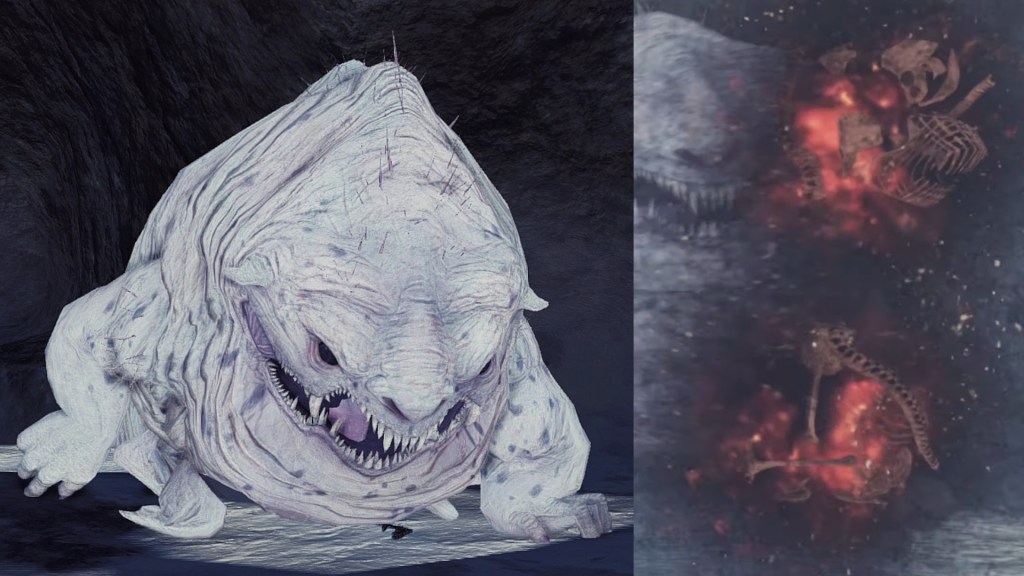
While exploring Eleum Loyce, we will descend into an ice cave that a certain creature has made its den. This enemy is identical to the Covetous Demon encountered at Earthen Peak save for its snow-white color, presumably resulting from the cold weather. Even accounting for the developers reusing assets, it is still a hefty slug-like creature which has gorged on many a man, bodies stripped to the bone laying all around its territory. If not related to the boss down south, this Covetous Demon no doubt greedily devours life by nature all the same — fitting that they are named internally after Jabba the Hutt, an equally gluttonous slug-like entity from Star Wars. And when the cave dweller hurls up the bones of its victims, its stomach acid glows a deep red, unlike its boss counterpart. Considering the location, this can only be because the demon was born from the Flame of Chaos, whose pyromancies manifest a similar color. This demon is an example for the kind of twisted life created while the Old Chaos ran rampant.
We can also obtain the Bone Fist from the area, the claw bones held together by cloth wrappings. The English description says that it was salvaged from a malformed creature, but the Japanese terminology is more accurately a “grotesque”, (異形) entities who possess a form different from the norm and typically repulsive. Fans of DS1 may recall that life influenced by Chaos were also described as “grotesque”, and these bones allow the wearer to fight with superhuman strength akin to the heftier chaos demons from that game. What local beast would possess that kind of power if not thanks to the Flame twisting life? Indeed, descriptions to various weapons reference “grotesques” generating from Chaos, so there is no doubt that the bones belong to a demon born of anarchic fire. Likewise, ice horses in the snowfields outside Eleum Loyce possess the Bone Fist, insinuating just how widespread these demons once were.


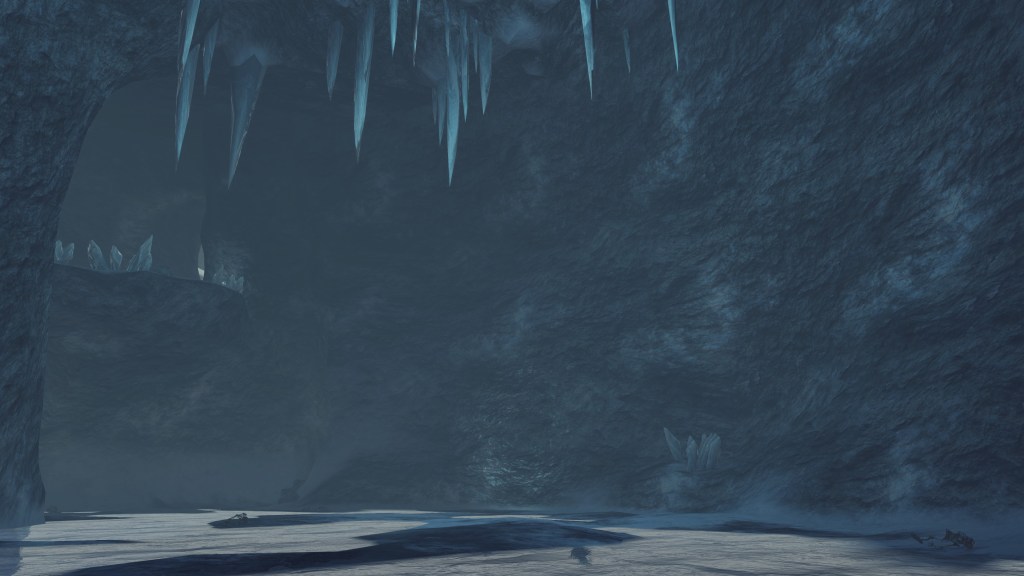
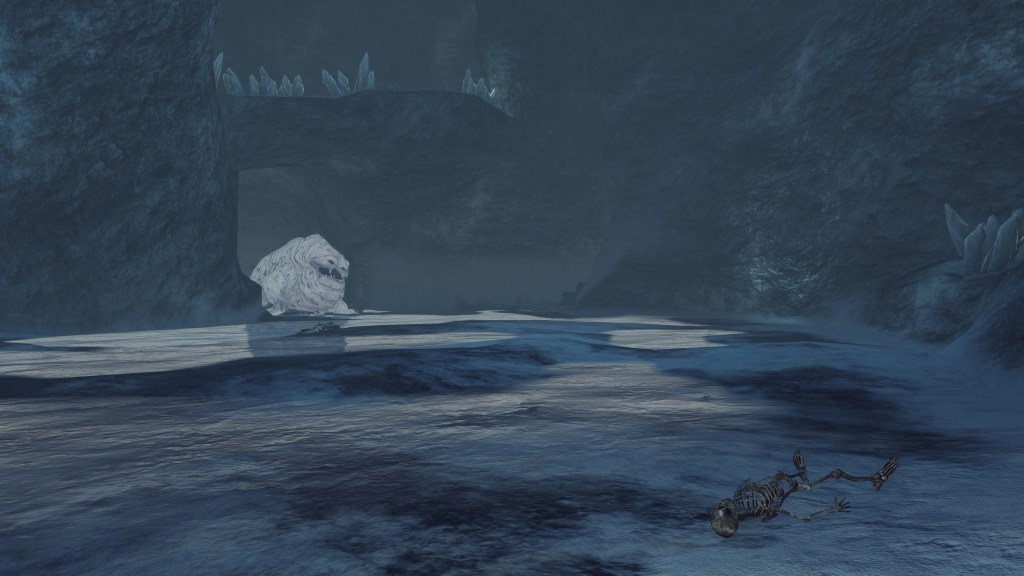


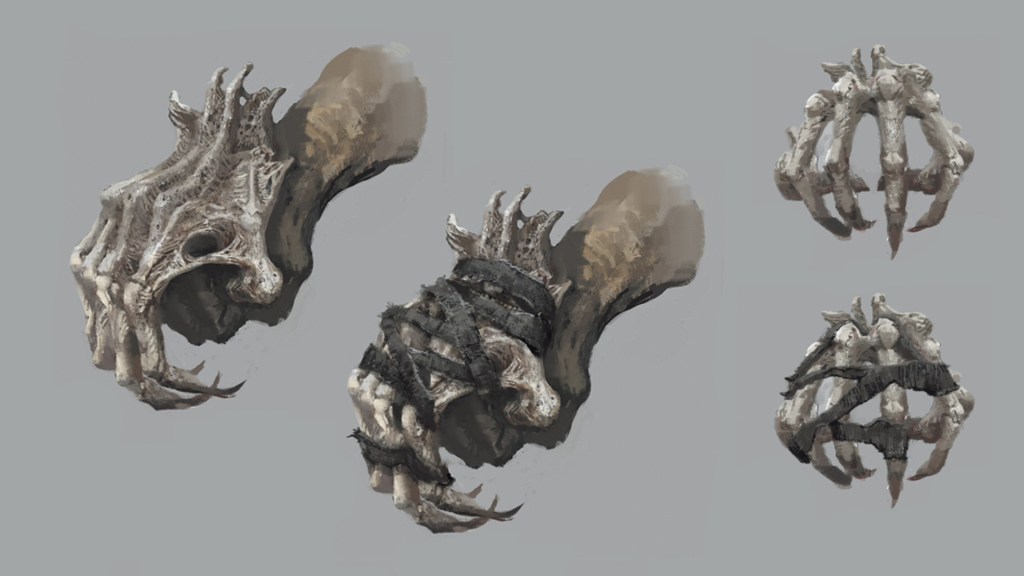
Bones that are bound to the fist. Used as an enhanced weapon for boxing. The bone’s owner is a kind of grotesque, right?
The one wearing it can unleash superhuman boxing. As if they have acquired the power of a grotesque.
But despite a horde plaguing the land, the Flame of Chaos was not as destructive to the land itself. Full-grown trees exist in Eleum Loyce, the former wood evident from the witchtrees roaming about. Specifically, these intelligent humanoid trees linger in front of the ice cave, perhaps curious to study the life denning within — their specialty is soul sorcery. Nonetheless, the description to the branch of their magical bodies they wield as a catalyst claims that they wander forests. The trees’ prevalence in the Dark Chasm of Old indicates that this can be any forest in Drangleic, but that makes the sheer number in Eleum Loyce all the more significant. Moreover, the snowy cold which now characterizes the area is what made it a “lifeless world”, implying that it was full of life before then. That a kingdom could be established means that the land was at least livable. Even underground, the damage from Chaos was fairly limited; there were still water reserves for Eleum Loyce to build a fountain on a small mountain. It is obvious that flame didn’t devastate the surface.
In short, the Flame of Chaos remained mostly confined to the deepest reaches of the Lower World, only maybe occasionally flaring up to the surface. Even these flare ups might have been a boon to would-be settlers. The “ivory” so heavily associated with Eleum Loyce refers to a white ore exclusive to the land — admittedly, this white metal hues genuine ivory in one instance. The unique color is apparently because it contains souls which, when unleashed, can form a blade extending a weapon’s range and lethality. And because the soul blade is not sorcery, the weapon doesn’t require intelligence to wield. Armor made with this white metal is also magic resistant by far, which makes sense if it is “soul” metal versus soul sorcery; when charred by the soul-hungry flame, the same armor also loses large part of that magic resistance in exchange for more fire resistance and nothing else. When factored with the location, this may be another byproduct of the Old Chaos, some of the souls it burns becoming infused into the land like embers. Alternatively, souls already lacing the land helped feed Chaos, explaining why it has remained relatively confined to the northern limit for so long.
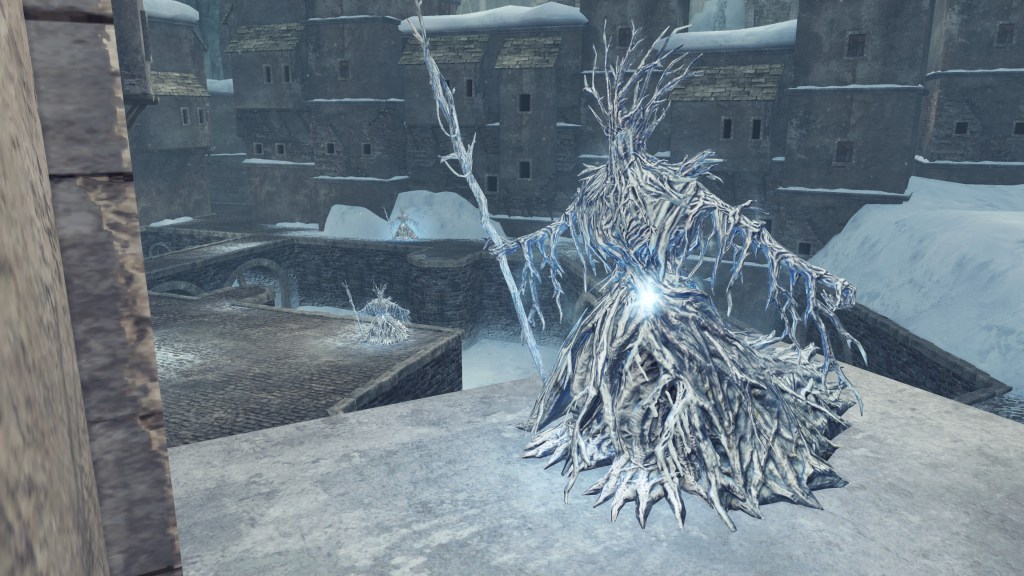


Whether the environment was shaped by Chaos or shaped its behavior, life was still coming in contact with the flame and becoming twisted monstrosities. The victims’ wills were in all likelihood compromised by its influence, the Flame outright puppeteering those it subsequently consumes. Its desperate desire had most likely made them mad with hunger. These ravenous demons were what kept people away, the large club on one skeleton in the surviving demon’s lair suggesting that only primitives would dare wander into this land carelessly. Outside of humans, only the local wyverns seem to have infringed, the dragon bone fossils also carried by the ice horses hinting to their frequent clash with the chaos demons. But for however long dragon and demon territories came into conflict, nothing would change so long as the Old Chaos continued to afflict the land. It is only after the Ivory King arrived that everything changed.
As typical for Forossans, the king spent his younger years in battle, cultivating a soul surpassing that of most heroes. This soul worthy of a king speaks to his storied career with a sword but little else. The only other detail to glean about his personal life is that he collected seven beasts as pets. Although we can only meet three of them, they all appear to be tigers with fangs of saber-tooth cats. On top of size and strength, they also prove immensely intelligent, capable of understanding speech and manipulating magic. Each of the three is worthy of their individual boss soul. Furthermore, the tiger is historically considered king of the beasts in Asian countries like China, so the pets certainly demonstrate strength for a monarch. However, where and when did he acquire them? Given the apparent struggle to survive with Chaos running rampant, it is hard to imagine them roaming the northern limit. Perhaps the species is native to Forossa, the country’s rising star taming the seven to support his career in battle. If so, it is easy to imagine how this scenario came to pass.
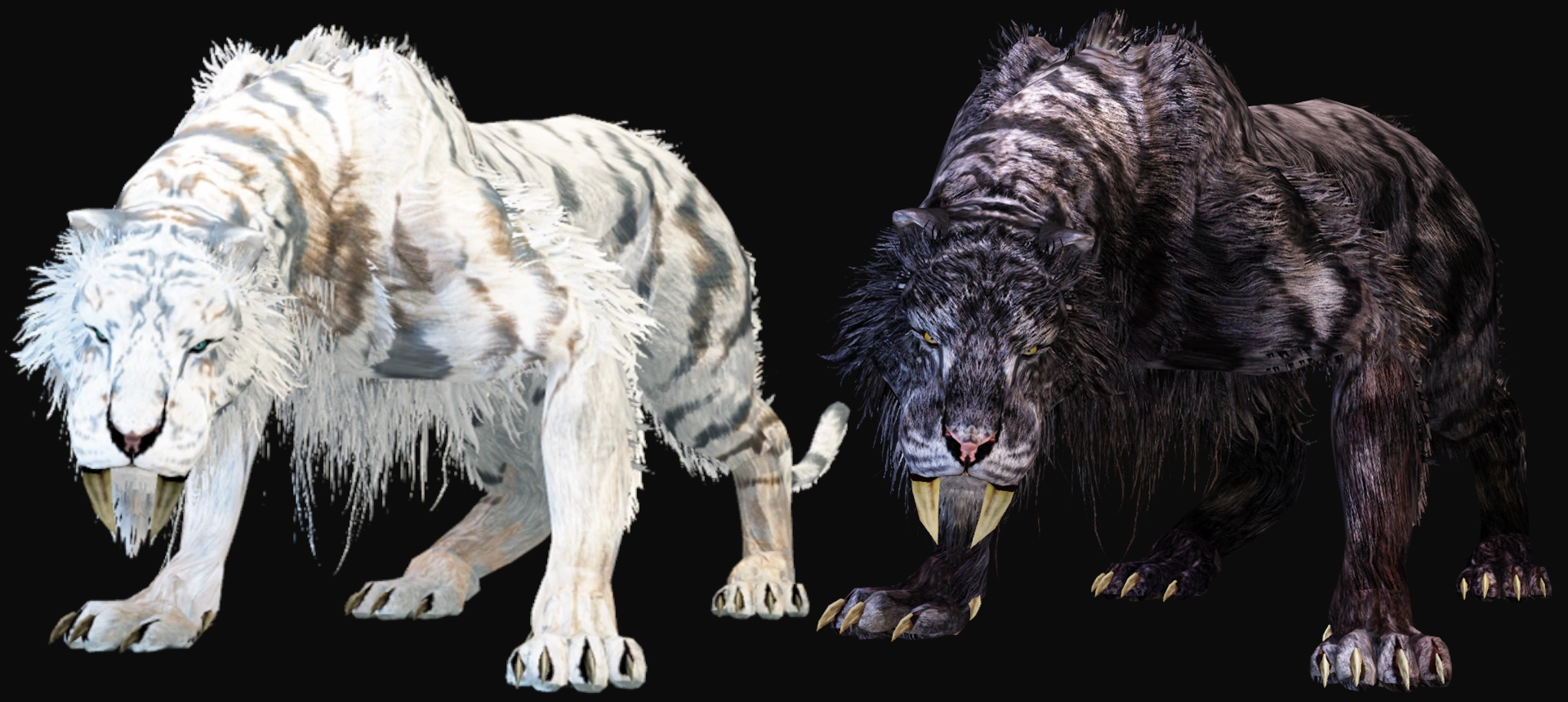
Recall Forossan warriors’ vigorous hunting culture, wearing pelts of animals they defeated as a badge of honor. Knights may have exterminated beasts causing problems for the populace; alternatively, it was recreational. In either scenario, the future king likely set out to hunt the mighty tigers wreaking havoc in the area, bringing the seven home to parade as trophies. Having clawed their way to the top since birth, knowing defeat earned the cats’ respect. The knight unambiguously sat above them in the food chain — similar to how Artorias, the indomitable knight of Gwyn, befriended the grey wolf Sif in DS1. The felines weren’t interested in learning swordplay, but they did want to follow his lead as the alpha male. And whatever the particulars, they all became his fiercely loyal pets, willing to carry out his orders long after they were free of his punishment. That strength would serve him well in his regal capacity.
Forossa’s greatest knight became king when he came to the land and successfully contained the power of the Chaos Flame. As Alsanna relates, this was accomplished by offering his mighty soul to the Old Chaos. Somehow, the man realized that the wild fire sought the kindling of Disparity and proceeded to answer its want. He provided his spirit in piecemeal to appease it, the soul only “drying up” after already creating his entire kingdom. This is impressive on multiple fronts. Not even Izalith, with her Lord Soul, could suppress the Chaos born from that same soul; the Witch required the help of her two daughters just to bring the newborn flame under control. Granted, their control enabled the invention of pyromancy, and we don’t see the Ivory King’s subsequent country utilize any lava arts. Still, he was able to curb the flame’s rampage with his own essence in a way the Lord of Life never could, his soul forged in battle sufficient to the task. The only question is how he devised the means. In all likelihood, he had lots of his own support in this endeavor.
My sovereign is undoubtedly one suitable to be King. Due to his great soul, the king constructed Eleum Loyce… and contained the power of Chaos. However, that was nothing less than continually offering his own soul to Chaos.
How does one man create a country in no-man’s land? One does not suddenly attract an entire metropolis out on the fringes where nobody would normally settle. The knight must have had others with him, or at least outside support willing to bring some later. And we know one party who did keep sending manpower: his homeland of Forossa. Perhaps the future Ivory King came with an entire army tasked to destroy the flame plaguing the land. Whether by order of his country or of his own initiative, Forossa’s most ranking knight fought to the heart of this Old Chaos. But then he decided to establish his own kingdom, sending word back that he would remain there to seal the rampaging flame until they found a way to subdue it once and for all. If Forossa truly cared about Chaos’ threat, it would no doubt send plenty more to help populate this burgeoning new nation keeping a cap on the fire. In effect, Eleum Loyce was simply the vanguard holding the line for Forossa, with the Ivory King its commander taking the front himself. It made no difference if frontiersmen wanted to think themselves as independent.
Leave. And never look back again. Don’t approach that which was sealed in Eleum Loyce.
A Forossan expedition to squelch the Flame of Chaos explains how the Ivory King even learned of this distant danger. Recall that the country worships Gwyn’s firstborn as Faraam. Recall also in DS1 that the war god was implicitly involved in Anor Londo’s conflict against Izalith and its chaos demons before his father relinquished the throne. He knew more than anyone what the Flame of Chaos was capable of, the hazards to the world if left unchecked — especially now that no one was directing its disorder. And given how the war ended, Gwyn’s successor may have felt responsible for unfinished business — especially if dragons were now being affected. Even after he got expelled from the pantheon and left to set out on his own, the medial lends his powers to humans who will still call him god. If he made his presence known to Forossans, then it is possible for him to come across the land ravaged by Chaos in that same part of the globe. Even with the power of a god, the firstborn obviously couldn’t defeat the flame and all its spawn singlehanded. So, he told peoples receptive to him to the east about this scourge, leaving them to one day handle the threat.
“Faraam” apparently didn’t stick around to train up and lead an army; the prior game indicated that his focus lay elsewhere. But what support he could provide via idols was more than enough for Forossa, welcoming the development to its bellicose culture. And when the future Ivory King appeared, the country clearly saw an opportunity to fulfill the mandate of its war god. With the most powerful knight in possibly the country’s entire history at their disposal, there was no better opportunity to strike so far abroad. The state organized a force and sent them off to fight a new battle against an unconventional foe, with their star knight at the head. The result speaks for itself. Not even he could stop the flame, but its suppression showed promise, and so the homeland continued sending human resources for as long as this “Eleum Loyce” remained in operation. Thus, a new king was born, carrying on the will of the missing sunlight deity his sudden subjects yet revered.
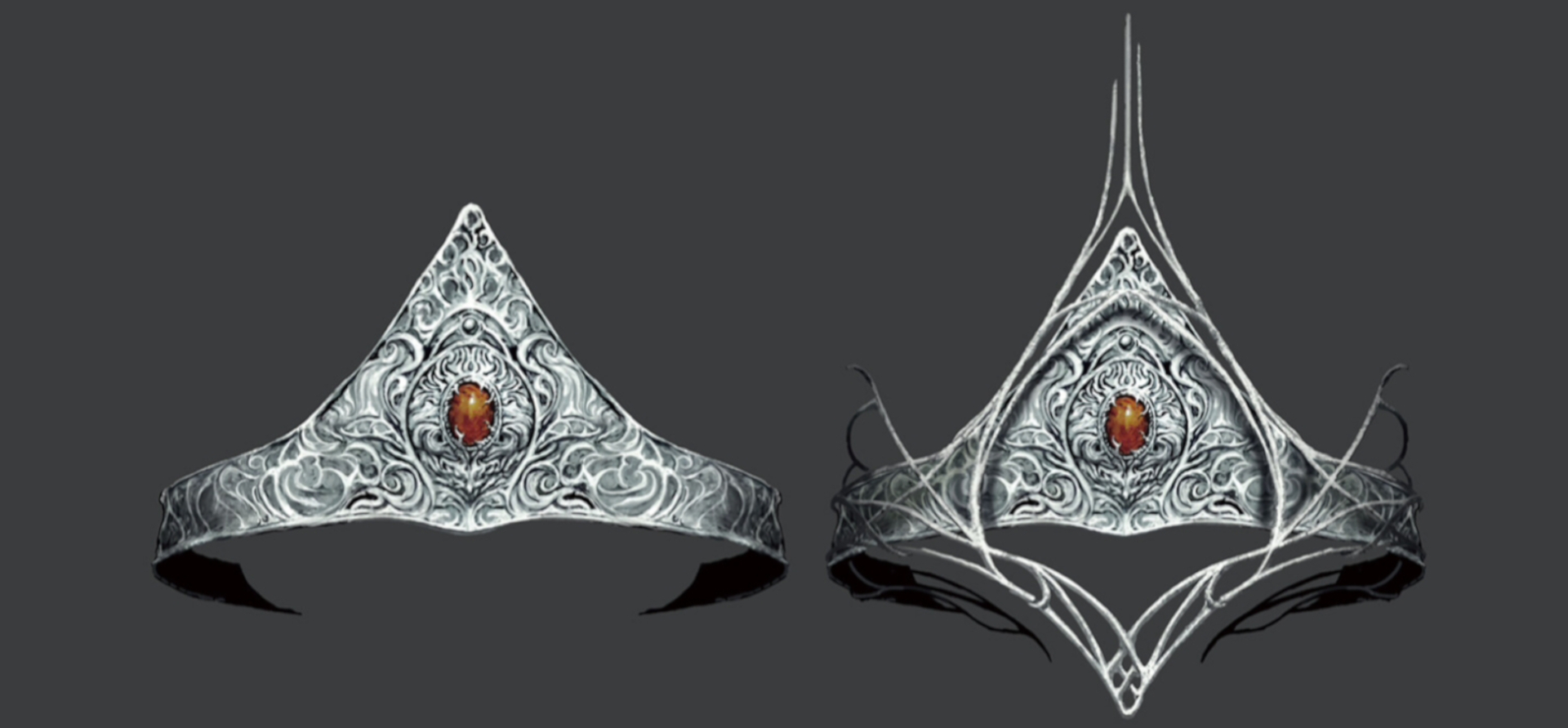
This was in no way an opportunistic power grab. As his own vanguard, the former knight placed his new throne upon the hole leading to the belly of the beast. He would be first to stand in the way should the Flame begin acting up again. The kingdom he built from there was more than just a big city; it was a giant wall. That mission behind his authority was embodied by his crown. Seemingly welded from the land’s unique metal, the white crown includes a glowing reddish-orange gemstone, no doubt representative of the Chaos the king contained within his ivory kingdom. By all accounts, the sovereign of the north acted with the chivalry of a knight, hoping to save people for god and country. If that meant taking up the mantle of kingship, so be it. The top knight probably had experience in command, so this was just organizing a larger-scale operation than normal. This was a new kind of warfare, one he was all too happy to pioneer.
Armor of the White King who controlled Eleum Loyce.
The land of Eleum Loyce became a giant wall that seals away the Old Chaos. For the White King placed his throne on the hole of Chaos and became his own vanguard.
Angel on Each Shoulder
Every king requires his faithful knights, and so the former knight of Forossa formed a new chivalric order under his command. These Loyce Knights were equipped with silvery white weapons and armor. These were at minimum laced with the soul ore, giving them the name of ivory warriors. The undiluted white metal was definitely shared with certain knights, namely Fabian. Like the Ivory King, Fabian owned a “straight sword” with ivory blade capable of producing a soul edge, which made up for the actual dagger’s short length. He must therefore have been favored by the king for his loyalty and accomplishments. Even then, it is obvious that the white metal was used sparingly, either because of limited quantity or perhaps difficulty with the metallurgy.
Sword of Fabian, knight of Eleum Loyce. The white ore mined only in this land is used for the blade. Slash enemies with the souls unleashed.
Fabian and the knights of Eleum Loyce leapt into the Chaos themselves to destroy the grotesques but none returned.
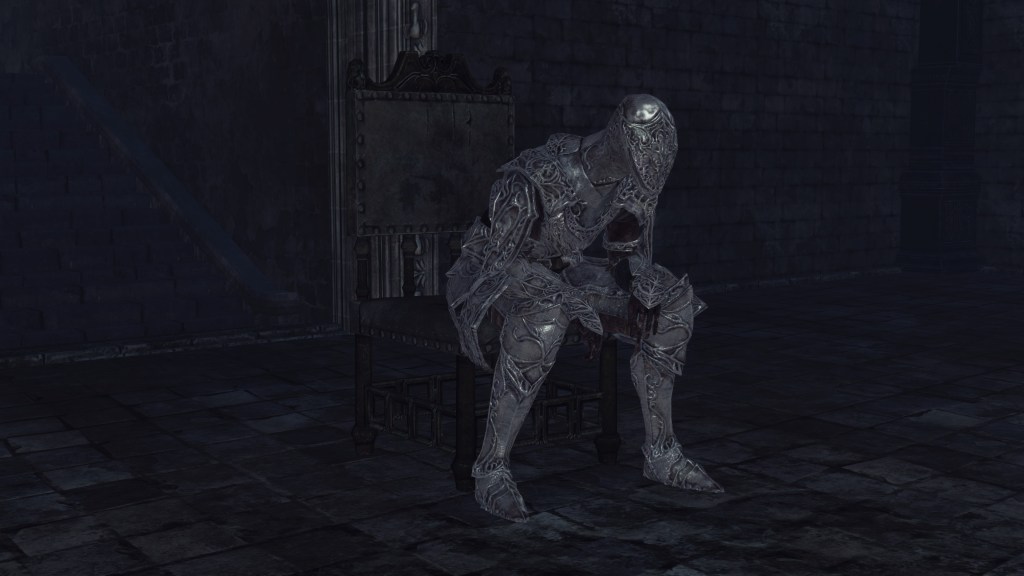
Still, there is no denying that the order was well-furnished. The warriors owned rings that wore down their foes’ stamina with each attack, perfect for slowing the advance of Chaos and its horrors. The guardians stood ready to stop the flame in its tracks at a moment’s notice. This is evidenced from the chairs surrounding the pit to the Old Chaos, each corresponding to a knight who would join us in the fight against it. Should the flame ever flare up, they would be there, prepared to hold it at bay if worse comes to worse. Of course, not even the deepest fealty can keep a knight on guard at all times. Based on the chairs, the order likely had the knights working in shifts, only keeping a small number on watch at a given hour. The rest could return home so that they would stay well fed, rested, and practiced for when duty called.


Ring of the guardian warriors of Eleum Loyce. Enemy stamina is greatly reduced when attacking.
Eleum Loyce, which suppressed the runaway flame, sank into cold and became a lifeless world via opening the White Gates.
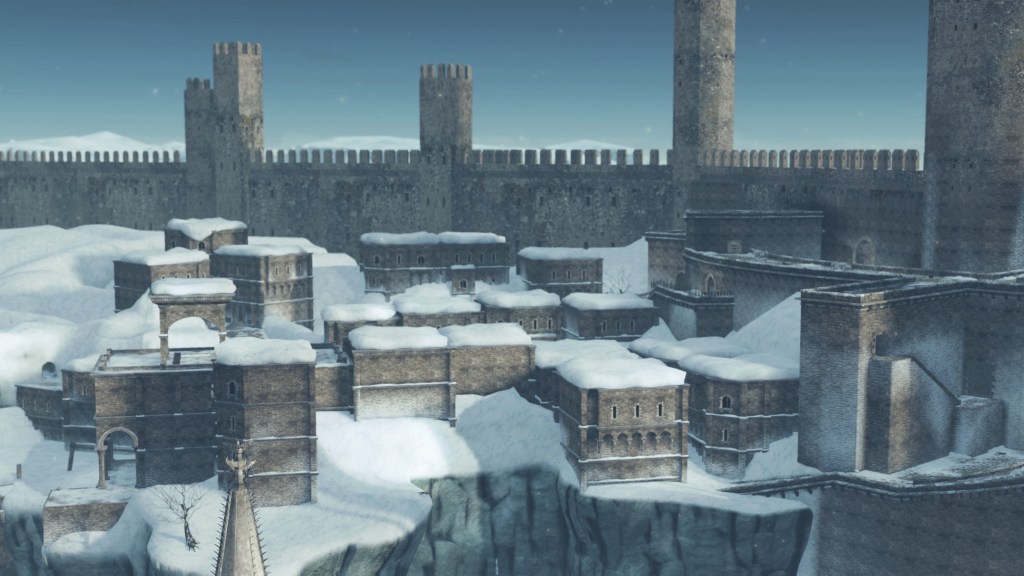
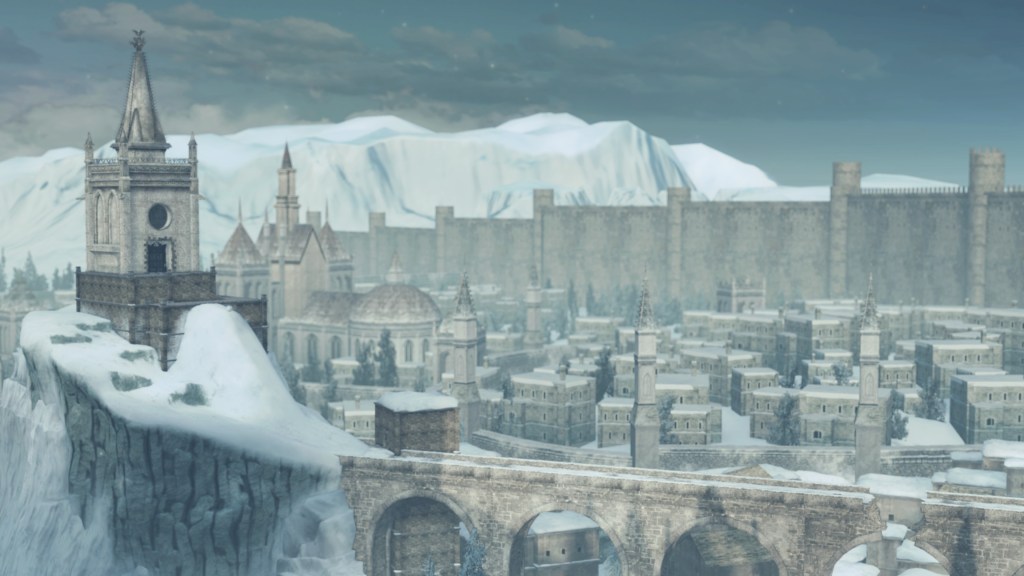
The Garrison Ward is more accurately named “Knight Town” (騎士街) in the same sense that one might think of a Chinatown. Although incorporated as part of the larger city of Eleum Loyce, it is distinctly its own residential block for a specific subset of the community. In this case, the quarter was built to be a “bulwark” against Chaos, housing the knights who would stand between the Flame and the rest of the world. Naturally, this Garrison Ward was constructed not too far from the pit to Chaos compared to the rest of the capital, allowing the knights easy travel to and from their place of work. Its size likewise betrays the dozens welcomed to stand by the king as a vanguard. So big is it, the residential district is divided into two strata, one at the top and bottom of a relatively small cliff. The two levels remain connected via lifts at either end of a stone bridge linking the upper stratum to an isolated tower.


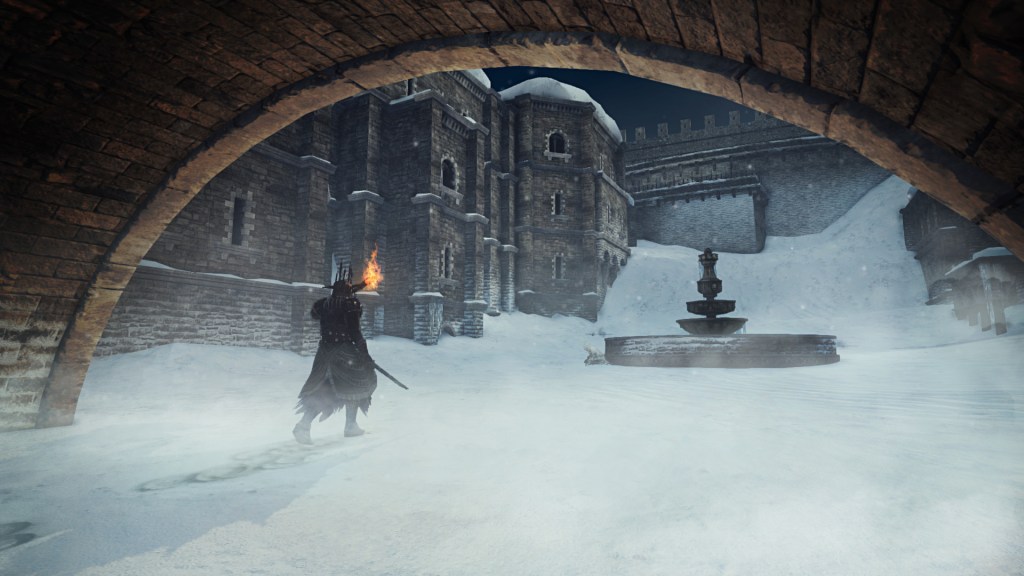


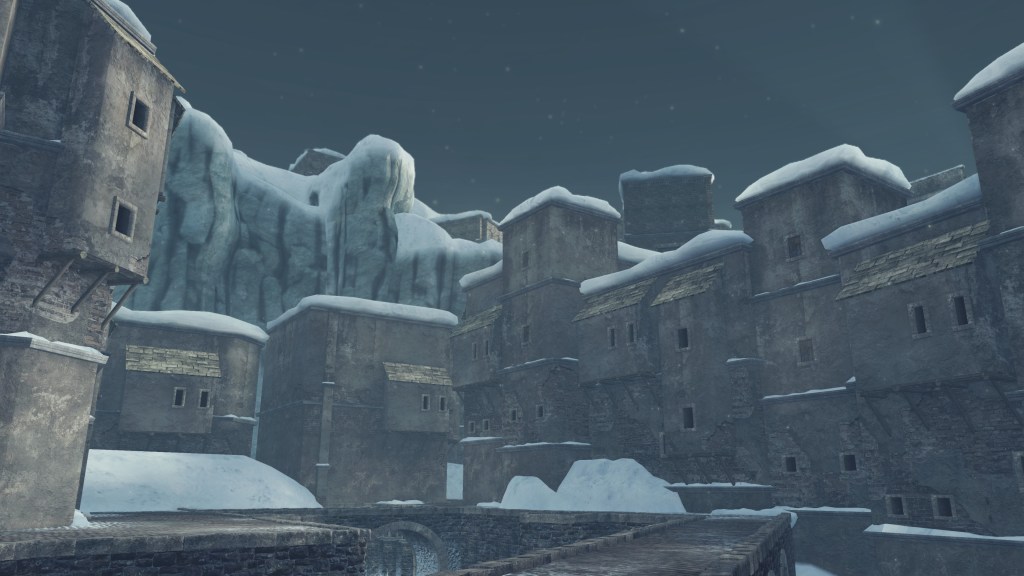
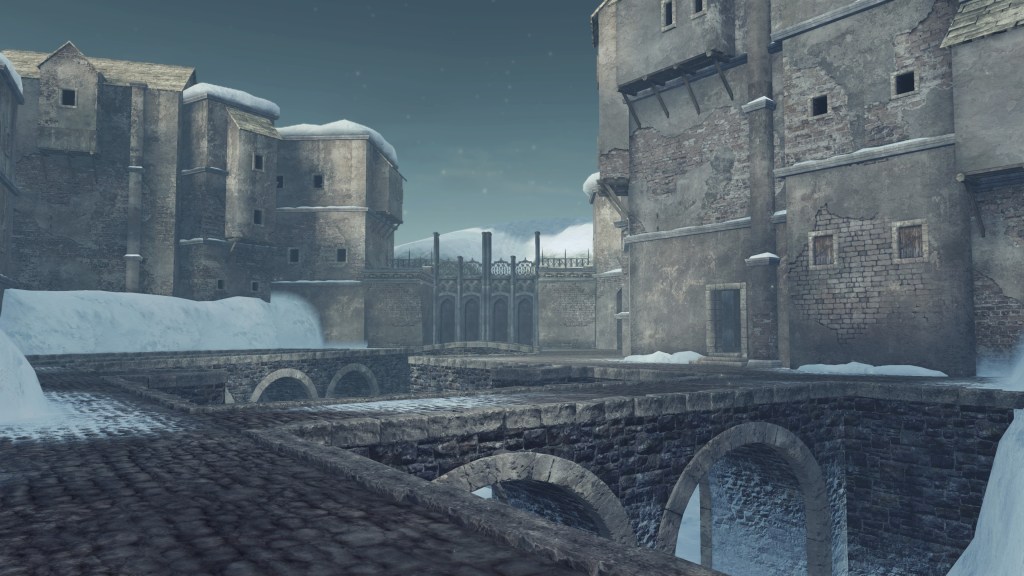
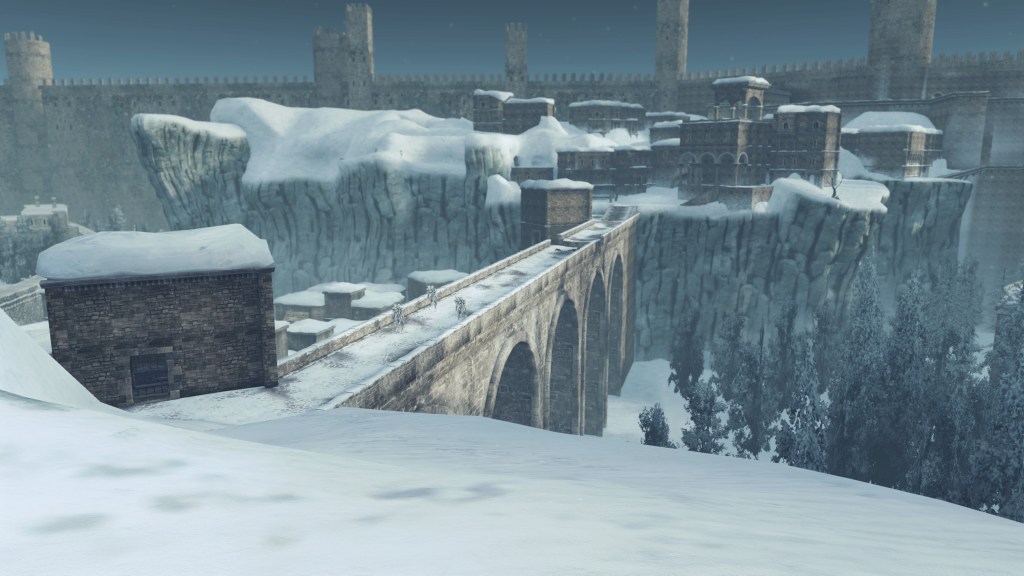
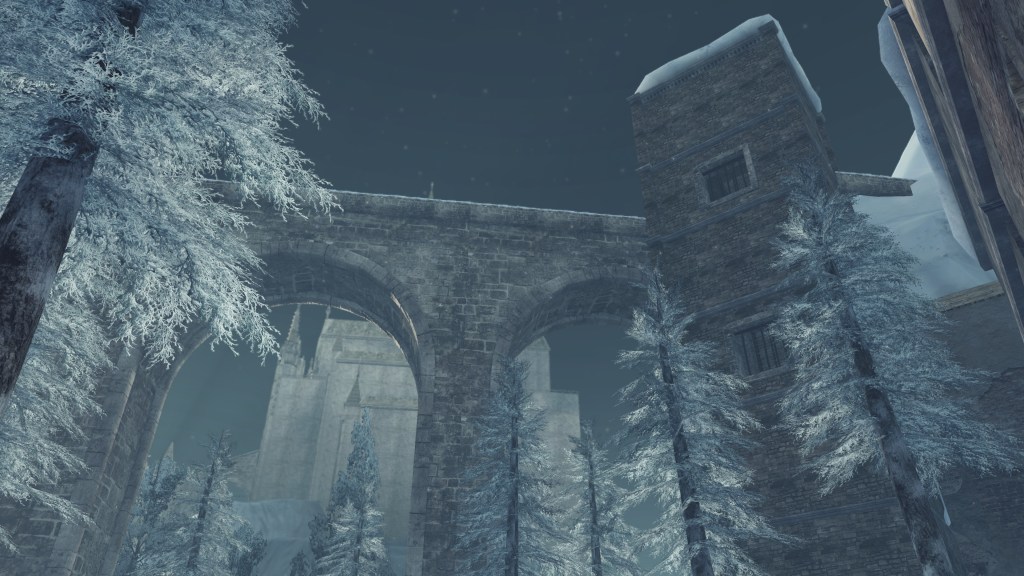
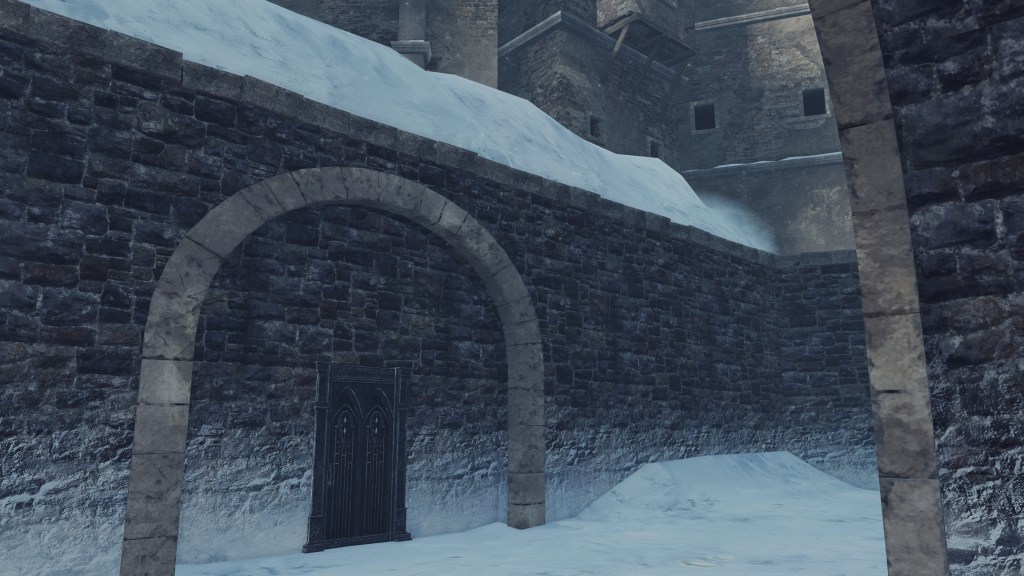
Key to open the door to Knight Town of Eleum Loyce.
Knight Town was built as a bulwark against Chaos. The knights of Loyce who remain there even now are awaiting the summons of one heading for Chaos per the last command given by their king.
But outside the comforts of their own homes, the knights always projected an image of readiness. Seeing how their king never showed his face to anyone, the knights also refused to take off their helmets while in public. Even if things seemed peaceful on the surface, Eleum Loyce couldn’t be in a more precarious situation — things could descend into literal chaos at a moment’s notice. If their king constantly appeared prepared for battle to his subjects, then it was only right for his knights to follow suit. Their choice to wear red and white cloth respectively also furthered this goal. Collectively, they would be the reminder that the peace everyone enjoyed was due to the kingdom’s unending vigilance. This not only reinforced the state’s reputation but inspired confidence in the people working in some way to support the king and his knights. It was another example of the knights’ solidarity with their king. The sword, greatsword, and shield forged with the souls of the Ivory King’s pets affirm just how closely they worked with the monarch on a daily basis. Whatever the king did, they did as one.
Helmet of the White King who controlled Eleum Loyce.
The White King didn’t show his appearance to anyone. It is said that the knights of Loyce didn’t take off their helmets in public in accordance with that.
Of course, battle readiness requires training. Whether or not all were veterans born in Forossa, the Loyce Knights needed to maintain their skills at a high level if they wanted to stand strong against the Old Chaos. Certainly, the order’s strength is demonstrated by the Loyce Soul left by these knights, each using the menu graphic for a generic boss soul. They may not have matched their king, but they had the innate power to be considered elite in their own right, something that could only be acquired through combat experience and continuous drilling. Cut area names for this third DLC do allude to a Knight’s Training Ground, (騎士の訓練場) which could have feasibly been applied to the entire Garrison Ward. Suffice to say, the guardian warriors of Eleum Loyce proved their worth for being knighted. And should they not practice with the monarch who conferred their title, the training regiment was still harrowing.
The lower stratum to Garrison Ward is particularly notable for its proximity to the one chaos demon’s den. This fact wasn’t lost on the knights, given that they built a gate to keep anyone going in or out of the cave. Whether discovered accidentally during construction or otherwise, the knights apparently never made a concerted effort to slay the demon. Perhaps they simply didn’t inform their king so they could enjoy a bit of japery. A back door around the cave proves that the glutton hardly hindered urban development. And since a collective inability to kill the fiend begs skepticism, they must have found some purpose to keeping it alive. The ring attained in its death simultaneously suggests that knights did try and fail to challenge the demon at least on occasion, probably as a trial. Indeed, a cut area name refers to a “trial’s ice cave” (試練の氷洞) and there is only one such cavern in Eleum Loyce. Therefore, the demon was in all likelihood a means to test individual knights’ strength and courage against an example of the horrors they would face. So long as they beat back the spawn of Chaos, they passed.



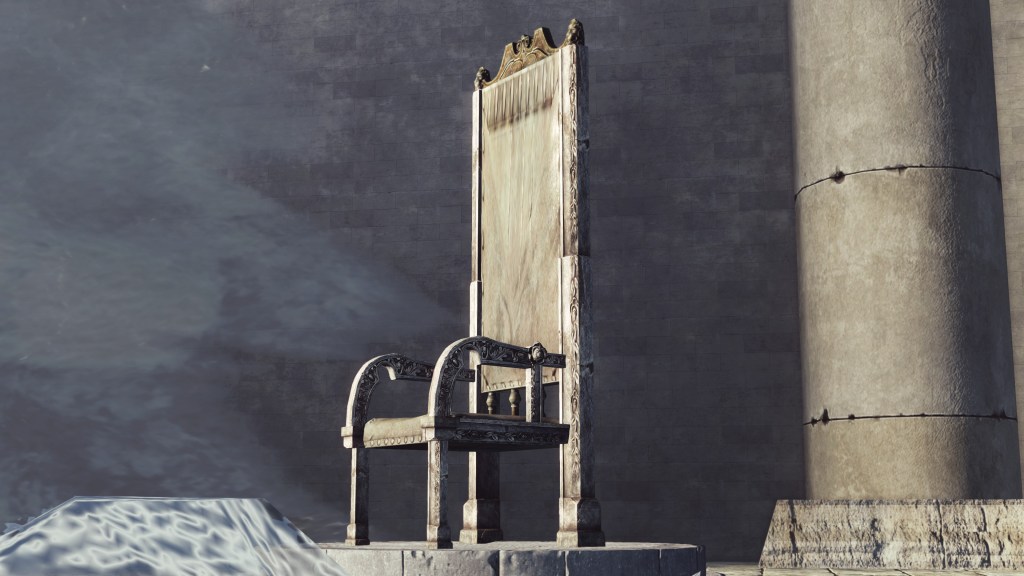
Although the knights were perhaps the most martially able of the king’s comrades, they were not the only ones to work so closely with him. When the Ivory King placed his throne over the pit to Chaos, it was not within a palace but a church. The man had a grand cathedral constructed on the spot where he would appease the flame. With this was the establishment of a new Loyce religion, with the country’s king as its high priest. In the leadup to the cathedral, we pass many statues of a bearded man dressed in robes and a tall hat wielding a staff, a bishop’s crook specifically once inside the building. It is clear that the figure is supposed to represent the religious authority headquartered within the church. And the only function of this cathedral, aside from sealing the Old Chaos, is to meet with the king on his throne, the audience chamber complete with a stand down the red carpet to step up and address the monarch likely seated on high directly above the pit chamber. In other words, the Ivory King must hold both temporal and spiritual authority.


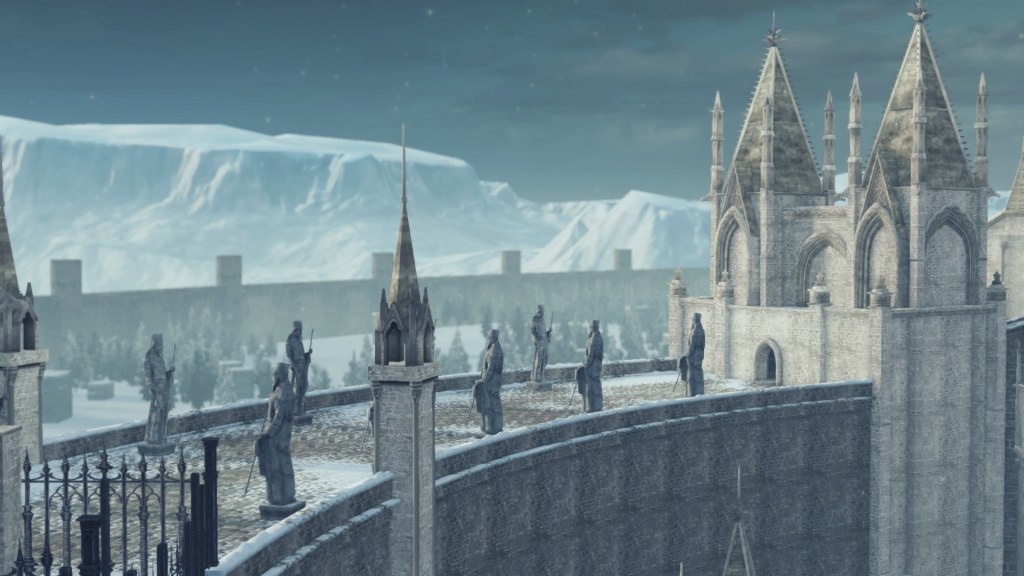

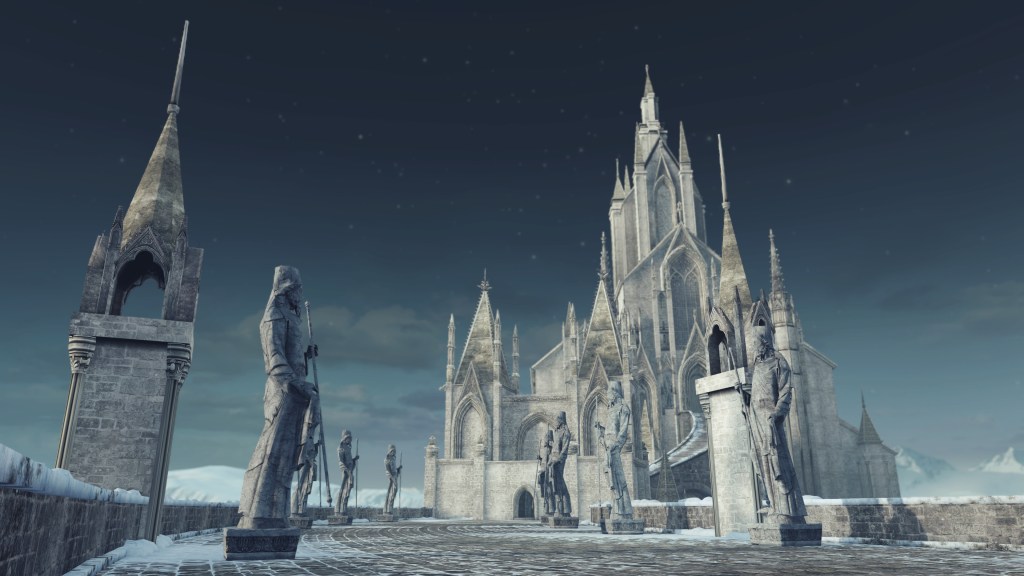


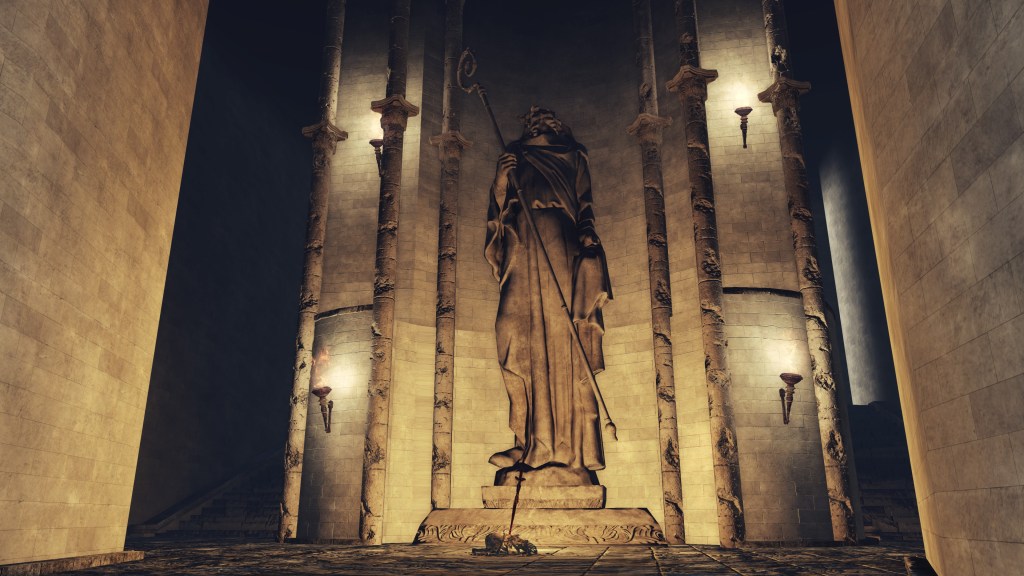


Crown of the White King, the king who controlled this land once.
In order to suppress the runaway Flame, the king built the cathedral in the northern limit. But, once his own soul dried up, he entrusted everything to Alshunna, who had been by his side before he knew it, and disappeared without anyone knowing. The king’s name is already lost.
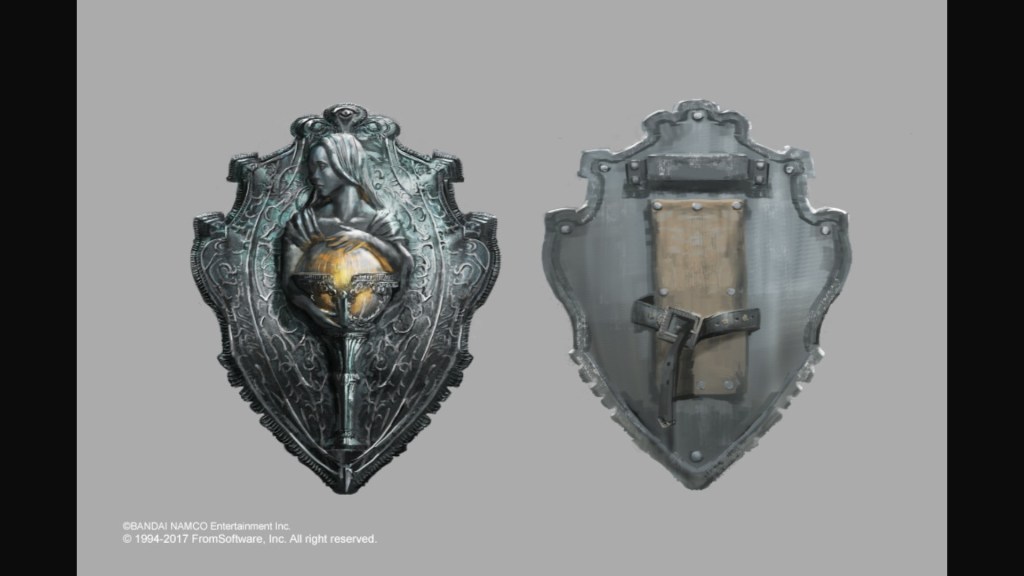
Like the Sunken King, this priest king of Eleum Loyce had a number of priestesses under him. Their dedication to suppressing the Flame of Chaos is reflected in the Vessel Shield, which depicts a priestess cradling a fiery orb contained in a chalice. From the slight heat the shield emanates, that glowing orb embedded in the metal may be an actual fragment of Chaos, which fits with where we find the shield inside a chest within the Grand Cathedral. If they were investigating the means to bottle up the great flame beneath their feet, that might explain some of its powers. Regardless, the shield empowers various physical and mental stats conducive to combat, dramatically enhancing the wielder’s strength and dexterity in particular. The meaning behind the shield is thereby obvious: they were core to the defense against the Old Chaos, both as its primary sealers and the knights’ support.
Shield depicting a priestess of Eleum Loyce. The shield is tinged with slight heat and raises the equipper’s abilities.
The priestesses who dedicated themselves to suppressing the old flame are no more.
The priestesses also kept retainers in their employ. These women garbed in hooded robes were attendants serving the holy women’s every need. Being women themselves, they likely doubled as priestesses-in-training, the apprentices learning from serving their mistresses how to perform the rituals and prayers among other things. This would explain why we see many attendants conjure magic with catalysts, the beginnings of their future repertoire under their seniors’ tutelage. Both priestess and retainer were probably a common sight at the Grand Cathedral, providing the Ivory King with all the support he required to appease the Flame of Chaos. However, this religious palace was not their only facility.
Robe of attendants of Church Town.
The attendants were the ones who served the priestesses but, after the priestesses were gone, came to roam the extremely cold interior of Eleum Loyce.
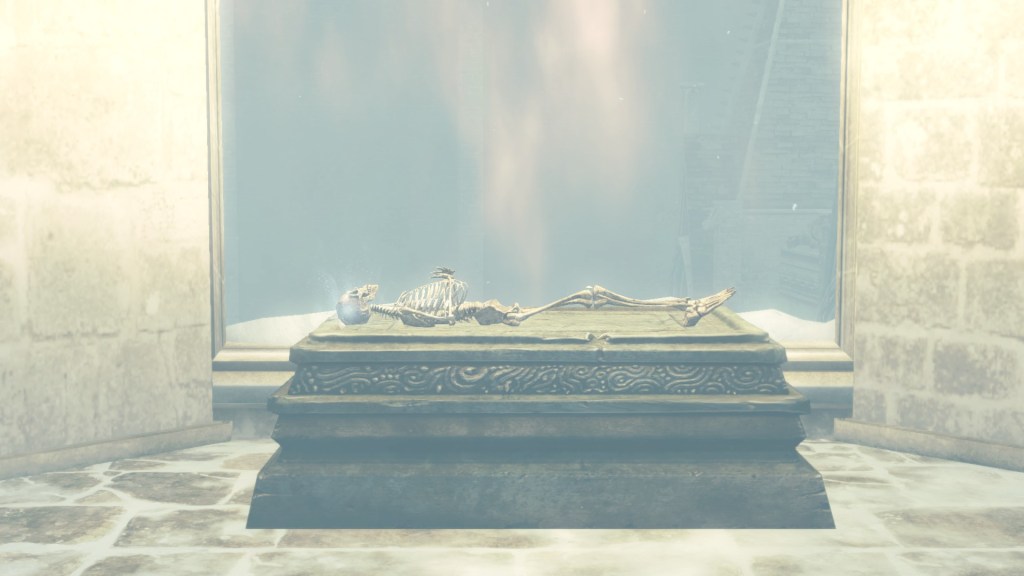
Item descriptions in the localization assert that the retainers belong to the cathedral city, giving the impression that they refer to Eleum Loyce as home to the Grand Cathedral. However, this “cathedral city” is Church Town (聖堂街) the same as how the Garrison Ward is Knight Town. (the term is shared with the Cathedral Ward in Bloodborne) The descriptions aren’t associating them with the entire Loyce capital but their own quarter the clerics operated from within the capital. And based on the architecture, this district refers to the collection of buildings with gothic spires next to the Garrison Ward. That more lavish section is also where we find the skeleton of the first priestess laid to rest on an altar, so it makes sense for this to be their facilities. It even presents a shortcut to the Grand Cathedral, which bears the same spires. It is all interconnected so that the clergywomen can effortlessly perform their duties.


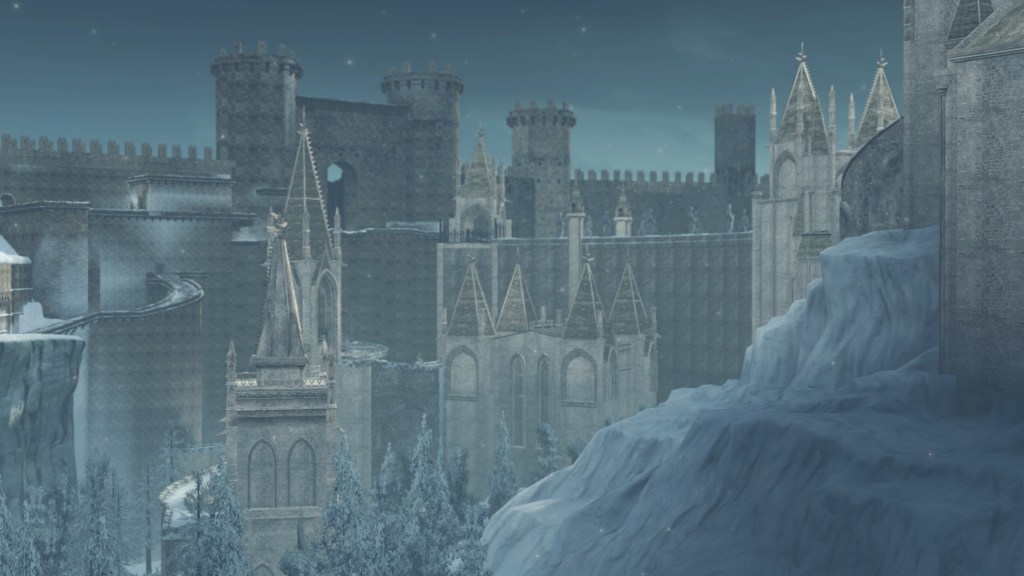

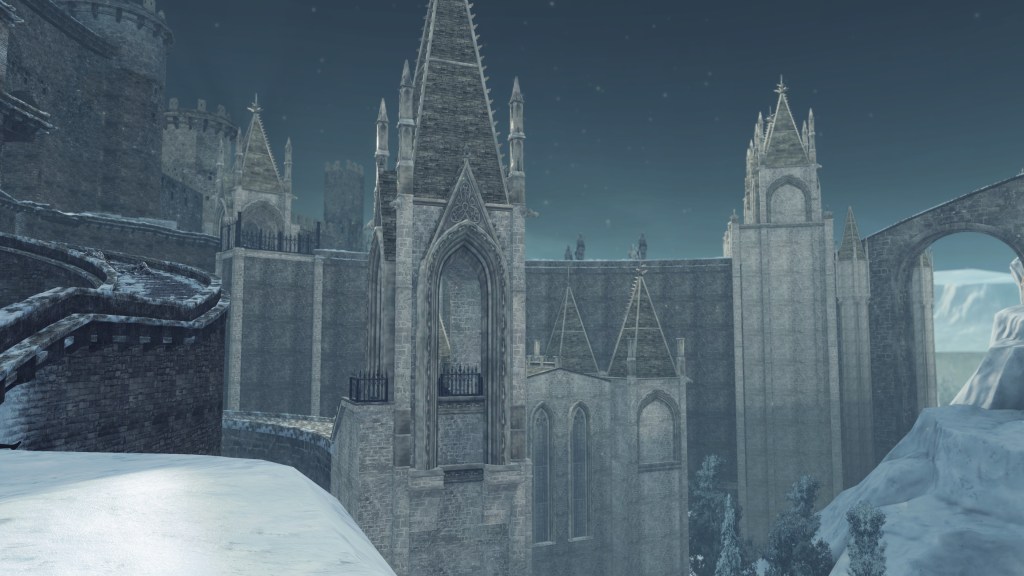


That being said, the clergy might have been more widespread than just the one district. The local bonfire identifies the Grand Cathedral as the “Main Church”, (主聖堂) which opens up the possibility of more. With regards to Eleum Loyce, we do see a large building resembling a church in the cityscape off in the distance. Since it is impossible for us to explore the wider capital where the ordinary citizens reside, it may be that the clergy divided themselves between their chief duties to the king at the cathedral and their secondary duties disseminating the faith to the common folk. The citizenry would learn the essentials of Chaos and their reason to stay and fight, inspiring morale and social cohesion. In the end, the kingdom needed the people’s confidence to support the Ivory King as builders, blacksmiths, traders, and more. Only by working together would they quash this evil beneath them.
Because of this, it is likely that precursors to both factions — knight and priestess — were present when the Ivory King established his link to the Flame of Chaos. The former helped him fight through the demons to the heart of Chaos; the latter, devise the means to quell it with his soul. Now they form the backbone of his new government. With their support, Forossa could trust in the Ivory King’s plan enough to commit more human resources. And given that the first priestess is shown dead, rotted away on an altar long after Eleum Loyce’s collapse, we can infer that this investment lasted for many decades. With no obvious dangers to her duties, the priestess in all likelihood died simply because she was first, the original member who initially performed the sealing rituals and trained younger women in her ways to expand the priesthood. After a long life of prayer, the oldest holy women passed away peacefully. And during that time, the Ivory King, holding both temporal and spiritual spheres, fleshed out his kingdom into the extensive metropolis we see today.
Stand Proud in Strength
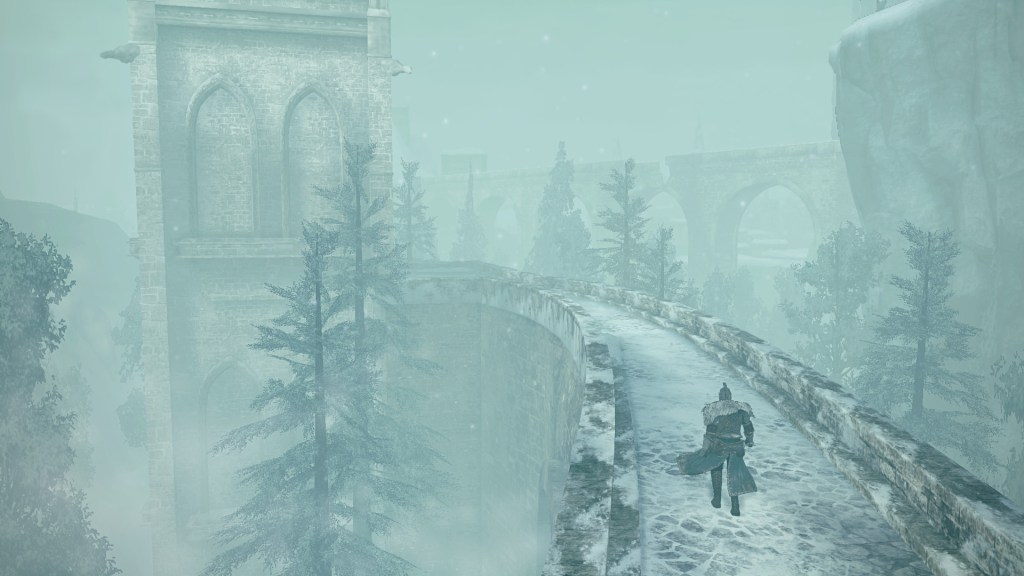
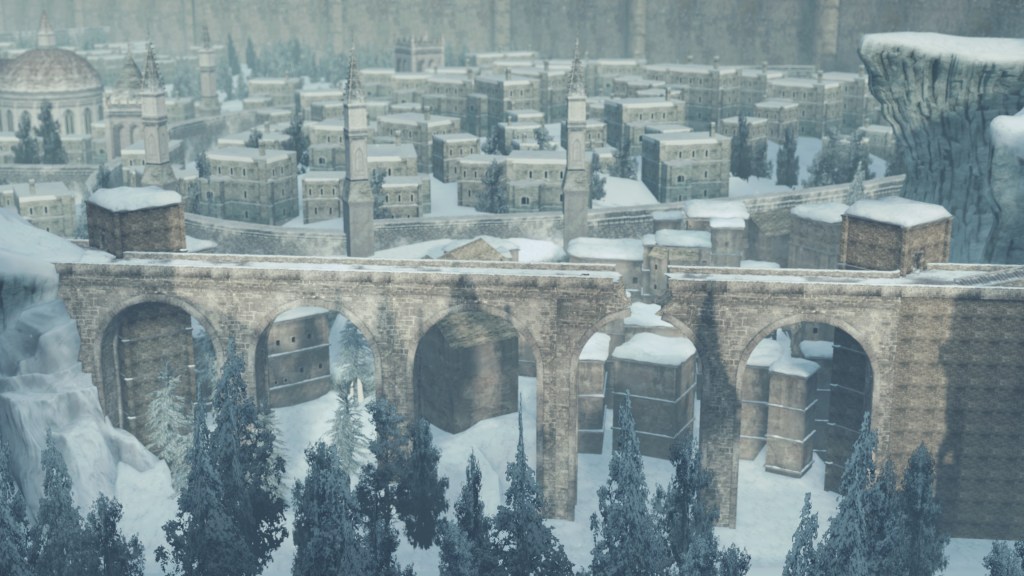
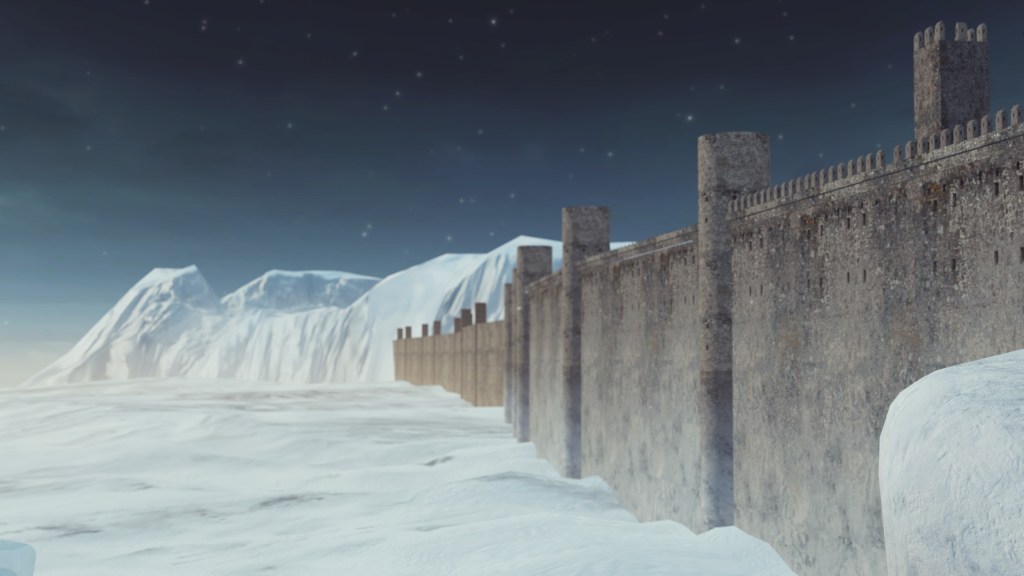
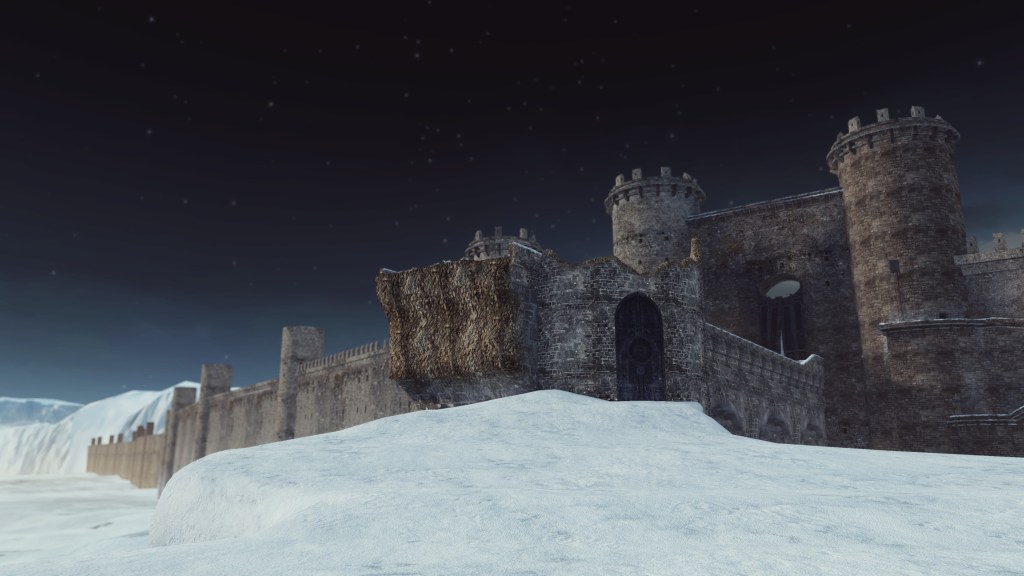
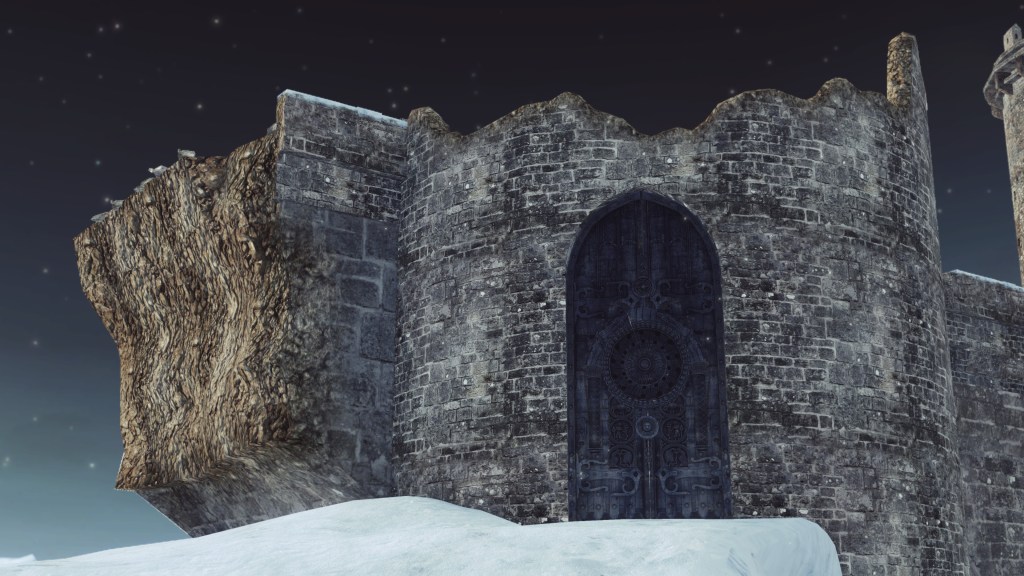
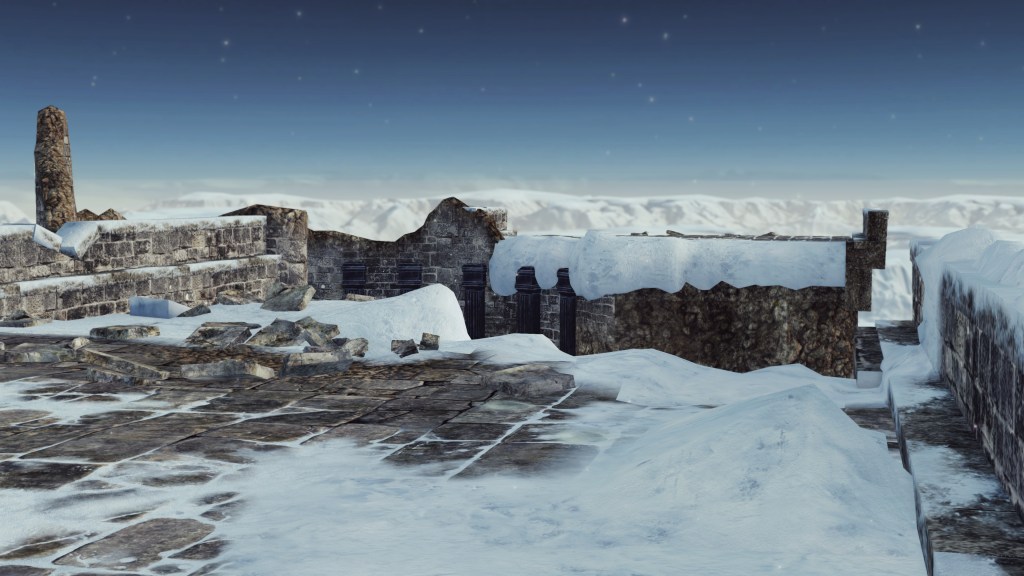
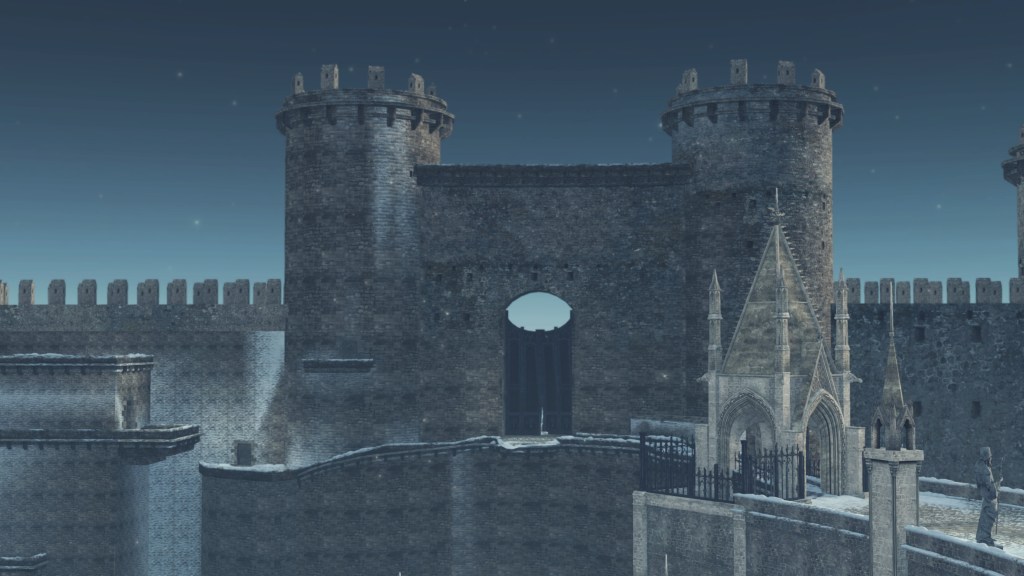
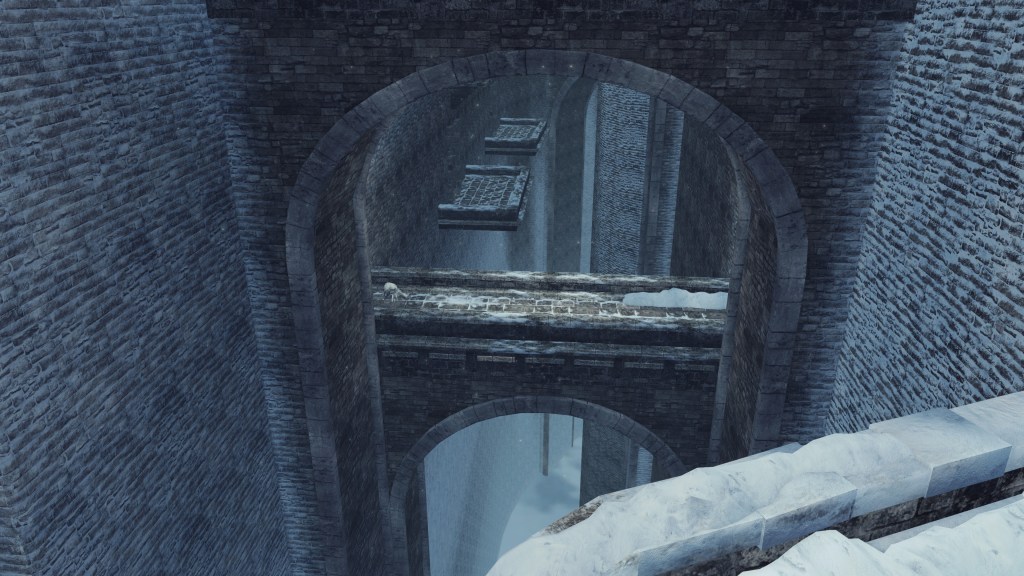
As the metropolis was built up, so too were its defenses. The cityscape is divided by a web of walls separating the areas into yet more district. But iconic to Eleum Loyce is its massive rampart, the castle wall stretching far around the front of the capital. Besides protection against hypothetical invaders from the south, the wall serves to keep the grotesque monstrosities the Old Chaos generated in, though leaving the back of the city exposed does seem to undermine this intention — perhaps this kingdom in northern Drangleic lacked concern since the demons would inevitably be stopped by the sea soon enough. Putting the walls’ extent aside, it was impractical for outsiders to enter from anywhere but the front. Access was facilitated by a viaduct; how far is impossible to infer from the bridge’s current state of ruin. It also diverted to a secure tower regulating access to the altar to the Shrine of Winter, so they were conscious of possible visitors from the south. Still, the metal doors prove that any access point was strictly regulated, as much for their own protection as Loyce’s safety.
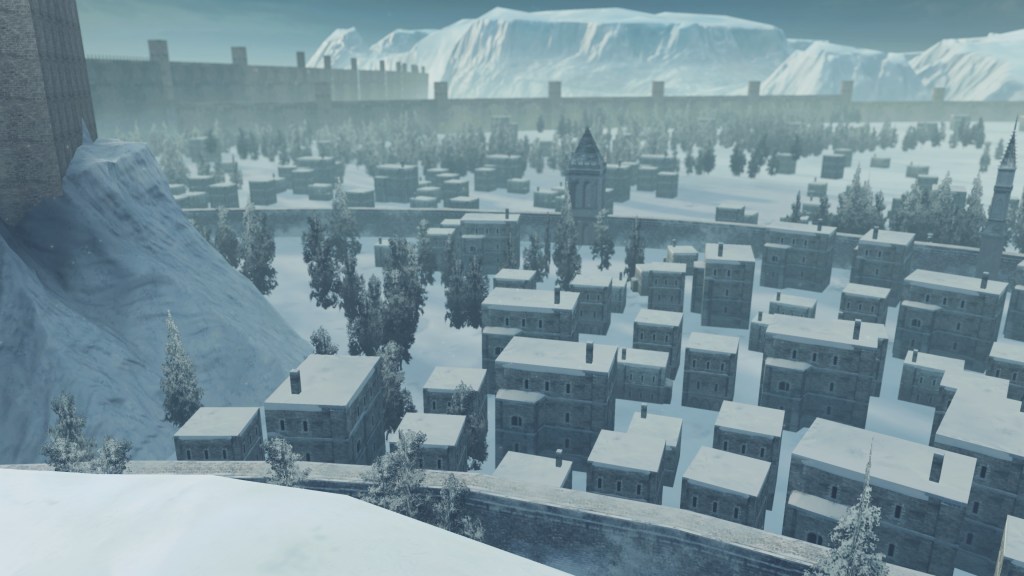

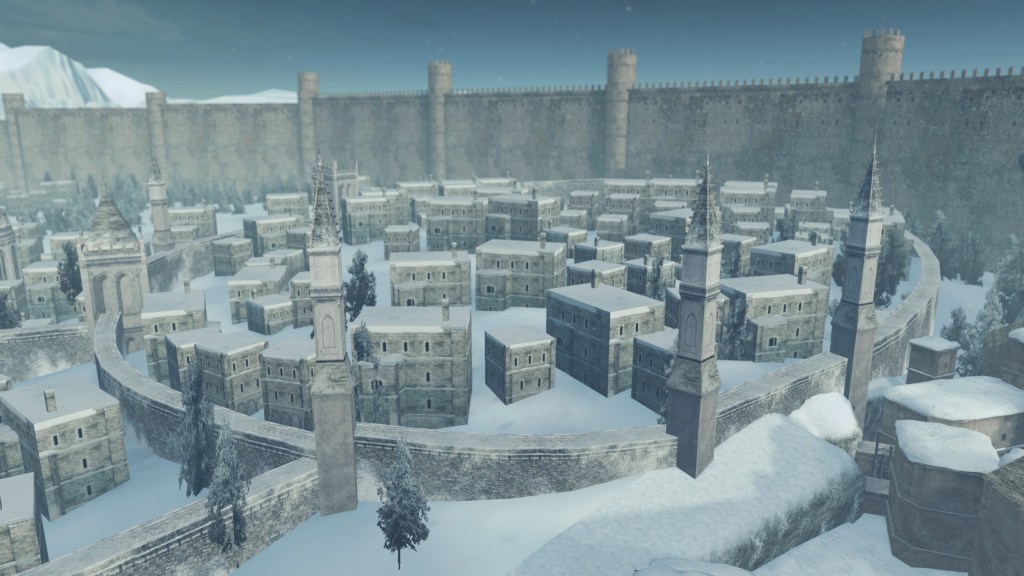

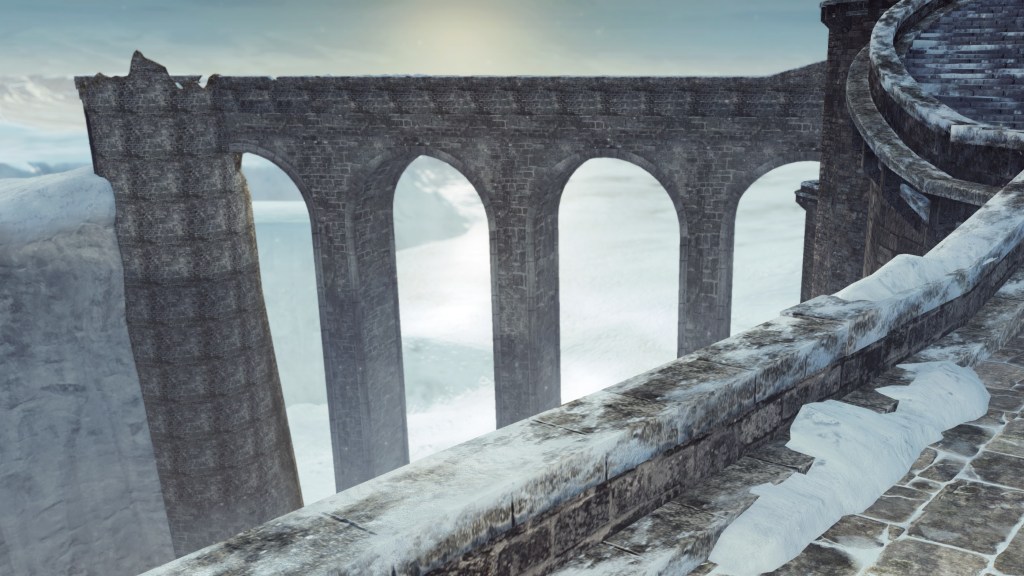


Indeed, the key to enter the bridge tower is a stone ornament modeled on a flower fully blossomed. Impressive as the ornate item is, the blossoming flower has been symbolic of fire since DS1. While this has normally concerned the First Flame, in this case, it likely relates to the Flame of Chaos. Anyone who wanted to enter Eleum Loyce needed to know the risks first, to always remember the flame the ivory kingdom was suppressing. The floral imagery is also present at the pit to Chaos, roses decorating both the archway we pass through to enter the pit and the knights’ surrounding chairs. “Every rose has its thorns,” as the saying goes, and nothing was a pricklier rose than the Old Chaos. Therefore, the flower undoubtedly came to symbolize that, no matter how beautiful the ivory kingdom founded upon flame might appear at first glance, there was always a threat lingering just beneath the surface.
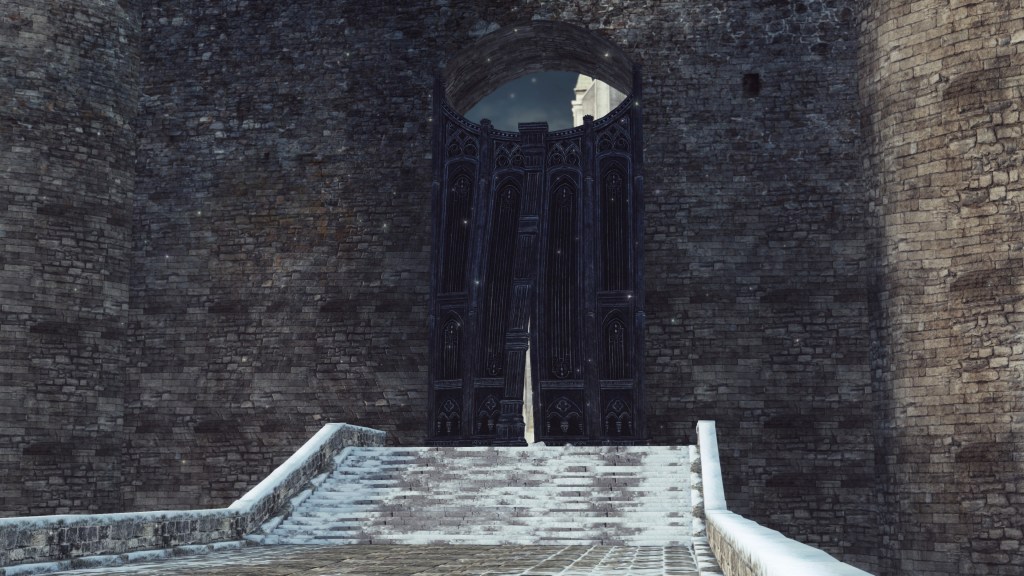
The symbolism extended beyond just flowers. To highlight Eleum Loyce’s security, even the main gate to the capital is apparently made of the local white metal, though the actual gates look identical to every other dark blue door we encounter in the city. Regardless of whether the metal was used to project their place as Chaos’ gatekeepers to the world, the city fulfilled its promise to be a bulwark. The outer wall was reinforced with inner ramparts in certain areas, specifically behind the Knight and Church Towns. Both were the pride of Eleum Loyce; if Chaos came to their doorstep, they were expected to give it the hardest time escaping. And naturally, such walls were staffed with soldiers to defend them, some more elite than others.



Piercing sword used by the casters of Eleum Loyce. It is tinged with magic power and unleashes that power with the strong attack.
Eleum Loyce covered itself with a huge outer wall to protect this land from Chaos. They are the soldiers shouldering its guardianship.
Operating from the walls of the capital stand guard the rampart golems. Despite the choice of English verbiage, they are not golems at all, but simply “wall defenders” (壁守人) in clear-cut reference to their duty. We can be certain that there is a person inside the armor because of their ability to drink from an Estus Flask — even assuming that an empty suit armor could benefit from the heat of Undead bonfires, why would it own a bottle? The bizarre translation is due to a misunderstanding of the descriptions to their unique equipment, the localizers’ reading that the Ivory King gave them life instead of a command. This is because both “life” and “command” share the same kanji. (命) Alsanna herself uses that terminology when describing both the “warped life” spawned from Chaos and, in cut dialogue, the “king’s order” which his pet Aava carries out. Aava being “given a command” is repeated in the Eye of the Priestess’ Japanese description, so it is obvious that FromSoftware intended the same for the defenders. The Ivory King didn’t make golems but assign certain warriors to defend the ramparts.
Helmet of the wall defenders who were given a command by the White King.
It was their mission to contain the grotesques generated from Chaos within the wall. Even now that the gates of Eleum Loyce have flung open and it has become a land with neither heat nor life, they continue to operate.
You have been found by Aava. A pitiful child who carries out the king’s command even now. It shan’t go easy on one not possessing the mark. Leave.
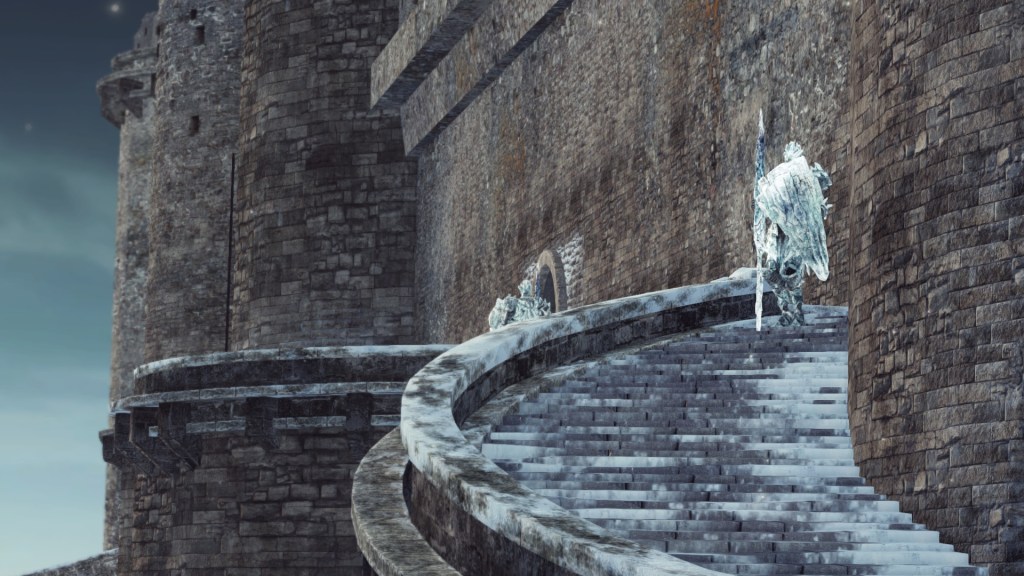
Outfitted with full suits of armor worthy of knights along with shields and lances, the wall defenders were prepared to hunker down against any adversary. They also weren’t restricted to the castle ramparts, with defenders also stationed at certain towers connected to the Knight and Church Towns. Given the similarity to the spires in Church Town, these buildings may have been some kind of shrine or tower of prayer, their isolation allowing for quiet meditation. And because Loyce knights currently occupy those towers, it is reasonable for the city’s living ramparts to safeguard their contemplation. This betrays the hierarchy still in place. Whether or not the defenders can be considered knights, they were definitely subordinate to the Loyce knights serving more closely to their Ivory King.





The soldiers also worked closely with the clergy. We can loot a Priest’s Chime from a corpse at one of the inner walls. A chest in the Lower Garrison Ward likewise stores boltstones, another in an outer rampart tower securing Splintering Lightning Spear. Having originated from Forossa, it is no surprise that Loyce clerics developed a variation on the firstborn’s Lightning Spear miracle to share with the faithful warriors defending the walls. Divine power was needed to help halt the march of Chaos, as it had before. Yet the Vessel Shield boosts not just faith, but intelligence too. This betrays Church Town’s role in cultivating sorcery along with miracles. The retainers themselves perform it with staves. And while the wilted dusk herbs and amber herbs found in chests or on corpses along the walls replenish the number of any spells we can cast, the latter is also carried by the “sorcery swordsmen” (魔術剣士) making up the bulk of the Ivory King’s army. We even see a Loyce knight casting sorcery with his sword. There is thus no reason to doubt why other corpses keep crimson water and magic stones on their person. Eleum Loyce was open to learning both schools of magic.




Sorcery’s importance is emphasized by the Ring of Resistance found on a corpse in the same inner wall as the Priest’s Chime. The description would normally indicate that the magic item was crafted in Olaphis. However, its name is actually the “Ring of a Resister”, (抵抗者の指輪) appropriate for a local soldier stationed on the walls to “resist” the Old Chaos more so than a random contemporary of Straid visiting from afar. Put simply, the ring in this context is most likely a product of Eleum Loyce. That someone independently invented Straid’s masterpiece speaks to the richness of Loyce’s sorcery culture. The country certainly made as many strides with sorceries as they did with miracles. Soul Flash is named for quickly brandishing souls in the caster’s immediate surroundings. Flashing the spell requires the souls be kept at a minimum for a small radius, hence it is more self-defense than damaging foes. But it is easy to see why Eleum Loyce in particular conceived of such an unconventional sorcery — their entire culture was defensive minded.
Old sorcery that was lost with Eleum Loyce freezing. Quickly unleashes minimal souls into surroundings.
Thing more for protecting oneself than dealing damage to enemies, you could say.
This reflexive defensiveness is obvious not just from their reliance on walls but even their choice of weapons. The common soldiers wield either rapiers or spears and shields, weapons which are designed for poking at opponents from a safe distance. In fact, it is in Eleum Loyce where we can acquire the Winged Spear, an otherwise generic weapon easily obtainable well before we can explore the frozen kingdom. The reason for the developers making it available is evident in its description, which highlights the longer handle for further reach with attacks. Warriors of Loyce were always thinking how to safeguard themselves, whether that meant attacking across greater distance or shoring up stronger defenses. This makes sense in light of their archenemy being a flame that can twist life at a touch. Being a wall meant more than just being strong but being smart with that strength. Sorcery opened up their ability to think smarter, and it led to spells more outside the box than traditional, straightforward sorceries.


Spear characterized by wing feather-like “barbs”. The handle is longer than usual, so can allow attacks from further reach.
Thrust-type attacks are effective against enemies with high defense power. However, their range of attack is narrow, and dealing with shield defenses is difficult.
Not everything was an option for them. Pyromancy, for example, never found common currency among the warriors despite proximity to the flame which inspired the art. It is clear that they didn’t want to employ fire the same as how the Izalithians had. The Flame of Chaos may have been the source of their white metal, but they didn’t long for its power in the way a pyromancer does. At most, the priestesses collected small pieces of the fire to embed into their metalworks like gems. However, that in itself might indicate the guardians’ willingness to utilize fire’s power to their own ends. The Fire Clutch Ring is stored for safekeeping within Church Town’s inner rampart. Assuming that it wasn’t confiscated from a daring visitor, someone there was at least hoping to employ flame more directly. Long-term, Eleum Loyce might have envisioned the Flame of Chaos as a great resource for the kingdom once they figured out how to fully control it, as the Witch of Izalith did. But even if this was never the plan, the country did explore such options before ultimately discarding them.
Although not immediate obvious from its English description, the Ivory King collected a number of weapons he would subsequently seal away as taboos, including the Curved Nil Greatsword. The reason is because its “ominous” blade is comprised of stone, wood, and souls. But there are plenty of weapons possessed of one or more of these materials, so why forbid this one especially? Perhaps because of the effect of their combination. The nil, or nihility, (虚無) in its name likely references komusou, (虚無僧) a wandering sect of Buddhist monks who travel great distances playing music as their method of nulling ego on the path to enlightenment. This reflects the blade’s strength corresponding to the “length of the adventurer’s journey”, but even its description recognizes caveats to this claim. After all, in-game, this is expressed not by the number of steps we take on our journey, but by restarting that journey in NG+, the red aura we emit while wielding the sword growing alongside the blade with each subsequent rerun. Putting game mechanics aside, such power could only manifest from these three materials together.
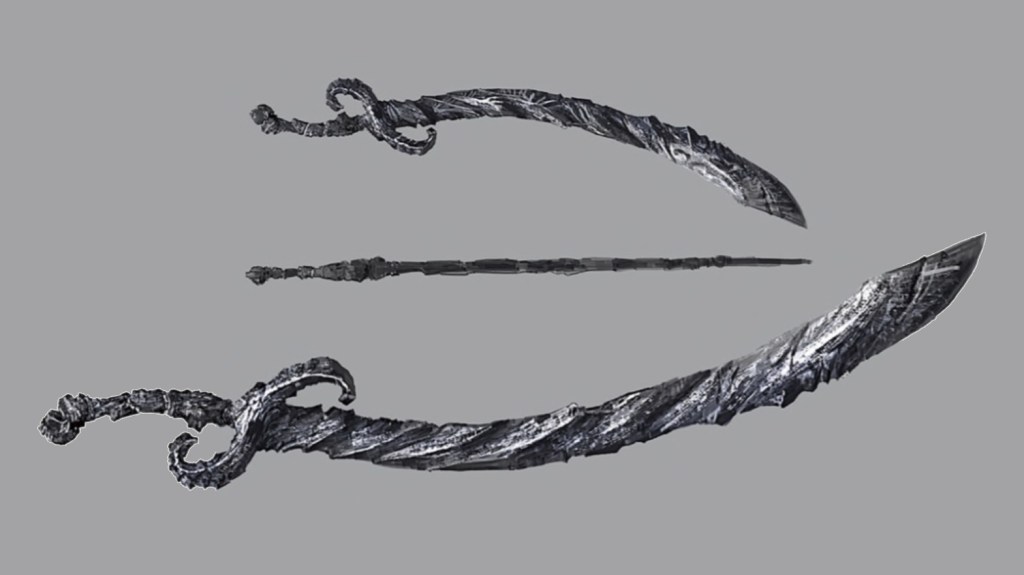
Great curved sword that possesses an ominous blade. One of the forbidden arms the White King collected and sealed away.
It is formed from stone, tree, and soul, and the vestige of a different kind of soul can be faintly felt.
It is said that its blade increases in power according to the length of the adventurer’s journey, but…
The stone and wood by themselves seem unassuming, if unconventional. However, the text posits that there is something qualitatively different about the soul, though it is apparently subtle. The sword certainly doesn’t manifest any magical enchantment or elemental power. And when it comes to combining rock, trees, and souls of a differing variety, what springs to mind is the transition from the Age of Ancients to the Age of Fire. The Curved Nil Greatsword more or less embodies the state of the world during that moment, dominated by grey crags and archtrees just as newborn Disparity began adding color. In other words, the unique soul may well have been taken from the First Flame before it began to fade. We do find twinkling titanite and petrified dragon bone stored in the same Church Town inner wall as the curved greatsword, so there was an interest in stone and light’s age-old history at Eleum Loyce. Whoever crafted the weapon, it was this insight into the world at the beginning that attracted the Ivory King’s attention. And it is that microcosm which gives the sword its potential.
The stone and wood, of course, are the most primal matter as Disparity first brought emotion to ens, so are theoretically at their strongest in nil beginning. Returning to “zero” also benefits the soul of fire, though for different reasons. We, who are on the path to link the fire and have in all likelihood done so after finishing our journey, would arguably be enlightened individuals who put our egos aside for the world, which only increases as we continue journeying through NG+ and beyond. This loss of ego perfectly resonates with the state of the universe before flame, when there were just stone dragons and trees in an equally rocky earth. And more practically, our single character’s repeated “firelinkings” across multiple playthroughs continue to strengthen the First Flame by adding a larger and larger soul to kindle — which can theoretically resonate with the stray soul from Flame imbued in the Curved Nil Greatsword. Therefore, our extended adventure through the same narrative over and over would empower the sword in kind.
Of course, this mechanic is impossible in proper continuity, but the concept which the developers intended is clear. It is no surprise then that the Ivory King forbid a weapon which is, at best, dead weight, and at worst, a free source of fuel and lava for the Flame of Chaos. Maybe it would have potential during the relatively brief window after someone reinvigorated the First Flame, but the Ivory King never seemed to have that fire or the Throne of Want on his radar. As is, it was something to seal away in case he ever did find a use for it. This was probably the case for many of the taboo arms, each showcasing some debilitating downside that ultimately made it not worth the risk in the king’s estimation. He could not find a surefire way to end the Old Chaos. At the same time, the fact that he could afford to make these searches sure to span far and wide is proof of his kingdom’s success. Eleum Loyce has quickly grown into a great nation, its remote location not stopping the country from integrating into that wider world.
Inside and Out
Because the ivory kingdom didn’t confine itself to its walls, the country’s dramatic rise was guaranteed to garner attention from the New World. Indeed, based on the items we can acquire, Eleum Loyce has been visited by people from various lands. Likewise, these constituted more than just the passing trader. While some of these visits assuredly occurred after the ivory kingdom’s collapse, several countries are also no doubt responsible for saving the ivory kingdom from total obscurity during its heyday.
The largest thanks are owed to continued contact with Forossa. Once the new kingdom stood on its own, the perpetually warring nation’s biggest contribution was regularly sending its sages on the arduous journey north. The wise men who proved their resilience and endurance despite sorcerers’ stereotypically weaker constitutions were welcomed into Eleum Loyce. Sages like Azal probably then spent their visit teaching the garrison sorcery, hence why they were revered as Faraam’s agents worthy of commanding their own troops upon their return. By helping develop the northern kingdom’s sorcery culture, the sages furthered the war god’s desire to see the Old Chaos vanquished. They in turn gained experience managing armies while picking up whatever useful knowledge Loyce made in its own advances. This system was mutually beneficial, so became critical to both nations’ military. The ivory kingdom seems to have been so reputable that, even so long after both their falls, a Forossan like Vengarl is curious enough to approach the place, leaving his summon sign out on the Frigid Outskirts.

As brethren with Forossa, Eleum Loyce also attracts enemy attention. Lucatiel leaves her summon sign in the Grand Cathedral. Normally, the Undead knight only offers aid in areas she happens to be passing through on her aimless journey; the only time we find her and her sign not in the same area is Earthen Peak, the summon script only later appearing in Iron Keep just beyond. Did she simply meander into the eternal winter as well then? Unlikely. A corpse in the Frigid Outskirts possesses the Mirrah Hat, implying that one of the country’s knights was approaching the northern capital — or got exiled for trying to infiltrate. More than likely, both knights of Mirrah were enticed by Eleum Loyce’s origins, wanting to see this kingdom established by one of their longtime enemies. For Lucatiel especially, Forossa had already collapsed well before she was born, so any knowledge she retains are stories from her homeland, and she is desperate to hold onto any of those memories.
But considering that Mirrah is constantly fending off its own neighbors, it is doubtful that it was ever sending precious troops to invade a land sealing an ancient evil. If any citizens of Mirrah did visit the land, it was scouting parties or Undead castaways acting on their own initiative. The “Sacred Knight Aurheim” (神聖騎士オルハイム) is a curious character. Despite the name, he never uses miracles or particularly holy magic, and his invasion at Eleum Loyce precludes moral fortitude to his piety. The only other clues are his actual equipment. The invader wears armor from the Drangleic set along with the Ruler’s Sword, but his most notable pieces are the Mirrah Shield and Benhart’s Knight Helm. The shield is proof of a Mirrah knight’s strength and willingness to die for his country, and Benhart scavenged his armor from places like Mirrah in his travels. Therefore, Aurheim may well be a knight from the land famed for its holy spring. And that divine power appears to be his obsession.
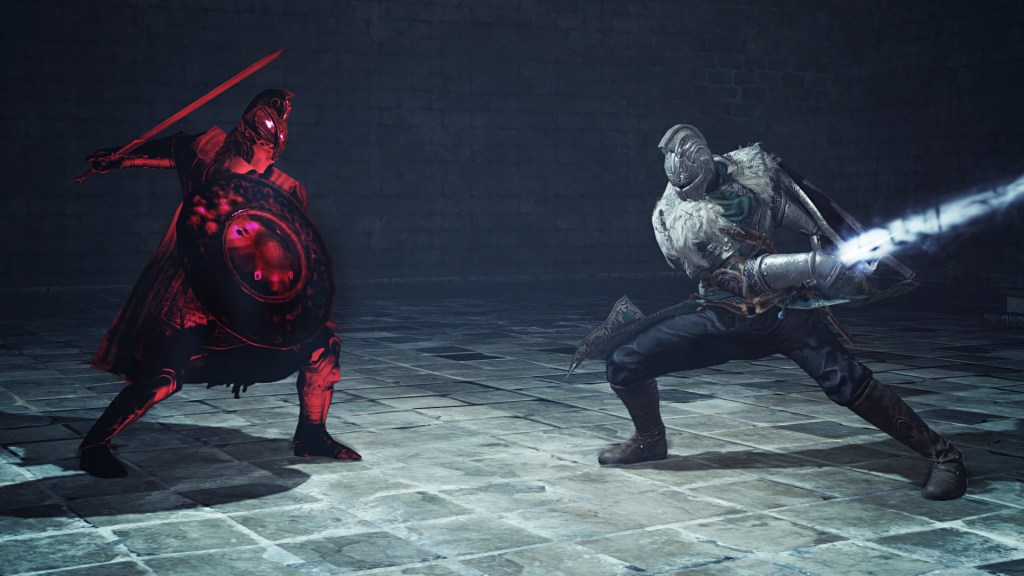
After invading, Aurheim immediately hides among barrels in the ramparts, presumably using the silver talismans stored in abundance within a nearby chest for his disguise. The silver talismans are simple protective charms using sorcery according to their Japanese description, found in few number all across Drangleic — many sold by Tichy Gren as part of the Brotherhood of Blood for their utility to invaders, as Aurheim demonstrates. With its emphasis on sorcery and self-defense, it is no surprise if Eleum Loyce produced such unconventional magic amulets for the soldiers. But recall that mimicry magic was the specialty of solely Oolacilian sorcery in DS1, which utilized the same golden light at the heart of miracles. Such sorcery could thus be considered holy, and Drangleic priestesses do carry the silver talismans on their person. This must thereby be an example of the sacrality that the invading knight lays claim to be a part of.
Like Aurous of Jugo, Aurheim’s name obviously draws from “aurora” combined with the Germanic suffix for home, making it essentially mean the home of ethereal light. Perhaps the “holy” knight hopes to snatch all light magic for himself despite his evident lack of faith or intelligence. As a knight of Mirrah, he has come to the fallen “Forossan colony” to rob it of that holiness “unworthy” of it, unlike his nation which safeguards a holy spring from ancient times. In fact, if his desire is simply light, his ultimate goal is possibly to free the Flame of Chaos and take its sealed power for himself, which would help explain why he is targeting the ruins of Eleum Loyce versus Heide or Shulva. Should he care not for the Old Chaos, there is yet plenty of holiness to be plundered.
Corpses and chests throughout offer us goldenfruit balms, dried roots, monastery charms, Lloyd’s talismans, Elizabeth mushrooms, and skeptic’s spice. Some of this might have been collected by Eleum Loyce — they do have relatively easy access to the south via the Shrine of Winter. However, the totality indicates that members of the Archdrake Sect from Lindelt have visited the northern capital. The dried root obtained from a corpse in the Frigid Outskirts reinforce this notion. Moreover, that “snowfield outside the walls” (壁外の雪原) is also where we can summon Feeva. Offering her lightning in the battle against Sinh isn’t surprising, yet her summon sign appearing in the Frigid Outskirts suggests that some sacred purpose drives the woman to approach the land, the same as Vengarl. And if she has motive, then any god-fearing pilgrim might.
If nothing else, Feeva’s example showcases that countries like Lindelt have an intrinsic interest in Eleum Loyce. It is easy to see why. If Drangleic is a holy land, then the Old Chaos is a blight upon that land to be exorcised, no different from Sinh. The Ivory King thus did other branches of Anor Londo religion a service sealing the Flame in the name of Faraam. But with Chaos persisting beneath their feet, it would behoove supporters to contribute to the cause. The Chime of Want which Feeva employs might speak only to her personal craving to see the great adversaries of the faith vanquished. But if she is reflected of the most devout clergy, then others have perhaps come before her in the interest of potentially assisting to end the Chaos of Izalith once and for all. Whether or not this amounted to much, their presence was appreciated given the number of items associated with such pilgrims. Their interactions might have even assisted Eleum Loyce in other endeavors of religious import.
Evil Begone
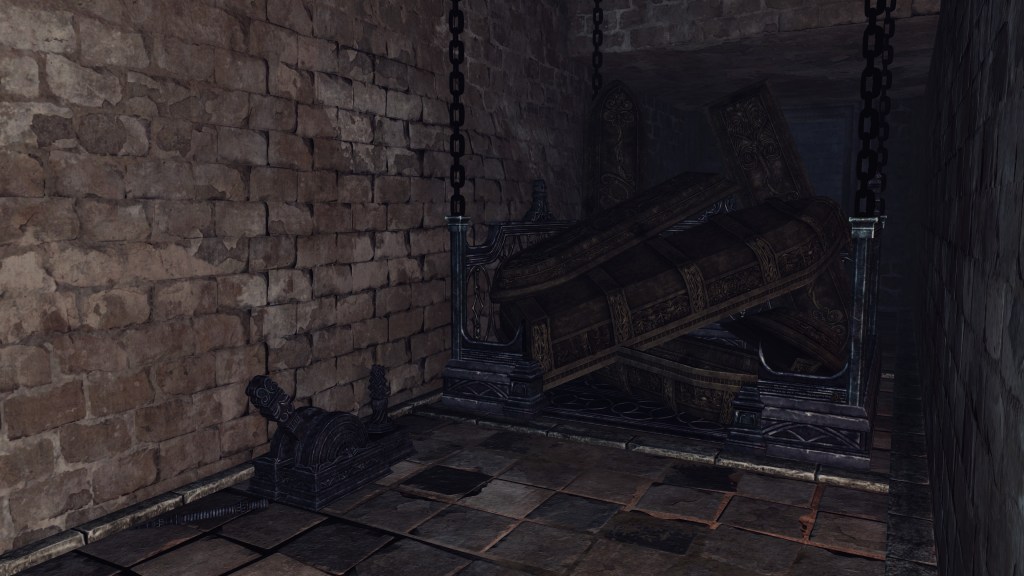
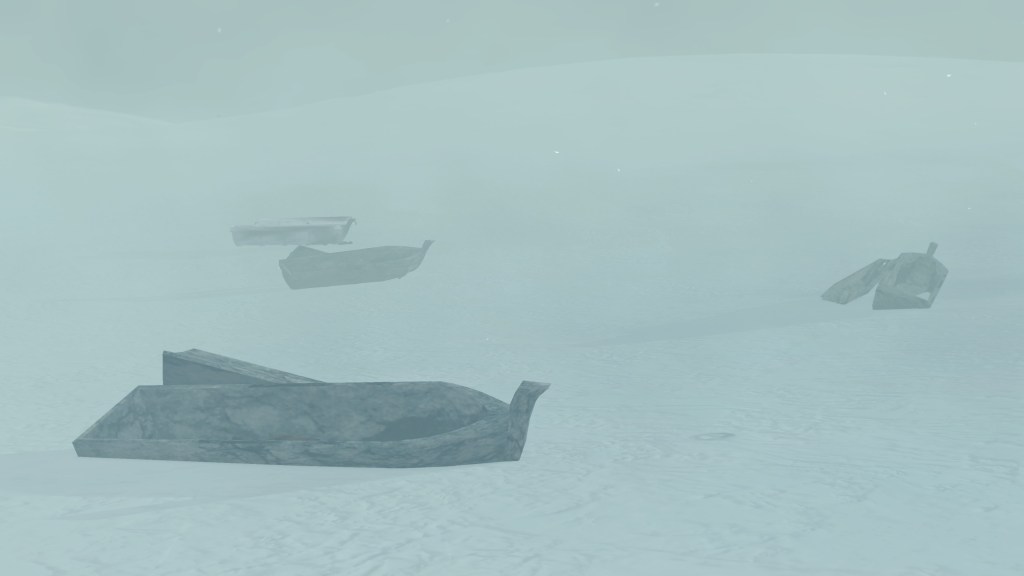
As the ivory kingdom dragged on, it inevitably had to contend with the Undead curse. Their solution was stereotypical. Hollow prisoners loiter together at the outer walls, absentmindedly waiting to be shuffled into the “exile chamber”. (追放の間) Although now in ruins, this special room built into the rampart still maintains a number of coffins we use to slide into the Frigid Outskirts. A few levels down, a lift inside the rampart holds the same coffins for ease of transport to the higher stratum. Though the lower lever to the lift has since been inconveniently broken, Undead and coffins were apparently regularly brought up the outer rampart, where they would stuff inside and haphazardly dumped outside the walls from the select area. We do find brightbugs within a chest in the rampart tower just across from the Expulsion Chamber, perfect for pacifying unruly undead before expulsion. It is also easy to imagine the kingdom collecting the insects when the Undead Crypt is also situated at the northern extreme. Nonetheless, the city had no intention to transport their cursed to the mausoleum.
As demonstrated by the wall defender overseeing them, banishing the Hollows was managed by the knights. We require the Garrison Ward Key to open the Expulsion Chamber. The description mentions opening doors to Knight Town, but this is inaccurate, as the only door it unlock is that chamber on the outer walls. Even if the wording is an oversight by the developers, it is still found at the Garrison Ward and thus indicative that the banishing was an extension of their guardian duties, hence occurring on their side of the walls. If anyone in the capital didn’t stay dead, the knights would round them up, their final rites to be sealed inside a metal coffin so they couldn’t escape “burial” on the far side of the walls. Once dumped, the Undead were left to wander the fields. But we see several ruined buildings dot the landscape, a wall defender active at one. These are likely satellite facilities the knights operated to monitor the Undead in case they needed to signal the capital — can’t be too careful with a growing horde of Undead, even outside your walls. The facilities also ensured the cursed didn’t wander too far off the hunting ground.


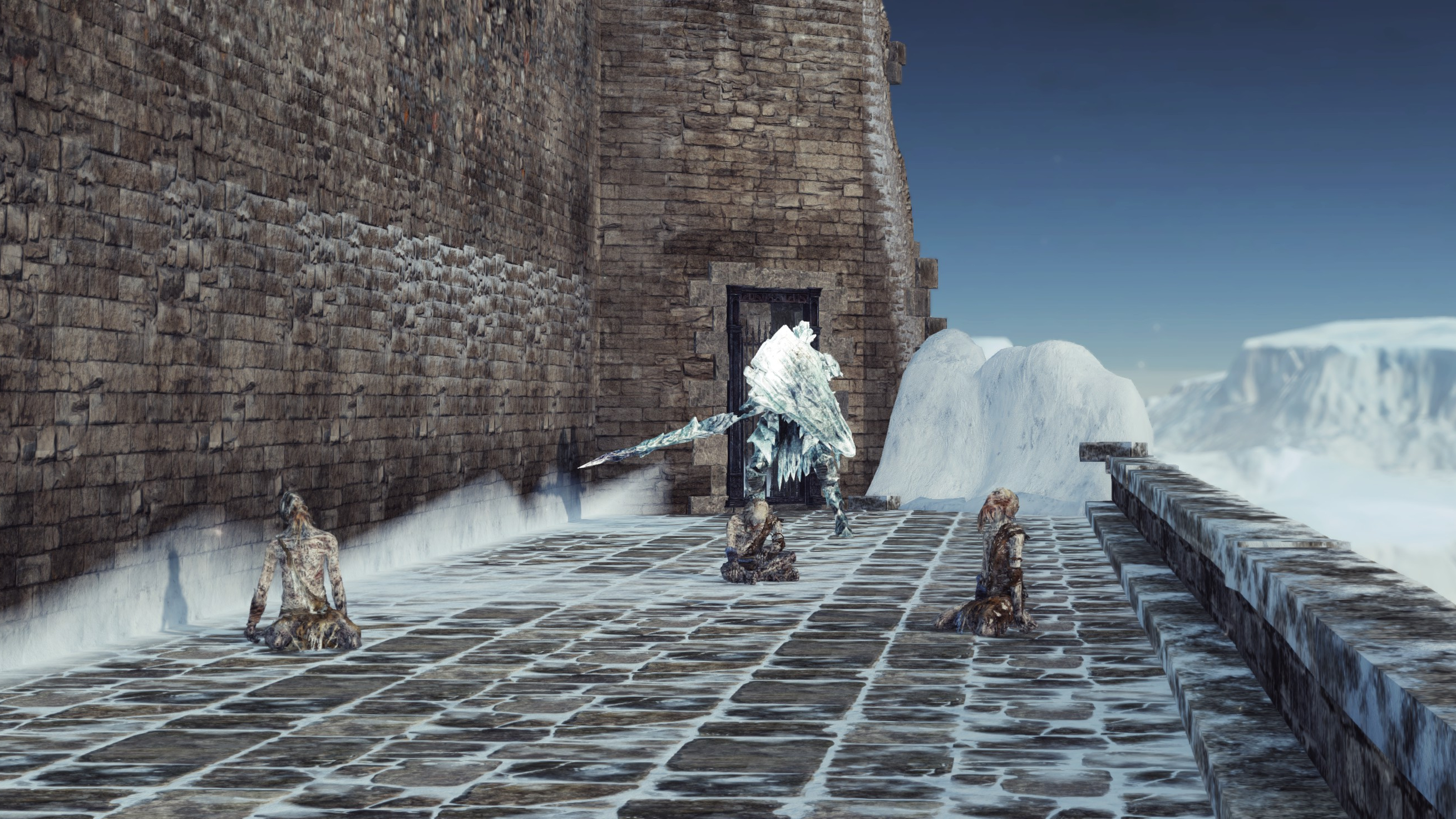




According to the descriptions of their souls, the Ivory King commanded his pets Lud and Zallen to grant “mercy” to the exiles. From their boss battle, we can infer that he referred to the mercy of death. This might be easily accomplished if the exiles include ordinary criminals, but with Undead, this reliably meant repeated slaughter at the hand of the saber-tooth cats, tearing the cursed limb from limb. The tigers also didn’t distinguish between the sane and Hollow. Among the corpses we can come across in the Frigid Outsrkits, one possesses the Ring of the Living designed to pierce the flesh so as to make the wearer constantly self-conscious of their own state alive. This has the added benefit of making us retain our physical visage even as an ethereal spirit, but it also theoretically benefits Undead who wish to remain conscious of mind out on their own in the fields. But to Eleum Loyce, it didn’t matter if you were still sane; you remained a threat. And so, countless exiles were hunted down over and over until they were neither sane nor still living.
Soul of Lud, who served the White King.
The White King’s seven beasts were each given a mission. The mission given to Lud was granting mercy to exiles.
The special soul this beast possesses is used to acquire a vast amount of souls or create a great power.
Ring bearing sharp protrusions. Appearance becomes the true body even when a spirit body.
The ring pierces the flesh of the finger and brings a throbbing pain. It makes you always aware of being alive.
Not all were helpless prisoners, strangely enough. We encounter two “exiled warriors” (追放された戦士) among the Undead in the field. One is a Faraam Knight dual-wielding a Puzzling Stone Sword and longsword along with two Avelyns. The other is of less discernible origin. His mix of hardy equipment for comfier travel could apply to any visitor to the northern limit. His most recognizable piece is the Archdrake Helm, so he may be some kind of knight from Lindelt. However, he also dual-wields, relying on the Mastadon Halberd, Ruler’s Sword, and Lion Greataxe alongside a shield. He may therefore be one of the more unconventional knights of Forossa. And wherever either hails, they both were undeniably visitors banished with their equipment, allowing them to fight back out in the wilderness. The added threat certainly explains how Zallen’s face got so seriously injured, the tiger refusing to even enter battle until Lud is clearly unable to handle us without the help.

Still, their survival betrays their track record. The king could trust his two pets to handle the Undead problem on his people’s behalf. Overall, the Ivory King had a strong handle on the Undead curse, deploying his knights and pets in this systemized extermination. With how crucial it was to stand firm against the foe beneath their feet, they couldn’t afford to succumb to the enemy within their hearts. Rather than risk a messy battle inside the walls, he prioritized removing the immediate threat and then responding with extreme prejudice, slowly grinding down the ever-increasing number of Undead as they trickled in. So long as there wasn’t any mass casualty event, Eleum Loyce never needed to divert their main focus to the Darksign — the Old Chaos was forever their front-and-center concern. Indeed, this deliberate distraction to flame allowed many kinds of Dark to slip in unnoticed.
Black Queen’s Check
As Alsanna herself admits, she is a fragment of humanity born of Manus’ fear. Because of this, she was constantly afraid for her continued existence even when lacking a clear identity of her own. The woman was just a small piece of a dead man, fortuitously came to life after so many years. What if it simply fizzled out? That fear of losing the life fate granted her consumed the spawn of Dark. When her “sisters” went their separate ways, craving powerful souls per their nature, “Alshunna” (アルシュナ) too sought after one, hoping to assuage her fears by standing beside someone mighty like a shadow. She eventually found that security in the Ivory King, acquiring for herself a place by his side at the end of her wandering. Item descriptions note how suddenly she appeared in his life, becoming part and parcel to his day-to-day as if that was always the case. Taking on human guise, she had earned the king’s favor and become his queen, just like her sister Elana.
I was once born from amongst the darkness. With the destruction of my “father”, who was in the depths of an Abyss in antiquity. Countless fragments of Dark separated. I was one of those. I was just scared. An indistinct self born from a fragment of Dark, but… what if someday I suddenly disappear? I was born from the “fear” that was undoubtedly within my father, wasn’t I?
This lines up with her profession. While Alsanna is described as the silent oracle, the Japanese term is the same as the priestesses of Loyce. In other words, while not the first, she is probably the effective high priestess in much the same way as Elana, acting as a role model for the other maidens in how to behave with their priest king she served the closest to. And as was the case in Shulva, the child of Dark likely only received this position because she was married to the priest. Her importance is further conveyed by the bodyguard afforded to her in her clerical capacity. The Ivory King commanded his pet Aava to protect Alsanna, a decree made while there were still priestesses aside from herself. The eye of the priestess is evidence of this, the peculiar magical device apparently replacing one of each priestess’ eyes so that they could see the tiger rendered invisible by some magic. When not with her sovereign, she mingled among her fellow priestesses, hence they needed to be watchful before making a possible misstep.

Soul of Aava, who served the White King.
The White King’s seven beasts were each given a mission. The mission given to Aava was protecting the child of Dark the king favored.
The special soul this beast possesses is used to acquire a vast amount of souls or create a great power.
Eye of the first priestess. Serves so as to see the form of the unseeable who was given a command to protect Eleum Loyce.
It is said that generations of priestesses surrendered their own eyes for this and returned it when they finished their role.
It is possible that this needlessly complicated effort was intended to keep Alsanna isolated. If nothing else, it confirms that the Ivory King feared someone might want to see their queen dead. It is true that her circumstances could arouse suspicion. The woman slipped smoothly into the core of Loyce society by charming the king, becoming untouchable politically and religiously despite seemingly humble origins. What were her contributions before or during her tenure? All she has to offer on the surface is her Dark powers. It is easy to see why someone might want to slay this nobody who suddenly sprang to the top of the hierarchy. And if the Ivory King figured out her intentions as she suspects since early on, then the bodyguard might have been intended to keep a distance between this unholy abomination and the kingdom’s holiest of women. Granted, that assumes others didn’t already know. Corpses around Eleum Loyce possess items like the Dark Clutch Ring, cracked red eye orbs, or the Dark Dance hex.
Hex that fires large Dark in exchange for souls.
The dense Dark dances as if expressing the joy of being liberated, or maybe mocking the opponent.
Hexes are a manifestation of man’s warps, but this is its extreme.
The last two are employed by Hexer Nicholai, a former priest of Drangleic by dress. His miracles reveal that he was a devout man to the gods of light, but the description to Dark Dance wonders if the dense humanity dances for joy at being liberated as much mockery toward the opponent. Perhaps Nicholai felt the common constrictions to men of the cloth, the humanity within him begging to be unleashed. Considering how the text likewise claims that Dark Dance embodies the extreme end of man’s twistedness, his heresy is the backlash of a repressed life. Self-discovery led him to embrace hexing as an outlet, no longer using his powers of sunlight or the Abyss for anyone but himself; that harmonious synthesis of both may be why he also knows Promised Walk of Peace. The fact that Nicholai can cast even Splintering Lightning Spear suggests that he has come to the icy north for the knowledge frozen in the place. With a cleric’s pilgrim shield in hand, the hexer explores Drangleic for further power, his chains broken — oddly fitting that “Nicola” (ニコラ) originates from Greek to mean “the people’s victory”.
Castaway Witch Donna is a similarly eclectic invader. Donning the iconic pointed hat, the woman initially appears to be just another descendant of the Dark covens pushed to the fringes of human society, utilizing hexes like Dark Hail to great effect. However, the fact that she is an “exile caster” (追放術師) indicates that Donna was pushed out of some group for her magic. The witch does cast soul sorcery alongside her hexes using the rustic Staff of Amana, so maybe she became curious about magic with non-dark souls and was branded a heretic for her studies; she refused to abandon either school of magic, so the community banished her. Her use of Profound Still betrays the jealousy and humiliation Donna feels for being cast out, but she is now her own independent woman, reflected in her Italian name referring to a mistress. And that freedom to pursue both hexes and sorceries brought her to Eleum Loyce, where knowledge of both Dark and souls lays ripe for the taking.


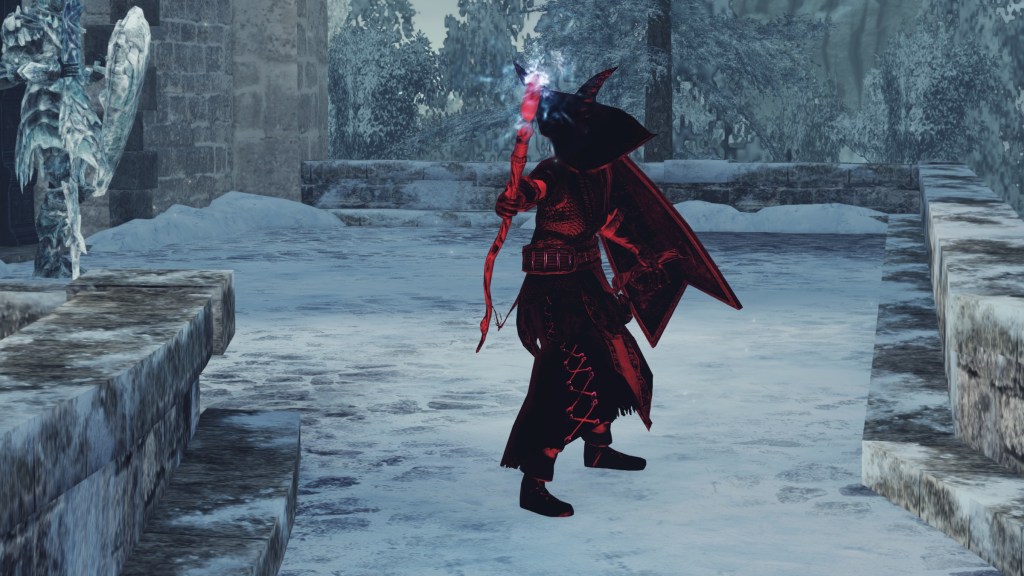
Both Nicholai and Donna’s examples show that Eleum Loyce has attracted lovers of the Dark arts, which could only be due to Alsanna. However, there is no hint of a hex or similar Dark item finding currency among the army or clergy. Perhaps Dark Dance, with its high faith requirement, was practiced by the priestesses under the queen, and perhaps such practices are why the staff imbued with Azal’s magic excels in both sorcery and hexing — but that may just as well be coincidence. The capital’s Dark-loving inhabitants, alive and dead, are more likely all outsiders who came only after the country’s collapse, Alsanna remaining in the ruins to potentially attract their interest. The two invaders certainly aren’t there just for the silent priestess, so the fortuitous convergence of leftover miracles, sorcery, and the Dark arts may be what has brought so many heretics to Eleum Loyce. Either way, their implicit recognition of the Abyss within the ramparts doesn’t necessitate that Alsanna be forthcoming about her true powers during her time with the Ivory King. In fact, more indications lead to the contrary.
The child of Dark’s main contribution to the kingdom before its collapse is possibly the invisibility spell placed on Aava. Typically, such magic relies on the powers of light or fog to reduce one’s existence anchored in spacetime. For that reason, total invisibility is avoided since that would mean negating one’s entire existence. The one exception in DS1 was Priscilla, who used the cold of her world in conjunction with her abilities tied to rock and Dark. This makes it possible for Alsanna to perform a similar magic through the Abyss with its dominion over space — what is the dark good for if not hiding things from sight? It would explain why the eye of the priestess generates a reddish-orange aura when left unattended. Whether sourced from the Flame of Chaos or elsewhere, the eye likely uses the power of light to reveal Aava and others of lessened presence, the power of time clarifying their place in space. However, that wide applicability would make it difficult to determine the nature of the invisibility by itself. And even if Alsanna did use the Dark to beef up her own protection, it wasn’t openly.
After relating her selfish intentions for approaching the king, the spawn of the Abyss confesses that he “might” have known that, implying that she never directly told him such. And since telling him would require revealing her true nature, she must not have shared either details with the nation. As far as Alsanna was aware, no one in the country realized the truth, least of all the king ruling them. This leaves the queen no opportunity to spread Dark among the culture. The apostle served quietly in the king’s shadow, never letting her reasons be known for fear of the consequences in all likelihood. It wasn’t some grand scheme. Despite the localization’s claim in her soul’s description, she does not pray “in reverence of the apocalypse” but for fear of the end, her end. The monster harbored no malicious machinations for the kingdom, but she nonetheless deceived her sovereign with illusions of love. Given her nature, how could she trust the proud and mighty warrior to let her live for such a slight? As far as the queen was concerned, she just needed to do the minimum to keep herself by his side.
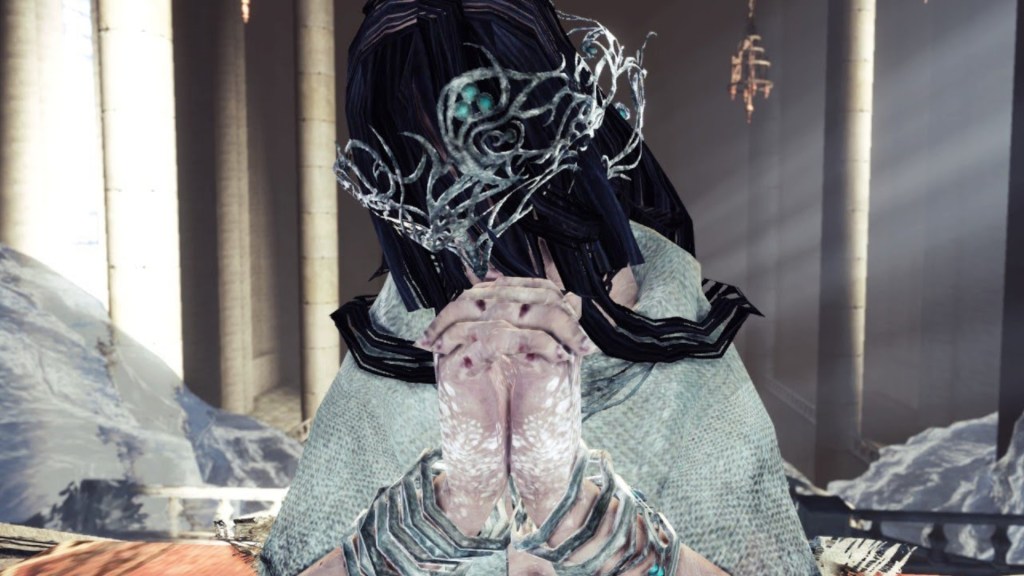
I sought a place to go and found it in this land’s king. Simply in order to continue being in this world… in order to bury my fear… The king might have known that.
In short, Alsanna’s motives up until that point were purely survival, the Ivory King a means to an end. If he could be a mighty wall for his country, his fiery soul could be one for her as well. If she ever felt her existence was threatened, she could devour that soul at a moment’s notice to buy her more time. She could just as easily claim it after he inevitably perished, moving on to find a new soul to ease her anxieties. But her silence ironically kept her trapped within that same box, now afraid of everyone discovering her deceit. Alsanna had no one to rely on, no one to turn to, no one to take comfort in. And for what? A lonely existence. The fragment of Manus was so focused on living that she never considered the purpose. What was she to do with that life? Her husband’s noble sacrifice provided her the answer.
Gratitude is the Sign
At some point, the Ivory King reached his limit. To be more exact, this seems to have occurred not long after the first priestess had passed. The woman’s body has rotted away in the time since, but her eye to spy the invisible Aava remains, emanating great power. This is odd because the magical device is supposed to be returned upon the completion of a priestess’ duties — a euphemism for her demise. If the body was in the custody of Church Town but not dissected for the eye, then she must have perished not too long before Eleum Loyce’s collapse. The fact that she is left out on the open on an altar reinforces this impression. The body was probably being prepared for the surgery while giving the priesthood a chance to mourn in a kind of open casket funeral. But the king disappeared, and the country fell into disarray, so the process was never finished, a new priestess never to be christened with the eye. Did the first’s natural death affect the man’s link to Chaos? Perhaps, but her successors should have limited any blowback. Rather, the problem appears to have lay with the aging monarch.
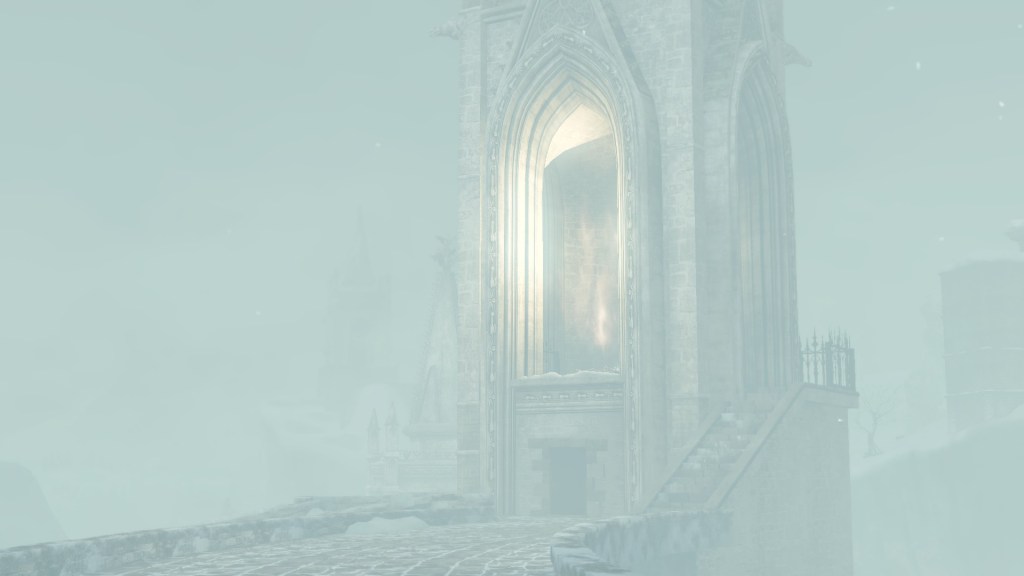

Item descriptions emphasize how his soul dried up as he exhausted his power, but this doesn’t affect his fighting ability during our boss battle; his soul is still comparable to other warrior kings. Therefore, his “power” must refer purely to his ability to suppress the Flame of Chaos while maintaining independent from its influence. If he offered any more of his soul, his presence of mind would be compromised, making it impossible for him to manage the kingdom’s affairs. The capital he built filled him with pride, but the country was now in jeopardy. No one else appeared with the strength to succeed him as king, and no method to challenge Chaos directly had yet emerged. And so, he decided on the best course of action: throw himself to the flames. Taking his crown with him, the armored king plunged down the pit and confronted the Old Chaos directly, battling until he was consumed by the flames. His plan was to either free himself of the evil or buy time by giving his soul fully to it. In the end, there was no miraculous victory, and the monarch was reduced to a mere puppet.
Before that, he laid the groundwork for Plan B. Although the crown’s description claims that he disappeared without “anyone” knowing, there were obvious exceptions. For one, he entrusted Alsanna with “everything” before he left according to the same description. This was embodied in the sword he gave, inscribed with the name “Eleum Loyce” — or “Es Loyes” (エス・ロイエス) to be more accurate — to represent how he was handing the kingdom over to her. It was no random blade he forged either. The sword is peculiar in that it combines two blades, one white and one black. It is easy to see the parallel with the royal couple, a King in white metal and spawn of black darkness. Moreover, the blade’s strong attack draws out orangish energy which heals allies struck. The message is clear: by working together, they could both protect the land they call home by targeting their own ally.

Curved sword created from the soul of Alshunna. Possesses two strange blades and restores an ally’s HP in situations where the strong attack hits an ally.
It is said that the sword that was given the name of this land as its inscription was given to Alshunna, who was by the White King’s side since who-knows-when, when he exhausted his power.
It was this symbolic gift that presumably made Alsanna suspect the Ivory King’s knowledge of her hidden intentions. The black sword could only mean that he knew her true nature. Perhaps it was just a gut feeling, or perhaps he had found something in his search for chaos-slaying weapons that tipped him off. The sword is likely one of the taboo arms that Ivory King had sealed away. One mimic in the ramparts rewards only the Symbol of Avarice, its head, upon defeat, making it a container with no contents. Why keep a security chest if you have nothing to secure? Unless, the item you wanted to ensure no one acquired more than anything else was removed and never returned, which lines up with this weapon left in Alsanna’s possession. It is obvious why it was sealed. Pointing your blade at a comrade to help them survive? It was risky to execute mid-battle, and hardly the mentality to promote among the soldiers. And since it did nothing to advance the destruction of Chaos, it was left to rot until the king saw fit to inscribe it with his country’s name and bestow it to his queen as a parting gift.
A man of the sword instead of the pen, the warrior communicated his feelings in a way only he knew how. And in that silent gesture of his own, he spoke volumes: he knew the whole time, yet kept silent himself — because he trusted her. Although the English description to his soul claims that he is “ever-merciful”, it would be more accurate to say that he is full of “love” as much as pride. That was true for his country, his subjects, and his wife. She never had reason to fear his reprisal; human or monster, he adored her all the same. Even if she did not reciprocate his affection, he hoped that she would use her powers, which he believed would be able to help preserve Eleum Loyce from the Old Chaos. That wordless statement apparently resonated with the apostle of fear, as the priestess has remained in this land praying on the world’s behalf long after the soul she sought became out of her reach. Logically, she should have left Eleum Loyce to its fate, seek a new soul. But emotionally, the apostle needed to stay, “saved” by his stalwart acceptance in the face of her never-ending fears of the end.
Soul of the White King who controlled Eleum Loyce.
The king who was full of pride and love continued to devote himself to protect this land until he was ultimately swallowed by the Flame of Chaos.
The special soul this king possesses is used to acquire a vast amount of souls or create a great power.
I was who once born from “fear” was saved by my sovereign. I shall continue to seal Chaos from here. For it was the part the king left for me. Until the end of time… Until the end of this body…
The knights were also informed about the Ivory King’s plans. He commanded that they wait for his return, wanting them prepared for the final battle against the life warped by Chaos once he had critically debilitated it. If not him, they needed to be ready for someone with the strength and conviction to challenge Chaos in his place. Only then should they step up to the pit. Whichever scenario played out, he would not bring his men on this suicide mission. If the Ivory King became one of those grotesque perversions of life, he wanted as many available to cut him down. But many of the knights, including Fabian, couldn’t accept his order. After the king disappeared down the pit, they followed after him, hoping to defeat the grotesques by his side. This was the king who always protected them — they would not stand idly by while he sacrificed himself one final time. Did they not pledge their knighthood for this very moment? Whether or not the king appreciated their spirit, he would have allies in this tussle with Chaos.
Greatsword of knights of Loyce.
The mission left to them after the king left was to slay the grotesques that came from Chaos. Even if it was their own king, their mission is unshakable.
Some of the knights of Loyce followed after the king and headed to Chaos. But, not a one returned. And then there are even those who continually remained in this land awaiting their master’s return. Eventually all of them, into silence… The knights of Loyce should be eagerly awaiting even now. For the one who will lead and face Chaos with them.
But much like the Silver Knights loyal to Gwyn after the demon war in DS1, they all simply got burned. The knights’ armor has been scorched, the helmet melted. This charred state is a result of constant burning by the flame, the power of life it has imbued into the metal evident from the gradual healing effect of their shields. The knights themselves have received some of that power, several employing pyromancy. Curiously, they are affected by Soul Appease, suggesting that the survivors turned Undead and since hollowed. Nonetheless, they are puppets of the Old Chaos, their wills lost; unable to resist the direction to slay even former comrades should they threaten the Flame. At the same time, the description to their souls insinuates that it is their memories that guide the Hollows “home” even if for such a tragic outcome, grief undeniably remaining even after the death. Their minds may be lost, but some fragment of their former selves remain, instinctively drawn as they are being manipulated for it. Their only hope is for Alsanna to one day bring their sad and sorry souls solace.

Charred helmet of knights of Loyce. It is scorched with flame.
They who leapt into the Old Chaos with their king were burned by flame and lost their will. And so, they continue to burn along with their king.
Charred greatsword of knights of Loyce. Its blade is scorched with flame.
Without their former will, they only exterminate those who try to disturb the flame. Even if they were former friends.
Soul of a knight of Loyce.
The knights who were consumed by Chaos lost their own mission. But still, were those who returned guided to the road home by their memories?
Only grief remains in this soul. If it is Alshunna, she may be able to suppress it.
A Fate of Ice and Fire
With her loyalty to the Ivory King secured, the apostle of fear reoriented her fears toward the flame threatening to swallow the world. Her savior left her with a mission, and she fully intends to fulfill it. From her soul’s description, her praying serves a ritual to keep the Old Chaos sealed. This is apparently her only option, lacking the same fighting power as the warrior king as she does. Nonetheless, it is also the one thing holding the Flame of Chaos back now that it has assumed direct control of her husband. By her own words, she will carry on his will to suppress the flame until the man returns — and she is painfully aware of the chances the latter comes to pass. She is devoted to maintaining this ritual until either she, Chaos, or time itself dies out. Granted, this is a task that no other priestess could complete.
Soul of Alshunna, the silent priestess who continually prays at Eleum Loyce.
The spawn of Dark that fears the end devotes herself to a ritual in order to suppress the runaway Flame.
The special soul of the apostle of “fear” is used to acquire a vast amount of souls or create a great power.
My sovereign is already gone. All I can do is suppress the Chaos here and pray. For the sakes of my sovereign and the knights.
In the silent priestess’ account, Eleum Loyce has been plunged into eternal winter ever since it lost its king. Snow drapes the northern limit far into the horizon, becoming a “lifeless world” devoid of foliage save for some surviving trees behind the walls. Description to the Frozen Flower notes how this key to Eleum Loyce seems to be robbed of its heat from the cold — an odd detail to highlight when cold normally robs the heat from things. However, considering that the stone flower has remained frozen even after sitting in a much warmer climate at Drangleic Castle for who-knows-how-long, the cold freezing this stone ornament is clearly unnatural. The icy winds originated from inside the capital, their force flinging open the Ivory Gate before spilling out into the wider land. And when we confront Alsanna and earn her trust, it is she who calms the winds freezing over the path to Chaos among other things. She even uses this power to form icy tendrils to block our path or otherwise discourage journeying onward.
The king eventually lost his power and then cast himself within Chaos just before that point. Eleum Loyce lost its king and has been in this form ever since… I shall inherit the king’s will and continually seal Chaos. For months and years on end, until the king returns… For months and years on end, until this body is at its end… There is nothing here anymore. Well, except for the cursed flame…
Stone ornament shaped like a flower. Possesses a coldness as if robbing all its heat.
Opens the door leading to the land beyond the Shrine of Winter lying on the corner of the royal castle highway.
We can be certain that this power of cold derived from her Dark nature. Out of the snow emerge ice golems. Because the humanoids are formed from the frost draping the land, they carry flora like wilted dusk herbs. But they are nonetheless artificial bodies, able to manipulate the cold to reform their arms into various deadly shapes. And if they are golems, they must be animated by souls that existed within the ice crystals. The underlying nature of these souls is evident from the ice horses. Formed in the constant tundra sweeping over the Frigid Outskirts in regular rhythm, the more animal-like form with horns and hooves plus generation of lightning may be due to the demon and dragon bones picked up with the ice — the horse-like kirin is occasionally depicted as a dragon in Japanese mythology and often associated with lightning in popular media. Nevertheless, the ice horse emanates a dark aura. What could be causing this except being steeped in more of those icy winds than the golems in the city? Even Lud and Zallen have garnered this shadowy aura as a result of remaining in the snowfield.
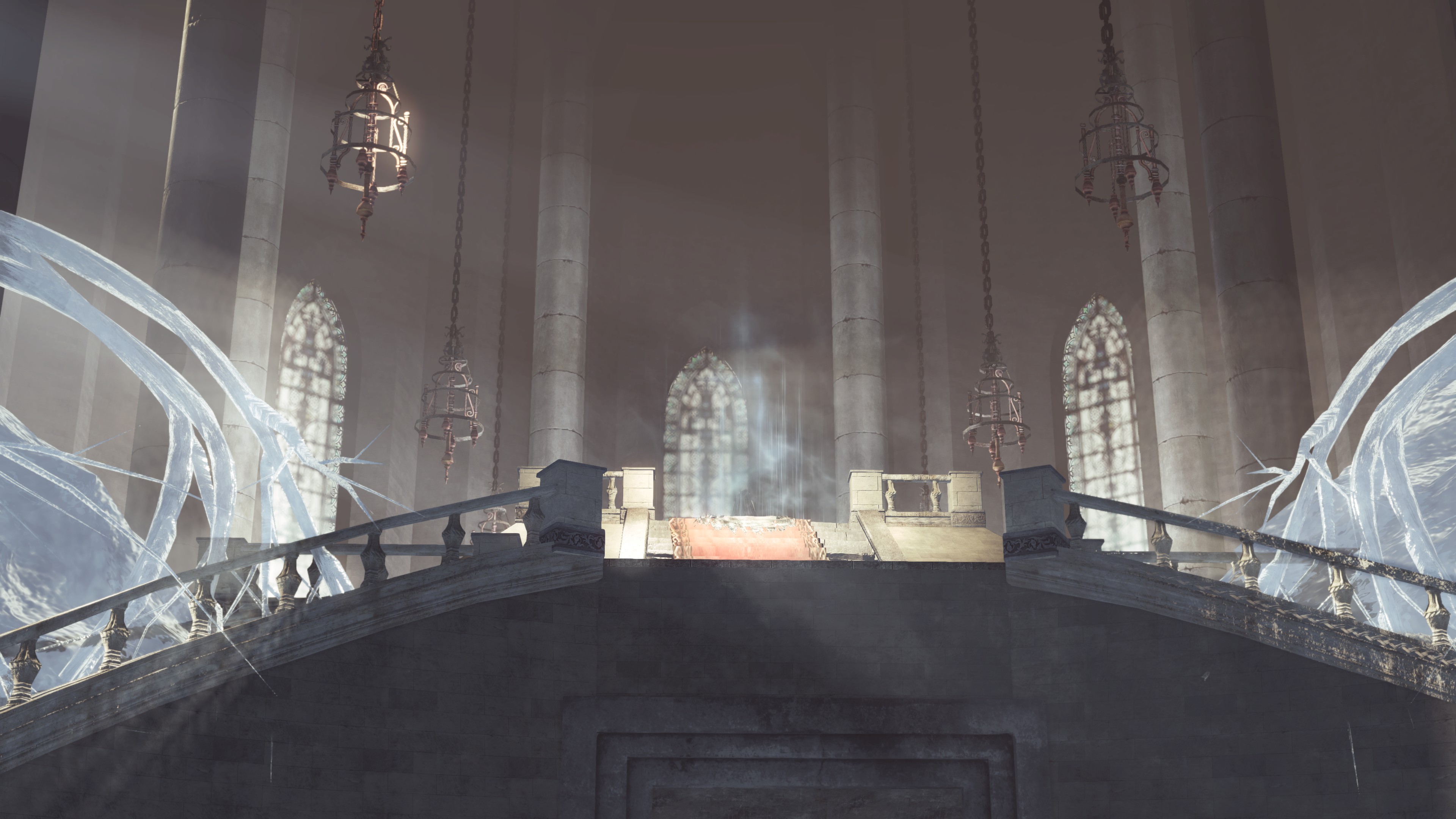
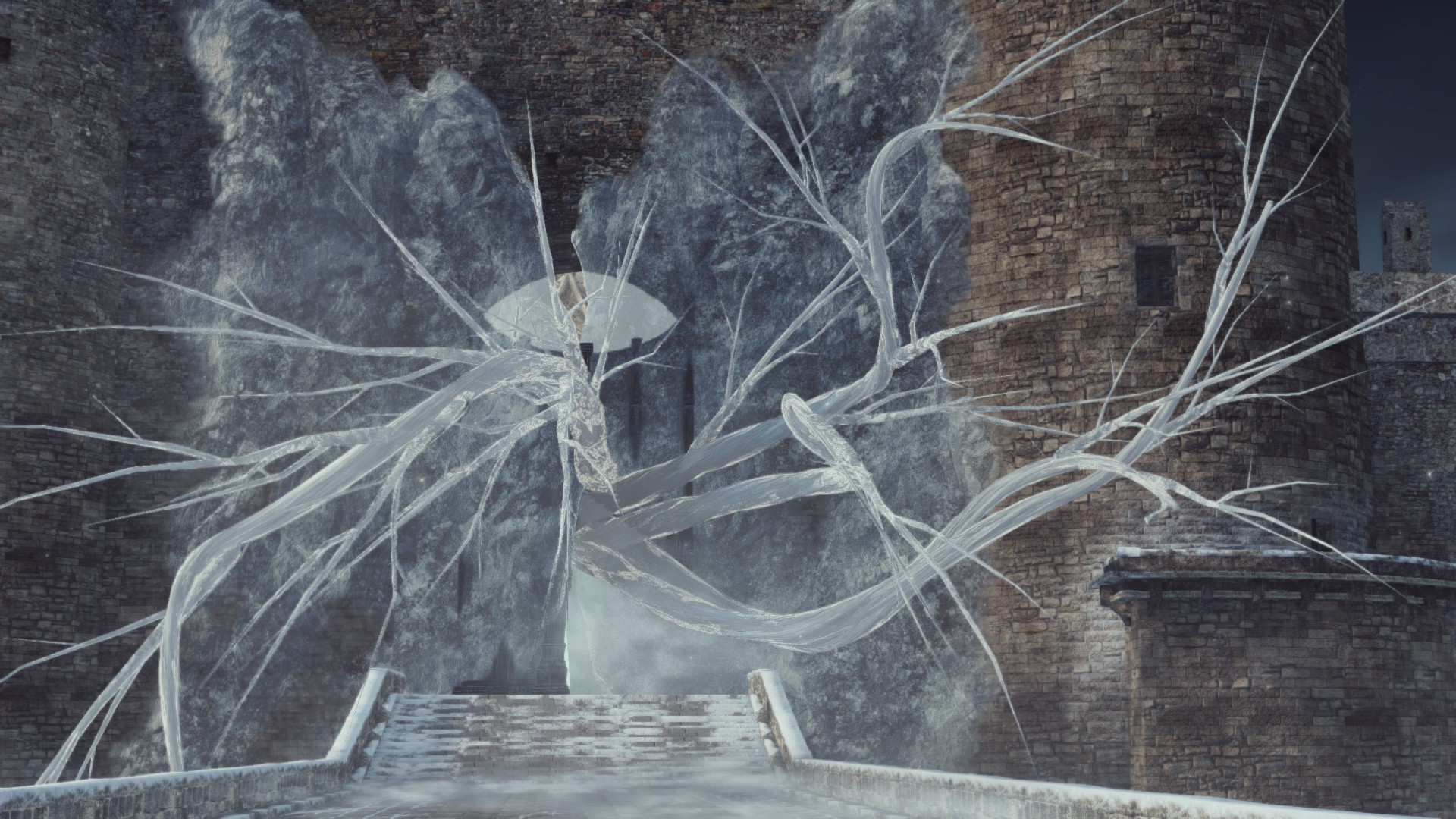
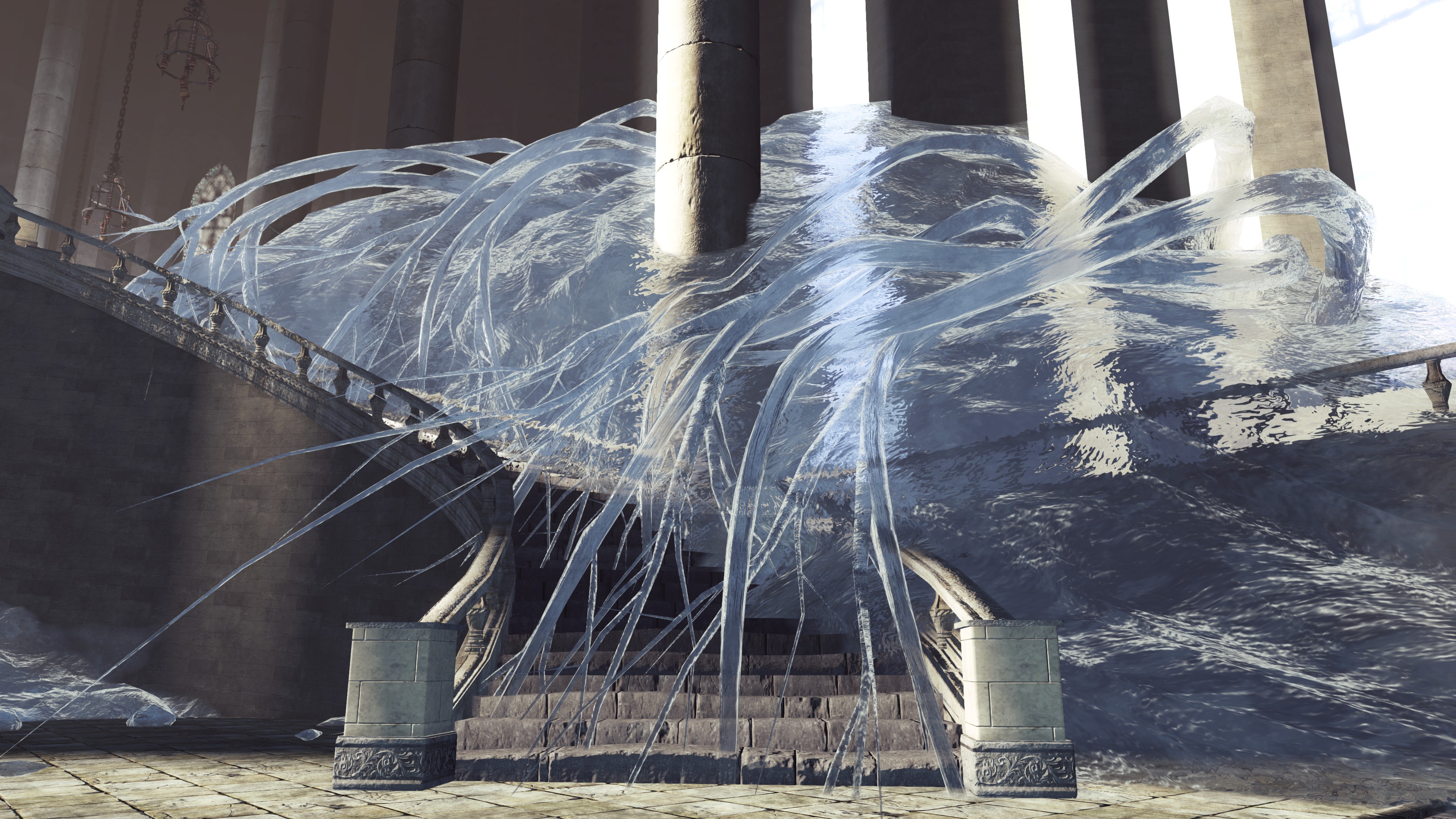
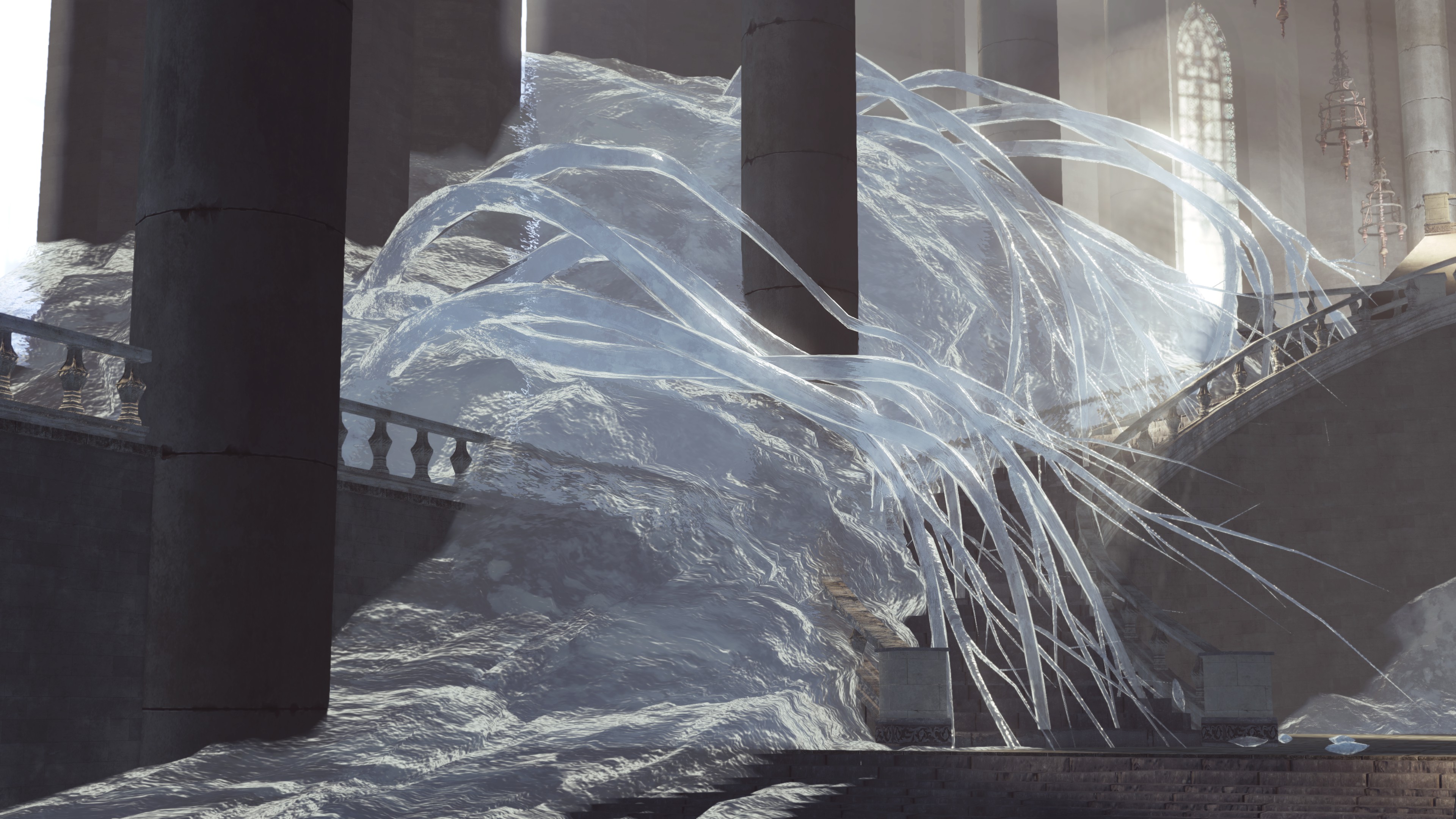
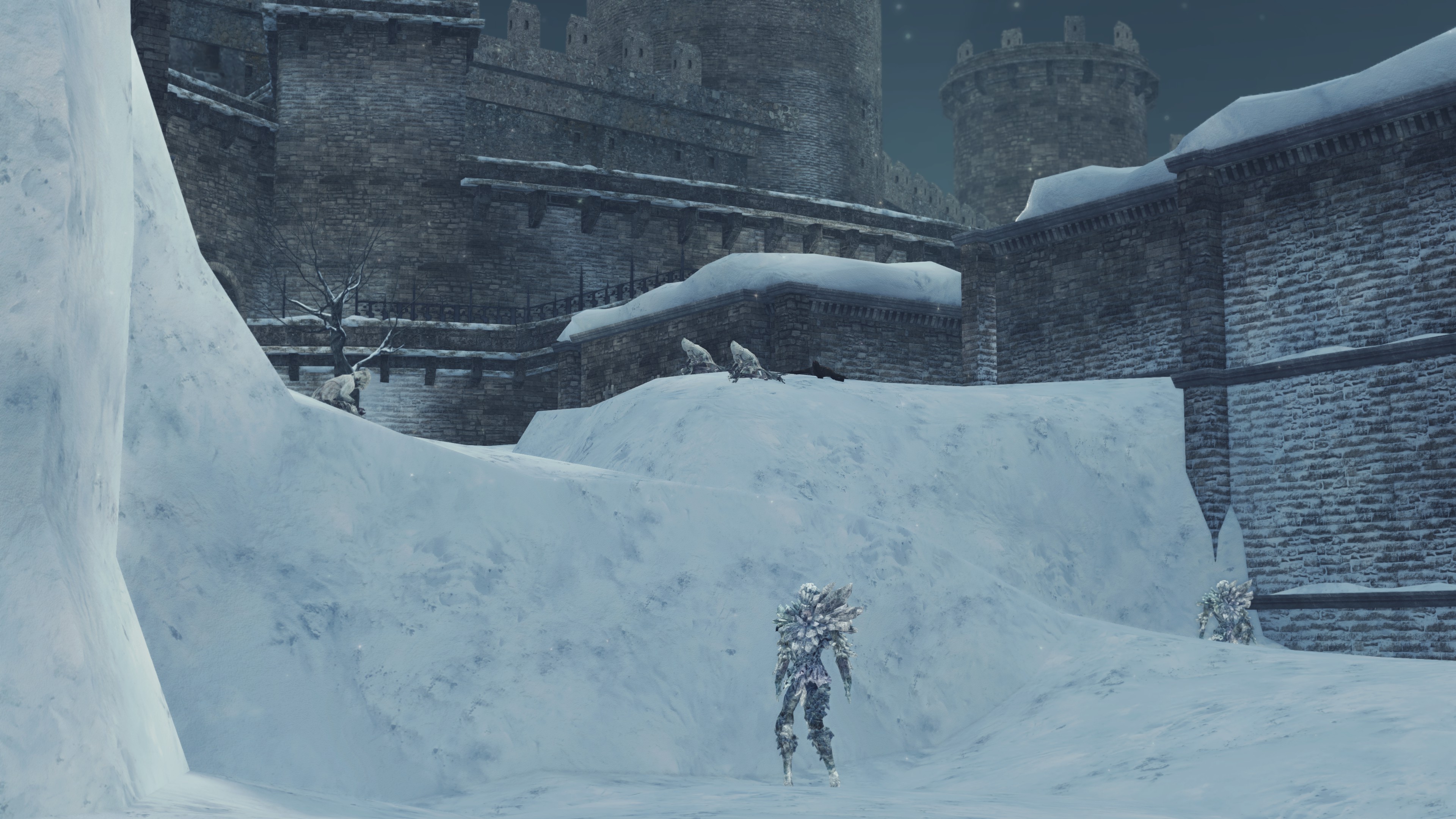
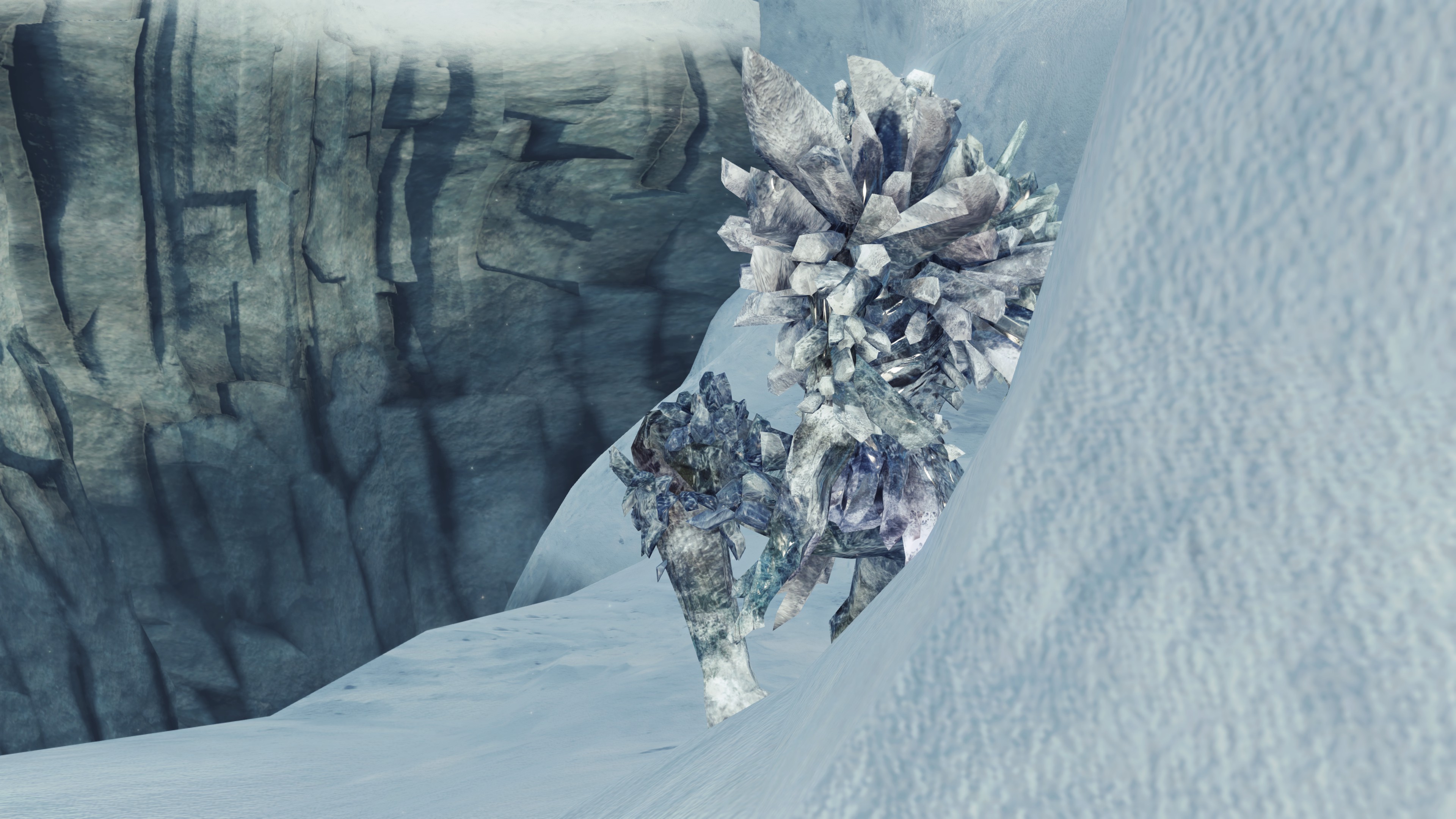
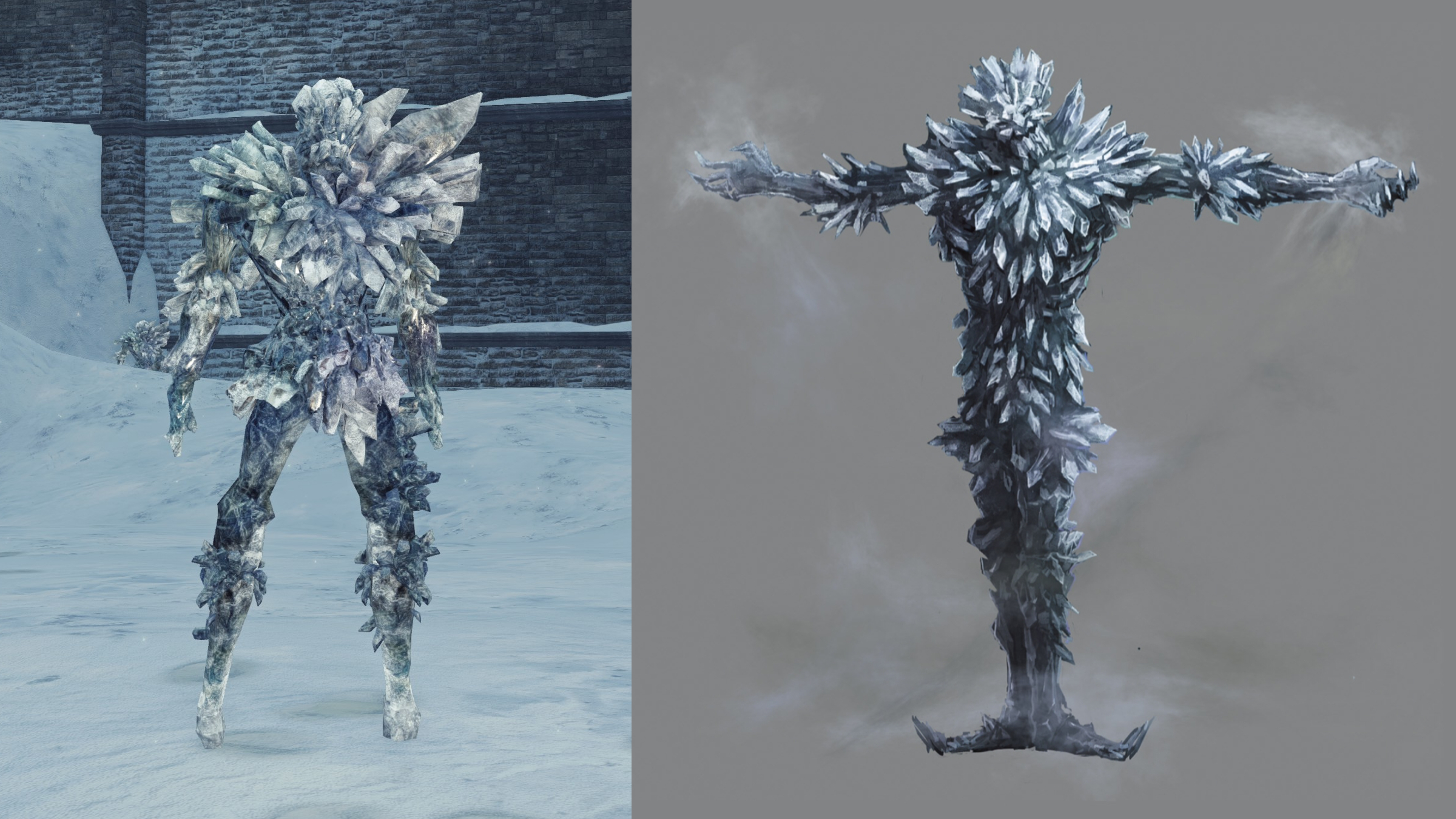
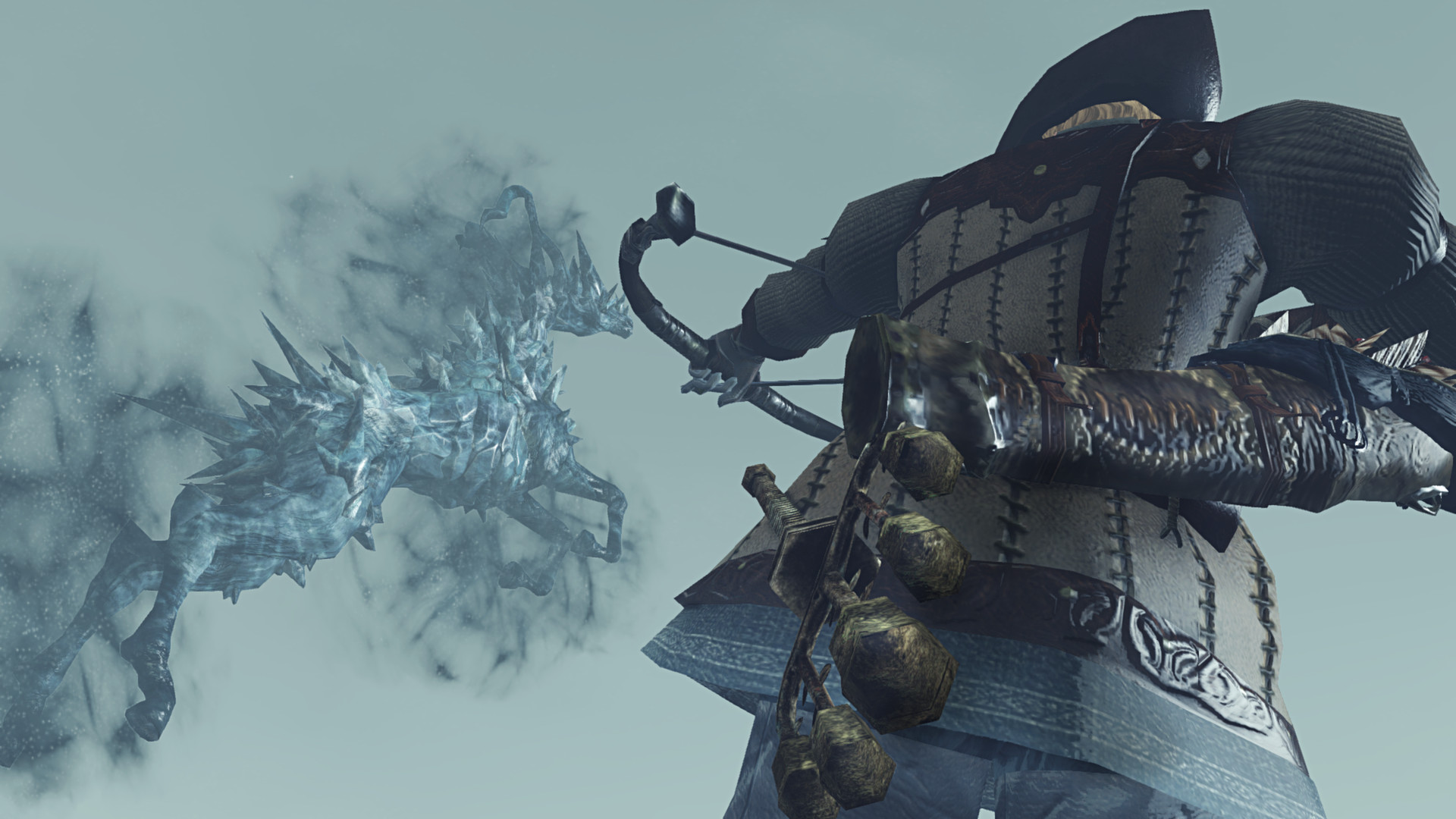
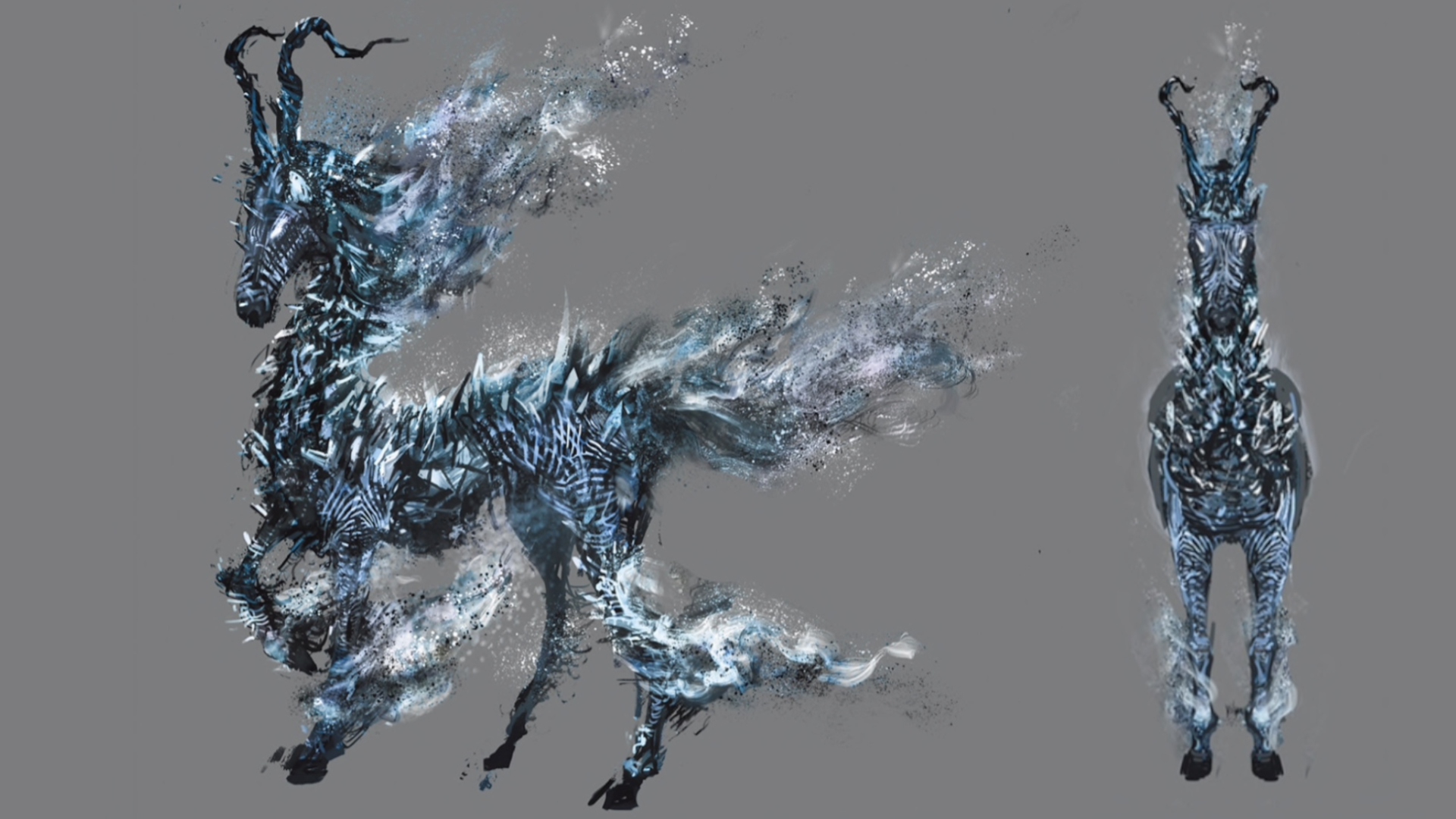
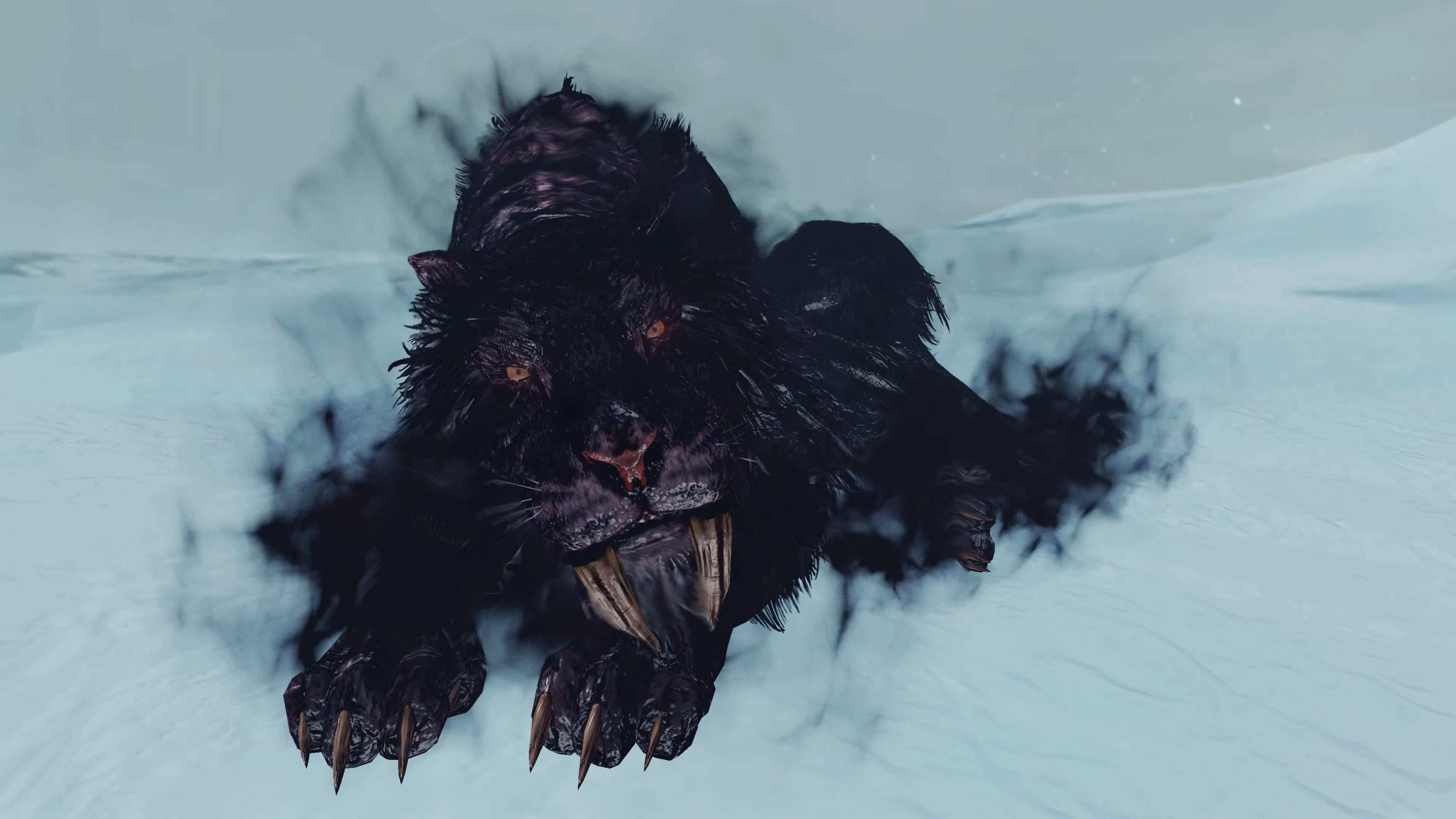
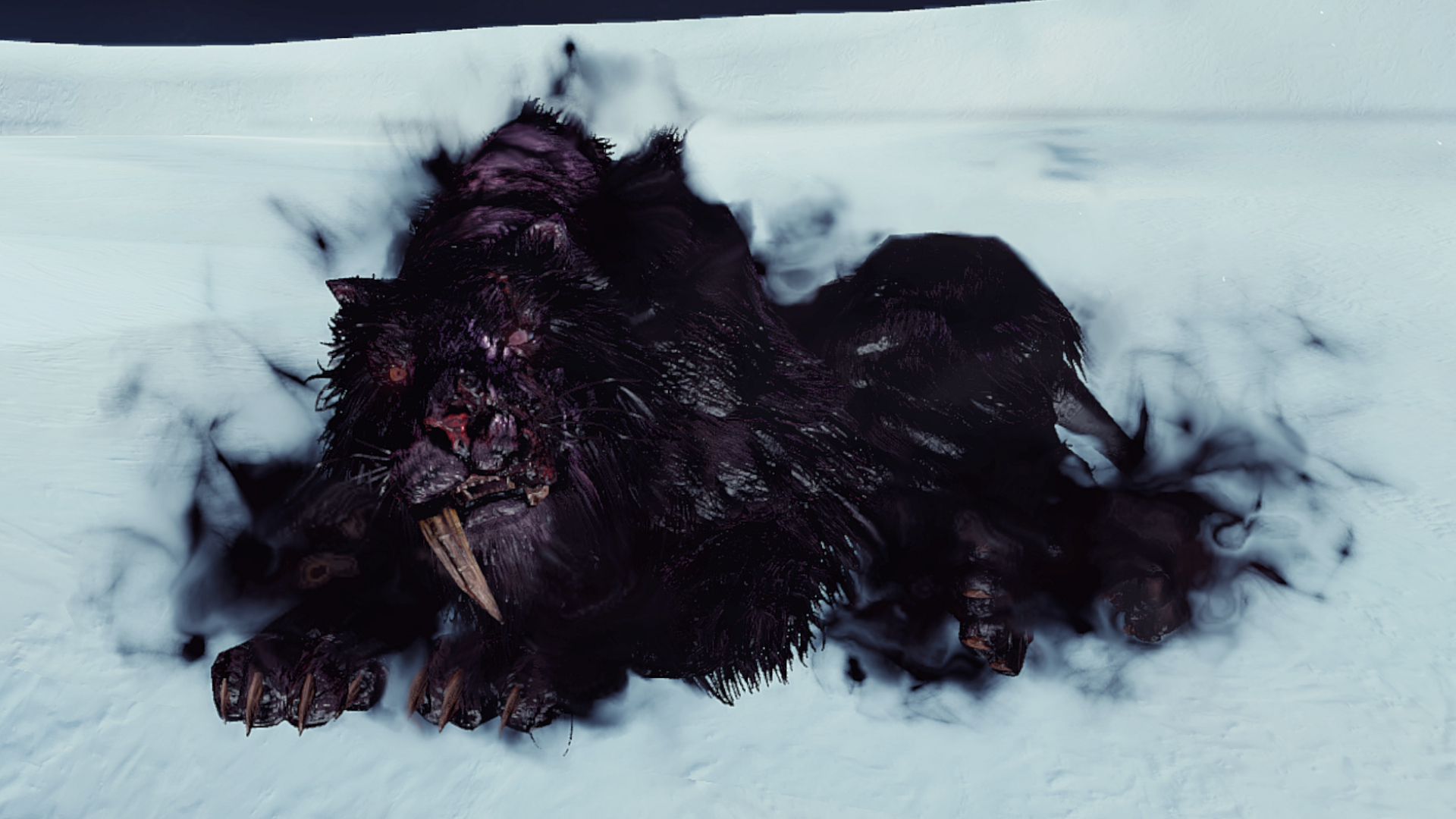
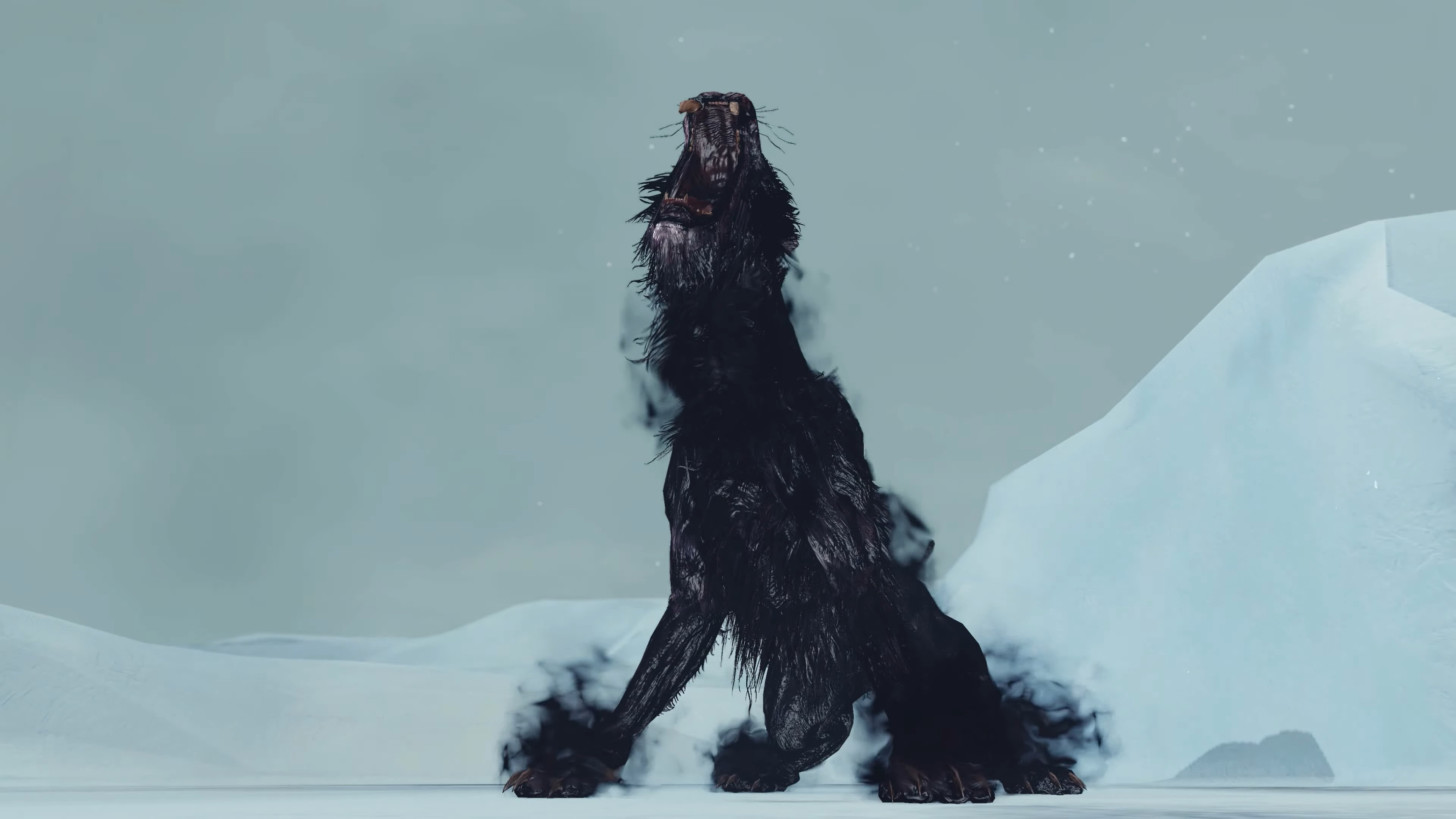
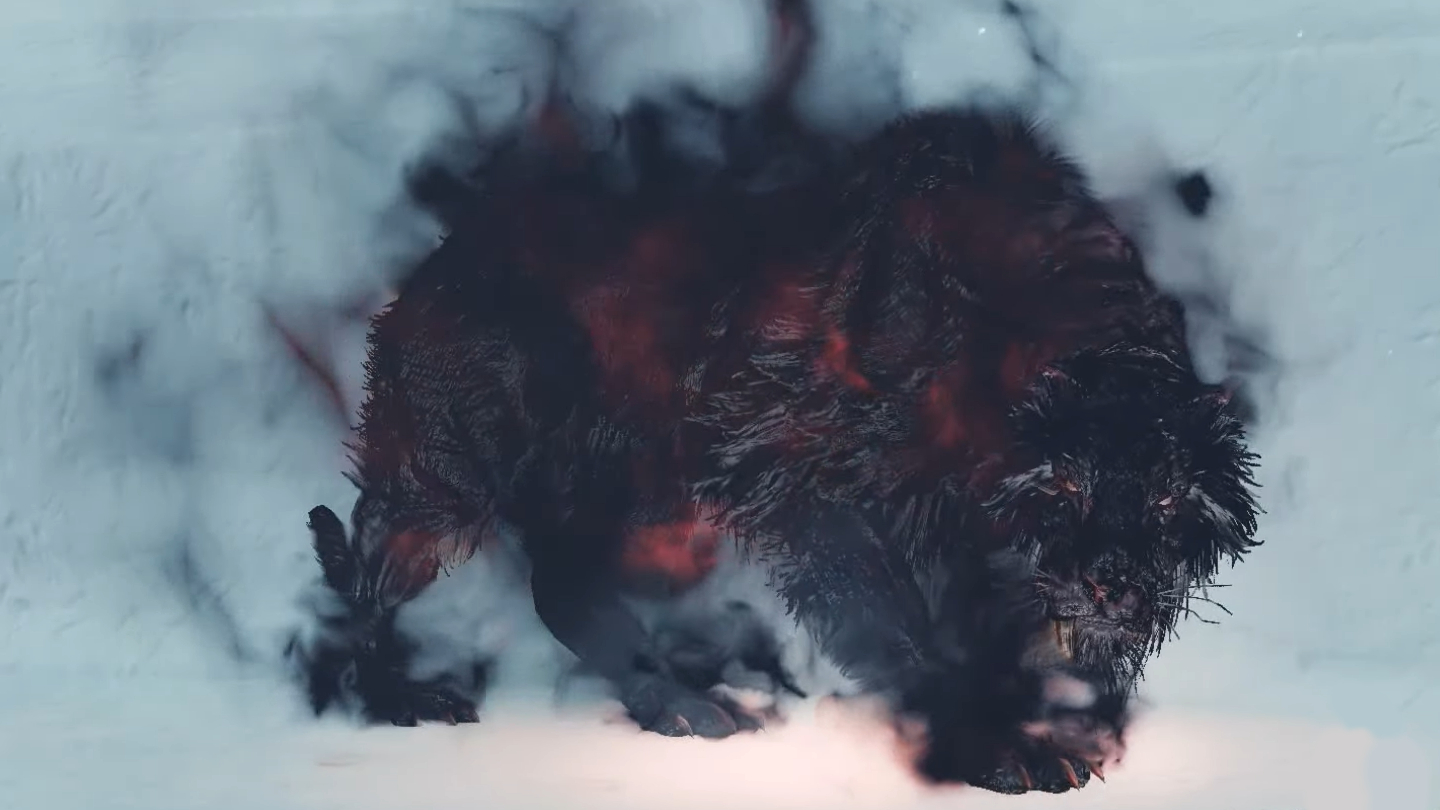
In short, Alsanna’s cold winds stem from her underlying humanity, whose penchant for spontaneous generation sometimes animates the ice when the souls happen to coalesce. That Dark might only exist in trace amounts, hence requiring extensive blizzards to manifest any symptoms. Still, it is there, and it is easy to imagine how it accomplished such an extensive change in climate. If fire produces heat, then Dark leaves cold. Both elements of the universe lie on the consequence end of the spectrum, alongside death. And just as the cold winds have brought death, the spawn of the Abyss has brought the chill. Performing this kind of cold air ritual is well within Alsanna’s abilities as a fraction of the powerful dark sorcerer. And because it is the power of their queen, the army learned to adapt to it.
Turned blue covered in icicles, the soldiers and priestess retainers have formed new armaments from the ice, the warriors using them as catalysts to perform a kind of ice sorcery functionally similar to soul arrow. In the case of the wall defenders, their mastery is so grand that they are willing to throw their lances before generating new ones out of thin — or rather, cold — air; they also impale the weapons into the ground to generate a line of jagged ice crystals. The Ivory King’s intelligent pets have likewise picked up on how to perform this sorcery without any catalyst, conjuring multiple ice projectiles akin to Homing Soulmass. Even the Loyce knights will seal portals to Chaos with ice before their last breath. Whether all aware of the source or not, the Ivory King’s subjects clearly taught themselves how to manipulate the cold now blanketing their land. Eleum Loyce’s defenders continued to perform their duties to the best of their own abilities. With or without the king, the ramparts must stay strong.
Inevitably, not everyone survived the cold. Alsanna refers to Eleum Loyce as an obsolete capital for good reason. There is no way for a large city to maintain its population after all potential crops in the region have perished under the snow. Even for game, the only wild animal we encounter is a unique species of rat, which we see feasts on the refrigerated corpses — and uses the icicles forming on its back to roll around like a certain blue hedgehog. Outside of vermin, there was simply nothing to eat. Hypothermia and starvation were sure to have run rampant, until only Undead remained. The priestesses were not blessed, or cursed, with such a fate. After the clerical masters all died out, their attendants came to roam the freezing temperatures inside the city; most we find simply kneel in corners, clearly distraught. Without the priestess’ guidance, they are lost. It is only when Alsanna relents with her blizzard that many seem to regain their composure, ready to join the fight for Eleum Loyce.
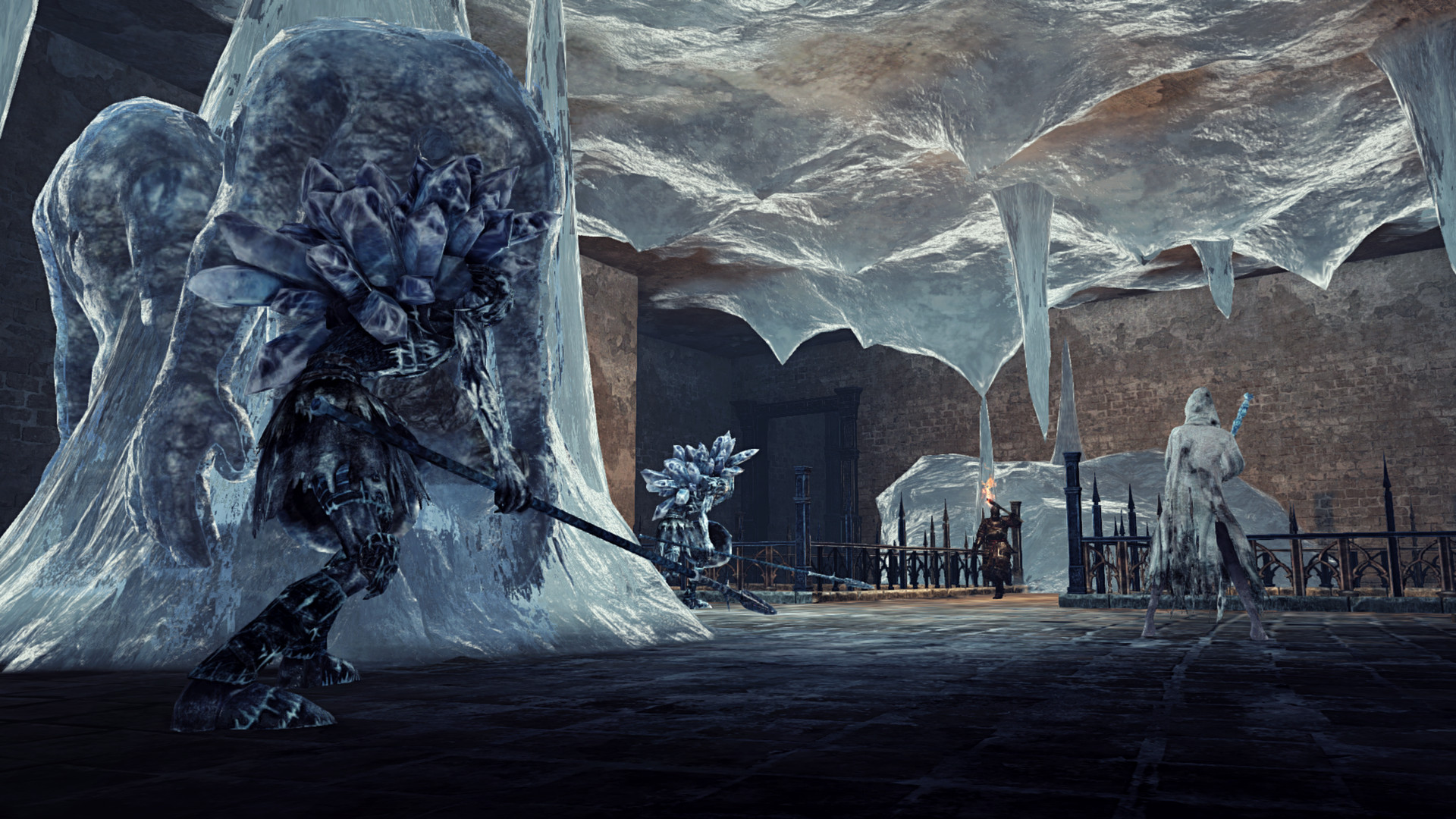
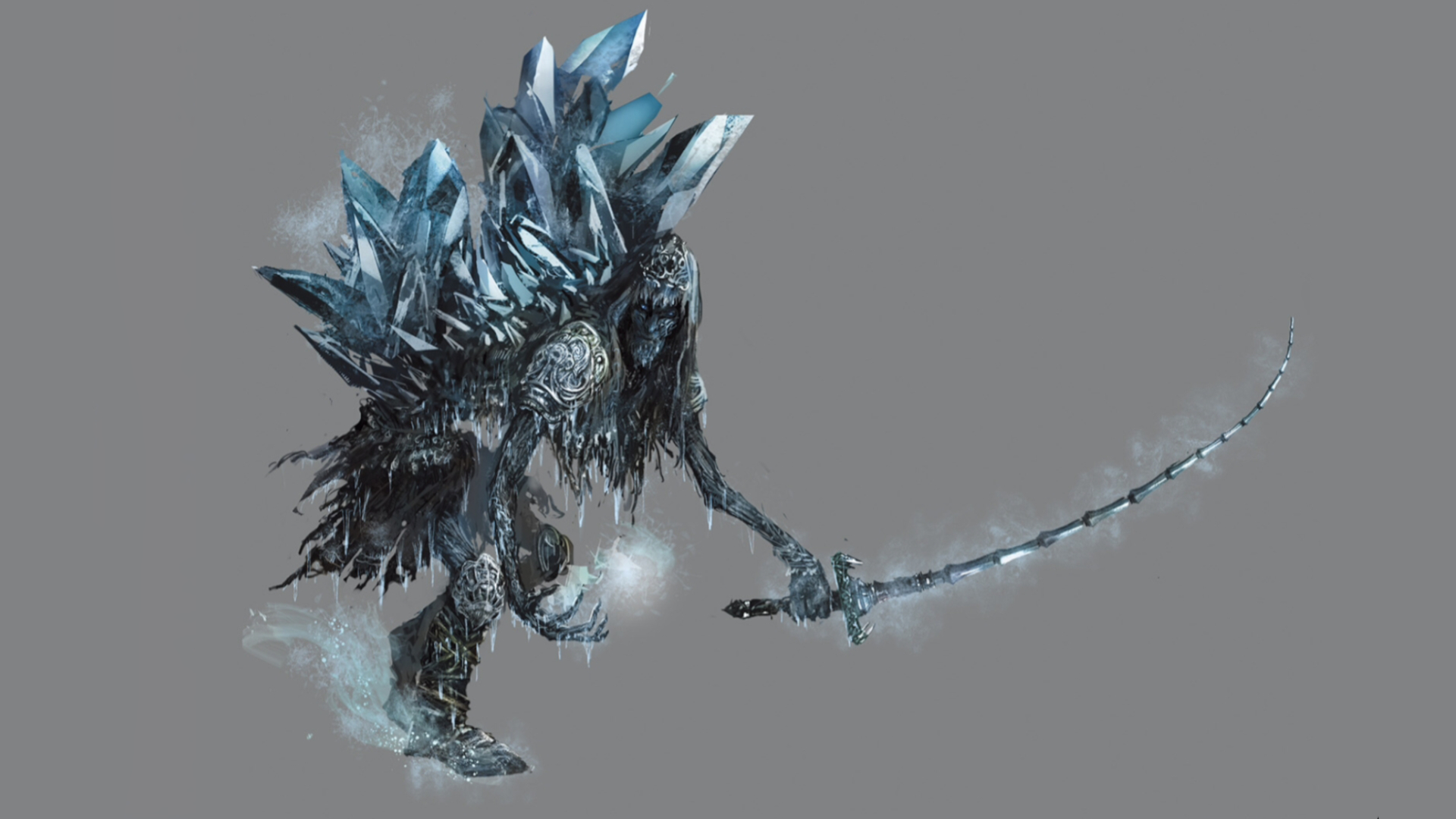

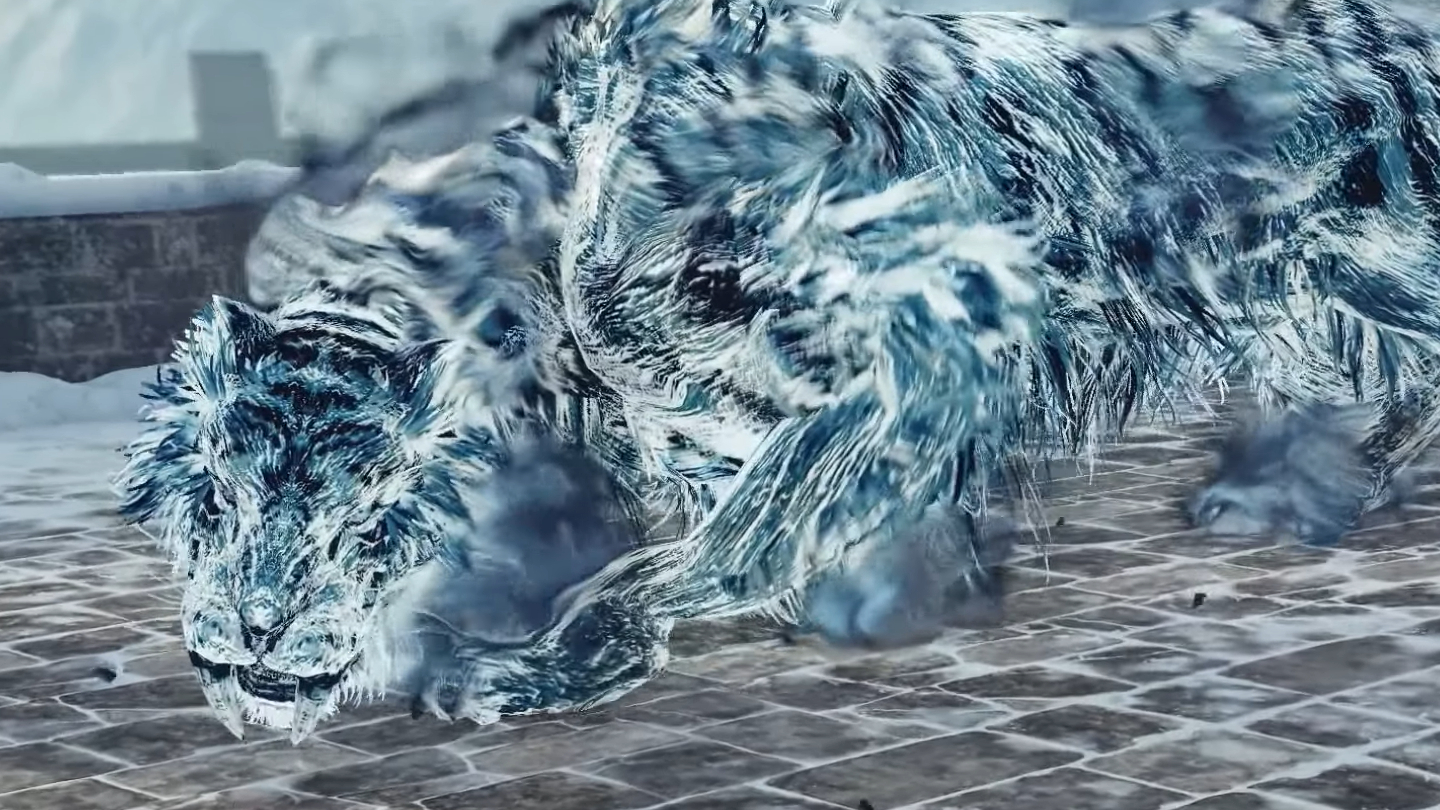
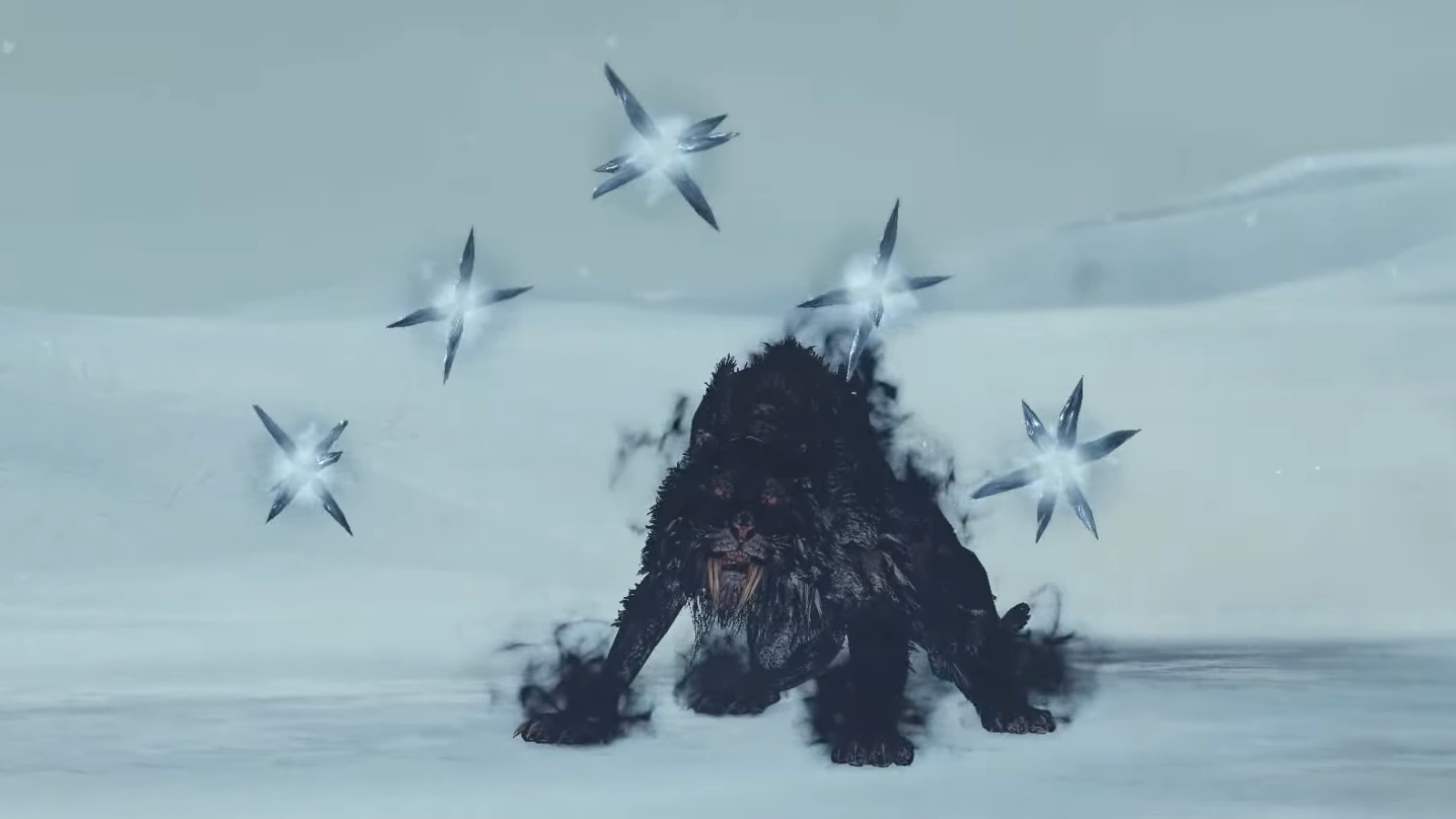
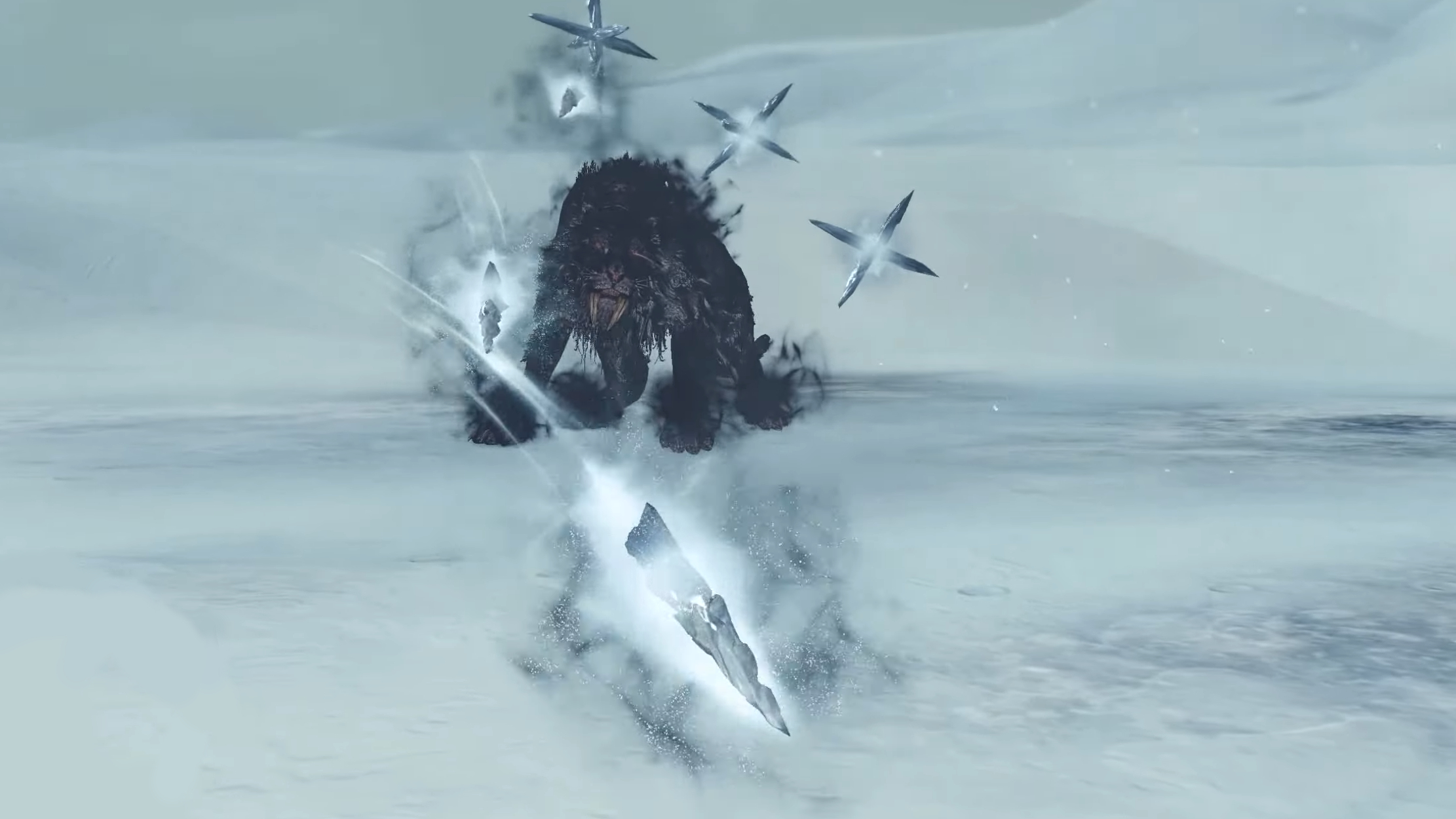
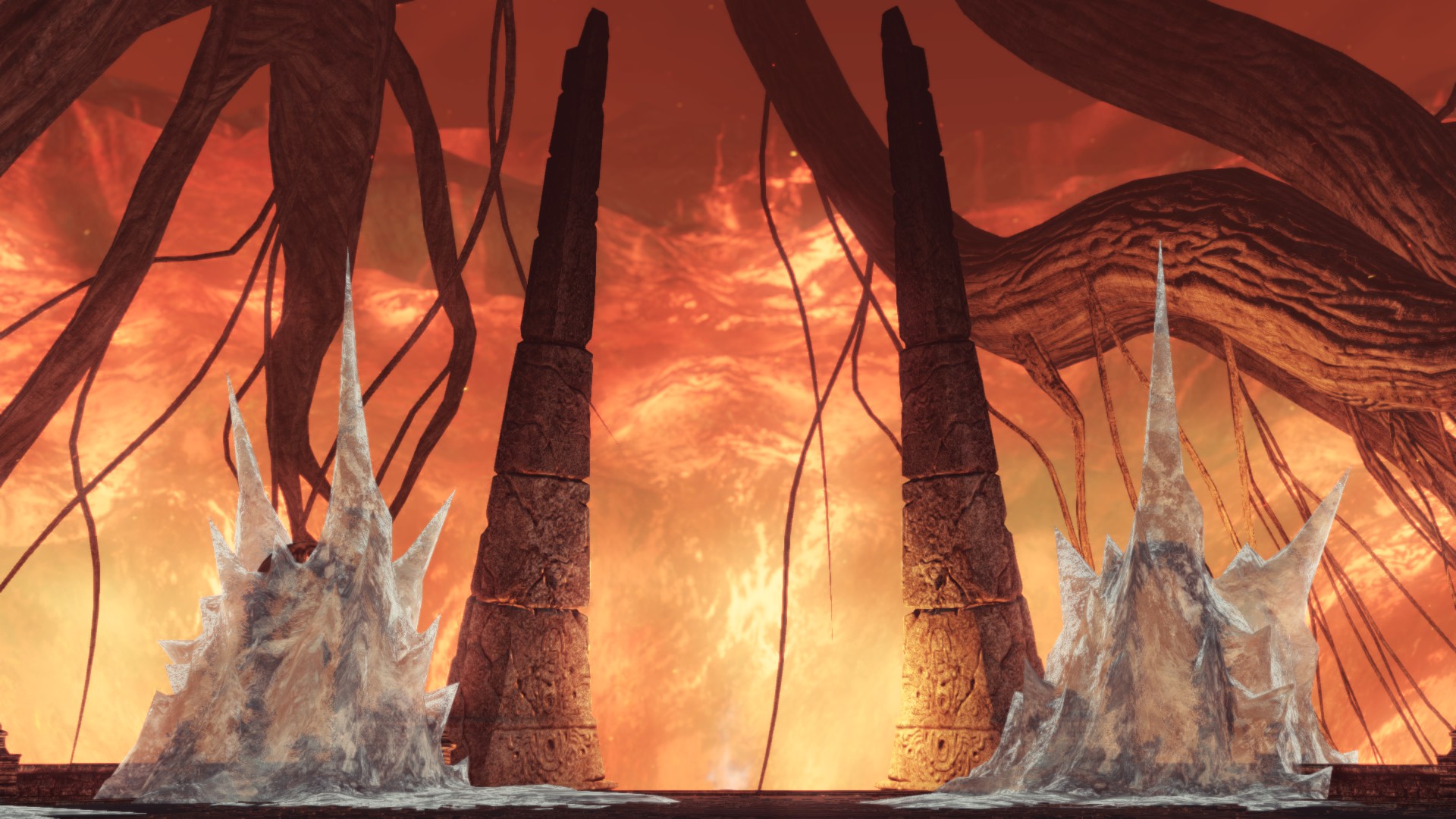
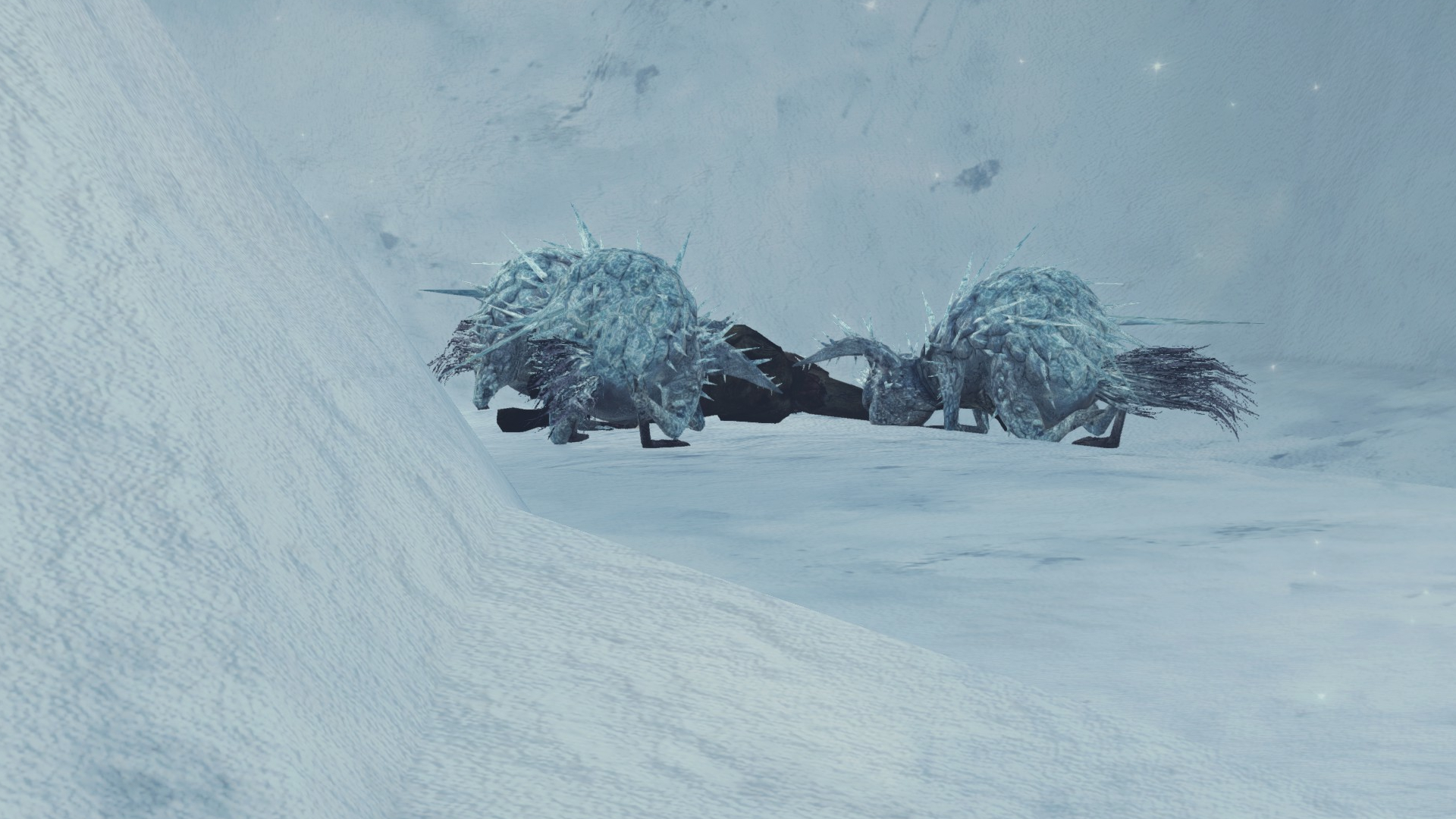
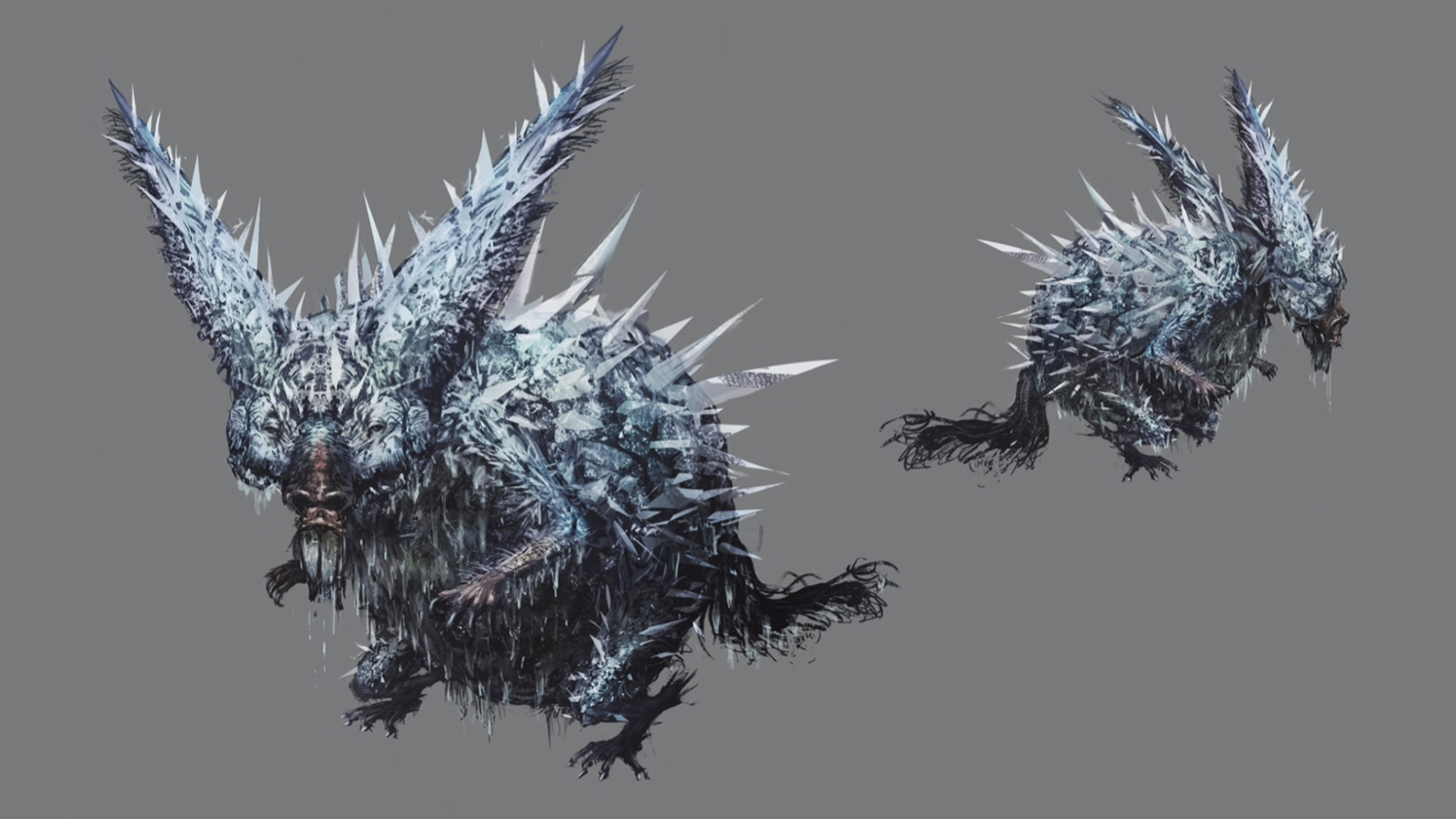
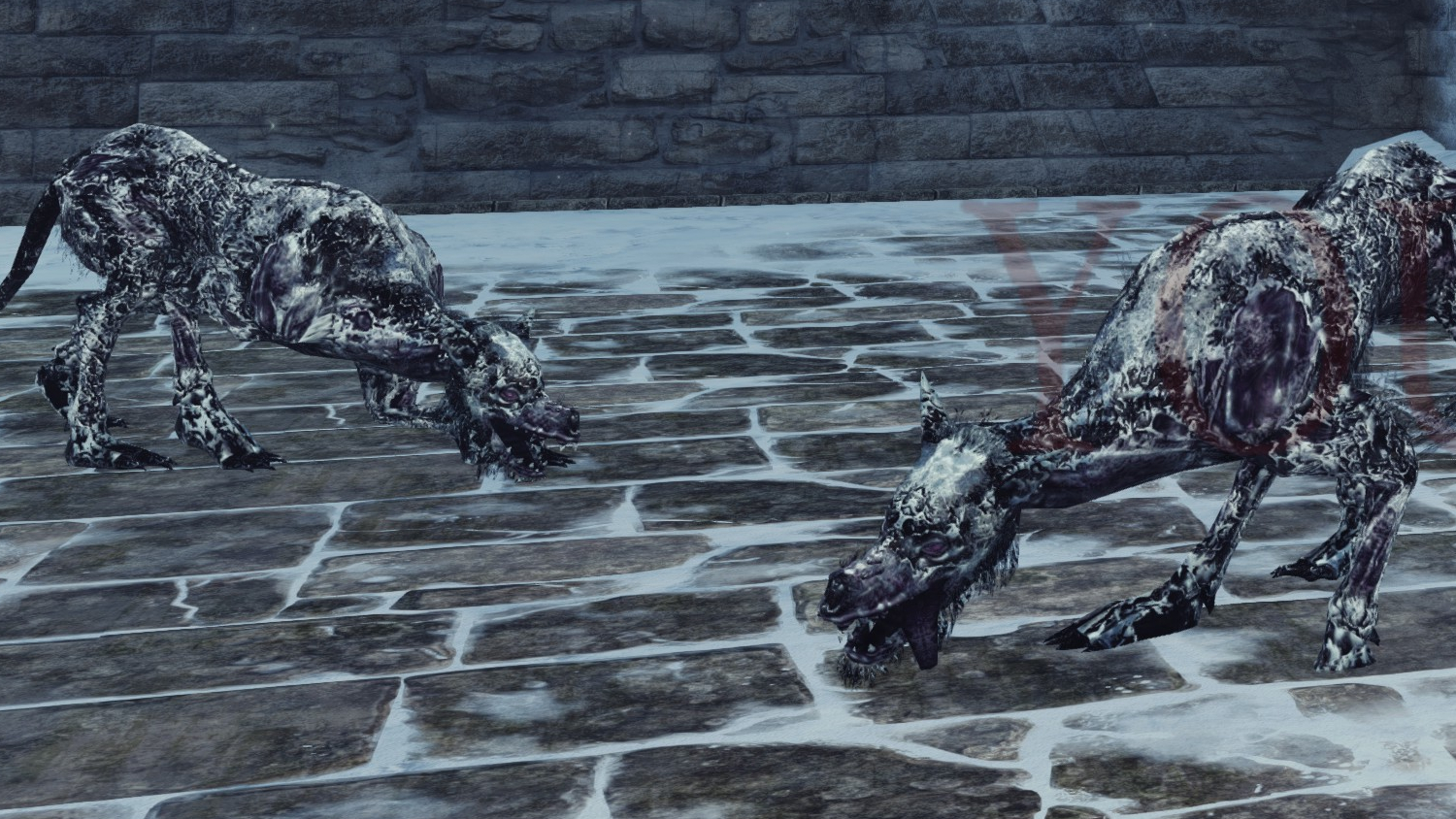
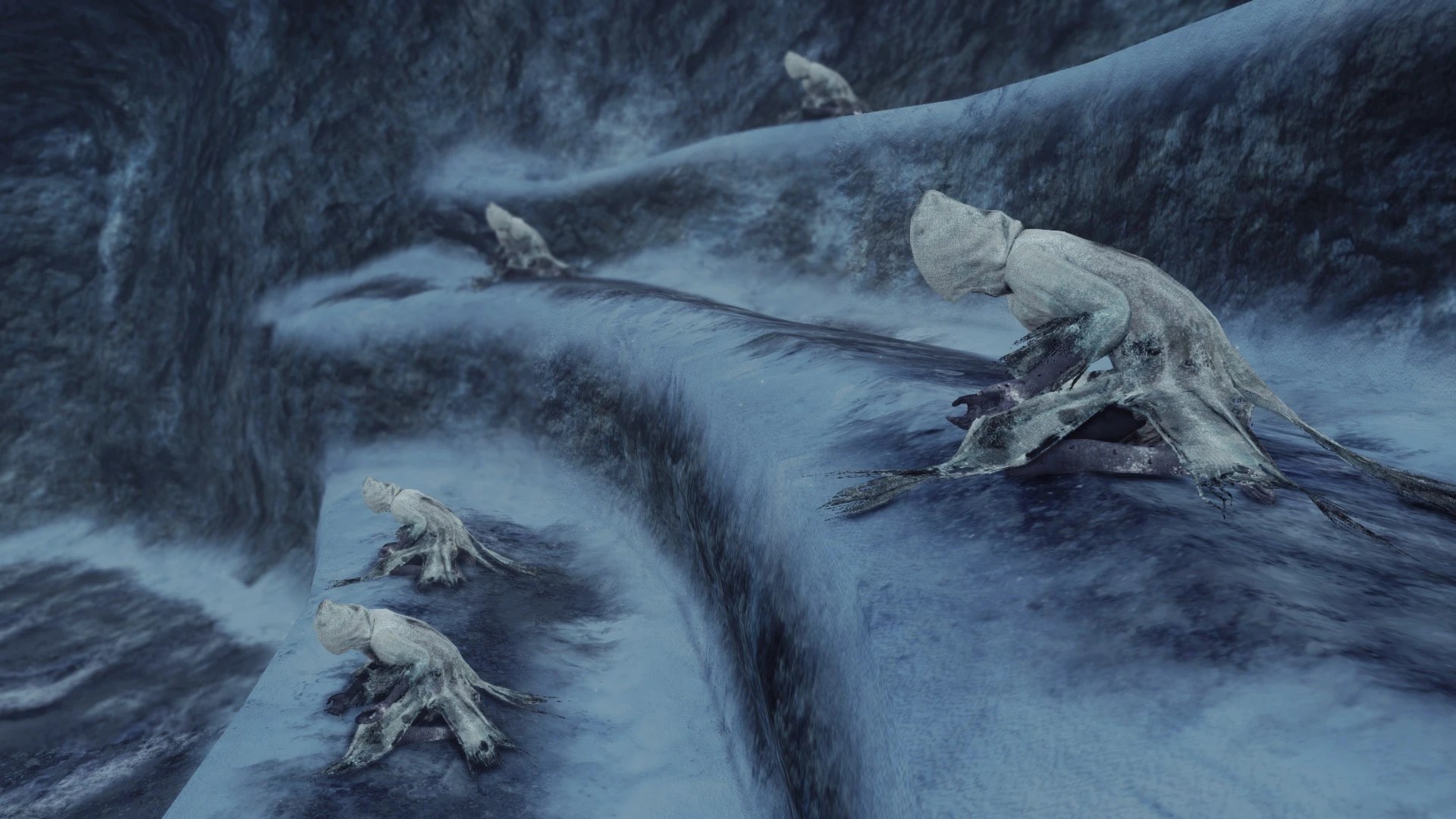
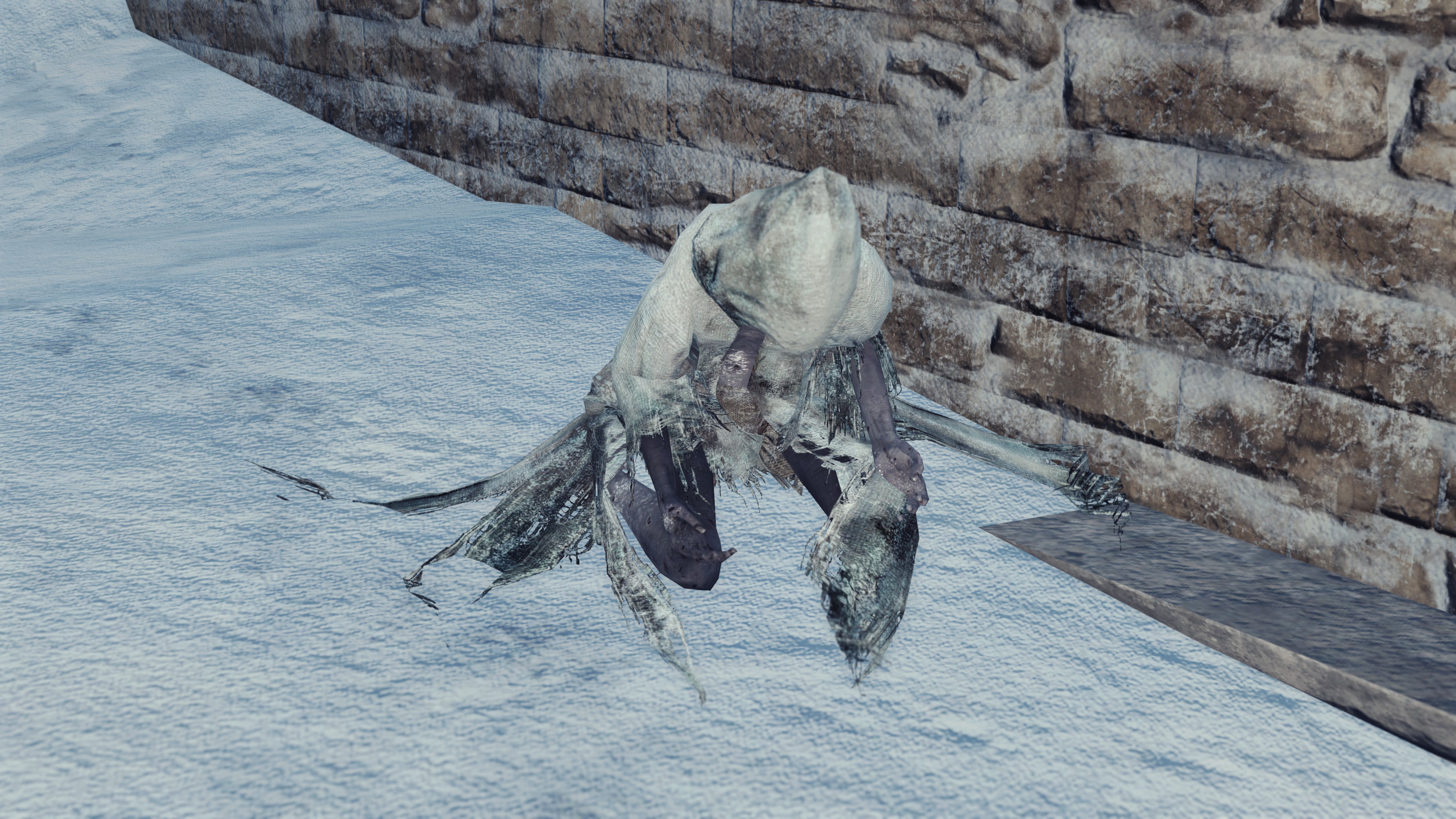
Of course, the defenders do this as Hollows. Both the sorcery swordsmen and attendants are vulnerable to Soul Appease. The wall defenders might still retain full clarity of mind, or perhaps their survival is due to conviction in their duties more than any Dark curse. Whatever the specifics, they maintain the expulsion system, proof that Eleum Loyce’s soldiers first duty in this unexpected ice age was protecting Eleum Loyce from themselves. The war dogs we find still alive own souls of lost Undead and nameless soldiers, explaining why. Countless Undead invariably hollowed and were forced to be put down or banished. Soon enough, the mad exceeded the sane and overwhelmed them. Without the Loyce Knights to help, the army couldn’t keep up with the Hollows.
As for the few who remained, they too have survived by some means. Perhaps it is the Darksign, or perhaps it is their conviction to their king cursing them to persist for so long. Either way, only one knight has remained at the pit, ready to enter battle. The rest have gone into seclusion, awaiting the summons of their king or some other worthwhile challenger of Chaos. Although the Garrison Ward Key description asserts that they remain in that district specifically, this isn’t strictly accurate. While one does sit in the tower across the bridge from Knight Town, another hides in the tower accessed from the ward’s inner wall at best. The last lies in the inner wall for Church Town, which can also access the second tower. Considering the previous oddities with the text, this is likely just another oversight by FromSoftware. There is a reason the local bonfires establish this place as the “Old” Knight Town. (旧騎士街) No knight actually lives in the district anymore, the place filled with one “uninhabited ruined home” (無人の廃屋) on top of another now. For all intents and purposes, Eleum Loyce has collapsed.
Helmet of knights of Loyce.
They who were given a mission to protect this land disappeared into the Chaos. However, the portion who were left behind continually await their master’s call to convene at Eleum Loyce, which sank into intense cold.
Light a Fire in their Hearts
When we make our way into Eleum Loyce, Alsanna’s voice echoes through the cold air warning we “fear” the Old Chaos and leave. Despite her attempts to scare us with words and the one icy tendril, she does not meaningfully stop us from acquiring the Eye of the Priestess or challenging Aava. Even coming face-to-face with her guardian beast, she prays we do not suffer. But contrary to her expectations, we are able to defeat Aava and have an audience with the silent priestess. Although she won’t let us get close, our actions tickle her curiosity, and she reveals her desire to free the Ivory King from Chaos’ clutches with our strength. Although she permits us to challenge the flame with just one knight at our side, we are free to recruit the others to our cause, inspiring each to return to his post and fulfill his king’s last command following us into battle. All of this is very impressive to Alsanna, who truly believed her kingdom was as good as dead. But once again, she was never alone. The spirit of Eleum Loyce remained dormant but was still there. It just needed to be drawn out by a new King.
One who sets foot in Eleum Loyce. Leave. Fear the “Old Chaos”.
Aava. Pitiful king’s orphan. One not possessing the mark arrived. Bear your fangs. May they not suffer at least.
The resurgent knights shall obey you.
The frozen knights of Eleum Loyce. To think you give they, who lost their role, power again. Who are you?
As noted earlier, the knights will sacrifice themselves to prevent their brethren from continuously flooding in through portals powered by Chaos — which oddly reuse the rose gateway seen at the pit above rather than Izalithian architecture. Once we prove resilient, the spirit of Chaos brings out one final fiery portal for the Ivory King to step out of. Unlike his knights, Soul Appease has no effect on the king, so it is questionable if he ever even fell in his battle against the Flame of Chaos. The fire took his soul, but his charred armor remains unmelted. Perhaps even as its puppet, he was slowing the rate at which it devoured him as a way to keep it suppressed. Regardless, the former knight of Forossa brings the full force of his might to bear, the words he mutters with each strike indecipherable. Maybe his last words were thanks or an ode to his beloved. In the end, we claim his soul from Chaos as Alsanna wished and may return with his discarded crown.
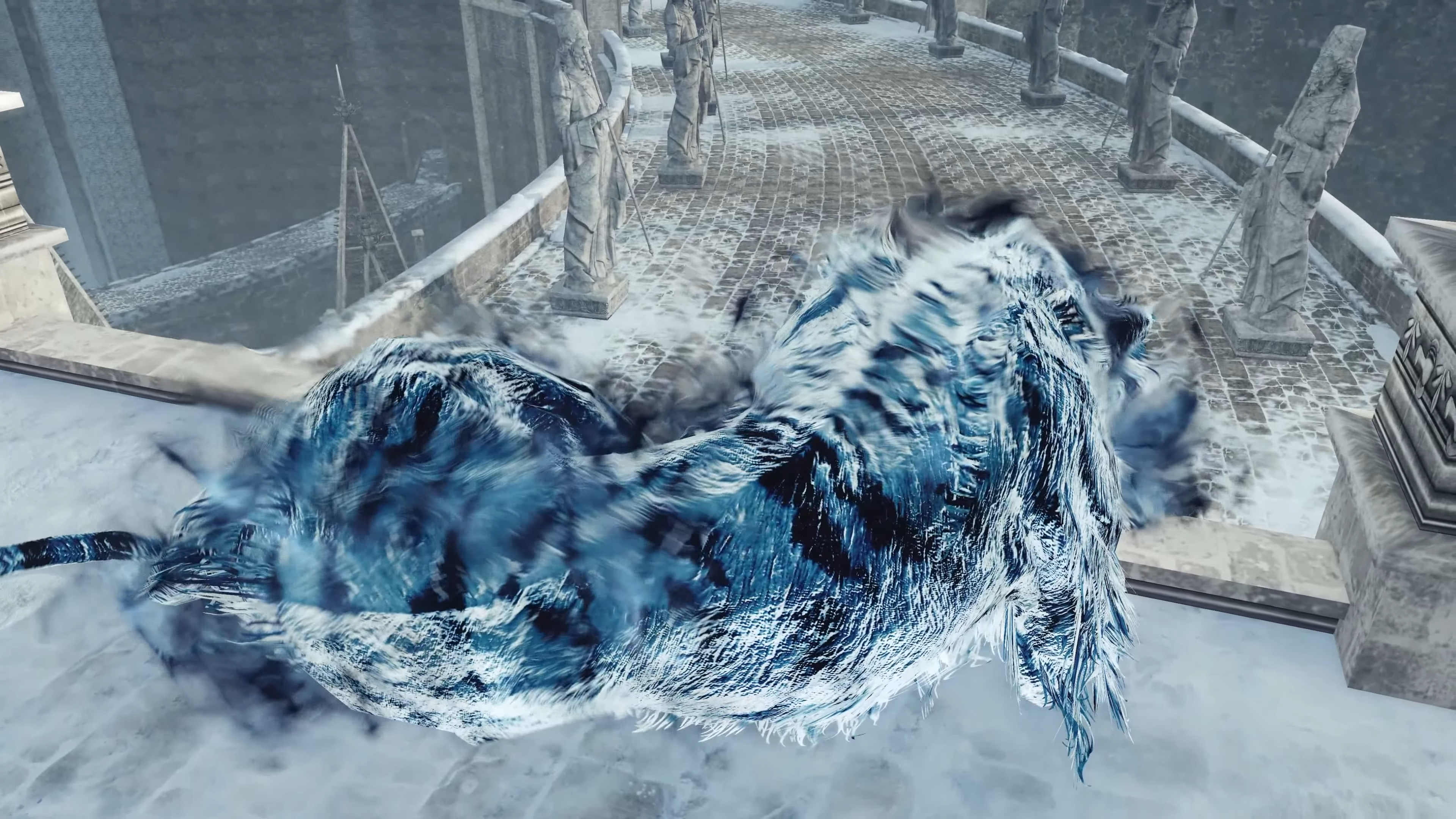
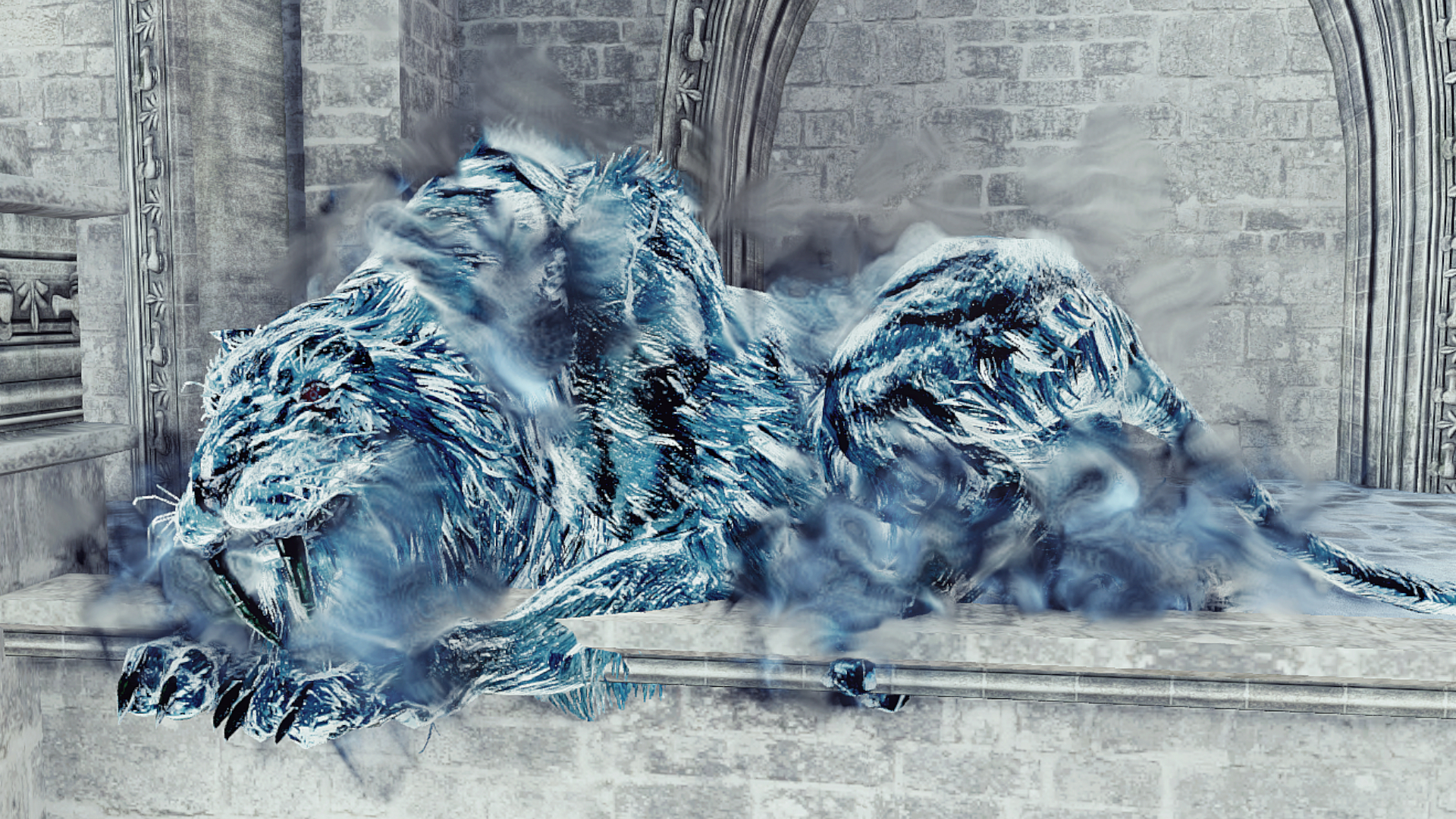
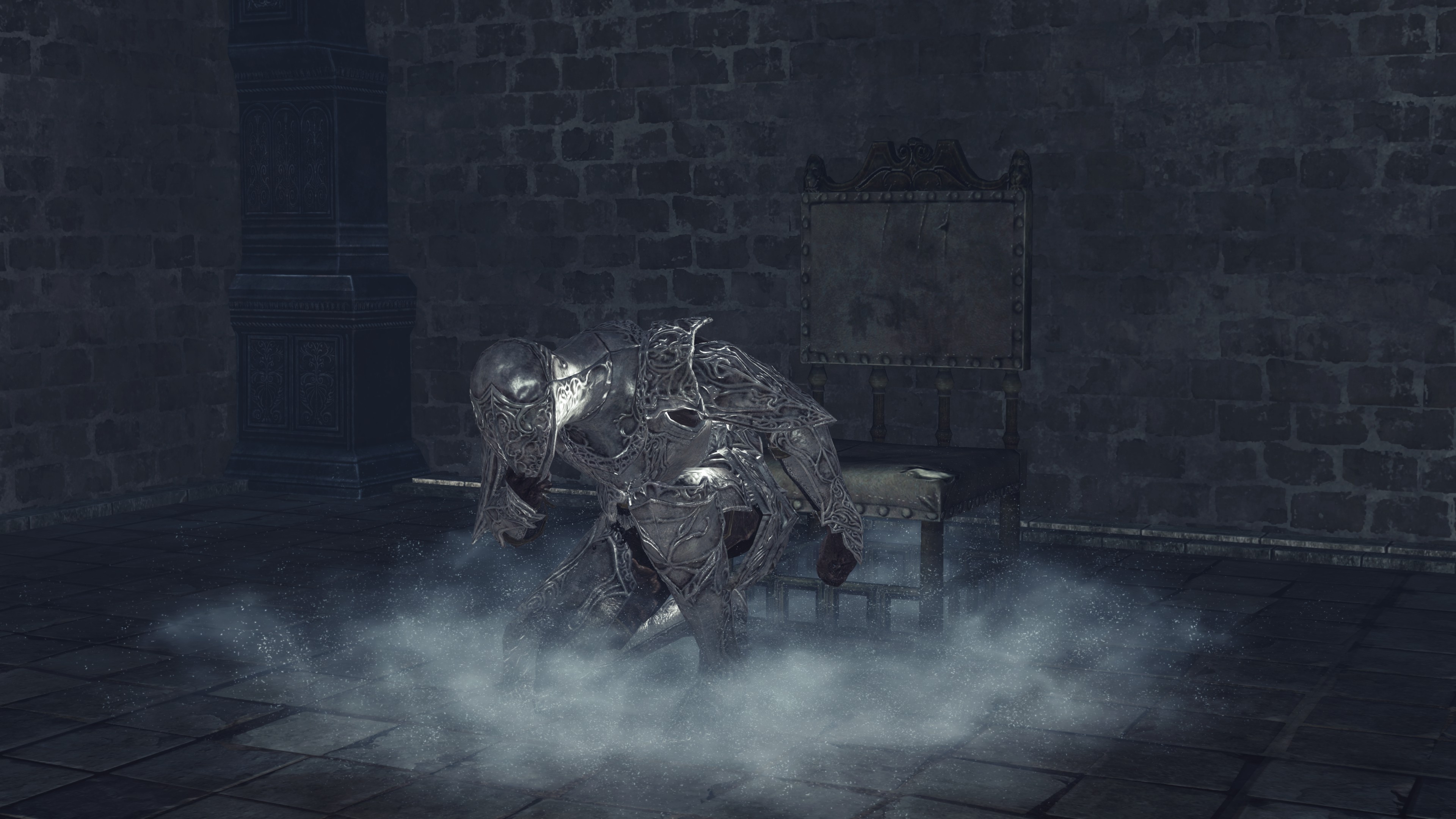
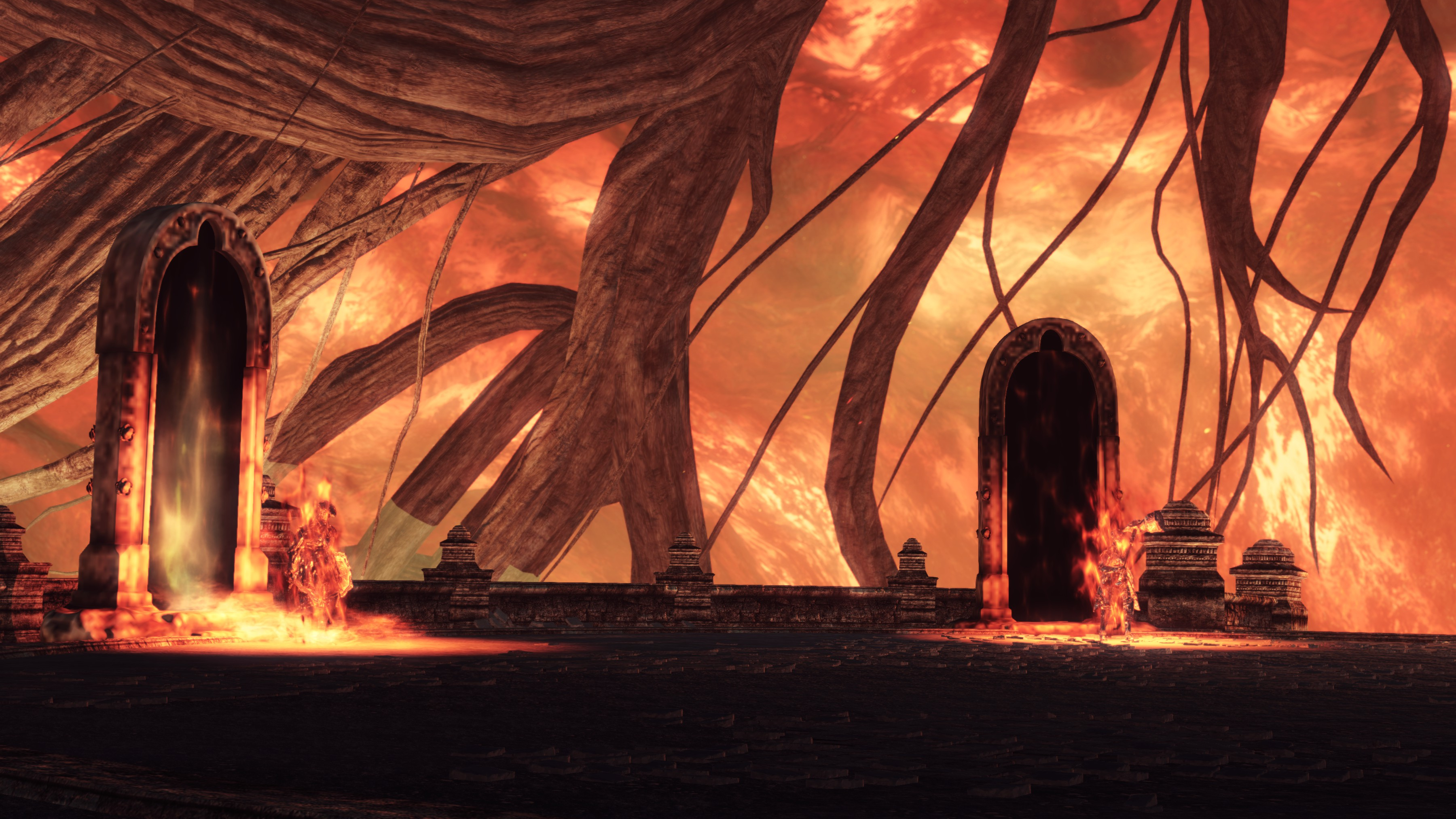
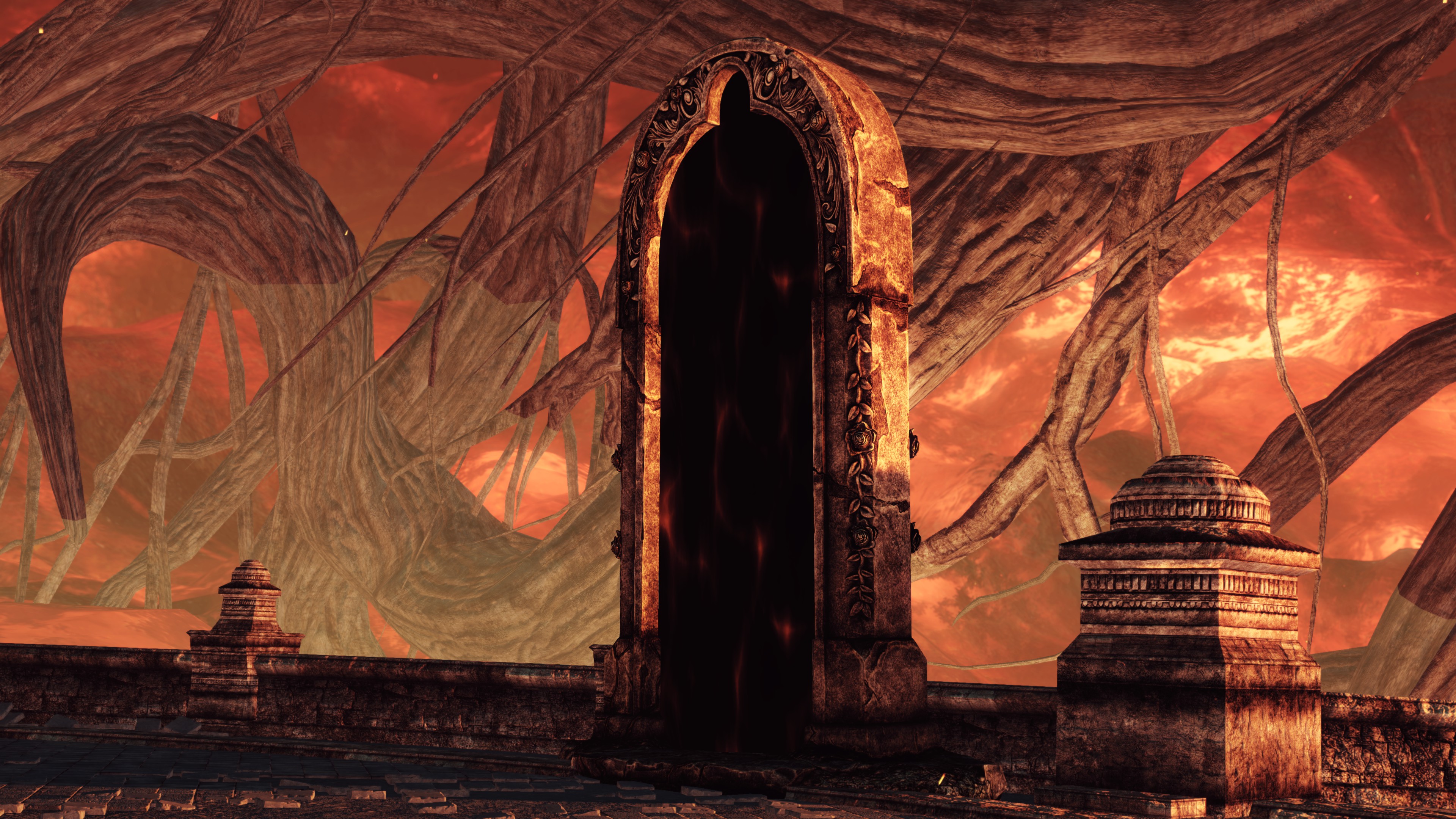
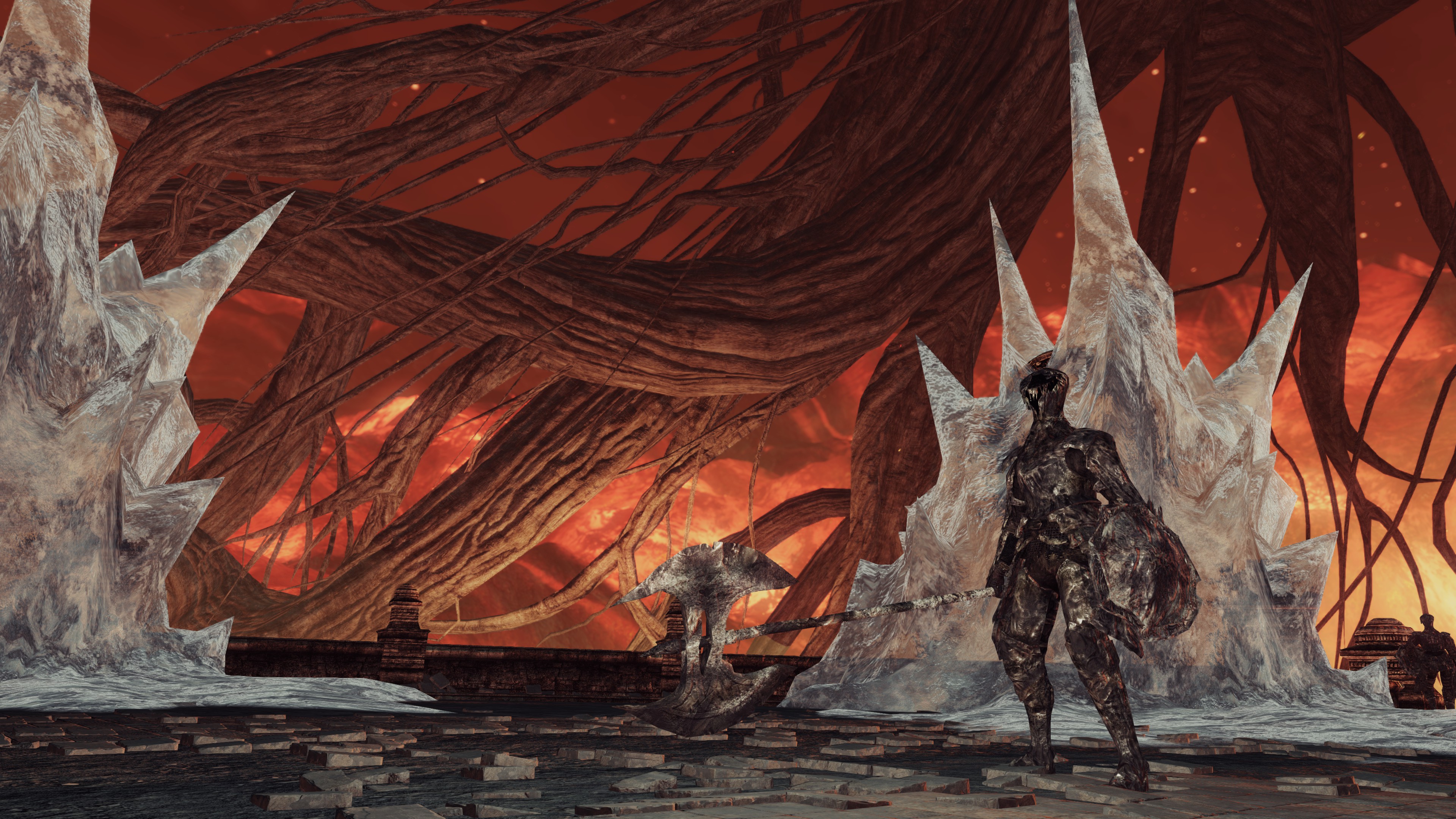
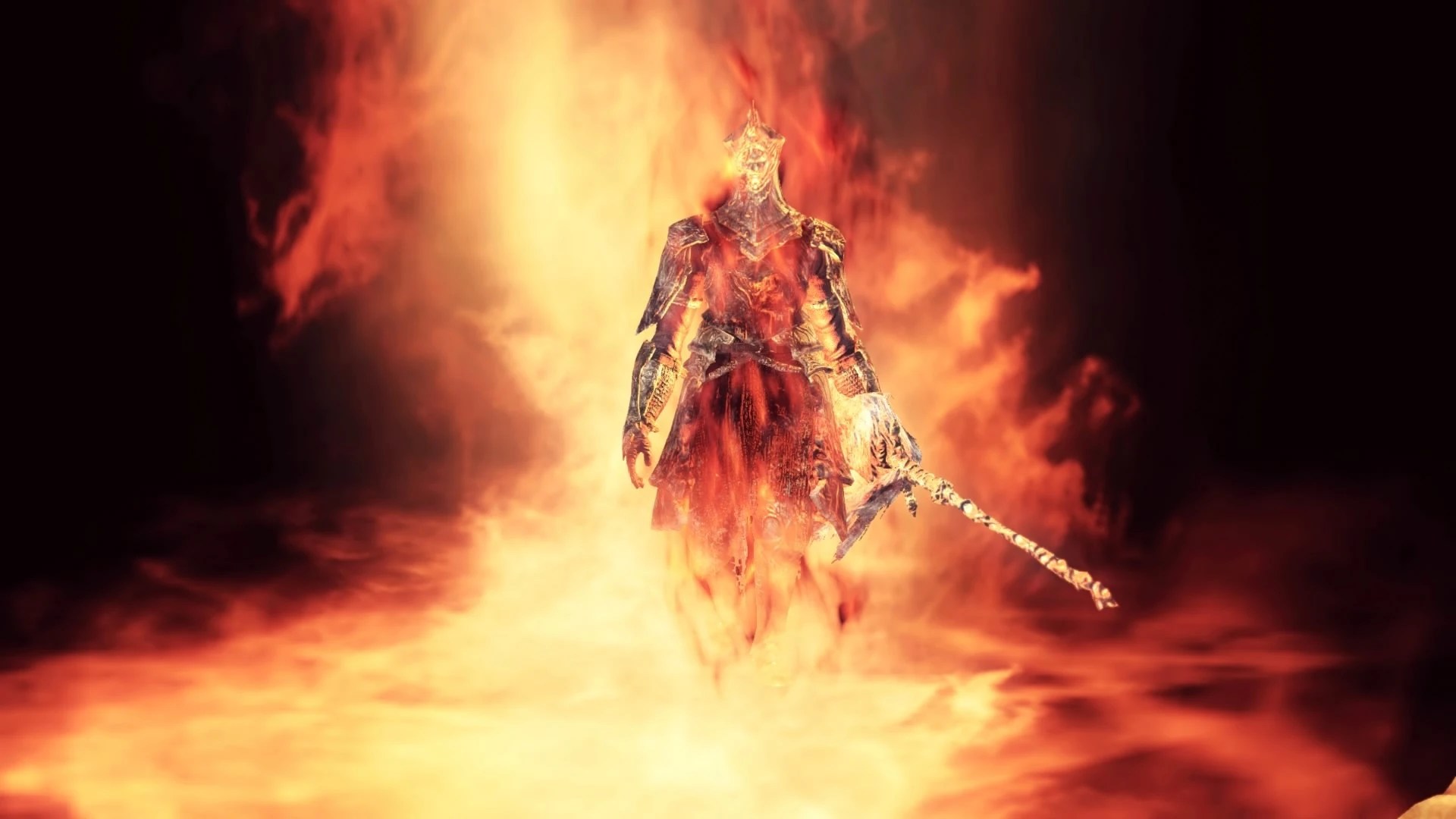
For her part, Alsanna renews her determination to see her duty through to the end. With Chaos cut from the soul of a king, she now has a chance at outlasting the Flame. Even still, she frets for the knights who remain trapped down there, souls consumed by Chaos. We are thus allowed to plunge back down the pit and slay all the knights, collecting fifty souls in total, for her to memorialize. As we bring more knights “joy” per her words, her fear of us also dissipates. She slowly but surely removes the icy tendrils blocking our path to her. And when she runs out of Loyce Knight armor to award, she presents us with her soul, or at least a sizable chunk of it. Even without such power, she acts confident that she can keep Chaos under seal until it has died out. How long that will take she doesn’t know. But shackling herself to this purpose is the most freeing act she has taken in a life spent in fear.
The knights of Loyce consumed by Chaos. Their souls are within Chaos even now… Will there be salvation for even them one day?
I hear a knight’s joy. Visitor, please accept my gratitude.
 Lokey Lore