
Preface
It is always fascinating to see how fantasy worlds incorporate magic into the setting. Dark Souls is rather mild in this regard, magical power, while ubiquitous, not seeing universal practice — it is only those relative few with the will and ability to manipulate the power all around them who earn that privilege. Even then, the developers at FromSoftware have never shied away from the obvious reality: if there are swords and sorcery, some culture is going skew heavily toward the latter. The fact that these countries, often times, become lost lands of older times only adds to the romance. And where I believe the Dark Souls franchise stands out is how that concept intersects with the games’ unique take on another of its ubiquitous elements: undeath.
Magic Kingdom
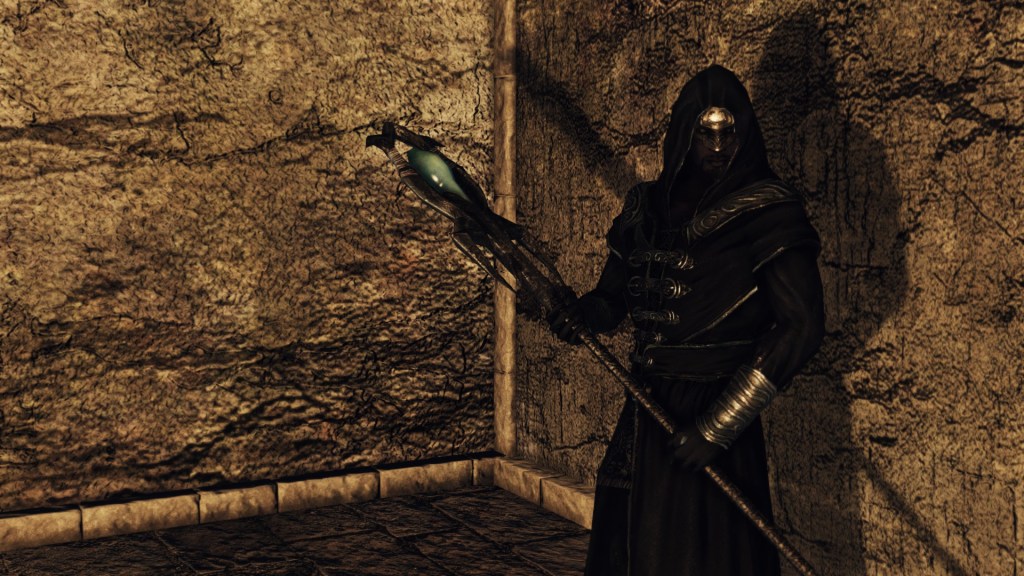
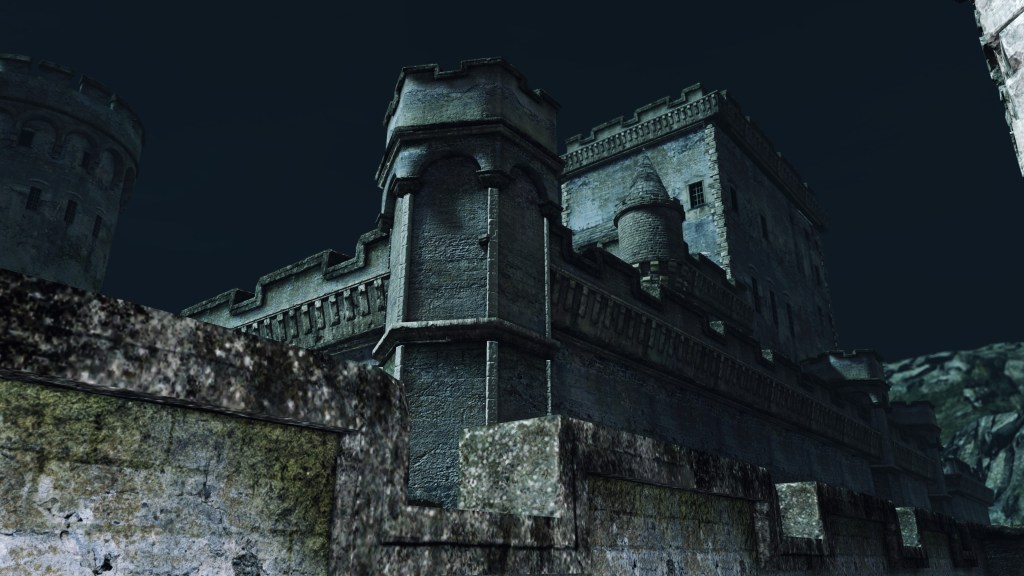
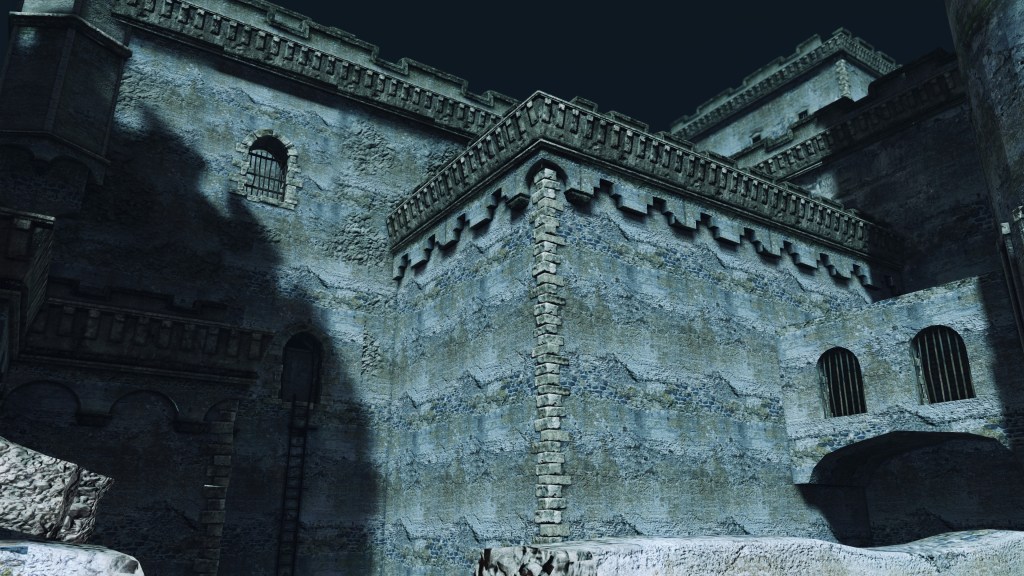
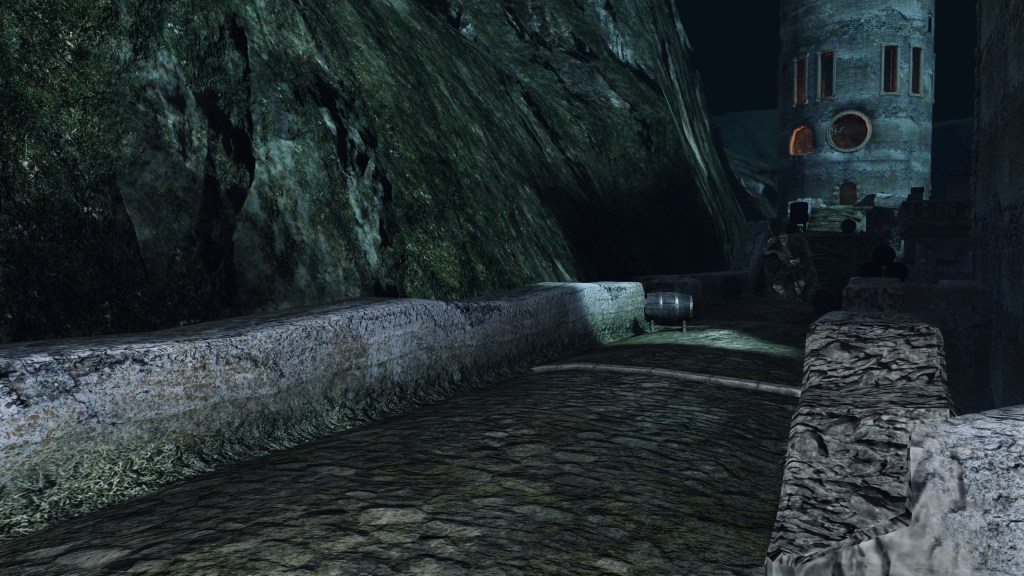
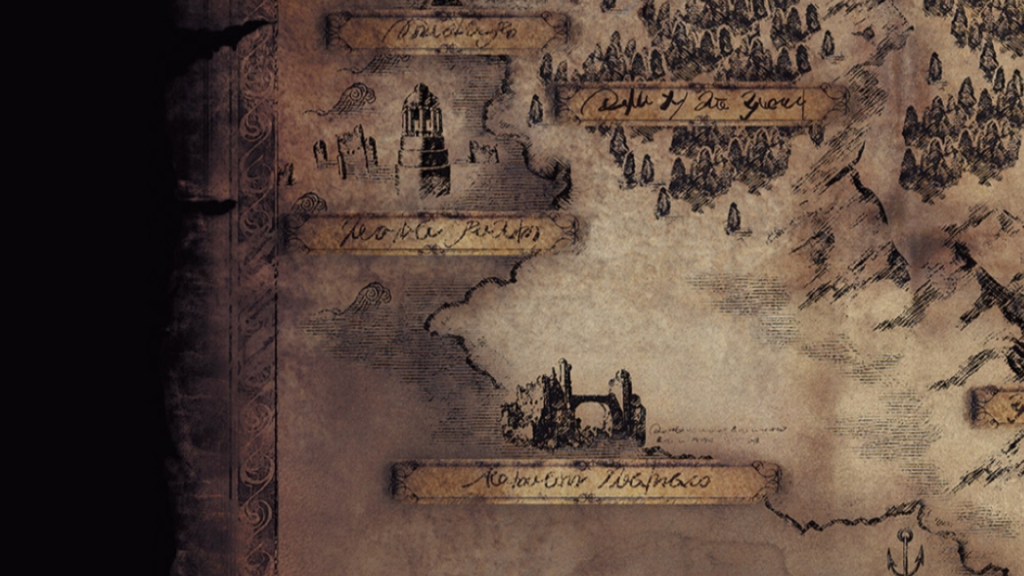
The Lost Bastille is home to a number of prisoners, but none are chattier than Straid, a sorcerer from the ruined nation of Olaphis. Although now a “forgotten prison” (忘却の牢) high atop the cliffed coast of western Drangleic, this facility was once someone’s castle, remnants of which can still be seen in the surviving servant quarters. Before the stone gained iron bars in practically every door, window, and wall, it served the needs of a certain individual or family, who possessed the wealth and authority to build this fortress with high ramparts and towers. Apparently, it was the seat of government for this land, the castle owner presumably also the head of state — possibly a king, given the feudal setting. And based on Straid’s dialogue, this government was the one responsible for converting this castle into a jail originally, long before the land was dubbed Drangleic.
In that case, we can learn much about Olaphis from what it left behind there. Straid confirms that many countries preceded his, but assuming that the nation’s founders had constructed the fortifications, it is among the older civilizations in Drangleic. The Blossom Kite Shield left in Sinner’s Rise depicts a now extinct species of flower, its fleeting beauty nonetheless soothing the bearer and thereby boosted the defender’s endurance against enemy assault. The castle was thus well defended and witness to major changes in the ecology, as expected of an ancient government center. No matter how unrecognizable the land of ages past was, however, the facility must postdate the fall of Heide still, a lone Heide knight loitering in his prison cell to this day. Already, these details establish the curiosity of Olaphis, wanting to learn about the world around them both past and present. Was this because they were descendants of native Heidens, hoping to reclaim their legacy, or maybe outsiders, fascinated with the mystery of their new home? In either case, they had good reason to protect themselves behind castle walls.







Unusual shield depicting a large-blooming flower. The beautiful design soothes the heart of the one possessing it.
For what reason does man find beauty in flowers and acquire soothing? The flower depicted on this old shield is already lost.
Thanks to that industrious sense of wonder, this old country was incredibly advanced, inventing excessively complex weapons like the Helix Halberd. Furthermore, its culture was heavily based around sorcery as evidenced by the Staff of Wisdom, another advanced technology which serves exclusively as a sorcery catalyst. The Southern and Northern Ritual Bands reaffirm this point. Both magic rings can be found in different parts of the prison, and their descriptions note that they were things which Aldia “reproduced” — meaning that these items for increasing a sorcerer’s number of spells were modeled on an invention which preceded them. In short, the rings we acquire at the Lost Bastille are most likely the original products, made in Olaphis. As to why a magic nation founded its capital on this particular corner of the continent, relics of the Old World are likely to blame.
Staff of the destroyed country of old Olaphis. Since it is a catalyst dedicated to sorcery, hexes are unusable.
The crystal of the staff head has an effect which greatly amplifies the might of arts.
Since it was originally made using advanced technology, the crystal that was polished via great magic power further increased its efficacy over time.
Halberd possessing a spiral handle and strangely-shaped twin blades. The likes of the built-in spear are endowed with a complex structure that can be called excessive.
Its origin is unknown, but it is said to be something created from the wisdom of the destroyed country Olaphis.
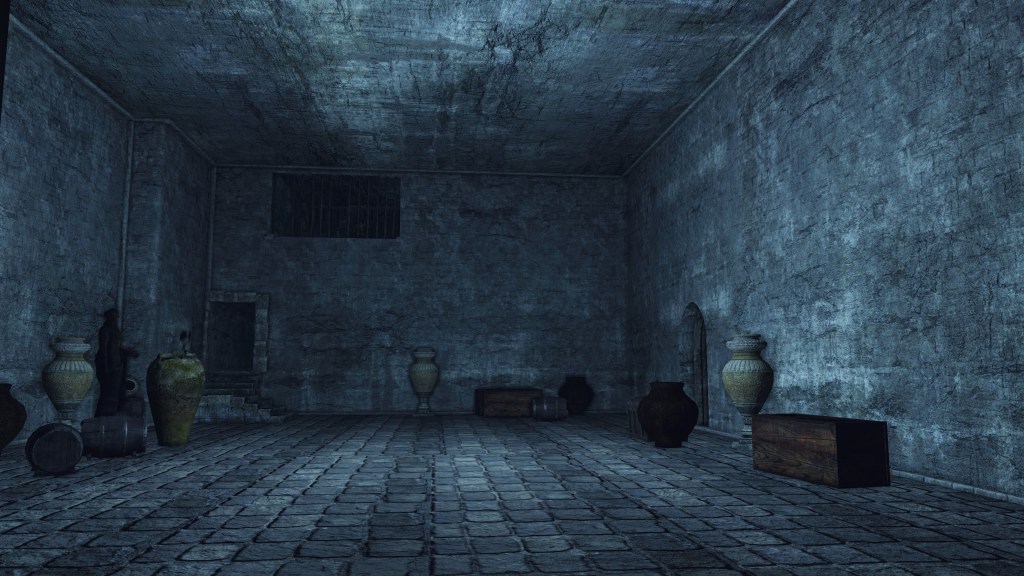
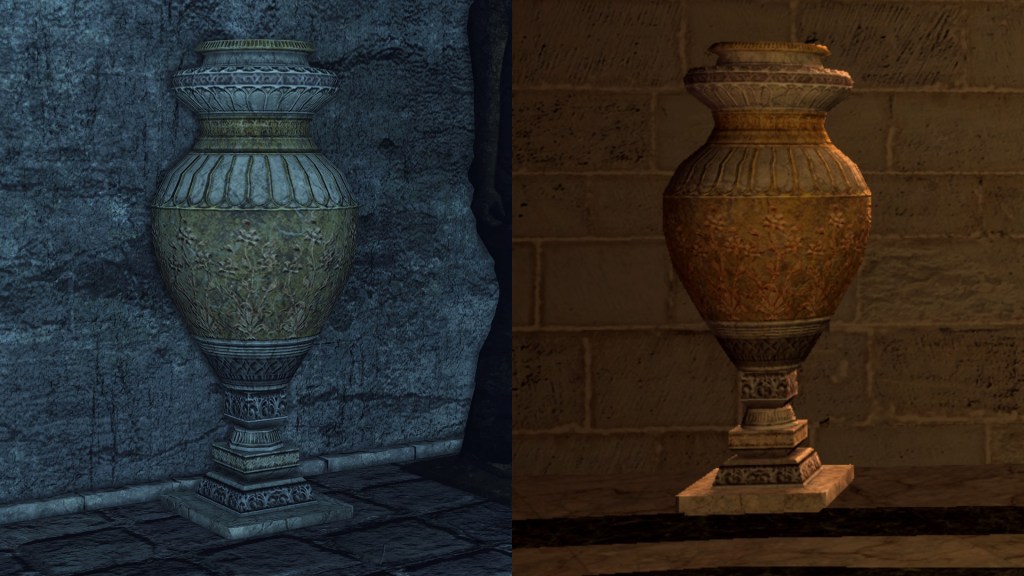
One of the larger chambers in the bastille collects a broad assortment of items, some stored in chests and even hidden behind false walls. By all indications, this is a storage room, one which holds objects in varying conditions denoting a wide age gap. And among these items left to rot in storage by different owners throughout the eras, we find pots from Anor Londo in the original Dark Souls. (DS1) The Heiden ruins and the Lost Bastille are practically next to each other on the official map for Drangleic, so it is feasible for remnants of the divine capital to have encompassed a larger area than the limits of Heide’s Tower of Flame would suggest. In fact, after Heide’s watery destruction, this coastal area might be the only spot where pieces of the original capital had survived. It reasonable then for later peoples to settle there when trying to study the history of their predecessor. And the founders of Olaphis didn’t find just any piece of the gods’ ruined homeland.
Despite the filth from years of neglect, one of the statues in storage is clearly the same that lined the passage to Anor Londo’s archives in DS1. In other words, the part of the divine capital uncovered at the bastille might have included remnants of the gods’ library, which Seath had taken over until the Chosen Undead slew him during the previous game’s events. We are able to obtain the trident wielded by the white dragon god’s evangelists in DS1, but they had been spreading their gospel all around Lordran, not just at the Duke’s Archives. The same cannot be said for the enchanted falcion we find elsewhere in the prison, an exact sword previously acquired from the gods’ library. The Japanese description for Freja’s soul confirms that Seath’s works are sprinkled across lands like Tseldora, thanks to the Great Shift. If the founder of sorcery’s works were among the remnants of Anor Londo’s library, then Olaphis had every incentive to develop in that direction, and their technological advancement proves that this magical fixation paid dividends.



Soul of the Duke’s Freydia that is the crawler’s watchman.
The crawler is an Old One who scattered its works in this land. Tseldora is also called the land where the works dwell, and it is said that those who stopped there were transformed into forms grotesque.
The special soul this watchman possesses is used to acquire a vast amount of souls or create a great power.
Seath definitely left a lasting influence on Drangleic’s sorcery culture, local sorcerers wearing white or black robes depending on sex. The reason for the custom isn’t remembered, but the colors obviously correspond to the white dragon Seath for males and black-haired witch Velka for females. Both gods hold an important place in the history of sorcery and have left their mark across the land. If Drangleic had enough knowledge of them to develop such a fashion tradition so many years back, then there is no reason for ancient Olaphis to be ignorant of the scaleless dragon. How much they knew at the time remains an open question; currently, his name and draconic identity are lost. But the country of sorcerers must have known enough to contribute to these practices persisting on the continent.
Hood of a sorcerer of Drangleic who became Hollow.
Sorcerers of Drangleic have a custom to put on different dress according to sex.
What meaning it has is unknown, but it is a custom because it is unknown. This one is for males.
Put simply, Olaphis used the knowledge Anor Londo’s duke accumulated as a roadmap for their own advancements. It seems that the country even sought out more places connected to Seath to further their understanding of sorcery. Deep in Drangleic’s mountains far to the east of the Lost Bastille lies the land of Tseldora with its vast deposits of brightstone. Aside from being an obvious reference to the magical “augites” (輝石) of Demon’s Souls, the glowing white crystals also bring to mind twinkling titanite and magic crystals associated with Seath. The description for the Tseldora robe does imply them to be fragments of the paledrake, meaning that they are most likely his artificial crystals infused with the magic power of souls — perhaps vestiges of the Crystal Cave the duke created in the garden behind his archives. And Olaphis had undoubtedly been mining these crystals.
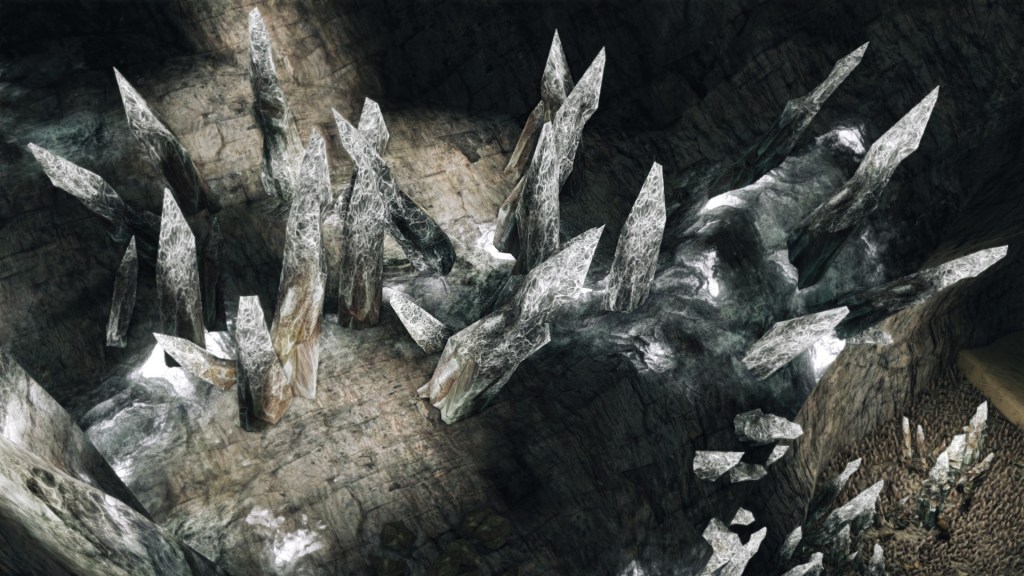
Robe that citizens of Tseldora wore. It is pricey but not suited for battle, and it has a low defense effect.
The brightstone that brought prosperity to Tseldora aroused the citizens’ desire and ultimately brought about their ruin. Was its beautiful, bewitching radiance a fragment of someone who wanders the bottom of the land?
It is the crystal at the head of the Staff of Wisdom which amplifies the power of whatever sorcery it casts; Olaphis simply mastered the art of polishing this crystal with additional magic to enhance the effect. Fitting then that we find the staff secured in a Tseldoran mimic, implying that the magic nation had a presence there at one point. We can likewise acquire another southern ritual band from in town, whereas Ornifex sells the Homing Soul Arrow of Straid’s invention after settling in there. As the final nail in the coffin, there is the Dispelling Ring and Ring of Resistance. Each ring is designed to counter either all magical elements or every status ailment, but they both make use of four different-colored brightstones, not just “gems” or “gemstones” like the English descriptions claim. These rings are powered by the crystals mined in Tseldora, but their description confirms that they were solely created by a sorcerer of Olaphis, namely Straid.
Ring of protection that was embedded with four-colored brightstones. Boosts defense power to magic, fire, lightning, and dark.
A masterpiece created with preeminent arts that is said to harmonize the power of four brightstones which possess different effects in one.
It is said that only a sorcerer who was in the destroyed country of old Olaphis had accomplished that.
Ring of protection that was supplied with four blessed brightstones. Boosts resistance to poison, bleeding, petrification, and curse.
A masterpiece created at the destroyed country of old Olaphis.
It’s said that the sorcerer who made this art gradually became a subject of fear because of his excellent power.
Straid introduces himself as a wandering sorcerer who was once known far and wide. This is because he was a magical genius with a wealth of knowledge. It doesn’t matter if it is miracle, sorcery, hex, or pyromancy; the man has learned all manner of magical arts, every sorcery and pyromancy if the description for Lingering Flame is to be believed. Part of this claim is because arts like Lingering Flame are his invention. Considering that the desert sorceresses of Jugo perform an art resembling the pyromancy, he has been to places well outside of Drangleic, leaving numerous spells for different cultures to inherit in his wake. But whether it is the desert sun or something else that tickled his curiosity, Straid always takes the knowledge he gained with him elsewhere for new stimuli. This cosmopolitan experience is likely why we see him dressed in all black as a sorcerer, contrary to Drangleic custom.

One of the pyromancies created by Straid, great sorcerer of the country of old Olaphis. Fires a stationary ball of fire, and it explodes if an enemy approaches.
Straid was well-versed in every sorcery and pyromancy. He was an unusually talented sorcerer, but never stayed in one place due to his curious behavior.
Even if his mastery of every art is an overstatement, he certainly has mastered a wide array of magic before showing a single wrinkle or grey hair, some spells remaining obscure to this day. For instance, he refined Soul Bolt so that the sorcery would no longer rebound on its caster as it had in the past. And with such a talent for spellcraft, the sorcerer unsurprisingly put that wisdom to use inventing new and impressive magic spells or tools, such as a homing version of Soul Arrow or the Ring of Knowledge now fashioned by Volgen priests — truly, a man ahead of his time. There are limits to his ability. He acknowledges, for example, his own uncertainty with regards to the history of pyromancy’s founders. But his knowledge was still vast enough to warrant Olaphis’ invitation.
Never passing on an opportunity, Straid accepted the chance to pursue his work in what was probably the most advanced magic nation at the time, adopting the Staff of Wisdom as his magic catalyst. Its treasure trove of knowledge probably also played a part in his ability to derive spells and the occasional weapon from powerful souls, prompting his insatiable lust for more. Recall that Seath was the implicit origin of Anor Londo’s ability to forge boss souls into weapons in DS1, a sentiment echoed by Ornifex. If the duke conceived of the art at his archives, then it is knowledge which Olaphis might have inherited. But if so, Straid took the idea far beyond the scaleless white dragon’s initial concept, seeming to require none of the tools Anor Londo’s blacksmith utilized in the process. Granted, this may be why we see fewer weapons from the master sorcerer, instead mostly providing the instructions for different schools of magic corresponding to the soul’s nature as is his specialty.
Regardless, there was much to gain from Olaphis in terms of knowledge and resources, Straid happy to explore the potential for sorcery. And as the brightstone rings demonstrate, he made huge contributions to Olaphis culture. However, those masterpieces didn’t seem to gain him any friends. Straid thinks that anyone feebler than him in magical ability or intellect is “deficient”; being a rare genius, this encompasses basically everyone. Such arrogance is to be expected for a man of his talents, but constantly talking up his own achievements while underselling others’ ability to handle his works only serves to push people away. In the end, Straid took on no apprentices as he immersed himself in studying magic’s greatest mysteries, and his relationships in Olaphis fared no better.

Cut dialogue and item descriptions state that Straid became a sworn friend with the country’s king Alavis, (アラヴィス) the two even slaying an archdragon together. Indeed, Straid does sell the Lingering Dragoncrest Ring, whose description acknowledges its use in a local country of older times — such as Olaphis — and how similar rings of indefinite origin — DS1’s land of sorcery erudition Vinheim long forgotten — can be found among the many dragon-worshiping countries. Between these artifacts and Seath’s works, it is easy to imagine the preeminent sorcery kingdom building a culture around archdragons, similar to Vinheim’s Dragon School. At the very least, Olaphis might consider them sacred beasts for the sorcerers to study and dissect in the same vein as the Drakeblood Knights. The king bringing Straid to help slay one therefore wouldn’t be unusual if they were trusted companions.
Hood of the great sorcerer Straid.
Straid, who was a sworn friend of an old king from the old country of Olaphis, defeated an archdragon with the king and acquired much knowledge and clairvoyance. But, that work creating unique sorceries couldn’t be controlled by even Olaphis, which was proud of its wisdom.
That country’s king Alavis feared the curse like a disease.
Ring said to have been used in a country that existed in the land of Drangleic long ago. Extends spell effect duration.
The dragons of old are treated as subjects of worship in many countries, so the rare thing with powers similar to this ring is reported in several regions. There is no way of knowing its definite origin at this point.
But this content makes no reference to Straid as a wanderer, instead suggesting that the dragon was the source of his great knowledge as well as clairvoyance. The man presented in-game has no interest in developing such longstanding relationships, nor the time to. His lifelong curiosity is what kept him from ever staying in one place for long. And although it makes sense for Olaphis to have a royal government like most other nations in the setting, the lord of the castle’s name is currently unknown, forgotten much like the castle itself. In all likelihood, removing any confirmation to King Alavis’ identity was the developers’ intention. As is, the supposed kingdom’s sole survivor only makes reference to an impersonal country, not an individual monarch with whom he shared a particular connection. Without any deep ties between Straid and the state, it is far easier to imagine Olaphis one day betraying him.
Paranoia Before the Fall
Eventually, Olaphis needed to wrestle with the problem of undeath. The government officials feared the curse like a disease and so thought that they could prevent its spread if they “contained” it. As a result, the castle became a prison for locking up whatever the state suspected to be the source of undeath. Straid indicates that this was an excuse for them to turn their eyes away from the problem, but if the goal was to lock them up out of sight, out of mind, choosing the nation’s capital as the prison seems unwise. Perhaps the government hoped to keep a close eye on the afflicted for added peace of mind, or study the Undead for future reference. But if so, their efforts evidently failed to bear fruit. Undeath doesn’t spread like a disease, and it continues to manifest in humans to the present day. In the end, imprisoning people simply became a means for Olaphis to soothe its insecurities, sweeping any threats under the rug whether they be among the cursed or not; whatever they found disgusting or inconvenient to exist.

Key to the jail in the Forgotten Prison.
The castle lord whose name is now unknown tried to protect this land from the curse running rampant, so imprisoned anything and everything suspected to be the source of the curse.
The castle became a prison in its entirety and was eventually forgotten.
This land is the place where those who received a curse were sealed away. Being cursed ones, like you. Heheheh. Those of that country feared the curse like a disease. They then imprisoned them in this land in order to turn away their eyes. Detestable things, inconvenient things, things like that shouldn’t be seen. Seems like the thoughts of the deficient, no? Heheheh.
Enforcing this national policy was almost definitely the Olaphis military. The Ruin Sentinels currently securing the Lost Bastille are more accurately its “vacant guards”; (虚ろの衛兵) souls operating empty suits of armor per the creation of the latest jailer, making them golems. Despite this artificial origin, the prison guards are unlikely to have been conceived from whole cloth. The description to the sentinel’s boss soul claims that the hollow armor “lost” its body, implying that it was previously worn by a living person. The three we encounter as a boss also have individual names: Alessia, Ricce, and Yahim, or Alessandra, (アレサンドラ) Luca, (ルカ) and Regim. (レギム) This is bizarre for golems mass-produced to tirelessly patrol jail cells with little to no supervision, so they are likely based on actual warriors, specifically knights if the full armor and complementary arms are any indication. And why craft such golems at the bastille unless the crafter referenced those knights from the castle’s own history?
The reason to zero in specifically on Olaphis comes from Straid. When offered the sentinel’s boss soul, the sorcerer conjures a stronger version of his Homing Soul Arrow. Like the weapons, all of Straid’s spells produced in this way reflect the nature of the soul’s owner. Moreover, he never otherwise uses the special souls to invent new arts. Only in this case do we receive a sorcery attributable to him. This Heavy Soul Arrow must then signal Straid’s unique relationship with the armor the soul operated. In other words, this is liable to be the actual soul of the knight, who served Olaphis during the wandering sorcerer’s stay. Taken altogether, the jailer modeled golems functioning as prison guards on the knights of Olaphis who performed the same duties, having presumably recovered surviving records of their history at the castle. Along with that, the souls and armor were potentially recycled from leftovers surviving the test of time like Straid, comparable to the Old Dragonslayer’s circumstances.
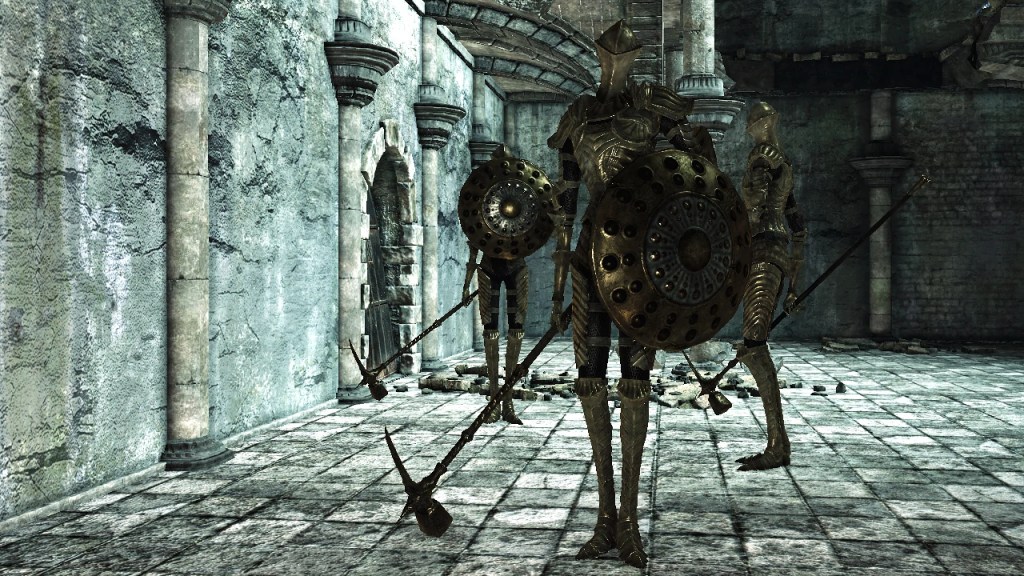
An order of knights would be consistent with the notion of Olaphis as a magic kingdom — what king in Dark Souls doesn’t retain an order of knights, and vice-versa? The one point of contention would be the absence of sorcery from the Ruin Sentinels’ arsenal, but that isn’t as odd as initially seems. Like Oolacilian society in DS1, knowledge of sorcery may have been concentrated in Olaphis’ ruling elite, among those who hoarded the secrets of the gods’ library. In that case, knights might have borne witness to the country’s incredible sorceries without ever learning them for themselves. Even with foreign sources, the one or more familiar with Straid were doubtless too “deficient” to replicate his works regardless. In the end, it didn’t matter. The knights served their country, up to hunting and detaining dangerous Undead, with or without such boons. In fact, this kind of magical elitism likely only intensified the friction with the cosmopolitan sorcerer in their midst.
If anyone had a grasp of the situation, it was Straid. From his apparent studies of past countries in the land, he learned that these states all flourished only to decline shortly after. The sorcerer compares the process to the way a flame flares up only to soon fade, indicating that all these countries had rather short histories — it would only take a century, at most, for Undead to start cropping up within a population. If not for the Old World culture inherited from the land, these countries would barely have time to build before the curse dragged them down. But in Straid’s allusion, the flame is revived, the next country replacing the last in a never-ending cycle akin to a curse. These similarities to curses and flames are why he jokes about Undead’s role in taking over fire, but it also reveals his awareness about undeath’s connection to the First Flame. In that case, he clearly didn’t care enough to clarify Olaphis’ misconceptions. Why would he? The sorcerer would be leaving the country soon enough, new curiosities bound to catch his attention. And this is precisely why Olaphis considered him dangerous.
It seems many countries have always existed in this land, even before that country. The country flourishes, but sooner or later declines. Like the flaring up and extinguishing a flame. It repeats again and again. However, the extinguished flame is eventually revived. And so, the country flourishes again, even though it has changed forms. It’s all a curse! Heheheh! It really is the cursed like you that assume the flame. Heheheh…
Imagine welcoming the greatest mind into your country, giving him access to some your deepest secrets on the promise that he would benefit your own nation. And now that person was perfectly willing to take that knowledge with him to another country, helping that nation to your detriment. Straid was a huge national security concern, someone with power that Olaphis couldn’t control and had every reason to fear. And this magic country had gotten into the habit of sealing away whatever it considered to be a threat. The sorcerer was therefore tricked and turned to stone, though the exact nature of this trap is never clarified. When we find his petrified body, he is standing at the entrance to a cell, presumably moved by someone in the years since. Perhaps the government told Straid about a special prisoner they captured and wanted him to study, using the sorcerer’s curiosity to lure him there before inflicting the curse. But however the officials managed it, they undeniably succeeded, surpassing even Straid’s expectations.

Completely black hood. Slightly increases spell casting speed. Personal effect of Straid of Olaphis.
Straid was valued for his myriad of knowledge and invited to the old country of Olaphis, but his excellent power was instead feared and he was tricked into a foolish trap.
Those of that country always knew their own deficiency. So then, many were sent here and sealed away. Both the cursed and those that were not. If they didn’t erase everything that threatened them… they couldn’t sleep otherwise. Along these lines, they even turned I, Straid, to stone! Heheheh.
Despite this triumph over a prodigy, Olaphis had nothing to celebrate. The country was still plagued by undeath, and hiding all of its problems under their noses didn’t change the reality of the situation. The fact that they even kept these threats alive shows the country’s own indecisiveness over the subject. Obsessed with wisdom as it was, it is no surprise that they defaulted to hoarding. If studying the curse was the initial rationale, the many specimens allowed them to find the cause. It wouldn’t take much effort to identify the Darksign. But after discovering the humanity at the heart of the brand, their research probably stalled. What more could they learn from just Undead with sorcery? And if they had tried to broaden their horizons, it didn’t go anywhere. (Dark Souls III reveals that the knights inspiring the Ruin Sentinels ultimately hunted for the Dark Soul per royal decree, never to return) There was no cure to this disease in sight. Why not move on to systematic extermination or banishment? At some point, knowledge became an excuse for cowardice.
But all the knowledge in the world couldn’t save Olaphis. With such inability to cut a path forward for itself, it is no wonder that the government eventually collapsed. Whether the prison population became too much to bear or other factors contributed to the strain, the outcome is the same: by the end, there were no sorcerers or knights at the bastille, only Undead. If there was still functional civilization outside the walls, the fall of the castle undoubtedly produced a systems collapse across all the country’s territories, wiping it out. This has resulted in much of the knowledge it amassed being lost, especially from Straid. But even without disciples to carry on his legacy, some of it managed to survive. We can find the texts for his pyromancies in the possession of certain enemies, so some of his work had to still be laying around during the countless years he spent as stone. The same can be said with the various relics of Olaphis recovered in later eras. But without a functioning state, Olaphis as a whole faded from memory, in more ways than one.
Completely black robes. Grants resistance to sorcery. Personal effect of Straid of Olaphis.
Straid spent a long time as stone. In the meantime, many countries flourished and then perished. And then, this land became called Drangleic one day.
One of the pyromancies created by Straid, great sorcerer of the country of old Olaphis. Engulfs distant enemies in giant flame and burns them to ashes.
Much of the great sorcerer Straid’s wisdom was lost because he absolutely immersed himself in the world of arts without taking on any apprentices.
Aria to Demise
The Shrine of Amana is a curious area. Amana (甘菜) is a species of tulip known for its sweet and edible bulbs, so the land may be named for the bulbous, glowing blue flowers beautifully flourishing in parts of there. But regardless of the name’s origin, the ruins have been resettled since Heide’s destruction, stone huts with thatch roofs interspersed amongst the architectural wreckage. Aside from the simpler construction and dissimilar styles, only one of these shanties has succumbed to the elements, joining the rest of the flooded ruins in clearly more recent times. Some of the old Heiden rubble has even been propped up to improvise torches, including within the huts. This leaves no doubt to people living down there, the inhabitants likely among the various Hollows we encounter.
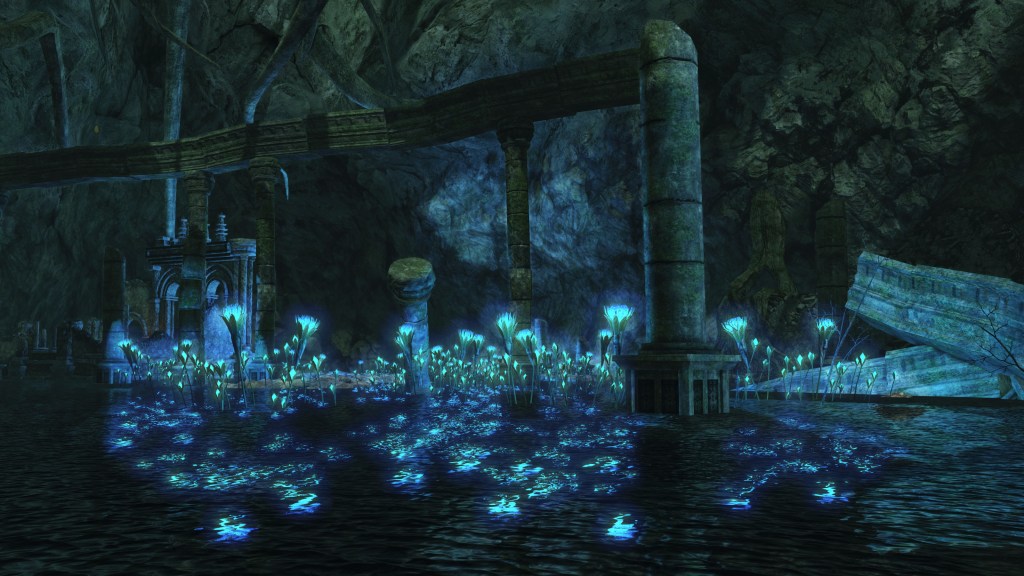


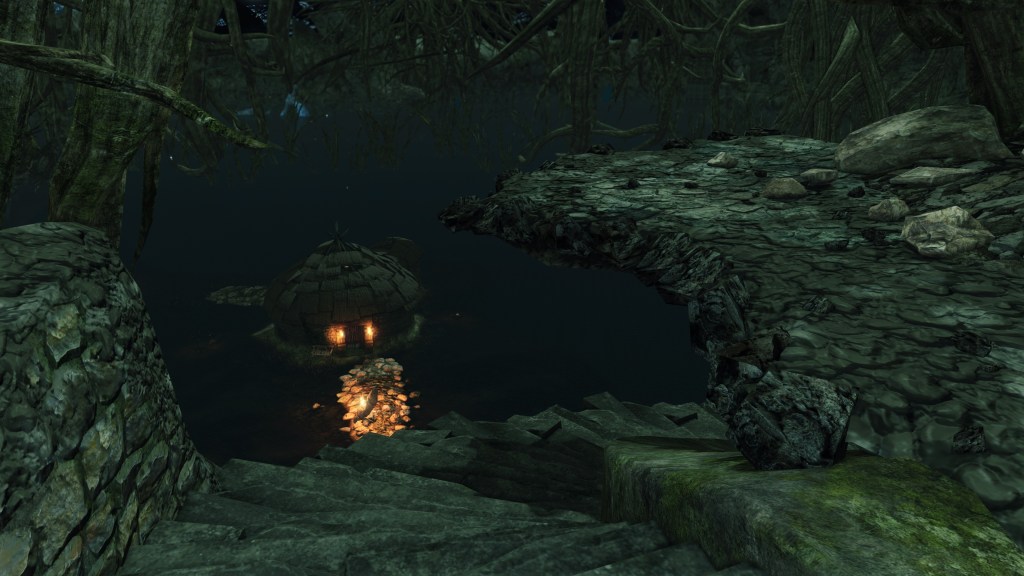


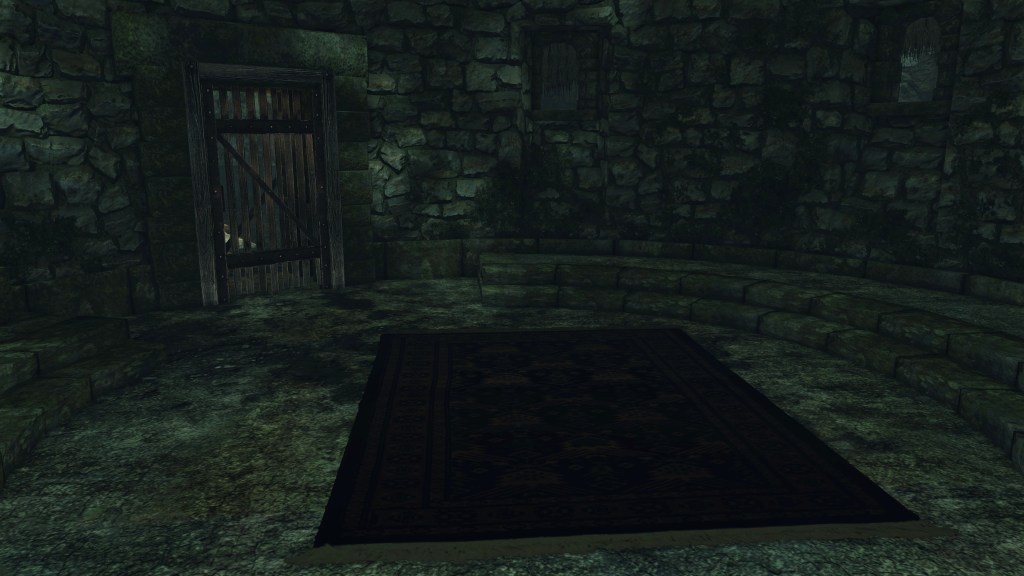

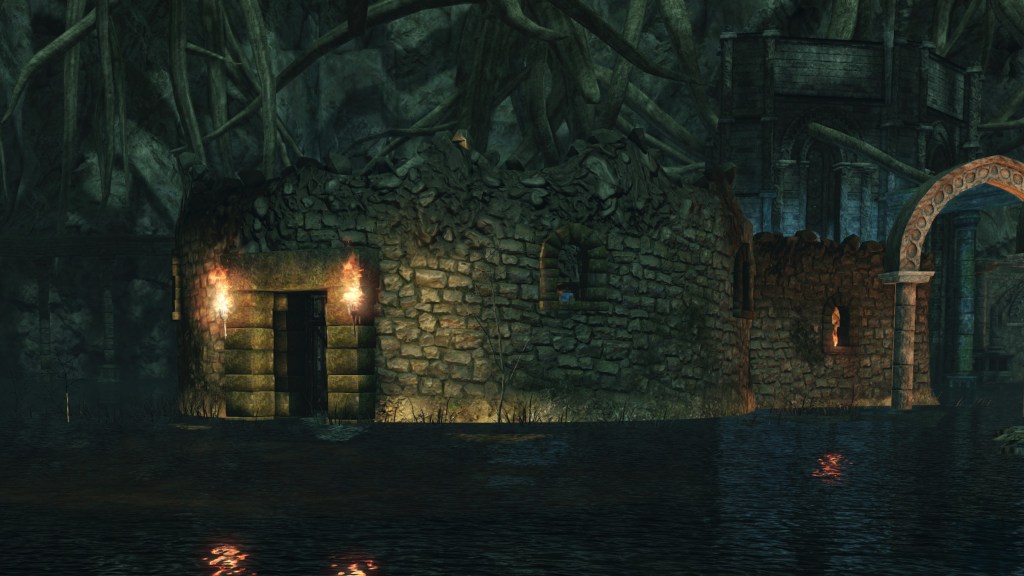
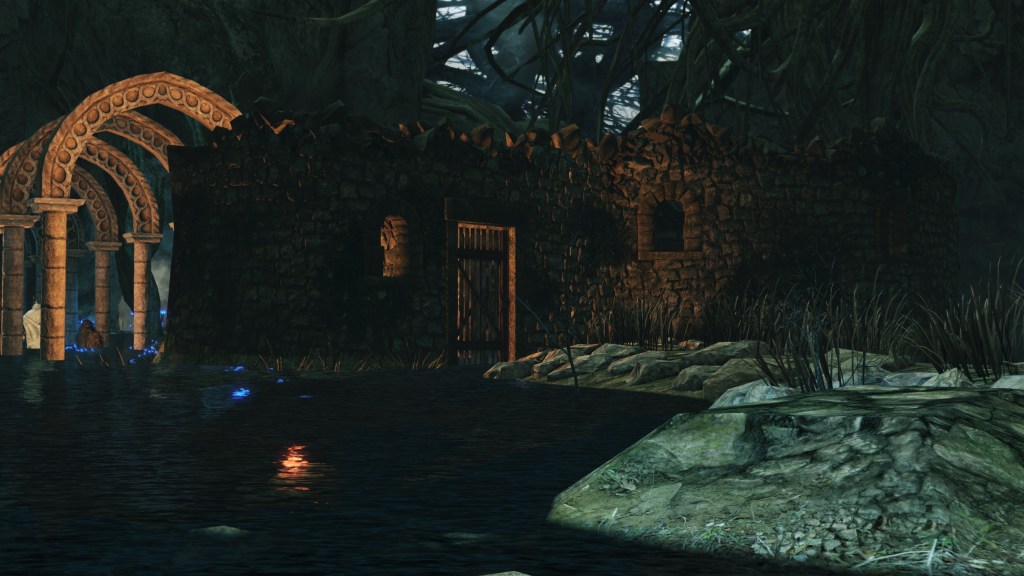


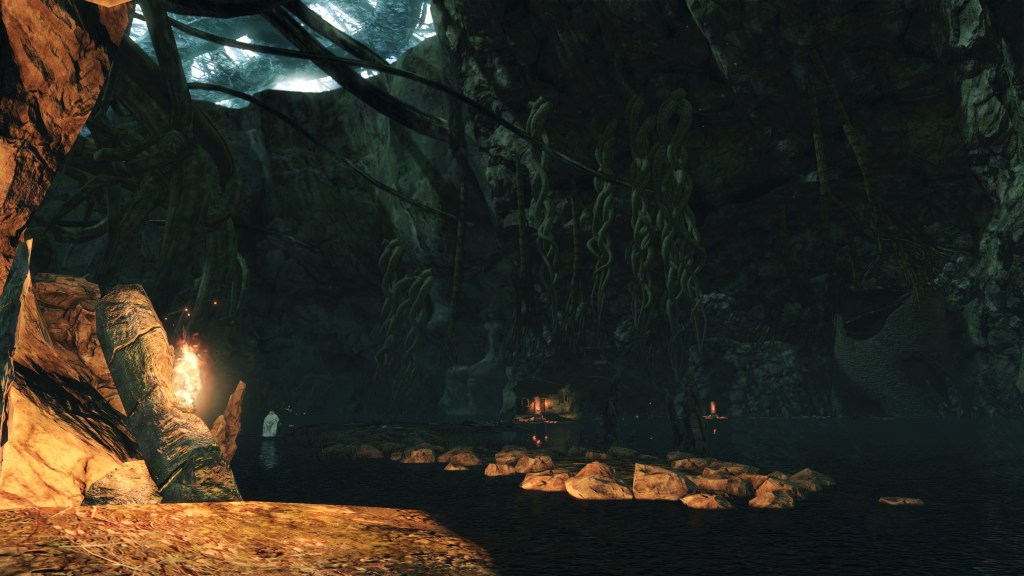
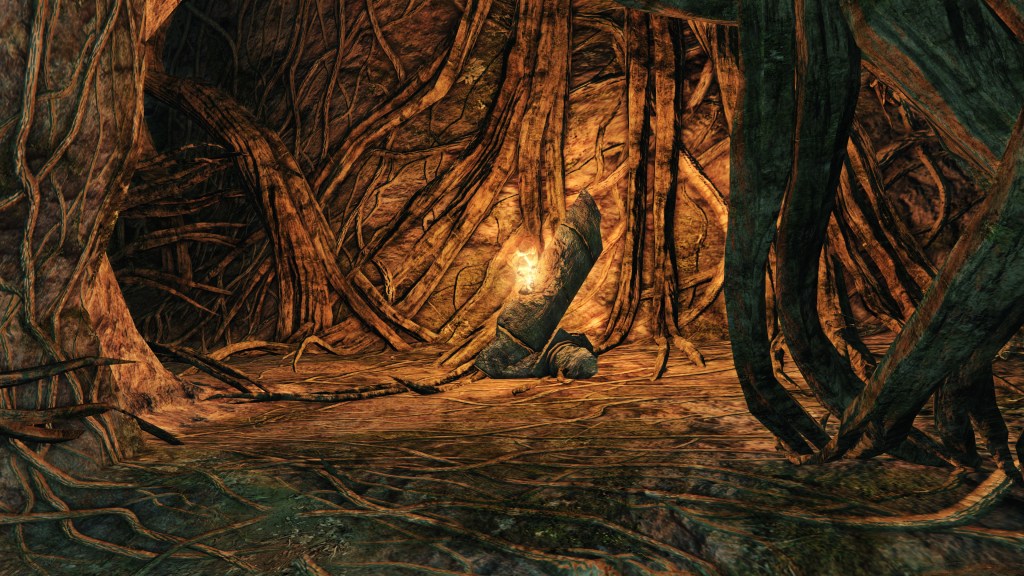


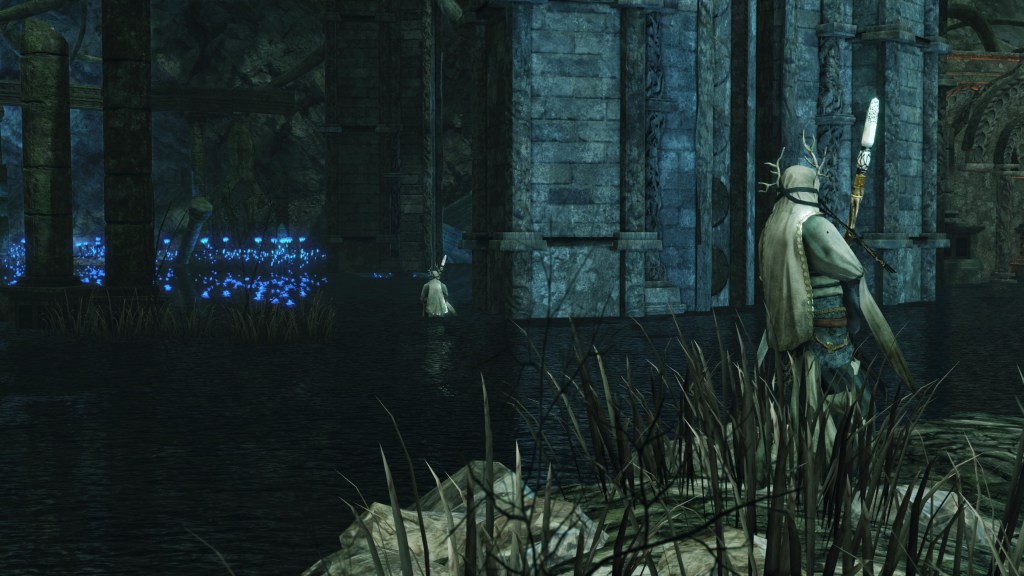
Most notable of these are the Amana priestesses. Although casting soul sorceries with staves, the description for the magic catalysts nonetheless confirms their original use for religious purposes, not battle. Indeed, the priestesses dress in rather shamanistic attire for a sorcerer’s hooded robes. They likewise keep holy water urns on their person, the water easy to come by down there; the holiness, not so much. The rare disarmed priestess will even pray to cast a healing miracle akin to Soothing Sunlight, a testament to her profound spirituality. This doesn’t come naturally to sorcerers, explaining the presence of skeptic’s spice around the area to make casting the faith-based magic easier. In every instance, there is something to reaffirm their spiritual ties. Like priestesses in Shulva, these women of Amana are miko, (巫女) who were historically associated with divination and sorcery. The combination of two schools of magic which were typically hostile thus isn’t beyond the pale.
More emblematic of this blend between faith and reason are the crimson waters in their possession. This red water is a stronger version of rouge water, which restores physical health as well as mental focus for spellcasting. The only difference between the two is that the less potent water is “crimson-colored” (紅色) while the other is “true crimson” (真紅) in reference to its deeper hue, making it presumably a more concentrated solution. Due to this fact alone, both are used by various different sorcerers throughout history. And yet, some people at certain points in time have also deemed such red water to be holy. In that case, sorcerer priestesses carrying it is no accident. Sorcery is a core part of Amana religion, the Dark Souls II Collector’s Edition Guide affirming that the priestesses consider magic sacred. And to that point, we can find a bunch of crimson waters in a chest behind the first hut we come across, leaving no mystery as to the building’s owners.
Water possessing a crimson color of unknown origin. Recovers HP and number of spell uses.
Although said to be holy red water, what is it that makes it holy? Needless to say, it varies between each person and time.
Water possessing a crimson color of unknown origin. Greatly recovers HP and number of spell uses.
Red water that carries a faint radiance exhibits undeniable power, whatever its origin. For many, the factuality of that is enough.
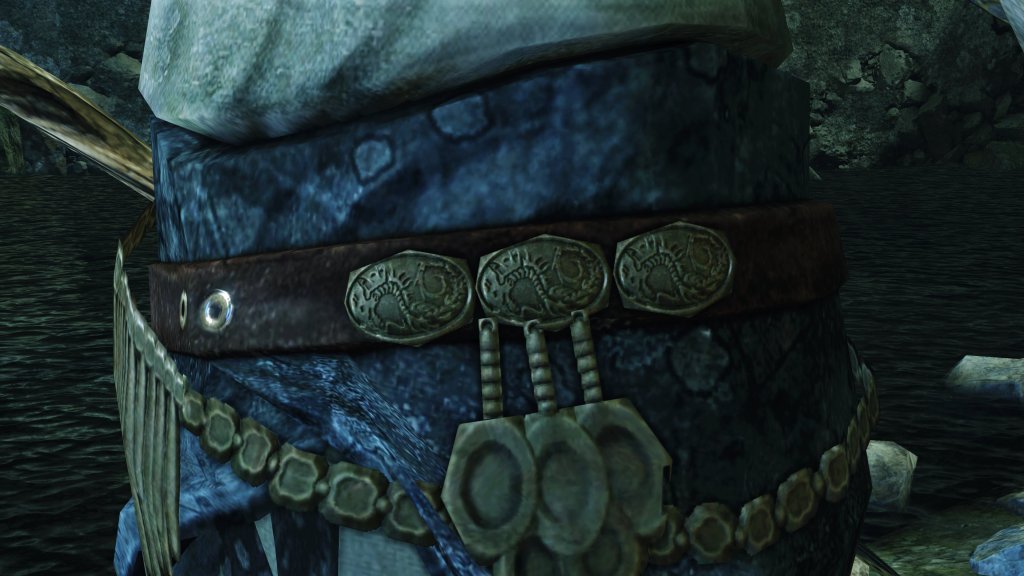
Put simply, these sorcerers of faith are the last bastion of civilization in those underground caverns. Why then do the pagans remain in such a hazardous environment? The obvious reason would be their religion. But then, how did a religion incorporating sorcery develop in this specific area? The dragon charms they retain indicate possible contact with Shulva, which would explain their choice to reside in Heiden ruins. The draconic reverence is furthered showcased by their white and blue robes ornamented with tree branches to evoke horns. Living alongside pilgrims of the Archdrake Sect currently does prove the two religions compatible, albeit with heretics hiding to practice sorcery. But more likely, this dragon element to the religion was inherited from another culture, namely Olaphis.


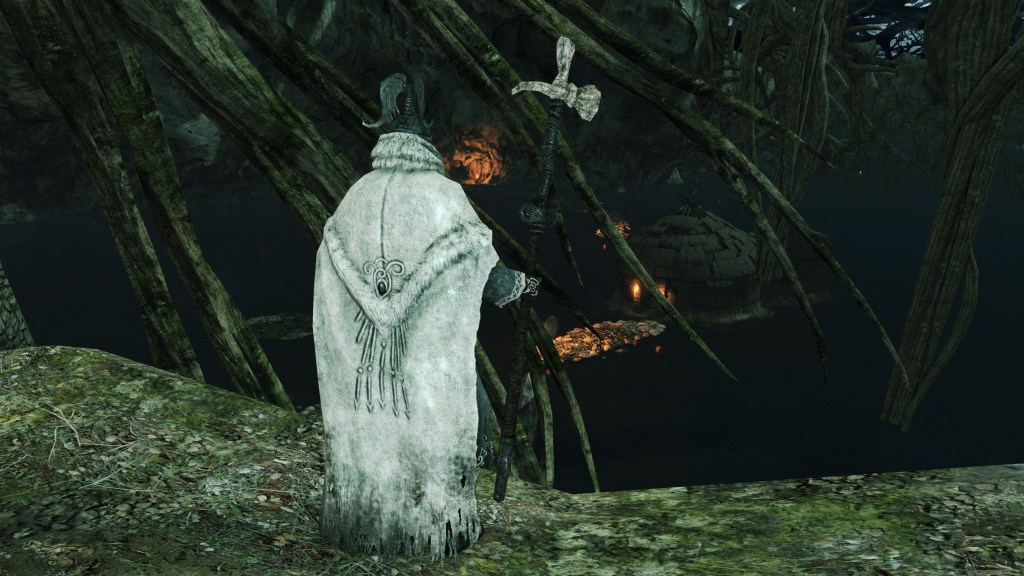

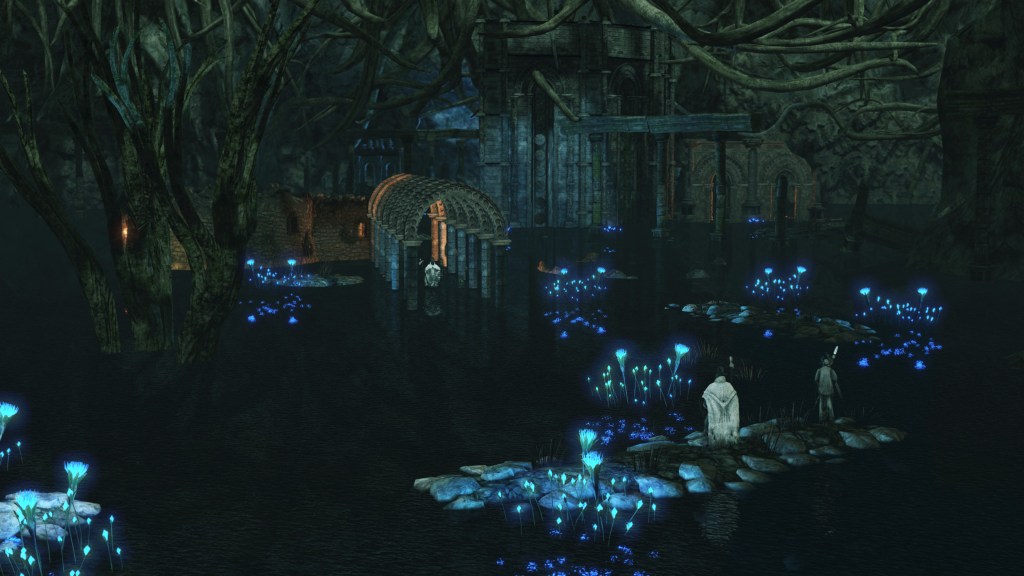

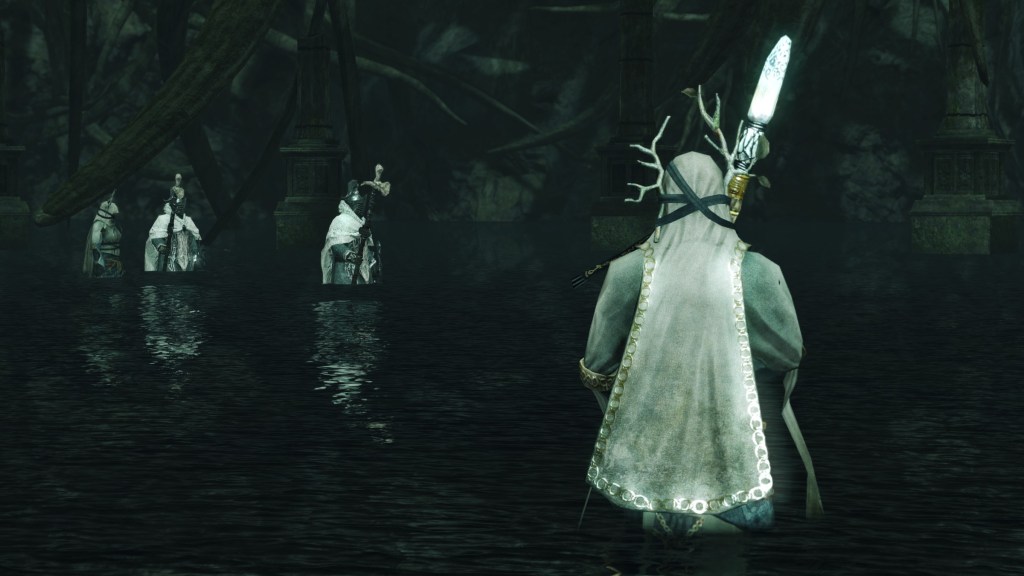
Despite Amana’s situation so far to the north, it isn’t actually disconnected from Olaphis in the south. We definitely find lesser crimson water at the Lost Bastille, some of which Straid sells. As for the Amana priestesses, their staves include a crystal at the tip, similar to the Staff of Wisdom — or perhaps that glowing white mineral is the twinkling titanite they carry. The Amana priestesses specifically cast Homing Soul Arrow in battle. Another tie to Straid is Soul Bolt, which we acquire along with a Spell Quartz Ring within a chest at Drangleic Castle just before the entrance to the Shrine of Amana; thereby undoubtedly recovered from the underground ruins. On that subject, the Helix Halberd is only acquired from Amana, confirming that Olaphis kept a presence this far north. We might even infer that Homing Crystal Soulmass — a sorcery Logan invented after acquiring knowledge from Seath’s archives in DS1 — is attainable in the ruins because of this Olaphis presence. Taken together, it is easy to see the influence of the sorcery country venerating a white dragon on the priestesses.
As the final nail in the coffin, there is Bellclaire. This woman is called a pilgrim and wields the Priest’s Chime indicating some connection to clergy, yet she doesn’t cast any miracles. Instead, she uses the Staff of Amana to conjure a specific brand of sorceries: Soul Spear, Crystal Soul Spear, Great Soul Arrow, and — most importantly — Homing Soul Arrow. Moreover, she wears the white robes of Drangleic sorcerers despite being a woman. Is it because she is far removed from Drangleic culture, like Straid, or does she have an especially strong affinity with Seath? We do encounter the pilgrim earliest at the Lost Bastille, only offering her summon sign again later at Drangleic Castle — as we invariably make our way to the Shrine of Amana. This is especially suspect when the pilgrim wears the Lion Warrior Helm, the tribalistic chain headpiece featuring an eye on the forehead invoking the mind’s eye. With that added sense of primitive spiritual enlightenment, the sorcerer’s identity couldn’t be any plainer.


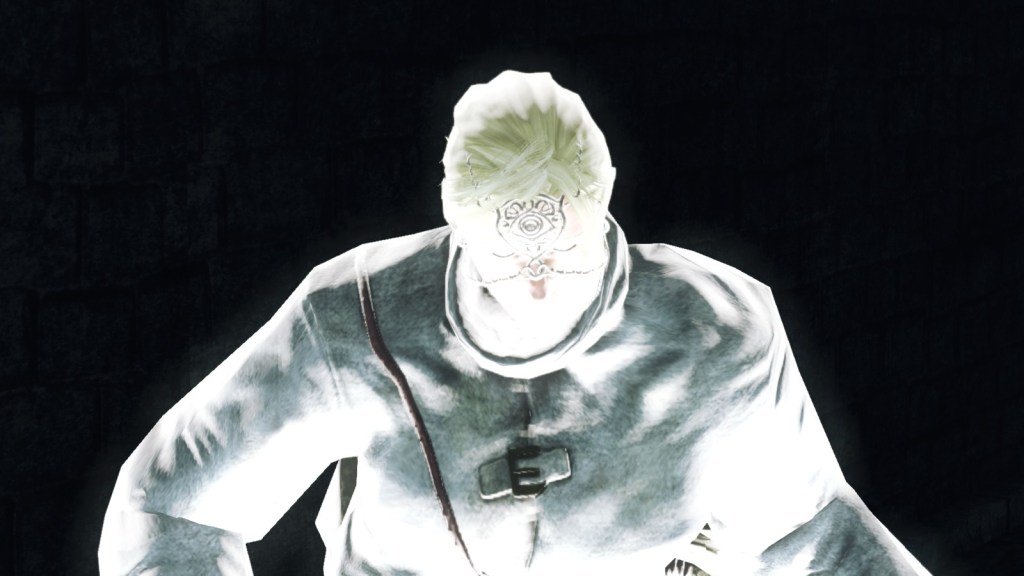
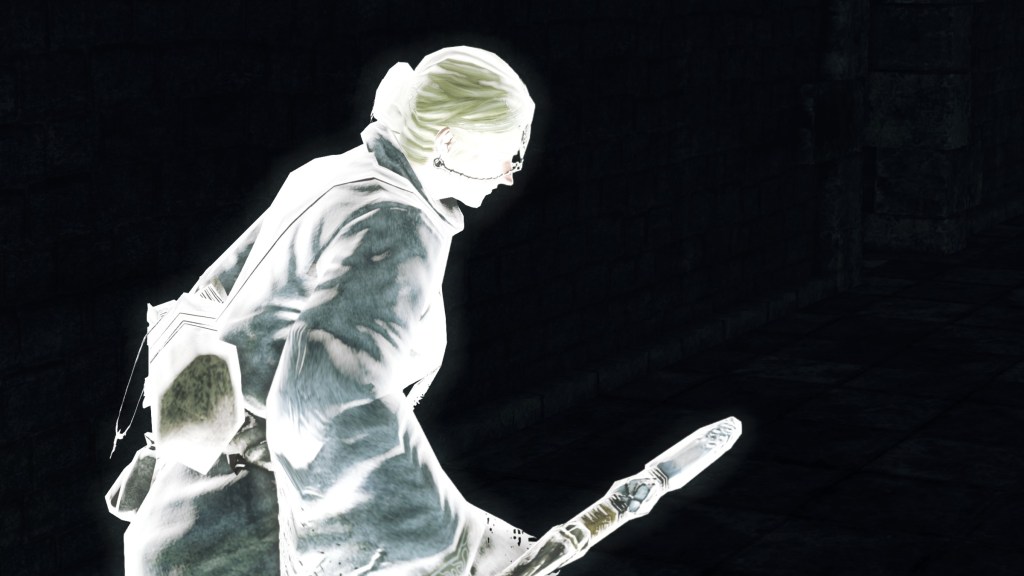
In all likelihood, Bellclaire is an Amana priestess who made a pilgrimage to the castle where Olaphis established itself. After touring the land where Seath’s knowledge was discovered, along the way collecting pieces of armor from the royal swordsmen currently in the area, she makes the return trip home, for some reason through Drangleic Castle. This affirms that the society she is part of still remembers their origin, if only vaguely. Why was Olaphis there? Possibly to study the local ecology, the one species of flower glowing blue due to some connection to sorcery. However, that flower may just as well be a byproduct of Olaphis’ presence. More likely, they were interested in the Undead Crypt, the mausoleum potentially informing them better ways to handle the curse if nothing else. But then the country collapsed, the faraway people up north essentially stranded without support from the homeland. Is it any wonder the sorcerers degenerated into a simple tribe fending for themselves in this hinterland? They carried on the culture, but the years spent in isolated obscurity undoubtedly distorted it.
At a glance, the Demon of Song resembles a giant frog that would be native to the watery environment, spewing gallons of fluid to attack. However, the grotesque face and arms the creature hides beneath its “mouth” flaps earns it the “demon” label. If it is a natural species, then the monster probably adapted this innocent-looking exterior so as to lure prey into a false sense of security, similar to the basilisks’ fake eyes. The poison-spotted whip derived from its soul reinforces the implication, as the demon can’t actually inflict poison; the effect simply represents the danger this otherwise unassuming creature poses, something easy to recognize for anyone paying attention. The Amana priestesses certainly were, for they sealed the creature in an altar through magic rituals. Since the entire area is the “Altar of Amana”, (アマナの祭壇) this might not be anywhere specific. If the priestesses thought that the Heiden ruins were sacred, then the whole place could be considered a kind of ritual stand. And based on the creature’s size, nothing else suitable is even close to matching the description.

Whip created from the soul of the Singing Demon. Has a poisonous spot pattern on it and, as you can see, possesses a poison effect.
The beautiful voice that isn’t appropriate for its ugly appearance is probably for attracting and eating man.
Either way, they evidently needed to regularly perform the ceremonies to maintain the seal. But rather than kill this local menace, the priestesses instead chose to worship it, most likely out of actual fear of its strength. May well they had hoped that a higher power would save them from their precarious situation, but it was to no avail. Women alone can’t sustain a population, and there apparently weren’t enough, if any, men to keep the line of priestesses from dying out over time. The only “survivors” left are Undead who have since hollowed, none of whom inherited knowledge of their sacred sealing rituals. As a result, the demon eventually broke free, using its newfound liberty to learn how to sing with a beautiful voice — by copying the Milfanito heard throughout the area. Much like hiding its ugly appearance, this beautiful singing served to attract prey to devour, specifically humans like the Undead it also soothes via Brightbugs. This is because the “singing demon” (唄うデーモン) had previously “learned” to eat man. Where did it learn this taste for human flesh? Probably from the same people who sealed it away.
Staff that priestesses of Amana use. Originally it had religious uses instead of battle. Becomes a catalyst for sorceries and hexes.
A fiend was sealed in the altar, but the ceremony was eventually lost. The unleashed fiend gained wisdom and learned a song that lured humans.
The description for the demon’s soul notes that the worshipers also “appeased” it, but how does one appease a creature imprisoned with magic? By feeding it in captivity. In other words, the priestesses began offering up human sacrifices in order to keep the beast alive and happy. This explains the human bones they burn as kindling for their torches. As to where they acquired the sacrifices, the answer is probably from the lizard-like Undead abundant to the area. There are signs of the priestesses dissecting Undead. Near the first two huts, we find a handful of sealed pots whose contents eerily laugh in concert with the jar’s face-like engraving. The large pots emanate a dark aura upon approach, which induces hollowing. By all indications, these curse pots entrap living humanity, glad to resonate with our own to gorge on our souls. While this explains the rapid progression of our curse, why would the priestesses have this on hand? The same reason as the bones, something they acquired from the Undead after stripping them of their flesh for the sacrificial ceremony.

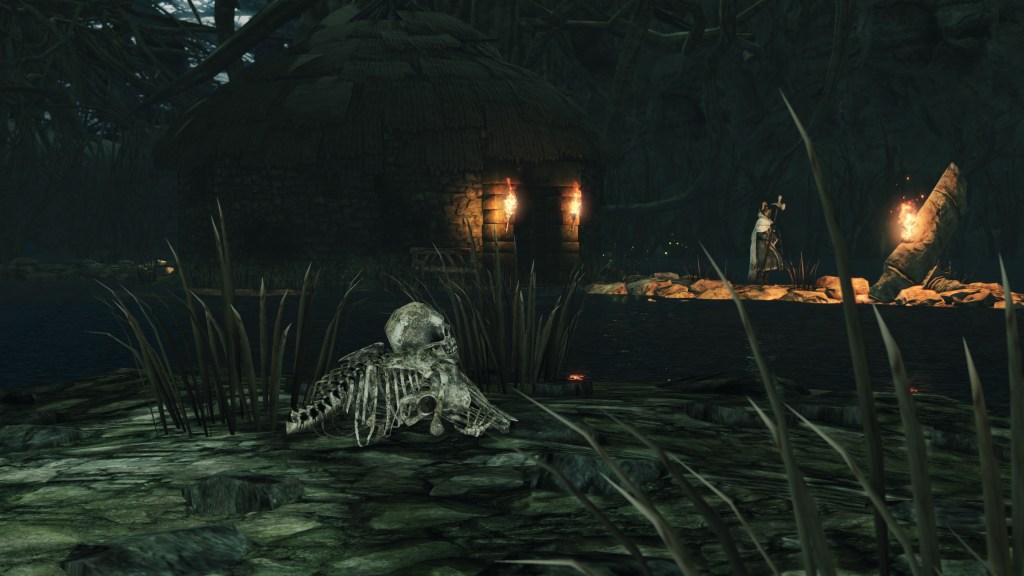
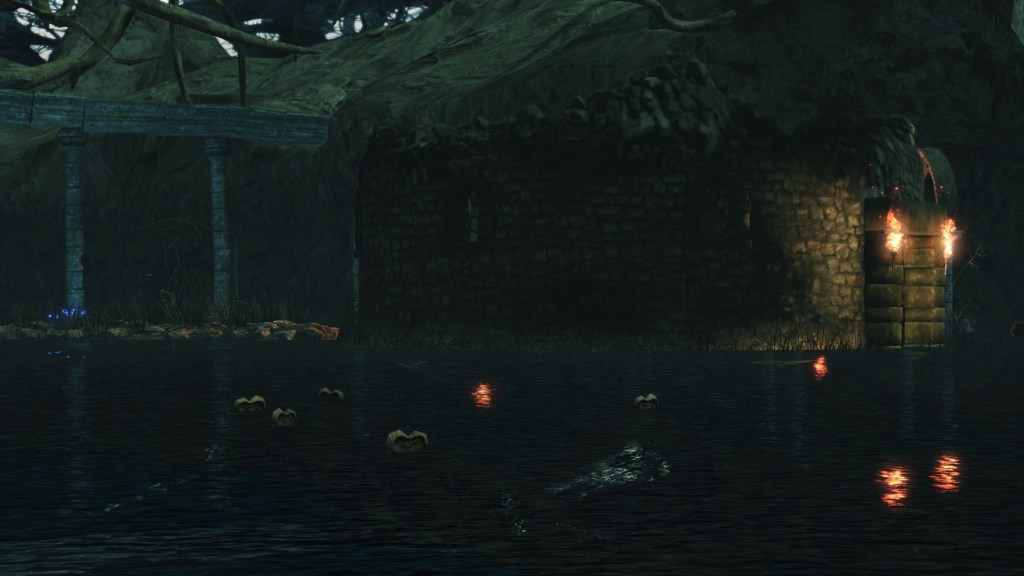
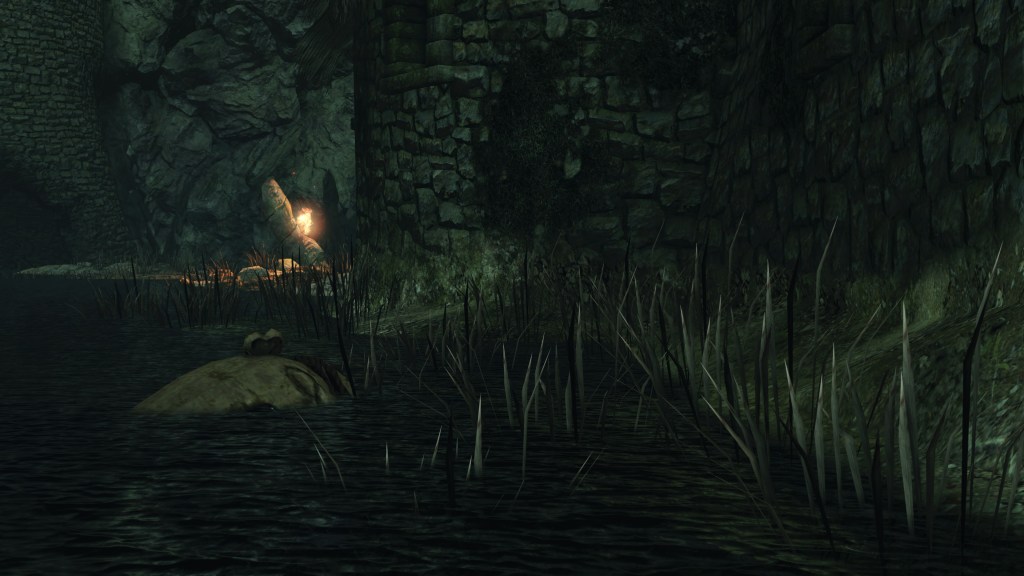

Soul of the Singing Demon at the Altar of Amana.
The fiend that learned to eat man was sealed within the altar, but the ones who worshiped and appeased it have died out.
The special soul this demon possesses is used to acquire a vast amount of souls or create a great power.
Maybe the women had always relied on this practice. Otherwise, they may have only resorted to it after losing the magical sealing ritual, a desperate attempt to keep the beast under their control before it actually broke free. Indeed, these events mirror classic Japanese tales of evil spirits being sealed away in shrine altars and subsequently deified, often appeased with human sacrifices after the fearful locals lost the abilities of the original sealers. Whatever the case, the remaining Hollows still haven’t abandoned the practice. We can find a helpless Milfanito sitting around in the first hut, another in much worse condition in the last hut leading into the Demon of Song’s lair. The fact that we can “save” that raggedy one just outside the boss room, much to her identical twins’ gratitude, affirms that they are being captured for new sacrifices, with the help of the Archdrake Sect pilgrims.
The adherents from Lindelt have clearly ingratiated themselves to the tribe, standing alongside the priestesses and patrolling their territory on their behalf; they might even be the maidens’ source of dragon charms as well as twinkling titanite, the latter of which the pilgrims also carry around. However they managed it, the apostates seeking a place to practice their religion and sorcery in peace found common ground with the pagans. Perhaps the Undead priestesses hope to see a revival of their line and religious practice now that men seem to have reentered the picture. Whatever the motive, the two parties have agreed to cooperate, including on the sacrificial ceremonies — though it is questionable why they have suddenly targeted the Milfanito for this. If they like to carve up Undead, why leave whole one of the living dead?
One can argue that the songstress in the farthest hut was captured as a tool to more easily hunt Hollows in the area. Amana’s grotesque Undead adapted to sneaking through the water are dangerous, especially in groups; a number loitering in the corner of a cavern filled with human bones, pacified thanks to a random swarm of Brightbugs. The chest with twinkling titanite left in that recess, combined with another storing a dragon charm next to the cave entrance closer to a hut, suggest that this was the fate of one poor hunting party, so the tribe would benefit from a voice that can control the bugs. Catching the passive Milfanito is no issue either. Despite being Hollows themselves, neither priestess nor pilgrim is pacified by the Milfanito’s singing, likely owing to a strong and lasting presence of mind. Just as their hostility to our trespass is likely not an instinctual hunger for souls but desire to offer our flesh to the demon, their resistance to her siren song was probably also thanks to pagan devotion. Rather, the problem lies with why they plan to soon offer one up to their demon in spite of the benefits.
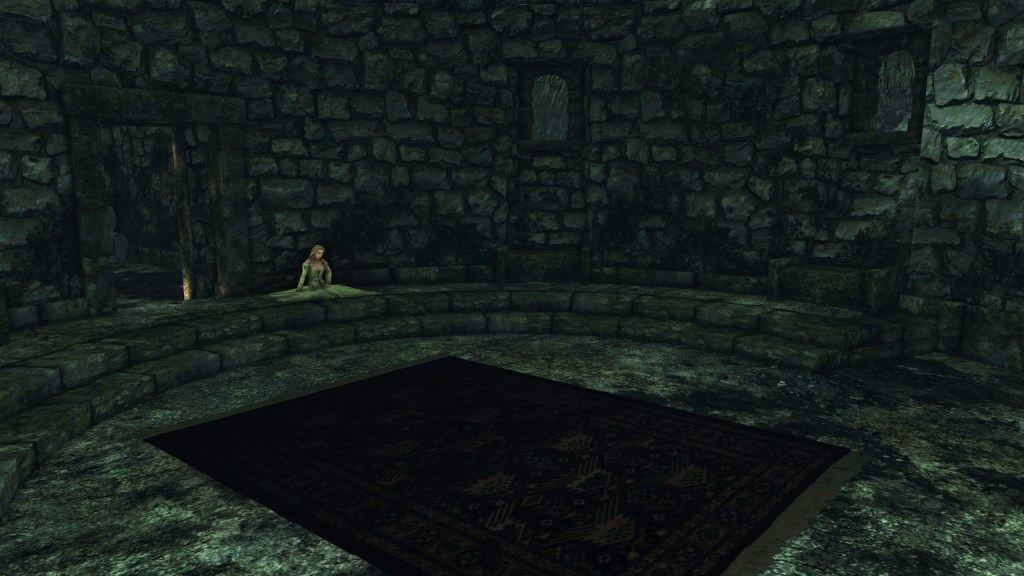

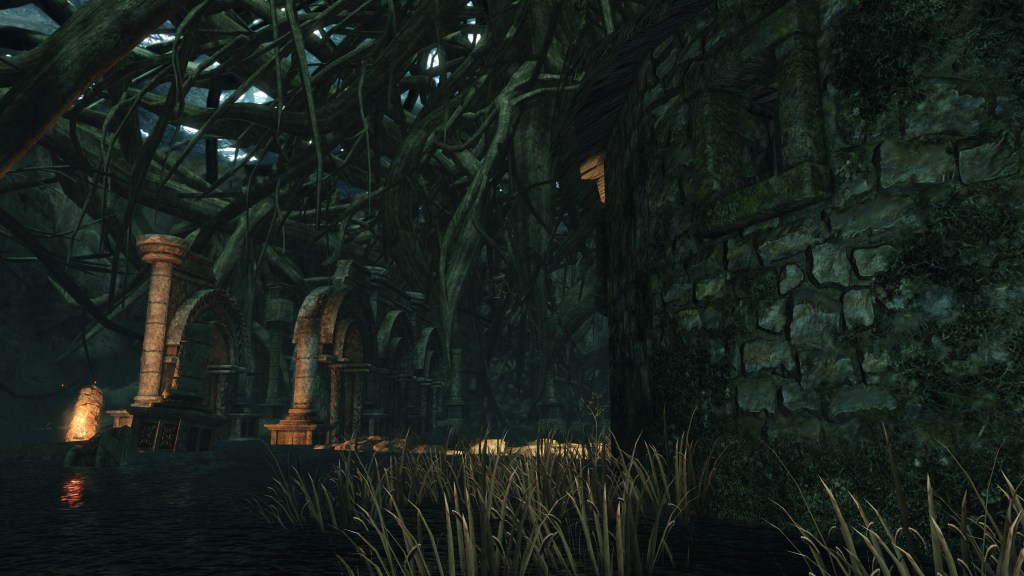

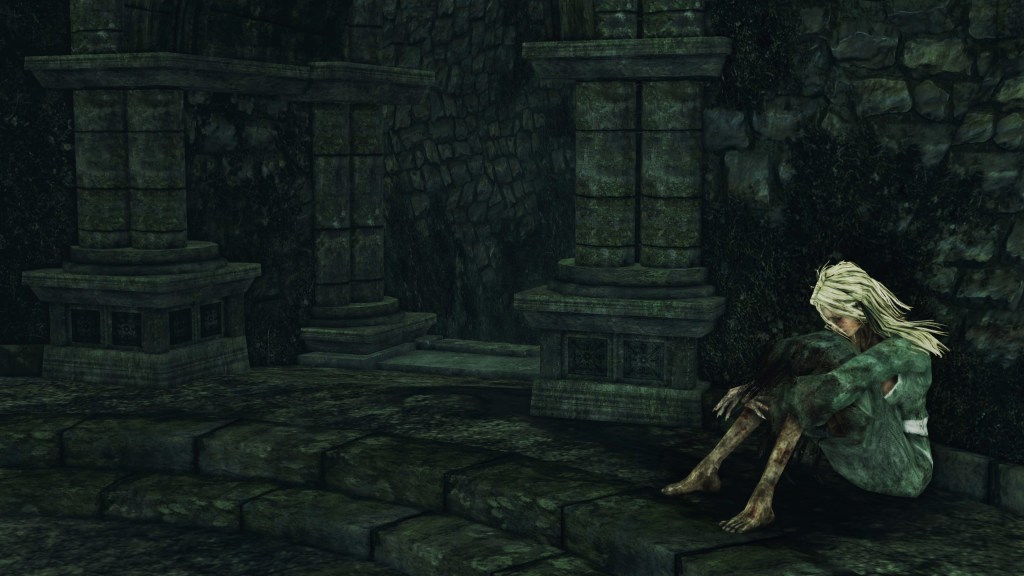

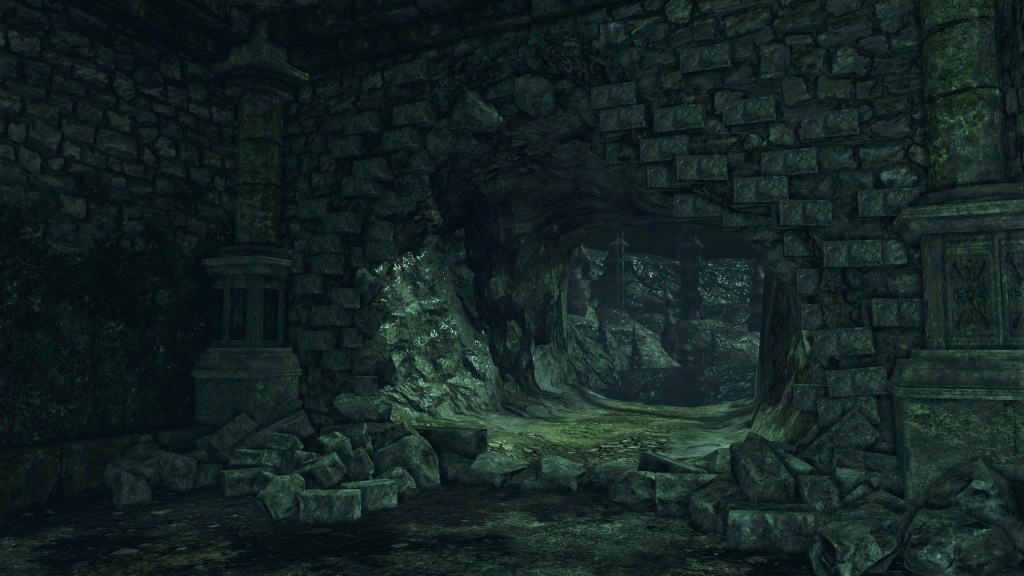
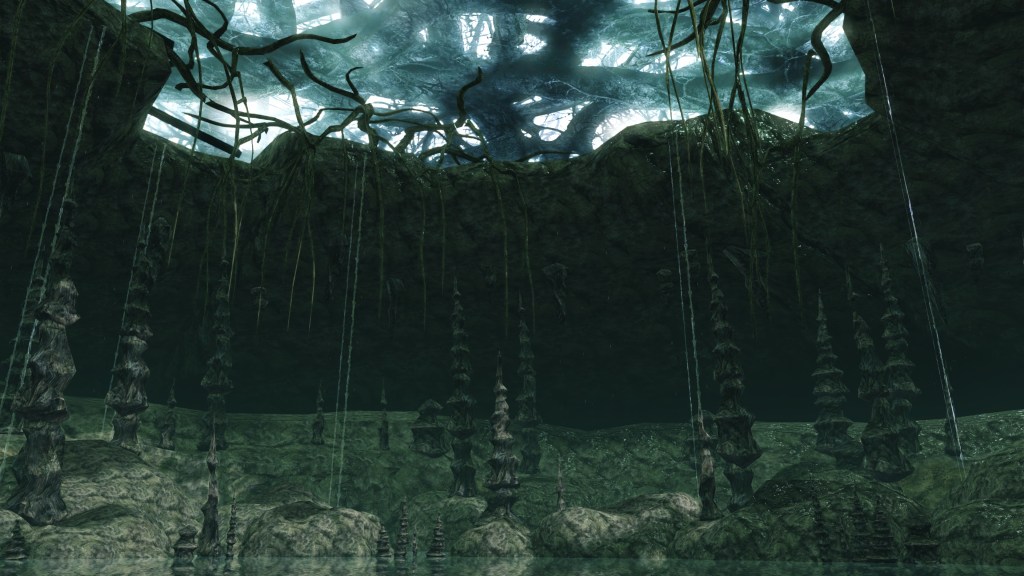


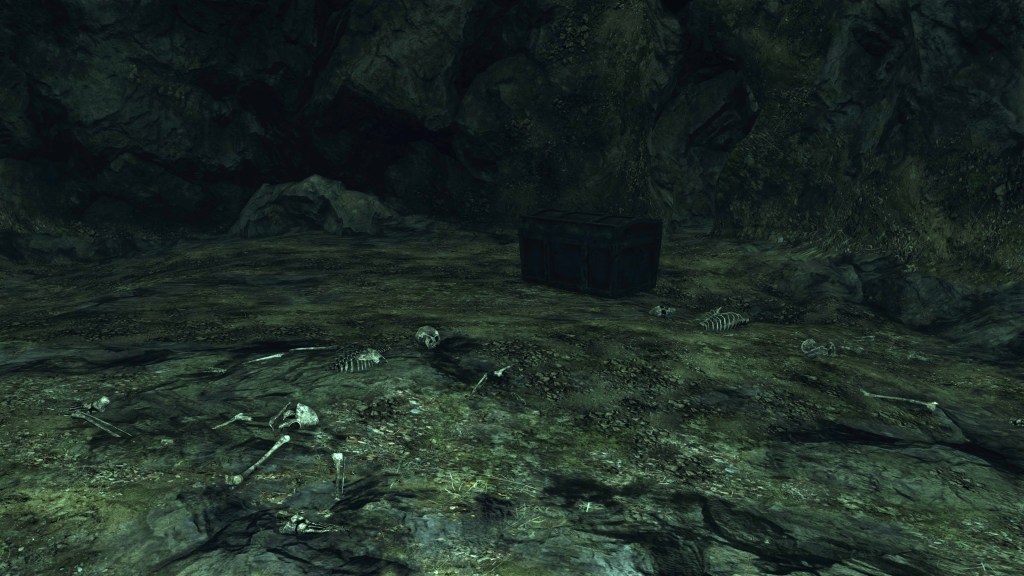

It is possible that the priestesses direct their ire at the Milfanito for “teaching” the demon its song. If a pagan tribe suddenly hears the monster they appease singing the same tune, then they are liable to associate the singers as similar evil. It is doubtful they interpret it as a sign of the Demon of Song wanting the songstresses as a meal — the one about to be sacrificed has obviously suffered terrible treatment during her, evidently, longer period detained. They probably blame the girls for making the creature learn a way to circumvent the ceremonial process, invalidating the pagans’ religion. And so, they must suffer, down to being eaten live. If so, then the last vestige of Olaphis’ advanced culture has descended to sheer barbarism, the rest lost to history. This isn’t an unwelcome development for Straid. After spending all these years stuck as stone, he is more than happy to hear that no one speaks of Olaphis in the current era. For a man so obsessed with knowledge, he can probably think of no better perdition than being forgotten.
 Lokey Lore