
Preface
Although understandably overlooked by fans trying to jump from one Lord of Cinder to the next, the Catacombs of Carthus provides some of the most charming bits of worldbuilding in all of Dark Souls III, (DS3) combining various elements from past games into something truly novel for the series and fantasy games as a whole. This elevates the area above the generic crypt level, though I would argue that the execution is far less successful than it was with the Catacombs and the Tomb of the Giants of the original Dark Souls. (DS1) However, so long as we are willing to look past the trite aesthetic, we can still find a true diamond in the rough to excite the imagination.
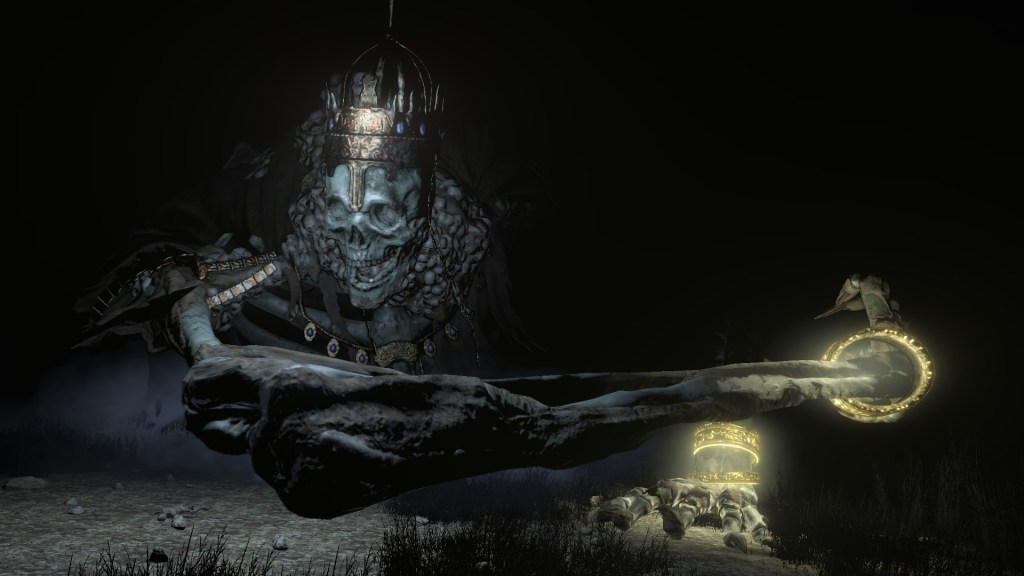
The Blood-Red Dunes
Fans have put forth the notion that Carthus has replaced or succeeded the Dark Souls II (DS2) nation of Jugo, and there are definitely good reasons to make the connection. Both were desert nations identified by their warriors and pyromancers, and no such country is ever referenced in the Old World. Moreover, the regions surrounding Drangleic had a much more lenient stance concerning magic overall. One would be hard-pressed to imagine the Way of White permitting heretical pyromancy to be widely practiced in Carthus. By contrast, the holy powers that be in Jugo’s part of the world didn’t have such a stranglehold over the magical culture, leaving both pyromancy and sorcery generally accepted and even taught alongside one another. And given that Jugo is never once mentioned in DS3 despite the presence of one of its desert pyromancers in-game, it is possible that Carthus was the country that emerged after Jugo’s implicit dissolution in the events since DS2.
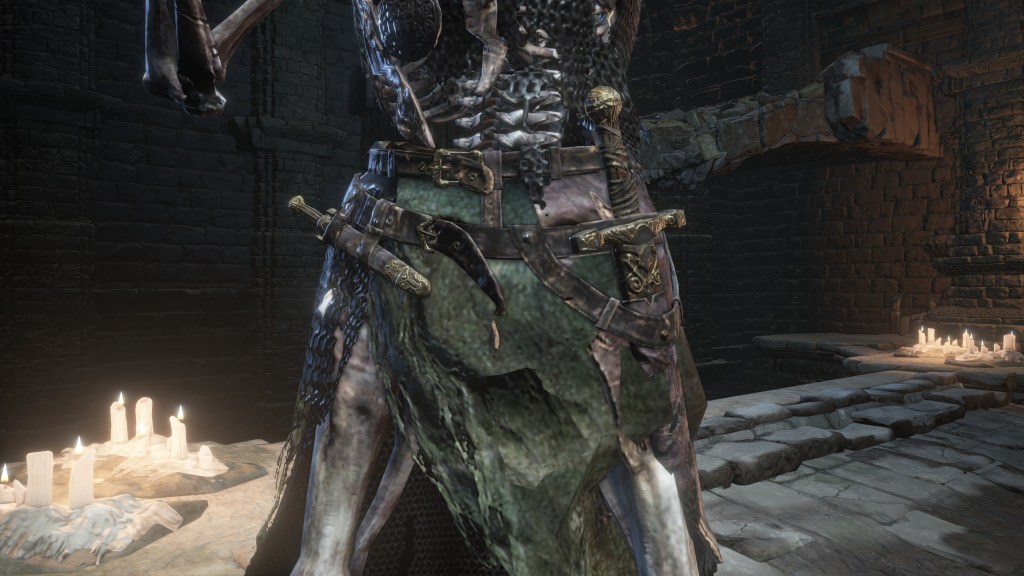
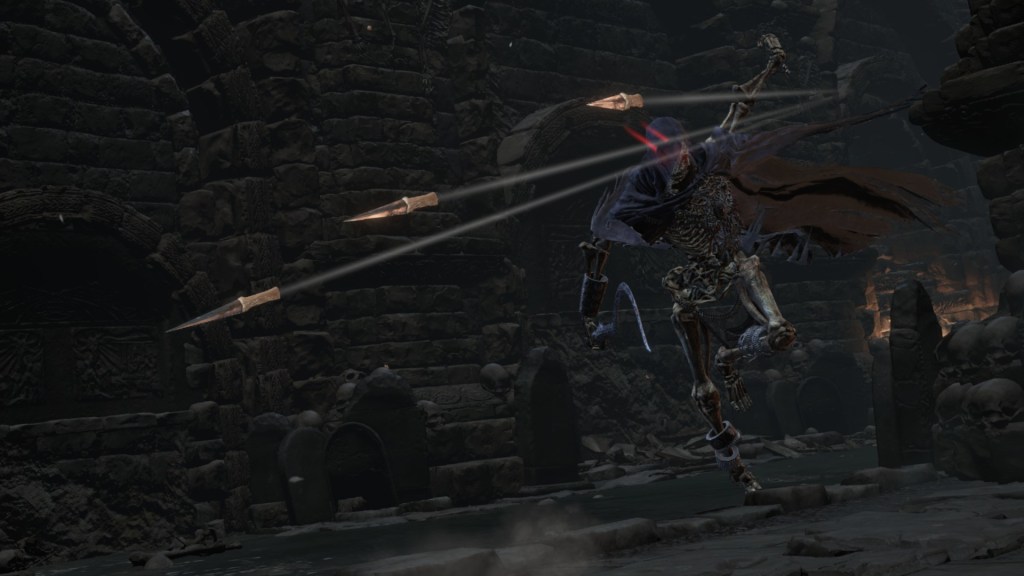
Further connection between the two might be seen in the subtler details. There were no named warriors of Jugo in DS2 besides Benhart, who wielded his own unique blade, but the game did hint to his homeland adopting curved weaponry as a standard. Carthus soldiers were similarly known for wielding curved blades — including kukris as throwing knives — and enhancing them with sharp gems conducive to dexterous swordsmen. As with Jugo, it wasn’t exclusively this one kind of weapon, looking at the side arms on their belts or knives they actually throw, but there was a good reason for the bias. Indeed, the craftsmanship to Carthus blades did more than provide them intricate patterns. Artisans’ designed their curved swords to be lacerating, much like in the far East. Carthus blades were thus dyed scarlet as much because of their effectiveness in bleeding out opponents as the viscous grass fluid used to amplify said effect. This earned that secretion the name “Scarlet Blade” (緋刃) back home, and it was just one aspect to improving the army’s lethality.
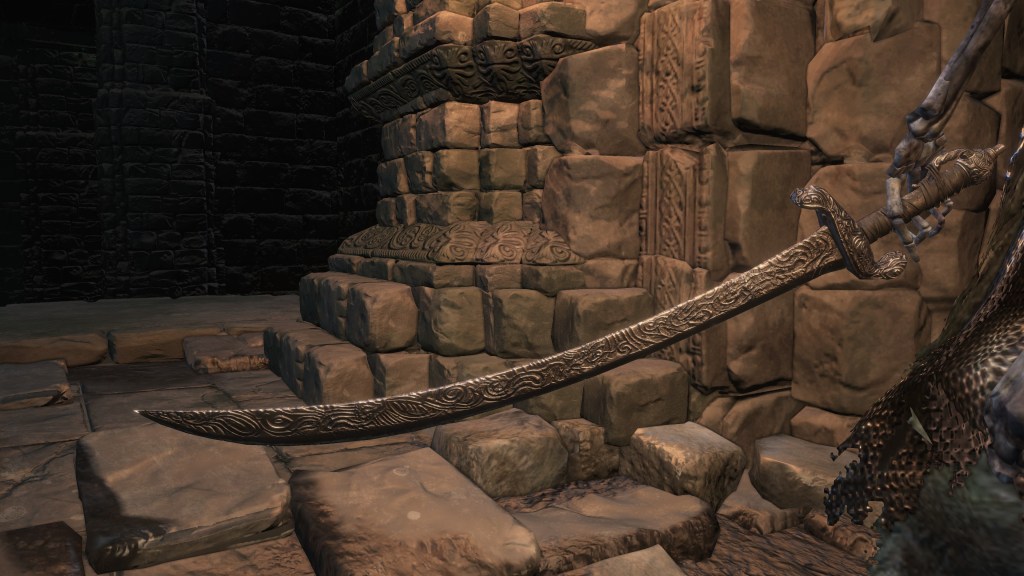
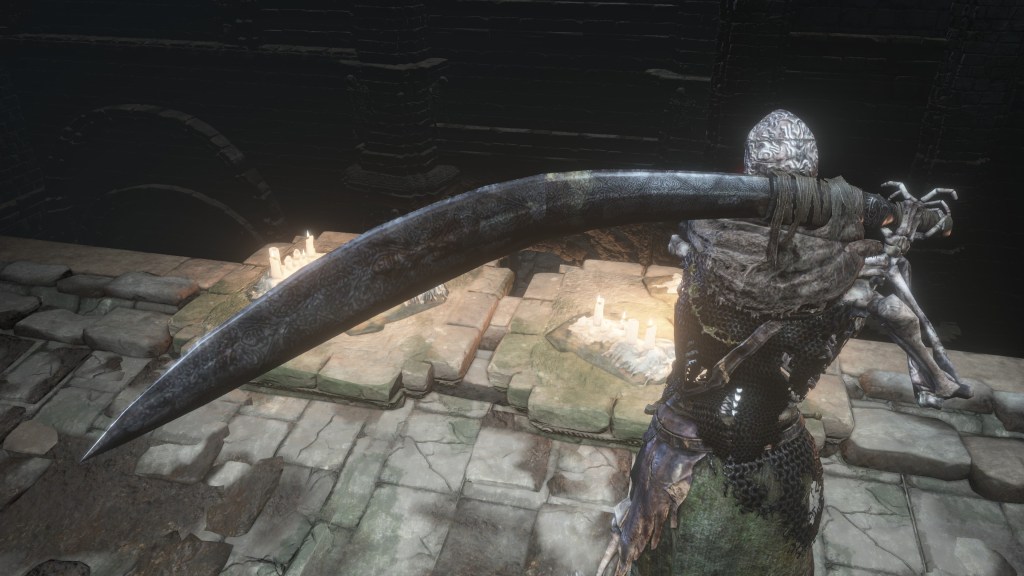
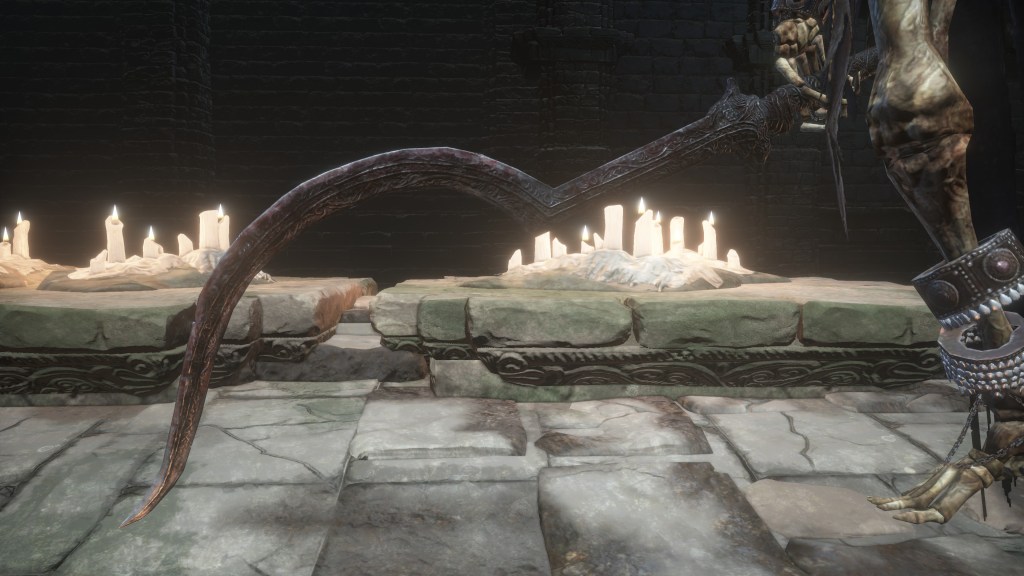
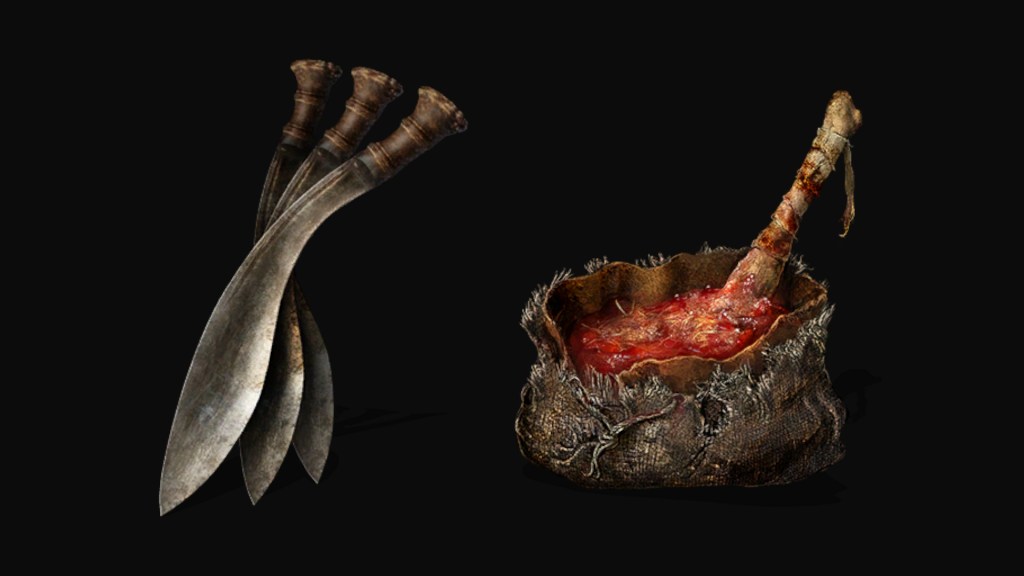


Gem said to be bond stone that was altered. It is said to have been used in Carthus’ characteristic curved swords.
Used in weapon alteration enhancement to make sharp weapons.
Sharp weapons coincide with swordsmen and have high dexterity scaling in particular.
Highly viscous scarlet-colored grass fluid.
Temporarily endows right-hand weapon with bleeding effect.
It is known for Carthus swordsmen using it. Blades of Carthus are stained scarlet. Due to the blood-like grass fluid and copious blood spurts.
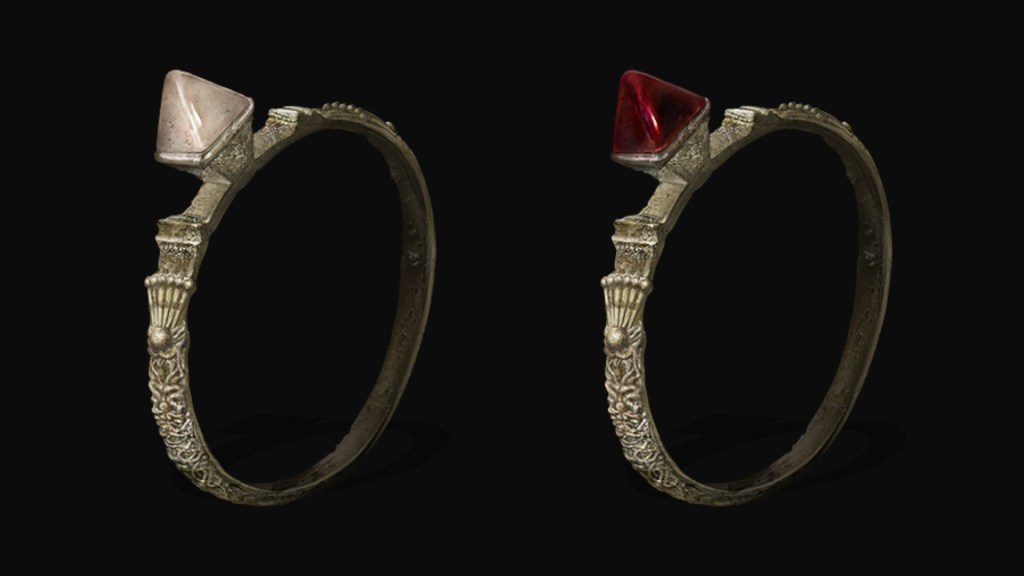
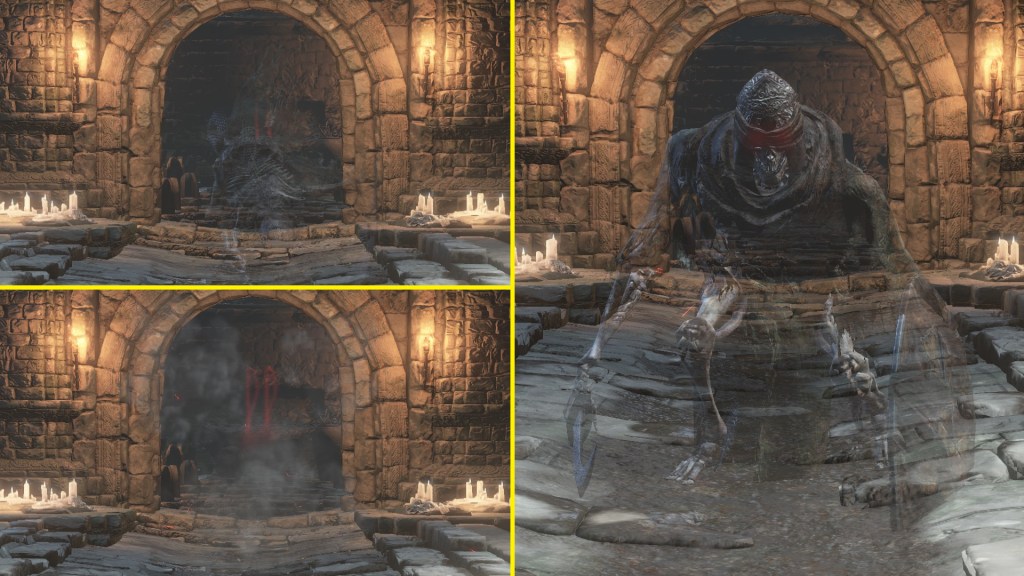
Carthus warriors dress in lighter protection such as cloth, leather, and chain mail. While unconventional, the choice of greater vulnerability was a necessary trade-off for power. That intent is, again, conveyed through the country’s blades. Although both require great strength and dexterity to wield, the standard sword is the heaviest singular curved sword in-game while the greatsword is the lightest of its class. These and other armaments were all designed with one goal in mind: to give their impressive wielders as much cutting power without dragging them down. The result was a quick and agile sword technique that led enemies around like a “cloud of sand”, making the weightier soldiers of other nations struggle to keep up. Aiding this, the Carthus Milkring and Bloodring enabled swordsmen to become more dexterous, evasive, and slippery as they rolled around before the decisive slice. With this darting back and forth rendering them invisible save for dust clouds, they really were like a cutting wind across the barren desert. And once struck, the blows all but guaranteed death to blood loss if not the initial cut.
Curved sword that swordsmen of Carthus used.
The blade applied with bleeding handiwork is thick and heavy, so requires great strength and dexterity to master. How powerful were swordsmen of Carthus? If you see this curved sword, you can tell.
Ring of swordsmen of Carthus, country of sand. Raises rolling evasion ability but also increases damage received.
It is said that the sword technique of Carthus that freely uses curved swords leads enemies around in combat like a cloud of sand. And so, they are associated with the name of High King Wolnir, who swept across many countries.
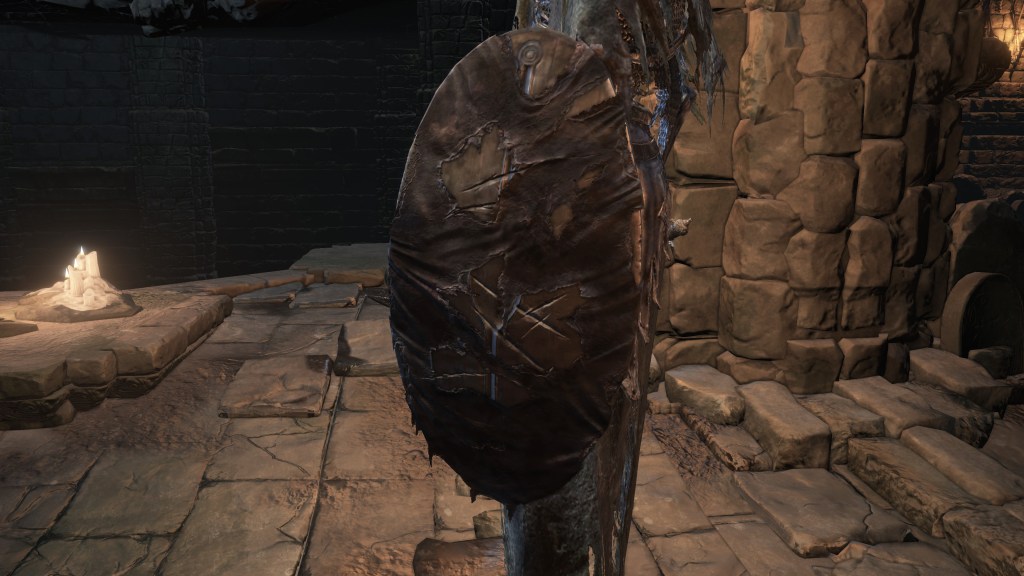
Perhaps Jugo warriors never fought with this same level of skill, modeled on their desert homeland, but the Carthus Shotel in particular bears mentioning due to the blade’s origins. Unlike the standard curved sword complemented with a light leather shield, the shotels were commonly wielded in pairs. But the shotel itself was invented by Earl Arstor and thereby unique to his homeland of Carim, where dual-wielding was likewise prominent. In DS2, this same shotel could only be acquired in the collection of forgotten trash and obscure debris known as the Gutter, with Arstor having been a forgotten quantity in the region. In other words, it continued to be a rather obscure weapon that wasn’t widely used and certainly not associated with any of the known countries in the New World. And yet, a spirit dressed like one of Jugo’s desert pyromancers employed one in Drangleic’s Abyss. Therefore, the shotel may well have been reinvented in Jugo as a byproduct of a cultural emphasis on curved weaponry, Carthus subsequently inheriting the design.
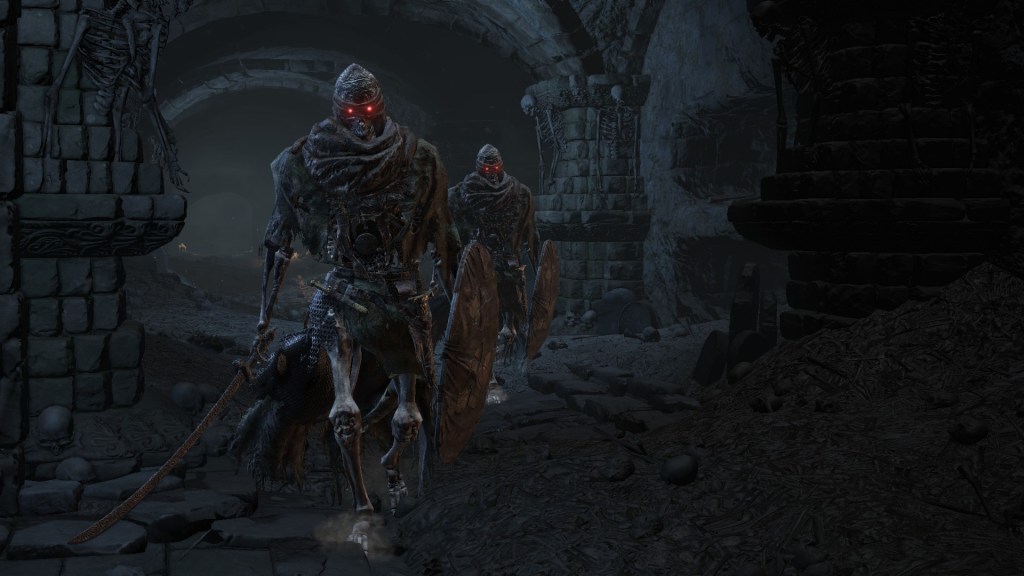
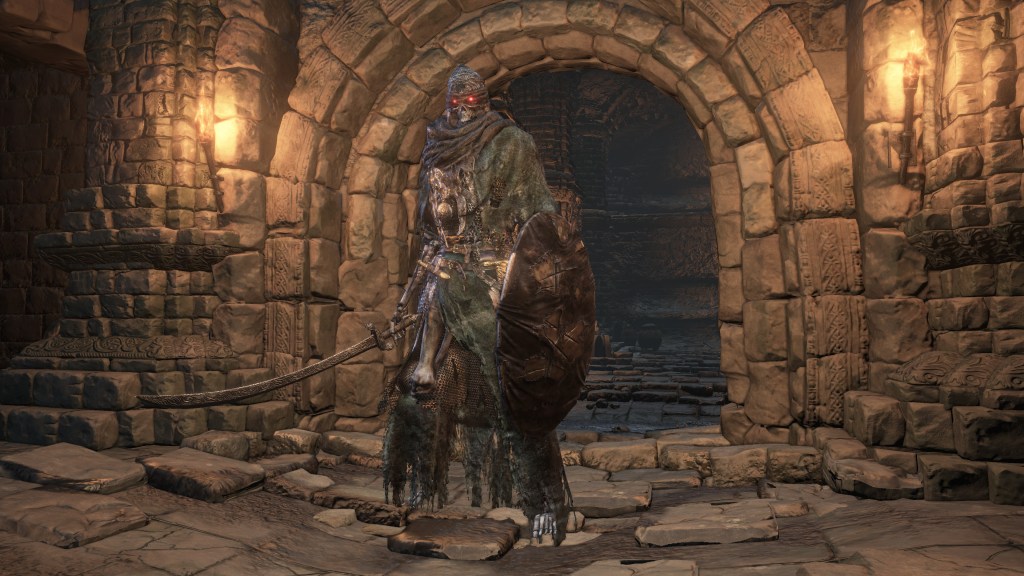

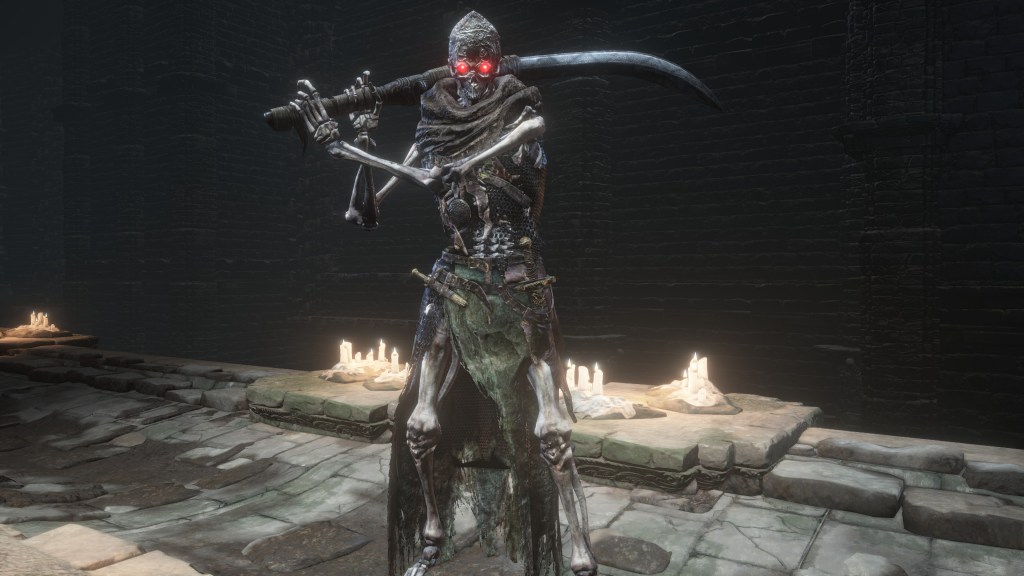
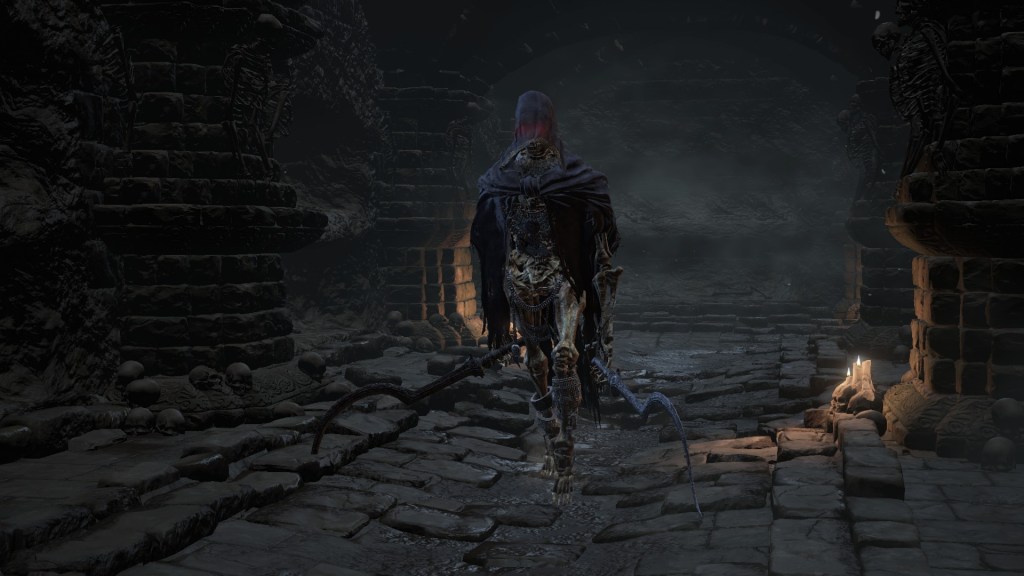
Shield that Carthus swordsmen once used. The leather covering is tattered and half-peeled.
Swordsmen of Carthus are known for their agility, so their shields too are surprisingly light for a medium shield.
We can also turn to its pyromancy for remnants of the desert nation from DS2. As the corrected description for their pyromancy tome relates, Carthus pyromancers didn’t have cultural exchange with others and thus their conjury went in unique directions. For example, Acid Surge was previously invented by an anonymous pyromancer from some remote land outside the Great Swamp in DS1. The spell can later be reinvented by the prodigal sorcerer Straid using the soul of a filthy rat as materials in DS2. In both cases, it was never widely adopted by any nation or tribe. But Carthus ended up reinventing the exact same spell, and we can infer where they received the inspiration. Jugo was already familiar with this tactic of corroding enemy equipment with powerful acid well before the other desert nation developed a pyromancy for it, a parallel too great for mere coincidence. If Carthus was Jugo’s successor, then it is only natural that it eventually create a spell revolving around the concept — far more cost-effective than trying to extract the acid from giant ants.
But Carthus pyromancy developed in a unique direction from even Jugo. The most basic of its pyromancies is Carthus Flame Arc, previously seen in DS2 as Flame Weapon — a creation of Straid using the soul of the Witch of Izalith. If Carthus didn’t borrow ideas from other countries, then why did they create a spell associated with the founder of pyromancy? The answer is because it is so rudimentary. Even the DS2 spell’s description alludes to its conceptually identical nature to the sorcery Magic Weapon, so anyone even vaguely familiar with magic could think of applying the basic concept to pyromancy. But if so, why has no one else thought to do so? Because Carthus alone had a culture conducive to such a spell. Pyromancers of the Great Swamp have used hand axes that deal primarily with the dense foliage of a marshland, not soldiers on any given battlefield. And in Jugo’s part of the world, pyromancy was lumped together with sorcery and thus primarily learned by wielders of a staff, not a sword. Even Jugo’s desert pyromancers were “sorcerers” who wielded fans to rouse flame.
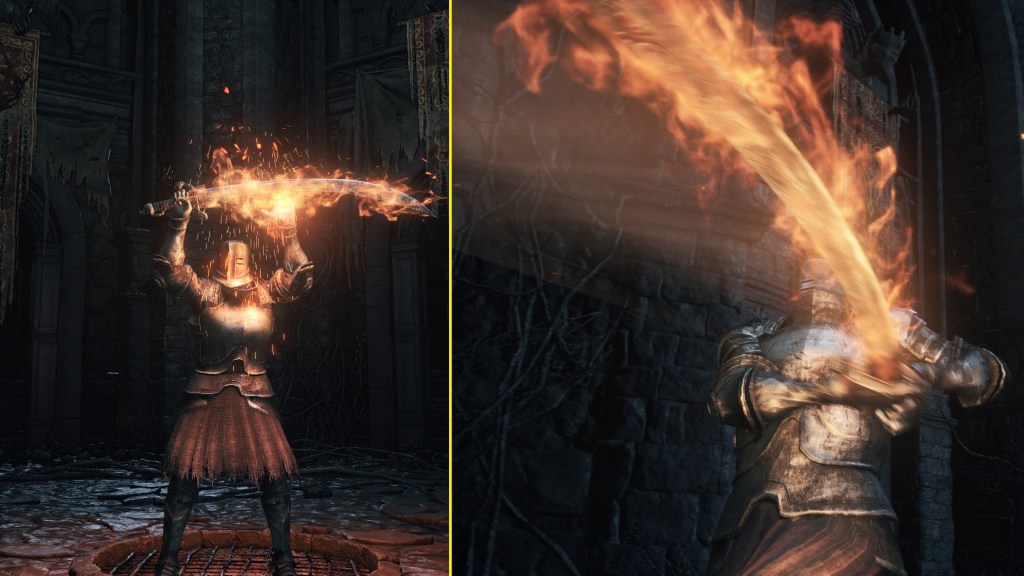
Pyromancy of Carthus, country of the sand. Enhances right-hand weapon with fire.
Supplementary pyromancy appropriate for Carthus, which was made up of the curved swords of swordsmen.
It was only Carthus that had warriors wielding both the sword and the flame, prompting them to combine the two — we see this at work with its similar use of flame arrows. This may even be a direct result of events in DS2. Though all Jugo pyromancers that DS2 introduces us to are women, the desert pyromancer set of DS3 makes it clear that such sorcerers were only “mostly” of the feminine persuasion. And considering that so many of these women moved to Earthen Peak in DS2, that male minority may have since become the majority, a majority less likely to rely on having a captivating physical appearance over more conventional tools of combat. And with so many desert pyromancers lost from the homeland, many more would have to take their place, even if they had been primarily swordsmen rather than sorcerers. In short, the massive exodus of female pyromancers from Jugo and need to replenish their ranks may well have the sowed the seeds for Carthus to develop Flame Weapon among other such unseen but practical pyromancies.
These seeds were, of course, fertilized by Carthus’ aggressive culture. Even assuming that it derived from the existing warrior spirit found in Jugo, Carthus took it a step further. The pyromancy kept as its most closely guarded secret was Carthus Beacon. Unlike the prior two spells, it not only served to maximize a Carthus soldier’s lethality, increasing the damage dealt by the chain of attacks common to their swordplay, but also served as a signal fire. Whenever a Carthus pyromancer was seen enveloping themselves in the spell’s peculiar flame, its armies and their commanders understood it to mean that they were to begin the attack, hence the Japanese for “beacon” is “signal fire”. (烽火) The result was them suddenly and aggressively sweeping across the land like a fire, without the enemy receiving any forewarning. Attentive minds may even note the efficiency of making a preparatory exercise their signal.
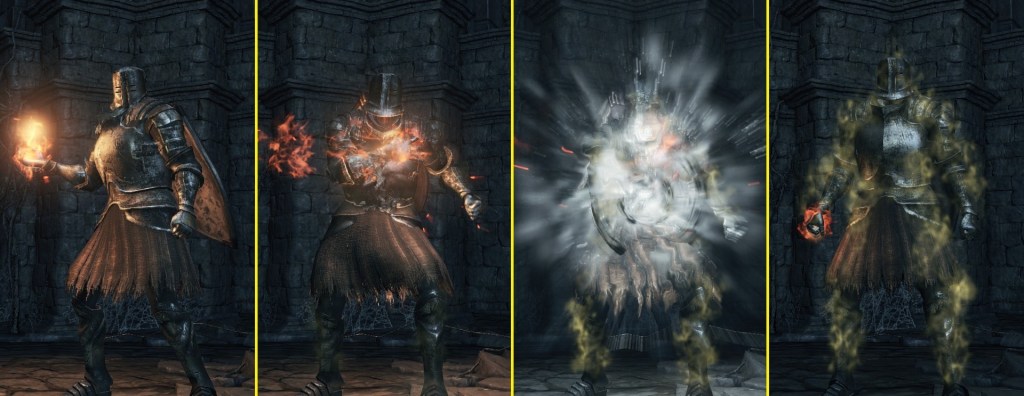
Pyromancy of Carthus, country of sand. Its most secret thing.
Attack power boosts as attacks continue in succession.
Carthus’ aggression was like a fire, and the signal fire was a signal for battle in time immemorial.
All around, Carthus pyromancies, like its weapons, reflect a culture built solely around warfare, and it didn’t care for the rules of engagement. The Carthus ethos was to do whatever was necessary to achieve victory, regardless of conventions. Why create a spell to melt an enemy’s equipment and potentially them along with it? Because you would win. While such tactics might be perceived by the larger world as dishonorable for knights or warriors, the Carthus swordsman only saw honor in winning. As the description for Acid Surge elucidates, what honor is there in dying exposed to your enemy because you detest their methods? If such “underhanded” tactics meant that you survive and they don’t, why not use it? It is improbable that Carthus made many friends thanks to this mindset, but they didn’t need any. War was their diplomacy, and they would grow their empire through conquest in the name of their king.
King on High
Wolnir is synonymous with Carthus. The name “Karrthus” (カーサス) belongs to a character in Magic the Gathering — a card game on display in Director Hidetaka Miyazaki’s office — known as the Tyrant of Jund. And despite the English description for Wolnir’s Crown labeling him the “Carthus conqueror”, the Japanese text only references him by his later title of High Lord, or “High King”, (覇王) associated with tyrannical autocrats. Whether this makes him the founder or simply its one ruler of note, Wolnir defined Carthus as a tyranny, conquering for him rather than conquered by him. After gaining power, he and his armies swept over many neighboring kingdoms and “destroyed” them all, emphasizing the violence and ruin brought with these conquests. To exemplify this, a cut description for the ominous skull goblet which brings us to Wolnir claims it to be the cranium of a noble king, indicating that the King of Carthus had his enemies’ heads turned into his drinking cups. This draws obvious inspiration from the infamously brutal warlord Oda Nobunaga, which only enhances Wolnir’s ruthless image.
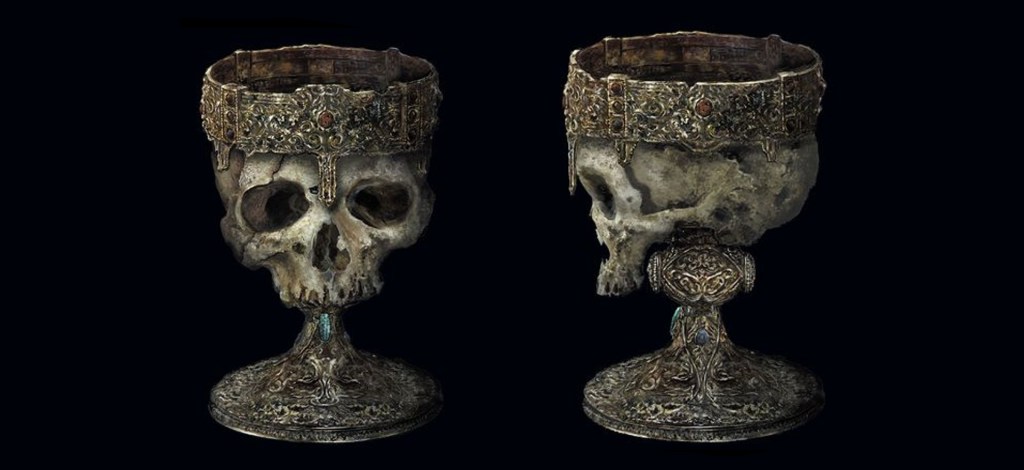
Sinister cup made using the skull of a noble king.
It is said to have been once placed on the altar of the catacombs, but its origins are uncertain.
A sinister air emitting from the cup itself captures the hearts of the viewers as if dragging them into the world of death.
Alongside this brutality was a profound indifference to the divine. Conquest made Carthus extremely rich if the copious amounts of jewelry decorating its soldiers is any indication. And among these spoils of war was a holy sword stolen from clergymen he killed. Raiding a church of its relics and slaughtering its holy men would surely be sacrilege, but Wolnir clearly made no distinction between soldier or cleric. Recall that Carthus philosophy dictates that you do whatever to win. By that same token, whatever isn’t needed to achieve victory is worthless, and Wolnir had no need for the gods or their holy power. There was nothing they could do that he and his armies could not, so why pay them reverence? Combined with the lack of miracles in its arsenal, and Carthus probably wasn’t a very religious nation — although faith was at least required to perform all of its pyromancies. And again, the nation didn’t follow arbitrary rules which weren’t to their benefit. Whether you were king or cleric or soldier, all would be swept up in the fire of Wolnir’s war.
Once his conquests were finished, all these countries were united under one crown with him as their “High King” standing supreme over the previous. Some fans interpret the description of the crowns becoming one as literal, but this seems doubtful. For one, the notion that Wolnir destroyed the actual crowns is challenged by the skull goblet, which retains a crown-like headpiece upon the noble king’s uncapped cranium — it even shares a similar style to Wolnir’s Crown. Rather than crushing their crowns to dust, the description of his simply claims the conqueror to have destroyed the kings. Even if we do assume the crowns destroyed, it would be incredibly unlikely for a well-proportioned crown like Wolnir’s to be comprised of many others, especially if all the kings wore ones of similar size going by description of their “equal” bestowment. It is far more likely that the crowns becoming one is figurative, hence Wolnir’s desire to be a King of higher status, unequaled. His was thus fashioned in a similar style to the rest to reflect this supreme union of various states with kindred cultures in a new empire.
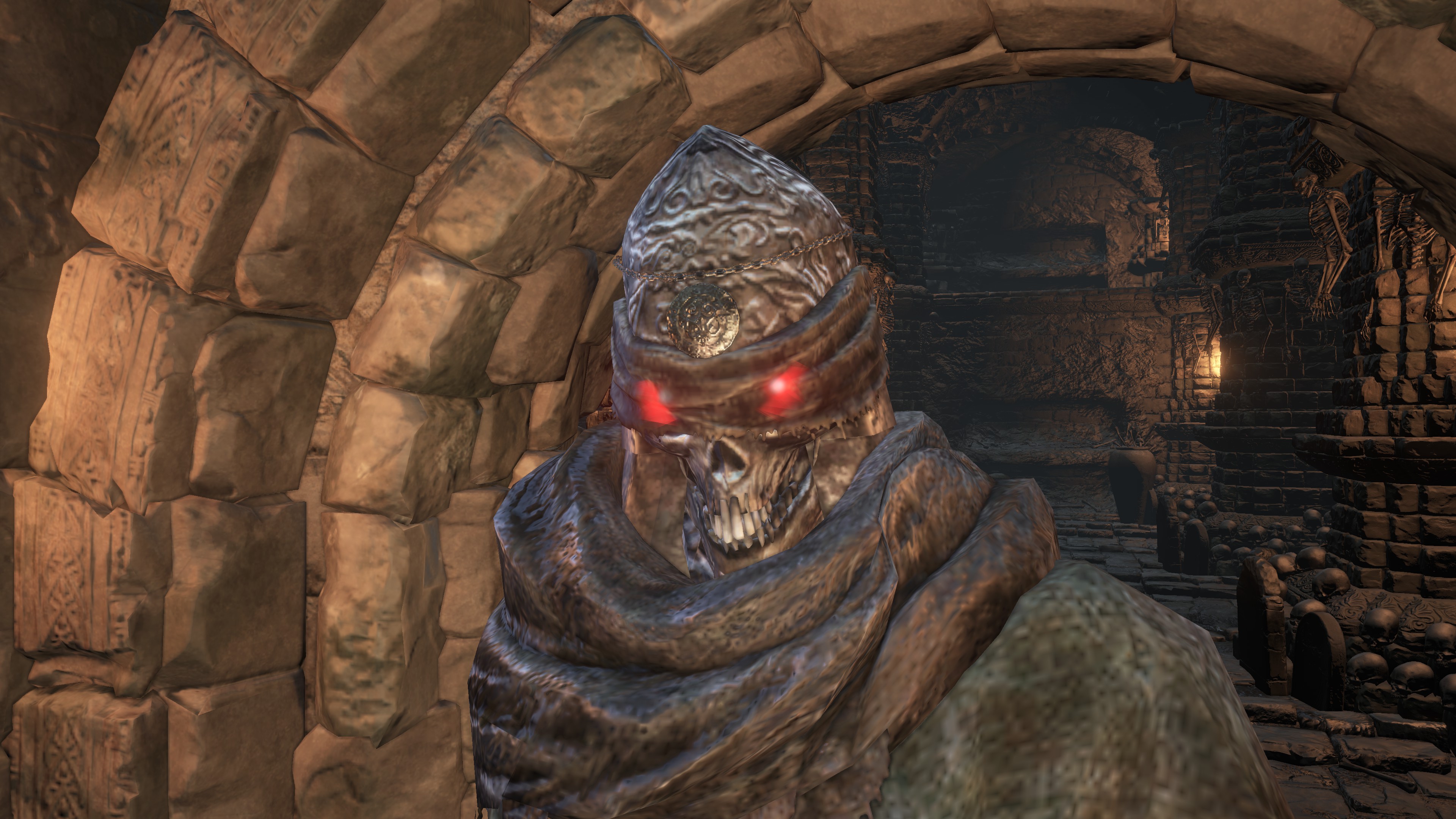
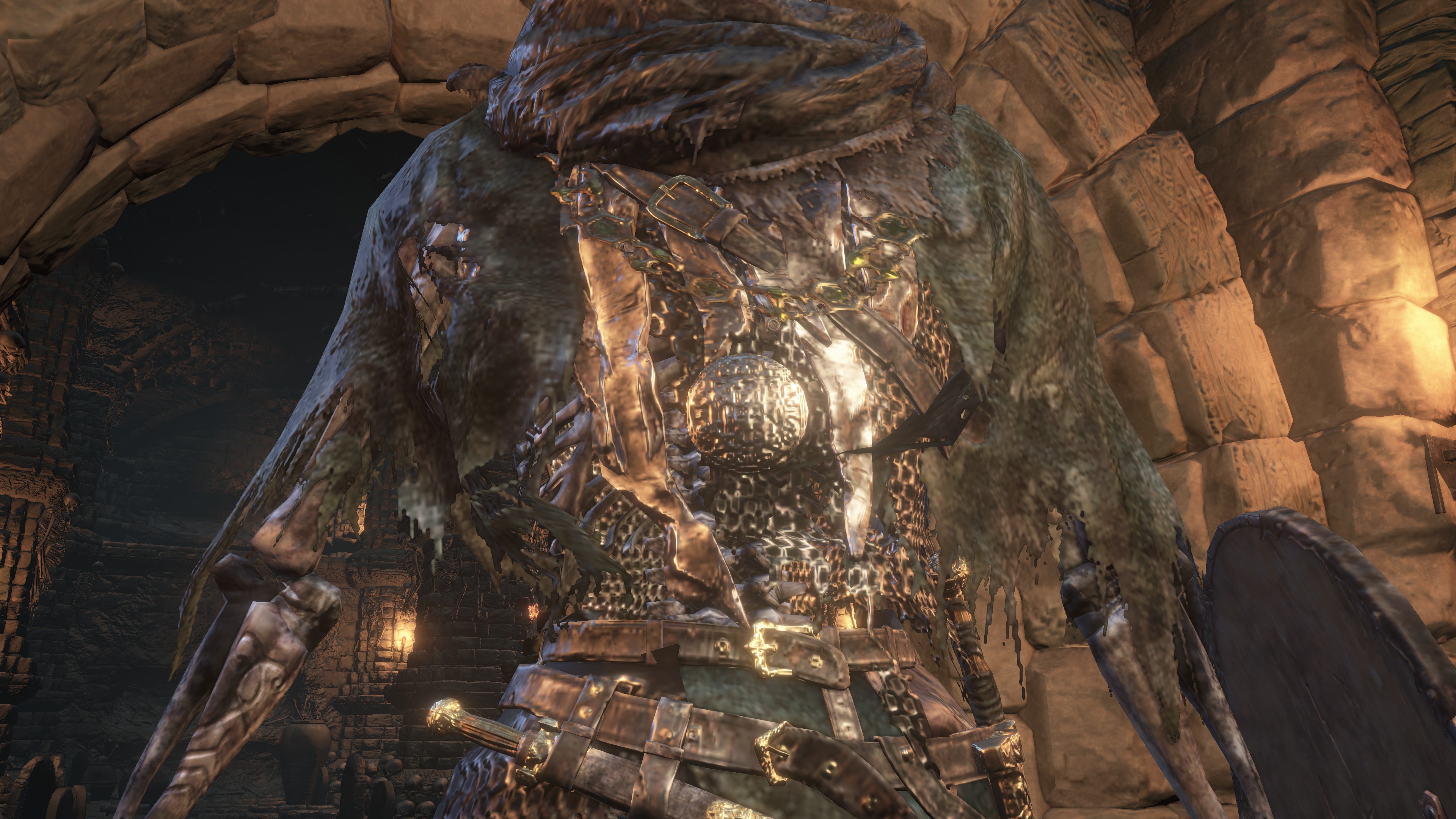
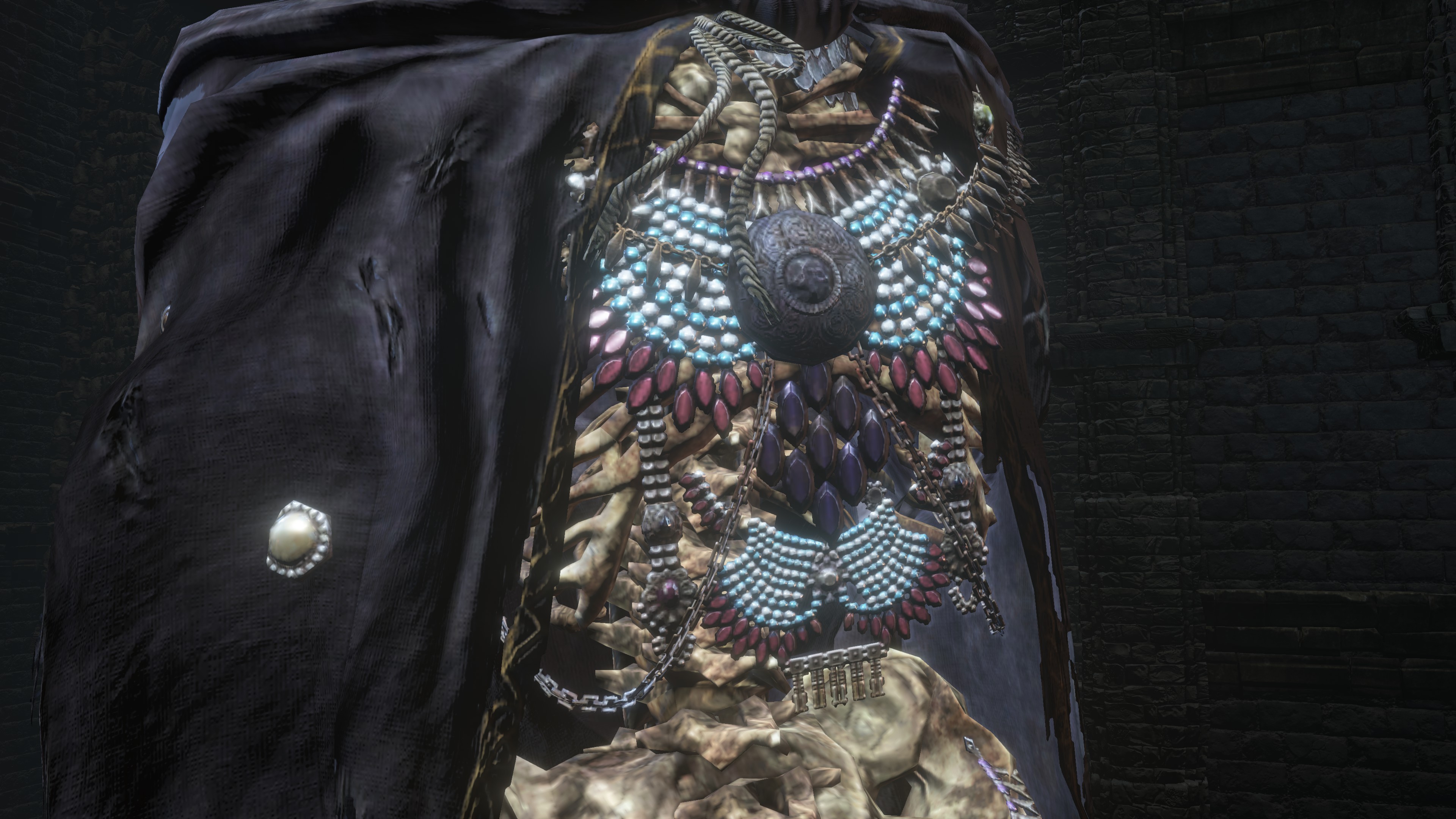
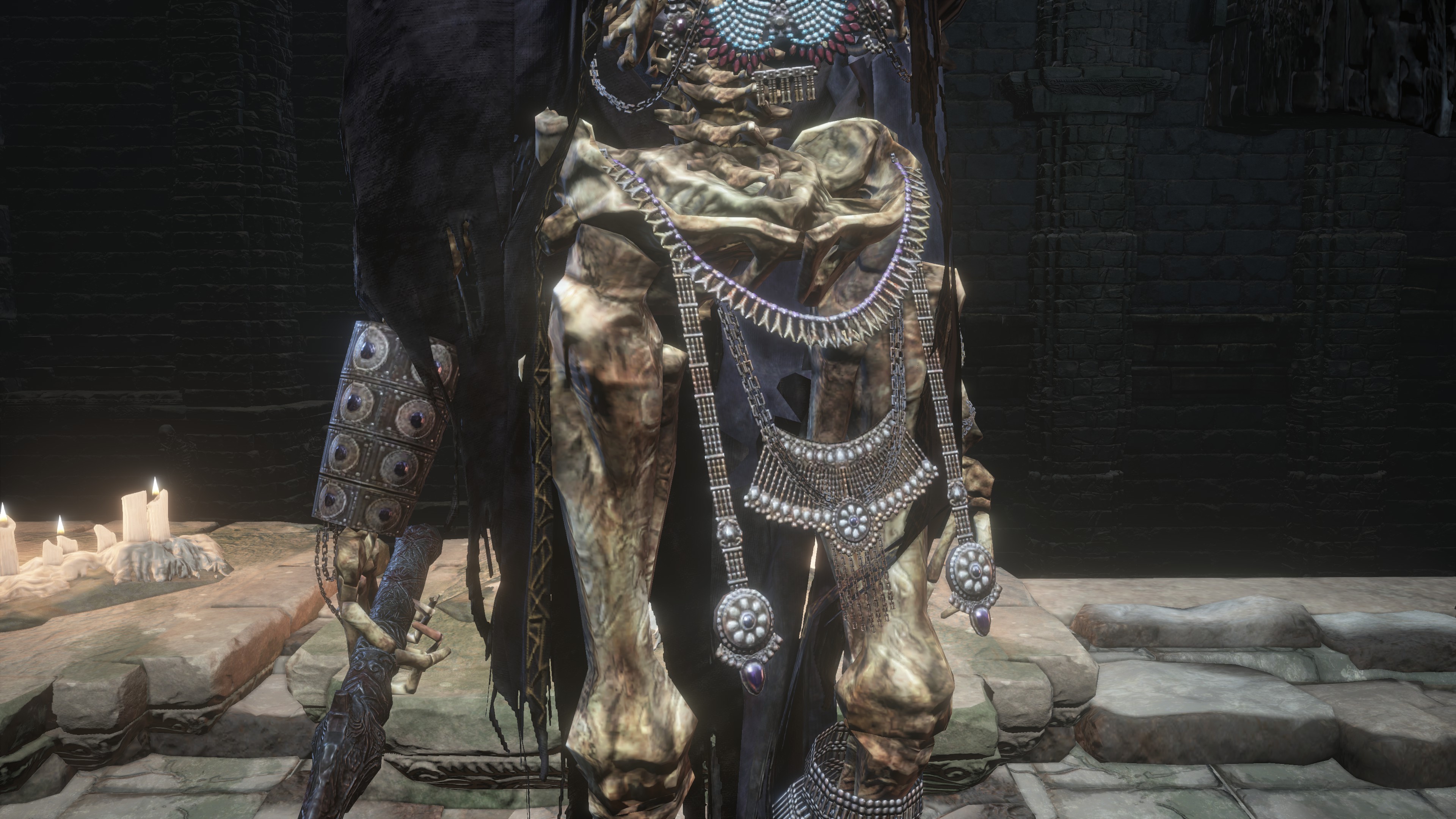

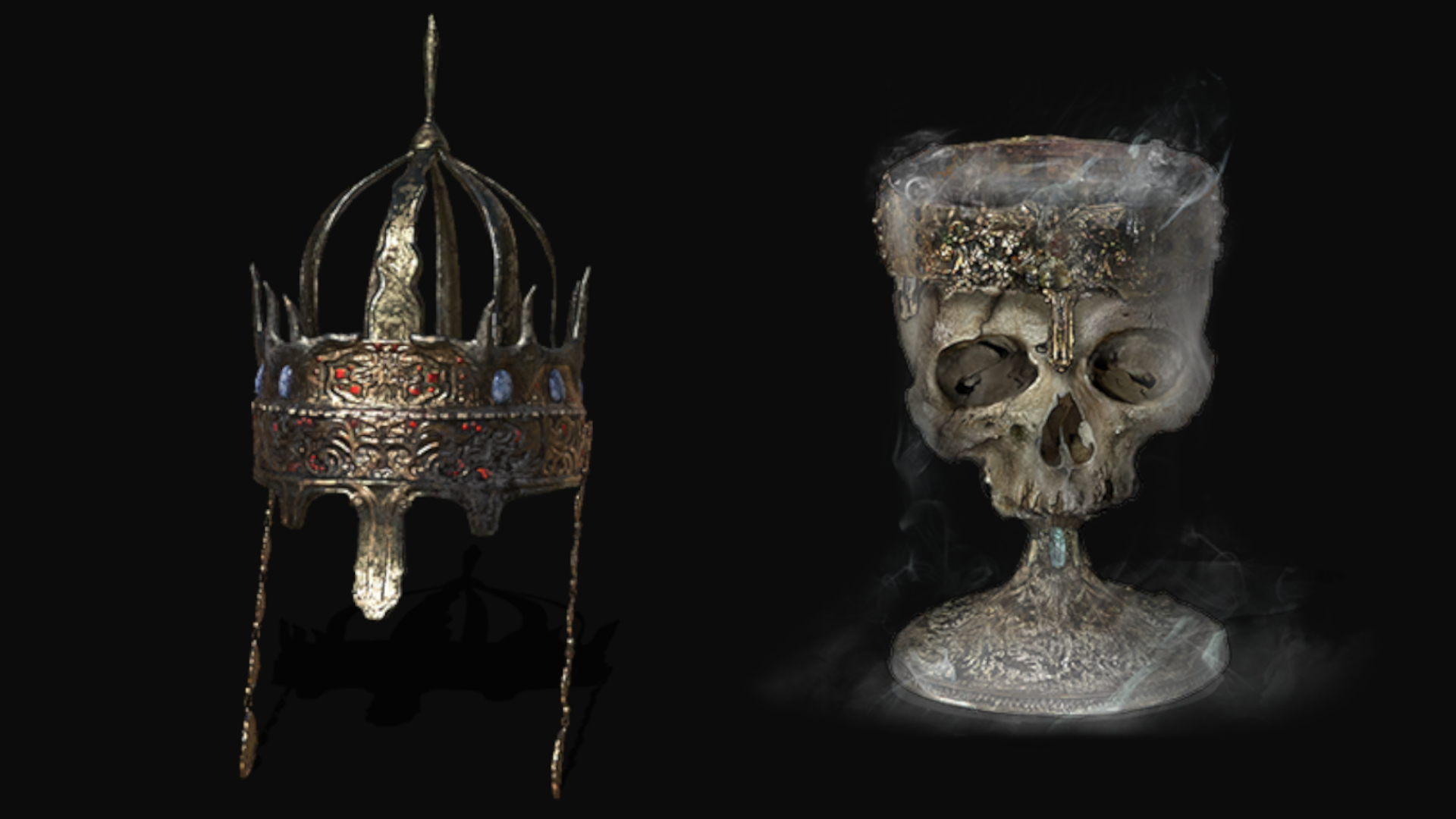
Crown of Wolnir, High King of Carthus.
It is said that those were once equally given to various kings, and that Wolnir conquered and destroyed them all. Then the crowns became one, and he became High King.
Which states these were and how they were managed goes unmentioned, though his looted holy relics might indicate the holy capital of Lindelt to be among the victims. Indeed, if Carthus was the successor to Jugo, then it is possible for many of the countries west of it to have been Wolnir’s prey. Mirrah is the only nation from DS2 referenced by name in DS3, and even these references don’t entirely clarify if it still exists. With no new items updating us on its history, this eastern country constantly assailed by Jugo among others may have finally been crushed underfoot by Carthus. There is certainly evidence of Wolnir reaching as far as Drangleic — an anonymous swordsman staying at Carthus as the High Lord’s guest wielded the Black Blade. Fans may notice that this sword is identical to the Berserker Blade of DS2, wielded by mercenaries lingering in the territory of the Old Iron King long after their employer their had expired by the previous game’s era. In other words, Wolnir’s guest was most likely one of these berserkers.
Petite katana of a swordsman who was known as a guest of High King Wolnir. The katana with black luster is thick, but shorter than normal katana.
It is said that the swordsman wielded this and had command of a novel sword technique. Remnants of that can probably be seen in the strong attack.
If Carthus extended so far as to host a guest from Drangleic, then the continent may have been among the subjugated regions. Even if not, why Wolnir entertained such a guest can be inferred from his weapon. Katanas are slightly curved swords with lacerating cuts, so Wolnir might have thought to incorporate his guest’s weapon and techniques into his military’s arsenal, similar to how the Old Iron King used his katana-wielding visitor. The High King wasn’t as hospitable to his guest, however. The Black Blade is found hiding within a mimic in the Abandoned Tomb at Carthus, suggesting that Wolnir had the swordsman killed once he was satisfied and then locked it away, safely securing his new toy and potential military secret; to be fair, the berserker was presumably Undead and thus a hazard anyway. Still, if his treatment of his guests is anything to go by, Wolnir probably wasn’t very hospitable to the lands he conquered either. Perhaps it was inevitable that such an amoral country like Carthus would end up being seduced by the Dark.
Dark in Death
Somewhere down the line, Wolnir fell to the Abyss. This too can likely be credited, at least in part, to his guest. Most of the berserkers in DS2 were encountered specifically at Brume Tower, which had become haunted by a child of Dark. In that case, Wolnir had an eye witness to regale him stories of this abyssal abomination and the black flames she wielded, stories that would undoubtedly intrigue him. Recall that New World culture didn’t have the same reflex aversion to the Dark like the regions dominated by the gods do. Many deemed it taboo, but that meant some did not. And as a country whose only standard was what it could use to have power over others, Carthus had no need for that bias. If there was power which could improve the country’s pyromancy, he wanted to know it — especially if its source is unknown to people at large as Black Flame’s description indicates. And the events at Brume Tower definitely had an influence on this development.
Pyromancy that the pyromancers who became gravekeepers discovered after High King Wolnir fell to the Abyss.
Generates a large, black flame in hand.
It is said that the black flames produced from the Abyss don’t bear a shadow, and that no one will be separated from them. “That is the fire of humanity.”
After familiarizing himself with the Abyss, Wolnir discovered dark pyromancies, the description for Black Serpent indicating it to be the first of such spells. Fans may recognize this pyromancy as a Dark version to DS2’s Fire Snake pyromancy created by Eygil, onetime overseer of Brume Tower. How convenient that the tryant just so happened to recreate that spell with Dark magic, a spell which the magic caster had invented in the hopes of ultimately granting fire its own will — the very thing the Dark of humanity sparks in its flames, as the Black Serpent’s description points out. In all likelihood, Wolnir took Eygil’s existing research at the tower, either directly or through his guest, and built upon it to its completion, using the knowledge of the Abyss his guest provided. Much like the Old Iron King whom Eygil served, the similarly belligerent and affluent High King sought to create living flames. And much like his predecessor, this came with its own share of problems.
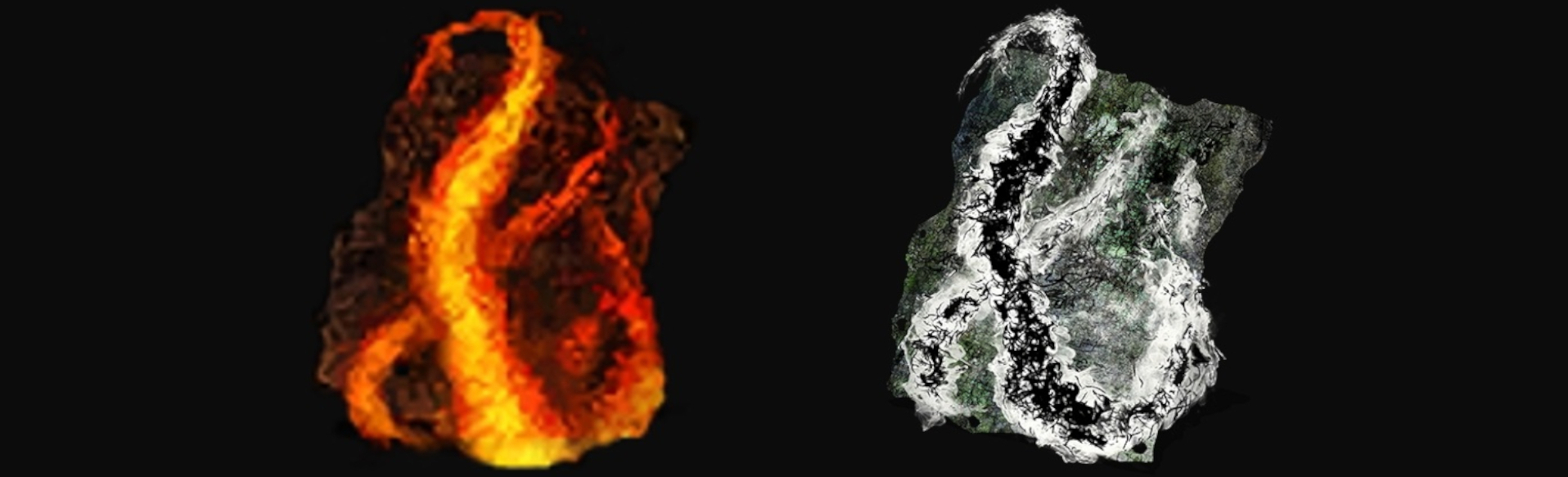
Pyromancy that High King Wolnir discovered in the Abyss. It became the beginning of the gravekeepers’ black pyromancies.
Dispatches black flames as if they run the land undulating.
Be it sorcery or pyromancy, the arts that come in contact with humanity arrive at the same place. That is, they seek a will there.
There has been much confusion over why the only part of Carthus we can explore is just the catacombs and not the entire desert civilization, even more so why Wolnir and his troops have joined the ranks of the dead and who killed them. Surely the lands drifting around Lothric would have brought the entire city, not just its crypt? This has led some fans to posit that Farron’s Undead Legion are to blame. We enter the Catacombs of Carthus from the Farron mausoleum built atop them, and Hawkwood mentions that the Abyss Watchers were willing to bury an entire country in order to stop the Abyss. Wouldn’t this mean that the legion destroyed Carthus and buried its people on the spot, building their base atop its remains? Not necessarily. Why would the Abyss Watchers bother to respectfully bury a civilization that had allowed the Abyss to fester, let alone embrace it? And if the legion was responsible for Carthus’ destruction, then there would be no Abyss and certainly no reanimated skeletons of its dabblers. However, one trip through the catacombs proves this can’t be further from the truth. Farron is not the reason.
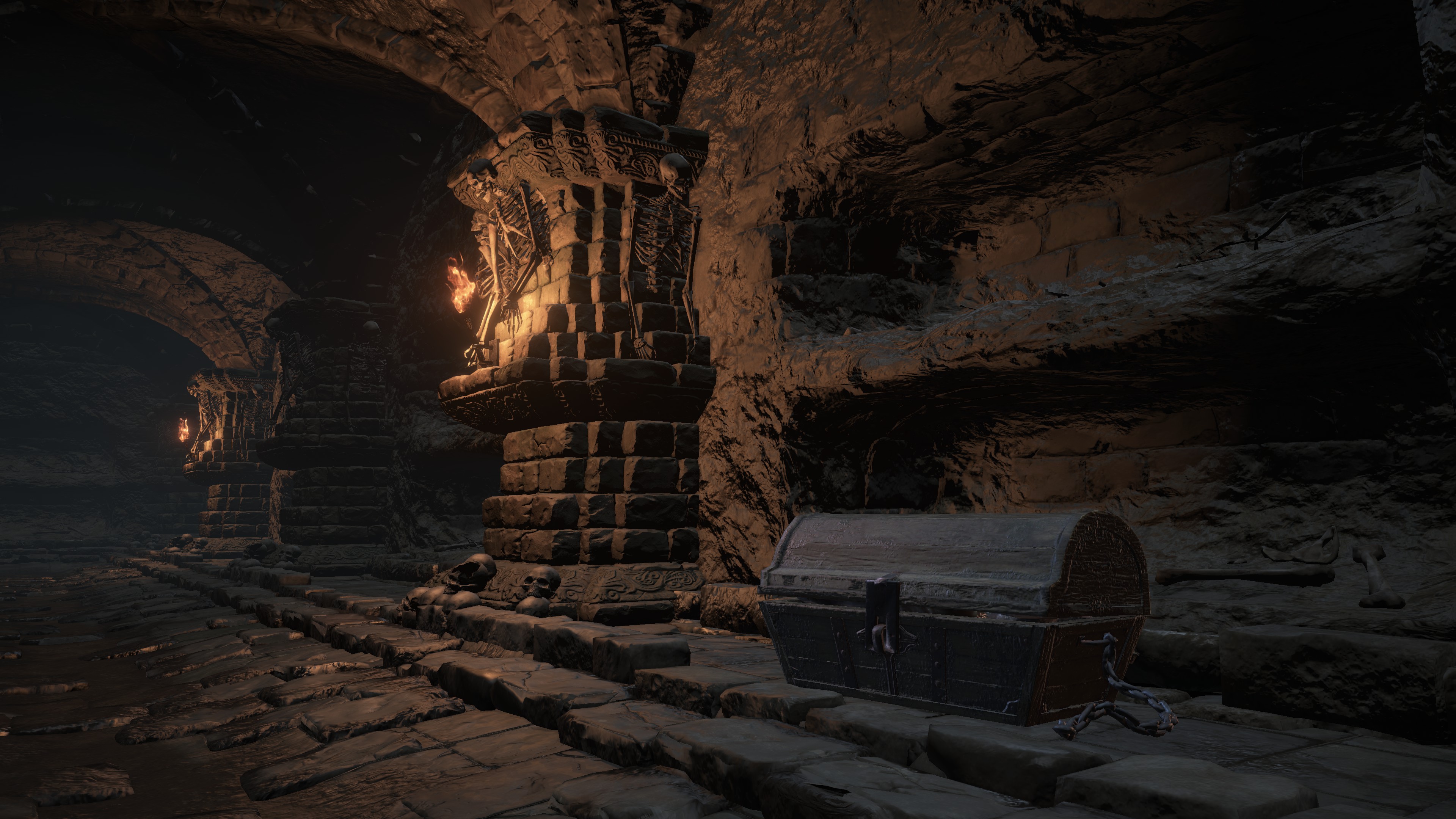
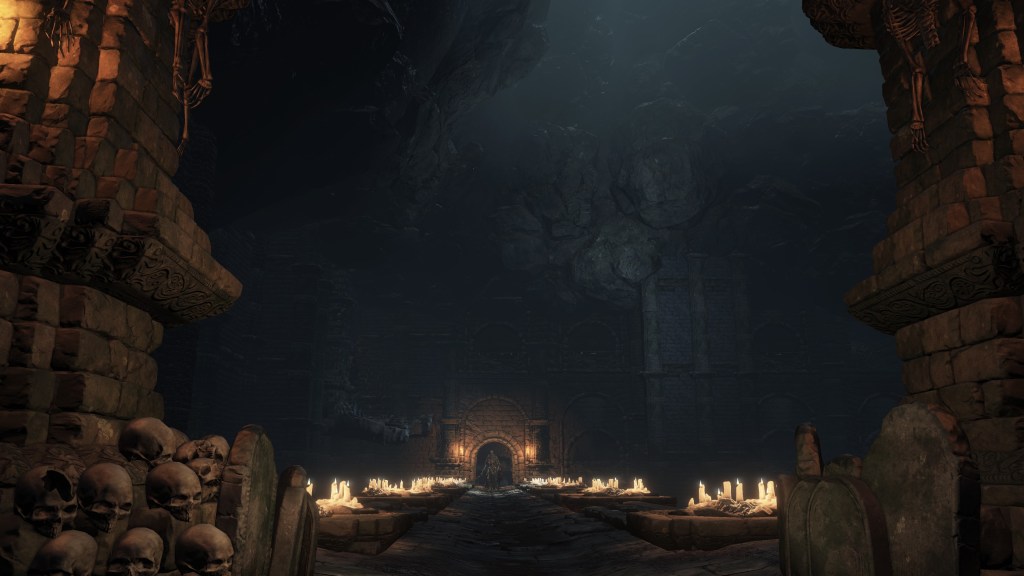
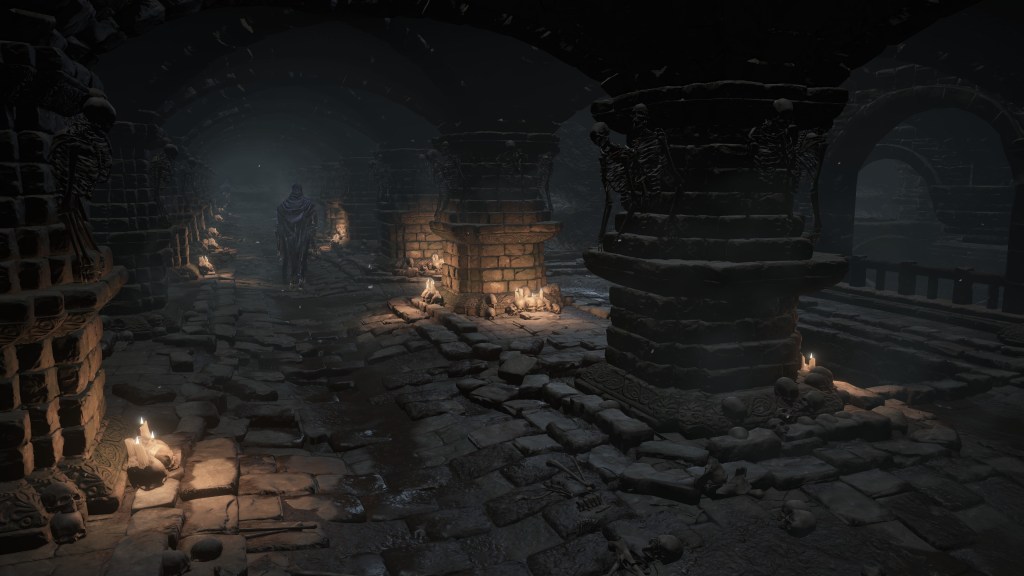
The reason is because the Catacombs are the city of Carthus. As with most other countries in Dark Souls, Carthus was in all likelihood originally a city state, only later becoming a multi-state empire. And Wolnir intentionally turned that original capital from a metropolis into a necropolis. The description for Wolnir’s soul doesn’t say that he was “keen to outlive” all the people he had killed as the localization puts it. Rather, he ultimately aimed to be the “last of the dead”. Put another way, Wolnir had offed countless people before finally deciding to off himself. He wanted his current skeletal form. Various item descriptions also reiterate Carthus citizens becoming the grave wardens for the Catacombs. Why would its pyromancers and squires dedicate the rest of their lives to taking care of their fallen nation’s tombs unless it was not really fallen at all? Everything we see is as Wolnir willed it to be, converting his own country into a massive tomb complex.
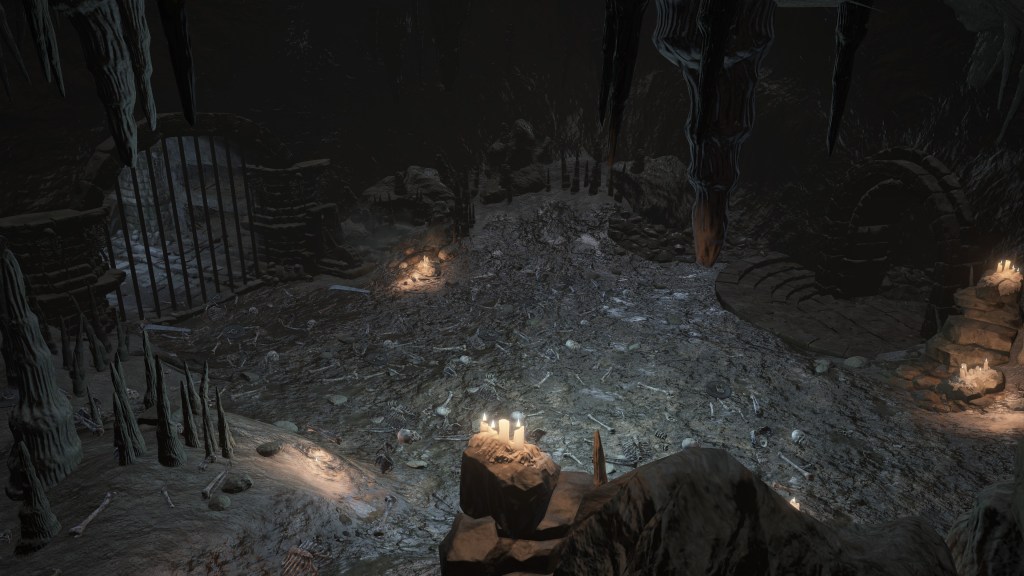
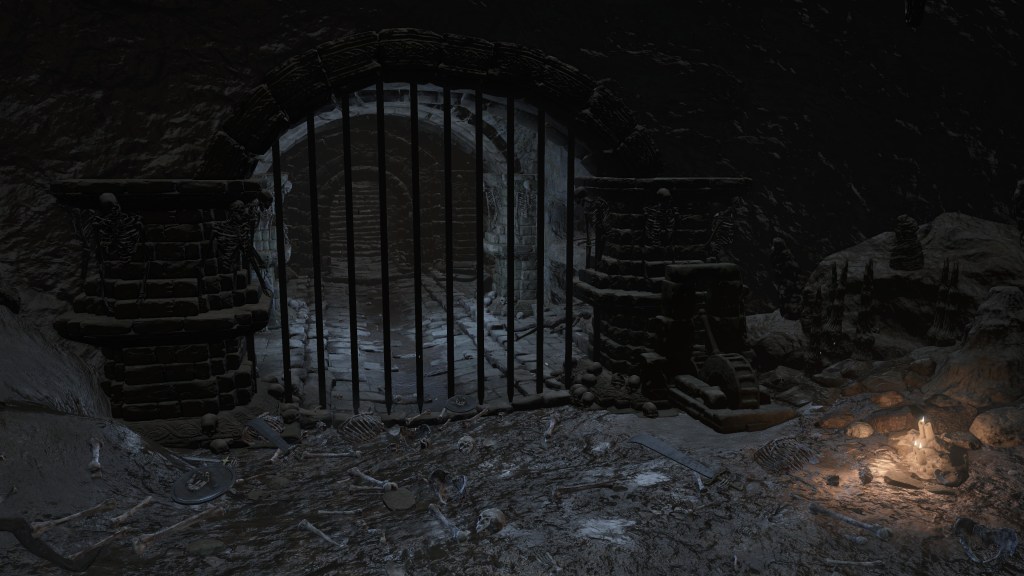
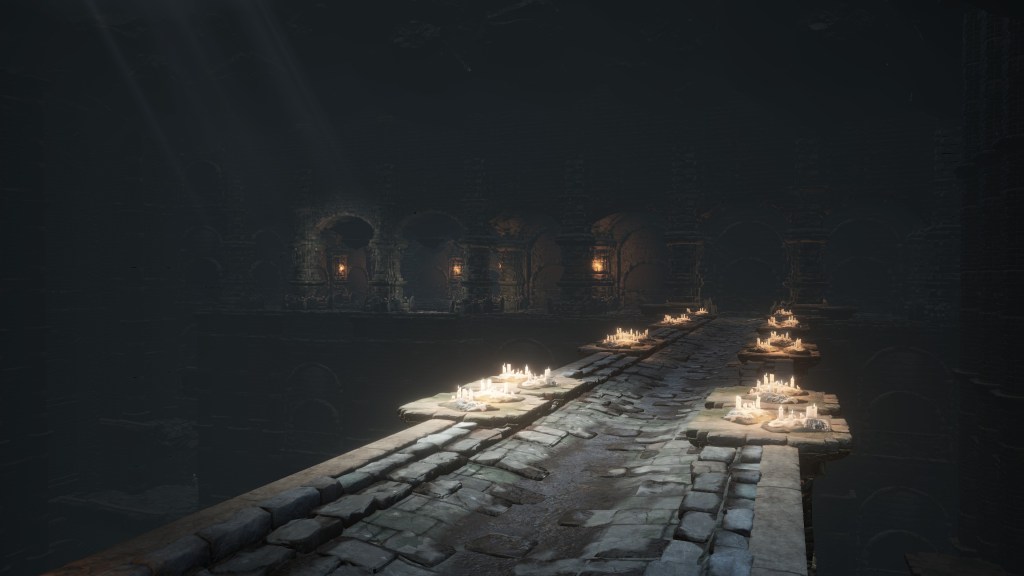



Soul of High King Wolnir. One of the atypical souls tinged with power.
Can either use to acquire a vast amount of souls or extract its power via molding.
It is said that the High King of Carthus who amassed a great many deaths eventually wished to be the last of the dead.
The emergence of these grave wardens followed Wolnir’s fall to the Abyss, implying that Carthus becoming a kingdom of the dead and his discovery of the Dark are directly connected. True, Dark and death do bear a close relationship. But more importantly, death comes with a form of immortality that would allow Wolnir to maintain his power for perpetuity — if Nito could think of it, why not him? This way, his kingdom could wield the tremendous power of the Dark forever without dealing with undeath and hollowing. It was an ingenious solution, but not without its problems. Contrary to his continued use of it, Wolnir was afraid of the Dark. For that reason, he relied upon the holy power of the gods for the first time in his life by wearing and wielding his stolen holy relics, which highlights how shameless the man really is. He never paid respect to the gods his entire life, but once he was met with a power that even he couldn’t entirely control, he clung to them.
Pyromancy book of the gravekeepers. Book of the Catacombs of Carthus.
Can learn black flame pyromancies by giving it to a pyromancy master.
It is said that, after High King Wolnir of Carthus fell to the Abyss, the pyromancers became gravekeepers and discovered black fire.
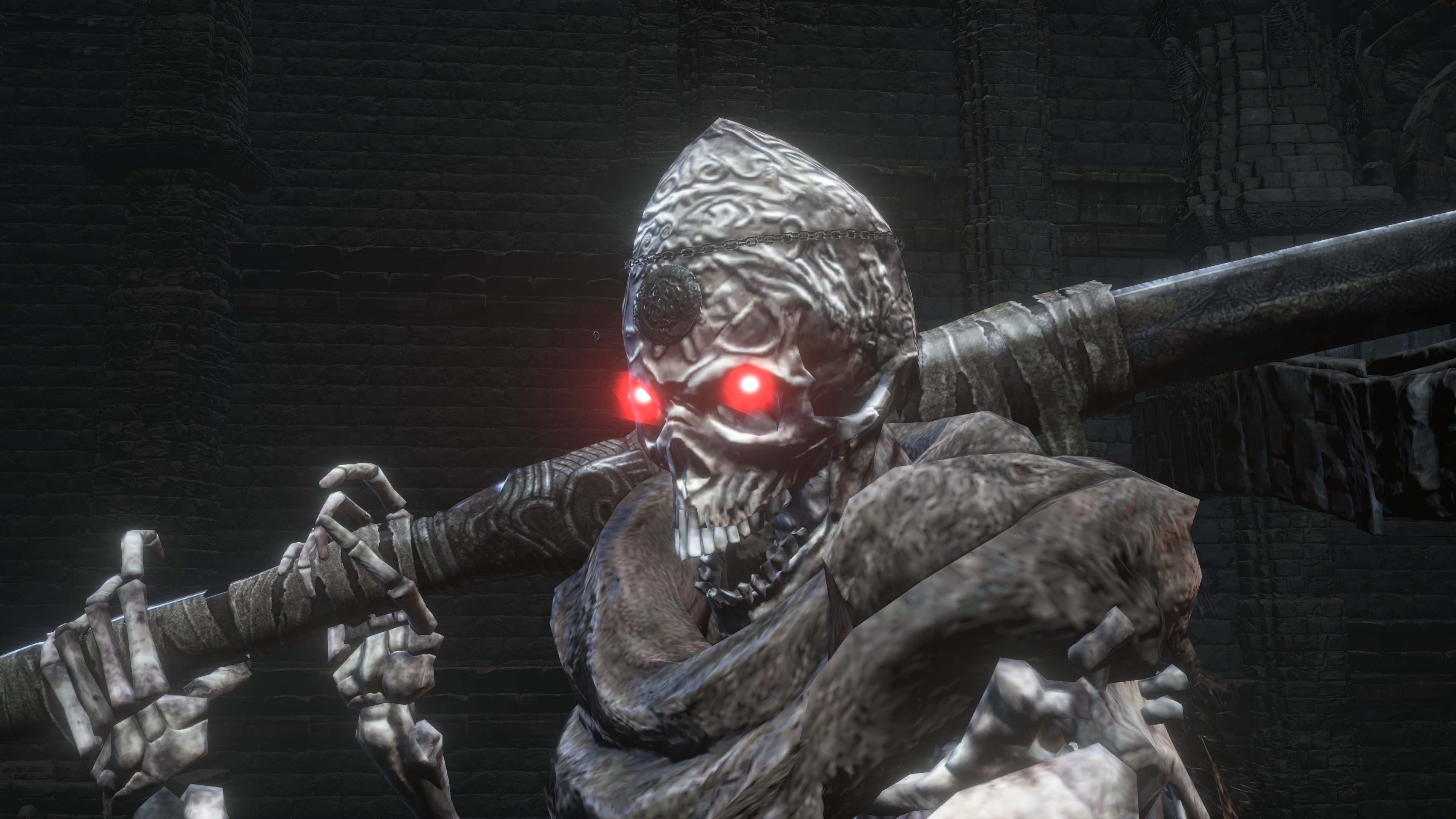
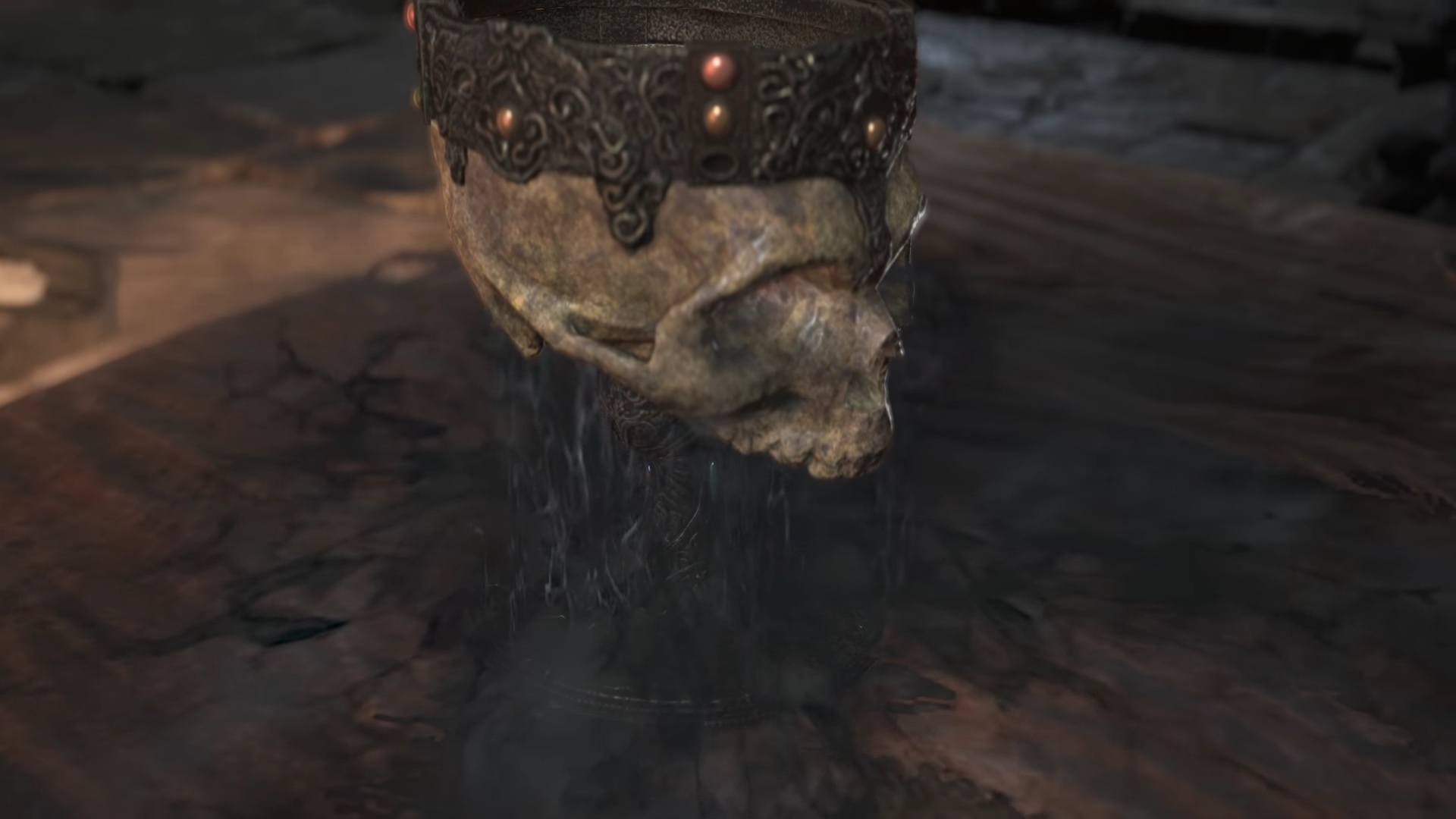
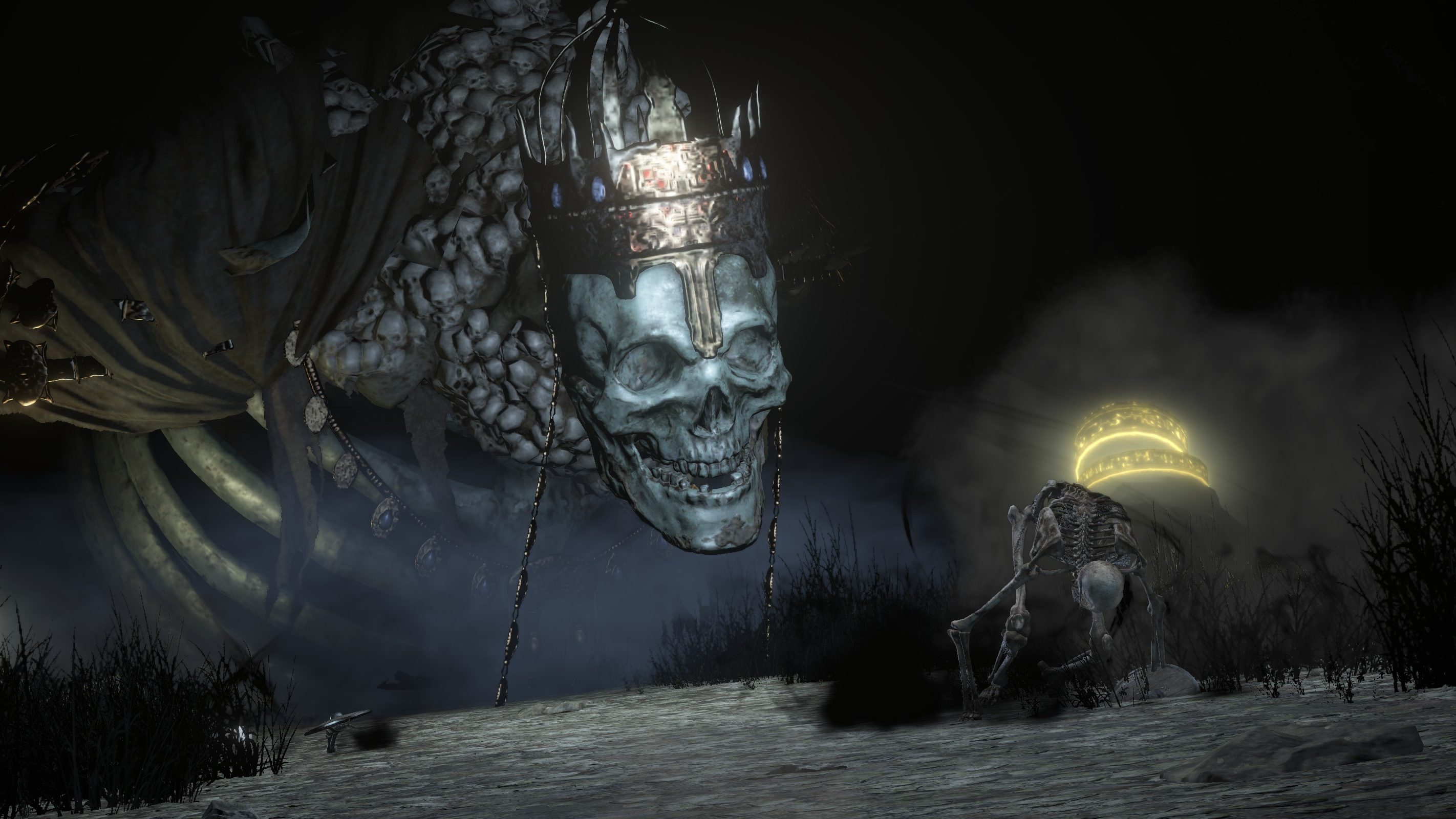
Whether his embrace of death was out of reverence or fear for the Dark he was experimenting with, his fear had certainly led him to utilize the powers of both light and death. For the former, we see him use not just the aforementioned holy relics but also the skull goblet. This cut item is named “Holy Remains”, (聖遺骸) suggesting that this “noble” king had been blessed by the gods or at least absorbed some of their power in the course of living a pious life. Either way, Wolnir had clearly known about this fact and decided to use that power to his advantage. It is through this cup on an altar that we are pulled into the Abyss where the boss resides. This Abyss is evidently in no existing part of the Catacombs, the terrain instead resembling an arid cavern. This suggests that the High King used the holy chalice as a medium to seal his fear within a dimension along with the piece of the Carthus desert it afflicted. Creating a pocket dimension linked to an object isn’t unprecedented for the gods’ magic, as the painting world so aptly demonstrates. What is more intriguing is Wolnir’s presence within it.
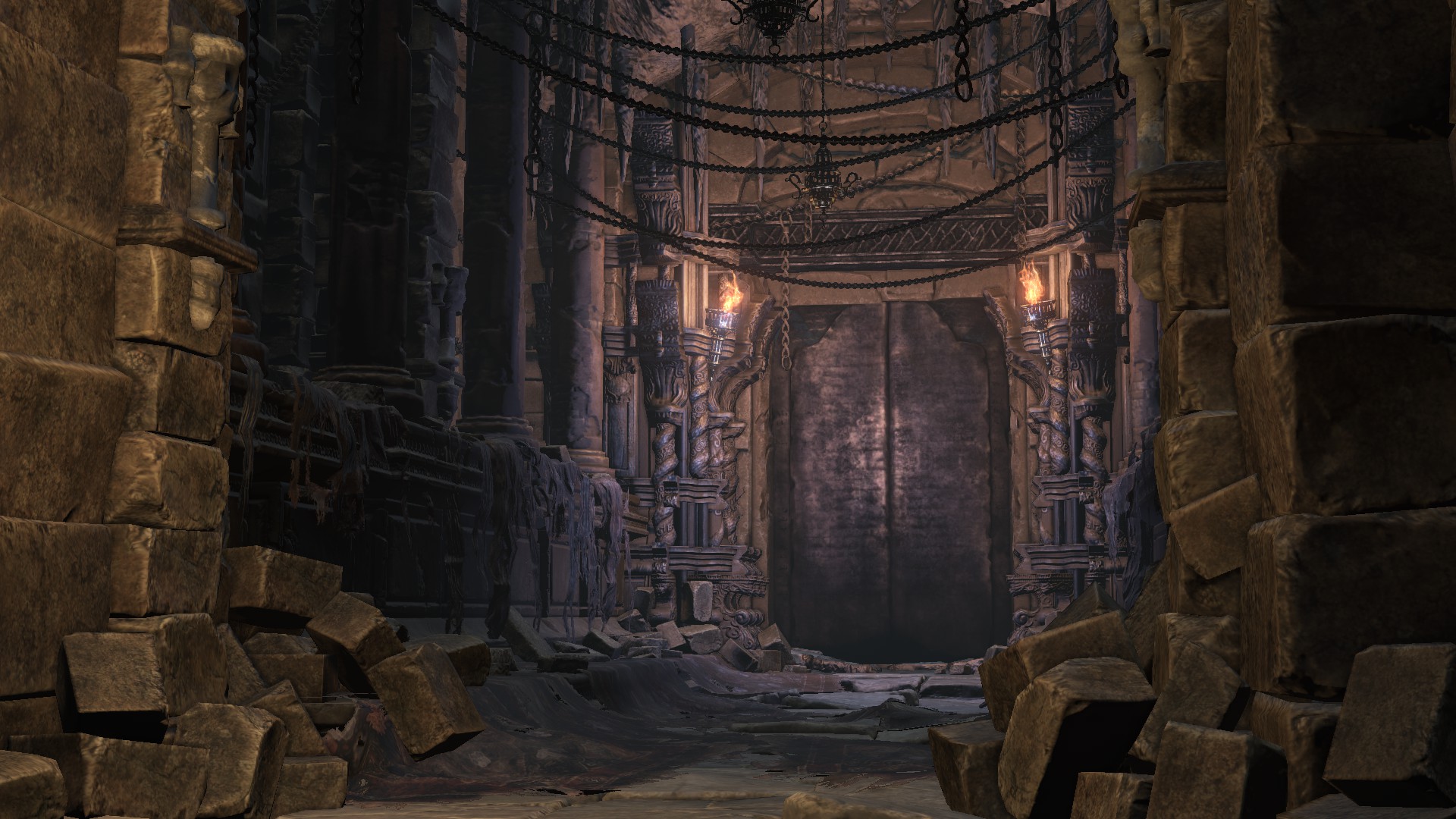
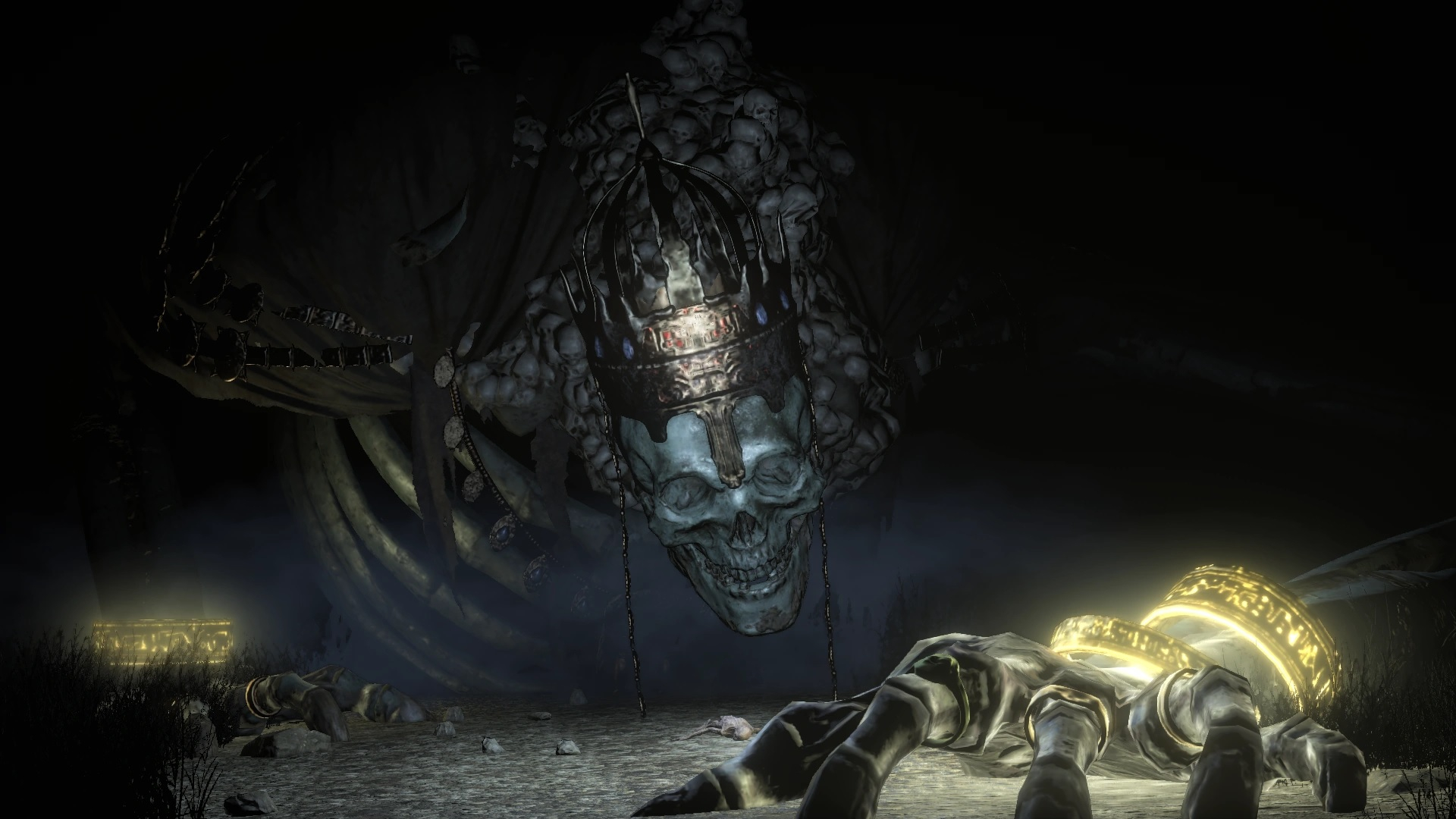
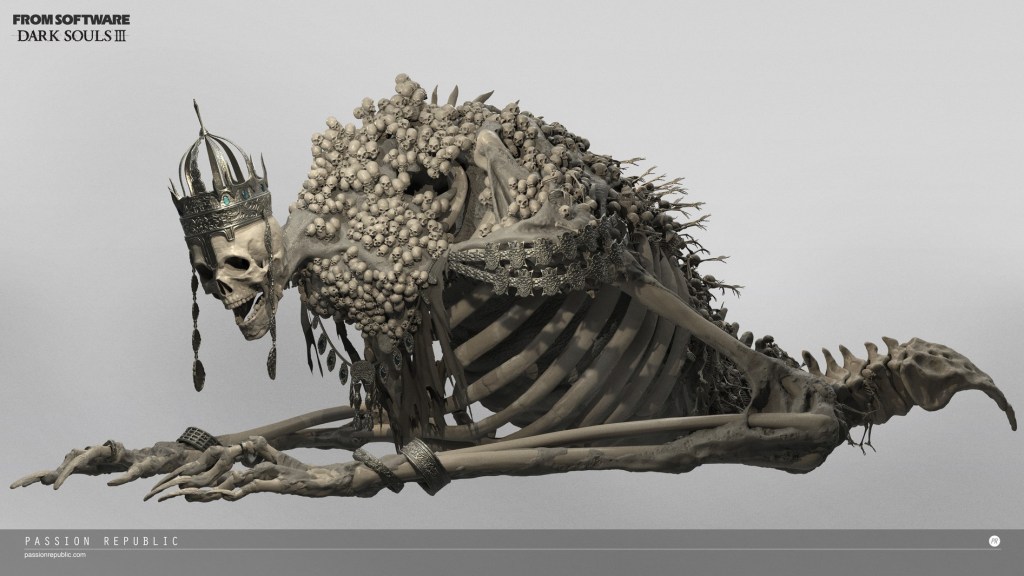
More than likely, the tyrant has chosen to reside there in order to increase his power, much like the Four Kings in DS1. The altar chamber and its preceding hall are uniquely decorated with luxurious architecture, cloths, and wooden ornaments, giving more an air of a throne room. The ritual site also houses the same pots sealing humanity in other parts of the area except without the humanity, possibly used to create the Abyss for the ritual. Wolnir likewise continues to use the Dark as a weapon, spewing a shadowy mist that has gathered inside his rib cage — likely due to the prolonged exposure; concept art’s portrayal of his immersion is even more severe. Dark pyromancy similarly spread to the grave wardens afterwards, the corpse of one such warden even carrying a tome detailing some of the spells they discovered laying right before Wolnir in the Abyss. By all indications, Wolnir is in control of the Dark and perfectly capable of bringing others in or out of his dimension from the altar room, like us. So long as he has his trinkets, he is confident that the Abyss won’t consume him or his kingdom.
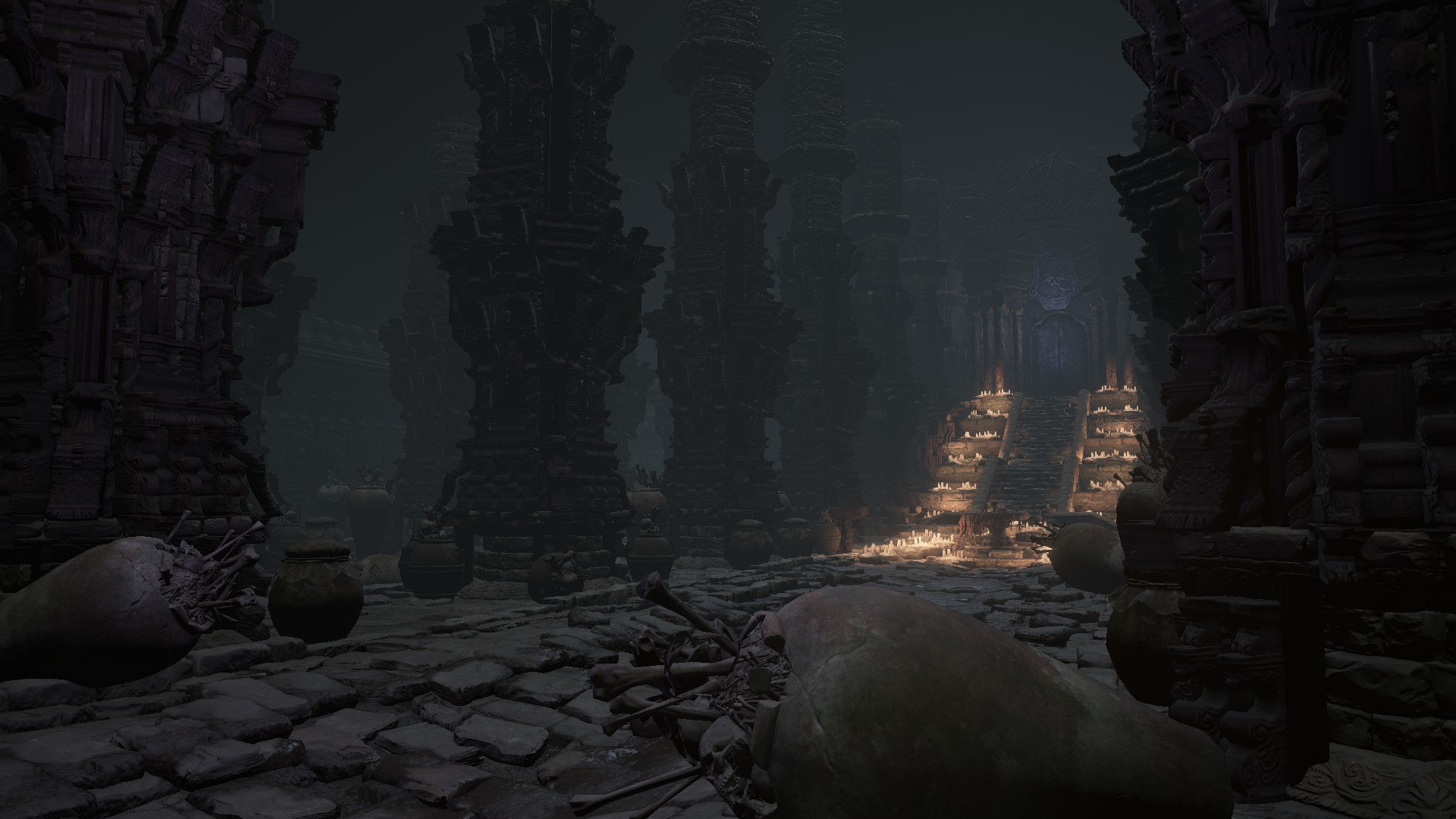
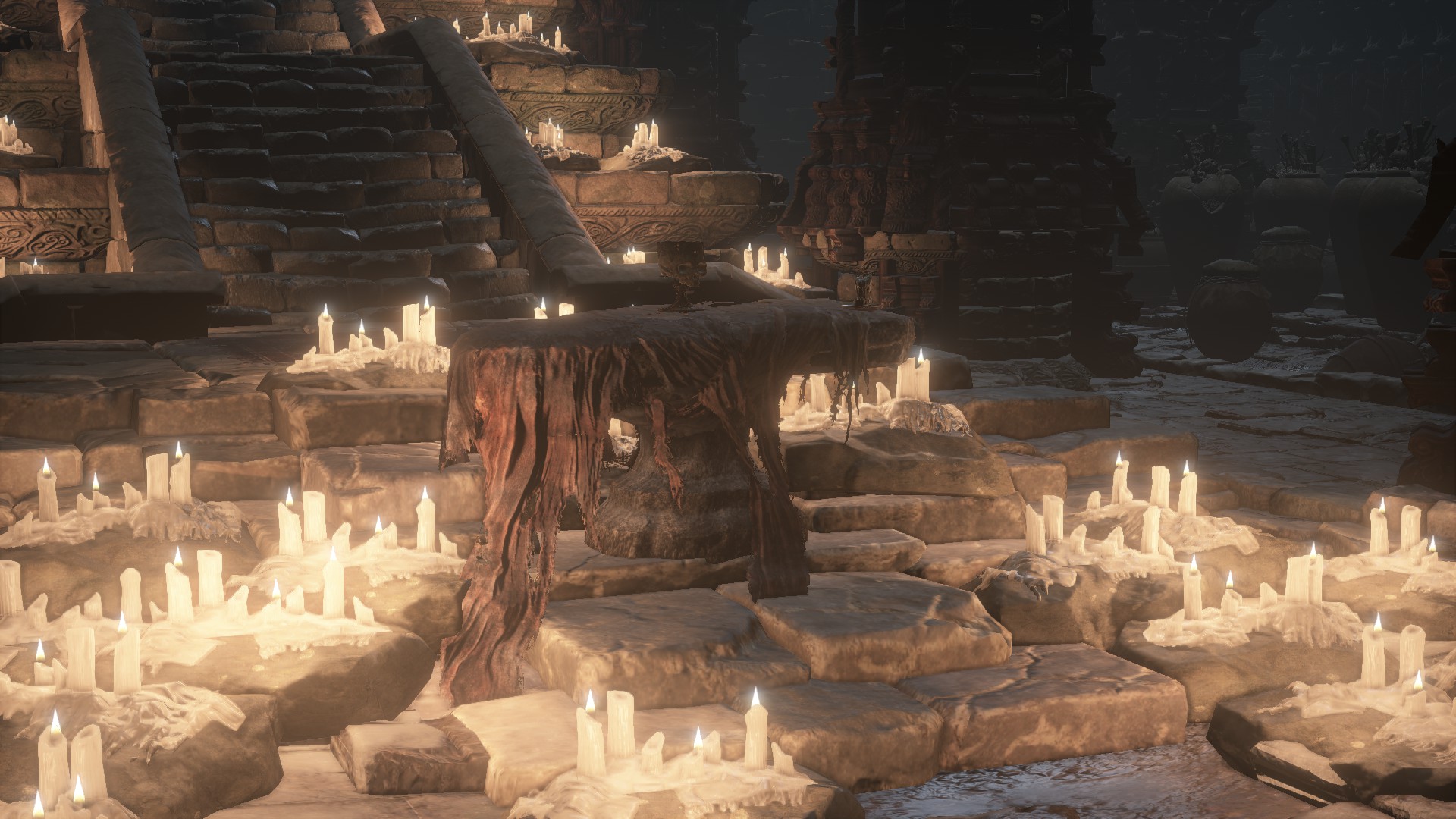

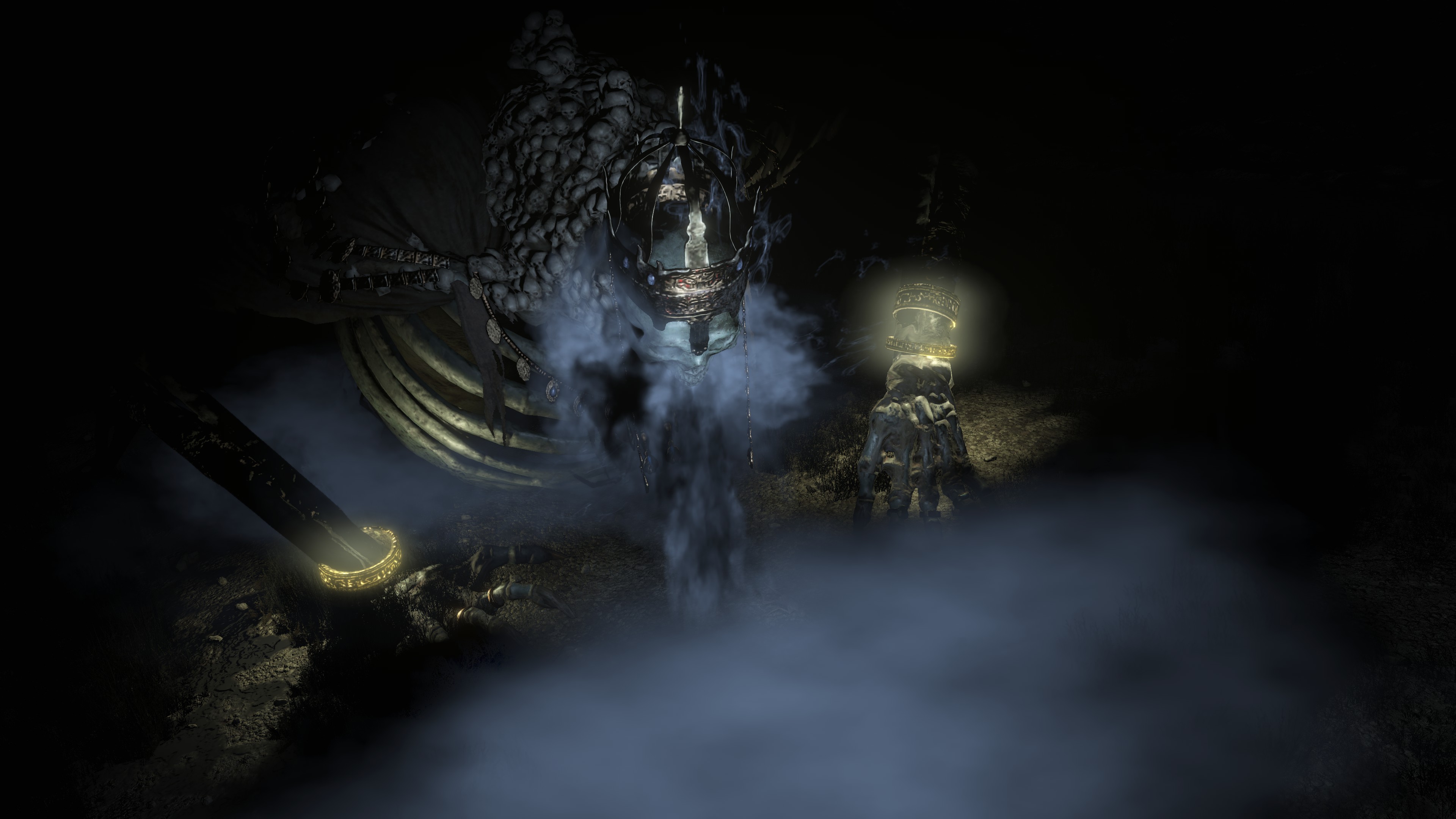
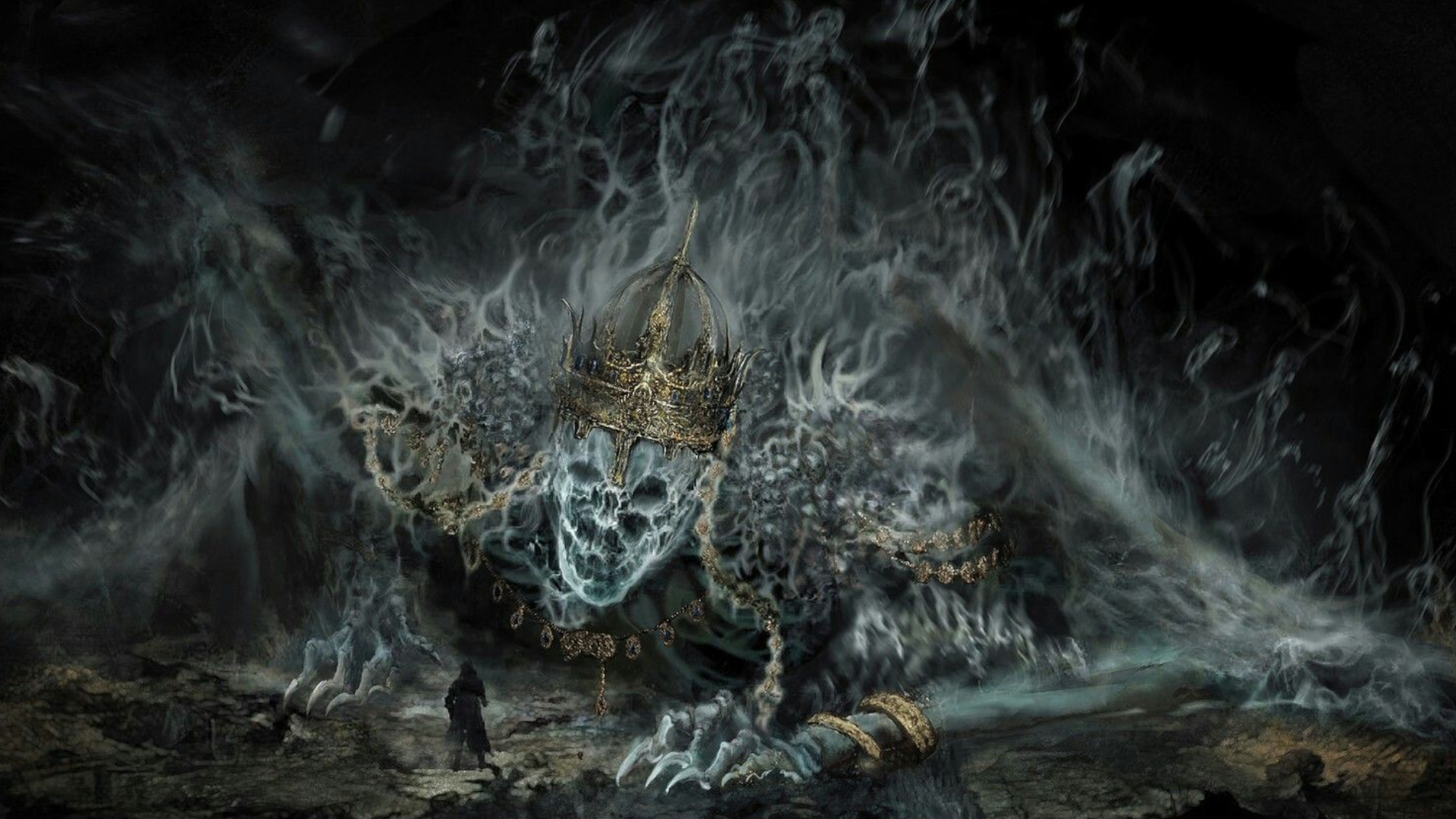
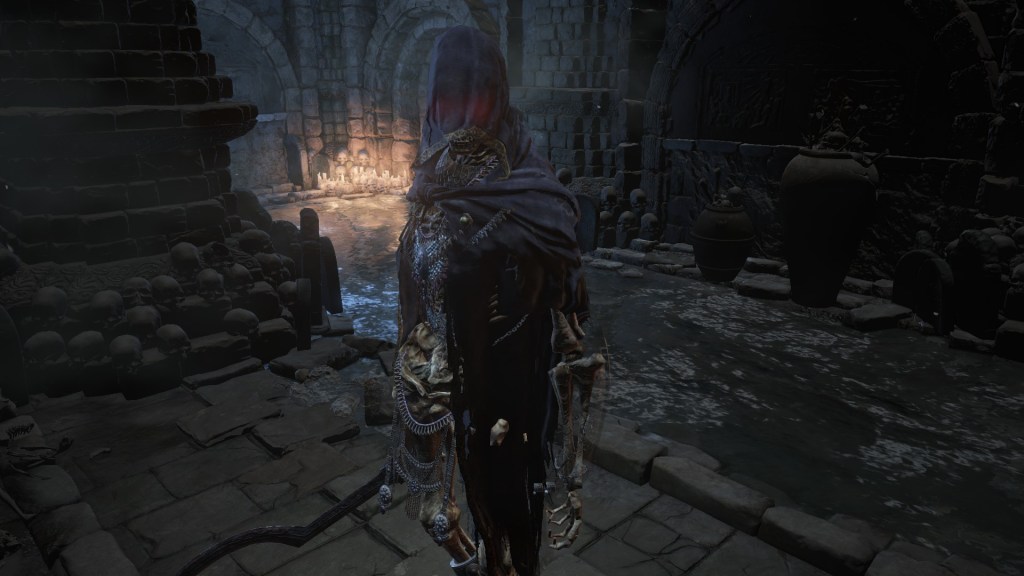
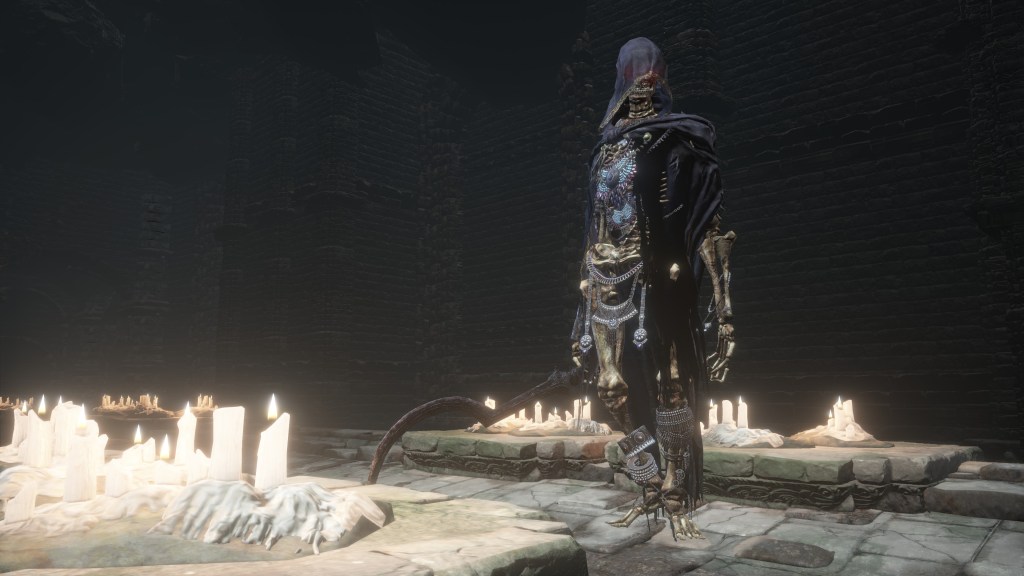
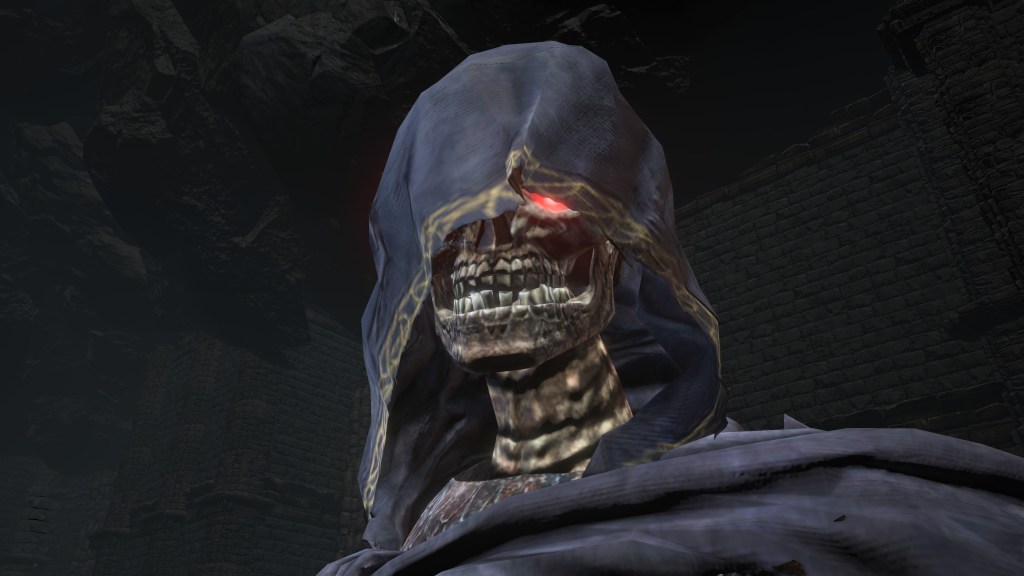
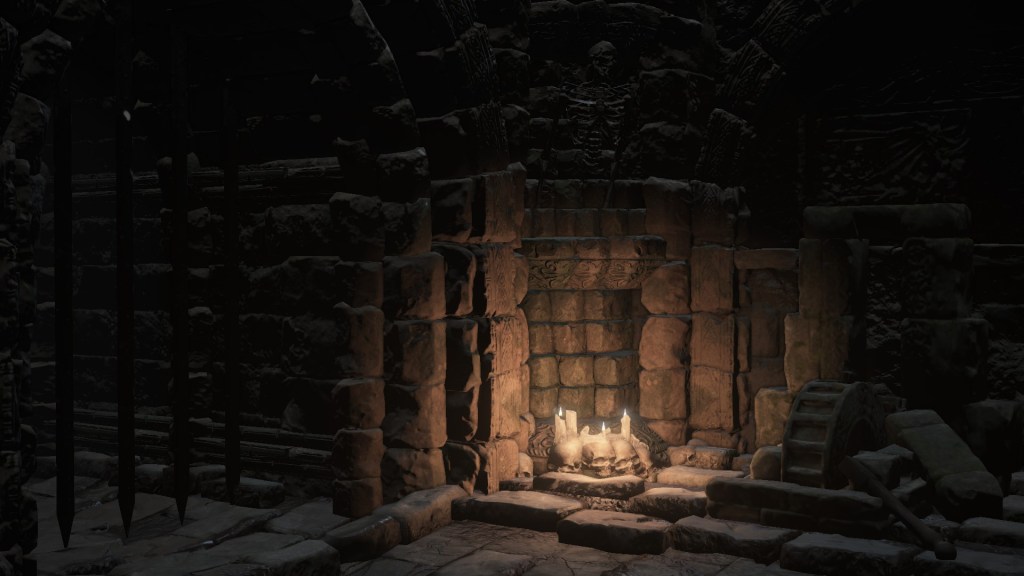
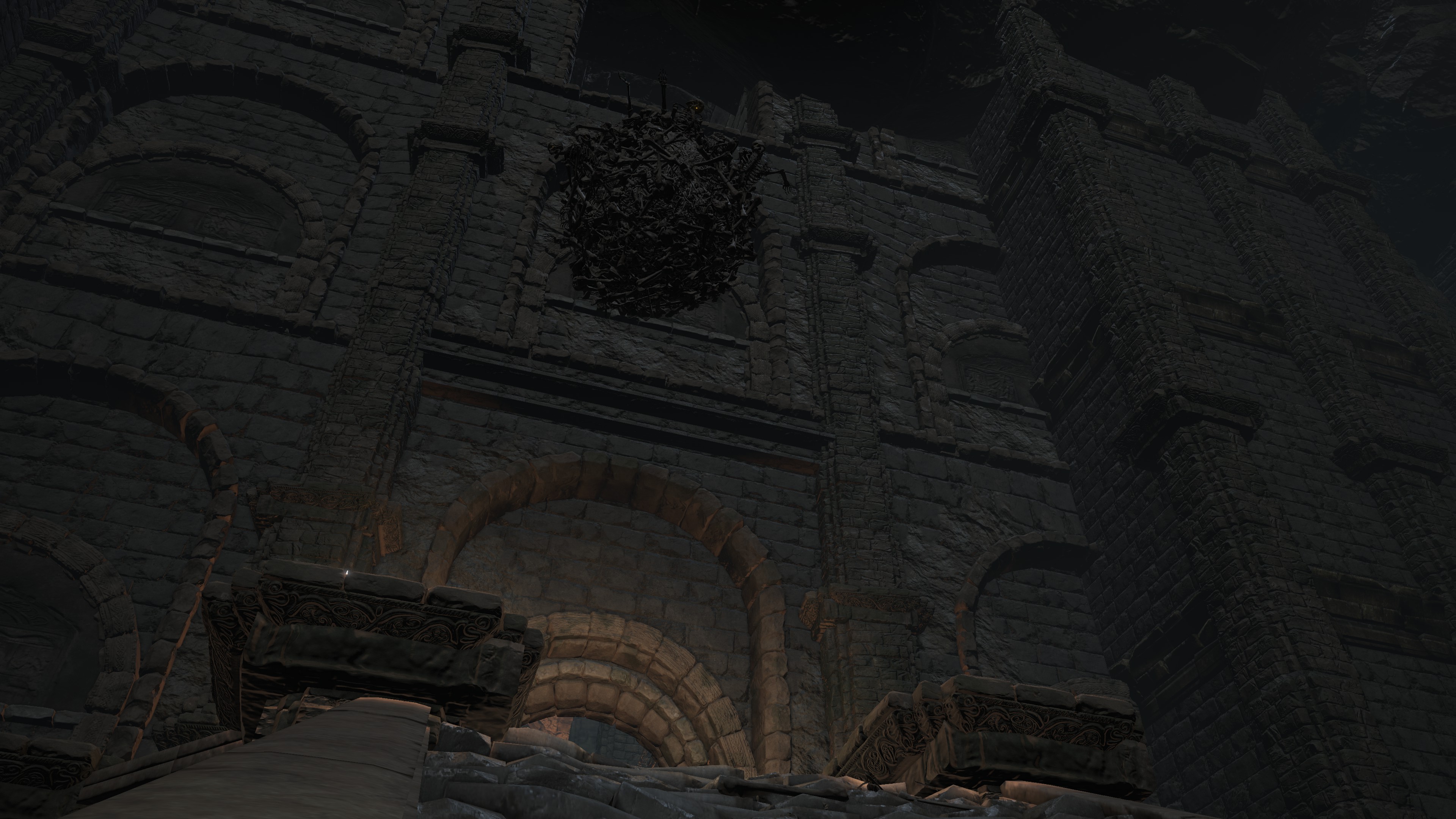
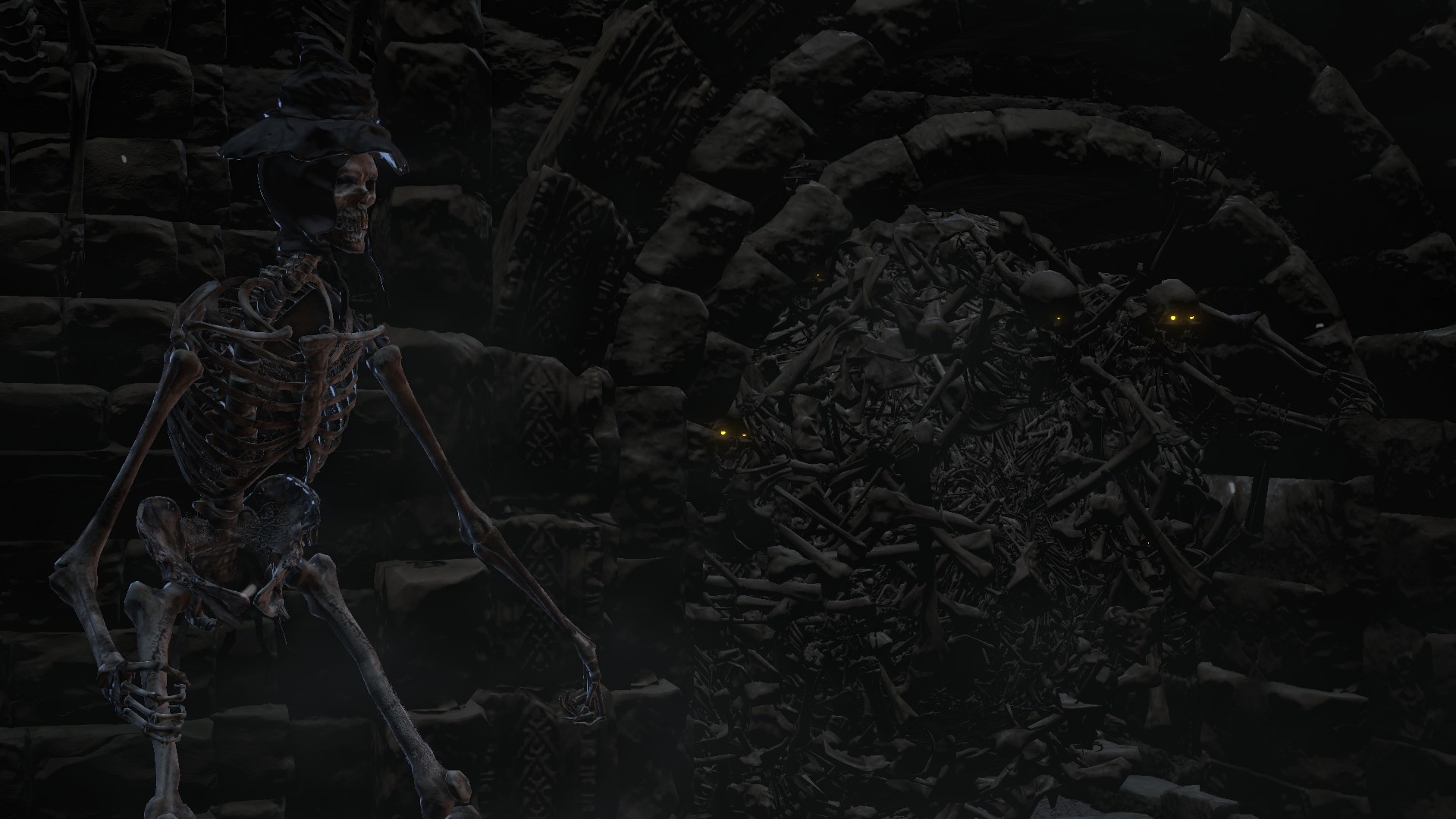
With a solution to his biggest fear decided on, the only thing left was to turn his empire into a kingdom of death. Aside from his knowledge of pyromancy and later Dark arts, Wolnir had also learned necromancy as demonstrated in his boss battle, knowledge shared with the grave wardens. Two peculiar skeletons lurk in different parts of the Catacombs. Both are naked save for the Worker’s Hat of citizens from the Undead Settlement. Said citizens wore it as part of their uniform for tending to burials, so these skeletons presumably performed the same at Carthus. Basically, they are likely to be two of the gravekeepers. When one is killed, a nearby ball of skeletons rolling through halls will break apart upon colliding with a wall instead of roll back. This implies that the two wardens keep those bones together through necromancy. They do possess alluring skulls packed with souls, the basics for such rituals. Several of their fellows likewise revive after falling to pieces just once, sans a blessed weapon, consistent with cases in past games. The signal? Eyes glowing white like an alluring skull.
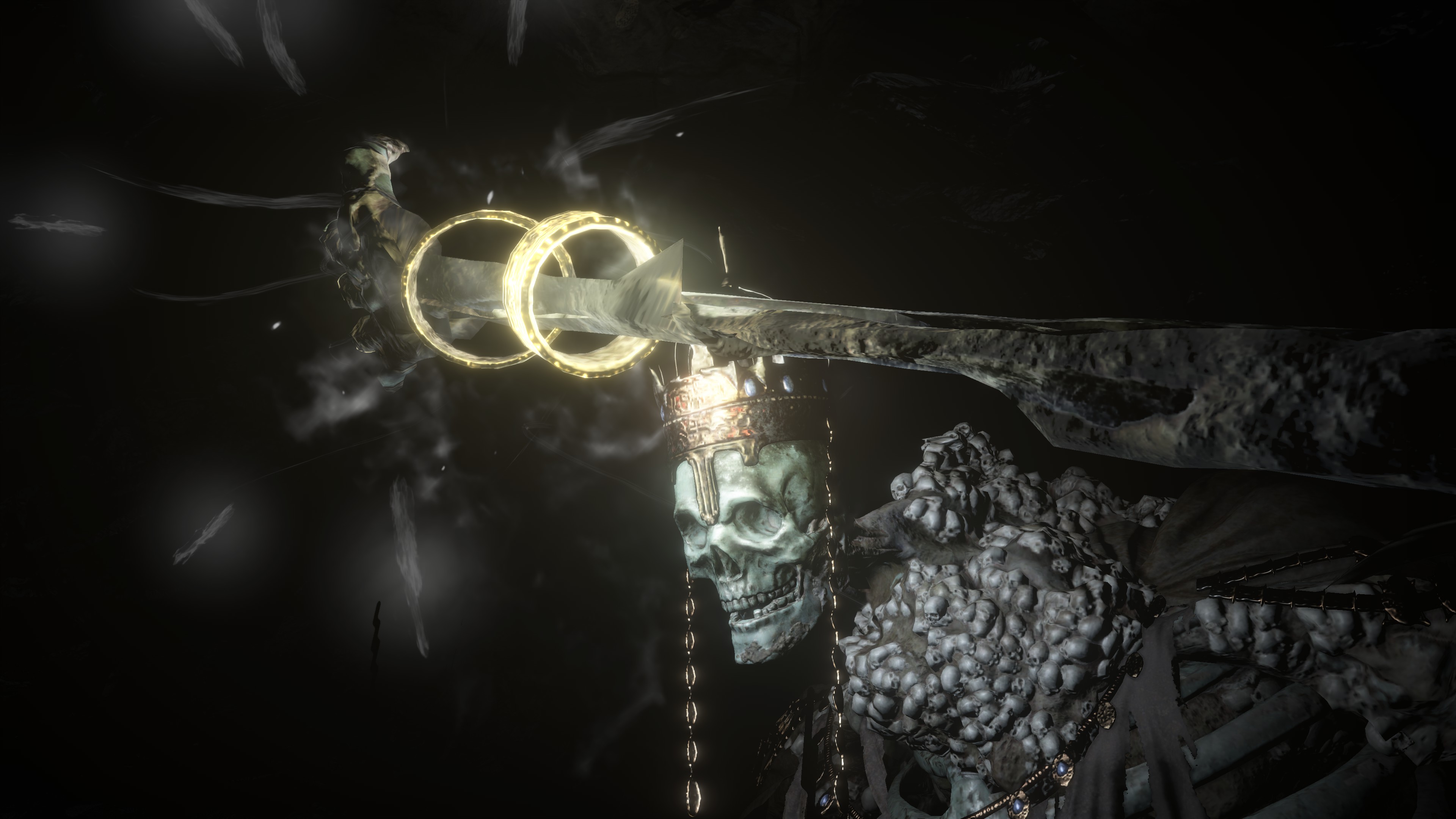
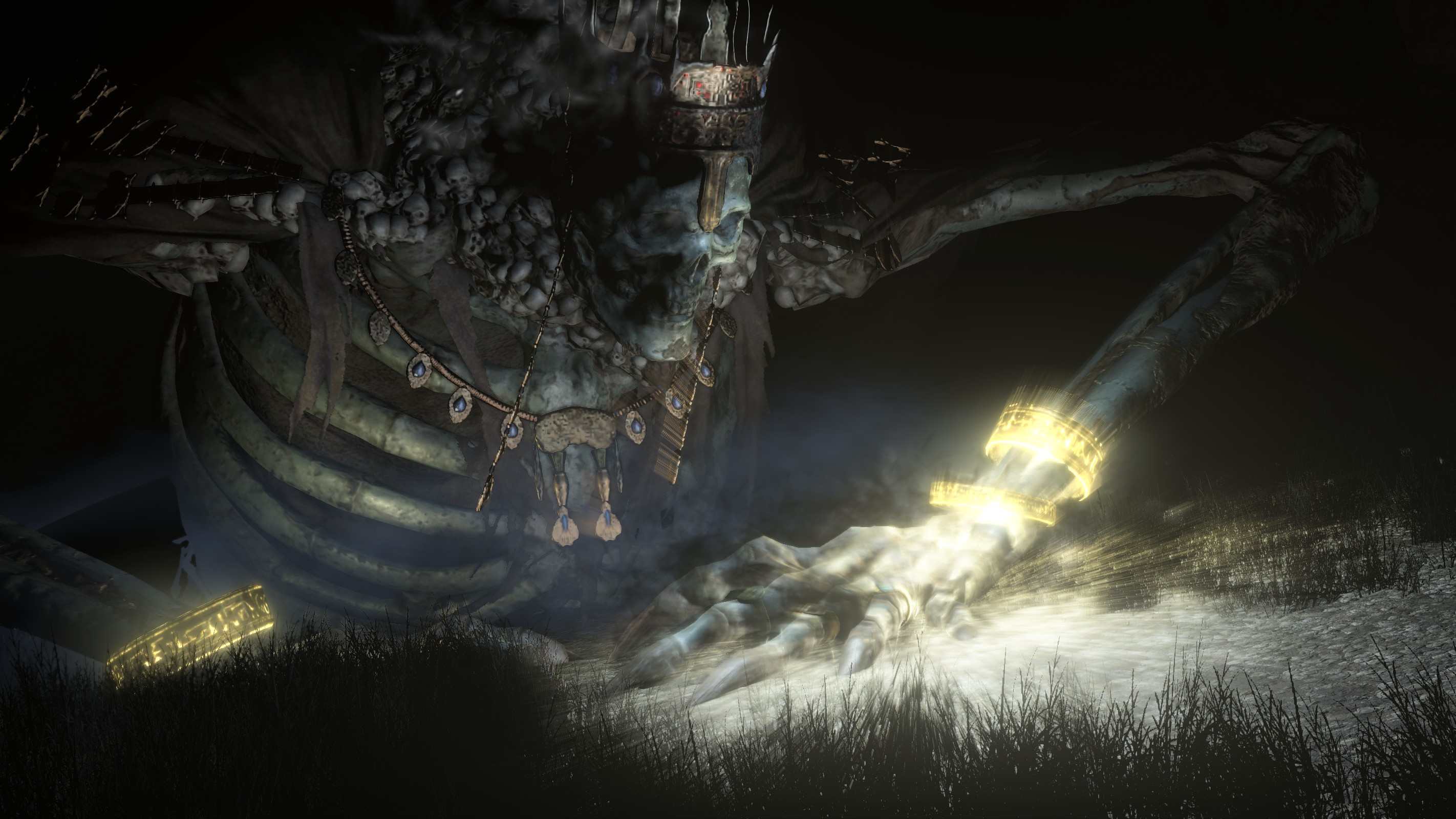
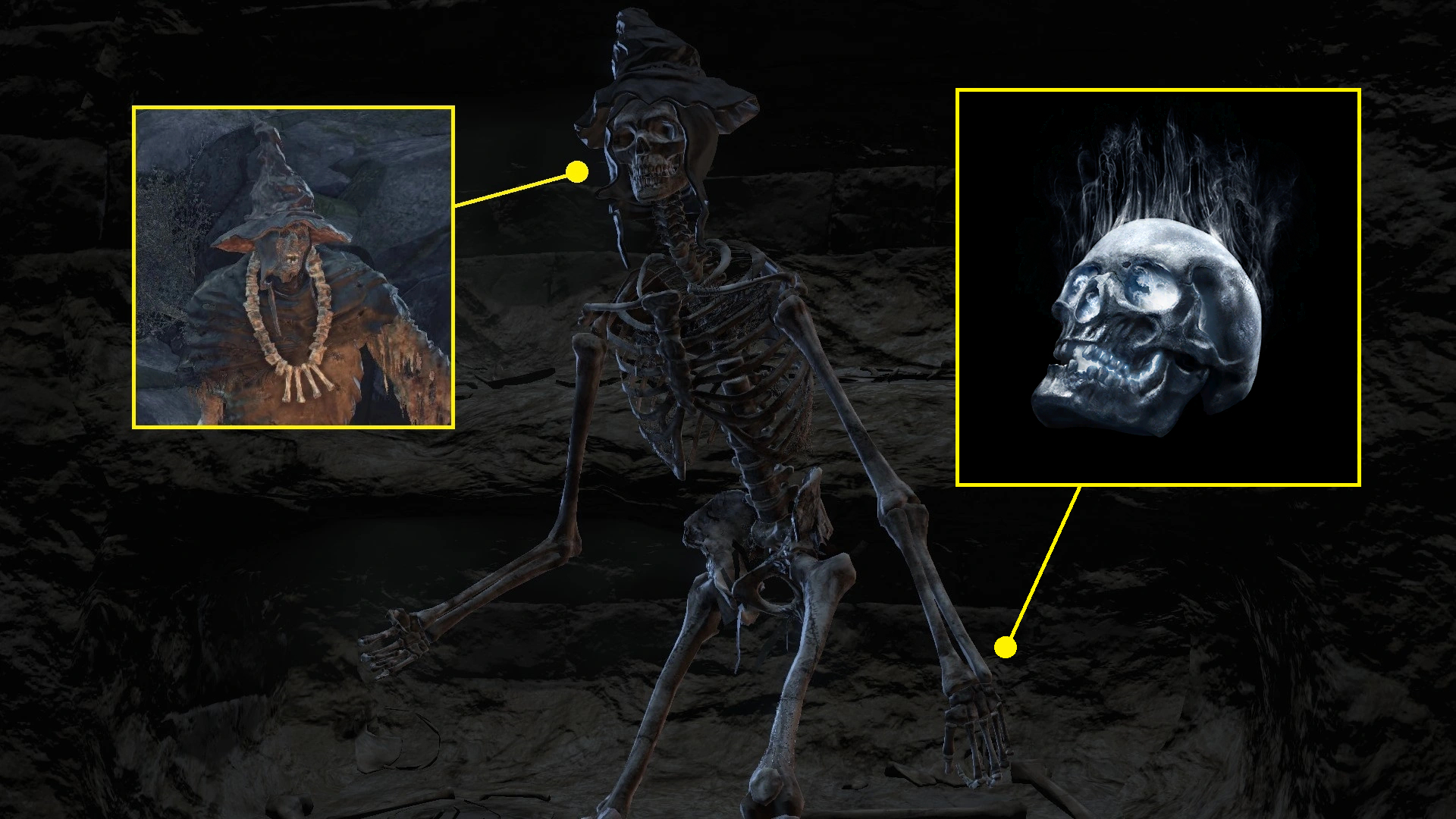
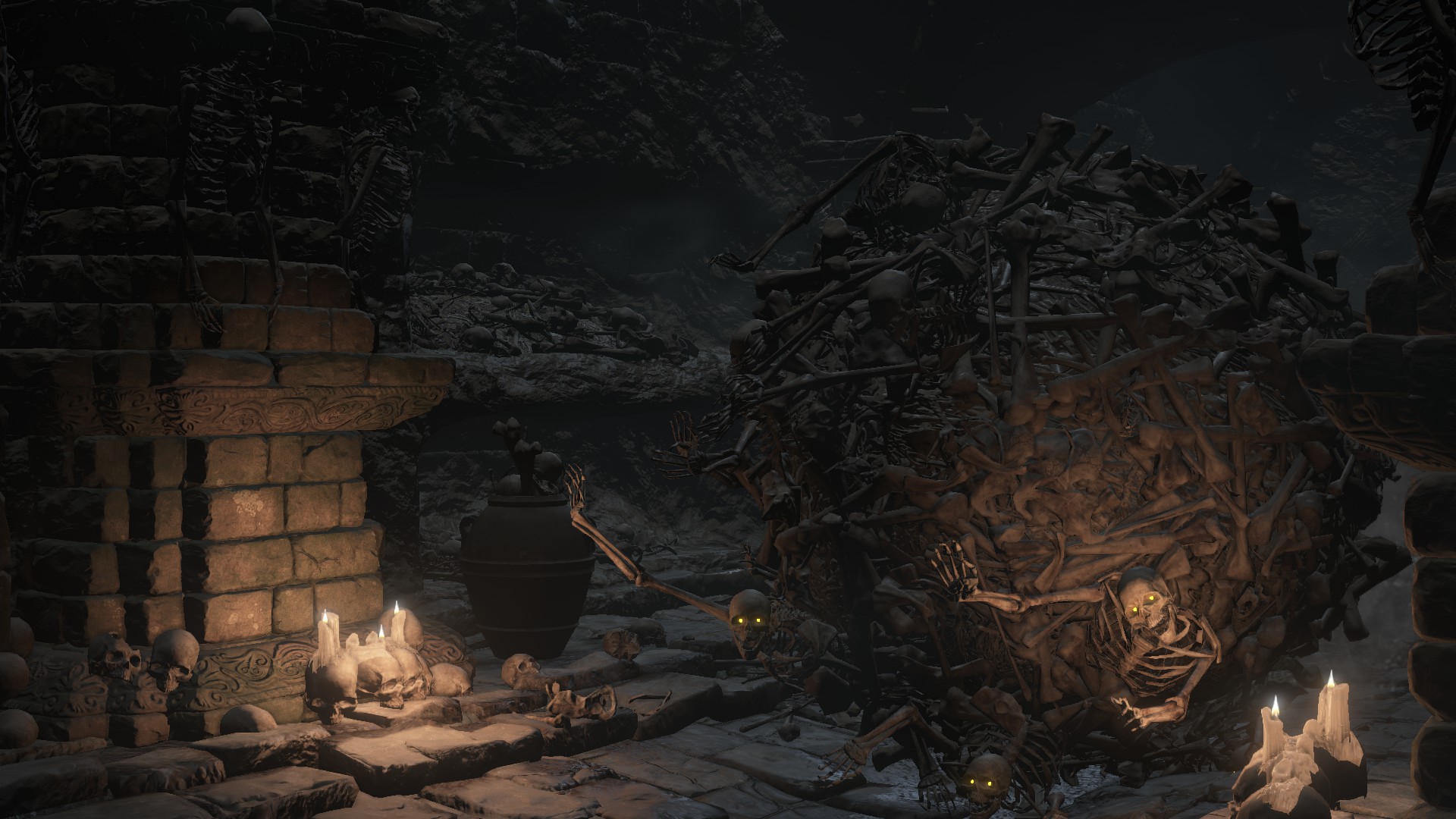
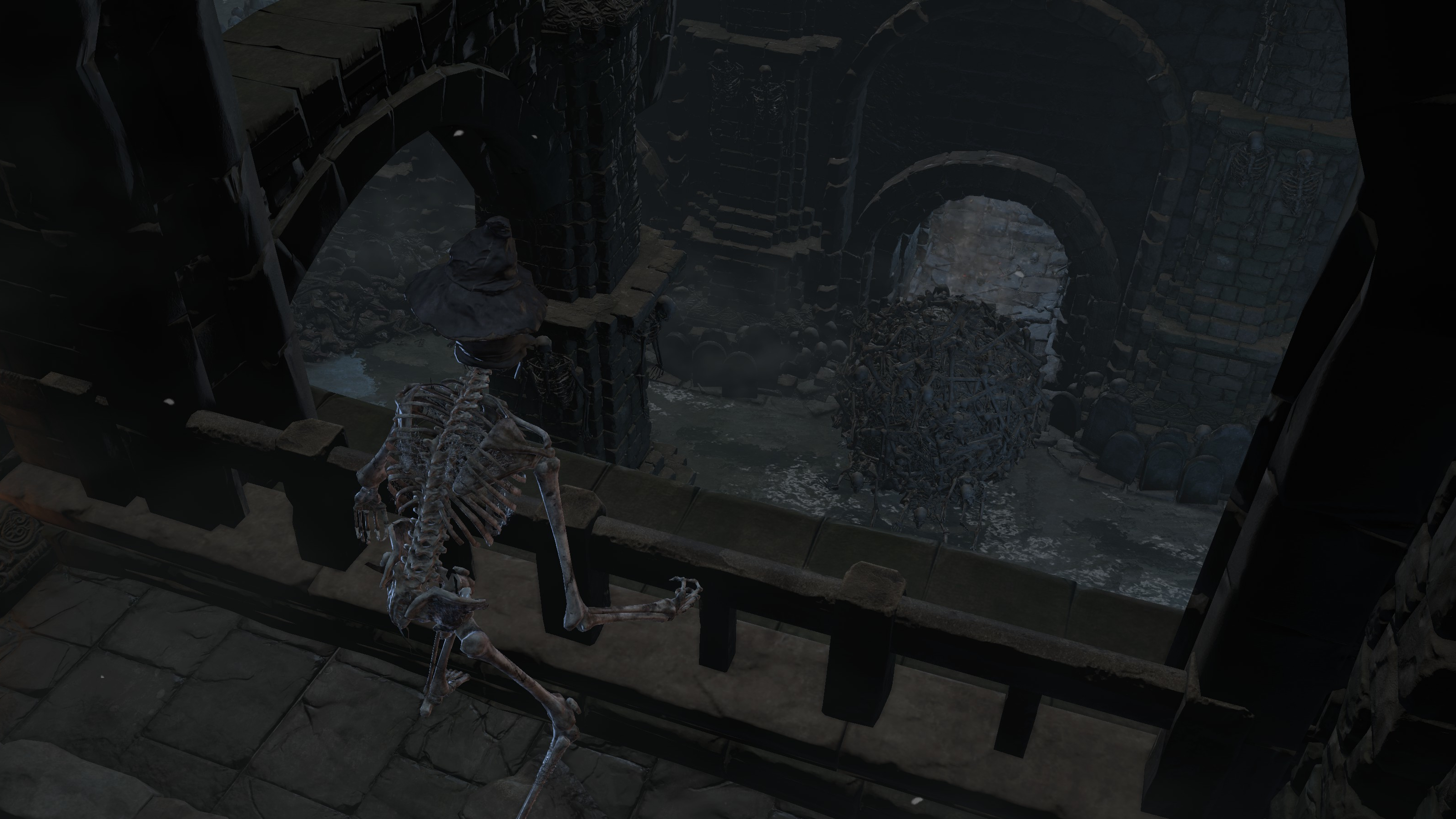
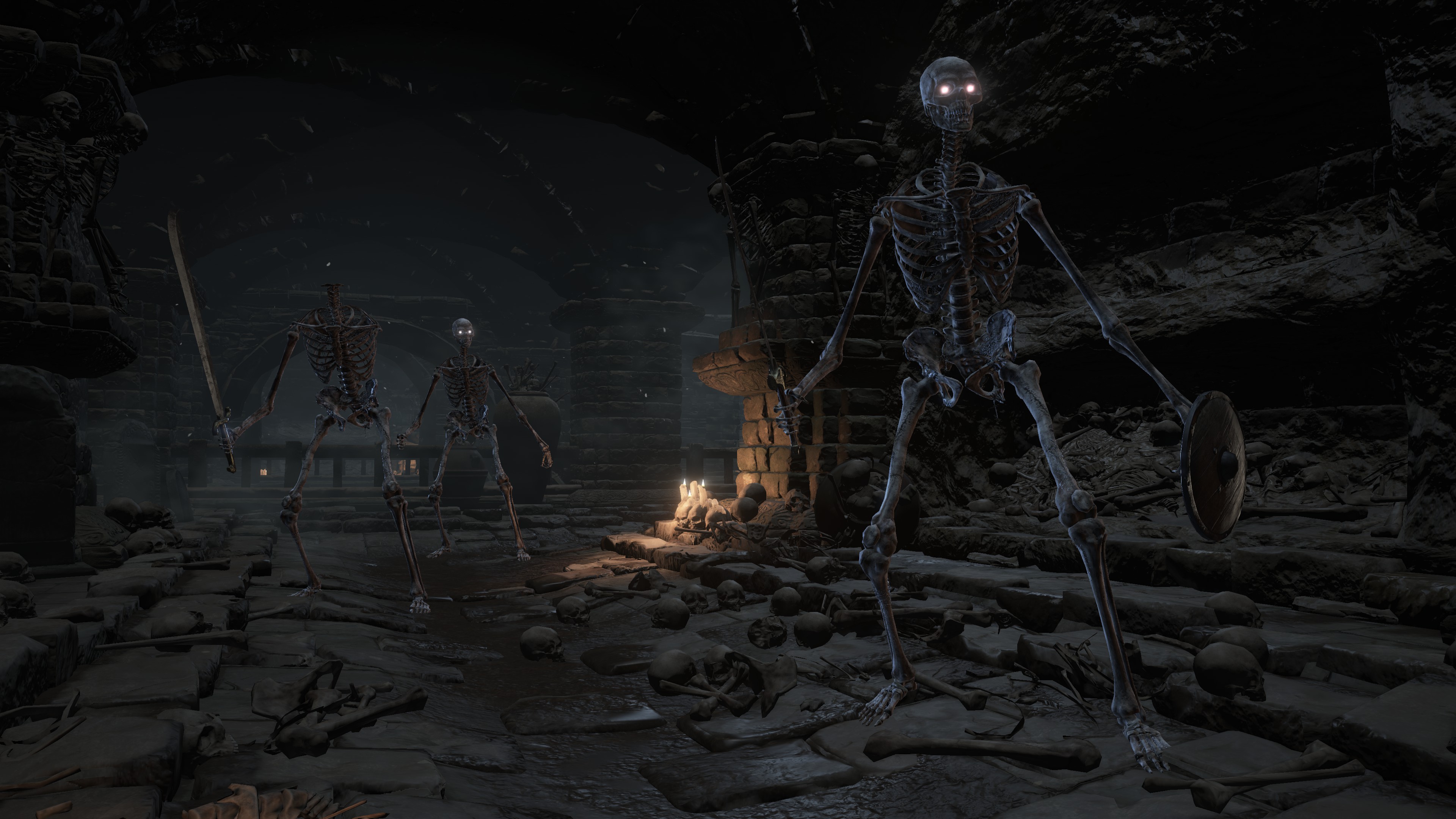
The reason that those charged with taking care to bury the dead were also taught the corpse arts should be obvious: they were expected to raise the dead after burial. As already mentioned, these grave wardens included both pyromancers and squires, one of whom continued to carry the battlefield items that his master used in life. It is no accident that these are people who you would expect to be very loyal to Wolnir or his soldiers; they are entrusting their afterlives to them, after all. The pyromancers in particular were probably motivated by the desire to learn the dark pyromancies their High King discovered. Item descriptions indicate that their discovery of black fire coincided with them becoming gravekeepers, so the task was likely a prerequisite to Wolnir sharing his findings. However, this all pertains to the upper classes and maybe their families. What incentive did the average peasant have to join in on this necromania infesting their government? They doubtless didn’t have one and were, in fact, forced to become part of Wolnir’s plan.
Ashen remains of a gravekeeper of the Catacombs of Carthus. The handmaid of the ritual place will have new items to offer.
The old man who carried arms as a swordsman’s attendant became a gravekeeper and didn’t let them go.
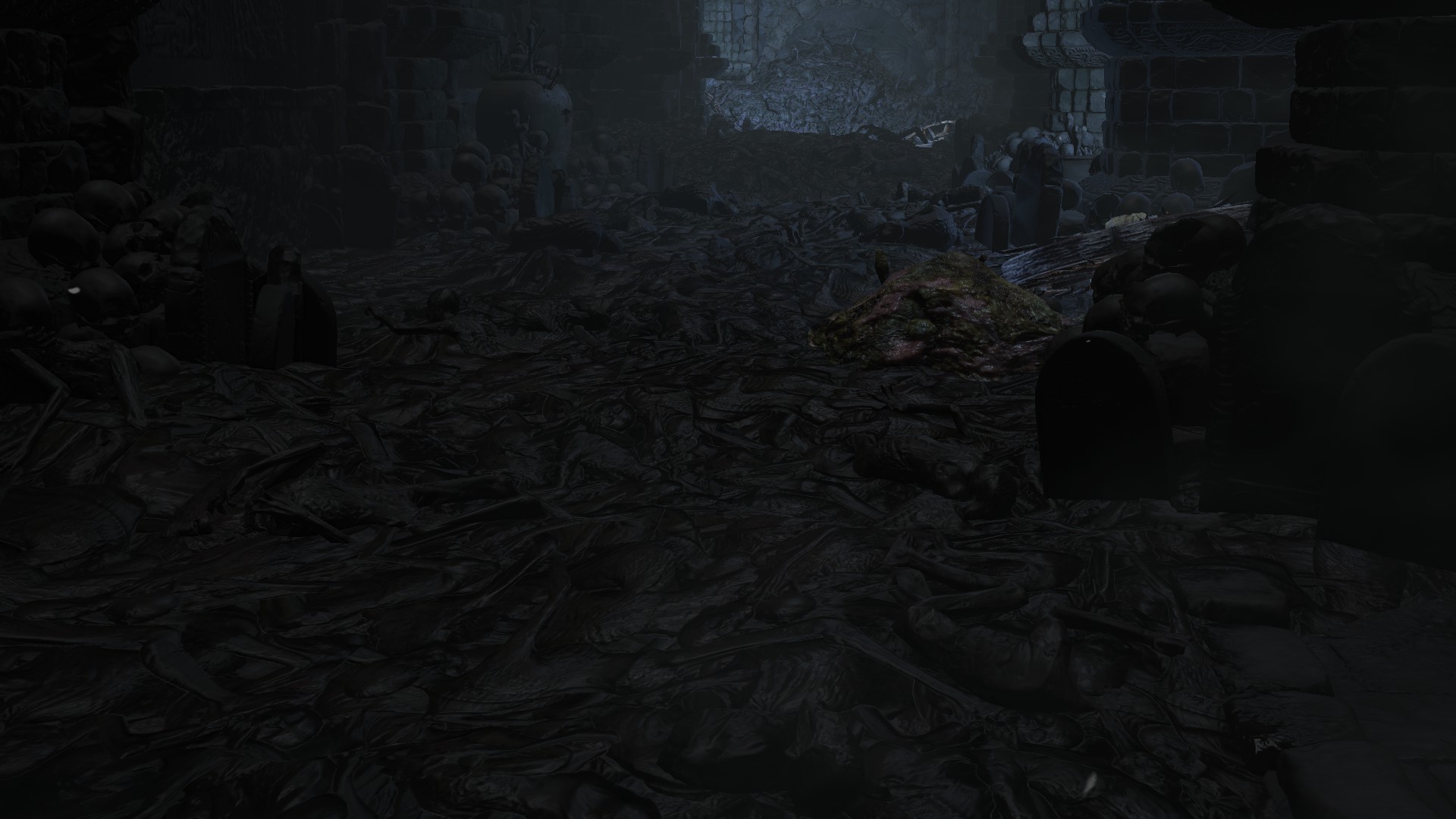
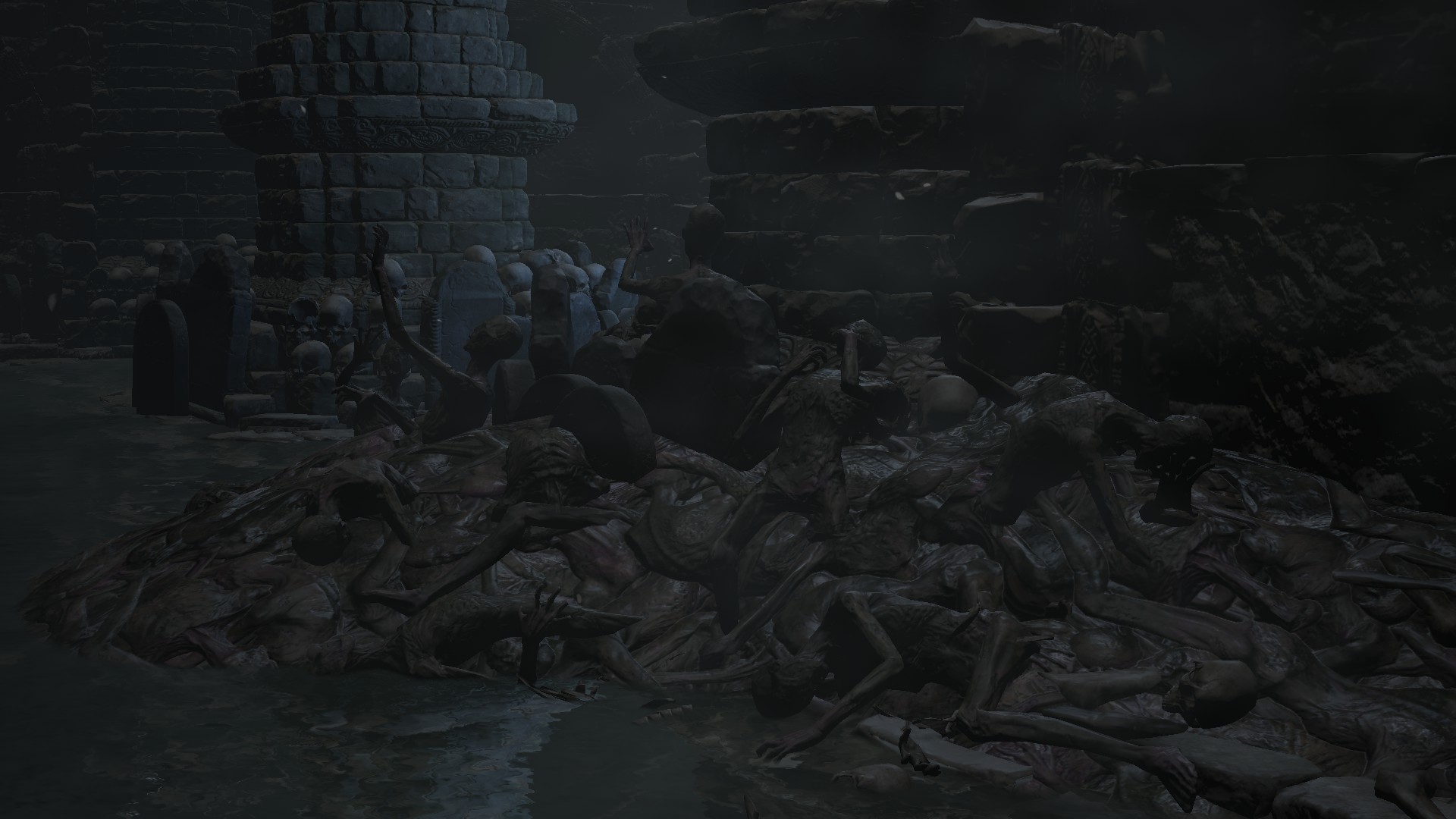
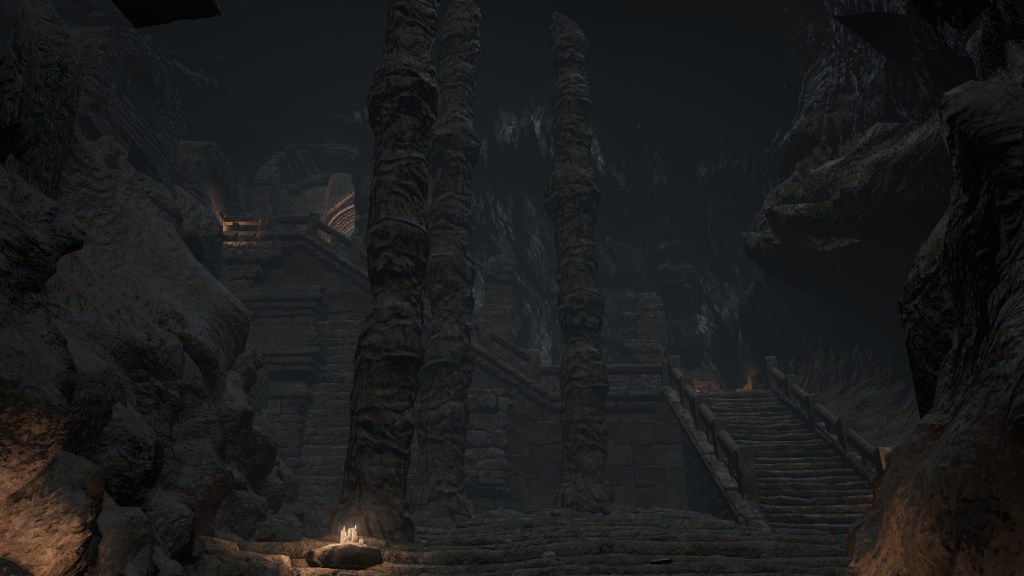
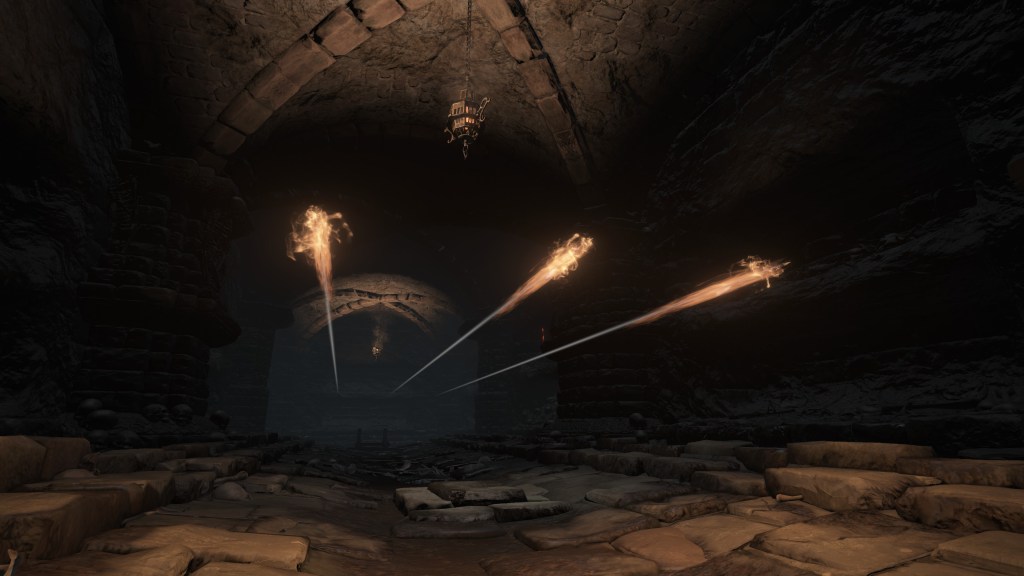
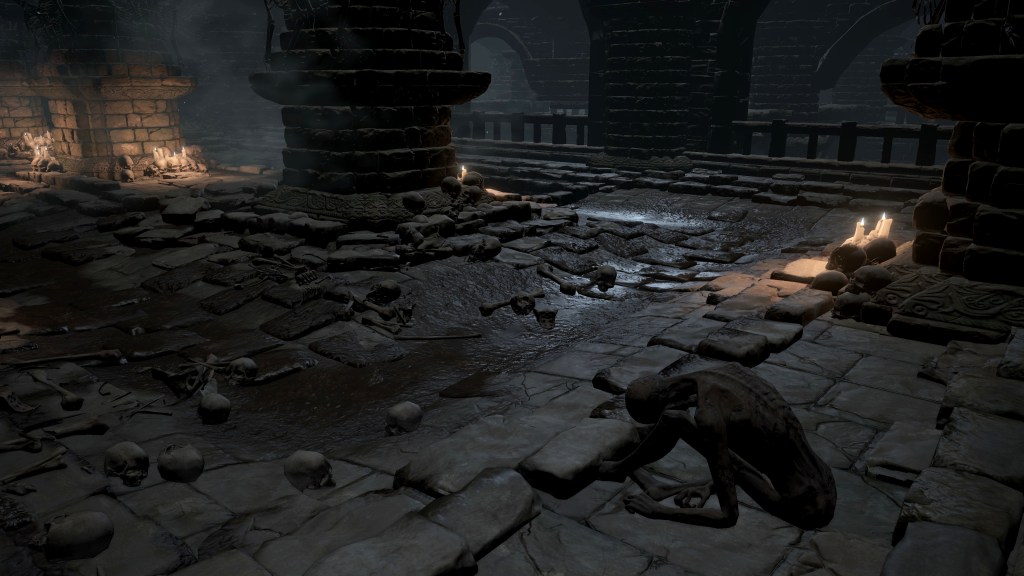
As we descend to the lower levels of the Catacombs, we come upon wide, waterlogged halls, likely remnants of the city sewer system given the prevalence of rats; we see something similar lower down in the Demon Ruins of Smouldering Lake, only the rats look to have been pushed out to the level above by the invasive basilisks. One passage in particular is littered with corpses. Unlike the rest of the complex, the bodies there haven’t shown signs of significant decays thanks to the stasis properties of water — natural refrigeration. Regardless, one need only look to notice the bodies contorted in pain, hands reaching out as if begging for mercy. This was a massacre. These were not loyal citizens who died for their country of their own volition, but horrified countrymen rounded up by military order and executed en masse. Their resentment over this fate is evidenced by the plethora of crawling carrion moving about the area. And if those with flesh begrudgingly died, the same is likely true for the countless more now littering the tombs as bones.
Perhaps this genocide was confined solely to the heartland, or perhaps the government went to the trouble of shuffling everyone from every corner of the empire to the capital just to be slaughtered. In either case, Wolnir had essentially organized an effort to kill, bury, and reanimate his entire kingdom save for the grave wardens, and the two skeletal wardens we encounter suggest that even they had the option to later join them if they so chose. Until then, the gravekeepers managed to live out their days in dark tombs until age finally caught up with them, even if that meant subsisting on rats and bugs. Perhaps returning to duty as another skeleton is the final honor for those young men who dedicated their lives to reviving their elders first. Whatever the reason, they have proved that their loyalty to the High Lord is undying. The sentiment wasn’t universal; a pyromancer holding onto the book for the old ways lies entombed behind an illusory wall for obvious fear of retaliation. Still, survivors who disapproved of Carthus’ fall were clearly the gross minority, forced into hiding from the Dark converts’ necromancy.
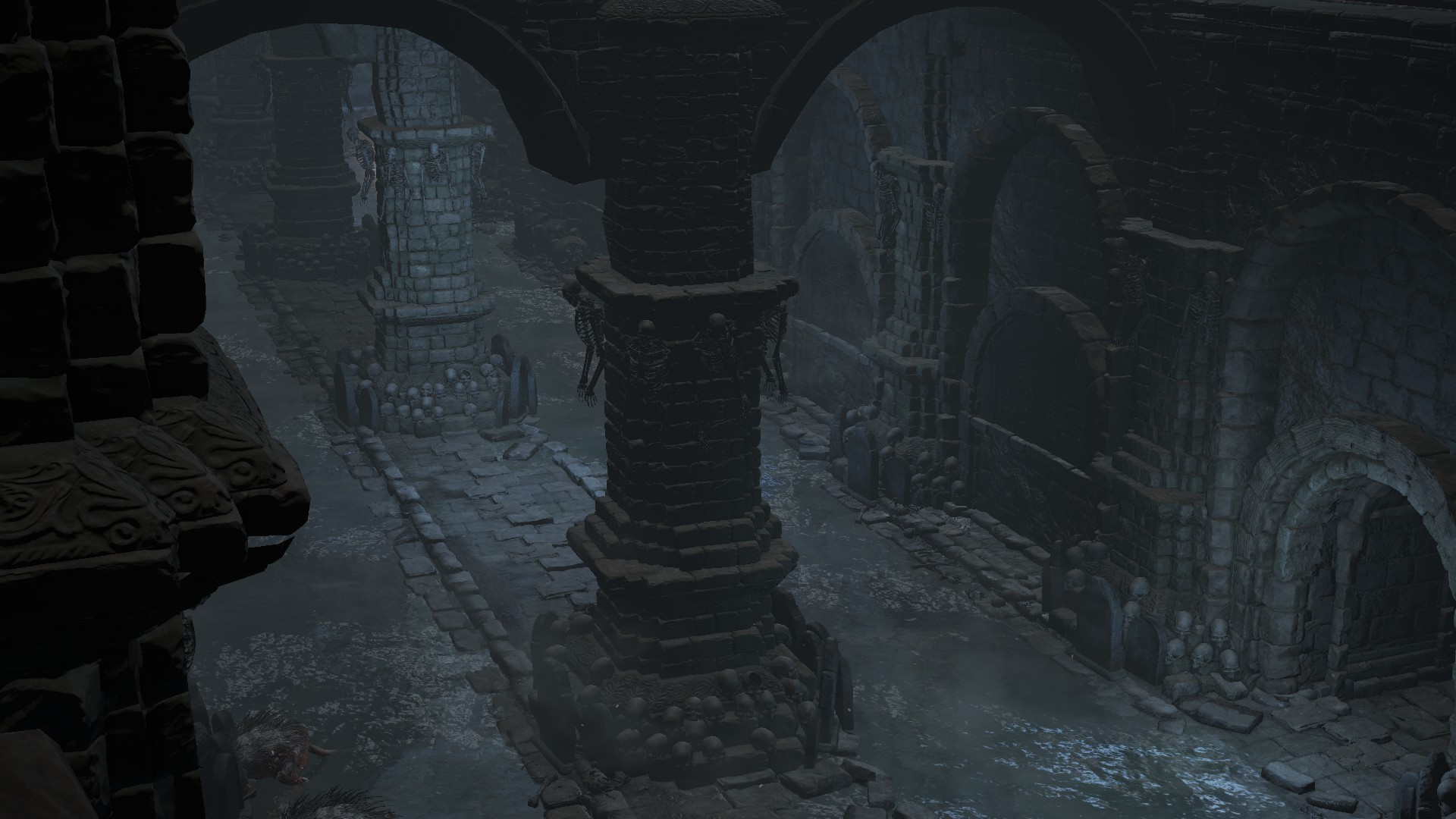
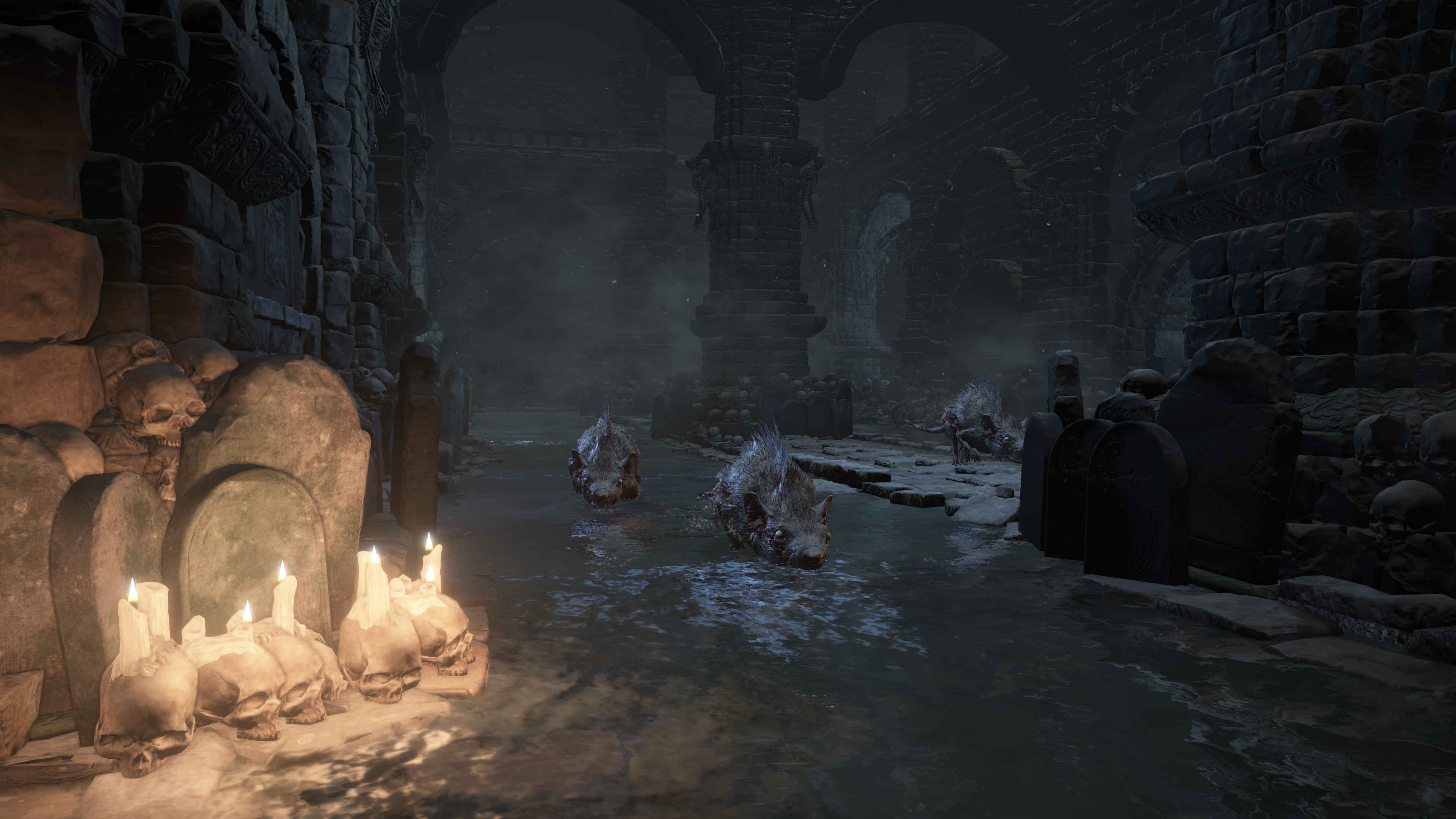
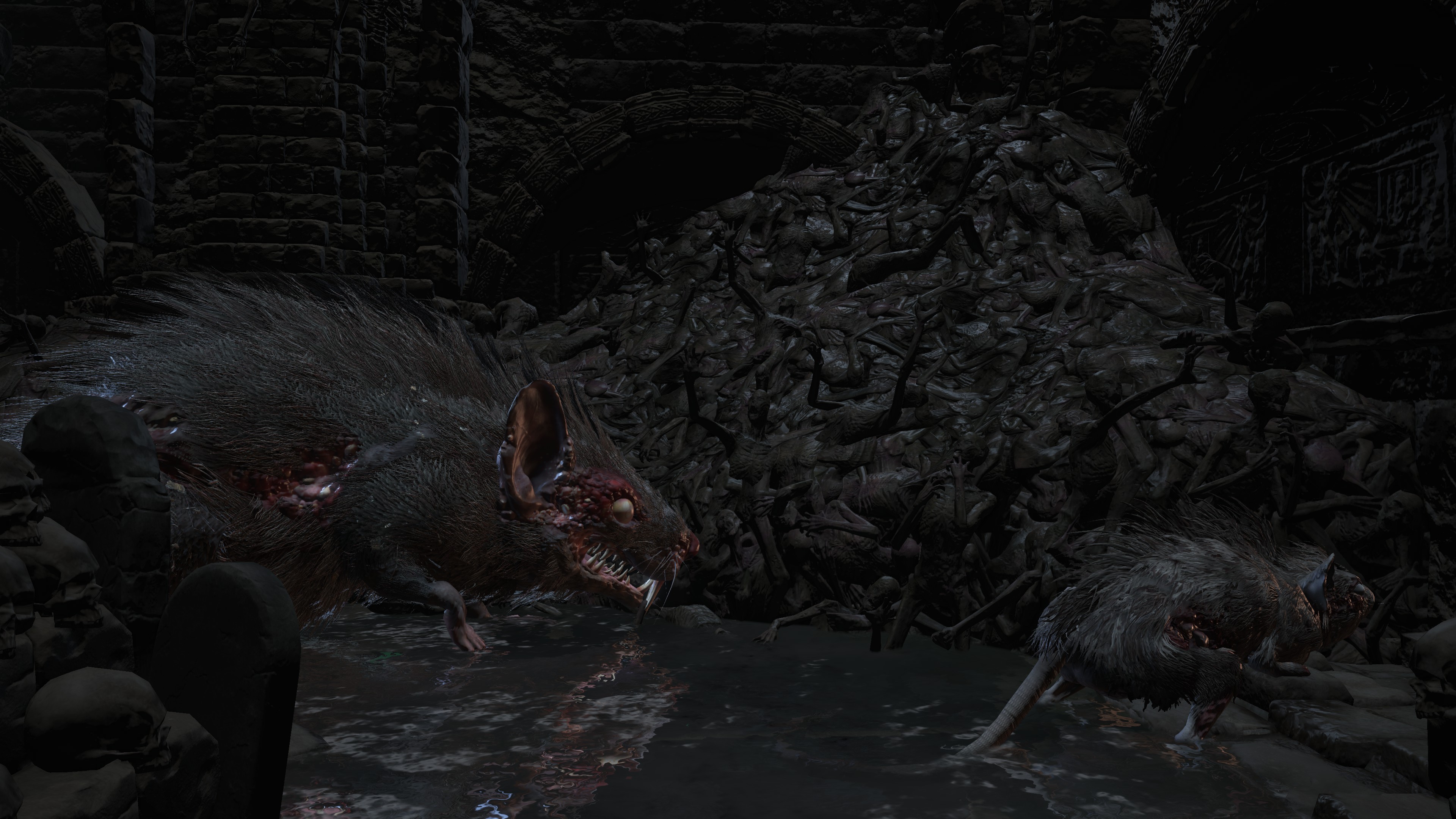
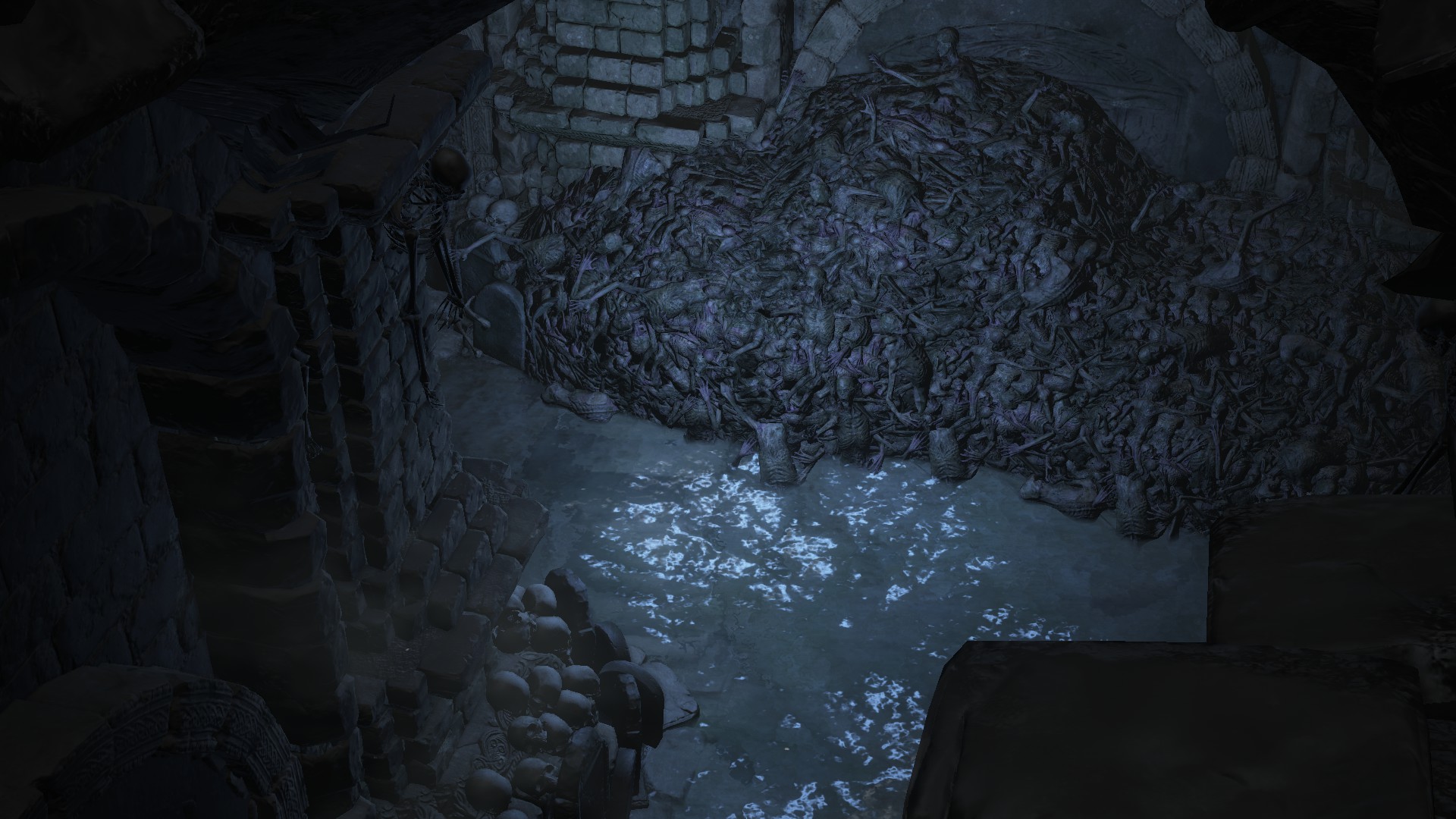
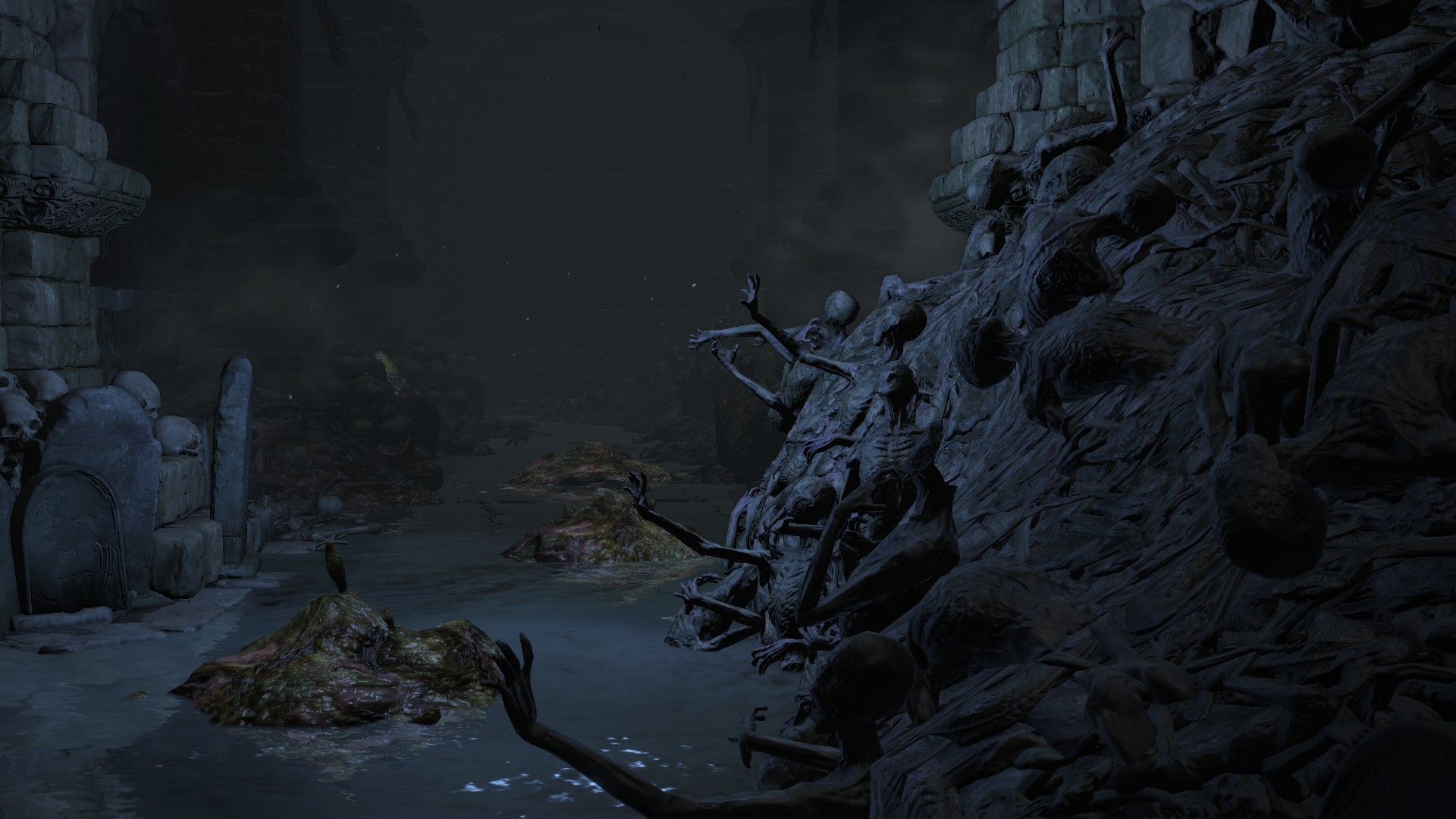
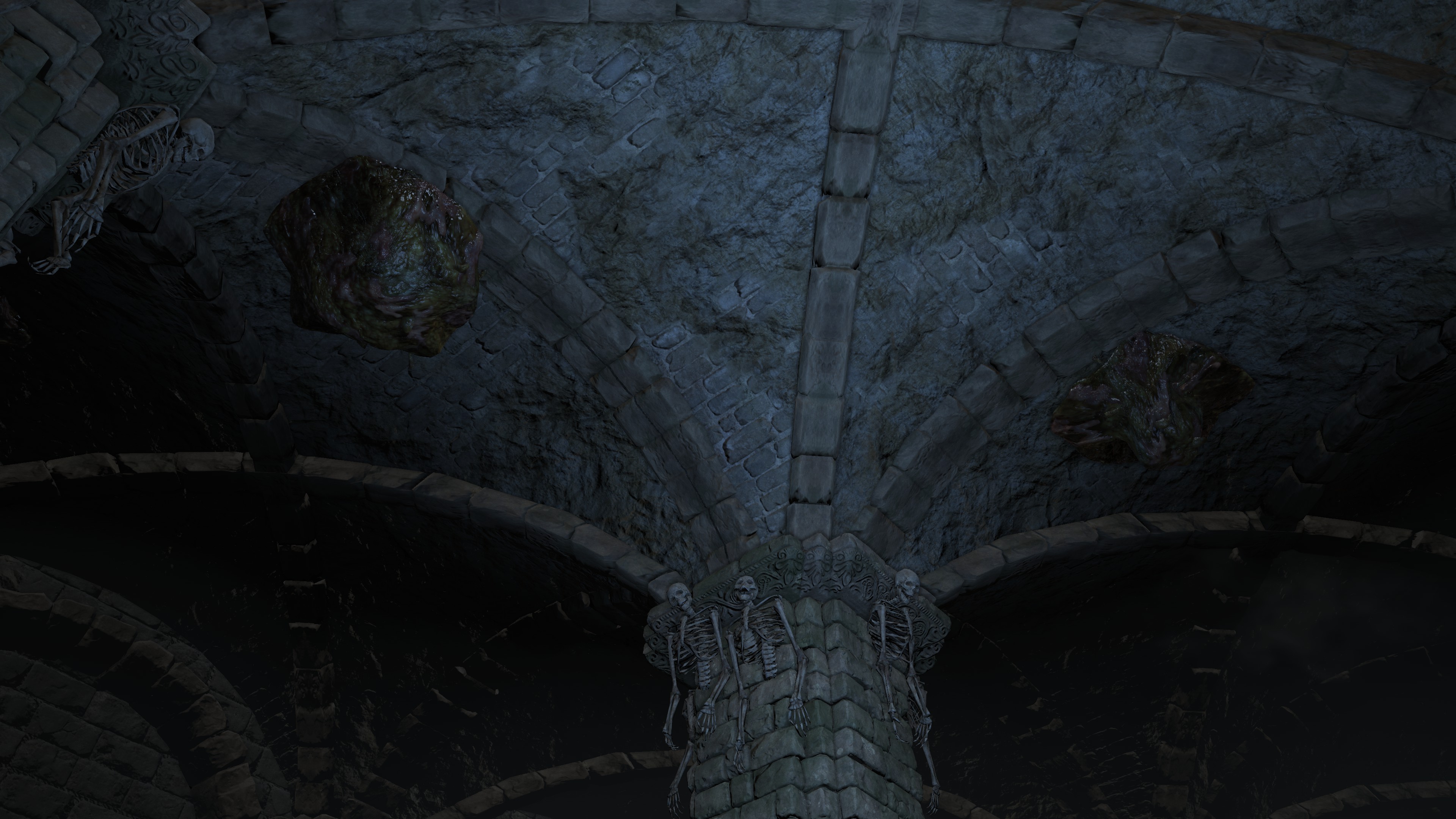
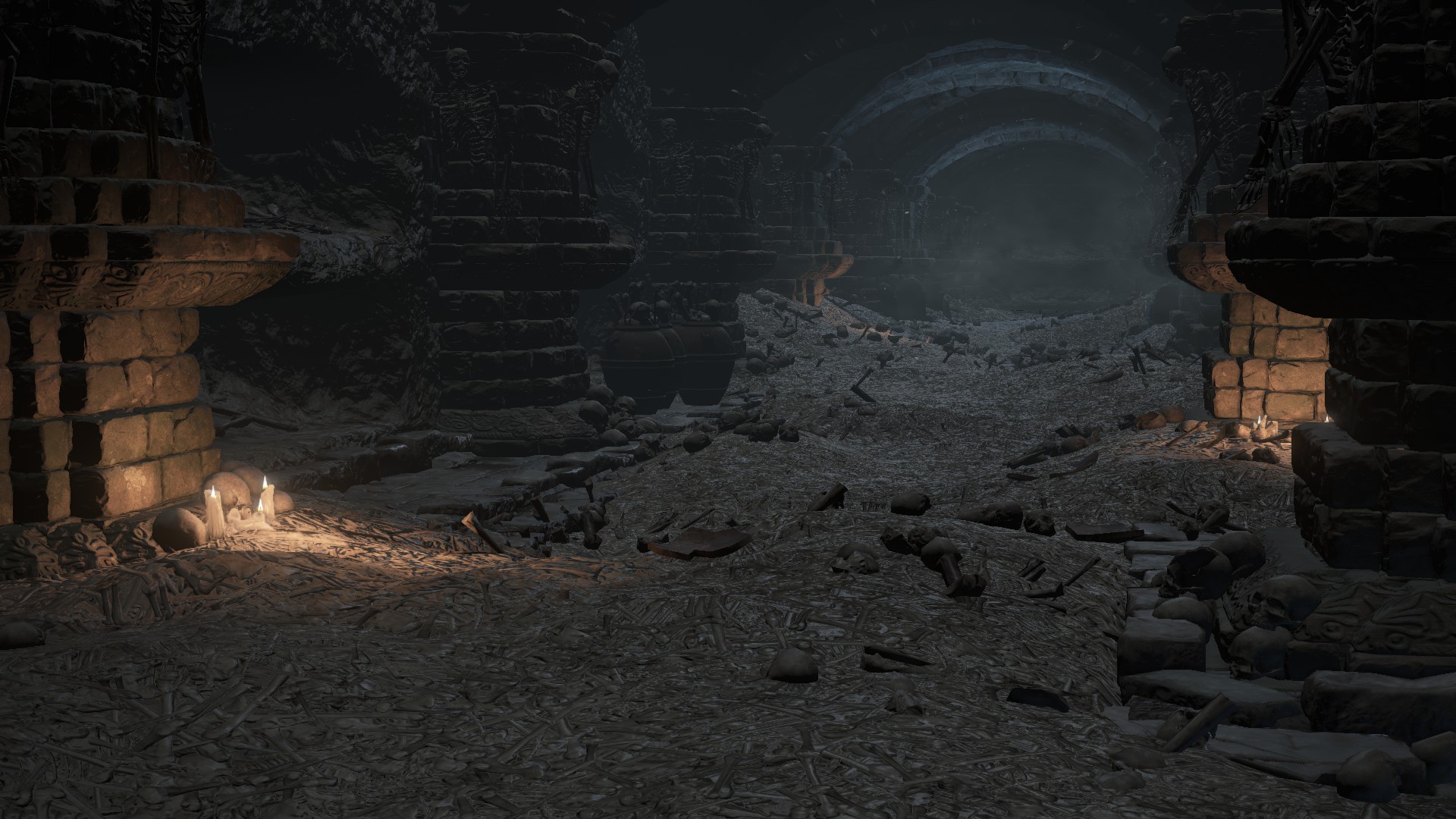

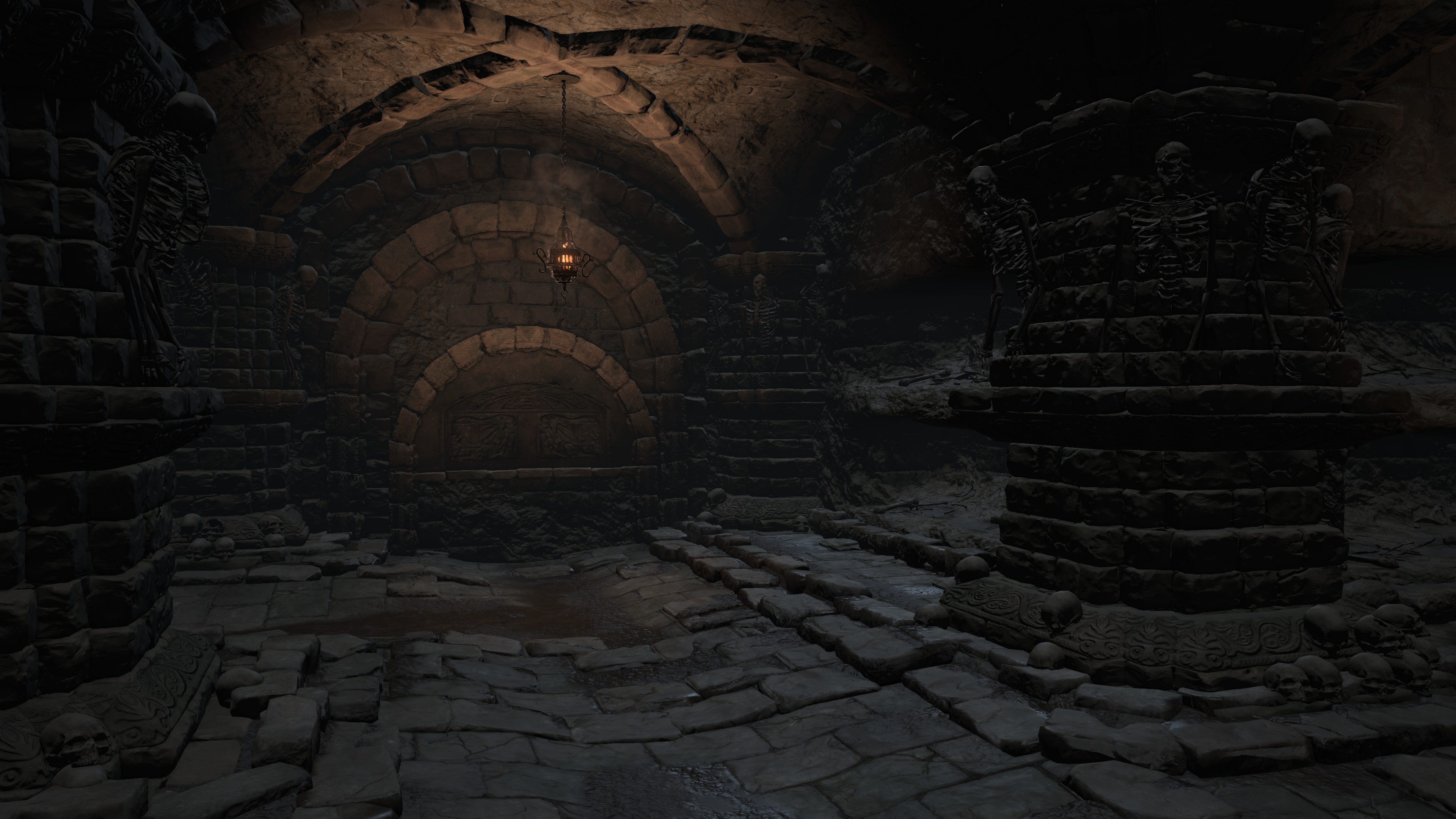
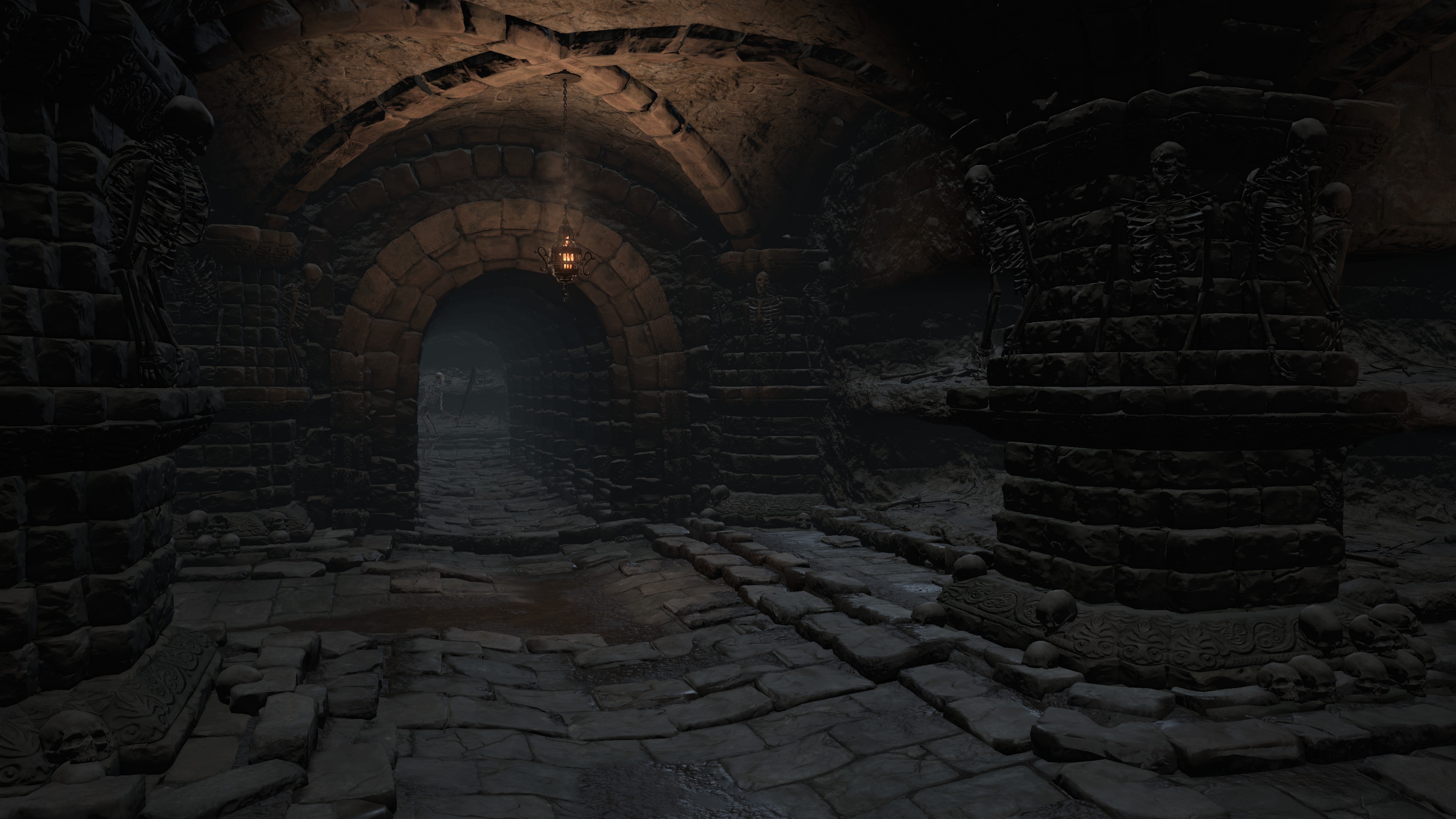
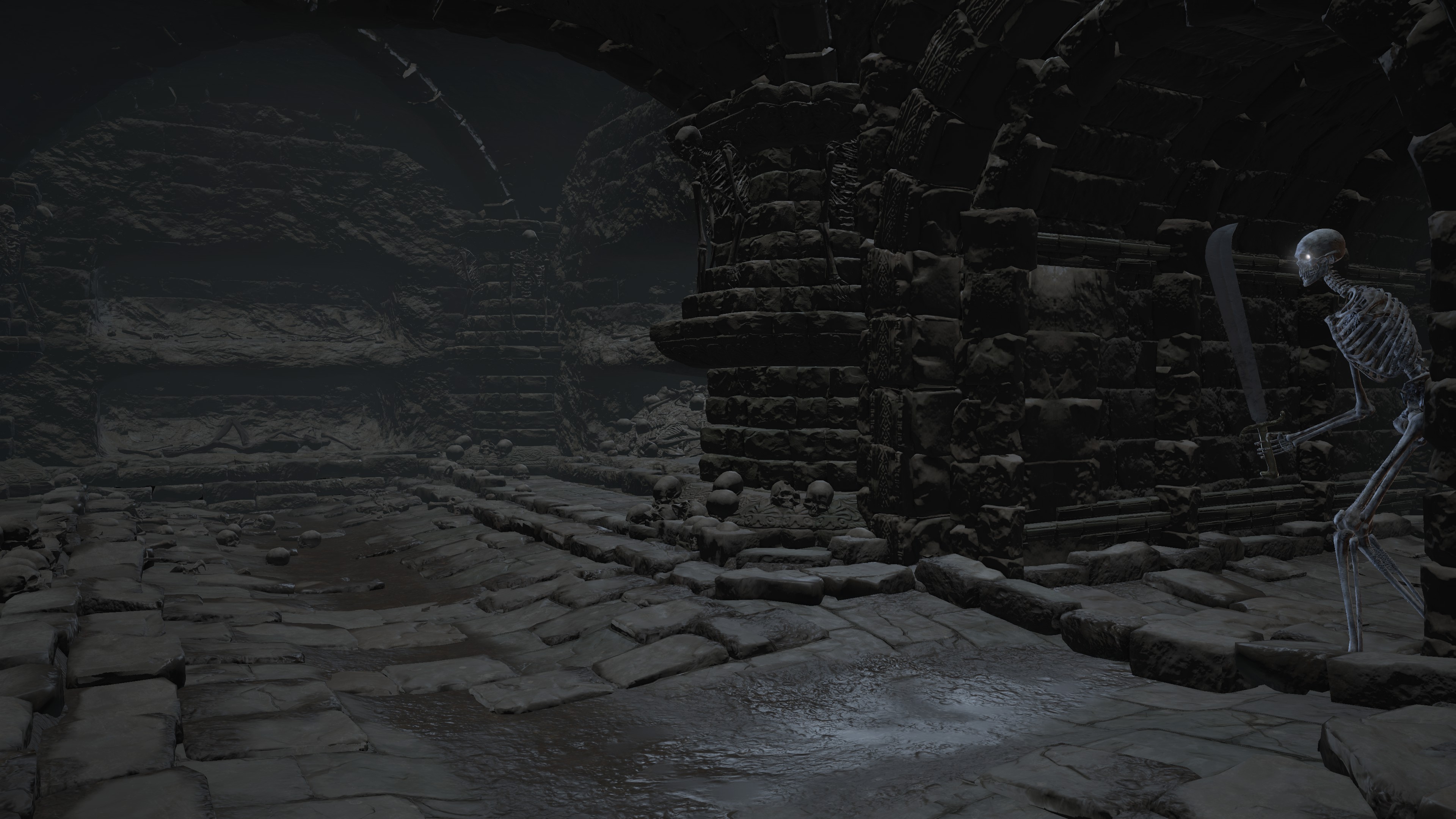
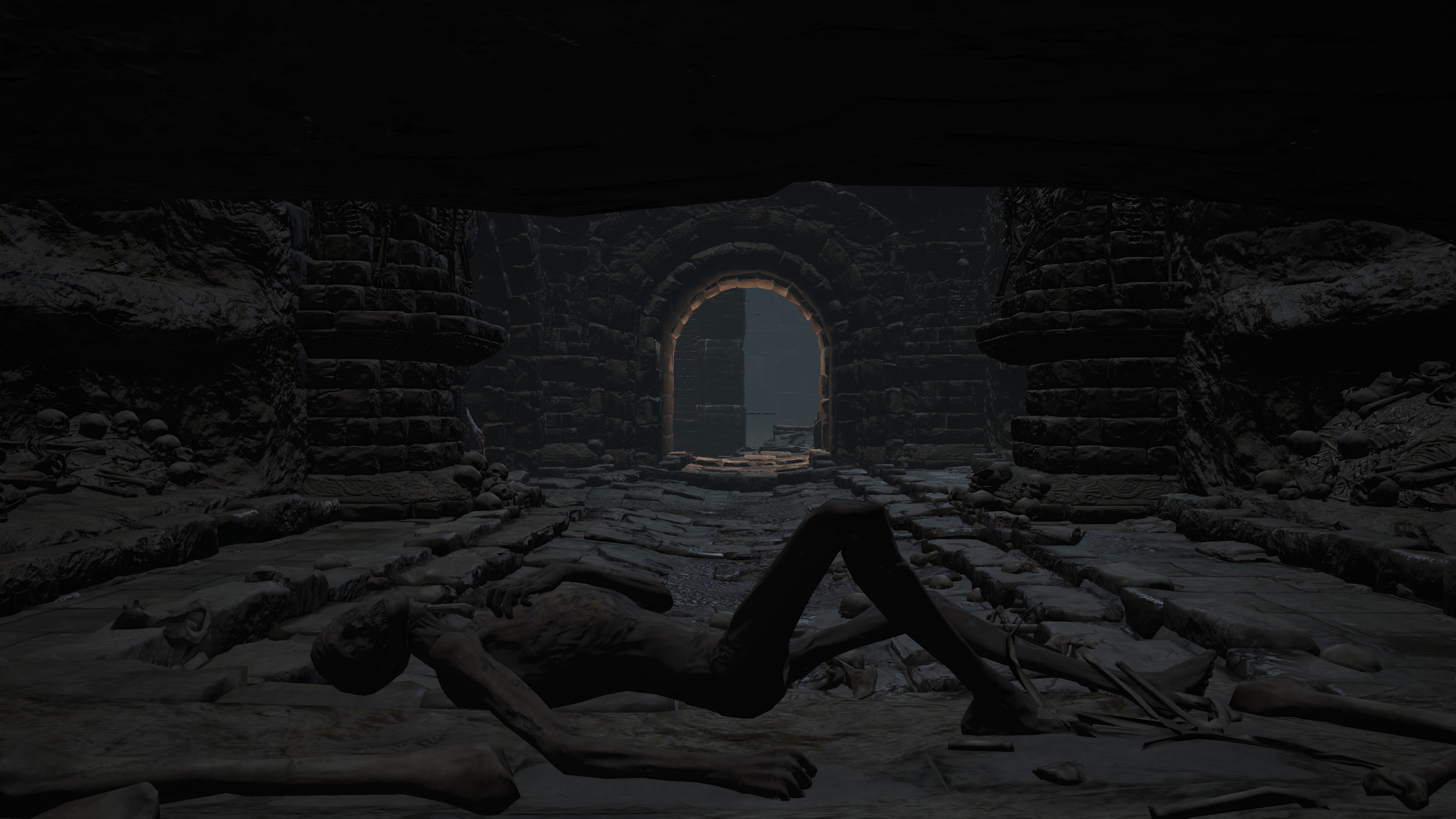
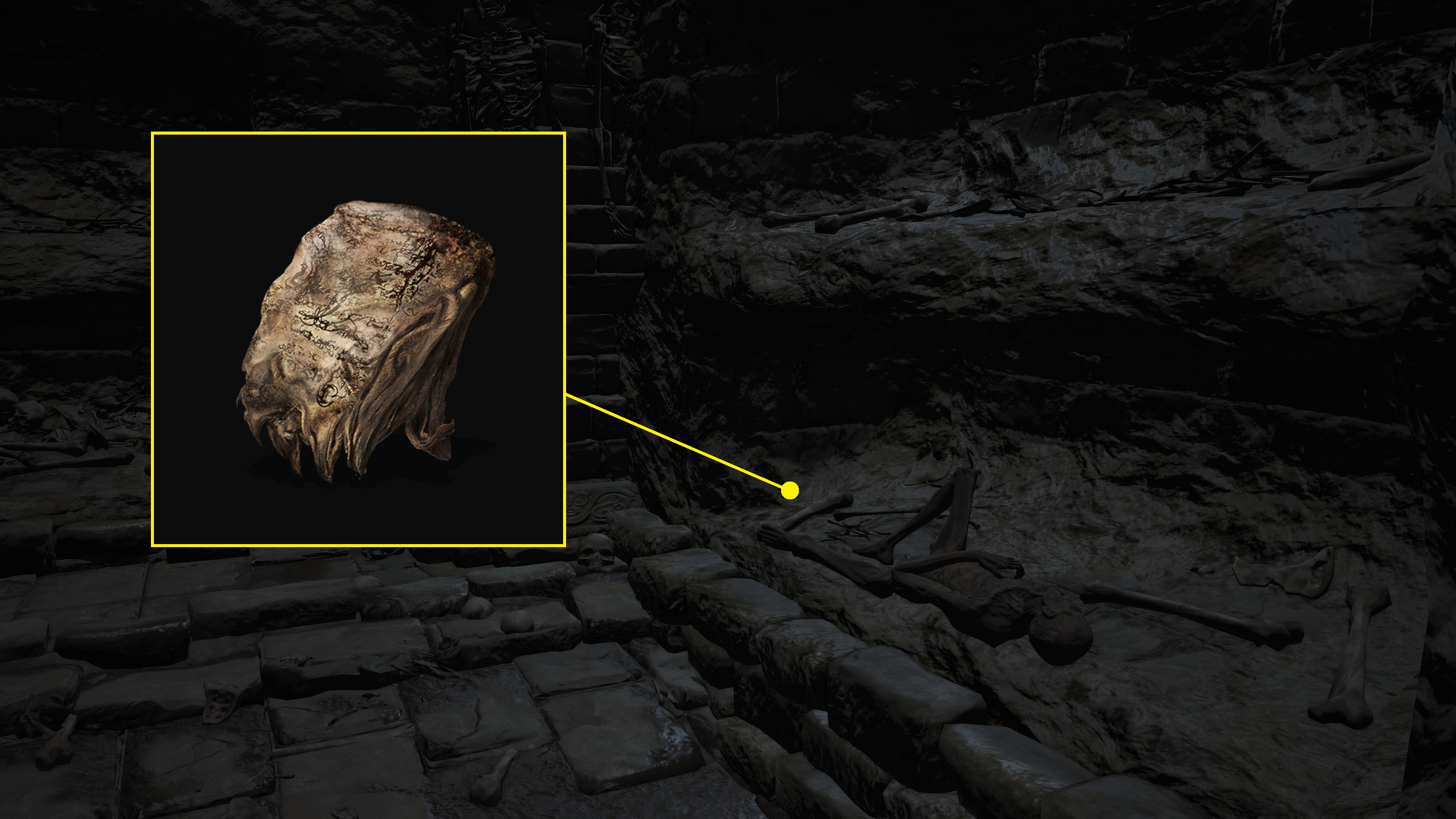
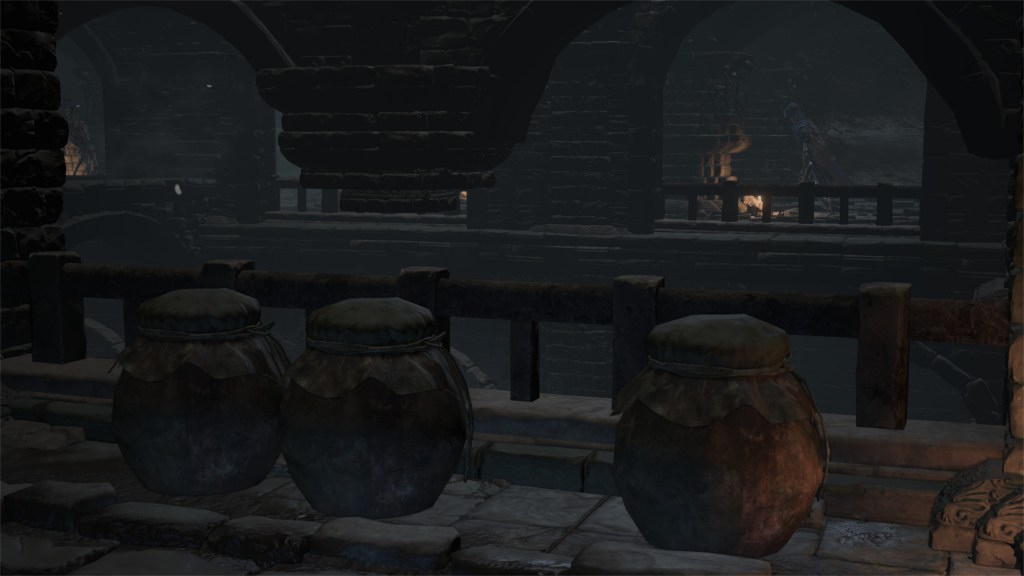
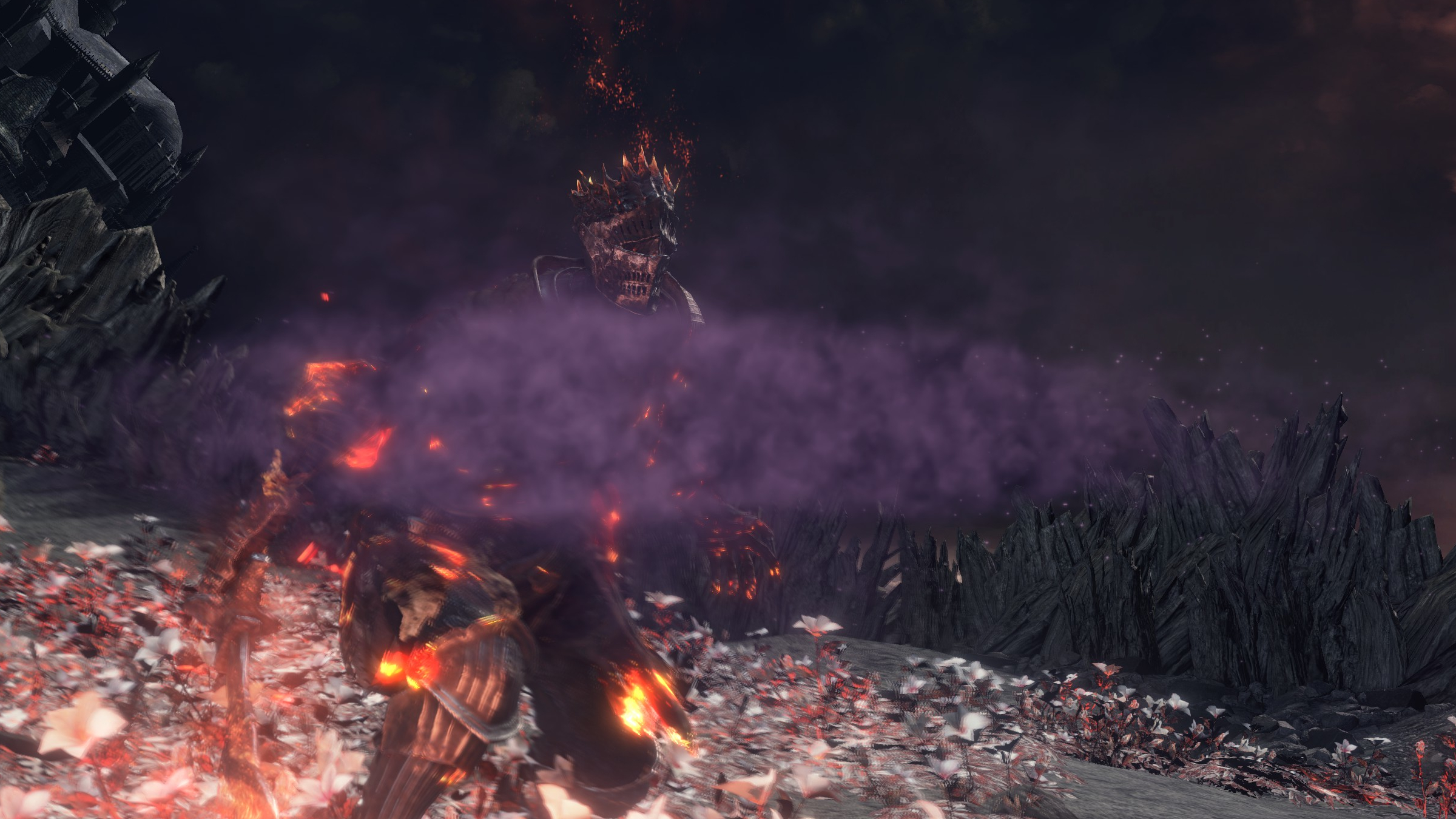
Wolnir’s plan worked, and Carthus was turned into a massive city of death with the Dark at its command. Based on the multitude of bone-filled jars alongside humanity-sealed pots, the army collected dark souls from their massacred, seemingly stockpiling them for the “darkbombs” skeletal minions throw. This and early reanimation is probably why skeletons in the Catacombs show far milder symptoms of stagnation, inadvertently saving the country future headaches. And from an outsider’s perspective, Carthus self-destructed. The most likely reason for the Abyss Watchers permitting a city of death practicing Dark arts to thrive beneath their feet was simply ignorance. They may have been familiar with the story of the massive desert empire that fell to the Dark and collapsed soon after, but one wouldn’t normally suspect that empire persisted on from the grave. As far as the world knew, Carthus was another civilization doomed by the Abyss. But in reality, Wolnir had found a way to keep his kingdom going indefinitely while growing his power. In effect, the High Lord succeeded Nito as the Gravelord, with all the might of a Dark lord.
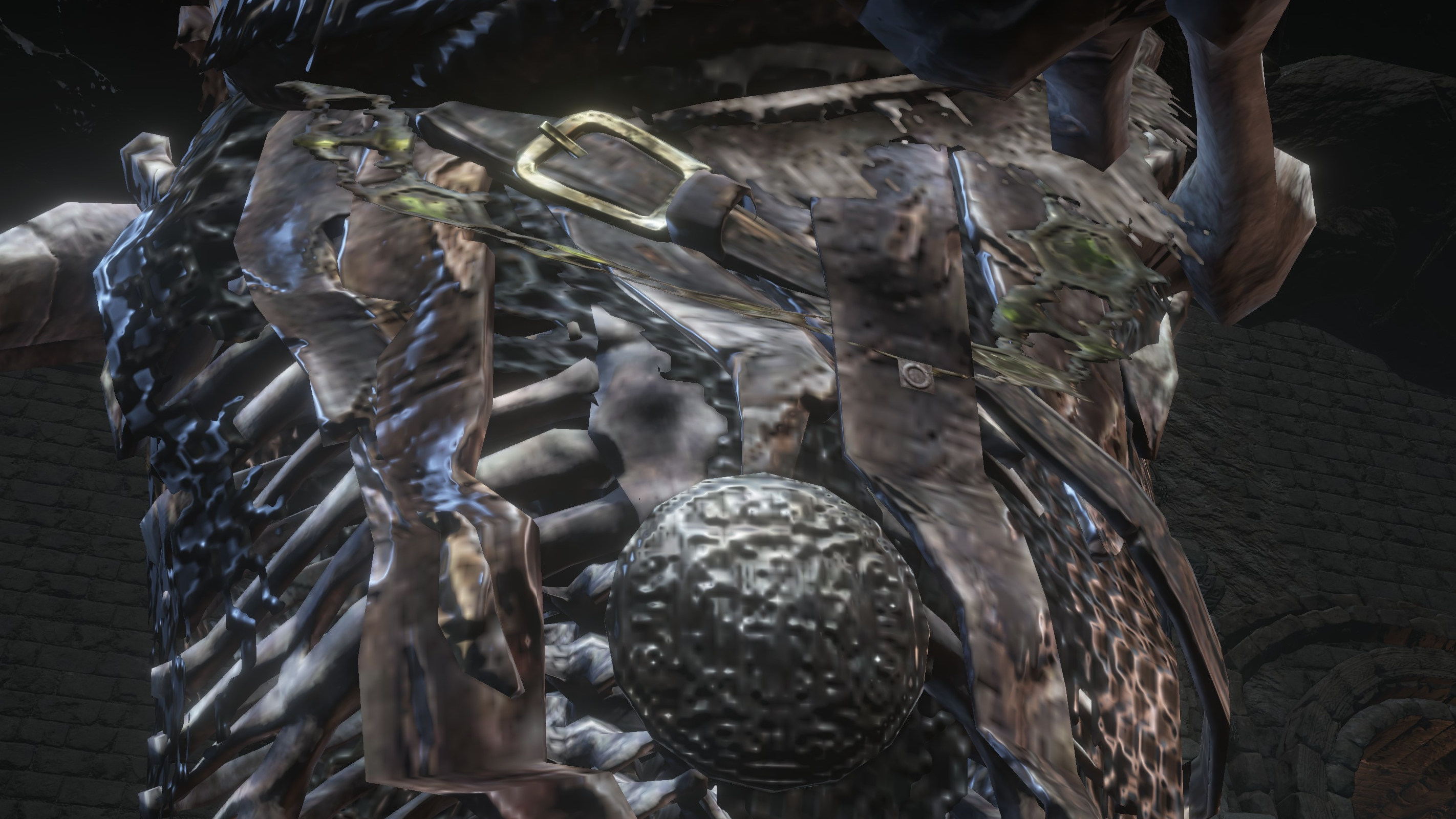
The number of skeletons in one body certainly merits the Nito comparison. Wolnir himself is enormous during his boss battle, but a plethora of human-sized skeletons jut out of his bones, many reaching out their arms in pain or desperation. This had led fans to put forth the notion of the High King being some species of giant, though this is doubtful. While his size cannot be outright dismissed as artistic license, it is unlikely that the bracelets and holy sword he stole were made for giants of his stature. Rather, the Abyss where we encounter Wolnir is more likely to blame for his larger mass. The Four Kings and Manus prove that the Abyss can radically transform the human body in various ways — including size — so Wolnir’s immersion in the Dark might have resulted in a similar growth spurt. Perhaps the skeletons adorning his huge frame were human sacrifices for the necromantic ritual, or additions to bolster his resistance to the Dark — or maybe just a megalomaniac’s idea for a decoration; he does adorn his “city” with the same aesthetic, after all. In the end, he is hopelessly human.
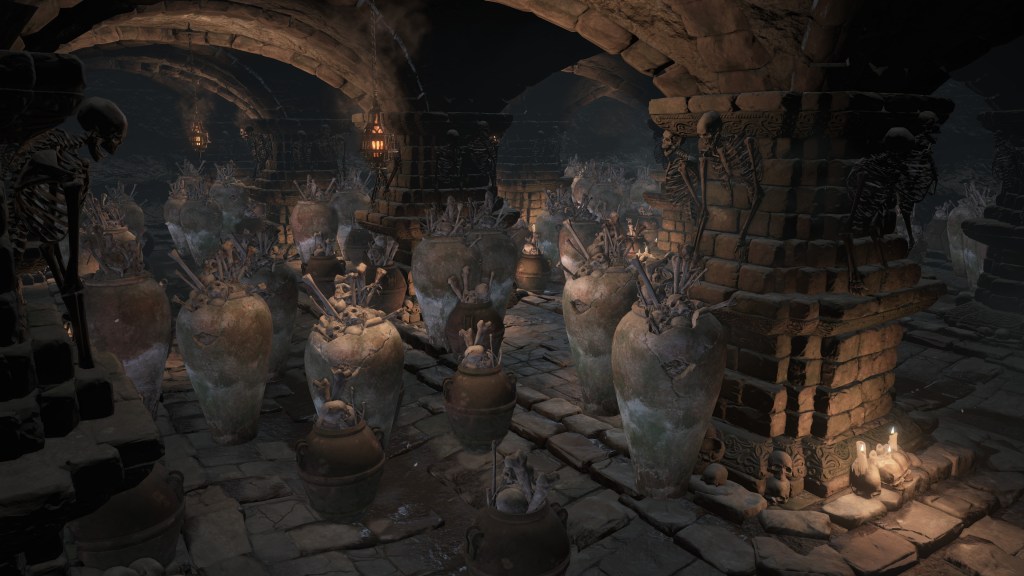
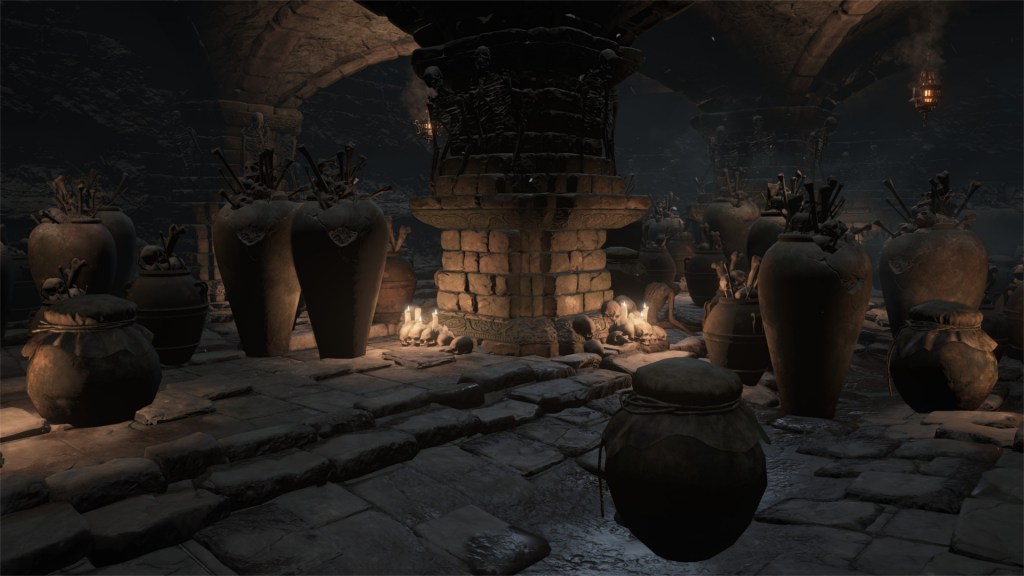
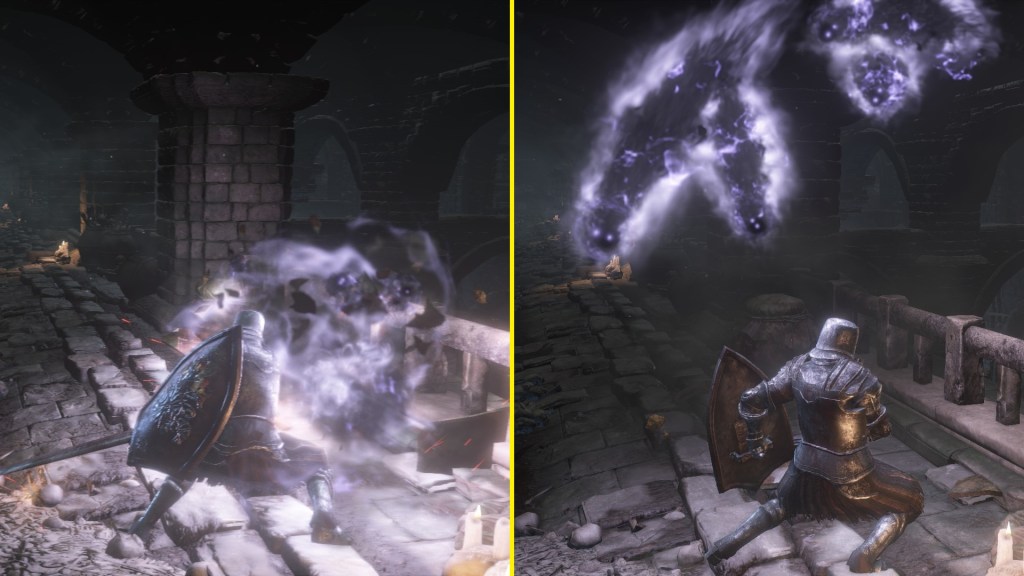
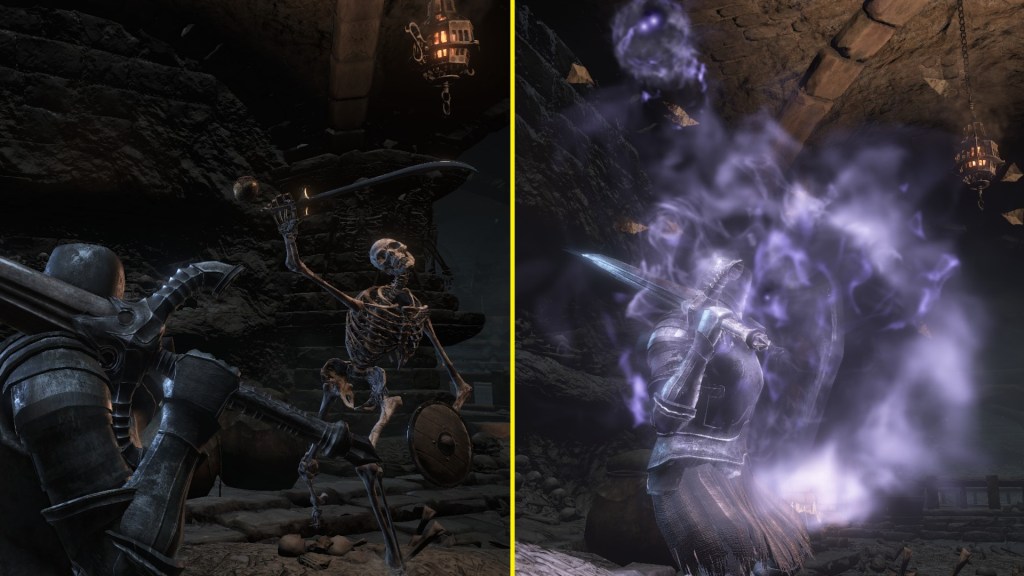

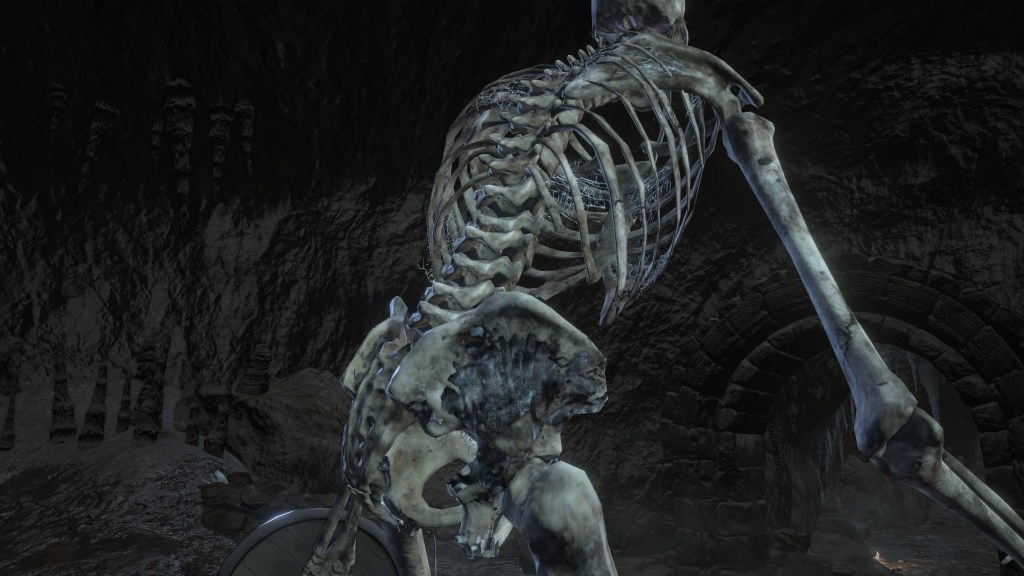
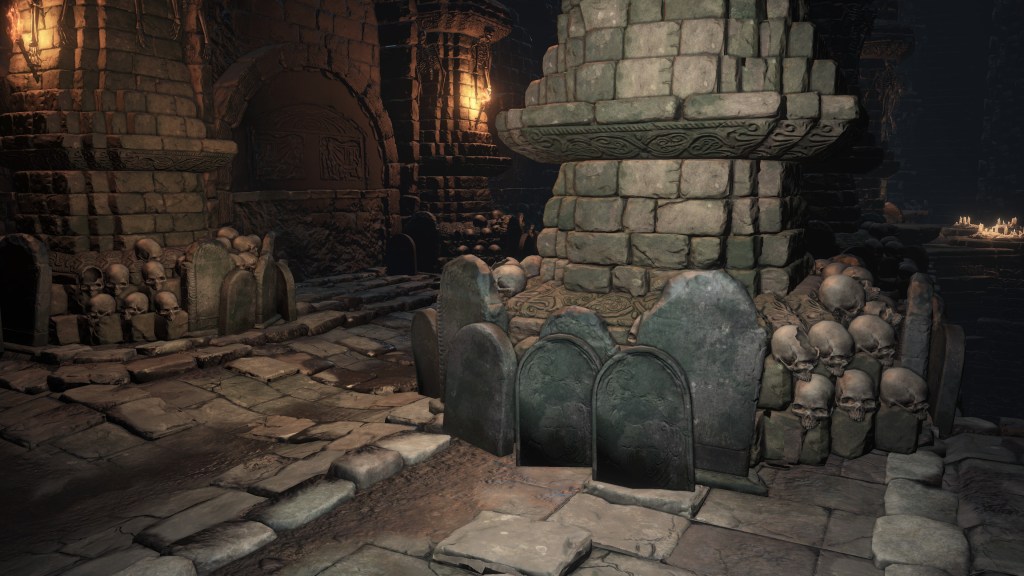
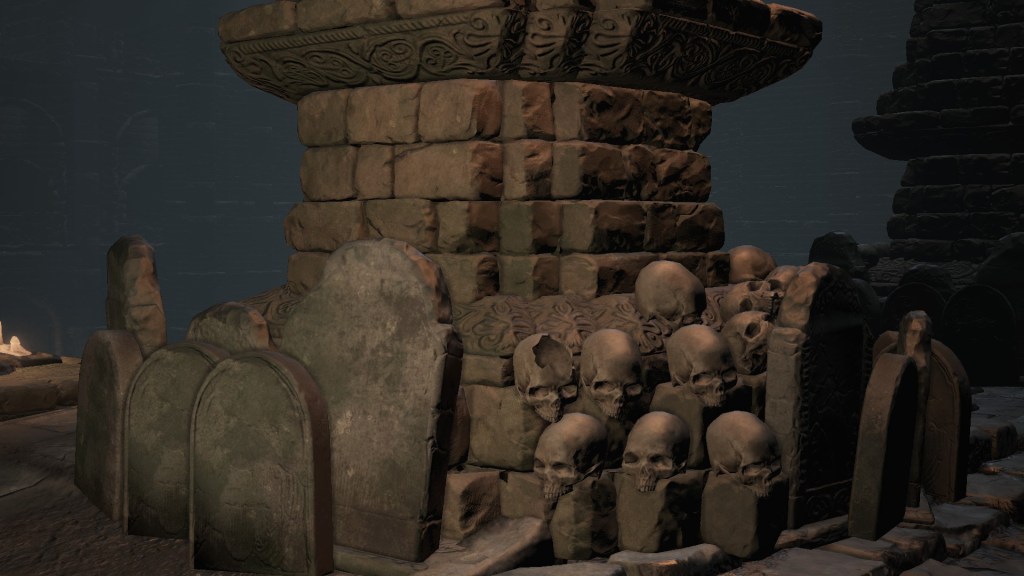
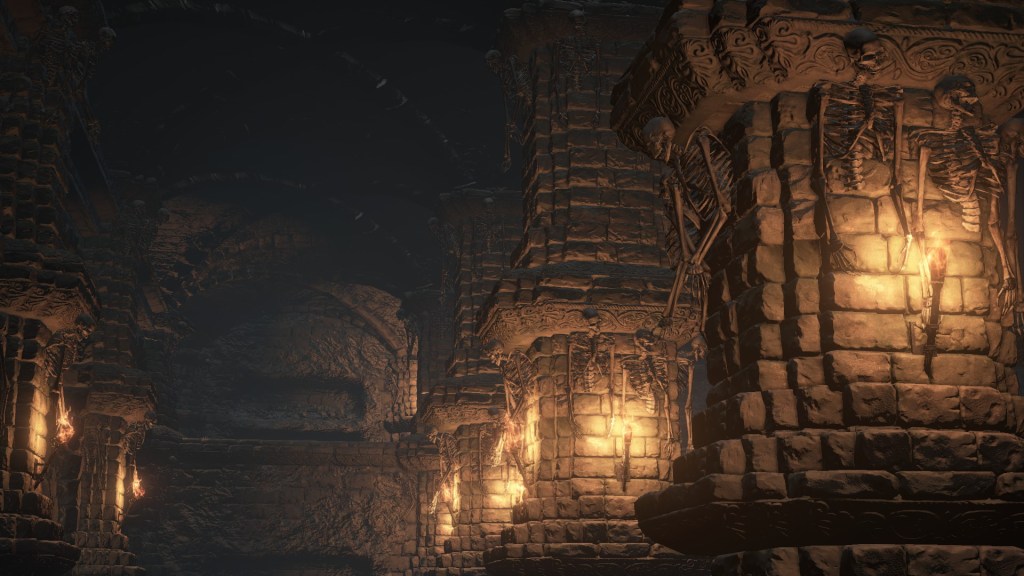
Regardless, with peace restored and his power secure, Wolnir has carried on with governing the state as he sees fit. Looming over the grave warden’s corpse in his abyssal space indicates that the High Lord is also still as ruthless as ever, perhaps more so now that punishing his subjects with death no longer gives them release from service. Indeed, the tyrant may now feel truly free to fulfill his every whimsy, leaving the public eye behind to embrace undisturbed eternity with absolute power — this crypt, his own little world. However, his vast empire didn’t fade from widespread attention without leaving its mark, as Carthus’ kukris are now favored by all of manner of thieves. We can assume that their usage spread from the various lands the empire had conquered to surrounding regions, including Lothric — that this cultural diffusion came in the form of the desert nation’s weaponry can only be described as fitting. The legacy of Carthus certainly survives, in more ways than one.
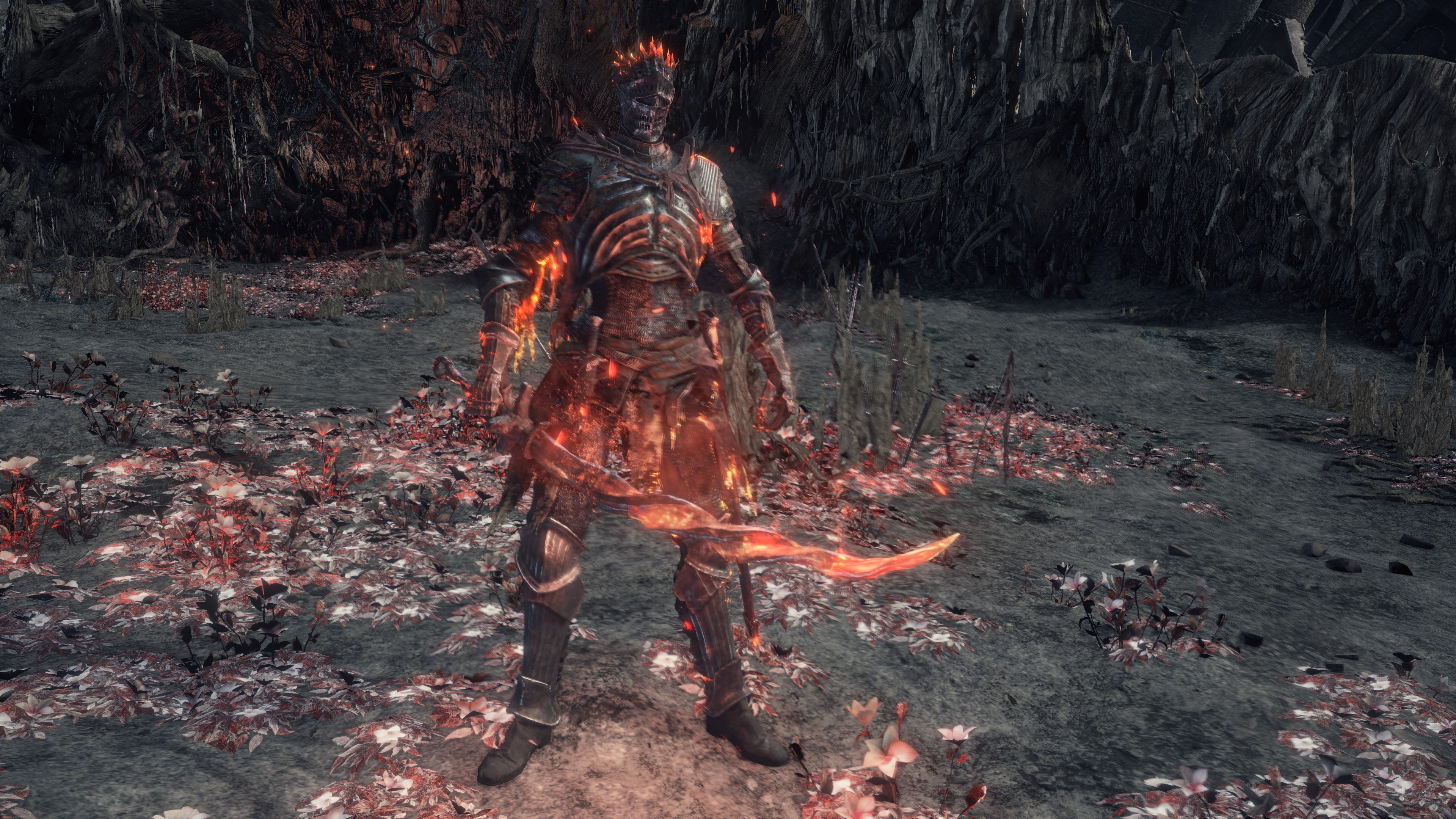
As for the date of the desert kingdom’s fall and by extension rise, we can look again to its gravekeepers for a potential answer. The Grave Warden’s Ashes make a point of the man’s old age, dating this one-time youthful squire’s lifetime to within the past century or so. And since Carthus rose and fell alongside its High Lord, we can safely assume that Wolnir’s own lifetime only extends as far back as the century preceding these subjects of his. If that is the case, then the desert nation’s conquests and its subsequent destruction are events of maybe 100-200 years ago at most. This means that it was contemporaneous with Lothric, though the two countries don’t seem to have ever interacted. Although one of the aspects to the Soul of Cinder is a pyromancer wielding a curved sword, all of the spells are associated with the Great Swamp, not Carthus. Add in his empire’s irreligiosity, and the High Lord wasn’t going to start sending his fair share of firelinkers anytime soon, even now that the kingdoms are technically neighbors.
Infestation
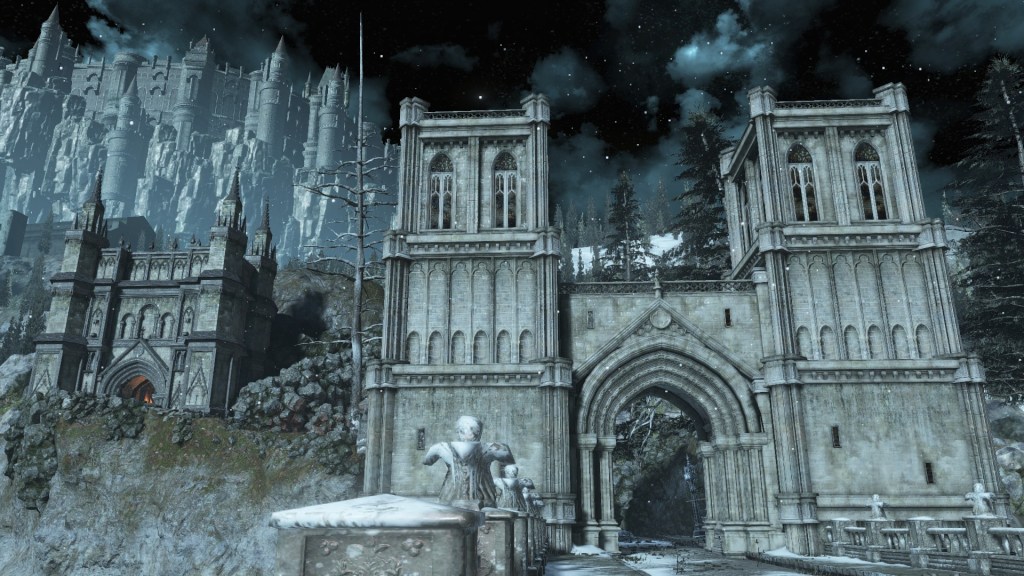
Since its “collapse”, Carthus has become one of the various lands that have drifted to Lothric and become part of the scenery. Aside from Farron, Irithyll too has built architecture over entrance to the Catacombs from the Boreal Valley. However, neither shows interest in actually exploring the tombs, the underlying nation seeming to widely be considered dead — in the extinct sense of the word. Animate skeletons do prove to be a common feature in graveyards even absent necromancers, and Cornyx is the only person to exhibit familiarity with the catacombs; given his overall commentary, he probably only remembers from stories concerning its pyromancy. The fact that the renovated infrastructure has had various traps installed also helps dissuade deep exploration. Few before us have likely ever seen just how complex, and Dark, Carthus society still is in the afterlife. Otherwise, a god-fearing nation like Irithyll would have shown more concern regarding the catacombs at its doorstep. But as so often with death: out of sight, out of mind. A cursory glance made Wolnir’s necropolis easy to ignore.
Oh, this is… a first I’ve seen. This inscription… a pyromancy book of the Catacombs, huh…? How interesting. You can say learning together will be fun for both master and apprentice. Ha ha ha.
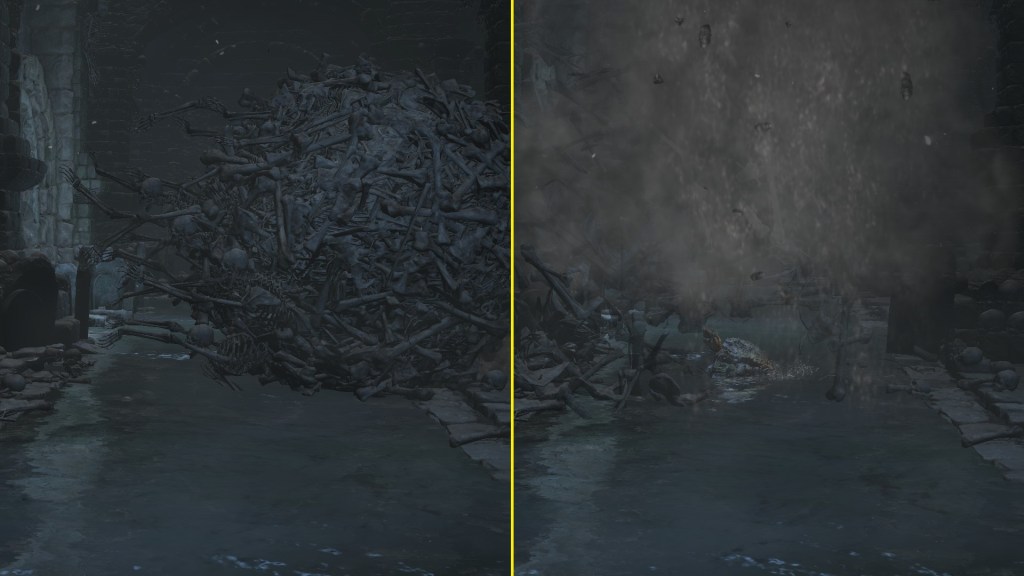
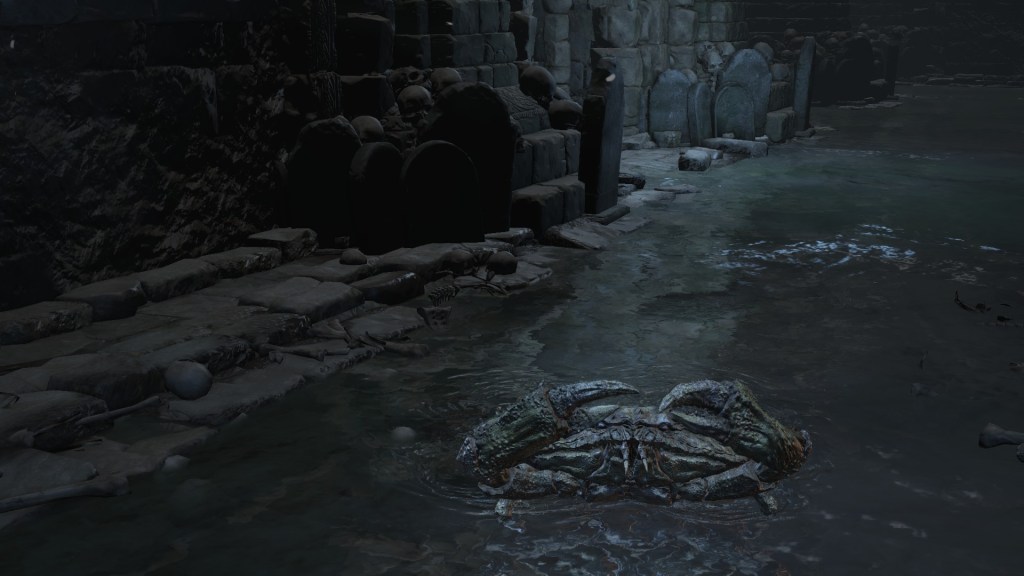
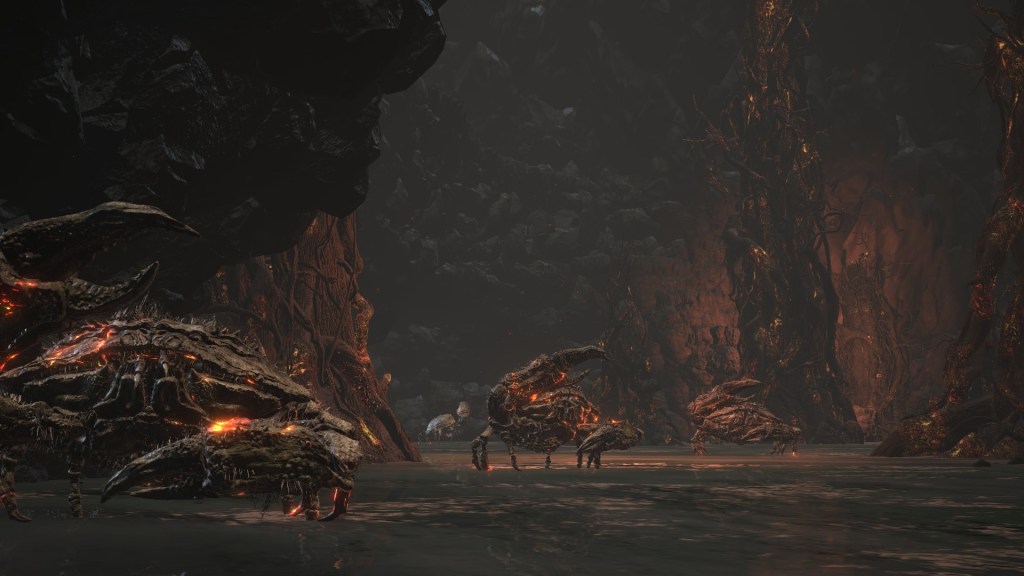
While the Boreal Valley’s residents may not have diven into the crypt, the same cannot be said for the wildlife. There is a crab hiding within a skeleton ball in Carthus. It carries rime-blue moss clumps, suggesting that it is native to the Boreal Valley. This makes sense since the vale is visible through a crevice in Smouldering Lake, where many giant crabs roam the waters. These crabs most likely migrated down from the valley, where our little friend then found its way back up into the Catacombs. From there, we can only presume that it was caught up in the ball when it was initially formed or as the bones had been rolling around the complex; its hard shell is probably to thank for it surviving any impact while being carried from place to place. Amusing as this encounter is, it isn’t the only wild animal to have invaded the tombs.

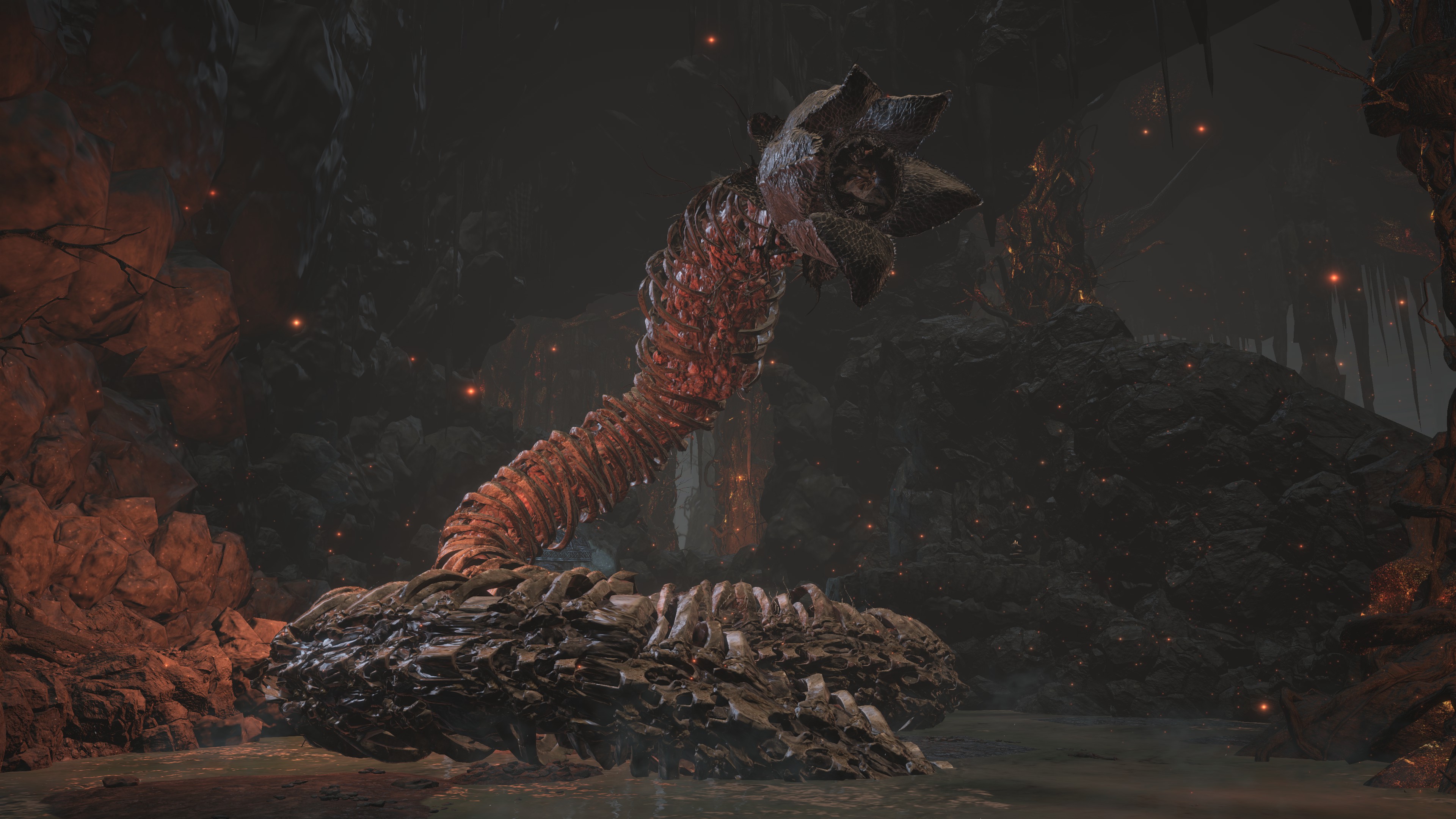
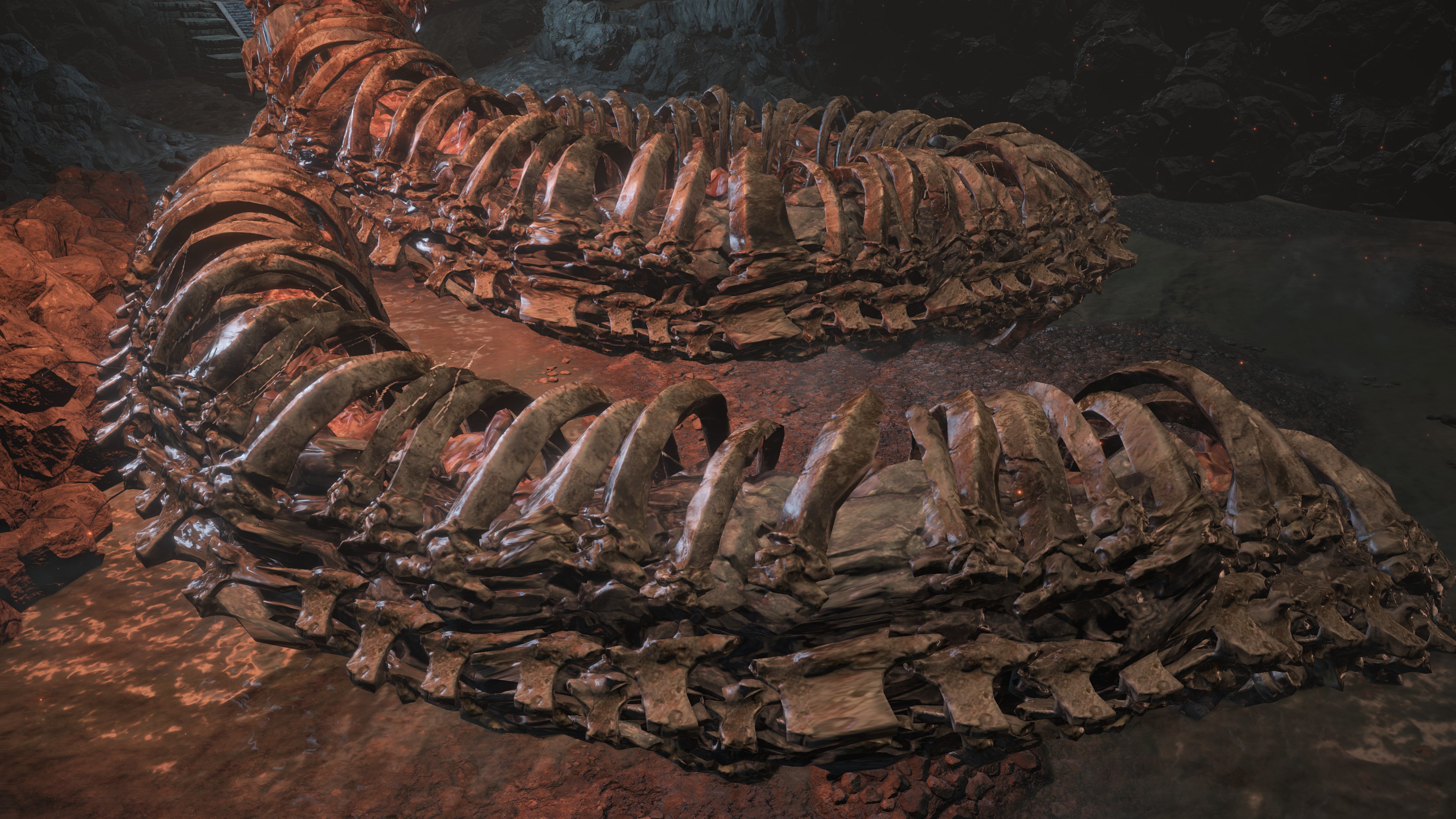
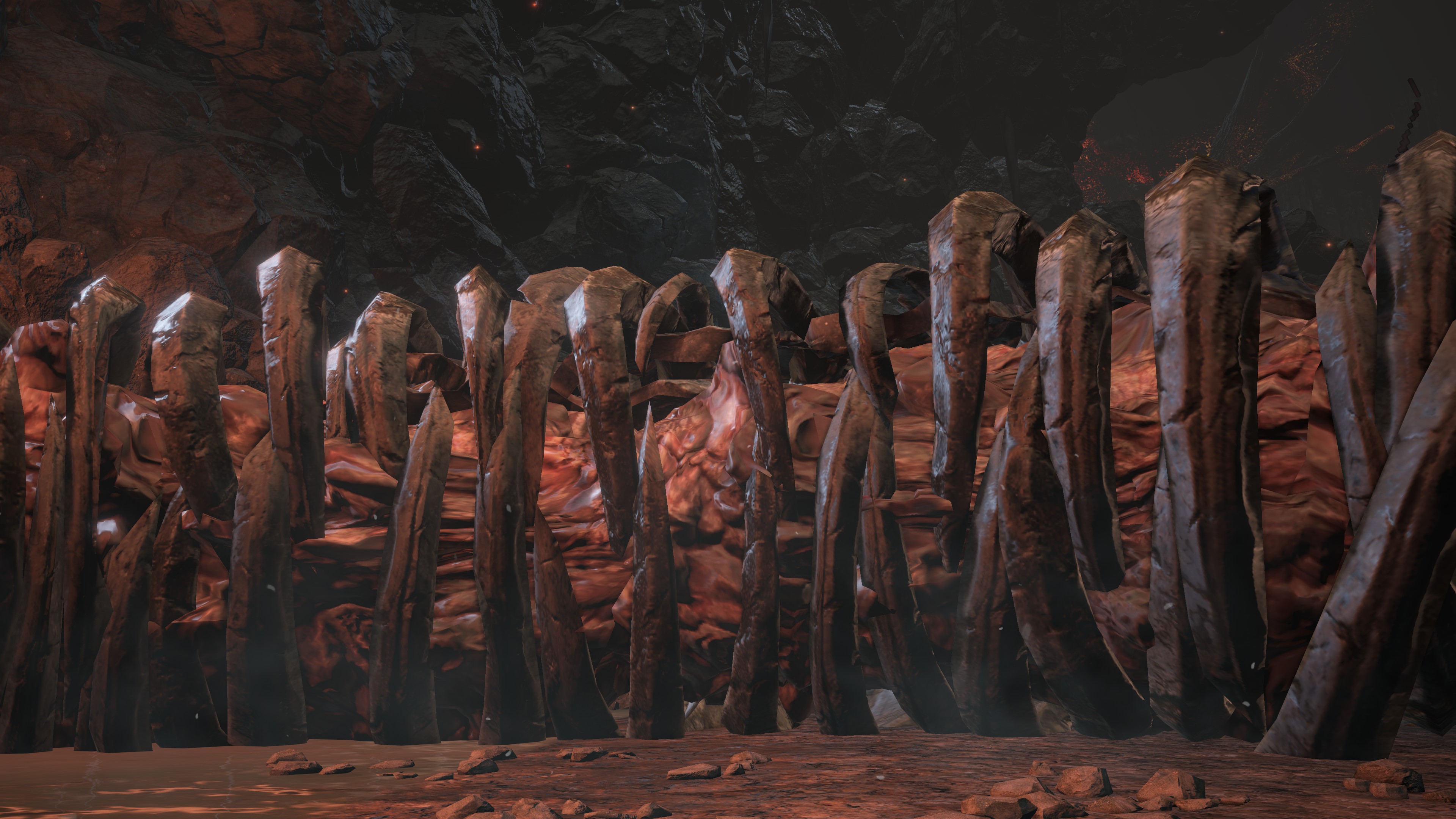
The Carthus Sand Worm is a massive creature which had been prowling deserts before becoming victim to the drift. Considering that Jugo was home to giant ants, giant worms are no surprise. What is surprising is that something so gargantuan was dragged along without the deserts it burrowed through, though it is possible that the deserts do exist between the forests and we just never see them. Whatever the case, this worm has caused Carthus some trouble. The Yellow Bug Pellet’s description relates how the grave wardens have been making this lightning-resistant medicine specifically to help them deal with the lightning-spewing sand worm as it terrorized the tombs. And the reason for its invasion might be inferred from the behemoth’s physiology.
Close inspection reveals countless human bodies melded together within its exposed rib cage, their distressed hands and faces still visible. In other words, it is a man-eater, which explains why it can breathe lightning — it channels the devoured remains of Lothric’s ancient dragonslayers long-buried in the region through its body and makes their power its own. It is possible then that the sand worm sensed the massive body piles in Carthus and wanted a bite. However, even if it was just happenstance, they succeeded in driving out the beast. It fell deeper underground, most likely from the chasm disconnecting Wolnir’s chamber from the cadaver-ridden sewers. A corpse with yellow bug pellets hangs over the edge, another impaled on a stalagmite down below in the Smouldering Lake where the worm has since made its lair. Taken together, the ground unexpectedly collapsed beneath them during their last encounter, the surviving gravekeepers cobbling together a rope bridge after the fact to restore contact with their lord as soon as possible.
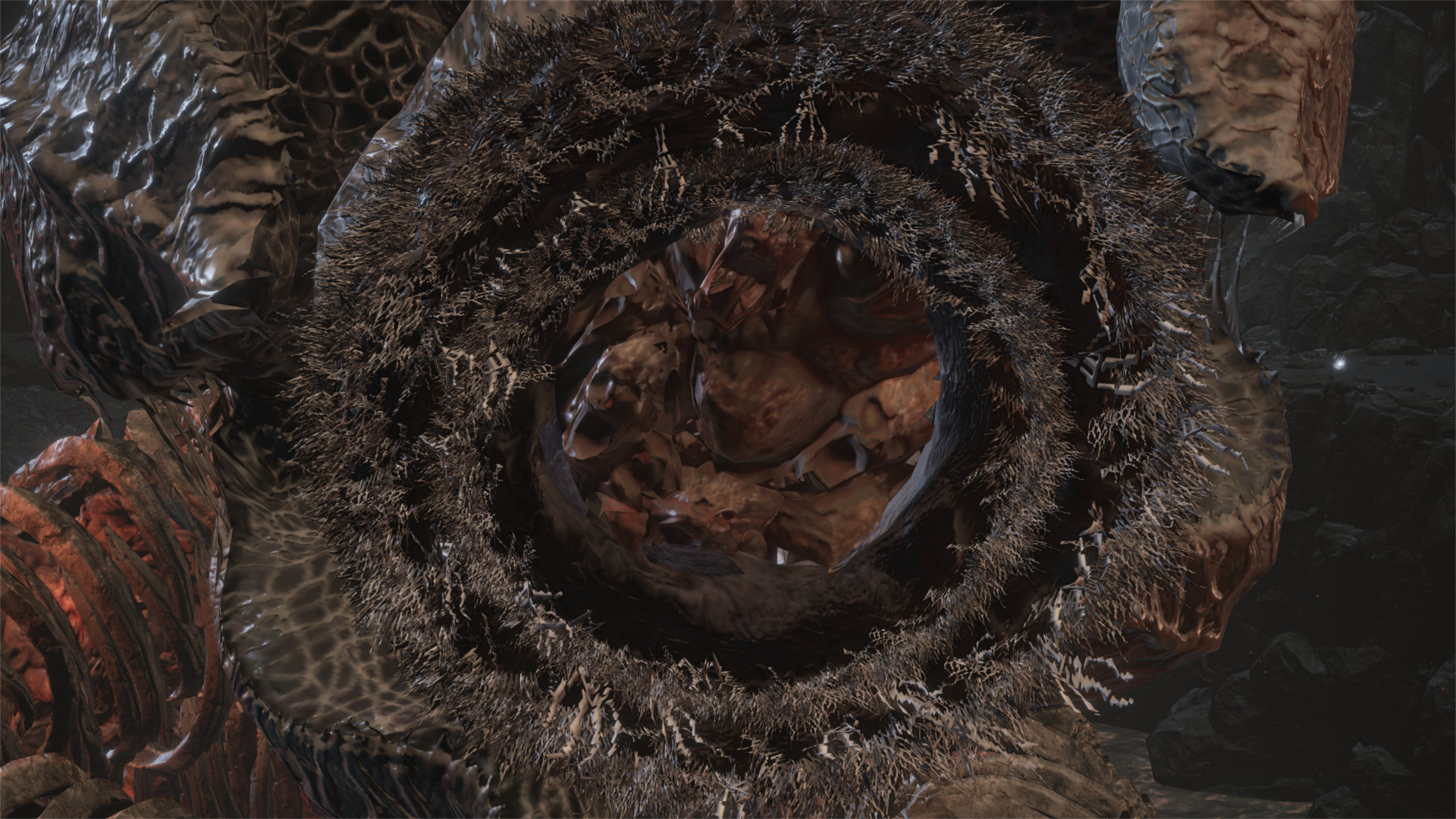
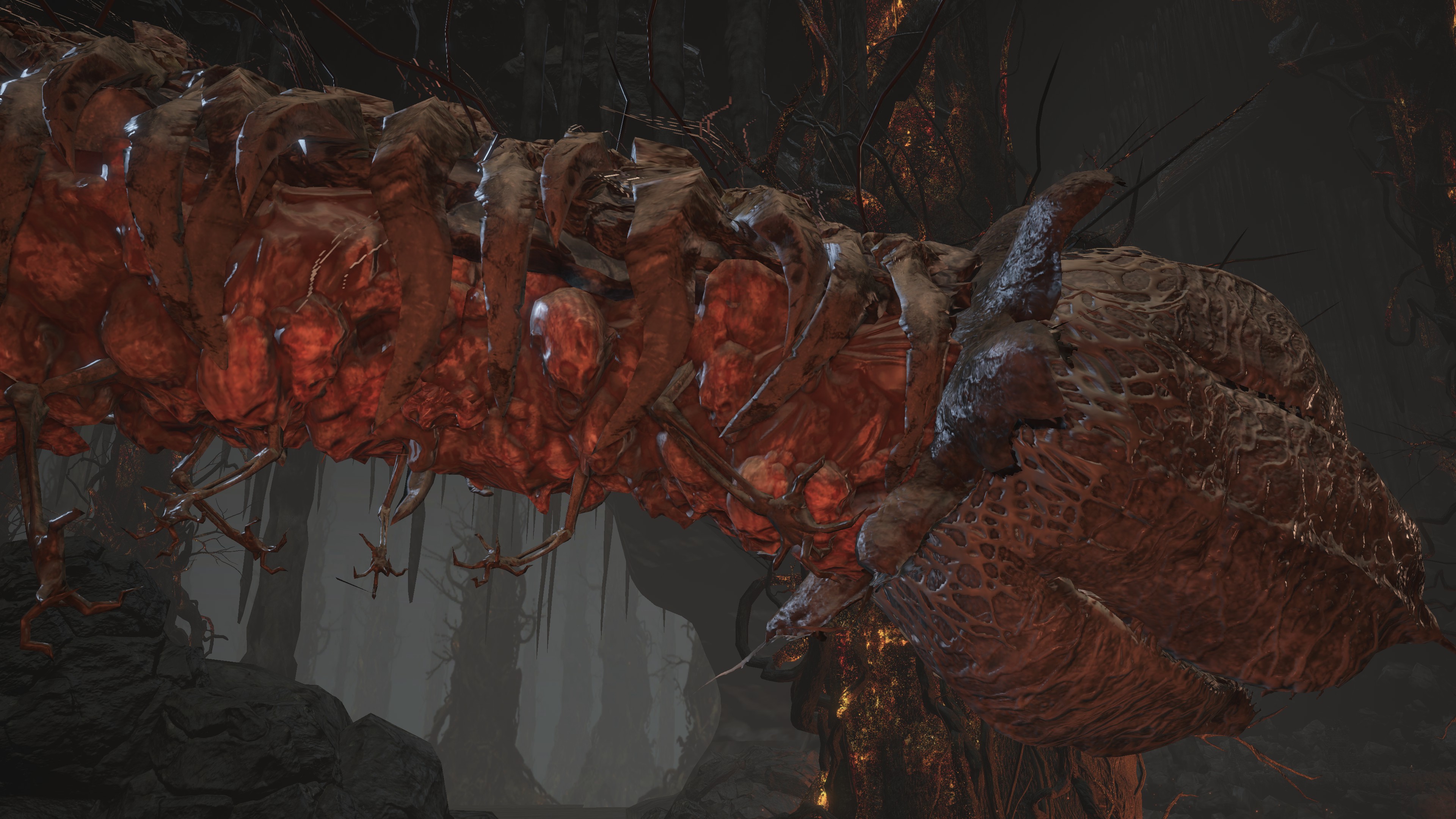

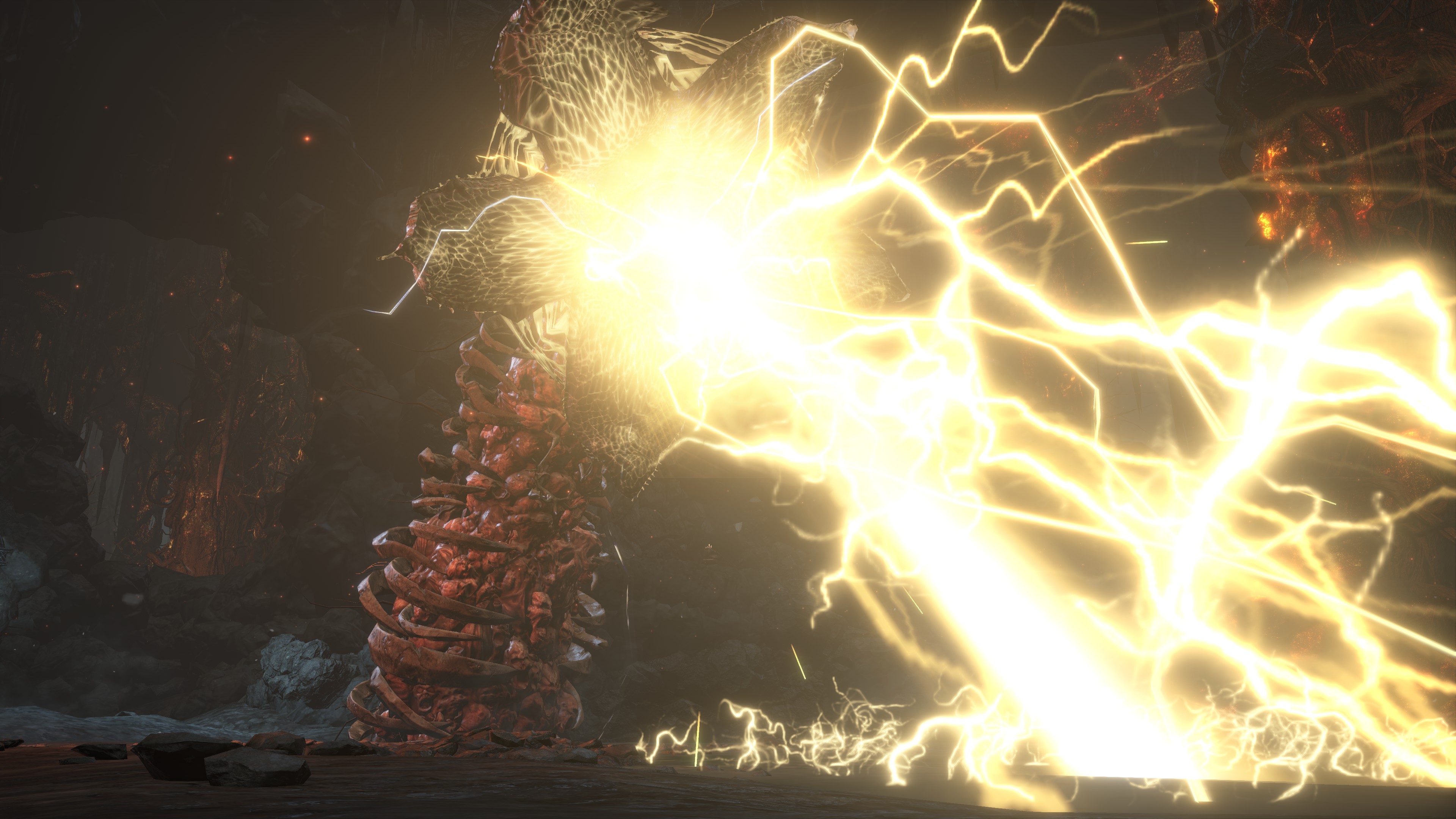
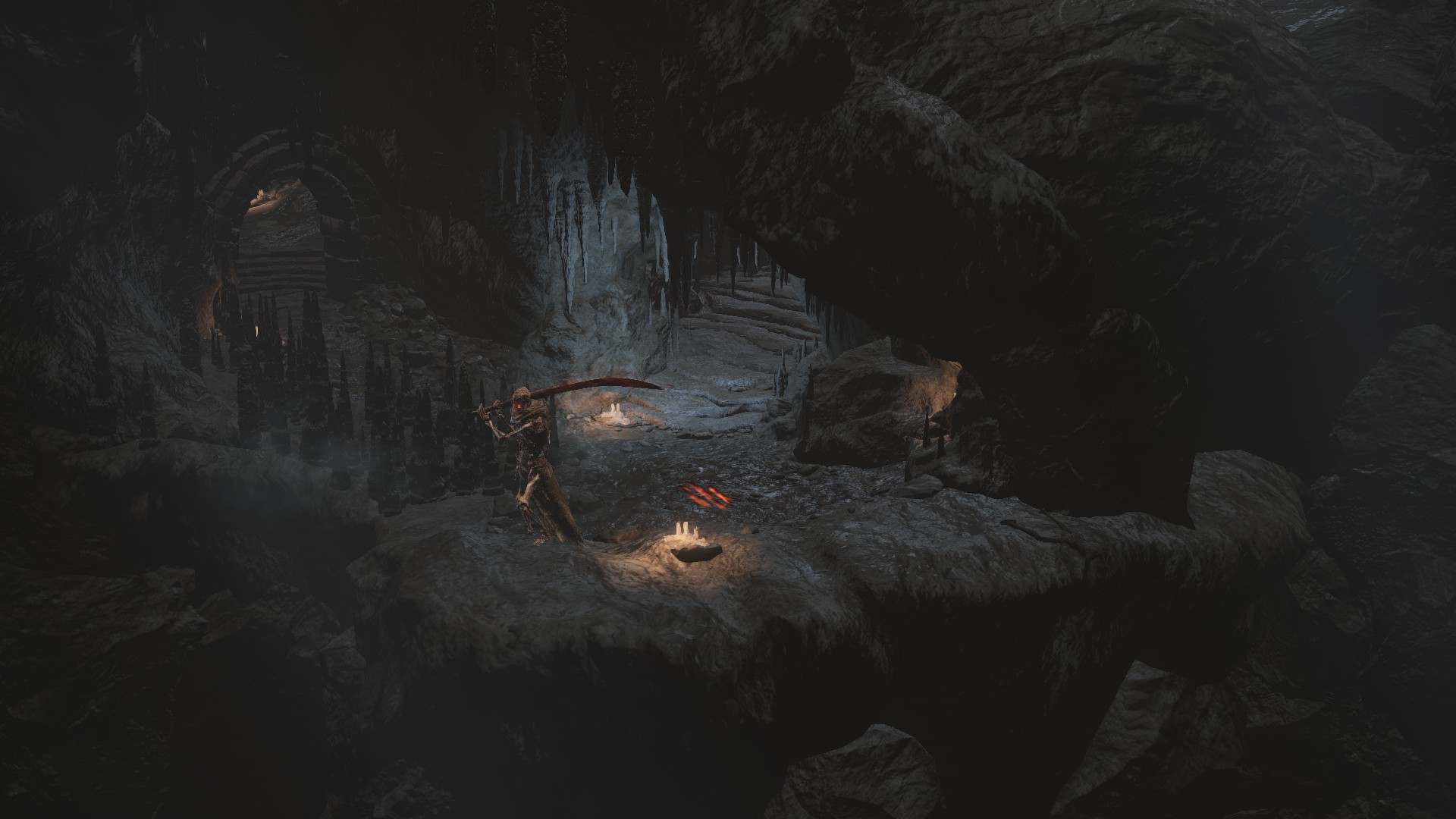
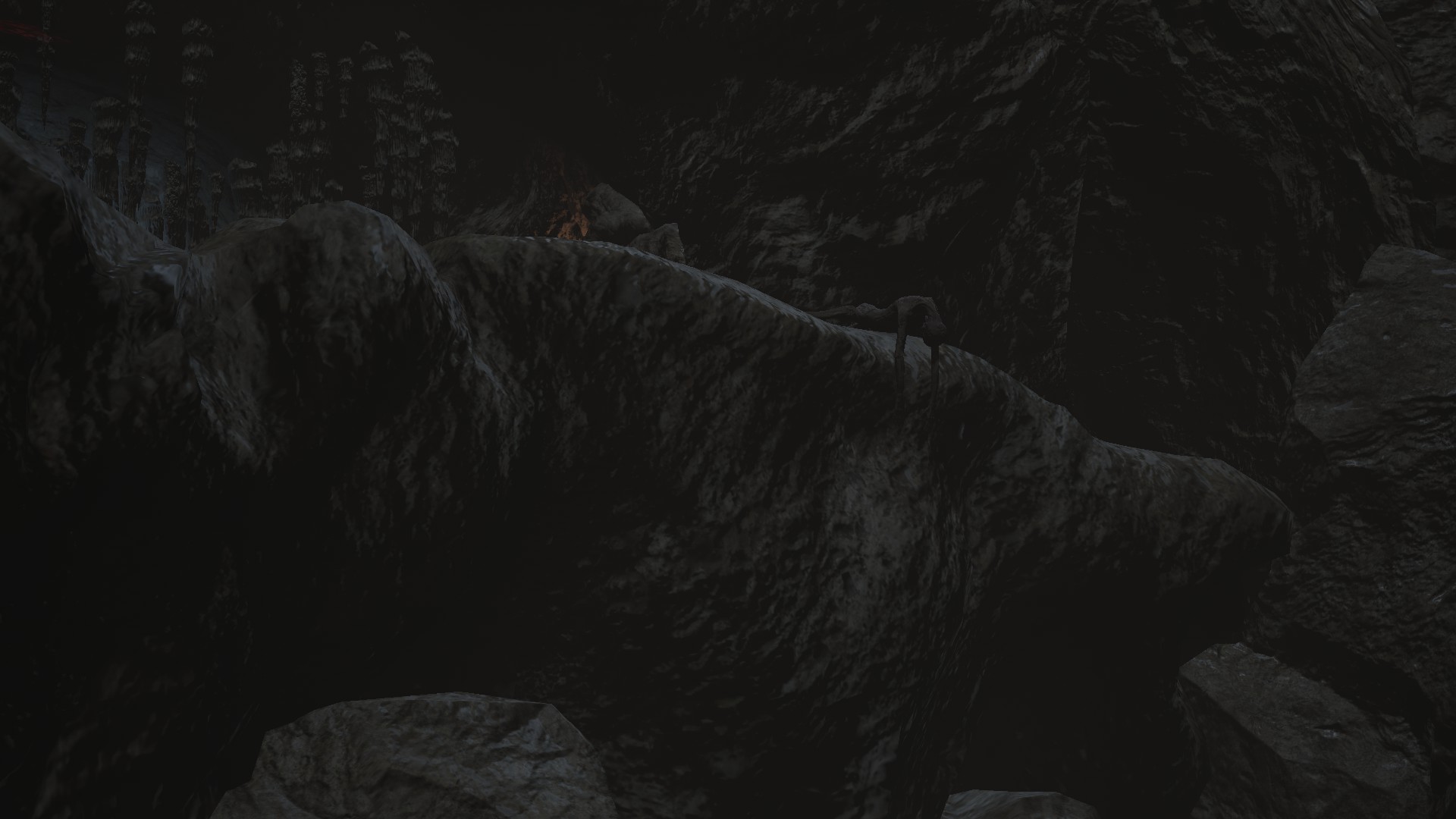
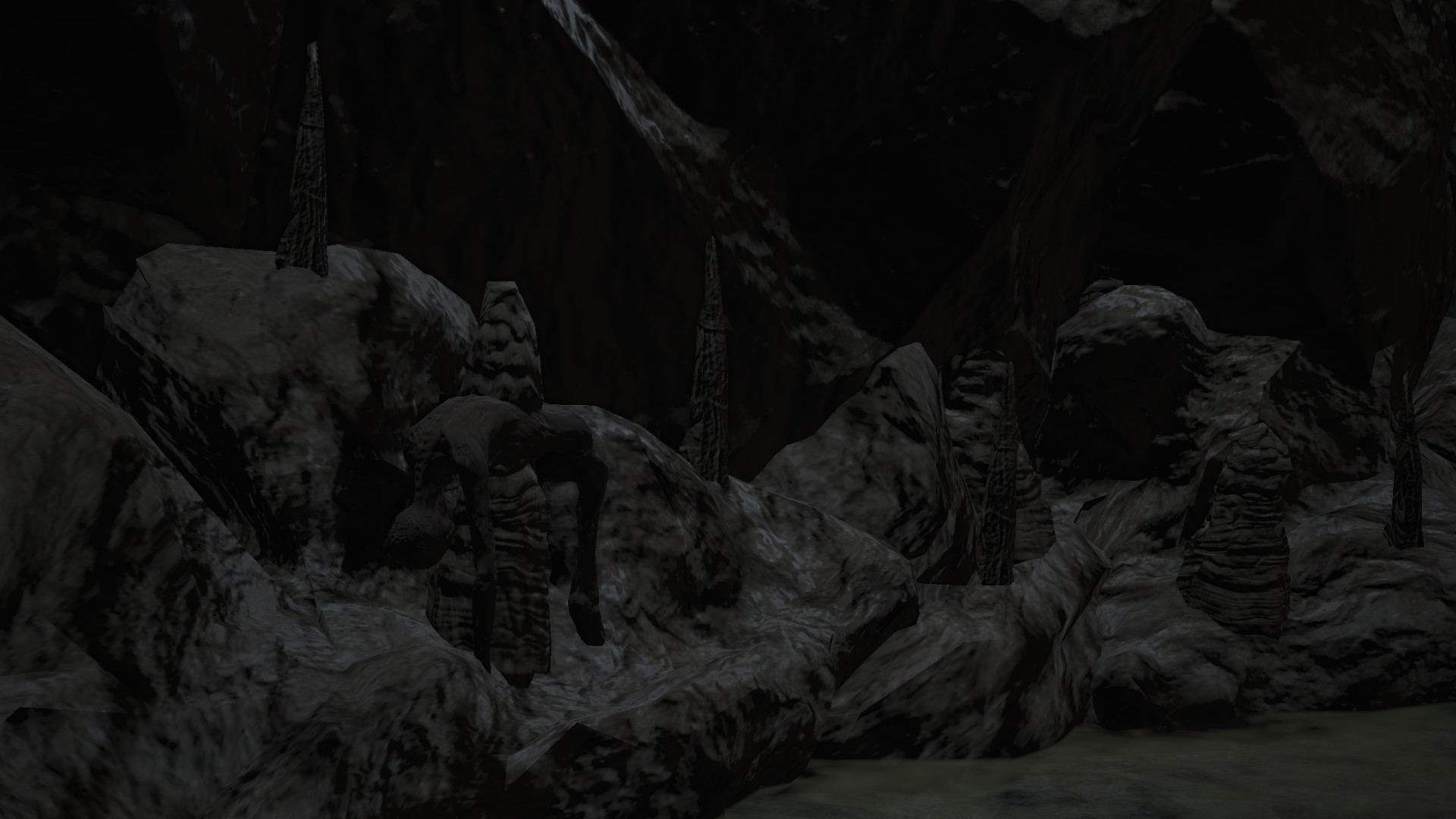
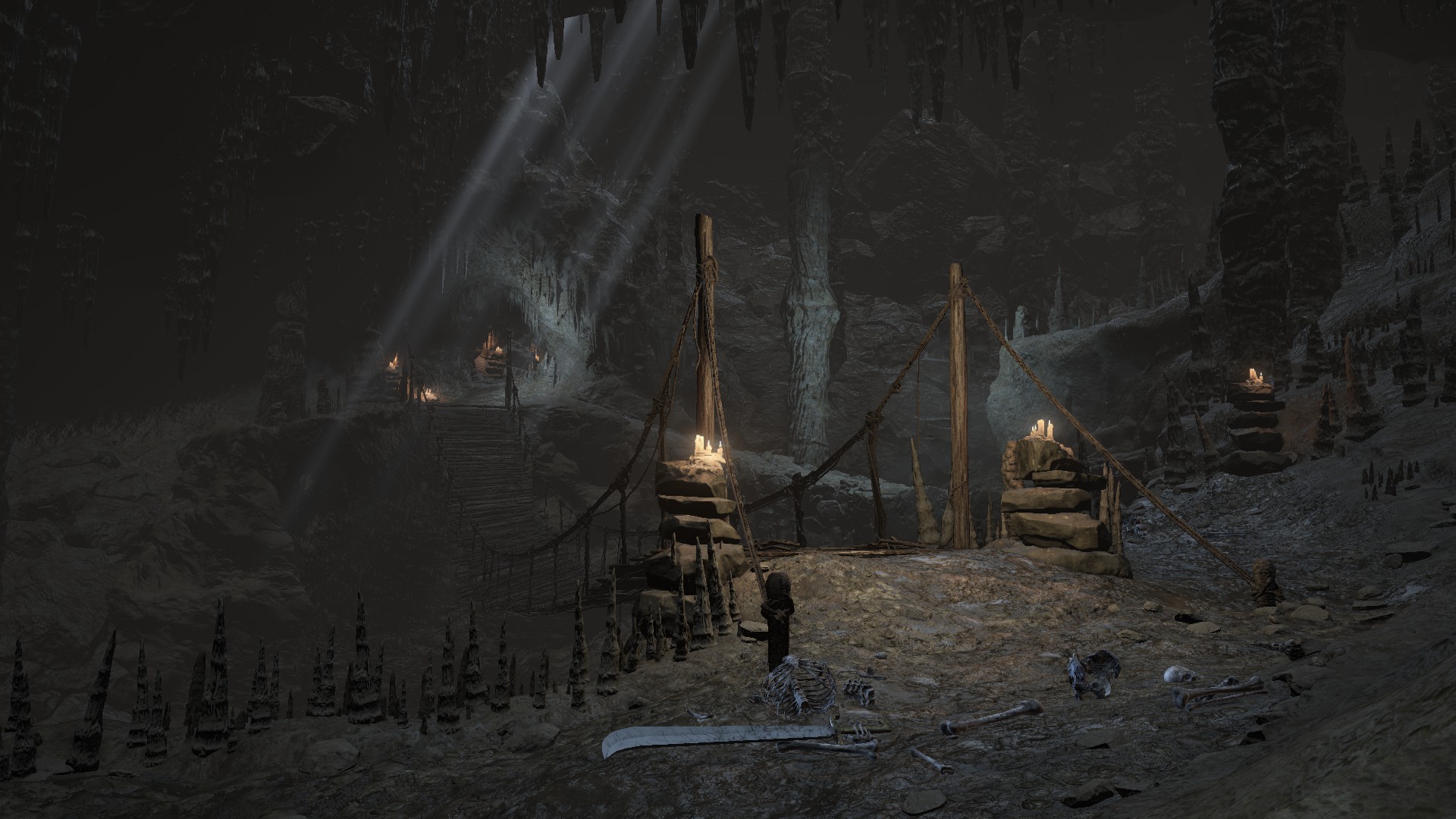
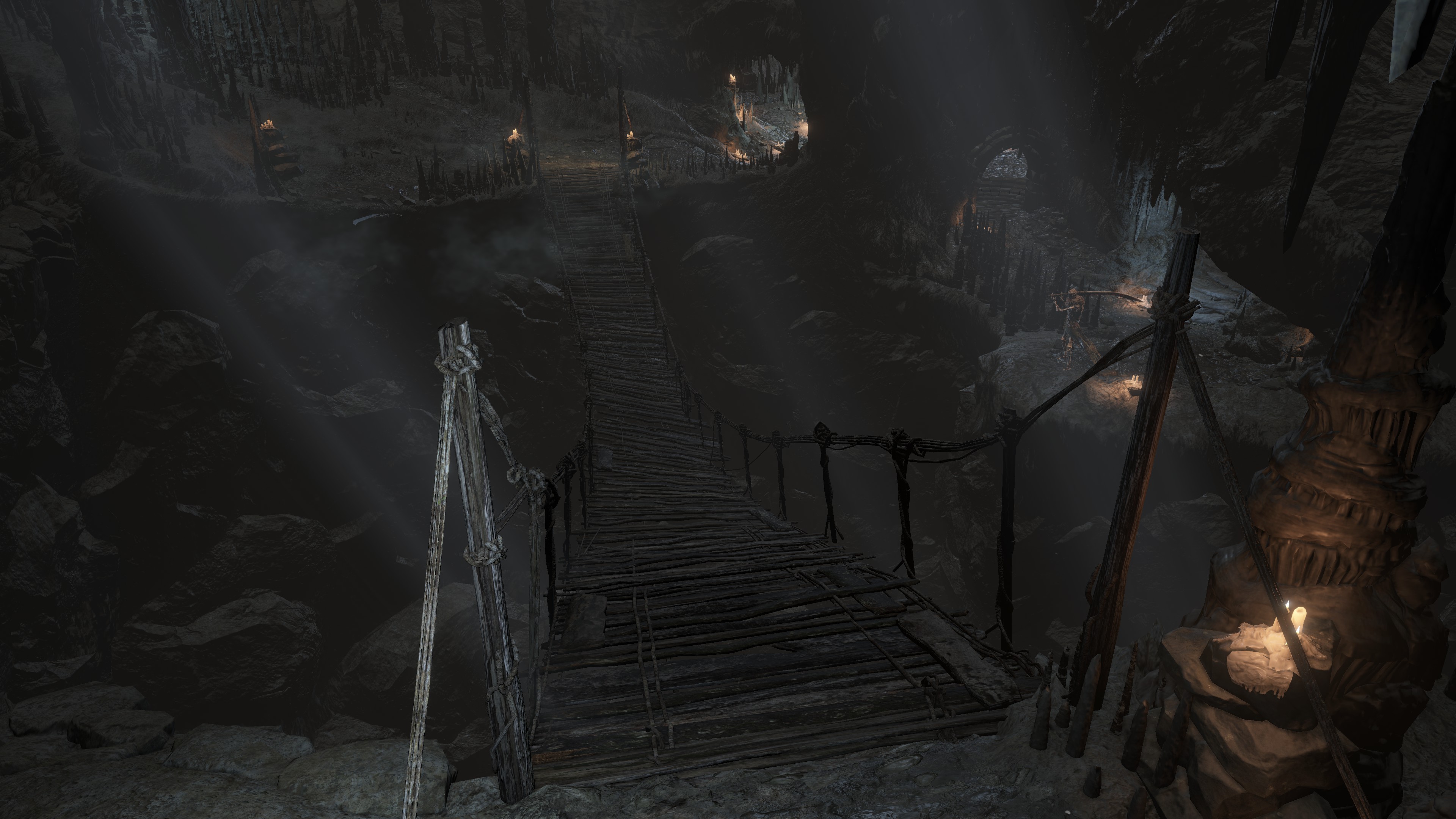
Oral medicine that ground and rolled up a kind of insect. The yellow-colored one temporarily boosts lightning cut rate.
The gravekeepers of Carthus relied on this to drive away a sand worm.
It is said to have fallen deep underground and become the giant master of Smoldering Lake.
Even though the sand worm problem seems to have been solved, Carthus is still dedicated to slaying the beast. The dead nation’s various skeletons meander atop the cliff on one end of the lake and uniquely hold onto yellow bug pellets, meaning that a small strike force has gone down there with the intention of dealing with the creature. This detachment has apparently already encountered the giant slaves operating the ballista on the cliff and killed them, perhaps intending to commandeer Irithyll’s device to help slay the sand worm like we can. There are no signs of the grave wardens, but Wolnir might be losing faith in their abilities. We find the nostalgic squire beyond an illusory wall in the sewers, the pellets derived from his ashes betraying how this necromancer was alive up until the worm appeared. Most likely, the old man fled the last confrontation and quickly attempted to hide — not realizing patrols had alternative access. After weak flesh’s punishment for desertion, it is no wonder if the High Lord turns to fearless bones. Either way, their reasons for hunting the worm may run deeper than just to ensure it won’t come back.
Because the drift has overlapped Carthus with Smouldering Lake, its Izalithian residents have moved in. In order to reach the lake, we have to snap the rope bridge and climb down it to the Abandoned Tomb which a chaos demon currently patrols, evidently, as its territory, fighting off local skeletons as well as us in a large chamber with support pillars demolished. If this section is abandoned, then the same can be said for all portions found from that point on, all of which are home to demons or reduced to rubble from the drift. In other words, Carthus was unable to handle the locals as they invaded the disconnected tombs and ultimately relinquished the lower levels to cut their losses. Since the chaos demons were only interested in retaining their existing territory, this ended the border dispute. But for an empire built on conquest, this must have been a humiliating defeat. True, the homeland of pyromancy was a bad match up for Carthus, but that wouldn’t make Wolnir any less bitter about it. And would he really take that sitting down?
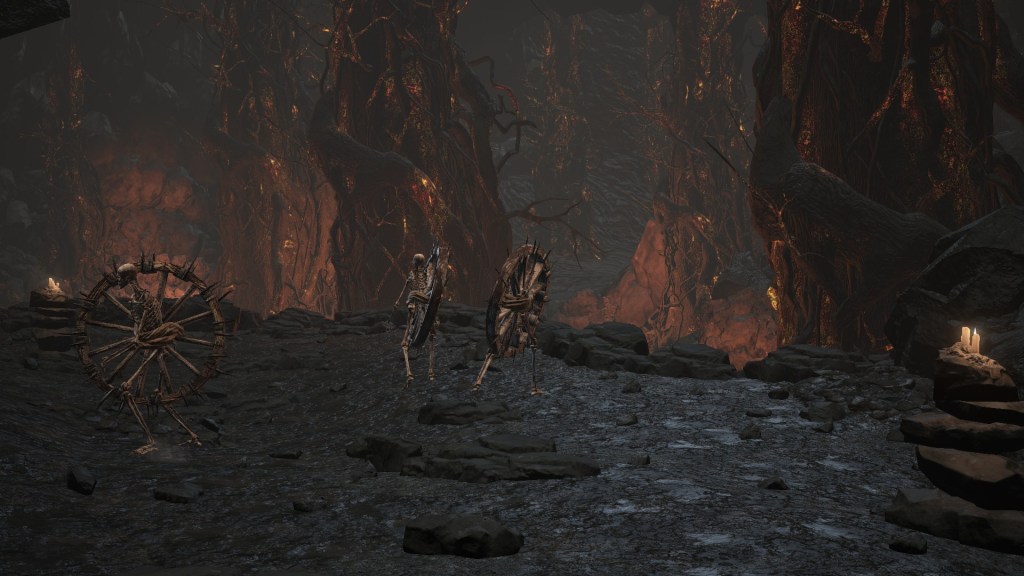

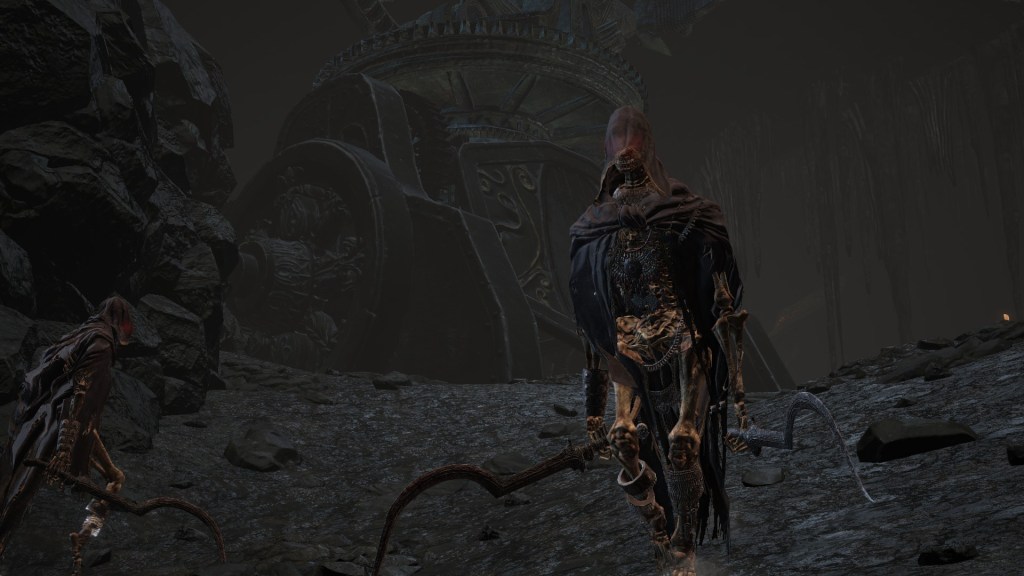
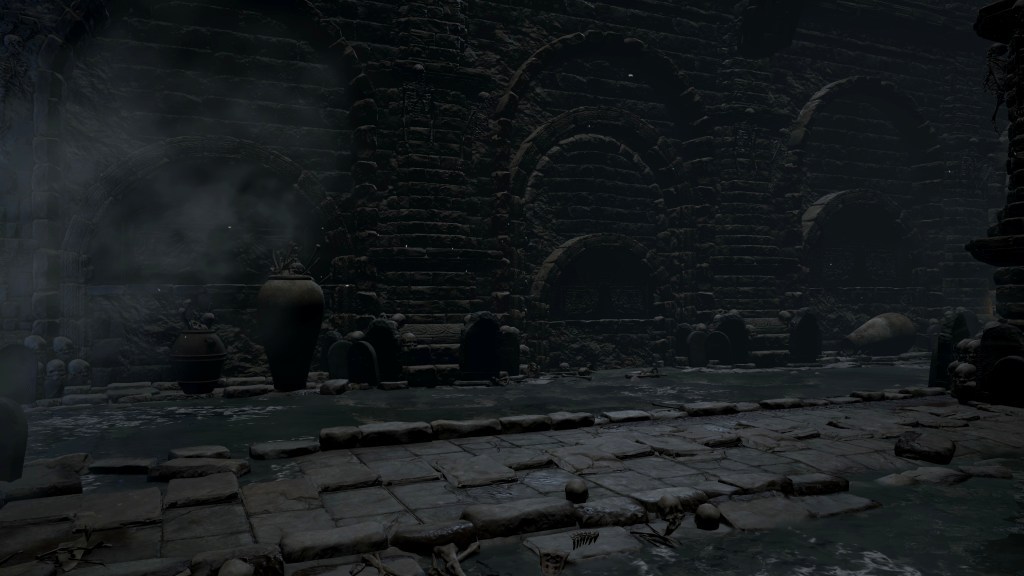
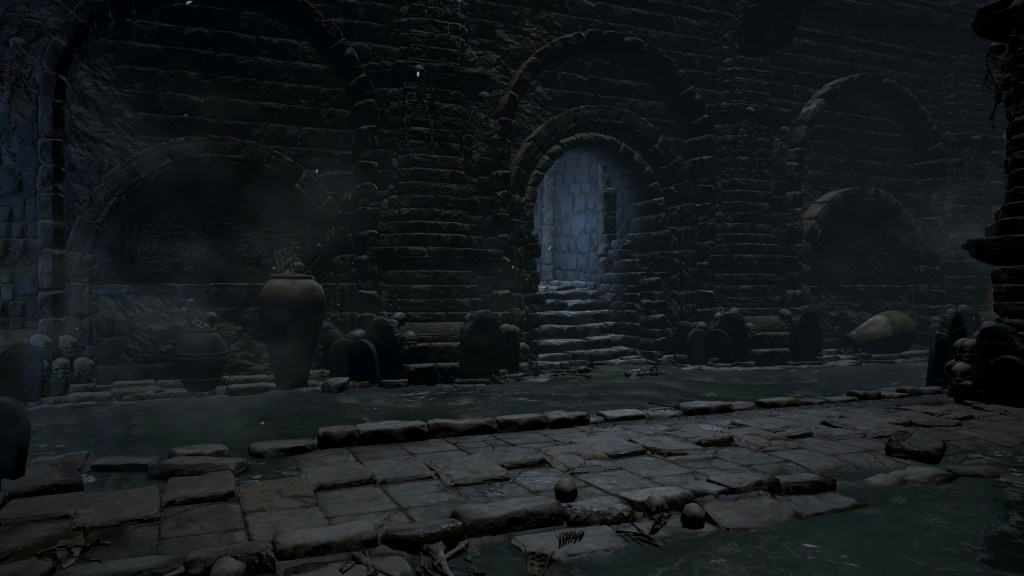
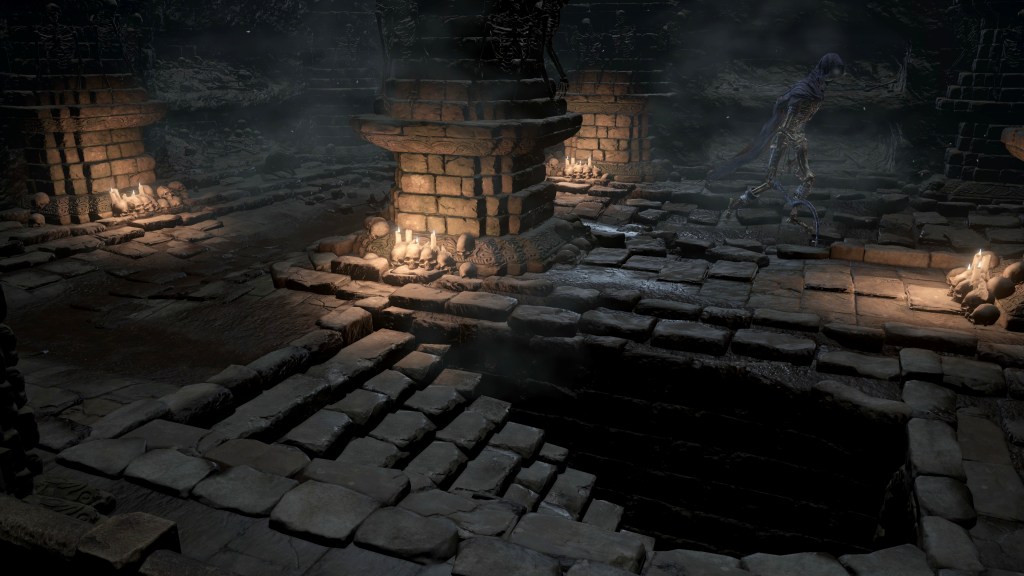
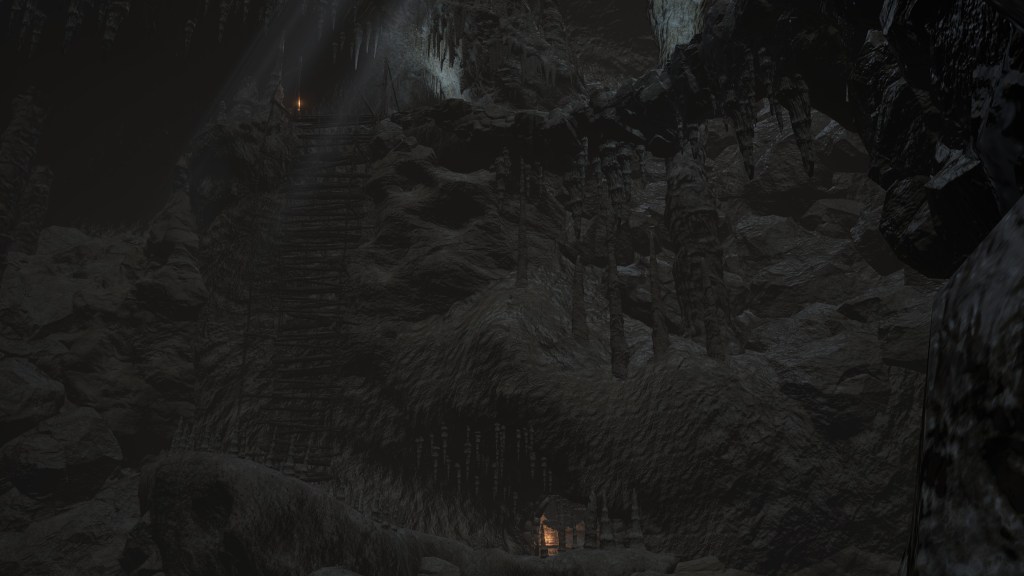
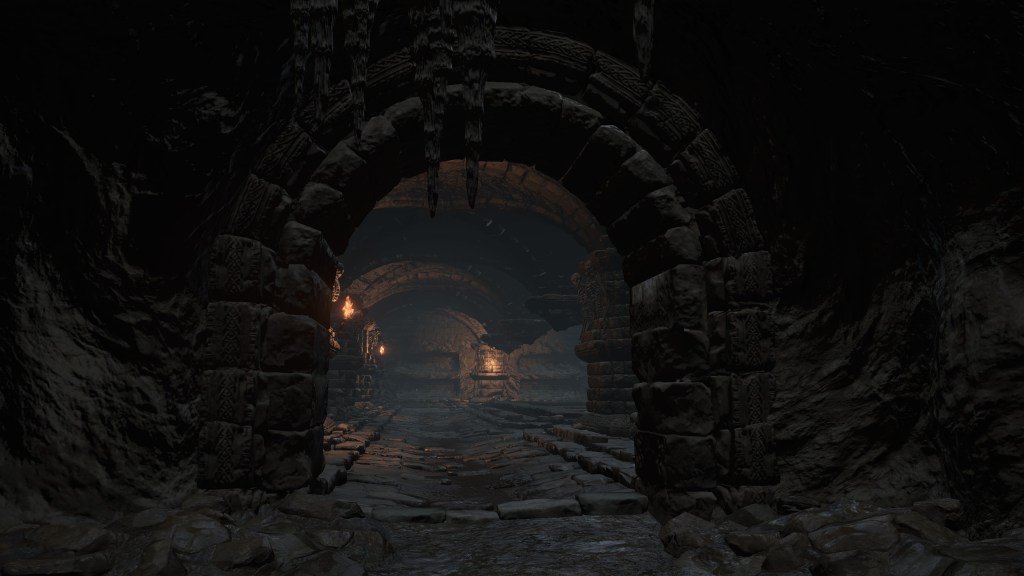

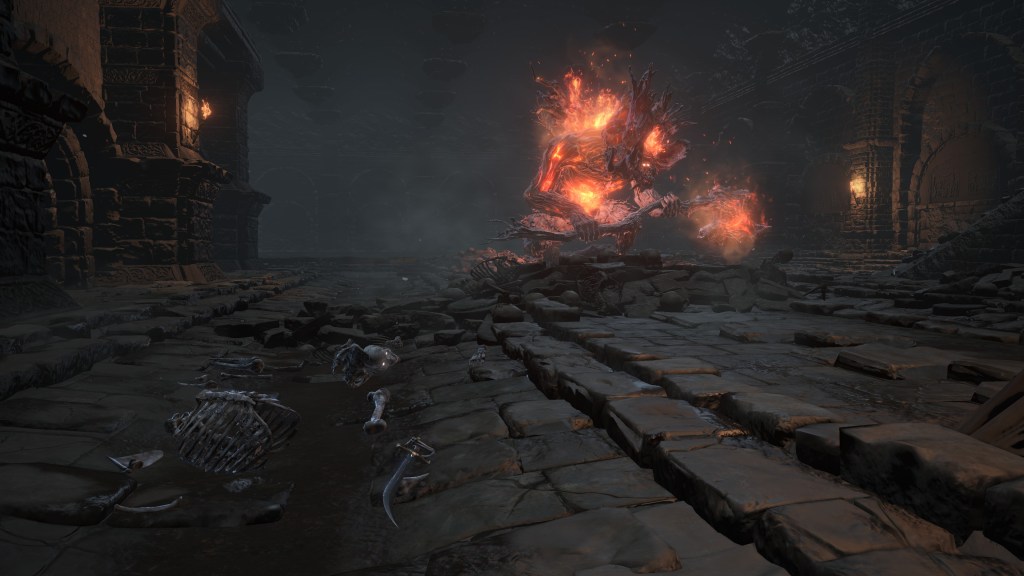
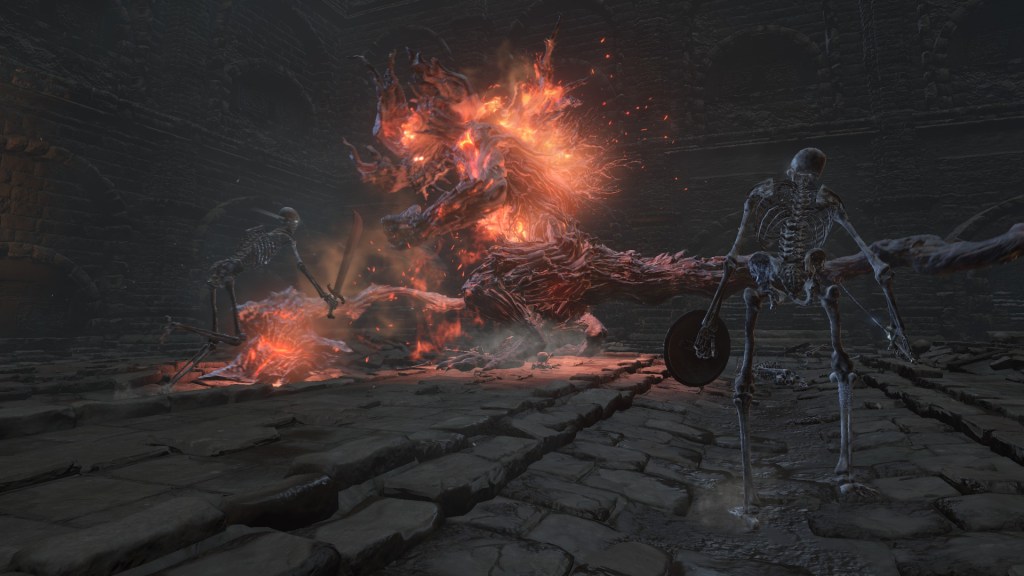
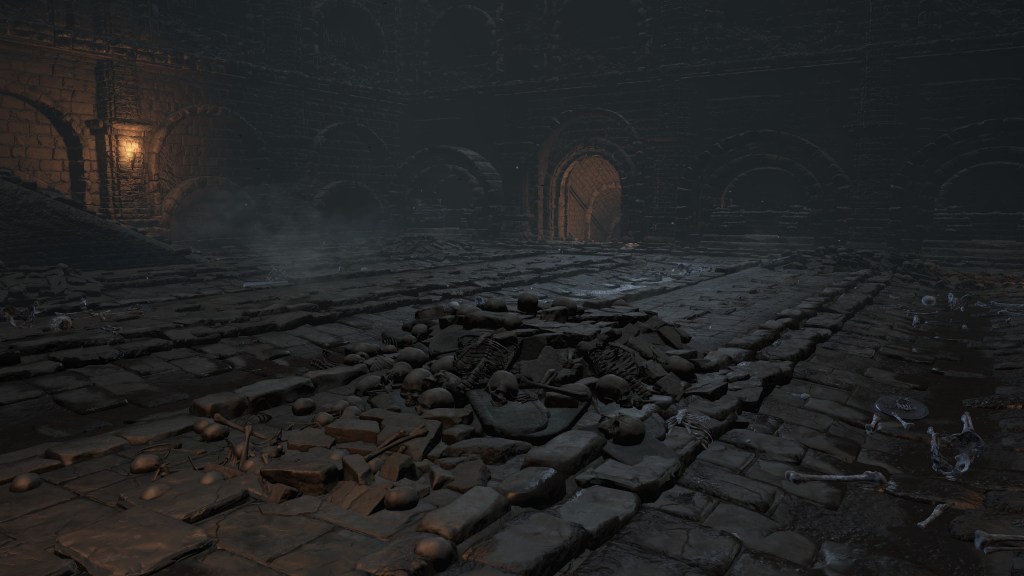
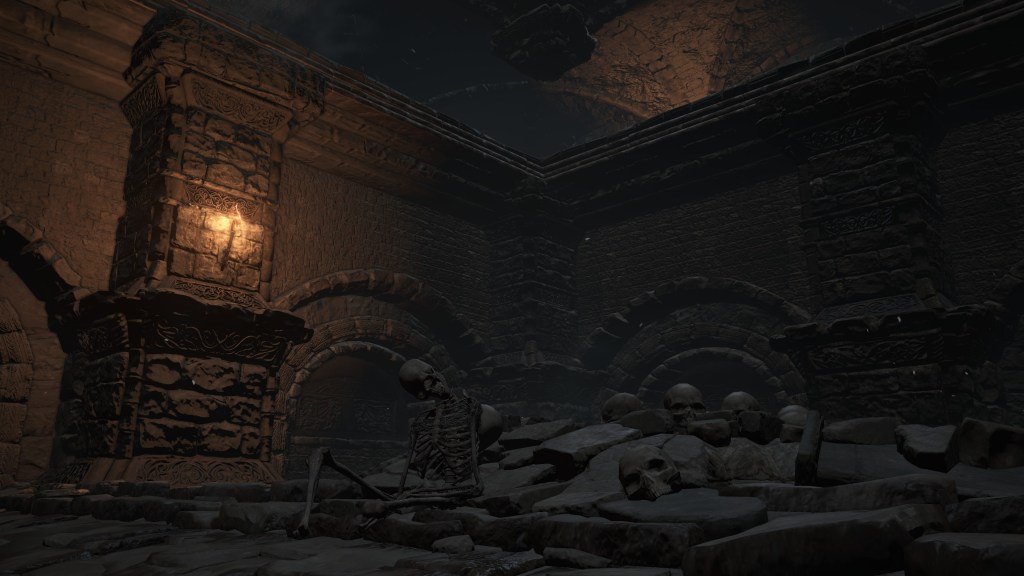

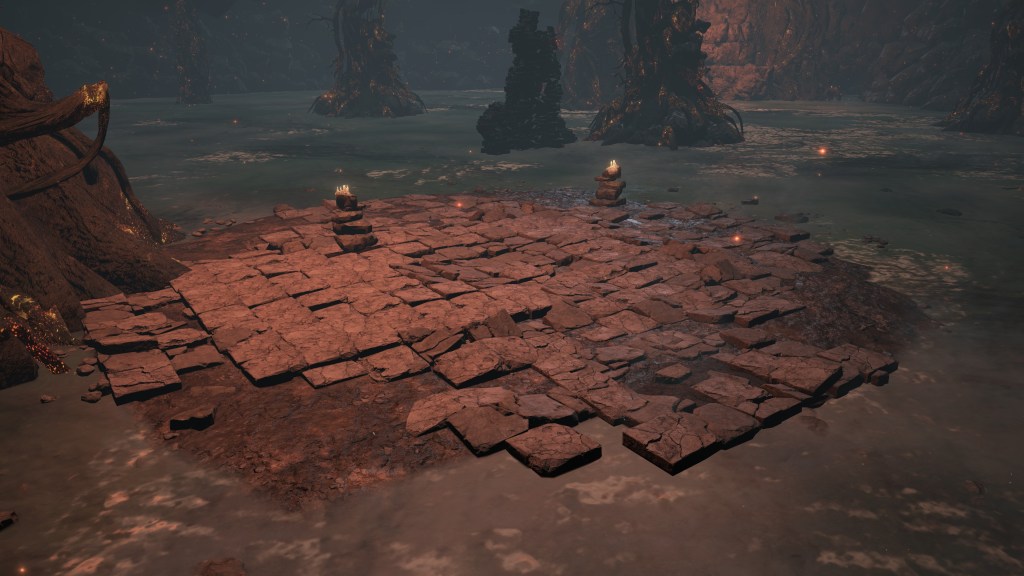
And so, Carthus’ pursuit of the sand worm even to these depths is probably out of a desire to one day reclaim these lost sections of the complex. Now that most of the demons are dead and nigh extinct thanks to other parties’ efforts, the swordsmen have opportunity to take back their graves; the sand worm is just the first step in a larger eradication effort, perhaps even renewed conquest starting with Irithyll if the way the skeletons eye the surface city is any indication. But unless they plan to overwhelm the remaining demons with sheer numbers, Carthus still looks to lack the advantage. The fire demon of the Abandoned Tomb starts out surrounded by the bones of dormant skeletons who only react to our presence. Each revives, so their hardy bones were presumably scattered by the demon beforehand, explaining why it is already fired-up. In that case, turning attention toward chaos life after the sand worm will be an uphill battle for the tranquil dead. And while Wolnir may have hopes of reclaiming lost territory and then expanding further beyond, can he even maintain his current holdings?
Wolnir’s greatest fear is being swallowed by the Abyss that he has painstakingly suppressed. However, given how much of the Dark has eaten away at his holy sword, one might wonder if the High King can really continue to remain in the void without the same happening to his bracelets. As reflected in his boss battle, destroying these bracelets makes him too weak to resist the pull of the darkness he has immersed himself in. How much would the bracelets need to degrade before either one of them could no longer ward it off? At the same time, weathering away the blade doesn’t appear to have negatively affected its power. In truth, the fact that the holy sword has been eaten away is credited as why its Wrath of the Gods skill is so strong. Even in its meager physical state, Wolnir might have been able to rely on that holy power indefinitely if left to his own devices. But unfortunately for him, we put an end to his empire of corpses once and for all.

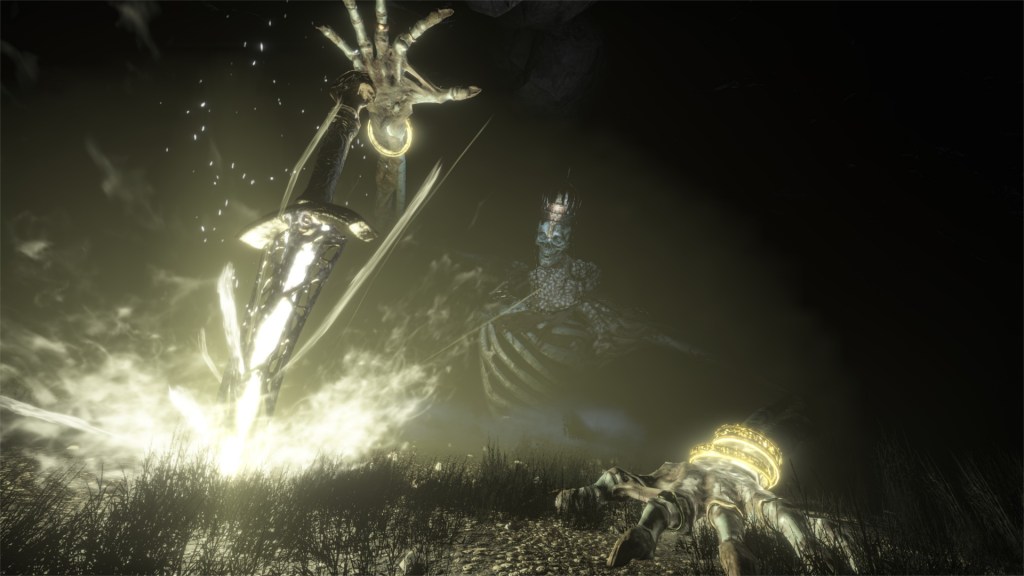
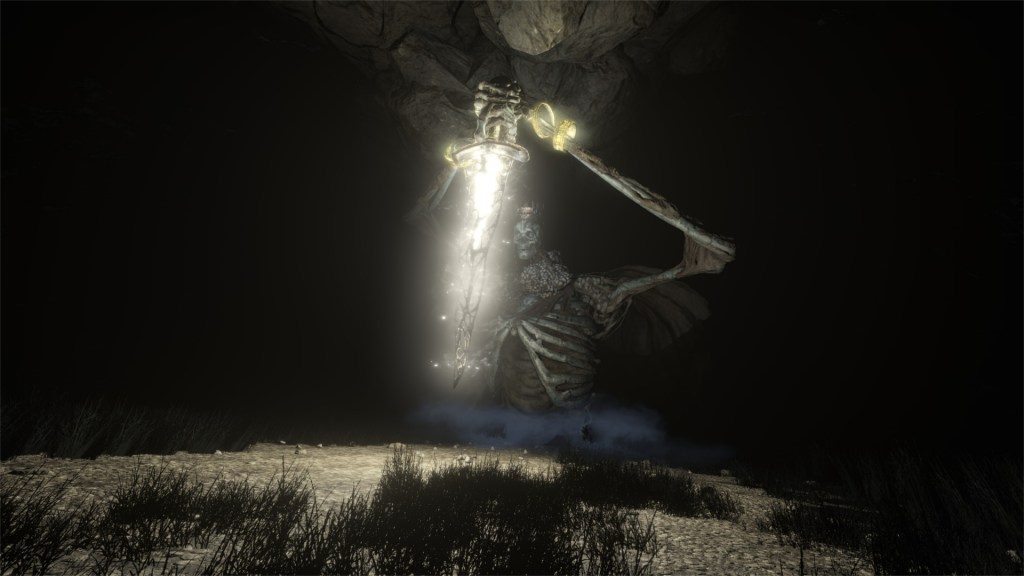
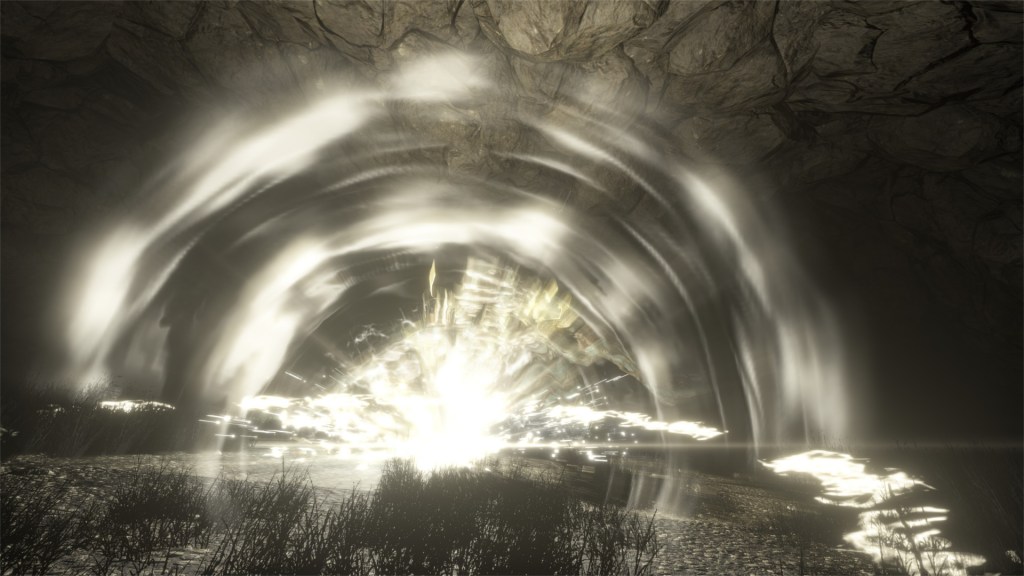
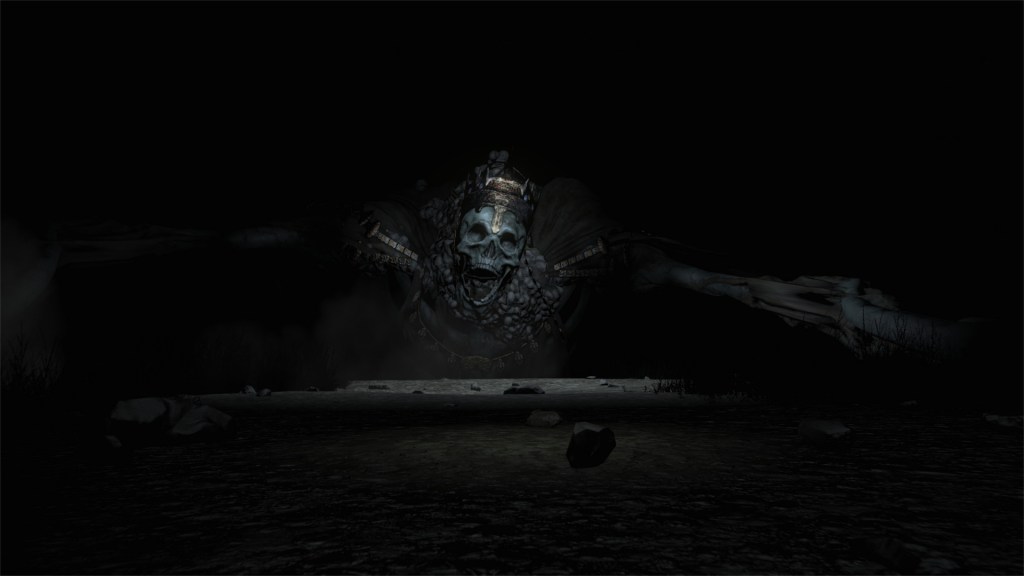
Former holy sword eaten away by the Abyss.
Wolnir, who fell to the Abyss, nonetheless feared the actual Dark and clung to gods for the first time in his life.
It is said that these are the items of clergymen he once killed and stole from: three bracelets and a single holy sword.
Battle art is “Wrath of the Gods”. Violently thrust weapon into the ground and generate a powerful shockwave. Because it was eaten away by the Abyss, that wrath is great.
 Lokey Lore