
Preface
Heide embodies perhaps the most frustrating aspect of FromSoftware’s approach to Dark Souls II. We are provided very little to work with even compared to similarly ancient events in the original Dark Souls. (DS1) As a result, reconstructing the overall picture of these ancient civilizations relies more heavily on inference than ever before, though we can arguably backfill the context provided in Dark Souls III (DS3) to supplement for these deficiencies. Lacking historicity may very well be the point, as the game’s overarching narrative seems to push back against attempts to understand the past in order to highlight its sense of nihilistic dread. Our efforts to connect the dots on what the world has long since forgotten is futile in the same way the struggle to continue existing is futile. And yet, appearances alone prove Heide to be an important clue to the setting. This requires answers to some of its most fundamental questions, and so we can only hope that the developers intend for us to defy their implicit mockery of fans seeking greater insight in the same way that they expect us to persevere through despair.
Old But New
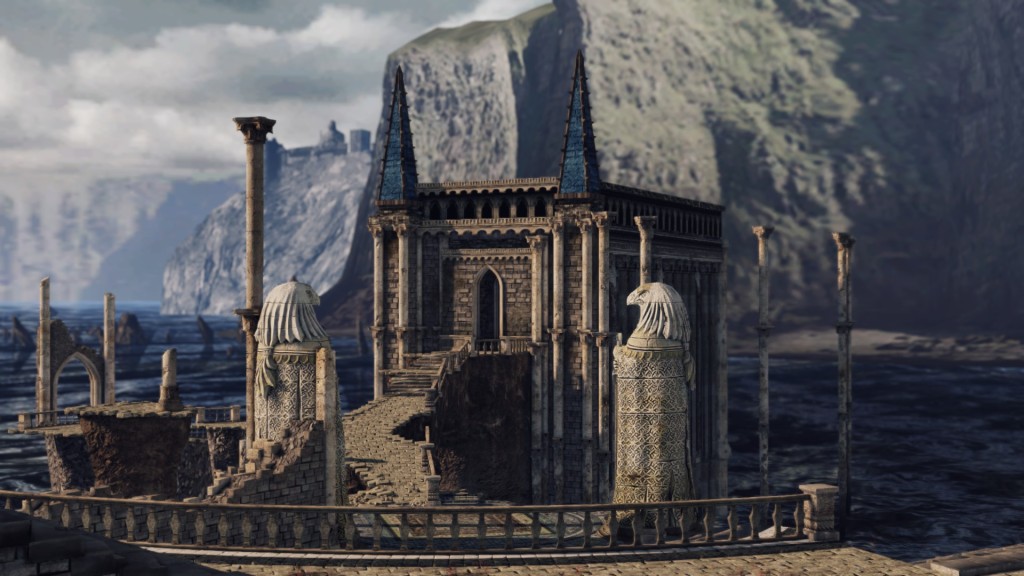
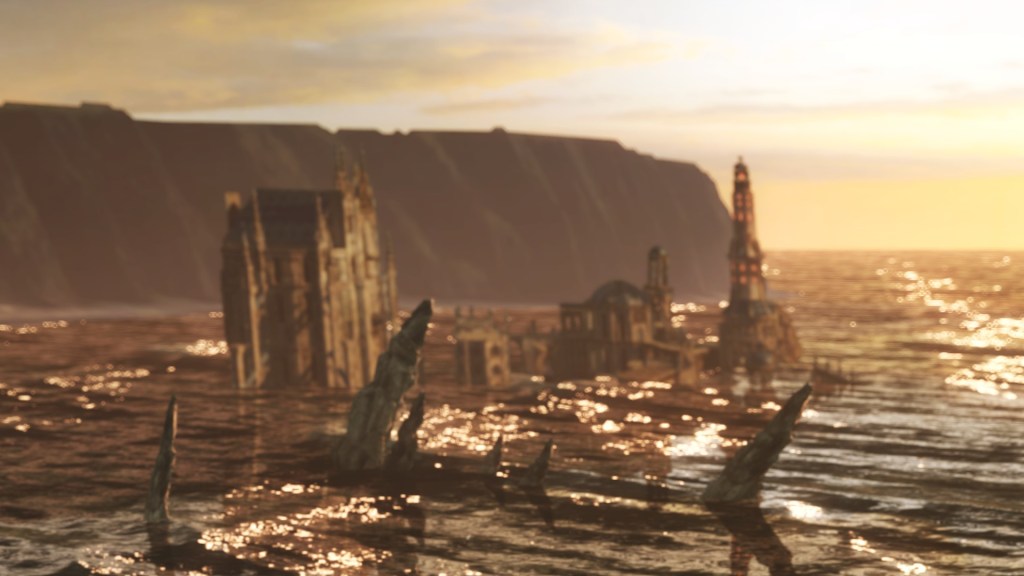
According to the description for the Heide set, it is uncertain whether the name actually denotes a country, perhaps because heide refers to a heathland in German. Indeed, the entire area hasn’t been cultivated as far as we can observe, so the actual region may have once been a moor. However, for the sake of simplicity, I will refer to the civilization itself as Heide. Whatever its true name was, this ruined nation must be exceptionally old considering that even its name is debatable simply due to its age. Most lost countries we learn about still have their identities preserved alongside at least parts of their histories, but the only things remembered about Heide is that it sank into the sea and that the Way of Blue originated from there. As various characters relate in existing and cut dialogue, the “Blue Church” (青聖堂) at the city’s apex is abandoned save for the Blue Sentinels, who seem to have used it as a base of operations from before Heide’s fall. So why did this faith and these warrior monks find their start in this city in particular? More than likely because Heide derived itself from Anor Londo.
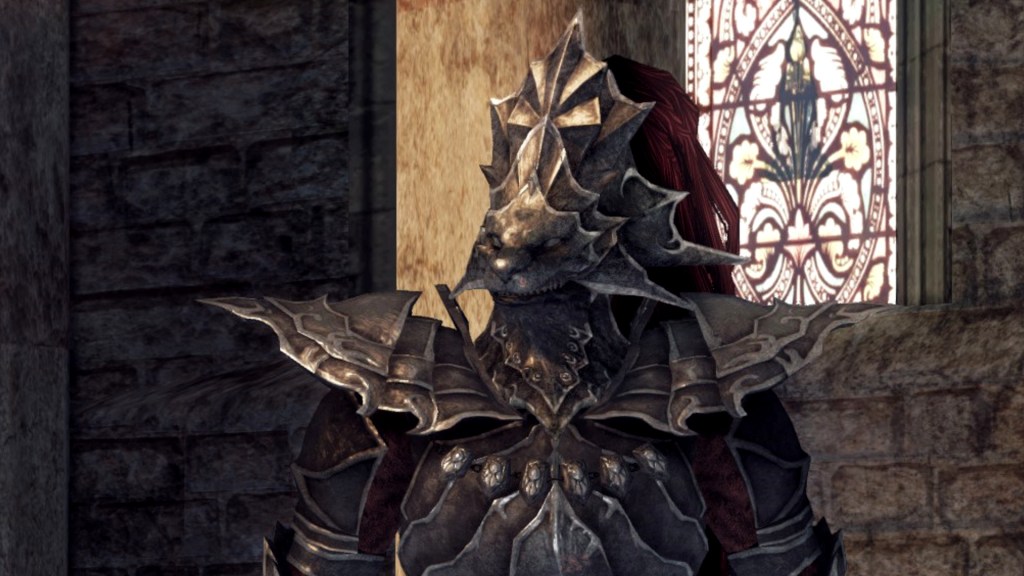
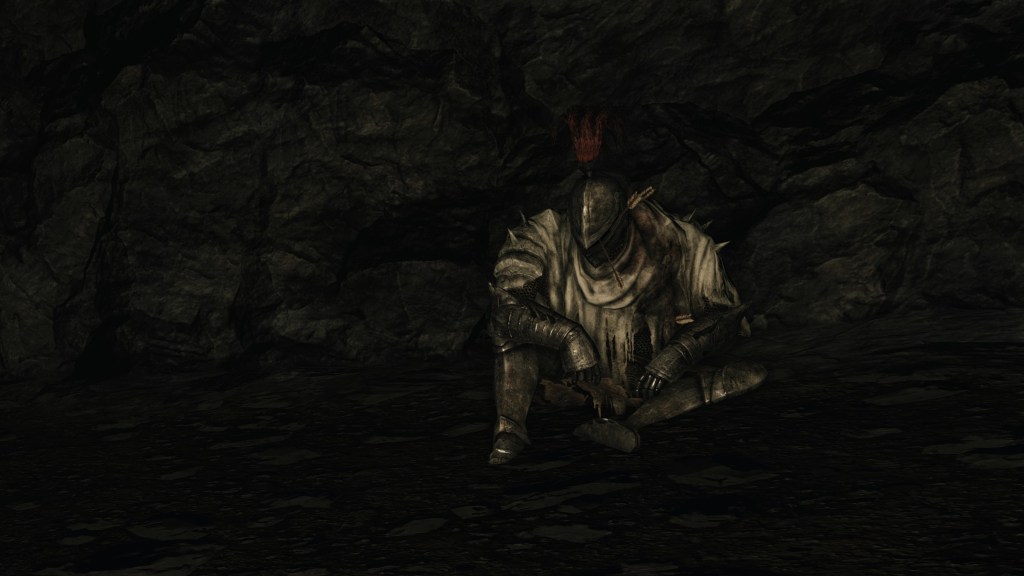
Greathelm of a knight of Heide.
Does the name Heide denote a country? Even that is already lost because it is too distant a past.
But it is said that Heide was the Way of Blue’s land of origin and later sank into the sea.
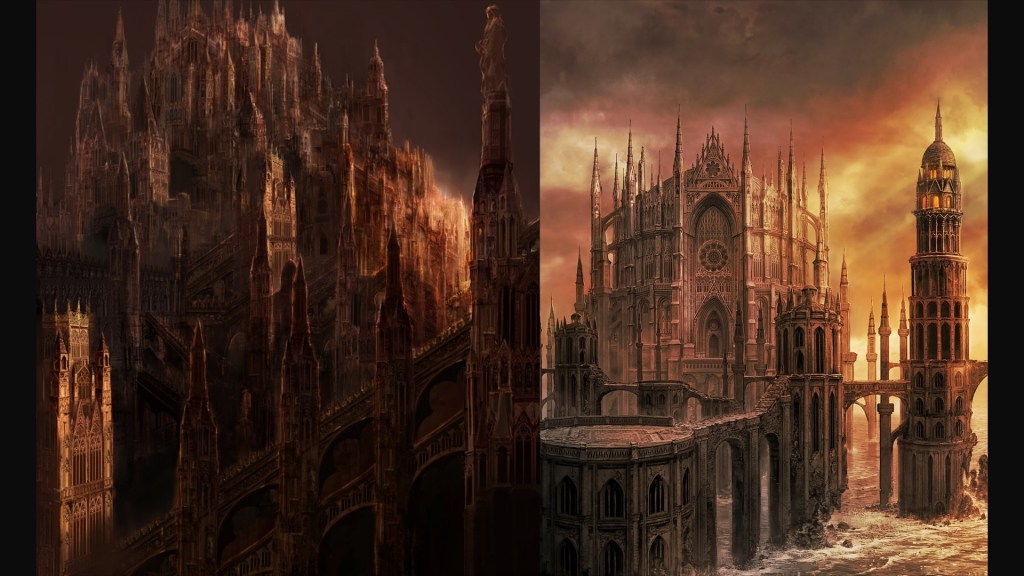
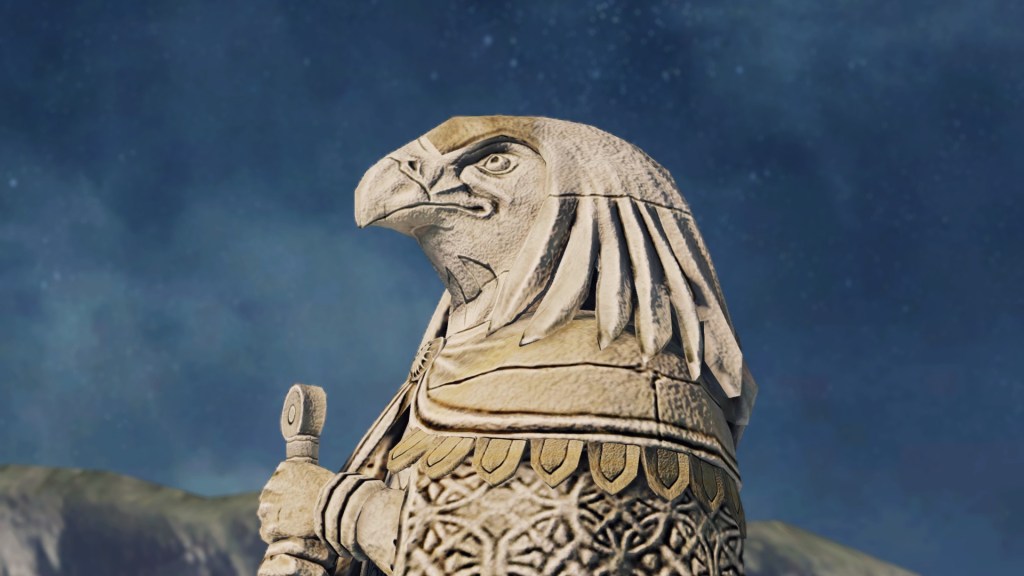
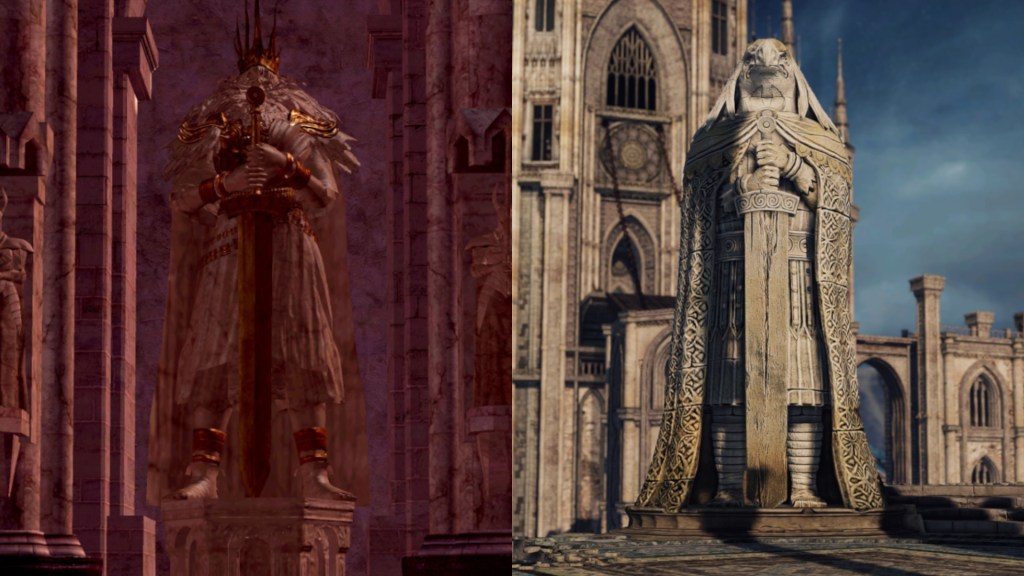
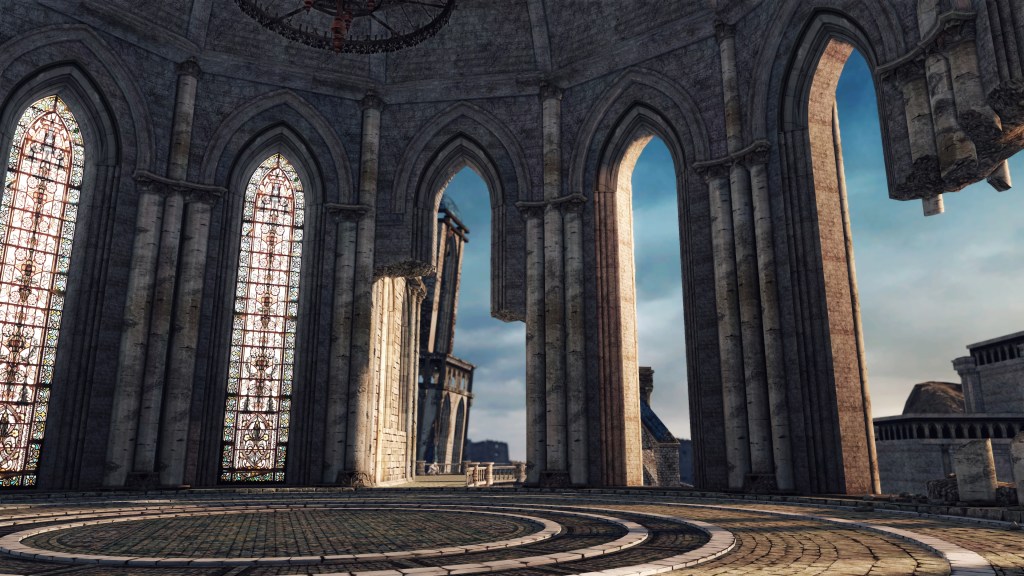
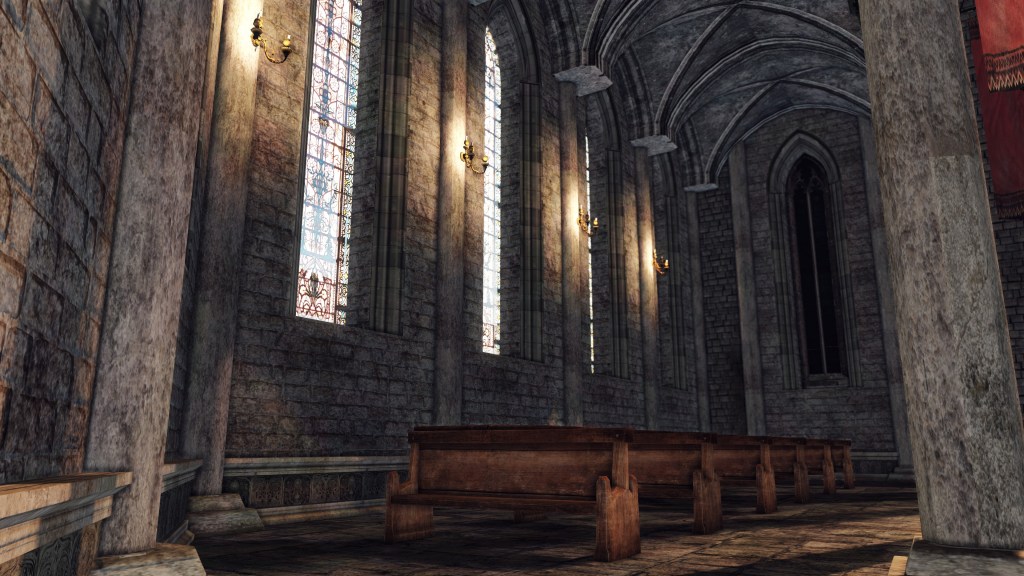
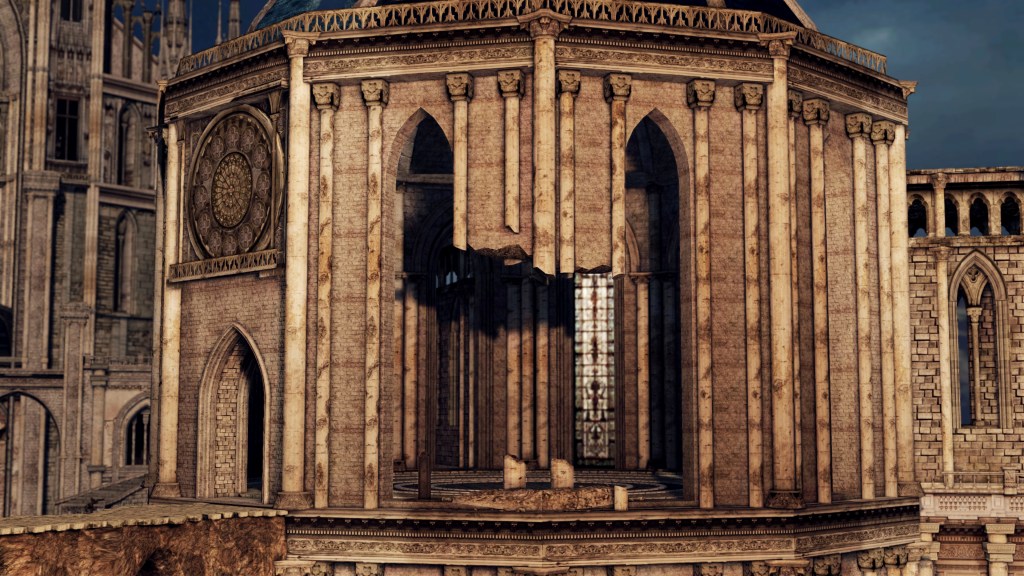
The architecture to Heide’s Tower of Flame is reminiscent of DS1’s divine capital, from its bright stonework to its gothic style. The civilization also seems to have worshiped the sun symbolizing the First Flame and the power of the gods. Despite its name, the Cathedral of Blue uses red banners and rugs while the Tower Shield stored there bears a personified sun on its face. Moreover, statues found within and without the church are clearly modeled after the statue of Gwyn seen in Anor Londo, except replacing his visage with the head of a falcon — taking clear inspiration from Ra, the sun god of Egyptian mythology. Aside from connections to Gwyn and the gods in general, we can also find a Divine Blessing in the area. This holy water belonged to the goddess Gwynevere, who once resided in Anor Londo and had left some vials behind in DS1. Likewise, the Heide Greatlance is imbued with the power of lightning, a manifestation of sunlight which had previously been exclusive to Gwyn, Gwynevere, and parties connected to the Anor Londo gods in general. If only superficially, the two cities mirror each other well.


The Blue Sentinels are also clear successors to the Blades of the Darkmoon from DS1. Both chivalric orders are associated with the color blue and use magic Eye Orbs to help them punish sinners in the name of the gods. The Blue Sentinels likewise reward ranking members with Wrath of the Gods and Bountiful Sunlight, miracles taught at Anor Londo. On top of that, the Darkmoon covenant was based in the divine capital, where its captain and deity Gwyndolin ruled the abandoned country from the shadows. Blue Sentinels held just as strong an influence over Heide, considering the universal use of blue roof tiling; although misconstrued in localization, Sauldon further acknowledges “gods of blue” (青の神々) behind the covenant’s protection. Moreover, the Blue faith has since spread to other countries, where its adherents appear to promulgate teachings like moonlight exorcising evil — uncanny, given how knights of Gwyndolin used Darkmoon light against invading dark spirits. The parallels with the Dark Sun’s covenant are simply too many to chalk up to coincidence.
Do you… require salvation? Traveling as an Undead is a series of hardships. Amidst your travels, invaders from other worlds will try to ensnare you. If you require salvation… will you become a person who believes in the Gods of Blue? When ensnared in hardship, pilgrims who are servants of the Gods of Blue will come to your aid. If you want, I will share their divine protection. And they will envelop you.
You have made a wise decision. Man are all weak… The Gods of Blue will accept and watch over anyone. You too will be enveloped by the Gods of Blue.
Are you interested in this sword? That’s how it looks to me. This is my clan’s ancestral sword. It’s imparted that moonlight, which exorcises evil spirits, gave it shape.
Taken together, there is no doubt that Heide traces its roots to Anor Londo, meaning that it must be one of the countries established in the wake of the Great Shift. We see this expressed in the culture. The Way of Blue and Blue Sentinels both use leaves as their symbols, as if to say they sit just beneath the blossoming flower which is flame — glorified in the “sun haven” of the divine. The “blue faith” (青教) itself is obviously designed to emulate the Way of White, which was the “white faith” (白教) in DS1. But according to the description for the Blue Seal, the Way of Blue isn’t a formal institution so much as a small prayer that has been created by humans seeking salvation. Salvation from what? What prompted citizens of a civilization resembling the home of the gods to seek help from an organization resembling a resident covenant before then? This prayer is normally reserved for protection from invading sinners, especially while adherents travel dangerous and unfamiliar lands. Was the Way of Blue founded in Heide specifically because it too lay in a hazardous world foreign to its people’s comprehension?

Ring of covenantors of the “Way of Blue”. Increases the equipper’s HP, albeit slightly.
The faith called the Way of Blue doesn’t in and of itself exist. It is a small prayer that was born among men who seek salvation.
Those who have made the pledge can acquire the help of residents of other worlds when invaded by dark spirits.
In short, everything regarding the country is consistent with survivors rebuilding civilization in the New World. After the events of DS1, a large chunk of Anor Londo translocated to Drangleic. (DS3 reveals the fate of the other chunk) Because this portion didn’t include Gwyndolin or seemingly any medial, the residents stranded in a foreign land were forced to reconstitute a working government on their own. Recall that at least a plurality of the abandoned city’s residents were Undead at the time, with more living at the foot of the mountain it rest upon. Even if the lands of Lordran each stood upon were strewn across the continent, it is reasonable for them all to come together as they catch their bearings. A number of them had become Blades of the Darkmoon, possessing both the strength and devotion to lead others through a crisis, so they naturally took charge of setting up a settlement in Anor Londo’s ruins for survivors to gather in. This dynamic developed into the Way of Blue and their “Blue Guardians”, (青の守護者) and the “heide” settlement they created turned into a new nation.
No doubt there were struggles with Undead combating the unknown in the early days. A chest in Heide’s Tower of Flame contains the Ring of Binding, which limits the negative effects of hollowing. If nothing else, the item implies that the country was concerned with the madness and memory loss inflicted upon Undead who lost heart at one point. Suddenly ripped from your familiar surroundings with no sign of rescue, it is easy to succumb to despair. But apparently, the Darkmoon Blades managed to stabilize the situation. Isolated from their gods, the knights made use of their limited knowledge, resources, and abilities to ultimately create a country. Society regained some semblance of normalcy, and the survivors inevitably mingled and procreated. The cursed gave way to the uncursed, who gave way to more uncursed. Suddenly, there were generations of Heidens prepared to carry on Anor Londo’s legacy.

Of course, these later generations had their own struggles. For one, there was no guarantee that their cursed forefathers would remain with them forever — the Lloyd’s Talisman found in Heide is proof that Undead, with their Estus flasks, needed to be suppressed on occasion. By extension, they stumbled with preserving facts about the Old World. Despite the name, Lloyd isn’t mentioned in the description to his talismans; it speaks of hunts conducted by knights of a god, not the chief god of the pantheon. This contrast from DS1 suggests that Lloyd’s name has been retained even as his exact identity, whether as a god or in general, has fallen through the cracks. Granted, adherents to Gwyndolin would have reason to neglect Lloyd’s status, based on implications from the past game. (which would later be seized upon in DS3) However, it is not just Lloyd; even Gwyndolin and his Darkmoon lack a presence in the Blue covenants and obtainable miracles. The only figure given major attention is understandably Gwyn, and even his depiction is stylized. The past had clearly begun slipping away even back in Heide’s time.
Talisman said to have been used by knights of god. Makes it impossible to recover via Est within the effective range.
It is said that knights of god, who hunt the cursed Undead, used this talisman once. For knights, battles are honorable duels, so they sealed only Undead recovery and fought fair and square.
Perhaps the cultural drift was all unintentional. No matter their caution, Undead are still susceptible to hollowing, while mortal men have finite lifespans that make it easy for information to be lost or gradually perverted. Without Gwyndolin there to guide them, it was inevitable that time distort memory of Heide’s already fragmented history and religion. Their zealotry probably didn’t help matters, as Heide is presumably responsible for making the names of the Old Ones ineffable. Targray confirms that the Sentinels are aware of the gods’ continued presence in Drangleic in some form. Although forbidding their utterance may have come from a place of respect, it all but guaranteed those names be lost somewhere down the line. And because so much had probably been buried far and apart in the Great Shift, it was impossible for Heiden civilization to salvage everything from the Old World, even less before they forgot crucial details. Slowly but surely, Lordran culture had become a shadow of its former self. On the flip side, “Anor Londo” was arguably seeing a revival.
Changing one. You carry proof to be a Knight of Blue and are welcome here. Raise the proof that you should be a guide and be permitted to spread your roots in this land where the gods be.
Carrying On
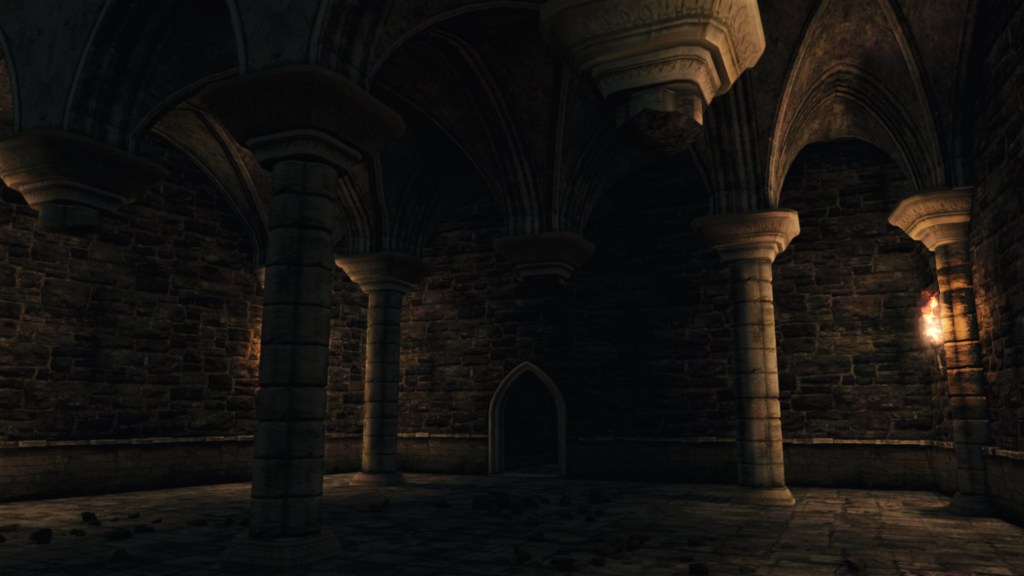
If Heide branched off from Anor Londo, then it only makes sense that they inherited its technical achievements. The city we explore is merely the pinnacle of an immense cityscape submerged beneath the water, with the church and the still-burning fire tower positioned at the apex — the Dark Souls II: Design Works confirming that the city centers around the cathedral. These landmarks not only reflect a civilization that values their religion and the power of fire above all else, but also demonstrate the lengths it went to preserve and even build upon medial culture. Nowhere in Anor Londo were there buildings quite so impressive except maybe its own cathedral, but humans made a monument to the holy fire wielded by the gods visible to anyone in or out of the city. This didn’t stop memory of their gods from being perverted, but it does show the depth of their reverence for them. How much of Heide replaced the old cityscape isn’t obvious, but they at least kept the recognizable style. This preservation and refinement of Anor Londo’s works extended beyond just architecture.





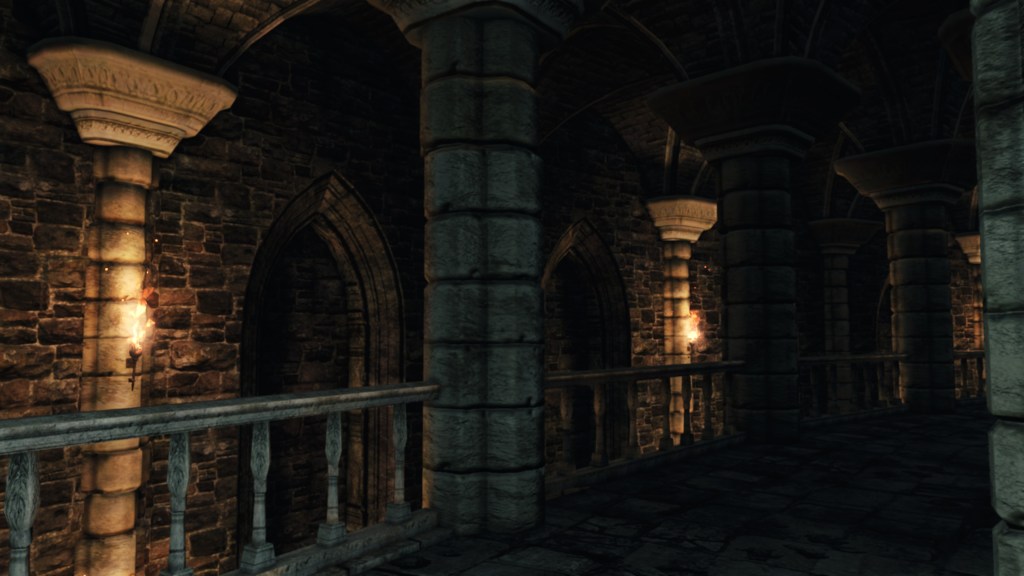


Heide Knight armor and weapons employ a special alloy that is as durable as it is mysterious. Attempts to copy this in Drangleic has resulted in a similar alloy known as bradden or “brandin” (ブランディン) steel, but this sheds no light on the exact nature of Heide’s metalwork. Based on the light grey tone, it may be made from Anor Londo’s unique white iron seen in DS1. The knights’ equipment has high resistance to the Dark without compromising its otherwise average resistance ratios for heavy armor, so it does appear to involve the gods’ holy power. That said, the Japanese description for the Elite Knight set notes that the ore the Kingdom of Drangleic used to forge bradden steel was acquired from the land south of the royal castle where Heide is located. If this ore wasn’t brought to the continent along with Anor Londo, then Heide’s alloy must simply be derived from the same process as the white iron but using local materials. Either way, the fact that Old Knight armor retains such strong physical power despite centuries of deterioration speaks to the skill of Heiden metallurgy, and to great effect.
Straight sword imparted to be of Heide origin. It uses a special alloy and has high durability.
This alloy has long remained an enigma. Copying this in Drangleic produced a similar material called brandin steel.
Helmet made of brandin steel. Possesses an excellent defense effect and has been favored from time immemorial by certain knights of rank.
Brandin steel is used much in Drangleic. It is an excellent metal, employing an ore acquired from the land south of the royal castle as its raw material.
The church in Heide is where we encounter the Old Dragonslayer, whose armor, weapon, and ring originally belonged to a knight of Anor Londo: Dragonslayer Ornstein. By most indications, the boss is that dragon hunter from DS1 who is still remembered in legend. Looking at just the boss soul, Ornifex can utilize it to craft the famed Dragonslayer’s lightning-imbued cross spear used to pierce the stone scales of archdragons. At the same time, Ornstein’s lion armor was gold, not black. Moreover, he wielded the power of lightning, making the Old Dragonslayer’s use of Dark magic all the more peculiar. One might suspect that the gods’ most faithful knight had at some point embraced heresy, but the soul remains uncorrupted, and how is this possible when he was undoubtedly slain during the course of DS1? This creates a conundrum where the Old Dragonslayer is almost certainly Ornstein and yet cannot be Ornstein. Still, there is more to the Old Dragonslayer than fanservice. The question shouldn’t be aimed at the boss himself but the context that he is encountered in.
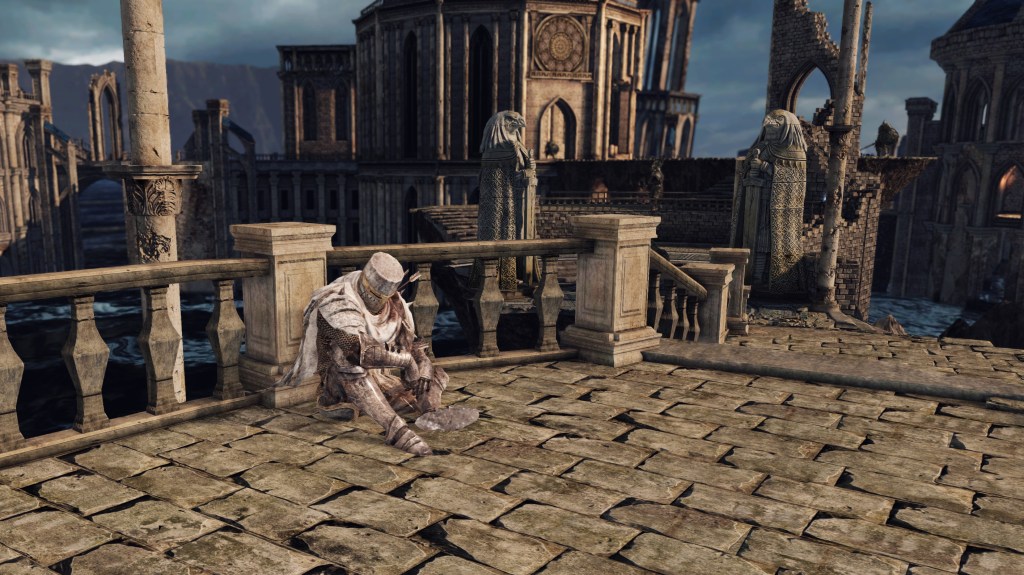
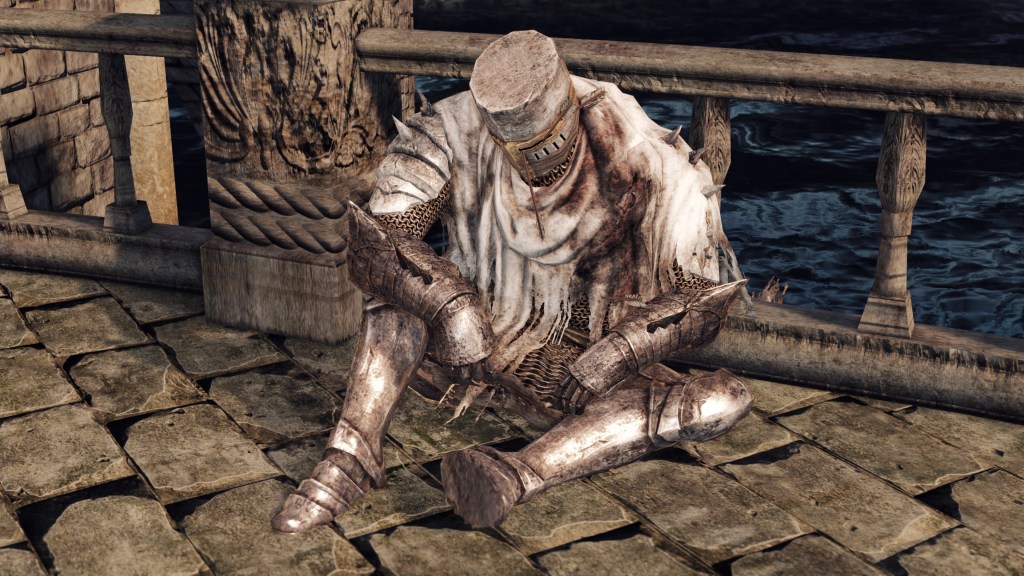
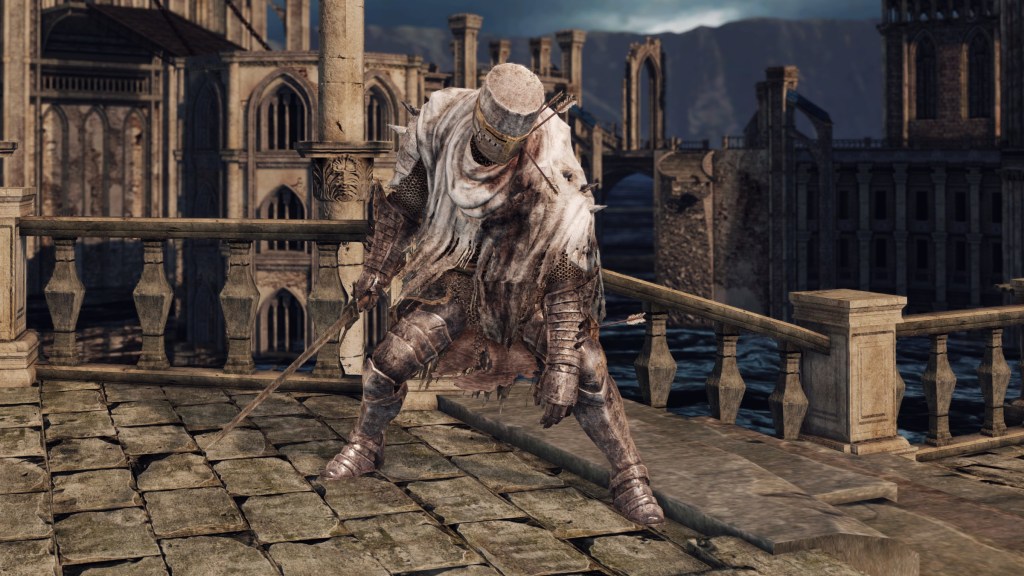

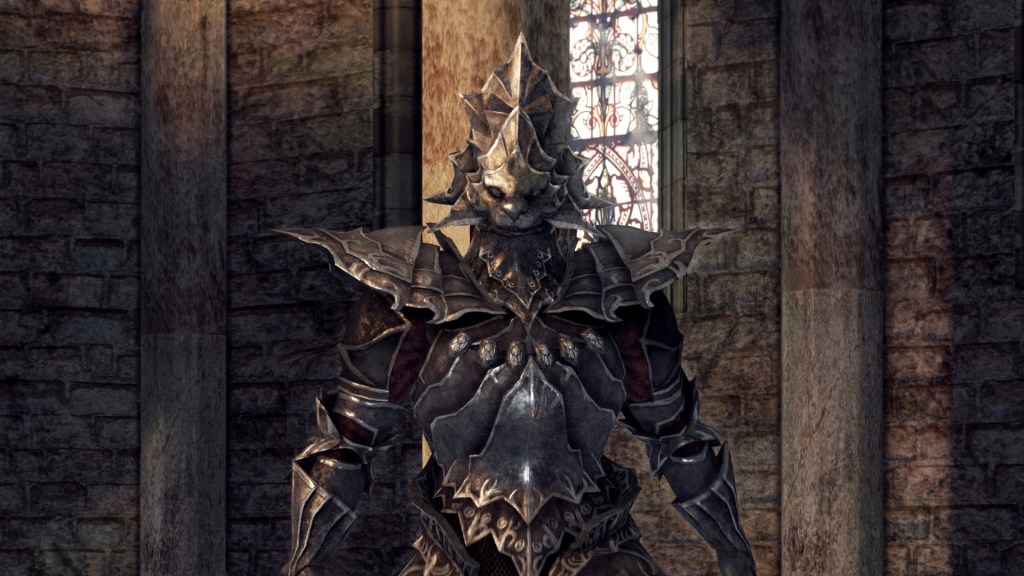


Soul of the Old Dragon-hunter.
Its appearance in some respects resembles the legendary knight remaining in tales of long ago.
The special soul this dragon-hunter possessed is used to acquire a vast amount of souls or create a great power.
Cross spear created from the soul of the Old Dragon-hunter.
The spear of the knight once called by the name of “Dragon-hunter” harbors the power of lightning and even pierced stone scales. Unleashes its hidden power via strong attack.
Ring that a knight who once vanquished dragons is said to have favored. Boosts counter attack power of thrusting weapons.
After the long, long months and years, the engravings on the face have faded. Looking closely, it appears that a lion design is carved into it.
Why do we encounter the Old Dragonslayer at Heide’s church? It is an old headquarters of the Blue Sentinels located in the country where the Way of Blue originated, a country that was founded as a continuation of the holy capital of the gods. Is it not odd that a Dark arts user is randomly found at this holy place? What’s more, we are not alone in this church. Though it is easy to forget due to the fog walls partitioning the boss area, Targray is standing just outside the doorway at the back of the church, gazing out from the balcony while a battle with a Dark knight ensues behind him. The leader of a covenant that makes it its mission to eliminate invading sinners who threaten god-fearing worshipers should be concerned about a Dark heretic standing right behind his back more than anyone. And yet, Targray ignores the boss as well as our battle, as if the Old Dragonslayer’s presence there is no cause for alarm. Either the man has gone senile or the boss isn’t quite what it seems.
Rather than pose any threat to Targray or the church, the Old Dragonslayer stands ready to face us as soon as we enter the building. And only once the boss is defeated can we speak to Targray and potentially join the Blue Sentinels. This setup looks strangely reminiscent of a trial, where a prospective holy warrior must face the gods’ greatest foe in order to prove the ability to overcome such unholy forces; it would certainly explain the boss’ location and behavior. NG+ reinforces the impression. Knights similar to Targray stand guard in front of the cathedral, implying that they are fellow knights of blue. Yet these additional enemies appear like invading black phantoms, wielding the Wicked Eye Greatshield of unknown yet sinister nature. It makes no sense for them to be corrupted knights, but with shields projecting the threat of the “evil eye” to any who approach, they obviously stand in for the vile users of red eye orbs whom the covenant must defeat. Clearly, the Blue Sentinels are using the church to test would-be recruits against the Dark’s forces, consistent with their selfless discipline and training like the armor they wear.


Armor of the one who is a guiding hand. Personal effect of the Knight of Blue Garynedawk.
The Blue Guardians hold no egoistic will whatsoever. They are simply path seekers who aim to improve themselves through discipline and training. This armor is for completing that mission.
In that case, why would a supposedly deceased Dragonslayer take part? Why would he know how to perform Dark magic for this test? The simplest answer is that the Old Dragonslayer is not Ornstein, at least not the same Ornstein encountered in DS1. Civilizations following after Heide had inherited Anor Londo’s knowledge for installing souls in artificial constructs in order to create living automatons. For the most part, these subsequent civilizations didn’t use the term golem, (ゴーレム) calling them “dolls” (人形) or “puppets” (傀儡) instead. Nonetheless, it is obviously the same magical technology. And where did their knowledge of golemcraft originate from if not the very civilization that had first built upon the remnants of Anor Londo culture?
In short, the Old Dragonslayer is probably a golem. A suit of armor animated by the soul of Ornstein can, at minimum, replicate his fighting style when armed with the knight’s signature weapon — its memories may even include his experiences and personality. Likewise, golems can be programmed to fulfill whatever tasks their creators desire, including battle potential Knights of the Blue with Dark power supplied to them. Some might argue that this is impossible since the boss sheds blood when struck. However, the Iron Golem of DS1 also bled despite explicitly being just a suit of armor with a core, so the same can be true of a similarly advanced golem like the Old Dragonslayer. The same holds true for contentions about the boss’ susceptibility to poison and bleeding when one or both of these very status effects can afflict the aforementioned dolls and puppets of later civilizations, including bosses like the Smelter Demons. None of it disqualifies the Old Dragonslayer from being an artificial construct.

Indeed, being a golem recovered from Heide would explain a few more discrepancies between the Old Dragonslayer and Ornstein. From the moment we walk in, the red cloth and chain mail hanging from the boss’ waist are in tatters, and the Leo Ring acquired after the battle has become “old”, the lion engraving faded over the eons. This wasn’t inevitable, as the Hawk Ring owned by Gough — a fellow knight of Gwyn — hasn’t suffered the same degradation despite changing owners since it was last seen at Anor Londo in DS1. If Old Dragonslayer is Ornstein in the flesh, why hasn’t he taken better care of his own equipment? But, if the boss is a recycled golem programmed to just be a trial, then the lack of upkeep is reasonable. The equipment was left to rot in Heide, especially after its collapse. By the time modern Blue Sentinels reconstituted the trial, the lion armor and ring were already showing their age. And because the soul in armor was set up just to be beaten and battered, there was no point in repairing the wear and tear.
We are therefore given no reason to doubt that the church in Heide created a golem of Ornstein to serve as a trial for potential knights, using the knowledge its people inherited from Anor Londo. In fact, it is unlikely to be alone. The Old Knights encountered in Heide are so old that their weapons and equipment are about to deteriorate, hence their low durability. And because not a single record detailing them has survived, they have been entirely forgotten in modern memory. Although their age is impossible to date, their location all but guarantees them to be from Heide. And yet, Heide already has its own order of knights, not to mention the Blue Sentinels serving as knights for the Way of Blue. Why would they need another? Stranger still, they are unaffected by Soul Appease, proving that they aren’t Hollows like the Heide Knights. In that case, how have they survived the ages, and, once again, why haven’t they taken greater care of their equipment? Being golems would explain it.

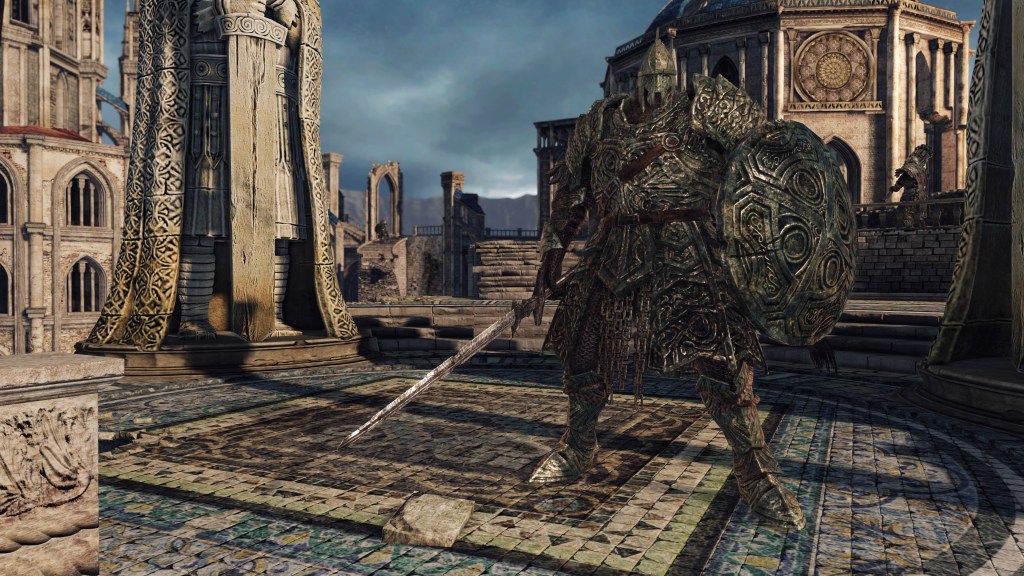


Greatsword of old with date unknown.
Thing which was used by knights of old times that are so long forgotten they aren’t left in any records. Durability is extremely low.
But it appears to be endowed with power at this time where it will rot away for sure.
Descriptions for the Old Knights’ equipment do note that they contain power despite their imminently deteriorating state. This is strange for weapons and armor without any elemental resistances or enchantments. What power have they been endowed with? Perhaps magic related to golemcraft has kept their metal bodies animated despite their crumbling forms? And although their massive size can be chalked up to artistic license, it can just as easily be faulted on artificial construction. And if there is an actual person within the armor, why do they neither bleed when struck nor suffer from poison and bleeding? Susceptibility to these status effects may not disqualify one from being artificial, but they do disqualify one from being your average organic life. They are probably another product of Heide’s church, acting in a similar capacity to the Old Dragonslayer. The Dark Souls II Collector’s Edition Guide even supposes that they too are just another trial for prospective Blue Sentinels, hence why they carry the same Cracked Blue Eye Orbs that the knights use — it is all part of one big system.
The cathedral is but one part of this system, the Heide Knights also guarding the path to the area’s eponymous Fire Tower. This landmark is identified as a lighthouse in the Design Works, but this may be due to the designer illustrating concepts for the sea-sunk ruin. From what we can observe, it served primarily as an arena. Entering the tower brings us to a small ring, with levers along the way to it widening the space by raising additional sections. These devices serve no purpose in a lighthouse but do function well for a ring-out arena, as proven by the boss faced in it. In other words, the tower probably served as another trial ground, the flames visible from every other part of the city beckoning warriors to prove their strength as devout defenders of fire. Perhaps prospective knights of blue had to prove their mettle there before moving onto the church, weeding out the generally weak before testing individual strength against the Dark.





That being the case, the Old Dragonslayer proves informative regarding the true Dragonslayer Ornstein. For it begs the question: If this Ornstein is a fake, what about the one encountered in DS1? It is odd for Heide to have created a golem of a legendary servant of the gods to represent the Dark, especially when they would have to be using his authentic soul. Why was this on-hand? Souls can be split, and large enough fragments will retain their unique properties, so it is possible for the Old Dragonslayer’s core to be sizable a fragment of Ornstein’s original soul. But this would imply that Anor Londo had acquired that fragment prior to the knight’s death in DS1, in which case it is just as possible for that Ornstein to be a golem using another such fragment. This would explain why the church trial was him specifically — when stranded Anor Londo began to rebuild, there was already a stock of his soul fragments and replicas of his equipment, making a powerful golem modeled on the knight more readily available than another developed from scratch.
However, this would mean that the original Ornstein was dead or absent during the events of DS1, the latter of which is more likely. It had always been odd that Frampt seemed to have a negative perception of Ornstein when exchanging his items for souls in DS1. Some might fault the world serpent’s affinity for dragons, but this didn’t affect his opinion of Gwyn, Gough, or anyone else who had participated in the dragon hunts. Artorias had failed to stop the Abyss in Oolacile, Smough was so disreputable that Gwyn ultimately rejected his candidacy to the Four Knights, and Seath betrayed Anor Londo in his madness. All of these figures had somehow failed to meet the expectations of the divine government, earning Frampt’s disfavor as Gwyn’s close friend. But Ornstein, a knight characterized by his honor and faith? What did he do? Surely Frampt wasn’t put off by a knight faithfully guarding Gwynevere alongside the despicable executioner per his orders. He can hardly be blamed for fulfilling his knightly duties.
Rather, Frampt’s animus would imply that Ornstein somehow betrayed that code of chivalry to his lord and gods. Perhaps by reneging on his duties and leaving Anor Londo? He would be the only knight to have done so when all the others stayed behind after the gods abandoned the city. And if he had left some of his soul behind anticipating that Gwyndolin would make a replacement, presumably as part of some agreement, it might prompt Frampt to think lesser of him. At the same time, these cordial implications behind his parting with Anor Londo would explain why the serpent still put him comparatively far above Seath or Smough in value. This doesn’t in itself clarify why he left or where he went afterward, but it does establish a sufficient basis for him leaving. And if so, then the existence Old Dragonslayer adds a useful hint. (one which wouldn’t be elaborated on until DS3)
Nonetheless, either boss can still be considered a genuine Ornstein. Both use the Dragonslayer’s actual soul as their core, so their actions may go beyond instinctual memory. And what difference is there really between a living being and a golem other than the composition of the body encasing their soul? The knight would still be himself whether his soul is housed in flesh and bone or metal. The question then is to what degree these golems retain the original’s memories and their own consciousness. In DS1, Dragonslayer Ornstein certainly demonstrated personality in the scenario where his comrade falls in battle before him. If their souls are fragments of the original, then it may be more accurate to call the both of them an “aspect” of Ornstein, an imperfect incarnation of the broader being that is Ornstein.

Regardless of the technicalities, the golem’s very existence is proof of Heide’s sophistication. Whether it be in architecture, metallurgy, or soul-powered automatons, this civilization proved itself a worthy successor of Anor Londo. There is no doubt that it had the military and cultural prowess to be a superpower during its era even without the gods’ support. Of course, this doesn’t necessarily mean that the Heide had any actual influence upon the larger world prior to the civilization’s destruction. But, even if we assume that the city never had direct contact with anyone beyond the Drangleic continent, its religion definitely had a lasting impact on the surrounding nations for generations to come. And there is still good reason to believe that Heide’s borders extended far beyond just the submerged metropolis.
Outgrowth
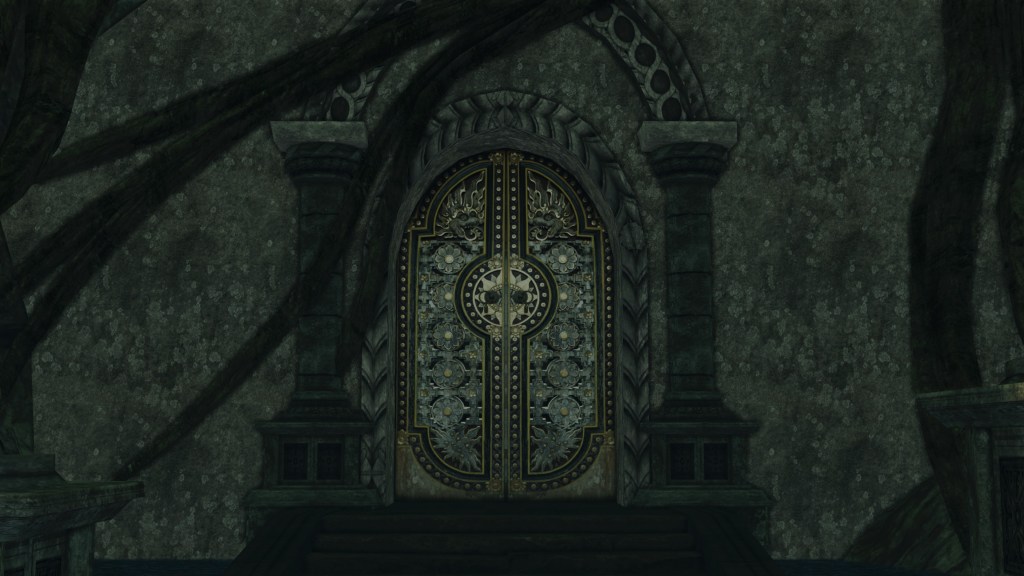
Even though the full extent of the Heide ruins is never clarified, we can still infer which areas that the civilization had once settled. Though far and away from Heide’s Tower of Flame, the Shrine of Amana ruins are most likely Heiden in origin. The stone buildings and corridors lead to the Undead Crypt, which we access from a large double door. This entrance is decorated with elaborate reliefs resembling Anor Londo iconography, particularly the image of a blossoming flower representing the sun. This is reinforced by a local chest containing Sunlight Blade, a miracle text previously found in Anor Londo in DS1. On top of that, a still-active Old Knight is encountered at the ruins, implying that Heide specifically had a presence there. Moreover, this wide complex of buildings is now largely underwater much like the city itself, though the actual water was possibly always present there to some degree.
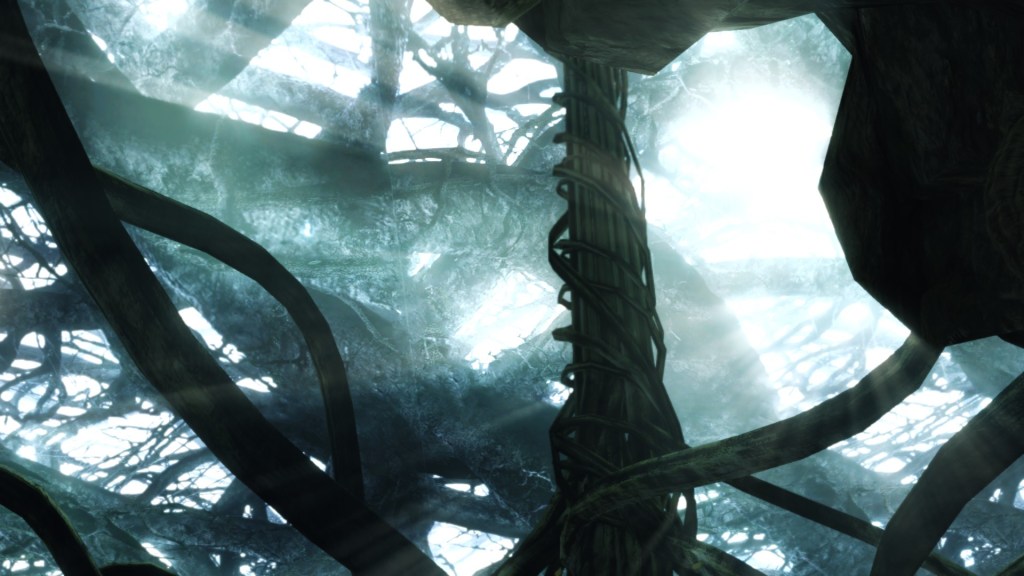
In order to reach the area, we take a long lift deep underground from Drangleic Castle. From there, we find the ruins within a massive cavern beneath roots branching across the ceiling in an intricate web. Such enormous plant life brings to mind the archtrees, which were also found underground holding up the Upper World with their entwined matter of branches in DS1. Add in the water pooling within the cavern, and it is possible that the area is a remnant of Ash Lake. Reinforcing the implication, we can use Chameleon to transform into one of the mushroom men — who thrived at the base of the archtrees in that area — so that we might “blend into” the Shrine’s surroundings. Another local chest contains an Elizebeth’s Mushroom, derived from the same fungi in DS1. If the mushroom was harvested down there, then the mushroom men must also still exist somewhere we don’t explore; the fact that Agdayne sells a bunch more in the neighboring Undead Crypt only furthers that notion. The Shrine is even home to basilisks, who were originally native to Ash Lake. It all ties back to that one area.


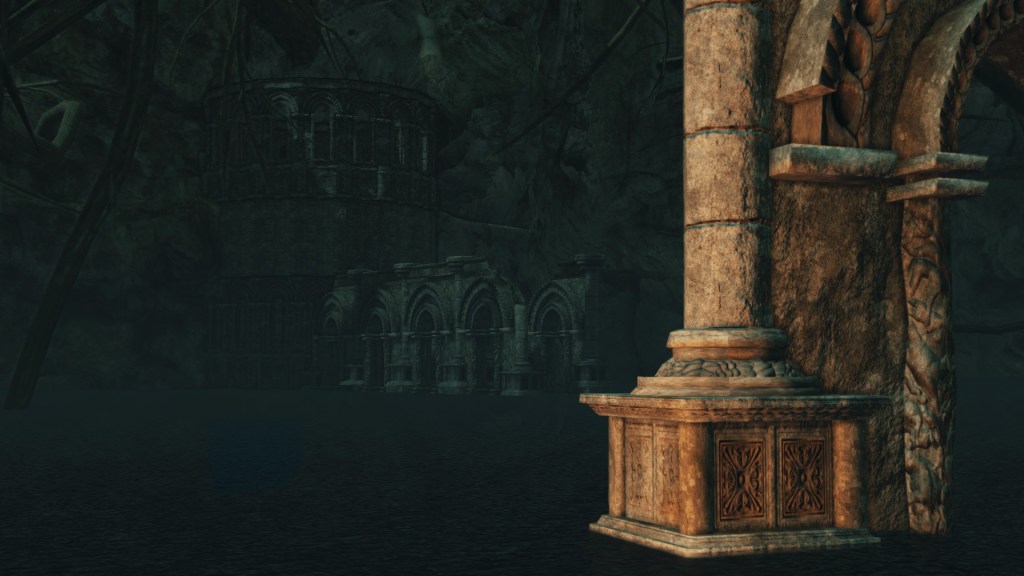



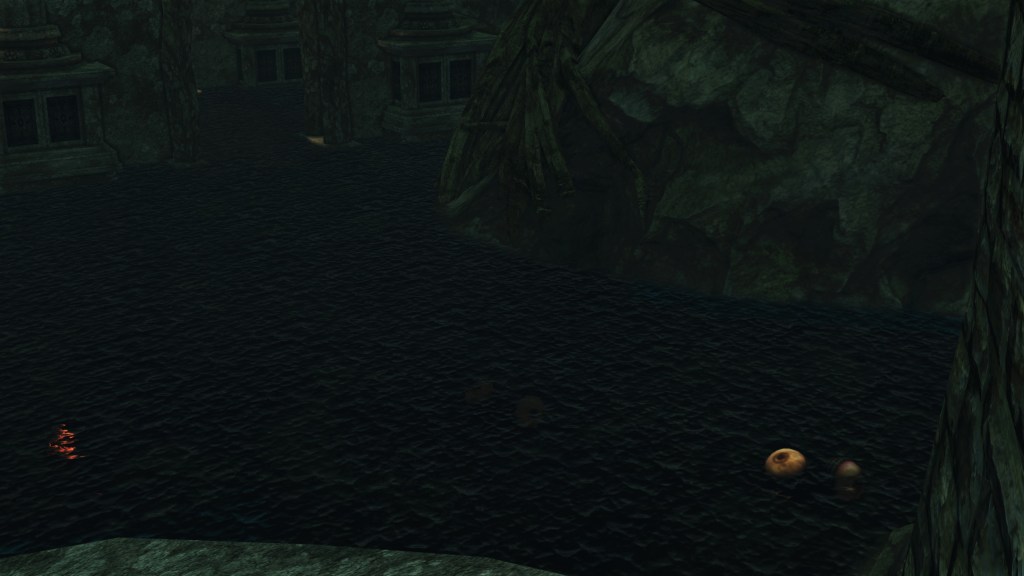
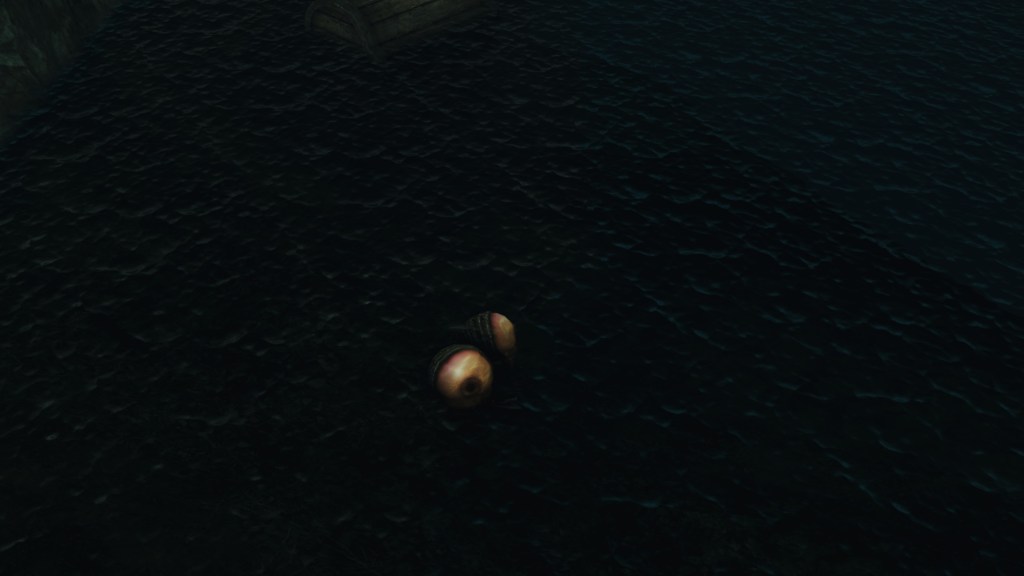
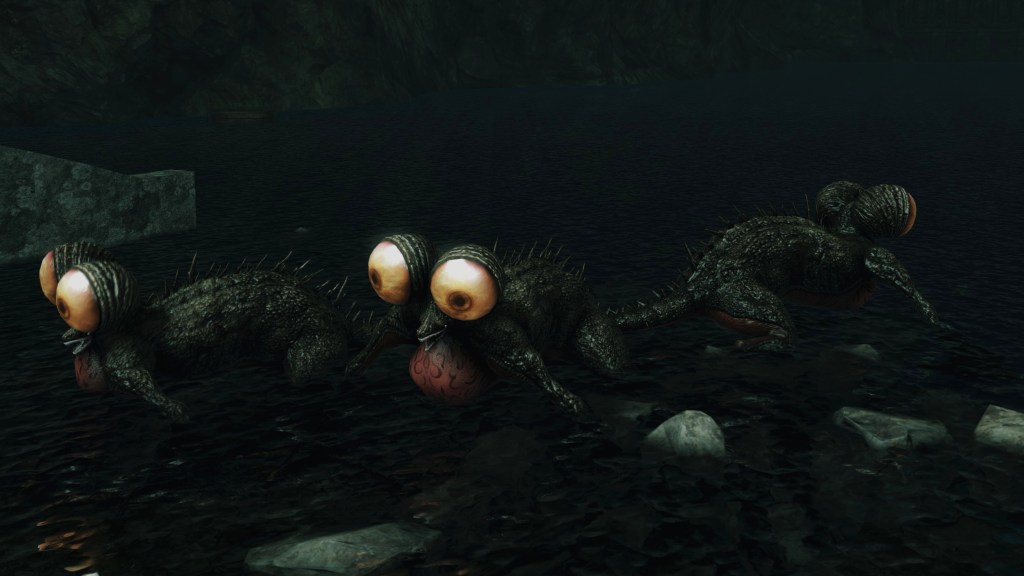
Though located in the Lower World, Ash Lake was still technically part of Lordran, so it is only natural that a portion be brought over with Anor Londo in the Great Shift. And whether or not the ginormous plant life descends from the lake’s archtrees, the ruins were likely built because of the Undead Crypt. Ignoring the pomp given to the mausoleum’s entrance, the various columns lining the buildings are carved to look like a mass of human bodies entangled together. Such iconography is appropriate for an area where bodies would be brought to dump into the Crypt. The fact that Soul Appease is a lost miracle sold only by Agdayne similarly shows ancient clerics’ intent to give the place’s existing Hollows final rest, a service helped along by maintaining local facilities. Heide’s founders were also liable to have knowledge of this mausoleum and want to maintain friendly relations, hence building infrastructure on the other end of the continent. That said, the citizens built out their civilization much closer to home, too.
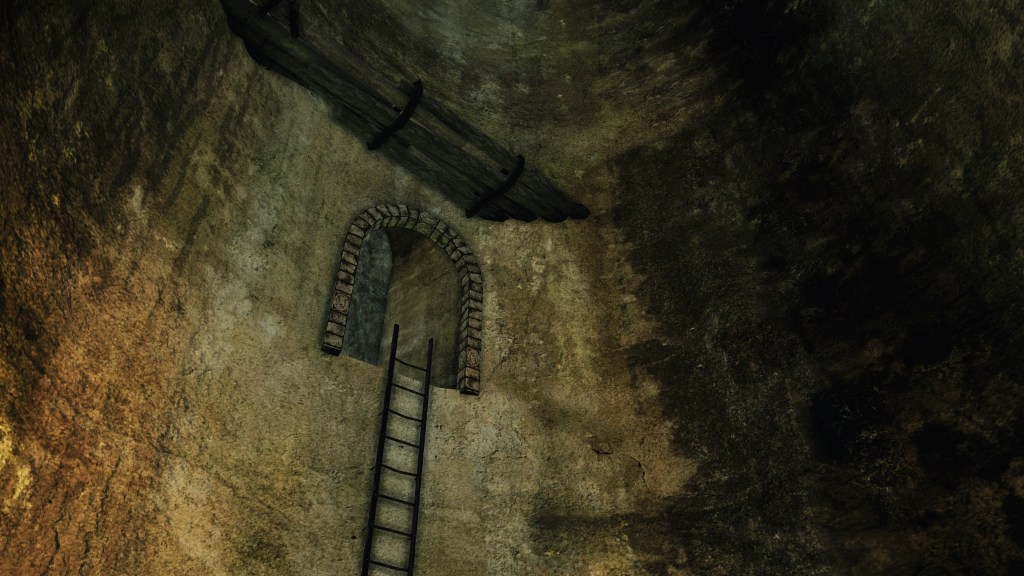
The Pit stands out as the most notable structure in Majula, yet very few seem to know much about it or what is to be found at the bottom. However, it too seems to be related to Heide. The path to Heide’s Tower of Flame can be accessed from a building built in the same style as surrounding ruins and Heide itself. Within it is a mechanical device that rotates the entry way from the Heiden ruins to the Huntsman’s Copse by inserting a key stone into the central pillar. Though this key stone doesn’t require the power of miracles to activate like Licia claims, the building is nonetheless called the “loop temple” (環堂) in its description. The temple likewise emits a white light above its entrance once active. All of this suggests that some element of religiosity is involved in the structure and the places it grants access to, befitting the Heidens. In that case, why build a holy place leading to this cliffside? Because that is where we find the Pit, a man-made shaft deep underground. And what religious role did it and the surrounding ruins play in Heiden society? Burying its clergymen.
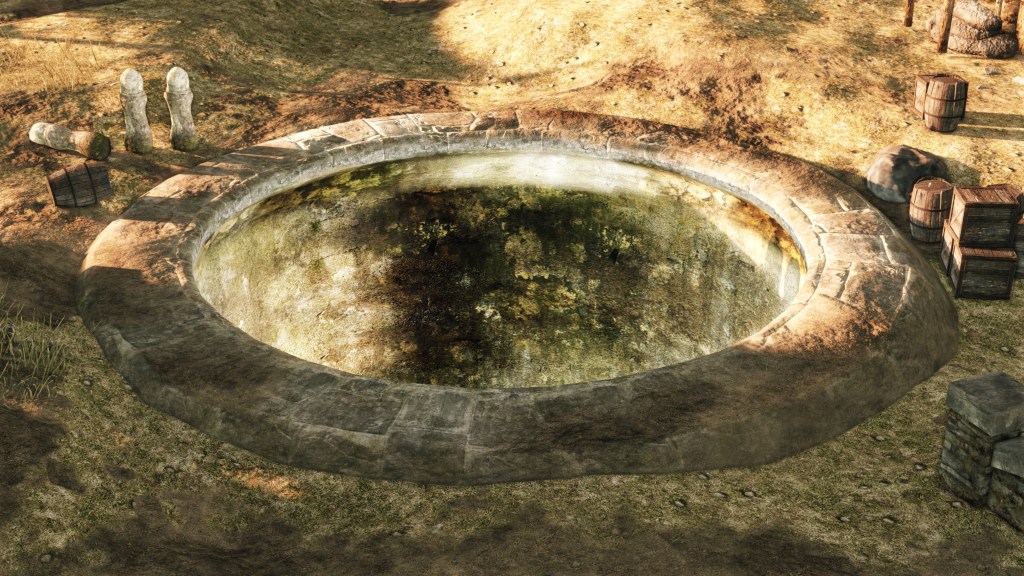


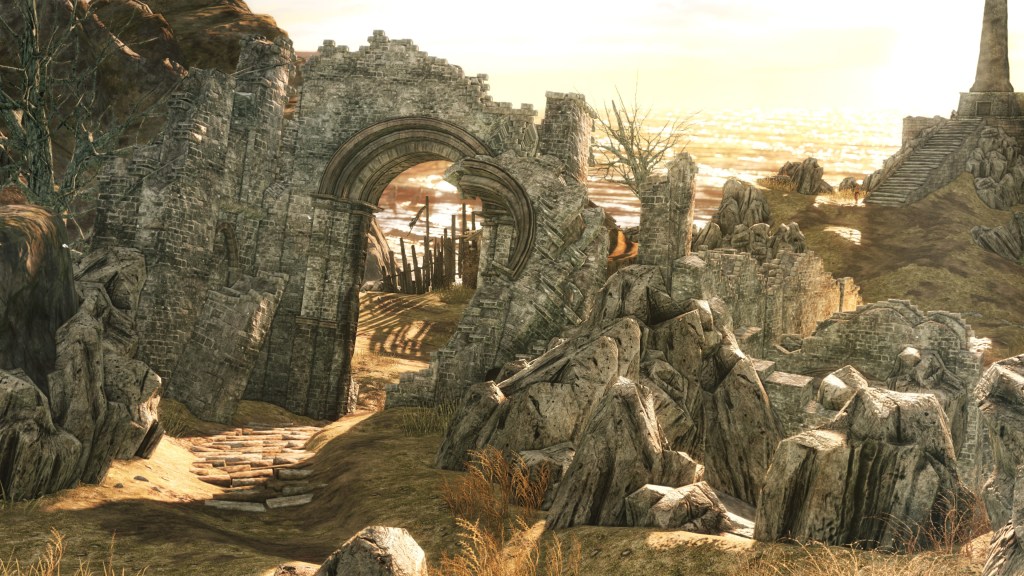
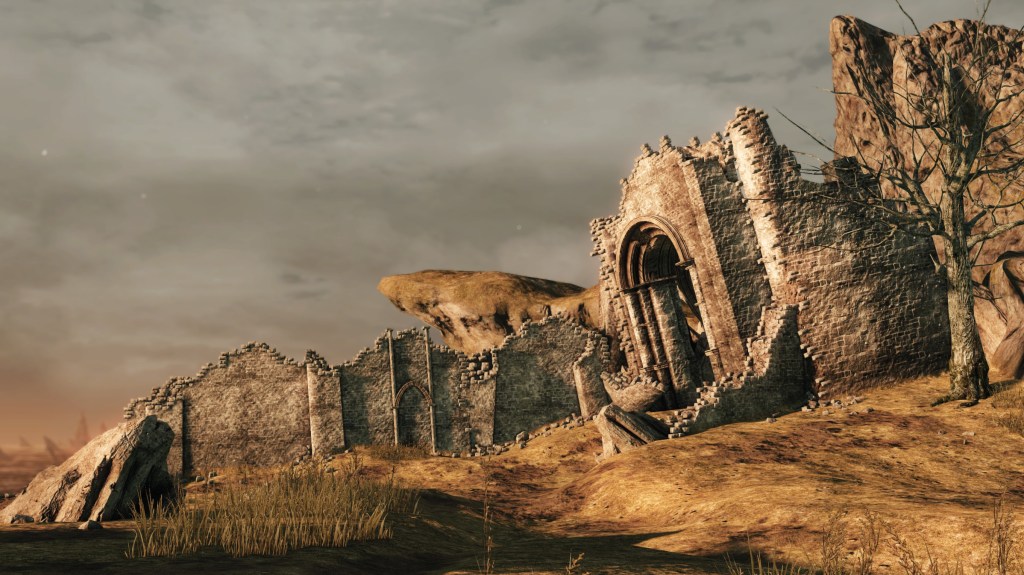
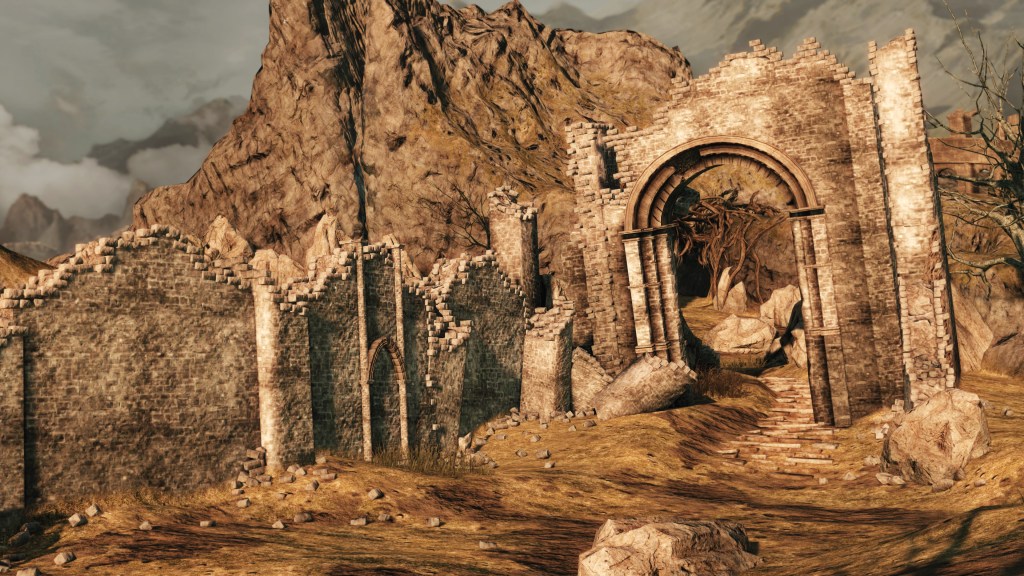
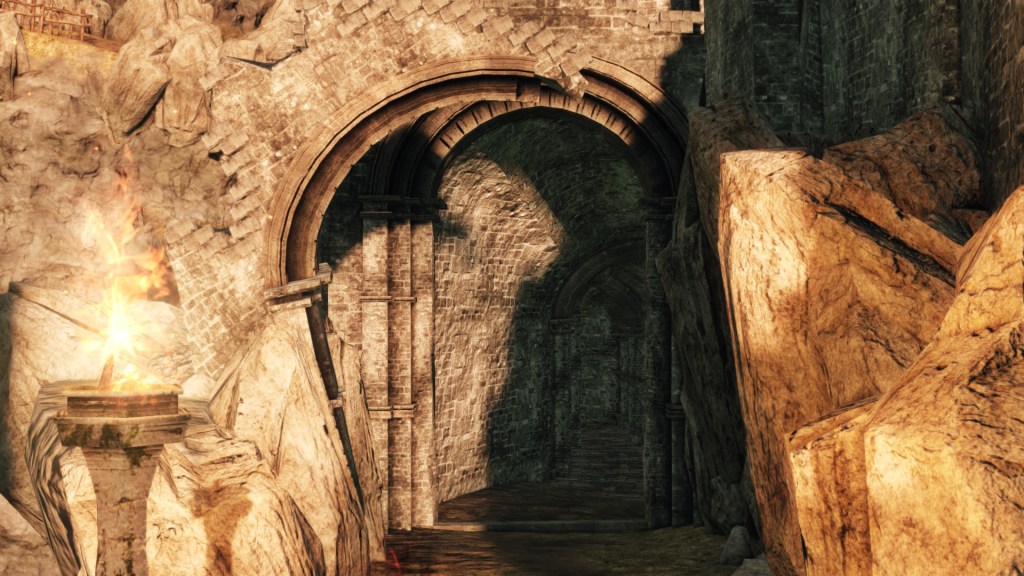
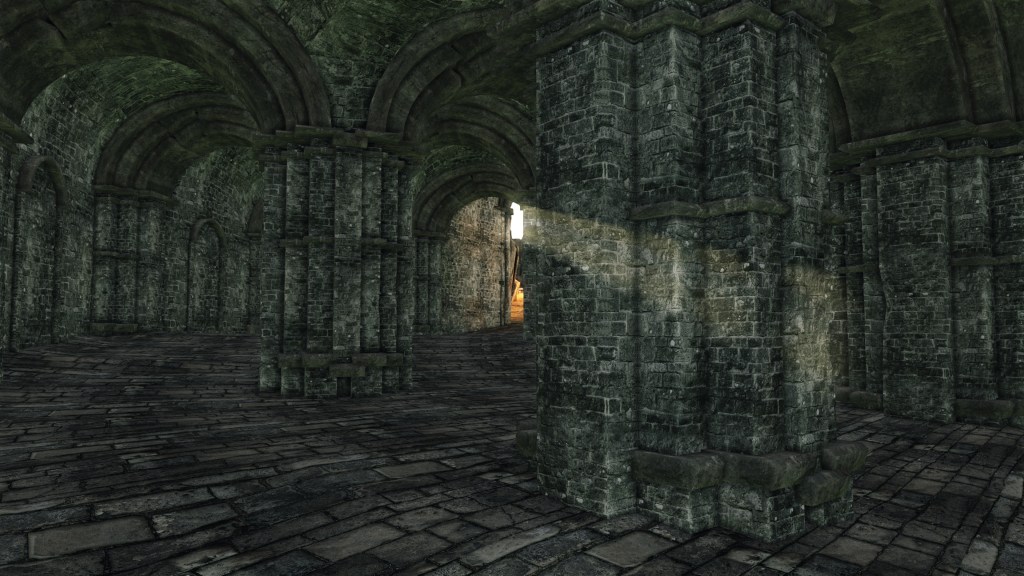


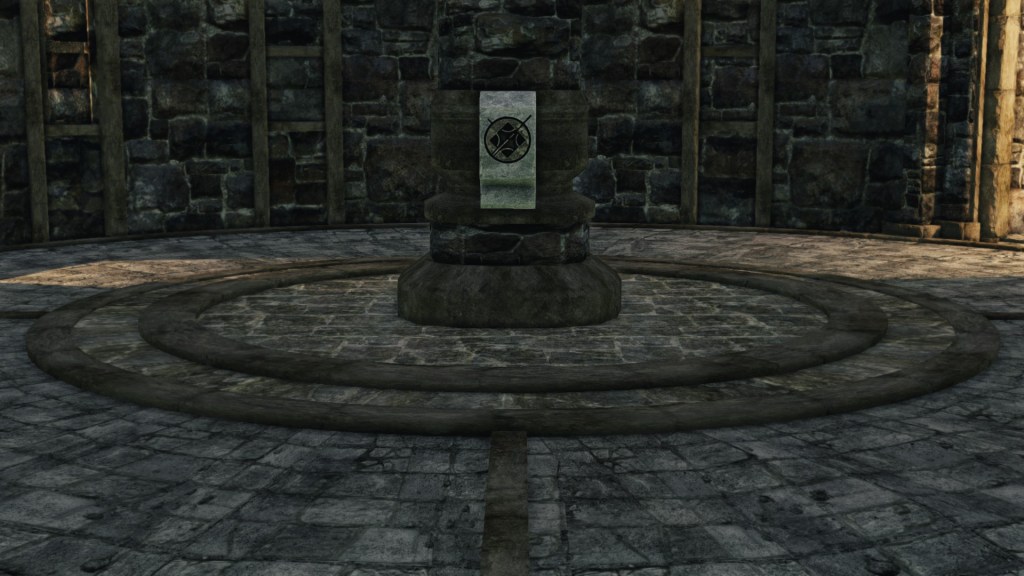


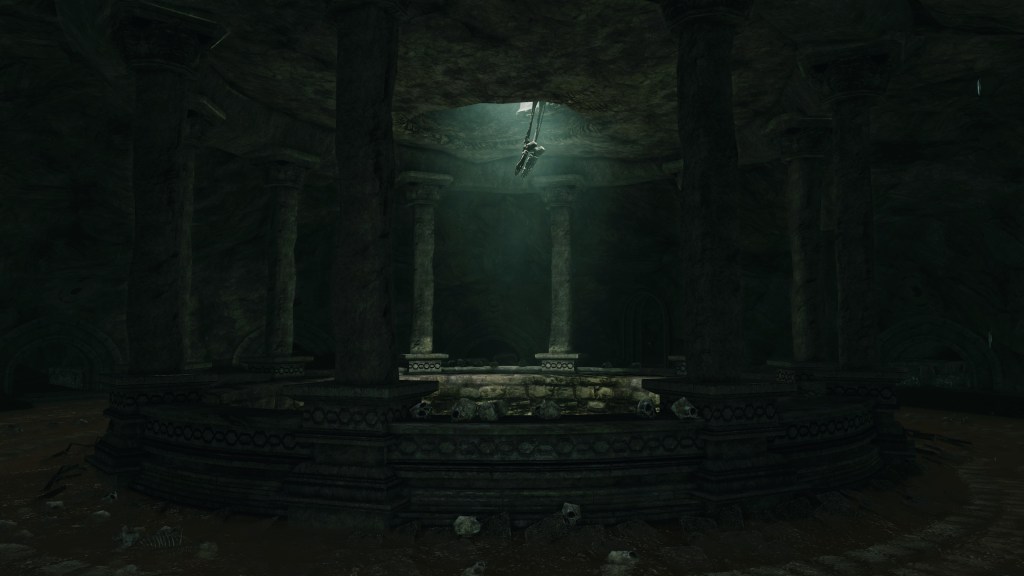
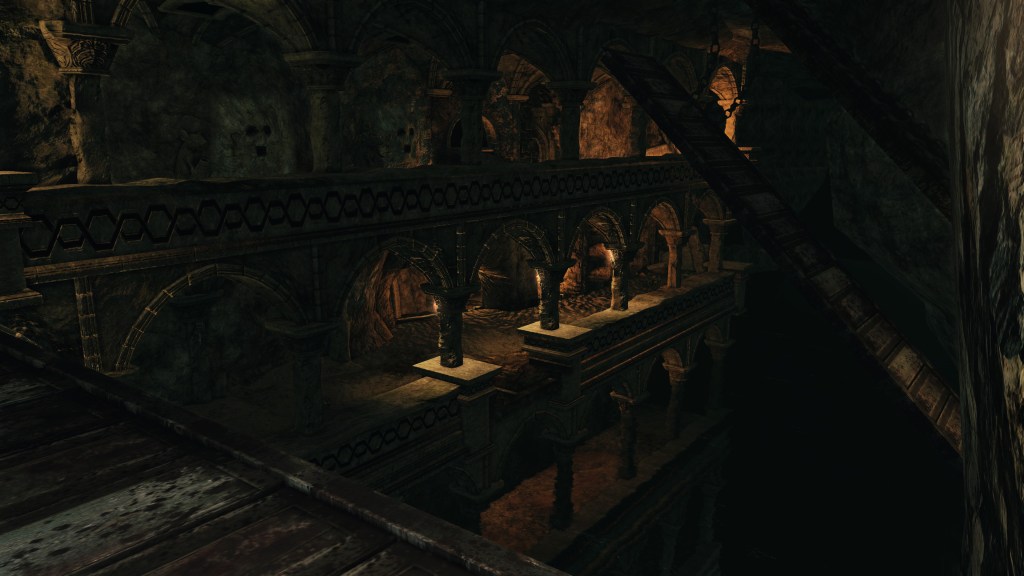
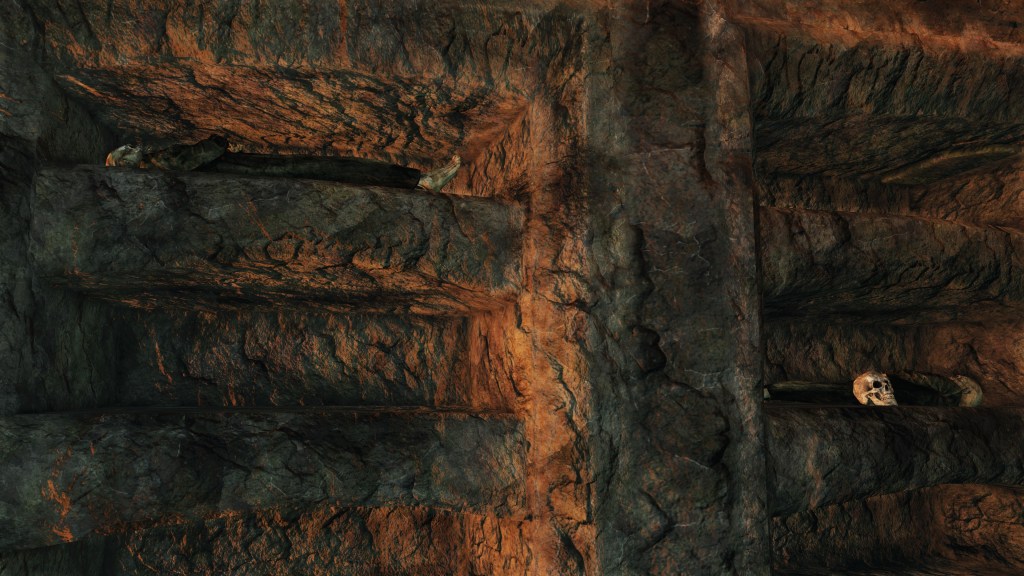
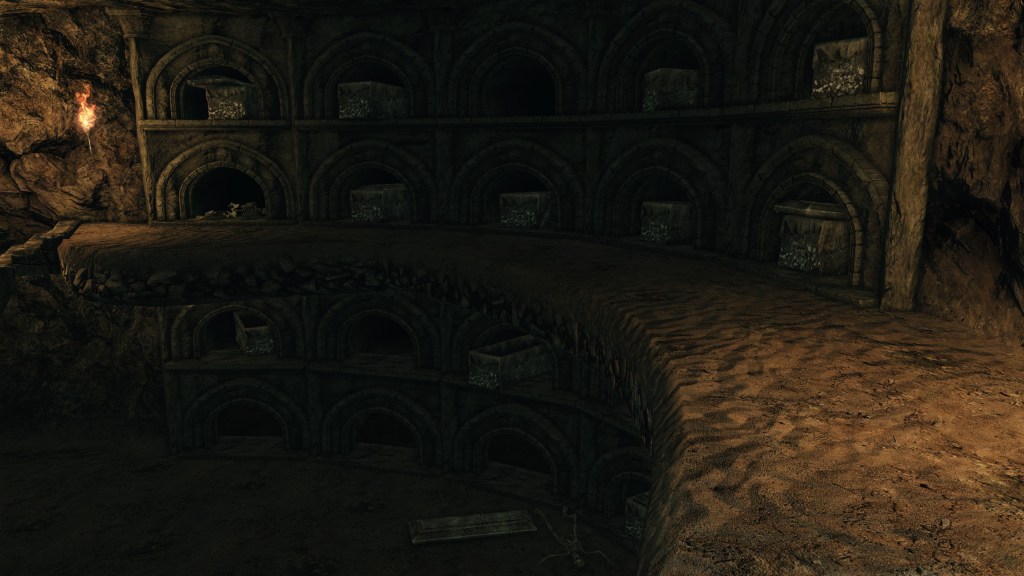
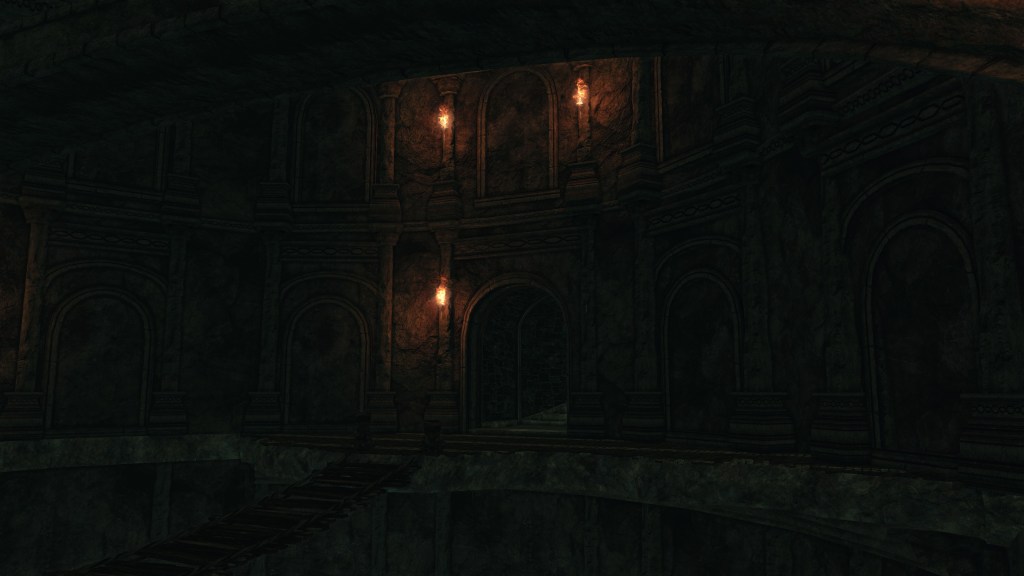
Down the shaft lie various entrances to the multilevel Grave of Saints. As the name implies, it is a “holy man graveyard” (聖人墓所) entombing countless clergy. This is evident from the area’s first bonfire dubbed Harval’s Resting Place, more accurately “Clergyman Hakbal’s” Resting Place. (聖職者ハクバルの最期の地) The bonfire name is likely a mistake; Harval’s supposed final resting place is situated at the cave entrance leading into the actual graveyard, whereas the Grave Entrance bonfire is perversely located in the catacomb’s deepest reaches. Since both bonfires are listed adjacent in the game’s code, it is possible for the names to have been accidentally swapped by FromSoftware, the small detail going unnoticed through the rest of development. Regardless, Harval’s ministry firmly establishes the nature of the “Saints” buried in this Grave area.
The contents of the tomb reinforce that impression. Among the various human remains in this complex of catacombs, we can uncover the long tale of Great Heal known by a small number of clergymen. There is also a chest carrying Sublime Bone Dust, bones that turned to ash and crumbled after a holy man threw him or herself onto an Undead bonfire. It is also where we find the Disc Chime, a holy bell that doubles as a shield. Despite the English description claiming it to have been brought there by a visiting saint, the Japanese text only vaguely surmises that it is the product of some holy man from somewhere, possibly locally. Indeed, the Protect Chime’s description alludes to how bells replaced DS1’s cloth talismans as miracle catalysts long before living memory — a transition which may well have begun in the New World with Heide. Moreover, we loot the Disc Chime from a solitary skull no different from countless others scattered about the graveyard. Taken together, and it is clear that all manner of clerics have been buried in these tombs. And what country would produce them in these numbers except for Heide?








Holy bell which can also be used as a shield. Rare item of indefinite origin.
It has an effect that slightly increases the might of miracles, and it is considered to be made by the hand of some place’s holy man. Can fire miracles and hexes with its strong attack.
According to Gilligan, the Pit long predates King Vendrick, leaving Heide as the only civilization whose known influence extended to this area. We can encounter a Heide Knight in the Gutter, evidently trapped in these caverns beneath the Pit. And based on the unique iron mask he wears, he may have been down there for quite a while, long before the helmets the knights in the ruined capital wear were designed. In other words, the Pit was under construction or already built by the time the knight fell underground. It may not have just been the Pit being built either. Buried beneath the manor before the Pit hide stone ruins bearing Heiden iconography, fragments of the Lordvessel —or at least a copy — from DS1 among the rubble; yet another possible carryover to the country’s successor. There is thus good reason to believe that these ancient structures are relics of Heide.
Ahh, yes yes, there’s a guy who says there’re graves of holy men below the ground here. Apparently, it wasn’t made by the king here, from a long, long time before then. The hole there’s probably connected to those graves.
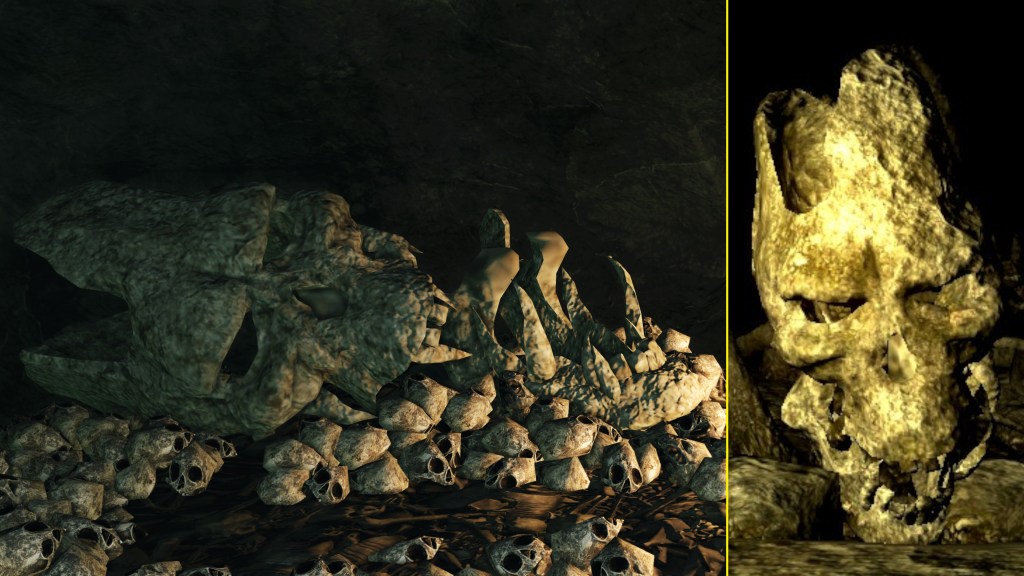
If the Pit’s graveyard was made for Heiden holy men, then it explains some of the remains buried there with them. The pile of human bones the Rat King sits upon is crowned by an ancient giant’s skull previously exclusive to DS1’s Tomb of the Giants. Aside from being a callback to the “giant graveyard” (巨人墓場) in the cemetery of holy men, it is fitting for Heiden burials. The Undead Crypt makes it probable for other parts of the ancient burial sites beneath Anor Londo to have warped over with it. From there, these age-old remains would be exhumed and reburied in more proper graves due to their historical and religious significance to the stranded denizens. Undeniably, a number of the holy men buried in these tombs are far larger than the average human skeleton. Assuming that this isn’t artistic license either, Heiden humans may have been copulating with Anor Londo’s giant slaves, resulting in some of its populace who became clergy growing larger than the average man. There are also some of shorter stature, but this can be attributed to poorly-placed corpse models clipping through the game world.





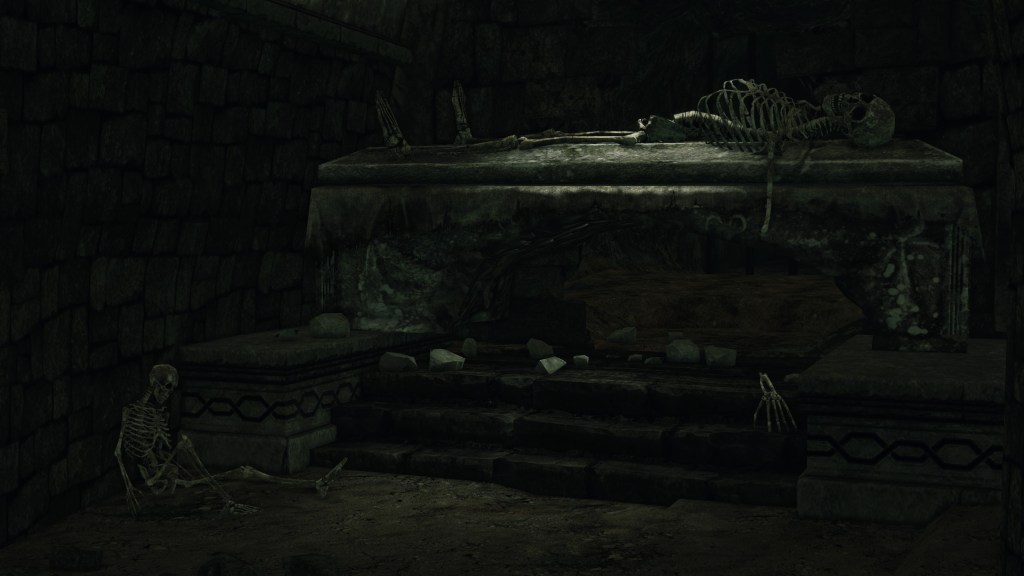

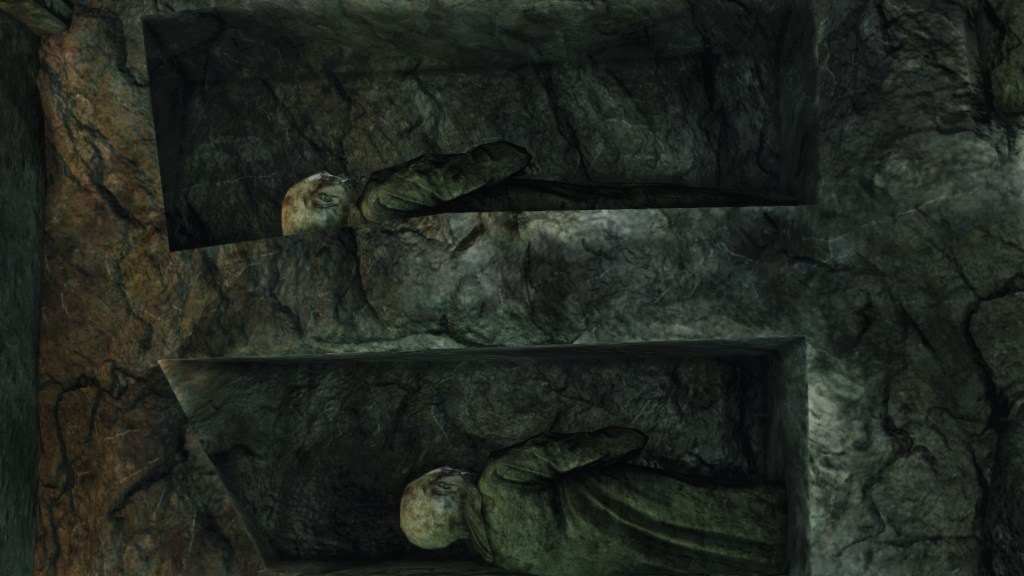
Besides their size, some skeletons and coffins are also shackled or wrapped in iron chains to keep them in their graves. This implies concern over these holy men rising back up again, whether due to undeath or grudges in life. Given the random nature of both curses, proactively chaining them so that they don’t freely wander around the crypt is prudent — once the gravekeepers found them, they could easily be put down or transferred to the Undead Crypt. But considering that this is only the case for some of the bodies, the practice likely only began much later after countless instances of these saints not staying dead. The reason is likely because they modeled their graveyard after the Catacombs from DS1, as evidenced by the shared iconography and style of architecture in certain areas. Heide built themselves a catacombs for clergy to reflect Anor Londo’s own without considering the change in circumstances since the dawn of the Age of Fire, forcing them to adapt to these newer factors after much trial and error.
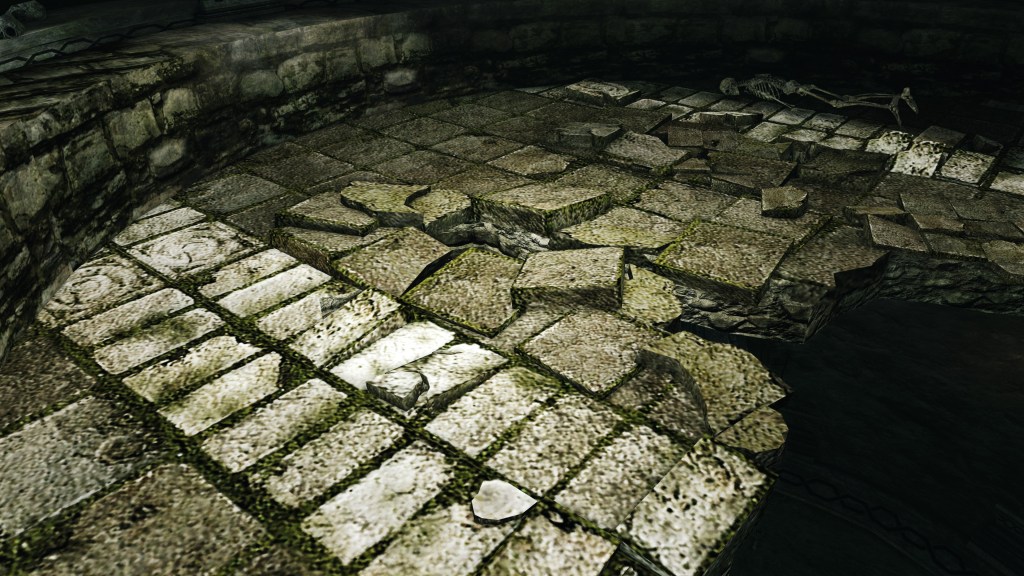
Therefore, the Pit was most likely built to be a circular elevator to various floors of the Grave of Saints, among other areas. For example, we can come across various stone doorways built into the rock face of the Gutter, each identical to the one in the Pit. These doors seem to be the only surviving Heiden ruins below the shaft, reached at the end of the proposed lift ride. But following the country’s destruction and the passage of time, the actual lift and any supporting structures or mechanisms around it were lost. While Majula sits well above sea level compared to Heide’s Tower of Flame, the lower levels of the Grave of Saints have nevertheless been completely flooded — if there were other means to enter the graveyard from the capital, they have been forever cut off. Only some of this can be attributed to water trickling in from above, as seen within one chamber higher up and another directly under through broken floors. And so, it is likely that any other underground facilities that this hypothetical lift would have taken us to were made inaccessible by Heide’s watery destruction.


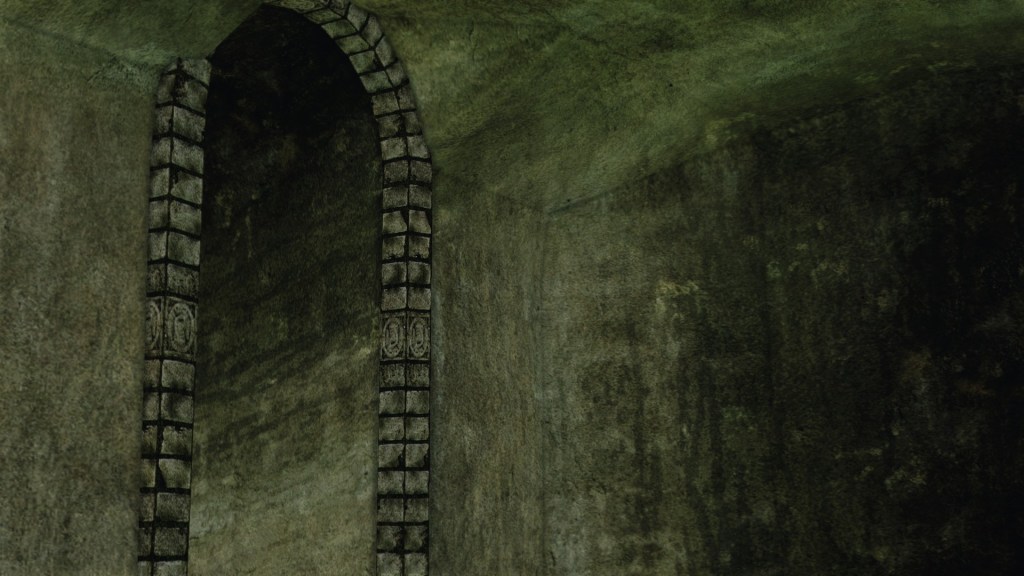

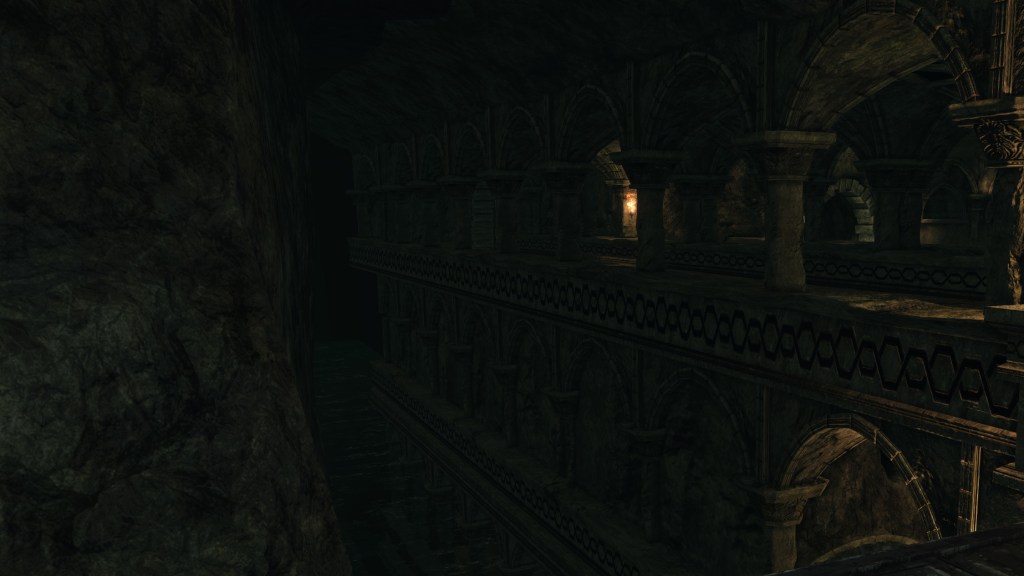


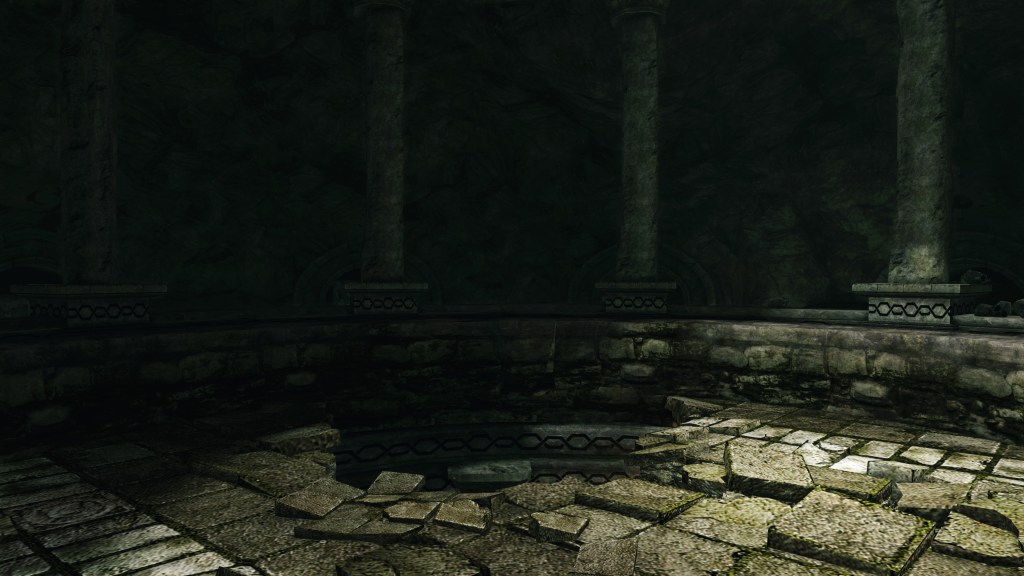


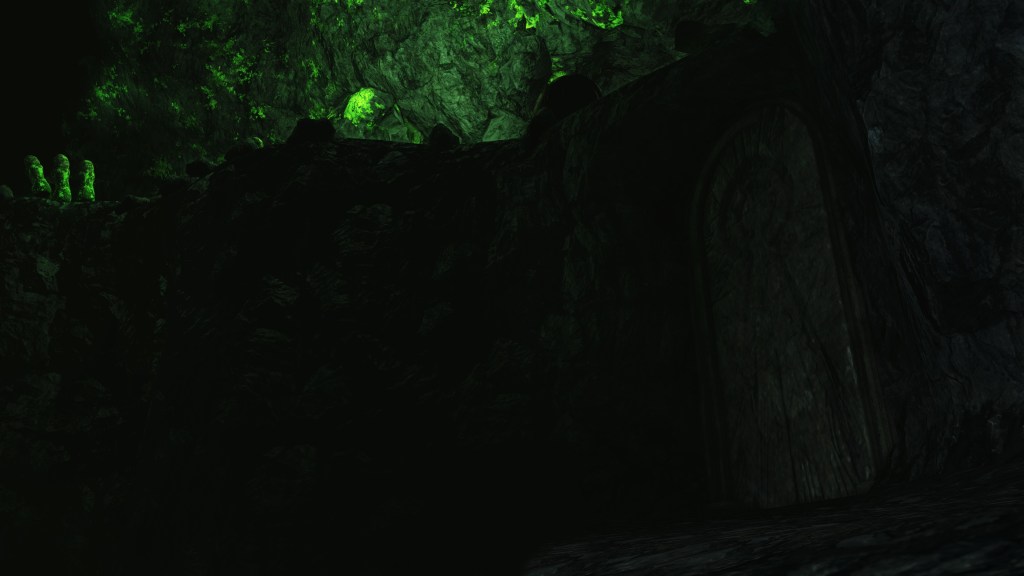
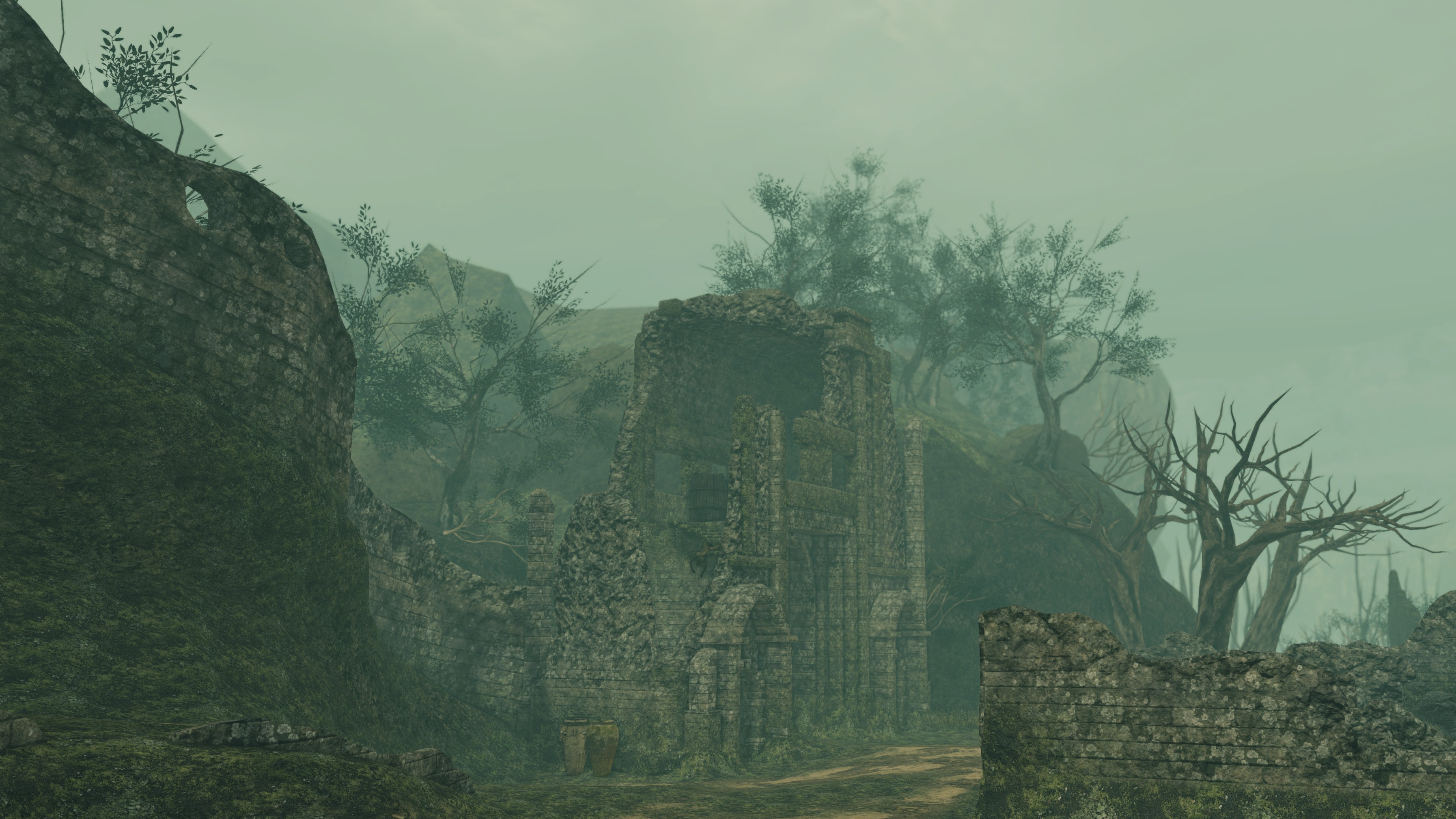
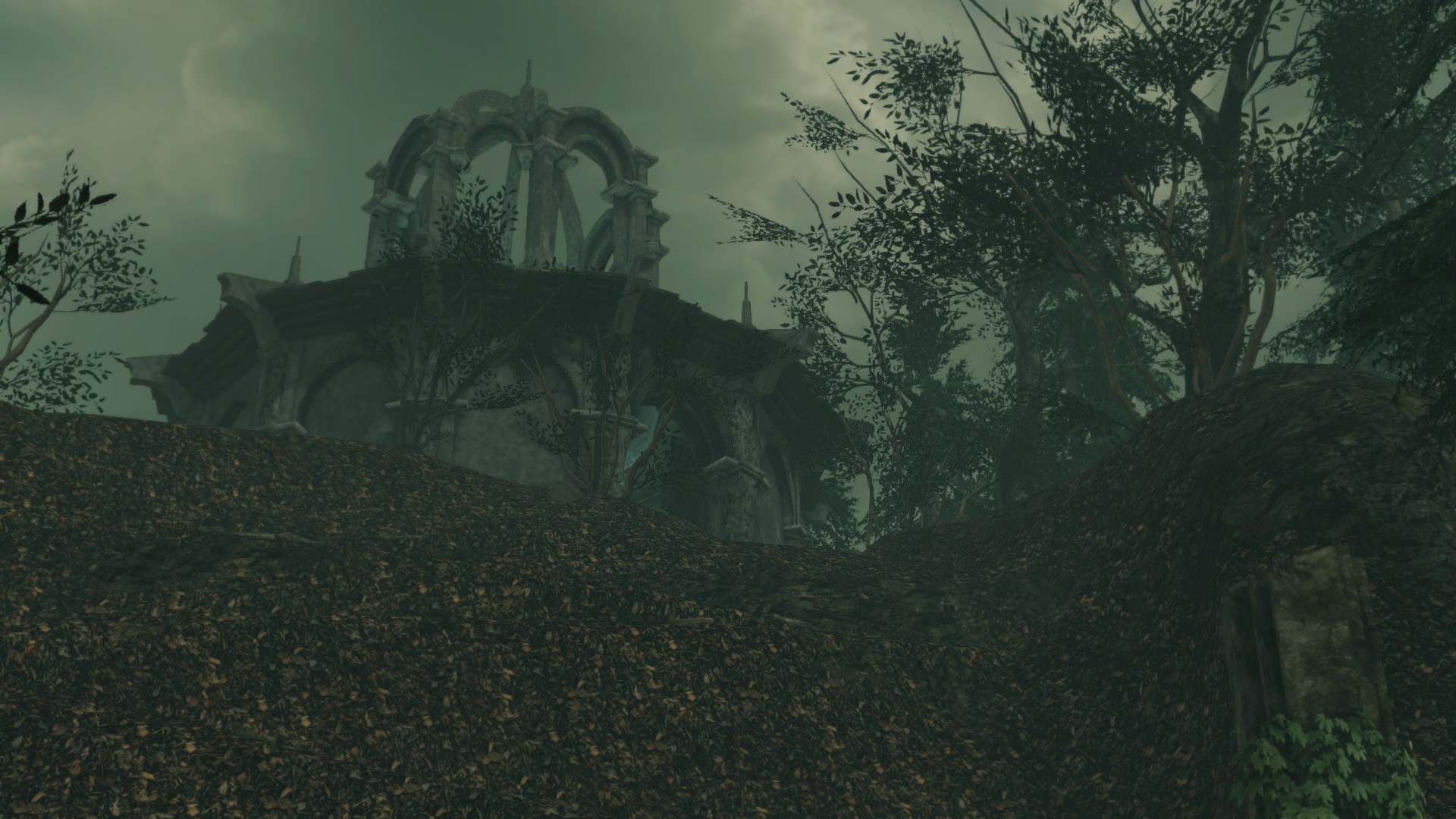
Of course, the loop temple leads not just to the main city and the Pit, but also to the Shaded Woods. This forest is home to stone ruins with architecture identical to the ruins excavated beneath the Majula manor and seen at the Shrine of Amana. This includes the Shrine of Winter, which is essentially an extension of the Woods. These similarities in design indicate that Heide originally created the small shrine, presumably to safely monitor the Old Chaos at the other end of the warp point. Adding to the connection is how the forest ruins end at Drangleic Castle, which bridges into the Shrine of Amana. Furthermore, items found in these two areas including the Old Sun Ring, Sublime Bonedust, a Divine Blessing, and some Lloyd’s Talismans. All of these have obvious associations with the gods of Anor Londo or their holy magic power, and the Estus-blocking talismans in particular can otherwise only be looted from Heide’s Tower of Flame. In other words, the remaining ruins in the woods were probably built by Heide like the rest.
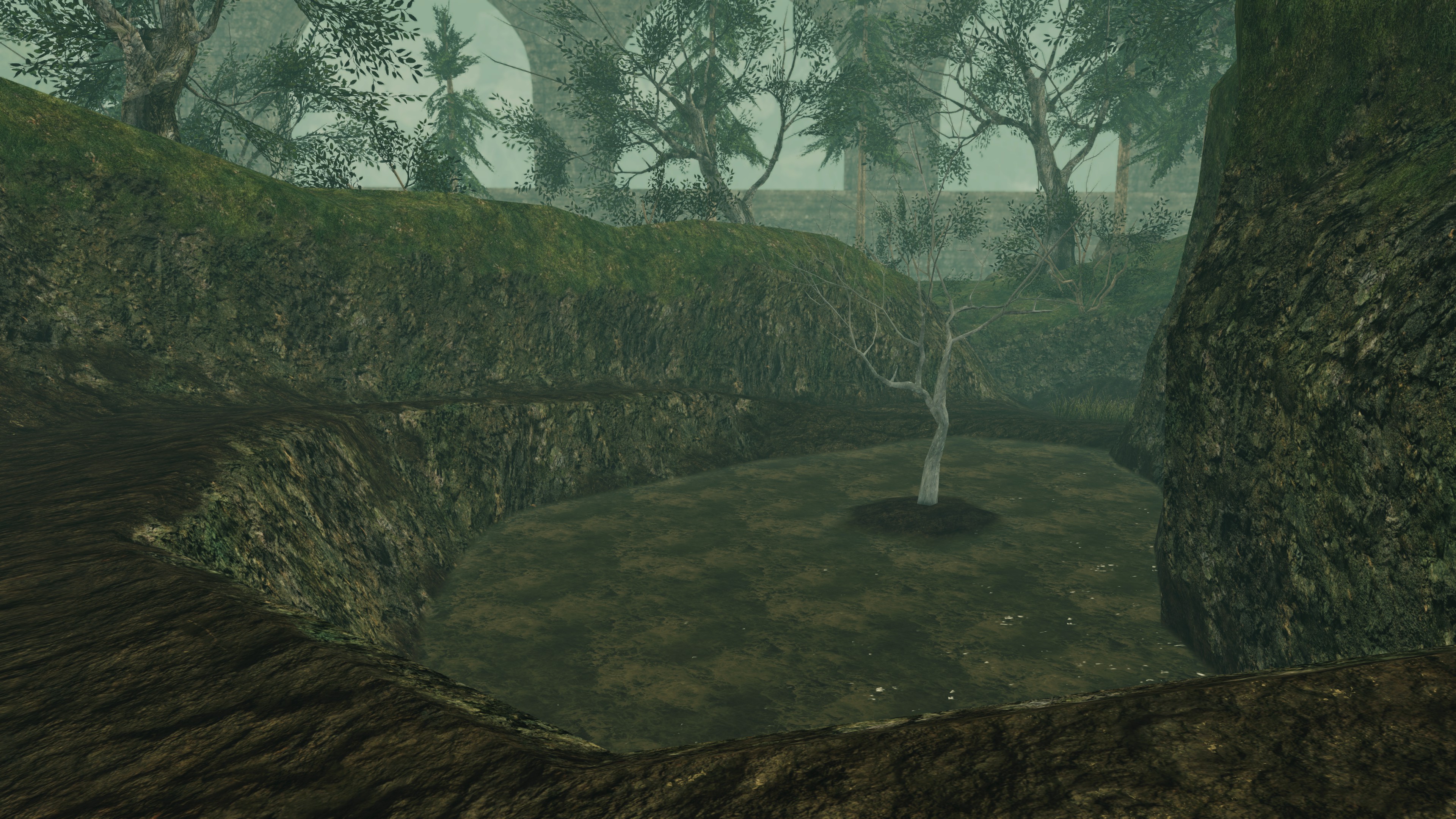
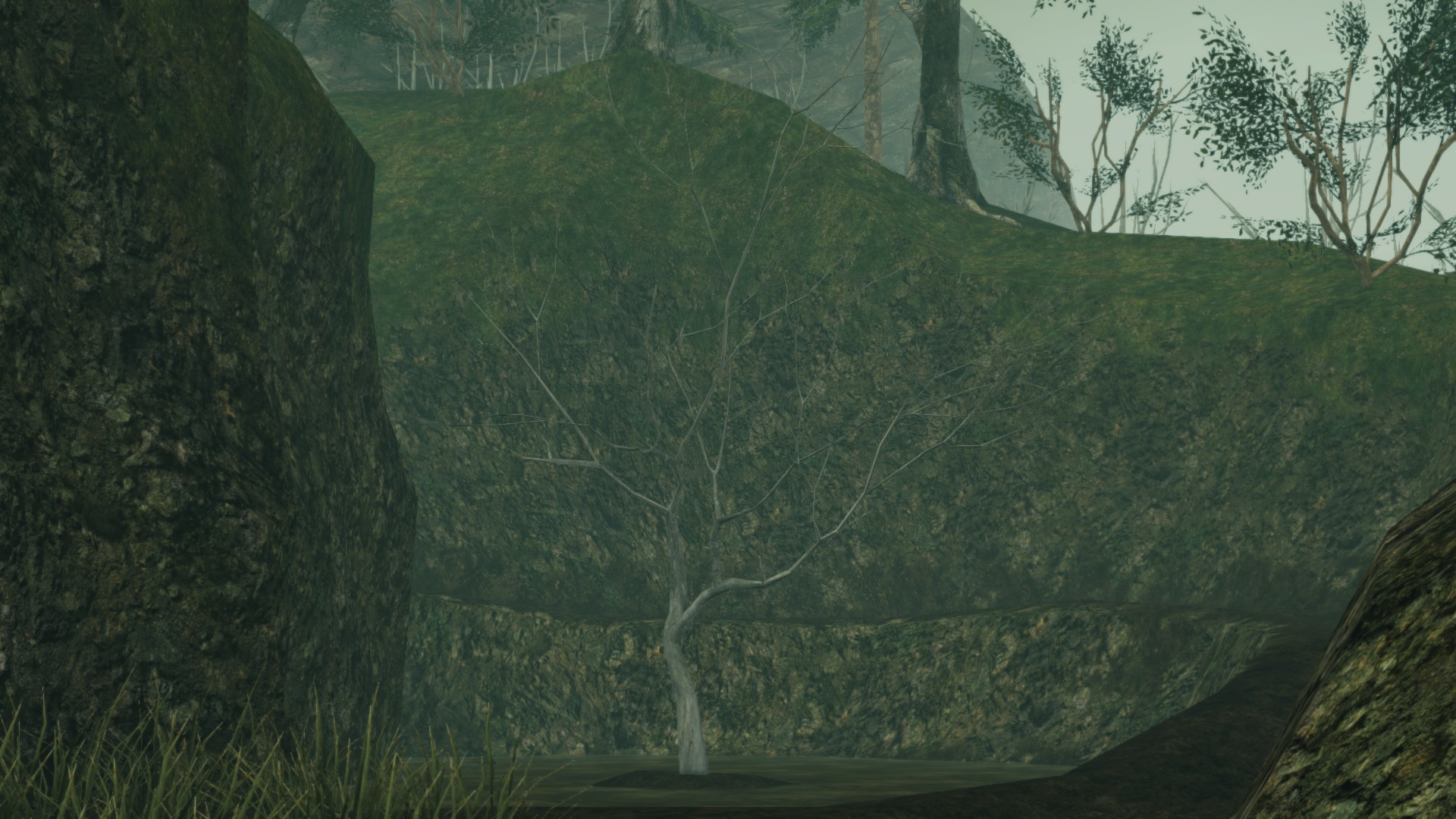
That being the case, these items and small shrine suggest that there was some religious aspect to this area before it fell to ruin — why else build a temple leading there unless it too is a holy place? The forest is largely nondescript save for a single white tree in a pond. Fans of DS1 may recall that white trees were an iconic motif of Oolacile, and cut content indicates plans to include the same orange flowers from Oolacile’s royal garden in the area. On top of that, a local chest contains the country’s Repair spell, recreated using more conventional sorcery principles based on its blue coloration. Another chest stores the Black Knight’s Halberd, wielded by one such a knight roaming the forests of Oolacile after it became Darkroot Garden in the previous game. Factored as a whole, the Shaded Woods is at least part of that Black Forest. It too shifted to this part of the world, where it was then resettled by Heide. The country’s reason likely had to do with Oolaciles deep ties to Anor Londo. The Heidens’ aimed to preserve their religious history and culture, after all, though to little effect.


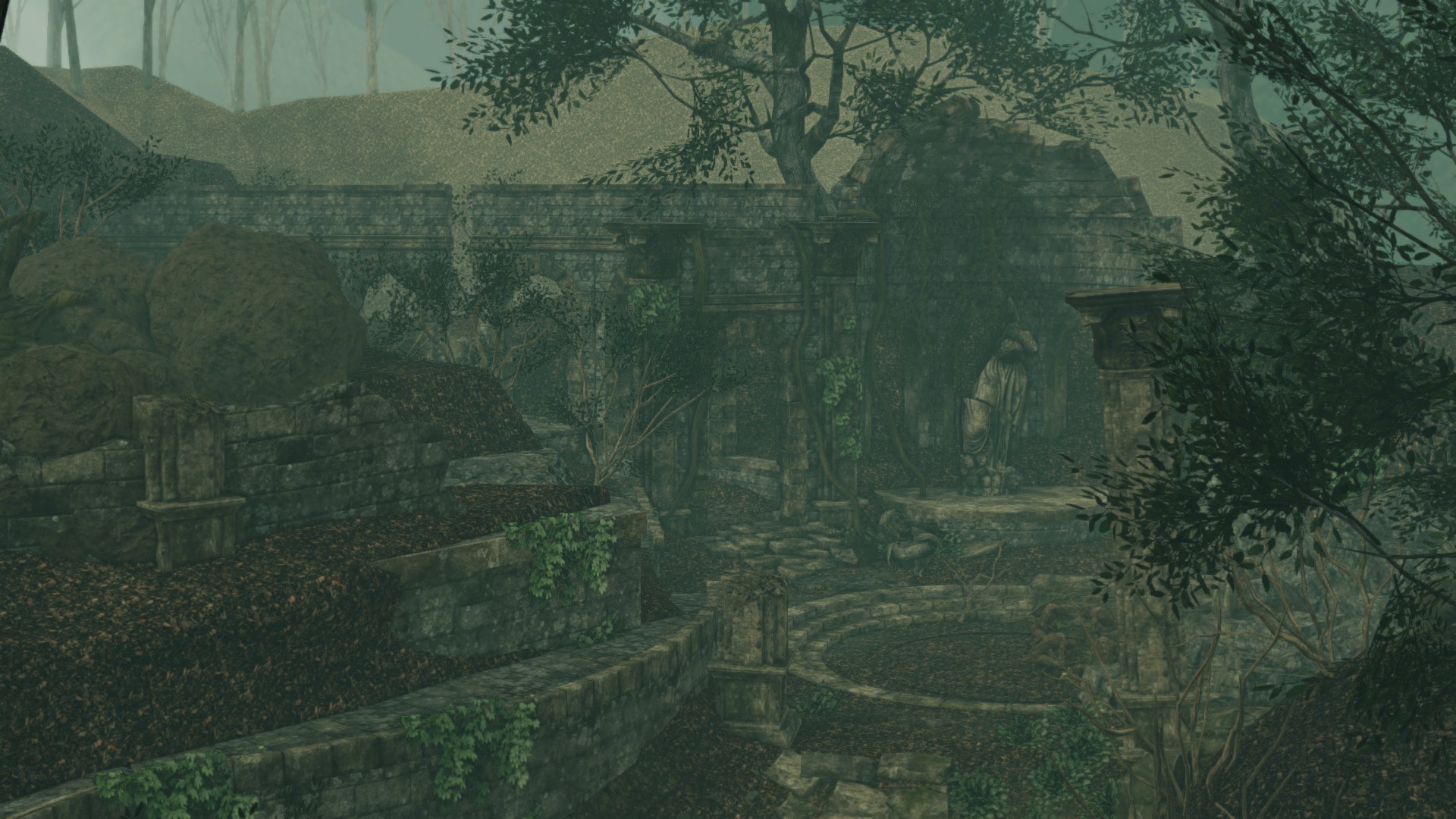
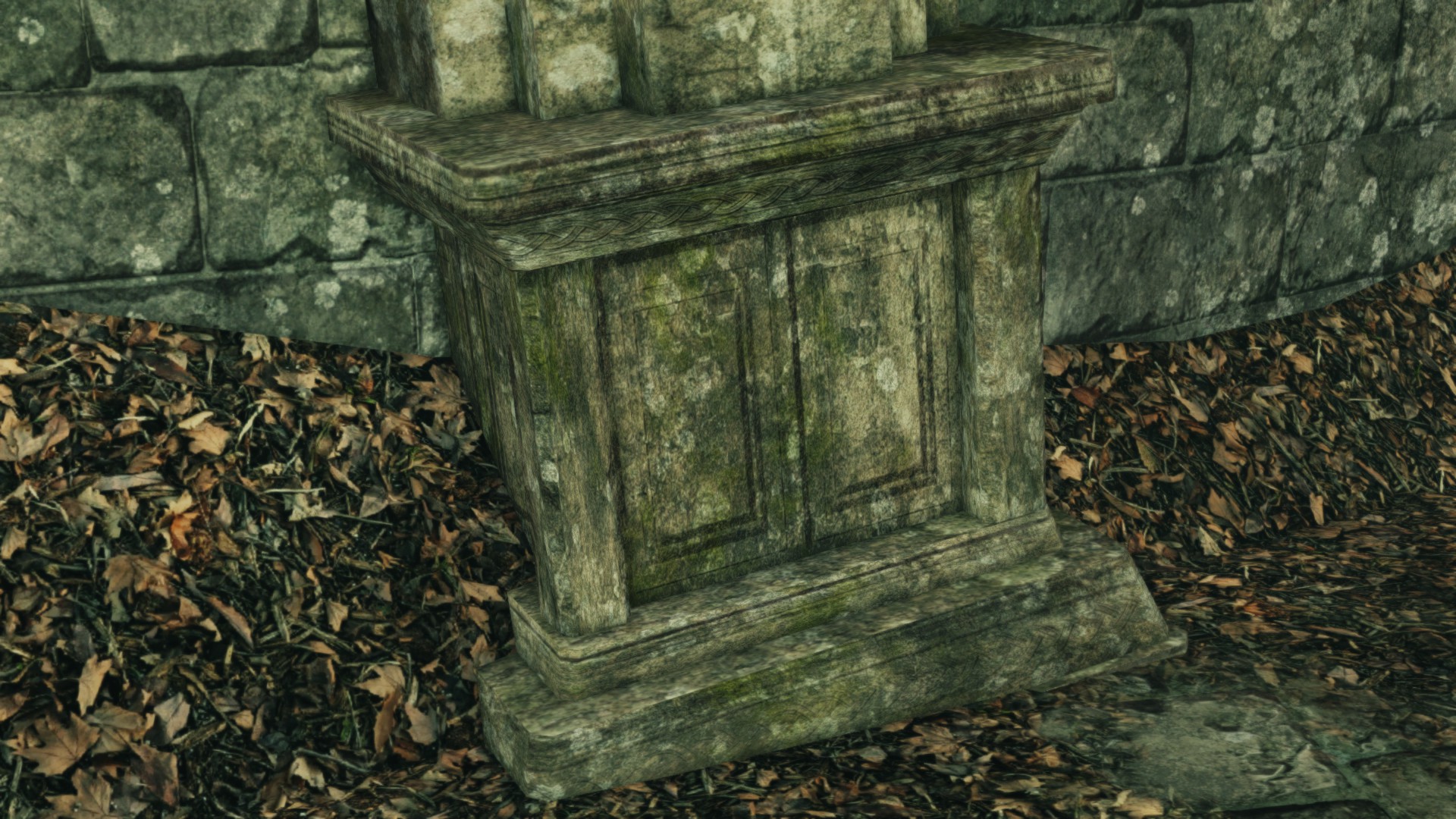

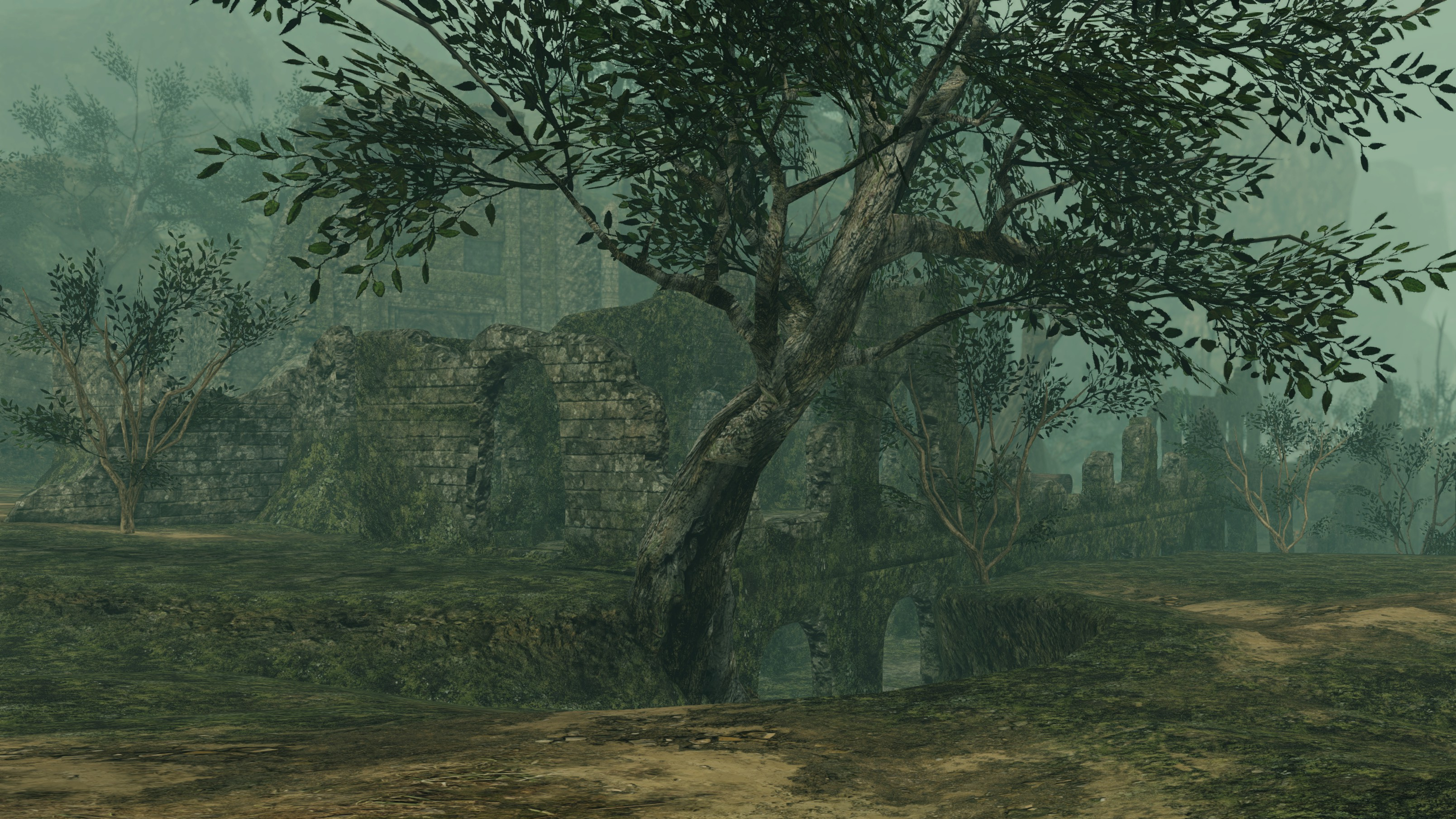

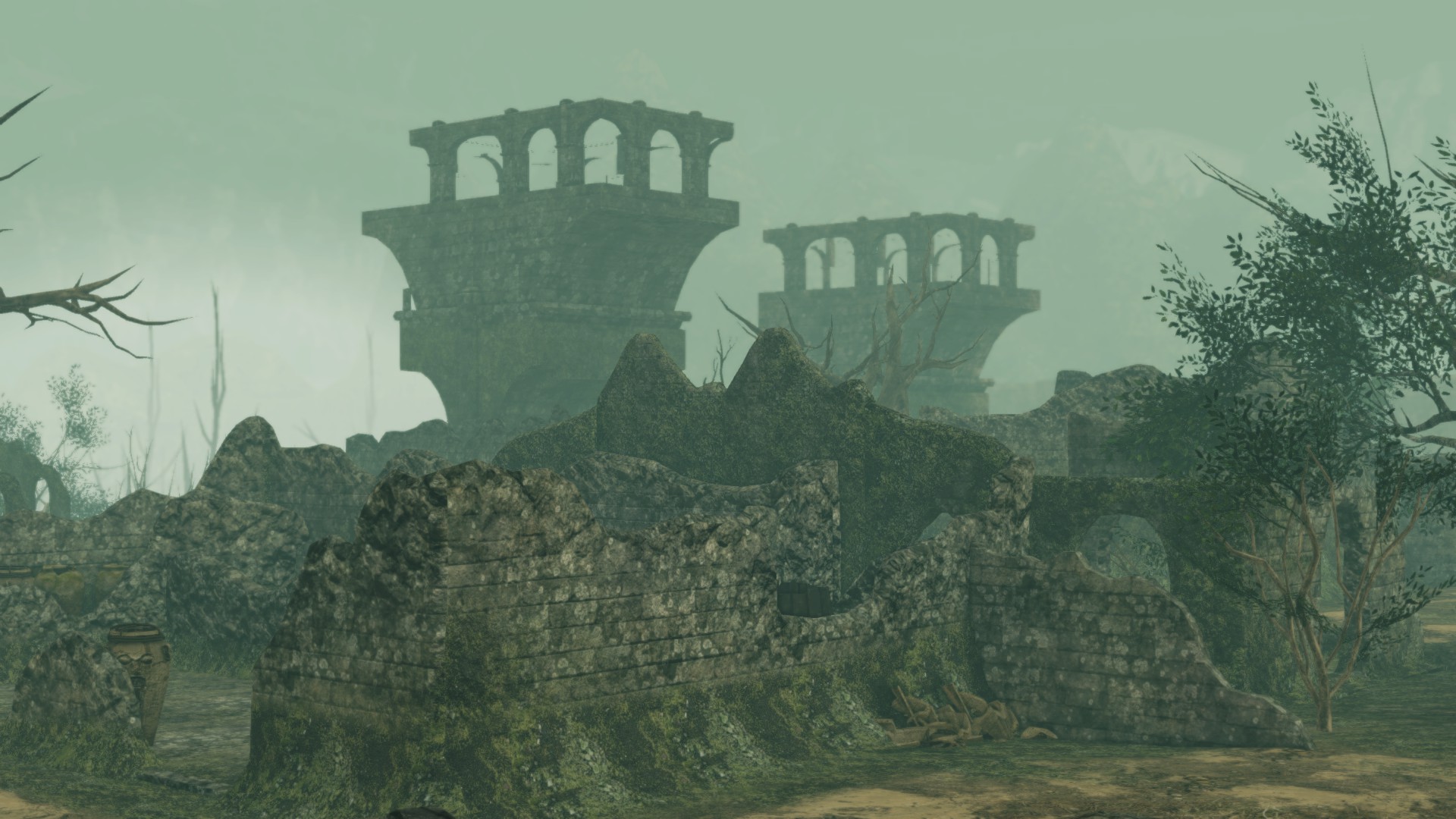


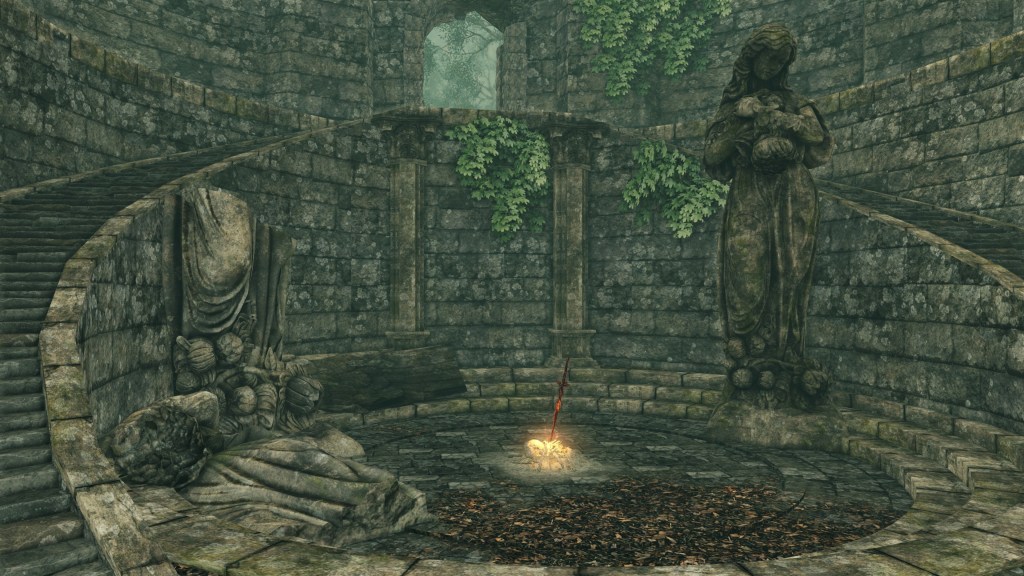
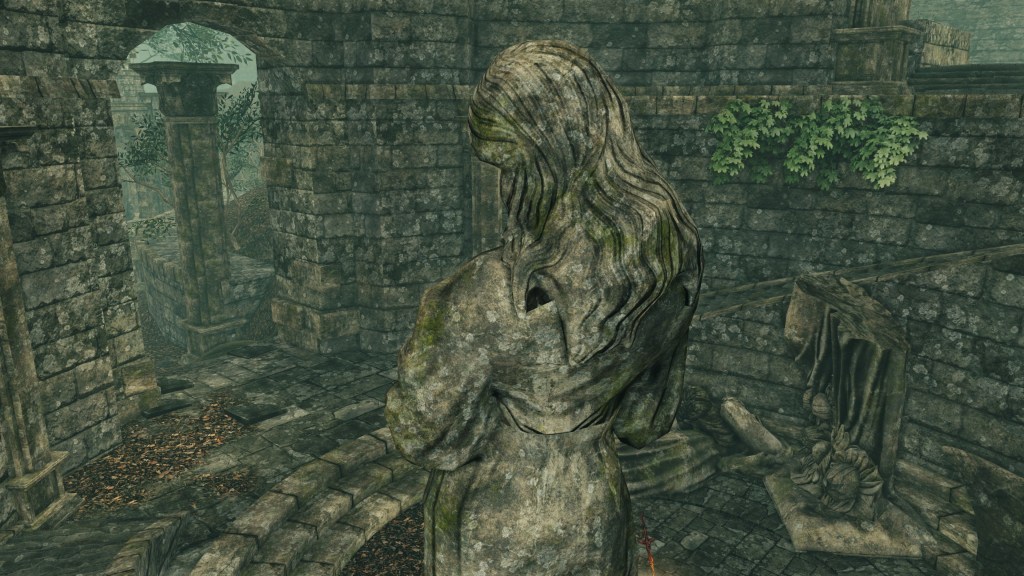
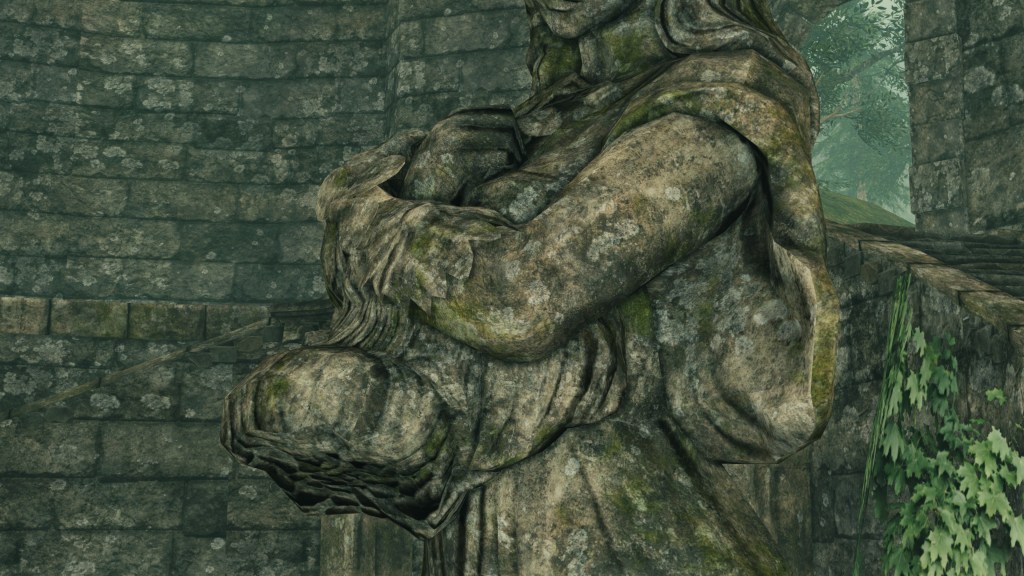
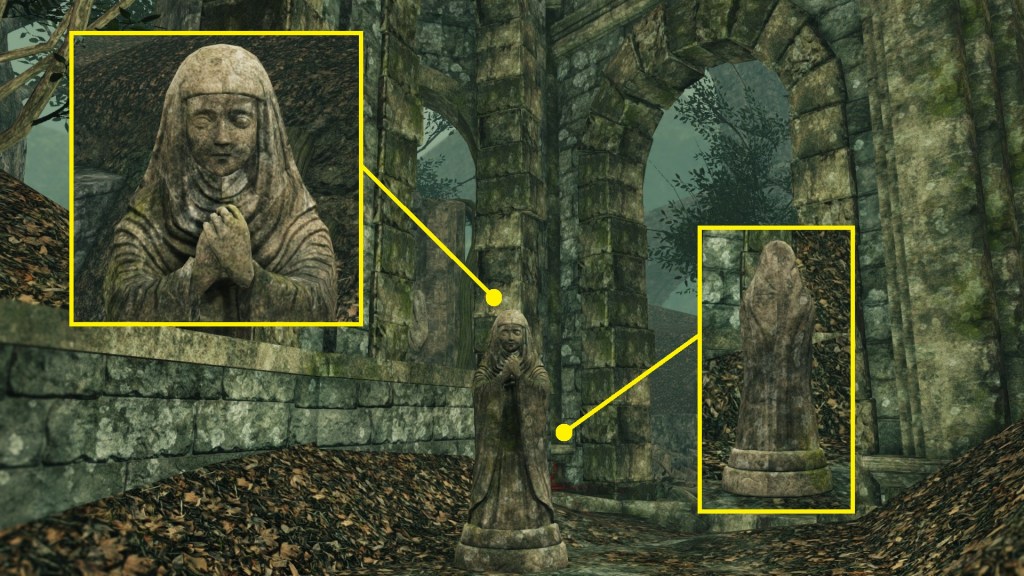
At the centers of the ruins stand statues of a woman, flowers held to the chest blossoming at her feet. The strong association with nature is appropriate for the area, but who is this figure specifically? If she is a goddess, then Gwynevere fits the bill. That being said, the harvest god doesn’t have any particular connection to Oolacile. Perhaps it instead portrays Elizabeth, who is revered as a holy woman that dedicated her life to relieving the poor with the help of her secret medicine. This vaguely lines up with DS1’s mushroom woman selling her own fungi as such medicine in Oolacile. Moreover, the description for Elizabeth’s Mushroom questions if her beauty matching her nobility is to be believed. Her legend has clearly been exaggerated to reimagine the kindly mushroom as a beautiful human, using all sorts of pills rolled up from New World flora and fauna. Therefore, the statue can be an icon of her. Another effigy connecting these ruins to holy woman worship is conjured with Chameleon. The figure resembles a nun in prayer, so it may be another depiction of the saintess.
Dried mushroom made through a special process. Gives an oddly uplifting feeling and greatly recovers HP continually for a limited time if ingested.
Legend has it that the holy woman of old, Elizabeth, created numerous secret medicines and dedicated her life to relieving the poor.
It is believed that she had a beautiful appearance matching her noble deeds, but how was it in actuality?
Holy women weren’t the only figures honored there. Half-buried among the ruins lay large stone heads of a male warrior, the same figure ornamenting training facilities at the Cathedral of Blue. Assuming that this isn’t a stand-in for the generic Blue Sentinel, then the only notable character connected to both Oolacile and holy knights with a mandate to hunt dark spirits is Artorias. With his strength and staunch will, it is easy to see knights of Blue adopt the Abysswalker as a paragon to strive towards. But with Gwyn’s knight long dead, his appearance needed to be reimagined as well. And although we cannot come across his grave, it likely does exist somewhere in Shaded Woods — or at least did. The Majestic Greatsword is Artorias’ corrupted Abyss Greatsword from DS1, just showing signs of age. That ancient weapon should have been buried with its owner at Oolacile, yet it has passed through many a famous swordsman’s hands in the New World. In short, the grave was pillaged after the Great Shift, which might explain why we seem to never come across it in those woods.





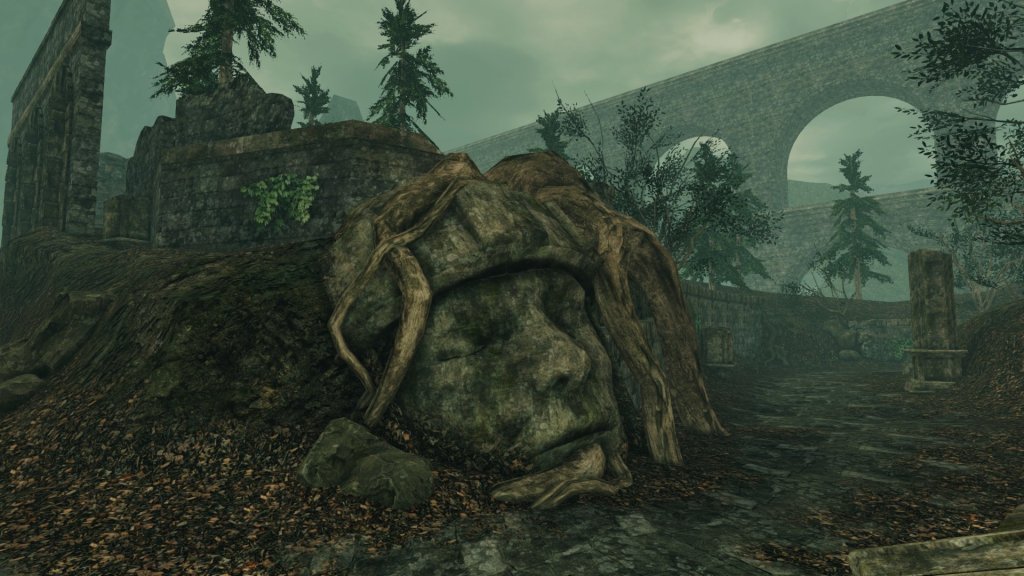


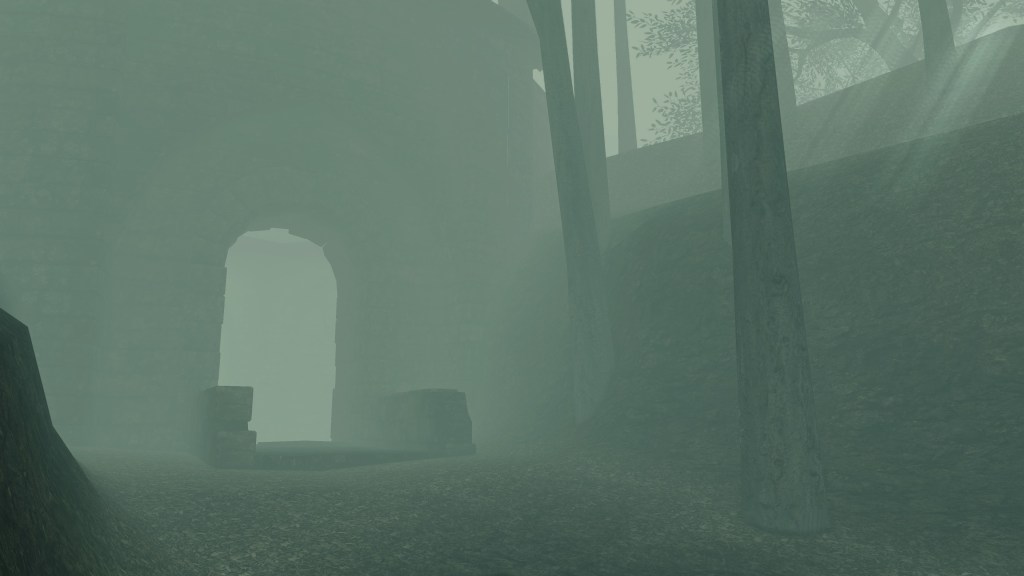
If the legendary knight of Gwyn’s corrupted body was exhumed, it probably wasn’t while Heide was erecting his statue. Even riddled with inaccuracies, the country’s efforts still emphasized preservation. Among a sea of green, one section of Shaded Woods presents us with a forest of fog. The defoliated grey trees seeming to attract if not generate this mist permeating their vicinity, making it difficult to navigate. And yet, the ruins appear to deliberately skirt around that specific zone. Clearly, Heide wasn’t willing to cut down the trees for urban development, possibly because the unique feature was originally part of Lordran. Recall in DS1 that a white cat lurking in Darkroot Garden, Alvina, manipulated fog. Despite hints to the ancient feline’s true nature, it was never clarified where exactly she picked up her mastery of fog during her years in the Black Forest. But if there was a small wood of fog trees elsewhere in that same forest, then the cat had plenty of opportunity to learn. At the same time, it provided Heide another landmark of the Old World to safeguard even if not of obvious religious significance.




When it comes to preservation, however, Heide’s chief concern would have always been fire. The ruins housing the Throne of Want are likely Heiden-made. The area is located beneath Drangleic Castle, at least partially nestled within the mountains the royal abode sits upon. And although the architecture doesn’t resemble anything previously associated with Heide, the castle’s situation between the Shaded Woods and Shrine of Amana lends itself to that notion. At the very least, this makes it unlikely for the ancient civilization to have been unaware of their existence. But while the main building features impressive style and architecture comparable to other Heide works, both the throne and the path leading to it are far more primitive. Such simple stonework suggests that it is significantly older, from a very early period in civilization. And Heide’s founders had every reason to enshrine this exceptionally old location.
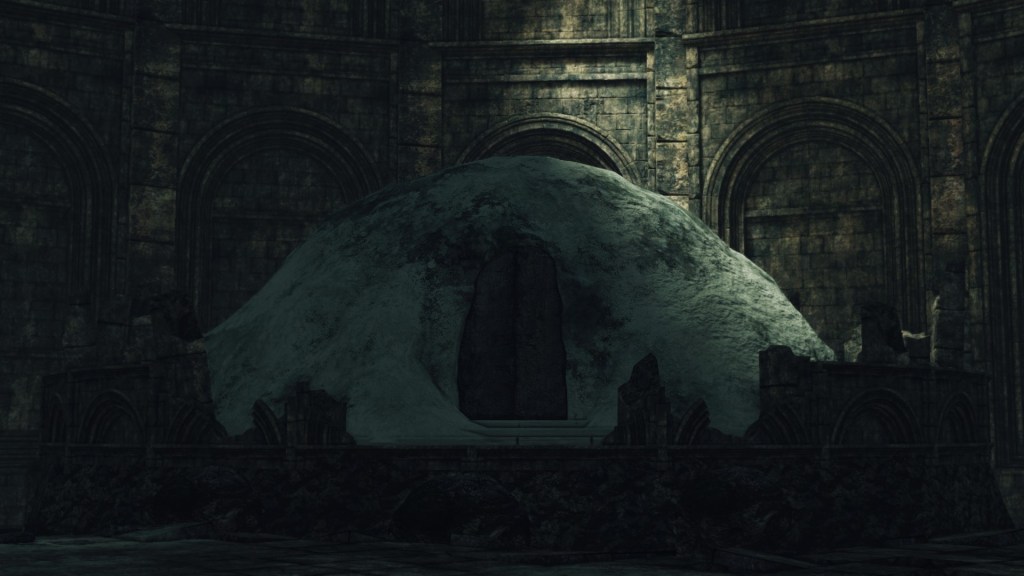
Various characters and item descriptions reference the throne as a path to linking the fire and the “King’s seat” (王の座) in obvious reference to the Lord of Cinder, or “King of Kindling”. (薪の王) The ruins too are filled with ash similar to DS1’s Kiln of the First Flame — concept art even includes the melted pillars present at the Kiln. And yet, there is no sign of the First Flame when we take our seat as sovereign. By all indications, the Throne of Want is somehow involved in the firelinking ritual, but it is not the location of the fire itself, just an intermediary. The chair is enclosed within a dome we access through two large doors. These doors automatically open and close as we approach and sit down, almost like a transporter. In that case, the dome is most likely a lift or teleporter to the Kiln similar to how the Firelink Chamber facilitated a wormhole to there in DS1; the gateway for said wormhole was also of primitive construction. It is feasible for the gods to have made several shortcuts to the First Flame during the early years of civilization. The Great Shift brought one to Drangleic where Heide built new protective structures.


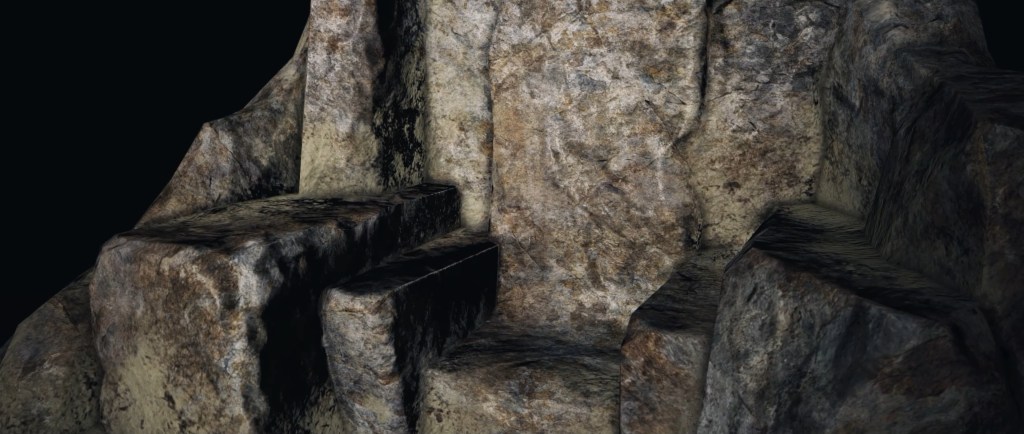

Heide is likely to have held the Throne of Want in particularly high esteem, not only as their only known link to holy fire but also as a continuation of the founders’ original mission. Recall that Anor Londo under Gwyndolin orchestrated the system for selecting the next Lord of Cinder in DS1. In the god of the Darkmoon’s absence, it was up to his human servants to secure the First Flame and carry on that system. After the Great Shift, they were apparently the only ones capable of reaching the Flame and keeping the Age of Dark at bay. And after reestablishing contact with the Undead Crypt, they had a means to funnel Undead out of decent society until a new Lord of Cinder was required. Everything was setup to continue where Anor Londo had left off. And as our journey reveals, firelinking via the throne would be remembered. Despite the twists and turns, Lordran’s greatest legacy has survived the ages — if only the same can be said about Heide.
Drown in Obscurity
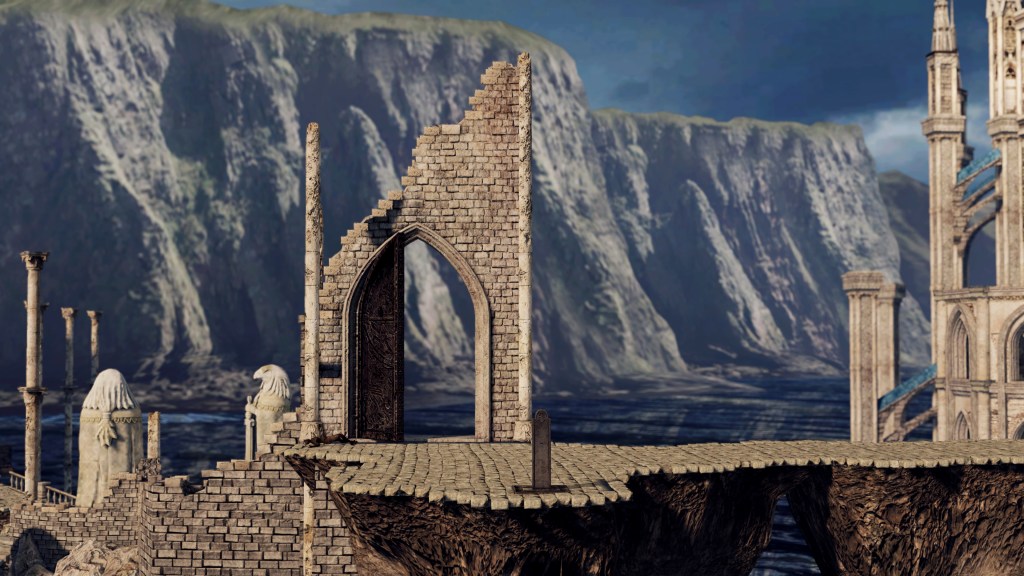
As alluded to earlier, Heide appears to have collapsed when the city inexplicably sank into the sea. This particular phrasing rings odd given that we reach the ruins from Majula, which sits on the seaside cliffs at higher altitude. Specifically, it is via a passage through the loop temple, a passage which remains unblemished aside from water flowing through the portions below sea level — and looking at the design, this is simply because it is part of the city’s water supply or sewer systems. If the city physically sank beneath the waves, then one would think passages like these would have been torn asunder. Instead, it is as if the entire continent sank along with it. But we can clearly see some of the rocky foundation above water even while taller buildings stand perfectly upright, if flooded, below it. This would suggest that nothing had actually sank; the city simply wasn’t built up all on the same level. At the same time, parts of the foundation do appear to have collapsed and brought infrastructure down with it, certain buildings leaning above the waves between huge swathes of ocean. That constitutes a sink.


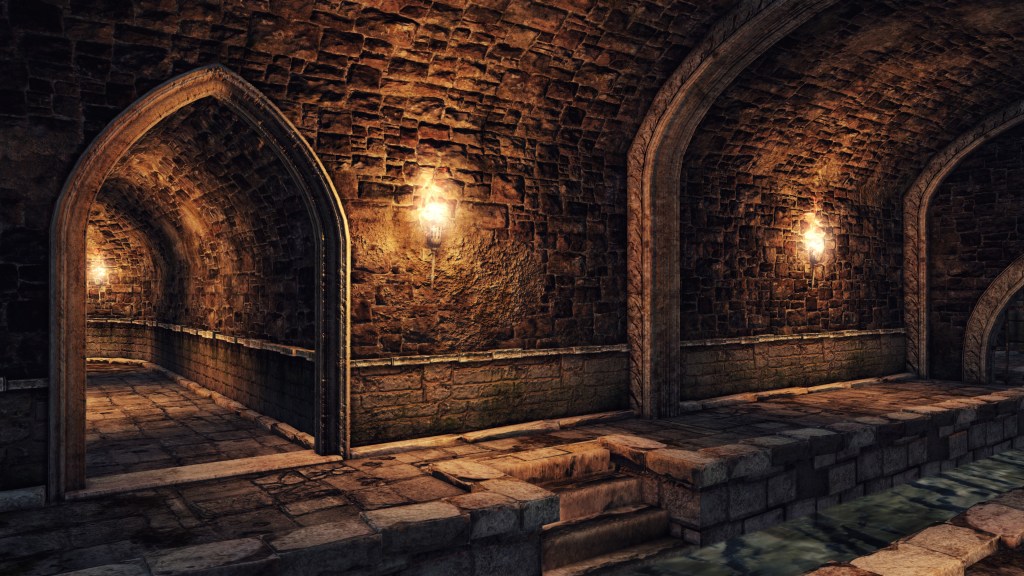
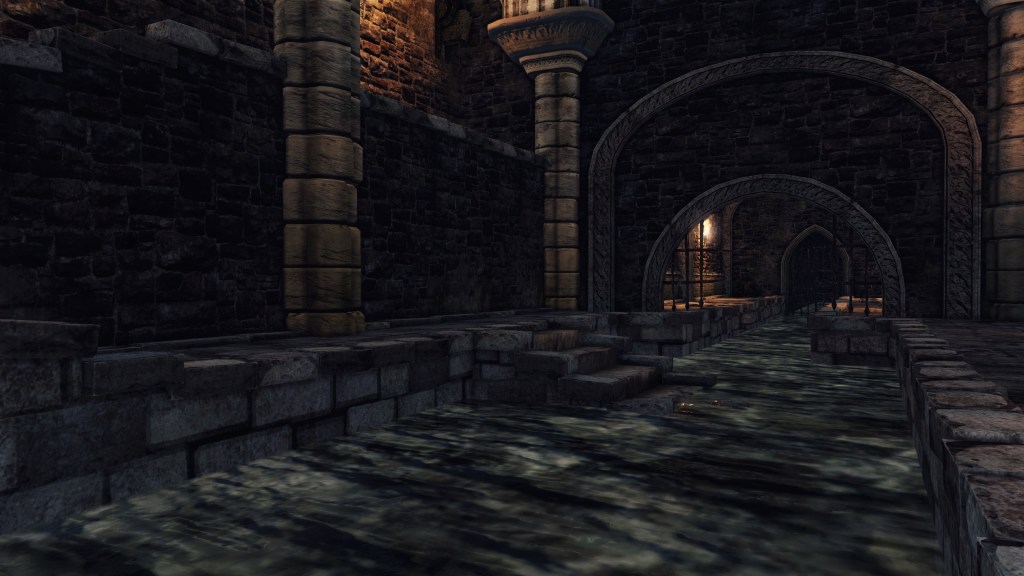
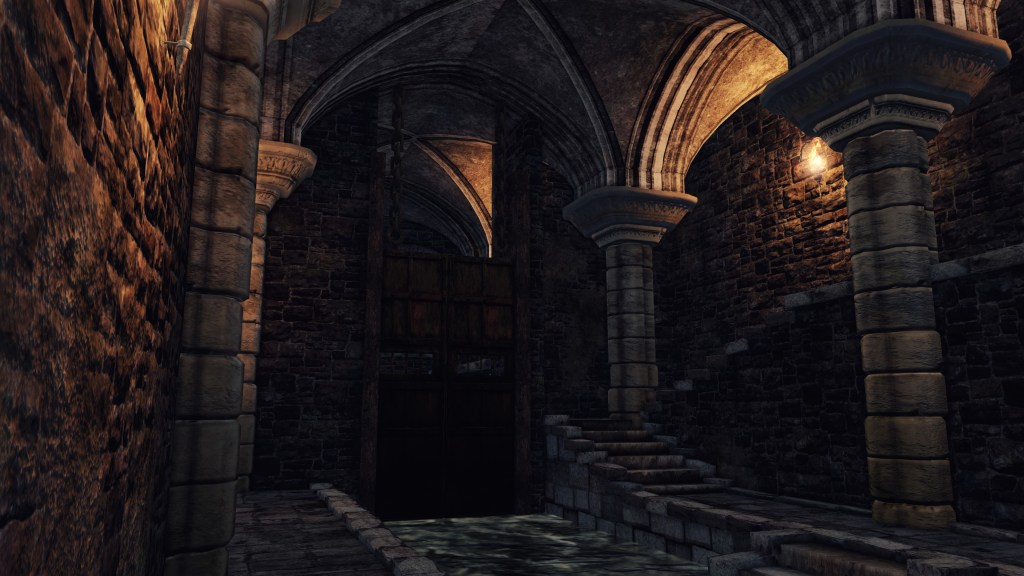


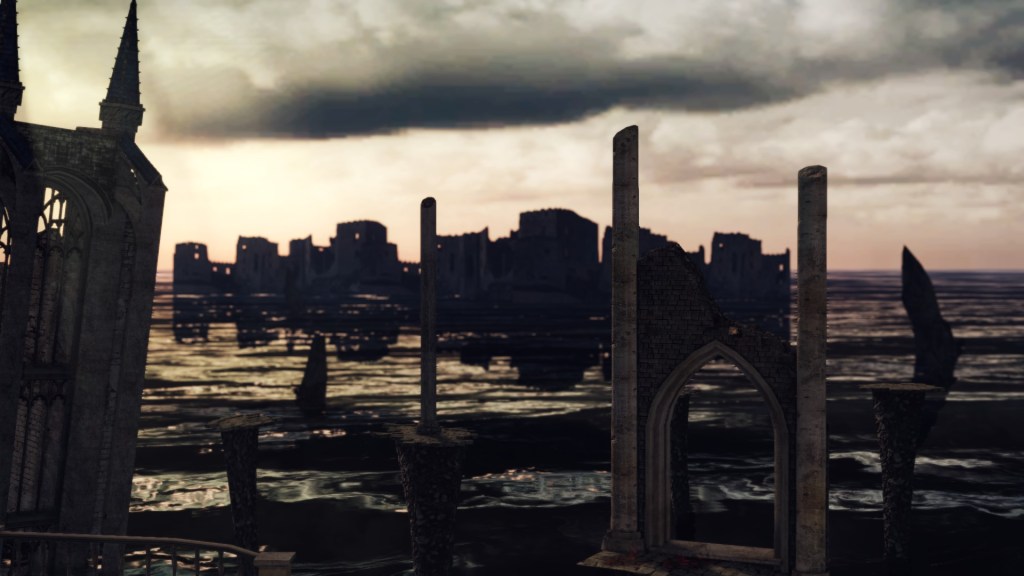
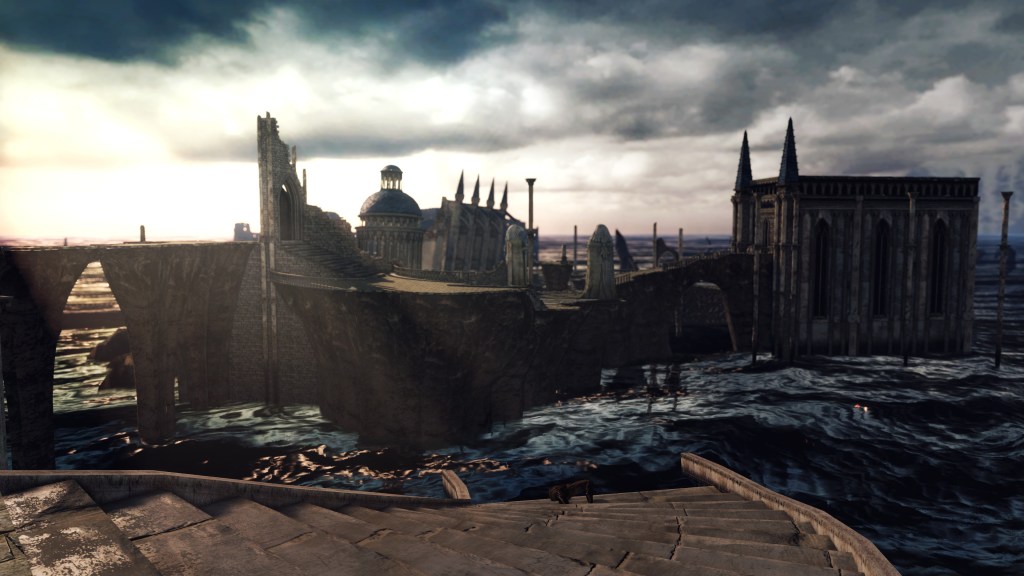
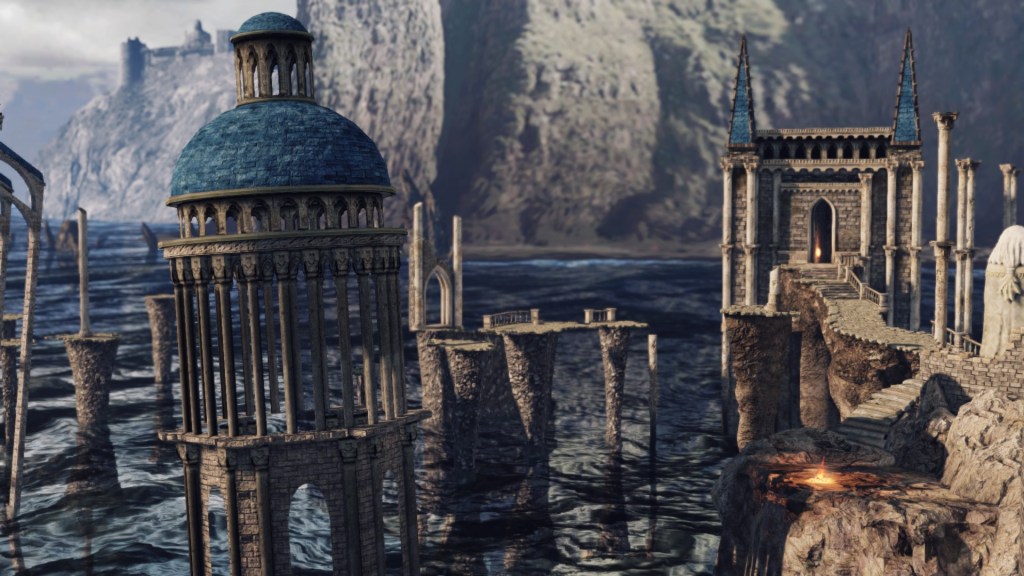
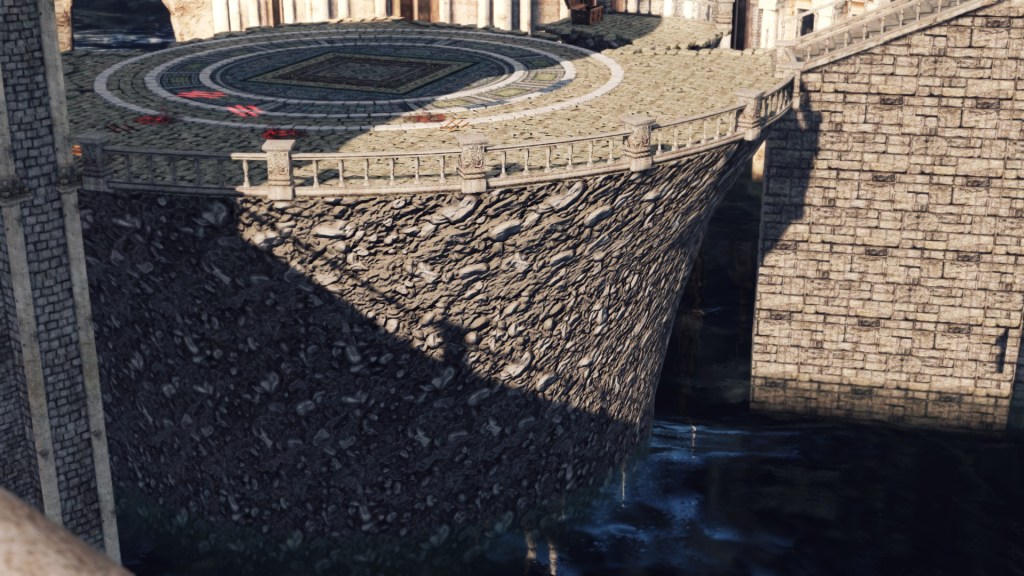


At the very least, a significant portion of the city did sink into the sea, but only in response to the sea’s arrival. Similar terminology was used to describe the destruction of New Londo in DS1 when it had only been flooded with water — that city certainly didn’t sink to a watery bottom in the traditional sense. The use of “sink” thus seems to be less in the sense of moving downward and more in the sense of becoming below the water’s surface. Heide may not have necessarily gone down so much as the sea had risen up. Seismic activity from the crashing waves would cause parts of the land to erode until they crumbled beneath their weight. But because this resulted from a rise in sea level, the rest of the man-made structures would simply be flooded similar to New Londo, explaining why they are so well preserved relative to such a violent catastrophe. However, that doesn’t reveal why this specific calamity befell Heide in the first place.
Indeed, the very nature of the sea is suspect. Dark Souls focuses on the relationship between light and Dark, but it is usually water that serves as fire’s antithesis. Flames can be doused with water, as demonstrated when using torches in waterlogged environments. Water counteracts fire, so it is fitting that the Dark be occasionally portrayed as a viscous fluid. At the same time, water can be blessed by the gods’ holy power, and it serves an important role in sustaining life whether they be flora or fauna. Add cold to water and it becomes ice; add heat, steam. And water of course rains down from the clouds. With how prevalent the substance is, where does it fit in the larger cosmology? It may be a derivative of fog, but it is just as possible that water’s mechanics fundamentally differ from our real-world understanding like is the case with lightning. Regardless, it is more prominent than ever thanks to the inclusion of the ocean, which went unmentioned and unseen in DS1 — at best, a painting of Greece hung in Anor Londo, and that water on rocky shore could easily represent just a large lakeside. This begs the question: did the sea even exist as of DS1?

Because we are unable to swim, it is difficult to determine the viability of undersea life. The Sea Bow’s description acknowledges the existence of sea monsters, but these creatures may not necessarily refer to demons of the deep; the multi-headed lake beast of DS1 surfed the waves with only the occasional brief dive beneath the surface. The developers did plan to include “yellow jellyfish pills” (黄海月の丸薬) at one point, which might imply a complex ecosystem existing under the sea — though FromSoftware previously had swamp jellyfish living in shallow waters in Demon’s Souls. There would have also been a giant hermit crab boss nesting in Lost Bastille by the ocean. However, these were ultimately cut, leaving us no hint to potential marine life in the final game. DS1 had likewise insinuated that water possesses anti-time properties, which would make their proliferation all the less probable. And if life hasn’t evolved deep below water, then there is no reason to believe that the sea is anywhere near as old as land biomes. Could such a large body of water in the Upper World be only a relatively recent phenomenon then?
Bow made for sailors who go out to the open sea. Flight range is long so that fiends of the sea don’t approach their ships.
The sea stretches to the north of Drangleic. It is said that at the end of it is an unknown continent where those not human inhabit.
If there was a sudden rise in sea level that caused Heide’s destruction, where did all of this water come from and why? There are two scenarios. Either it was just a natural disaster, or someone induced the cataclysm through magic. Whichever is the case, there is no limiting factor for how much water was added to the environment. It is therefore possible that the ocean in its entirety didn’t exist until the water flooded the world at the time of Heide’s destruction, in which case the game’s setting is a post-apocalypse. So who or what would be capable of generating that sheer amount of water? If this flooding was just a product of some natural phenomenon, then the most relevant phenomenon is the First Flame’s imminent waning as the Age of Dark approaches. Perhaps the progression of fire’s fading resulted in large swathes of the world being submerged? The Dark does have qualities akin to water as mentioned earlier. Or perhaps it is the prolonging of this perverse twilight era via firelinking that is to blame? Either way, water’s natural opposition to flame fits this explanation for the calamity.
In the end, the civilization was ravaged. Although the ruins themselves are remarkably well preserved, the indoor chambers and passages beneath the ocean’s surface are still ankle-deep in water and likely completely flooded at the base of these towering buildings. Few going about their daily lives within the city would survive the sudden crashing waves and resulting seismic activity. The same holds true for the Shrine of Amana and Grave of Saints — anyone in those areas would have drowned or become trapped during the flooding. Perhaps some had attempted to escape this fate by burrowing out of the complex, hence why our primary entrance to the Grave lies through a crude tunnel dug out to the Pit. But instead of a lift to the surface, the victims found an empty, unscalable shaft to deeper underground. No amount of digging would lead these survivors out of there before they succumbed to starvation.


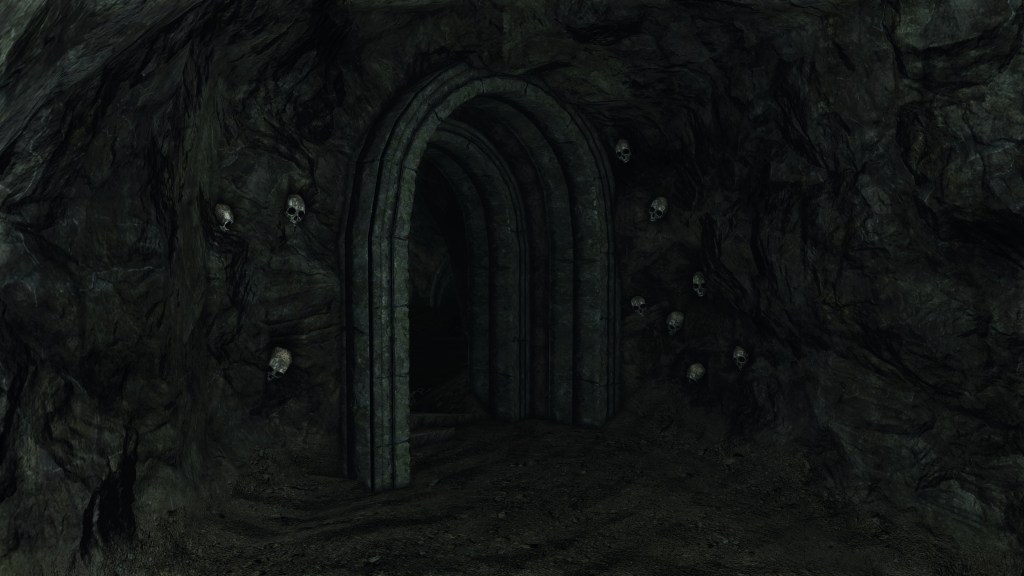


The only ruins which seem to have remained untouched by the waves are the Shaded Woods, which happens to be the only landlocked portion located well above sea level. Even then, the fact that they are in ruins implies that their inhabitants didn’t fare much better. As to what happened to them, the answer may lie with those still haunting the woods. The area is known as the “forest of vacant shadows” (虚ろの影の森) because of the illusory phantoms encountered throughout. These enemies’ resemblance to random player spirits in “other worlds” implies that their form relates to spacetime. And given how so many lurk in and around the forest of fog specifically, we can assume that longtime exposure to the mist has eroded the Hollows’ physical presence, though they can still be killed as normal. Why were they there? A number dress like typical thieves with hooded masks and black leather armor. Were they hiding out in the forest to evade justice, or just trying to fend for themselves stealing from their own as locals?
Put simply, it is possible for the hooligans to be surviving residents from the days of Heide’s collapse. The Collector’s Edition Guide does question if they are the remnants of an ancient clan which dwelt there before, and there are only ruins for one clan: the Heidens. Consequently, at least some of the shades wandering the Shaded Woods are liable to be the citizens of Heide who were eking it out in the forest, the Undead forced into thievery after the state fell into disarray and food became scarce; apparently, foraging from nature was a struggle. When they inevitably lost their minds, the Hollows wandered into the forest of fog, where they loitered long enough to nearly erase their whole existence. By the time many waltzed back out of the fog, they were hollow in another sense, and their home in the woods was as much a ghost town.

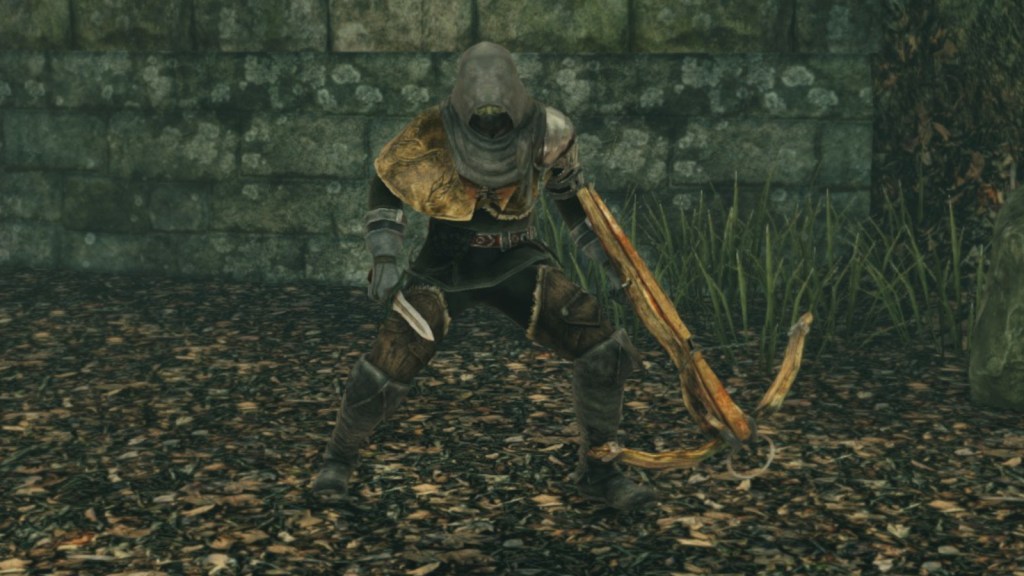


Desperate Heidens resorting to unsavory means in the competition for resources can be seen with another enemy. The “forest grotesques” (森の異形) are aptly named. Although bearing the green skin common to soul-starved, they lack the dark vortex swirling on the back and don’t react to Soul Appease. If they are Hollows, they are in remarkably good shape, muscular arms and legs complemented by no signs of rotting. These naked humanoids no doubt were once civilized people, judging by the sandals they still wear. At the same time, they stand apart from normal humans with their bumpy, reinforced spines. Their bulging, sagging bellies are due to their insatiable diet, most scavenging corpses or wielding human bones tied together into a club. From the wide variety of basic weapons they may carry, the grotesques have devoured all sorts in this forest — and the poison inflicted by their hands or “clubs” shows just how little concern they have for the disease-ridden rotten flesh they handle raw. What produced these habitual maneaters except the same circumstances that gave us the thieves?
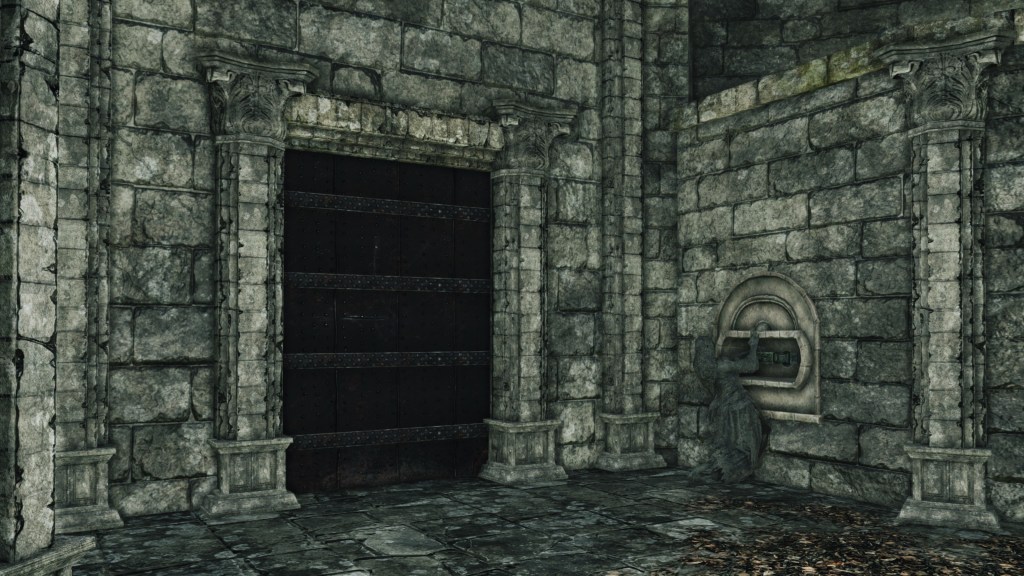
Indeed, we can derive a Heiden connection from the many lingering in the first ruins we come across after leaving Majula. Inside, the monsters remain behind wooden barred doors with locks on the outside, almost like jail cells. To that point, the building is set up like two cell blocks, divided by a metal door. The cells in one block automatically open when we active the mechanism to open this door, which coincides with closing the other entrance to the block. This serves to facilitate the transfer of prisoners between blocks, painting the ruin as a kind of jailhouse. The local bonfire labels this location as Old Akelarre, but that is simply a Basque term for a Witch’s Sabbath, the localization taking creative liberties with the name “Place the Witch Stayed” (魔女がいた場所) in obvious reference to Rosabeth; the “magic woman” was petrified while trying to escape a basilisk in the ruins, her hands still on the lever to the door. The actual ruin is patently a kind of Heiden jailhouse, and it imprisons some of these grotesque cannibals.
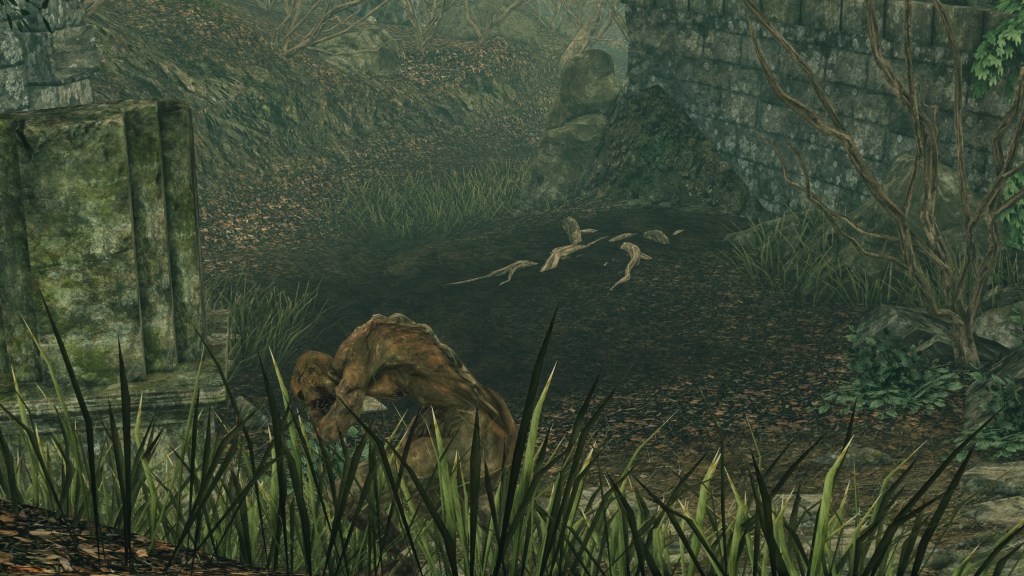


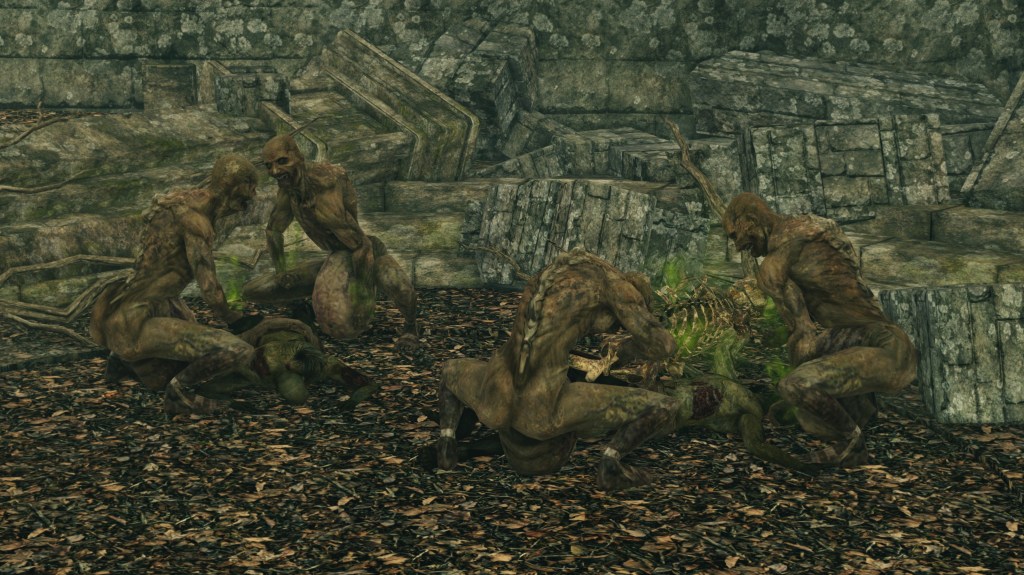


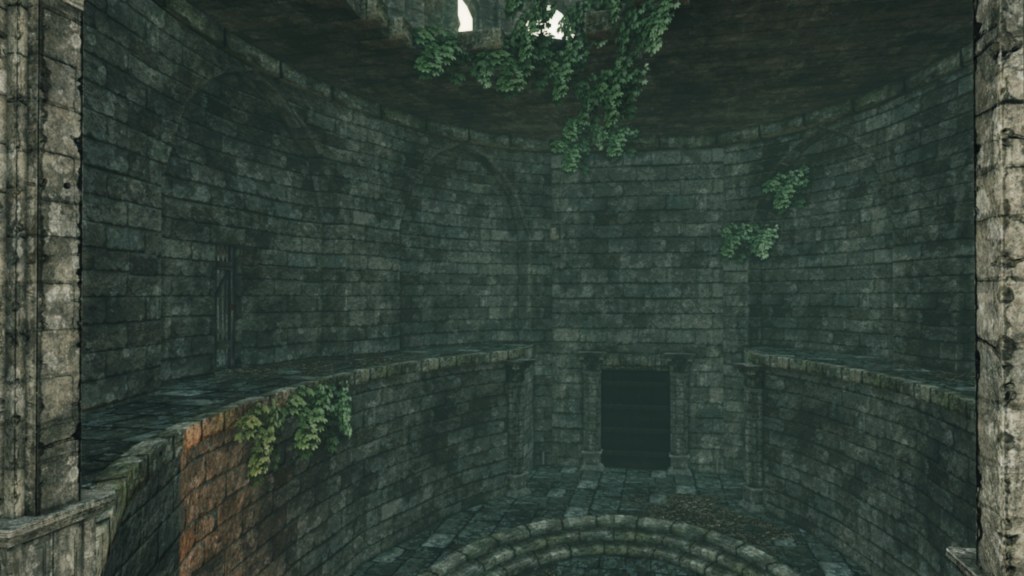
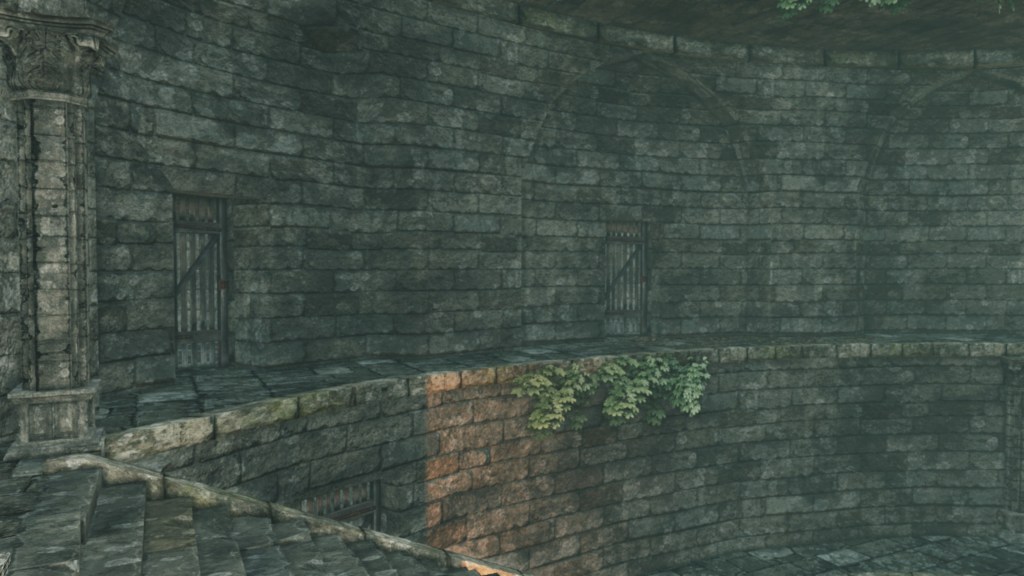
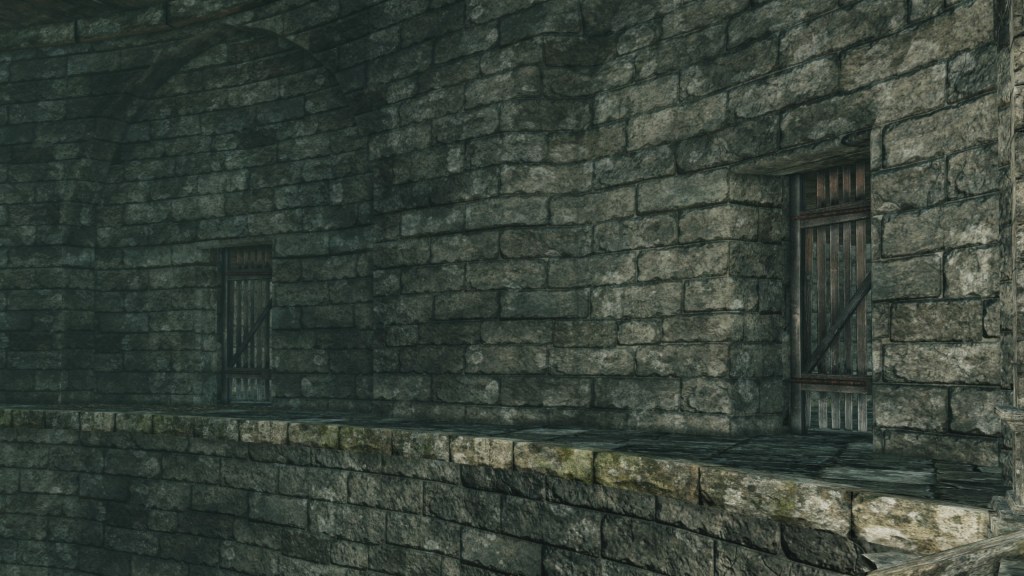
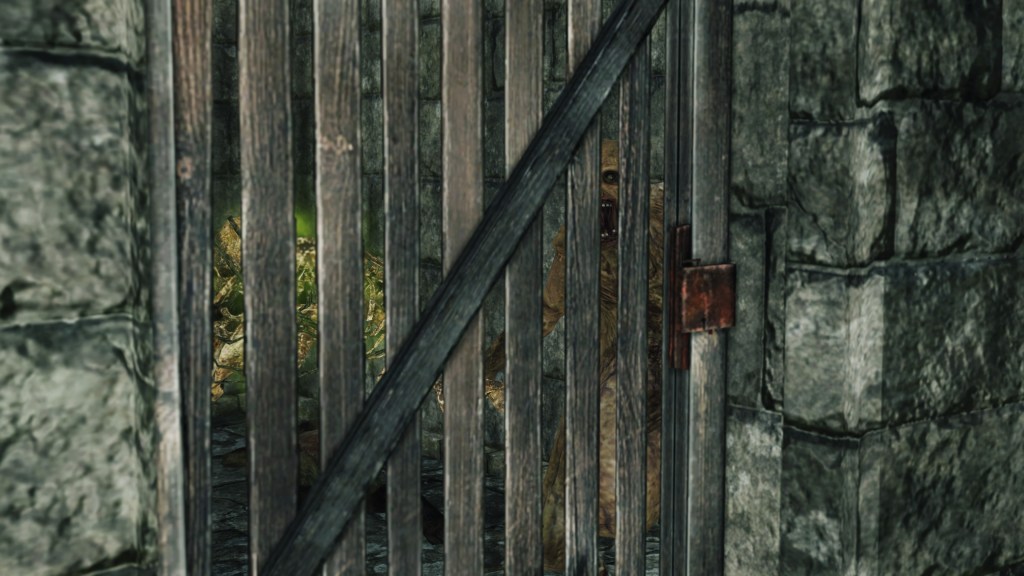




In short, more residents of Heide have survived to the present day after civilization in the woods fell apart. With any remaining food getting stolen, the starving citizens began eating their fellow man. And when that resource inevitably left arm’s reach, the cannibals started to seek out fellow survivors and, eventually, anyone passing through the forest, going native in the process. Their single-minded focus on hunting for prey without tools would explain their subtle transformation, DS1 having already shown how obsession can cause the soul to twist the body. Whether or not the grotesques can even be considered Hollows, scarfing down whatever they can has nonetheless become mindless instinct as the savages enjoy unnatural longevity. Insofar as they still behave human, it is other survivors treating them as such by throwing the “criminals” into jail, often with their meals, before public order had fully disintegrated — as the countless more grotesques still in the forest show, that semblance of civilization didn’t hold together long. Darksign or no, the people have become monsters.
This isn’t the only instance of such incident, as the Shrine of Amana has grotesques of its own. These “Amana grotesques” (アマナの異形) are treated as Hollows by Soul Appease despite appearing far less human. With their long tails, clawed digits, and extended tongues, they look more lizard than man; the tattered clothes are the last sign of their former civility. But while not strictly amphibious, these lizard-men also have a second set of eyes, perfect for maintaining visibility as they lie low in shallow waters. For sure, the grotesques lurch around the flooded ruins on all fours ready to ambush passing prey, those long tongues suited to scooping up small bugs or red leeches infesting the marsh. By all indications, their bizarre forms are the result of Hollows transforming in order to adapt to the marshy environment, their sheer number further suggesting their longstanding residence in the area. Combined, the grotesques must be another result of some Heiden survivors’ desperate hunt for food after the waters destroyed civilization.


Adding to that impression, we can encounter the dark spirit of an unsettling woman roaming the wetland in NG+, wearing tattered clothes and wielding a massive butcher knife — her hostility betraying what she hopes to chop up to eat with something so large. Her inclusion is an obvious reference to the raggedy butcher woman who waded through the swamps of the Valley of Defilement as a black phantom in Demon’s Souls, similar to Maneater Mildred in DS1. Nonetheless, the like-minded spirit’s presence in the Shrine of Amana insinuates that individuals reside there as hermits subsisting on whatever meat they can find. There is no reason for her to live like this unless she is both Undead and part of a civilization which no longer exists. Factor in the ruins, and we can infer that the dark spirit represents stragglers from Heide’s era, having survived but no longer able to return to decent society now that they have acquired a taste for human flesh. Those unwilling to descend to cannibalism instead became grotesque beastmen as they lost their minds to hollowing.
This cataclysmic event is one of the only two things known about the country, so someone lived to pass down knowledge of these events to later generations — it is just that few made it out of this period with their sanity intact. For a civilization spanning so much of the continent, the coinciding complexity to maintain everything became its downfall. And while we see much of its legacy has survived, dead — and Hollow — men tell no tales. Back in the main city, the Heide Knights loiter around the ruins, largely uninterested in our intrusion until the boss in the Tower of Flame has been slain. The two exceptions block our way to the Cathedral of Blue, still standing tall amongst the destruction. Even when all hope is lost, the knights’ faith moves them to act, as does their pride following our victory in the arena. The arrows they have withstood from raiders or former countrymen have yet to bring them down for the count, and their crestfallen spirits may still be rekindled. Even when an entire civilization is lost to time, its people keep the embers alive.
 Lokey Lore