
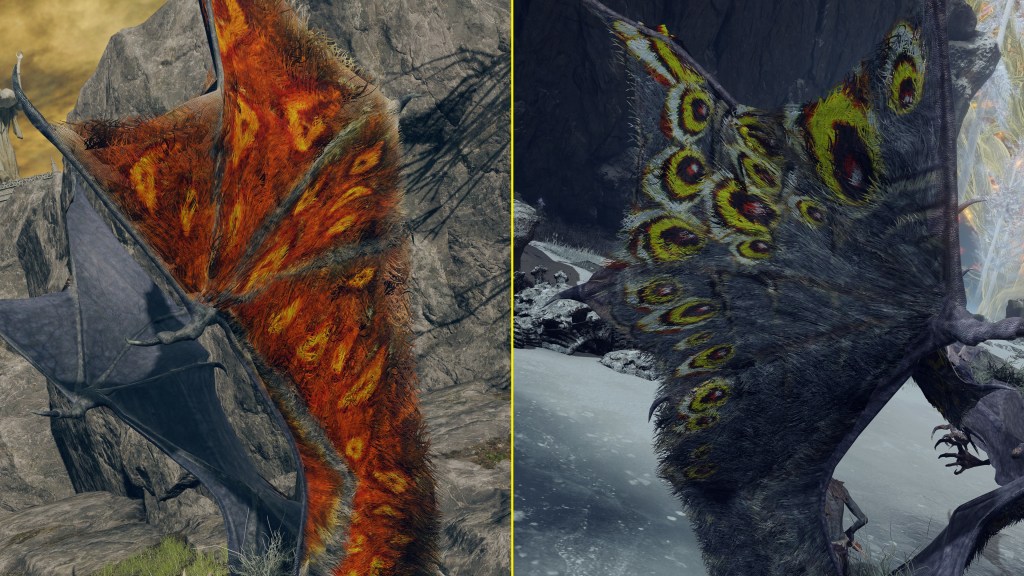
Despite the name, “man bats” (人蝙蝠) look to just be ordinary bats the size of men. The creatures love to hang in the shadows of cliffs, caves, and other rock formations by day and hunting in the field by night. That isn’t to say that none of them can be spotted active under the sun, but it is almost always in the shade of their territory or heavy rainstorms. They possess bloodsucking bites and ear-piercing screeches with functions akin to Beast’s Roar. The only major deviation from the typical bat is that they live more in packs than colonies, their greater size not allowing for the space. Of lesser relevance are the wing hairs with colorful patterns, akin to moths. These evolved differently between populations on the Mountaintops and elsewhere, with only a handful of the traditional species scavenging the Stargazer’s Ruins; probably vermin inadvertently brought over via trade with Liurnia in recent centuries. Overall, there is nothing to indicate that these animals were anything but at one point. However, their immense size and limited intelligence does open the way for genuine man-bats to blend in.

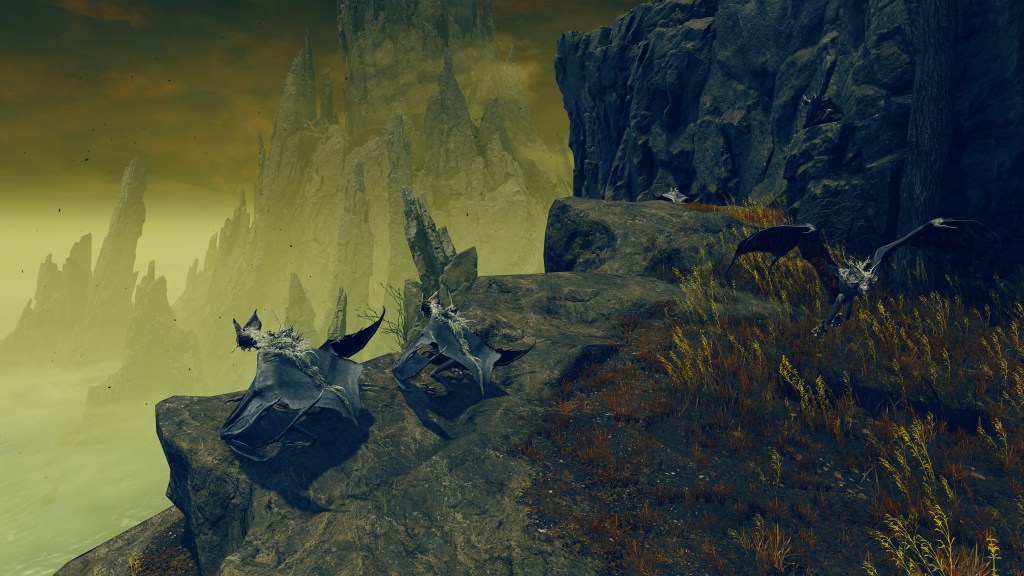
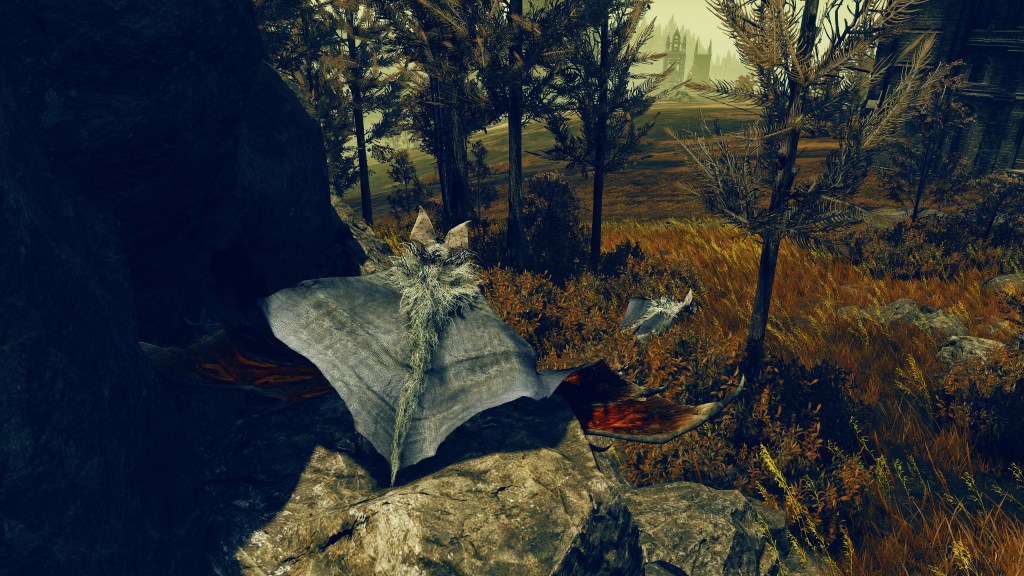

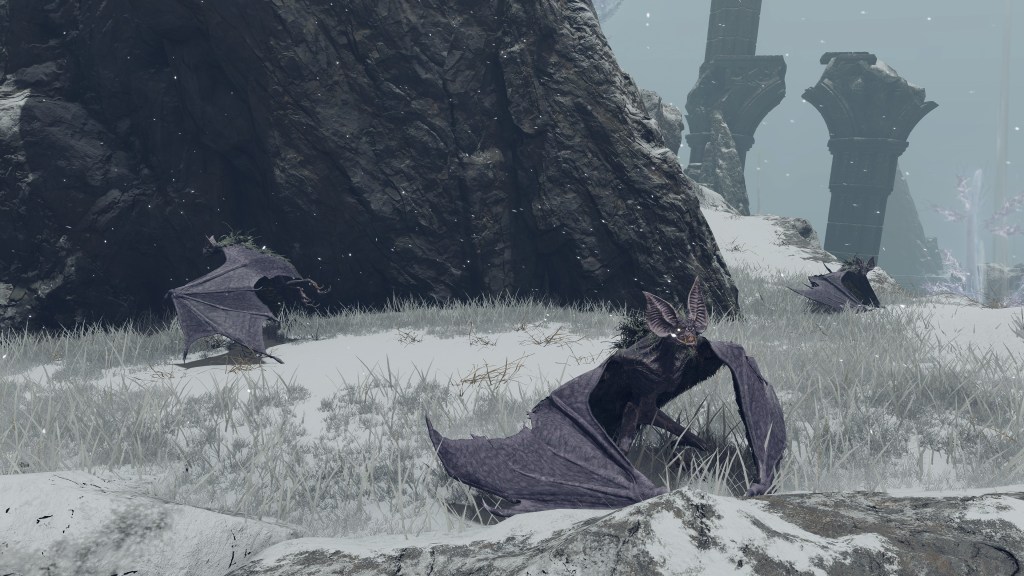


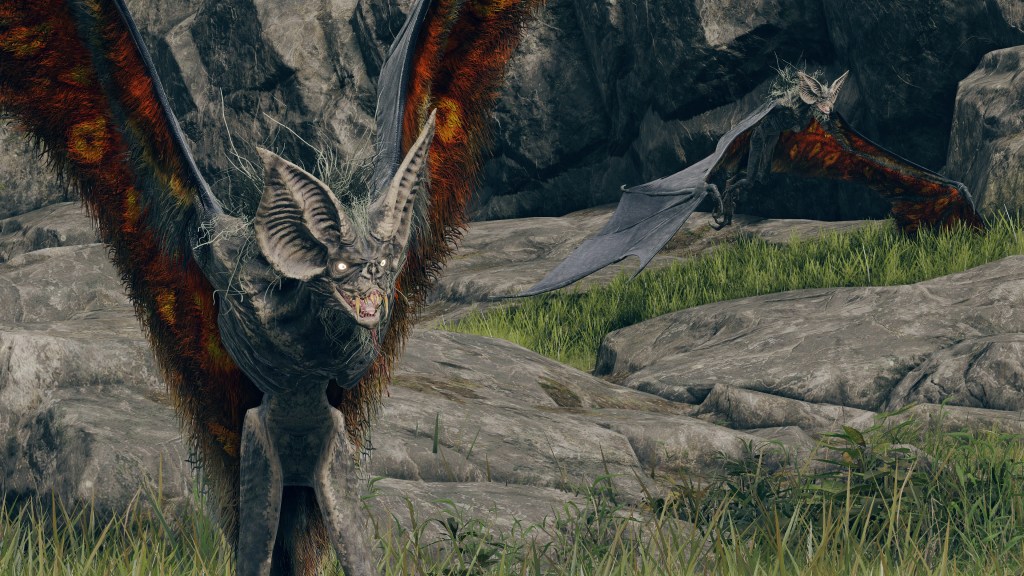




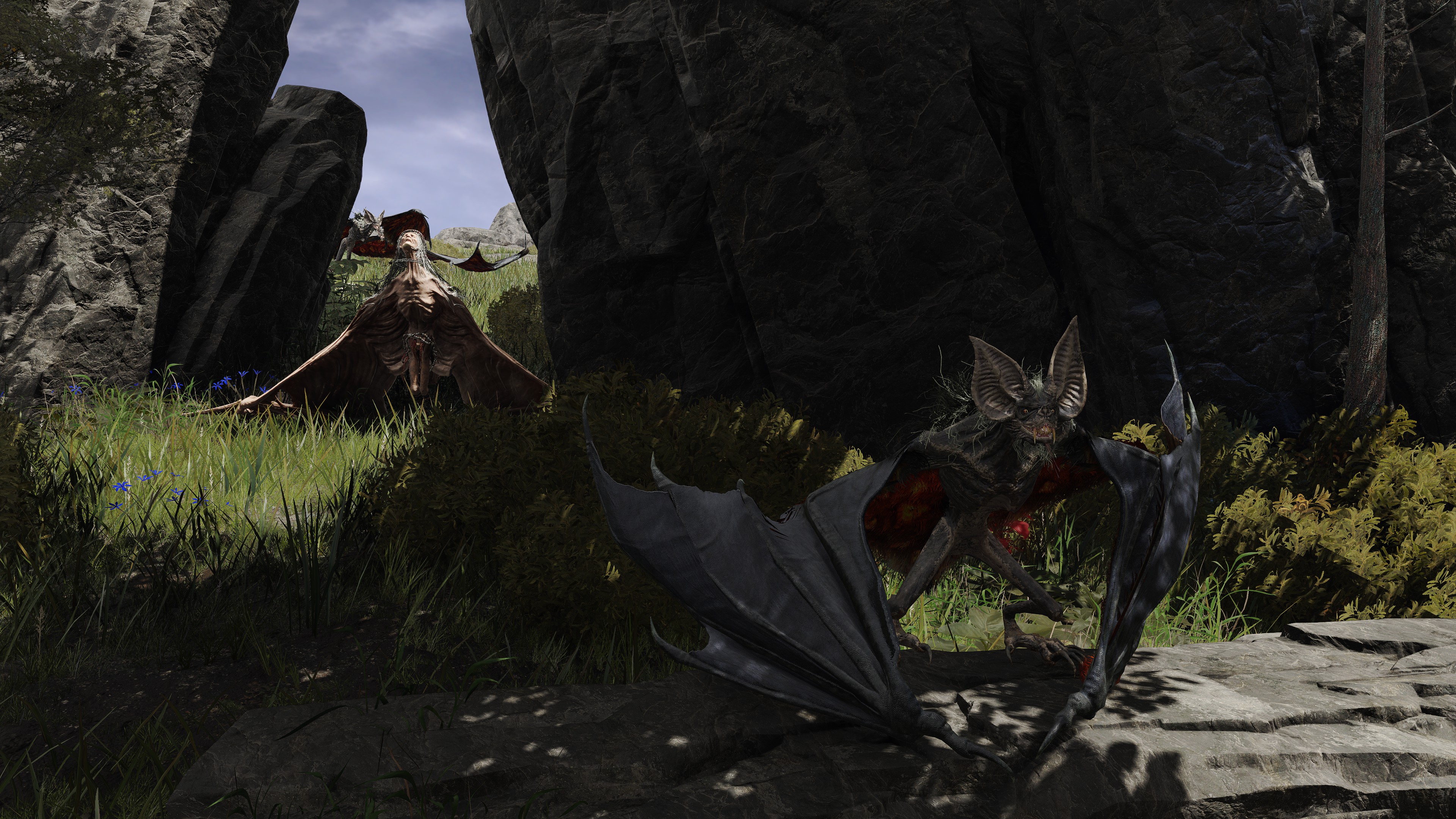
The “old woman bats” (老婆蝙蝠) appear to lead as the elder matriarchs of many a pack, and they weren’t always bats. The signals aren’t difficult to spot. Besides a more human skin tone, they have the face of a grey-haired elder, not a bat, and their place in the social hierarchy is thanks to their matching intelligence. When hostile, they hurl toxic dust or glintstone they think to bring with them, even using their wings to help spread poison clouds. The most prominent elders even know how to perform ancient death hexes with their screeches. They wear jewelry to define status and are capable of speaking Latin. In their song of lament, they define themselves as intended for motherhood — in other words, originally attractive — but now unsightly, with none to console them as they cry out and weep. This final point suggests that they have transformed into bat women rather than just be born human-sized bats. The question then is how they became the creatures they are, and the Crucible is the liable answer.


O, that place, once graced, now tarnished. We, destined for motherhood, now made ugly. We cry out and weep, but no one consoles us. Golden one, who has you enraged?
The crones are almost always singing about “that place”, and ignoring DLC, they appear in every region of the Lands Between except the snowy Mountaintops, singing everywhere but. Since they claim the location was once “graced” but now “tarnished”, this must specifically refer to Altus Plateau, whose blessing of gold has diminished with the Elden Ring shattering and the Erdtree’s rays fading. Reinforcing this, they reference an enraged “golden” one, a clear-cut allusion to the Golden Tree which prompted Wrath of Gold’s discovery after the Ring shattered. They are invested in, even empathetic to, the tree’s plight. The old women also uniquely own the golden runes of Altus citizens, power which they could have only received from a life on the plateau under the tree or from cultivating a life’s worth of power from the tree itself. Taken together, they are most likely the fate of many women who were similarly touched by the Crucible. Unlike the men, they used their wings to flee, integrating with bat populations in every corner of the lowlands where they assumed Marika wouldn’t find them.
Of course, never could citizens of the Sun Capital practicing ancestral Rancorcalls on the plateau in the days before Godfrey ever have imagined that Marika’s kingdom would one day sweep the continent. But by the time her soldiers were conquering these regions, the Eternal Queen had no interest in capturing and enslaving the hags like they had the misbegotten. The truth is, the god probably didn’t even remember the women existed, assuming that she ever knew at all. Bats were pests, like rodents; they lurked in the shadows and came out at night — were they really worth a god’s attention? No, and that was the old women bats’ saving grace. The huge number concentrated in Caelid may reflect that original sentiment to migrate as far away as possible. But now, this is just their habitat. Even if they were systematically hunted down by the Golden Order, they aren’t about to flee, especially when they have nowhere else to go. They might not return to the land graced by gold, but they will at least remember it fondly, when they, for a brief moment, bathed in the overwhelming power of life.



 Lokey Lore