
Preface
Although Bloodborne‘s narrative was largely coherent before the introduction of The Old Hunters DLC, some major questions did remain. Who was Kos? Where did Laurence acquire his Third Umbilical Cord? How did Gehrman’s mysterious apprentice die? These were holes in the narrative which were thankfully filled with our new journey through the Hunter’s Nightmare. The fresh ancillary tale itself adds a beautiful bow to this hauntingly beautiful gift, the perfect combination of both gothic and cosmic horror defining the game’s unique identity. After all, the surreal sights of dream equally awe and befuddle the mind, and who doesn’t love a good ghost story?
Guilty Be Damned?
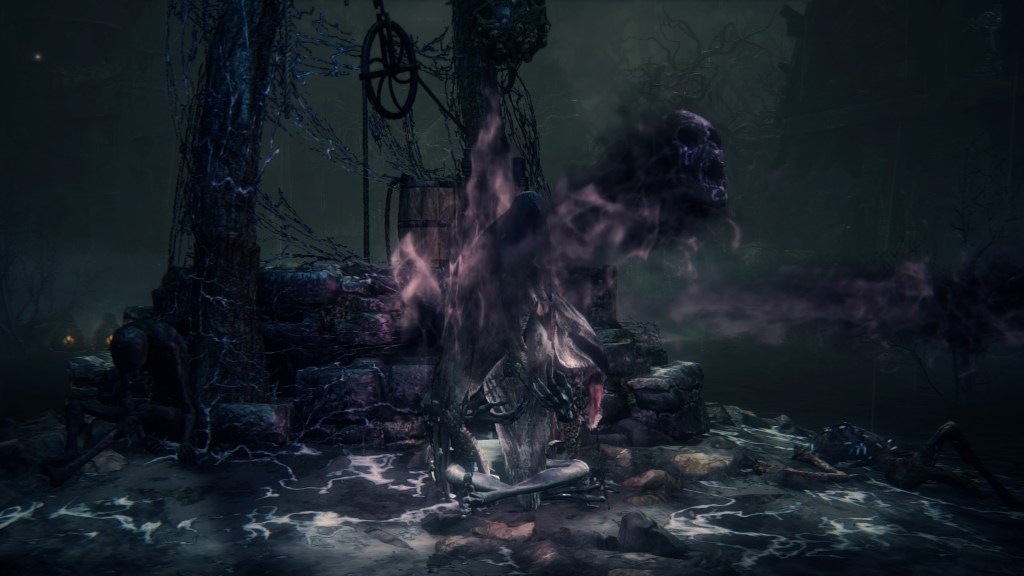
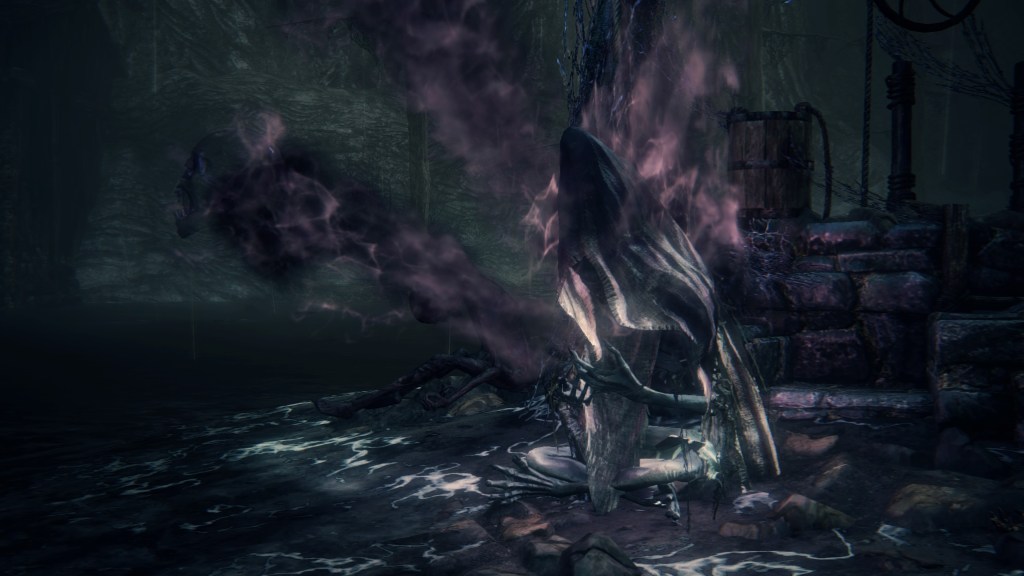
When the hunters finally left the Fishing Hamlet, they left behind the dead. Butchered like animals and denied even a proper burial, it should come as no surprise that their blood in death still boiled. The skull the village priest hands over is called the Accursed Brew, or “malediction pool”, (呪詛溜まり) because it has, as its description admits, accumulated curses within itself. We can take advantage of this to hurl some of those maledictions at others using quicksilver, but such arcane power no doubt stems from the owner of this skull — the grudge against those who reduced the villager to a severed head. That person isn’t alone, as we can see other priests summoning vengeful ghosts of the same hue as the maledictions stewing in Accursed Brew. They all share in their resentment toward the outsiders who inflicted such devastation upon their humble village. And would the same not hold true for Kos? She was perhaps violated most of all, her child ripped from her deceased womb on that beach. And would the curse of a Great One not, logically, be on a greater scale than the malediction of the average man?
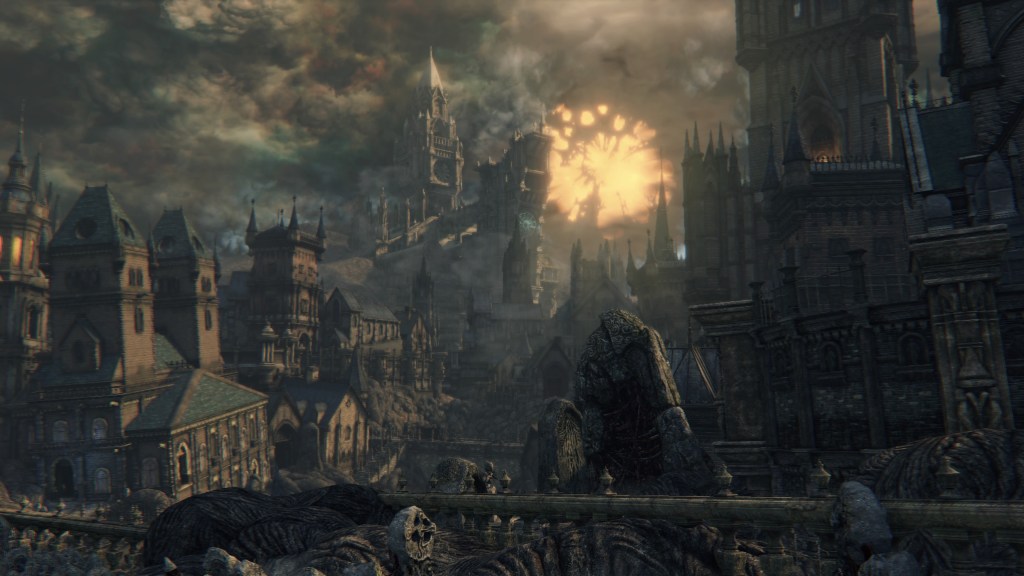
A nightmare was created as a direct byproduct of the hunters’ misdeeds upon the Fishing Hamlet, according to Simon. This Hunter’s Nightmare traps them in a surreal mash-up of Yharnam’s various parts, at times duplicating or otherwise warping these spaces. Naturally, the old hunters from Gehrman’s heyday are frequent in this dream, reenacting events from long ago. We see beast patients throughout Cathedral Ward hide or flee in terror as the hunters give chase. Sometimes they have aid of their faithful dogs, other times they use more creative means. One particularly mischievous pair rolls a blazing ball of kindling down the Grand Cathedral steps to kill a passing pack. Another sets up a web of trap gun emplacements on the Great Bridge. Yet more lie in ambush around street corners or inside the buildings; in one especially nasty example, the blood minister of the bridge’s clinic sits dead, wheelchair set to explode with a room full of oil urns upon attempting to loot the adjacent hunter’s corpse — carrying the Boom Hammer, of course. Anything they did or might have done in the past is repeated.
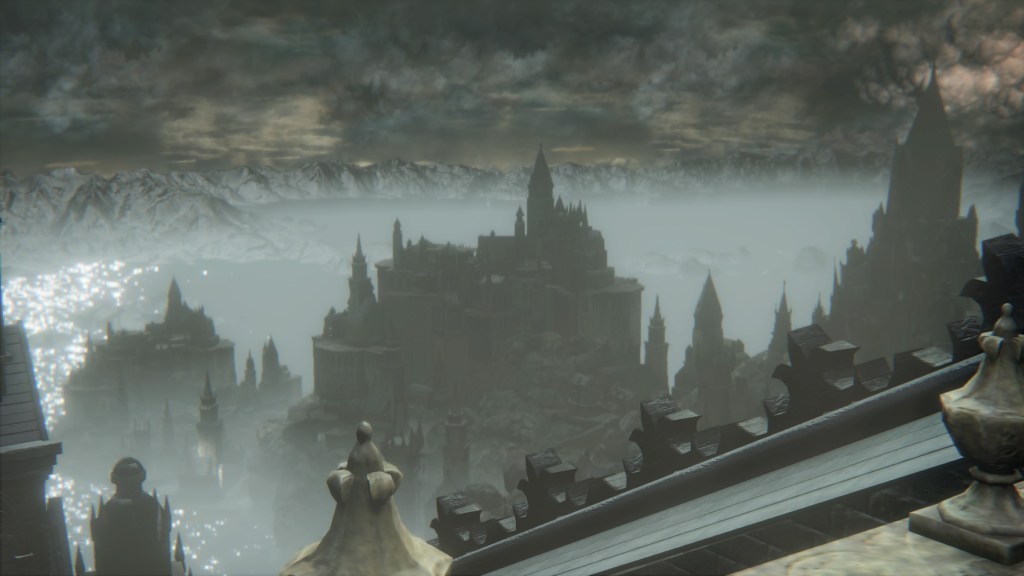
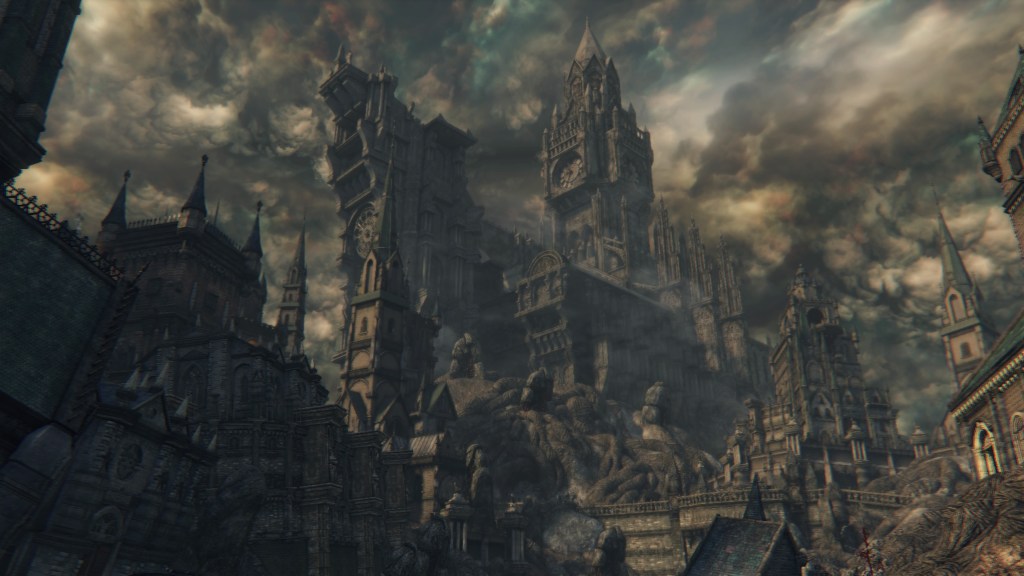
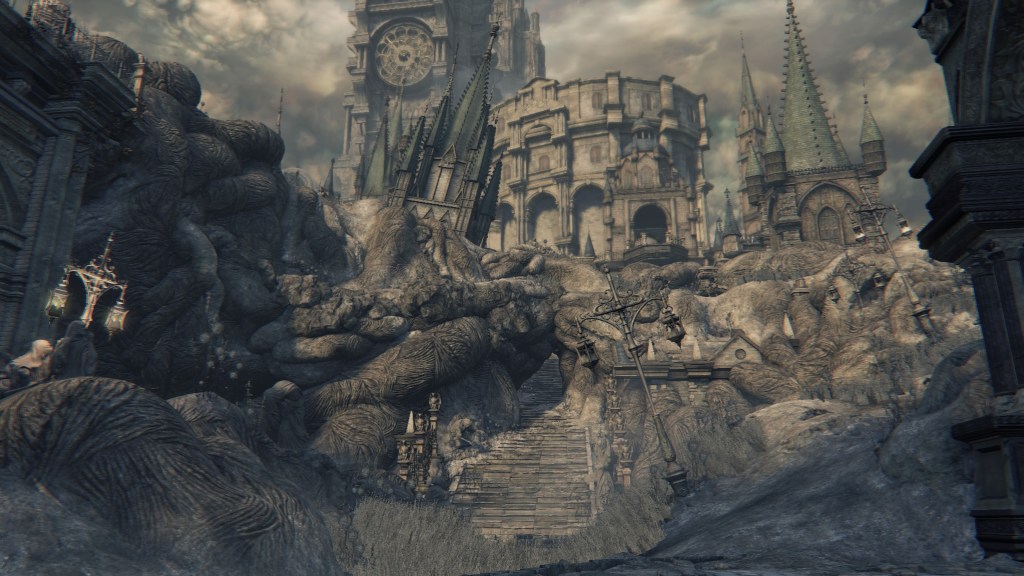
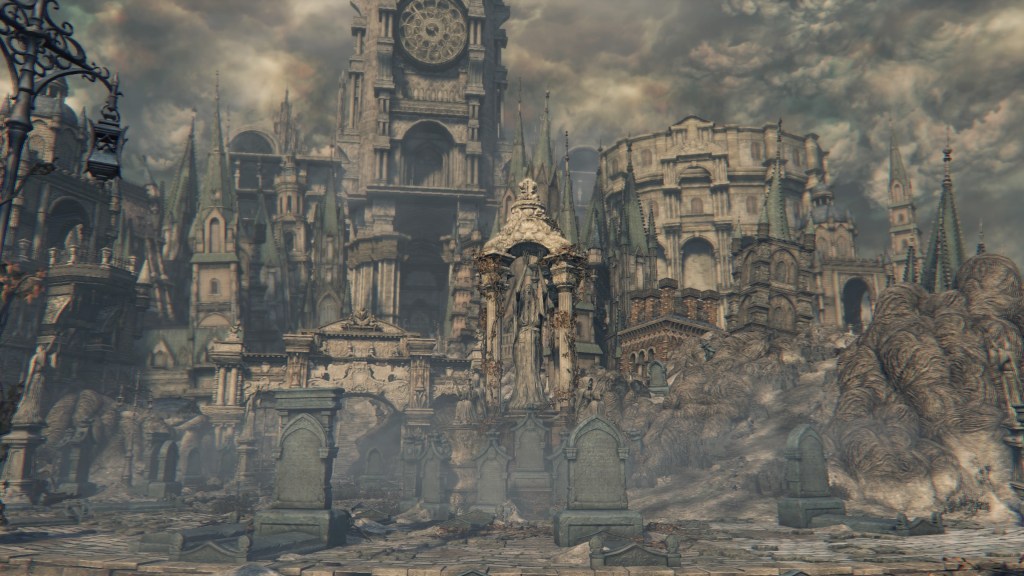
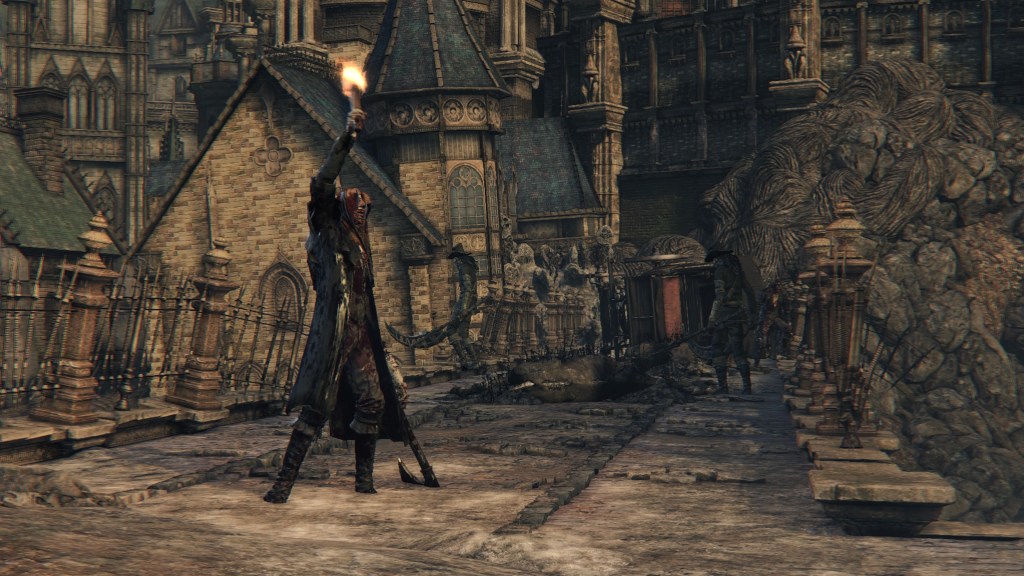
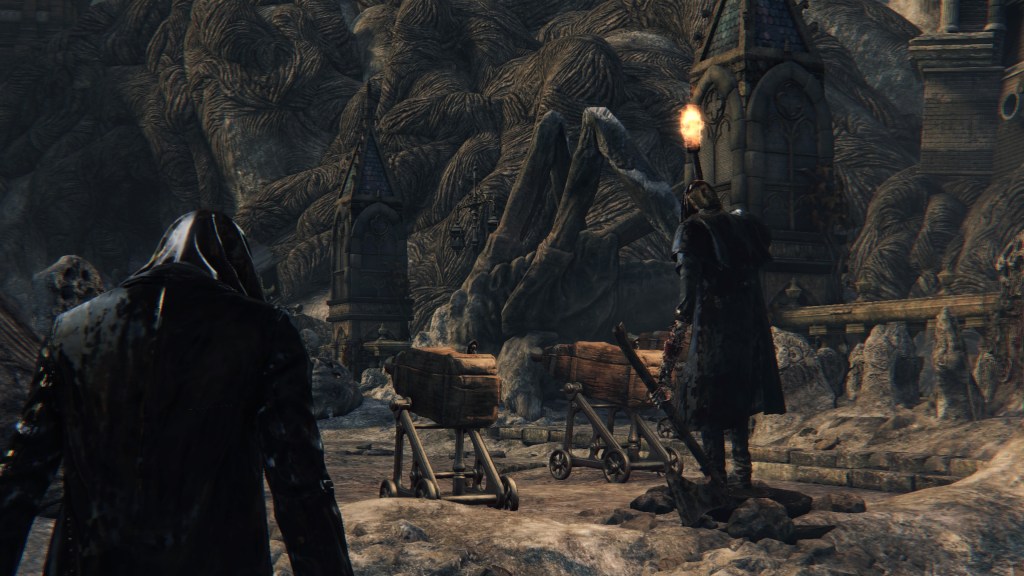
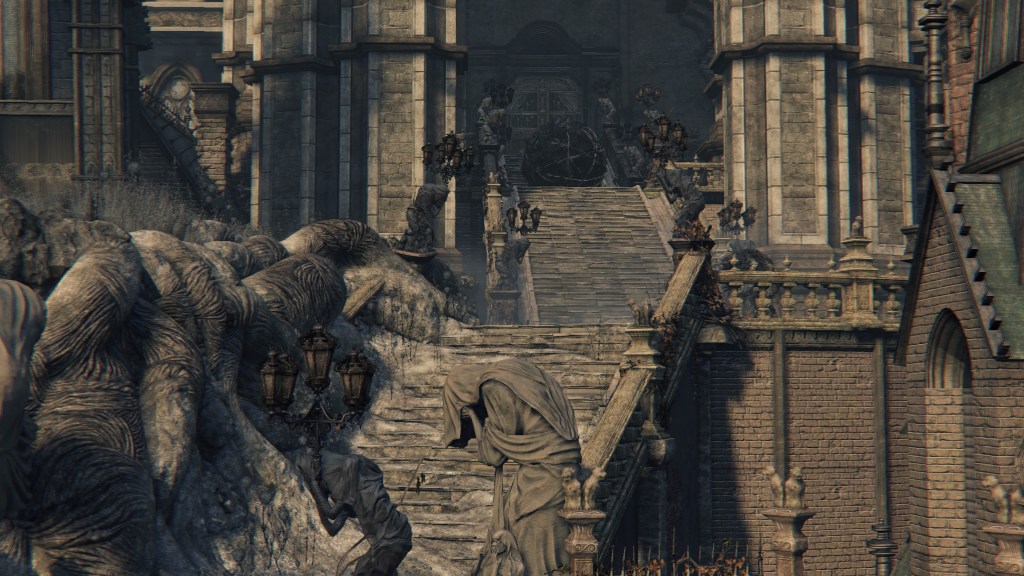
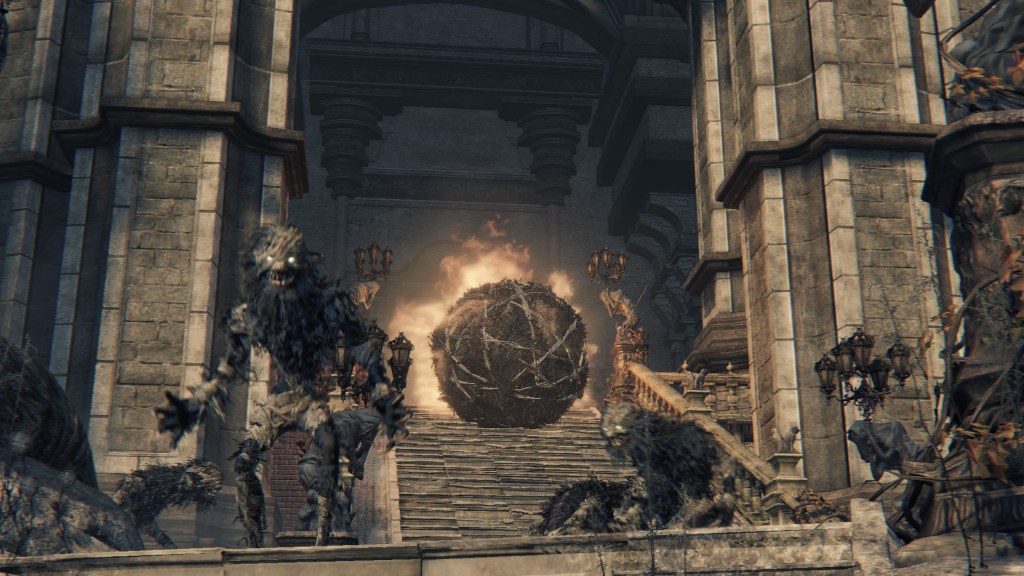
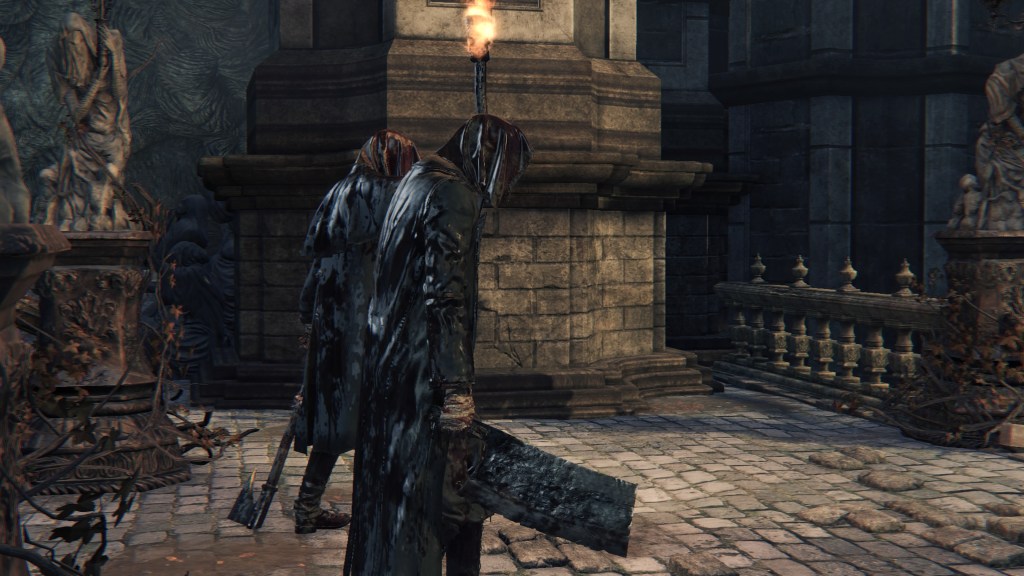
Do you know? Why hunters are captured in this Nightmare? This Nightmare has sprouted from the hunters’ deeds…
Clearly, the Nightmare has allowed the old guard to relive their glory days. But in simulating those snippets in time, setting and all, the actors will inevitably meet the same fate as before. Already, the old hunters we meet are half-crazed calling for more blood, attacking us because we have the scent of death and are mistaken for beasts. Slowly but surely, each is succumbing to blood drunkenness. In fact, that state is the norm. The reason we can visit the Nightmare is because we possess the Eye of a Blood-Drunk Hunter when grabbed by the Amygdala at Oedon Chapel, who subsequently warps us there instead of just crushing us. Evidently, the Great One mistook the blood-drunkenness it sensed upon our person as a sign that we belong to that plane. Put simply, almost every hunter we meet has become drunk on blood to some extent. In that case, it is only so long before those hunters begin turning on one another. They hunt beasts until they become beasts to be hunted.
Eye of a blood-drunk hunter. The pupil has broken down and dissolved, and it is also a feature of the beast disease.
It is said that hunters drunk on blood are captured in the Nightmare. They eternally wander within the Nightmare and continually hunt beasts. Simply because they were hunters.
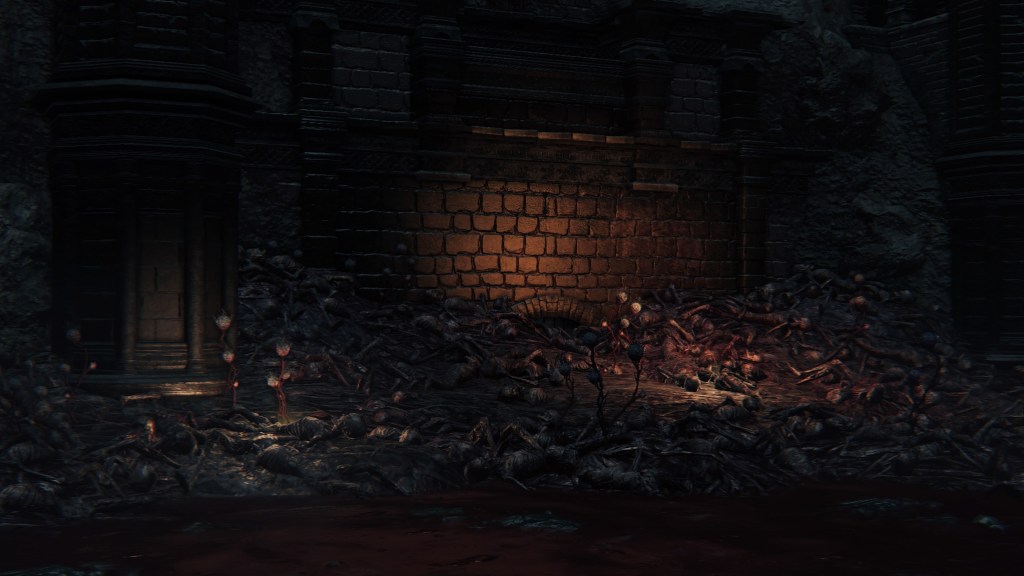
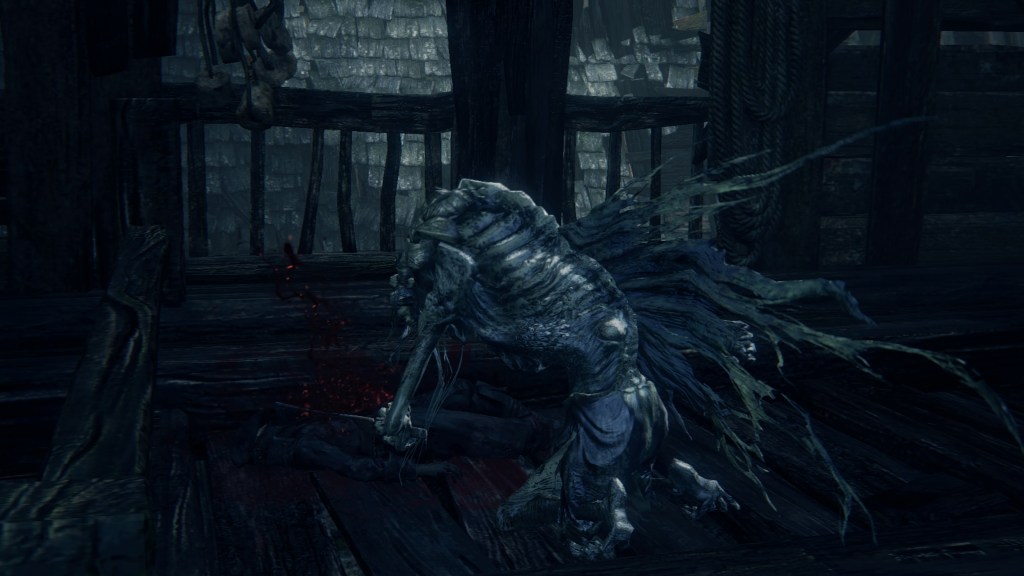
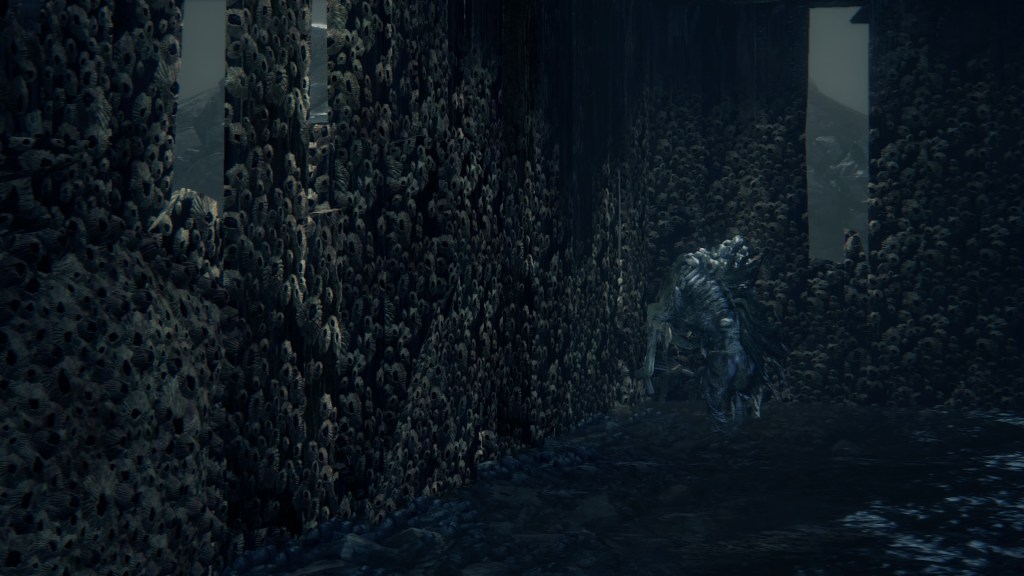
By the time we arrive, countless have already fallen to their prey or fellow hunters, the bleeding bodies forming a river between the Nightmare’s two Grand Cathedrals. This river of blood acts as their graveyard, the entire stream of corpses lined with tombstones otherwise only seen in the Nightmare Frontier. Despite the bodies piling all along the river, the blood still flows in more or less the same direction. The river ends in a dark cave, where many corpses carry bloodstone chunks demonstrative of the sheer volumes pooling there; a cleric-turned-blood-starved beast also lurks at the very back, no doubt lapping it all up. Heading upriver, we come across swarms of blood-lickers, numerous drunk hunters obviously devolving into these beasts as they obsessively fatten themselves on ever more. And as we continue following the river flow, we begin seeing pillars of stone faces arise as if bubbling from the blood, most likely a manifestation of the resentful wills inherent; those sentiments would naturally be fresher closer to the source.
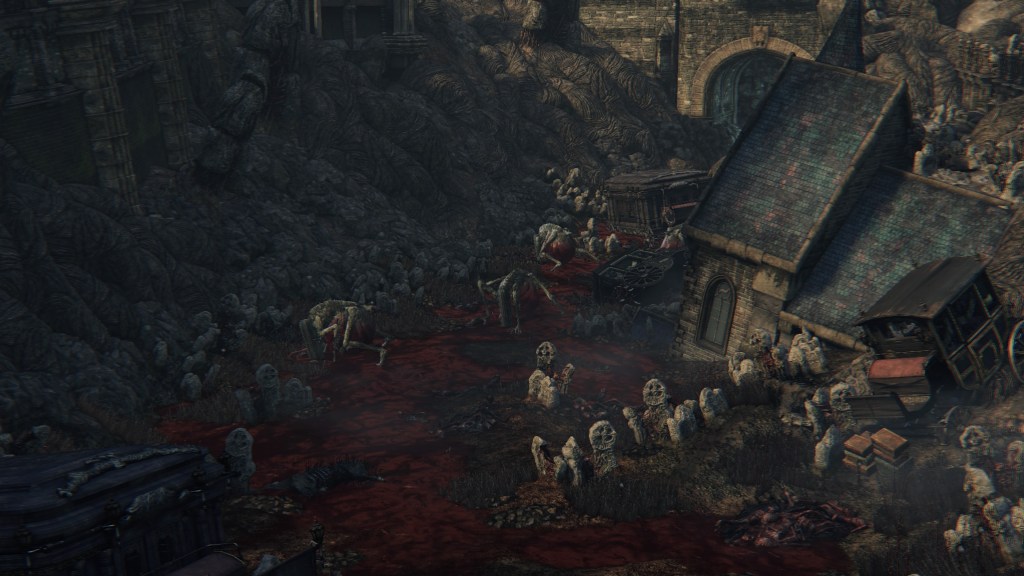
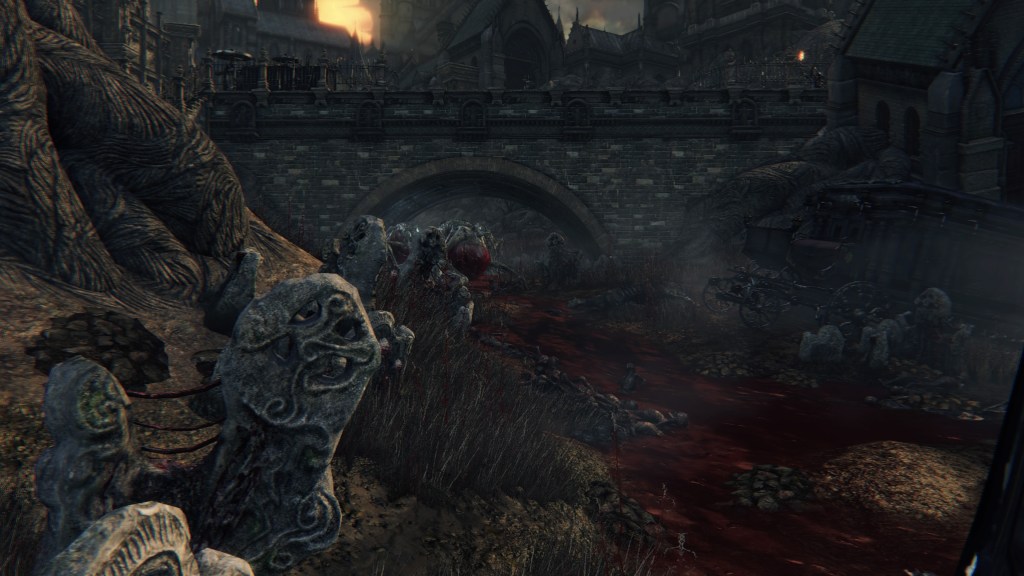
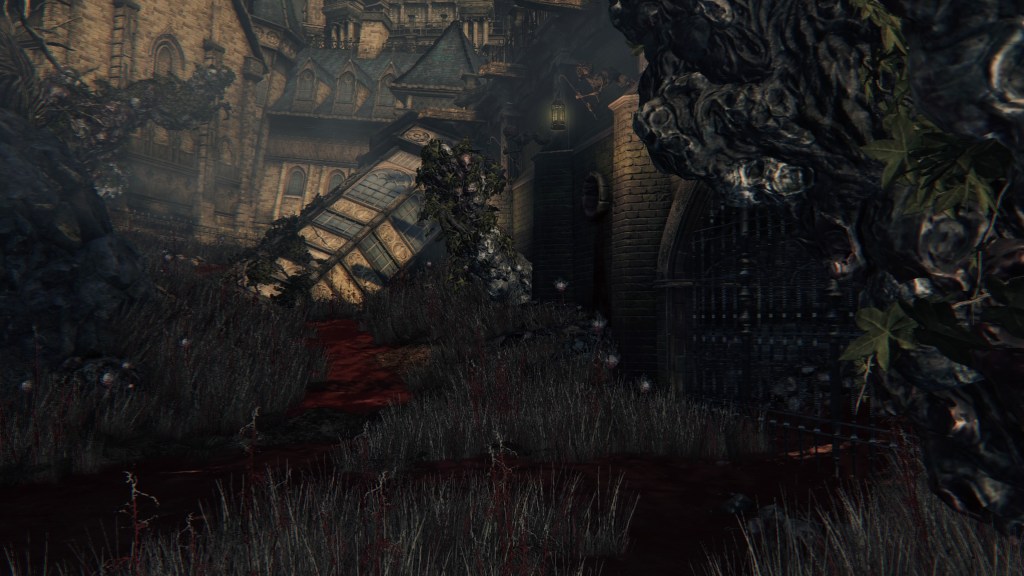
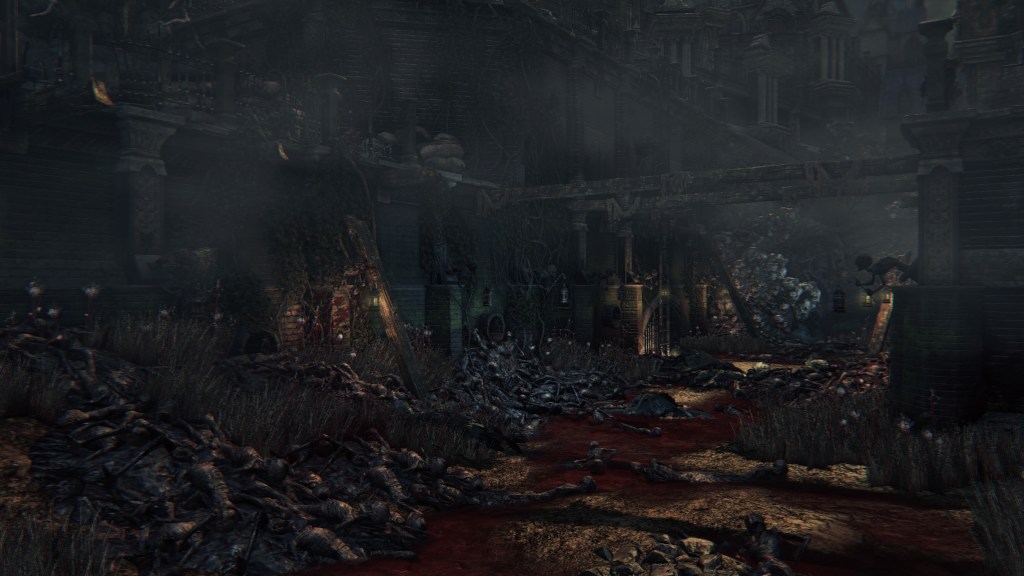
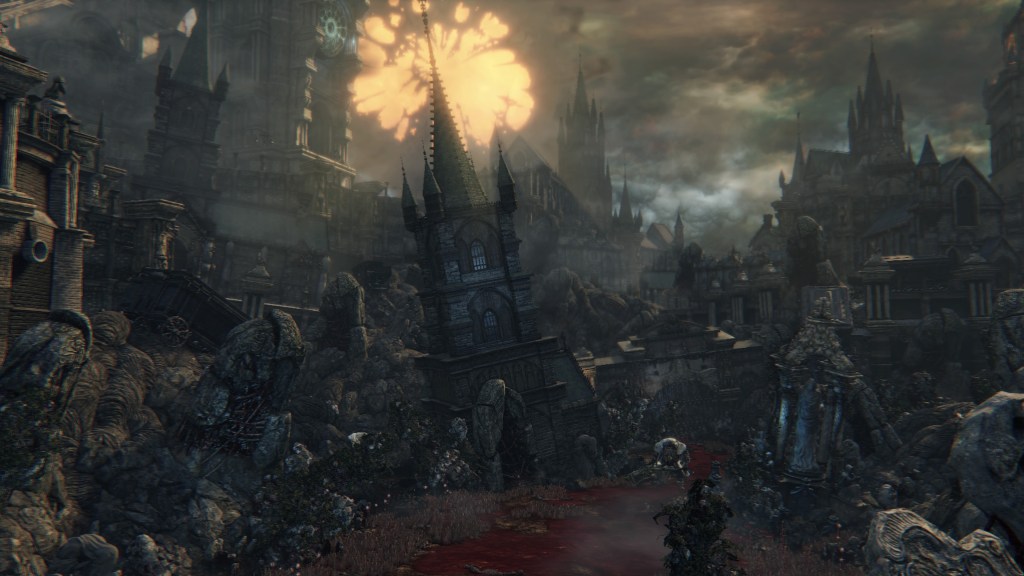

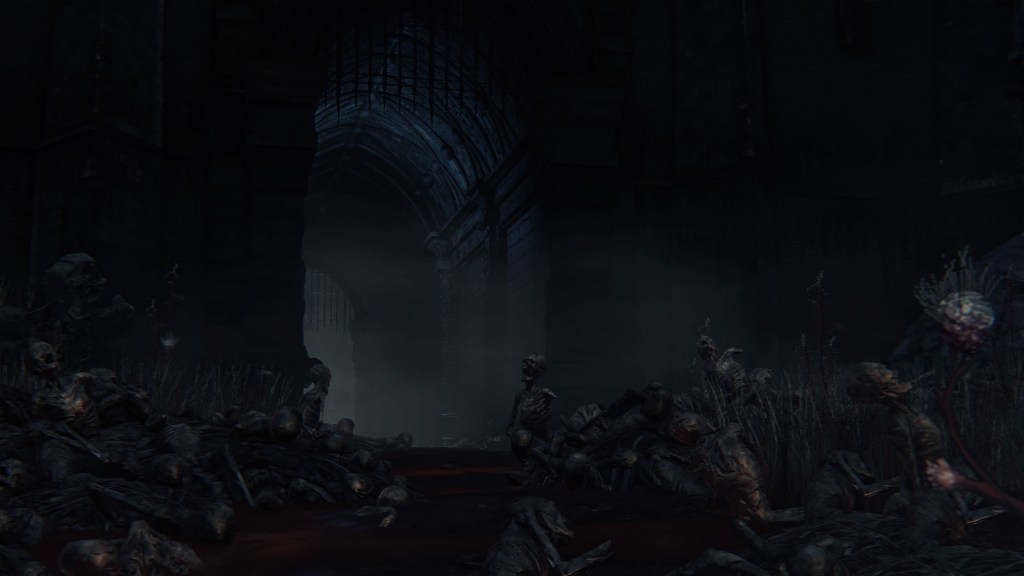
With such a hellish fate awaiting hunters engaging in this nightmare, why play a part? Certainly not by choice. The old hunters — at least the enemies not based on the Yharnam mobber model — have a peculiar black fog trail their dodges and swings. We see this same substance manifest as the core to the Nightmare, meaning that the hunters are in all likelihood acting under that same influence. This makes sense given that a hunter need not necessarily die to be caught by the Hunter’s Nightmare, blood-drunk or no. Such persons may be whisked away by an Amygdala at a moment’s notice, and the description to Old Hunter Garb affirms that they by and large did disappear while on the job. Simon likewise warns us against staying for fear that we will become blood-drunk and end up captured ourselves. Clearly, blood mania is key for the living being bound the Nightmare, and if the dead weren’t already drunks at the time they expired, the Nightmare ensures that they will become so. The result is all unquestioningly wandering around on an endless hunt for beasts, even in each other.
Apparel of the old hunters.
But they disappeared after some point, and it is said that the Yharnam citizens whispered to each other.
“It is the hunters’ sin. Drunk on blood, pursuing beasts, and so they all left for a Nightmare.”
This is the Hunter’s Nightmare. A place where blood-drunk hunters are ultimately captured. So, you, take my advice and leave before you get captured… Or maybe, you are interested in the Nightmare?
This compelled blood-drunkenness is important considering the Nightmare’s loose definition of a “hunter” itself. One example is the Madaras twins’ pet snake. Despite its death, the giant serpent will still answer the call of their whistle, briefly manifesting “from within the Nightmare” according to its description. Unless the creature preyed upon some stray beasts in the boys’ youth, then its only violence against beasts is the cut-up carcasses it was fed and which ultimately drove it mad. We also come across an eye collector of Yahar’gul in the Nightmare, capable of extracting eyes from the dead or inattentive but hardly equipped to put down a live beast. Littering the river of blood are similarly bodies with pieces of the constable set, implying them to be the police officers mentioned in its descriptions — foreigners who died to the beast they were pursuing to Yharnam. We even find the body of an Amygdala, at most guilty of crushing a passing beast it randomly picked up. Each and every one is a fringe case for a beast hunter. Yet all of them are legitimate for the Nightmare, thus set on the path to blood drunkenness.
Painting hunters with such a broad brush reaffirms the dream to be the product of Kos’ grudge. As a Great One, Kos is in the best position to carve out that plane in the cosmos; just as Flora captures live hunters in her Dream, Kos captures dead hunters in her Nightmare. Her resentment in death would likewise result in backlash with collateral damage. After all, this god of the seas knew nothing of her hunters. Now that she has joined the sea of conscious above, the will of her blood can only act on the feeling, her fervent desire for vengeance against her killers. Like with ghosts, that singular loathing manifests nothing in ways of higher sentience, simply intuitively following certain parameters in pursuit of a larger goal. In this case, the dead god has acted on impulse to create a world from the sea of data around her, grabbing the final soul record of any and all deceased “hunters” similarly adrift in the cosmos and somehow relatable to her butchers from Yharnam. It is the curse of a simple will. That will comes from a great intellect far beyond the scope of mere humans, but it is a simple will nonetheless.
In short, we are not dealing with Kos, but the ghost of Kos, whose name is actually “Ghos”, (ゴース) fittingly enough. The Nightmare’s creator is the grudge which has consumed the spirit, reminiscent of yuurei (幽霊) — Japanese spirits that remain bound to the earthly world due to grudges of their own. This is why we never see Kos take an active role stopping those who would interfere with the Hunter’s Nightmare. The god is dead, and what we witness is the construct left by her spiteful will. Just as its cultural inspiration commonly seek blind and overbroad vengeance against the living for a perceived wrongful, and often violent, death, the ghost of Kos doesn’t think of anything except unleashing her wrath upon others. Casting the net so wide on “hunters” also serves the Nightmare’s secondary purpose: doom any sort of “lineage” among the hunters responsible. Dialogue from residents of the hamlet affirm that the curse will affect not just the hunters, but also any child born of their line thereafter. They destroyed her and her legacy, so they and theirs shall suffer for eternity.
So a curse upon them. And their babies’ babies, and all their babies thereafter. There’s no bottom to a curse and the sea, thus all arrive.
… Retribution upon them… May it eternally curse the blood of their babies’ babies and all their babies thereafter… May they be born ill-fated and live an unwanted gloom…
So far, this has mostly meant that the hunters enter a karmic cycle of hunting and being hunted, drunk on blood. However, we see that the Nightmare can be tailored to the captive’s own personal hell. For example, Laurence takes the form of a generic cleric beast, representing his place as the first to define the concept. However, this beast burns unendingly, reflecting the man’s obsession to “purify” the disease of its unwanted bestial element with painful results. Never will Laurence know peace, his flesh constantly yet not ever truly consumed by fire, his insides turned molten. His body has become so fragile, that his bottom half simply collapses upon the weight of the top midway through the boss battle. The only thing keeping this dysfunctional corpus alive is Kos, but even that is not enough to satiate her grudge.
When we first encounter Laurence in the Nightmare, he is laying upon a sheet covering the first Grand Cathedral’s altar. His pose is reminiscent of Michelangelo’s Pietà, ironically painting him as the holy man who died for mankind’s salvation — the statue of the holy woman pouring her vessel right above his gaping maw reminds us of the sinful means behind it. Indeed, the image is flipped so Laurence’s body faces leftward, evoking evil perversity much like his oversized left arm. Moreover, the pose is equally reminiscent of the Cast From Nature, a Victorian era plaster sculpture of a body partially dissected for medical research inspired by Pietà. True enough, Laurence’s dissected beast skull does sit in the waking world where his bestial form lays in the Hunter’s Nightmare. Now Laurence is subject to the macabre public display of his so-called treatment studies with sacred veneer. Kos has made a mockery of the man who thought himself above it all in every sense while revealing him for the monster he was.
True enough, the beast holds in that left hand the eye pendant, representative of Laurence’s quest for eyes inside the brain. But Laurence’s brain is absent, his body comatose. He only stirs once we have taken the pendant and used it to raise the altar in the second Grand Cathedral, bringing back his human skull found there. As its description assumes, the beast awakes and desperately reaches out to claim the bone in our possession, his other hand grasping his head. He instinctively senses some link between the human head and his own and seeks it by whatever means, prompting the boss battle. Just as Laurence the beast lays where his beast skull sits in the waking world, his human skull lays upon the same altar where his human statue previously stood. Combined with the skull’s description, and we can be certain that this is a manifestation of Laurence incredible intellect which he so treasured for research into his ultimate transcendence and was robbed of in turning into a beast then subsequently losing his head. In other words, the man has been denied his mind, thus rendered incapacitated.


One can almost feel Kos’ taunting as Laurence is given the key to retrieve his head while placing it in a whole other Cathedral his mindless body can never reach. This isn’t even necessary since the description acknowledges how no amount of proximity to his skull will ever let him retrieve his recollection. More than his physical torture, he is mentally tortured by the innate sense that he is incomplete, missing that one thing he can never regain. Worse, this is Laurence’s soul at the end of his life, giving particular weight to the memories he is desperate to have back. As the skull text notes, it embodies the oath he failed to keep, that promise to Flora and Gehrman that could not possibly be fulfilled when his beast head was served and taken back to the Grand Cathedral. It is that promise which consumed Laurence’s will even as a headless beast, and so once again he chases after memory of it in the Nightmare. Kos has set up the first Vicar to eternally pursue his greatest regret in life even in death. And all because of the quest for insight he previously pursued in the Research Hall on account of her murder. She therefore lets him hand over the keys to the crime justifying the punishment.
With such a personal touch to the revenge, it comes as no surprise that the ghost won’t let the victims go so easily. For all the bloody bodies piling up, we find that a good number have returned to life, beginning to flail at our approach. One in particular begs for mercy as he dreads Ludwig implicitly coming to kill him again. No matter how much these blood-drunk fools hunt each other as men or beast, their prey will never be free of the Nightmare. Their respite is the suffering of enduring a gory death before they inevitably rise up to be murdered horribly again, a never-ending nightmare. But, similar to Flora’s dream, there does appear to be a loophole. Bosses like Ludwig seem to remain dead after defeat, so death by an outside force might sever the curse’s connection. Maria likewise claims that Ludwig and others we slay are saved in cut dialogue. But if so, their peace may only be temporary. The underlying curse still exists, so there may simply be a lag between us freeing the soul and the ghost rebinding it. To permanently end the curse, it must be uprooted from the seedbed.


You, hunter wandering the Nightmare. You have seen them, yes? The beast of the hero and the Church’s pitiful patients… and you have killed them… Oh, I don’t blame you. They were captured in the Nightmare, and that was probably their one salvation. So, what about you? Have you gotten anything out of it?
Innocent Be Saved?
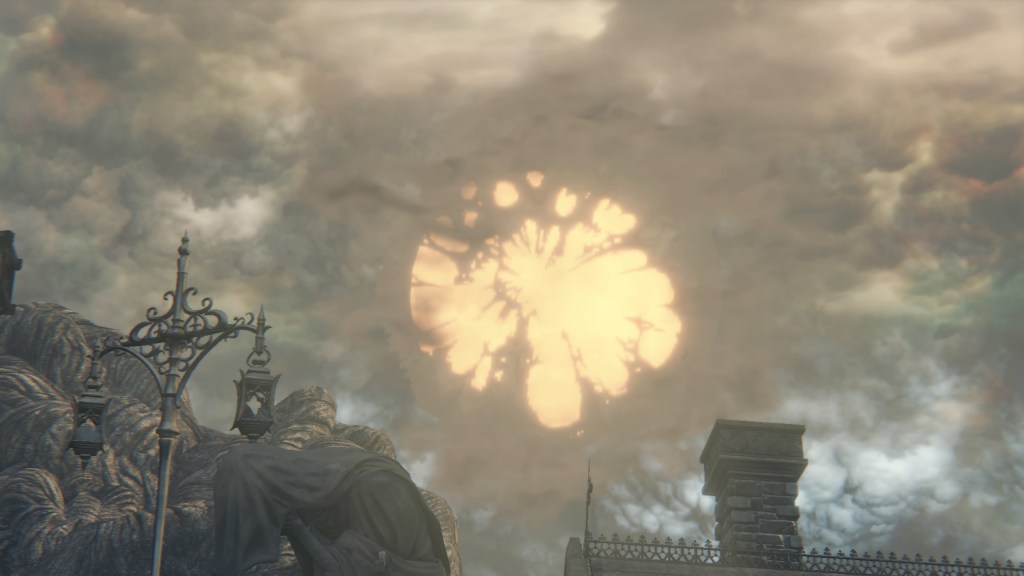
The Fishing Hamlet we visit is, of course, a part of the Hunter’s Nightmare. We can only enter through the face of the Astral Clocktower in the second Grand Cathedral. This is because that specific tower sits at the highest elevation, whereas the hamlet is situated in the sky above the hunters — from the hamlet, the cityscape is visible deep beneath the sea, the clocktower alone piercing the surface. Simply put, they are two planes layered atop one another, hence we can witness a snail woman drop down from above as we explore the nightmare city. Their only commonality is the bizarre sun lingering in both skies. Perhaps the Nightmare dragged in the actual location, or perhaps it simply took its soul data to create a simulation. Whatever the specifics, the two planes are linked because the village is, as Simon describes, the seedbed from which the Nightmare has sprouted. And because it is the heart of Kos’ grudge, the area is a snapshot of the village as it was left in the wake of the massacre.
… You, please…… This village is definitely the secret. A mark of sins…… And so the Hunter’s Nightmare made it the seedbed…
You will hear it. The sealess is the dwelling of beasts. The dwelling of beasts mad with blood.
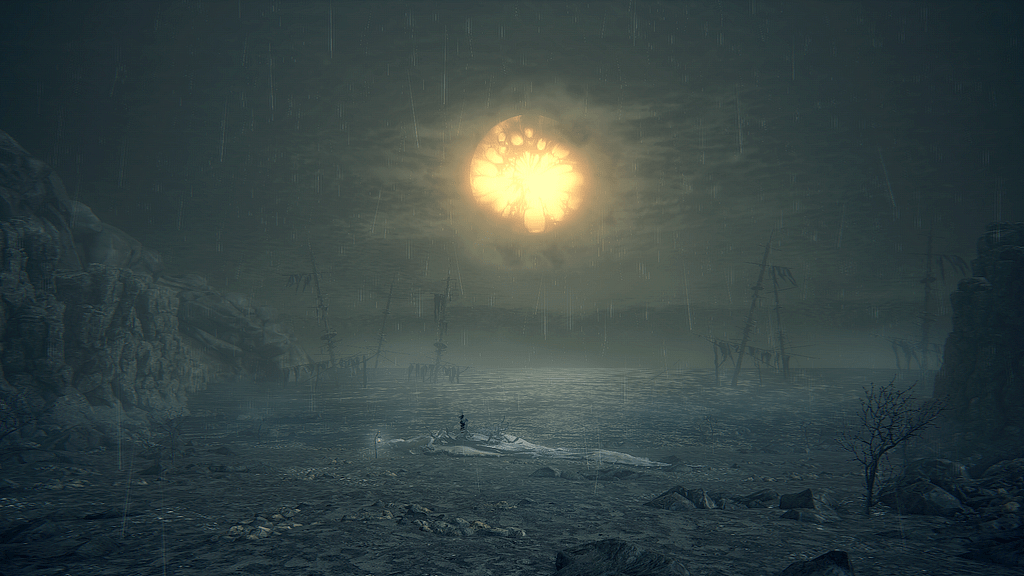
The seed to this proverbial seedbed, naturally, rests at her corpse on the beach, specifically her womb. From there, the black fog possessing the blood-drunk hunters rises in the vague form of the Great One’s missing child, the Orphan of Kos. How fitting that “orphan” (遺子) is pronounced ishi like the wills left in dying blood, for “killing” this shadowy phantom brings the curse to an end, along with the hamlet’s constant rainfall and the Nightmare’s aberrant sun. We can thereby be sure that the rain is an expression of the vengeful Great One’s grief, a lament which the villagers can sense in their aching scales — the same way a fisherman might sense a storm in his aching bones. Likewise, we can be certain that the sun is an expression of the weeping god’s wrath, her grudge incarnate hanging like an ever-watchful eye. In essence, breaking the curse grants final closure to this evil spirit, putting her as much to rest as the hunters trapped in her nightmare. Until then, both parties will remain in this endless cycle, never to escape the Great One’s sorrow and rage.




Of course, not all are strictly damned. Despite the hamlet appearing as it was when all its people were massacred, we nonetheless see that same populace alive and well. Plenty of the inhabitants continue to go about their business throughout the village, with more heard inside their homes. It is as if the fish-men were never slaughtered. In all likelihood, the ghost of Kos added their living forms to her simulation, essentially resurrecting them in “new” bodies. The reason is presumably because, despite their failure, the village did the utmost to protect her and her child. The villagers call to be forgiven while cursing the hunters, and that they have. This also proves to be a rather blanket pardon. We can come across one of the village’s butchers hacking away at the corpse of a Healing Church spy, evidently hunted down just prior to our arrival. The role this “beggar” played in the massacre clearly wasn’t forgotten and was repaid in kind. But this still insinuates that the Church’s plants are considered “villagers” as far as Kos’ curse is concerned. She has given them all a pass just as she rather liberally condemns slayers of beasts.
In some respects, this can be considered an extension of the Great One’s revenge. Those who faithfully served her are allowed to share in the ghost’s retribution against the hunters; giving the whole hamlet wronged by Yharnam the last laugh, as it were. The two planes of the Nightmare do seem to be connected with some intention. There is a certain irony to the clock used to discover the Great Ones’ secrets revealing the secret heart of Kos’ creation — doubly so in the Research Hall building upon the fruits of the hamlet’s devastation. In every sense, no one can know the cause to the Nightmare without first knowing the beneficiaries, a secret for a secret. This turns the safeguards to the Nightmare into a justification for the suffering inflicted, a silent reminder to any who might argue that this malice against the hunters is undeserved. The god resurrecting her worshipers in the heavens can thus be considered the flip side to that hell for sinners complicit in the deity’s murder. They became martyrs and so are awarded “paradise”, a twisted taunt upon the truly cursed.
Besides enjoying their own shot at revenge upon the traitors, the revived villagers have also taken the opportunity to mourn their demise. Bodies have begun receiving a proper burial, with some villagers praying over those that still remain; many of the women in particularly pray to the dead Kos from the mouth of the coastal cave. Others have returned to work at their phantasm farm. Although the latter might seem odd at first glance, it is part of their larger goal in this dream world. Ambient dialogue has the unseen villagers call upon the “bloodless”. While this could apply to many kin-like entities with their fishy fluids, the first priest we come across only joins in the chant if we have equipped the Milkweed rune — in other words, if a phantasm is planted inside our heads. We harbor the “bloodless” he beseeches, and so the priest recognizes us as a friend. To what end? To aid in their curse.
All the bloodless. All the bloodless. We call, Ghos’ death. Forgive us. And curse them.
The chants ask the phantasms to “weep” with their dead selves in cursing the hunters, citing how those who need the malediction are as bottomless as the sea. After seeing our apparent will to help with this cursing, the first priest hands us the Accursed Brew, allowing us to draw out the vengeful spirit within with quicksilver and direct his cursed will at others. Other priests around the hamlet all already do the same, summoning the wrathful spirits in the area to home in at our approach. The hamlet is not just giving the dead their final rites. They are drawing upon their own grudges from their dying moments and beckoning phantasms — all ultimately fragments of the wrathful Kos — to amplify their curse upon Byrgenwerth and its legacy. The Fishing Hamlet wishes nothing more than to see all be cursed as blood-raving beasts in that “sea” below, and so work tirelessly to add more arcane fuel to the resentful fire.

… Curser, curser. No matter how many, there are never enough. There’s no bottom to a curse and the sea, thus all arrive. Now, a malediction. Weep with them. Weep with us…
… Now, a malediction. All the bloodless. All the bloodless. Open your ears to us…
Some might question how the villagers are still burying the dead after, at minimum, years since the massacre. Even assuming the Nightmare didn’t develop right away, surely they should have been finished by now. However, this assumes that time flows equally between the waking world and the hamlet in the Nightmare. The priest’s cut dialogue acknowledges that time no longer exists in this village, the “sun” in both planes of the dream hanging in that same spot in the sky no matter how much time passes on earth. In that case, it is possible that the villagers experience time differently from those beneath the sea or outside the cosmic realm. Regardless, they have no doubt been caught in some sort of limbo, forever supporting Kos by either adding to her curse or protecting it from intruders; not that they need to.
… Time is no more, and the sea is far off.
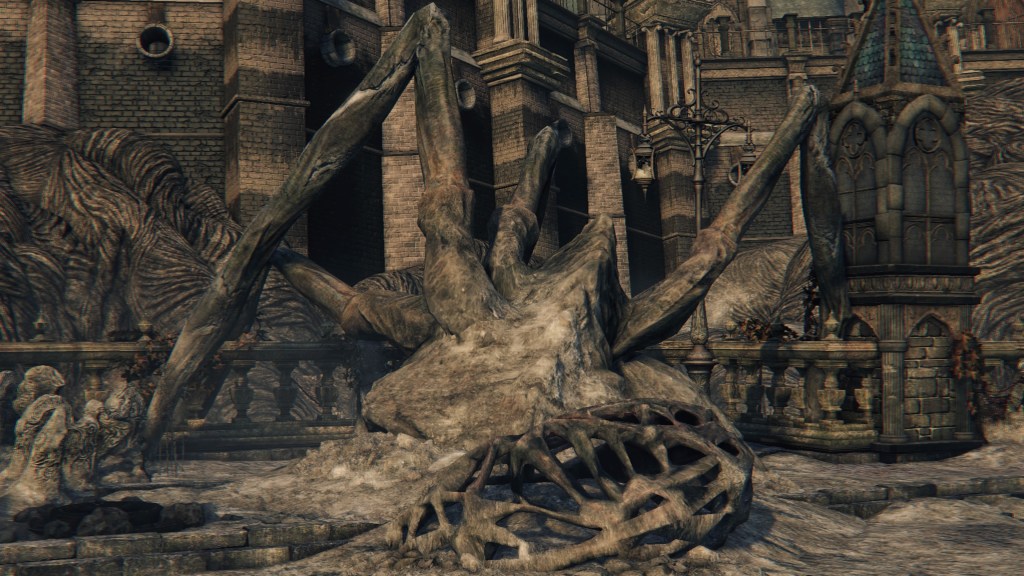
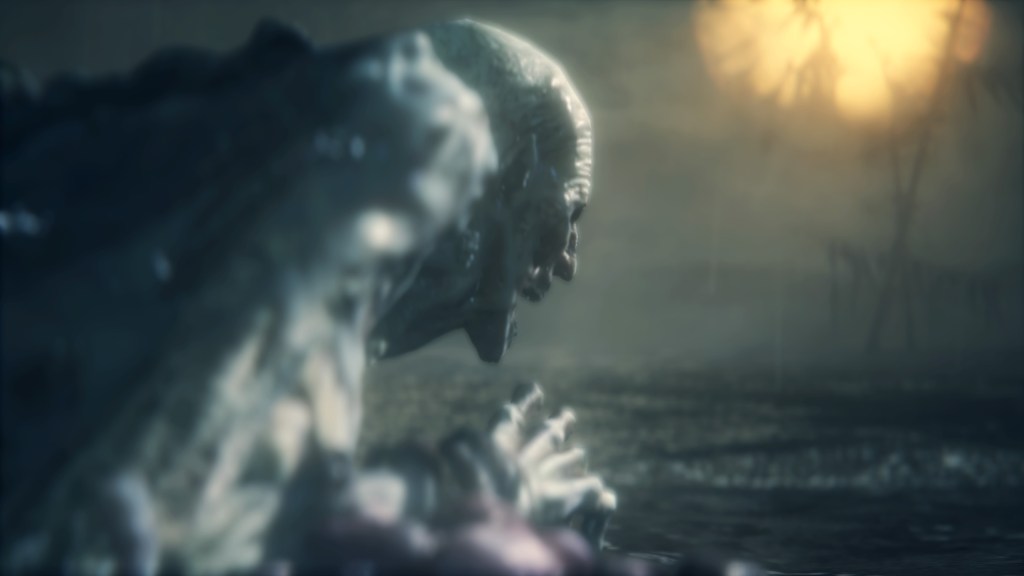
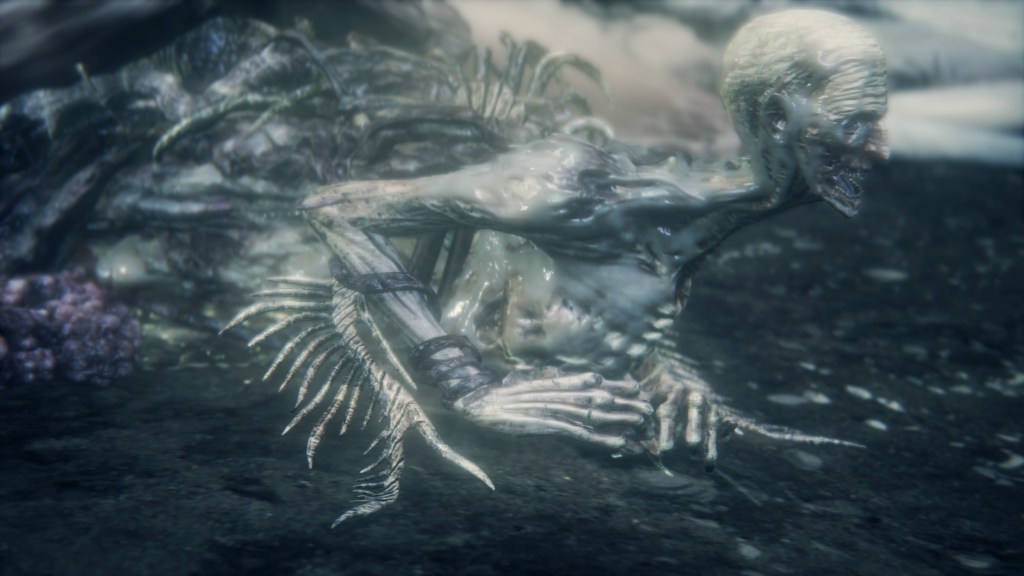
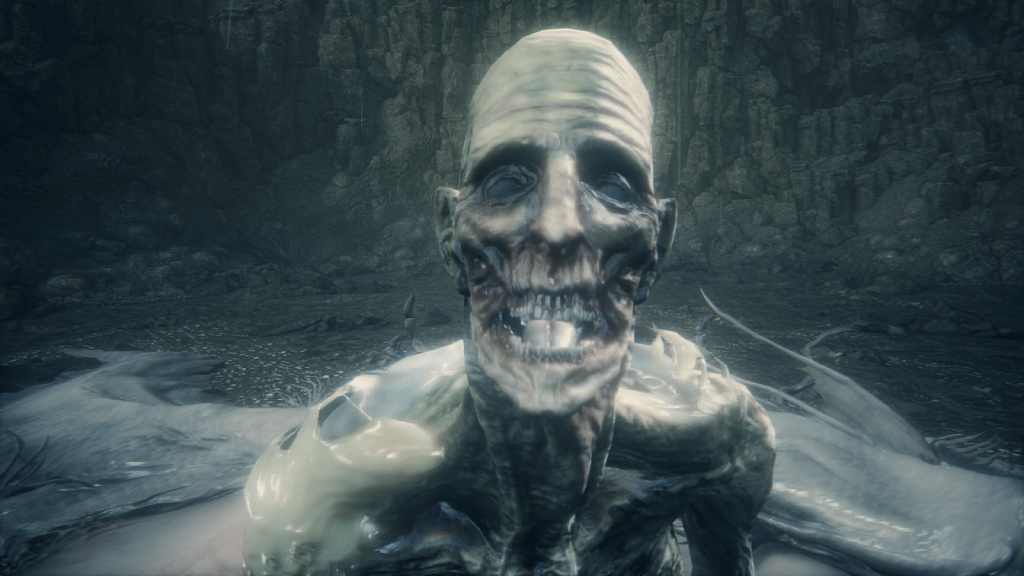
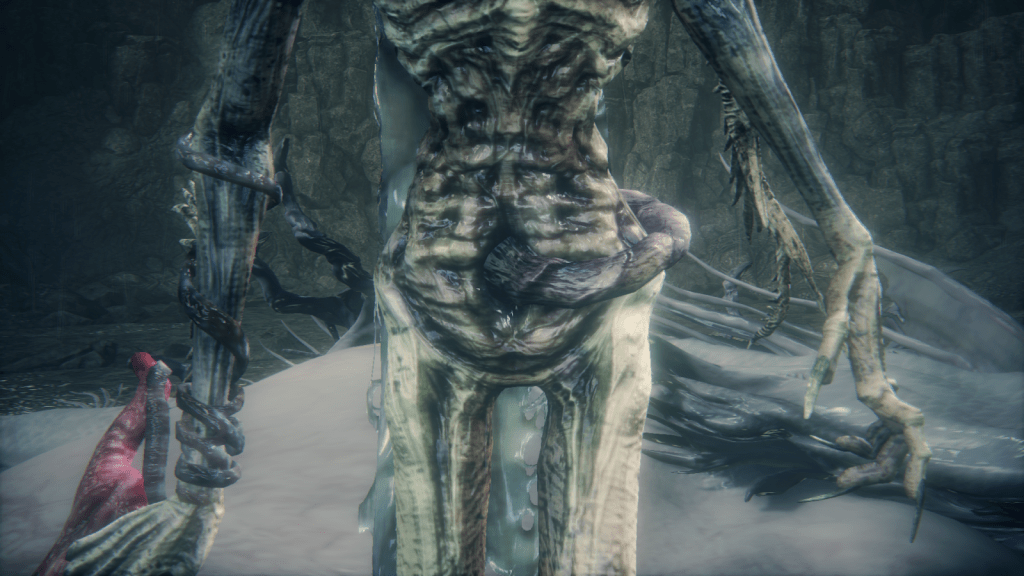
Before the shadowy heart of the Nightmare, we must slay the Orphan of Kos in the flesh. This “child” crawls out of the wrenched womb as if he had been left to die there with his mother. In reality, the boss serves more as a protective shell around the Nightmare’s core. When injured, the Orphan spews not just blood but also the same black fog comprising his shadowy doppelganger. Indeed, this Great One is no doubt a spawn of the curse. His weapon is his mother’s placenta, the “pommel” connected to an umbilical cord coiled around the boss’ arm until entering the elbow; it then exits again out the base of the spine and wraps around to the belly button. Since the organ is responsible for supplying blood to the fetus, it is no surprise to see the copious amounts contained within bubble up the pinkish membrane like a pus. This blood cut off from its child is what has stewed in resentment, the cursed will now flowing into the Orphan. That is why the pussy material explodes with the black fog when thrown by the boss, and why he is empowered after gobbling down on the stuff directly. The curse sustains him.
However, while the Orphan’s physical form may serve as a guardian to protect the curse within, it isn’t merely the twisted resurrection of her lost child. Rather than an infant, the Orphan of Kos takes the form of a wizened old man, specifically with some resemblance to Gehrman — even the baby’s initial cry while staring at the cursed sun simply reuses audio from the first hunter. In fact, after putting Kos’ grudge to rest, the doll will comment how soundly Gehrman is sleeping suddenly. We likewise cannot witness the old man having a nightmare after killing the Orphan yet before hearing the doll’s comment. All of this implicates the first hunter as another victim of the curse. But Gehrman’s still lives, his final record firmly held in Flora’s clutches. How then can the ghost of Kos be cursing him like the others? It is not. Like Laurence, Gehrman has received a special punishment. In lieu of the full thing, elements of his soul record have been mixed with those of the Great One baby. Gehrman feels a connection to the Orphan in his sleep because the boss is, in essence, a hybrid soul he is invariably tied to.




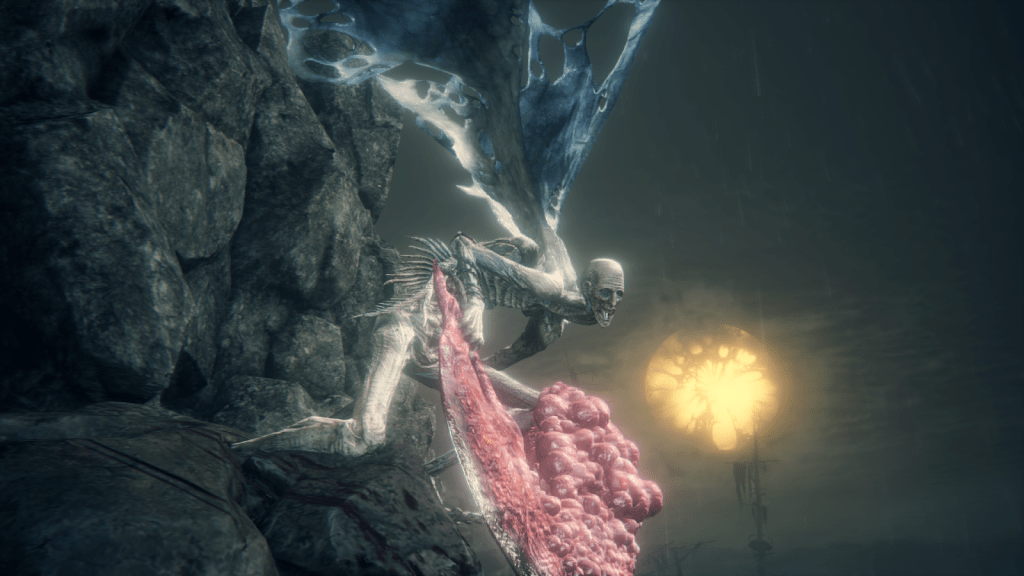


Oh, sir hunter. I can hear Gehrman sleeping. It’s very quiet tonight, not heavy like usual… Was there even a little salvation for him…?
We can be certain that the soul of Kos’ actual child is involved due to how she behaves apropos to the boss. Occasionally, the Orphan will make a huge cry, which does nothing in itself but is immediately followed by a bolt of lightning striking down from the sky. This bolt just so happens to land directly on Kos’ corpse every time, with the strength to create large waves of electricity as it dissipates in every direction. Basically, it is a convenient but unintentional attack by the Orphan provoking Kos. Even if a nightmare, the blood-filled corpse on the beach is still Kos, and the sky above is still the portal to the cosmos. Her will may have settled in the sea of souls overhead, but it is still linked to that cold blood on earth and still instinctively reacts to stimuli. Like a spark between synapses, that stir between flesh and spirit causes an electric jolt, its scale proportional to her power as a Great One. And the stimuli stirring even a dead god is her alleged child. After all, what loving mother wouldn’t be moved hearing her baby’s cry? Therefore, the Orphan is just as much the actual child as Gehrman, both if also neither.
The reason for this specific punishment is obvious. As the one witnessed heading in her direction, with the most skill and experience, Gehrman is the liable perpetrator of Kos’ murder, thereupon personally responsible for ripping the child from her womb. He is thus the hunter most important to the Great One’s mind, the soul she must punish above all others. Moreover, her baby alone is incapable of acting as guardian, as proven by how events played out in life. The proverbial data must be edited with code from someone else. And so, the child thief has been made her surrogate baby, set up to eternally suffer in her deceased womb until called upon to defend it. Gehrman is only spared so far as he is trapped by another Great One’s curse, allowed to live well past his expiration. Should we free him of the Hunter’s Dream without dealing with the Hunter’s Nightmare, the ghost of Kos will likely incorporate his complete soul into her spiritual Frankenstein creation; let him truly suffer. Until then, the Orphan is simply an ill omen he will sense in his dreams within a dream.
Of course, this punishment is inflicted upon Kos’ child in equal measure. The priest in the graveyard prays that Kos’ love will eventually reach the elderly babe, demonstrated by the stench of her freshly rotting corpse embracing him; fish do begin to smell more quickly after death, and we see ghastly green gas emanate from that viscera the Orphan first tears himself free from. Add in the cut dialogue where the priest mistakes the Yharnam Stone taken from the Pthumerian Queen’s corpse for his god’s child. This alone is news worthy of blessing the messenger, outsider or no. Clearly, the priest is aware of the man child currently nestled in her dead womb, believing the baby received “salvation” from death like them. But ideally, he wishes the wizened Orphan fully returned to his mother, so that they may at least die together when reality had them so cruelly separated. It is that fact, more than anything else, which drives the grudge. Anything less is simply extending the suffering to the innocent newborn. And as Kos’ reaction even from beyond the grave shows, she is incredibly sensitive to her baby’s pain.
… Salvation to the pitiful, aged baby… May Ghos’ rotten odor, Mother’s love, finally reach you…
But still, the rotten odor, Mother’s love, has reached you? Oh, thank you. Messenger, my thanks. Blessings of Ghos to the messenger from beyond.
But such an ironic twist in the Nightmare means nothing to her ghost. It can only lash out in rage as it grieves in an endless cycle of misery and self-pity. Kos is as much a victim of her own revenge as the victimizer. Such is the nature of a deep grudge. There is no taming these turbulent waters; the boat will simply be rocked back and forth along the waves with no hope of ever making landfall — a bottomless curse to a bottomless sea. Kos allowed her resentment in death to consume her and everyone else. In that case, perhaps it is for the best that we put this grudge to rest regardless of our personal stake in the matter. The past will not change, and this endless nightmare serves no one, least of all Kos. We can grant peace to both her and her baby. As the priest narrates after we have scattered that cursed shadow to the wind, the baby returns to the sea where all inevitably arrive. At least in the cosmic ocean, their souls can both enjoy eternal rest together. As for their butchers, failure will always be their karma.
Never Mea Culpa
That rumor of the Hunter’s Nightmare has spread reveals how people in the waking world are privy to its existence. Unsurprisingly, this information seems to be leaking out from the Healing Church. One of the few hunters in that dream but not part of it is Simon, whose dress and knowledge of the Church’s darkest secrets betray him as one of their spies — how fitting for a man whose Hebrew name means “listen”. In fact, Simon says that someone is trying to hide the ravaging of the Fishing Hamlet as one of those secrets, though he doesn’t divulge the answer until we have seen the for ourselves. From his insinuations, this is because the clergy involved are afraid of people discovering their misdeeds, even more damning for them than the Research Hall’s experiments. It is only natural. Yharnam has only held together for so long thanks to hunters. If credible testimony got out that they were not just cursed, but cursed because of the church founders’ actions, the city would collapse overnight; the hunters would fight and die to destroy the clergy before defend it. And so, they must never discover the truth.

… Are you, a sane hunter? Perhaps, you got lost? Good, I am the same.
And there is someone desperately hiding those deeds. A pitiful, and arrogant, story… That is why the secret should be revealed…
Oh, you. How about it, terrible, yes? This is the true face of the blood-blessing, beast-exorcising Treatment Church… But, something like this isn’t the secret.
As insurance, the Church planted Brador within the Nightmare as an assassin. The man simply loiters in one of the cells in the second Grand Cathedral’s dungeon, ringing a silent bell. This is because the ring is reverberating not on this plane, but the one above, the Fishing Hamlet. Hearing the bell is apparently a sign that the arcane device has detected our foreign presence, summoning Brador to the location. This isn’t the true Brador, however. This assassin shrouded in a flaring red fog appears far younger than the grey-haired old man in the dungeon. In fact, the two can coexist in the same plane, as demonstrated when we go to unlock his inner cell after acquiring the key from Simon. This is why the younger Brador gets resummoned no matter how many times he is killed. He is a copy of the soul made manifest in the Nightmare through the silent bell. As Simon attests, the assassin can wear down any target with an endless onslaught of doppelganger after doppelganger. He merely needs to keep ringing the bell. And the description to Brador’s Testimony confirms this device to be a gift from the Healing Church.
Your enemy is beasts, and they probably aren’t in a place like this. Return to the hunt. And if you realize it, forget the night… Places that shouldn’t be captured, things that shouldn’t be known…… The actions of a fool closing in…
… Can you hear it…? In that case, best fear the sound of the bell. Endless death to the fool closing in on the secret. The church assassin will chase you down, wherever you go.
Animal scalp of a horrifying clergyman beast. Sign that the hunter Brador, Treatment Church assassin, hunted a friend.
Brador has worn his friend’s scalp and shut himself in the dungeon ever since, and so the Treatment Church gave him a single bell. A soundless bell of death, to protect the secret.
With that special arcane power, the Church’s upper echelon trusted the assassin to keep the secret from the public. Assigning Brador specifically this task was carefully decided. The man is a foreigner as evidenced by his attire, thus bearing no connections to Yharnam. Like so many, he became a hunter, apparently choosing to stick with the Gehrman school from his lack of uniform. In the process, he even made friends with a cleric, presumably in the same line of work. But when that friend transformed into a horrifying monstrosity, Brador had the resolve to hunt the cleric beast. Although the size of the creature’s scalps indicates that it was much smaller than the identical Cleric Beast we encounter on the Great Bridge to Cathedral Ward, hunting one still proved that Brador had the strength to be the Healing Church’s assassin.

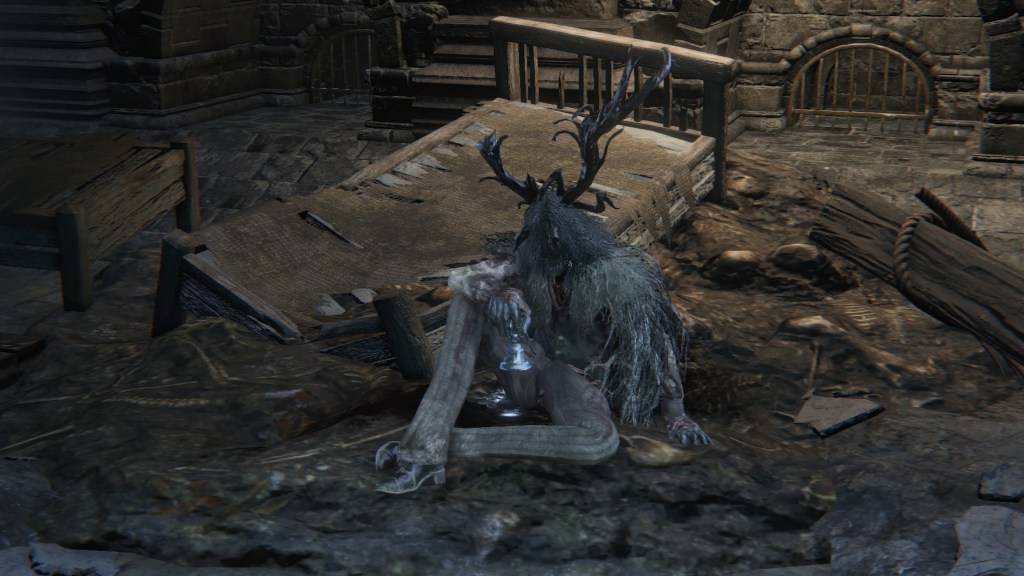


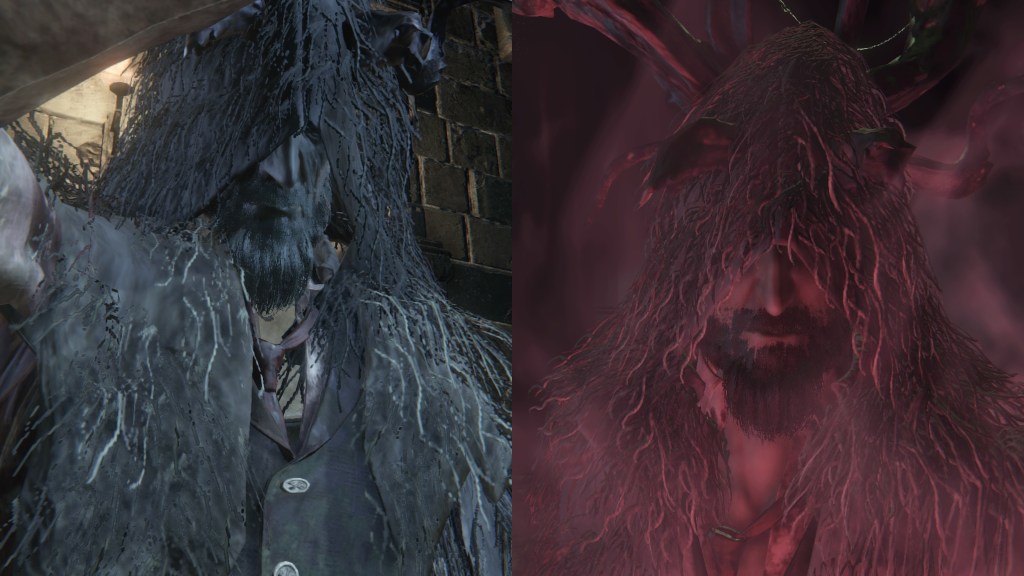
Bloodstained apparel that wears the beast skin of a horrifying clergyman beast. If you remove the beast skin, it is no more than foreign clothes.
Brador wore his friend’s scalp and beast skin before the blood even dried. Most of the blood on the apparel is from back then.
It wasn’t without damage to his psyche. Immediately after hunting the beast, Brador skinned his friend and began wearing the bloody furry scalp, almost as if hoping to regain that closeness they shared. Without even bothering to change clothes or clean off the blood, he then shut himself in that dungeon, almost as if seeking penance for some crime. With wild laughter, he mocks our aim to stop his endless assassination attempts by killing him or begging forgiveness, blaming us for foolishly chasing the secret and now “twisting” the resulting retribution. And if we go through with killing him, he bemoans how it is human nature that nothing changes. Such dialogue is bizarre unless he is speaking from personal experience — that he himself is painfully aware of killing others to avoid facing punishment for unforced errors.
… Oh, well, well… Welcome to my bedroom; you are my first guest. So then, you are going to kill me? You are going to kill me for your own foolish deeds and twisting the retribution? Hehahaha…haha!
What’s wrong? You are going to kill me? Or are you going to ask for forgiveness? But that is exactly what foolish deeds look like. Keheh….. Hehahaha!
… Nothing changes. Maybe that is human nature… Keheh…Kehaha……Gaha……
All of this suggests that Brador is suffering from profound guilt over murdering his friend, then choosing to kill on the Church’s behalf rather than face that reality. Even if a beast, that was still someone he shared a close bond with, and the choice to break that bond personally — and in such a visceral manner — inflicted a shock he has never recovered from. Nevertheless, he did follow through, showing a willingness to hunt even his closest comrades should the need arise; an excellent disposition for an assassin. This is because, despite the personal trauma, Brador, as a hunter, is obsessed with something far more important than friendship: the corruption in blood.
Brador’s weapon is Bloodletter, a hammer deemed “mad” for requiring the hunter to rip his own bowels to fully utilize. It is designed so that, by stabbing it into the gut, the wielder sucks out the blood to transform the hammer into an oversized morning star. Its unconventional construction and supernatural workings suggest that it is a Healing Church invention, likely gifted to Brador along with his silent bell. But his full-fledged embrace of its repulsive aspects betrays his own priorities. As Bloodletter’s description puts it, he believed it the only way to excise “bad blood” from his system. That is why it is named the “bloodletting hammer” (瀉血の槌) after the practice predicated on the belief that removing “bad” blood cured illness, which saw its zenith in the Victorian era. The intestines are responsible for up to 15% of the blood in the body, so it probably is a major concentration of the corruption within hunters. And for Brador, that corruption which turned men into beasts was more horrifying than amicicide.

Mad hunting weapon of the hunter Brador, Treatment Church assassin. It sucks the blood accumulated at the bottom of the gut, of the heart, and reveals its repulsive true nature.
It is also the only way to get rid of bad blood. Brador, who shut himself in the dungeon, continued to believe so.
In short, the Healing Church has played on the man’s paranoia to make him kill all the hunters who become existential threats. His new bell provided him with the perfect shield, and his new weapon guaranteed that he would never become drunk on blood. This plan has worked to apparently great success. The secret has been kept and none have stopped the assassin. Given that he invades in a form identical save for age, the man has been secluded in that dungeon for many, many years. The fact that he had imprisoned himself within the Nightmare “ever since” skinning his friend implies that the assassin began his new career not long after the advent of the Hunter’s Dream. Moreover, it implicates the Church’s founders in knowing about the Hunter’s Nightmare since sometime before that wave of cleric beasts, while Laurence was still alive. That certainly adds to the Vicar’s motivation to unlock the secrets to Great One status before they all die as beasts. In fact, it is added irony.
Whether he realizes it or not, Brader’s criticisms of us and himself are just as applicable to the Healing Church. Here the elites are, leaving an assassin to hide their terrible secret to avoid the consequences of their foolishness. It is they who dragged everyone into a dead god’s grudge because they needed to sate their curiosity. They are the ones twisting the punishment for their crimes. Their actions leave no doubt that they knew exactly what they had done wrong to create such an awful dream. It was Laurence and his ilk who led the massacre; it was they who heard rumor of hunters disappearing; it was they who investigated the Nightmare; it was they who decided the truth must never come to light. After all the damage they caused, the cowards still refused to change course. Putting off their cursed fate for as long as possible, the Church has continued pursuing the gods’ secrets. For them, there is no other option. Either they reach the heavens, or they fall straight into hell.
 Lokey Lore