
Although now defined by Erdtree civilization, there was a time when Altus Plateau was rife with barbarians. A scarab rolls up Barbaric Roar at the base of Liurnia’s waterfall streaming from Altus. Another, invisible scarab stamping along the Altus highway amusingly collects Earthshaker, which uses blunt or otherwise inelegant weapons like large hammers and axes to erupt the earth around its user. This is notable since the skill is similar in both name and effect to Hoarah Loux’s Earthshaker. The man who later ruled the plateau as King Godfrey was originally just a simple warrior and ultimately took up the name Hoarah Loux again when becoming chief of the Badlands — the “barbaric lands”, (蛮地) to be more accurate. Whenever adopting this persona, the king is portrayed as less than regal; stripped down, bare-chested, unkempt. And while proving more than capable with just his hands, he loves large axes, though it is a Great Mace collected at the army camp on the Bellum Highway to Altus; the weapon featured in Earthshaker’s menu graphic. All the same, Godfrey undeniably exemplifies these barbarians.
Clearly, there were “uncivilized” folk living out on the upland, who hollered like beasts and slammed the ground with boorish weapons like brutes. Godfrey’s reign confirms that these primitives existed up to the day the plateau obtained its first Elden Lord, and the culture seems to persist to some extent. Engaging the red sign in the Writheblood Ruins brings us face-to-face with Magnus the Beast Claw. Wielding a brutal morning star to bludgeon enemies, it is no surprise that this man behaves like a barbarian, dressed in simple furs and rags. And true to his title, his weapon employs Lion’s Claw as its skill, which coincides with his use of the Clawmark Seal to perform Beast Claw incantations on top of Bestial Sling. Without a doubt, Magnus wishes to embody the strength of a beast’s most basic tools, hence the Latin name meaning “great” or “mighty”. His faith lies in the raw ability of physicality, which his weapon replicates with its claw-like spikes and healing per strike. Whether he was born into such an environment or only came to adopt it later in life, there is no denying that memory of Altus’ past is still fresh.

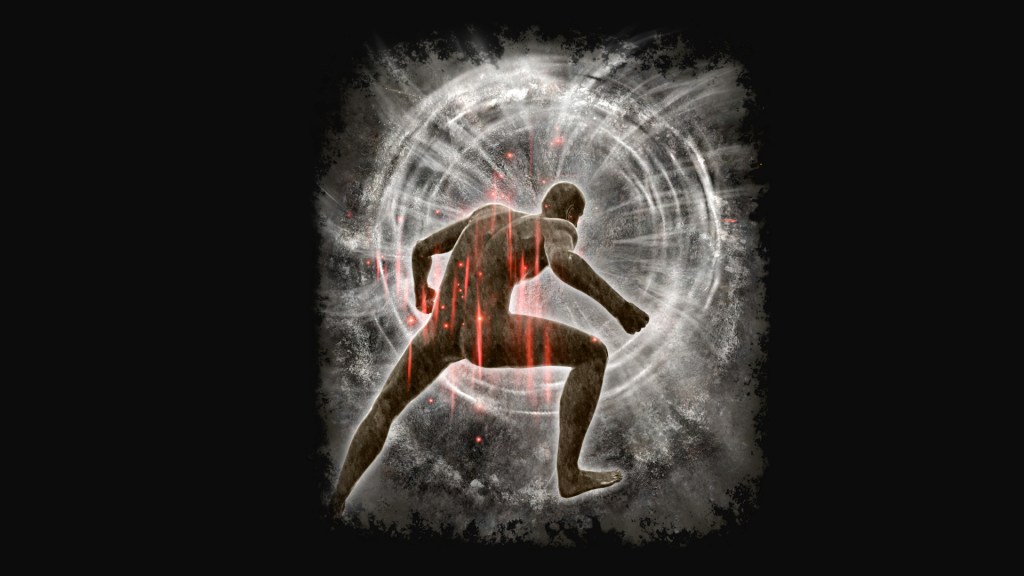


Another aspect that Magnus highlights is these barbarians’ fixation on wild animals specifically. Even after taking up a new name, Hoarah Loux was defined by his ferocity evoking the beasts of prey. Like a cornered animal, Godfrey on the back foot unleashes a mighty roar before clawing and grabbing at us with his bare hands. In fact, he revels in relying on nature’s tools to him. Making that beastly roar is part of Hoarah’s reintroduction, shouting his name before our new battle as is practiced by highland warriors according to their axe’s description. The enthusiasm for a straight-up contest of strength is palpable. It is only at the counsel of the Beast King Serosh, whom the Elden Lord shoulders on his back, that the barbarian suppresses this fighting spirit — though it still seethes endlessly. Even Barbaric Roar inspires mightier offense with a “beastly” roar, changing our weapon’s secondary “strong” attack to an equally “barbaric” flurry of strikes. The barbaric men of Altus undoubtedly show great deference to ferocious beasts, thereby choosing to emulate them for strength.
Talisman modeled on Godfrey, Elde King. One of the “legendary talismans”.
Enhances sorcery/prayer/battle art charging.
Godfrey was a fierce warrior. But when he swore to become a King, he shouldered Serosh, the Chancellor Beast, in order to suppress his ever-overflowing fighting spirit.
Battle art that makes a beastly roar to inspire self and boost attack power.
While in effect, strong attacks become barbaric chain attack.
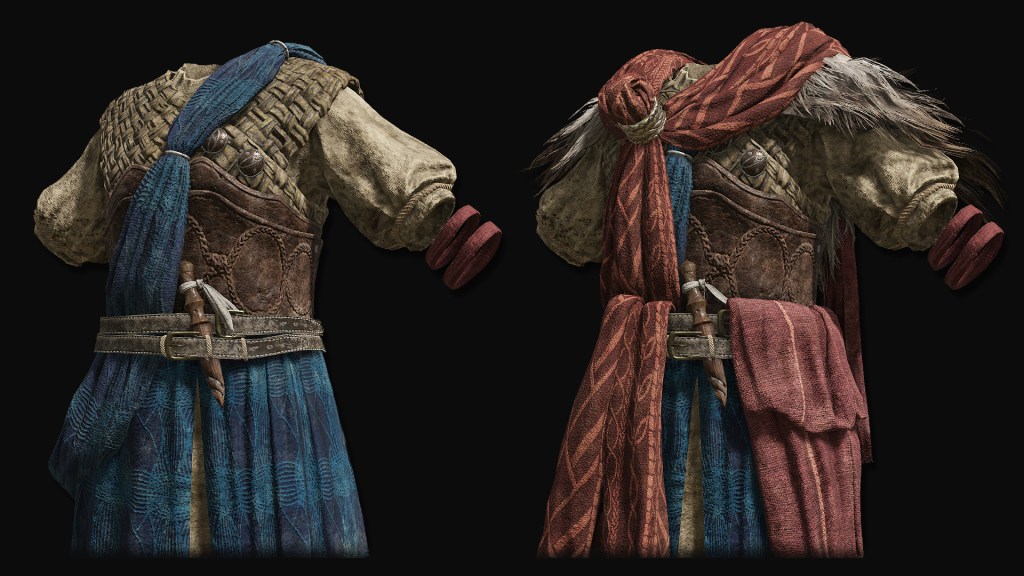
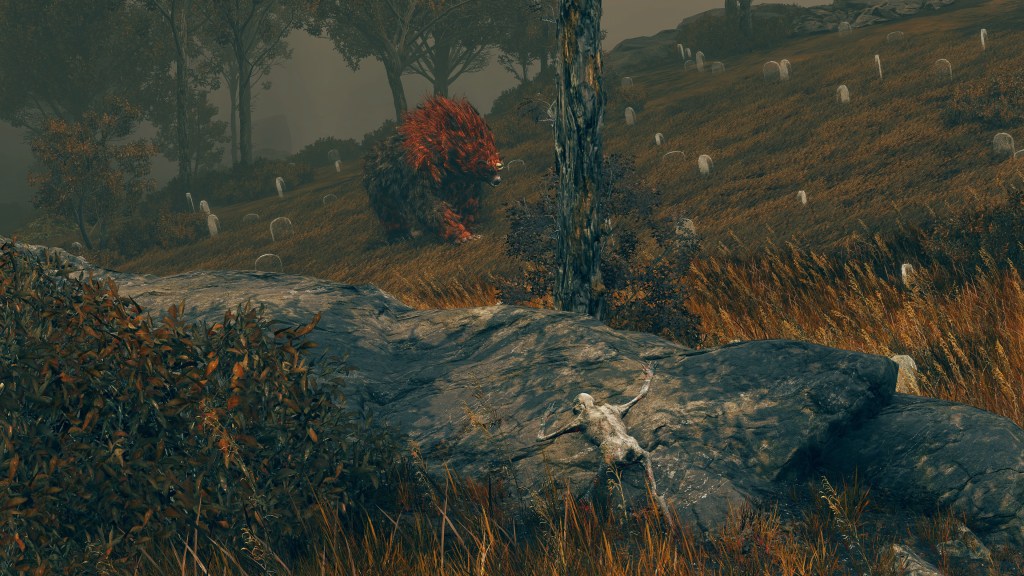
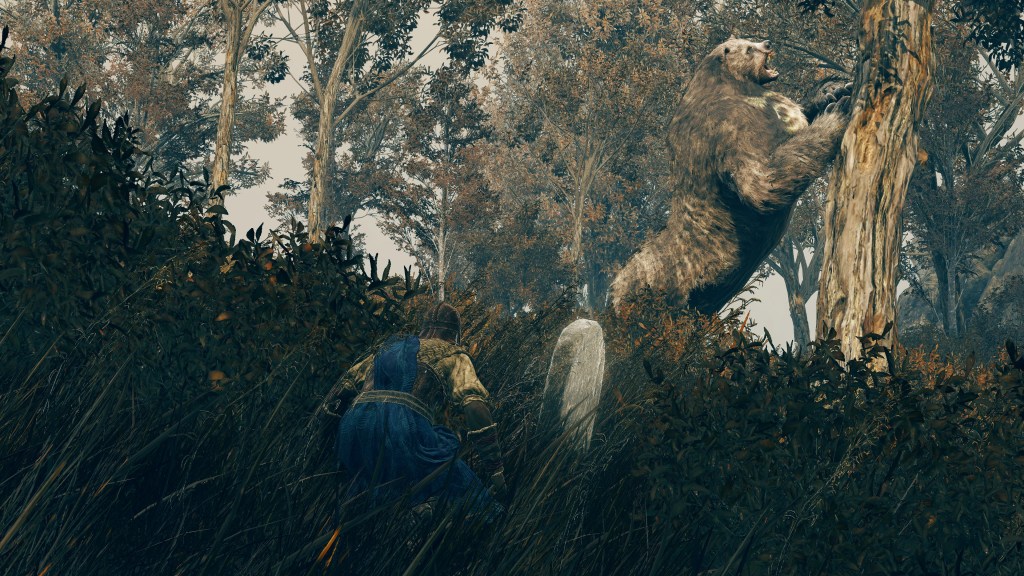
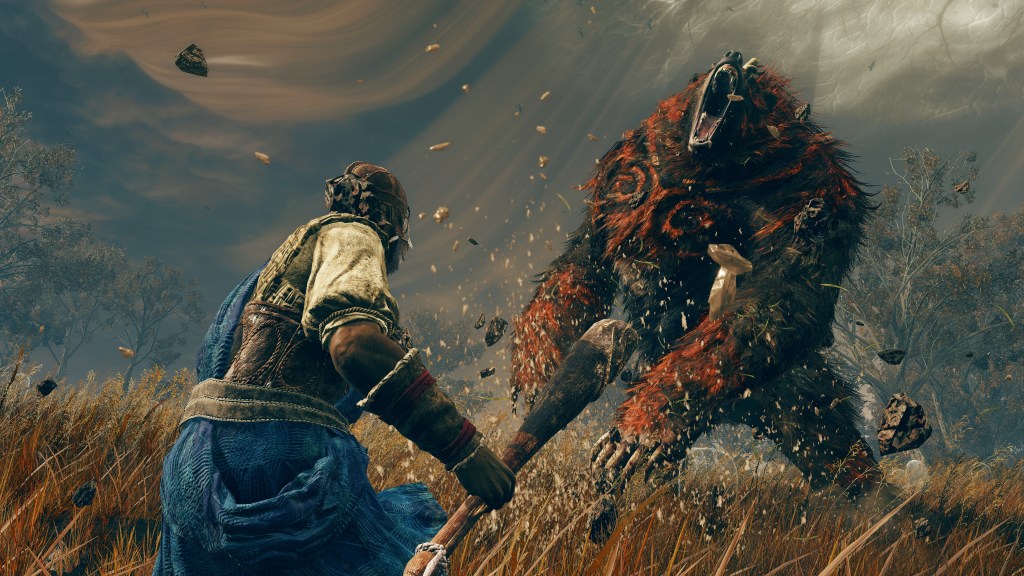
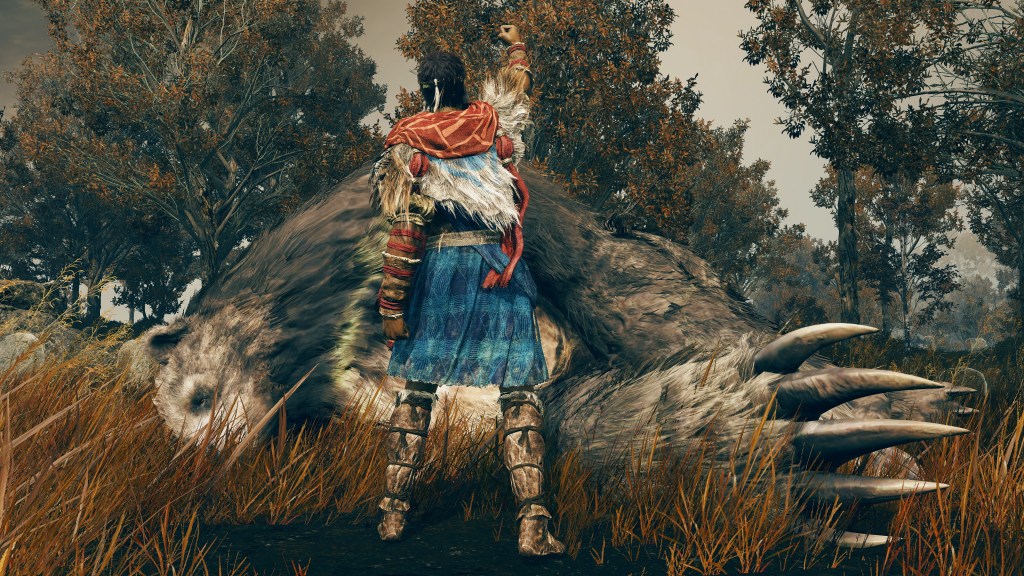
However, because their respect is founded upon strength, such barbarians could never coexist with the beasts. Carnivores, by their nature, compete for prey to survive, their place in the hierarchy decided when they invariably clash in life-or-death struggle. If a man wishes to be a predator, then he must prove he is not prey, against not just his fellow man, but also the beasts. We see this barbarian legacy in the Realm of Shadow. The highland set is the traditional attire of such warriors, descriptions of the leather armor revealing a society of bear hunters who consider challenging mighty beasts to be their honor. Those who achieved an especially standout honor received red fabric to wear over the blue cloth of ordinary glories. This presumably refers to hunting the giant red bears who still roam Rauh Base and Scadu Altus, where we find wearers of this equipment. This suggests that barbarian culture existed not just on Altus Plateau but across the highlands of the Lands Between in general.
Traditional apparel of warriors of the highlands. Blue-patterned cloth wrapped over armor woven with fabric.
Warriors of the highlands are hunters of bears. Challenging a mighty beast is their honor.
Traditional apparel of warriors of the highlands. Fur layered over armor woven with fabric and wrapped with two patterned cloths, blue and red.
It is said that the red-patterned cloth was given towards a hunter of bears’ standout honor in particular.
Indeed, like Magnus, the Realm of Shadow has its own barbarian adopting the alias Beast Claw. Heading south through the Gravesite Plains, we come across a forest home to Logur, who immediately slashes at us with sharp claws imitating a beast’s nails. His appearance, fighting style, and the name “Loga” (ロガ) are an obvious reference to Hugh Jackman’s role as Wolverine in the film Logan. (ローガン) Nevertheless, this Logur, dressed in little more than undergarments, reveals another attempt for modern man to revive the old barbarian ways of the region, including mimicking clawed beasts. This is why both prefer lacerating arms which cause quarry profuse bleeding, Logur’s specific choice of weapon inducing the wielder to embody a beast in the way we move in for the kill or leap away from harm — even its skill is a “beast claw attack” (獣爪撃) where we pounce from low to the ground like predators on the prowl. Cementing the connection, the other ash of war featuring the claws is Raging Beast, acquired from a scarab in the woods of Scadu Altus. These highlanders were hunters who wished to become their prey.
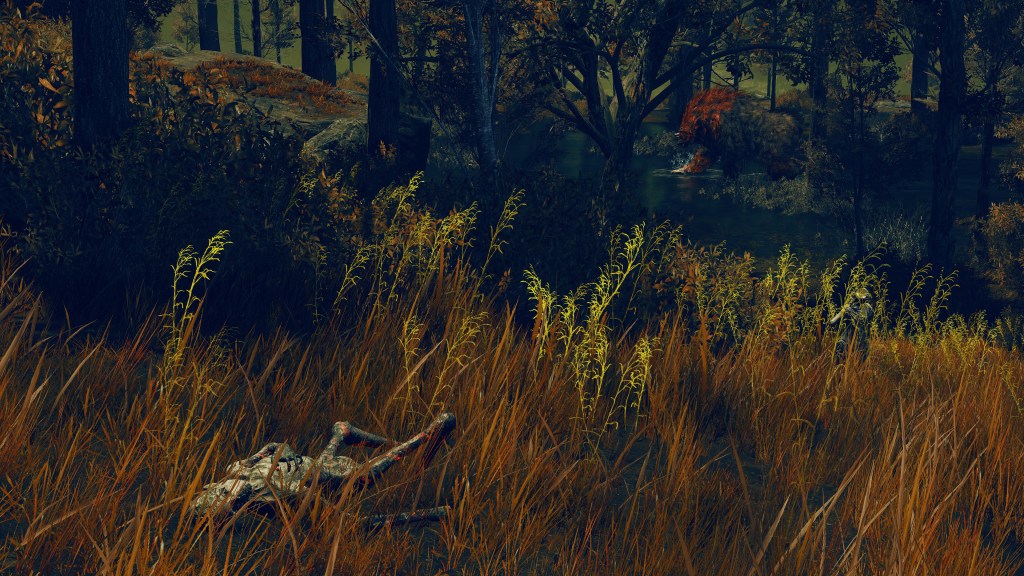

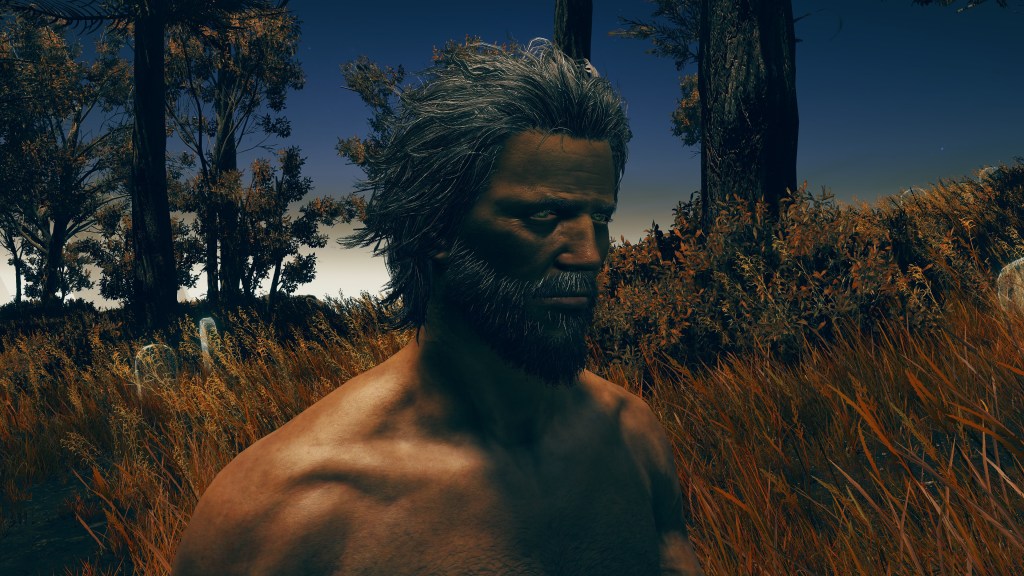

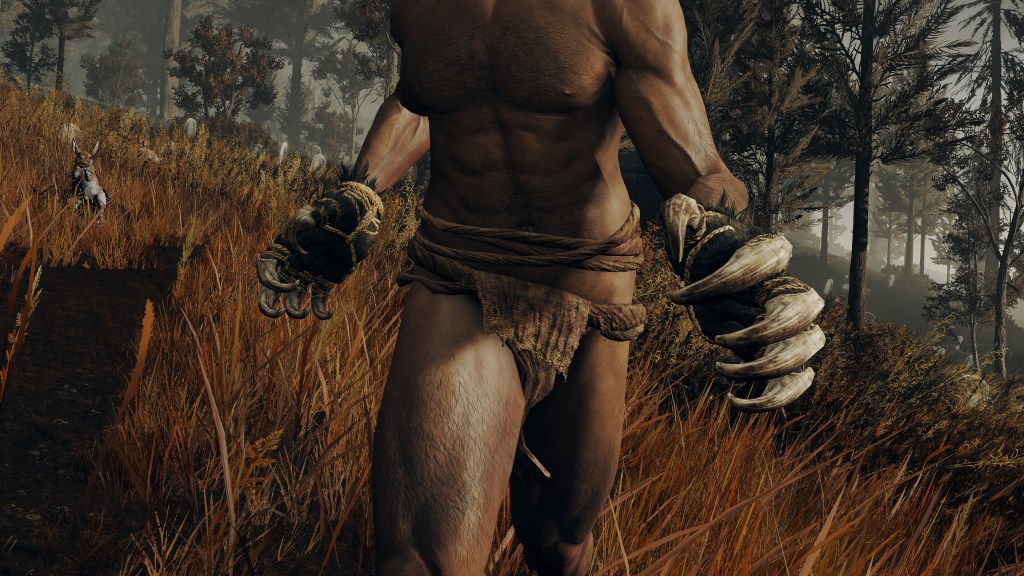

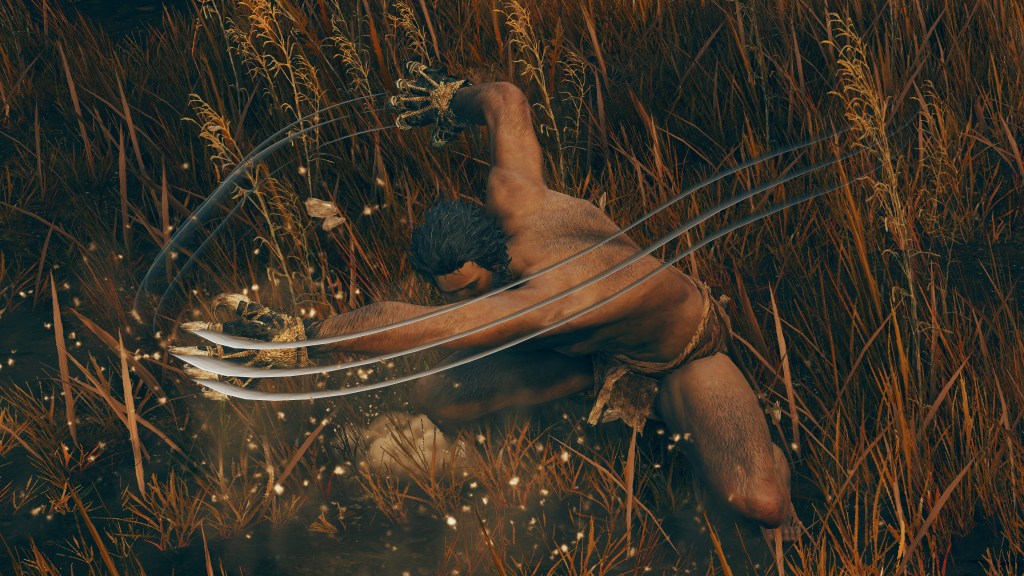
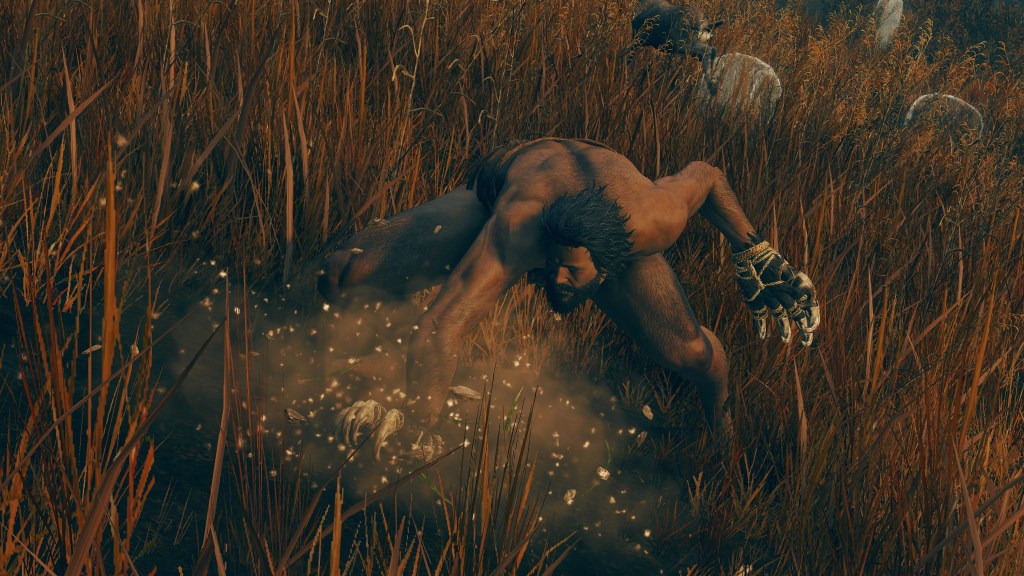


Weapon modeled on sharp claws of a carnivorous beasts. Beast claws. Performs slash attacks akin to a beast, not man.
A weapon akin to invoking a beast to oneself which imitated the secret art of horned warriors.
In line with this, we can witness how slaying great bears like Rugalea allow hunters to discover new incantations. These arts are colloquially dubbed bear communion since they cause the caster to manifest some aspect of the creature they channel. In the case of Rugalea’s prayer, we transform our head, using the red bear’s likeness to let out a violent roar. But similarity to Greyoll’s Roar aside, there is not much resemblance to dragon communion. No part of the bear is actually dined upon; the closest the so-called bear diner may do with the body is skin it and wear the fur so as to feel more like the beast and thereby better use such prayers. Neither do the arts require a spiritual connection to the arcane mysteries, only faith. That draws attention to the self-actualization inherent to bear communion. Rather than physically consume the prey, the communicant internalizes the beast’s essence through their life-and-death struggle. By the end of the battle, the warrior discovers within himself a divine spark.
Prayer colloquially called bear dining. Art that wields the power of the great red bear Rugalea.
Transforms self into great red bear and violently roars. Enhanced with charging.
An art closer to the horn-men’s divine invocation than dragon-dining. For at the end of a life-or-death battle with the great wild, for sure, you will discover a god of you alone.
Fur of the great red bear Ralva. It is worn from the head.
Enhances prayers colloquially called bear dining.
Only a rawhide personally attained at the end of a life-or-death battle turns the warrior into a wild bear.
Put simply, the highlanders hunt the apex predator in their area because the experience helps them realize themselves as a god. They place their faith in this belief based on solely the thrill and adrenaline a deadly beast creates pushing them to their limits in battle. After all, what is a god if not a will which is master of its own fate and the fates of others by extension? Outer gods demonstrate as much, to say nothing of the Greater Will. From that lens, any man who realizes his or her potential atop nature’s hierarchy can be considered a god. The barbarians thus try to follow a similar path to dragon communicants, except from outside that intuitive understanding afforded to those spiritually centered. Their self-reflection is skin-deep, reverse engineering the spirit from the flesh. That is true not just from observing themselves in mortal combat, but their opponents. When in the zone, they feel their way to seeing the beast in themselves and finally unleash that hidden potential to triumph over the genuine article.
Part of this may be due to a kind of spiritual possession. When casting the Roar of Rugalea, we wield the power of the bear in question, not necessarily replicating it. This makes it possible for us to have absorbed our transformative capabilities from the living beast. We do obtain runes from killing the great bears like with any other creature. Perhaps in reverting to base instinct to match the beast, our souls synchronize, allowing the hunter to intuit the power on the basis of faith in oneself — essentially trusting the actual beast to manifest from somewhere within. We see something similar with Godfrey and the living Serosh. The Beast King exists between planes, his ghostly upper half hovering over the Elden Lord’s back. In this state, he is able to do little more than hold the human king’s body and roar; it is only during our battle that the lion begins to turn physical as he prepares to join the fight, allowing Hoarah Loux to kill him as he desperately claws away at armor and skin. Even if the method is unrelated, the idea of coexisting with a beast’s spirit most likely took inspiration from Hoarah’s own life experience.




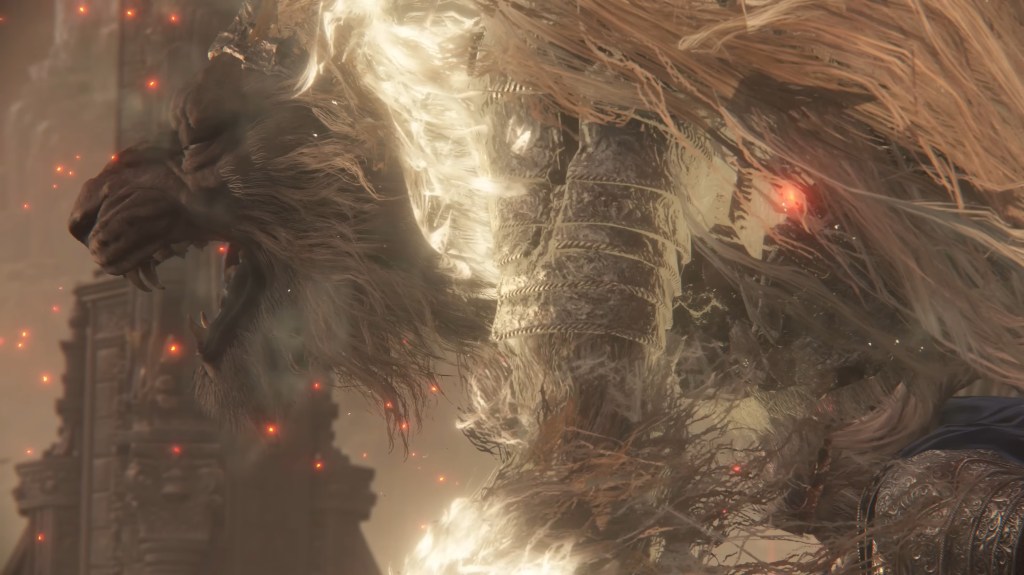
All of this is to say the barbarians’ culture is much more profound than that descriptor might impress. Highlanders value the strength to effectuate your will as a divine aspect, which probably carries over to their politics. If glory always goes to the strongest, then how can the community organize unless the strongest are positioned at the top of decision making for the tribe? A god isn’t much of a god if it cannot use its strength. And how to determine the strongest amongst the tribe unless the two battle it out? When winning the boss battle as Hoarah Loux, rather than offering a pithy complement, Godfrey touts power as prerequisite to becoming King, acknowledging our worth instead if he is bested in this contest. In Hoarah’s world, might makes right, and raw, unbridled power was the only kind needed. Whether these were also battles to the death or more friendly competitions, warriors of the highlands must have fought each other to confirm the pecking order. No matter the age or disposition of the current chieftain, the tribe would only accept a victorious challenger as their new leader.
Perhaps there were further divisions in society along family politics, heads of the various families competing to decide whose bloodline remained in charge as well as which would-be heir ultimately succeeded their position. Perhaps the highlanders themselves were split into separate tribes across the different regions, neighbor warring against neighbor to assimilate one another in a bid to decide the truly godlike. Whatever the specifics, there is little doubt that the community structured secular life in a fashion similar to their religious life. The warriors’ apparent choice to live closer to nature, with the wild, rather than establish any cities or towns also betrays a nomadic lifestyle. Given that the lands are filled with the remnants of civilizations, past and present, the barbarians seem to have shirked development as a choice, remaining “uncultured” in a similar vein to the ancestral followers. In fact, the parallels between the two populations of primitives may be intentional.
The Leather Crown and Headband stand out among highlander equipment. The latter’s description brings particular attention to the white cloth hanging among the braided cords, claiming that the accessory symbolizes their homeland. That is strange, since the color hardly characterizes Altus Plateau, Rauh, or Scadu Altus. The only area a pure white invokes are the snowy mountains even further north. This would imply that the highlanders originate from the snowfields or mountaintop, preserving memory of that fact for future generations despite now living in temperate forests. The migration of a mountain population to the adjoining plateaus isn’t unreasonable, but it does beg the question: why migrate if their place of origin was so important? However, the answer becomes obvious when considering where the migration stopped — around the Rauh Ruins seated in those northern highlands. Recall that the Mountaintops are home to the black stone ruins and its golems. In other words, the barbarians may well be descendants of the Ancient Civilization, visiting the former center of power.

Headband of warriors of the highlands. A thin leather cord that has been braided. The hanging white cloth is a mark of the homeland.
Warriors of the highlands are hunters of bears. Challenging a mighty beast is their honor.
It is easy to imagine the scenario. With the collapse of the Ancient Civilization, peoples across its vast territory would have also experienced a precipitous decline. But for those residing on the Mountaintops of the Giants, making the trek down to Rauh was more feasible. And from their perspective, it would be worth checking — what if the central government had survived or reconstituted itself? Even if they were driven solely by curiosity about what had transpired, there was plenty of motive for surviving remnants to depart the harsher snowy environment for grassland. And as they traveled, they discovered a new thinking whilst fending off the wildlife. Although never forgetting where they came from, the migrants split off and embraced barbarism, until the last arrived to see that Rauh had truly fallen. By that point, why bother with going back or rebuilding civilization? They were better off staying where they were, living off the land, trying to achieve enlightenment in the heat of bear hunts.
In short, the highlanders can be considered counterpart to the ancestral followers. One emerged in the aftermath of the Ancient Civilization; the other, in the wake of the Ancient Dynasties. One sought enlightenment through the flesh; the other, through the spirit. One remained above ground; the other, largely below. Each rejected many aspects of “civilized” societies, yet diverged based, in part, on those societal backgrounds. While the followers still look to their ancestor spirits as ways to reinvent themselves, the highlanders pursued the peak of physicality to achieve apotheosis. As both are the vestiges of organized human societies on the continent, their cultures had room to flourish. However, unlike the ancestral followers, the highland warrior tribes appear to have more or less gone extinct, either dying out or eventually becoming part of civilization like Hoarah Loux. Admittedly, territory underground is less sought after. It was inevitable that new empires would emerge to take the barbarians’ place on the verdant plateaus, filling the vacuum their predecessors left.
 Lokey Lore