
Preface
FromSoftware is no stranger to magic kingdoms, or queendoms for that matter. However, these countries tend to have a simple, relatively bloodless history. “Simple” might still describe the Carian regime, with its one queen. Yet the tale of an organized Liurnian state is fraught with intrigue and power politics, the sorcery aspect almost superfluous. Seeing all the factions at play, it is definitely one of the more precarious nations to follow from start to finish. “Caria” is a star that shined bright but short. And while it may not have been the developers’ intention, it serves to illustrate the pains in forming a lasting national identity, even with peoples ostensibly united by region and culture.
The Moon Points Back
Although renowned as the former rulers of Liurnia, the Carian royal family saw humble beginnings in the Mountaintops of the Giants. Even now, Caria Manor keeps the treasured Sword of Night and Flame, not to mention a huge number of rimed crystal buds among many of its corpses. The resident servant, Pidia, similarly sells the Black Leather Shield from the polar north. All in all, it is no secret that the royal family maintains a close relationship with the snow-capped mountains, the preceptor set’s description going so far as to declare that Caria will never forget how glintstone sorcerers descend from astrologers. The obvious reason is because it is their heritage, the Carians owing everything to their time on the mountaintops. What then propelled them to reign over another land so far from home? For that answer, we must turn to the first and last queen of Caria, Rennala.
Black leather round shield. Large class for a medium shield.
Northern shield depicting the polar star with gold studs. The fur lining wards off chill.
Bright blue robe depicting the stars’ movements. Apparel of the sorcery professors, who serve the Caria royal family.
The brightstone sorcerers are the progeny of stargazers, and Caria will never forget that. Even if fate no longer coincides with the stars now.
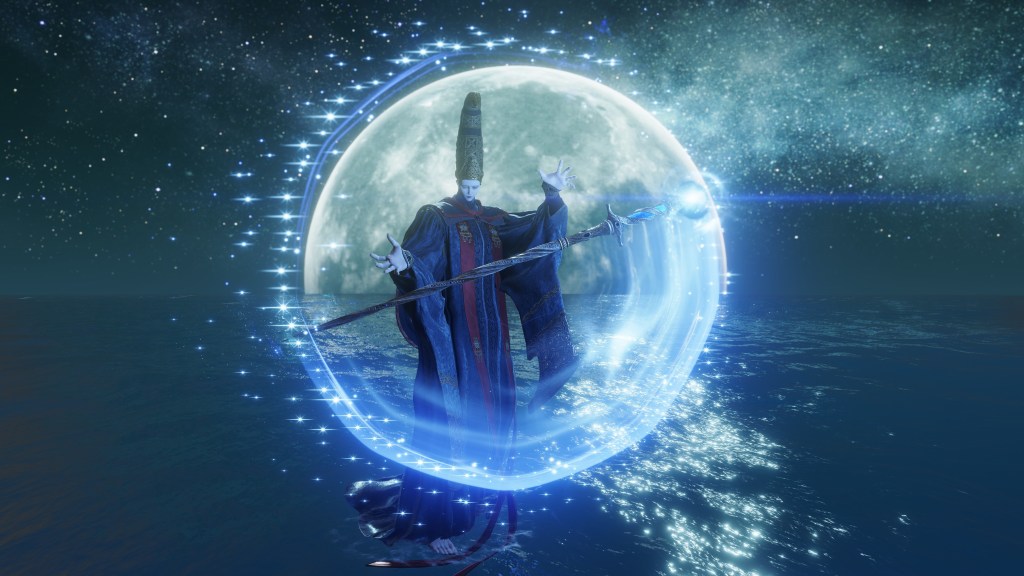
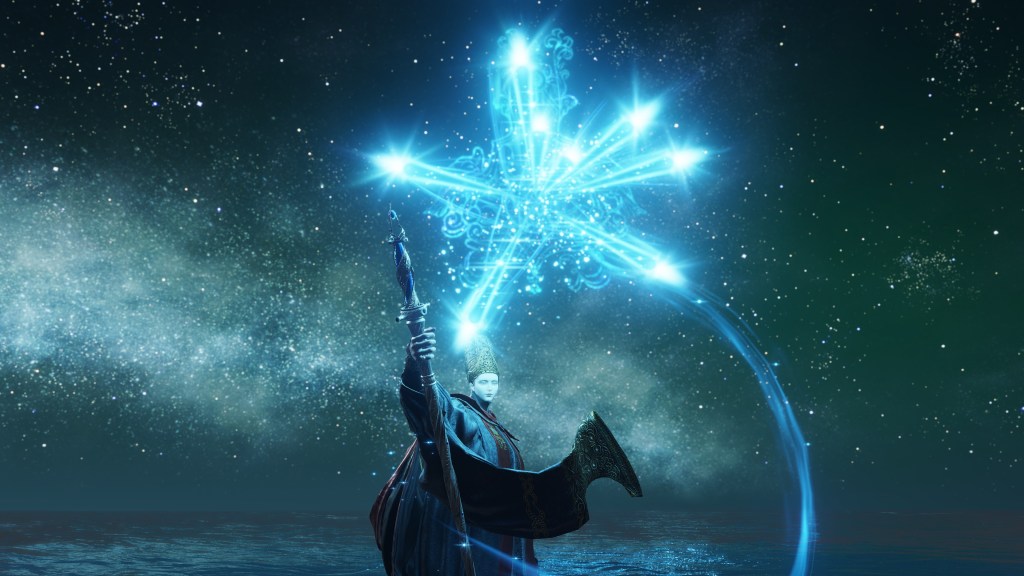
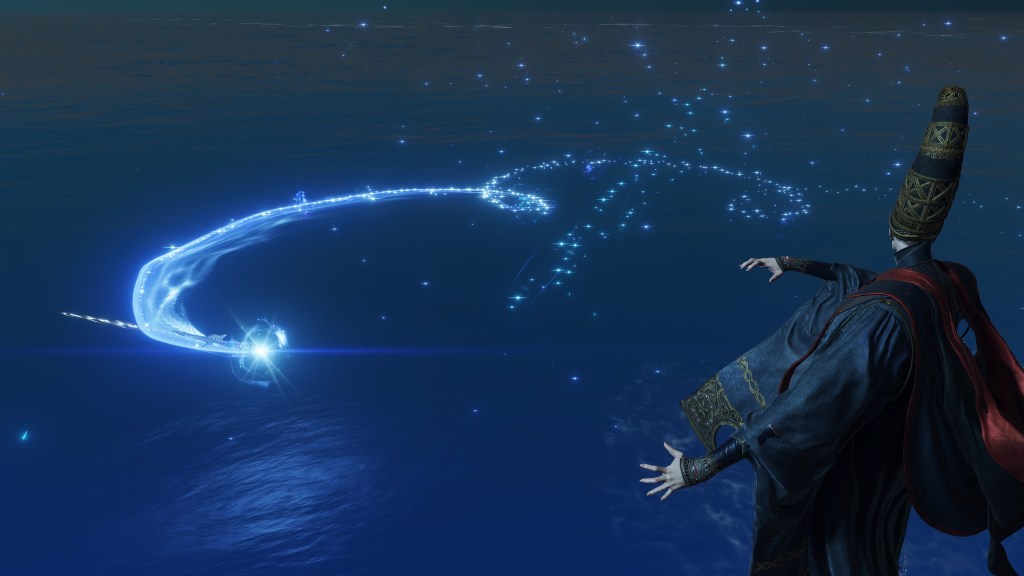
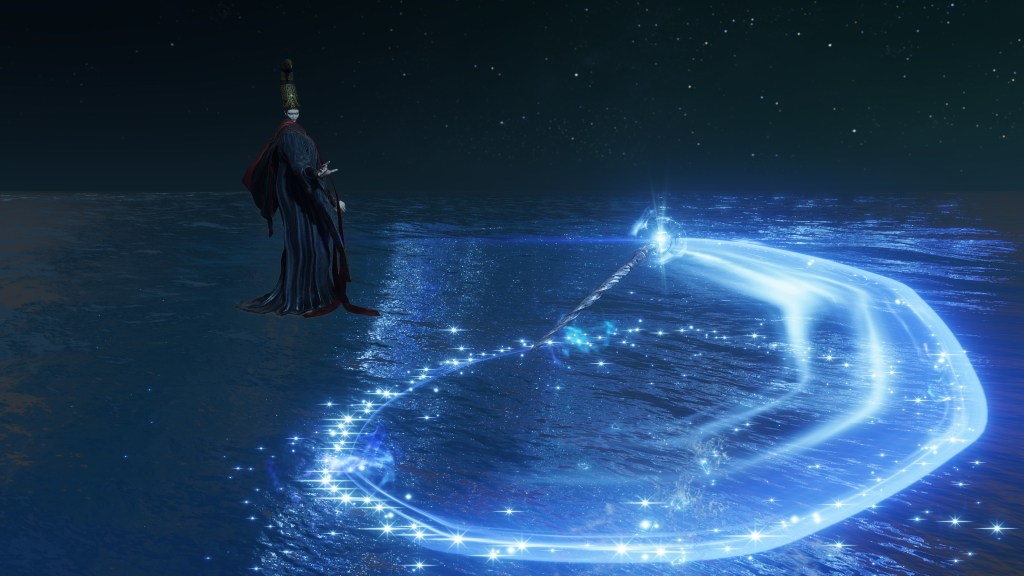
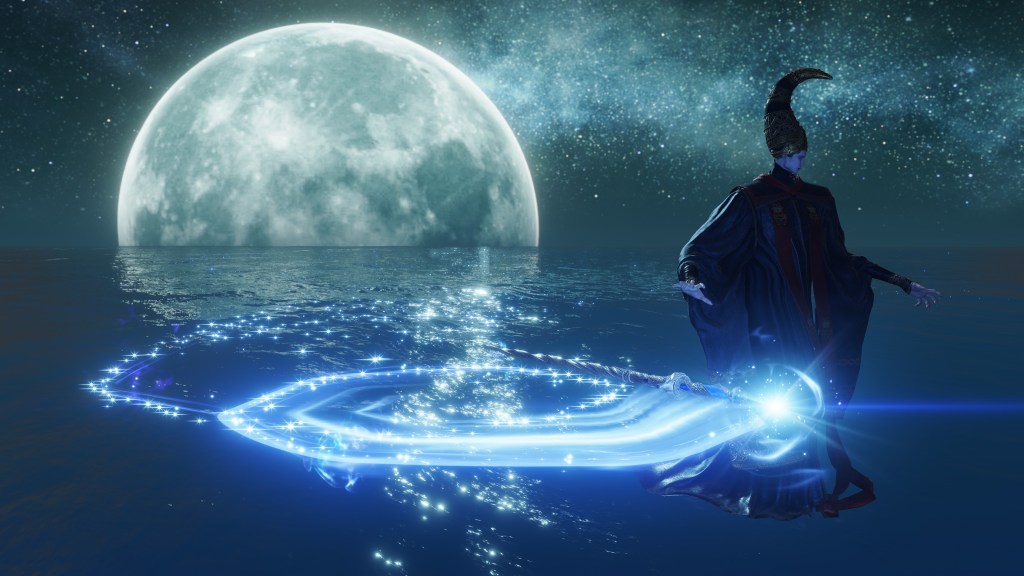
Rennala was originally just another astrologer of the village up north. The Stargazer Heirloom captures the legend of the future queen, always walking the land whilst looking up at the night sky just as her ancestors before her had. At the end of her wandering, the girl encountered a full moon, which we can trace to the snowy peaks thanks to the owner of the Greathood. The person died wrapped in that burial cloth upon confirming that she looked up at this moon as it still appears for us in the mountaintops area. The deceased’s fate is appropriate since the cloth sacrifices HP in exchange for greater intelligence and faith — seeing is believing for a stargazer, especially when it comes to royalty’s legend. But more importantly, it emphasizes the seminal importance of Rennala’s meeting with this heavenly body. Among the stars, the full moon stood out to uniquely Rennala. Perhaps it had chosen to reveal itself to her, or perhaps it was pure chance. Either way, the beauty and power the astrologer gleaned would inspire her to craft a sorcery surpassing any other, one which summons that very moon.
Talisman engraved with the legend of the queen. Boosts intelligence.
The stargazing girl walked looking up at the night sky. Ever, ever did she travel pursuing the stars. And then she met the full moon and became queen.
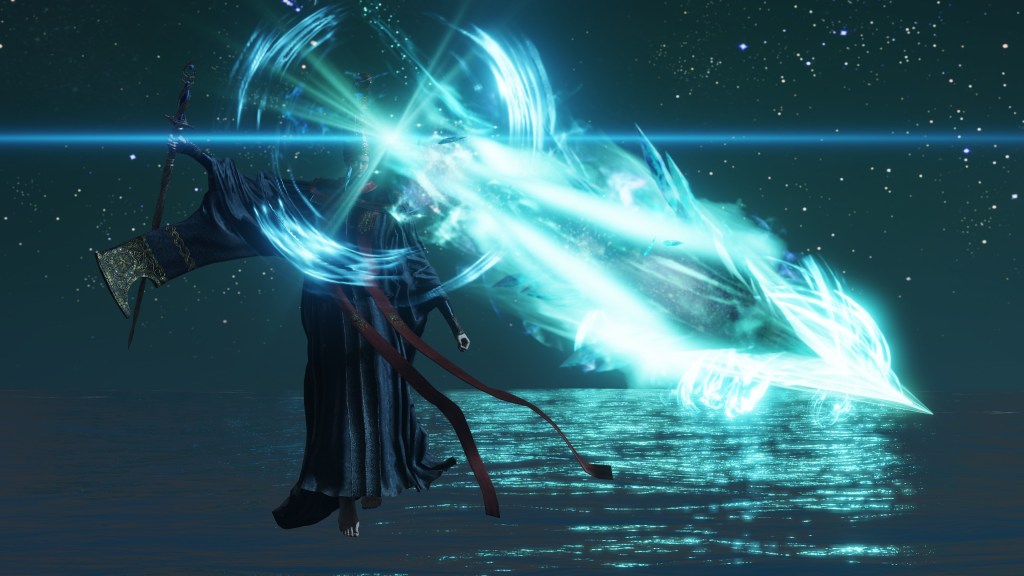
Sorcery serving as a symbol of the Caria queen.
Calls a full moon to oneself and directs it at the enemy. The full moon nullifies all sorcery it touches and temporarily lowers the magic cut rate of those hit.
It is the beautiful moon that Queen Rennala met in her very younger days and later charmed the academy.
Hood far bigger than the head. Apparel for dying, wrapped in it when he met the truth he sought after.
Boosts intelligence and faith in exchange for HP.
Ah, very young Rennala certainly looked up at this moon.
Rennala wasn’t alone for this incident, as her younger sister Rellana had also been present and witnessed a second moon overlapping with the first. These “twin moons” inspired the girl’s own sorcery, summoning both to drop in quick succession. Based on the name and description, the moons reflect the sisters; Rellana was Rennala’s twin, always nestling close, never far behind wherever the older sister walked. This allowed them to share in this magical moment, one which apparently afforded them the knowledge to make leaps and bounds with glintstone sorcery. Considering that moon sorceries have the highest intelligence requirement of any, the girls’ talents shouldn’t be discounted, especially at their age. Item descriptions repeatedly affirm the twins as “very young” during those days, (幼き日) terminology which suggests that they may have been as young as small children at the time. Even assuming that they were in their teens, it still speaks to the girls’ enlightened comprehension compared to their peers.


Sorcery of Rellana, Twin Moon Knight. Symbol of one who is princess of Caria.
Calls twin moons that overlap with self and lets them fall to earth continuously, one by one. They violently shake the earth with moonlight.
The moons that she met alongside her older sister Rennala in their very younger days. They were overlapping as if nestling close.
The two must have shared this discovery with their family. Before their lifetime, the Carian bloodline remained at the village in spite of past migrations. Why then did the family who passed on earlier opportunities suddenly depart for the lowlands? The answer lies in where they ultimately settled. Rather than join Laskyar, the Carian migration headed west, settling atop a mesa called the Moonlight Altar. There, where blue rays shine down in a permanent night sky, we find two ruined settlements belonging to “moon citizens” (月の民) or “nobles”. (月の貴族) Combine that with the grand cathedral at its highest point, a large hemicyclium on the cliff just outside the north transept aligned beneath the full moon. If mass involved performing such stargazing ceremonies as part of its religious rituals, then this “altar” was established for astrologers to study and revere the moons specifically. Add to that, the map for western Liurnia acknowledges the Carians’ deep connection to the whole region in its description. This was their home, before moving into the royal manor.


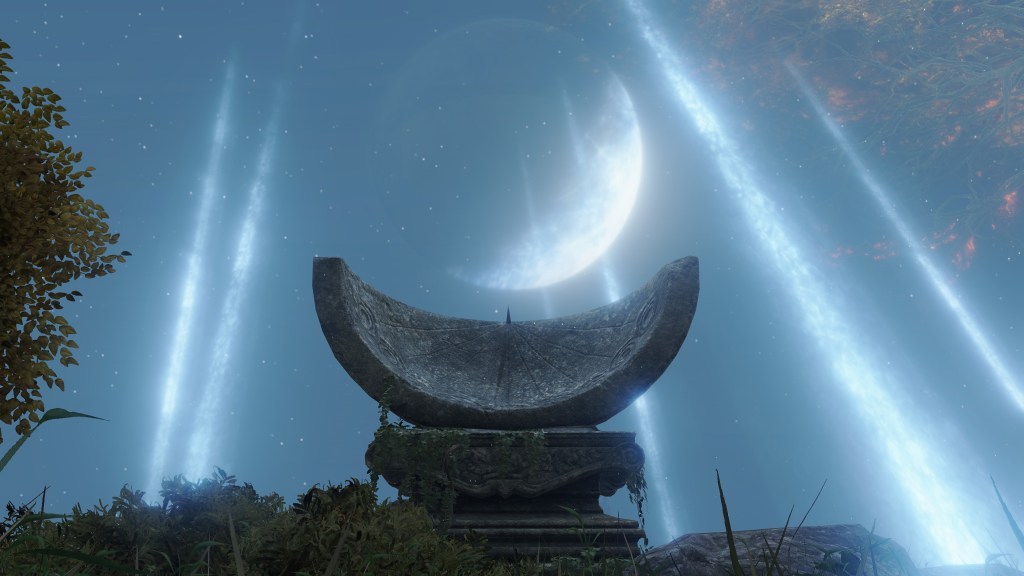
Map fragment of the western part of the land of Liurnia.
More than half of Liurnia, known for its vast forests and daytime fog, has sunk into the lake, and its west bank is deeply connected to the Caria royal family.
In short, the Carians and others created a new stargazing community out west, motivated by the moons the youngest among them had come across. Surely, this wasn’t a coincidence. The young Carian ladies had most likely showcased their new abilities after revealing the story of their encounter. With each sister corroborating the other’s account, their testimony was hard to deny, and the sheer power of their moons was incontrovertible proof. Many astrologers in their tiny village were bound to be fascinated by these mysterious stars and would follow the Carians wherever to glean more about their nature. The question then is why choose to create a secluded community closer to Laskyar, rather than simply take over their mountaintop village? Perhaps they saw Rennala’s fate writ in her full moon and knew that they needed to be elsewhere. It is also possible that they required a new location to better examine these particular stars, the moons making their presence known to such a degree solely on the Moonlight Altar. Either way, Rennala was already taking the lead of her family.
Even from a very young age, the future queen exhibited an interest in control. During battle, the woman invokes oaths, summoning phantom projections to attack on her behalf. These include a pack of wolves as well as a troll. With both existing on the snowy heights, it is feasible for the queen to have bound them to such magic before the move to Liurnia. To this point, trolls who later became her knights are described as “oath friends” of the “very young” Rennala in the text to Greatblade Phalanx, all but requiring the oath be made before her leaving. Evidently, the girl was doing more than just stargazing as she trekked through the snow, befriending the individuals she came across. As friends, she earned their promise of protection, perhaps to help as she continued exploring a land fraught with dangers. The wolves especially had likely been first to show such loyalty to a stranger, as the Wolf Crest Shield depicts the beast of the oath as a symbol of Carian pride, standing tall beneath the twin moons. They cleared the way to Rennala’s encounter, and so the contribution is preserved in Caria’s memory.

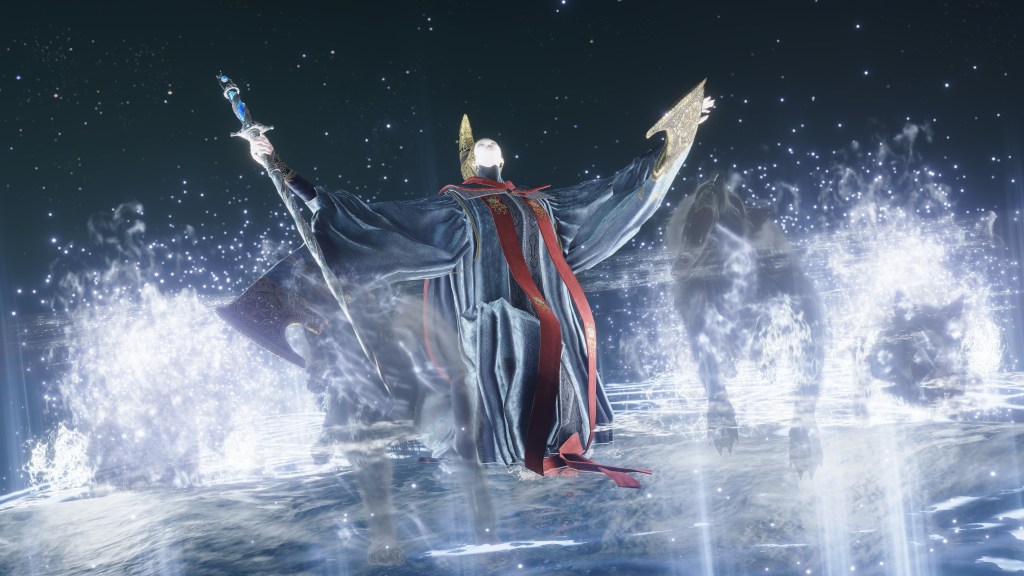

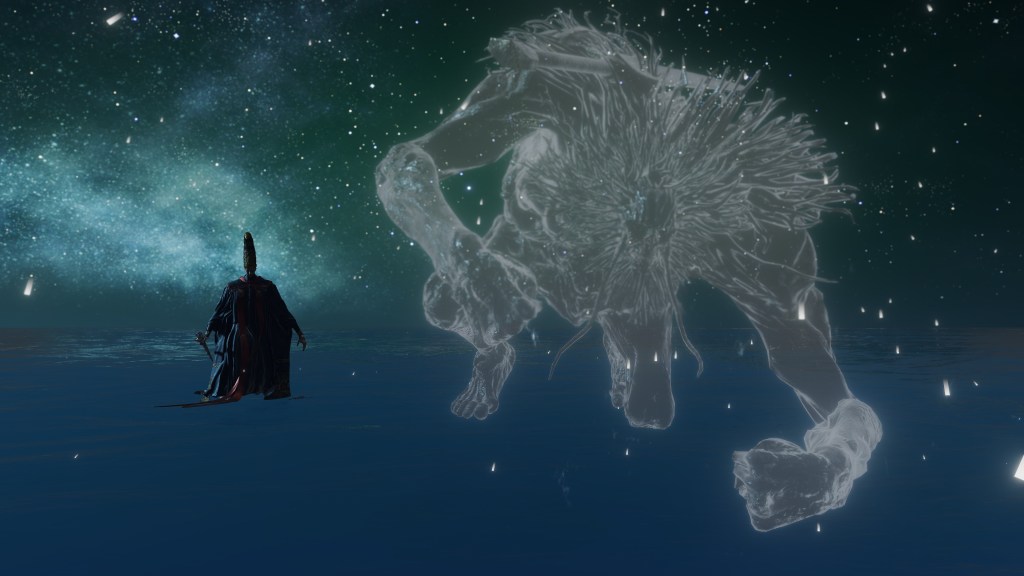
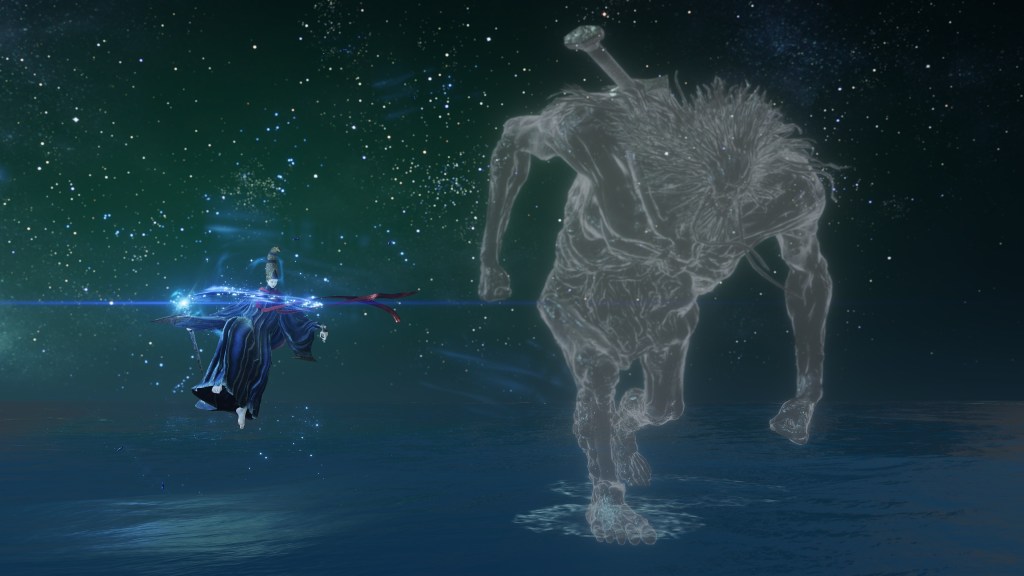
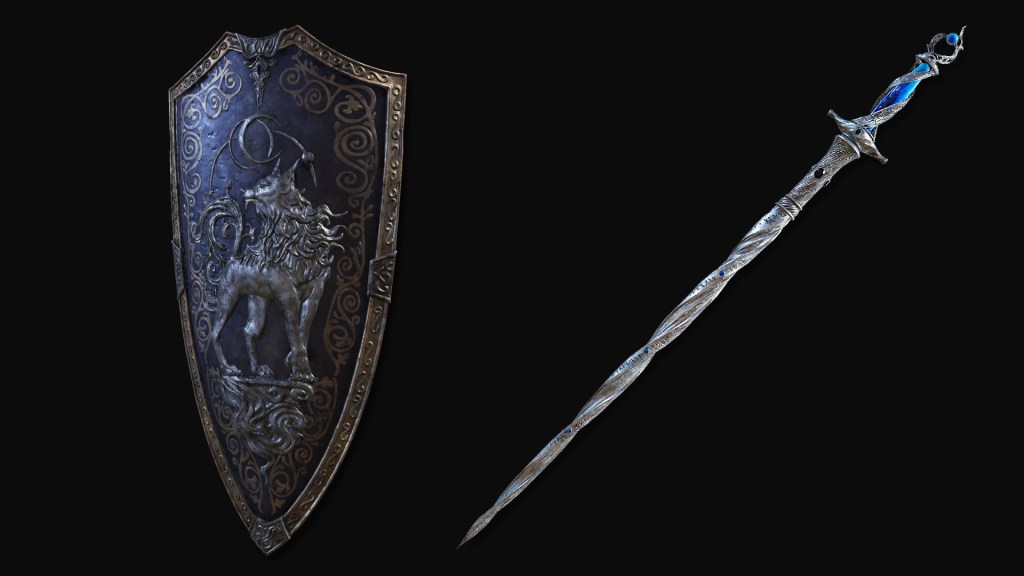


One of the sorceries of the Caria royal family.
Deploys circular formation with giant magic brightswords. The brightswords automatically fly toward enemies nearby.
Thing the troll sorcerer knights used. They were oath friends of the very young Rennala.
High-quality shield inscribed with a wolf under the moon. Blue shield excelling in anti-magic.
It is the beast of the Caria royal family’s oath and a symbol of the moon’s pride that will never be forgotten even in a distant land.
Suffice to say, Rennala was a charismatic person, attracting the likes of her twin, animals, neighboring giants, and eventually a plurality of her clan to rally behind her. Given her natural beauty and impressive intelligence, the coinciding sociability isn’t a surprise. The use of magic oaths likewise hints at an impulse to command, binding others to your will as a show of sincerity to the relationship. Already, she had the makings of a queen, using honor as currency for personal ends. Nonetheless, she was still a young girl and doubtless needed more time to both develop her craft and mature as a person. The Moonlight Altar gave her that environment, everyone wholly dedicated to deepening understanding into these strange celestial bodies. As a result, we see her queen’s scepter inserted with “Carian Blue” which enhances their lunar arts, blue glintstone in general becoming standard for Carian sorcery catalysts. Besides, a change of scenery would allow for new friends.
Sorcery scepter of Rennala, Queen of the Full Moon. Its brightstone is called Caria Blue and enhances full moon sorceries.
To enter the area, we take the Deep Ainsel Well from Nokstella, crossing the Lake of Rot in between. The Eternal City stands out for the amount of glass smithing stone from the northern mountains present, several of which the resident Nox store away. This begs the question: how did they come to acquire it so far and away underground? The answer, it seems, is that the stone was brought closer. Moonlight Altar also has glass stone, three kept in storage at the Lunar Estate — evidently, the Carian migration brought some of the high-grade rocks with them from home. This opens up the possibility of contact, and trade, between the Altar and Nokstella. To that point, more stone does exist in the Lake of Rot between, along with one draconic stone and rotted conifers. Add to that non-magic candlelight from the deep well plus two saint statues face-to-face at Nokstella’s exit to the lake. No other Eternal City employs this icon, but we do see the Carians adopt it at their own cathedral. Conversely, the magic sigil Carians adopt as the family crest draws heavy inspiration from the sigil for Noxian sorcery.
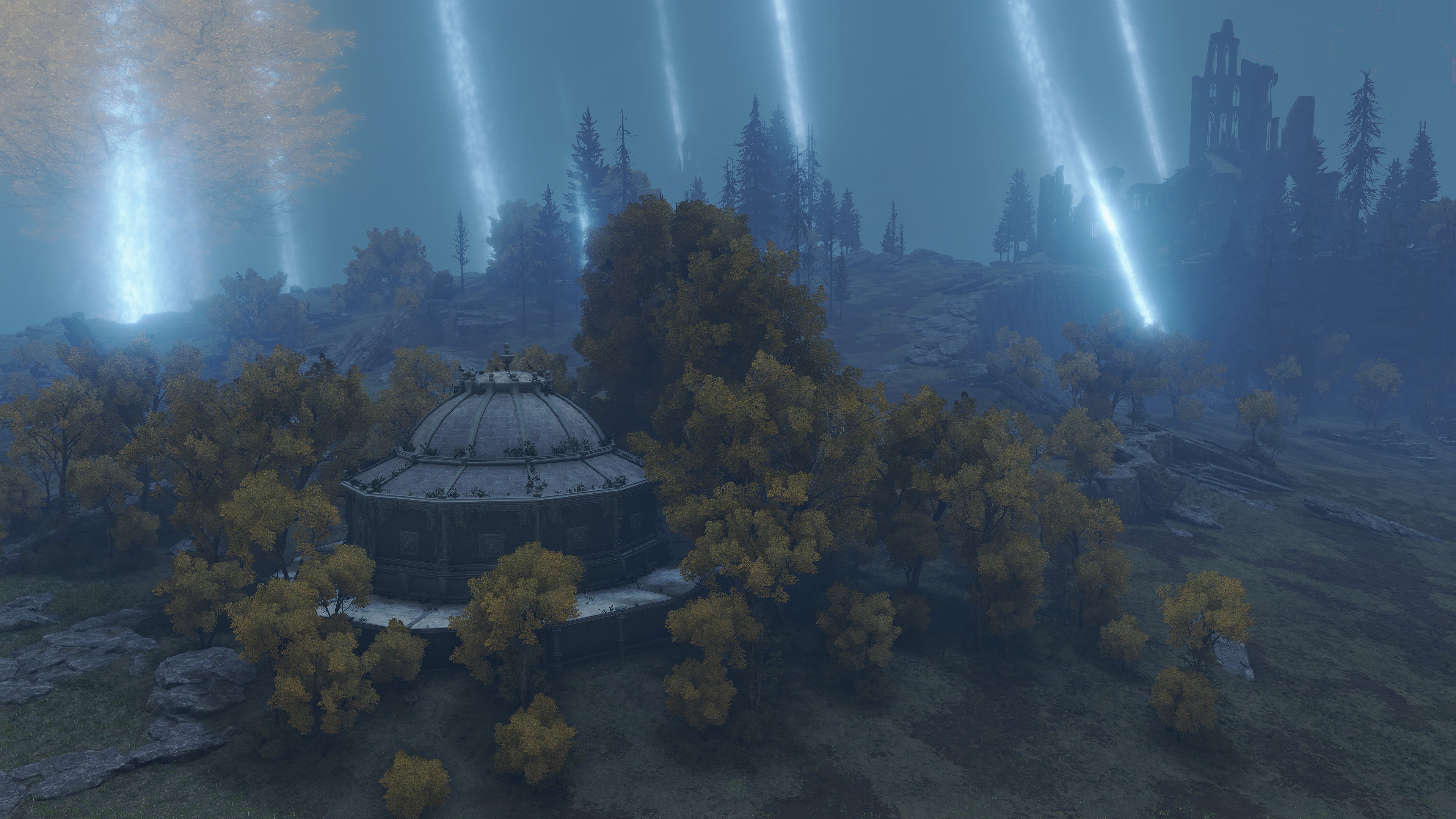
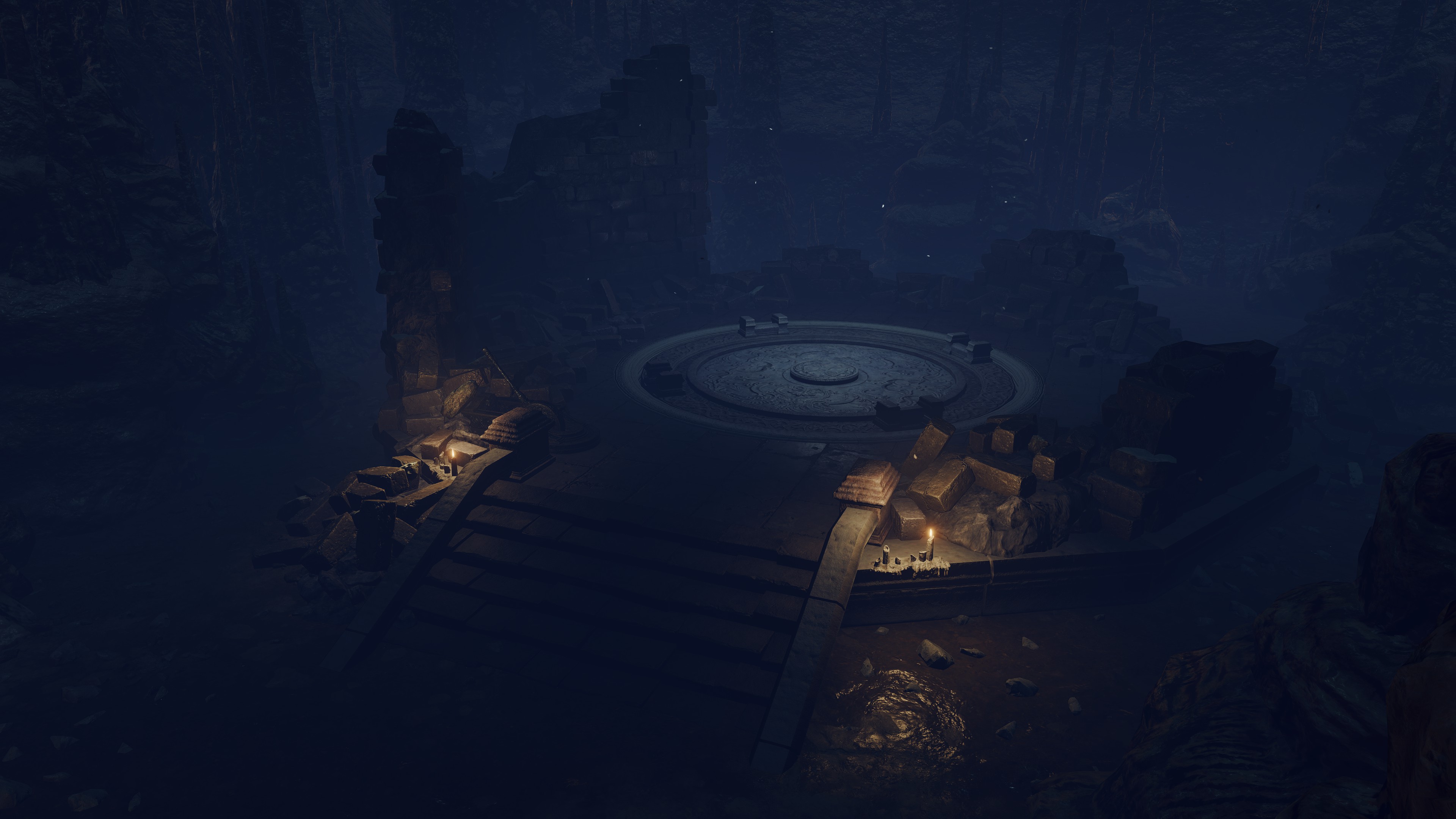
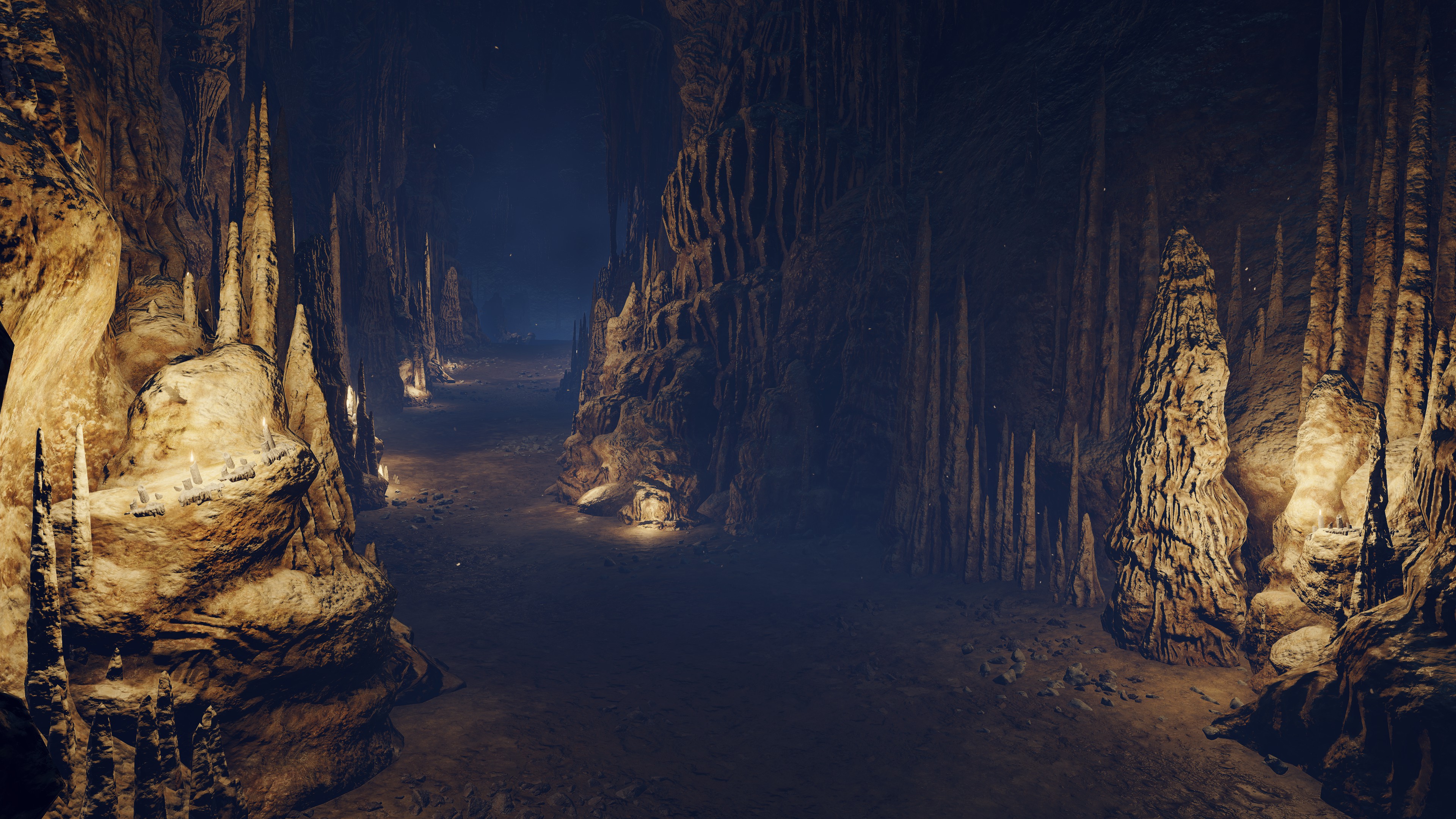
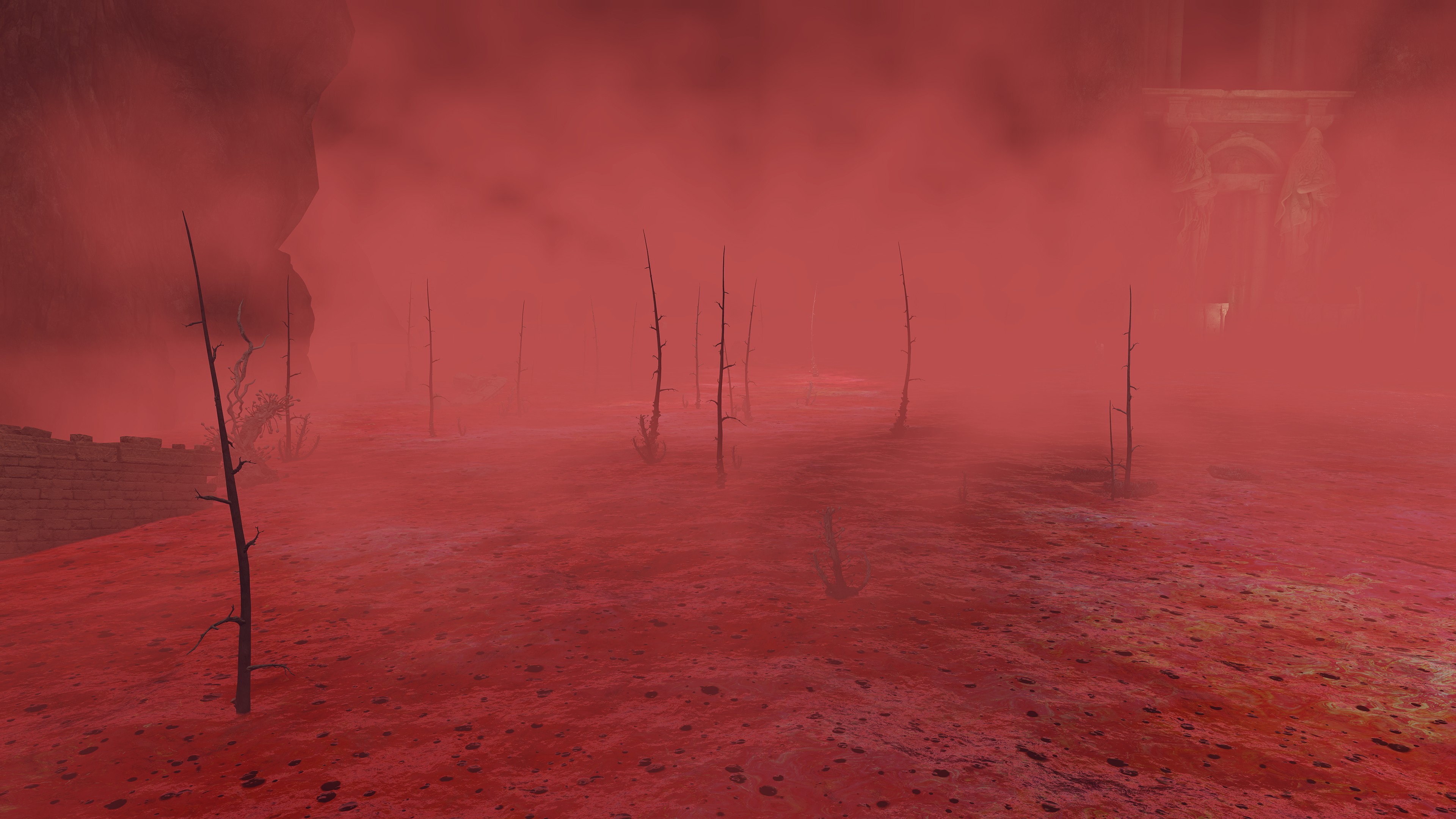
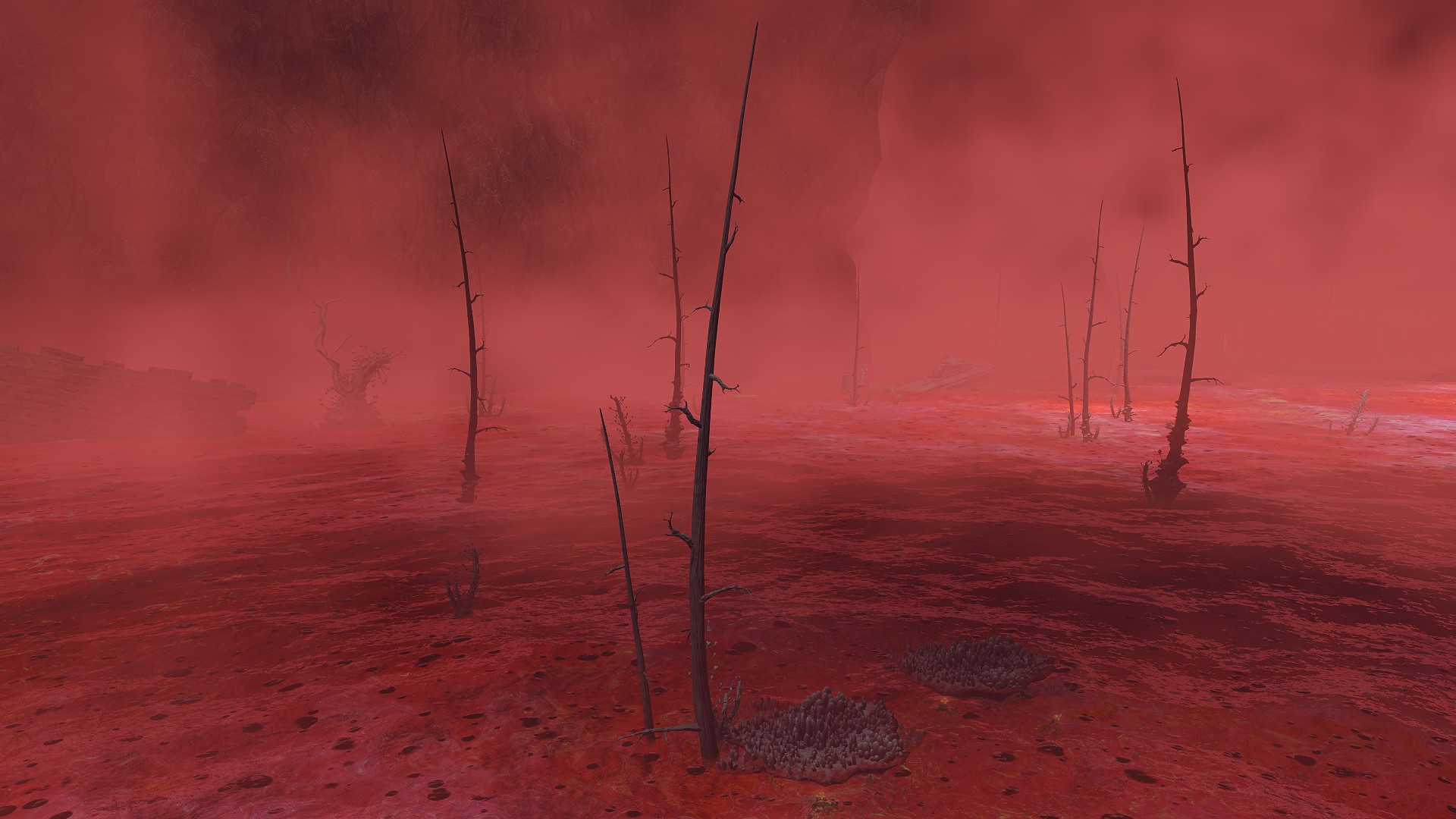
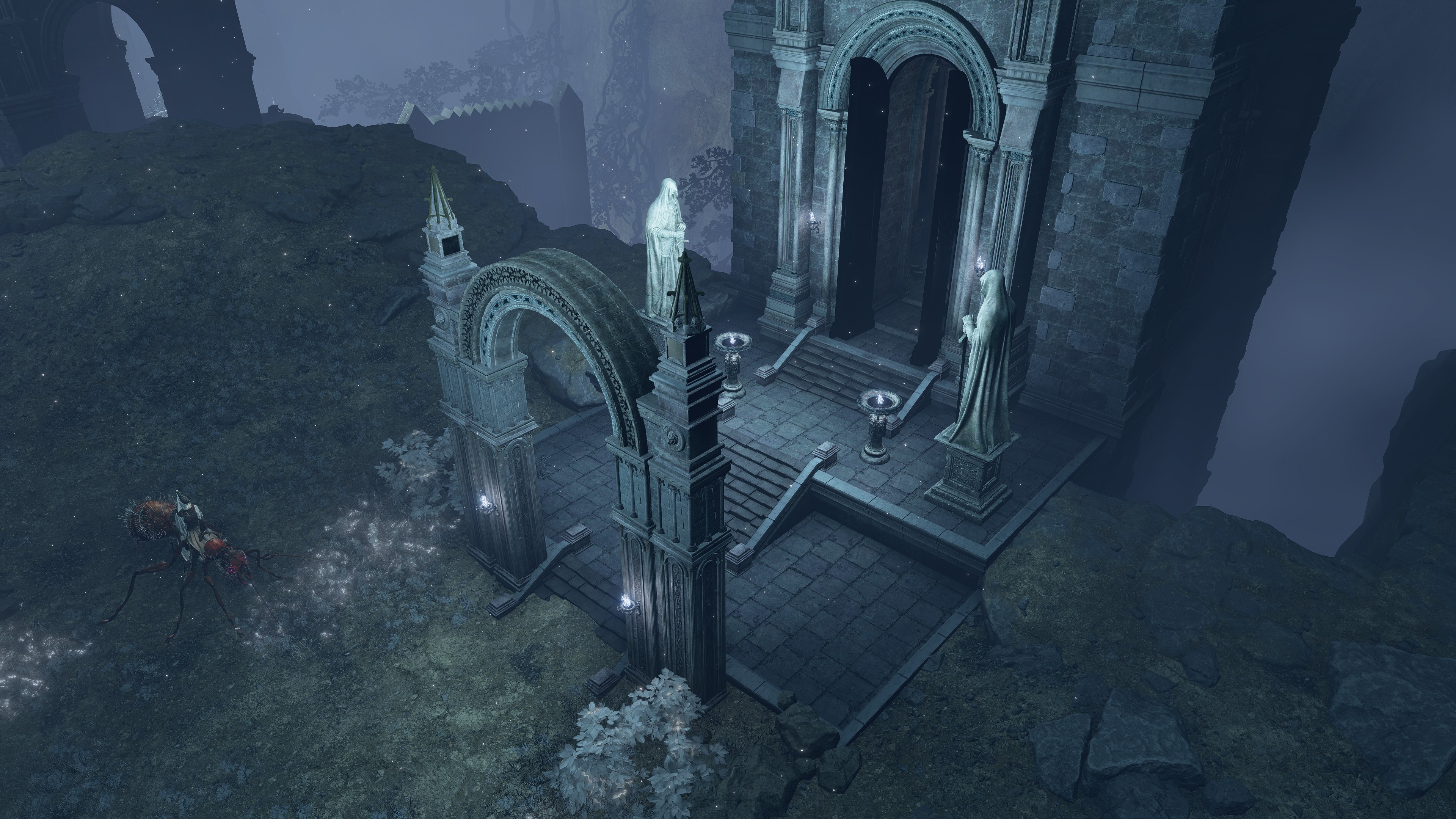
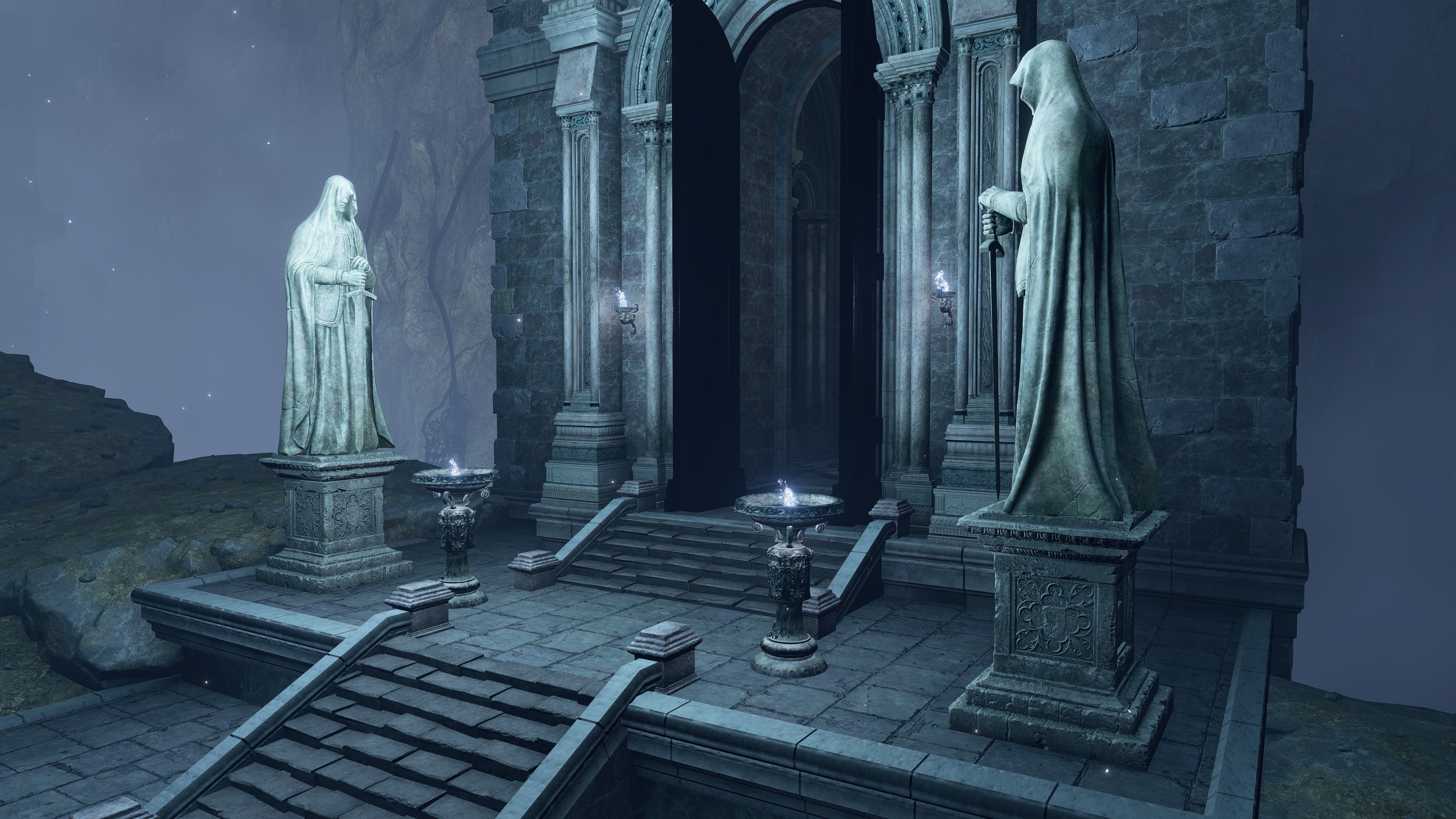
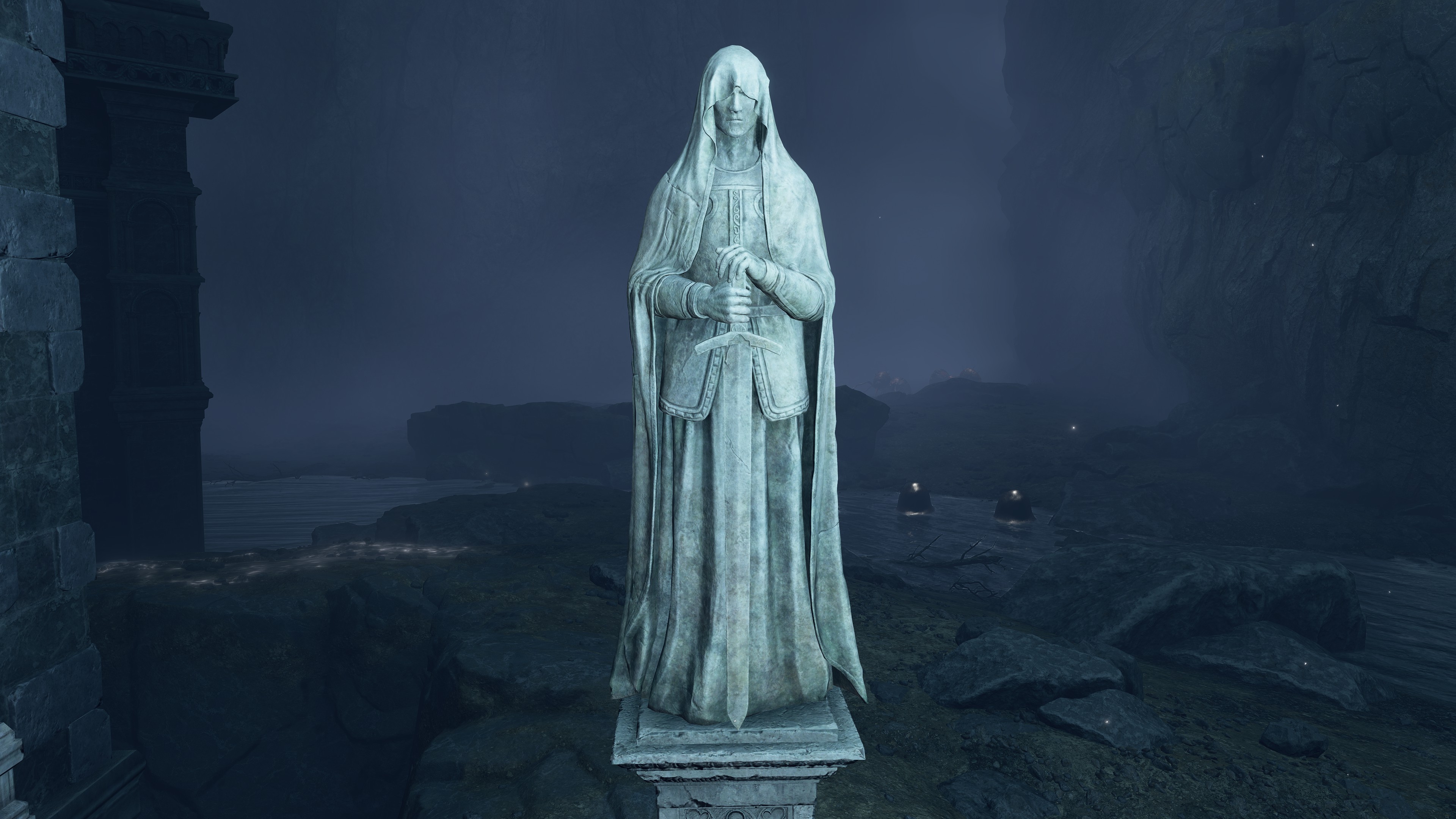
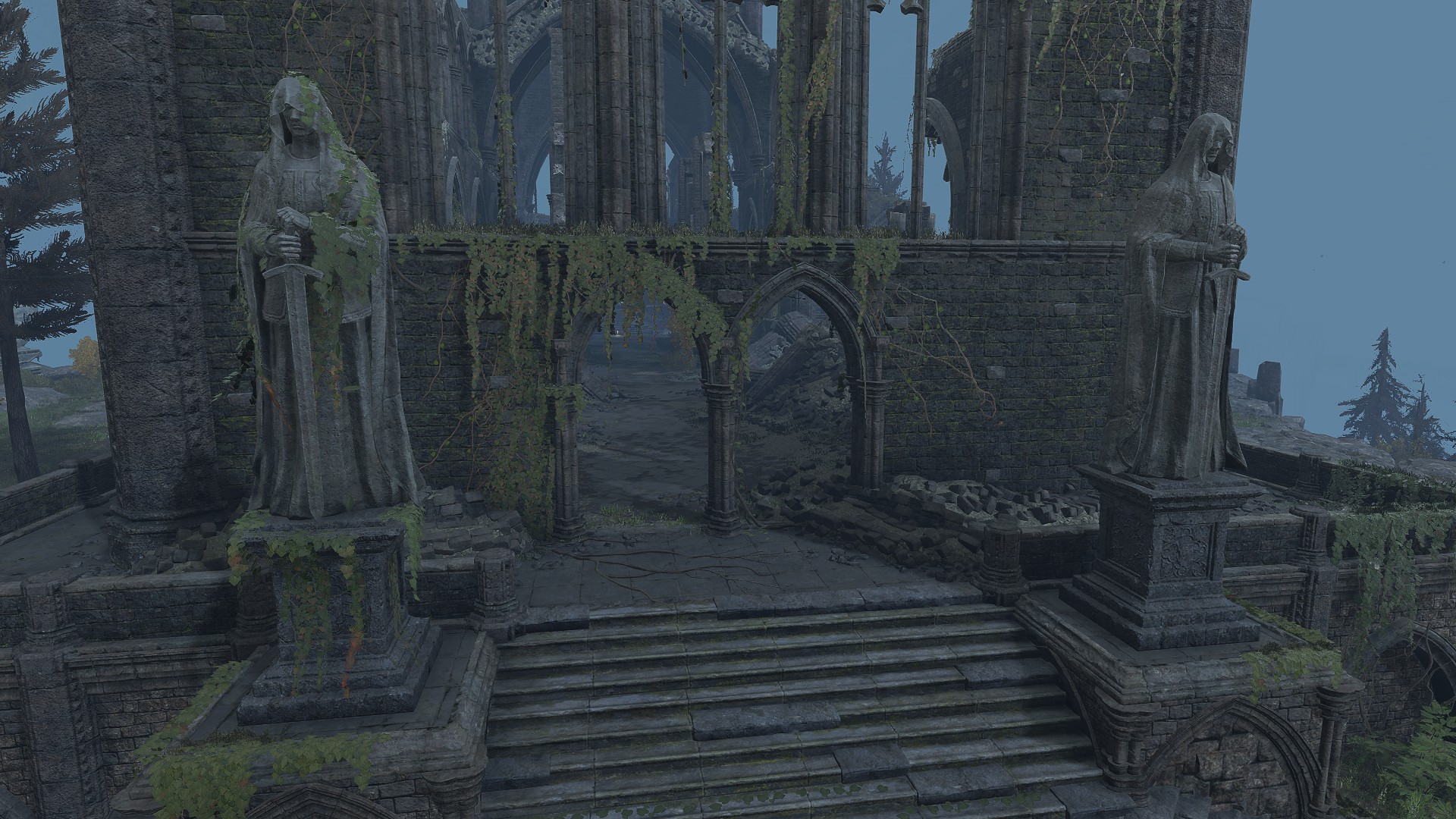
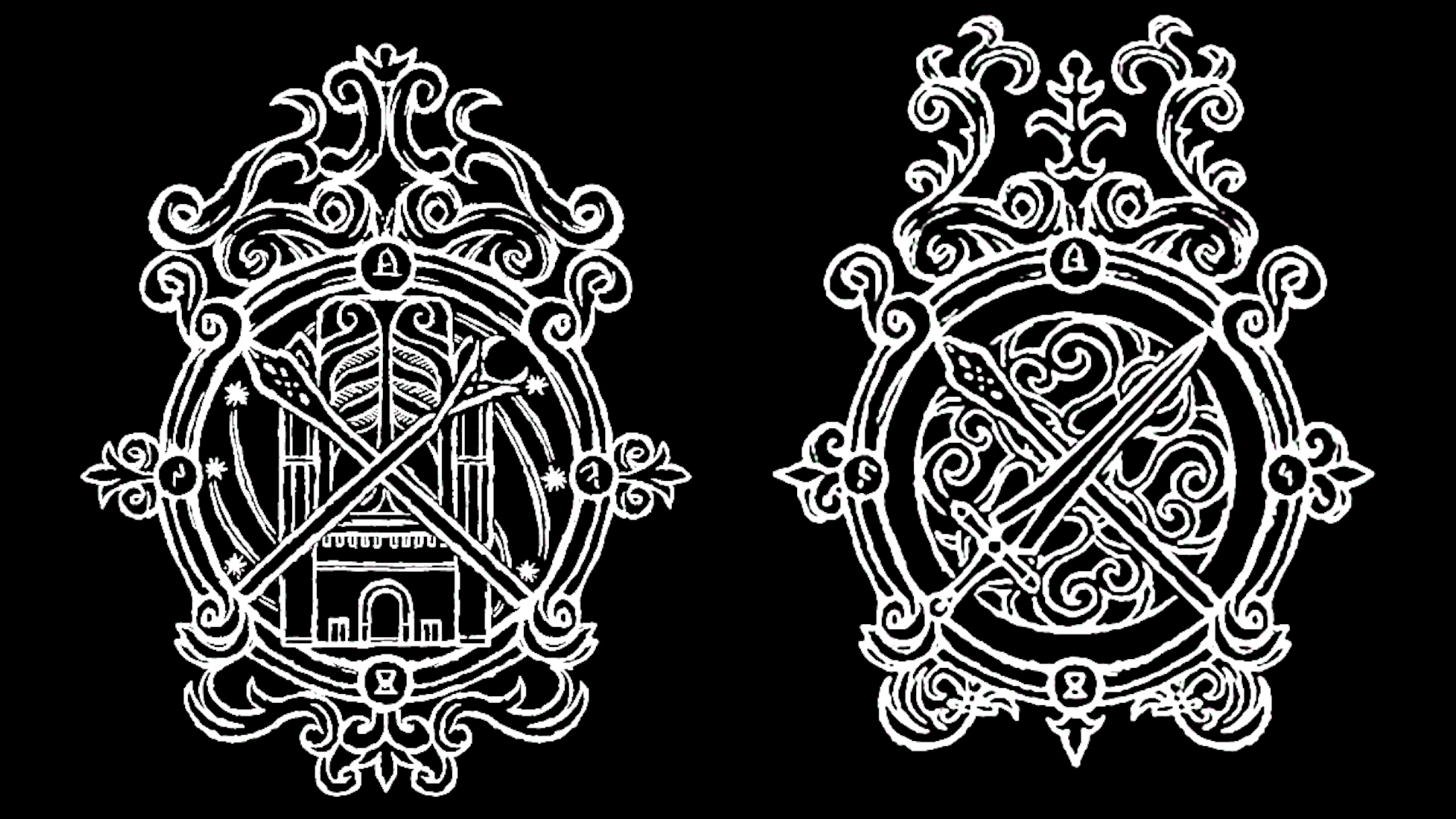
Put simply, the Carians had likely explored down the Deep Ainsel Well and established relations with Nokstella, the Nox coming to associate the otherwise inconsequential route to one of their dams with moon worshipers from the surface exclusively. These frequent exchanges are presumably the source of memory stones finding their way to the surface, Nokstella dumping all the “useless” fragments of its black moon on the foreign sorcerers — who passed many on in turn until they spread across Liurnia and beyond; sorcerers retreating into their secluded towers for independent studies especially love to collect them, manufacturing the talismans as their secret treasures. It is no surprise that moon worshipers would take great interest in the “moon” known to the Nox, and that was likely just one area where the subterranean race benefited the Altar’s research. Carian-Nox interactions likely also contributed to the spread of waygate technology above ground. With so many possible benefits, they had ample incentive to part with some of their smithing stone.
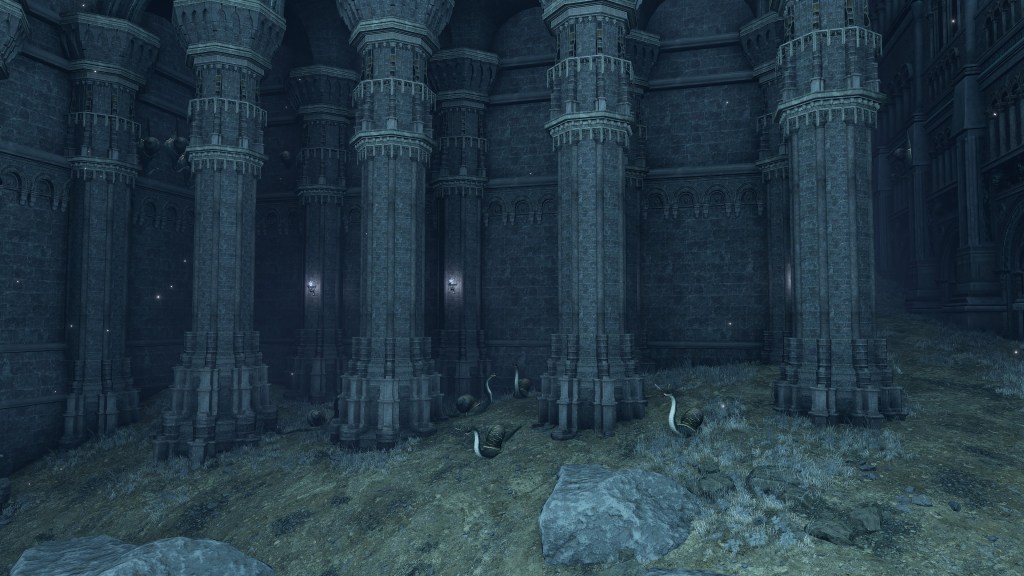
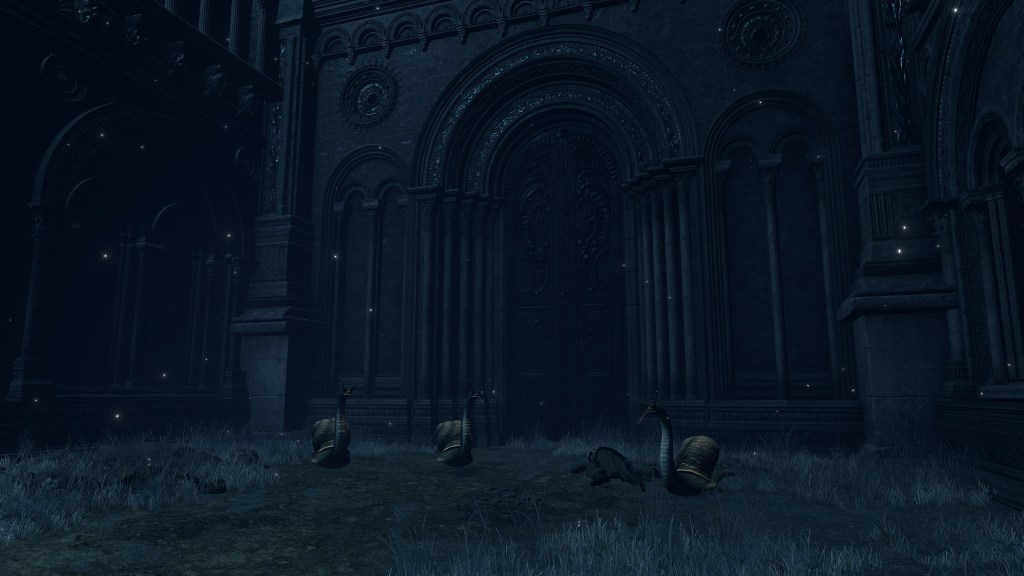
Not everything about this relationship was positive, at least for the Nox. For instance, a less desirable byproduct seems to have been pests, serpent-snails slinking in corners and alleyways of Nokstella like rats in other areas. Nowhere else do those serpentine creatures appear this deep underground, so like the glass stone, we can look to the Moonlight Altar to explain their presence. The Carian’s area is home to the crystal variant of the snail, persisting amongst the scant formations in the small wood. Just like rodents, the snakes probably slipped onto any trade caravans heading for Nokstella, where they scurried off unseen. Because the Eternal City lacks the same crystal formations, the species ultimately reverted to its base, venomous form, though the Nox doubtless care not for the difference. Still, a minor pest problem didn’t override the utility of this “friendship” with Caria. Even if the Nox were considerably more advanced, they saw enough value cooperating with the family and its allies to persist despite the hiccups.




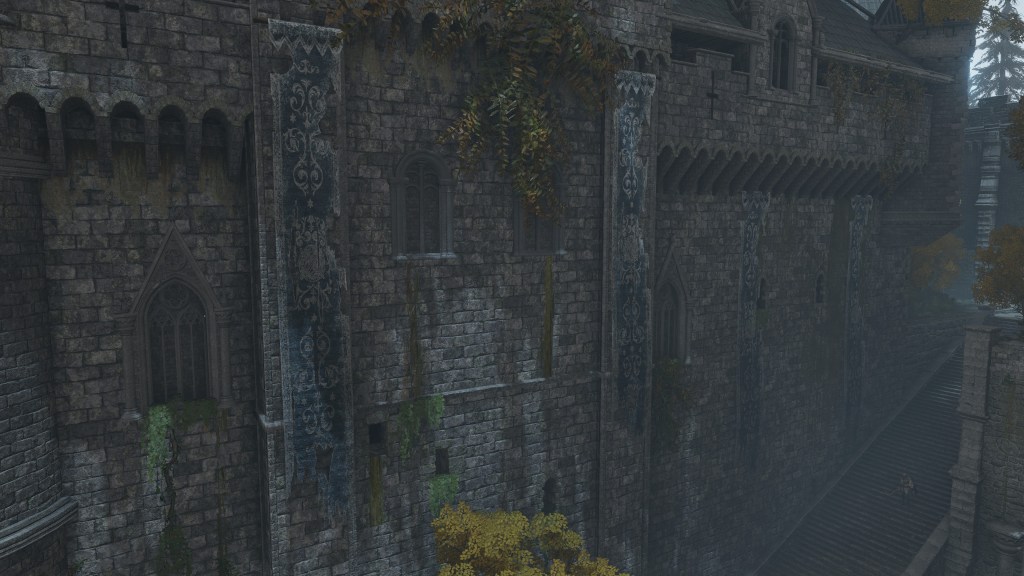
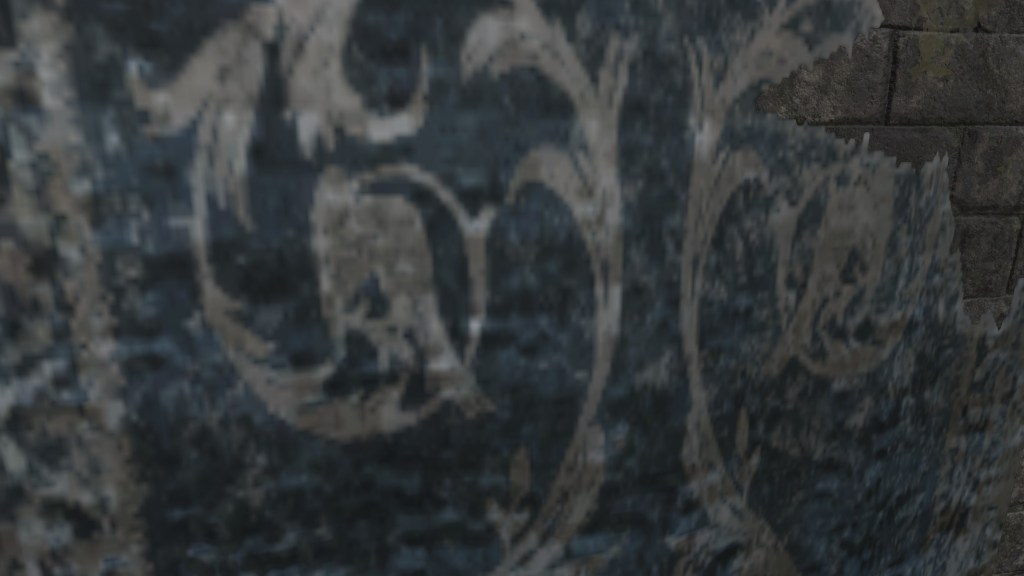
The Nox weren’t the only people the Carians were reaching out to. Upon close inspection, the Moon of Nokstella offered to their future Night Lord is topped by peering cuckoos. This implies that the talisman isn’t a homemade product of the Eternal City but actually originates from Liurnia — in other words, Caria. More than likely, it was fashioned as a diplomatic gift at the height of relations. This model moon encircled by gem stars holds twice the power of a memory stone and so can be viewed as a sign of gratitude — proof to the Nox that the sorcerers were learning from the materials they obtained for study through these relations. At the same time, the cuckoos highlight Carians’ integration into larger Liurnian culture, reinforced by blue banners in Caria Manor including the same symbol alongside the royal crest. Certainly, it was a waste to move so far from home just to learn more about moons. Any knowledge of glintstone holds potential value to their research. For that reason, the residents of the Moonlight Altar probably still engaged with Laskyar, the previous migrants in turn giving their future queen an education.
Rennala’s portrait hangs in Raya Lucaria’s Debate Parlor next to its other major contributors. While this painting includes her iconic crescent crown as queen and thus postdates her ascendance to royalty, this still suggests a deep and personal involvement in the academy, whom she first charmed with her moon sorcery. In all likelihood, she was originally a student herself. Indeed, beyond her full moon spell, Rennala conjures not just the academy’s elementary Glintstone Pebble but also the Star Shower and Glintstone Cometshard sorceries signature to the Olivinus and Karolos classes respectively. She even performs an art resembling Comet Azur, though the Sword of Night and Flame’s skill proves how this may be her independent invention. Other than that one example, the future witch appears to have learned all her non-lunar sorceries from school. The girl spent at least a few years attending, as it would be in the days of the more generically “young” (若き日) Rennala that the Full Moon Queen would emerge.



As Night Follows Day
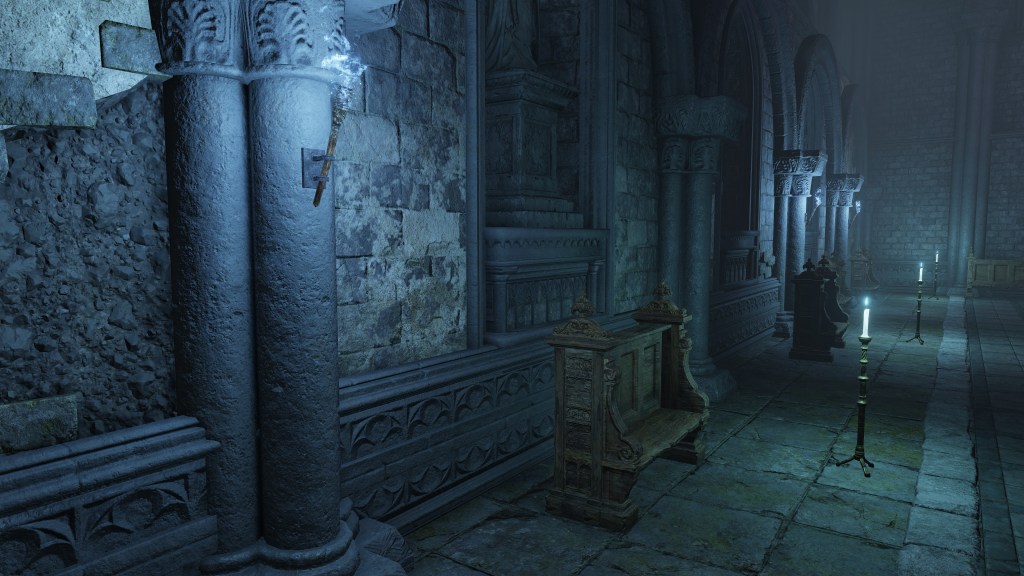
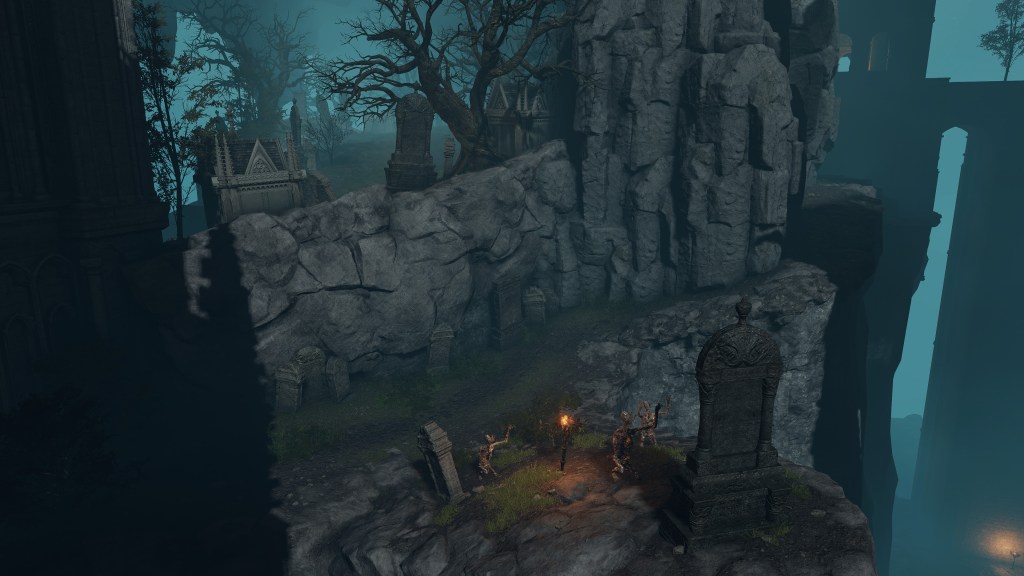
Split upon the northwestern ridge of Liurnia resides the Caria Manor, (カーリアの城館) a Norman-style “castle manor” like on Altus; only with added gothic elements. The castle chapel lays out a red rug with the golden beast crest at each end, more lion imagery incorporated into the wood architecture. Although this is common to chapels in similar castles, this one doesn’t enshrine a statue, but rather glintstone. Without a doubt, masses were held to advance sorcerers’ craft, hence the library maintained downstairs otherwise used for storage. That being the case, why use Serosh’s symbol? It has no meaning to lowlanders, the same the “hawk” levers for lifts. Another oddity is the graveyard in the middle of the manor among the clifftops. This doesn’t bury the royal family since they have their own cemetery outside the castle walls. Neither are the dead respected given the number of living jars in its midst, which we see used to collect the flesh for study at the academy. Such grave desecration is unlikely to be related to Caria. It must be graves for people of low status, either servants or previous occupants.


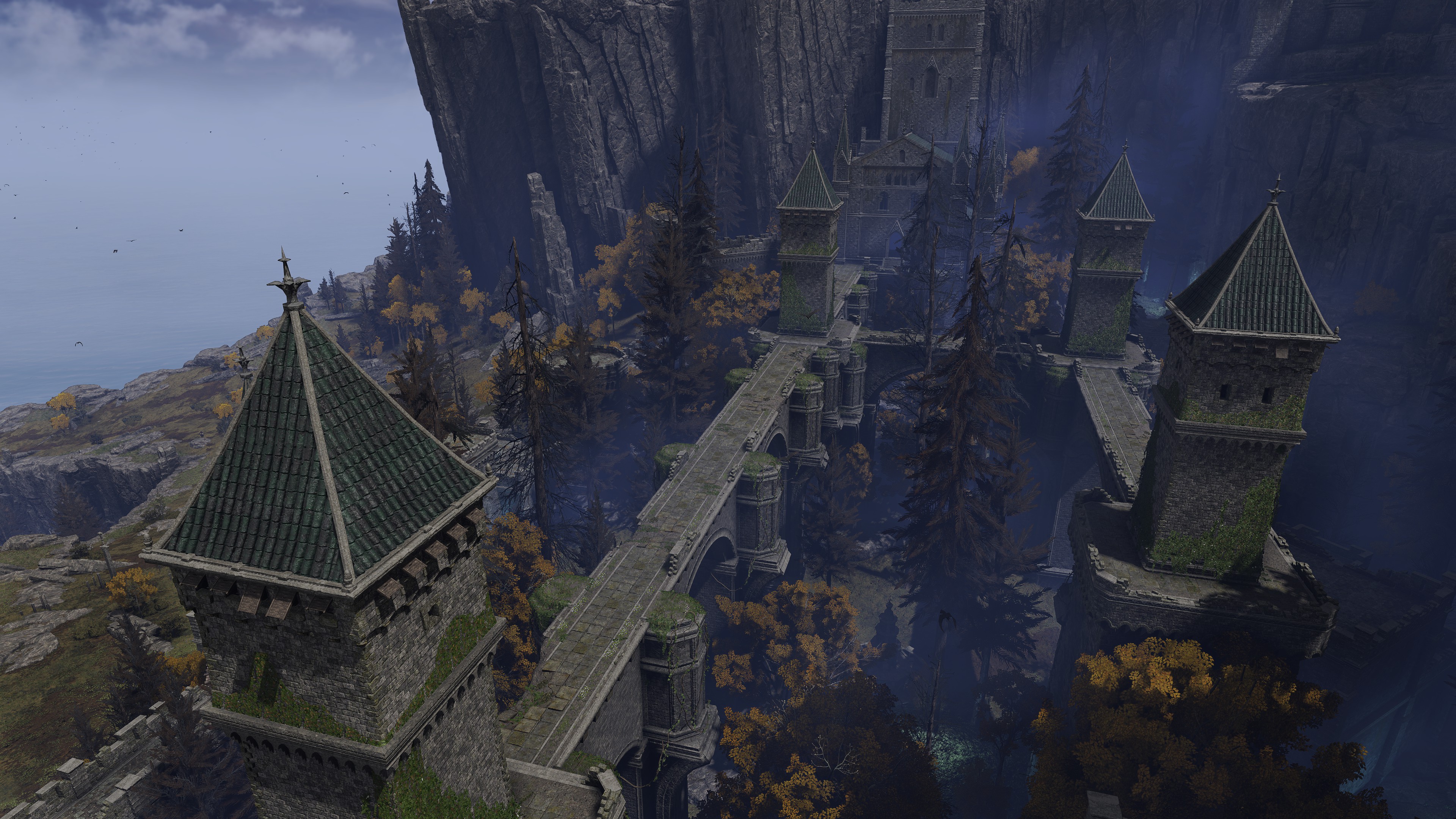
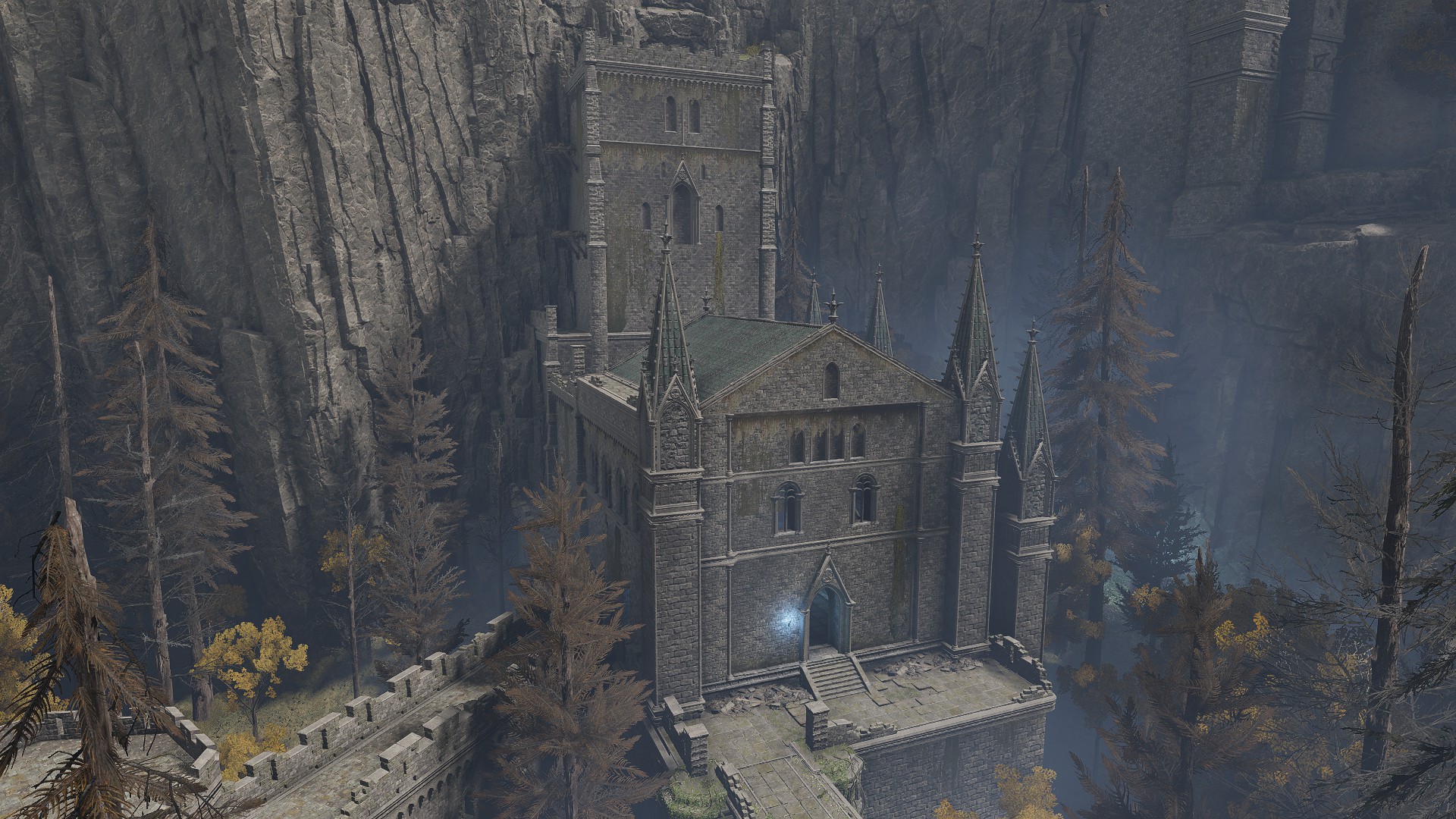
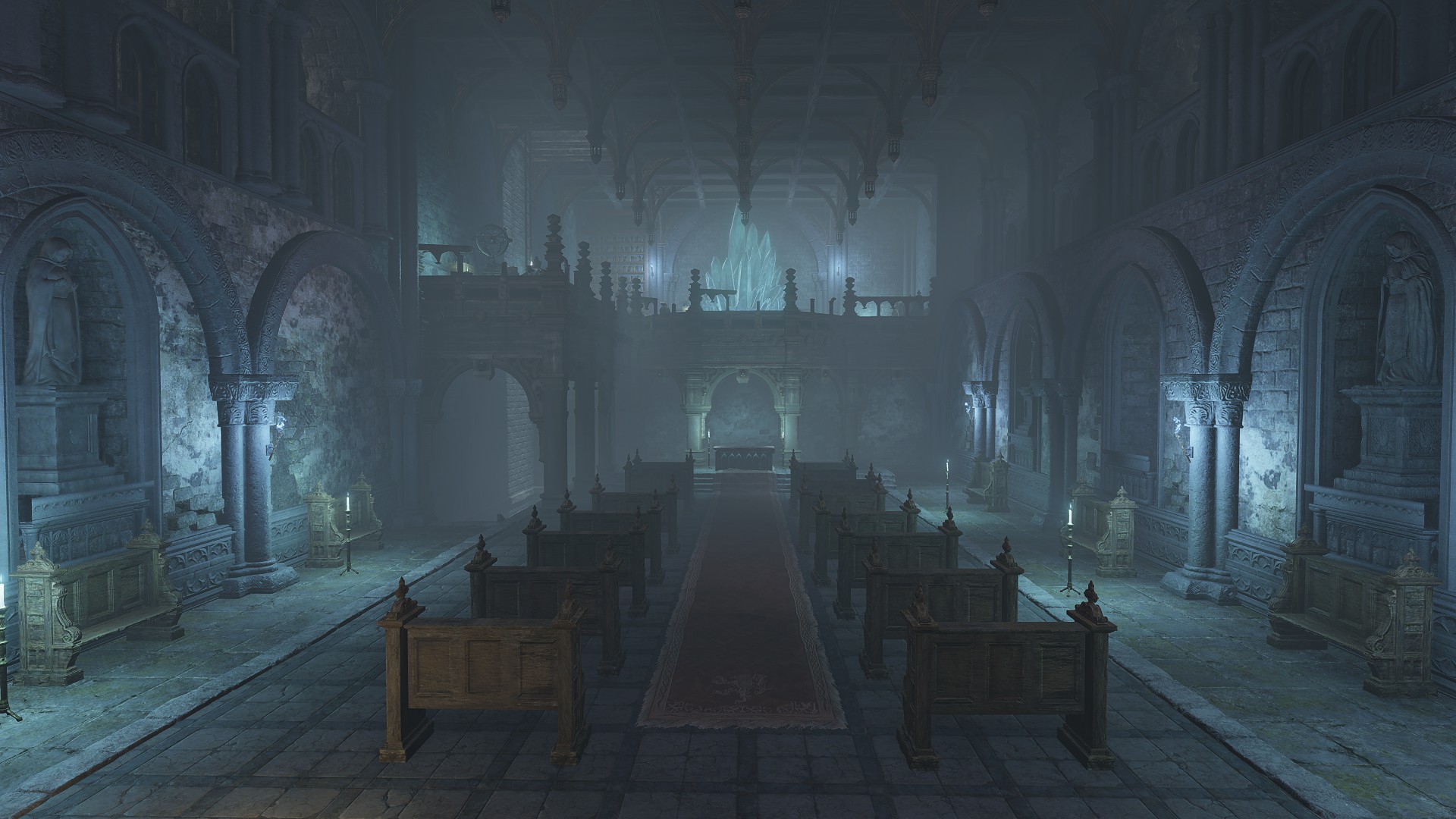
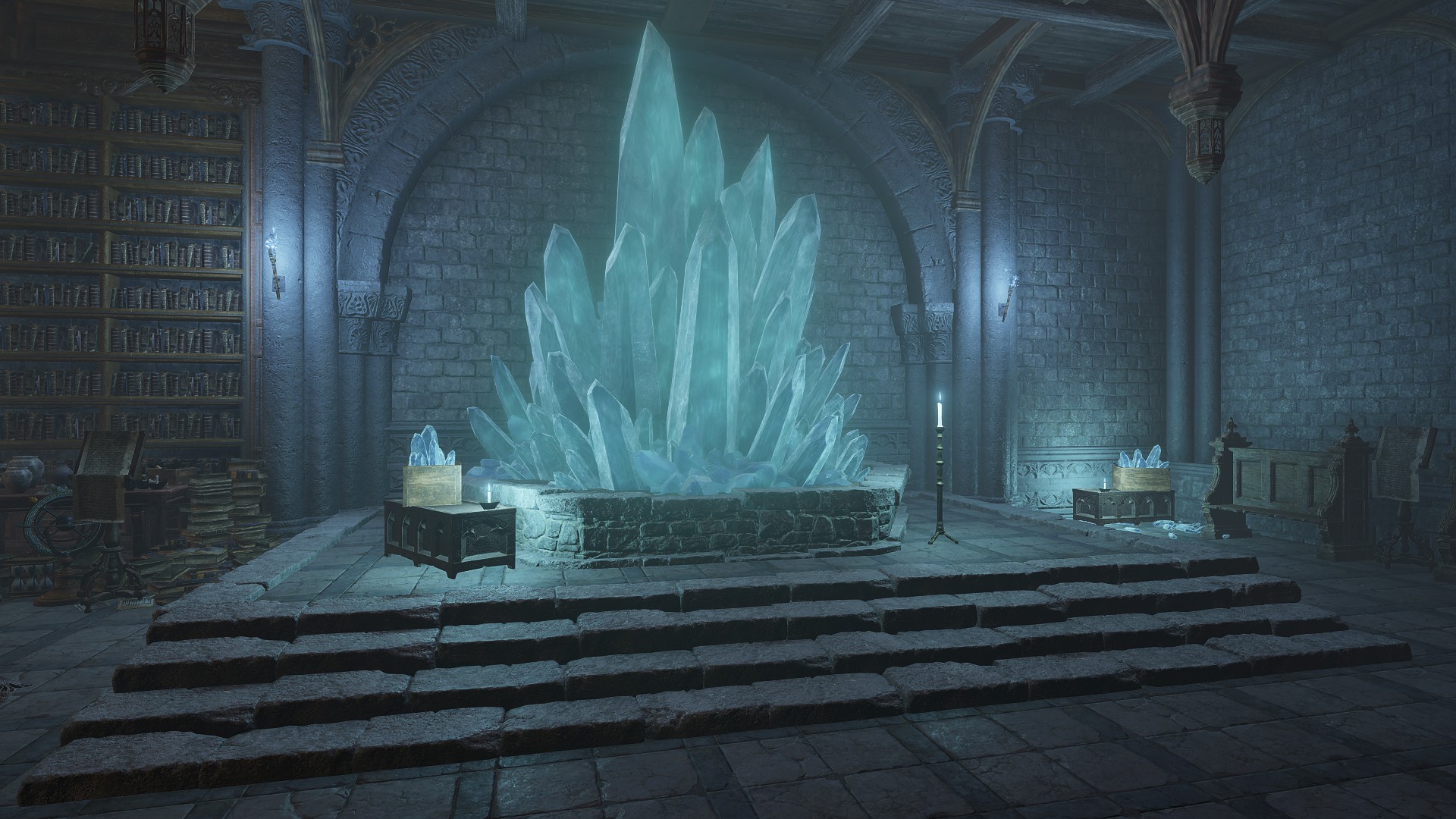
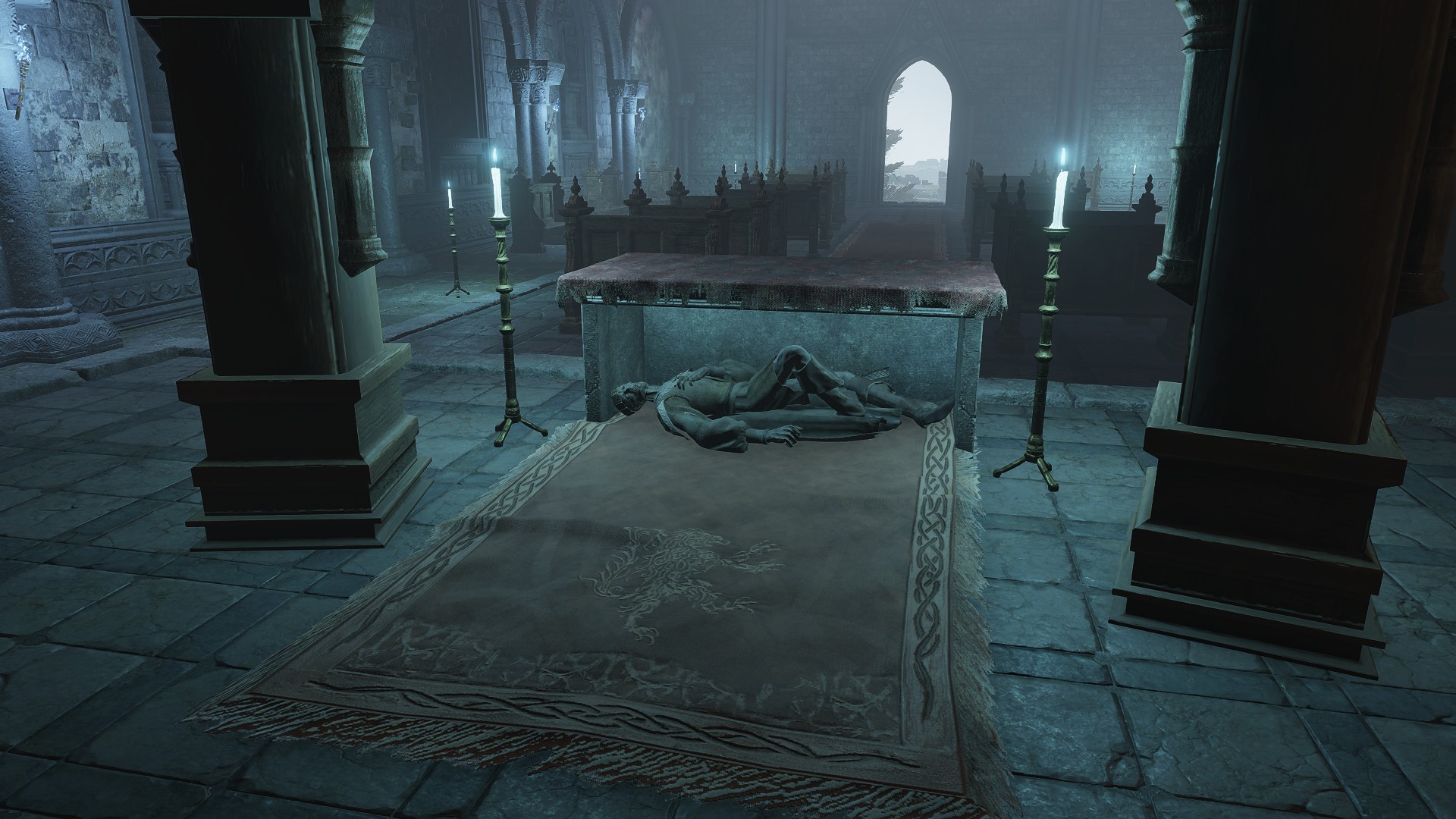


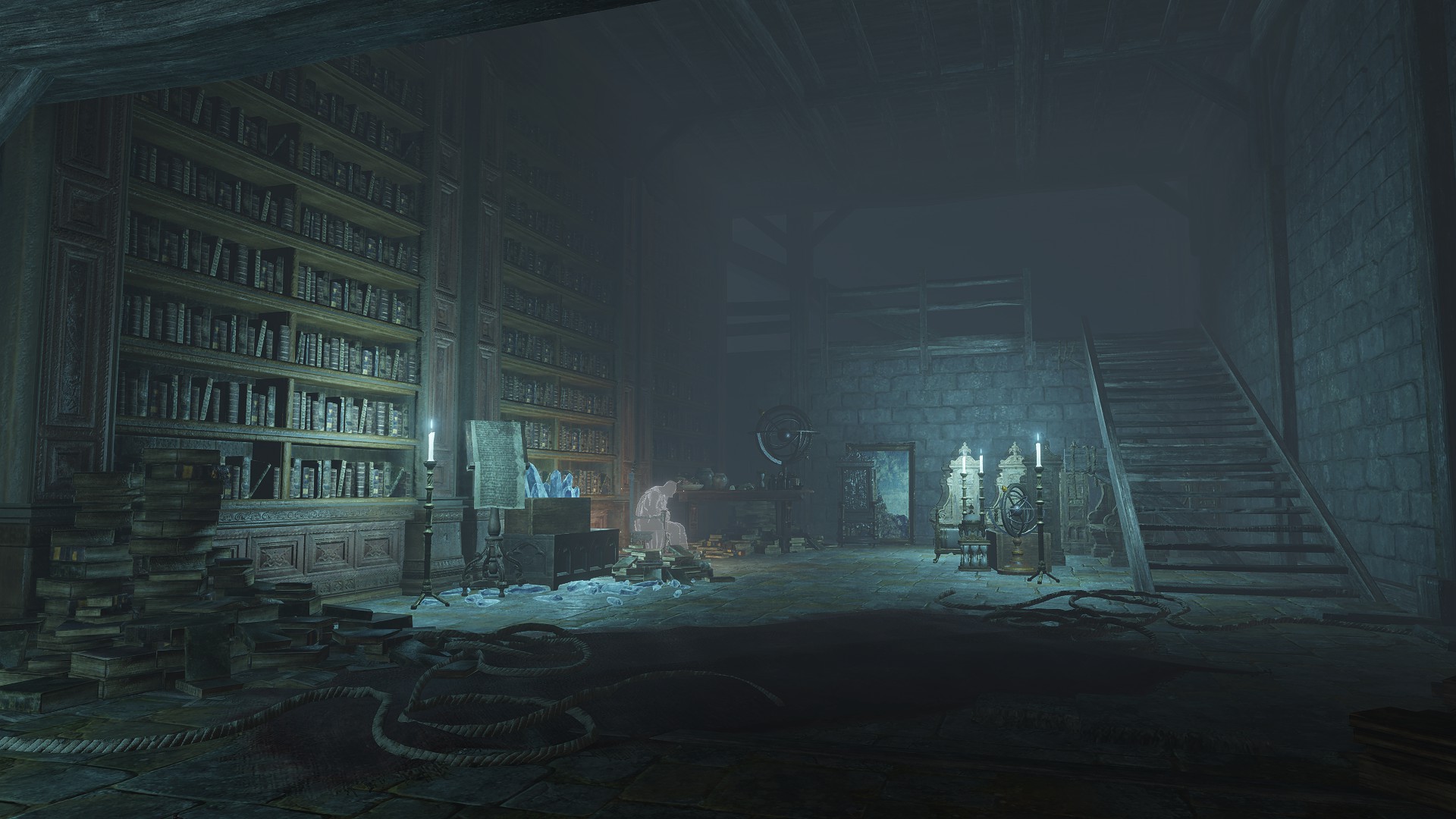
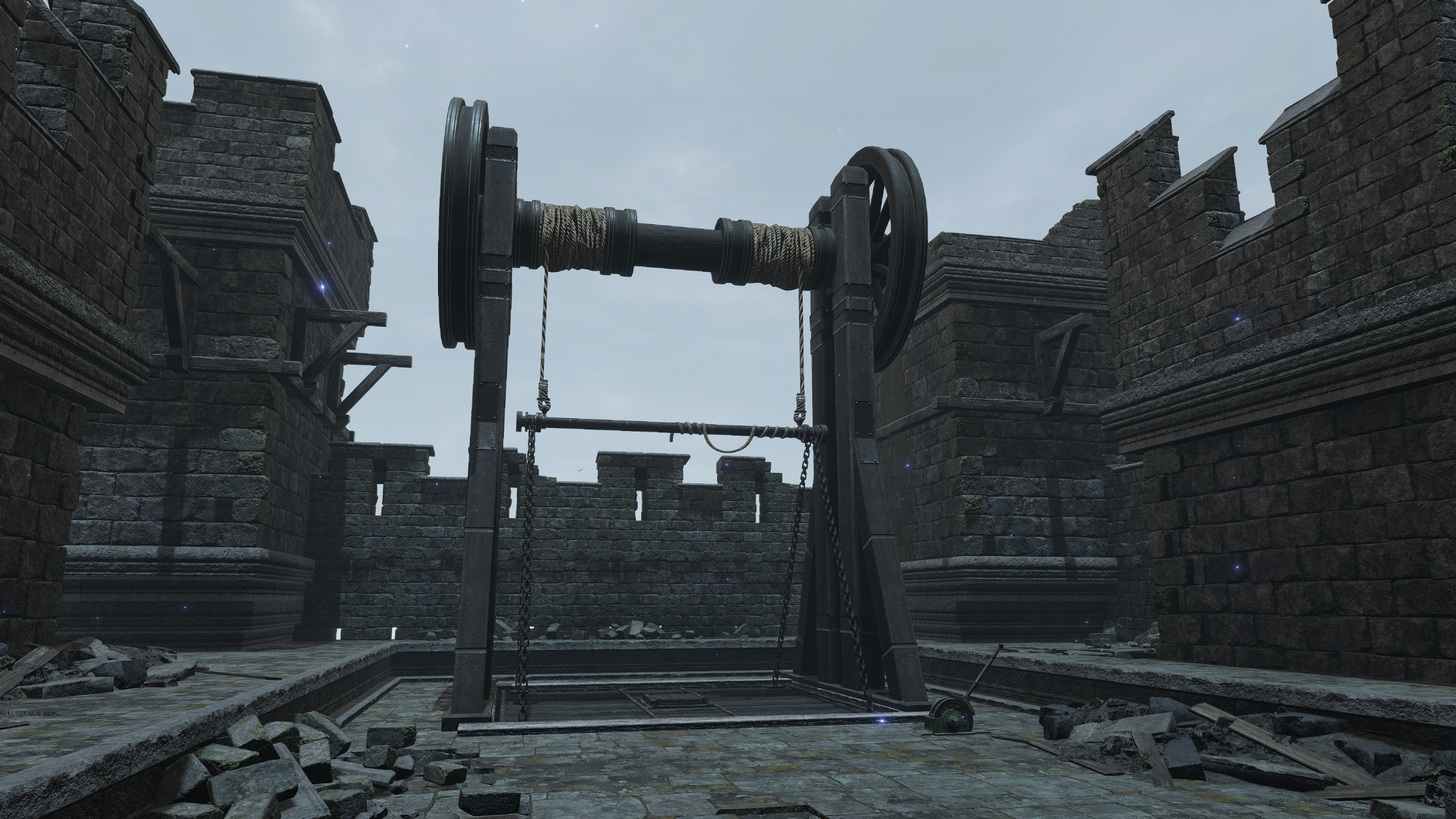


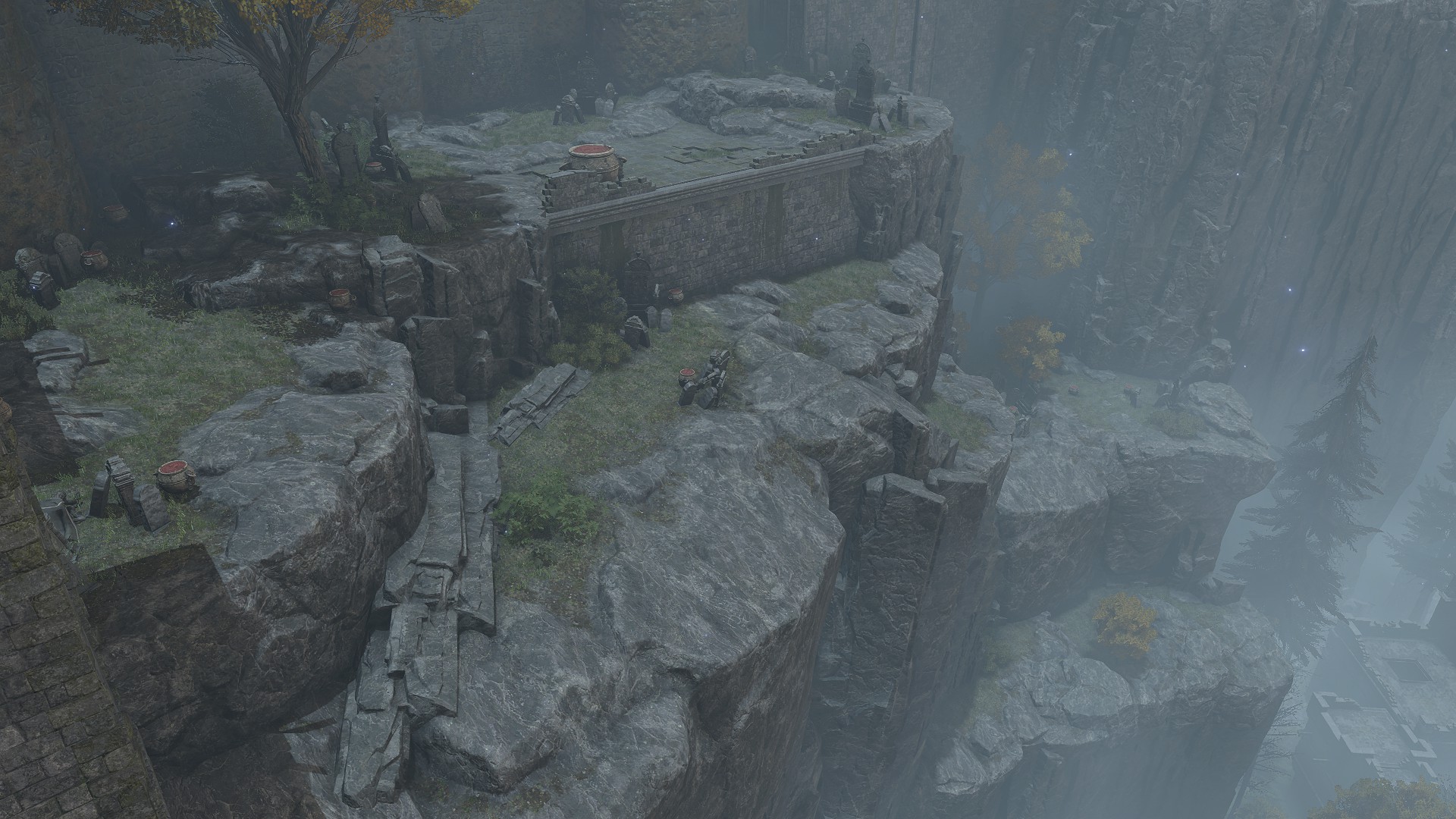


All of this together indicates that the Carians didn’t construct the manor but took over an existing facility built by the Farum colonies, adding their own personal touch after moving in. Unlike Volcano Manor or the Sun Capital, this foreign influence was unlikely to be part of a collaboration with the dragon worshipers. The manor’s current owners became a royal family thanks to the heroics of their queen, Rennala. But a hero requires a villain. Who did the Full Moon Witch prove her strength against when establishing her house as royalty? Perhaps the soldiers and knights who built the castle that royalty since occupies. The lunar tribe already had their place atop the Moonlight Altar, so there was no need for a new dwelling further north. However, if it was the boons of war, then there is great significance for a hero declaring herself Liurnia’s queen to take up residence there — it certainly sends a message. Therefore, Caria’s castle manor probably did earn that name through conquest.
Recollection of Rennala, Queen of the Full Moon, engraved in the Golden Tree.
Can acquire the owner’s power via the Finger Reader. Also, can use to acquire vast runes.
In her younger days, Rennala was an excellent hero. For she charmed the academy with moon sorcery, became its leader, led the Brightstone Knights, and established Caria as a royal family.
In essence, Caria Manor originally belonged to Farum colonists from Altus Plateau, constructing the castle on the northern hill as a base of operations down south. The manor’s location just below Altus and Gelmir is sensible for migrating colonists after first coming down from the plateau. The fact that it is a castle rather than a village betrays their expectation for conflict with the locals. By any outside observation, the colonists weren’t infringing on astrologer lands to make friends. Granted, their fortifications were doubtless aimed more toward their dreaded enemy, the wyverns. Liurnia is home to a number of lesser dragons, so it was inevitable that the colonists expand their hunts to the lowlands. Doubtless, the colonists didn’t intend to bring harm to the native humans initially, hoping instead to work out a deal as had been accomplished with the highlanders. However, that ended up putting them on a collision course with the Carians.
Among the phantom projections Rennala summons, one is a wyvern. This isn’t an ice dragon from the mountaintops, but an ordinary flying dragon who breathes fire. More likely then, the oath was exchanged with a dragon down there in Liurnia. Most of the local dragons are encountered on the Moonlight Altar, and while we see these spout magical blue flames and comets, this is because they have gobbled up sorcerers, glintstone and all. Without the stone eating away at them, they would just be mundane wyverns. And so, before deciding to dine on astrologers, those dragons appear to have aligned themselves with one of them. But for what benefit? More than anyone, the Carians should know the Farum colonists’ aims from memory of Castle Sol — there was no way that the young woman was ignorant of the implications to befriending their enemy. Why paint a target on your back? Most likely, the dragons’ oath was part of a mutual protection agreement. The future queen promised to safeguard them from their hunters, precisely because she wanted the colonists to threaten humans.


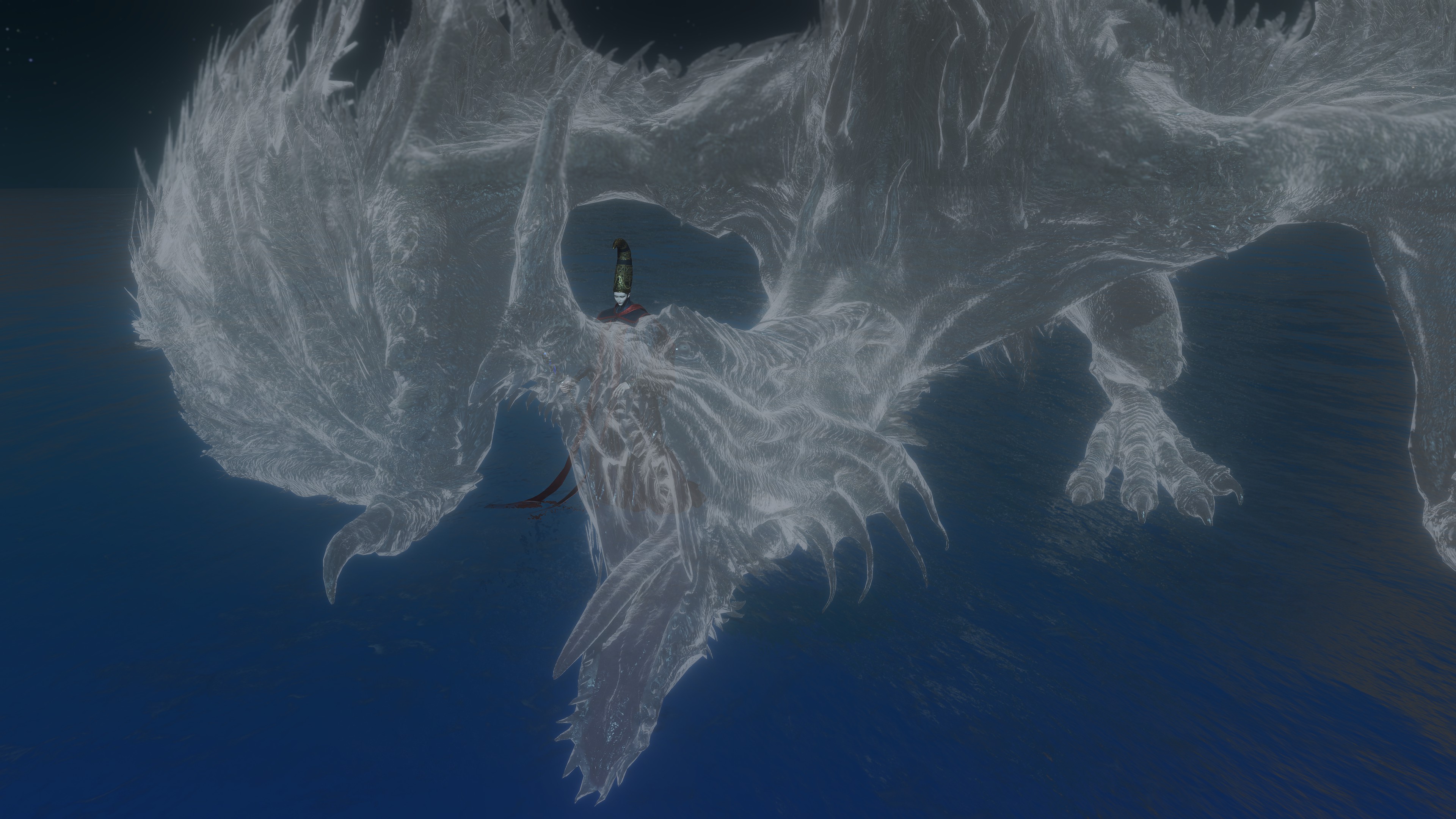


Rennala’s remembrance ties her heroism to becoming the academy’s leader after showcasing her moon magic in its description. If the sorcerers felt threatened by invaders, then it is reasonable that they rallied behind anyone displaying the power and vision to quell the menace. Despite its highly defendable position, the Academy of Raya Lucaria was still merely an academic institution. The sorcerers lacked the history of violence and conflict to prepare them for such an incursion. An organized and well-equipped army presented a real threat, enough for the bookworms to simply fold if the invaders reached their doorstep. All it would take is the Carians or Laskyar to come under attack from first contact, coloring perception of the colonists’ presence for everyone. It didn’t matter if the issue was due to a mistaken alliance with the interlopers’ sworn foe, making conflict avoidable — nothing hobbles rational thinking like fear in the moment. If sorcerers were whipped up into a panic, then it just takes someone to give them the guidance they crave, thereby shaping their outlook.
In stepped Rennala, a sorcerer whose full moon makes victims vulnerable to other sorcery. She presented a power which could tip the scales, and that caught everyone’s attention just as sorcery is drawn to her moon. Evidently, this was the first time that she actually revealed her full abilities during her entire time at the academy. Up until that point, the student mastered the spells they taught, all the while remaining recluse on that mesa; now, she showed skill worth labeling her a “witch”, (魔女) literally magic woman. Once again, one wonders if this witch was waiting to unveil her power for just such a moment, when it would have the most impact. After seeming to engineer the plight, she suddenly swooped in with miraculous power as everyone’s salvation — what better way to engender followers? Maybe Rennala originally imagined a different scenario, but the result was the same. Charmed by her magic, the sorcerers agreed to follow her lead through this crisis. And as exposed by her pointed scepter bearing a sword’s silhouette, she intended to meet the invaders on their terms.
Regardless of Rennala’s personal ability, her plan wasn’t simply to be the lone vanguard for their counterattack. Rather, the woman would be leading a number of her own knights into battle. These Glinstone Knights were sorcerers who swore fealty to Rennala’s moon and so received the power of swordsmen. Not only did this involve training their physical prowess with the blade, it also meant advancing their magical prowess in that regard. Magic Glintblade is the original sorcery behind all “sword formation” (剣陣) arts the knights employ, casting a single sigil which soon conjures a small glintstone sword to fly straight for nearby targets. The obvious utility of these formations is how they offer the enemy no quarter, the typical opening after swinging your sword immediately filled by another blade. This leaves opponents helpless against an onslaught, either overwhelming their defenses or catching them in a counterattack. The sigil’s depiction of a sorcerer’s staff crossed with fencer’s sword embodies the Carians’ new ethos. By combining sword and sorcery, they could compete with foreign knights.
One of the sorceries of the Caria royal family.
Forms magic greatsword and slashes clear. Can be used continuously.
Sorcery that gives the power of knights to sorcerers. It was also proof that they swore loyalty to the moon.
Old sorcery of the Caria royal family.
Draws magic formation overhead and generates brightsword that flies toward enemies with time lag. Can be used without stopping movement and slows brightsword’s creation with charging.
It is said to be the prototype of the sword formation sorceries that sorcery knights of the royal family use.
Evening the playing field with magic was very much needed. The later royal family has its own magic greases, infusing mundane weapons with more extraordinary power. They are currently presented to squires yet to receive a magic sword, but the book detailing their recipes are supposed to be for arts of the “old” knights. This implies that the first glintstone knights, too, used grease absent a proper sword in the past. The order was still new and pressed for time. It is only natural that they didn’t have the same arsenal of equipment and spells enjoyed by future generations of knights. Those first to step up to the plate needed to rely on their own talents and Carian ingenuity. That isn’t to say that Caria forged them no equipment. The Carian Sorcery Sword is the weapon of choice for these old knights, a blade slender as a wooden staff with the glintstone to conjure sorceries just as well. Complemented by a sorcery glintblade, at least some knights may have been equipped to pierce through armor with magic and metal. But for the most part, they were the underdogs in this fight.
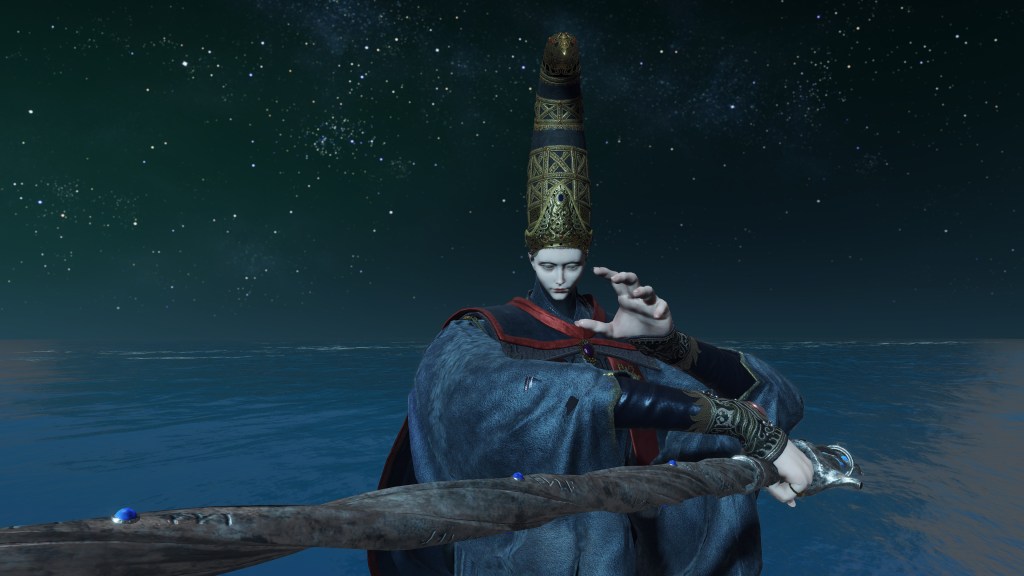

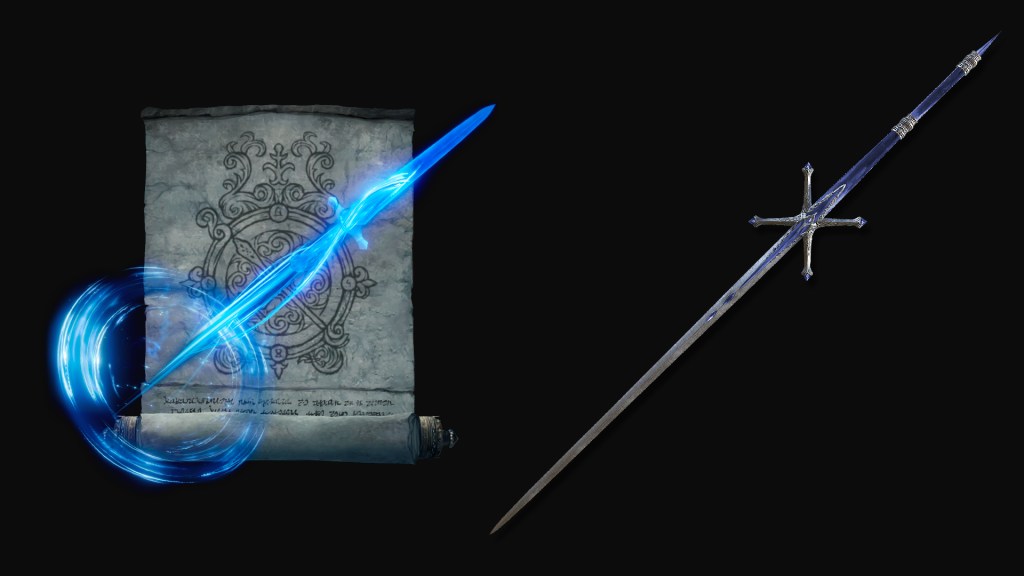
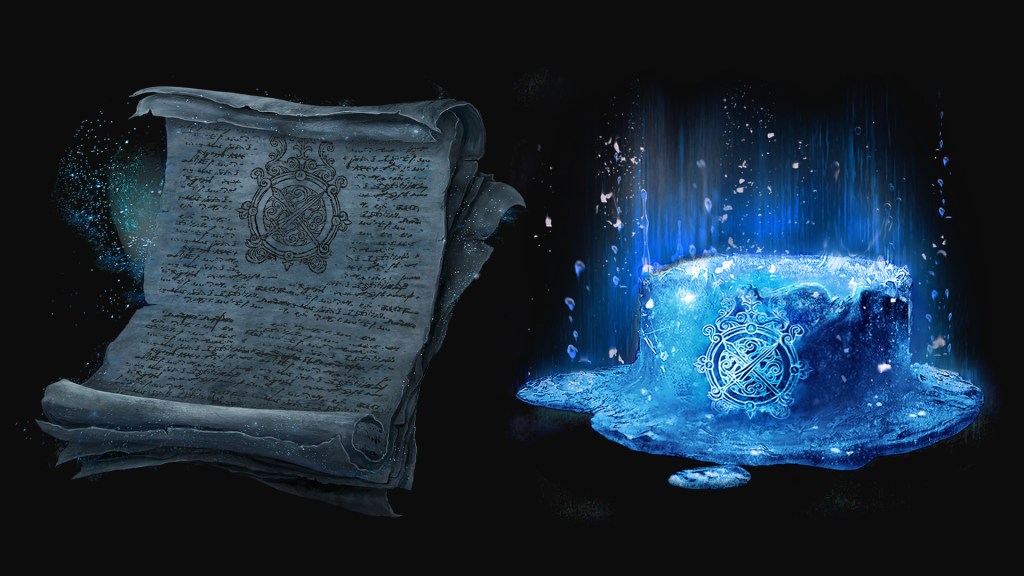
Recipe book of junior knight of the Caria royal family. Details arts of the old sorcery knights.
One of the brightstone swords of the Caria royal family. Small thrusting sword possessing a thin blade.
It is the choice weapon of the old Caria knights before sorcery battle arts became widespread, so serves as a catalyst for brightstone sorceries with strong attack.
Nevertheless, many demonstrated bravery in the face of these odds, having placed their faith in Caria’s moon. Among those to join Rennala in battle was her own sister, Rellana relying on swords and armor similar to her fellow knights. Assuming that the younger woman was also attending the academy, then she might well have been the first to stand beside her sister in this cause, her example serving to inspire others not as closely related to join. Even if she was just one among a crowd, adding her twin moons to the mix guaranteed at least two powerful sorcerers spearheading this effort — and likely secured the knights’ overall confidence in the endeavor. And although not optimal, these sorcery knights of Caria proved impressive. The description to the knight’s sword confirms that their order never numbered as many as twenty, but their individual ability was more than a match for an entire army. And with the Full Moon Witch fighting alongside maybe a handful in battle, the Farum colonists were decisively pushed back and ultimately defeated.
On a small island north of the academy stands Testu’s Rise. Unlike other secluded sorcerers, this Testu shows less of an interest in astrology or glintstone compared to nature, with landscape paintings on practically every wall. That explains the location of this rise, a patch of fulgurblooms just east of it in the lake — clearly, the sorcerer likes studying natural phenomenon. The lighting connection befits the name “Tes” (テス) in probable reference to Nicola Tesla, (テスラ) the world-famous electrical engineer; the localization, meanwhile, references the test we undergo to enter the rise finding turtle spirits, testudo meaning “turtle” in Latin. But while flowers attracting lightning that disperses across the water might be neat to examine, that doesn’t rationalize why they exist in this area. Testu seems to have made progress on answering that question, as spirits for the test consist of not just turtles but also rotten bodies rising from the ground. In other words, this land is someone’s unmarked grave. Clearly, locals didn’t care to respect the dead with proper burial, and Farum knights are known to occasionally use lightning.
Put simply, Rennala and her knights probably faced the invaders as they were approaching the foot of the academy’s mountain. They left the bodies to rot, maybe haphazardly buried them in the dirt where they might bloom electric flora. At the same time, they collected their potentially useful weapons from the battlefield; that is the best explanation for the small Farum arsenal amassed in the nearby Academy Crystal Cave, specifically in an area otherwise used for miscellaneous storage outside the school proper. If nothing else, it shows that the feeble scholars were helping with the cleanup, even thinking of putting up a fight if push came to shove — though they would never need to prove their resolve, apparently. Rennala and her glintstone knights were doing just fine, their sorcery possibly supplemented with the added firepower of their latest oath friends.


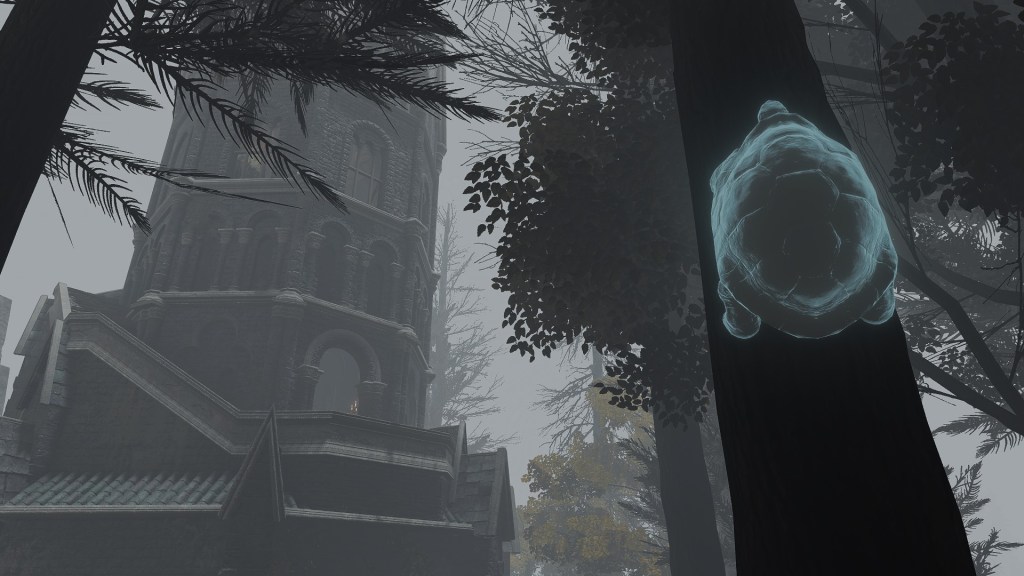

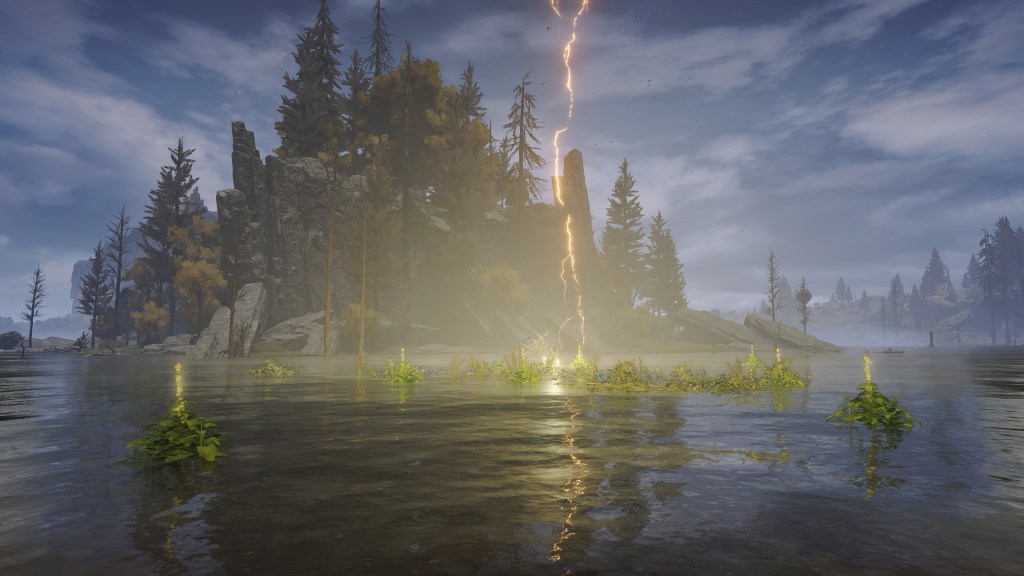
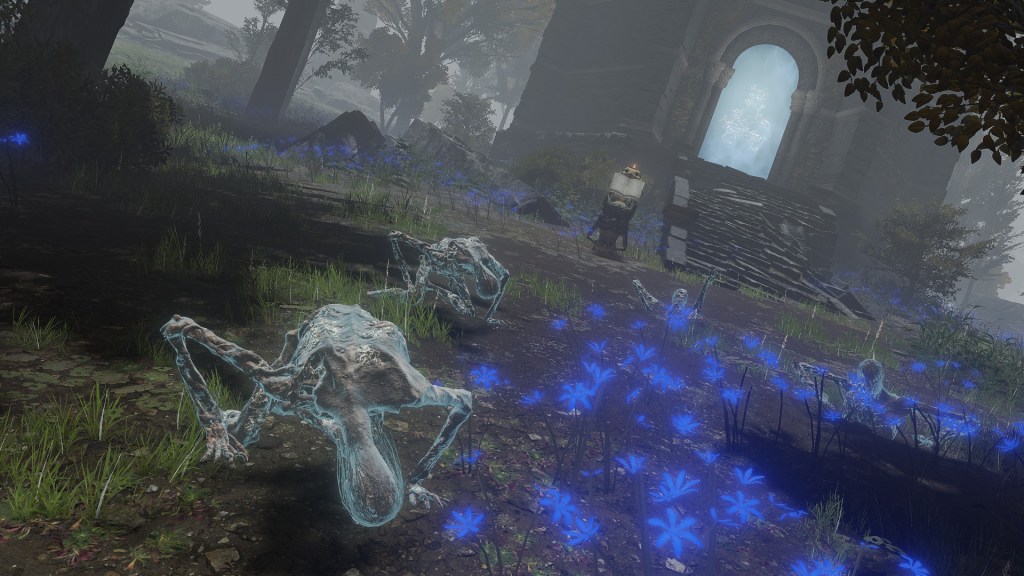


Whether or not they had the dragons for support, the ragtag band of sorcerers overcame their enemy’s lightning weaponry and plowed through to the castle. Based on the graveyard there and not by Testu’s Rise, the Farum colonists were then besieged, slowly but surely losing manpower as fighting dragged on. Maybe they surrendered, maybe they were wiped out. In the end, Rennala laid claim to their castle manor for Caria and established her house as royalty lording over the Liurnians. Whether or not everyone was enthused about this development, they didn’t have much of a choice. The witch showcased her strength and became a hero to the academy. Now that same hero was in the enviable position to continue the castle’s invasion with the support of even stronger knights. The Full Moon Witch was the only thing standing between Liurnia and another foreign incursion. It was either accept Carian rule or die.
Meanwhile, the colonists’ setback seems to have forced Farum Azula to intervene. The Four Belfries loom upon a hill between Moonlight Altar and the manor, placing them firmly in Carian territory. The design likewise evokes Raya Lucaria’s architecture, save for the waygates beneath the first three towers; each requiring a special magic stonesword key stored at the fourth up top. That does explain why we can acquire another of these imbued keys within the confines of the academy, with the navy-blue color of the magic bringing Noxian night sorcery to mind. But in total, these bell towers appear to signal sorcerers using the waygates at Caria’s behest, drawing on the Eternal Cities’ technology. And among the three gates, the first leads to Farum Azula. What business would the lowlanders out west have with the beast capital out east unless it related to the conflict with their worshipers? More than likely, the capital mediated the dispute, prompting the Carians to create a shortcut for easier dialogue.

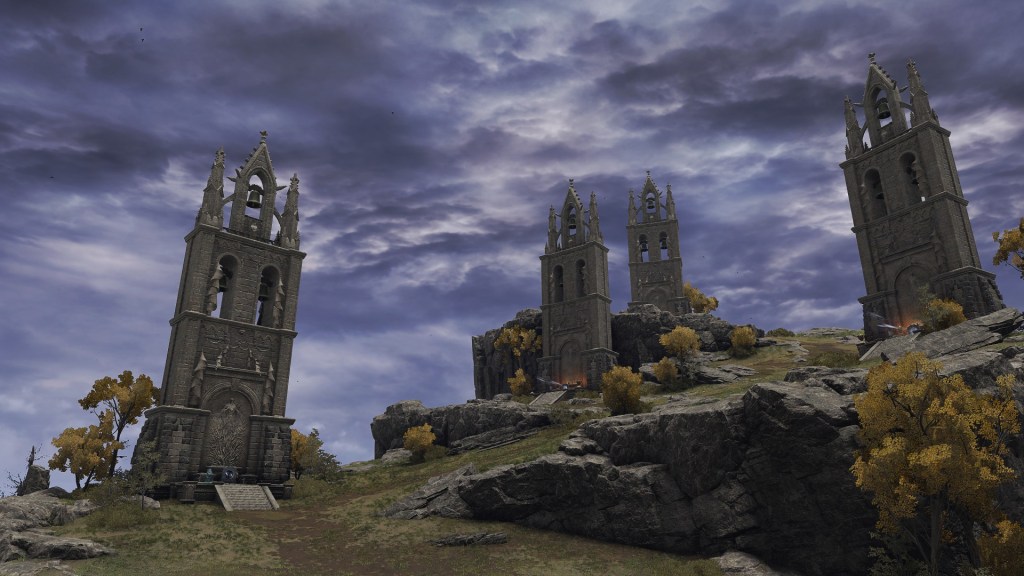


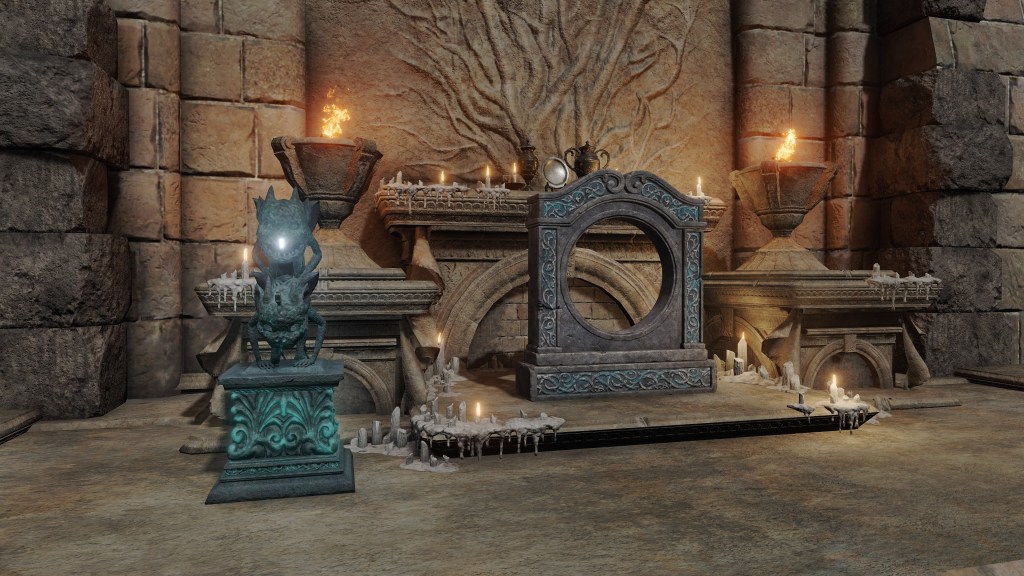
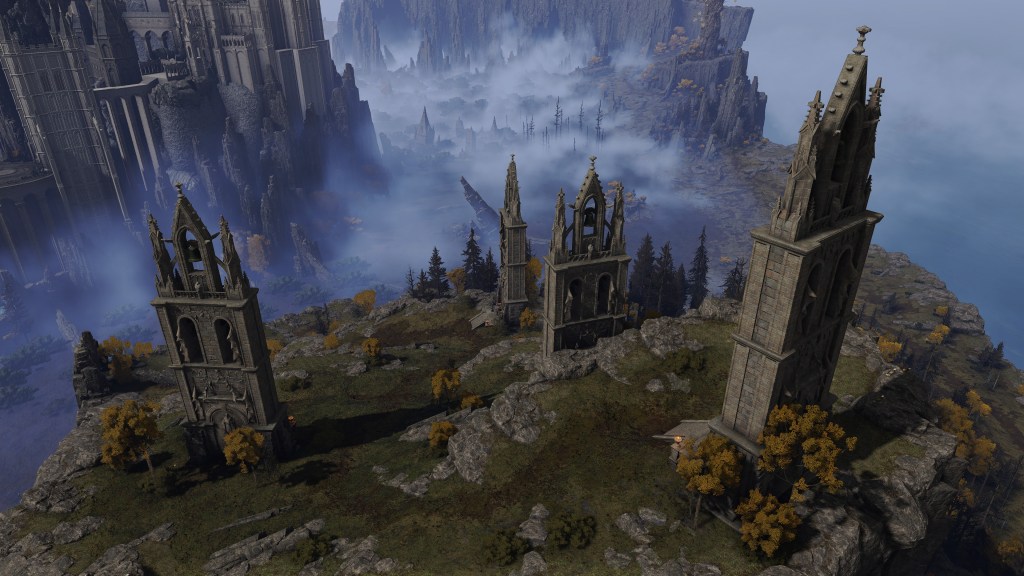
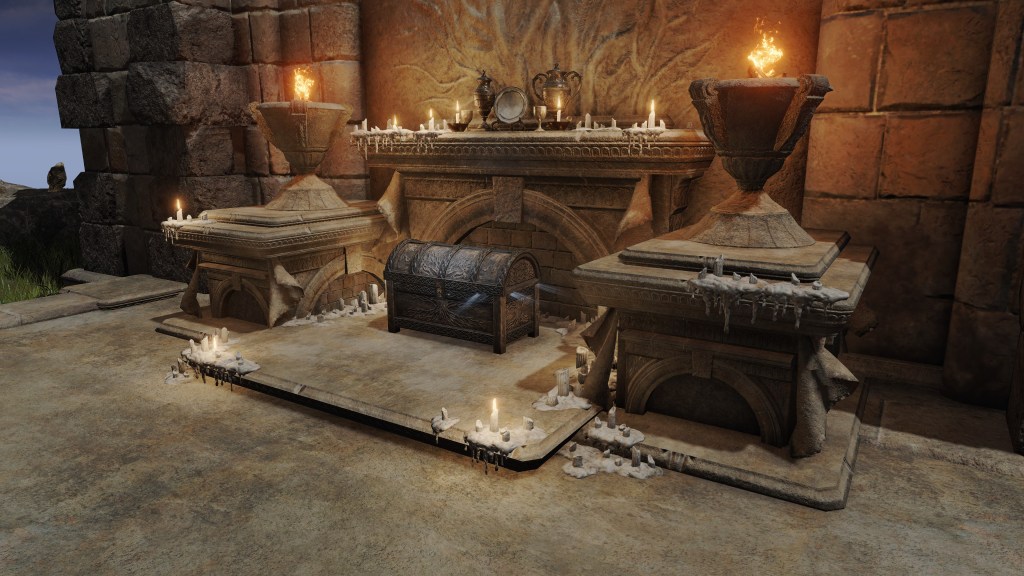
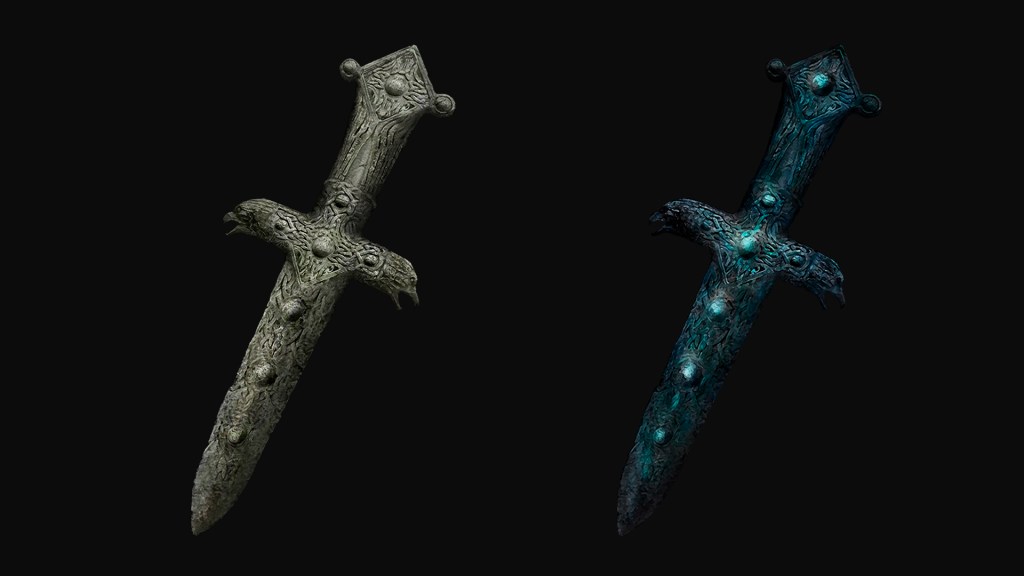
Realities on the ground left the ancient dragons no choice but to accept that the western wyverns were under Caria’s protection. The lowland was simply too far and out of the way, and beasts had bigger priorities. Instead of stretching themselves too thin, it was in Farum Azula’s interest to end their hunting grounds at the plateau line. Moreover, the astrologer people had long lived alongside Farum civilization, particularly at Sol. Perhaps that is the reason for the castle far up north being the one to offer tribute. The Icerind Hatchet attaches the frozen scale of Borealis to a metal haft of Sol make, yet it is stored in the Temple Quarter in faraway Liurnia. Although the localization claims it to be one of several gifts, the description only clarifies the one axe as kenjouhin, (献上品) an offering presented to persons of high rank such as the local lord or the imperial family. In this context, the obvious recipient would be the new Carian royalty. We can certainly see the attempt to resonate with Caria from its skill, Hoarfrost Stomp; a giant scarab rolls the ash of war around in a pool next to their castle manor. This is for them.
Hand axe possessing a blade with a frozen rind. Tribute from Sol, castle fort of the polar north.
Considered to be scales of a dragon called the Freezing Fog and possesses a strong chill status abnormality effect.
In that case, gifting an axe derived from their ever-elusive prey sends a clear message: the colonies failed the hunt and want to bury the hatchet. With this, the highlanders and lowlanders appear to have normalized relations, Sol continuing to appeal to the astrologers’ history with the mountaintops as insurance. Put another way, it was appeasement for a trading partner which tried to maintain a connection with their old homeland, the country of magic knights bringing back items like the Sword of Night and Flame through Farum territory. And in that sense, the axe’s place in the Temple Quarter shows that it has been enshrined as the colonists’ sacred bond to not just Carians, but all Liurnians. Whatever the royals’ personal feelings about the conflict, they took their victory in stride and ended hostilities there. This was wise, since a newly declared queendom has enough on its plate already. It was important that Caria turn their attention internally, both for the future of peace and war.
You Have My Staff
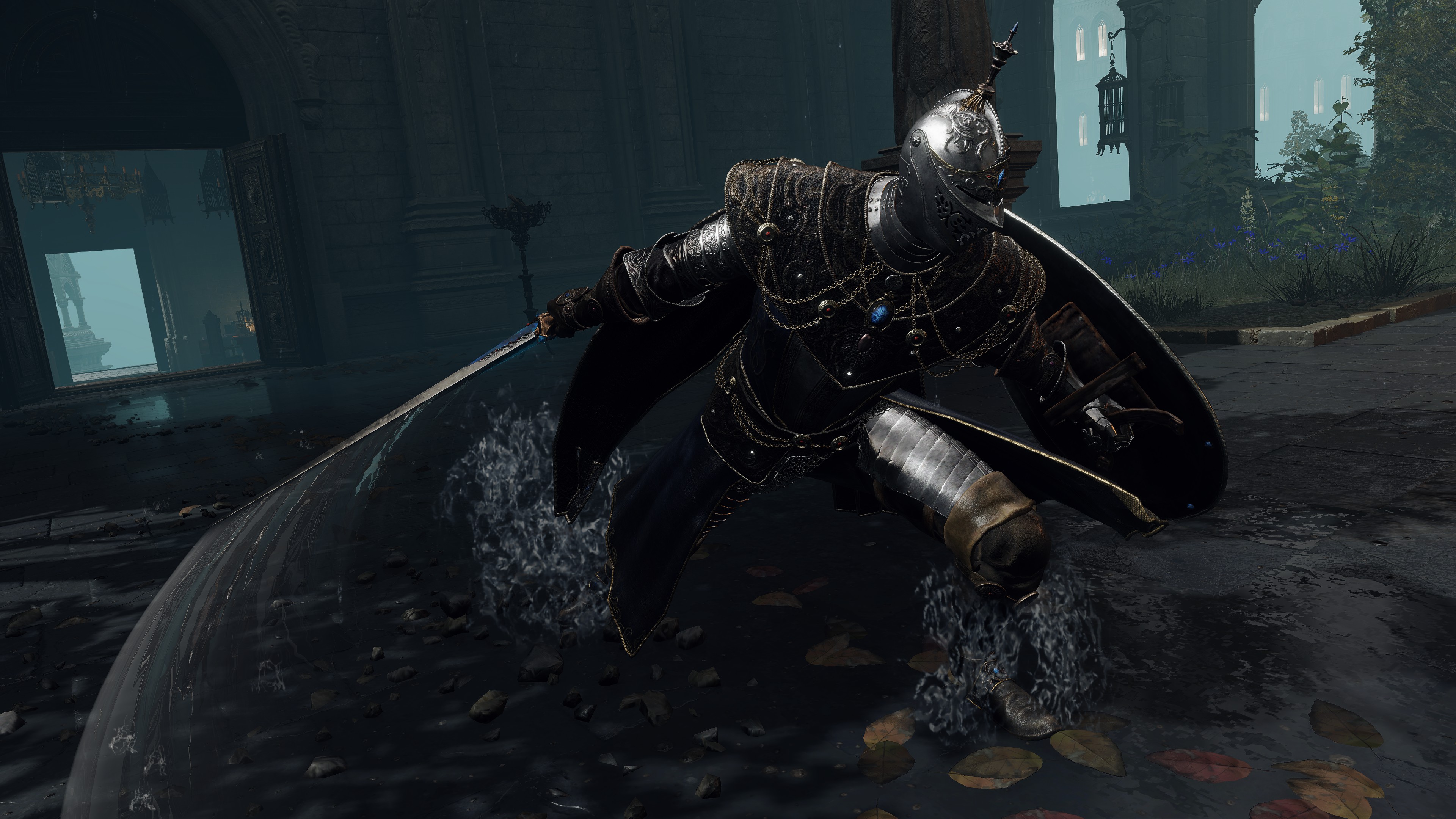
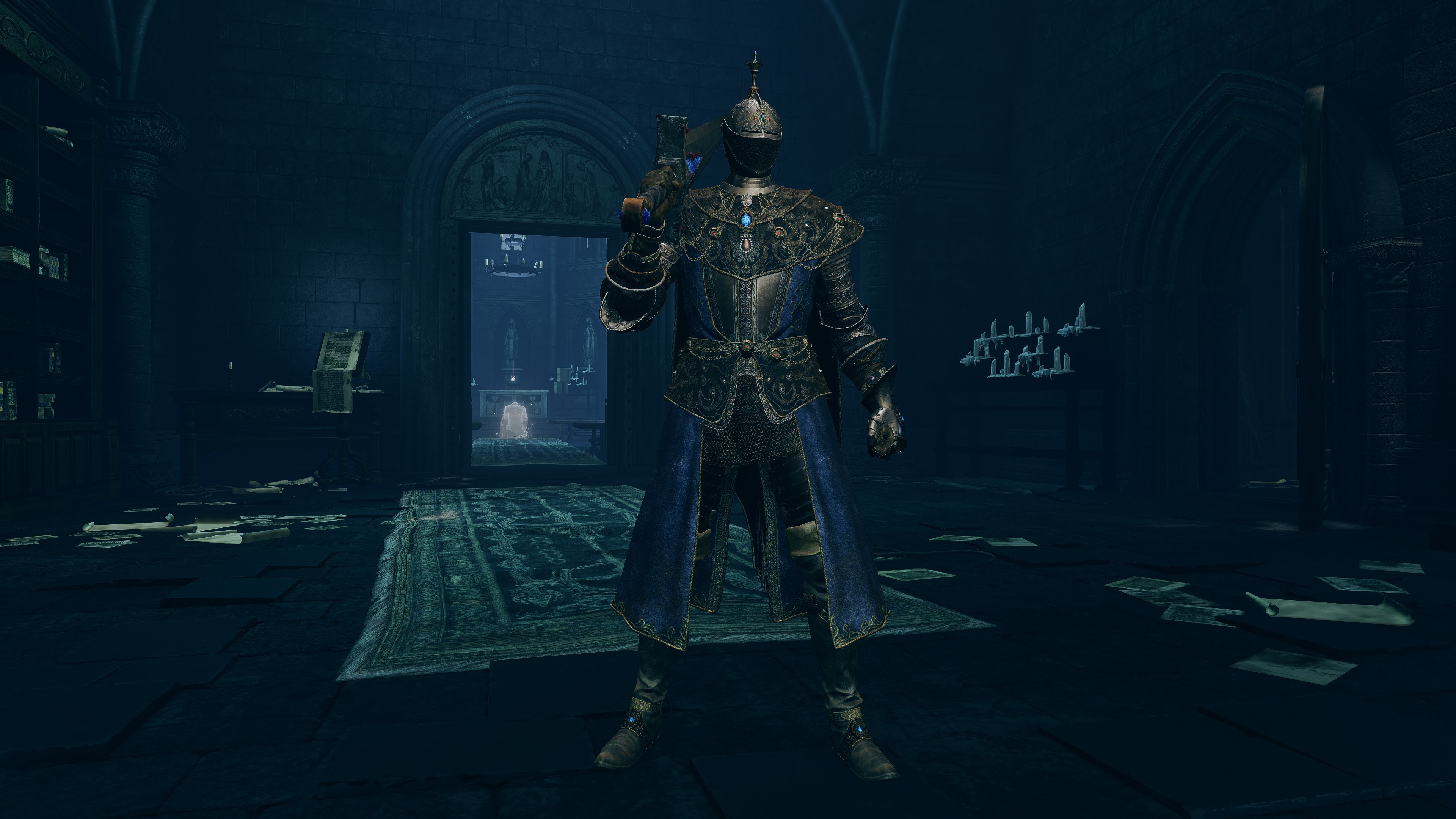
Rather than rest on their laurels, Carian Knights continued developing their craft. The royalty forged them their own silver iron armor, draped in an illustrious lapis lazuli to signify the family’s pride. This remains uniform across all knights, though details vary in special cases. One example is now Princess Rellana, whose helmet incorporates twin crescents representative of her dual moons. The other is the “royal guard knight” (親衛騎士) Loretta, dedicated to the general household’s security — for personal protection, the most ranking royals take on their own retainers, the “Caria Badge” (カーリアの徽章) princesses provided those bodyguards taking the shape of their shield bearing the royal crest. Barring these exceptions concerning the royal family, glintstone knights met one standard, which is presumably why their numbers remained small. To be conferred knighthood by the queen, each sorcerer was to cultivate the strength of a hero able to match a thousand ordinary men. That is no easy feat, so only a handful ever proved worthy of donning the symbol of Carian pride, though the rewards were worthwhile.


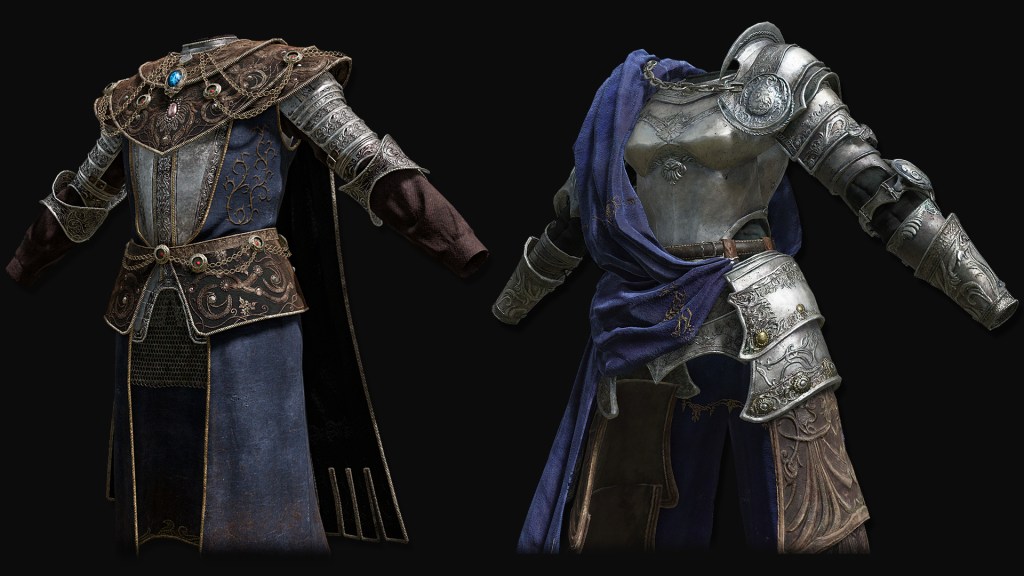
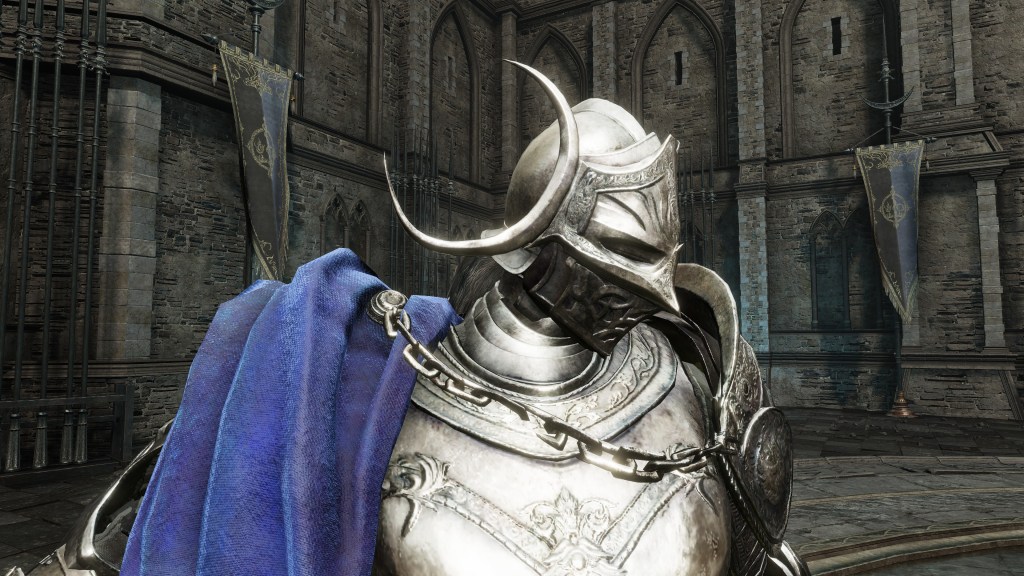


Silver iron armor of Loretta, a knight who served Miquella’s Holy Tree.
She was once a royal guard knight of Caria and remembers the pride in that even now. The lapis lazuli blue cape is probably a symbol of that.
Talisman modeled on the royal family’s crest on a shield.
Lessens FP consumed for battle arts.
The beautiful badge said to have once been given to the princess’ direct retainers even among Caria knights. The only princess these days is Ranni, daughter of Rennala.
Chest armor of sorcerer knights who once served the Caria royal family.
The knights conferred by the Moon Queen were each one-in-a-thousand heroes, but with the royal family’s decline, they were all no more.
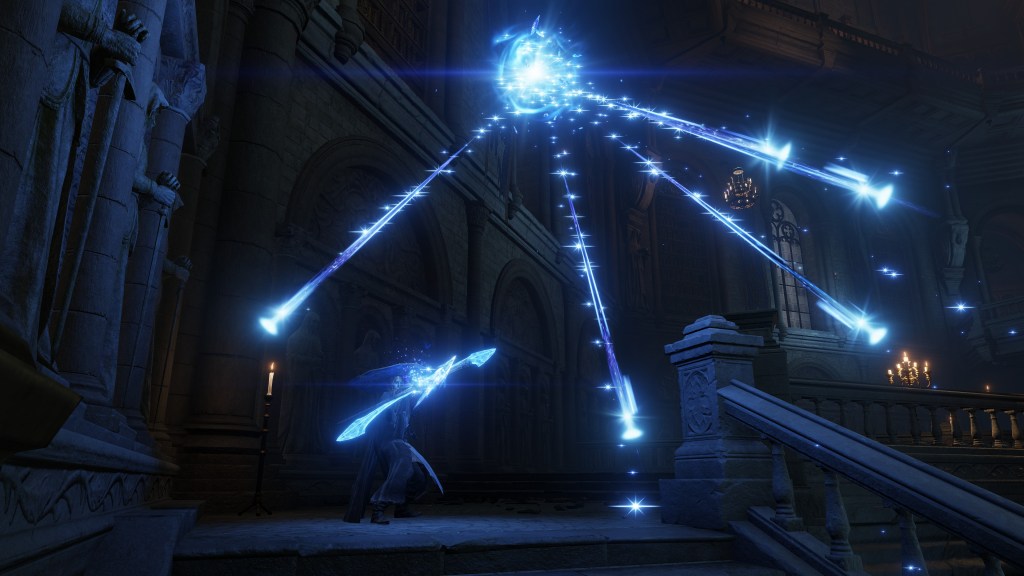
Building upon the prototype, the glintstone knights multiplied the number of conjured swords to arrange into proper formations. This went from a five-sword formation with Glintblade Phalanx to twice that with Carian Phalanx. Unlike Magic Glintblade, these glintswords follow the caster in formation before automatically homing in on nearby foes, making it even easier to conduct unrelenting waves of attacks when combined with swordplay. Caria went so far as to bestow knights with a staff specialized for this glintblade sorcery. It, unlike most sorcerer’s staves, requires dexterity — which is true for all staves related to Caria, even Rennala’s own scepter. The Full Moon Queen and her faithful knights were to show finesse on the battlefield, a refined combination of sorcery and steel. This is why they learned Lucidity to dispel any disturbance to their presence of mind; a knight must always be alert, composed, and kempt. Perhaps it was so the Carians could prove their own regality, but everything from armor to arsenal was designed for this. And that elegance was embodied by their icon: the magic sword.


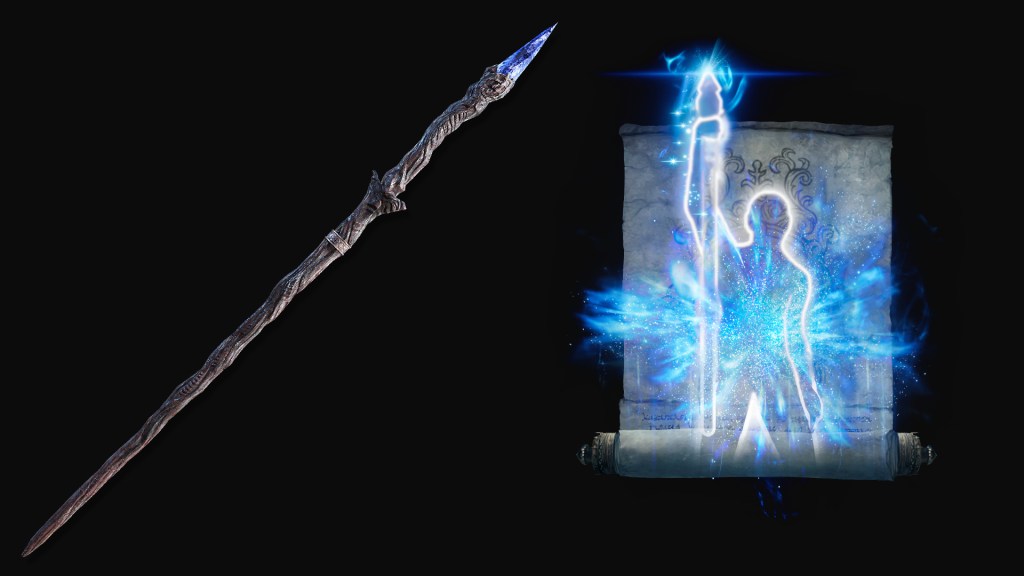
One of the sorceries of the Caria royal family.
Deploys circular formation with magic brightswords. The brightswords automatically fly toward nearby enemies and can be used without stopping movement.
A sorcery bestowed to sorcery knights of Caria. Combines with swordplay to make attacks in waves.
One of the sorceries of the Caria royal family.
Deploys circular formation with numerous magic brightswords. The brightswords automatically fly toward nearby enemies and can be used without stopping movement.
Superior one of the brightsword sorceries of sorcery knights.
Staff embedded with blue brightstone. One of the Caria staves, of which there are two.
It is a staff bestowed to sorcery knights, so enhances brightsword sorceries.
This symbolism pertained to physical steel as much as glintstone energy. After the slender sword of old knights, the royal family produced a more conventional straight sword resembling their glintblades, though it retained the blue glintstone at the hilt like its predecessor. That gave the order a magical edge in the fray but also piled on expectations. As noted earlier, the senior knights shared the secrets to Caria’s magic grease with their juniors so that they could practice with a substitute until they earned their enchanted sword proper. These “junior” knights (従騎士) are labeled with the common term for squires, though the descriptions to the actual greases indicate that they are, in fact, knights, just “low-rank” knights (下級の騎士) who have yet to merit the elite equipment. In general, the line seems to be hazy between a sorcerer and knight, owing to the strength and dexterity the former required to reach the latter’s full potential. Before they could wield a magic sword, they needed to wield a sword, and that ability took time to build up.
Lump of grease mixing in materials that generate magic power. One of the craftable items.
Coats weapon and adds large magic attack power. That effect disappears after fixed time.
It is said to have been given to low-rank knights who served the Caria royal family as a substitute for a knight’s sword.
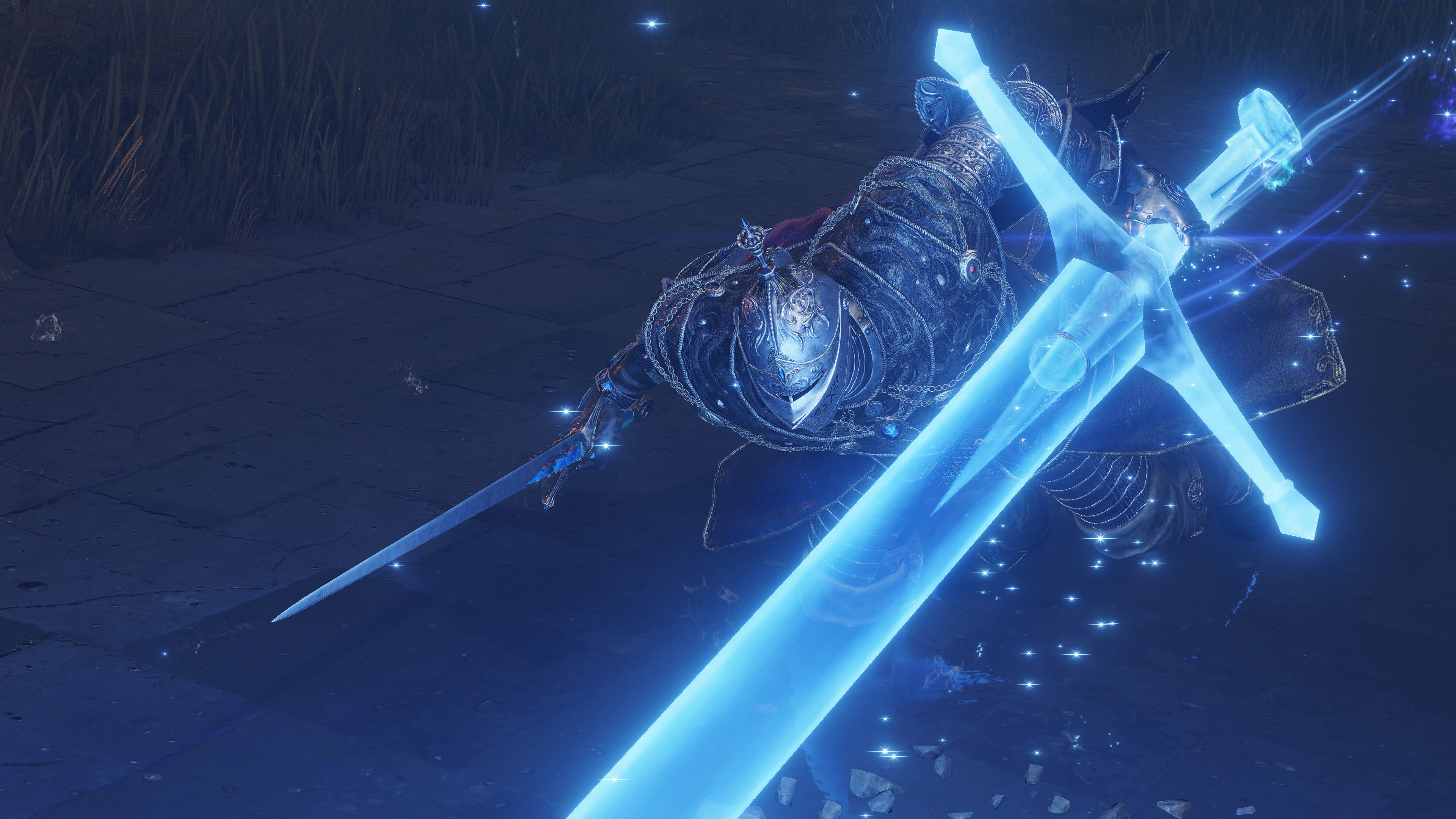
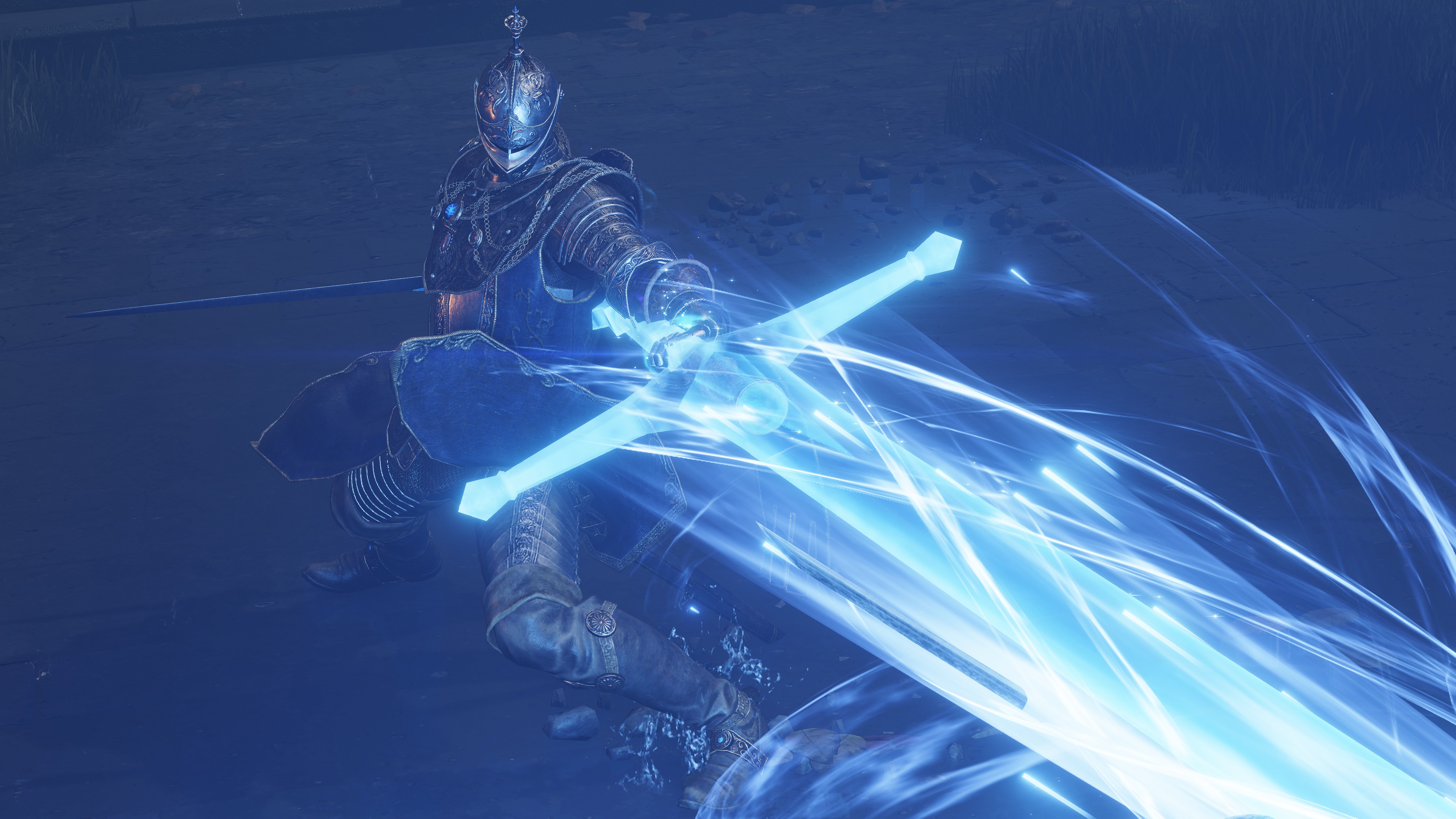
For that reason, Caria appears to have eased aspiring knights through the transition, allowing them to practice their sword technique with sorcery as they still pursued physical training. The royals invented another glintstone staff, this one specialized in making sorcerers into knights by empowering Caria’s sword sorcery. Mainly, this branch of arts consisted of conjuring a weightless greatsword with which slash soldiers or pierce through cavalry, though the short sword variant’s swift slices during the small gaps in close combat were considered the most practical. Regardless, if a sorcerer received the Carian Greatsword spell, then he or she had already sworn loyalty to the moon as a knight. These relatively simple sorceries were merely the first step toward mastering the blade of chivalry, and soon to become secondary for full-fledged members of the order.
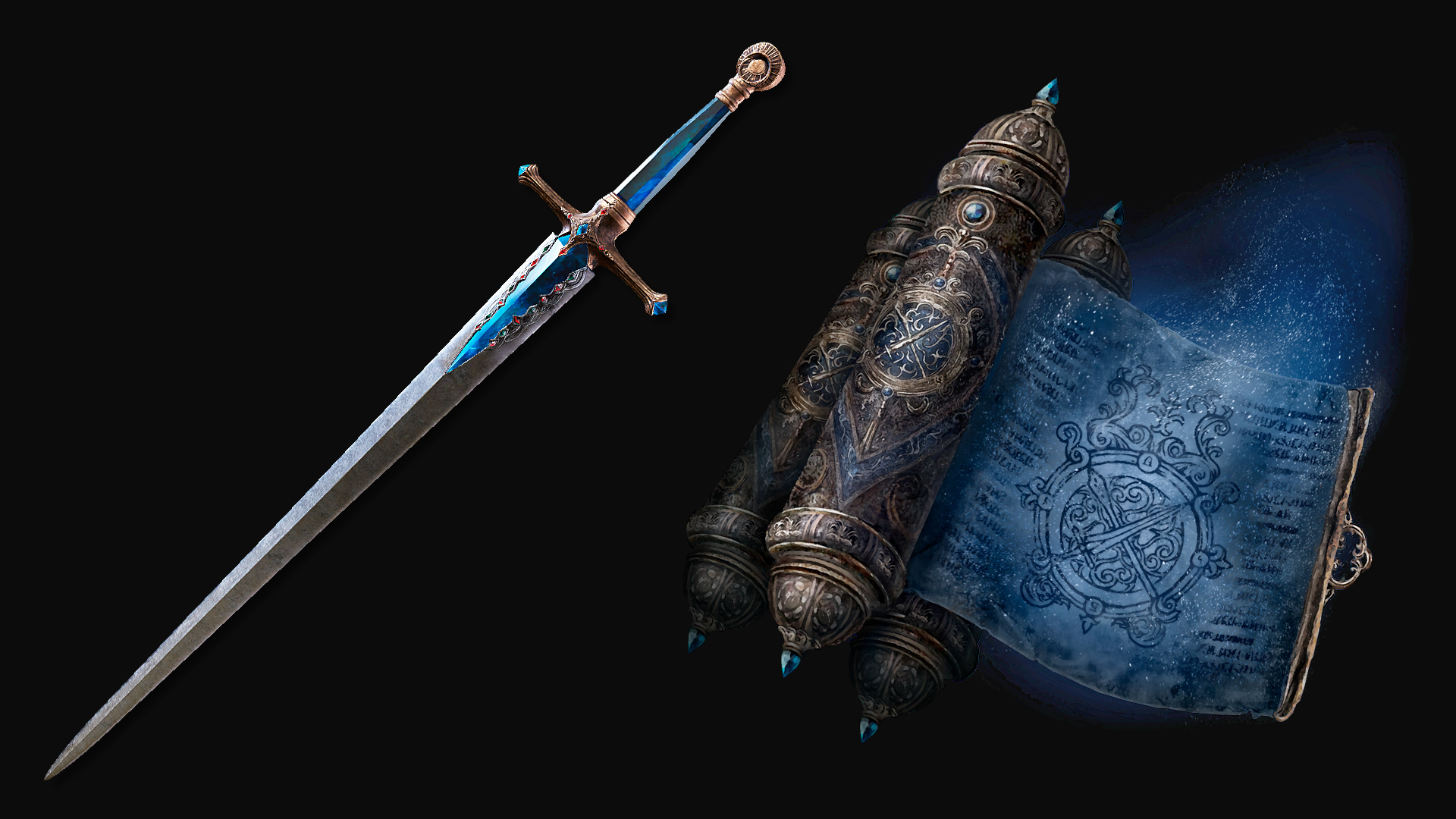
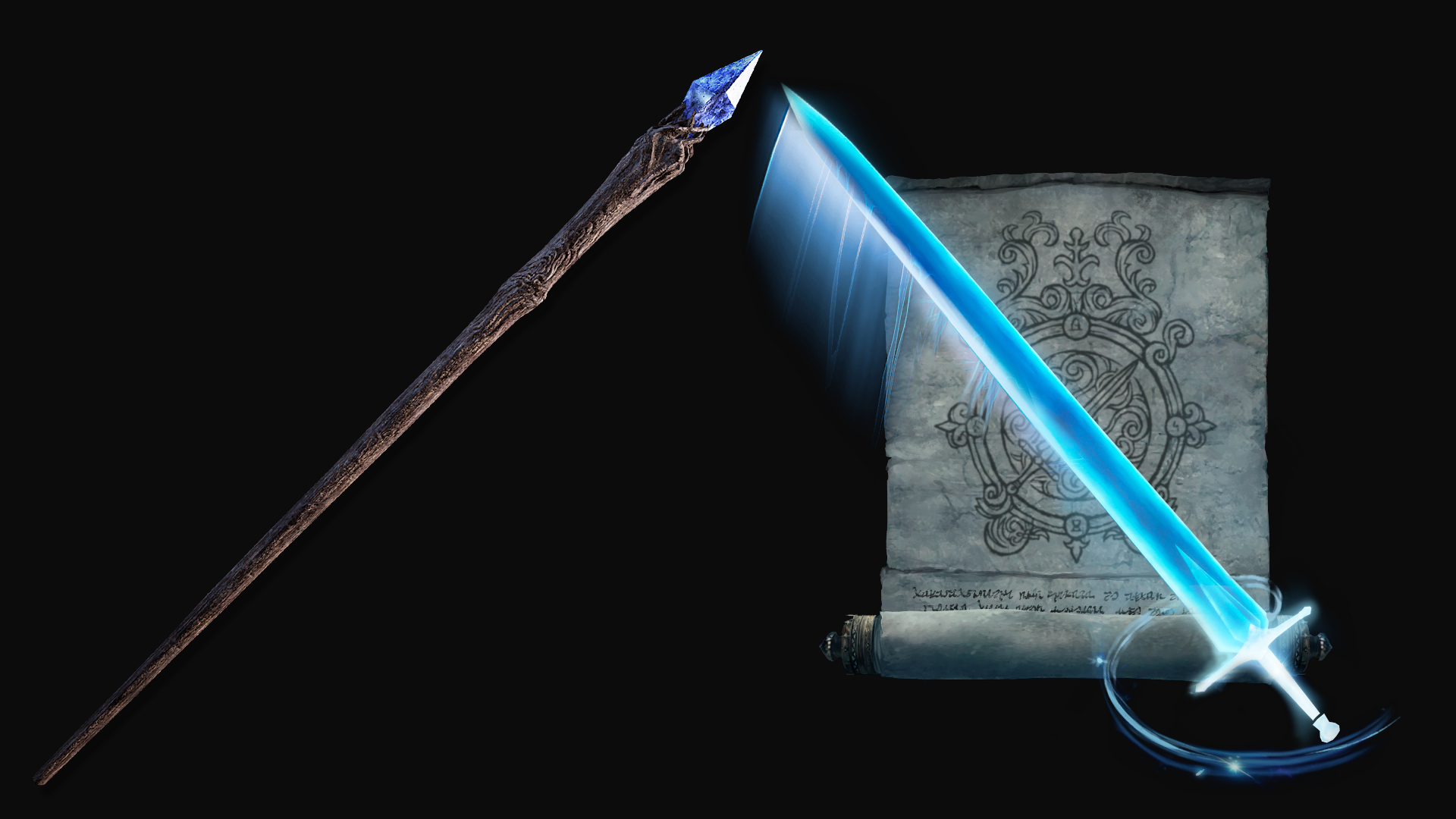
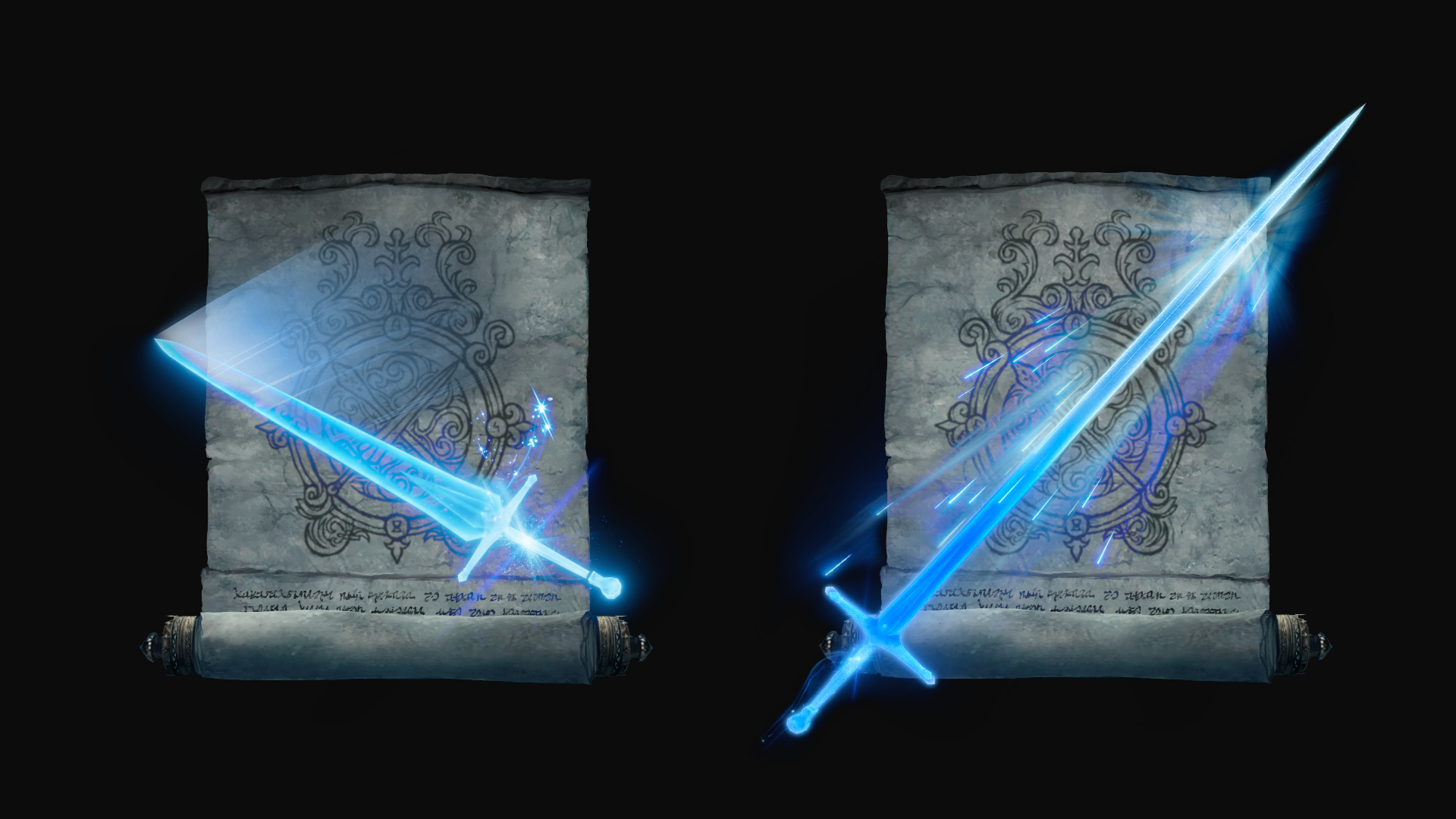
Staff embedded with blue brightstone. One of the Caria staves, of which there are two.
It is a staff that makes sorcerers into knights, so enhances Caria sword sorceries.
Caria pioneered not just sorcery but also sorcery skills. These arts of war largely adapt sorceries for swordcraft, such as Carian Phalanx. But the specific sword to symbolize Caria was the Carian Greatsword, manifesting a blade which only grows larger the longer the caster waits before the swing. Bringing such a mighty weapon down upon the enemy, it is no surprise that the stronger version came to be called “Great Caria” (グレート・カーリア) with the most powerful variant reserved for royalty dubbed “Royal Caria”. (ロイヤル・カーリア) Nothing better captures their sovereignty and grandeur, which is why the Impaling Thrust of the Sorcery Sword was replaced by such Grandeur for the Knight’s Sword. Rogier counts such arts among the academy’s developments, but it was clearly a collaborative effort for the soldiers. And while the old guard refused to adopt, these sorcery skills were nonetheless popular; the badge princesses provided their direct retainers reduces the focus required to use one. A knight of Caria was simply expected to use them, especially when it could determine the life or death of their charge.
Battle art that is considered a symbol of the Caria royal family. Transforms sword blade into magic greatsword and swings it down. Enhanced in two stages by charging.
Battle art handed down in the royal family of Caria. Transforms sword blade into magic greatsword and swings it down. Sweeps a wide area horizontally with additional input. Both attacks are enhanced with charging.
By the time knights were proving themselves against golden heroes in the Liurnian Wars, casting sorcery skills with swords was standard. Even the royals with staves had embraced their own brand of these battle arts. For their self-defense, Carian princesses learned to telekinetically spin their wooden catalysts like propeller blades to ward off attackers closing in. And as queen, Rennala naturally developed this technique the furthest, her spins enwreathed in magic power. They had every reason to fear for their security. The Carian Knight’s Shield is, by far, most effective against sorcery, which its description insinuates was preparation for the targets they expected to go up against. Who is answered in the text for Carian Retaliation, a skill the family secretly invented in anticipation of Raya Lucaria’s betrayal. Even if they didn’t realize the full deception, few sorcerers of the academy would appreciate coming under sudden tyranny, especially from relative newcomers. For that reason, Caria needed skills which convert the magic parried with their shields into glintblade formations.
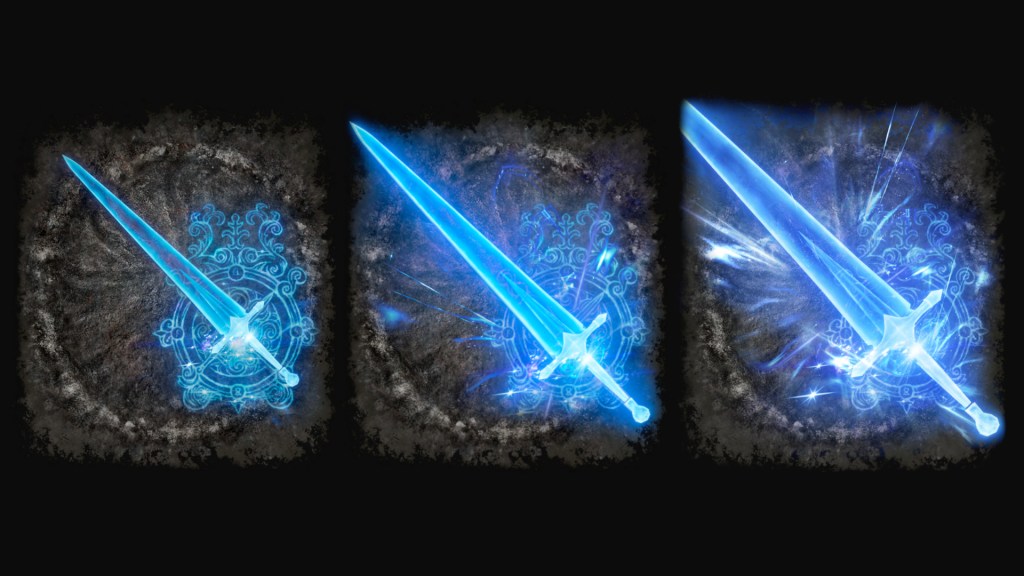


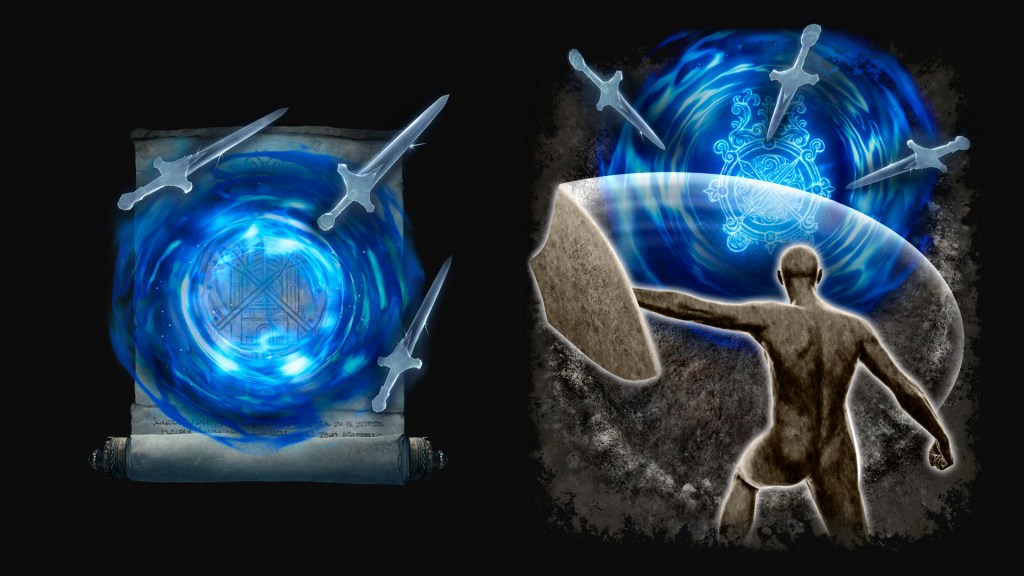

Straight sword embedded with blue brightstone in the blade. Weapon of knights who served the Caria royal family.
Those knights numbered fewer than 20, but it is said that they ranked alongside the golden heroes, wielding sorcery battle arts with swords as the catalyst.
Teardrop-shaped medium shield embedded with blue brightstone. Choice weapon of knights who served the Caria royal family.
Highly effective against magic power and the holy attribute. Who were the knights getting prepared for?
One of the sorceries of the Caria royal family.
Waves staff to dispel sorceries and prayers and deploys that power as brightswords in reverse.
It is the Caria royal family’s secret preparation for facing the academy. The moon and stars will probably go their separate ways someday.
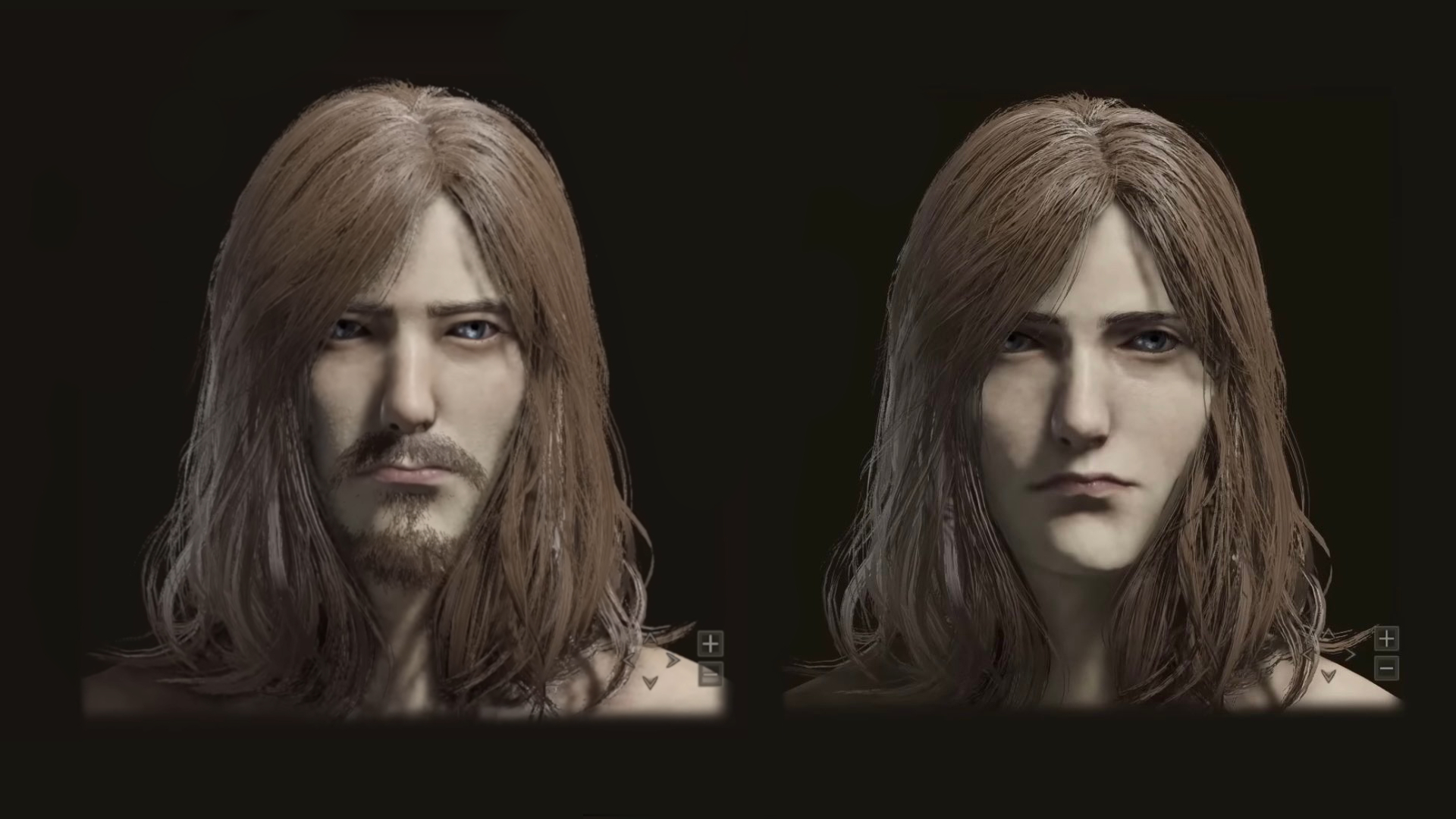
But while the moon and stars would inevitably go their separate ways, the Carians were winning over hearts and minds in the meantime. Moongrum and Moonrithyll are knights serving directly under the queen and princess, respectively — blocking way to their individual boss. The latter is expressly identified as a chamberlain, kaizoenin (介添人) denoting basically anyone who attends to someone they accompany. It is also the Japanese translation for the eternal “companion” of the Eternal Champion series, which Director Hidetaka Miyazaki admits to liking in an Edge interview. One of these champions’ companions in the series is also called Moonglum, so Moonrithyll’s position likely reflects “Moongrum” of the same name. (ムーングラム) That meta connection would explain why the two share similar names and even faces under their helmets despite being different sexes; perhaps the moon twins’ retainers were twins themselves. Regardless, they both appear to be close attendants to the highest royals. And Moongrum, at least, wields the Academy Glintstone Staff suggesting his prior attendance.
In short, the royal family was continuing to recruit sorcerers from Raya Lucaria’s ranks even as it secretly engaged in an arms race to counteract it. The queen eventually brought in her troll friends, conferring knighthood to each oath keeper along with a special set of armor and sword. This is reasonable, given the race’s natural strength and booming roars, to say nothing of their individual wit. Troll knights are capable of casting a “giant sword formation” (巨剣陣) as both a sorcery and a skill, though the latter is localized as “Tremendous” instead of Greatblade Phalanx. They were more than worthy of raising their swords alongside the human knights. That included Moonrithyll, a warrior so strong that she likes to wield a troll knight’s greatsword — a feat unmatched by her male peers. Still, the fact that she is singled out as a friend and uniquely owns a sword with their characteristic skill implies a degree of separation between the races, humans and trolls keeping to their own until brought together by the queen they both serve. Even so, with giants among their ranks, Caria’s future was that much more secure.
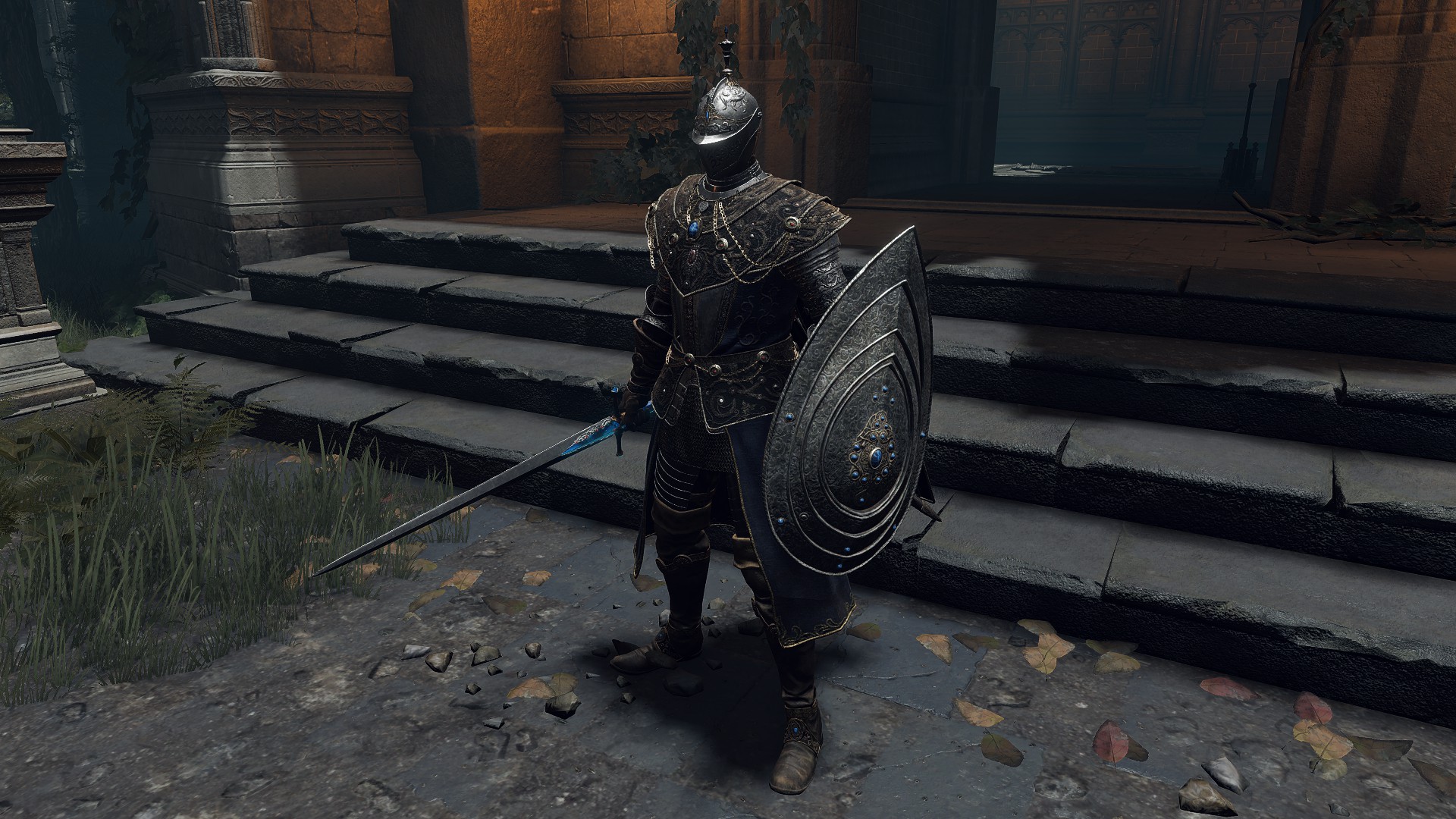
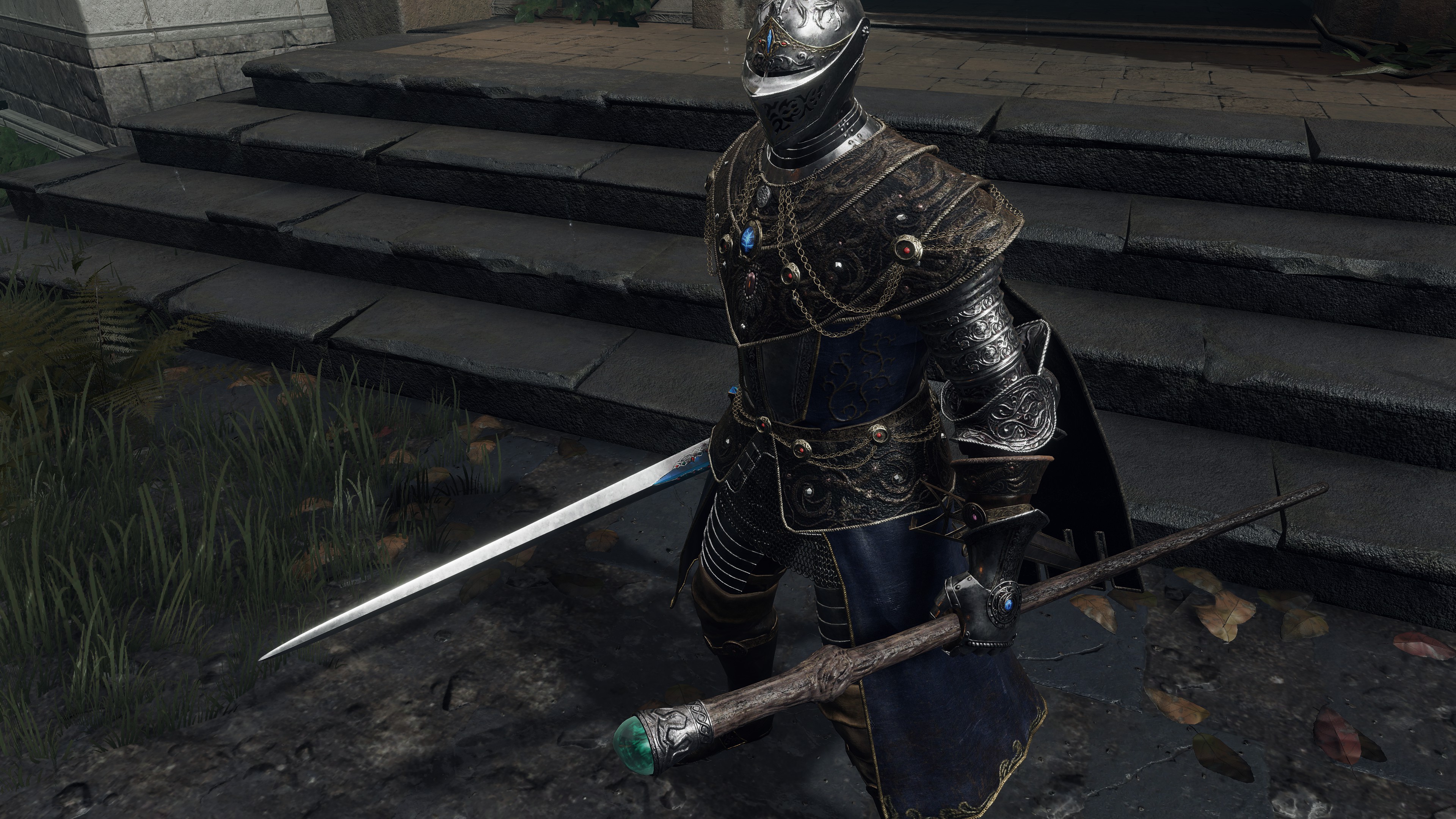
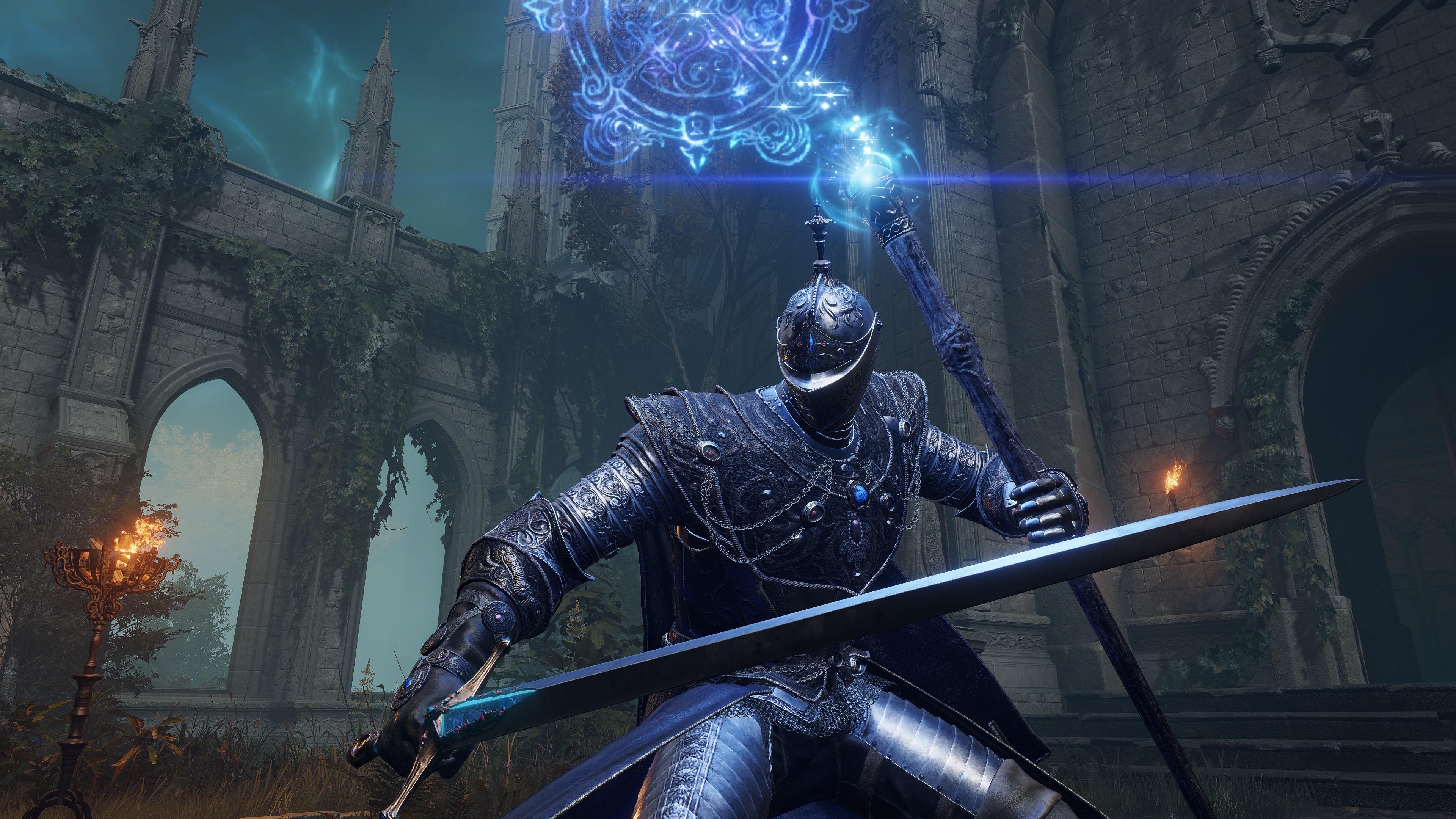
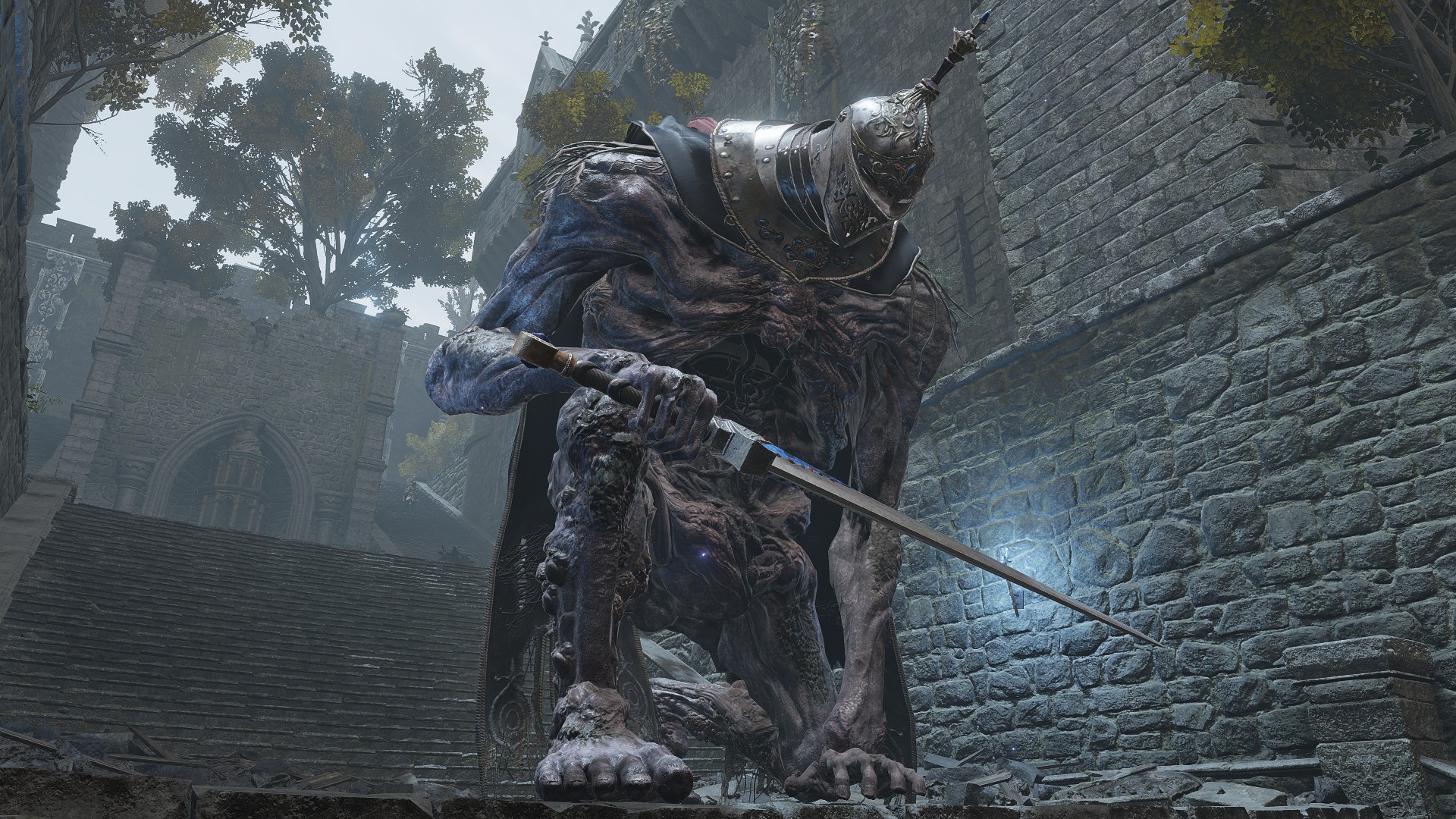
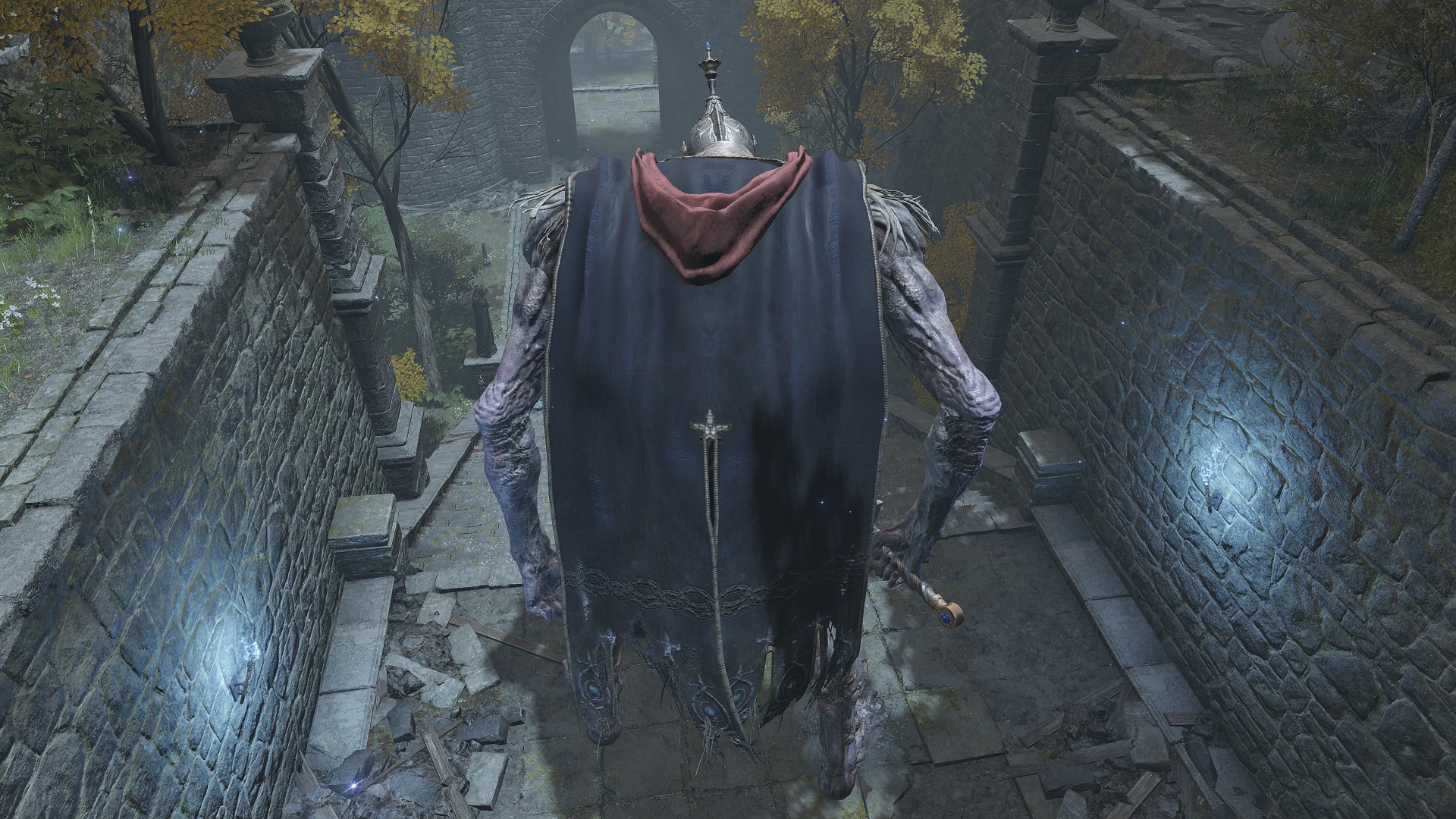
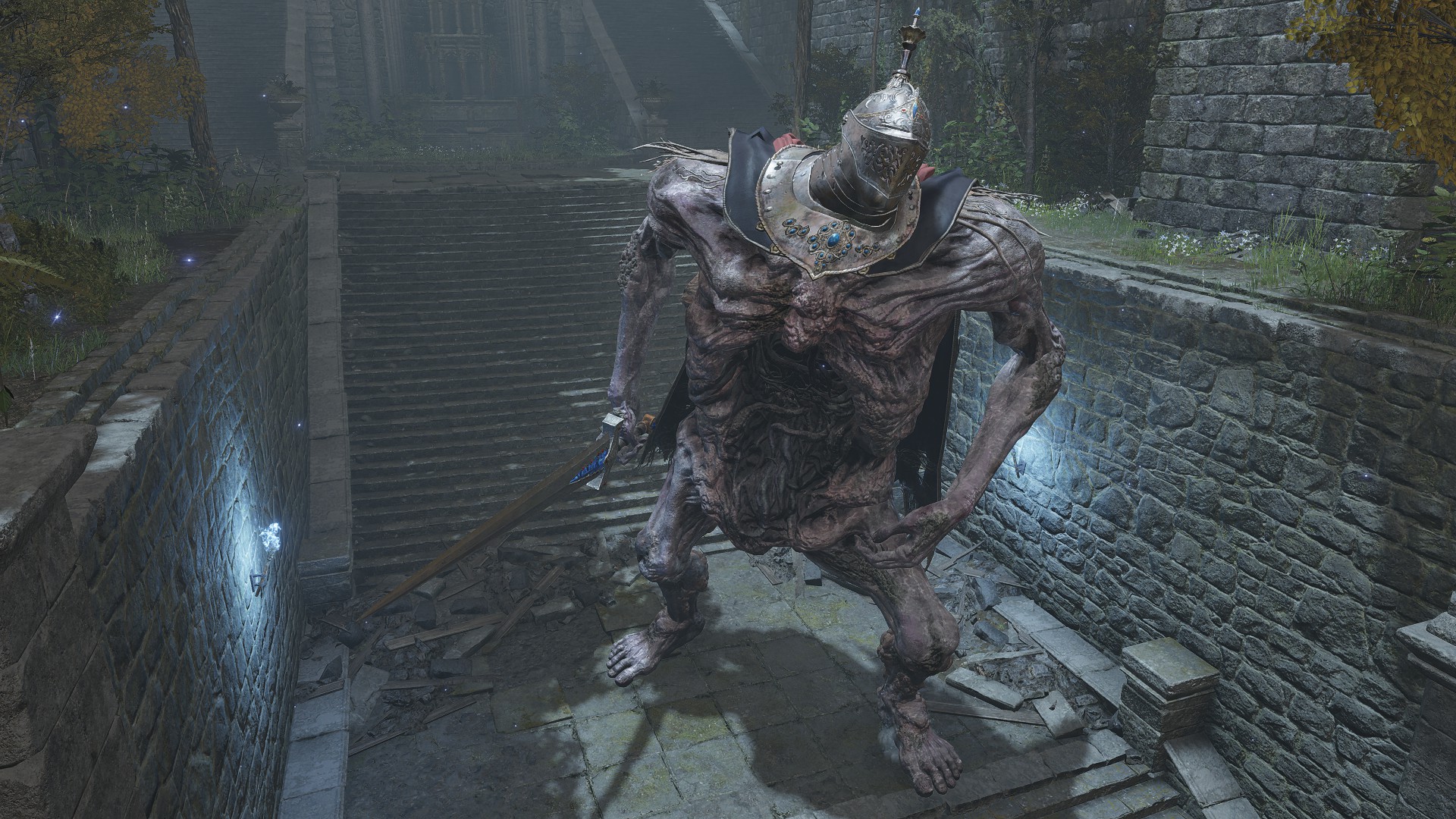
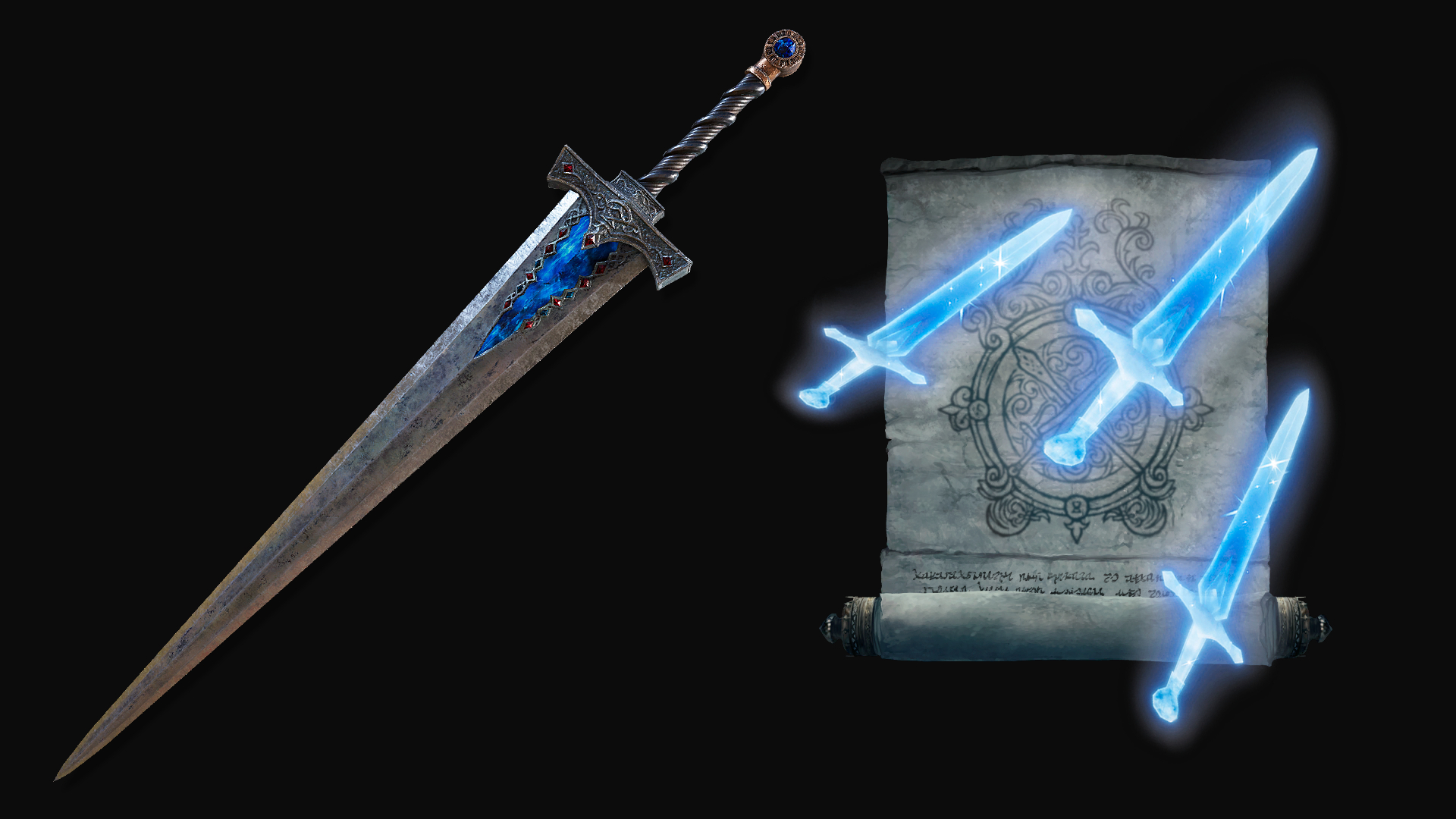
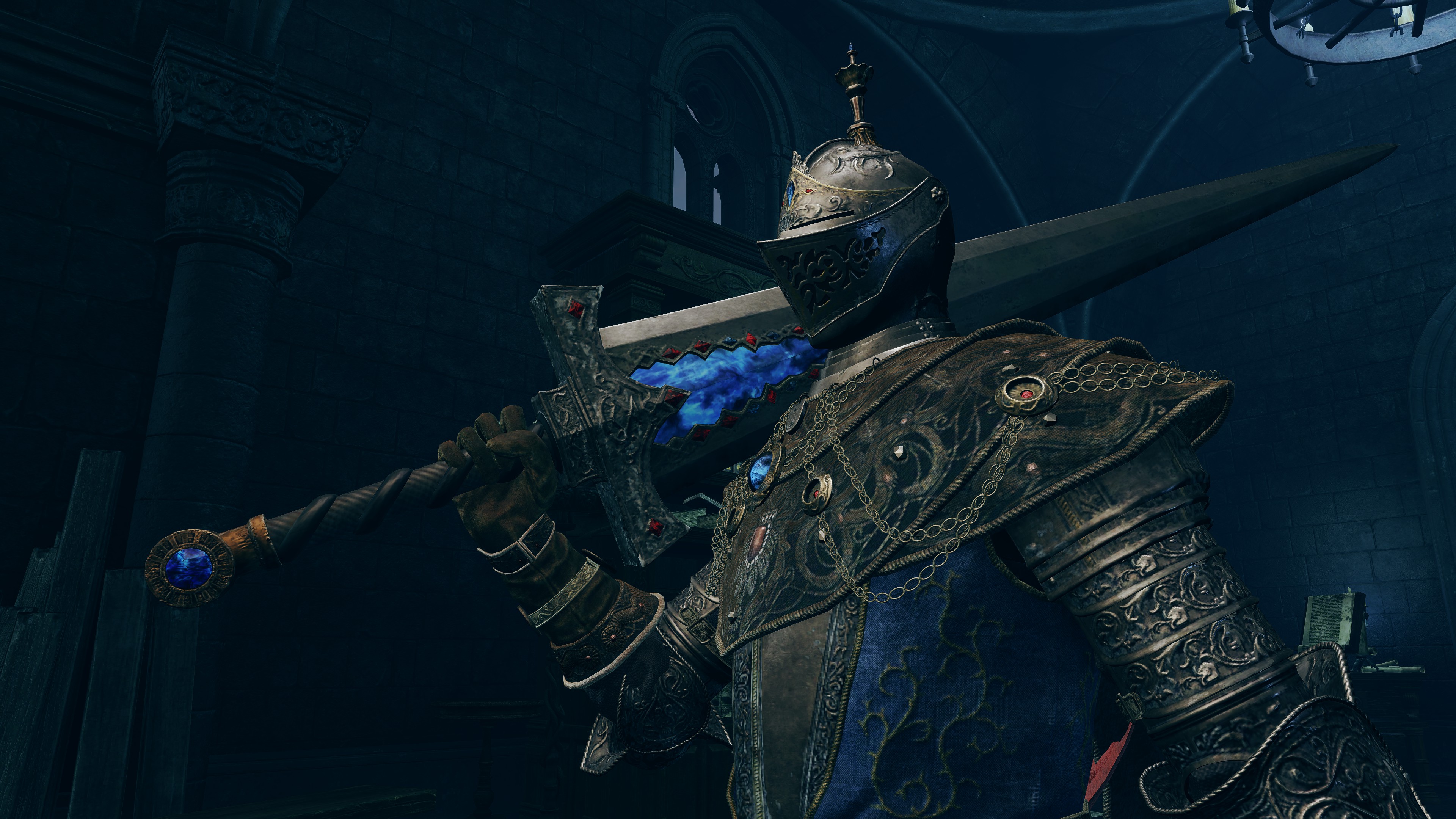
Battle art of troll sorcery knights. Deploys circular formation with giant magic brightswords. The brightswords automatically fly toward enemies nearby. Can chain to a stomping thrust with strong attack.
Greatsword embedded with blue brightstone in the blade. Weapon of trolls who served Caria royal family.
It is said that they, who the queen called oath friends, are formal Caria knights and raised their swords with human knights.
Greatsword embedded with a blue brightstone in its blade. Choice weapon of Moonridel, Caria knight of herculean strength.
It is said that Moonridel, the Twin Moon’s second, was a friend of the trolls who served the royal family and raised their weapon alongside them.
It took time for all these different developments to occur, as highlighted by what little involving the knights is expressly old. Much of what we see had likely not been finalized until many years after the order’s first battle. As noted previously, Rennala wasn’t in a position to fear rebellion at the outset. The military buildup was thus more a deterrent for what anyone could assume was an inevitability. Perhaps many weren’t as incensed by a sudden warlord imposing her authority in the immediate wake of her heroism, but splinters in this Liurnian queendom would multiply as time passed. Wise Rennala understood how tenuous her grip on power could become, so she cemented the glintstone knights as no one’s equal in the region. In the interim of secretly preparing her forces to quell fellow sorcerers outright, she would rely on political acumen to quell discontent or at least divide opposition. But make no mistake, hers was still a regime by coercion. In the end, the royal family’s strength was the sole thing keeping the land together, through war and peace.
Upon Her Works, Ye Wise
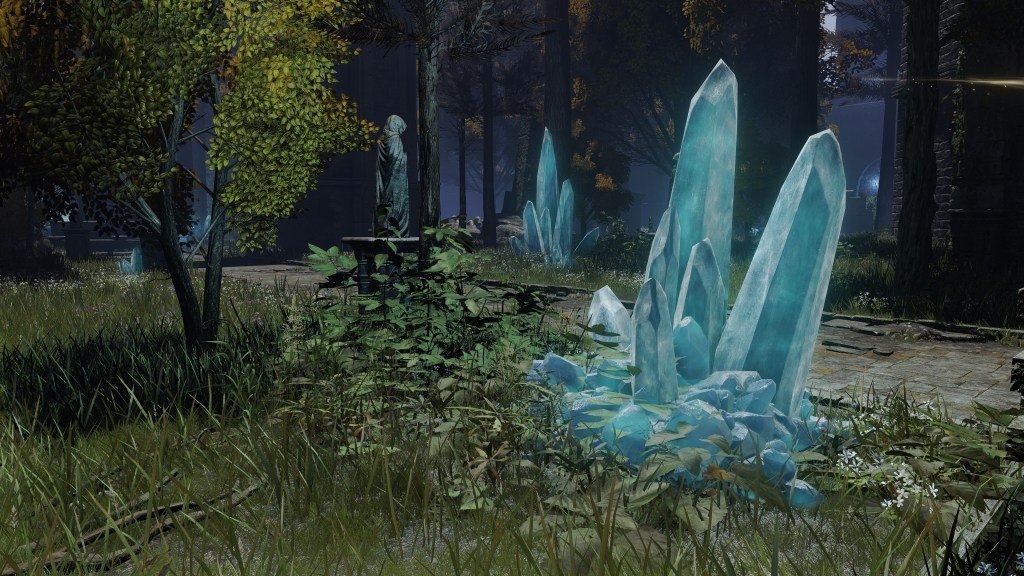
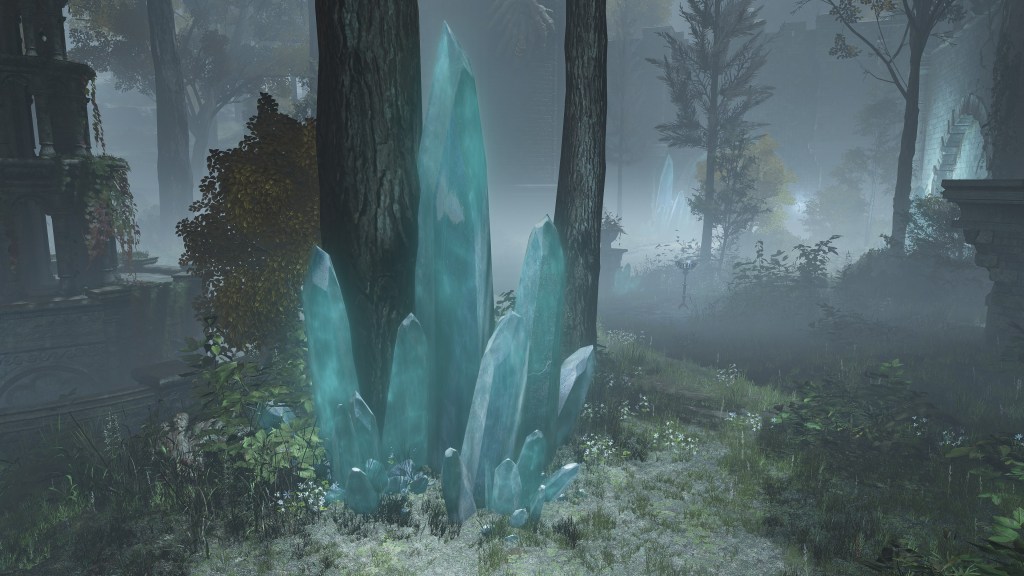
As the queen secured her hold over Liurnia, she sprinkled reminders in her wake. Back home, the most overt signal was the blue flame burning all throughout the manor property from the smallest candle to the grandest torch. Using magic for lighting shouldn’t be so unusual for areas owned by sorcerers, in theory. But in practical terms, not even the sorcery academy bothers to burn anything more than mundane kindling. Either it is too difficult for an institution mostly comprised of mere students to handle, or they consider it too wasteful for something as mundane as reading books and navigating hallways to class. Caria’s practice consequently only serves to highlight their deep connection to sorcery. Just like the blue particles sparkling through the manor air or large crystal formations in the courtyard anyone first enters, showing off how they possess an overwhelming supply of magical fire on hand gives every impression that the royal family stands above even Liurnia’s preeminent learning facility. This is fitting, since the foremost concern were the sorcerers at Raya Lucaria.
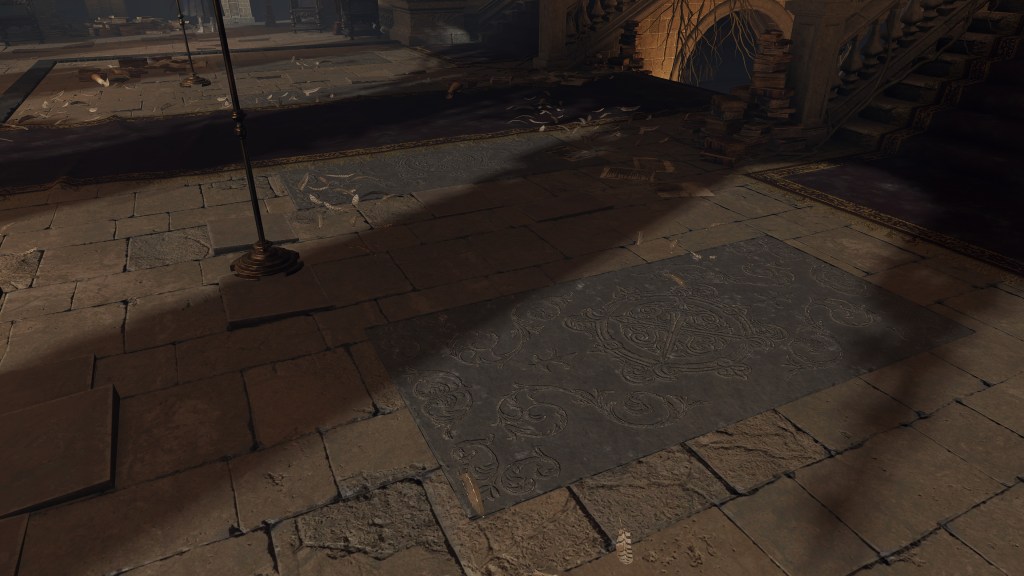
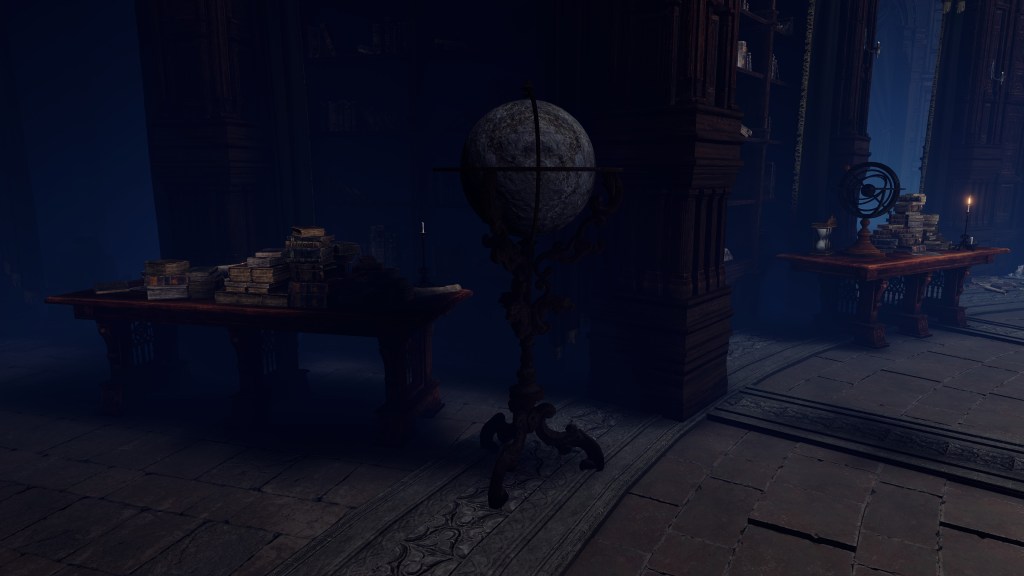
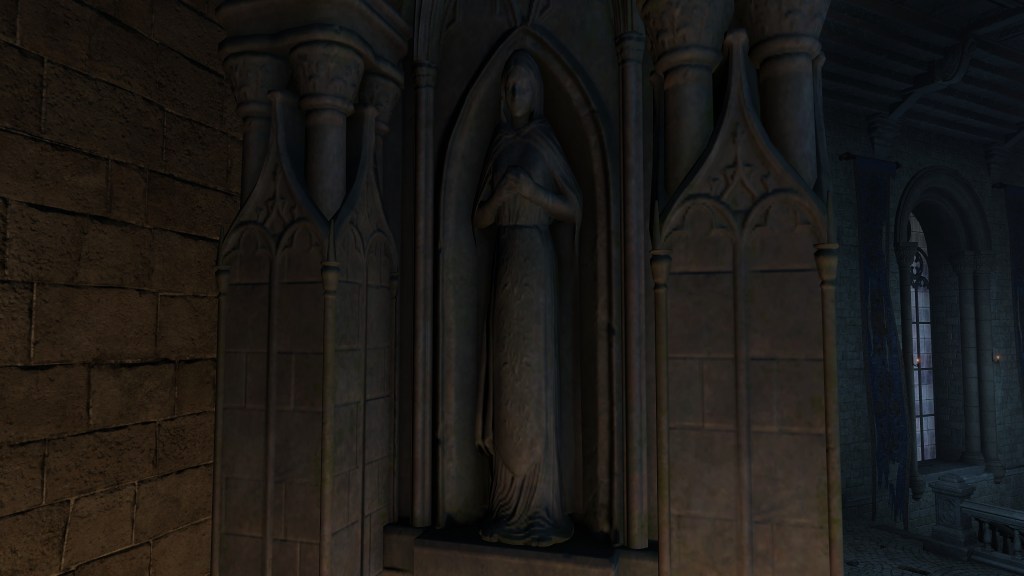
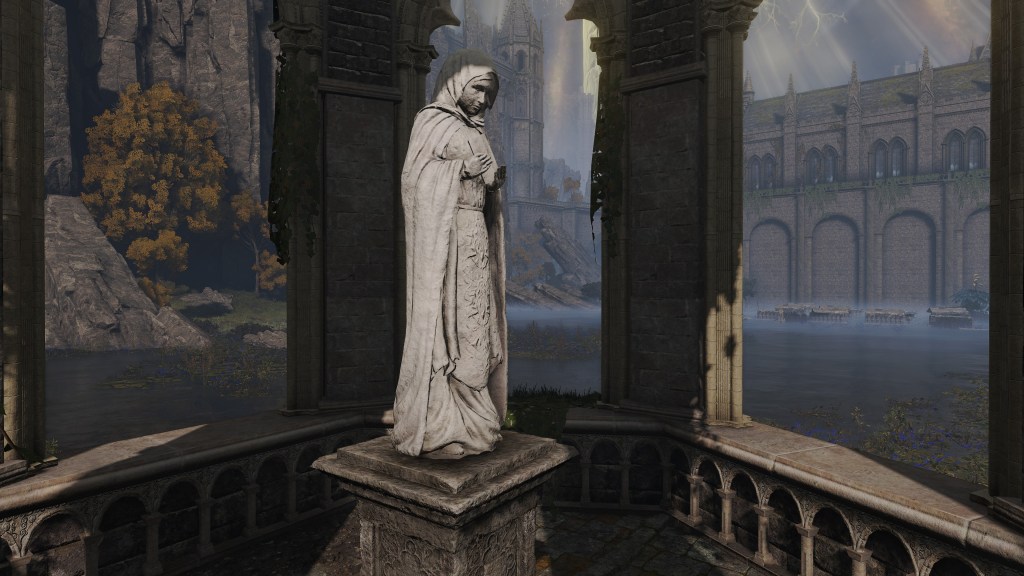
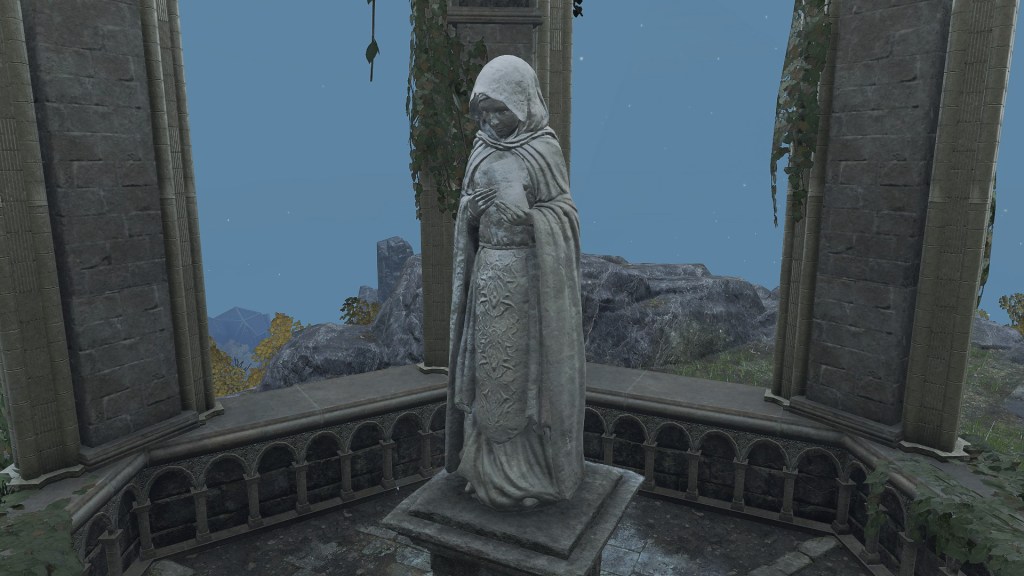
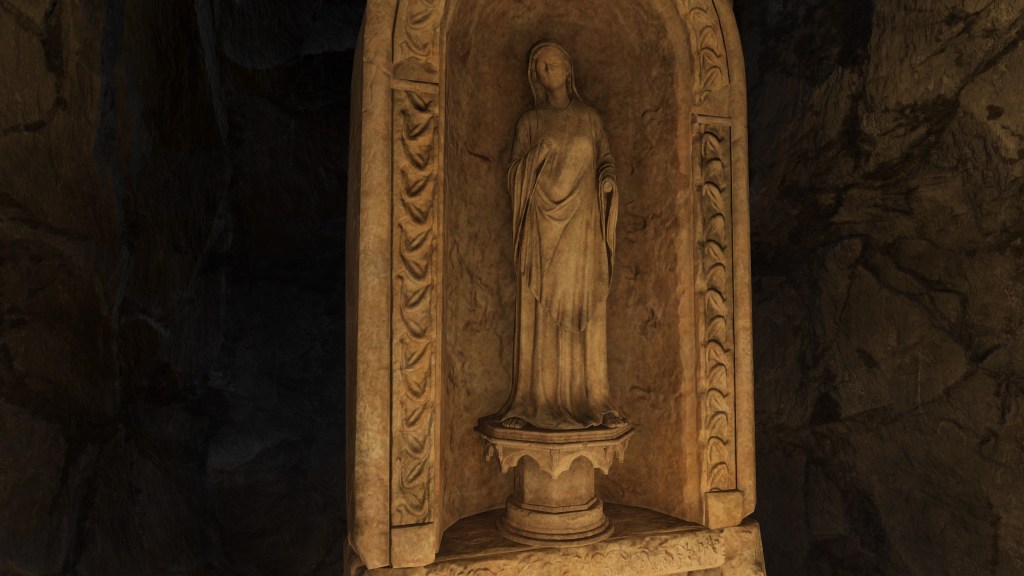
To demonstrate how the academy relinquished their halls to the new royal heads, the Carian crest has been captured in stone on the floors. A full-length portrait of the Full Moon Queen additionally hangs in the stairwell to the Debate Parlor, her royal scepter mounted underneath — the replica’s tip embedded with turquoise glintstone instead of Carian Blue, of course. The actual debate hall has a uniquely large armillary sphere hanging from the ceiling, utilizing a moon instead of a globe. Meanwhile, the statuette placed on the Church of the Cuckoo’s altar portrays the scholar standing atop the lunar body as his foundation. Caria’s influence over the curriculum is palpable, and no example is more shameless than the statues of a hooded woman typically clutching a book close to the chest, her robes featuring the same pattern enshrined by the astrologers there. The association with reading and knowledge insinuates this to be a representation of an intelligent magic woman — a witch. Combined with everything else, the idol must primarily represent Rennala, the revered hero.
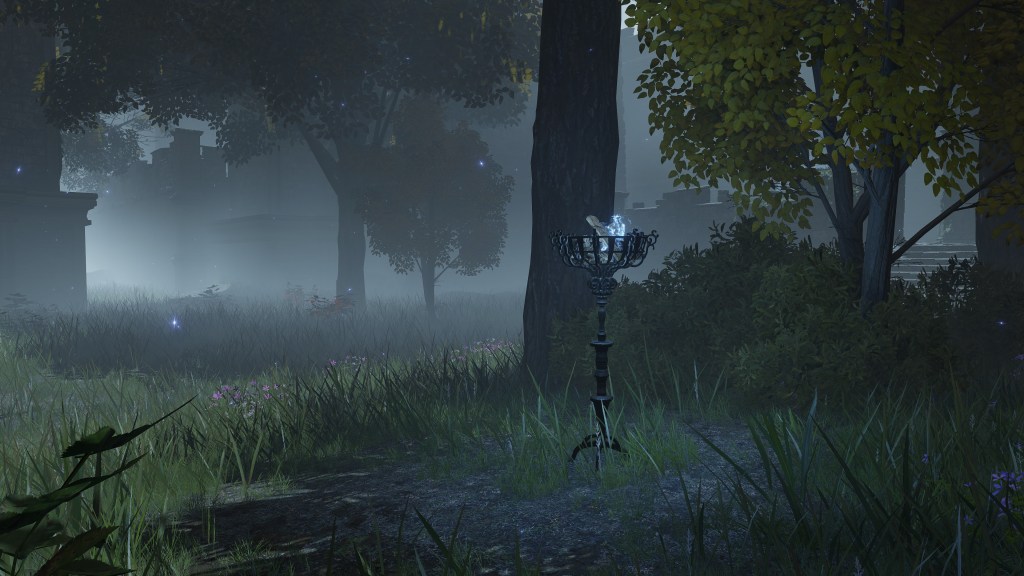




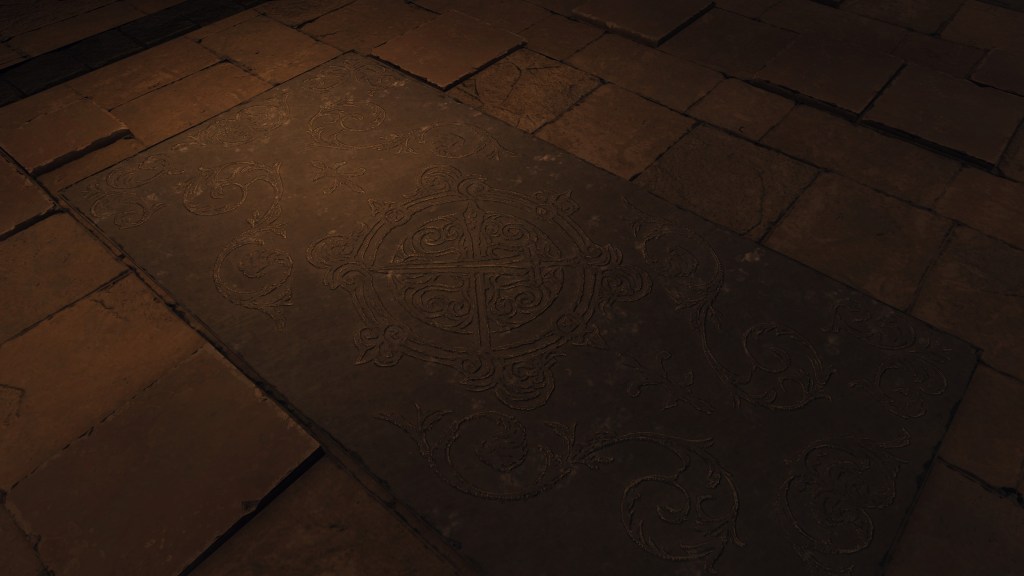


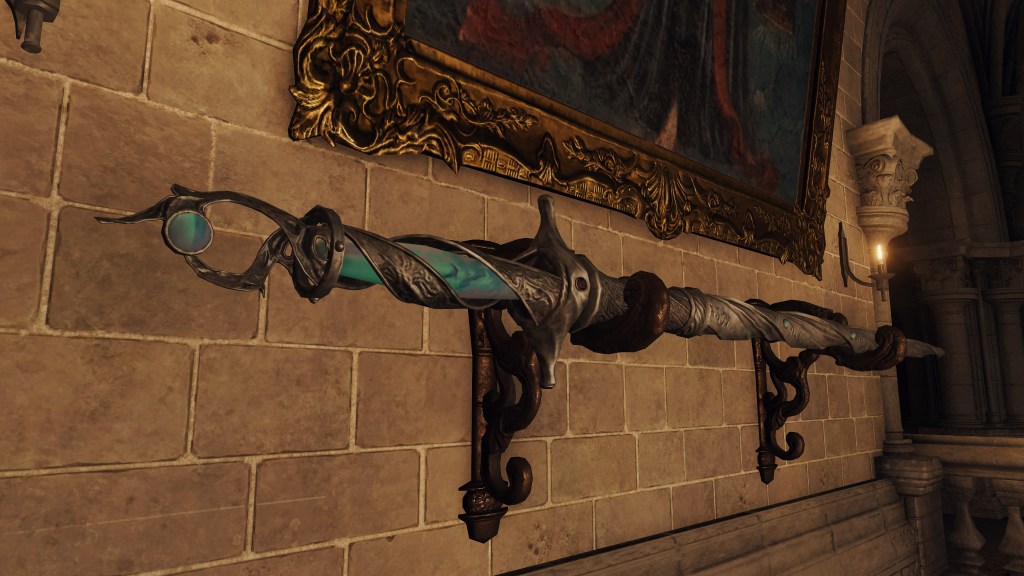
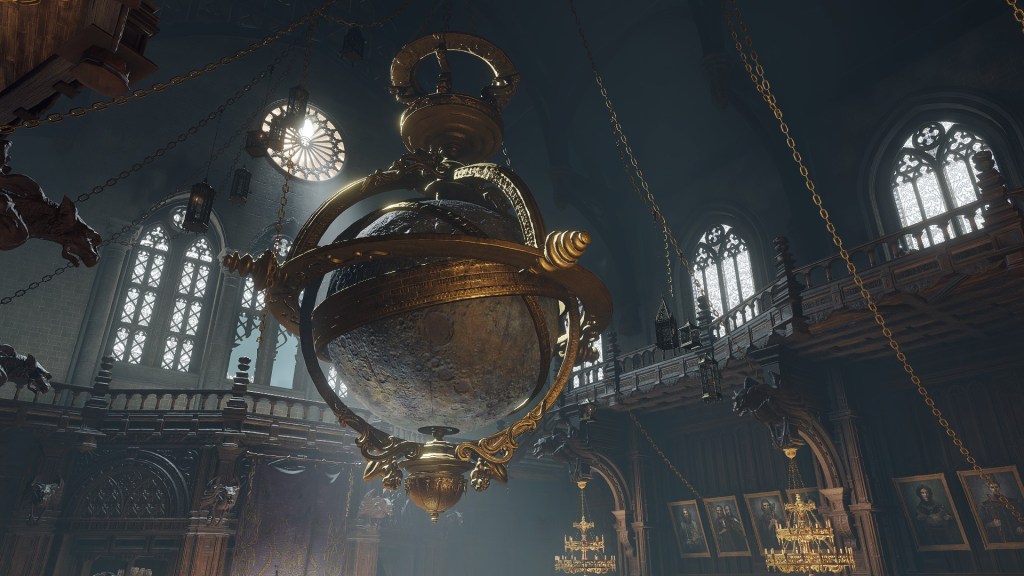
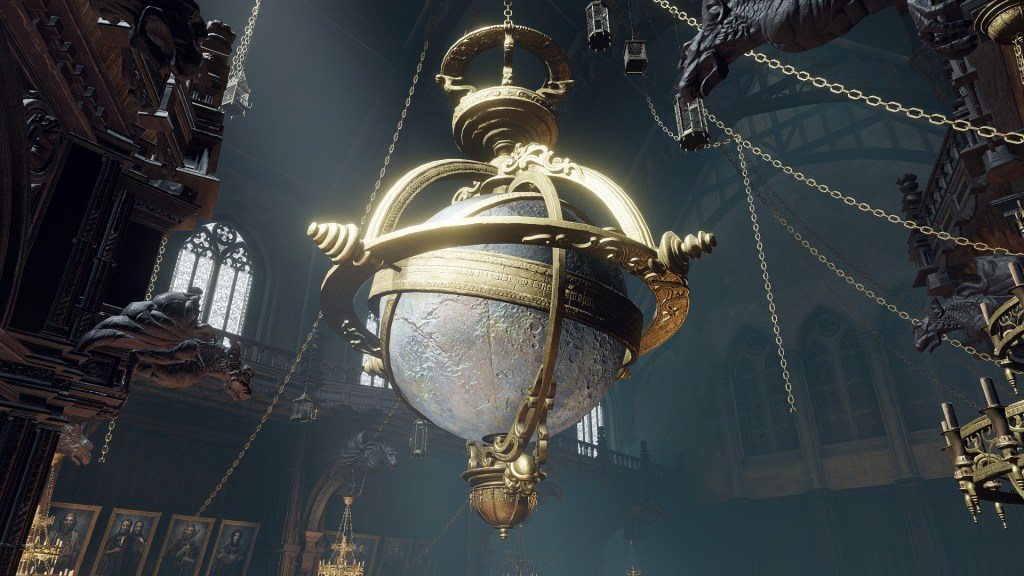

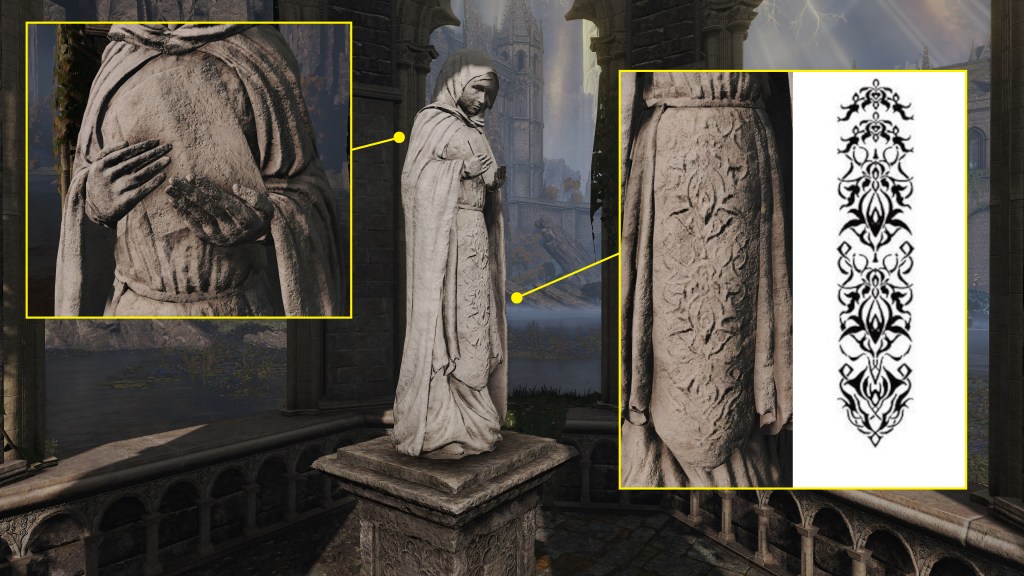
Scroll of the Caria royal family, who are the heads of the Sorcery Academy of Raya Lucaria.
Indeed, the witch statue flanks the entrances to the Church of the Cuckoo and Debate Parlor, as well as the hemicyclium overlooking the Temple Quarter. The idols have even been erected underground, preceding the ride up to where Terra Magica is cast over the entire academy. No one was allowed to forget this image, least of all when approaching the genuine article. Most of the academy’s statues have been placed in the lead-up to the Grand Library where we encounter Rennala in person. Based on this and the Carian crest above the gateway, the massive archive was where the Full Moon Witch stayed whenever she visited her alma mater, endless pages of information always within arm’s reach alongside more armillary moon spheres. This sealed Caria’s place at the head of the academy, Rennala’s frequent lodging precisely because she was leader to both — her robes, resembling the standard academy uniform, have its crest sewn into the red stole, denoting authority. Like Lusat before her, the queen was the effective school principal, overseeing everything as conveyed in icons.

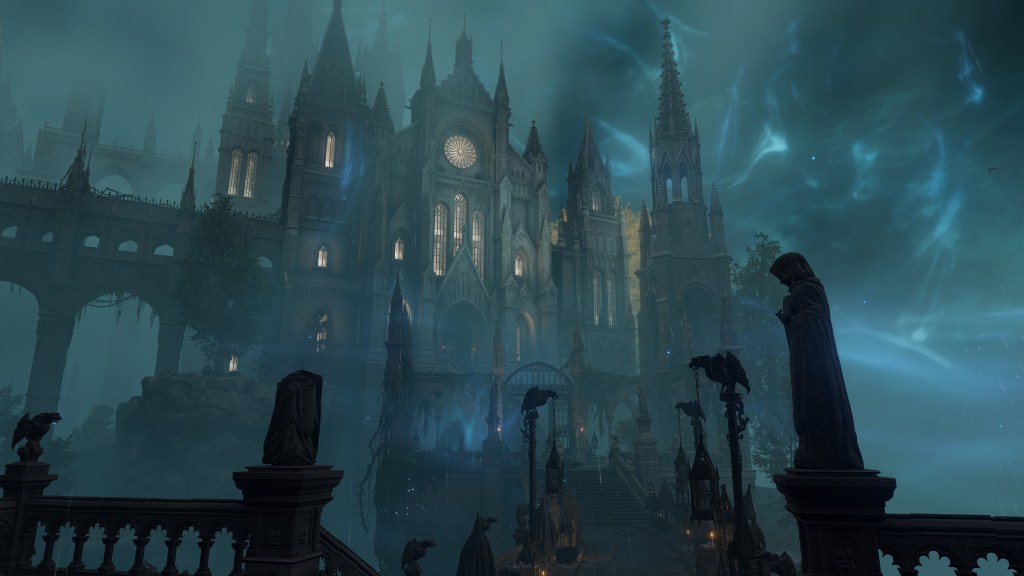


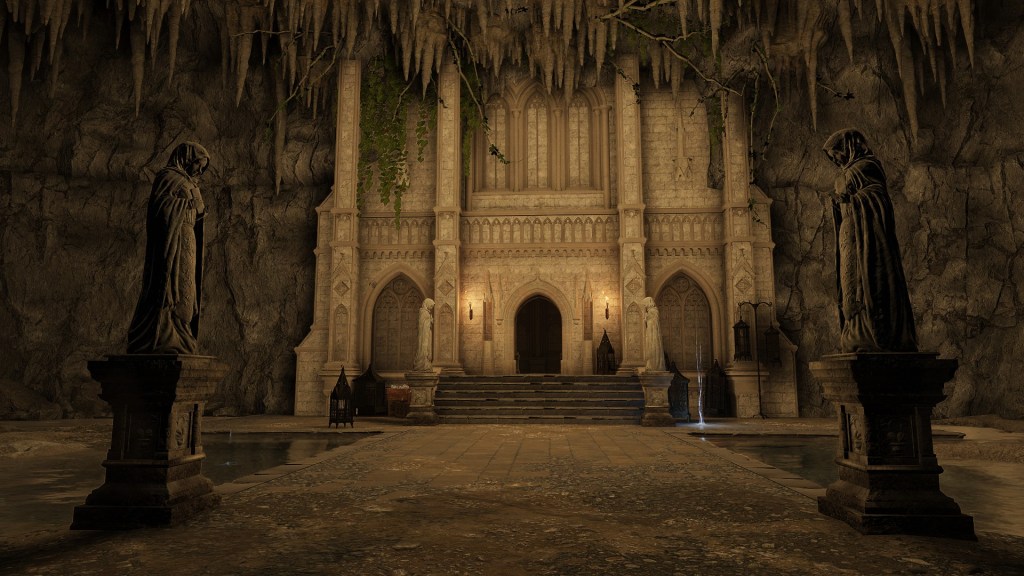


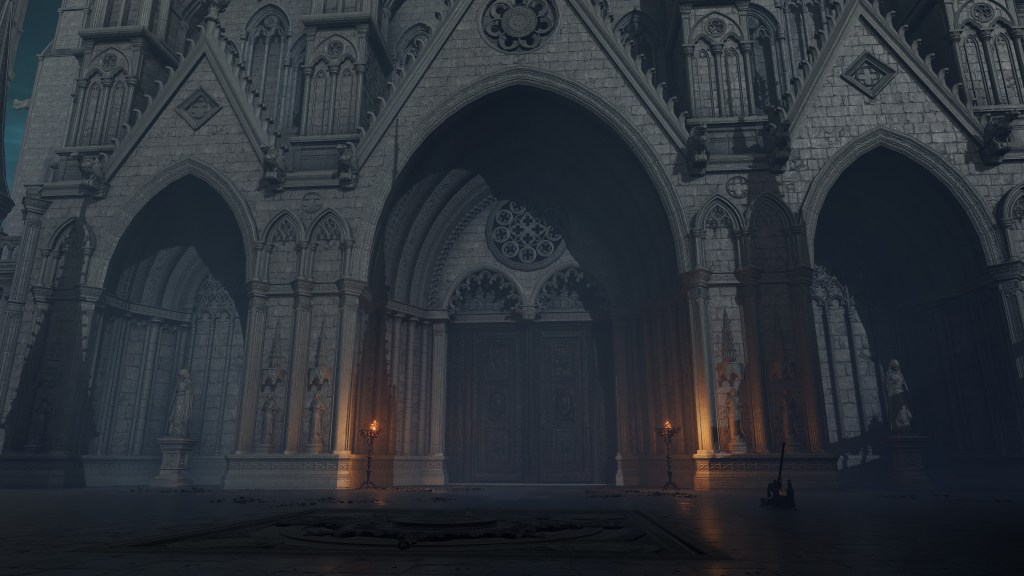

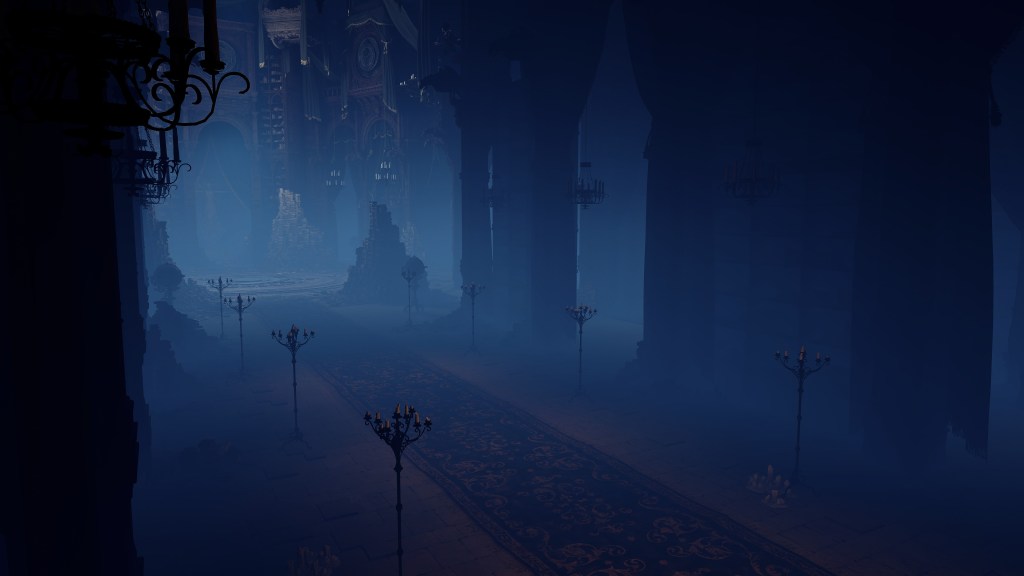
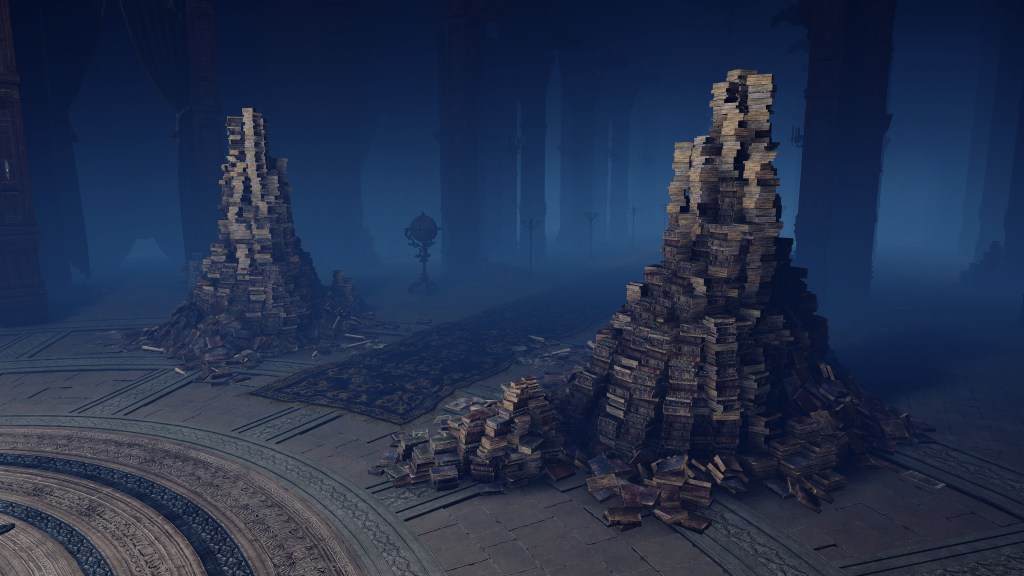
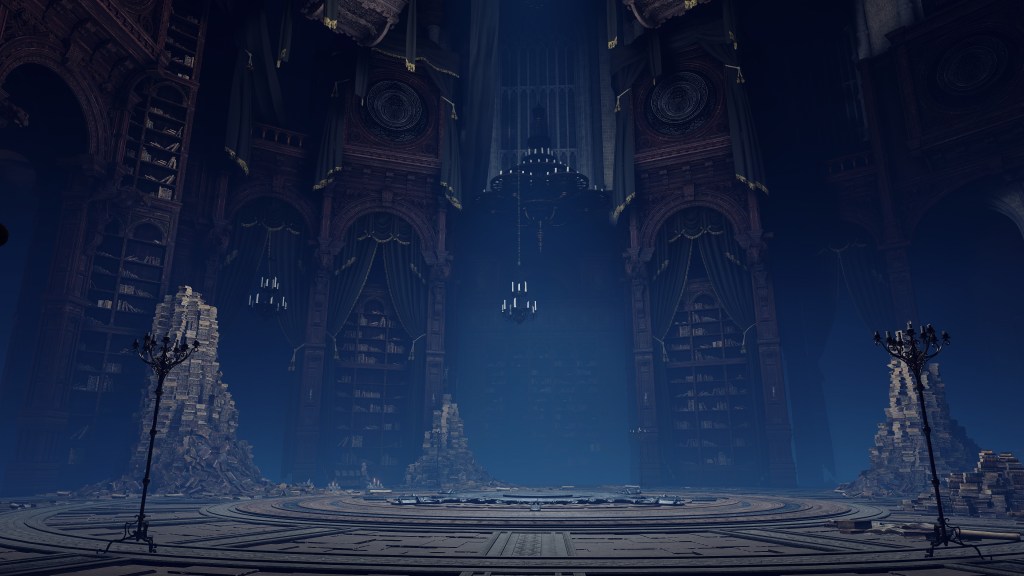
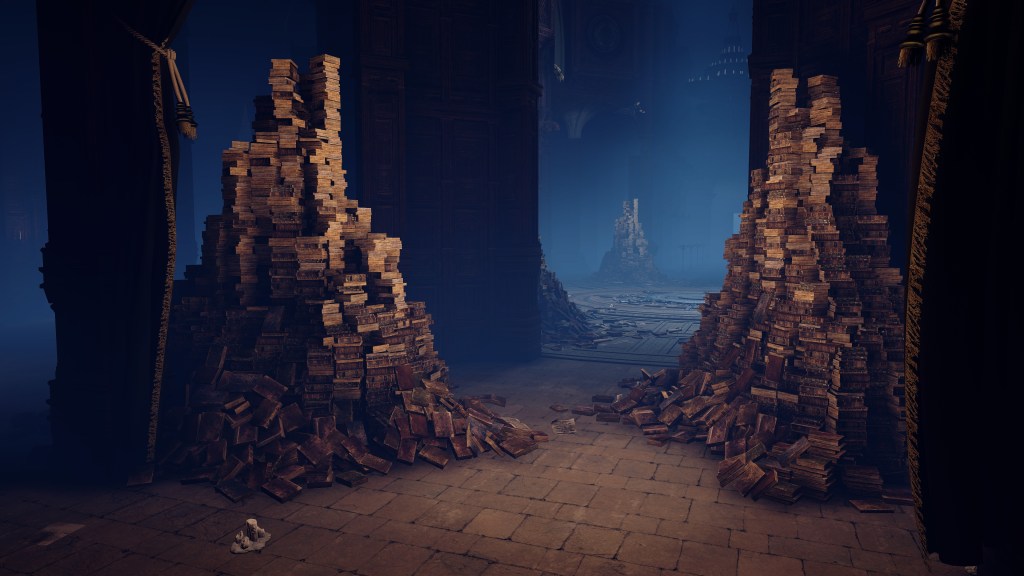


The witch statue appears to have been used to denote more than specifically her on occasion. For example, the image is built into the classroom halls as the face to tombs, a Carian Glintstone Staff mounted overhead. This plainly conveys the deceased as academy sorcerers on the road to becoming Rennala’s knights; burying them amongst their classmates showcases the glory afforded to students who serve Caria. More such tombs lay in the Church of the Cuckoo’s cemetery, with a conventional statue set up to “overlook” the rest in the enclosure — an obvious parallel to the queen leading her knights. This sort of special treatment may be reserved solely for female members, since knights are also buried in the academy’s general graveyard; armor robbable from one grave as some of the rotten bodies rising up pay respects. It would definitely be odd to depict a man as a magic woman on his coffin, so it is possible that the knights received disparate funerals on account of the matriarchy inherent to Carian royalty. The witch might still be employed to honor the males in other ways, however.
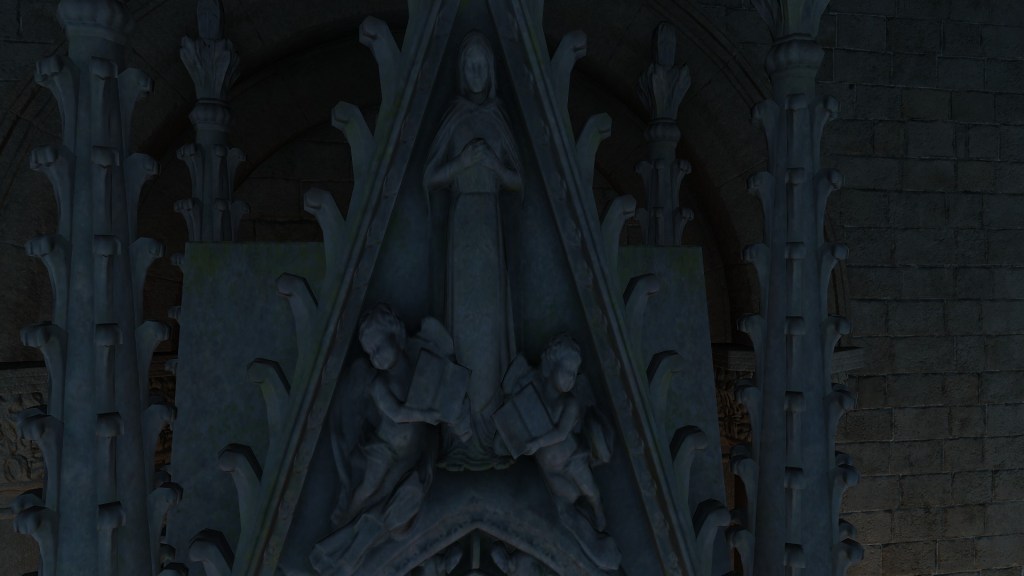
The statues precede a separate tomb monument, far larger than the rest in the graveyard. Given smaller tombs receive similar praise from the rotten, the arrangement adds a particular aura to this grave. The monument itself bears the same witch on its sides and crown, the latter surrounded by cherubs holding open books. This same cherub imagery decorates the Grand Library where Rennala resides, insinuating that the witch in this case is supposed to be the Full Moon Queen. Certainly, more cherubs surround a veiled woman in the scene below, her crescent crown confirming her identity. Once again, Rennala is portrayed elevating the dead; framed by robed men holding priestly implements, presumably the sage academics following her lead. Although there is no guarantee that the person entombed is even a knight, somber smithing stone used to strengthen the glintstone swords has been laid on the memorial. There is thus potential for distinguished male knights to have received a degree of ceremony comparable to female counterparts, the queen’s appreciation immortalized in their tomb.


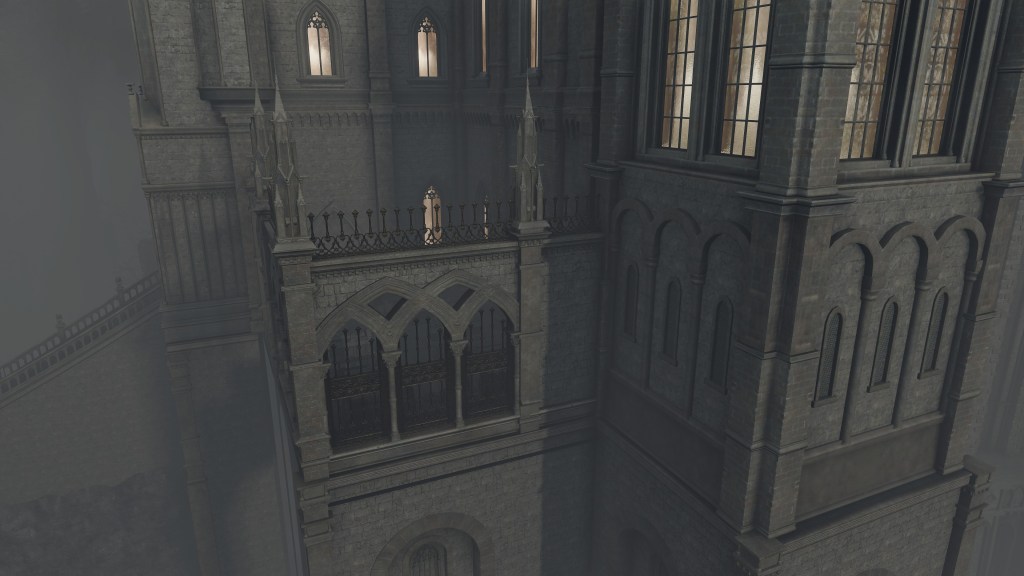
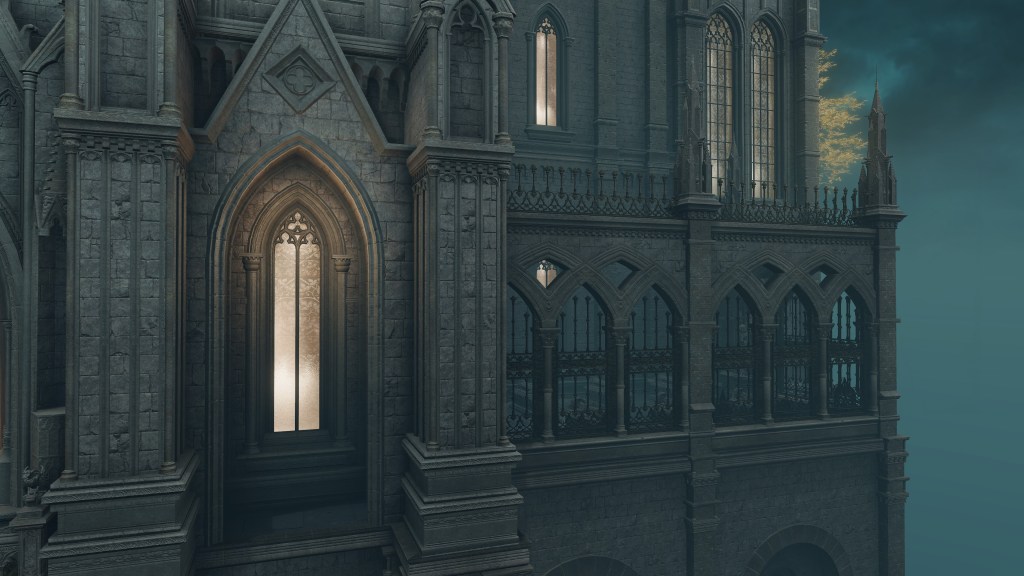

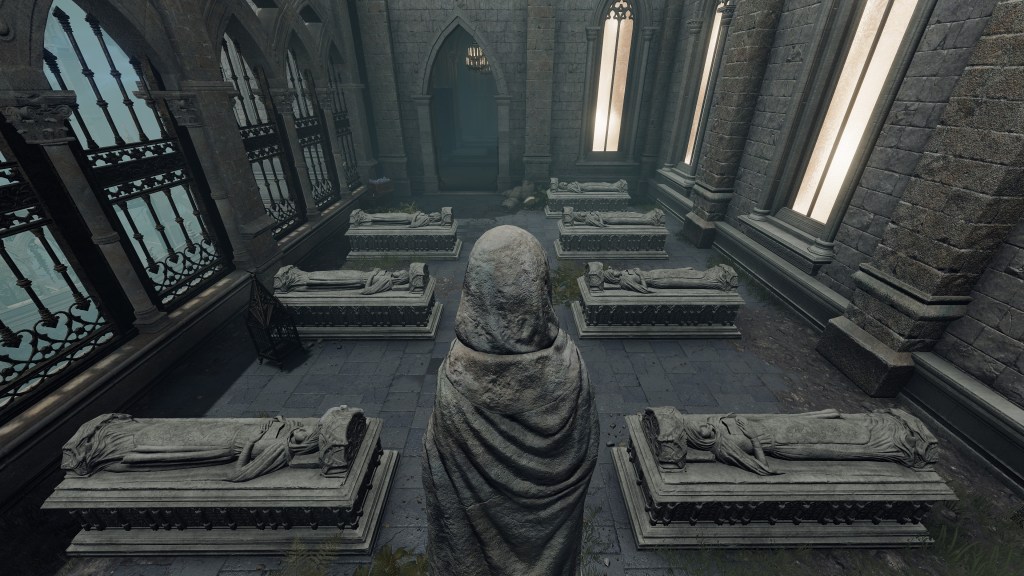


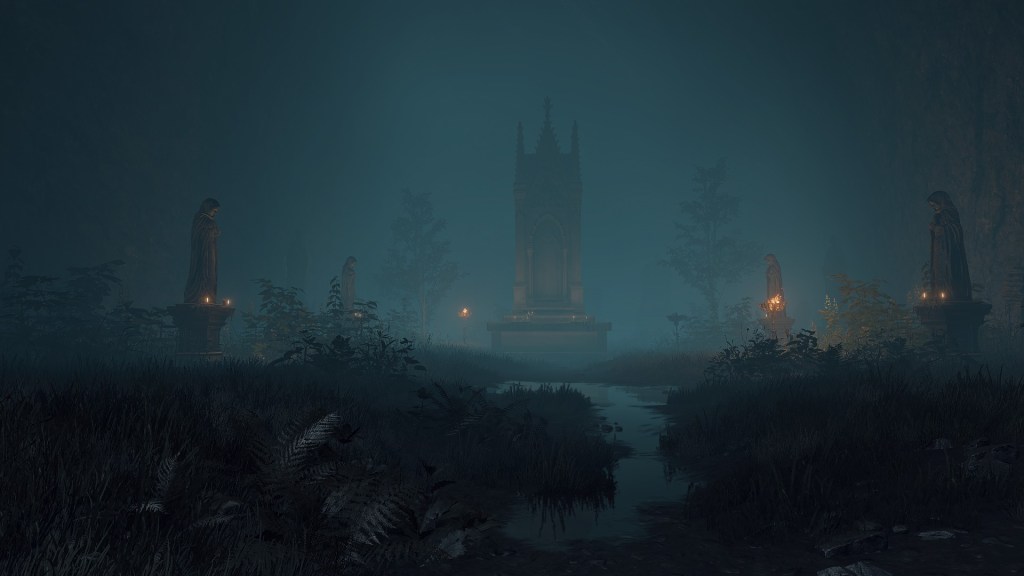



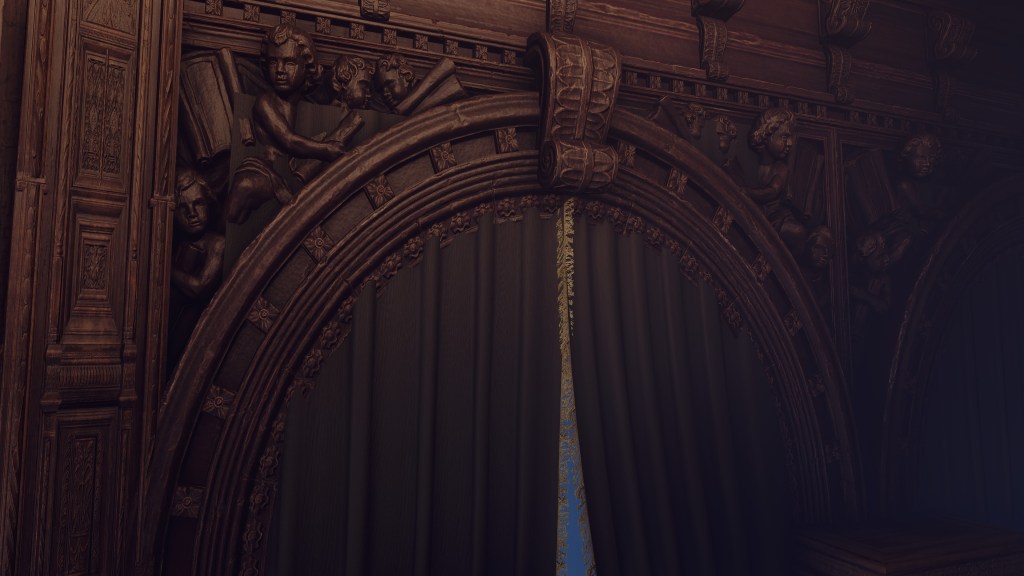
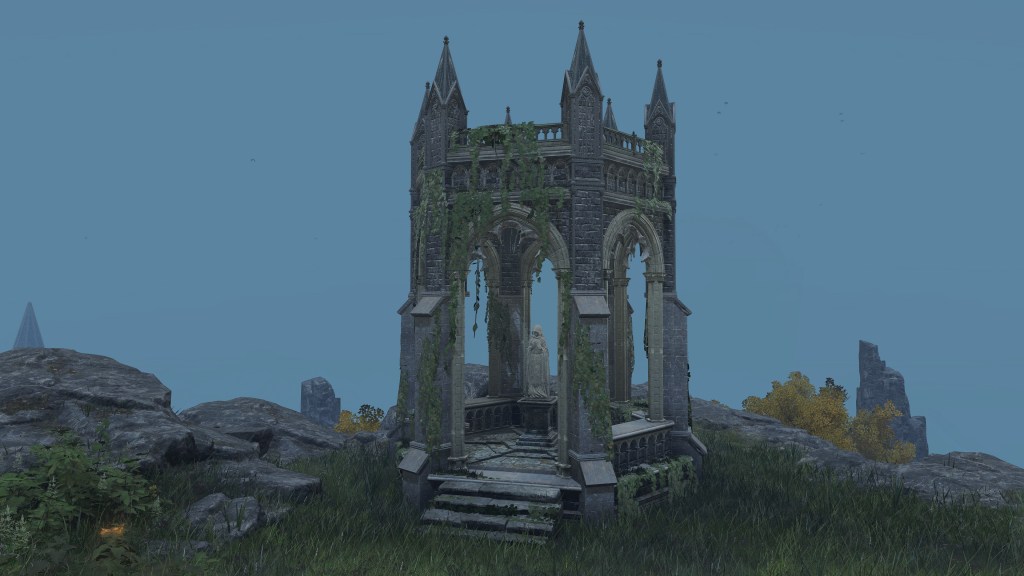
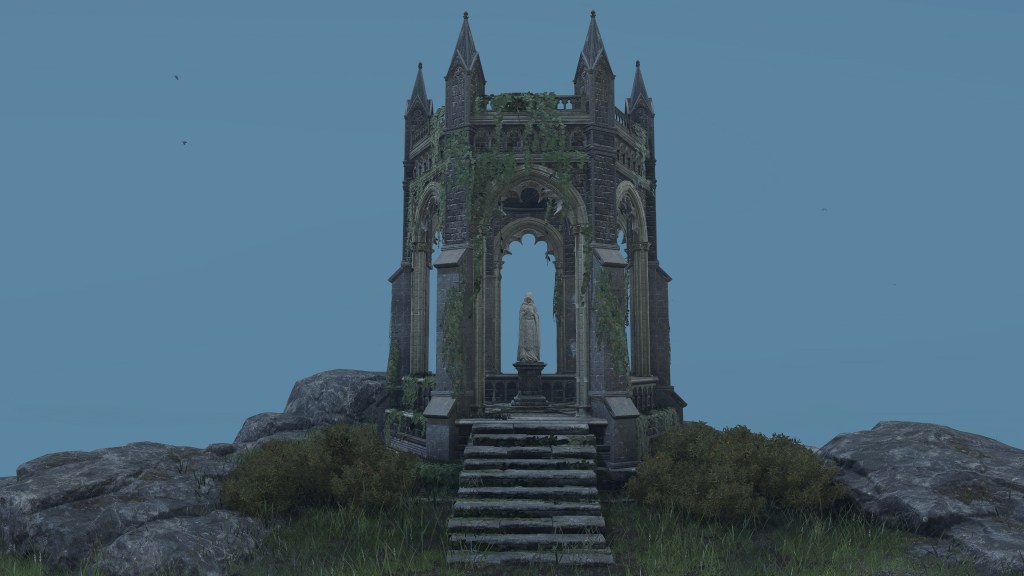
Overall, while not strictly an effigy of Rennala, we see that the witch serves as an icon to unite astrologers under Caria as embodied by its queen. That propaganda wasn’t limited to Raya Lucaria. Outside the academy, witch statues are the centerpiece to follies dotting the stretch between Laskyar and Caria Manor, citizens and travelers alike taking shelter from the frequent rains under the protection of that witch. The statues also decorate the stone sarcophagi of coffin cemeteries, but because those cemeteries are used interchangeably with other graveyard types across all the Lands Between, that small detail may just be the remnant of an earlier concept cut during development. Even so, the follies demonstrate the importance placed in Rennala and Caria throughout the land. This was the burgeoning royalty planting its standard for everyone to see, to let every subject know whose domain they were now a part of. And should they visit the royal manor, they would be greeted by those same witch statues as they walked the path to a possible audience with the Full Moon Queen.

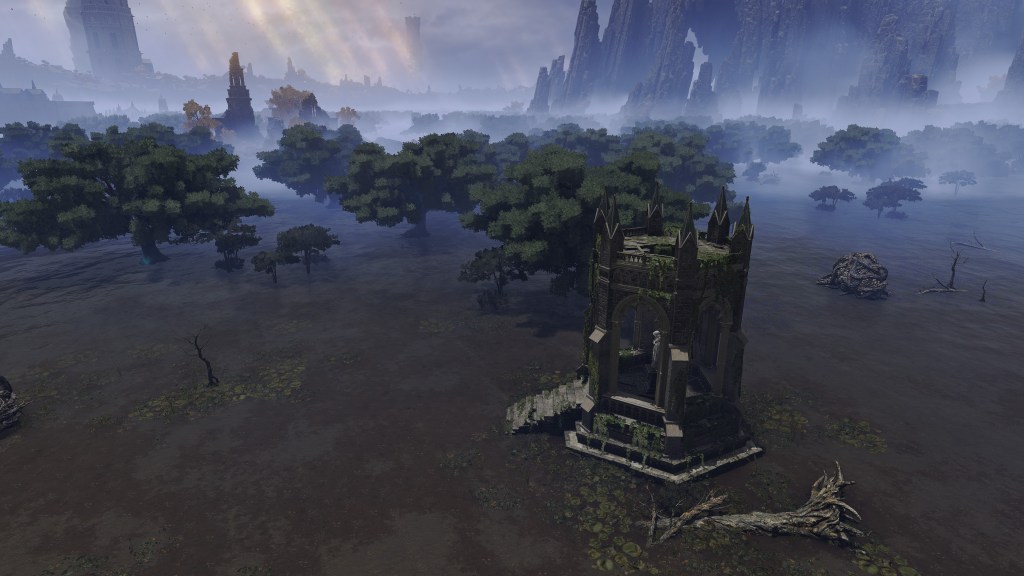

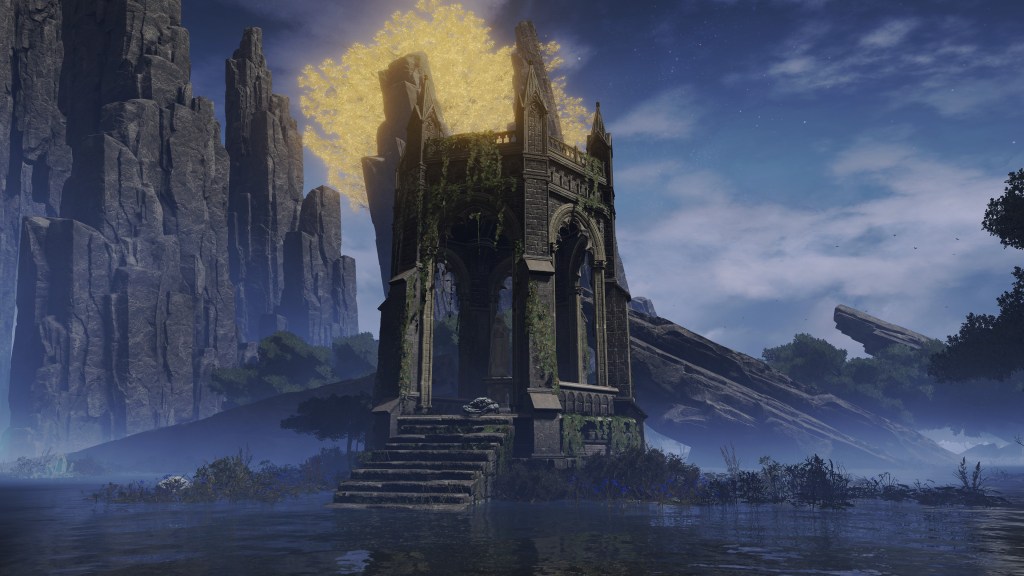

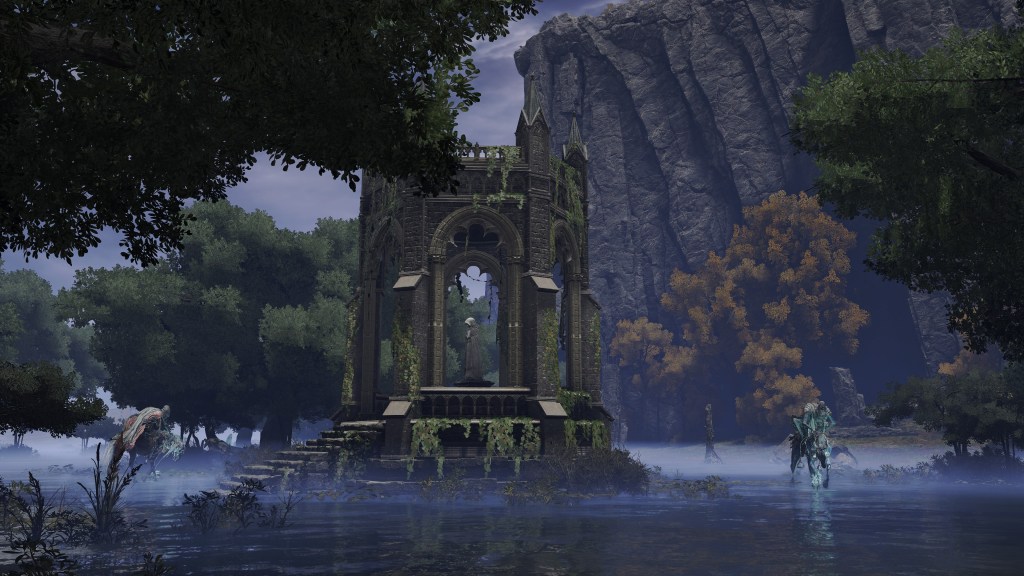


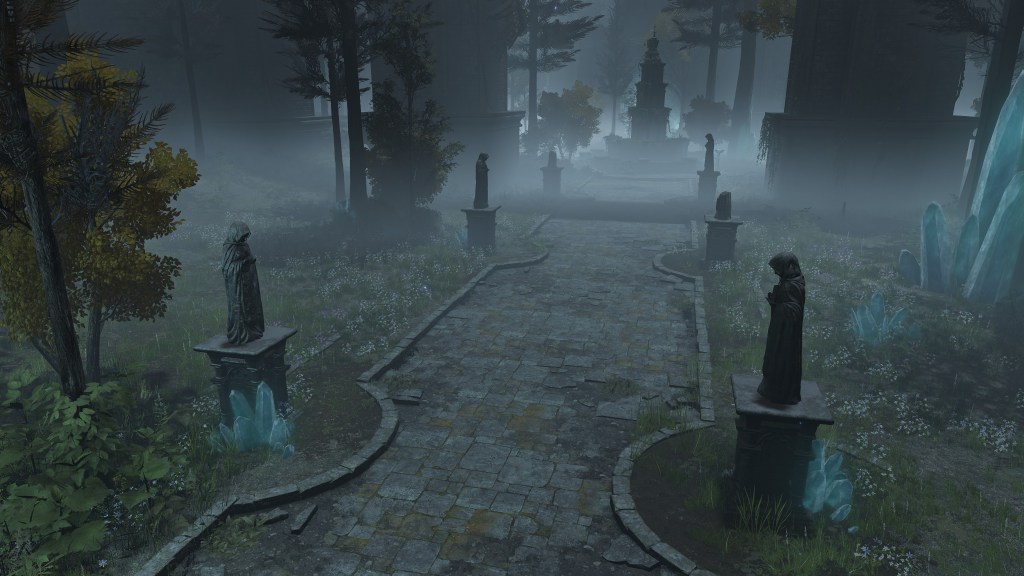


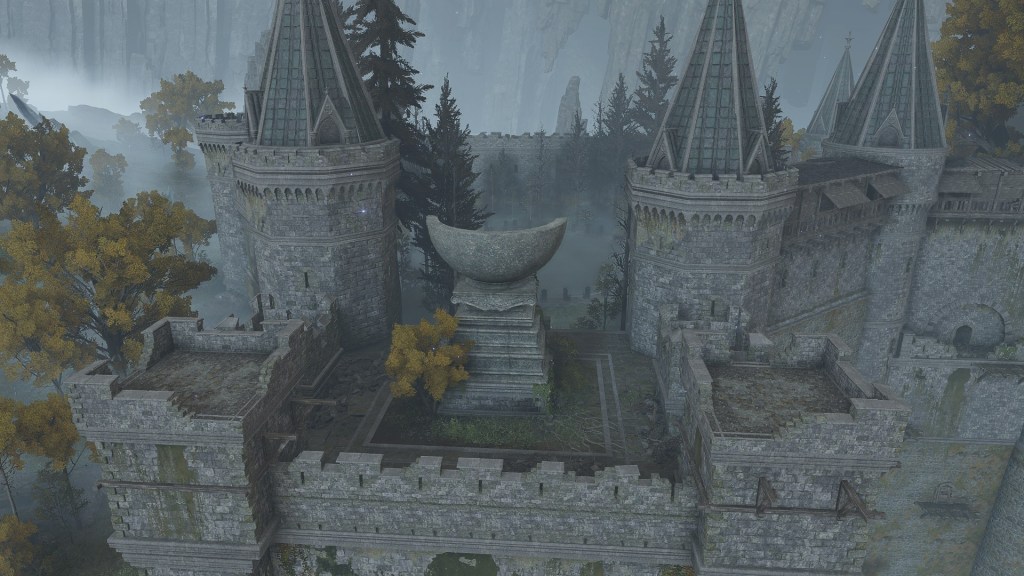
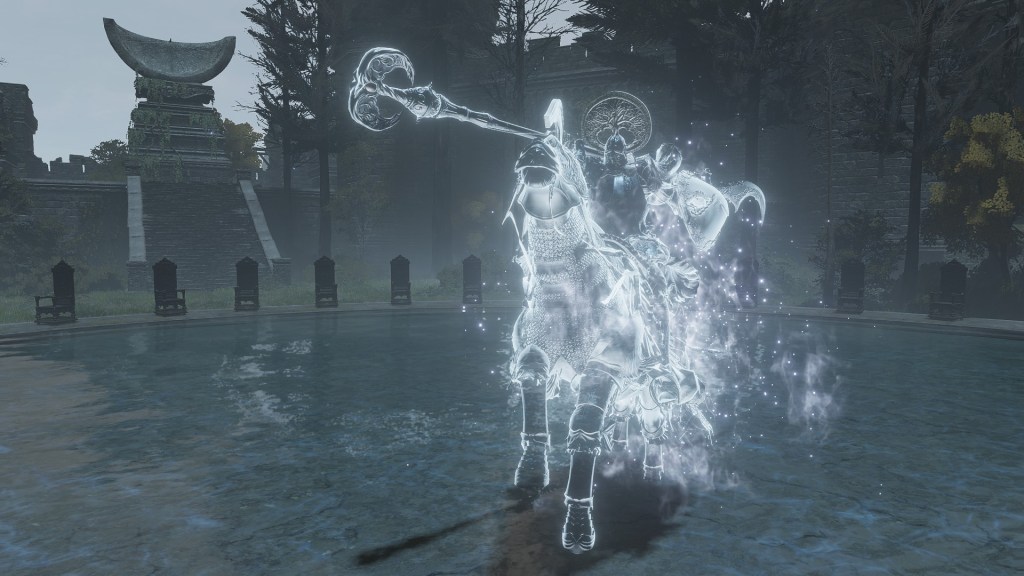
Of course, any audience might be hampered by the queen’s own business. The back end of the castle was the Carians’ sanctum based on all the royal banners decorating the stonework from the moment we take the lift to the top of the ridge. Proceeding to the deepest part of this hallowed castle leads to the “royal family’s” moongazing grounds (王家の月見場) as the local grace point reveals. More specifically, it is a courtyard reserved as a ritual site — a wide circle of chairs lining a pool at the center, an especially large hemicyclium enshrined up a staircase nearby. With the way the water might reflect the lunar body, it appears that the Carians regularly performed their astrological ceremonies in that location for improved sorcery. Naturally, these mass family gatherings would have included Rennala, Loretta’s phantom rising from the pool to imply that the queen had involved her castle guard in these secret rites. The Full Moon Witch likely did most of her major work back there rather than at the academy, in fact.


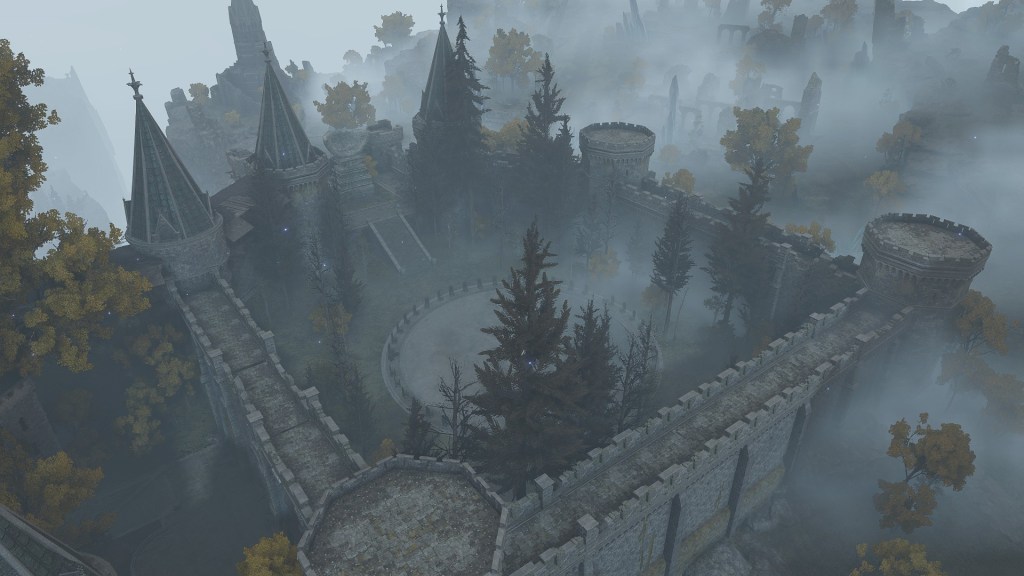


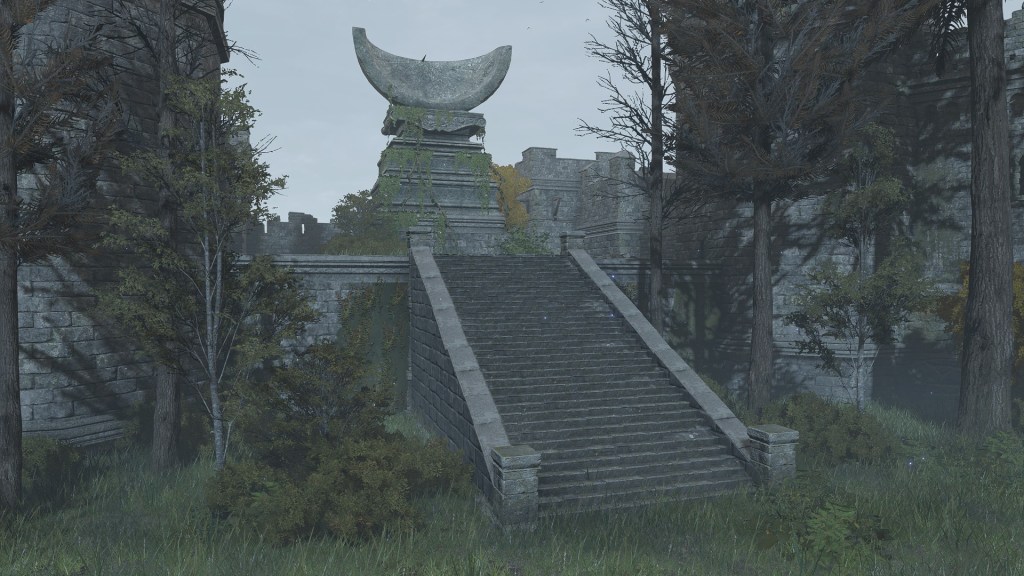

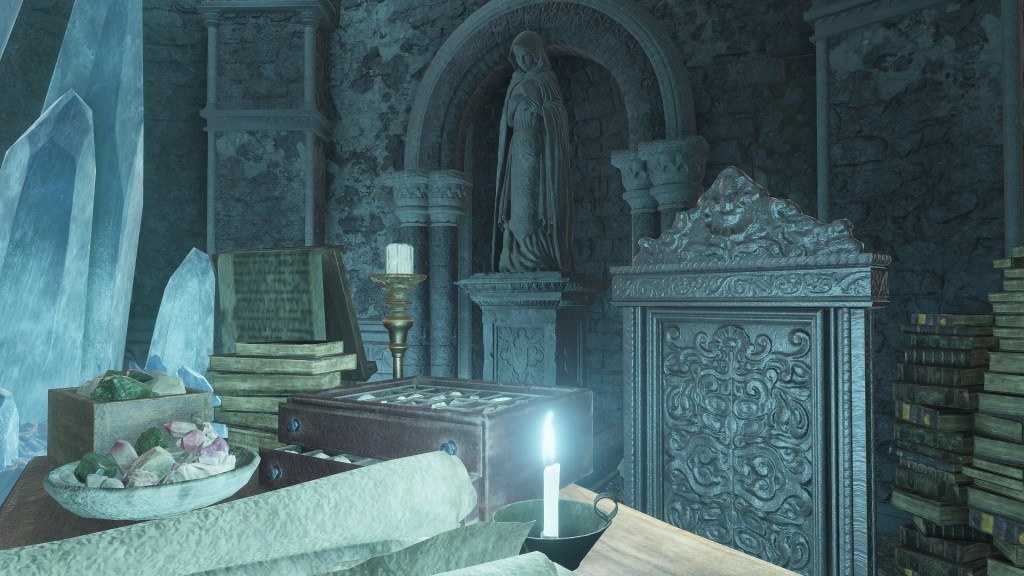
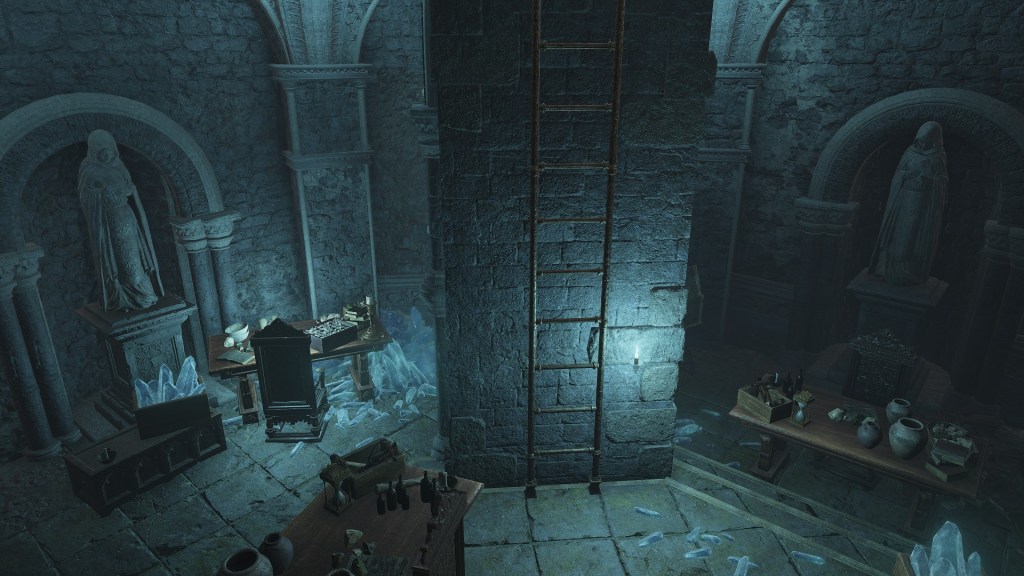
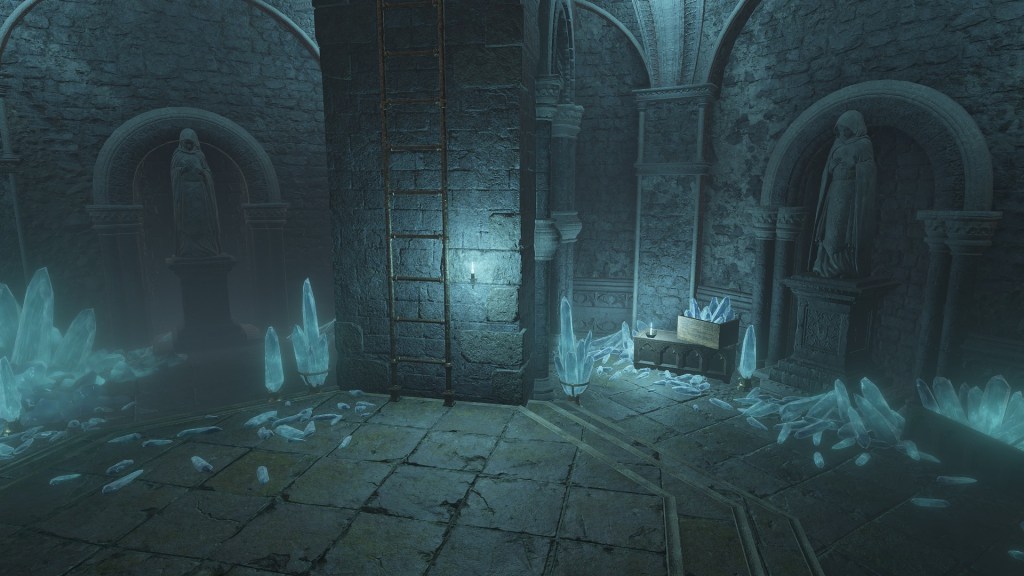
Exiting from the moongazing grounds to the area behind the castle brings us face-to-face with the Three Sisters, a trio of sorcerer’s towers dominating a more extensive ruin. From the size and complexity, the place was comparable to a town or village, but it is doubtful that the buildings served as more residential. Large crystal formations grow throughout the ruins, and blue rays shine down like on the Moonlight Altar. Perhaps the complex functioned as a string of laboratories and similar facilities for sorcerers. That would explain why all three rises are situated so close when their kind are typically built for seclusion, away from urban areas. Put simply, sorcerers of the towers worked in privacy while retaining the freedom to interact with a larger network of researchers just outside. We already see signs of research in the manor proper — books, crystals, and armillary spheres lying about — so any operation set up in Caria’s backyard must have been special. And who were the operators? Top Carians, including Rennala.
The name Three Sisters is likely tongue-in-cheek for the towers’ owners as much as the towers. Currently, two belong to Seluvis and Ranni, but this doesn’t necessitate that it was always their place to reside. If they only moved in more recently, then those rises might well have originally belonged to the two known sisters in the royalty, Rennala and Rellana. This would be consistent with the name of the third tower’s owner, Renna — three sisters with three similar names. Putting Renna’s Rise aside, it is easy to identify who owned which of the remaining two. The tower at the center is the largest of the three, partially overtaken by crystal formations and filled with plenty of bookshelves and armillary spheres; perfect for the witch heading the family. Meanwhile, the southernmost tower at the cliff’s edge overlooking the approach to the castle is surrounded by its own walls, conscious of suffering bombardment like the manor in the event of enemy siege; perfect for the military-minded twin. All things considered, who better to own private towers than the queen and two princesses?


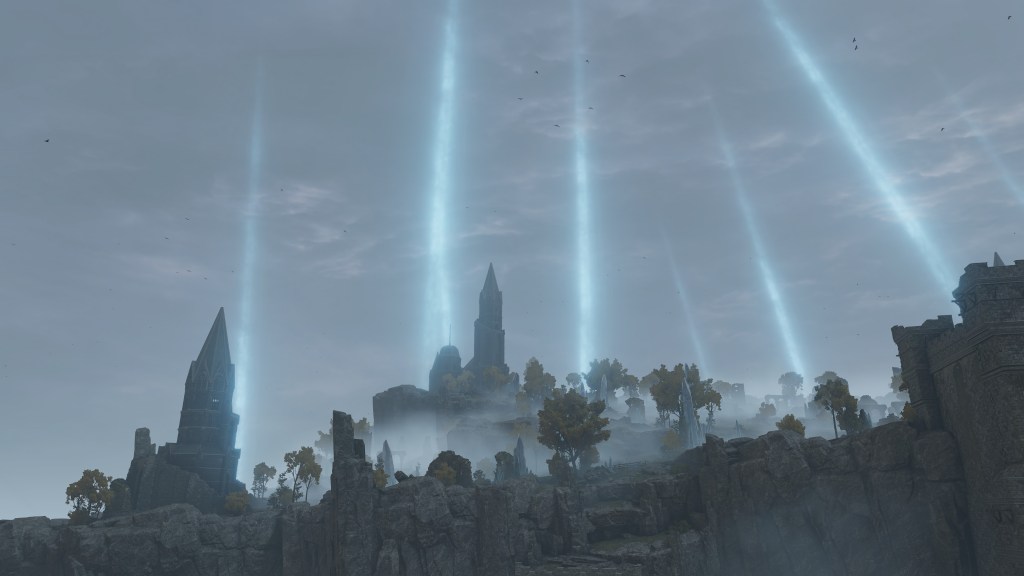
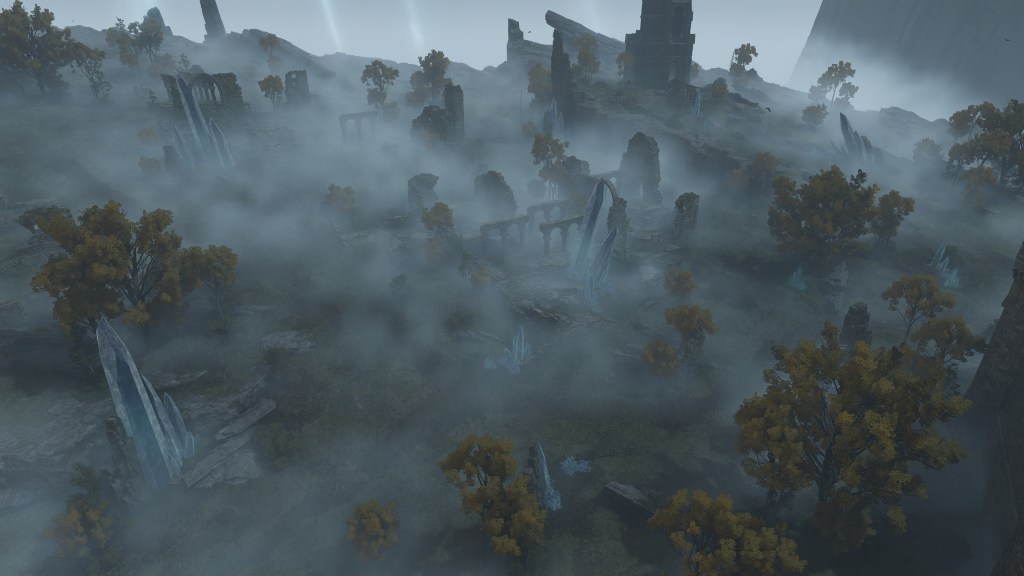

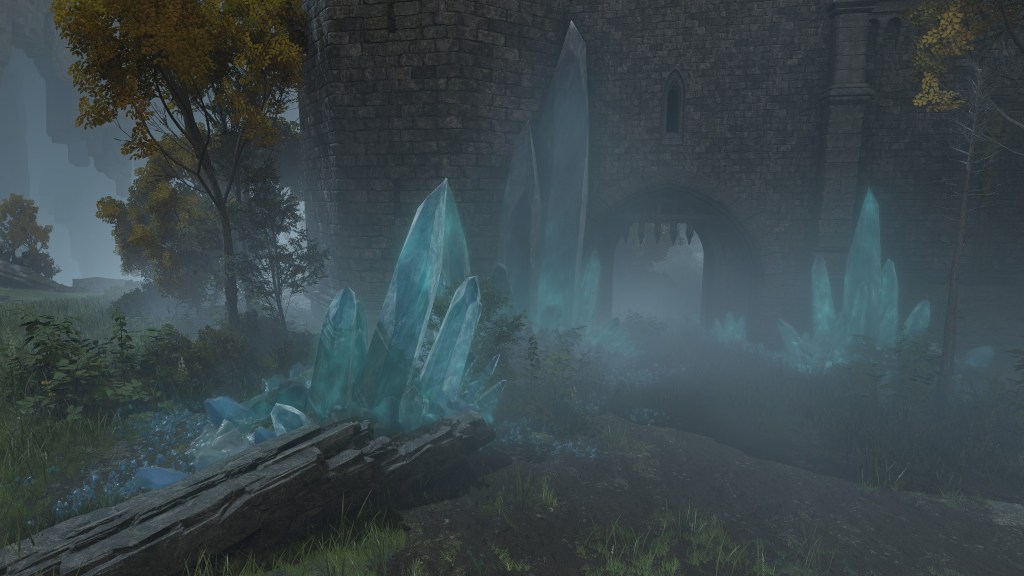
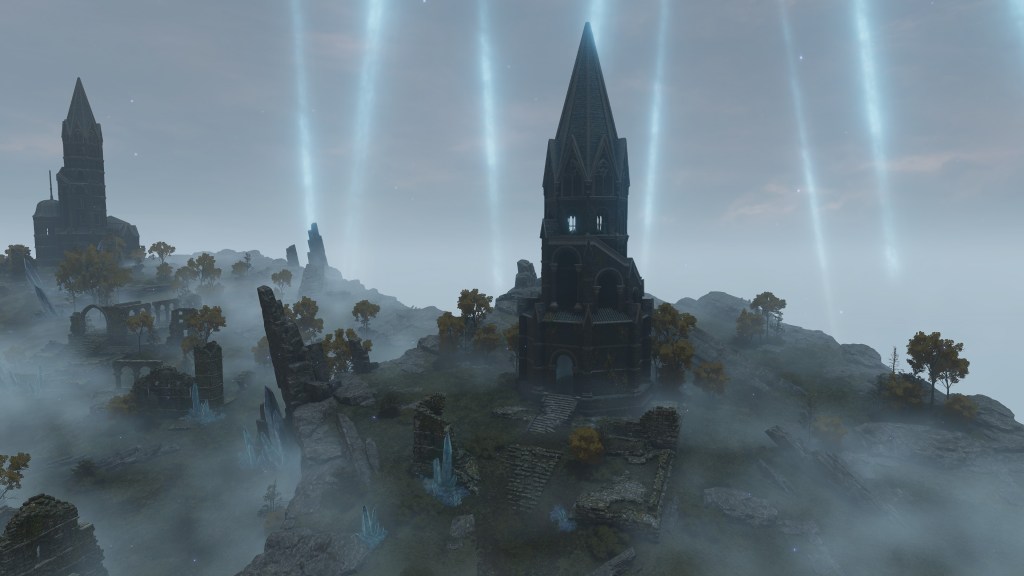
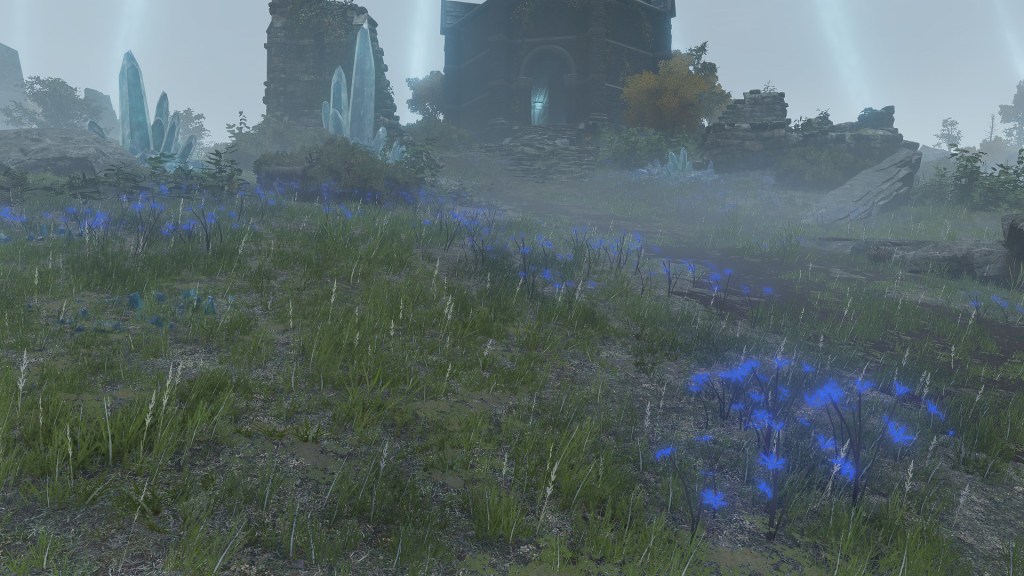
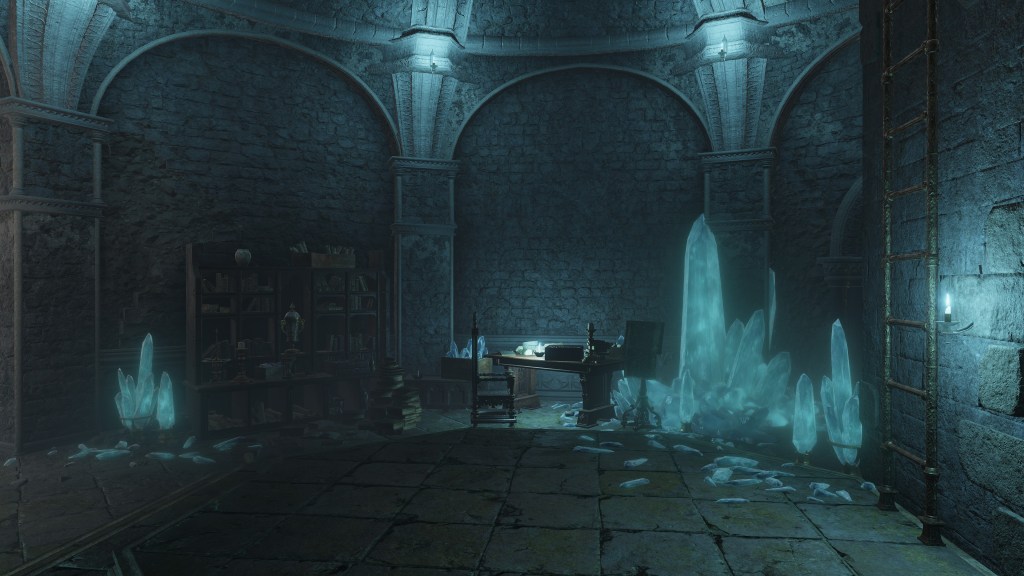


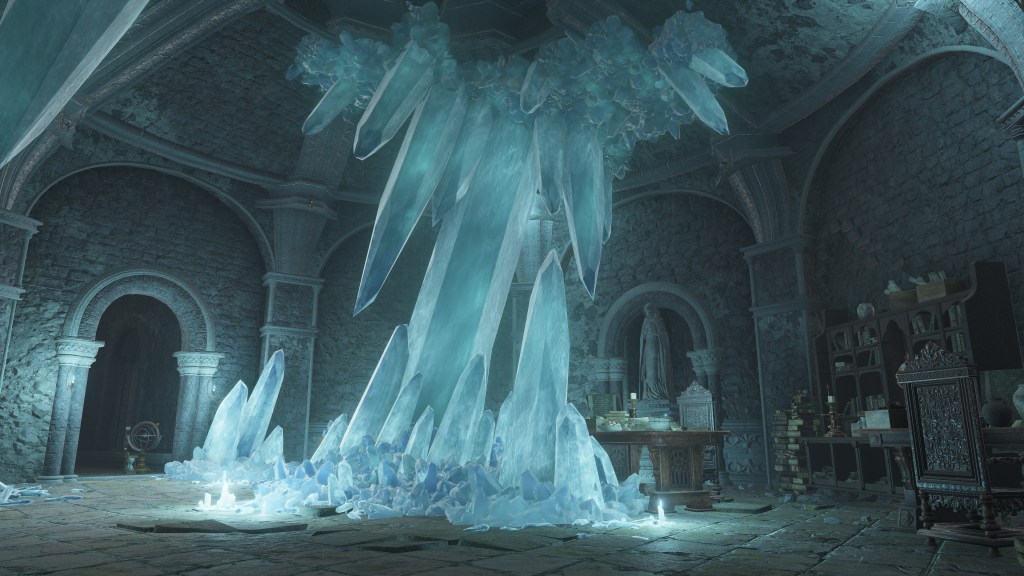
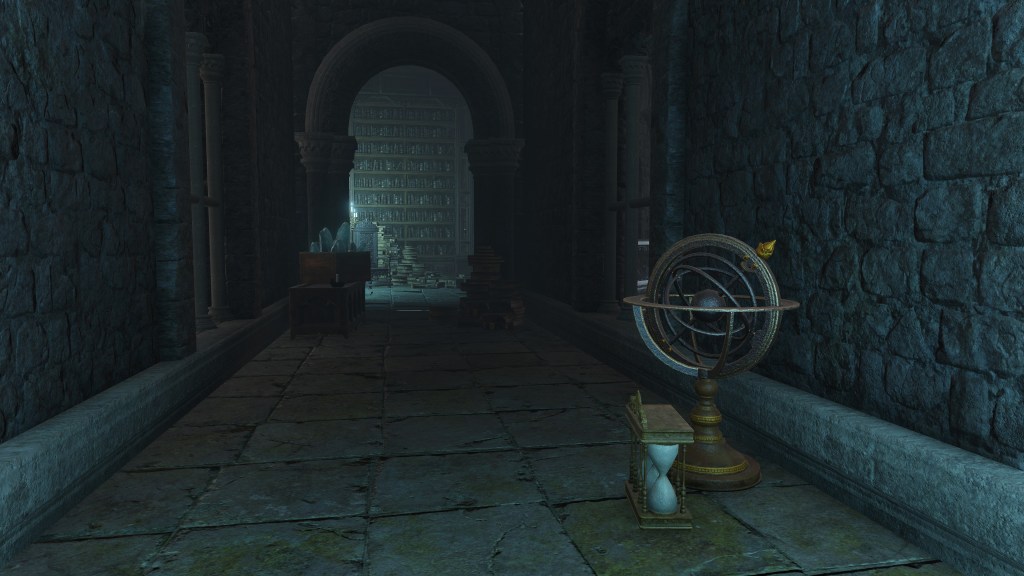
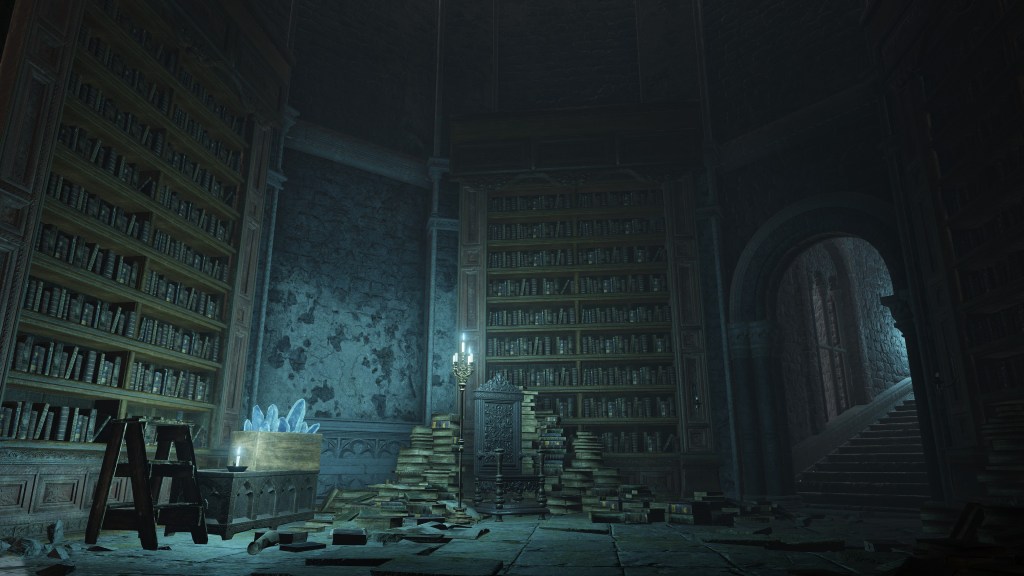

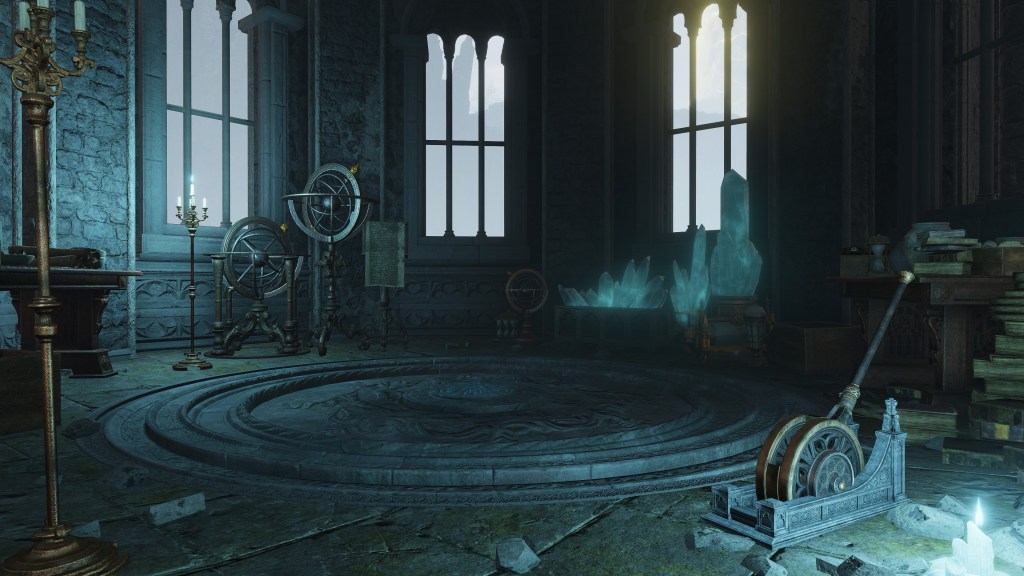

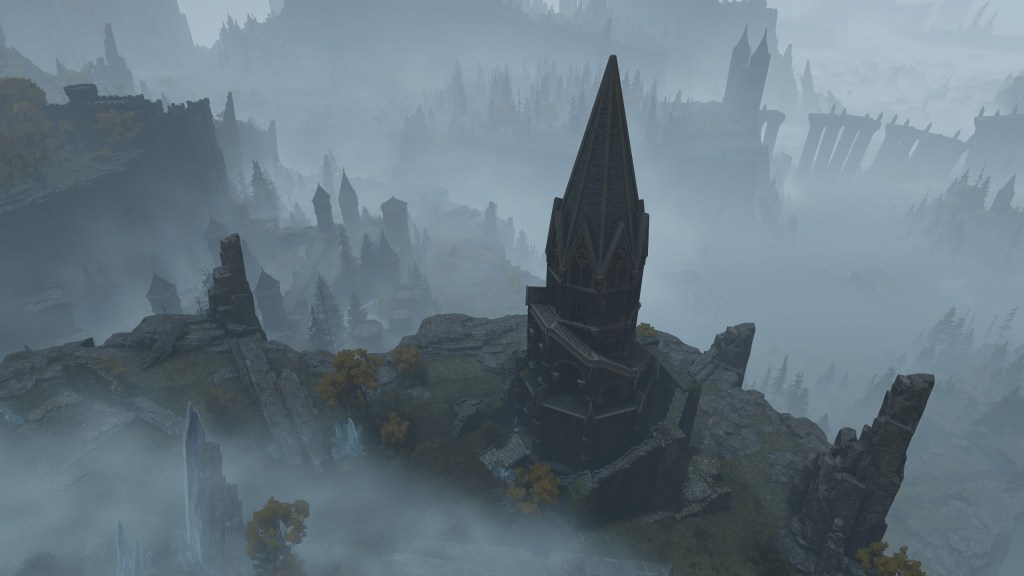
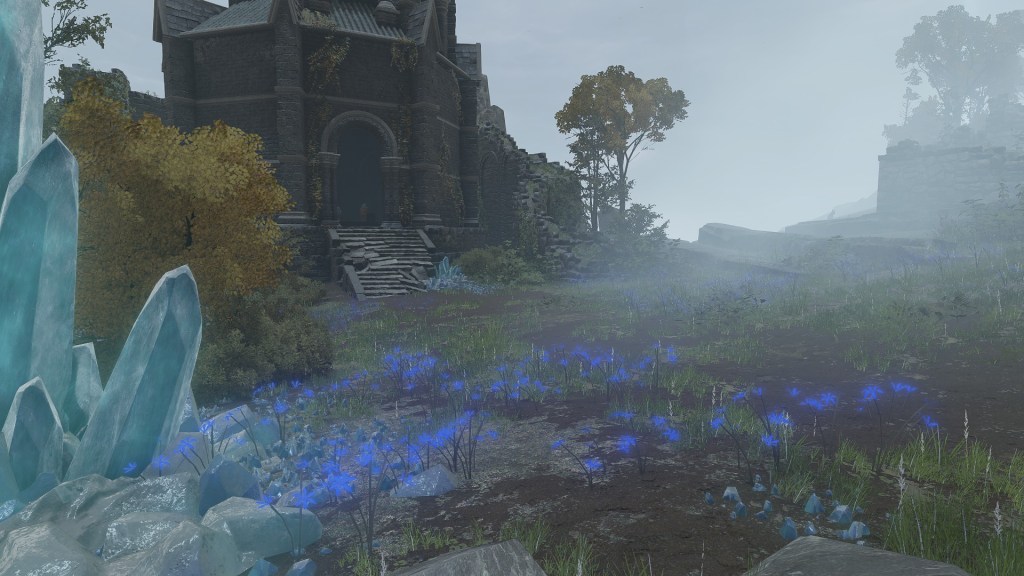
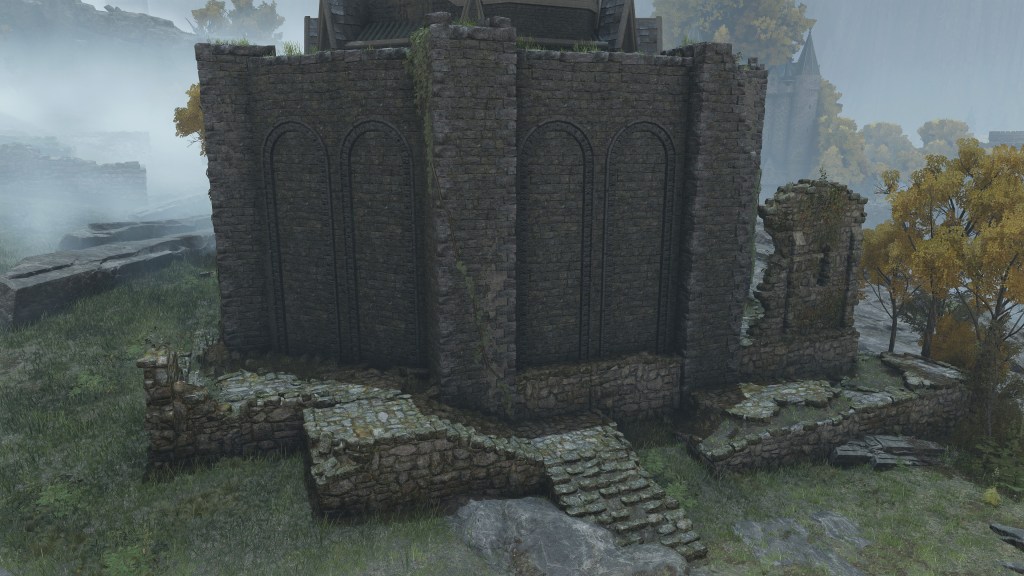

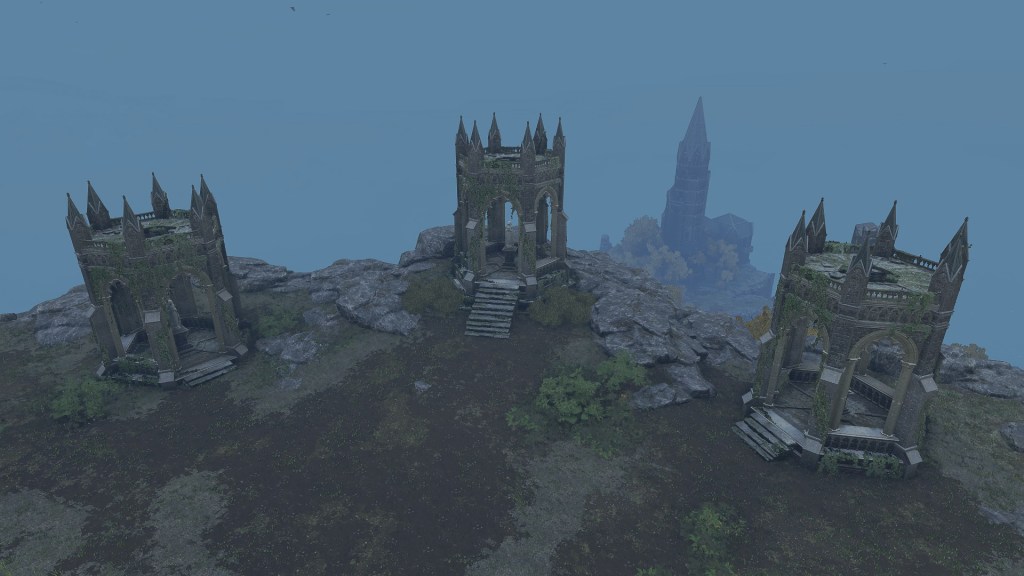
The notion that Rennala has not one but two siblings finds further credence back on the Moonlight Altar. Three follies with three witch statues sit side-by-side on a cliff. Unlike the gazebos strewn about the ground below, the effigies for these pavilions aren’t made with mid-grade local smithing stone but glass stone from the mountaintops. Furthermore, the stone of the center witch is of a slightly higher grade than the other two, corresponding to the actually folly’s taller height — exactly like the arrangement of the Three Sisters. Taken together, it is easy to see this as a depiction of three stargazing sisters from up north, one of higher status than the others. And with how it mirrors the three towers behind the manor, there is no denying a connection to Caria specifically. Therefore, the Three Sisters were doubtless Rellana, Rennala, and Renna’s center for study as the leading Carians when they were first built.


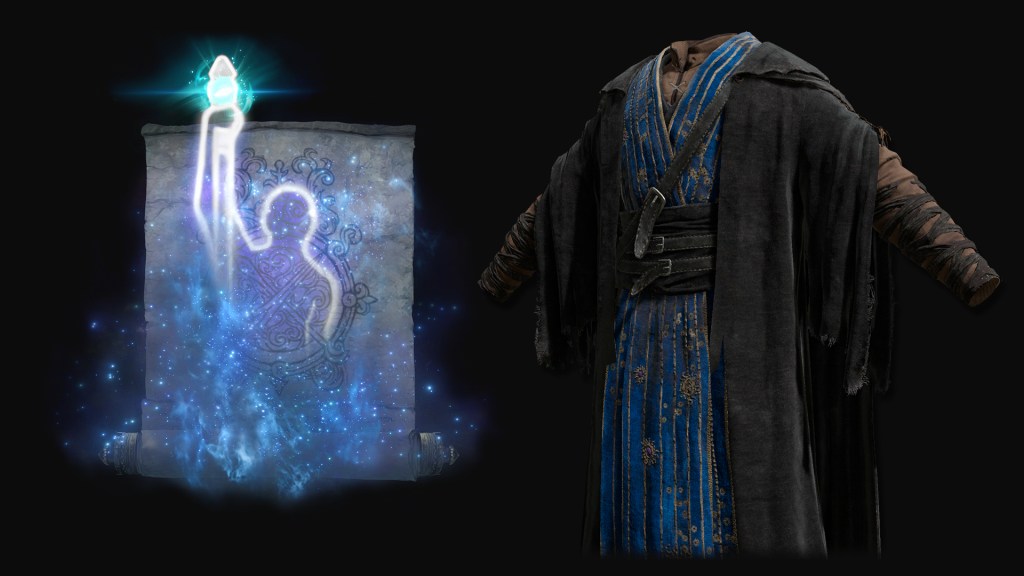
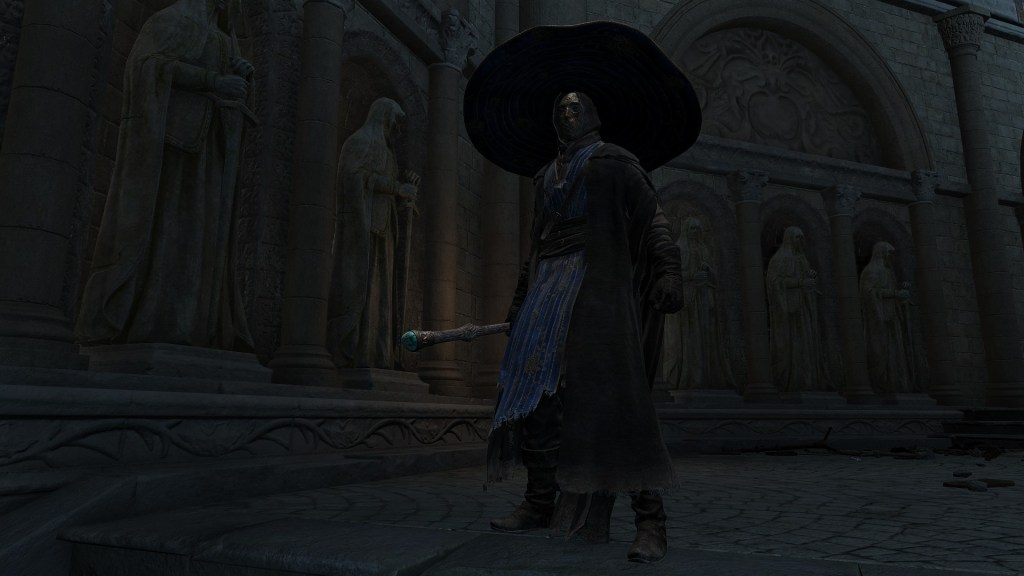
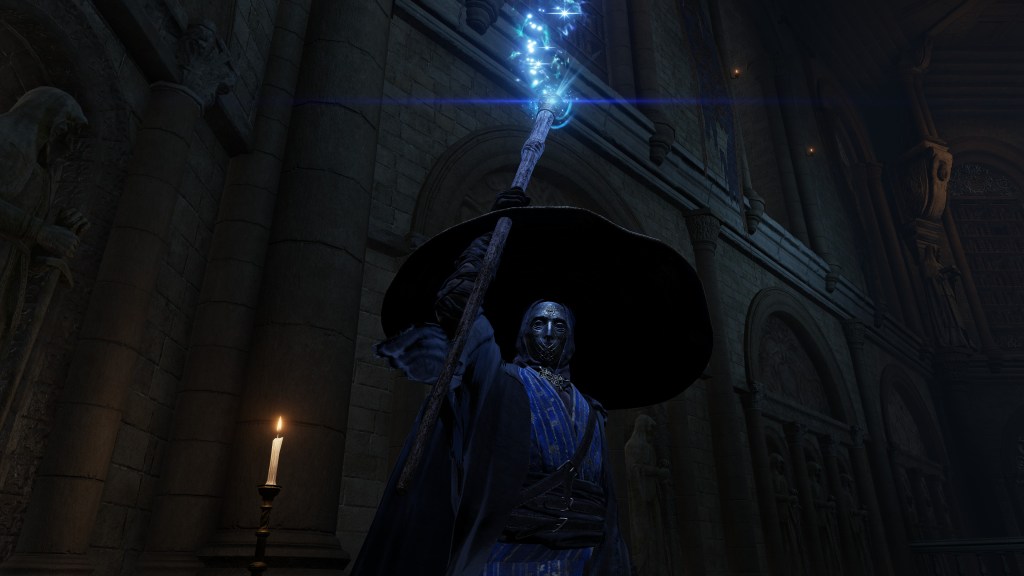
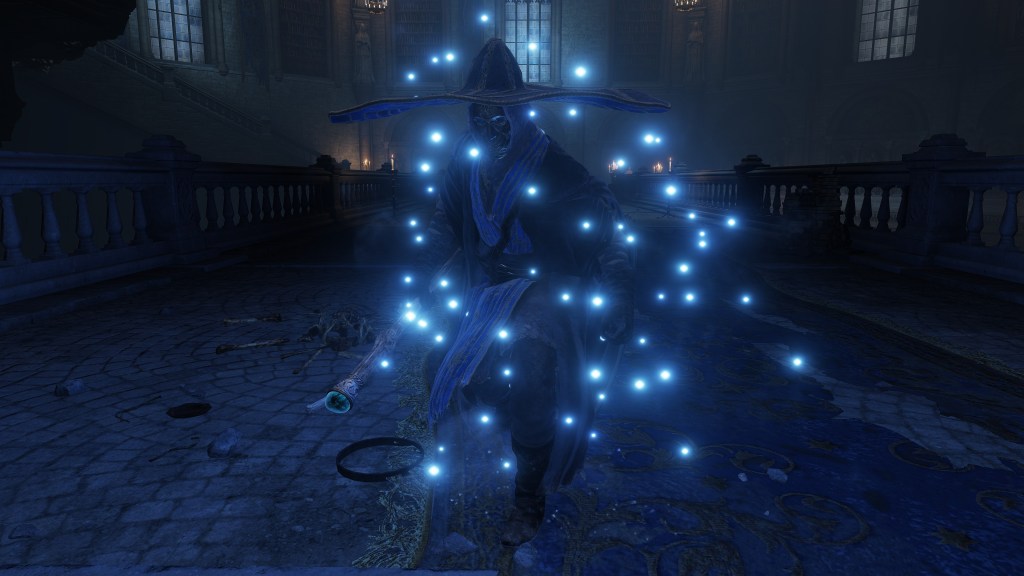
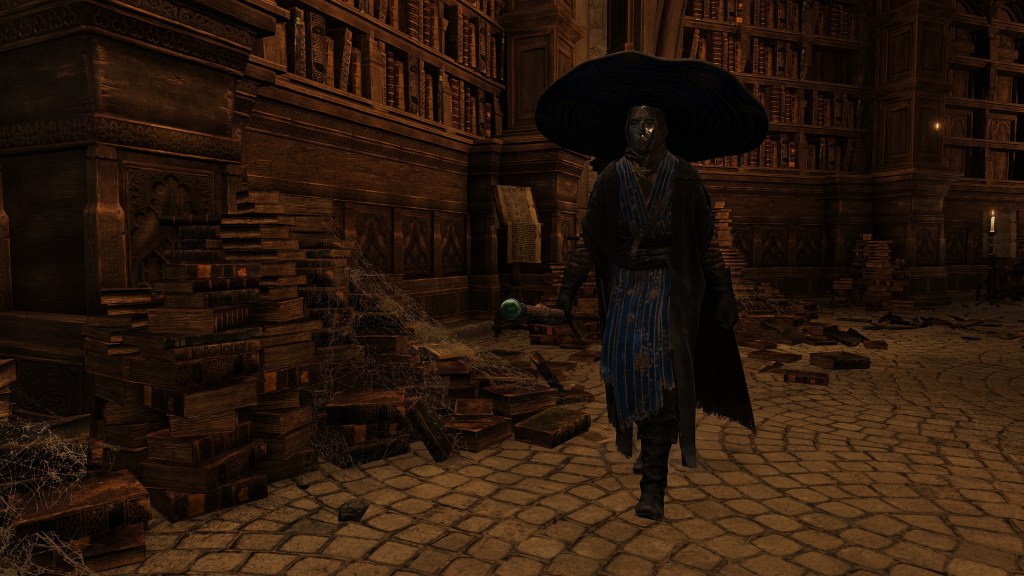
Supporting them at these facilities were probably preceptors like Seluvis. As the name insinuates, these “sorcery professors” (魔術教授) shared their knowledge of glintstone arts in service to Caria. Illustrations of the stars’ movements on their attire reminded them of their roots in astrology, but their actual lessons presumably spanned a wide variety of magical subjects. One example of their expertise is a spell to practically teleport across short distances while shrouded in a glintstone haze. This might seem redundant for talented witches at the top of the Carian hierarchy, but the Japanese description to the High Priest Hat confirms that Ymir was Rellana’s professor before becoming a cleric. For all their knowledge cultivated regarding the moon, the royal family was still only human, so even their greatest could benefit from an outsider’s second opinion. If nothing else, the preceptors existed as the Carians’ most competent assistants, whether they be accessories to inquiries or experiments. A good example is Miriam, the curator of the Carian Study Hall.
Art of the sorcery professors who serve the Caria royal family.
Disappears own form within brightstone mist. That form reappears after a few moments. Appearing position can be controlled in all directions.
The curator of the Study Hall is considered to have taken it to the extreme, so it is named after her.
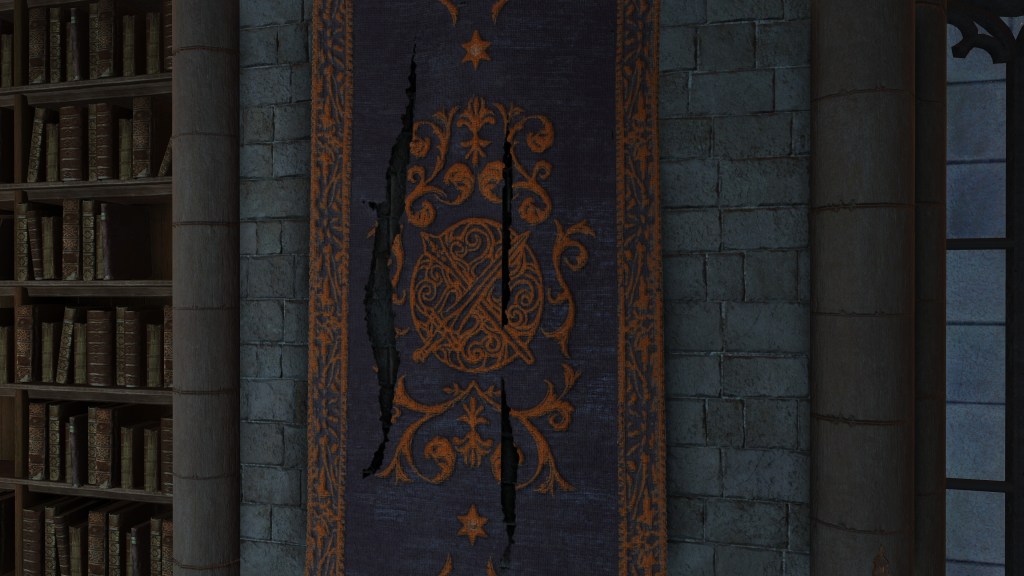
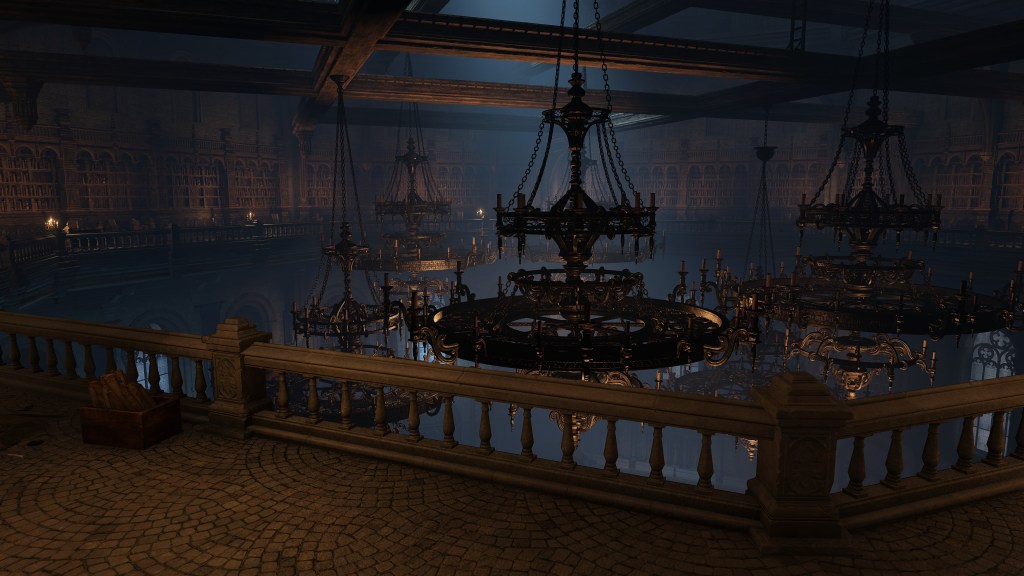
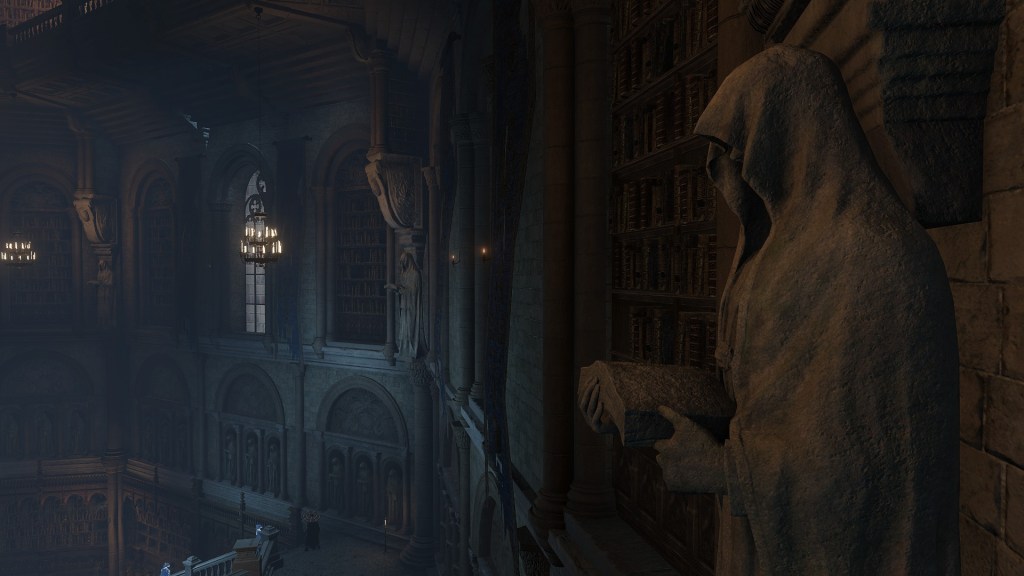
Far and away from their manor, the royalty’s study sits snuggly amidst the southeastern cliffs, gatekeeping access to Liurnia’s Divine Tower. Based on the building’s design, the Carians might have renovated an existing tower transporting visitors up to the Divine Tower’s bridge; it is similar enough to the bridge tower in the Forbidden Lands. Either way, the royals added their own gothic touch to the architecture, among other things. The path leading into the edifice, for example, is laid with blue flowers possessing a magical glow. The royalty’s banner likewise hangs all around the interior. Then there is the new yet familiar figure decorating the walls inside and out. Rather than just the typical saint statue, there is also a depiction holding open a book — a wise man more so than a holy man. This “sage” statue betrays the Carians’ interest in knowledge from this place, hence why it is a study with shelves upon shelves of books. The only question is why own a separate facility from both their castle and the academy?





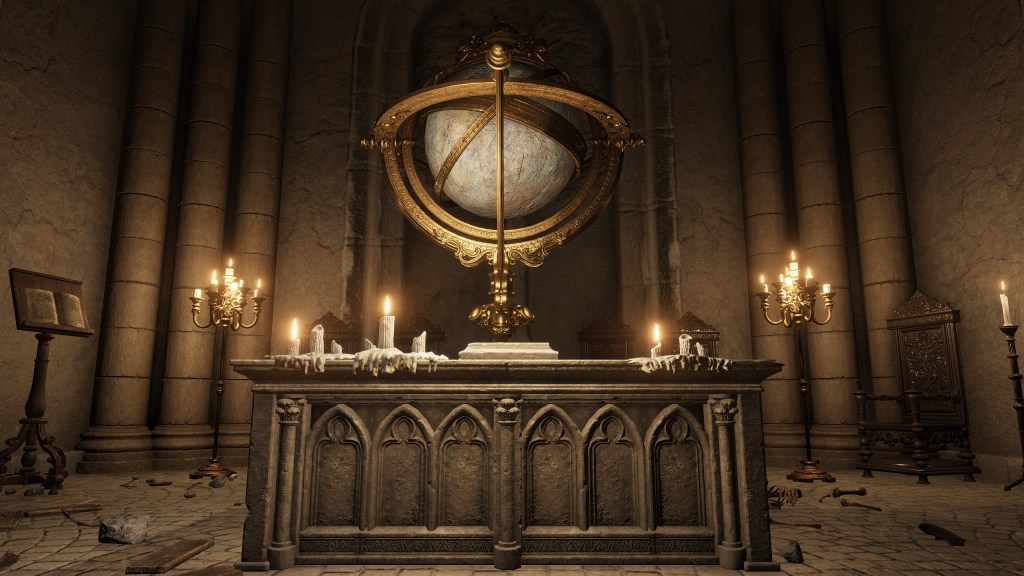
One obvious answer is that the Carians were intrigued by something which could only be studied there and nowhere else, namely the Divine Tower. Certainly, the mystery surrounding such ancient monuments would be an enticing topic for sorcerers. It also only takes a glance at the meteors embedded in the stone to realize the tower’s astrological significance. For the Carians, having a place where they could advance their astrological studies while investigating the Divine Tower as needed sounds logical. The tower’s original function remained integral even after renovations. Upon entry to the building is a chapel with an altar. By placing the statuette of a scholar — inverted so that the moon is under head instead of foot — on the altar, the celestial globe behind it will activate, flipping the entire interior space beyond this chamber along with its gravity. While surreal to navigate, it is the only way for us to access the lift to the top of the tower and the bridge by extension. This system emphasizes the importance placed on entry to the Divine Tower. The royal family wanted a monopoly.
It is no surprise then that a veteran sorcery professor like Miriam has been put in charge of the facility, killing any and all intruders with her array of sorcery. The grey-haired preceptor is particularly adept with their haze transportation spell, to the point that it has been named “Miriam’s Vanishing”. But as the hall’s custodian, her job should mainly consist of organizing books for her Carian masters. The professors evidently filled the gaps for whatever the royal family required of them. They might have even been responsible for developing and sharing the knights’ arts, hence old Miriam’s knowledge of spells like Carian Slicer, Greatblade Phalanx, and Lucidity. Both Vanishing and Lucidity spells’ menu graphics do depict the caster with the Carian Glintstone Staff, which appeared to belong to her predecessor; the catalyst is left on a tomb inside identical to the academy’s grave monument. These pseudo-knights were managers, advisers, instructors, and more. But if the Academy Glintstone Staff Miriam actually wields is any indication, they were also chiefly recruited from Raya Lucaria.



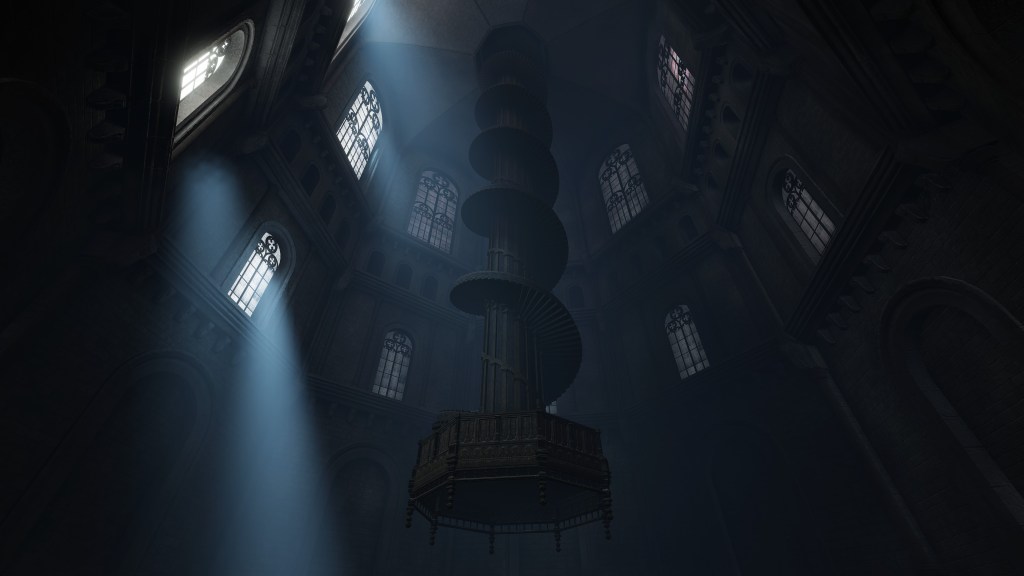
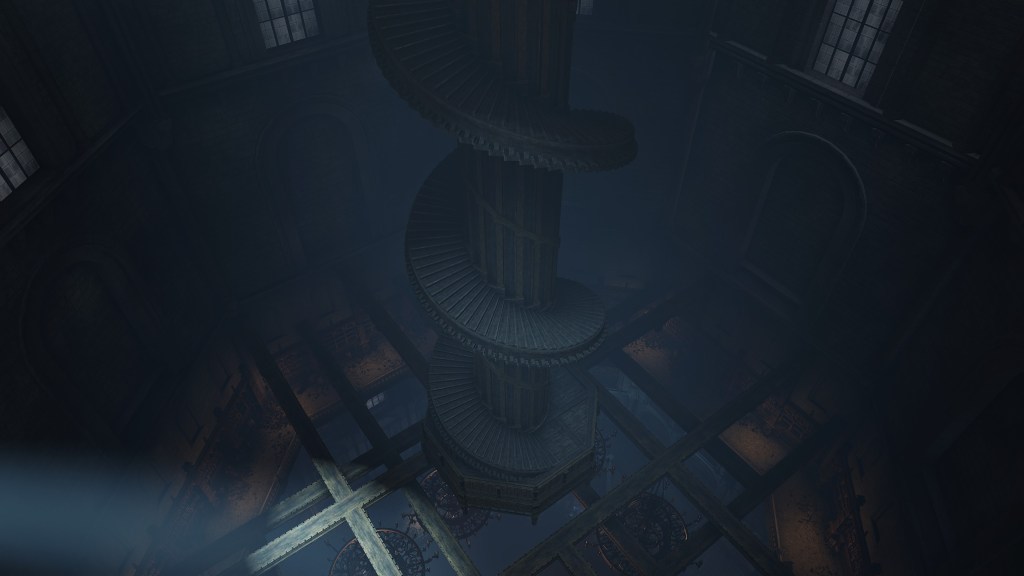
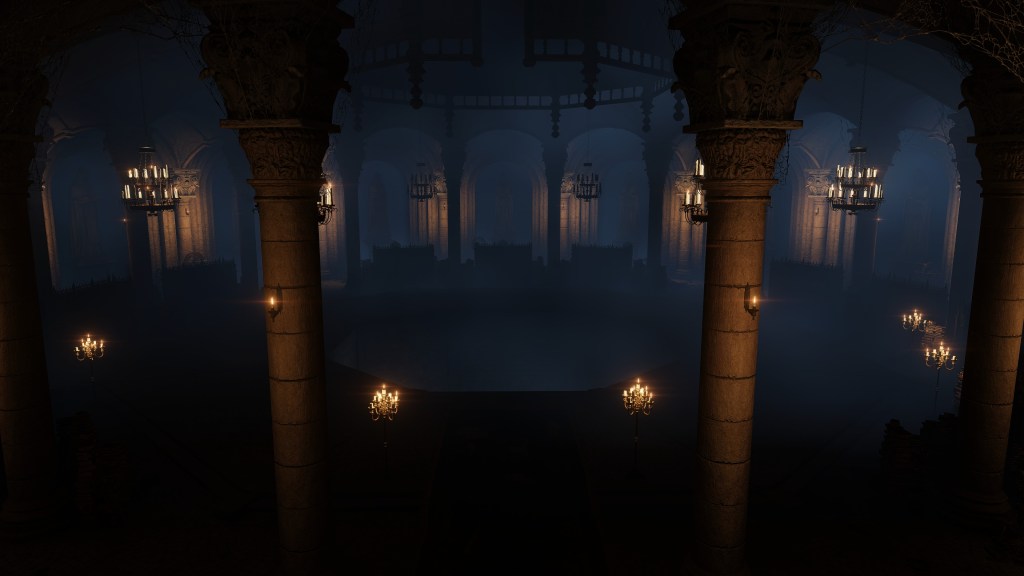

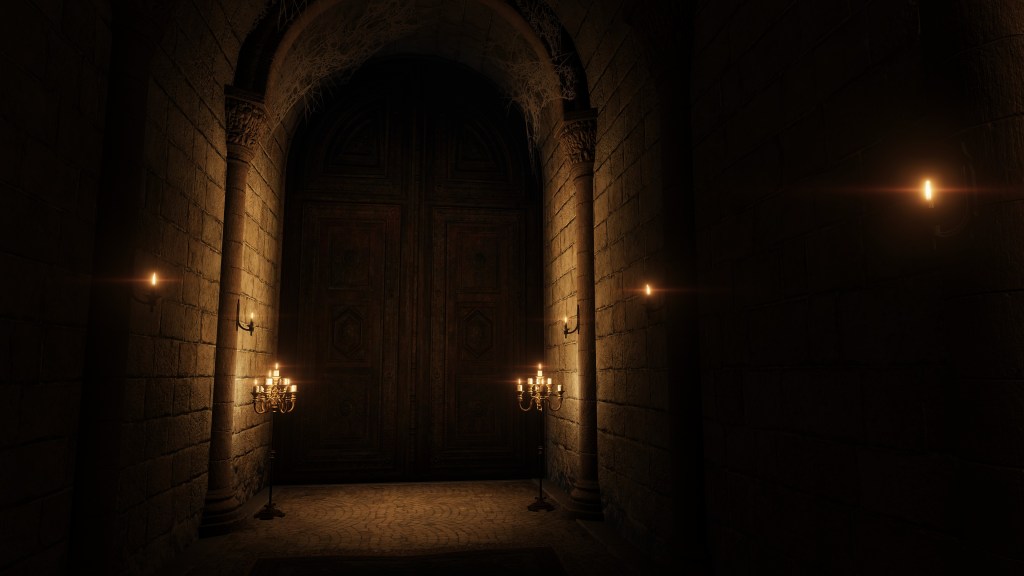




Without a doubt, Caria as a royal family now had the power to elevate anyone’s status. Their conquest of Caria Manor likely precipitated the division of Moonlight Altar’s residents between noble and commoner. Considering that the Carians are already themselves royals, the nobility must consist of key contributors to the royalty’s ascension — such as the original glintstone knights or exceptional magic preceptors. We can confirm at least one example with “Count” Ymir, a professor to royalty who is addressed with the generic honorific for a noble “lord” (卿) or similar ranking official in the government hierarchy. If only individuals who served close to the royals earned titles for themselves and their families, then it explains why the nobles were allowed to live in luxury while acting as stewards of Caria’s second home, alongside the moonfolk supporting them as attendants and the like.
The Lunar Estate is divided into two blocks. The east end stores high-grade glass smithing stone in the basement, similar to the Moonfolk Ruins. The western collection of buildings, meanwhile, keeps a Cerulean Amber Medallion locked down behind an imp statue seal. A gemmed talisman is the perfect property for nobles, but it belongs to people living under Godfrey’s reign as Elden Lord, so was probably more of a curiosity. The east block may have thereby functioned as residential while the west block was used for research laboratories. This works well with the area’s location relative to the citizens’ village and the cathedral. When attending mass, residents in the east block could take the nearby slope up to the church without crossing paths with the commoners following the opposite road. Conversely, commoners heading down slope would first meet their betters where they were most needed, as lab assistants. The aristocracy certainly had it easy up on the Altar. Granted, some might be called upon to fulfill other duties rather than sitting idle with their fellows.


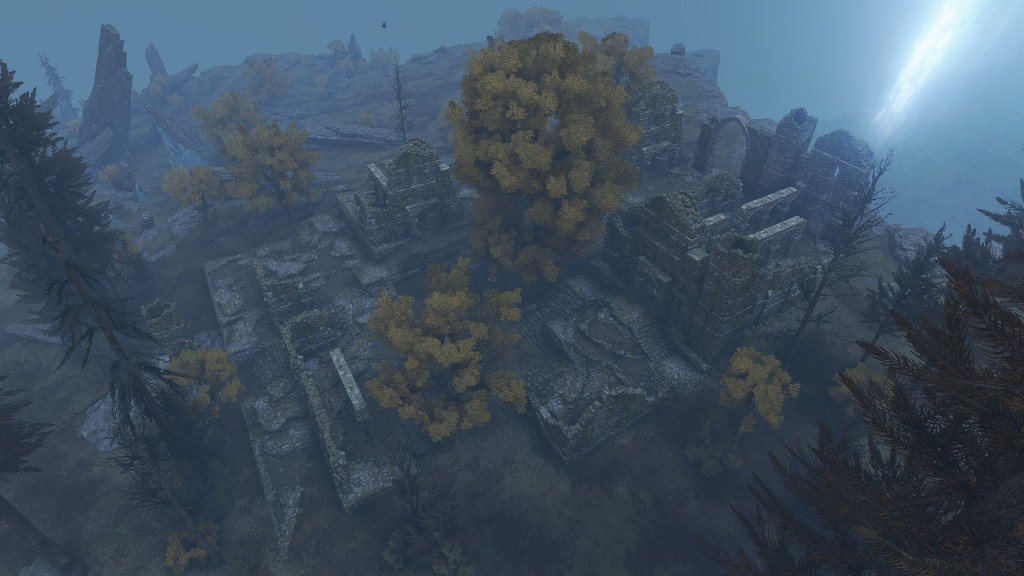
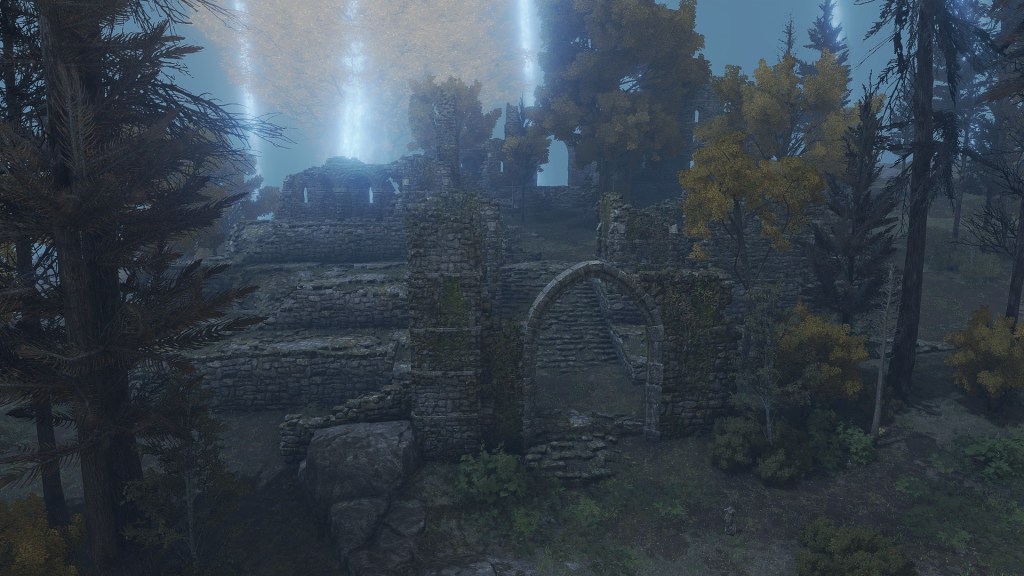


Besides professors like Ymir, there are also the residents of Kingsrealm Ruins. (Site K) As hinted in the name “royal family territory” ruins, (王家領の廃墟) the settlement marks the point that travelers have entered Carian private property. The waygate to Site K at the edges of Academy Gate Town indicates that sorcerers of Raya Lucaria were particularly common visitors, whether to seek a royal audience or send important news. Either way, the gate didn’t afford them the convenience of bringing the sorcerers to the manor’s doorstep, and why would it? The royal family was wary of their inevitable betrayal. The shortcut only presented them the path to the manor, and the ruins before us hides the pathway behind an illusory wall. In other words, Site K acts as a checkpoint for anyone wanting to head up the slope to the royal abode. To take the road all the way up to Caria Manor, this processing station must first approve. And manning that post are aristocrats.
These noble sorcerers slightly differ from the identical enemies associated with the Erdtree royal capital, additionally utilizing an art similar to Miriam’s Vanishing as well as invisibility from afar. Ignoring DLC, the only other places we can face these enemies are on the Moonlight Altar and at the Three Sisters, suggesting a connection. On top of that, Site K hides the basement with an illusory floor, a trait shared solely with the two Altar and Sisters ruins. Moonlight Altar and Caria Manor are also the only locations to install cometshard landmines like Site K. All these factors combined, we can affirm the enemies staffing Site K to be the moon nobles serving the Carians. Although the Altar’s aristocrats display a limited repertoire of spells, they were still entrusted with the royal family’s land and so worked closely with the manor.
This is demonstrated by Iji, the giant operating his anvil emblazoned with Caria’s crest from behind Site K. The rapier the blacksmith forged is stored in the ruins, and one noble’s spirit shows great deference to the elderly troll knight in his Japanese dialogue. Ranni’s future War Counsellor was therefore likely put in charge of coordinating the castle’s defense, petitioning moon nobles to come and operate the checkpoint on the queen’s authority. He subsequently provided his full support whenever he came down to check in person, forging more weapons in the meantime — and a wide variety at that, from what we can see laying around his informal workshop. Another group were apparently allowed to assist the queen and her siblings, one standing guard to a secret laboratory. This was their duty to Caria, just as it was Iji and the knights’ duty to serve in their own ways.
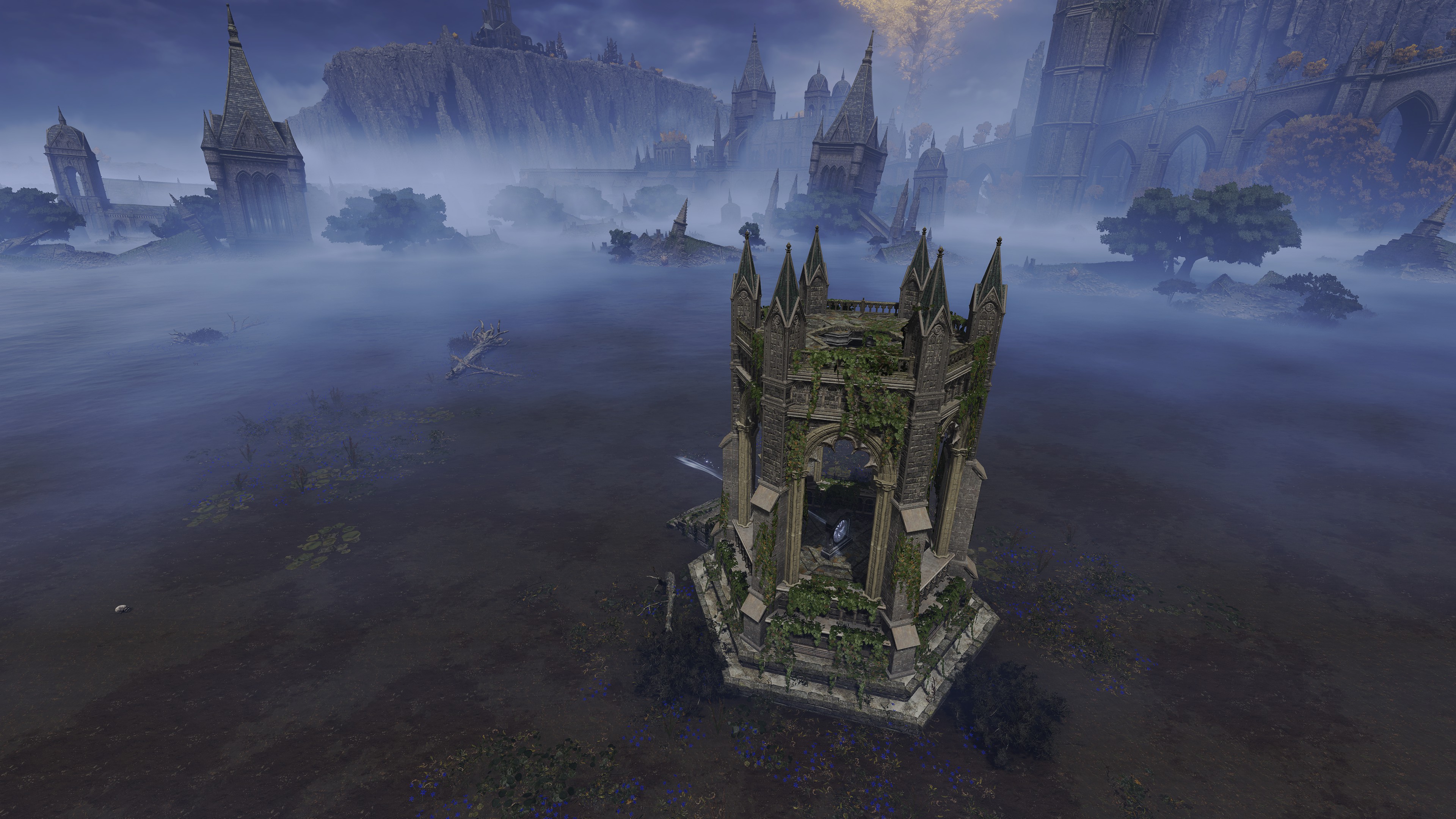


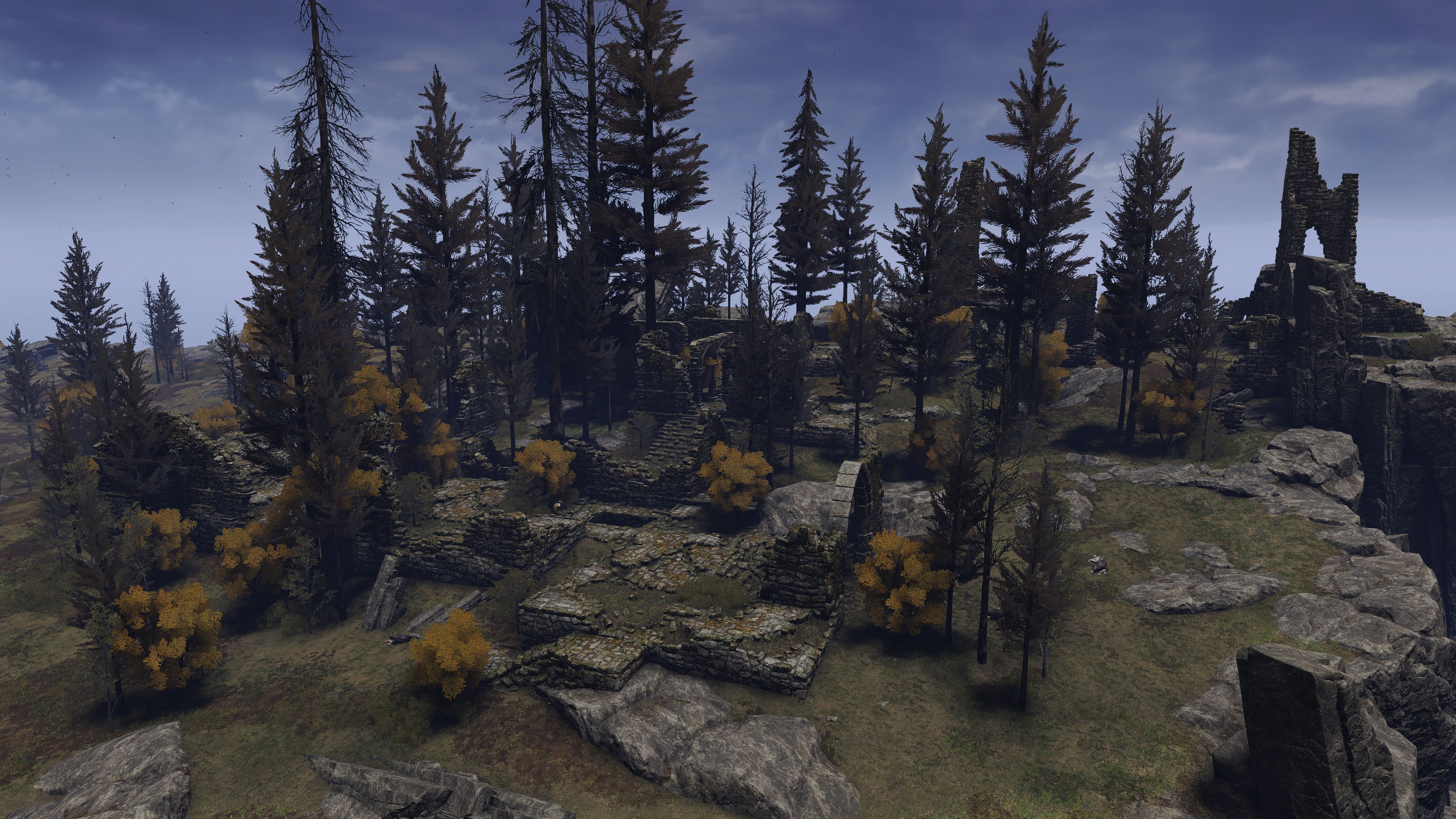
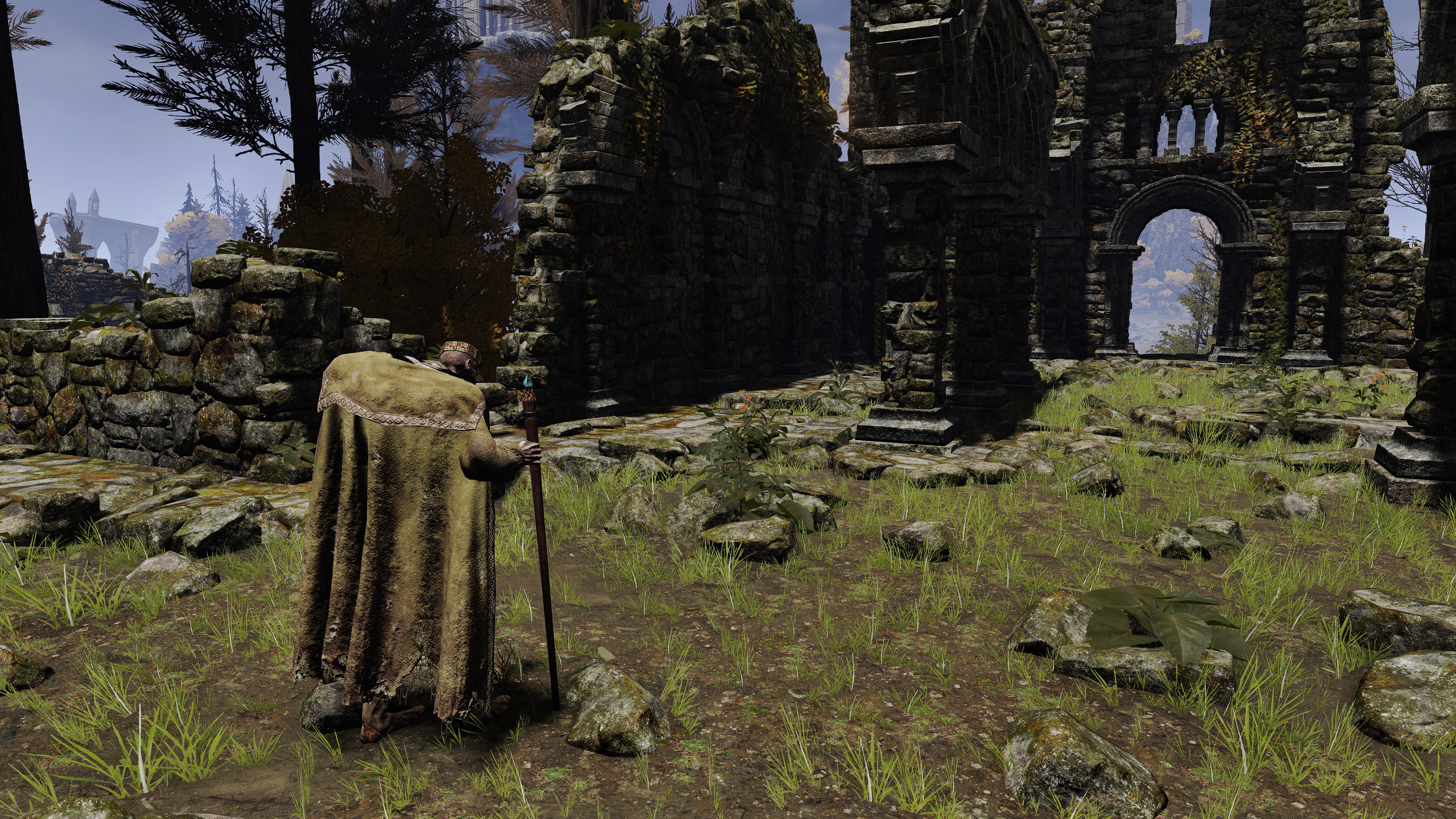


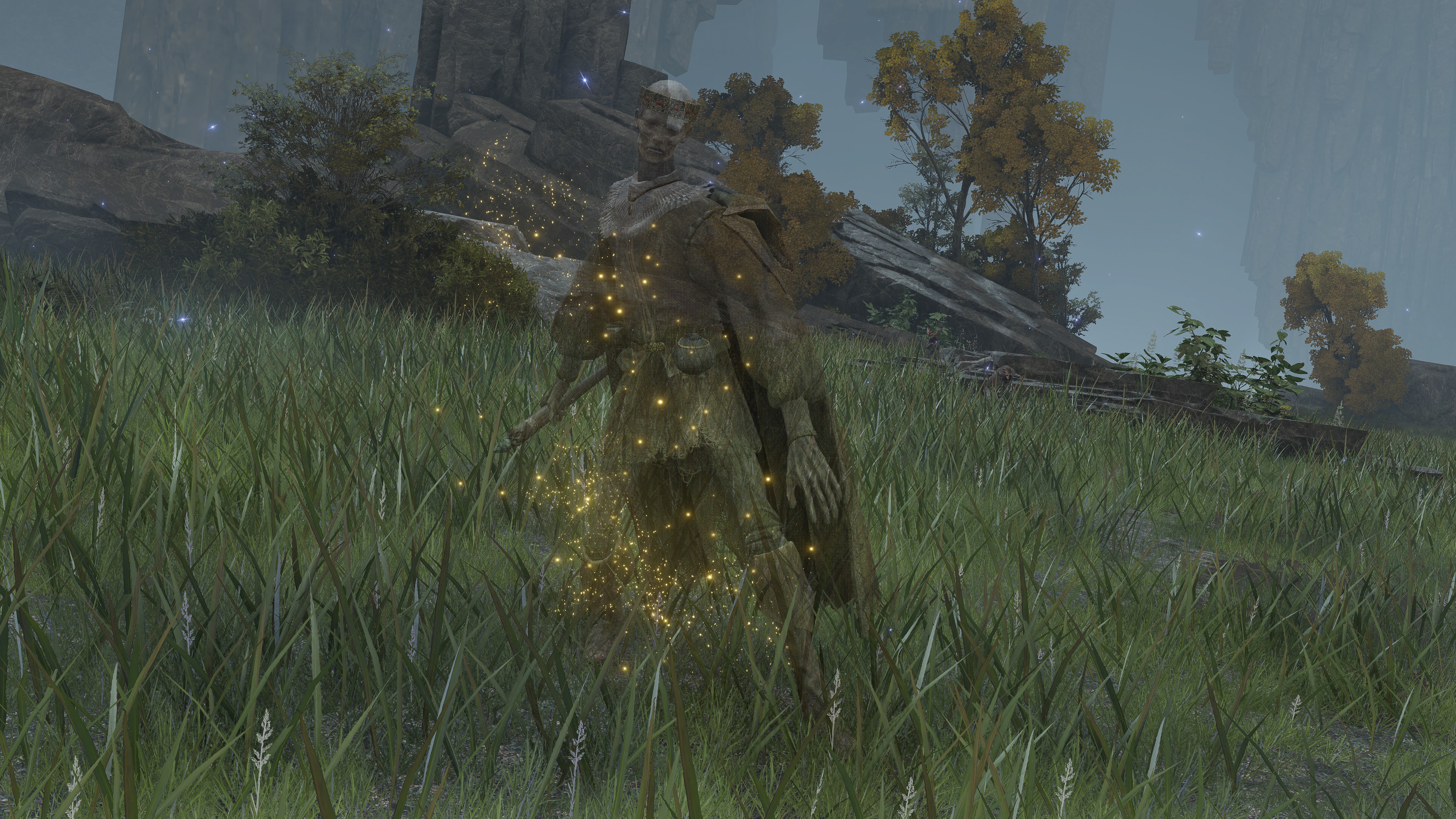
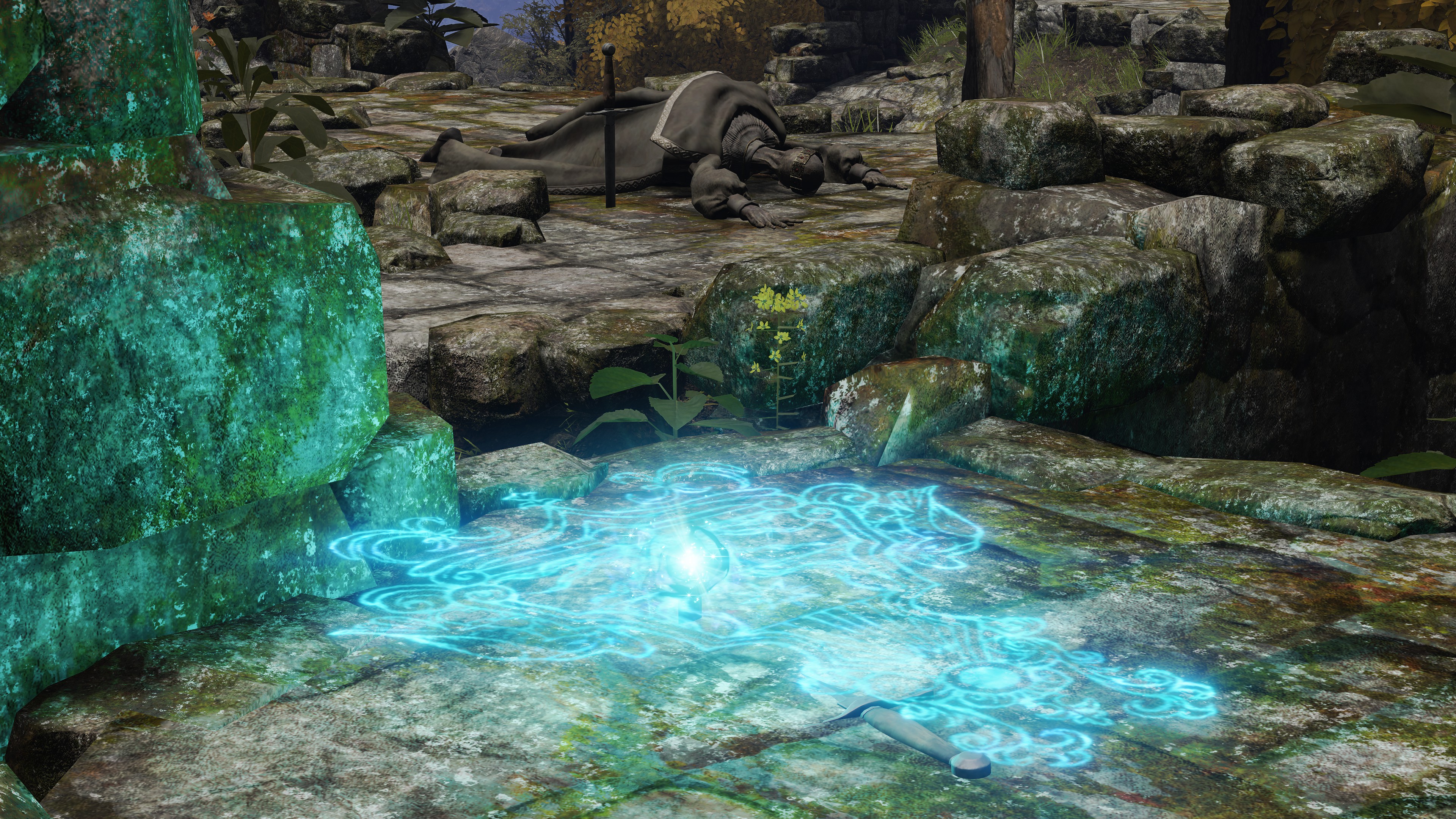


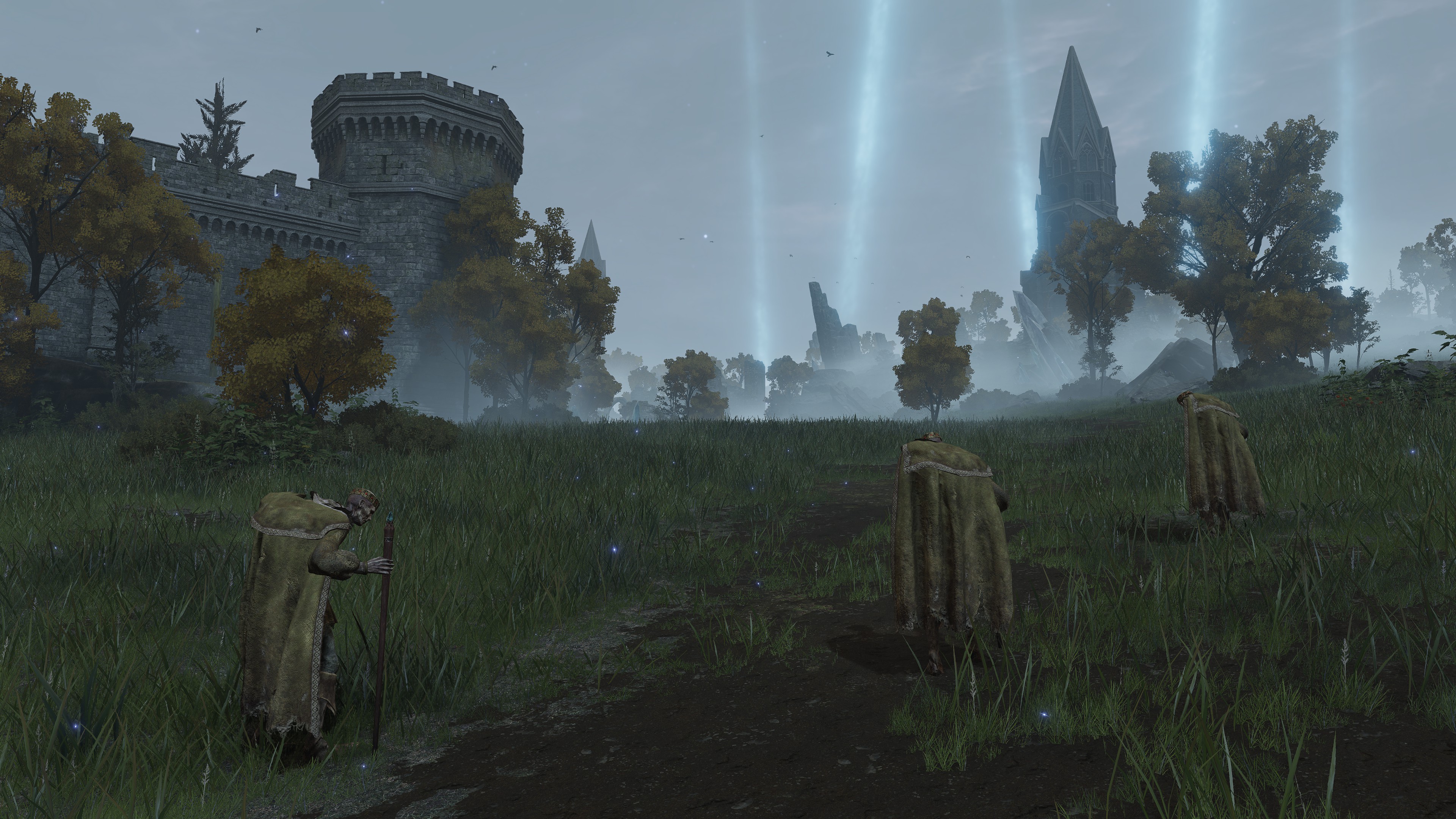

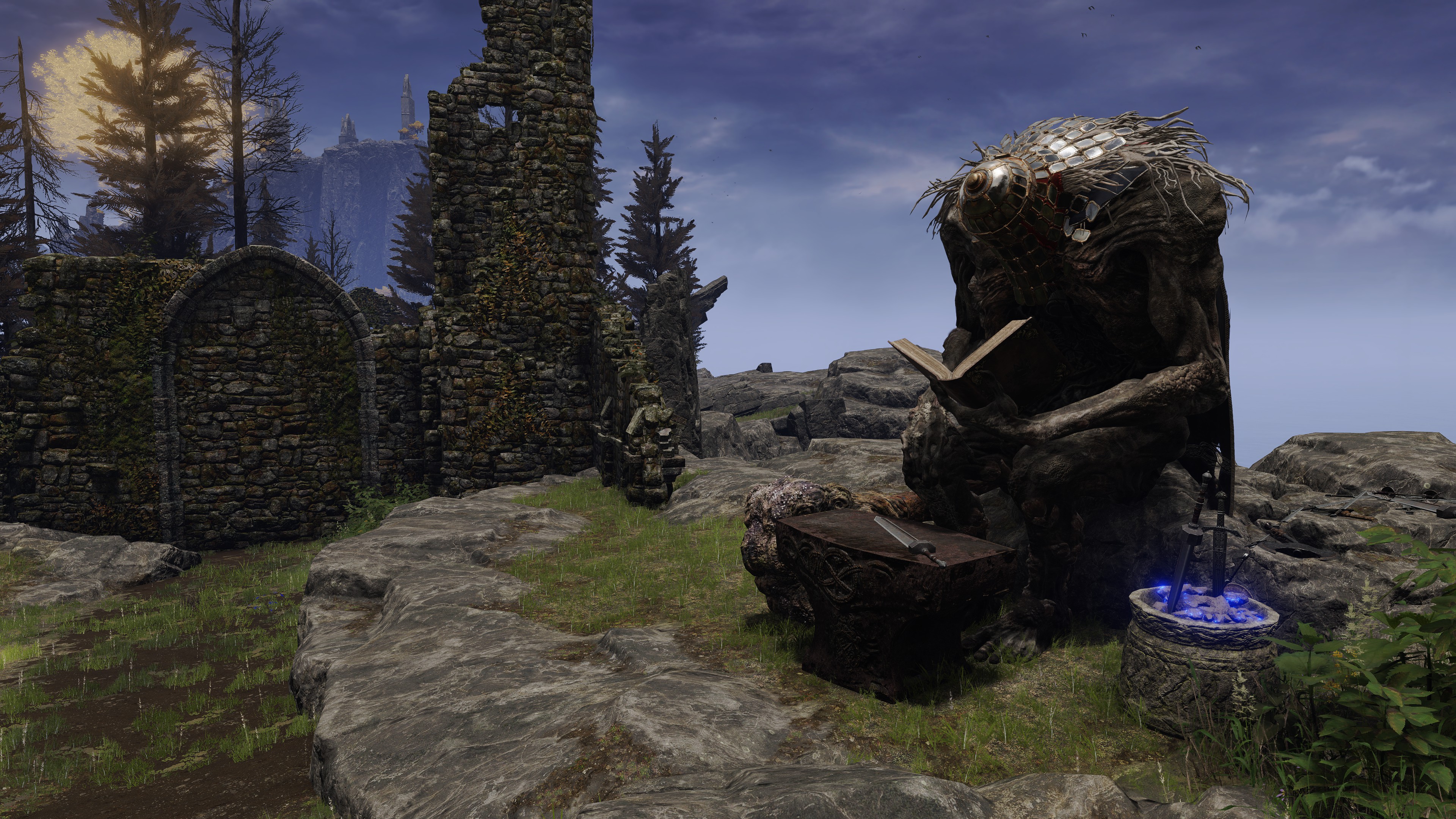


… Ahh, Lord Izzy, my deepest apologies. Even though this land of the royal family was placed in our custody, we were unable to do anything…
On the opposite end of the social ladder, we can see that Carian royal family has impressed fealty upon the lowliest bluntstone. The miners of Raya Lucaria Crystal Tunnel place the smithing stone they dig up in an offering chest before a shrine. Said shrine’s idol is a veiled woman with arms conveniently broken off, the same model used for statues in hero graves. However, in this context, the figure is most likely intended to be Rennala, portrayed more like a saintess than a witch to comfort the hard laborers — not unlike the tomb monument with a similarly veiled rendering of the queenly figure. Deprived of the mildest affection, this more maternal image must help motivate the academy dropouts working under an inhuman taskmaster. It moreover highlights the depth of Rennala’s influence, ensuring that even the most insignificant sorcerer in Liurnia knew their queen.
Indeed, most of the sorcerers’ towers install at least one witch statue, paying their monarch token respect at minimum. The Three Sisters are a given, but this includes sorcerers living in the furthest reaches of the Lands Between like Oridys. If even those living far outside of Liurnia, where the academy isn’t necessarily popular, acknowledge Rennala, then impressing herself upon the culture succeeded. Admittedly, there are still examples who refuse to be reminded of the witch, even close to home, like Testu. However, that sorcerer’s area of interest is liable to have earned the Farum colonists sympathy, resulting in antipathy for the hero who slew them. Just because both Testu and Oridys came into possession of memory stones doesn’t guarantee gratitude to the family who enabled their circulation. It is no surprise that those with antithetical interests reveal indifference in the privacy of their own homes — what matters was overall public perception. In that regard, the Full Moon Witch had assumed full control of her domain and oriented the new system toward one end: the advancement of sorcery.



Light Beneath the Stars
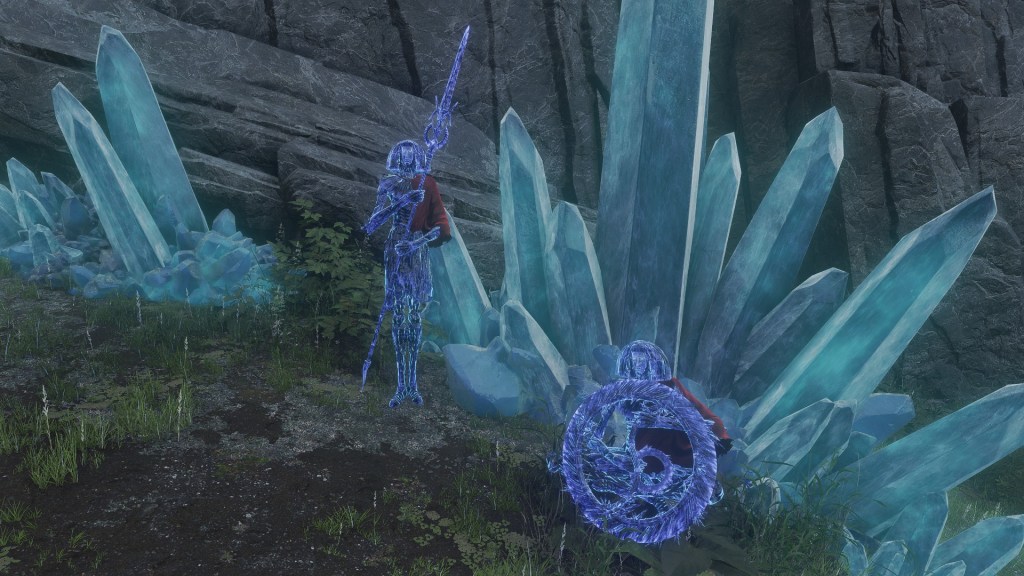
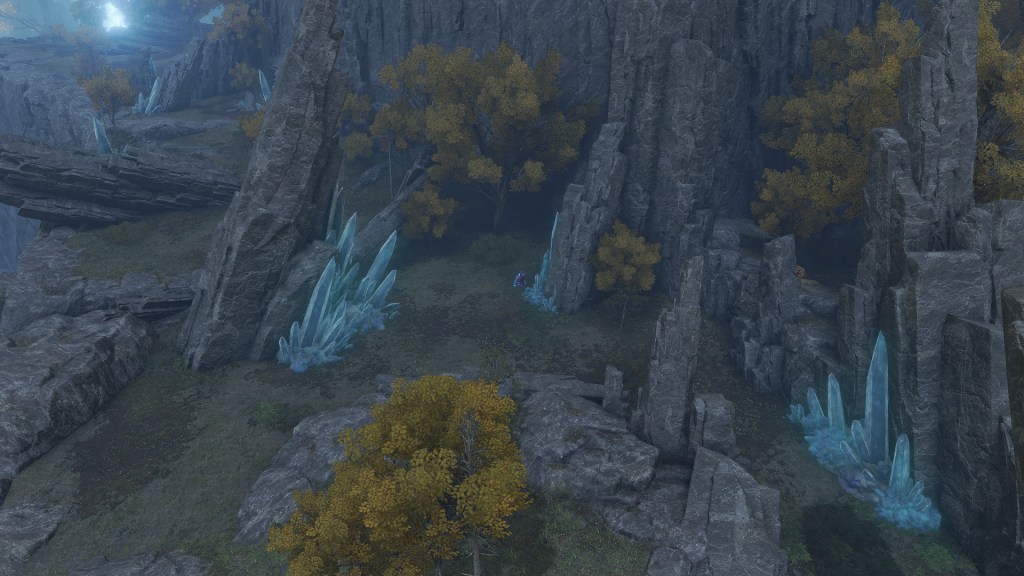
As the Full Moon Witch went through this transition from very young to young, she continued making “friends” from her surroundings. Most prominent are the Crystalians. The inorganic life are the sorcerers’ guests of honor, as detailed in the description to Shattering Crystal collected from a corpse within Raya Lucaria. How and when were they introduced to the academy, however? The Crystal Cadre only invented a far weaker version of Shattering Crystal, so the full potential of Crystal Burst must have been taught by the Crystalians much later. Rennala, too, performs this Shattering Crystal, and the Crystalian imparted Magic Downpour to sorcerers serving Caria like Miriam during the old “oath” — presumably the same as all others made by Rennala. The spell is plainly a simplified form of Crystal Release, as if to better teach the royalty the basics of mineral arts. Its inventors cluster amongst the large crystal formations on or at the base of the Moonlight Altar. And while only Magic Downpour is labeled a sorcery of the royal family, all Crystalian sorceries we cast use the Carian sigil instead of the academy one.
Sorcery of the mysterious crystal-men.
Generates crystal mass and fires crushing it ahead. Enhanced with charging.
While they are inorganic, they are also life. The way of the crystal-men is close to the ideal of the primeval flow. They were the honored guests of sorcerers.
One of the sorceries of the Caria royal family.
Floats magic mass and rains magic bullets over wide area. Can be used without stopping movement and extends duration with charging.
It is said to have been imparted by the crystal men during the old oath.
From all this, we can infer that it was Rennala who forged a close relationship with the crystal men, bringing the mineral beings into Caria’s orbit. Like with the Nox, the royal family had much to possibly learn from a close examination of star life. But for the Crystalians, what could be gained from swearing fealty to a human queen? Given that their creator has failed to return and carve for them new brethren, they might have put their faith in Rennala’s offer to reverse engineer the process themselves. That would justify the race taking up posts on Caria’s behalf, particularly when it relates to those interests. Two guard the lift up the Terra Magica tower from the Academy Crystal Cave, with more helping oversee mining operations within the various crystal tunnels, both in Raya Lucaria and at Sellia. If the human sorcerers can accumulate the power and resources to rediscover the secrets of their birth, then the Crystalians no longer need to wait on a creator who will never come. Inviting in such honored guests simultaneously appeased the academy, so the royalty had nothing to lose.





A more distant friend arrived in the Nox. As ruler of Liurnia, Rennala was now in charge of relations with Sellia, which brought her closer to the Eternal City behind them. Perhaps because of the trade with their sister city, Nokron seems to have secured direct contact with Caria. The second of the Four Belfries takes us to the Ancient Dynasty ruins in Siofra, specifically the viaduct which would lead to Nokron if not for portions collapsing. In that case, it is doubtful the bridge was a dead end during the belfry’s construction. Like with Farum Azula, an exclusive waygate became most convenient for any diplomatic exchanges between the Carians and Nox once upon a time. With it, they could coordinate policy and settle diplomatic disputes, like how to treat academy sorcerers visiting Caelid, who held jurisdiction over lawbreakers abroad, and what policies might be enforced on Liurnia’s behalf — the queen certainly didn’t want anyone using the sorcery town to foment rebellion back home. These were important matters to resolve for an organized Liurnian state, hence creating a semi-private channel.
The Carians also continued their relationship with Nokstella, eventually receiving the largest castoff of their experiments in the form of the Albinaurics. The silver race’s village is located above ground under the Moonlight Altar, within the dark hollow of the mesa. A number of the elderly first generation have likewise become Carian servants, wielding staves made with their arcane essence which are nonetheless tipped with blue glintstone. Some in the second generation similarly patrol the royal cemetery as gravekeepers. Surely, none of this is coincidence. In all likelihood, the Nox agreed to transfer their silver men into the family’s custody after replacing the creations with silver tears. The Eternal City was going to dispose of them anyway, so why not give them to the moon worshipers to play with? The moon folk then allowed the exiles to establish their own village, quite literally, under their new masters’ charge; having lived without a sun for so long, no surprise they choose to settle in the shade. There, they could live in peace, so long as they contributed enough to Caria.
Considering how little choice they had in the matter, the Albinaurics gained much from this arrangement. Aside from a degree of freedom and privacy at home, the elders specifically acquired the opportunity to learn sorcery while helping with their masters’ research in the castle manor. And as those servants cleaned floors and desks strewn with paper and glintstone, they were able to learn even more about the stars’ secrets and how it related to their bodies’ own — maybe do independent studies during break. It was undoubtedly an improvement from their original lot in life. That said, they were still trading one master for another. The aged servants each don a hooded black mantle, probably so that they don’t stand out as much with their bright skin as they crawl around low to the ground. To that point, none of the race wear anything more than ragged tunics in spite of serving next to royalty. Even if not mistreated, silver men were still considered second-class citizens, beneath the Carians’ notice when not required. But that cost to enjoying the royal family’s protection was apparently acceptable.

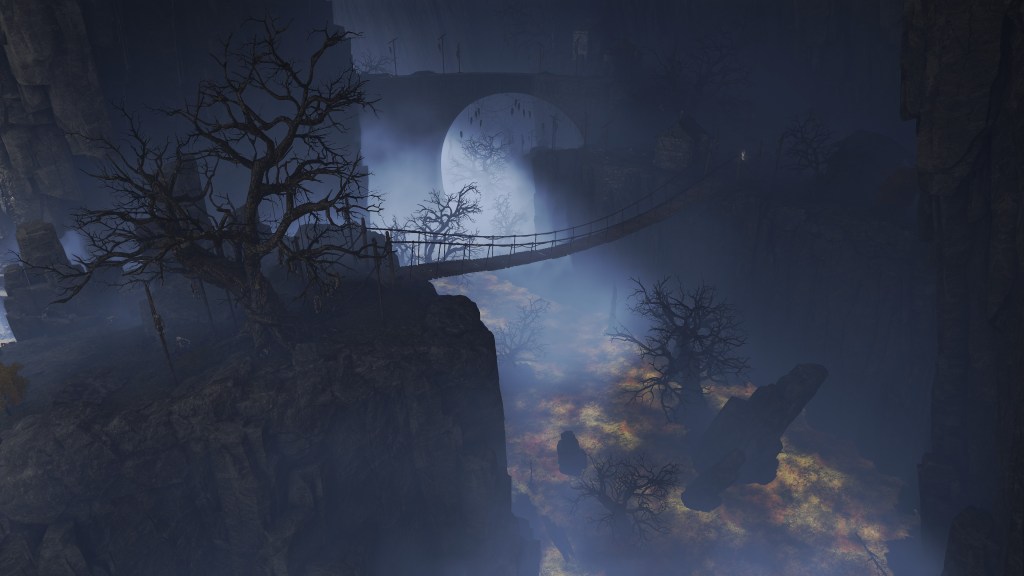
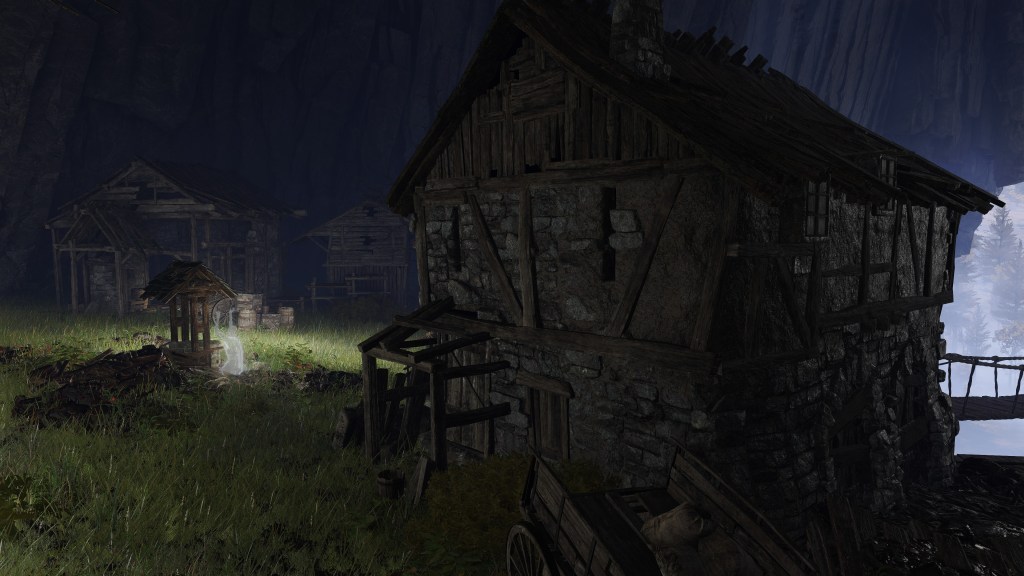


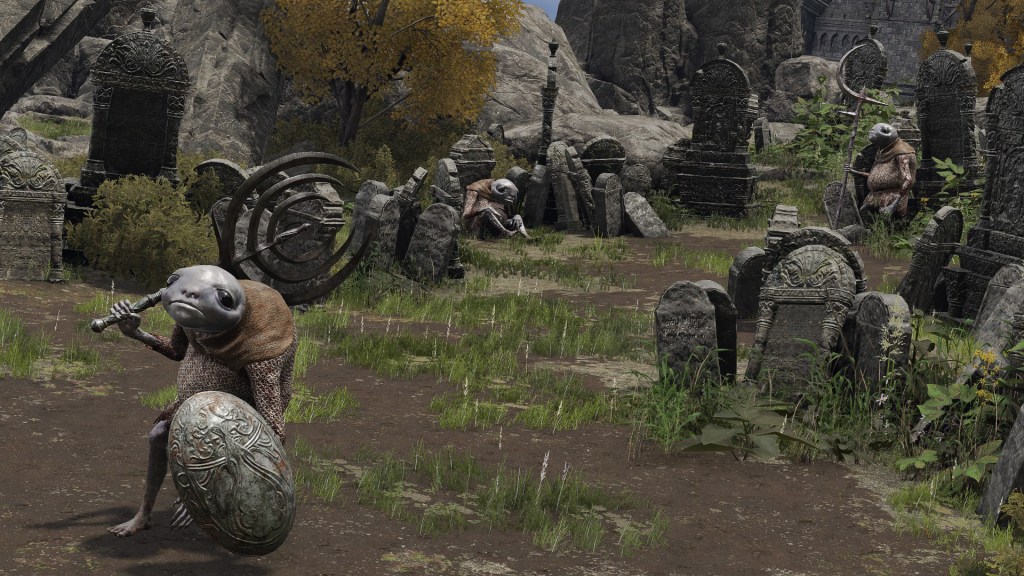


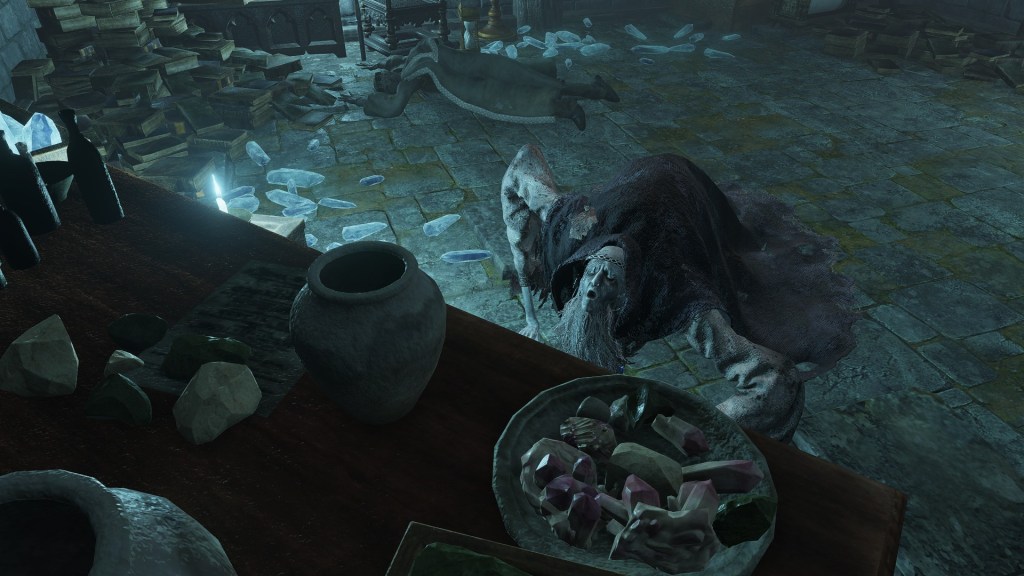

For Caria’s part, the Albinaurics presented an invaluable prospect at insight into the cosmos, so their uses didn’t end at free manpower: studying the race appears to have resulted in the female Albinaurics. Some fans have identified this enemy as part of the first generation since they too lack function of their legs. However, the silver women look younger than the first-generation males by a large margin, and their legs aren’t translucent from metaphysically fading. This indicates that Albinauric women come from a distinct generation after the old codgers. It can’t be the same as the second generation since they yet maintain a normal human physiognomy with the clear ability to speak if not walk. That leaves their own subsequent generation to be a part of, first being the especially large Albinauric Phillia whom other females like Latenna consider to be their older sister in Japanese dialogue. And with that established, their creators are liable to be, not the Nox, but the Carians. This comports with cut text for their equipment claiming the women’s creation in the land of Raya Lucaria, and much more.
Now, our big elder sister. Accept it, the first drop. And then give life. For the sake of all us silvers.
Hood worn by the female body of the artificial life called the children of silver.
That which was woven from steel wire of silver, which is their mother substance, is the one thing that doesn’t violate their skin.
It is said that they, who were created in the land of Raya Lucaria, later followed Miquella and headed for the enclosed tower.
As substitute for their legs, Albinauric women ride an especially large species of grey wolf as their other half. Why and how did this beast become such dear companions to them specifically? Those wolves most likely originate from the Mountaintops of the Giants, their size and builds not only better suited to weathering blizzards; we can also witness them unleash ice breath after their rider infused some of their cold silver power into them. That answers why they are chiefly encountered on the Consecrated Snowfield, with their rider, but a few also roam the upper courtyard in Caria Manor, without. Factoring it all together, the royal family probably imported all the best wolves from the far north for their Albinauric creations, showcasing their status as a Carian achievement by having them ride a Carian symbol — those left over after they halted the experiments were then kept around as guard dogs. This scenario explains why mounting wolves was solely the women’s privilege. They alone represented Caria’s ability, not just as followers of the moon but as molders of life.

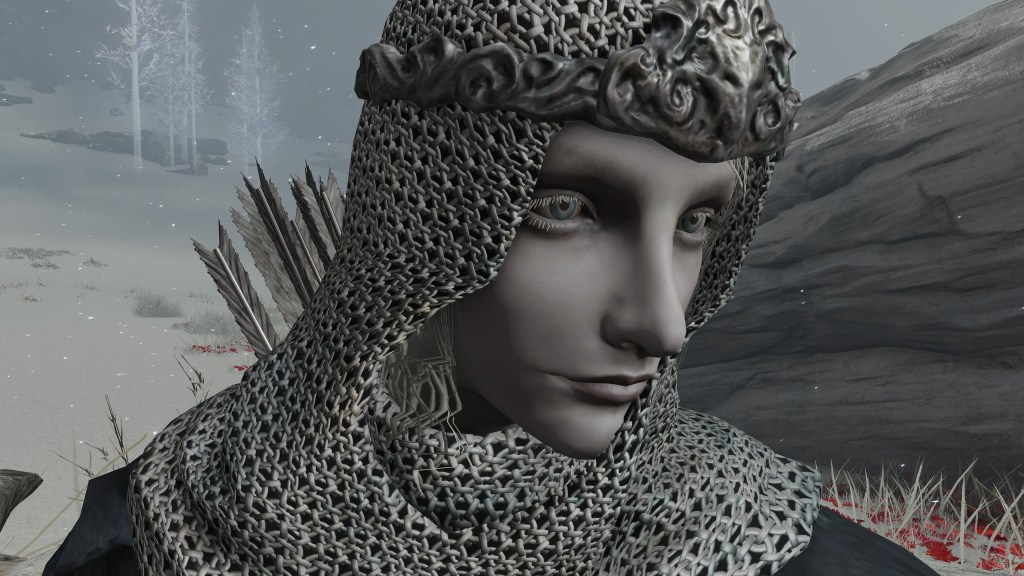

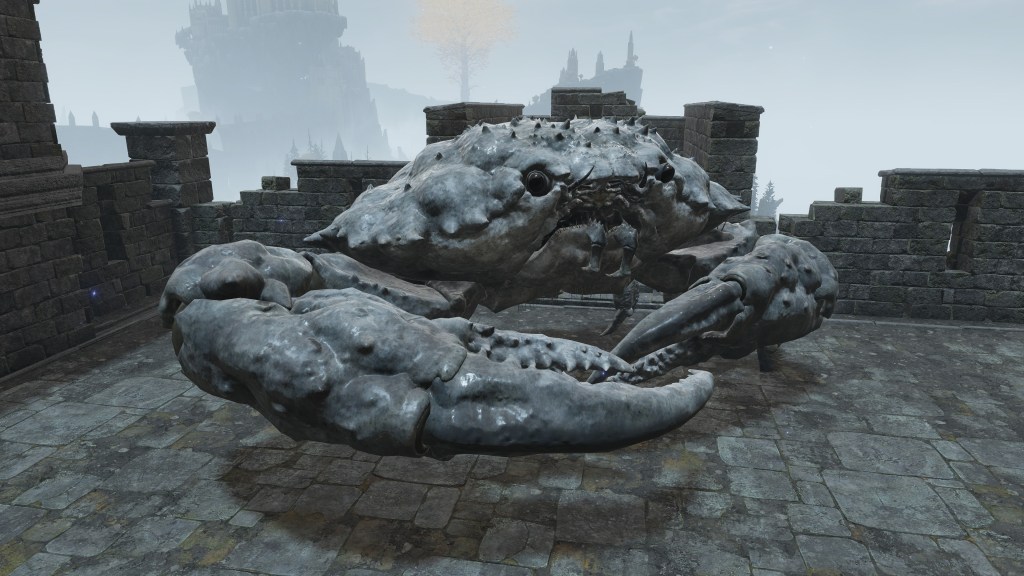
The royal family on the surface no doubt had an interest in “drops” from the night sky, especially from the people lurking beneath their feet. Among the many items collected in the course of his work at Caria Manor, Pidia sells one of the Nox’s celestial dews. Another can be looted from a corpse past the gate to Raya Lucaria, so it wasn’t a closely guarded secret interest of the family. And when it comes to silver specifically, the manor keeps a giant crab who has turned the color. The castle has similarly collected Urumi, betraying that the royals were at least suspicious about the Nightfolk’s connection to silver tears. The Carians were clearly willing to look into anything concerning this subject, so reverse engineering the ritual behind the Albinaurics and iterating upon the process is well within possibility. It is just as fitting that a royal matriarchy thought to improve upon the Nox’s work by making their silver homunculi female, judging the male status as what might have been limiting the race’s full potential. It is this plus other unique details that make the possibility of a Caria connection more of a certainty.
On that note, the females are the only Albinaurics to have received formal military training. Each has been provided with chain mail armor woven from blue silver and equally intricate silver longbow. This magic-resistant blue silver derives from the same “mother” as the women, which may refer to Phillia — the size disparity does make them look like parent and small child more than sisters. Even if it is merely an abstract allusion to silver drops, it confirms that their creator also saw fit to equip them for battle, which the Nox never afforded past generations. This seems to be because the women, riding on agile wolves, were the best couriers and escorts. Back at Liurnia’s Temple Quarter, we can come across a memorial to a random female lying dead amongst the rubble, circles of flowers planted around her by the surrounding second-generations. If females resided there, then there is a good chance that they had been responsible for delivering the tribute from Sol, their bodies and armor perfect for the icy cold of the Mountaintops. It was their job to fend off threats whilst traveling back and forth.

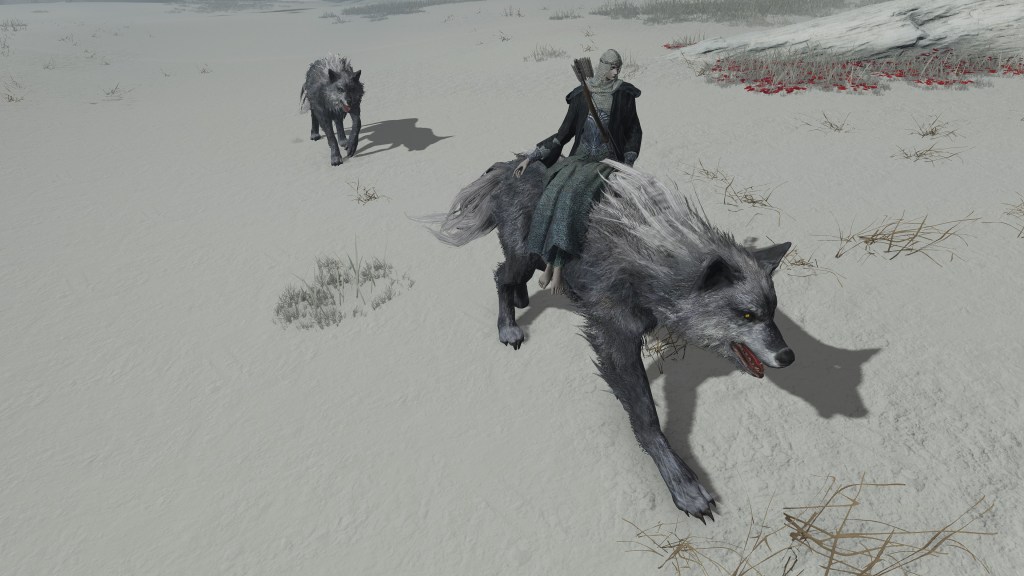

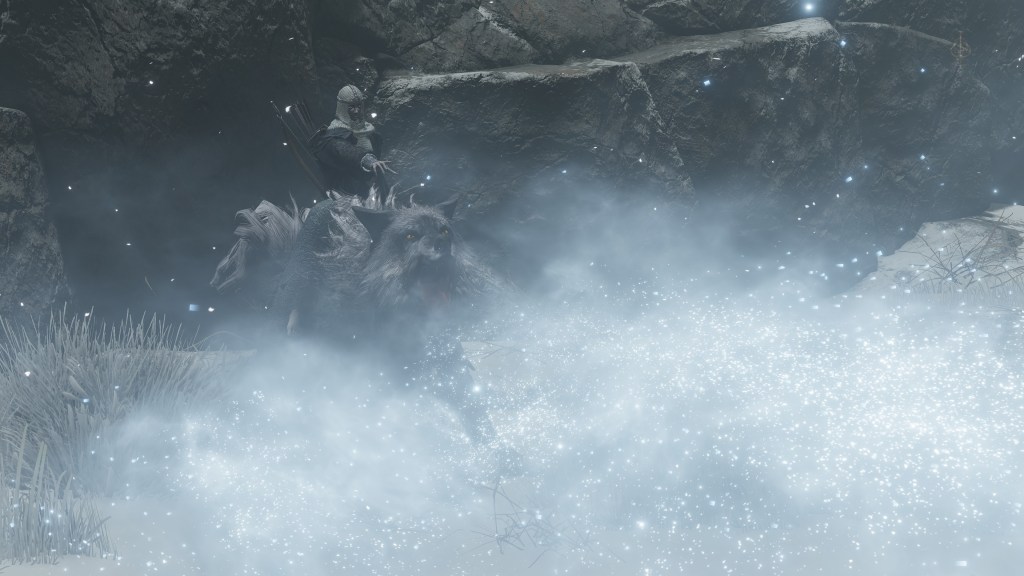


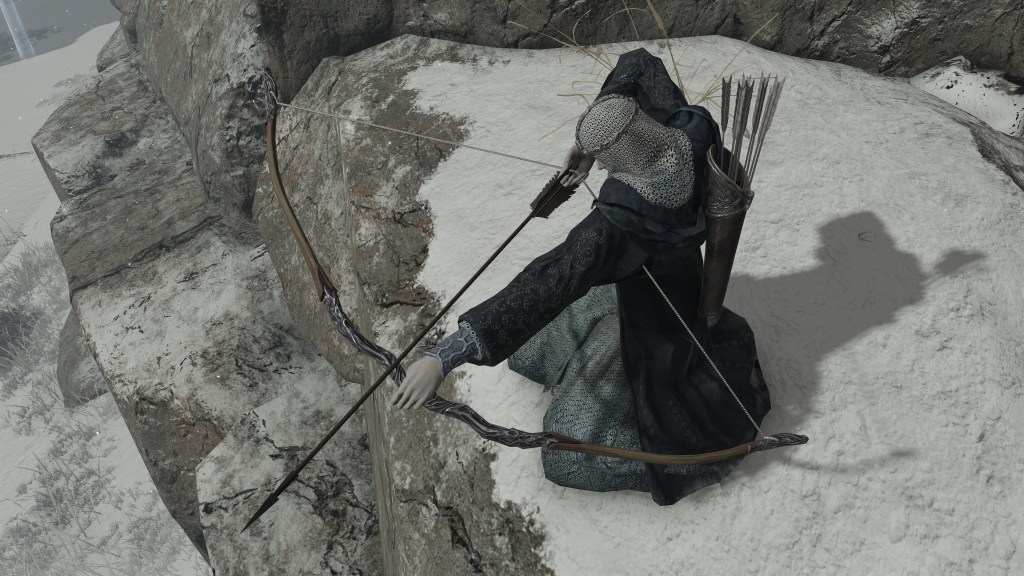


Chain mail armor woven with blue silver. Equipment of the silver archers who ride on wolfback.
Blue silver is a metal born from the same mother as the women and has resistance to magic power and chill.
Longbow applied with intricate silverwork. Choice weapon of the silver archers who ride on wolfback.
This requires dexterity more than strength to master.
Again, the Carian royal family were best positioned to supply this equipment and training, their deep involvement with the Albinauric women reflected in the royal guard accompanying them. Loretta stands out among her peers with her array of skills. Using the white-silver war scythe she received with her position to great effect, the knight performs a leaping slash imbued with the power of glintstone. The glintstone at the bottom end of the haft similarly allows her to cast both Carian Phalanx spells and Glintstone Stars, proof of her history at the academy before becoming a knight — maybe even migrated from Sellia before then. However, her forte is conjuring a powerful greatbow with which she snipes enemies. The royal guard knight appears to have developed this sorcery with the help of Miriam, who also enjoys conjuring Loretta’s Greatbow following her assignment to the Carian Study Hall. And yet, her inspiration seems to be the Albinauric archers. Her shield’s description notes that it was “secretly” modeled on a drop, which led to an “absurd” rumor that she too was born of a silver drop.
White-silver war scythe like an elegant handicraft. Choice weapon of Loretta, knight of the Holy Tree.
It is a weapon that she was given as a royal guard knight of Caria, but the blue brightstone has been replaced with a gemstone of pure gold.
Sorcery that was used by the royal guard knight Loretta.
Generates magic greatbow and fires greatarrow. Enhanced with charging and maintains drawn status without firing greatarrow while holding.
It is said that the bow was her forte.
Radiant white-silver shield embedded with amber. Specialty of Loretta, knight of the Holy Tree.
Its shape is said to secretly be modeled on a drop. It has even become the source of an absurd rumor: “Loretta is a silver-man.”
Some fans have construed this as a hint that Loretta is, in fact, secretly an Albinauric. There are certainly oddities with the woman fully encased in armor. Always riding a mount into battle isn’t that odd by itself, but paired with a bow as her signature spell, and the parallels are undeniable. While she bleeds red instead of silver, the same is true for another boss, Gaius, who is expressly an Albinauric, so this may just be an oversight by the developers. It wouldn’t be the last time, since we also find another Albinauric, Pidia, in a pool of his own, red, blood when killed by his own puppets. However, it is still unlikely that she is genuine silver. For one, Loretta rides on horseback, with enough function of her legs to put and keep them in the stirrups; this contrasts the wolfback riders, who let their feet hang without a saddle. Furthermore, the ash of war obtained from Loretta’s phantom at the castle depicts her leaping without her horse in the menu graphic, implying that she is as capable of standing on two legs as we are performing this same art. If Loretta isn’t human, then she is most unconventional for an Albinauric.
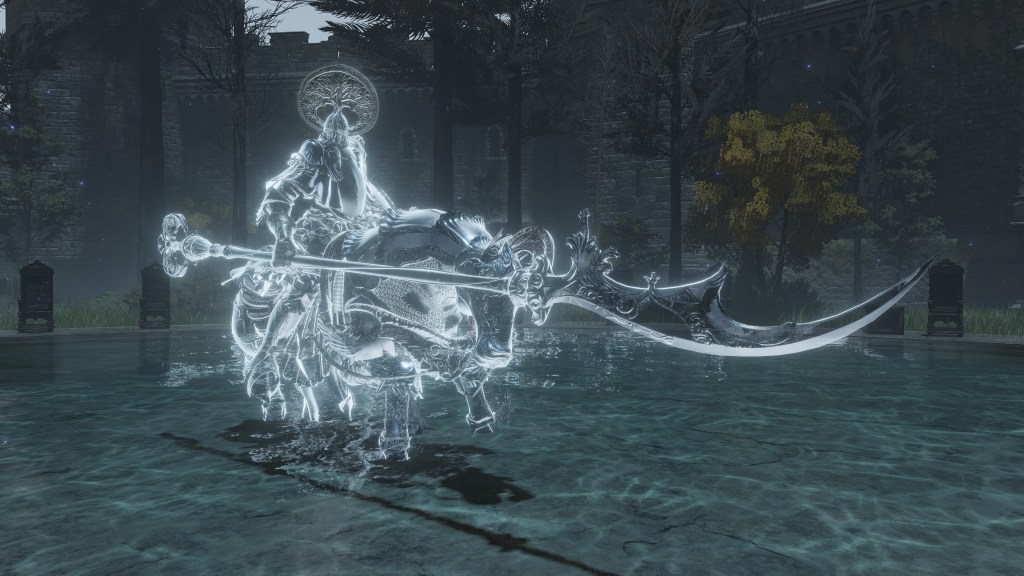


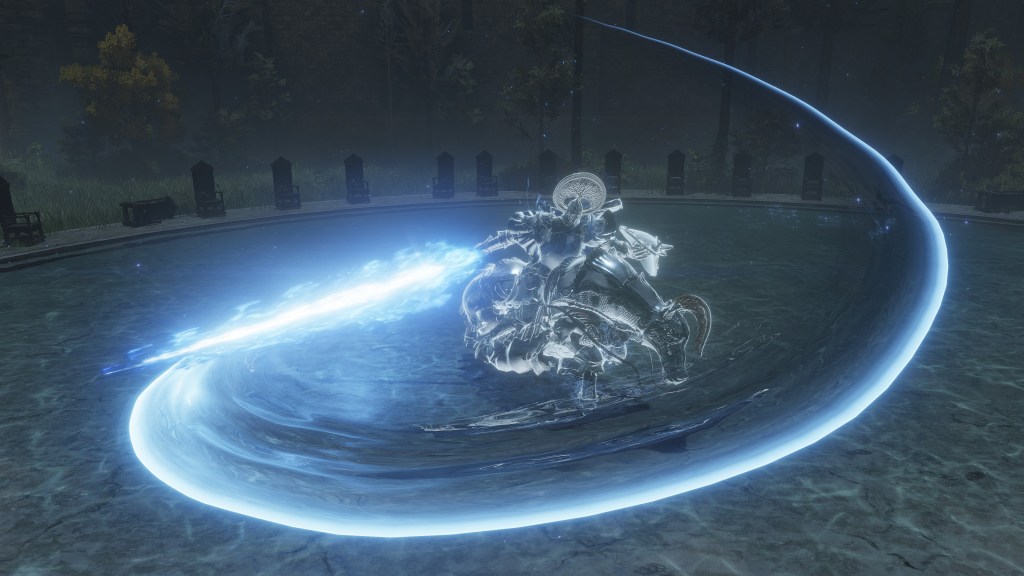

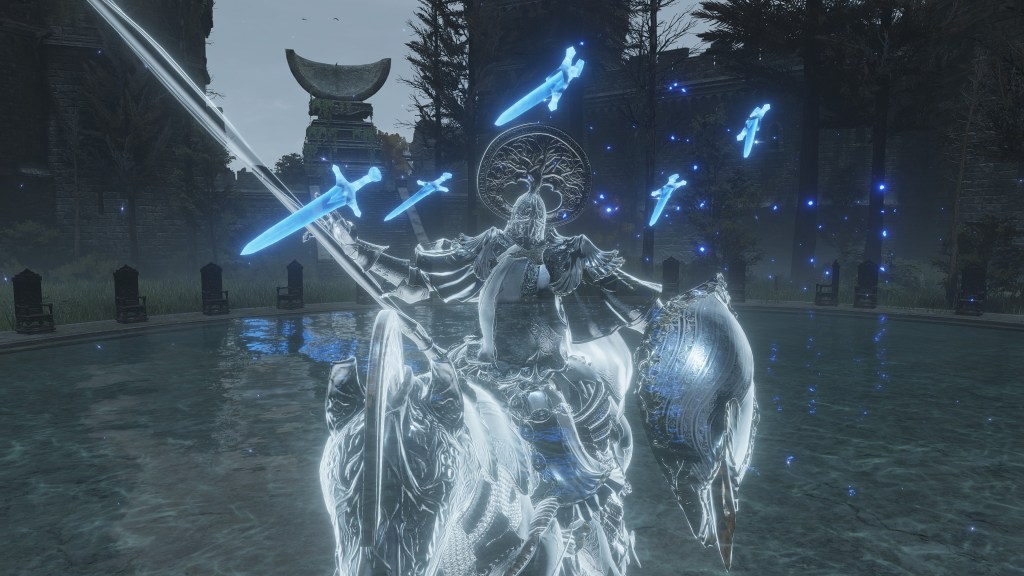
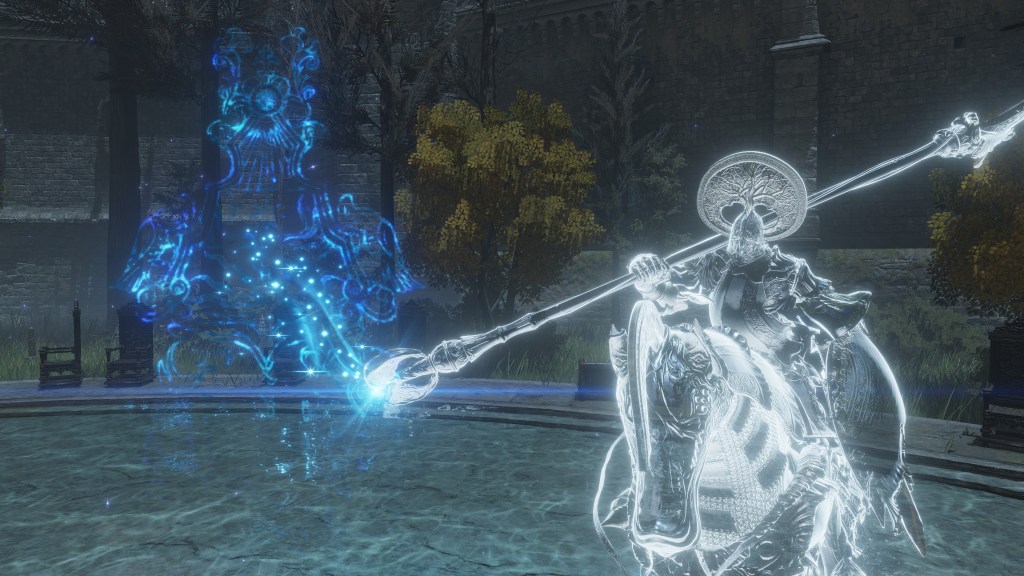


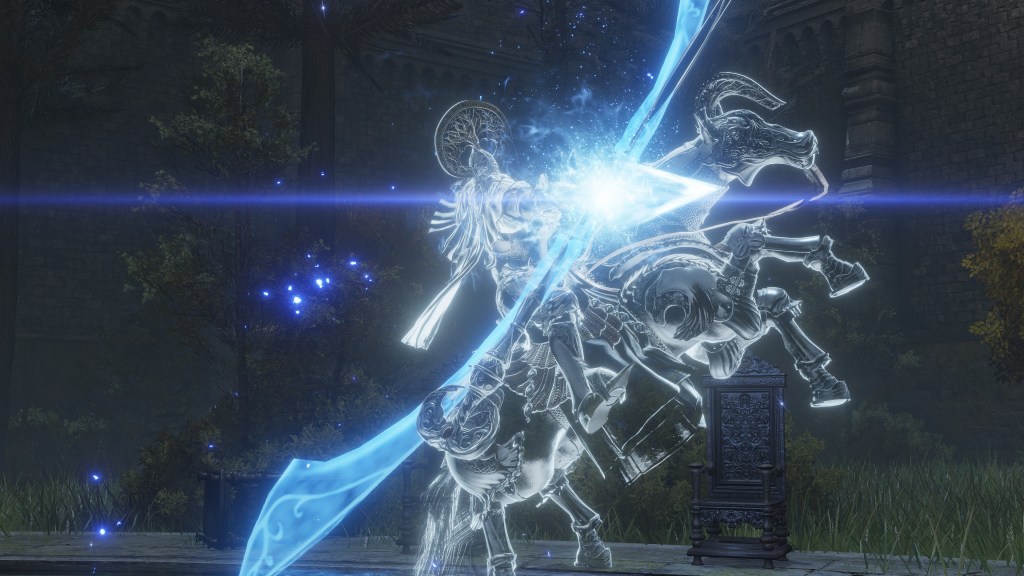
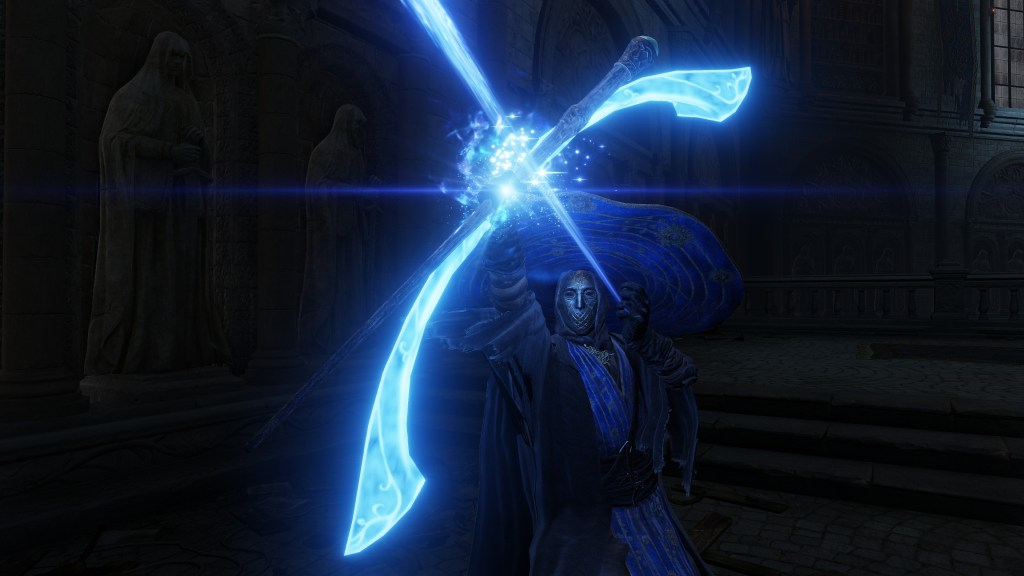
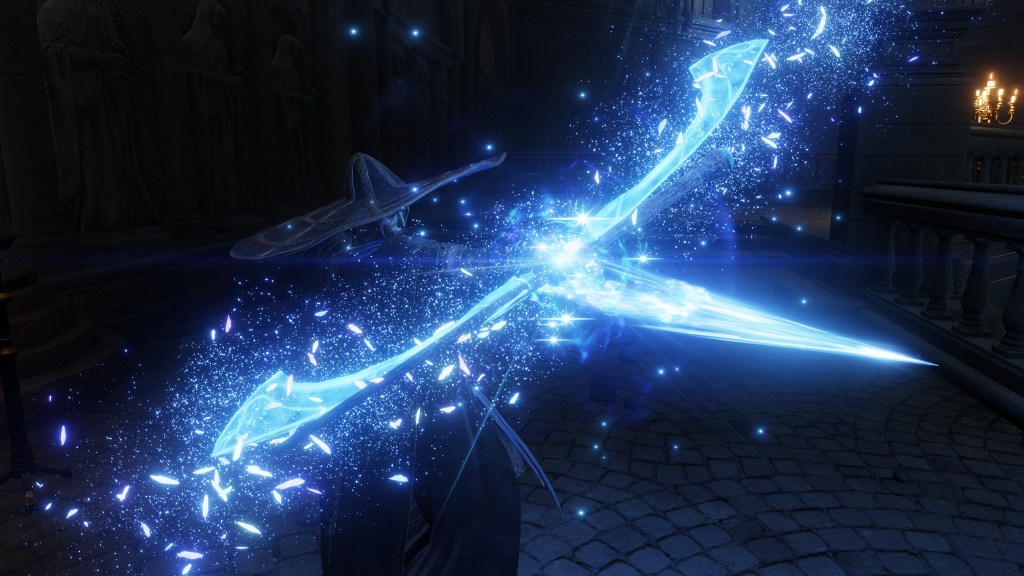

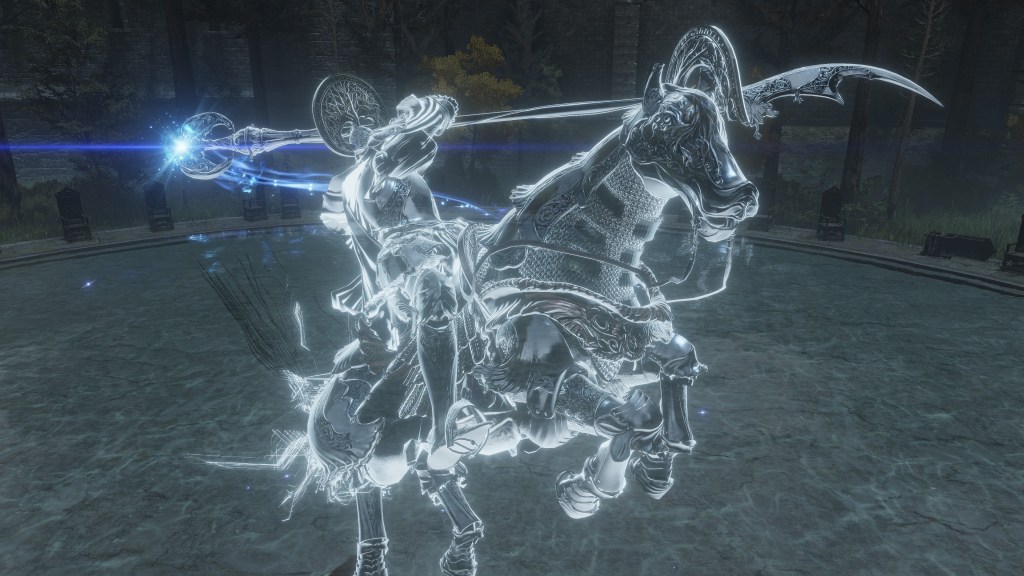

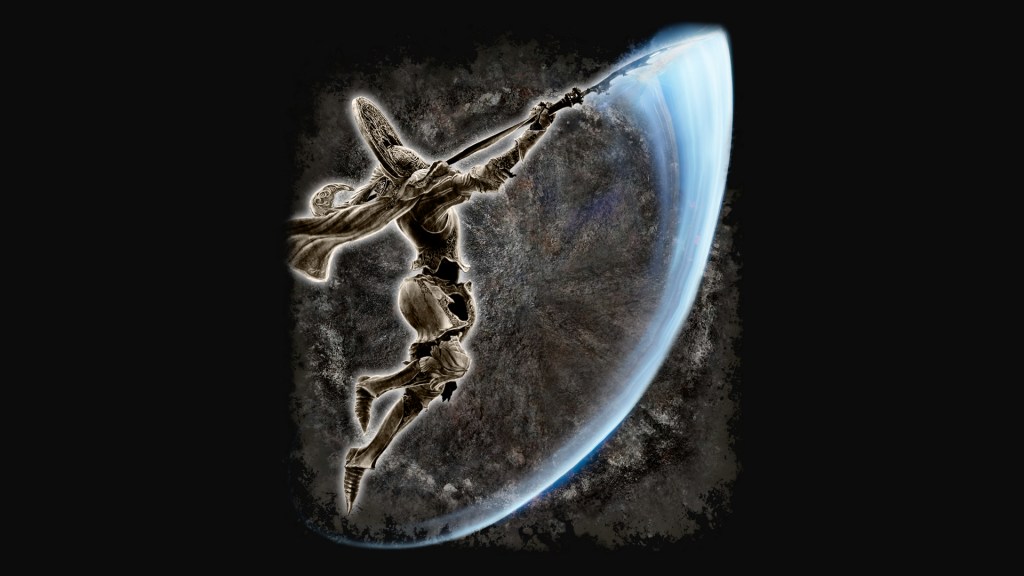
More likely, the parallels are because the knight chooses to emulate a race she respects despite their servant status. Similar to the second-generation males, the females on wolfback exemplify liquid flexibility with their dexterity, in their case becoming excellent shots. A talisman attempts to capture this precision shooting with their form, and their longbows were designed to complement this heavy bias toward technique over strength. As a royal guard, Loretta personally witnessed this mastery of the bow develop under the queen’s purview, taking pointers from how they learned to fight in conjunction with their wolf steeds — the result was her preference to do battle while riding her horse and fire glintstone in the form of a precision arrow. And after surpassing many of her peers with these skills, she then quietly crafted a shield to pay homage to her oblivious teachers; others took notice, and the rumor mill began. The reality is that the knight couldn’t openly admit to taking pointers from lowly creations of her queen, lest she besmirch the honor of her charge. Great and royal Caria stood alone.
Talisman modeled on an archer with longbow. Boosts attack power of precision shooting.
Silver archers were known as fearsome snipers excelling in dexterity.
All of this makes clear that, if the women are first generation, they are Caria’s first generation. In truth, the Albinauric archers are the third iteration born of the royal family’s obsession with the Nox, creations whom they were proud to show off but treated equally as inferior. This prejudice appears to extend to nonhuman races in general, for we see an Onyx Lord captured in an evergaol located at the royal graveyard. The stone-skinned humanoid’s gravity abilities, like his Meteorite sorcery, might easily pique Caria’s interest, making his proximity to their manor too convenient to ignore. Perhaps it was because they feared his destructive capabilities if left unattended, but the royalty clearly imprisoned the “specimen” after he proved uncooperative, shelving his secrets for future observation. By all indications, Carian sorcerers were willing to treat anyone like lab rats in a cage if it suited their needs; the lowlanders had always been beneath them. Their sights were firmly fixed on the moon, the stars, and the perpetuation of their regime.


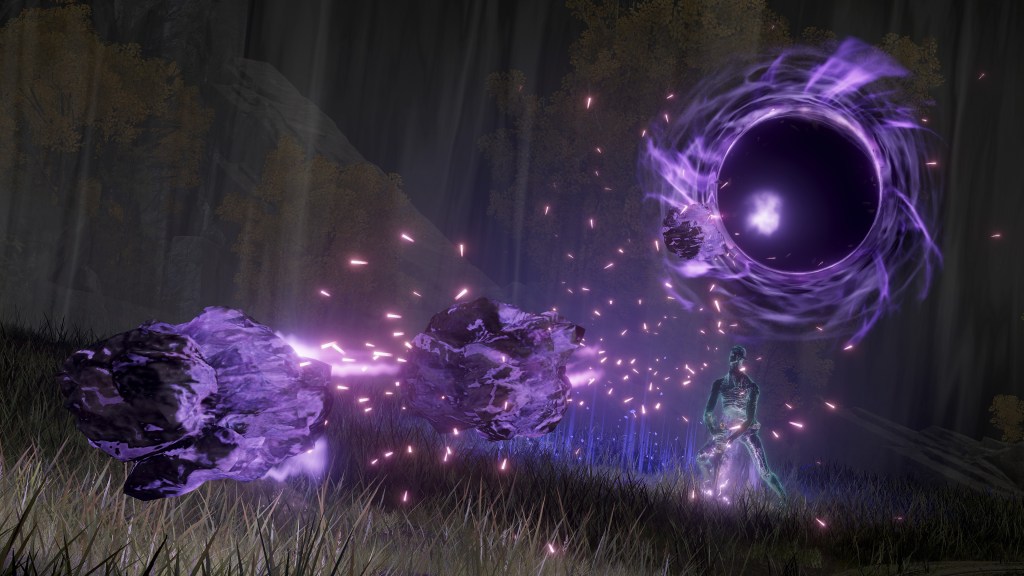
Digging Their Graven
With a tight hold of Liurnian policy both foreign and domestic, the Carian royal family was soon in a position to dictate more than just the allocation of resources. Although the queen never mandated the entire academy focus on her full moon, it was inevitable that her administration reflect her biases. Sellen bemoans the academy’s research into glintstone as pedantry, watered down in accepting Caria as royalty. Evidently, the new school principal laid out guard rails for the sorcerers’ research, determining what was and wasn’t taboo. Many sorcerers were willing to go along with this, in part because they were mesmerized by Rennala’s beautiful moon which demonstrated the potential for sorcery under her leadership. That is why some came to be recruited as glintstone knights, and it wasn’t just scholars actually swearing fealty to the moon who were compromised.
The Lazuli Conspectus is a class established to research Carian sorcery, considering the moon equal to the stars — hence the uniform grey of their robes, mirroring the full moon. This makes them heretics in the eyes of their peers, but they clearly hold the royalty’s works in high regard. Admittedly, they only “try” to master the family’s arts as outsiders; the only example we can see a student perform is Carian Greatsword. Nonetheless, their imitation of the knights is uncanny. The sorcerers’ glintstone heads exchange life for dexterity, which they need to wield their wooden swords molded from staves. With that blue glintstone at the hilt, the sword casts Glintstone Pebble for its skill. Even their swordplay resembles the knights’ techniques. The Conspectus strives to replicate Carian knights’ success. Some might have even dreamed of one day receiving the actual lapis lazuli cloth, which may be why Lazuli is the sole class operating in Caria Manor or Castle Ensis where Rellana currently resides. They are, without a doubt, the faction most sympathetic to the Full Moon Queen and her clan.
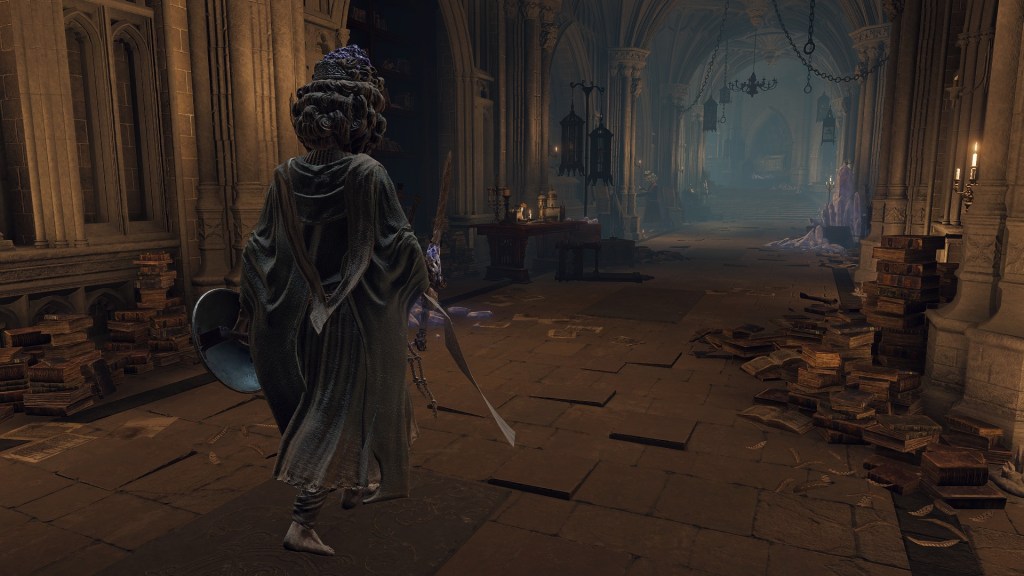
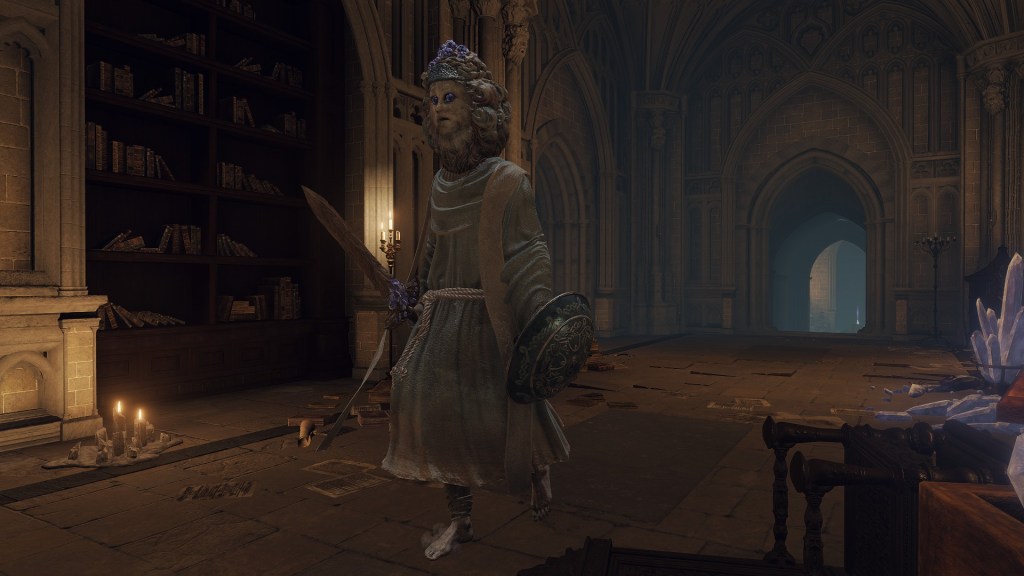
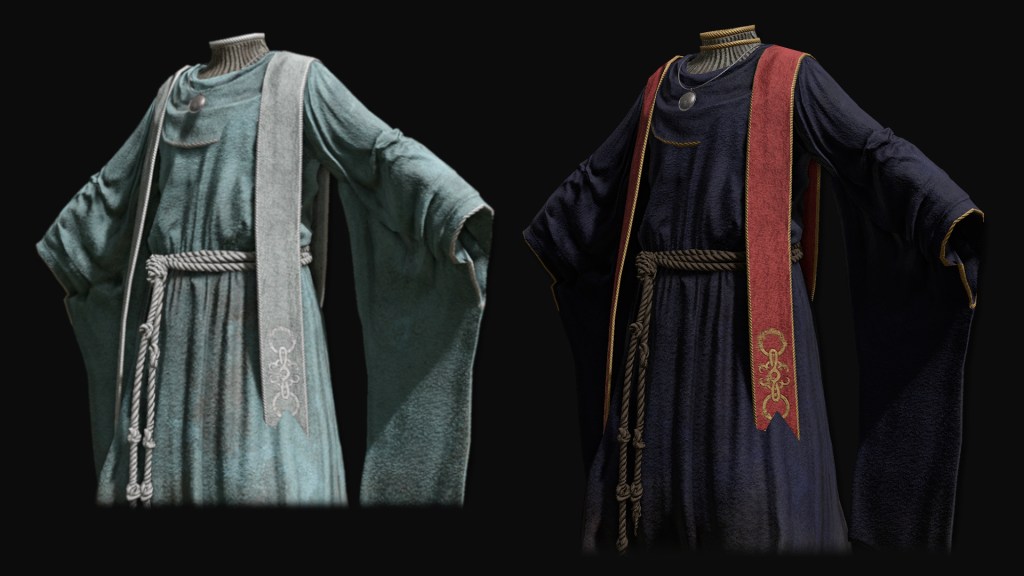

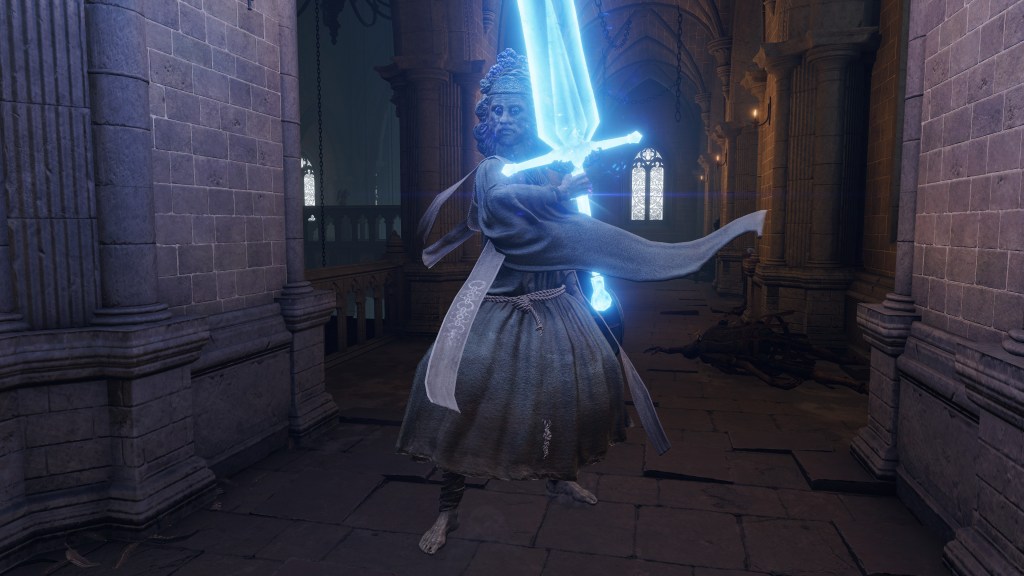
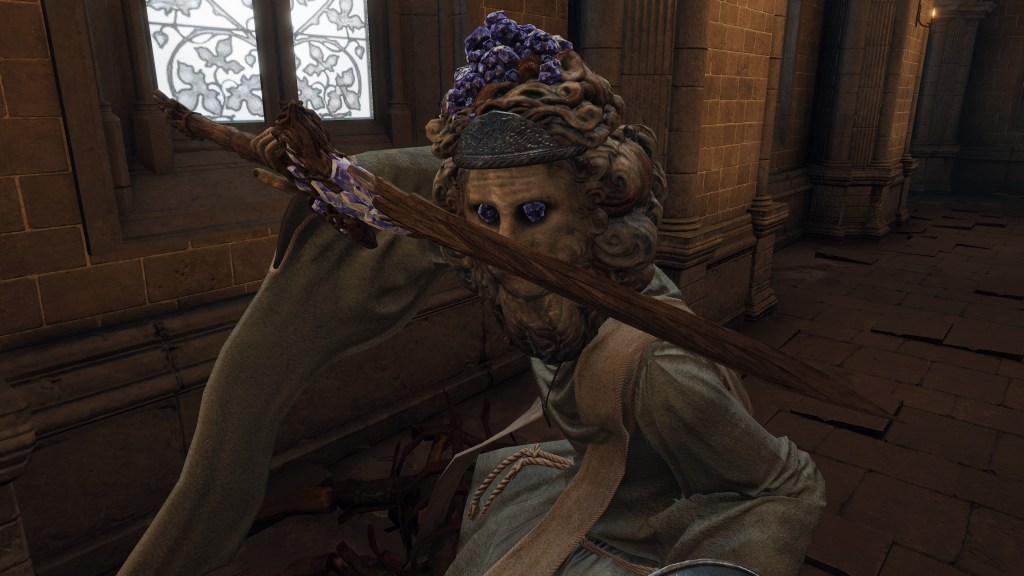
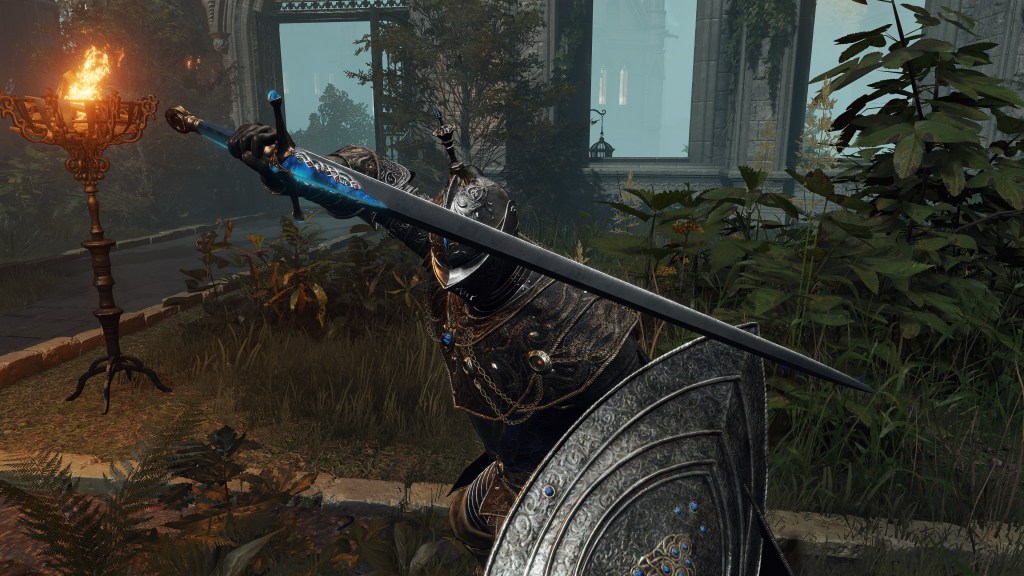

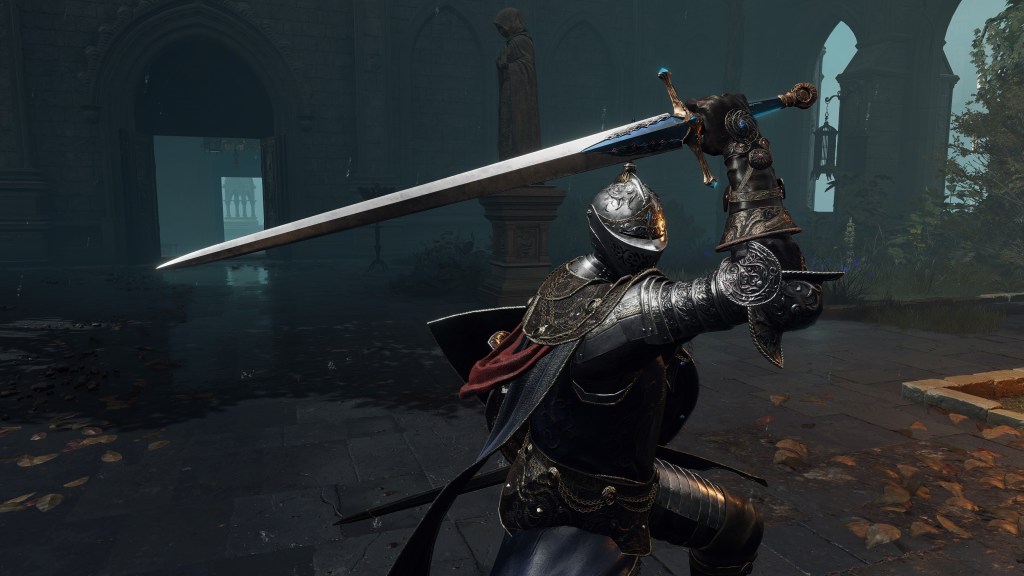

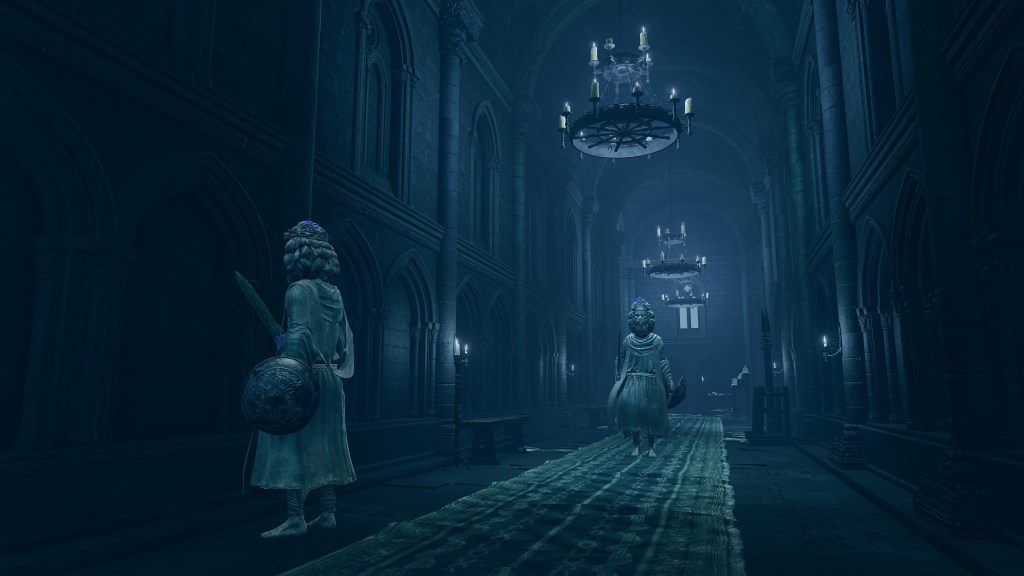


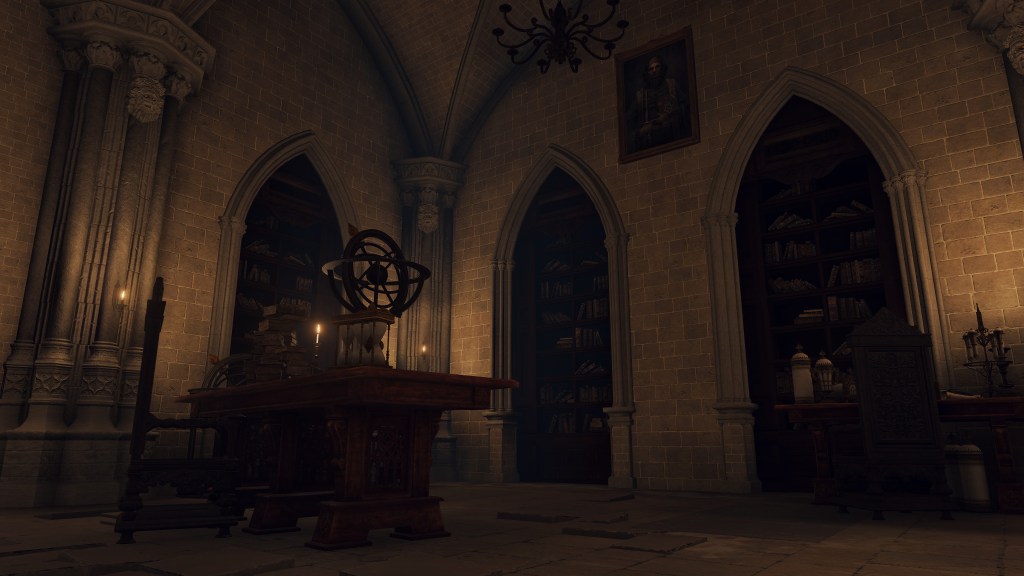
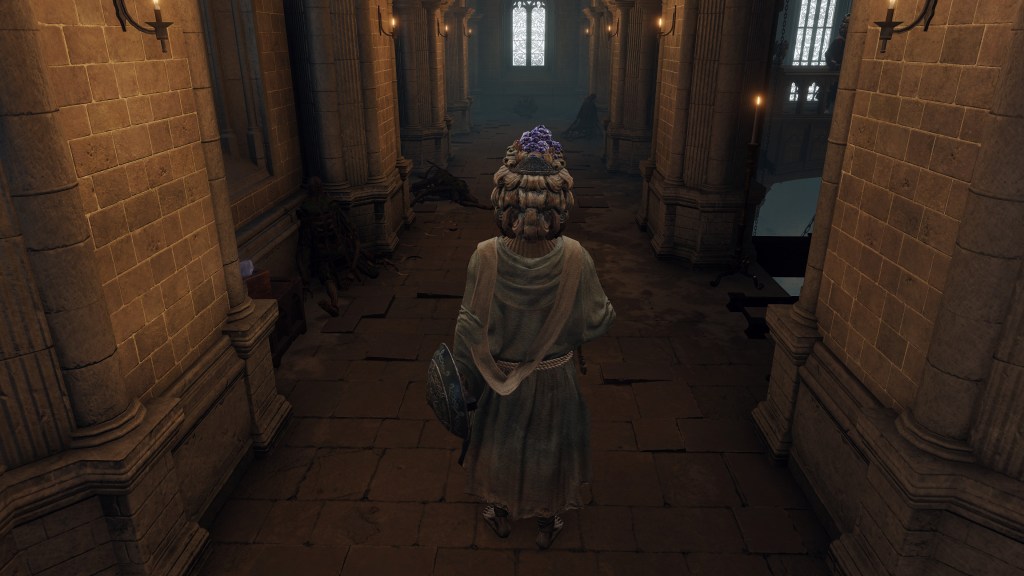
One of the brightstone heads that students whose research was recognized wear in the Sorcery Academy of Raya Lucaria.
Boosts intelligence and dexterity in exchange for HP.
Those learning in the Lazuli class are heretics who try to master the sorcery of Caria and see the moon as equal to the stars.
Robe of those learning in the Lazuli class even among the sorcery students of Raya Lucaria.
They who try to master the sorcery of Caria are heretics who see the moon as equal to the stars, so wear full-moon-colored robes.
Choice weapon of those learning in the Lazuli class, who try to master sorcery of Caria. Possess attack power of the magic attribute.
It seems to have originally been a sorcery staff. This is a wooden sword.
In reality, the class was probably instituted by the Carian royal family. The portrait of its founder stands out for featuring the Raya Lucaria crest on his stole like Lusat and Rennala, denoting that he too represented the academy as an authority. Indeed, this Lazuli wayfarer holds up his sword alongside the generic book the scholars carry symbolizing the school’s knowledge. The message to students couldn’t be more transparent: Lazuli upheld the integrity and curriculum of the academy, with the power of force if need be. They were the hall monitors, ensuring the school ran to expectations — Caria’s expectations. In light of this, it appears more likely that Rennala planted the class as the Carians’ enforcers on school grounds, letting those most mesmerized by her full moon serve as her eyes and ears; with promise of a peek behind closed doors at the royal family, many were sure to jump at the chance. That fits an earlier iteration of their robes identifying them as eji, (衛士) guards assigned to protect palaces and their dignitaries. They are royal security.
This shift, naturally, brought tensions, but academic society adjusted accordingly. The Haima Conspectus exists for one purpose: to enforce peace on school grounds as its judiciary. True to their Greek name, Haima adjudicators are prepared to shed “blood” if necessary. They are always the largest sorcerers of Raya Lucaria we come across, their glintstone heads increasing both strength and intelligence at the cost of focus. However, the class doesn’t care for this loss, since they prefer to end battles in one huge attack — if not with the heavy club hewn from unremarkable glintstone, then with sorcery. To that end, members study Cannon and Gavel of Haima, mastering how to conjure a magical cannon ball or great hammer with which to flatten all resistance. That is the “judgment” the Conspectus visits upon those who persist with conflict. But this requires conflict for them to quell, which would emerge with the new royalty suddenly imposing lunar heresy on astral orthodoxy. In other words, there was no Haima class before Caria’s rise to power.
One of the brightstone heads that students whose research was recognized wear in the Sorcery Academy of Raya Lucaria.
Boosts intelligence and strength in exchange for FP.
Those learning in the Haima class master cannon and judgment sorceries as the power to quell conflict.
One of the brightstone sorceries of the Sorcery Academy of Raya Lucaria.
Generates magic great hammer and slams it down. Can chain attack only once.
A sorcery of the Haima class, who are the academy’s judiciary. It is the power for quelling conflict.
We can see this reflected in the glintstone head worn by the Conspectus. Although obscured under a hood, Haima’s mask is clearly modeled on the Lazuli head. The main difference is the additional blindfold, which obviously serves to convey how Justice is blind. This implies that the class was formed specifically in response to the Lazuli, hoping to act as neutral arbitrators in disputes between the Carian hall monitors and the older classes. Perhaps they started off as a splinter group within Lazuli, only later developing into their own faction; Gavel of Haima does follow the same principle as Carian Greatsword. Regardless, Haima sorcery bears the sigil of academy arts, showing where their priorities ultimately lie. They stood to defend scholars from tyranny and corruption. If a Lazuli sorcerer overstepped his bounds, then a Haima sorcerer would step in to deter further action with overwhelming force when required. In short, the class acted as a counterbalance to the new royal cronies.


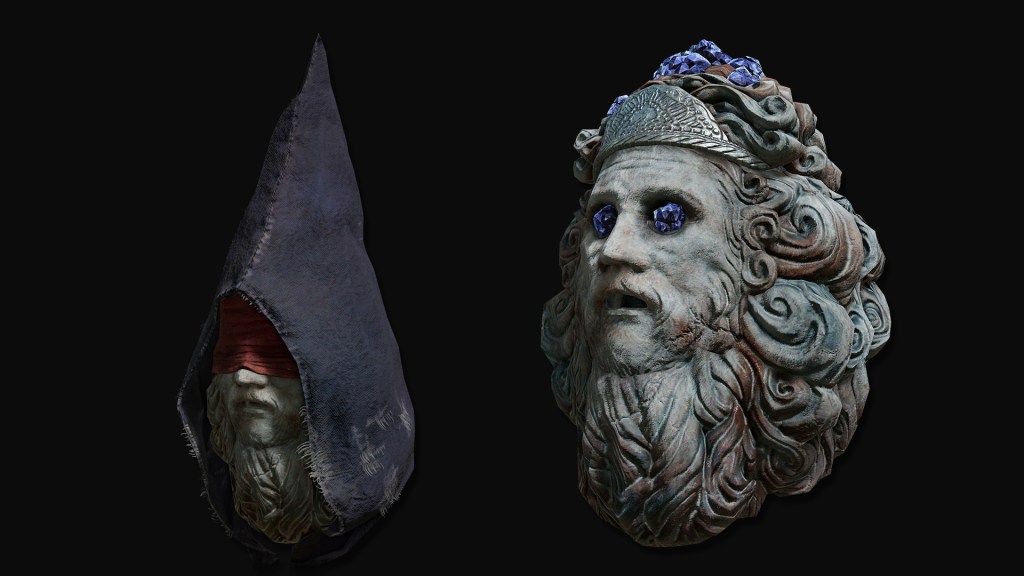
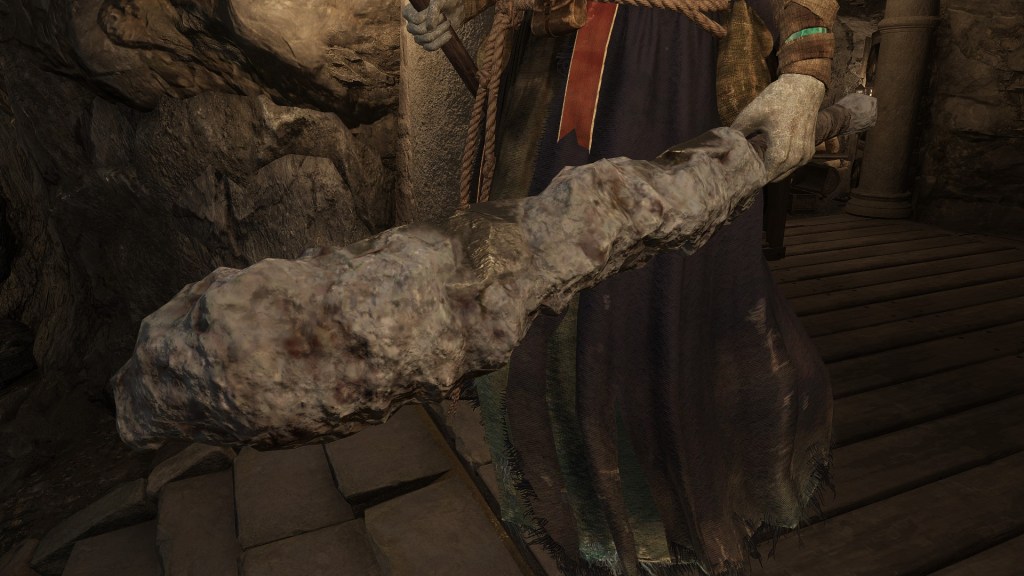
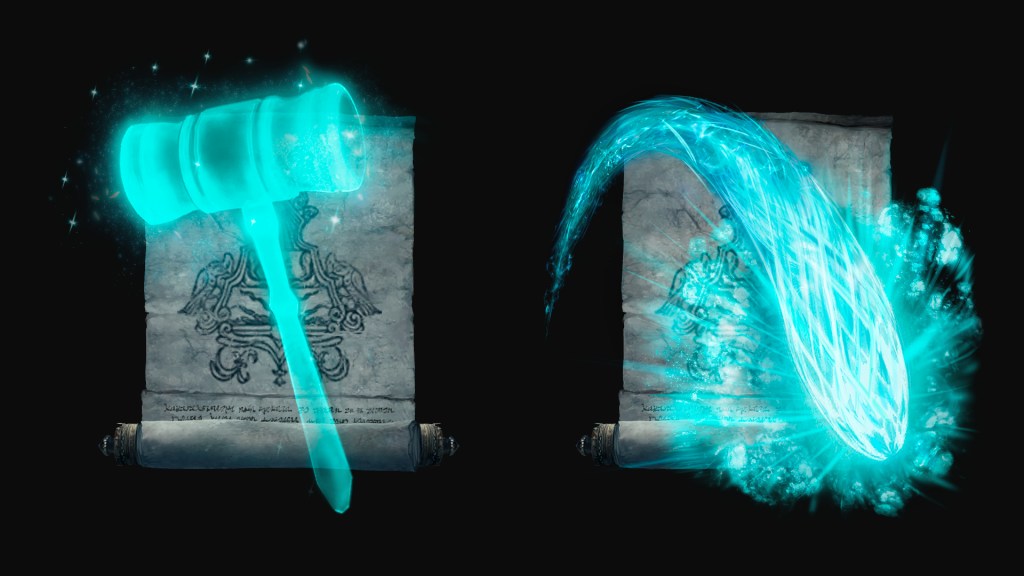
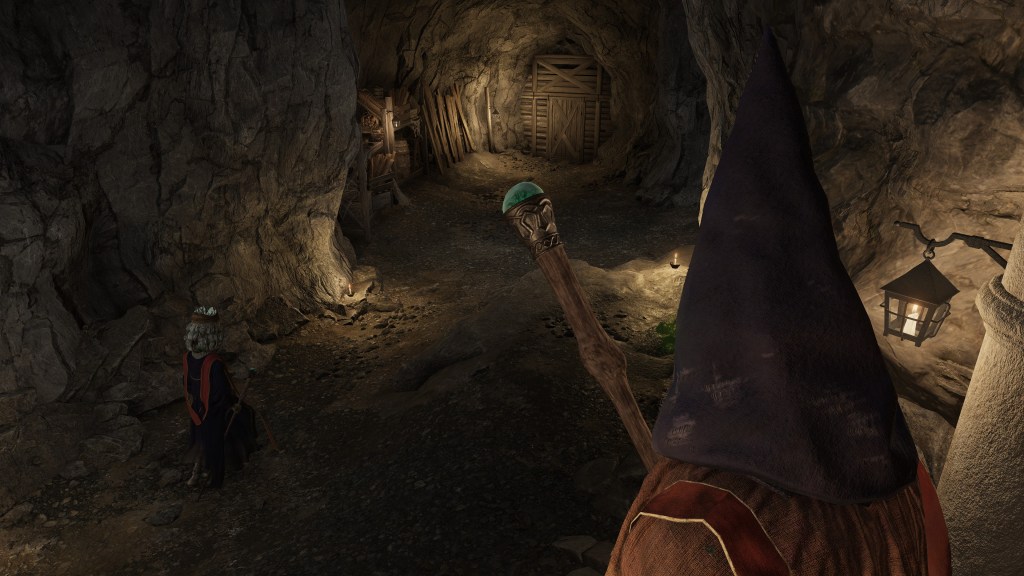
That deterence element seems to be how the Haima Conspectus justifies its violence to end violence. Going so far as to squash their enemies like a bug might seem unbecoming of a scholar. But the description to their Stone Club reveals that this trogolodyte behavior, too, serves their own erudition. The brutality of the method is a visercal reminder of why they seek to end conflict — nothing leaves an impression quite like pummeling a person to a bloody pulp with your own hands. Knowing the ugliness of war, Haima has taken it upon itself to resolve civil conflicts before they escalate to that level. Whether it be the stars or moon, sorcerers need to focus on cooperation for the sake of progress. Let them be the only ones who engage in such vulgarities. An intermediary’s job is to smooth over complications, after all, especially when it concerns all-too-important research. In practice, however, the judiciary simply legitimized the Carian system, leaving all the decisionmaking in the hands of Rennala and her watchdogs. And first on their radar was sure to be the queen’s biggest impediments, Azur and Lusat.
Choice weapon of the war sorcerers that whittled down hard brightstone. A very heavy club for its size. Not particularly tinged with magic power.
What is war? So as to not lose sight of its true quality, war sorcerers squash the enemy themselves.
The Graven talismans attest to primeval sorcery as taboo. The reason why is obvious: it demands the sacrifice of human life for progress. A purely rational man can argue that this is for the greater good, but the average person would perceive such experiments as morally bankrupt. And as Sellen indicates, it was Caria who introduced these “ethics” to Raya Lucaria. Their generation migrated from the Mountaintops, so the follies of their astrologer forebears were fresh in the western clan’s mind. It is no surprise that the royal family were biased against a repeat of those mistakes. Maybe Rennala just saw this as an excuse to remove rivals from her court, but the Carian queen nonetheless forbade them from sacrificing their fellow sorcerers to create stars — something which, unsurprisingly, found purchase among the student body. Thops exemplifies the horror at the idea of sorcerers killing sorcerers, and others were sure to oppose if only for their own self-preservation. This invariably isolated the unrepentant primeval sorcerers within the academic community, namely Azur and Lusat.
The supreme sorcerers were banished from the academy presumably for their pursuit of the Primeval Current. If there was a particular crime, it may have been restarting the experiments to replace a sorcerer’s heart with glintstone. Sellen has accomplished this feat and holds the two in high esteem as one of their students. It is possible that they were responsible for her successful surgery or provided her the basis to perform it on herself. But even if their open practice of primeval sorcery was the sole pretense, Caria held all the cards in this situation. The Carians were heroes who saved lives with their power. Contrast to the two instructors. They must have already lost Haima; from that Conspectus’ perspective, Azur and Lusat were just causing unnecessary conflict. And from the outset, Lazuli stood in solidarity with Caria. That left the Twin Sage Conspectus plus their own if the two had any hope of challenging the Full Moon Queen in this forum. But even if equalizing the moon and stars was decidedly heterodox, those three classes, too, had been mesmerized by the heavenly body.

Robe permitted only to the supreme instructor of the Sorcery Academy of Raya Lucaria. It is being eaten away by blue-green brightstone.
After both supreme instructors, Azur and Lusat, were exiled from the academy, none exist who have reached their standing.
Not helping matters for their contingent is the fact that the ban was narrowly tailored. The Olivinus and Karolos classes were allowed to continue studying shooting stars and comets as they had. It was only their founders who were subject to scrutiny, having crossed the line at where those studies took them. This forced the two Conspectuses to make a choice: challenge Liurnia’s rising stars, or eject the two old fogeys? There was no contest. That far-off fantasy of primeval sorcery proved dangerous and ugly compared to Rennala’s beautiful moon dangling right in front of them. Although none could fill their shoes, the great wise men of Raya Lucaria were driven out with apparently not much conflict. That isn’t to say that the instructors were eager to step down — they continue wearing the academy’s pattern, after all. However, the master sorcerers understood their position and so seem to have reluctantly accepted the humiliation. There was no point fighting the verdict. Just as Sellen insinuates, Azur and Lusat were clearly not welcome anymore.
In some sense, this was a blessing. Without the support of the sorcerer community, the two sages explored other means for reaching the Primeval Current. Azur seems to have just wandered around, meditating until he reached an epiphany. Meanwhile, Lusat returned home to do the same. Both have had their brains turn to glintstone connecting their thoughts to the cosmos, the crystallization spreading to their upper bodies and entire arms. This implies that it has been a slow-going process; they even took the time to fashion new staves utilizing the glintstone. But eventually, these meditations did take their toll on the body. By the time we encounter them, the primeval sorcerers are both largely immobile, only moving their arms to hand over the results of their insight. Comet Azur and Stars of Ruin are the ultimate forms of the sorcery practiced by their former Conspectuses, yet neither manifests the academy’s sigil. The spells go without affiliation, for their instructions were penned by exiles operating outside the academy — just like how the original primeval sorceries were first formulated.


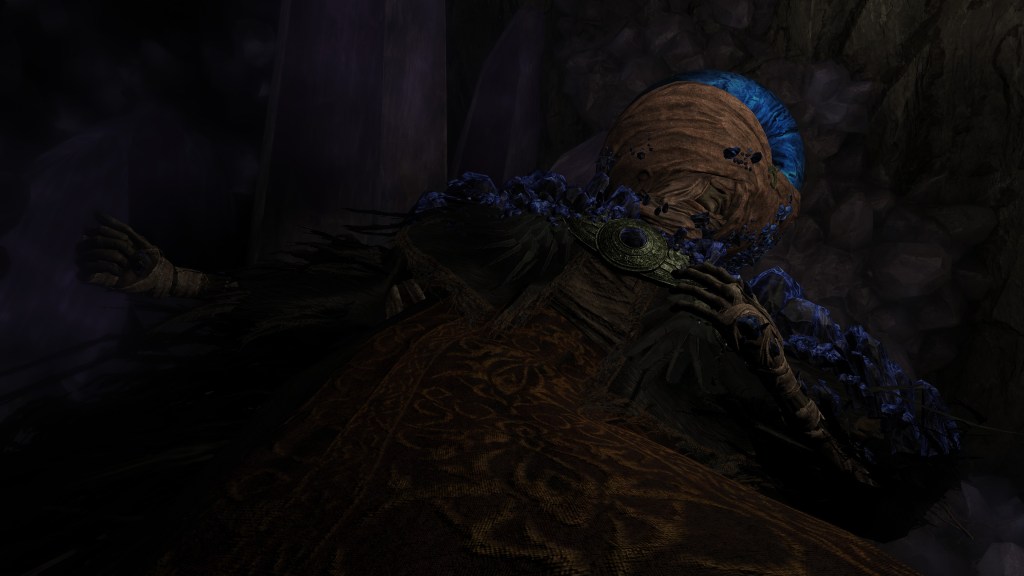


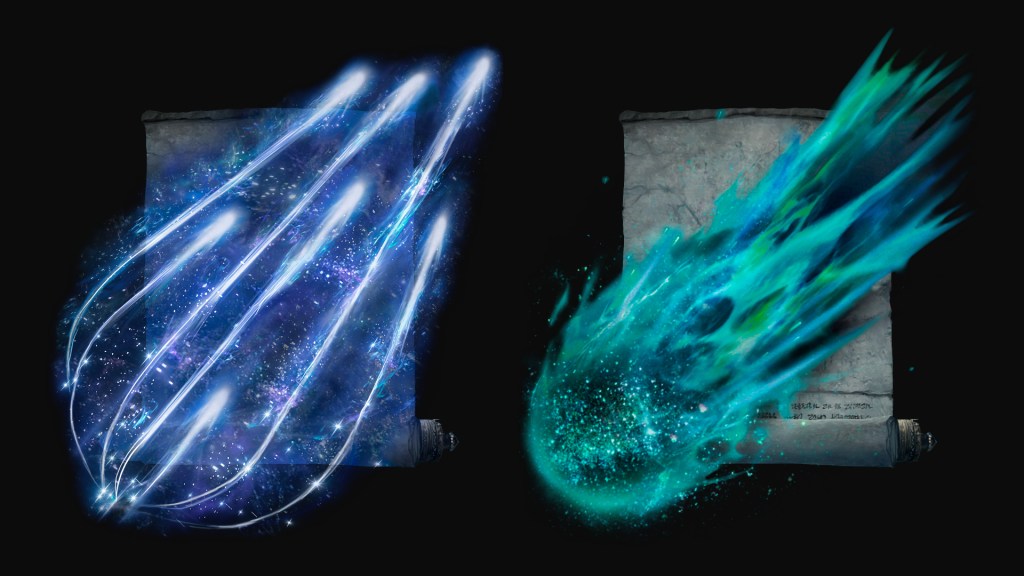
Impressive as their progress is, it was arguably also a curse. At its root, their immobility appears to be because their minds are broken. Comet Azur encapsulates the torrent of the starry sky flowing from the darkness of space, its creator simultaneously enthralled and terrified by that abyss he glimpsed. Meanwhile, Stars of Ruin captures twelve dark stars shooting toward their own destruction, its creator having witnessed a similar star cluster’s demise. Each saw the beginning and end to the life they aspired to become, respectively, and witnessing such a Greater Will to the universe broke Lusat in his entirety as well as presumably Azur. Neither could look away from what they saw, nor fully comprehend it. The result is they are helpless as others go about their lives, ignoring their concentration. In Lusat’s case, Sellia imprisoned him in the crystal cave north of town, an illusory wall making it the “hidden cave” (サリアの隠し洞窟) we know. Indeed, Gowry’s note confirms the intent to “hide” the Primeval Current in its Japanese description, stationing a Haima sorcerer to preempt the cave’s discovery.
Sorcery of Azur, one of the primeval flow sorcerers. One of the “legendary sorceries”.
Fires an enormous comet which is the torrent of the distant starry sky considered the home of brightstone. It continues firing while holding.
The primeval flow glimpsed by Azur was darkness. It is said that he was both enthralled and terrified by that abyss.
Sorcery of Lusat, one of the primeval flow sorcerers.
Fires twelve dark shooting stars that fly toward the target. Can be used without stopping movement and is enhanced with charging.
The primeval flow glimpsed by Lusat was a great star cluster’s moment of demise. In that moment, his entirety was broken too.
There is another first brightstone sorcerer. Master Lusat. Like Master Azur, he was driven out of the academy and has been imprisoned somewhere. My apprentice, will you search for Master Lusat?
Piece of paper handed over by the wise man Gowry. Shares the promised secret.
The town of Saria hides the primeval flow.
If you light the three flames in the candle stands of the high towers, the seal on it will be broken.
Lusat’s detention was done at Caria’s behest. An Olivinus sorcerer is stationed guard over the actual prison, a magic seal using the academy’s sigil, with two Lazuli supervised by a Twin Sage waiting in the wings and Crystalians overseeing the mining operation. Moreover, the silver tear mother traps en route from town utilize Caria’s sigil. Since Sellia was still frequented by the academy, there were risks in allowing its former instructor to roam free in town. What if distant Sellia became a hub for primeval sorcerers to plot rebellion? Word of Lusat’s state approaching dangerously close to a “star child” leaked out to Sellen, so reports reaching Liurnia are feasible. And after hearing this, what choice did Caria have but to seek the Sellian authorities’ cooperation in eliminating this threat? Local Nox had as much to gain from detaining the sorcerer; his staff confiscated to offer up to their future Night Lord. But normally, heretics would simply be forced into joining the sages. The fact that Lusat wasn’t permitted to sit around in a nearby town as, essentially, a vegetable betrays their decision to ameliorate the royal family’s fears.
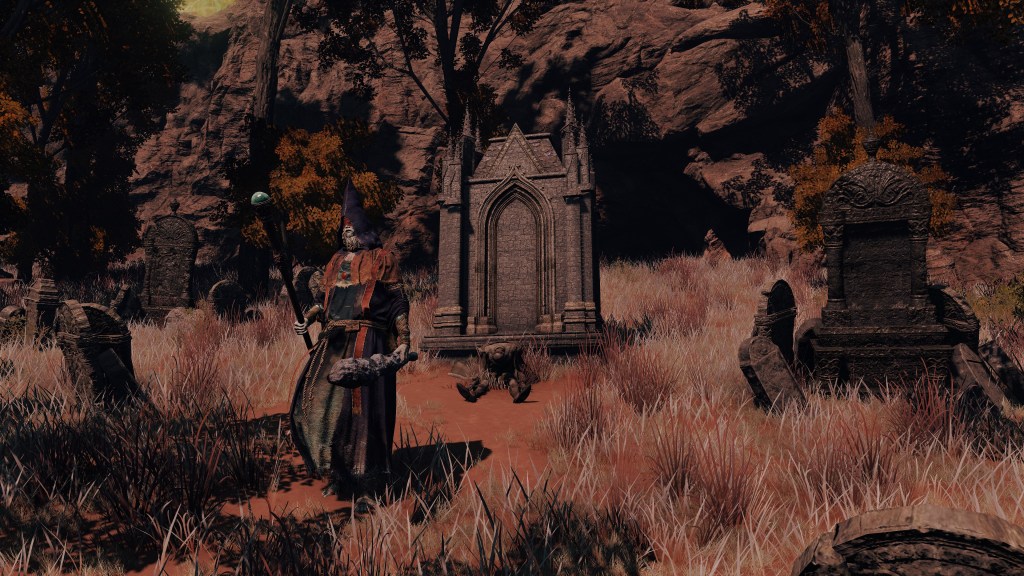


With this brightstone key, you should be able to overcome the barrier confining Master. For it is needed to revive the primeval flow of brightstone sorcery. That body which came closest to a star child…
If nothing else, Caria’s decrees were effective in deterring the practice across the sorcerer community continent-wide. Granted, no rule is constantly observed, and this remains true even at the academy. The top instructors were the obvious targets, but primeval sorcery still has its silent supporters for Raya Lucaria to root out. With the Lazuli on watch, anyone openly advocating for the Primeval Current would quickly be reported. Even so, there are scholars who refused to join Azur and Lusat in exodus but also wouldn’t abandon the practice — a prime example is Sellen, their remaining student who instead worked to revive it. After her masters left, the woman continued to excel at the academy, earning herself her own glintstone head along with the title of “witch” to rival Rennala. But despite this, she never established a class. The reasons for this are transparent from Sellen’s stone head; it improves intelligence and arcane at the cost of stamina, a perfect encapsulation of her finally touching on the stars’ secrets after chasing them for as long as Karolos. Her Conspectus could not exist without primeval sorcery.
… I remember being exiled from the Academy of Raya Lucaria. The reason was because I aspired to revive the primeval flow of brightstone sorcery. For I desire brightstone sorcery as sincere research, without taboo, not the pedantry which accepted the Caria royal family and became watered down…
One of the brightstone heads that students whose research was recognized wear in the Sorcery Academy of Raya Lucaria.
Greatly boosts intelligence and arcane in exchange for stamina.
This amiable brightstone head was given to an excelling female sorcery student in particular along with the alias of Witch.
The signs were always there. Recognition for a stone head likewise merited a portrait, where Sellen reads a scroll for Carian sorcery, unimpressed. Clearly, the new witch made no secret of her little regard for the royal family’s works; more than just view them as heresy, she wanted every classmate to know how small-minded they were to be acting as Caria’s lapdogs — ironic when the name “Selen” (セレン) comes from ancient Greek for “moon”. She was, to put it simply, an unabashed agitator. But the Carian royal family tolerated her combativeness in the academic setting. The fact that she was called a “witch” like Rennala is a testament to her talent, so she would be afforded the same respect as her banished masters. It also helped that Sellen was personable, her stone head capturing the witch’s amiable smile while Thops recalls her as a lovely individual. Beneath the jaded criticisms, she is an enthusiastic teacher with an infectious passion for sorcery, no doubt. But that charisma may be exactly what led to so many becoming her victims.
Sellen was banished for killing many sorcerers in her obsession with the Primeval Current. Thops refuses to believe that she could commit such a crime, but the suspect in question never denies the accusation, and she does turn herself into a ball of sorcerers after collecting the bodies of her masters at the academy. No matter how affable she might behave one-on-one, the witch doesn’t think twice about being brutal for the “sincere” research of glintstone. And in her case, she managed to murder countless. The Graven-Mass Talisman distinguishes the sorcerer “mass” (魔術師塊) from the typical ball, the menu graphic featuring more stone heads along with an array of glintstone jutting out between them. According to the description, it was the first of these “nightmares” which horrified the academy. Meanwhile, Sellen’s crime resulted in her title becoming the “Mass Witch” (塊の魔女) for posterity. The connection is apparent: she didn’t just make any ball of sorcerers, but the first and largest ever created within its walls. Jerren refers to this as the worst disaster in Raya Lucaria’s history for good reason.
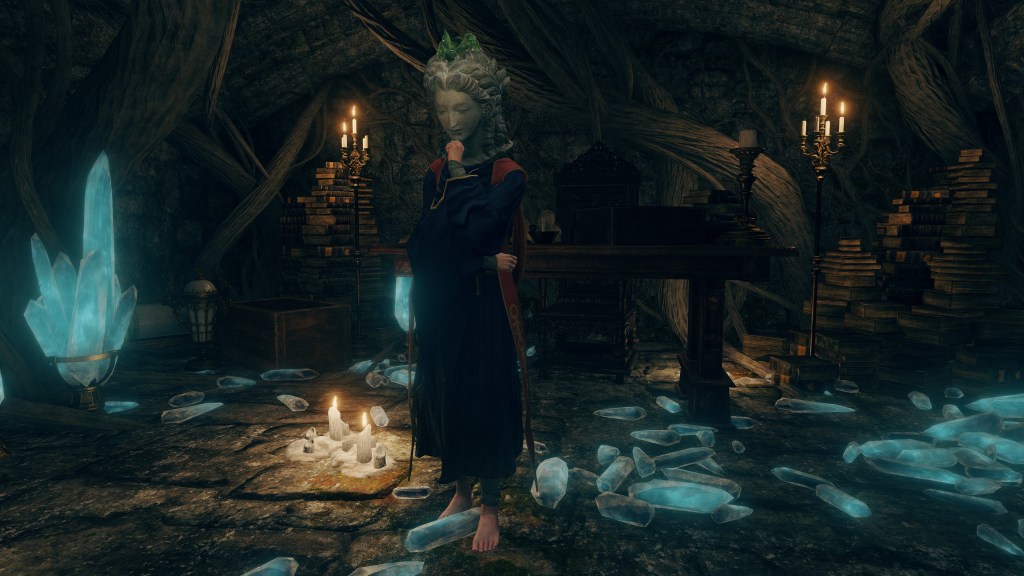

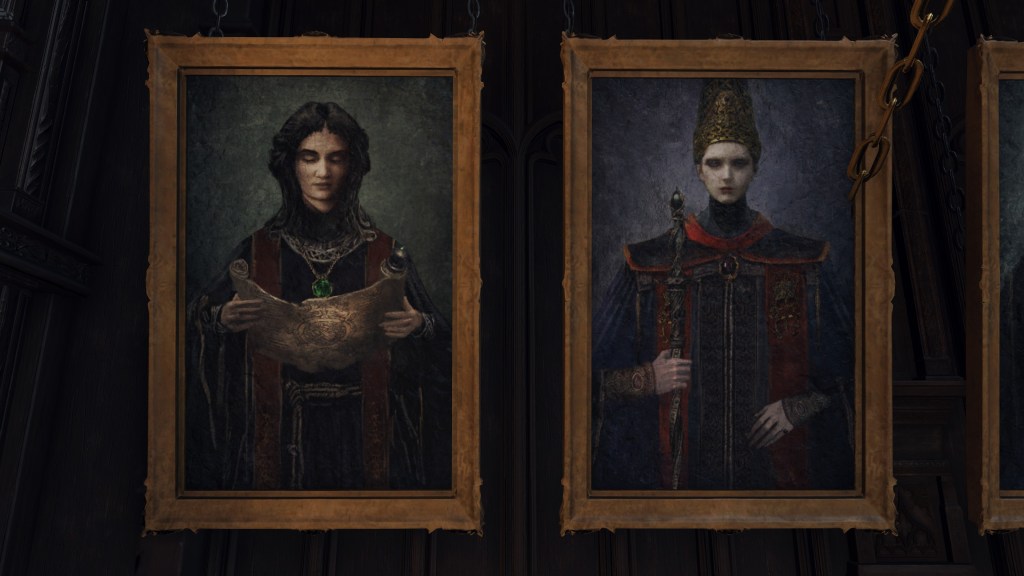

However, she was exiled from the academy. The Mass Witch, suspected of brutally killing many sorcerers… I don’t believe it at all. A lovely woman like that can’t have done such a thing.
Talisman modeled on the first nightmare of the academy called a sorcerer ball.
Greatly boosts the might of sorceries.
Brightstone sorcery has a taboo called the primeval flow. It gathers sorcerers and makes them into a kind of star. With the primeval flow, this is a means of research.
This woman is the Mass Witch. Absorbed in primeval flow ideology, innumerable sorcerers were done in by her hand. It was the worst disaster in the history of the Academy of Raya Lucaria.
Sellen’s only saving grace is that she caught the eye of Seluvis, the Carian preceptor helping her relocate to Limgrave following her exile. Perhaps he heard discourse surrounding her amongst the Carians, but he clearly impressed that the witch needed to go into hiding if she ever hoped to see her research finished. In truth, Sellen proved herself too resourceful. The number killed before she got caught made her a more palpable threat to Caria, especially given that she wore her misgivings on her sleeve. What was to stop this woman with a grudge from plotting something in the future? She might well succeed if left to her own devices. To assuage the royalty’s ongoing fears before they decide to sic an assassin on her, it was critical that the Graven Witch lay low for the time being. Sellen cooperated with Seluvis, though her reaction to seeing his message indicates that it was a less-than-pleasant encounter for a negotiation. As a result, she continues to do favors for the man while he keeps tabs on her. Becoming the pawn of a servant to Caria must be humiliating for Sellen, but it lets her bade time for revenge.
A brightstone sorcerer called Sellen should be staying in the land of Limgrave. It is because when that one was exiled from the academy, I took care of her. I requested the matter be investigated since before.
Despite the Graven Witch’s exile, however, it was impossible for the royal family to put the genie back in the bottle. We can encounter a number of graven schools across the Lands Between, each tracing to independent sorcerers exploring her same method. Some have been so brazen as to attempt the practice under the academy’s nose. Certain sorcerers have brought living jars to a shadowy classroom. Behind closed doors, we find the floor littered with not just them, but also the bodies of cuckoos and piles of human bones. The bone piles especially congregate around the heap of crystal at the back of the building, a blatant attempt to combine man with glintstone. A group have been surreptitiously studying ways to recreate Sellen’s success; evidently, they relied on both the long dead in a graveyard and the living around them to avoid notice. A separate student has realized the end product, a ball of sorcerers immersed in crystals within a tower reached from the Church of the Cuckoo’s upper stratum — Sellen’s portrait hung above the doorway. The witch has undoubtedly left a legacy at her alma mater.
Naturally, most inspired by Sellen prefer to practice their primeval sorcery in obscurity, far from the watchful eyes of the authorities. The graven schools are normally seen on the outskirts of civilization, typically sourcing their materials from the dead in the area. Even in cases where they do seem to use the living, the creators still choose to operate away from the community. This includes places far beyond Liurnia, Sellia in particular attracting a sorcerer who subsequently experimented on fellow tourists in the valley just around the corner from town; a sorcerer ball sits in front of the massive crystal formation at the back of the escarpment. Even accounting for Caria’s influence over the sorcery town, it was impractical for Rennala to enforce this ban everywhere at all times. Malcontents inevitably slipped through the cracks. However, it had arguably already fulfilled its purpose, helping eject the queen’s strongest opposition and solidifying her position in society. Through law enforced by Caria’s sword, she suppressed any chance of rebellion for the foreseeable future.

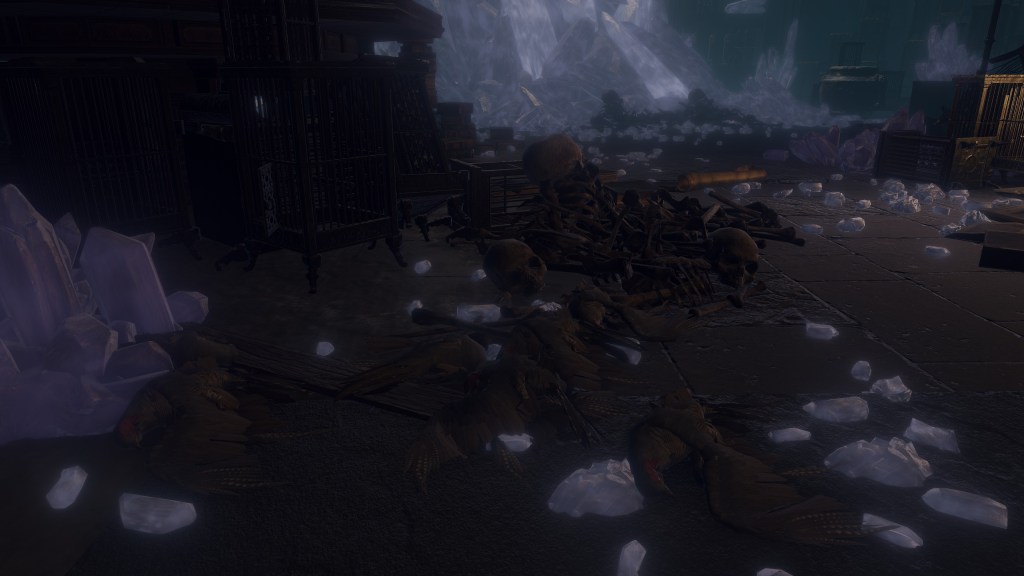


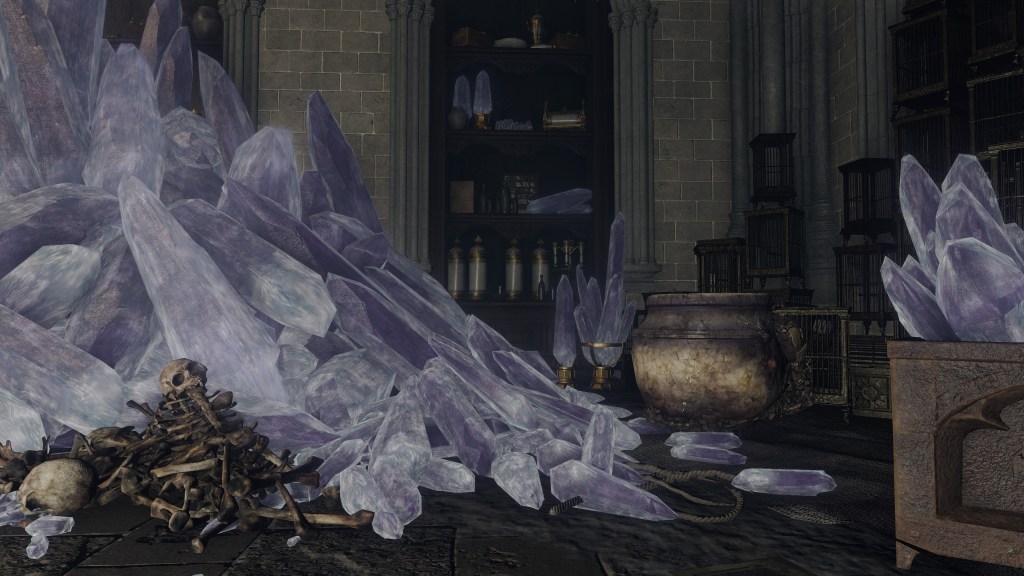
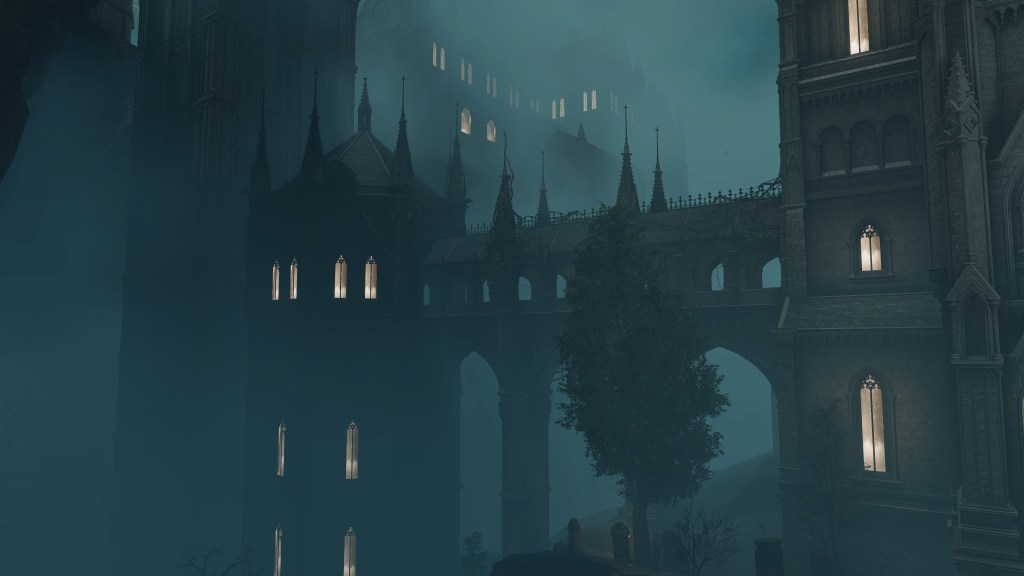

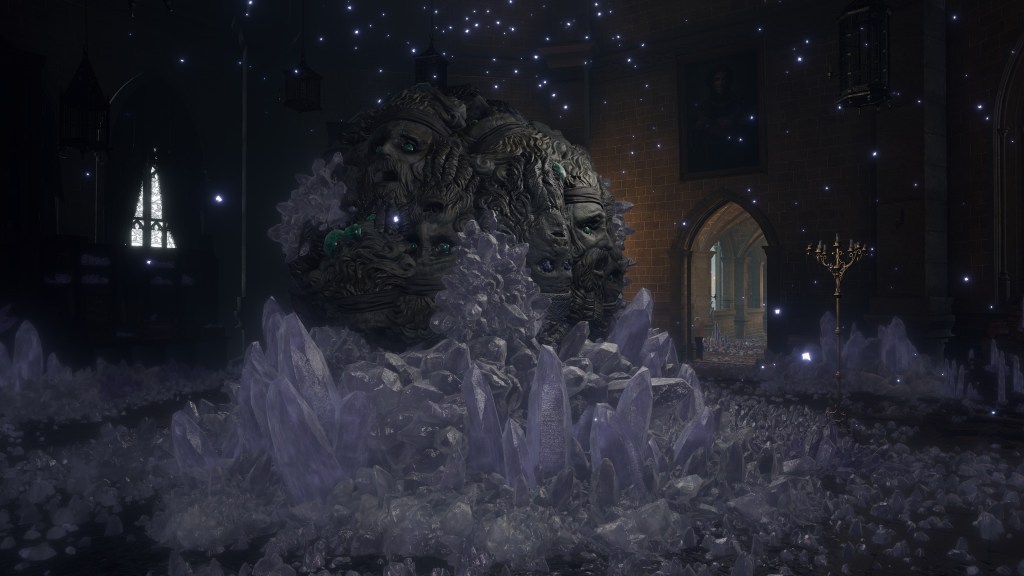
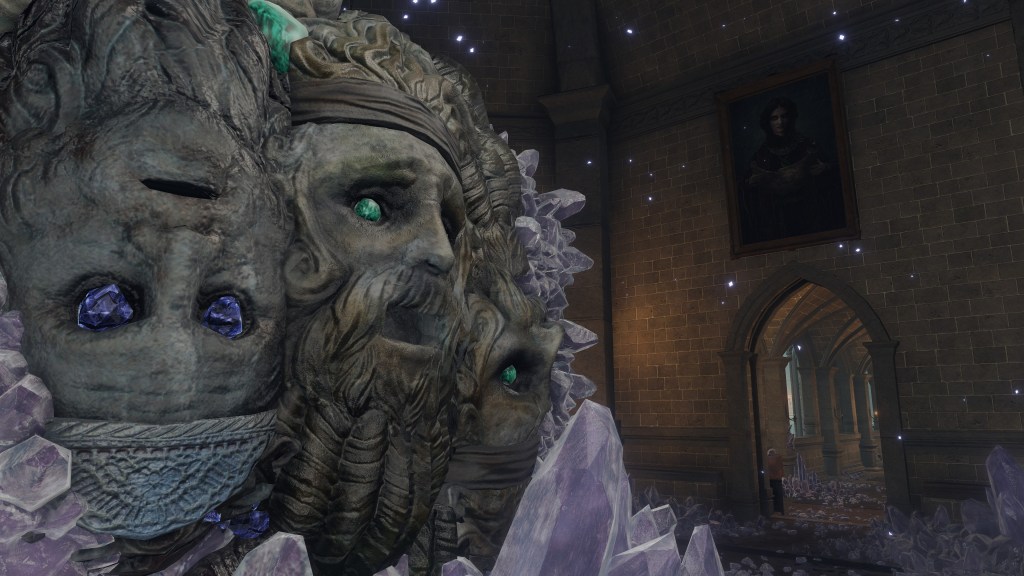

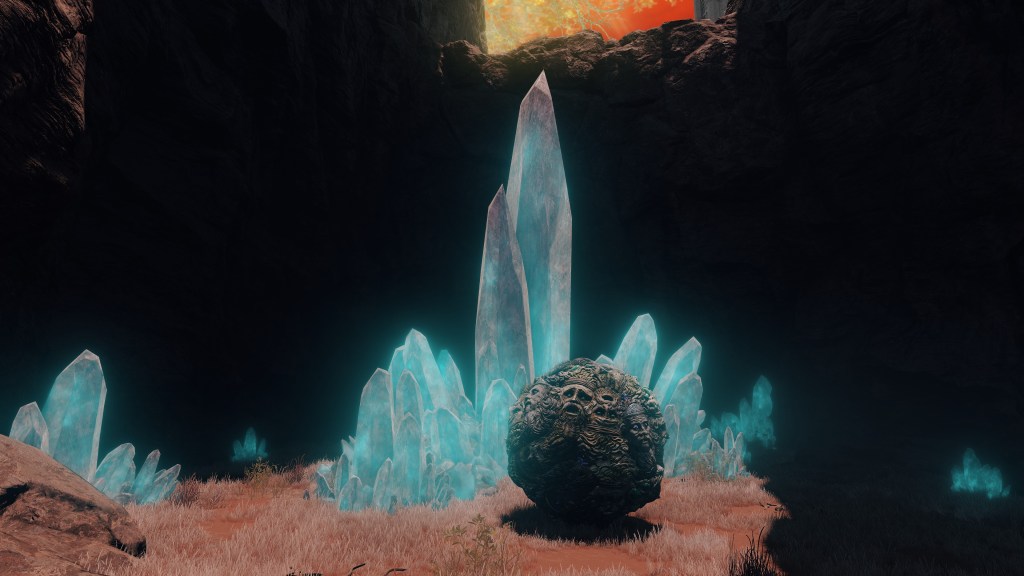

Icy Turn of Face
While the Full Moon Witch was winning enough popularity to hold her coalition together, there does appear to have been some sort of turmoil at home. Despite Renna’s lasting presence in the Three Sisters, the sister herself is strangely absent. No one has taken over her tower, yet she is the only one of the three we can never meet in person. The description to the Carian Filigreed Crest confirms that Rennala’s daughter, Ranni, is the only princess left as of the present day. This implies that Renna is either dead or otherwise no longer part of the royal family. Rellana is currently in the Realm of Shadow where she has remained for some time, so where has the queen’s other sister gone to similarly disappear off the map? In all likelihood, the lack of further reference to Renna is because she is another absent character: the snowy crone.
This “snow witch” (雪魔女) is Ranni’s teacher and practitioner of cold sorcery, the frostbite inflicted befitting her epithet. When the apprentice later loses her body, she installs her soul in a marionette made to resemble her master, dressed in white robes with a stereotypical witch’s hat. The pointed headwear denotes, in fact, the sorcerer’s heresy according to its description, which justifies Ranni keeping her as a “secret” mentor. Nonetheless, how does a heretical witch come into contact with a Carian princess, whom item descriptions clarify was still a child when she was first taught? Even more peculiar, the snow witch derives her sorcery from the cold of a dark moon, which her student can conjure no different from her mother. This insinuates some connection to Caria, and the obvious answer would be that she is the missing third sister, the only one of the three to otherwise not be associated with a moon.
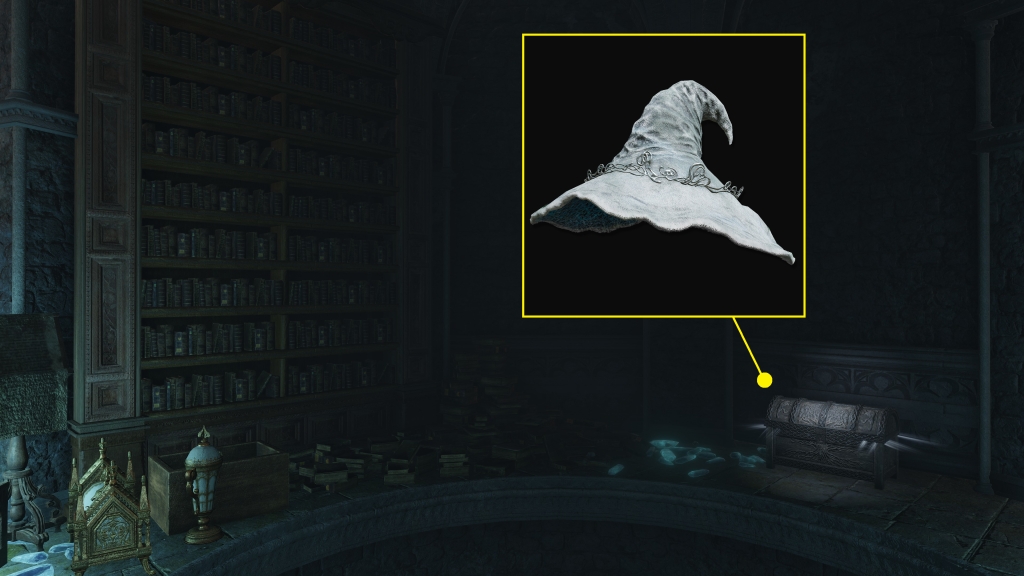
Cold and frozen witch’s hat. Pointy hat that denotes a heretical sorcerer. Enhances chill sorcery.
It is the apparel of an old snow witch whom the child Ranni met in the depths of the forest and learned cold sorcery from, and it is said that she became the model of the doll that harbors her soul.
The old witch became Ranni’s secret master.
Sorcery that serves as the symbol of the Caria Queen. One of the “legendary sorceries”.
Calls a cold dark moon to oneself and directs it at the enemy. The dark moon nullifies all sorcery it touches and temporarily lowers the magic cut rate of those hit.
The moon the very young Ranni met, led by the hand of her mother Rennala. It was a cold, dark, arcane moon.
There are plenty of hints to this connection, even ignoring the familiarity with moon magic. Ranni uses the name Renna when first introducing herself to outsiders like us — what better identity to use as a public persona than the teacher you dress as? To that point, the snow witch’s apparel is stored in Renna’s Rise, the chest shoved in a random corner rather than at the top like those in the other towers. This suggests that it was like the rest of the princess’ belongings inside the building, a spare set of clothes she could pick out when she inevitably descended from her secluded research on high. Finally, there is the snow witch’s location when she became Ranni’s teacher. Rennala’s daughter met the old crone in forest depths, presumably at the same place that the very young girl had first met her dark moon. And when it comes to places with forests, we witness both full and dark moons in the sky above the Moonlight Altar. We can even pinpoint the specific location of their encounter.
Small forests and groves dot the Altar west of the moon worshipers’ ruins, especially beneath the clifftops those ruins rest upon. And nestled in a small wood at the back of the mesa, farthest removed from civilization, hides Chelona’s Rise. This sorcerer’s English name derives from Greek to mean tortoise, which fits with our need to find three large turtle spirits across the area in order to break the seal on the sorcerer’s tower. However, the Japanese name is more accurately rendered as “Hierona” (ヒエロナ) in likely reference to Hieron, (ヒエロン) an ancient city of the western Anatolian region similarly called Caria (カリア) as well as general ancient Greek term for a temple or sacred space — nothing more appropriate for someone living at the Moonlight Altar. But whether the person is a moon noble or ambitious commoner, the tower itself appears to carry on the snow witch’s research.
This isn’t because it has glowing blue flowers leading up to the area like at the Carian Study Hall and the Three Sisters; the same kind of flora precedes Testu’s Rise as well, among others. Neither is this due to the tower collecting mostly glintstone for experimentation like at Renna’s Rise; the flames aren’t of the magical variety like typical Carian property. Rather, it is because the top of the tower stores the text to Ranni’s Dark Moon, a sorcery which must originate with her teacher. Chelona evidently retrieved the art in Renna’s wake, building a tower in the area for the purposes of replicating the snow witch’s research — resulting in her tracing the princess’ steps from her time at the Three Sisters. The implication would be that this is the deep forest where the witch operated during Ranni’s youth, living out in the rural outskirts of the Carians’ second home, secluded from but still accessible to her own clan. Now that she has trained her niece and disappeared, others like Chelona have tried picking up the pieces.

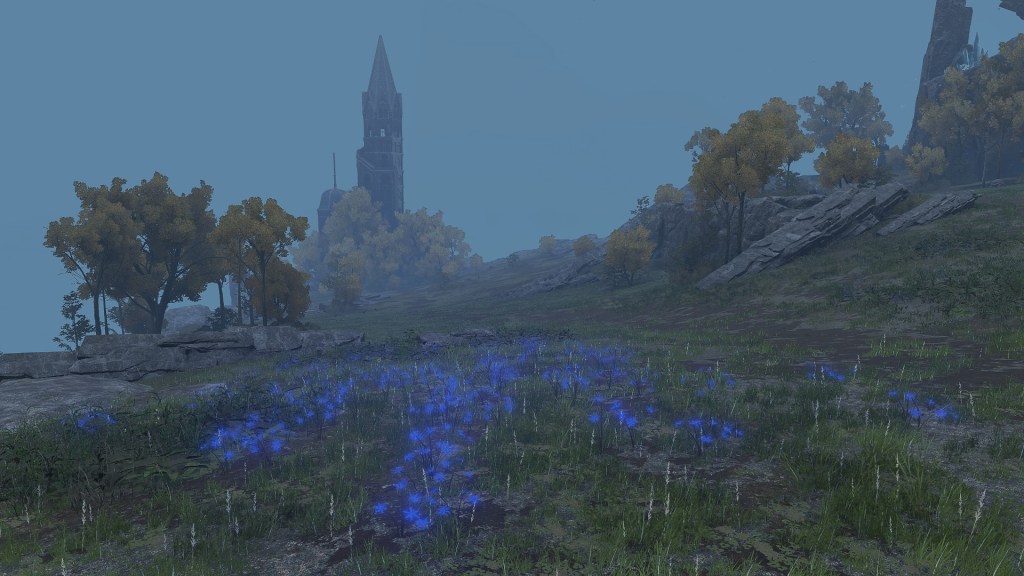


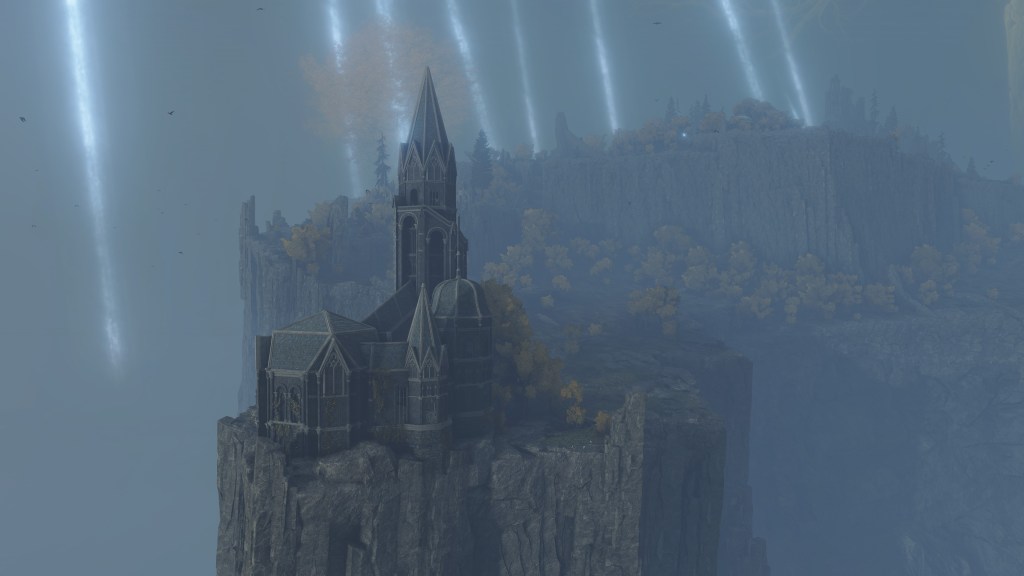


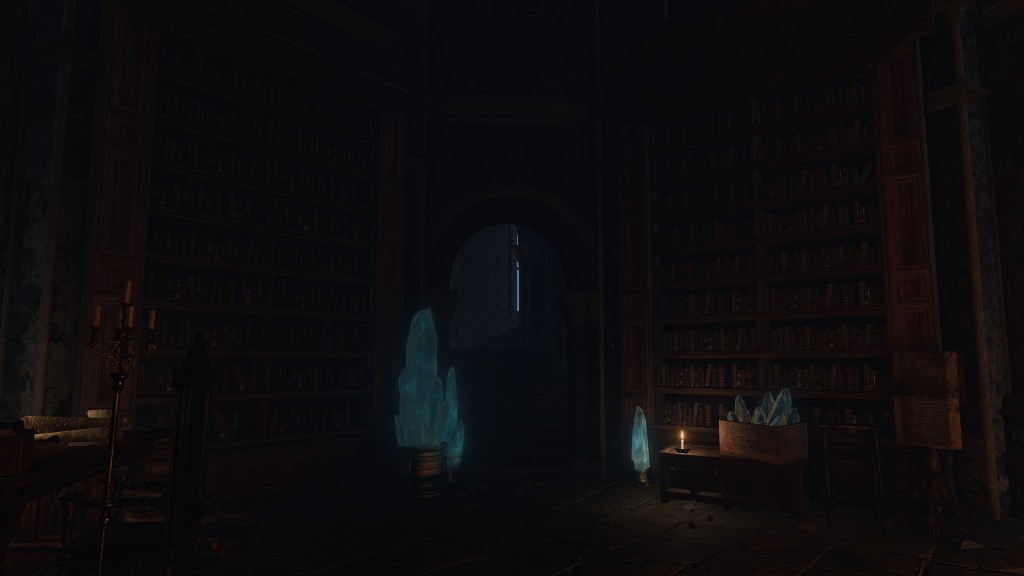
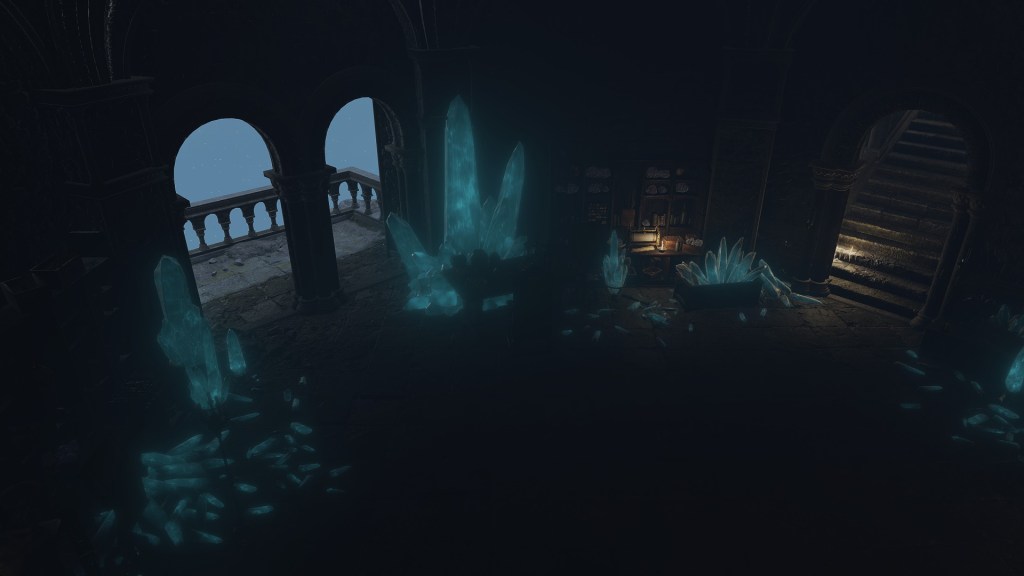

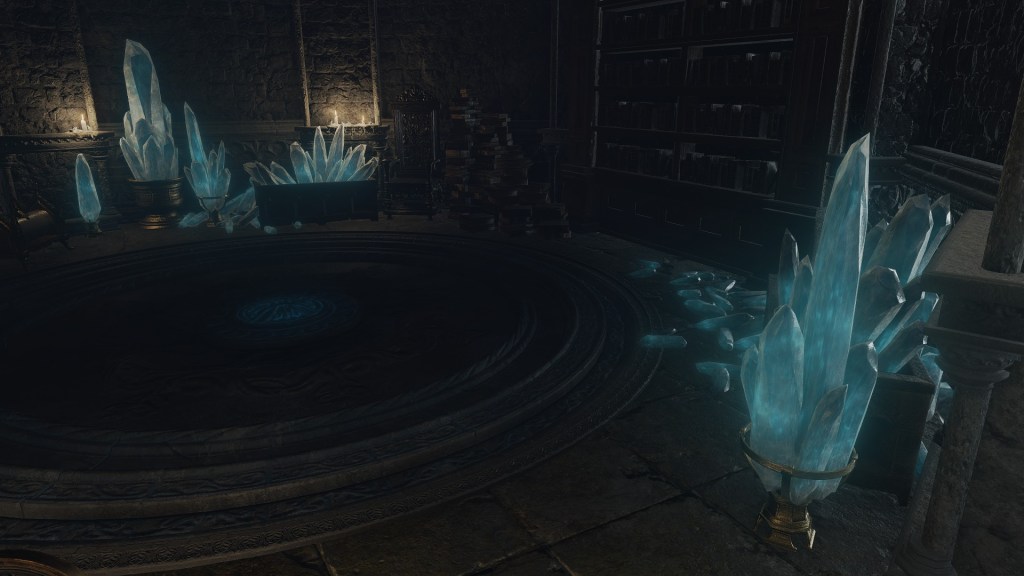
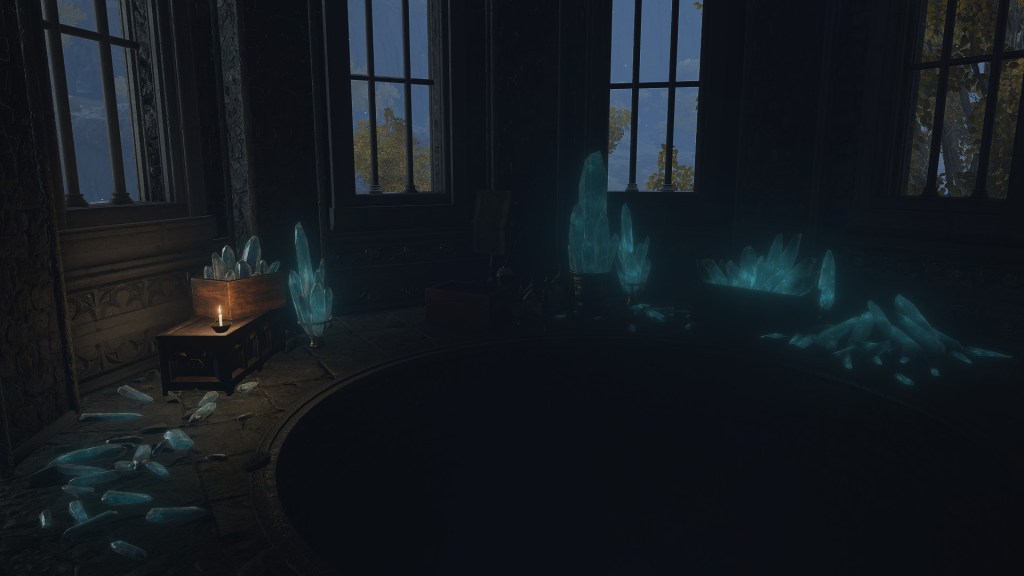
With all this established, Renna and the snow witch are clearly one and the same. This reveals much about her relationship with Rennala and Rellana. For one, item descriptions repeatedly note how the dark moon witch is physically aged, making her significantly older than her two sisters — a humorous allusion to the Neopagan Triple Goddess, whose three aspects aligned with different moon phases are defined as the Maiden, the Mother, and the Crone. Parallels aside, her many years on this earth before the twins might explain why the three’s parents seem to have no relevance in their lives during their rise to prominence — they themselves were of advanced age when adding two more to the family, thereby possibly perishing of natural causes before their children had achieved much of significance as royalty. Regardless, it positions Renna as the eldest, and yet her later independent streak still didn’t preclude her earlier subordination to Rennala and her full moon. Seniority notwithstanding, Renna had no interest in ruling a nation, so let the middle sister take the lead.
This doesn’t even touch on her experience with the dark moon. Despite the name, the chilling heavenly body is not a new moon or a waning crescent moon; the crescent moon shape is used to represent the Queen’s symbol. Instead, the dark moon is presented as identical to the full moon, only a darker shade of blue. It is still a separate star in the sky, remaining almost hidden from the Moonlit Altar compared to its brighter counterpart. Nonetheless, the dark body requires only slightly less intelligence to summon, making them both comparable like Rellana’s twin moons. At what point then did Renna encounter her moon? Was it after they moved to the Altar down south, or had she been supervising the other two as they wandered outside the astrologer village up north? If the latter, then Rennala’s legend appears to leave out the fact that it was all three sisters who discovered the moons while out stargazing or at least considers the other two a footnote in light of the middle sister’s rise to power.
On that note, it is possible that Renna fought alongside her sisters and the glintstone knights in the royalty’s founding. One of the sorceries she taught her student was Frozen Armament, which imbues the cold air of her dark moon in weapons like swords as depicted in the menu graphic. The description claims that the snow witch herself utilized the spell, which intimates wielding more than just a staff. Of course, she teaches Ranni this art to show why one must fear the dark moon, so it may just take that practical form because swords are so prevalent in Caria. Still, this makes it feasible for Renna to have served as a knight like Rellana, wielding her sorcery in battle. The Lazuli Conspectus have universally adopted the Ice Crest Shield derived from a Carian princess, the description not specifying which. Perhaps now they wield it thanks to Ranni, but the witch is no knight, so the practice may first originate with her teacher who earned her title combining ice with swordplay. Add to the fact that her frozen clothes remain at the Three Sisters, and we can be certain that Renna’s work wasn’t always considered heresy.

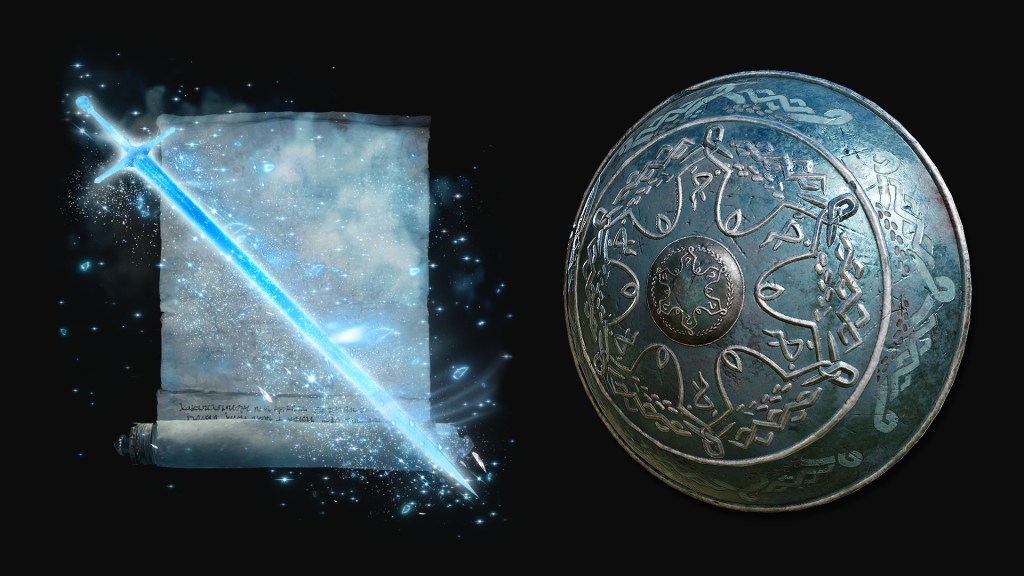

Sorcery that the old snow witch is said to have used.
Grants chill status abnormality to right-hand weapon. Can be used without stopping movement.
It is said that the old witch taught the child Ranni. Cold sorcery, and fear of the dark moon.
Small, metal round shield. Heavier than wooden shields but has high cut rates.
The ice crest originates with a princess of Caria, and though slight, it excels in magic damage cut rate and also has resistance to chill.
But now, the witch statue is missing from Chelona’s Rise, contrast to its presence within each of the Three Sisters. Did the actual sisters have a falling out, Rennala exiling the eldest to the furthest reaches of the Altar? Or was it Renna who chose to disappear into the forests and avoid dealing with her family going forward? In either scenario, something must have triggered the division, and that was most likely the dark moon which became labeled heresy. The description to Ranni’s Dark Moon highlights its arcane nature, indicating a closer link to the gods’ secrets. Perhaps in studying that cold darkness, the princess came to a terrifying realization about the moons or their place in the universe which outraged her queen. Failing to make her sisters heed her warnings, she chose solitude so as to not rock the boat. Even if they were on bad terms, the old crone hadn’t been forgotten. The three sister follies just so happen to overlook Chelona’s Rise, suggesting that the monuments were set up in this remote location to remind Renna that she would always have a place at their side if she ever came back.
Clearly, the snow witch was never once interested in abandoning her “heresy” to be accepted by family. This begs the question of what exactly her dark moon could have possibly revealed that would be so damaging to Carian interests. Considering the circumstances, it may be that the arcane moon showed Renna the fates of the three moon sisters if they continued along their current path — that the full moon which elevated Caria to its height would also be the ball and chain dragging it to its downfall. As Rennala acknowledges, fate coincided with her moon. But the description to the Carian telescope highlights how this didn’t last. The royalty’s stargazing came to be obsolete — for while they were looking up at moons, fate in the whole night sky was becoming fettered by a new Order for the Elden Ring, bathed in gold.
… Fate coincides with mine moon.
Stargazing tool of people of the Caria royal family. Parts of it were removed and taken out.
Distant scenery looks bigger.
In the Age of the Golden Tree, Carian stargazing came to be obsolete. For fate which was in the night sky was tied down by the Golden Regulation.
 Lokey Lore