
Preface
If I had to choose one word to describe the School of Mensis, it would be macabre. There is a delightful villainy to the whole faction absent from so much of Bloodborne. They certainly lend themselves to the game’s most iconic imagery, skirting the line between sterile and viscerally grotesque. But more than any other of the major players, the School feels like it is having “fun”, the energy it brings almost overshadowing the horror. Although a looming threat from early on in the plot, one can imagine that they were chosen as the antagonist for its third act because of that strong impression. Without them, the climax might have been nowhere near as bombastic after so much strenuous buildup. And for how much Mensis ties the narrative together despite little direct involvement in our adventure, I can appreciate FromSoftware making them so memorable.
A School in the Dark
Despite what the name might impress, the School of Mensis isn’t a learning institution like Byrgenwerth. Gakuha (学派) refers more to a school of thought, an academic tradition which isn’t strictly tied to a specific place. Mensis is, in other words, its own sect developing from within the Healing Church, one of the two embedded in its higher ranks alongside the Choir. How Mensis fundamentally differs from its counterpart is evident in the name. The Latin mensis means “month”, which uses the same kanji as “moon” (月) in Japanese. Factoring it all together, the School of Mensis’ learnings always relate to the moon in some way. We do acquire Moon runes in Mensis territory, whose power to bring the owner more wills left in blood of the dead reflects certain Great Ones’ responsiveness to summons. The association also brings to mind a specific Great One who exhibits that behavior: Flora, the Moon Presence. And when it comes to Flora’s past dealings, only one incident stands out.
Recall that Laurence summoned the entity to create the Hunter’s Dream, using an infant Great One to bargain. Gehrman likewise implies that the moon was “near” on the night they parted ways per their deal with Flora. Would this not be pertinent to the Healing Church’s “moon” sect? Its members are certainly trying to follow a similar path, their rituals responsible for the red moon appearing during both the Old Yharnam Incident and the present day. This was even done for similar ends. According to the Mensis Cage’s description, they wished for the bad dream associated with their name. Micolash is called the host — more broadly, the “master” or “owner” (主) — of the Nightmare of Mensis and can thereby be presumed the leading figure in the School as a whole. And during our boss fight, he appeals to Kos, praying that she will give their brains eyes to overcome their “foolishness” as beasts and join the enlightened talks of the cosmos.
As you did for Roma the half-wit, give us eyes. Give our brains eyes, and let us overcome the beast foolishness.
This line, evoking language from Iosefka’s imposter, leaves no room to doubt Mensis’ intentions. Like the Choir, they aim to become Great Ones; unlike the Choir, they commune with the past gods for enlightenment before undergoing blood evolution. The two factions are diametrically opposed methodologically, each approaching the problem the inverse of the other. While the Choir model their approach on the original work of Byrgenwerth and its successors who founded the Church, the School of Mensis instead look to Laurence specifically and his later career when he was last seen by the clergy. It is no mystery why the two factions ended up splitting the institution at the upper echelons. But Mensis’ rivalry with the Choir had most likely begun before the School had even formalized its ideology. After all, the Choir are the secret brains behind the entire hierarchy. For the Mensis faction to split off, they must have taken issue with their general administration of the Healing Church.

Consider an outsider’s perspective. Suddenly, the founders who guided the Church for decades stopped appearing in public at all, passing orders purely through intermediaries. Those intermediaries happen to be the orphans the church leaders were raising for many of those years. Not even the Vicar has any obvious contact with them, at least none that inspires confidence in leadership. Anyone with a modicum of suspicion might think this looks like a coup by the apprentices, the wise elders captured or worse. Such apprehension would, of course, be warranted. And for the high-ranking clerics regularly dealing with the orphans, skepticism was sure to grow. Maybe somewhere down the line these suspicions were ultimately confirmed — Choir members are seized and interrogated, as we can witness. Either way, the ranking clerics had enough reason to believe that the Healing Church was subverted by a group of young upstarts. And so, a plurality came together to form their own faction with the goal of steering the Church back on course.
But there was a problem: who were they to right the ship? It is telling that their leader lacks a single grey hair. Micolash isn’t from that same generation as the founders — most of those clerics had either died or turned into beasts. Their School was comprised of blood ministers who rose through the ranks when the Healing Church was at its peak, the same period that the Orphanage was established. They are older than the orphans but with a median approaching middle age at best. These weren’t individuals who were closely acquainted with Byrgenwerth’s traitors or privy to the Church’s deepest secrets. Any and all information was public record or rumor, hardly the same access the Choir had been afforded. It is therefore reasonable why they don’t give the same attention to the sky and the stars despite regarding the moon as a seminal sign. Whatever Micolash’s qualifications, his guidance wouldn’t help them recover all that knowledge hoarded by the Choir. Without entry to Upper Cathedral Ward, the faction needed to find answers elsewhere.
Unseen Underneath
As part of their formation, the School of Mensis required a base of operations. In the end, they chose Yahar’gul. The pick itself was logical. Because of the town’s relative isolation at the bottom of the valley, it was below the Upper Cathedral Ward’s notice in every sense. The “traitors” within the Healing Church could thus act with impunity. Even if the Cathedral Ward did notice resources being diverted to the place, Mensis’ actual works remained hidden and unseen. The deceitful clerics could justify their suspicious movements as making inroads with the locals for beast hunts. Yahar’gul also had means to access Pthumeru, giving Mensis the opportunity to explore the underground labyrinth for themselves — again, without the Choir’s oversight. This was the perfect setup. The only question is how they came to preside over a town traditionally wary of outsiders in the first place.
Recall that it was the city church which regulated contact with outsiders. And the School of Mensis are now in league with the kidnappers, eye collectors, and bell-ringing women who comprise that native cleric class. In that case, Mensis established their base with the local clergy’s consent. Somehow, the School convinced the native leadership to cooperate. This sounds like it might have been a herculean task, given the hidden town’s longtime seclusion. However, several circumstances were working in their favor. Among the various statues ornamenting the church facilities, one icon in particular stands out for its resemblance to Laurence — a robed man with full beard and shoulder-length hair. Perhaps it simply represents the local clerics, though we never see any with facial hair. Perhaps the School installed the figure after the two clergies bonded over mutual respect for their respective wise ancestors in faith. Whatever the case, they shared some common ground with blood and rituals. In fact, this wasn’t actually the first time that the protectionist elites had let in the Healing Church.
According to descriptions of their attire, the hunters of Yahar’gul are “in contact” (通じる) with the School of Mensis. Although implying a level of intimacy between the two parties, the wording nonetheless indicates them to be distinctly separate. This isn’t surprising, since beast hunts in Yahar’gul’s antiquated armor well predate Mensis. One of the hunters locked away in the Grand Cathedral’s dungeon wears that very attire along with the Repeating Pistol and Church Pick, meaning that the Healing Church had been operating in Yharnam’s oldest burg since its earliest days with Ludwig. However, the Yahar’gul division are now hunters in name only, for their primary duty isn’t seeking out beasts to kill but people to abduct. Their personal protective rope charms double as restraints for their captives. Their black hooded garb for stalking unsuspecting prey in the dead of night serves to whisk away their targets unidentified. And who do they do this on behalf of? Mensis. Those who had long stayed to hunt beasts in the secluded town were the perfect people to recruit as the researchers’ henchmen.



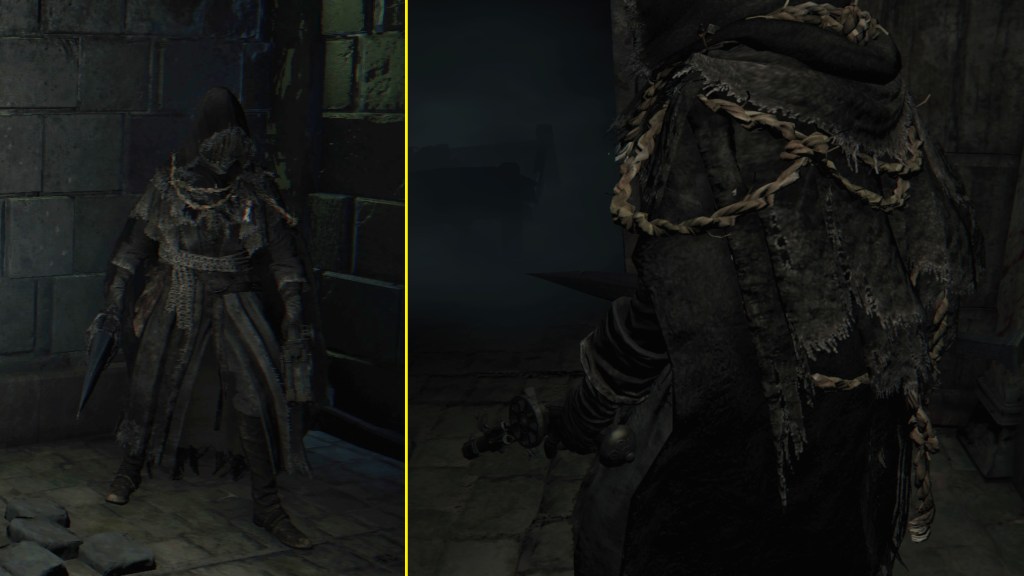
Thick black clothes that hunters of the Hidden Town wear.
They who are in contact with the “Mensis School” that presides over the Hidden Town are abductors, hunters in name only, so their garments disappear into the night.
It is a garment chiefly cognizant of physical defense power, but the entwined straw rope seems to be a certain kind of charm along with having capture uses.
Iron helmet that hunters of the Hidden Town wear.
They who are in contact with the “Mensis School” that presides over the Hidden Town are abductors, hunters in name only, so conceal their eyes beneath black hoods.
It is metal armor, unusual for hunter garments, and boosts defense effects if limited to physical attacks.
Put simply, the Healing Church already had a presence in Yahar’gul. The dissident faction just needed to convert its existing personnel to their side, which was probably easy considering how removed they were from the rest of Yharnam. Once they brought more clerics into the fold, the School could then establish deeper relations with the Yahar’gul church. Those native clergy had been welcoming hunters to deal with their beast problems since Gehrman’s heyday, so the church hunters should have been treated no different. And while there are no signs that the pale-skinned elites indulged in blood ministration, the very existence of so many Yahar’gul hunters betrays its adoption by the common citizen. The uptick in beasts necessitated closer collaboration with this foreign church offering hunting services. And when a certain faction of that Healing Church suddenly approached them with a new offer, who were they in to ignore it? Their religion had already fallen on hard times.
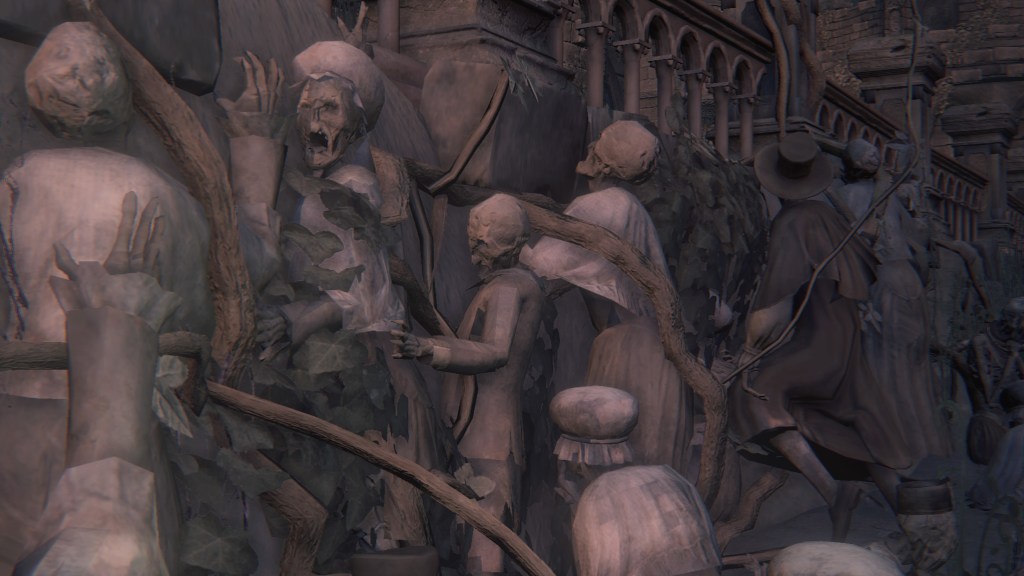
As we progress deeper into Yahar’gul, we pass throngs of petrified people, presumably the otherwise absent citizenry. Curious then that the common folk dress no different from the rest of Yharnam — the men, in fact, more resemble Willem’s manservant. Even with the local church limiting contact with outsiders, their fashion trends still bled into the culture. Only the clergy wear raggedy robes and traditional dresses reflective of their Pthumerian roots. Their old iron armor has likewise become relics for hunters to swipe. Yahar’gul was changing with the times. Indeed, fashion trends seem to coincide with a broader drift in devotion. The church’s street pulpit complex looks long neglected compared to surrounding infrastructure. The state of disrepair speaks volumes about the laity in modern Yahar’gul society: they don’t care to hear the clergy’s message. Ironically, the overbearing religious authority made the flock simply tune out the supernatural, leaving satellite facilities to become rundown as it lost effect and support.



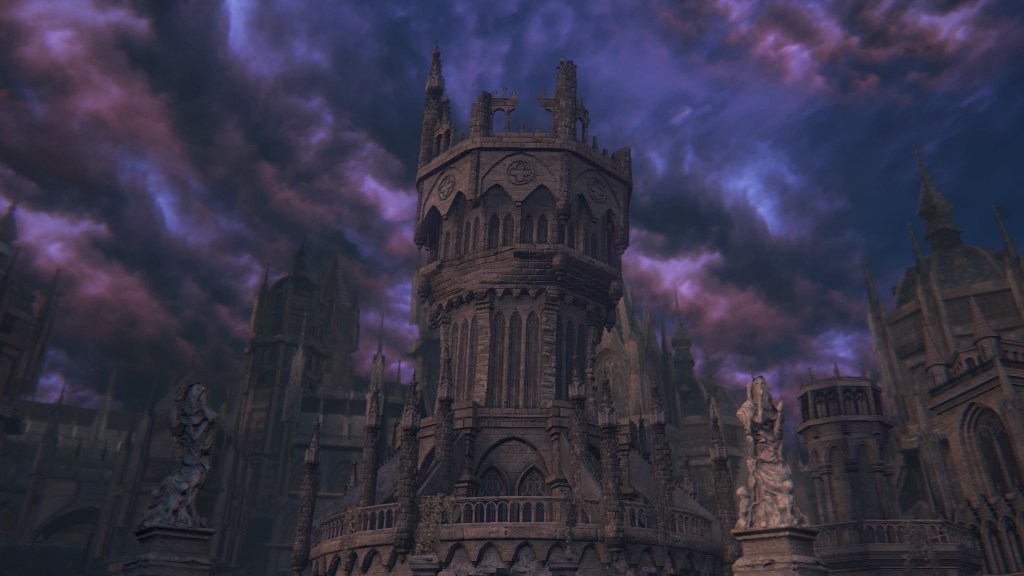

In short, the arcane arts and history which the governing church structure was so intent on preserving has been losing relevance for some time. As the years march on, their hold over the population is slipping, and everyone’s memory of the past has faded. It may be a slower decline compared to Yharnam, but it still defeats the purpose of their generations of seclusion. Even the clergy appear to be victims of this cultural drift. Never before had the Healing Church benefited from the knowledge preserved by the Yahar’gul church specifically. The image of their gods was already seen in the graveyard of the Forbidden Woods, the level of their arcane arts was much more advanced in the underground labyrinth, and the history between blood and beasts was previously documented at Cainhurst. From Willem onward, Yahar’gul was never the source. In the town’s isolation, its clergy were only marginally more aware than the average Yharnamite. The old ways they retain, like their pale skin, are merely a fragment of the Pthumerians they interacted with. They were just barely keeping the memory alive.
With all that in mind, it is no wonder that the church in Yahar’gul joined hands with the School of Mensis. Seeing their decline, the clergy would be liable to taking radical steps. If those outsiders who have long assisted them with the growing beast epidemic spoke true, then they promised to recover much of that rich but forgotten history and culture with their research. Why wouldn’t the churchmen want to share in the fruits of such labor? To that ruling elite, this was their chance to reverse course for Yahar’gul and, more importantly, themselves. It didn’t matter if this was some dissident faction — when did they pay mind to the petty politics of foreigners? The salvation of their insular church was of sole significance. Even its laity, lapsing in the faith as they had, was expendable apropos to that goal. And so, they gave safe harbor to this School and assisted in their research to transcending the earthly plane.
Swept Up in the Sands
Now that they acquired a base to operate, the insurgent scholar plotted out their course. Because they held no irrefutable evidence of the treachery in Upper Cathedral Ward, the newly formed School of Mensis opted not to engage in a full-scale civil war. This was ultimately a split amongst the management, and the Choir had the upper hand with credibility. Mensis was sure to be outnumbered if the faction drew clear lines out in the open. Instead, they worked to subtly undermine the orphans as they were busy handling all the necessary affairs to run the Church, recruiting parties while advancing their own studies. Chiefly, those studies concerned the “right” way to go about transcendence which the Choir had, until that point, failed to divine. The entire Healing Church primarily explores blood evolution, so that informed the School where not to look. Still, they couldn’t just investigate blind.
By this point, Micolash and ilk were looking to Laurence for true guidance. He was the leader amongst the church founders and the only member to establish a dialogue with the gods of the cosmos. The red moon was indisputable proof of his success, so it is only natural that this School of Mensis try to replicate it. Depending on their knowledge, it is possible that Laurence’s absence even signaled his success in transcending the mortal coil. This reveals another problem with the School of Mensis’ fragmentary information: they had to piece together what Laurence had discovered, and how. Worse still, they had few eyewitnesses to work with. Developing their philosophy and methodology had thus probably been a slow-going process. What they did know was that Laurence tried to find answers on earth, in blood, which gave rise to all manner of beasts. And luckily for them, they had a prior case for comparison.
In contrast to the Choir’s focus on Isz, the School of Mensis turns its attention to Loran. Aside from their nightmare coalescing portions of the desert nation and its inhabitants, Mensis shares its predilection for electric bolts. We can acquire the Tiny Tonitrus from a chest outside the tortured Choir member’s holding cell in Yahar’gul, its larger counterpart looted off a corpse in one of the street corners outside. It is possible that these are simply Archibald’s inventions, adopted under the influence of the town clergy; like a number of corpses in Mensis territory, the kidnappers do possess bolt paper, and have since at least the time that Laurence and Rom were both exploring the labyrinth based on our experience in the Chalice Dungeons. The paper might be one remnant of Pthumeru culture the historic clergy preserved. However, if the kidnappers’ item did influence Mensis, it was only for putting them on the scent.
Two Yahar’gul hunters are stationed guard at the border between the Grand Cathedral and the hidden old church to Yahar’gul. One loves long range, wielding both Ludwig’s Rifle and the Rifle Spear, while the other enjoys melee, armed with a wooden shield and Tonitrus. These total opposites complement each other well in their shared duty, and this isn’t the last time. We encounter three more in the Yahar’gul church proper after the red moon appears, with just as much diversity between them. The first wields a Tiny Tonitrus along with the threaded cane and flamesprayer, evidently concerned with maintaining his humanity purged of crude beastliness — the reason can be surmised from the skull of madman’s knowledge looted from his corpse. The second has a fetish for heavy firepower, utilizing the Rifle Spear along with the cumbersome cannon. The last has all but fully embraced the beast; stripped down to his skivvies, we can only identify his affiliation thanks to keeping the iron helm, otherwise relying on a beast claw and Clawmark rune inviting him to keep tearing into that warm blood.

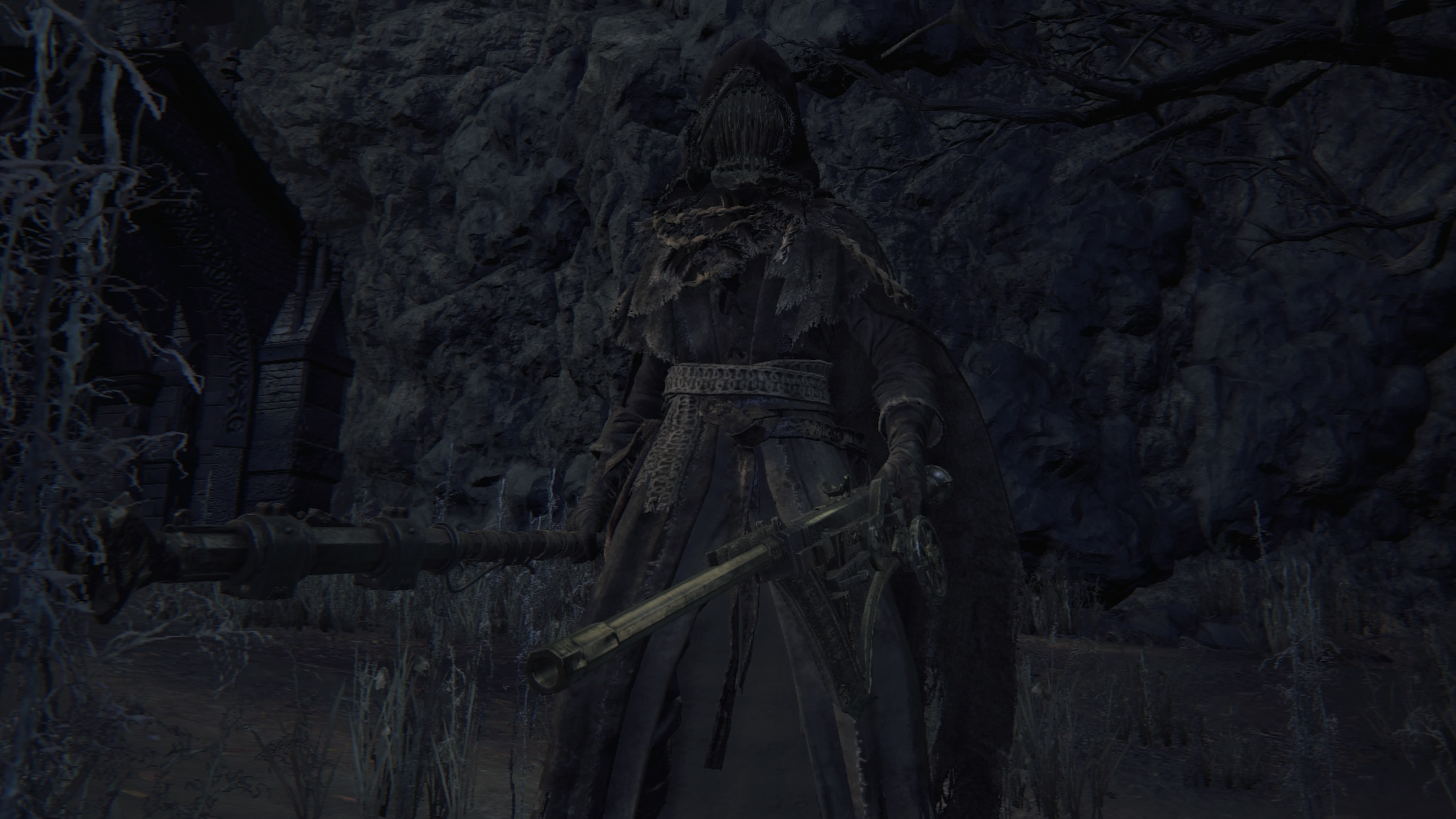


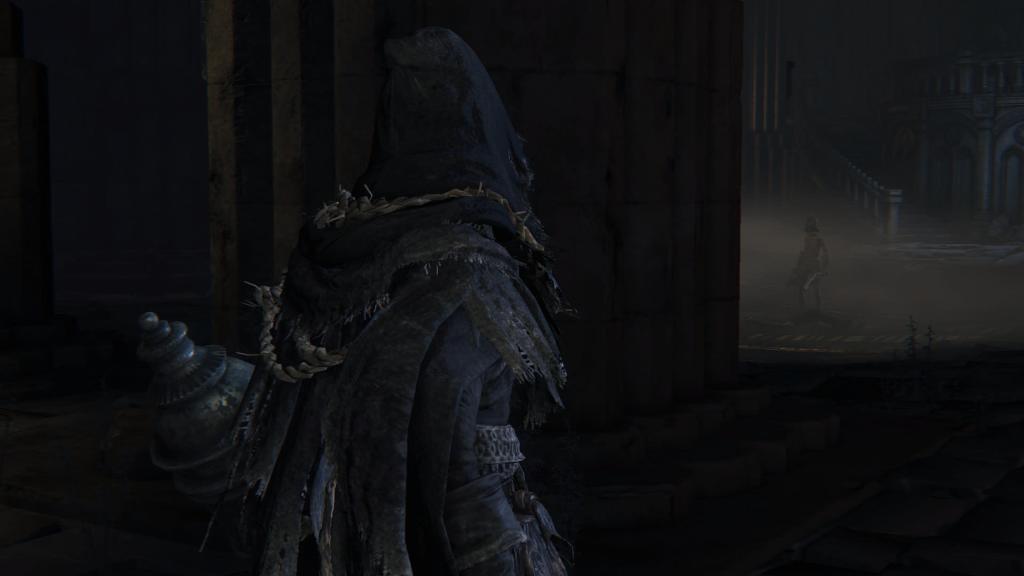
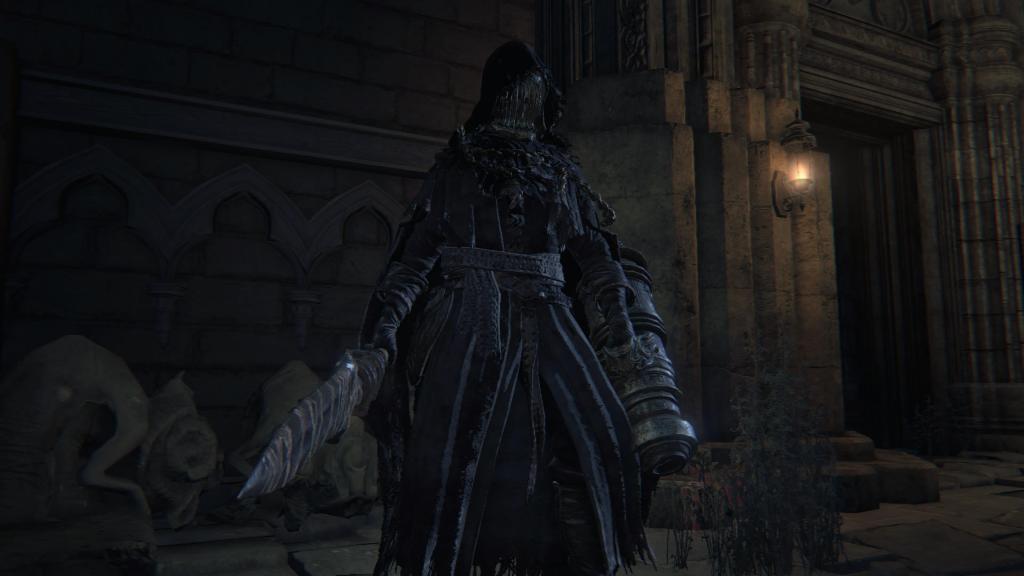

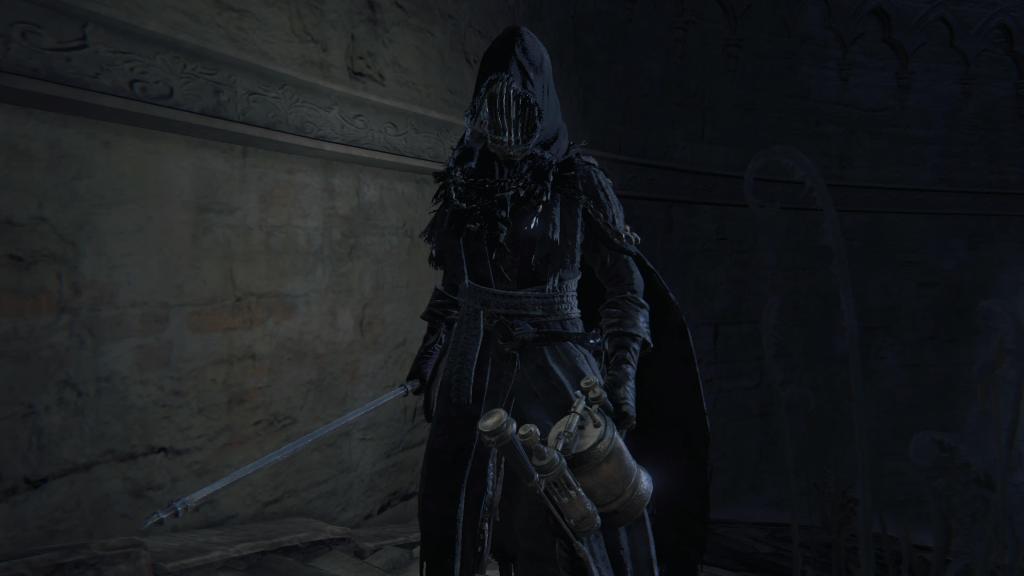

Despite these hunters’ individual dispositions, there is still an obvious trend. Each choice in main-hand weapon or hunter tool is invariably associated with Loran. Two out of three in the latter group likewise demonstrate some affinity for beasts. Add in the fact that the corpse in Yahar’gul with another Tonitrus is a hunter model, and it is clear that the town’s hunters have been influenced by the lost desert nation. But this wasn’t necessarily always the case, as shown by the Church Workshop-affiliated hunter imprisoned in the Grand Cathedral’s dungeon so long ago. Therefore, these influences are most likely a product of their more recent history with Mensis. In that case, the School must have acquired these Loran interests independent of their headquarters in Yharnam’s hidden town. The local clergy were, at most, a jumping-off point — they discovered the full marvels of the ancient land’s past through their own experience in the underground ruins.
With that, the School of Mensis’ development becomes plain as day. Their later Nightmare used parts of Loran as the foundation because the country was the general basis for their theories. As to why they were fixated on this country in particular, it is possible that the renegades were unable to find their way to the Isz ruins. More likely, however, they simply never bothered to delve deeper. The similarity between “Lauran” (ローラン) and “Laurence” (ローレンス) is no accident. FromSoftware had probably chosen the ruins’ name because the place reflects the Byrgenwerth traitor’s work in Yharnam — item descriptions even infer how its ultimate fate portends the comparable diseased land above ground. Such parallels with blood and beasts were sure to be apparent to any Mensis dungeon diver. And with Laurence as their guidepost, the School would naturally view Loran as a model to retrace his steps. Uncovering the happenings there became synonymous with revealing the secrets of the first Vicar.
This fixation on Laurence and Loran is why we can find a cleric corpse with the Clockwise Metamorphosis rune in the Nightmare Frontier. They also dreamed of man’s evolution via blood and realized that mutation from the beast scourge was a base perversion of that. Still, it was the first step, as it did make them immortal beings like they had hoped. They just needed to retain their sanity with their renewed vitality, to uplift their thoughts to the higher plane. And their answer to that problem was evidenced in the Heir rune acquired from a corpse in Yahar’gul. As they dig their nails into blood and flesh like beasts, the so-called heir draws out more wills from the victim — becoming prone to the dead’s thoughts and feelings. From this, one might derive that blood holds the key to inheriting a greater psyche, and it is by way of the beast. It was these kinds of observations which led to Mensis departing once again from the Choir. They weren’t concerned with refining blood treatment to filter out the beast. Rather, the School seemed to believe the beast to be an essential stage in the evolution to Great One status.
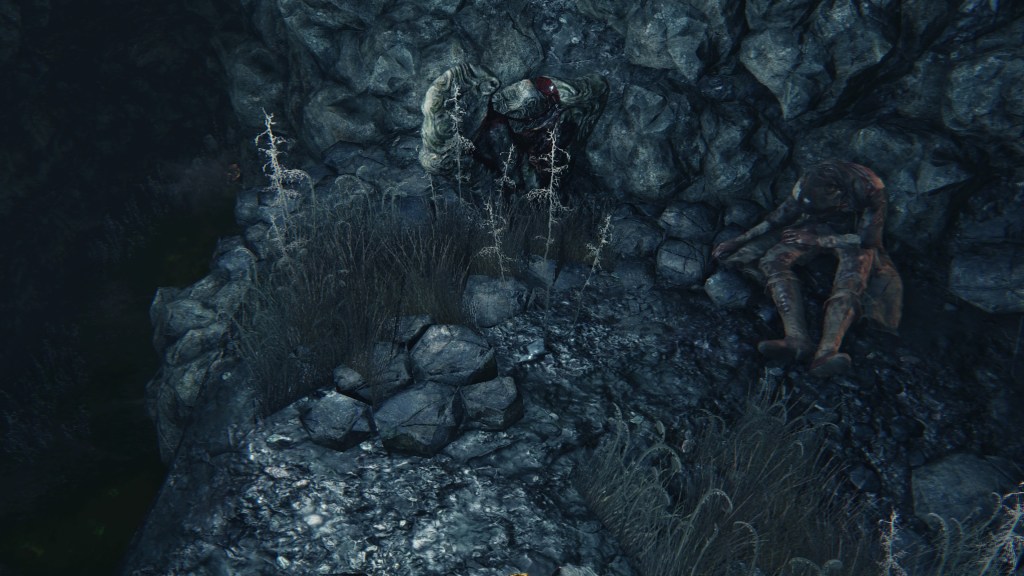
Such a conclusion isn’t without merit. If a man can transcend his thinking, then so can a beast lowlier than him, theoretically. The Choir proved potential in that regard with their own experiments. More relevant, certain beasts in Yharnam had shown more human-like behavior throughout the Healing Church’s history. For those specifically investigating Loran, its clerics demonstrate the greatest potential in spite of their physical degeneration, making them an excellent example. Cut content even included priests of Loran operating out of the same building in the Nightmare of Mensis as Micolash. The fact that FromSoftware had even considered placing the enemies there, implicitly cooperating with the School, reinforces the importance of their intelligence. Their inclusion might have been dropped partially due to circumstances behind their recruitment — these particular beast clergy in all likelihood reborn by the Nightmare the same as the Loran silver beasts. Still, witnessing how these beasts behave firsthand would inspire consideration for the role of beasthood in man’s evolution.
An unused boss further reveals plans for a Great One Beast (大いなる上位者の獣) named “Fauna, Silver Beast” (銀の獣 ファウナ) who utilizes bolts like darkbeasts and the existing silver beasts. Said silver beasts are internally dubbed “Fauna’s kin” (ファウナの眷属) or “Silver Beast’s kin” (銀の獣の眷属) and so were probably conceived as the beast equivalent to Rom’s spider children. With all the men-turned-beasts in Loran, it is feasible for one to subsequently achieve at least partial transcendence, becoming the ultimate darkbeast. And in the case of Fauna, one can see the diametric link with Flora, the all-too-familiar phrase “flora and fauna” contrasting the two Great Ones’ respective origins — Flora in Isz, associated with plants and the heavens, and Fauna in Loran, associated with beasts and the earth. Put simply, the Great One Beast would have likely featured in the Loran dungeons as proof of the concept.

Of course, outside the silver beasts, there is no hint to Fauna’s existence within the Loran ruins in the final game. Perhaps the School of Mensis never crossed paths with a Great One that any onlooker would identify as also a beast. If nothing else, the Great One Beast confirms that the developers were exploring those same possibilities as Mensis. And whether or not the School encountered a beast who reached a higher plane of thought, existing enemies in those sandy ruins gave ample signs for the supposition. The Choir didn’t need Ebrietas to confirm their theories, and neither did Mensis need Fauna to affirm theirs. Loran and Laurence already showed them that beasthood was the starting point. The question for the renegade scholars was how to get across the finish line from there.
Back to Class
With Loran as the road and Laurence the north star, Micolash and his crew of rebels began to form the Mensis school of arcane theory. However, this could not resolve the underlying issue of succession. There was only so much of Laurence’s secret research they could reconstruct from ancient Loran. If these latecomers wanted to claim themselves the true heirs to the church founders’ legacy, they needed to draw upon more than their scholarship in Yharnam. After all, their lineage of thought traces back to their time with Willem at Byrgenwerth. How then could the burgeoning School of Mensis one-up the “illegitimate” Choir, who inherited their knowledge directly from the students of Byrgenwerth? By becoming students themselves. Mensis members each wear the Byrgenwerth uniform despite their affiliation, presumably for the same reasons that Choir members don their masks. Indeed, what better way to demonstrate their bonafides than showcasing proof of walking in the founders’ same footsteps? And with this comes the implication that the School of Mensis attended Willem’s college.

Some fans might argue that last point, citing the restrictions to the Forbidden Woods where the schoolhouse is located. However, the prohibition giving the woods its name wouldn’t be instituted until after Mensis summoned the red moon for themselves; regardless, we encounter a kidnapper in the forest village, so Yahar’gul has its ways of circumventing the Church’s bans. Even if those high-ranking clerics were somehow not privy to the password, they could have definitely gotten past the gatekeeper. Given that the Lecture Building has been displaced to their Nightmare, Micolash and fellows must have visited the remote campus at least once. As to getting their hands on a uniform, the chest in Willem’s abode proves that the school had spares. All that it would require is to swipe the clothing, formally joining the student body not necessary. Mensis scholars therefore had every means to witness Byrgenwerth firsthand, learning from the fallout of the university’s lectures if not the classes themselves.
This includes eyewitness accounts. Although dressed the part of a Mensis scholar, Damian employs all the arcane arts available to us. The hunter has clearly immersed himself deep into the divine mysteries, more than most. His Loch Shield implicates him as an Isz tomb prospector once upon a time, giving the man plenty of opportunity to study the arcane firsthand. But such prospectors were typically members of the Choir, and Damian owns their characteristic bell. Yet he is also a wrinkly old man, far too old for the orphans raised into this life of arcane research. Why then bear the traits of a Choir member? Because they inherit their knowledge and methods from Byrgenwerth — Damian is most likely one of Willem’s students, part of the faction who stayed behind to focus on the study of kin seen in Isz. That “purity” of thought over beasts and blood explains why he utilizes the threaded cane symbolizing the owner’s humanity. The shield and bell were either borrowed by the Healing Church or created independently. And the arcane arts are proof of the elder’s long loyalty to his wise provost.
However, this also means that Damian oversaw his school’s long and precipitous decline. While word of Laurence’s apparent inroads with blood treatment spread amongst the student body, Byrgenwerth had stagnated. The mad dash to replicate the Healing Church’s results went nowhere, only driving Damian’s classmates into further frenzy. Some might have seen their ultimate fate as proof that Willem was right about the blood, but others were liable to view the opposite: their mistake was not straying far enough. They acted too much within the bounds of their schoolhouse instead of breaking away entirely as the so-called traitors had. To these students, Laurence was right: their teacher was a shackle.
As one of the few survivors still sane, Damian appears to be one such disillusioned student. Now that he has joined up with Laurence’s supposed successors, the codger has made it his mission to snip Willem’s ideological lineage in the bud. Chiefly, this has concerned hunting the Great One driving Byrgenwerth and the Choir’s obsession with kin. The Mensis hunter can be summoned to help battle Ebrietas at the Upper Cathedral Ward’s secret altar — his sign is even present for fighting the Star Maiden in the Isz dungeon, before she had come above ground. Evidently, Damian has been pursuing Willem’s long-sought “phantom” for quite a while. He can likewise help defeat Yurie and Rom as they inhibit Mensis’ plans at Byrgenwerth, so this is part of a general opposition to all things aligned with Willem. For so long, he lived up to his Greek name meaning “subdue”, suppressing vulgar beasts and blood from his work. But after extensive research, he just wants to keep anyone else from chasing ghosts, wasting their life as he did.
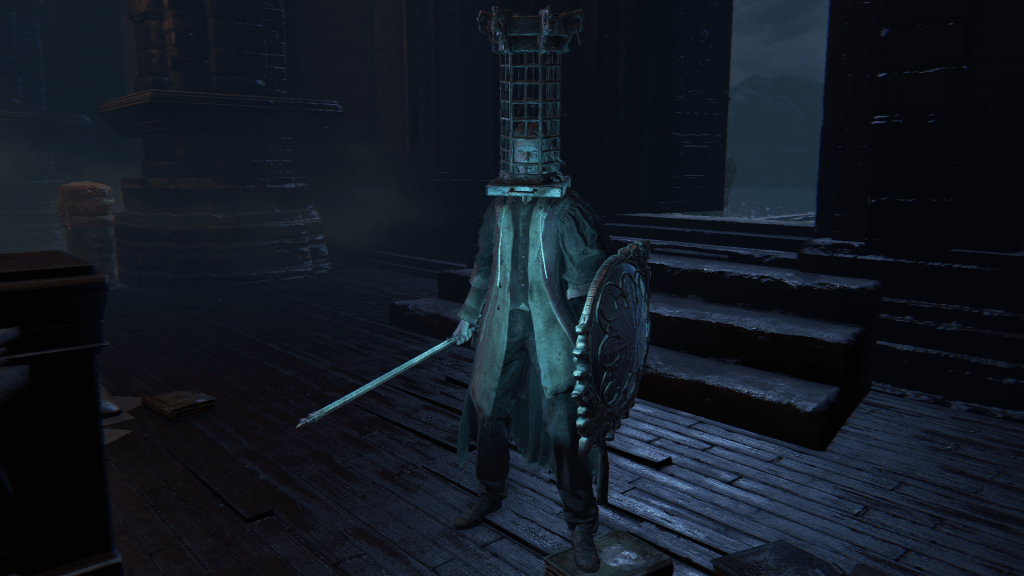

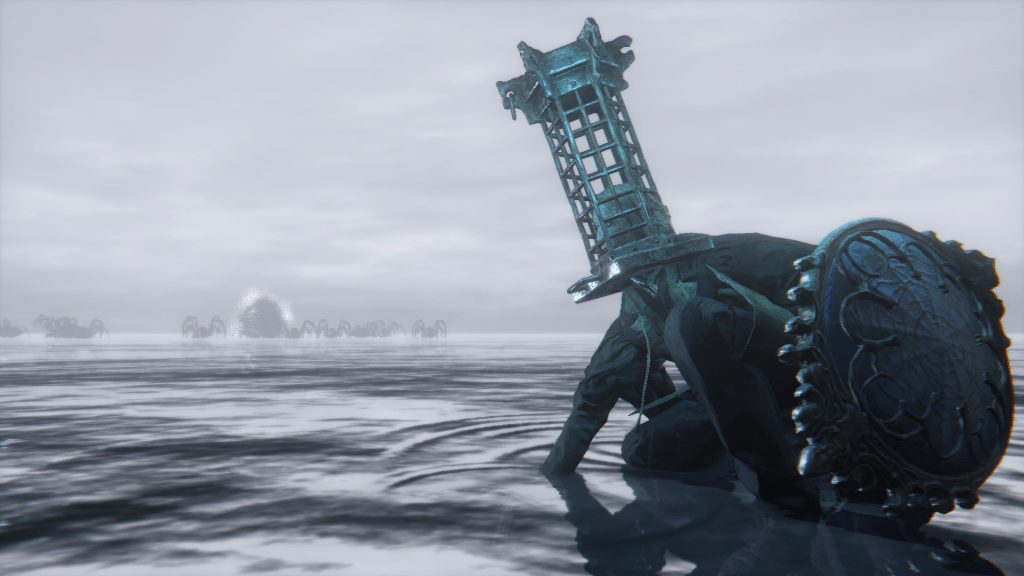
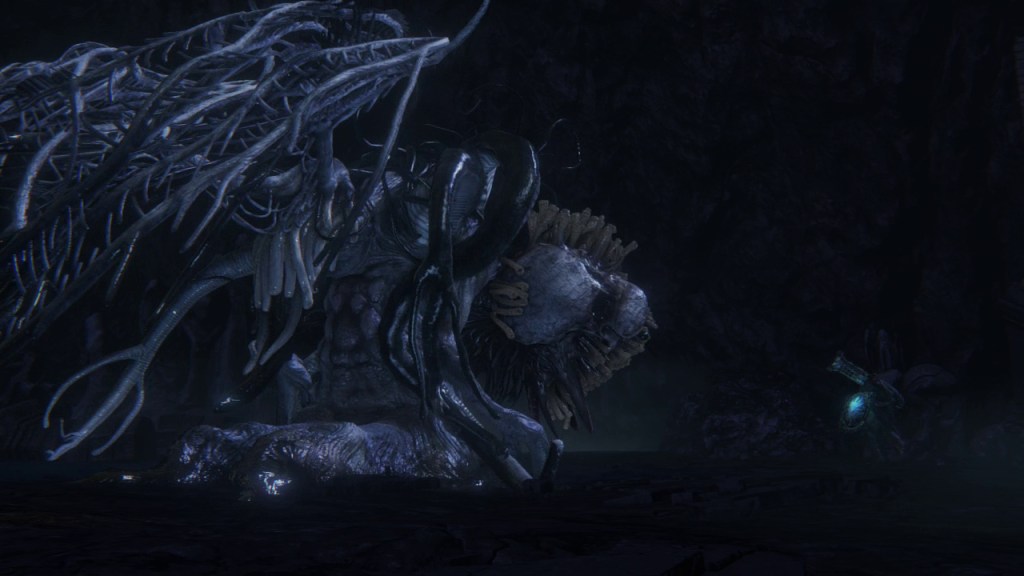
To that end, Damian has given credence to the School of Mensis’ claim to Laurence’s legacy. But in order for that to occur, Mensis must be around to recruit him. In short, Micolash and his ilk visited Byrgenwerth before all its students had died or become monsters. No doubt, this excursion was kept secret from the Choir. The clerics’ intrusion on the premises probably also faced no resistance. The university was already well into decline by the time they became involved. Add in the college’s ongoing collaboration with the Healing Church, and Willem might have mistaken the extra hands for aid. While there is no sign that they did help the provost get a handle on the deteriorating situation, the Mensis scholars enjoyed the freedom to familiarize themselves with the location and its contents. It would hardly give them a complete picture of Laurence. Still, they would be able to glean important history from surviving records and eyewitnesses like Damian.
This impromptu education is why Micolash dragged Byrgenwerth into their Nightmare. The Lecture Building holds a unique position in the dream’s construction. Rather than share the same physical space with the rest, the game’s trophies affirm that the edifice drifts somewhere in “between” (狭間) that dreamscape. That explains why we can’t see the exterior from anywhere in the Nightmare of Mensis — it is essentially floating around within its own dimensional pocket. From the inside, it just looks like a dark fog is consuming the building, but in reality, that fog is more like a shroud. The reason it occupies this shadowy interspace is seemingly to serve as a kind of lobby. Anyone accessing the Nightmare first appears in the classroom halls, each exit transferring us to different parts of the dream. The door to Willem’s abode naturally leads to its center; the door to the front campus, its frontier. In other words, the Lecture Building was made the nexus to quickly get around the dreamscape, just as Byrgenwerth was the connecting bits which let Mensis tie together their research on Loran with everything else.
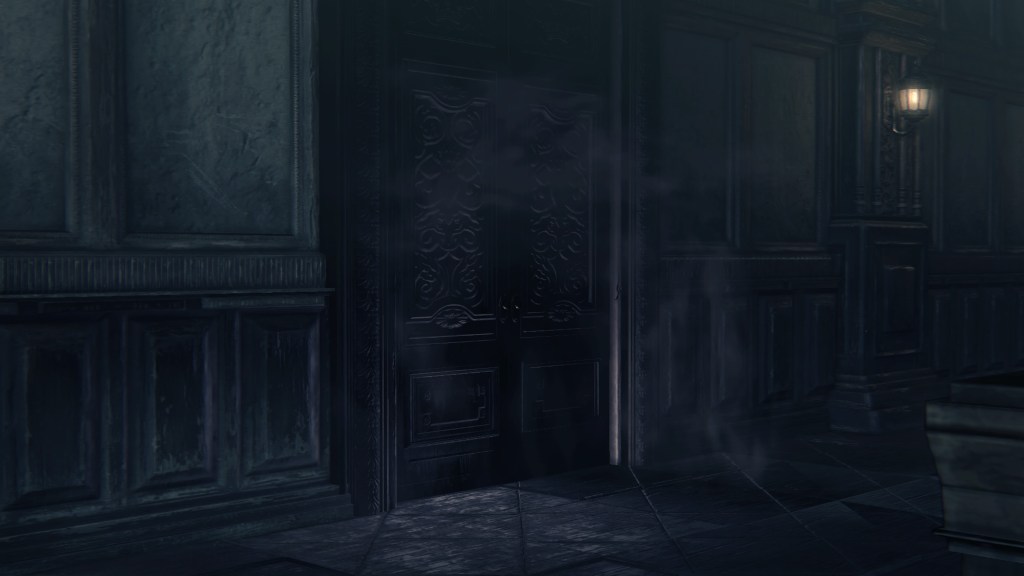
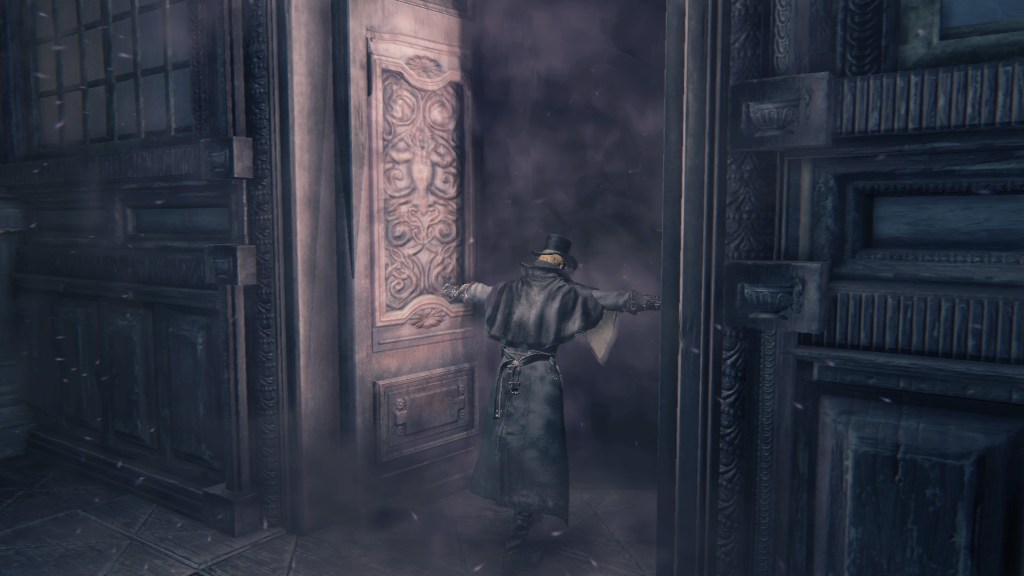

That “everything else” is a critical component. Byrgenwerth was where Micolash could obtain testimony of Kos, both for Rom and the Healing Church’s encounters with her. Kos was proof that a man need only make contact with the gods to receive eyes inside the brain, as they would learn Willem had framed it. Such insight regarding insight was seminal to formulating Mensis ideology. Blood evolution would fix itself if they received divine inspiration. “Vacuous” Rom was a failure in this regard, fumbling the divinity’s gift, so they needed to contact another Great One willing to share the secrets to transcendence. But how to secure a god’s attention, let alone cooperation? Laurence found the answer: hunt Great Ones who refused to contribute and pawn off their child to another in exchange. Suddenly, all the fragmentary information came together. Mensis believed the first Vicar to have found a compromise between Willem’s ideas and his own, petitioning god to enlighten them on how to undergo a proper blood transformation. And Kos’ example undergirded their entire theory.
This is, again, reflected in the Nightmare of Mensis. Looking beneath the floating islands from the Nightmare Frontier, we can spy familiar shipwrecks. Although anything more is obscured by the “sea” of green fog, this wreckage is likely the same from the Fishing Hamlet, specifically the dreamscape at the heart of the Hunter’s Nightmare. Certainly, while lead elixir are acquired mainly within both Mensis and Kos’ nightmare realms, it is by far more plentiful in the former. If the drugs in the hamlet were derived from the “nightmarish despair” it displays, then it is odd to not find more in the bloody hellscape of hunters beneath its waves. Certain enemies otherwise exclusive to Mensis’ dreamscape also appear sparingly in the village. This makes sense if those items and enemies inadvertently fell from the Mensis Nightmare on occasion, just as how the one snail woman falls from the hamlet to the nightmare Yharnam. Put simply, the two nightmares are layered atop each other, just like the dream hamlet and Yharnam. Why? Because Micolash recognized the role Kos plays in propping up his group.

This shouldn’t be mistaken for deep familiarity with the subject. Although he mentions how “some say Kosm” instead of Kos during our boss battle, no one but Micolash says Kosm. In truth, the wording is inexact. The Japanese script only has him invoke the names of Kos “or” Kosm, giving the impression that Micolash alone isn’t sure which name he should be using. In other words, it is possible that the boss simply doesn’t remember the Great One’s name he heard so long ago. He didn’t properly commit it to memory, because it was never important until that moment — he just cared about the implications for his School’s theory. For all their time at Byrgenwerth, the Mensis School seem to still be dilettantes. They only learned about the Great One of the Fishing Hamlet as far as it was required to follow the stories of Rom and the orphan Laurence used to beckon Flora. Those facts were the key to Mensis’ theory, not “minor” details like the cause’s name.
Ah, Ghos, or Ghosm… do you not hear our prayer? But, we won’t give up the dream! No one can catch or stop us now!
At the same time, fault can’t be laid entirely on the School for their ignorance. Byrgenwerth’s framework was inherently limiting. For instance, in the course of investigating Kos, Mensis have adopted the water association for the cosmos. This is illustrated in how Micolash addresses the cosmos as a mud-covered lake, the mud alluding to the beastly idiocy preventing man from seeing the true enlightenment which is the deeper waters. Like Willem, the insurgent scholars understood that there was some connection to the celestial bodies, hence the School’s namesake. But they didn’t make the next logical leap that the sky is the cosmos. Unlike the Choir, Mensis remained constrained by their teachers, so it is obvious that Byrgenwerth never made much progress in understanding the nature of the stars. Granted, the cosmos’ location relative to earth wasn’t critical for Mensis’ purposes.
The lake submerged in mud and seeable no longer, the cosmos! Eventually let us bite our tongues talking the night away, nighting the talk away… About new thinking and transcending planes!
When exploring Yahar’gul before the red moon, we are treated to ominous background music. Although the track in the final game is dubbed Hail to the Nightmare, early versions entitled it False God Hymn. Internally, “Wicked” or “False God” (邪神) is the name for Amygdala, whose statue is prominently enshrined in the local church. The song was thus intended to be an appeal to the Great Ones, which becomes obvious looking at the lyrics. The Latin chorus addresses the sleeping slug, the mother of blood, and their redemption, being infected with cursed beasthood as they repeat over and over. They beseech the divinity lead them to the “silver water” shrouded in darkness, departing land for sea. This silvery seawater is a clear allusion to the spiritual aspect of blood and thereby the cosmos, the darkness a metaphor for man’s lack of enlightenment keeping them from finding their way off this mortal coil. This explains the need for guidance from an invertebrate of dreams, with the singers’ final call for blood betraying the means with which they hope to be led.
Parallels to Micolash’s lake in mud aside, this hymn highlights their desire to contact the Great Ones above all else. With their foray into the past complete, the School of Mensis crystallized into the form we know it today. Donning the student uniform as the ultimate pretense, Micolash and his followers recruited any survivors receptive to their message, like Damian, and returned from Byrgenwerth with renewed purpose. Equipped with all their knowledge, the dissident faction was convinced that they were the true heirs to the church founders’ legacy. They understood the work of those wizened sages, their leader, their intellectual process. Compared to that, the pretentious Choir withdrawn in their ivory tower were nothing more than posturing beneath their station. Tinkering with the blood was pointless — only the divine had the answer. First and foremost, they must make contact.
Mere Insanity
Having no sense of where and how Laurence conducted his ritual to beckon Flora, the School of Mensis began developing their own methods in Yahar’gul. For example, stuffed into the corners of every church facility in town are distinctive standing mirrors. Their blue glass draws a comparison to the mirrors Micolash hops between in the Nightmare of Mensis. Moreover, there is the Arcane Lake rune available in Yahar’gul, its description reminding us of water as a divide and to seek beyond it. In that case, the School must have concocted the same idea as the Research Hall, trying to reach the cosmos via arcane looking glass. Rituals with this tool were apparently unsuccessful in cutting through the barrier to the higher plane, but it was a step toward transplanar travel. And if nothing else, it provided the same benefits as Yahar’gul’s warp basins, as Micolash demonstrates during our boss battle. Considering that the Research Hall experiments were secret, this was an admirable step in the right direction.
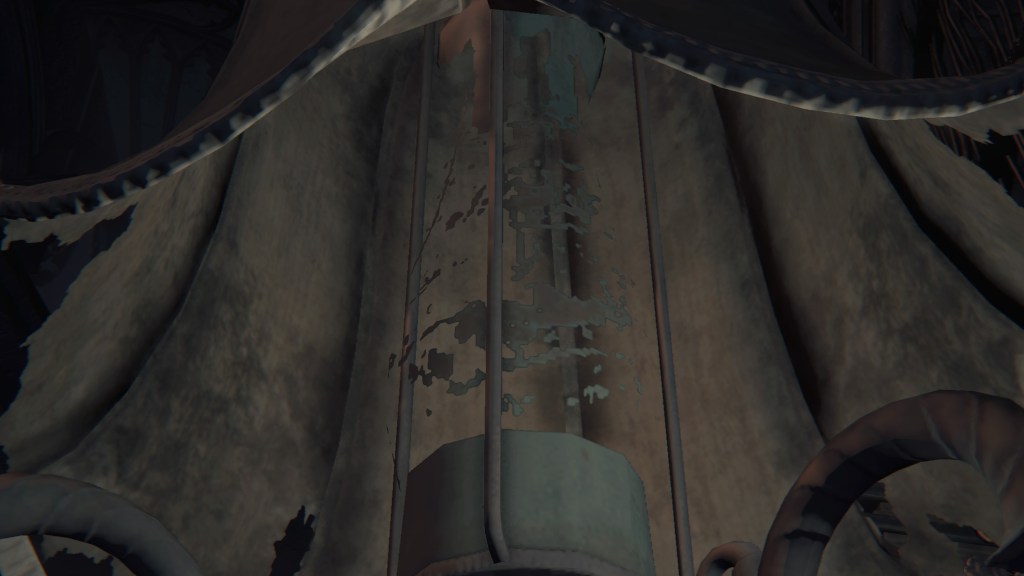
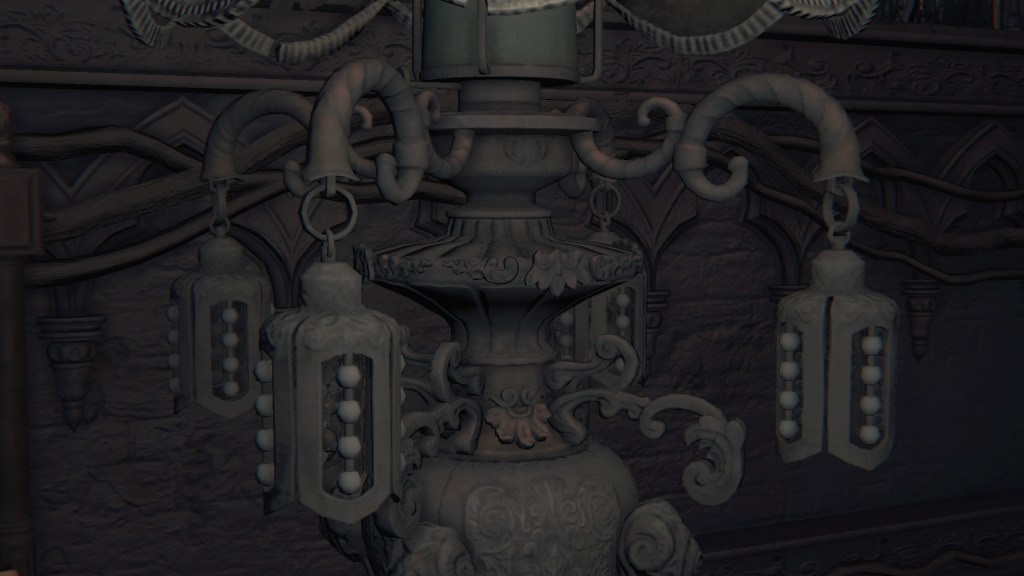
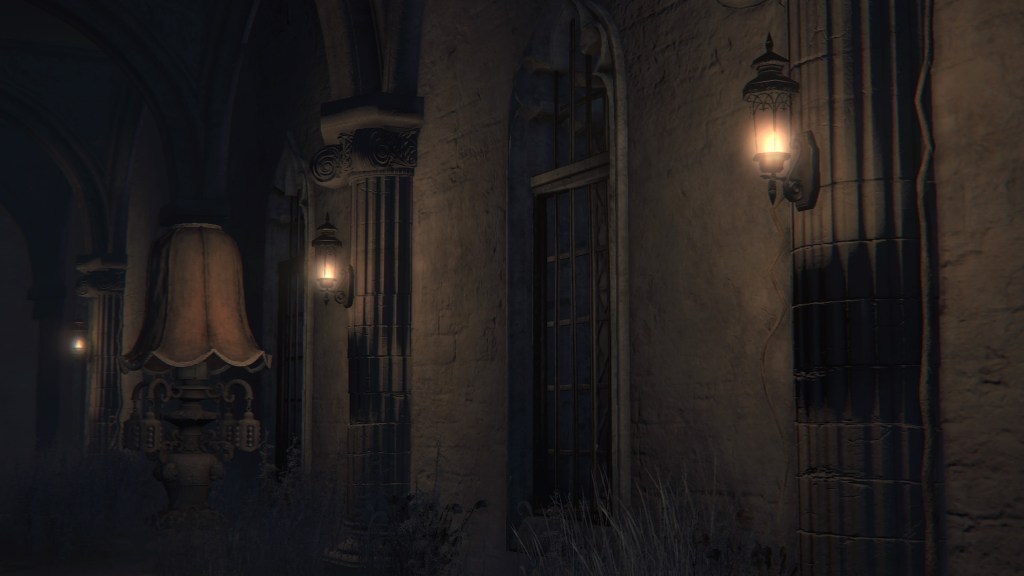
Not all of the devices they invented have precedent. Commonly alongside the mirrors stand oversized table lamps. Besides the primary bulb beneath the shade, four auxiliary bulbs dangle from the lamp body, encased in peculiar decoration. The atypical design, even by Victorian standards, suggests an equally atypical use for this tool. A lamp normally serves to generate electric light, yet Yahar’gul has no shortage of firelight in its facilities. Therefore, the critical factor must be that it is electric. And thanks to their experience in Loran, Mensis has shown a fixation on electric bolts. In short, the giant lamp is most likely some kind of bolt generator. Perhaps the shade and position of the light bulbs is intended to direct the currents to create a pyramid-shaped electric field, which would give off random bolts that the School could draw upon for their rituals. We might even have an idea of the nature to these rites.



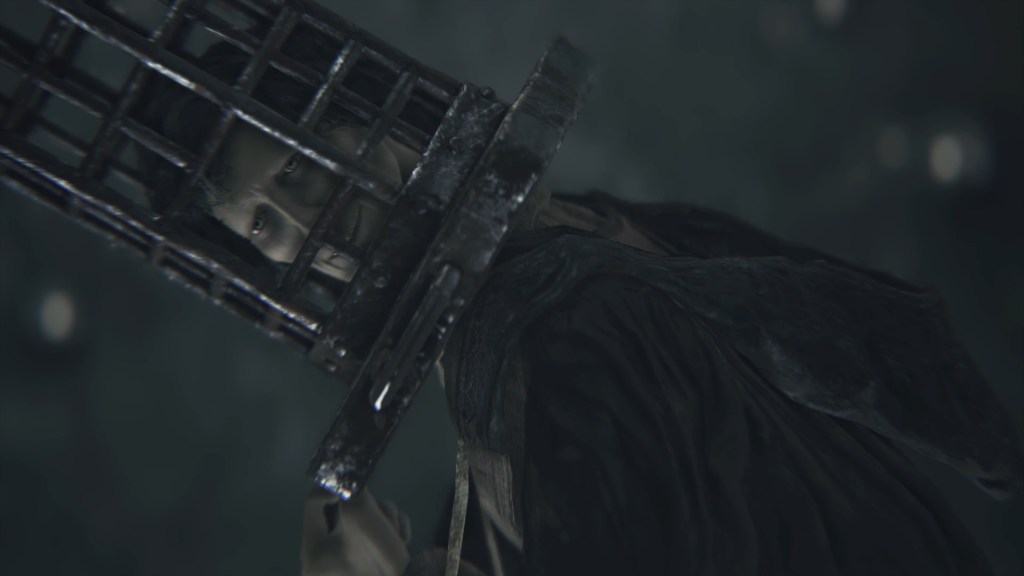
The Mensis Cage was created to serve multiple functions. On the one hand, the headpiece gives the wearer perspective on the mundane world, presenting normal life as a cage they would want to break free from. It is no surprise that members like Micolash and Damian enjoy the not-so-subtle reminder, but the cage serves a practical purpose, too. As a confined enclosure does in other contexts, this one entrapping the head also regulates the will, meaning that it can limit and control the spirit and mind seated in the wearer’s brain. This is important for its secondary utility as an antenna, justifying the cage’s extra length. The added iron over the head is specifically for corresponding with Great Ones, so the concept is straightforward: the cage directs the user’s thoughts and feelings to the higher being in question, then sends the same received from that being back to the user. How does it accomplish this? Through bolts.
Hexagonal iron cage that symbolizes the strange ways of the “Mensis School” that presides over the Hidden Town.
This cage is a device to regulate will and acquire perspective on the mundane world; at the same time, it is an antenna for correspondence with the Higher Ones of dreams.
And so, this actually led to the Nightmare they wished for.
Drawing upon the principles of the Faraday cage, the iron lattice structure should be able to move electricity up the antenna without bringing harm to the wearer. If the brain converts the will in blood into electric signals that motivates the flesh via the nervous system, then bolts can theoretically be used as a medium to carry that will. From there, it would be simply a matter of getting the bolts to jump to the “charge” of a will on the other side, which requires immense power. This is where the giant lamp comes in as a bolt generator. Something of such scale should produce that level of electric energy easily, which the owner can presumably dial up or down as needed. With a controlled source of electricity and a device to channel it, the School had another avenue for contacting a Great One. And according to its description, the Mensis Cage did lead them to their desired Nightmare, so the ritual was eventually a success. However, it was after much trial and error.
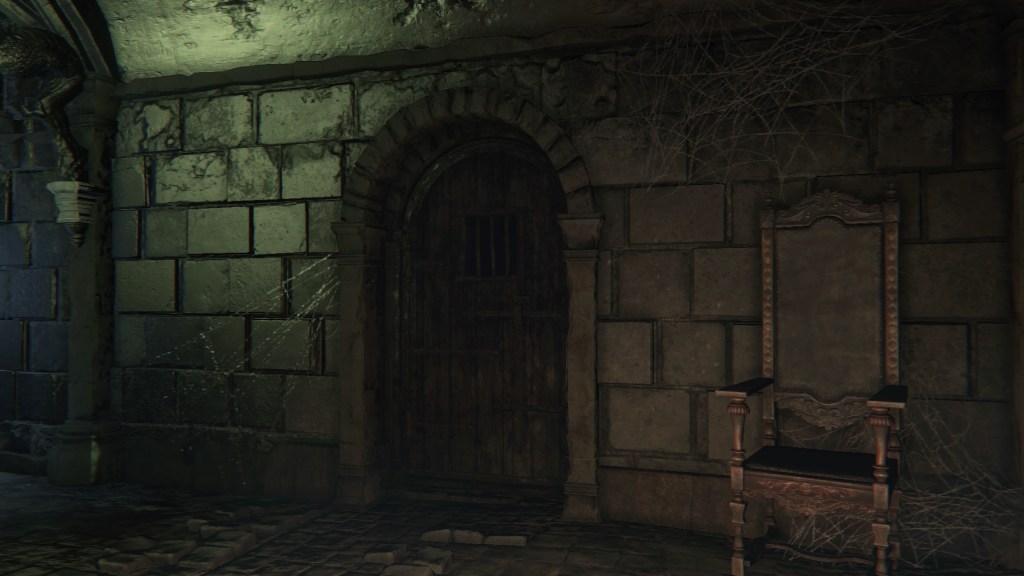
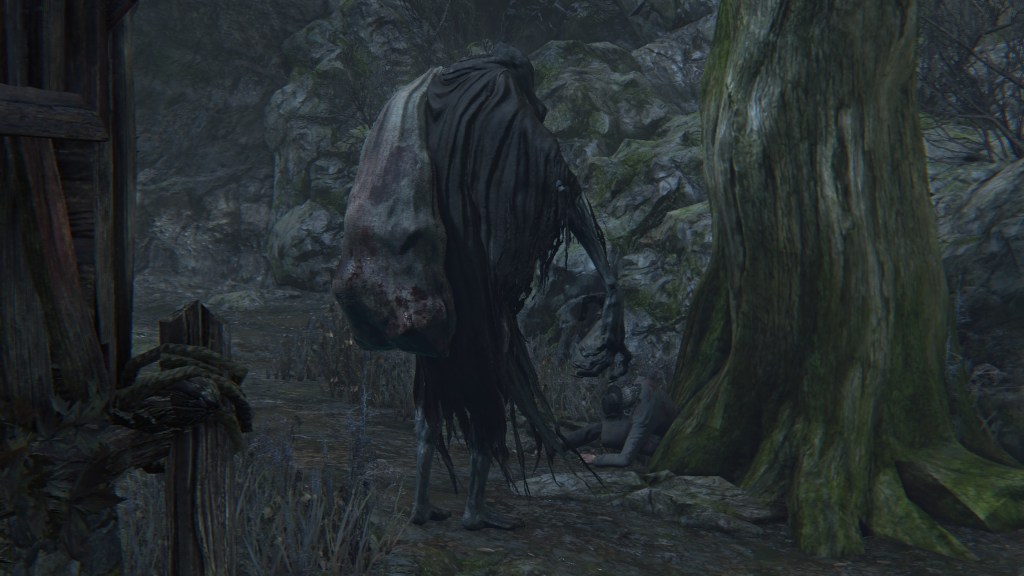
It is likely at this point that the larger, stronger clerics began kidnapping locals. Heading out in the evening at earliest, they pick off any poor stragglers from alleys or street corners while the rest of town locks up for the night. Once incapacitated, the clergy carry them back home in their bloody sacks, having converted their church facilities into dungeons with them as the wardens. Oddly enough, this night watch isn’t the most diligent; they don’t bother to even lock the cell doors in most cases. Granted, the ordinary citizen, battered and confused, seems generally too demoralized or frightened to resist. But we do see some prisoners in chains, including helpless children, so this cavalier attitude toward captivity may just be a more recent practice. Either way, the kidnappers are more than confident that they can supply a steady flow of specimens to their collaborators, especially with the help of the local hunters.



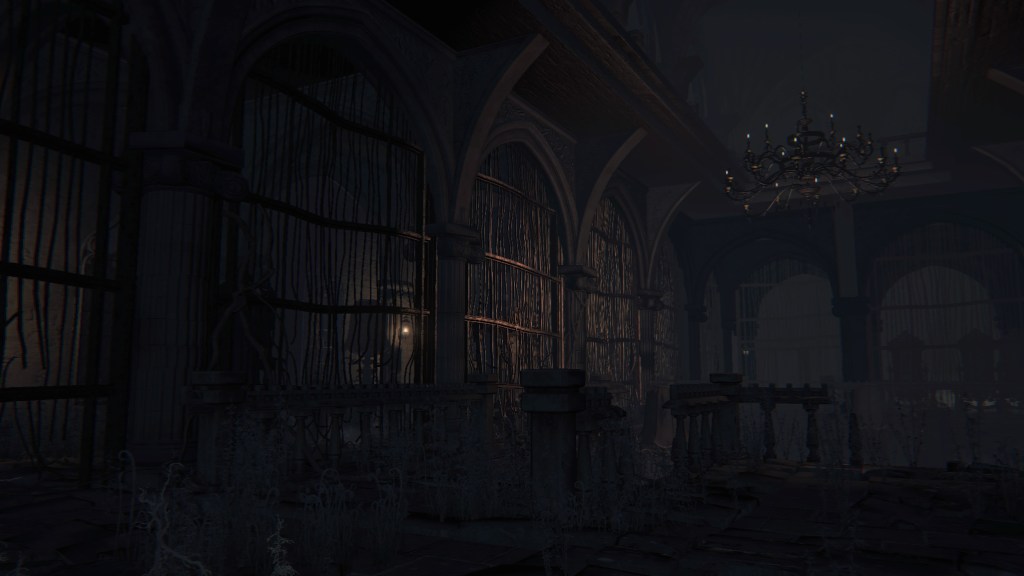


These subjects we see put in chairs wearing the Mensis Cage, obviously to test run Great One correspondence — much like the Choir member who attempted to make contact on the Orphanage balcony, their bodies have mummified. Whether because one person’s mind simply lacks the capacity to withstand direct connection with a Great One or otherwise, the energy overload consistently caused a backlash, frying the subject. It may not have always been fatal, since we do see more mummified prisoners on their knees in despair within their cells; admittedly, this assumes that FromSoftware isn’t just reusing assets. But without an infant Great One, they were unlikely to see results. Mensis did try reaching out with human children, most notable example found beneath the Amygdala statue in the church chancel. Clearly, the gods would only be receptive to one of their own kind.


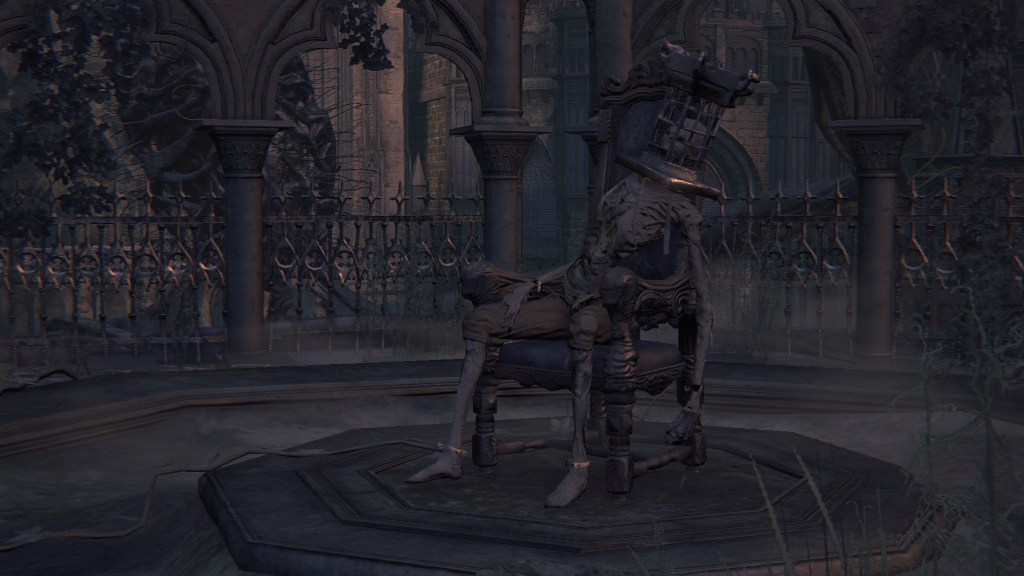

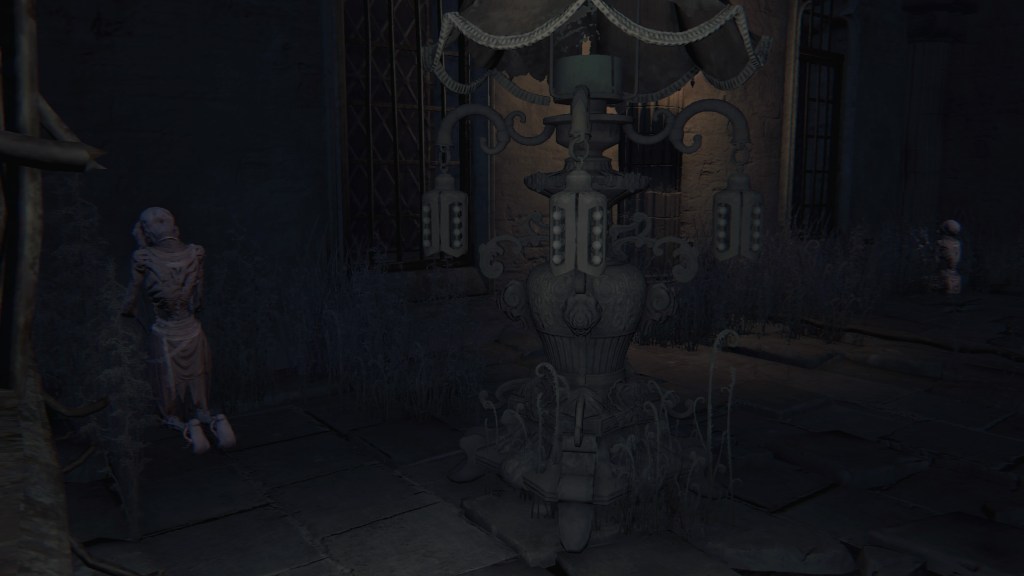
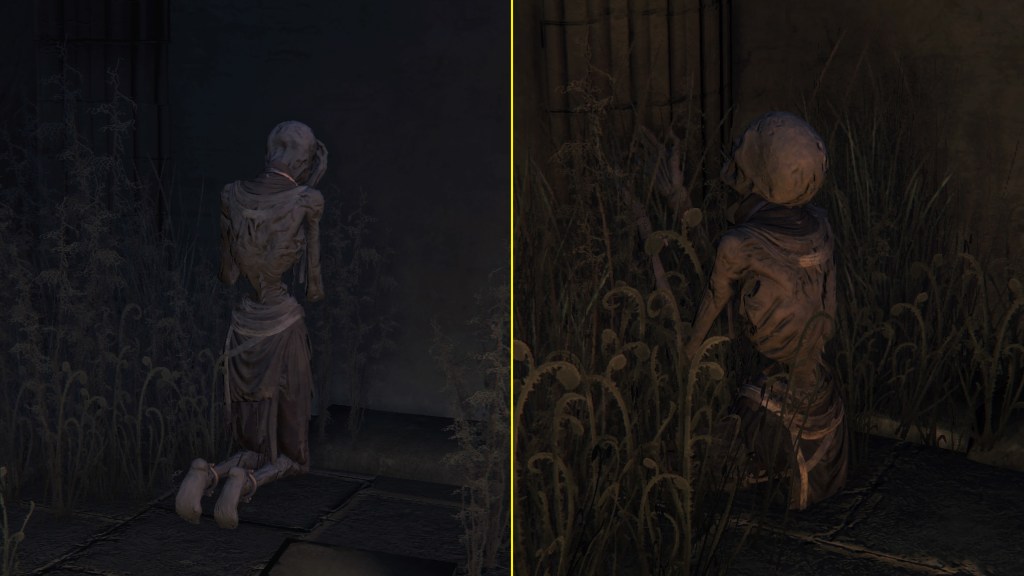
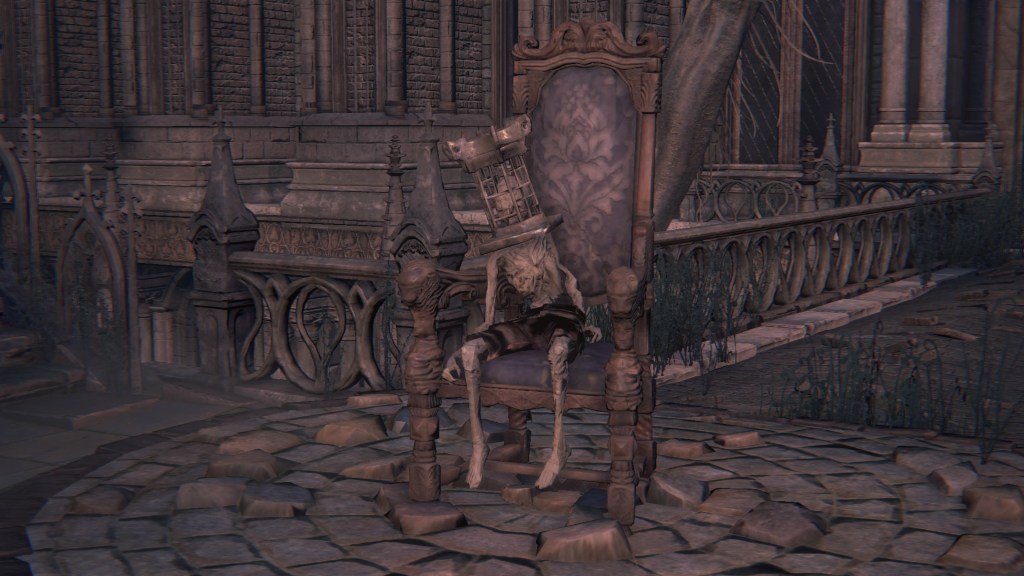

Suffice to say, Yahar’gul’s horrific rituals get Micolash and his colleagues labeled madmen. The School’s ways certainly look “strange” for their crudeness and creativity, the Mensis Cage emblematic of that. But if using citizens in human experiments for ends indiscernible to the average Joe is insanity, then the School of Mensis is no less off-kilter than the Choir. Micolash and his followers simply don’t bother to dress up their eccentricity in the guise of geniality and sanctimony, choosing instead to just hide it from sight. For those unfortunate enough to be given a peek behind the curtain, it is the ungodly work of mad scientists. But to the perpetrators, it is affairs of the highest calling. What man fully grasps logic of the divine? Let the public face of the Healing Church feign compassion — they don’t need to indulge that farce. So confident is Mensis in their path, they won’t waste time with appearances. The so-called madmen knew exactly what they needed to do. And with a little luck, they would succeed.
Upon defeating Mergo’s Wet Nurse in the Nightmare of Mensis, we receive a third umbilical cord. According to the description, it brought a chance encounter with Mergo, using the same phrasing as the eye cord connected to Flora. It is easy to infer then that this reflects the same scenario, Mensis happening to summon Mergo with the cord. However, the text is probably just misleading. For one, that interpretation doesn’t explain where Mensis acquired their cord. A note left between the books in Willem’s library predicts a Great One appearing with the red moon. Although the localization says that it will bless a womb with child in the process, the text merely asserts that the writer and others collectively “harbor” one; held, like in a Blood Queen’s arms. All things considered, this memo was most likely penned by a Mensis scholar while the School was still in contact with Byrgenwerth — theirs is the only faction with both knowledge and interest in the red moon, summoning gods, and obtaining babies. And they weren’t summoning a Great One to have a baby, but to trade one for their wishes.
Great relic also known by the alias “Eye Cord”. Even with Higher Ones, only babies possess this. “Umbilical Cord” is derived from that.
All Higher Ones lose babies and so seek them. Thus, this brought a chance encounter with Mergo, and that gave the defective brain tissue to Mensis.
Use to acquire enlightenment, but it is said that you simultaneously acquire eyes within. Everyone has forgotten what that actually brings, however.
When the red moon draws near, the boundary for man will blur, and the great Higher One will appear. And we will harbor the baby.
It is more probable that the eye cord we receive was part of Mergo. The Great One is already an infant, with no motive for seeking a similar child. During our entire night in Yharnam, the babe simply cries from within the Nightmare, hardly the behavior of a being with the power to communicate with humans and grant their wishes. Instead, the helpless child is left to the whims of the supposed nursing mother. A Great One herself, Mergo’s Wet Nurse descends upon her ward at our approach, covering the entire baby carriage with her body. Attentive listeners can then hear an audible gulp, the boss seeming to swallow the baby before engaging us in battle. Earlier iterations of this cutscene make the child’s assimilation into the adult Great One more obvious, hence why Mergo’s cries peter out after she is defeated; slay the devouring mother, slay the devoured child. The Wet Nurse is the one in control, not Mergo. Indeed, Micolash is the so-called master, yet our victory message is “Nightmare Slain” only after hunting Mergo’s Wet Nurse, implying that — like the Moon Presence — the Great One boss is actually fueling the dream. And she clearly wants to be a surrogate mother.


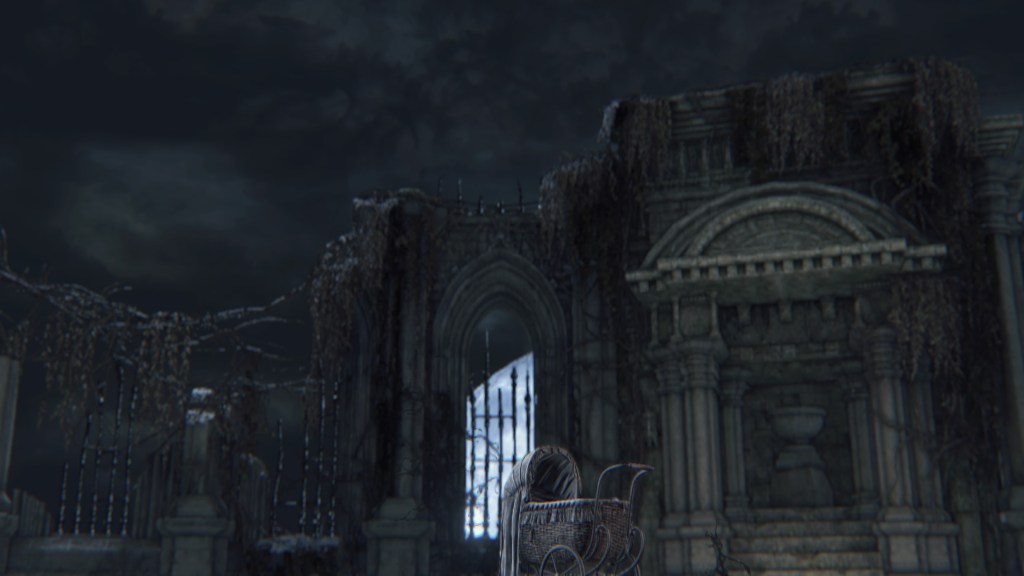

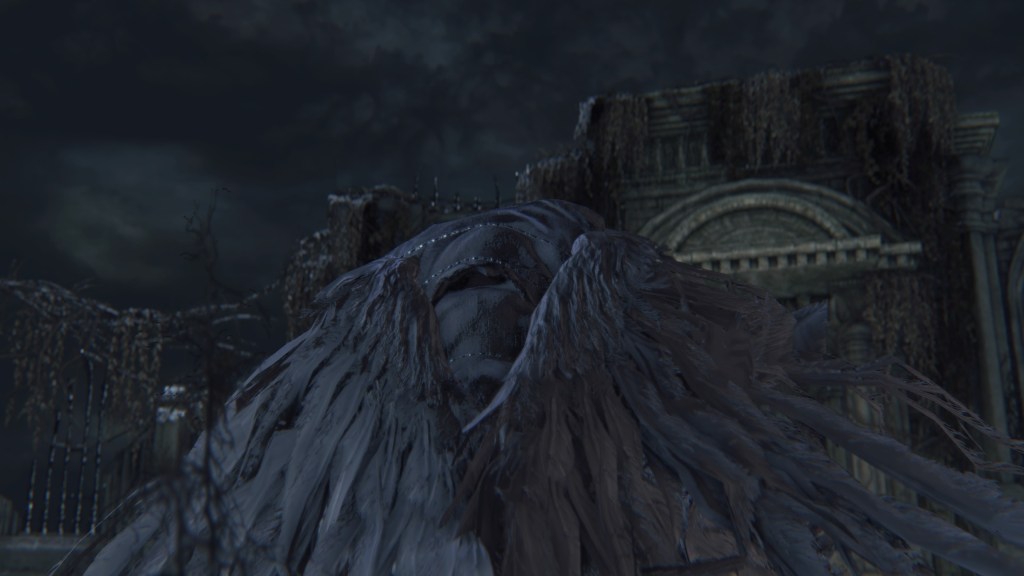

From every angle, the School of Mensis summoning Mergo is nonsensical. It was another Great One they contacted through their rituals, one who gladly took the infant already within their midst in exchange for conjuring their Nightmare. The “chance encounter” with Mergo thanks to the third umbilical cord likely refers to how Mensis came to harbor the child — they were looking for a baby’s cord, they found the entire baby. After all, the School looked to Laurence, and he managed to beckon Flora with just a cord. In light of their ongoing failures, it is reasonable to replicate the one known factor in his success. Byrgenwerth told them that finding, let alone artificially creating, anything more than that was exceptionally difficult. Acquiring Mergo, where Laurence had failed, was thus an unexpected development.
But if it wasn’t through their rituals, how did Mensis come into contact with Mergo? The baby was last seen in Queen Yharnam’s womb in Pthumeru Ihyll. Given that the pregnant monarch appears in the same dungeon as the headless Bloodletting Beast, this snapshot in time must date to between the first two red moon events, sometime long after the Healing Church had obtained its new holy medium for blood ministration. This means that as late as the Old Yharnam Incident, Mergo’s mother may have still been with child, though an Executioner soon separated them. Of course, this wouldn’t be her permanent end. But the Executioners didn’t know about Blood Queens’ immortality before the Cainhurst massacre, so “Queen Killer” wouldn’t have realized that she was only resting. The fool probably moved on without sparing the corpse a second glance, ready to tackle the next great “evil” to overcome for his training. At best, his wheel had done some debilitating damage to the royal mother, the child in the womb not even a factor.
Whatever state she was in, it left her incapacitated long enough for the School of Mensis to come in and swipe Mergo from her “dead” body. In all likelihood, the scholars just happened to be exploring the labyrinth around the same time. Their and the Executioners’ development would more or less coincide, so the former should have begun experimenting by the time the latter had started fashioning their own equipment. And again, following Laurence’s example, Mensis would definitely search the underground ruins for any signs of an infant Great One’s third umbilical cord. By fortune, or you can argue the wheel of fate, they discovered a dead pregnant woman bearing an actual infant Great One. Whether or not they fully realized this at the time, it was still a curiosity warranting further examination. They took the baby and returned to Yahar’gul harboring their prize. The immortal queen would eventually begin searching for her lost child. But by the time she followed the trail to the surface and left home with her bodyguards, it was already too late.
Omen of Ill Intent
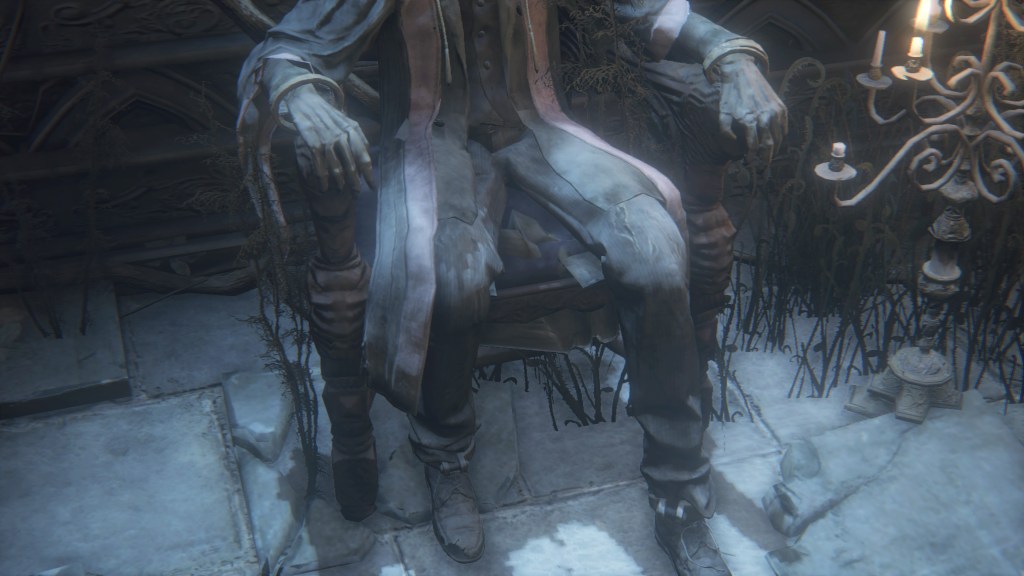
In order to reach the Nightmare of Mensis proper, we must first head into the building past Advent Plaza. Judging by its location of prominence at main street’s end with a town square, this building was possibly a kind of mayoral office or similar town hall. Whatever its original function, the School of Mensis converted it into another ritual site. Row upon row of mummified prisoners in chairs and head cages line the walls. One “prisoner” is a Mensis member. It is touching this mummy which puts us on the path to confronting Micolash within the Nightmare, so it is most likely his body. This should therefore be the Mensis Cage ritual which led to their dream’s creation, the lingering connection between Micolash’s remains and his consciousness in the dreamscape allowing us to cross over. Function like a warping lantern aside, the body’s location at the center of this setup indicates that Micolash amplified his “signal” by combining his and the prisoners’ brainpower in mass correspondence, essentially sacrificed to help shield his mind during the attempt.
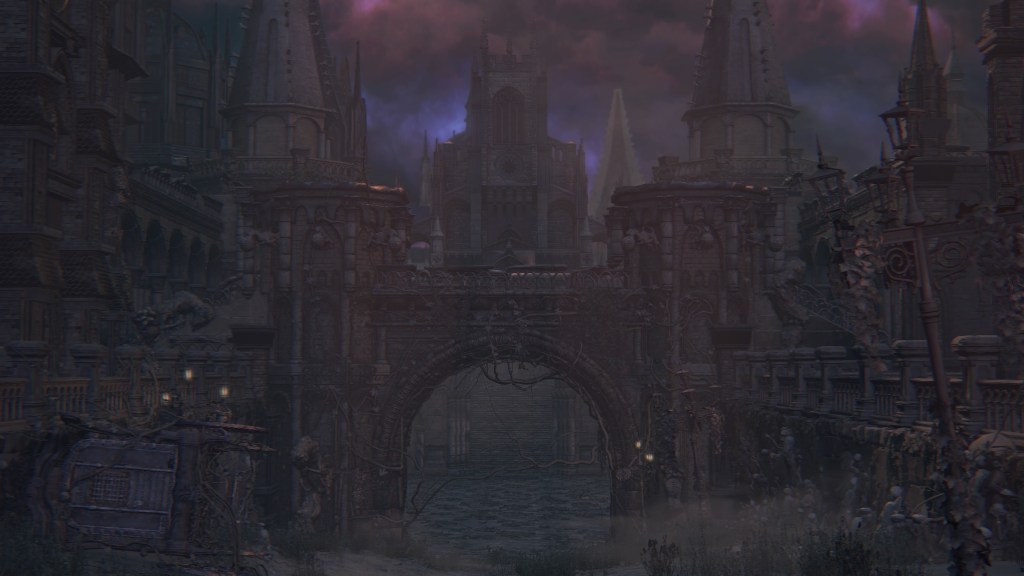


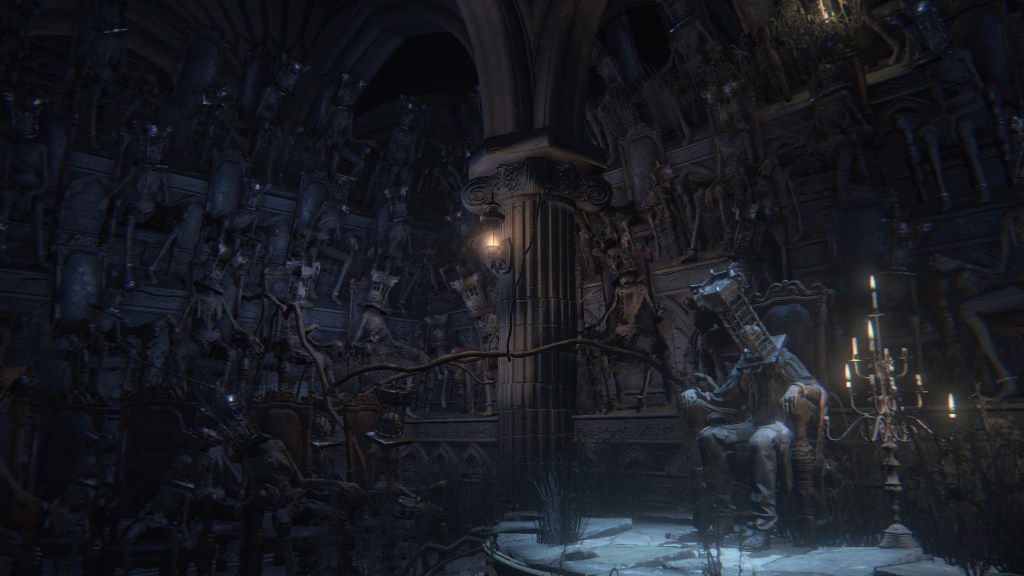

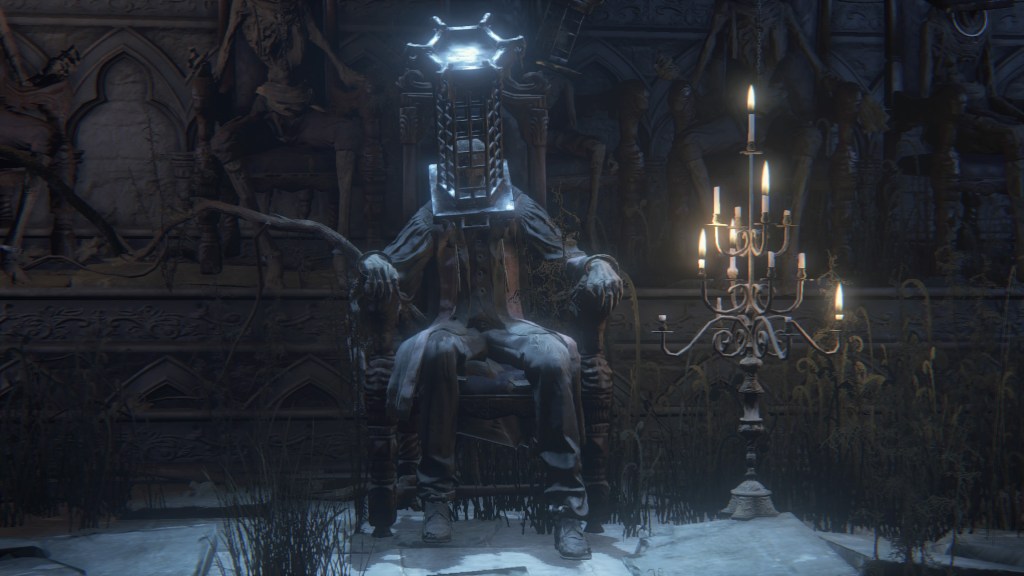
Those prisoners don’t appear to have been the only sacrifice. Yahar’gul’s petrified citizens fill the street between Advent Plaza and the gate partitioning off the city church. Their bodies look desperate to escape something; climbing walls, clawing at doors, looking back in horror. Given their current state, they experienced some form of incredible arcane power. However, this power didn’t possess any physical force, buildings only affected by the people fusing into them. And the people’s panic seems to be stemming from Micolash’s ritual. Adding to that notion, three clerics lay prostrated before the partition gate, each corpse bearing madman’s knowledge. Even behind a barrier farthest from Advent Plaza, Mensis were mildly affected by this “holy” sign. But this implies that these clerics overwhelmed with awe had shut the gate. Among the ordinary men, women, and children petrified hide more prisoners. Why would Mensis let their captives freely roam the streets that night? Because they, along with the citizens, were all gathered there and trapped inside for the ritual.
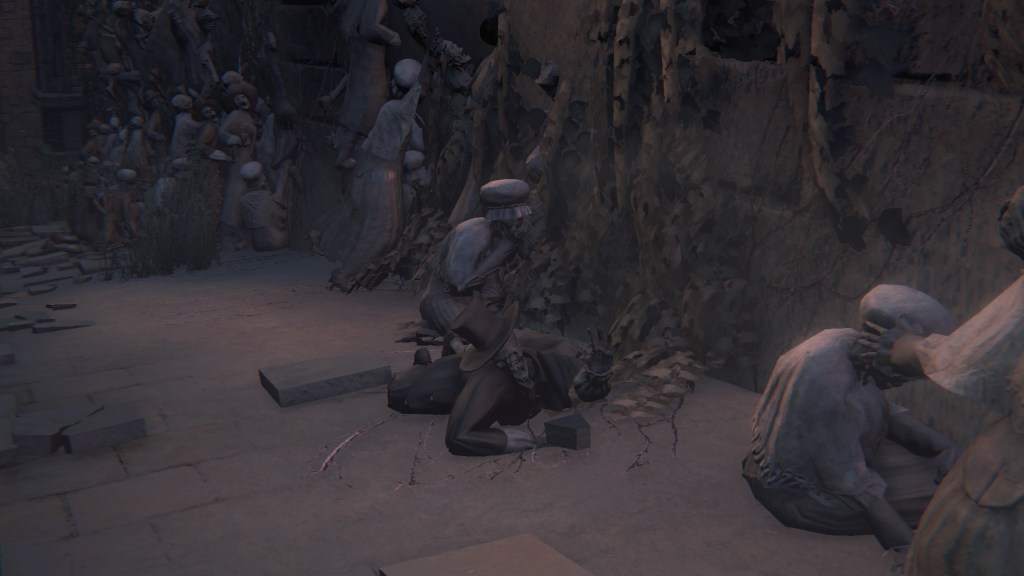
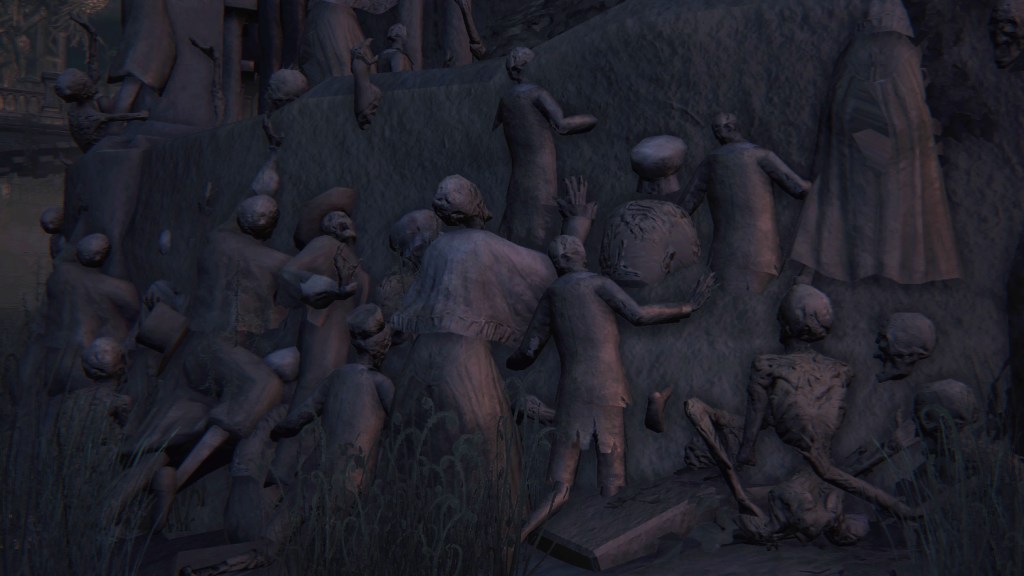

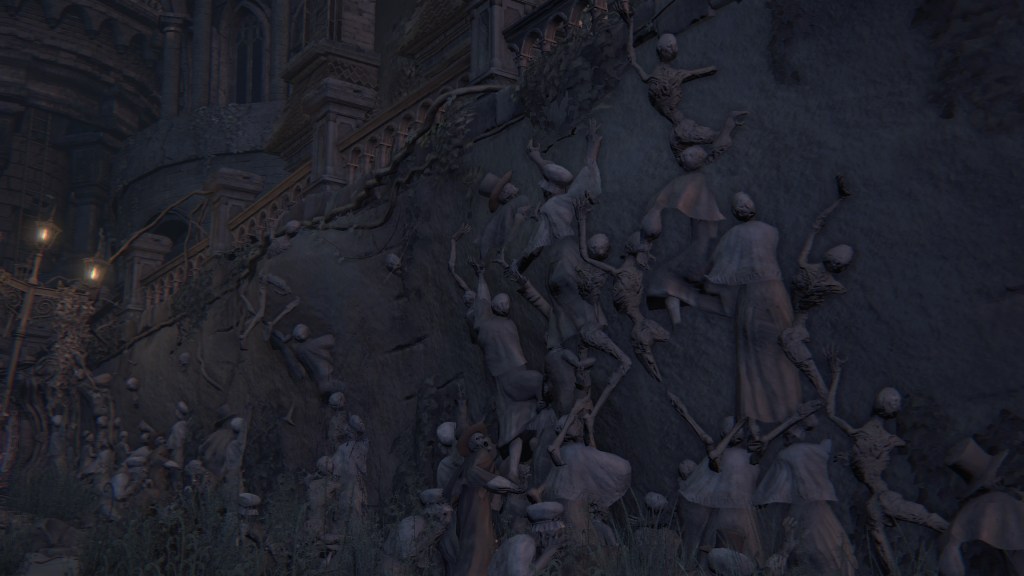

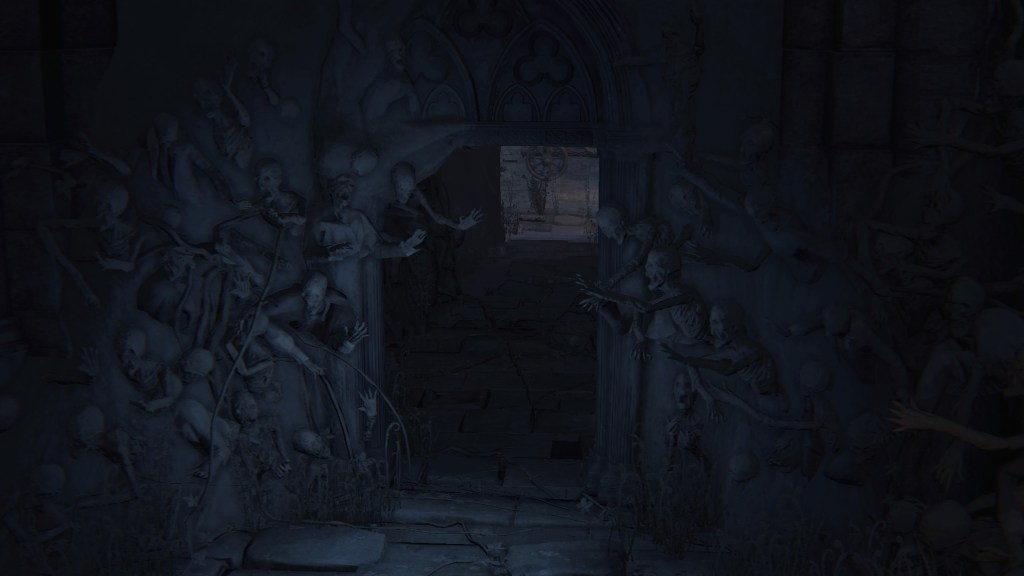


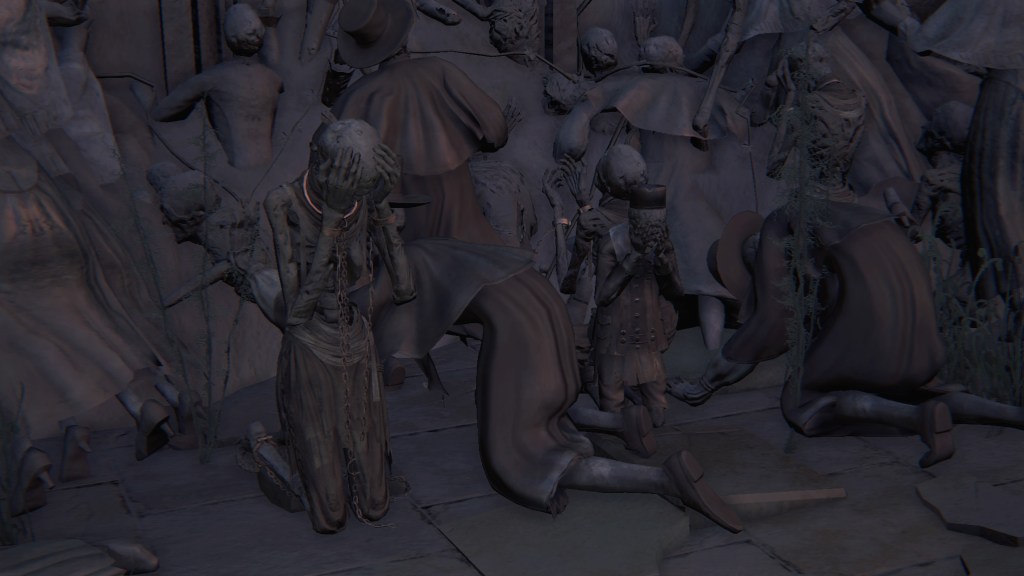


In short, every innocent in Yahar’gul at the time unwillingly contributed their life and energy to help power that “signal” sent out to the Great Ones. This is why we acquire Arcane Lake from a citizen’s corpse among the petrified — they were all sacrificed to connect Micolash to that proverbial lake in mud. We can see this reflected in statues on the streets and around the church facilities. A strange confluence of bodies shaped like a grotesque Tower of Babel, their multiple sets of arms clasped in prayer as they attempt to reach god. Such an icon perfectly encapsulates the School’s intentions with this ritual and indicates that they had been preparing for it for quite a while when the plan was finally executed. According to their theory, Mensis just needed to achieve contact once to uplift the whole of humanity. Weighing that against the lives of one meager — and unfaithful — populace, it is no mystery why they were sacrificed to secure Micolash’s connection to the cosmos.
And if the clergy there were using all “resources” available to guarantee his success, then they must have been harboring Mergo. With an infant Great One to offer, this was their best shot. Of course they would spare no expense to make this ritual succeed. They just needed to get a message beyond this plane and they were sure to receive a favorable response, as Laurence had. And the Mensis ritual did garner Flora’s attention. We find the note commenting on the “Paleblood” sky on the street in front of the city church, before the red moon appears during our journey. It is a hunter’s note, probably left by an awestruck Yahar’gul hunter during the original incident. This plus the prostrated cleric corpses affirm everyone except Micolash as bystanders during this moon-beckoning ritual. The conspirators were present to witness the fruits of their efforts, from a safe distance.


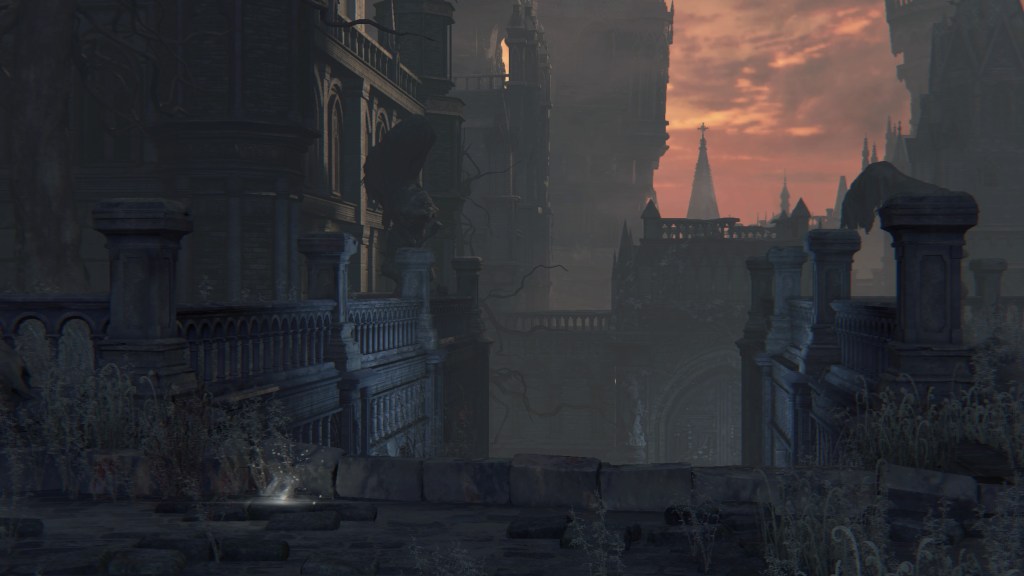
Granted, safety was not a guarantee. The note in Willem’s library acknowledges how the “boundary” for man will “blur” due to the red moon’s approach. The School of Mensis understood that their summoning would cause collateral damage, and such high-ranking clerics couldn’t have been ignorant about the fragile situation in Old Yharnam. Like with their kidnappings, they didn’t care. Exposure to the arcane would create more beasts, but that was necessary in their theory. What was more important was that a Great One grant one of them the insight to reaching the next step beyond an idiotic beast. Micolash was on track to becoming that chosen one; he could uplift the rest later. This is likely the reason for the apparent disregard for his body outside the dream. It didn’t matter if his earthly vessel perished, so long as his mind lived on in the cosmos. Upon seeing that paleblood sky, they must have been overjoyed to know a Great One was descending.
In the end, however, it wasn’t Flora who made first contact, but Mergo’s soon-to-be wet nurse. As part of their correspondence, the Great One agreed to grant Mensis’ wish, creating a Nightmare to Micolash’s specifications — reconstructing parts of Loran atop the Hunter’s Nightmare and dragging in Byrgenwerth’s Lecture Building. Crowning the center of this new dreamscape stands two mountaintop churches connected by three great bridges. The first is a “chapel” (礼拝堂) according to Bloodborne Design Works. Like the Witch’s Abode in Hemwick, this oratory has a bridge for preaching to new arrivals. Afterward, crossing the lower great bridge takes us to the second church where Mergo’s Wet Nurse cares for the child from the highest rooftop. Although the localization denotes to its entirety as Mergo’s Loft, kourou (高楼) more accurately refers to a generic high-rise building. The only portion labeled as an “attic” (屋根裏) is the upper exterior section in concept art. The Iron Door Key’s description does allude to the twin churches as a cradle, however. This was a place for “her” child to nestle.
Naturally, the Wet Nurse makes sure there are no disturbances around this cradle. The church guardians are officially Mergo’s attendants. Garbed in chain mail with iron breastplates and stolid face masks, they already look more like medieval soldiers than caretakers. But they are generally armed with a flail or crossbow, the larger chief attendant wielding a cleaver and chain whip. With that, the blood on their ragged clothes and armor gives more the impression of torturers. Such a sordid occupation might explain why these enemies only possess dirty damp bloodgems; it would also be appropriate considering the cages hanging all throughout the facilities imbue the aura of a torture chamber. Still, this doesn’t unveil their origin. Because of their pale blue skin and antiquated aesthetic, it is possible that the attendants are Pthumerians revived by the Wet Nurse — if a Great One wanted to conjure up some guards for her new domain, it makes sense to draw on the people she was most familiar with. Regardless, they are clearly intended to serve Mergo by brutally eliminating intruders.

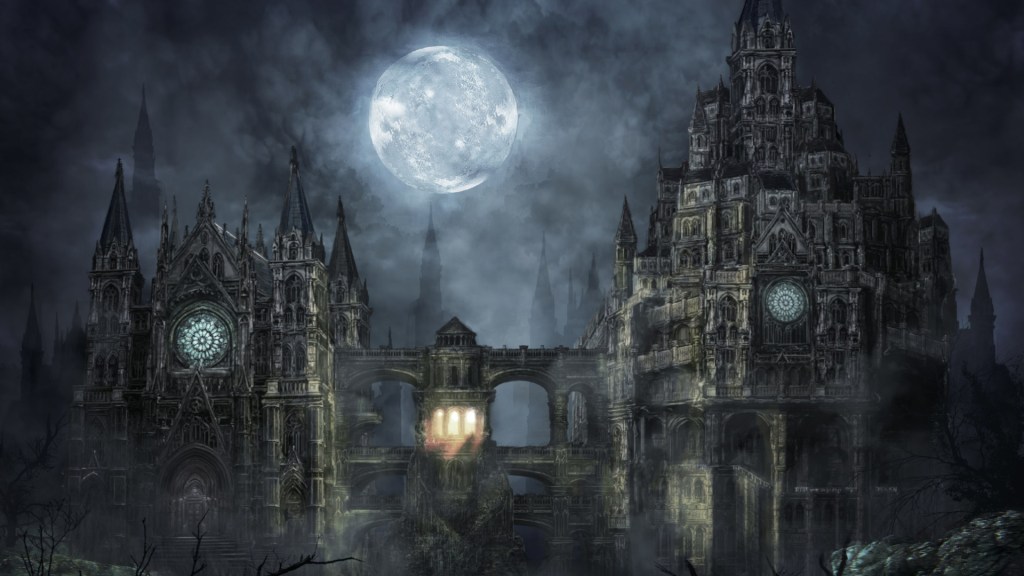


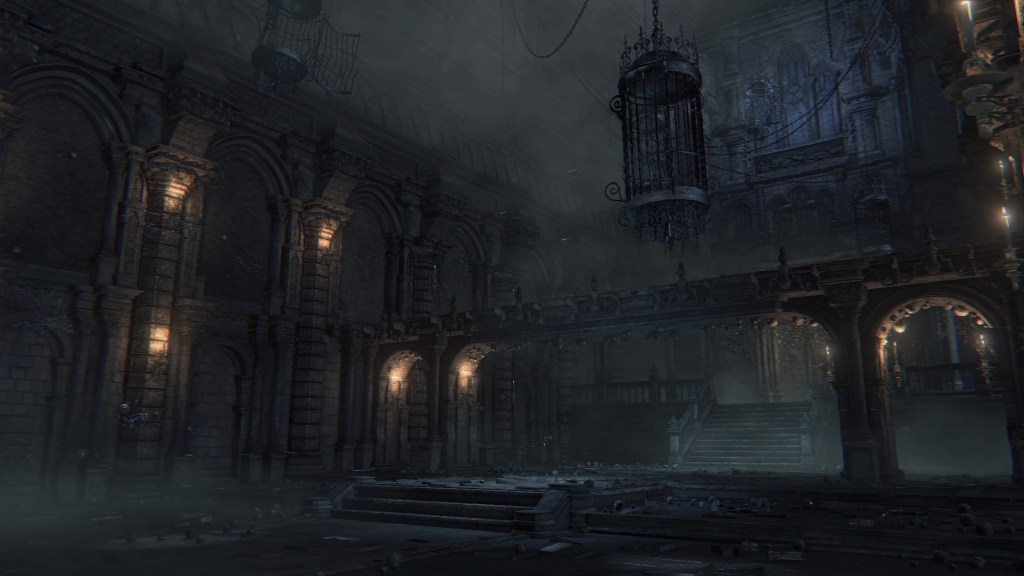


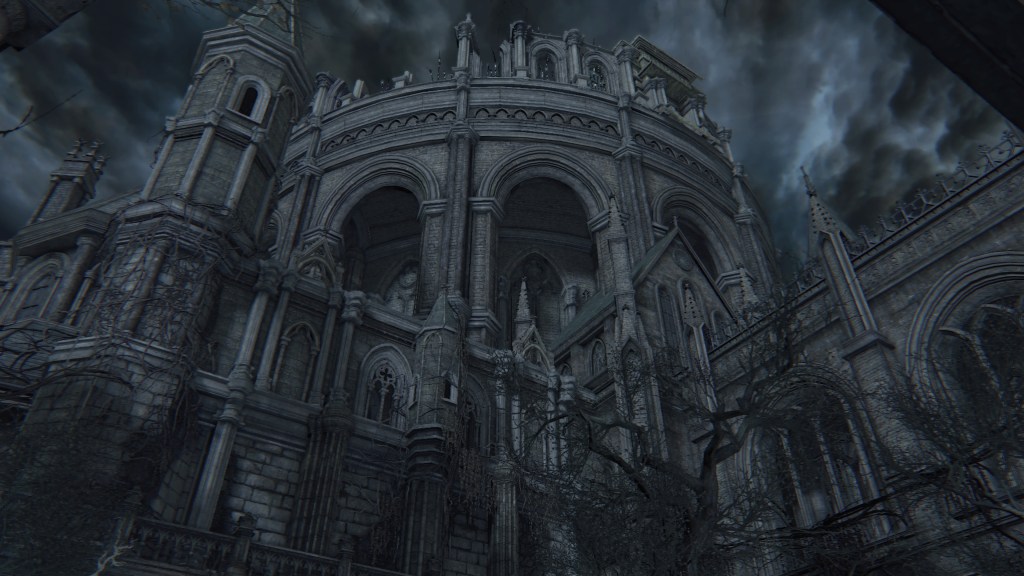
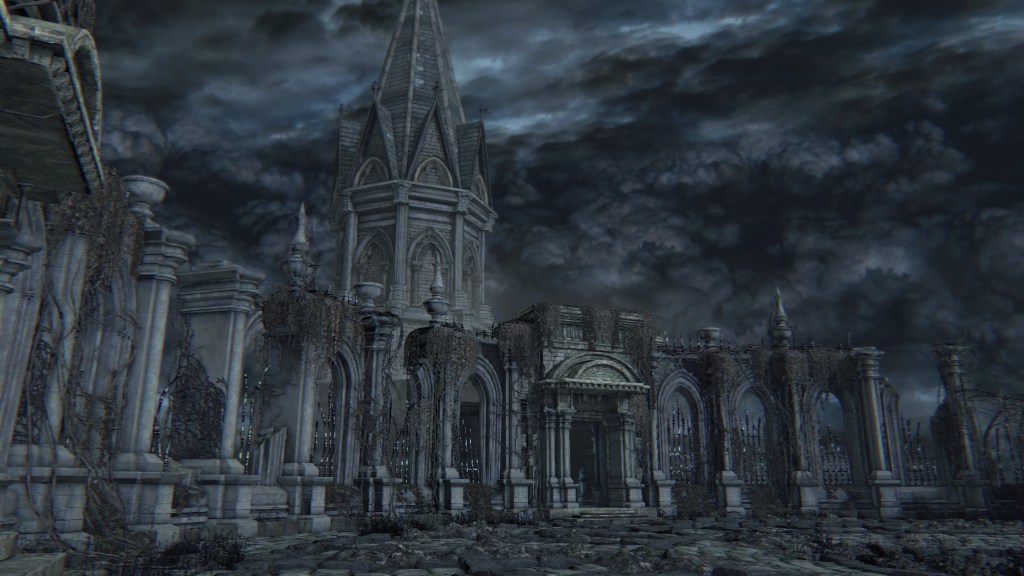


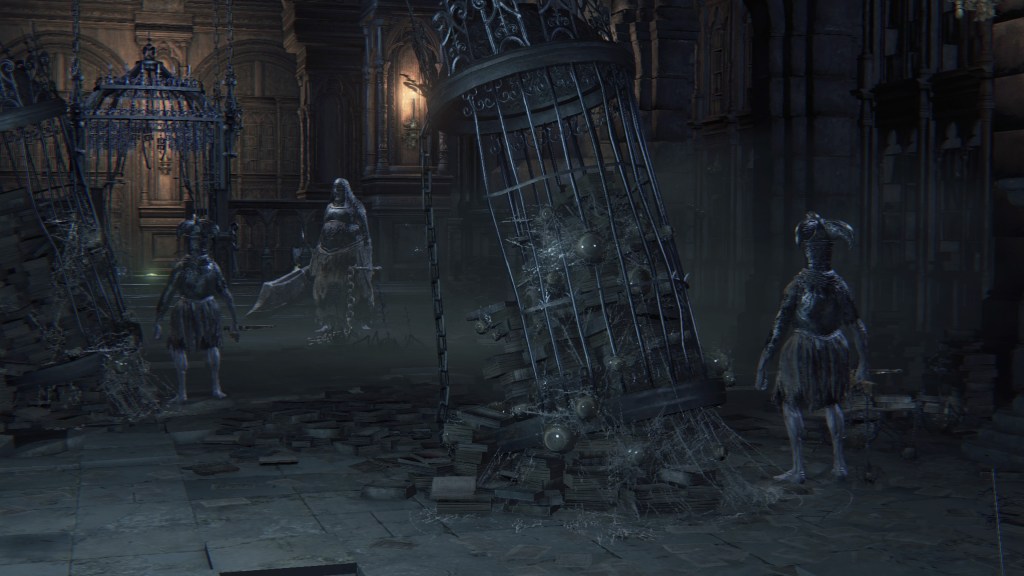


The School of Mensis, however, were not intruders. Rather, the churches were just as much their playground. The second is fundamentally a giant library, with plethora of books no doubt detailing the scholars’ areas of interest. This is because the building also seems to serve as their laboratory. Many of the cleric corpses we come across hold onto various drugs, like blue elixirs and sedatives, as well as ritual tools, like shaman bone blades and their blue mirrors. Therefore, this was the new hub for the group’s experiments. Micolash and Mensis are ultimately owner of this Nightmare. If they wanted a dream, then they saw a use for it in their future as gods. More than likely, the plan was to make the Nightmare a holy land bridging man and Great One — pilgrims flocking to hear preach of the School’s journey to divinity and the secrets to ascension. It is not surprising that having their own church complex was among their specifications to the Wet Nurse. The only oddity is its use as a research facility when it should be unnecessary by that point. But the reason is rooted in why they are still not gods.
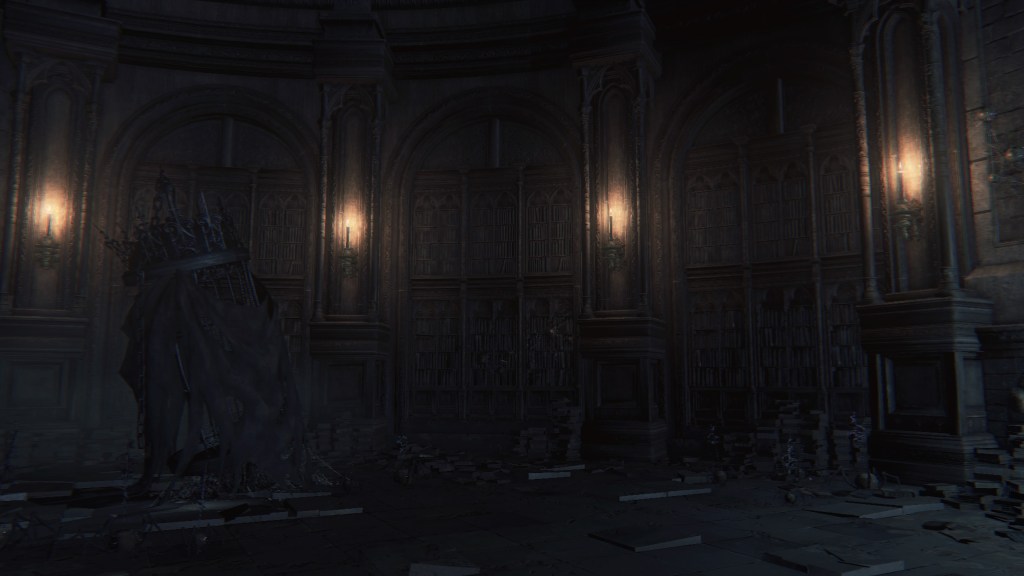
The Brain of Mensis hangs from within the central tower supporting the three great bridges. This giant mass of brain tissue bears many large eyes and two tendril arms, the latter of which dangle without evident function. It is a Great One, responsive to the Make Contact gesture once pacified, and even rewards the strongest Moon rune to reflect that. Yet it also stays suspended by chains, completely helpless should we choose to pull the lever dropping it down into the abyss beneath the churches; it survives, but just barely. What then is it doing there? The description for Mergo’s eye cord claims that Mensis’ chance encounter caused “the stillbirth of their brains.” However, this is another error by the localization. In actuality, the text says that their meeting is what “gave” them “the defective brain tissue.” That language is otherwise only used for the description of the Living String derived from the Brain of Mensis, detailing how the School acquired the giant brain tissue in the Nightmare. Put simply, this Great One was gifted to them in the course of their dealings with Mergo’s Wet Nurse.





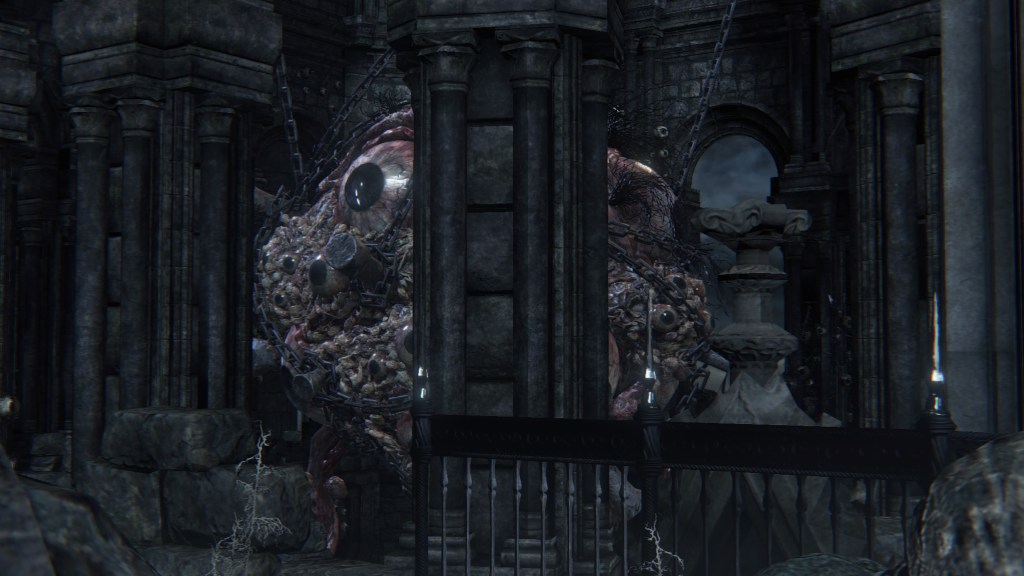


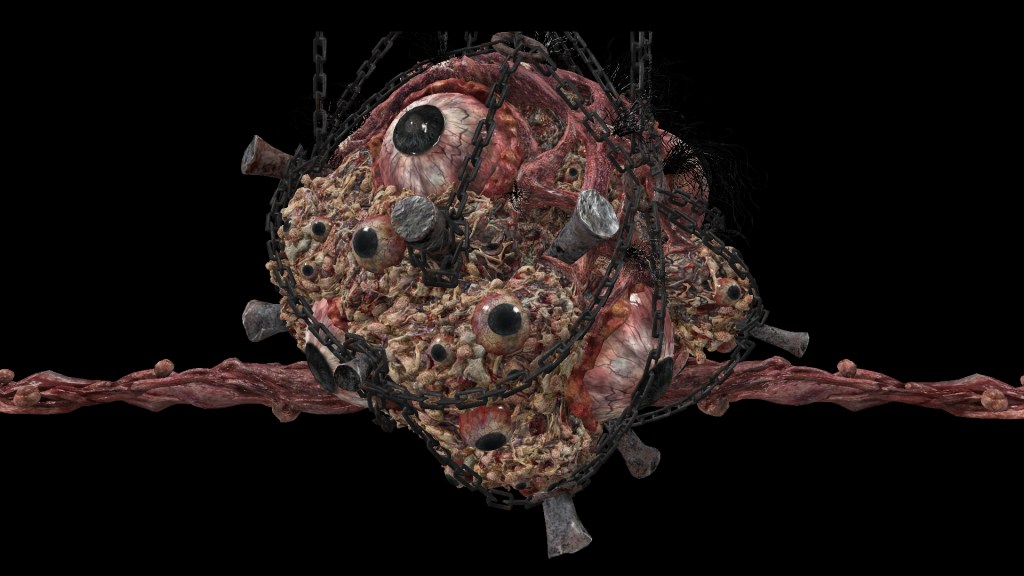

One of the special materials needed for Holy Grail rituals.
The giant brain tissue that Mensis acquired in the Nightmare certainly harbored eyes within, but it was completely defective. Those eyes are a kind of evil eye, and the brain itself was rotten.
However, it really is a Higher One, and leaves a relic. Living ones in particular are quite valuable.
Recall that Mensis’ primary goal was to receive the insight to join the gods in the cosmos. The Nightmare was just an ancillary wish. Listening to Micolash’s ramblings, it is easy to imagine how this played out. In all probability, he wished for a “brain with eyes” and the Wet Nurse granted exactly that. Whether due to misunderstanding or mischief, she provided a living brain with physical peepers. Indeed, the Brain of Mensis is in all likelihood artificial. Close inspection reveals the brain tissue comprises of dead messengers, entities that Great Ones like Flora can conjure up with ease. In that case, the brain’s specific form was shaped to fit with Micolash’s requirements — it wasn’t designed to be an independent entity. The Wet Nurse’s creation was naturally a higher being in its own right, but this seems to only be an accidental byproduct of their deal. She ultimately delivered him his exact words, with no intention of ensuring it elevated anyone to similar greatness.
Ignorant of this fact, Mensis could only assume that this was all part of the process. And so, not knowing how to proceed from there, Micolash and his fellows continued their research from the second church. Webbed eyes cover the inside of both churches and the Brain’s tower. Those in the library are especially peculiar for growing spider-like legs, the eyes on the floor additionally sprouting a plant-like growth. Knowing Mensis’ strange ways, these are probably a result of their experiments, trying to manifest enlightenment by inducing associate features. Glowing eyes are a motif in the cages used for the church’s lift systems, so that image is definitely top of mind. Since an actual brain obviously wasn’t what they were expecting, the School assumed that they were still missing some important context. From their perspective, they were supposed to somehow use the brain tissue to transcend. None were able to fathom the possibility that their theory was wrong or that their wish wasn’t truly granted. Instead, they put the onus on themselves to understand what god had given them.


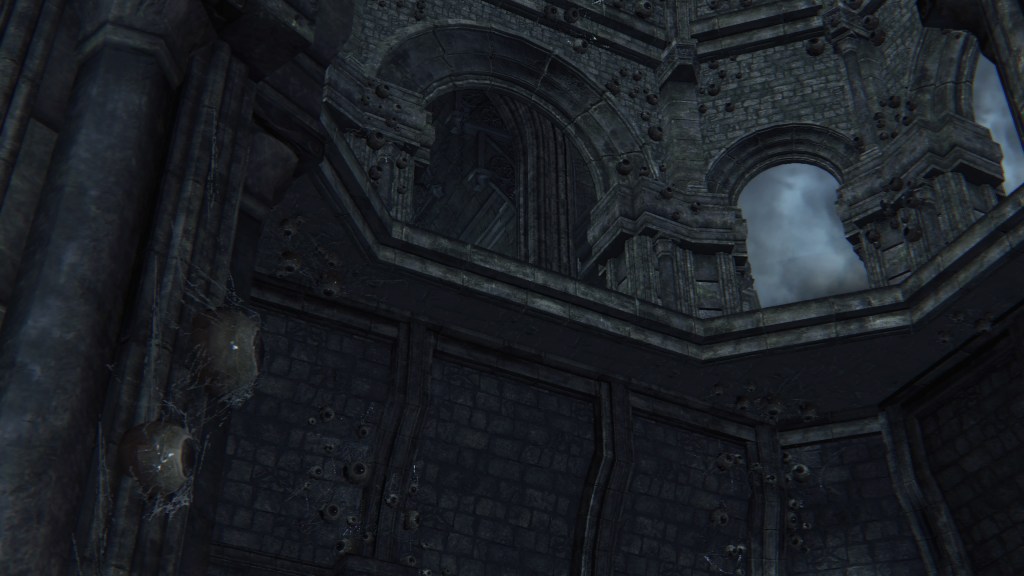


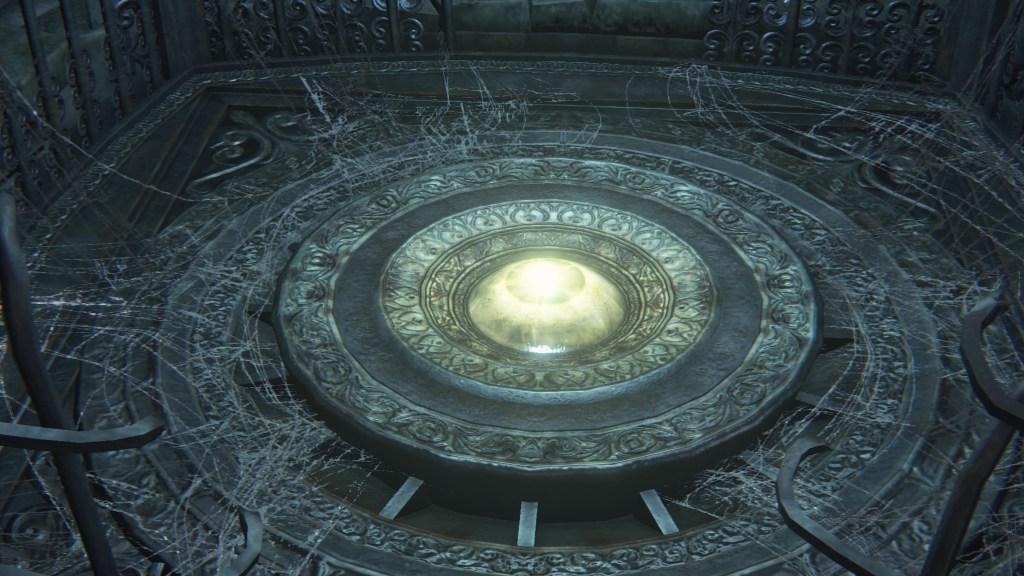
But little did they know, the Brain was totally defective. Being made of corpses, it comes as no surprise that the Great One is rotten. Other than explaining its mostly passive behavior for an enlightened mind, this decaying state has negatively affected its other faculties. Its eyeballs are a kind of “evil eye” that glow with hostility upon spotting a person. Once the Brain spies humans from its tower, it begins assaulting them with shadowy spears which amplify the madness its gaze already brings. Anyone who approaches the Nightmare churches risks death before they can even cross the stone bridge leading to the chapel. A number we see have already suffered that fate. And like the river of blood in the Hunter’s Nightmare, the deep resentment of countless visitors caught unaware have manifested pillars of stone faces everywhere within its field of vision. Even allies are not spared, as the middle great bridge on the Brain’s level is flooded with the same pillars along with bone piles. It is no wonder that the door to that bridge from the second church is locked. Mensis couldn’t afford to carelessly lose any more members.
Key to open the iron door leading to the middle one among the three great bridges connecting the two cradle churches.
There can be no thieves in the world of a nightmare. Even so, there must be a good reason to close the door. Maybe you shouldn’t go near.
Why then did they remain so confident in the Brain’s potential? The answer is revealed from the dead clerics often prostrated toward the Brain on that same bridge. The two bodies furthest away respectively possess madman’s knowledge and a damp bloodtinge gem, implying higher blood quality. The closest bodies possess Great One’s Wisdom and an arcane damp blood gem, implying the highest blood quality. Even if defective, the Brain of Mensis was still a Great One, its maddening eyes nonetheless inspiring. Just the Living String obtained from its remains is a powerful relic needed to perform the ritual with the Great Pthumeru Ihyll Chalice. Experiencing such power gave Micolash and friends every reason to believe this Brain of theirs wasn’t half-baked. Madness from approaching the cosmic truth wasn’t anything new. The School was willing to take the risks if proximity meant drawing closer to transcendence.
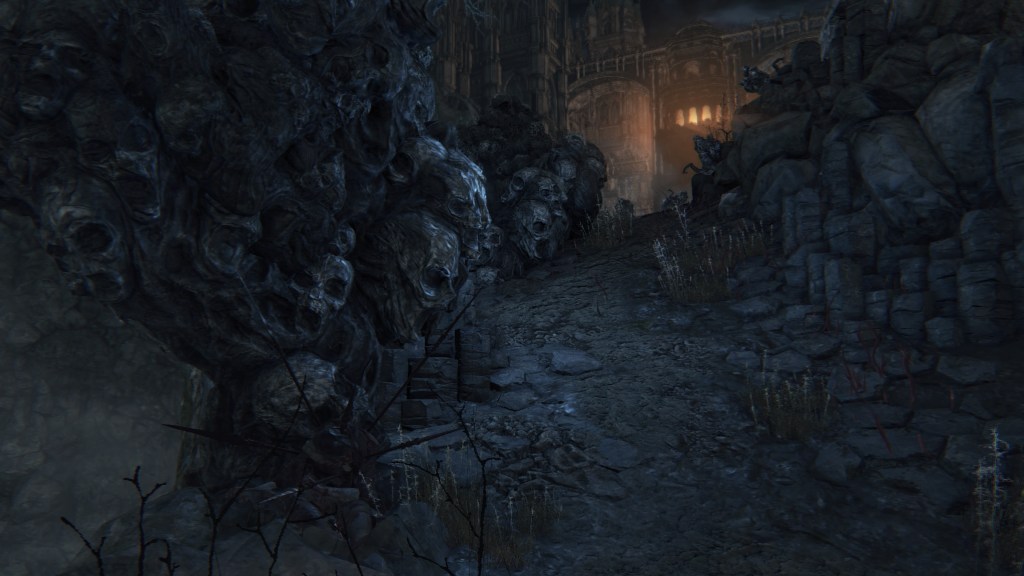


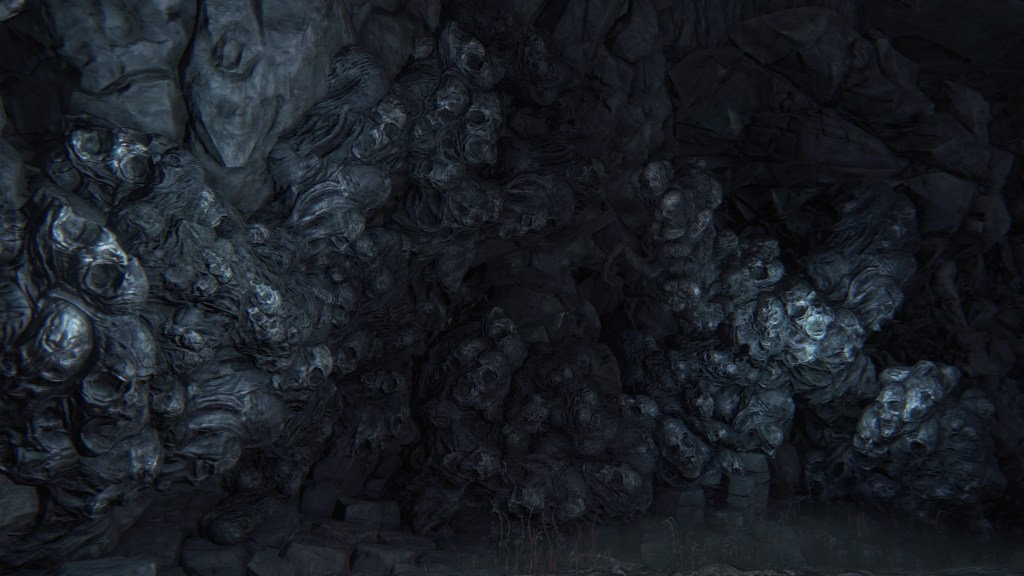








In saying all this, Micolash still had contact with his subordinates in the waking world, many of whom joined him in the Nightmare. Some fans have posited that Micolash’s bodily death has left him trapped, cut off from his colleagues. True, the man may be unable to leave with his healthy body manifest within the dreamscape. But as we can see from the corpses inside and amount of dead at their doorstep, the twin churches have had plenty of human traffic. It doesn’t just go one way either. In the old hidden church to Yahar’gul, preceding the very Amygdala who sends us to the Nightmare Frontier, lies a corpse with lead elixir. Clearly, there were ways to return from the Nightmare for non-hunters, and an inability to formally enter would defeat the purpose of the Lecture Building. Whether by touching his mummy or some other means, those left in Yahar’gul were still capable of crossing over to their leader and back. Most of the School of Mensis probably did join Micolash in the Nightmare. Whatever the wrinkles, their plan to make contact succeeded. Now it was time settle in and get back to work.

Everything Ventured, Nothing Gained
When it came to utilizing the Brain of Mensis, Micolash and his associates started with the most straightforward approach. The winter lantern is an enemy almost exclusive to the Nightmare of Mensis, found both on its Frontier and concentrated around the Brain. In fact, the entity’s head appears to be just a piece of that brain tissue, rotten messengers and all. The main difference is that this mini-brain can produce working tendril arms and jaws of ravenous teeth. And yet, it is head to a humanoid form. Granted, the brain tissue seems to have overtaken the body underneath the bloodied dress, its tendrils replacing the legs and almost both of the arms. It is also no less defective, the evil eyes inflicting the same madness with its glowing gaze and shadowy spears. Besides the amusing eye-shaped pebbles and fitting cursed blood gems, slaying the enemy only awards quicksilver bullets like kin-related beings. All this makes it obvious that the winter lantern derives from Mensis’ Brain, but how exactly?
Close inspection of the body reveals a strong likeness to the doll, though the torso and limbs stretch to dissimilar proportions. The association with a caretaker may be why the enemy sings a haunting tune evocative of a disarming lullaby. However, the doll doesn’t bear any connection to the Nightmare, the Brain, or Mensis outside this instance. That detail might therefore be a scrapped concept from the winter lantern’s initial inception, the developers relying on the copious bloodstains to obscure the similarity during normal gameplay. The broader concept is a humanoid figure whose head has been taken over by a cut of the Brain of Mensis. And who would want to make their head a brain with eyes except the School dedicated to granting their heads just that? Combined with the location, and winter lanterns are probably intended to be Mensis scholars who somehow planted a slice of the Brain on their heads. Even if that wasn’t the original intention, it still complements what they are called.


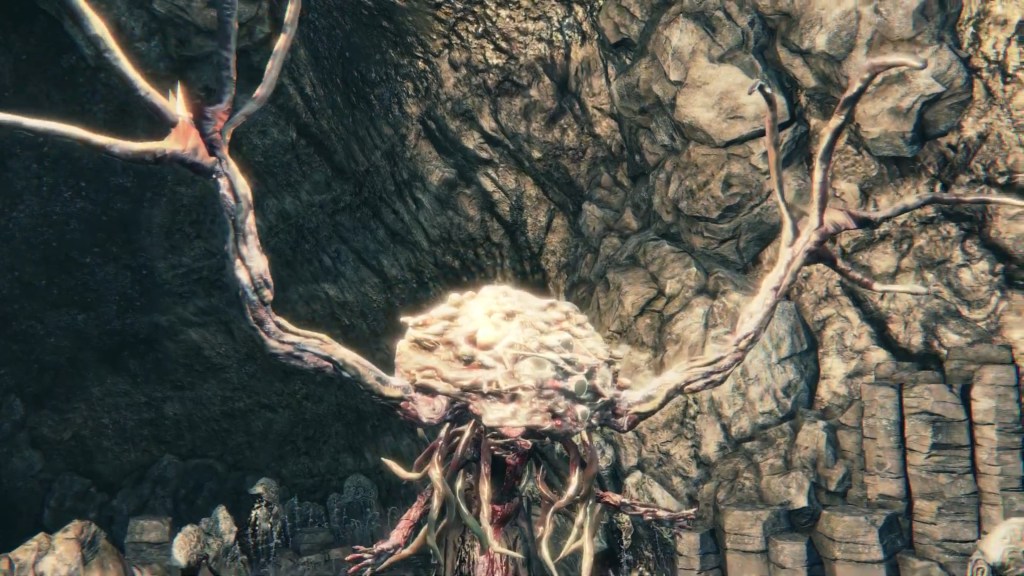


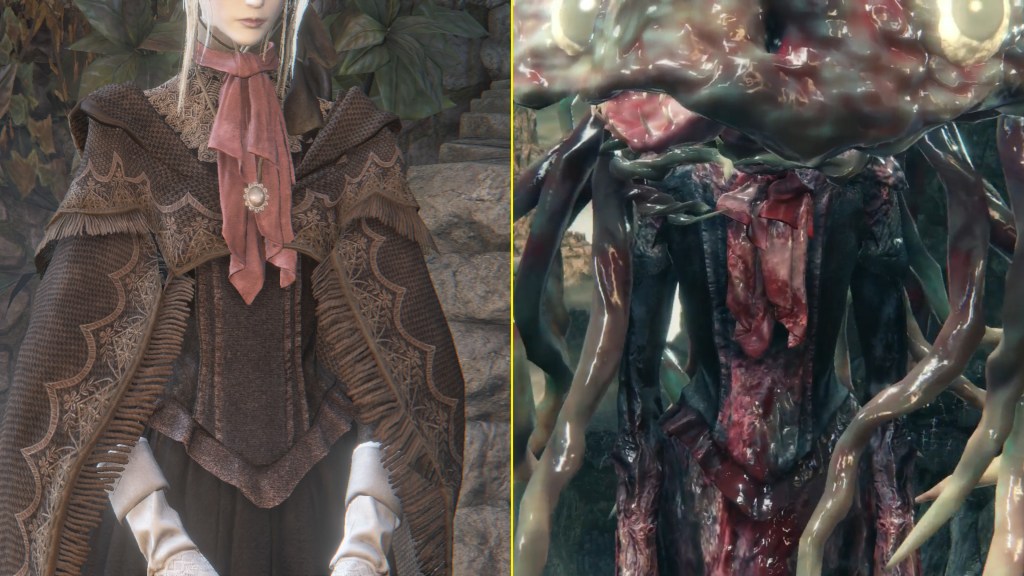
While it might look odd at first glance, the English name is referring to hoozuki, (ほおずき) a dried fruit plant colloquially known as a winter cherry or Chinese lantern. This is because their fruiting calyxes resemble paper lanterns until winter, where they degenerate into a cage-like network of veins revealing the so-called cherry. That specific appearance is presumably why the developers chose the name, the multi-eyed head bearing a vague resemblance. Of course, the plant association also brings to mind seedbeds for insight. From that view, the brain tissue would be the blooming seed of enlightenment planted in the head. Historically, the plant was used as both a sedative and abortifacient, ironic for a mad entity who will never reach its next childhood. The calyx is likewise used as an Obon offering, substituting for the paper lantern that guides ancestors’ spirits back to earth during the Buddhist festival — and the enemy lights up like a lantern, though leading the living to death. Everything about the name impresses the winter lantern as a beacon of enlightenment-gone-wrong.
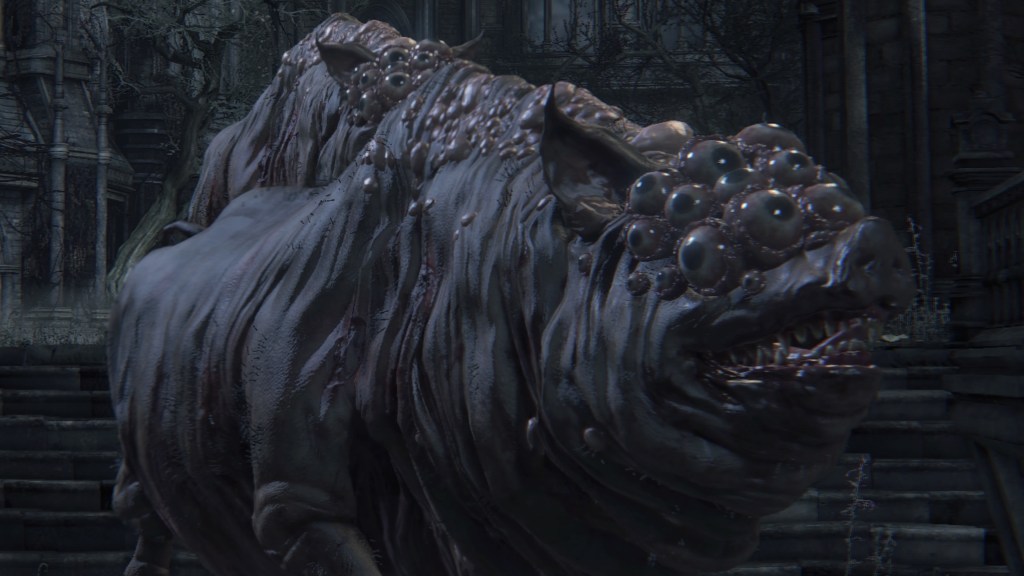
Although this implies the enemy to be a failed experiment, the School of Mensis weren’t hasty in this endeavor. As we ascend the second church’s exterior levels, we encounter a number of nightmarish creatures. First are the familiar carrion crows and mad dogs, the former often chowing on the latter — except their heads are disturbingly swapped. Next are the maneater pigs, except they possess a clump of extra eyes. While it is easy to disregard these as mere creations of the dreamscape, they are more likely products of Mensis experimenting on actual creatures. The pigs demonstrate the School trying to transplant eyes to grant an entity more sight, while the dogs and crows betray their interest in seamlessly replacing the head of one living being with that of an entirely different organism. Both fit as tests in anticipation of transplanting the Great One brain to their own heads, which would require live but not necessarily human subjects. We can even trace the beasts they use to the same source as their human specimens.
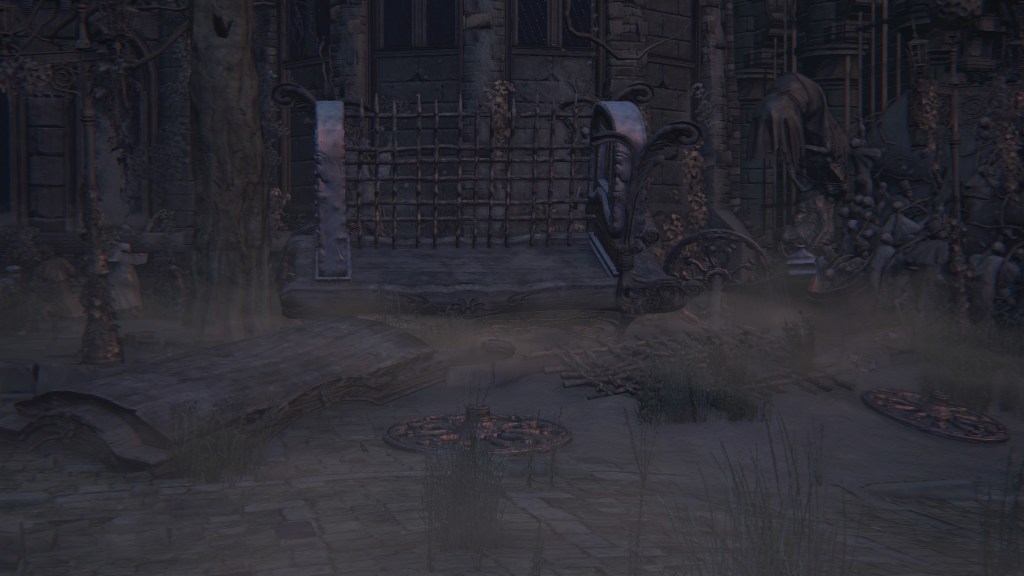
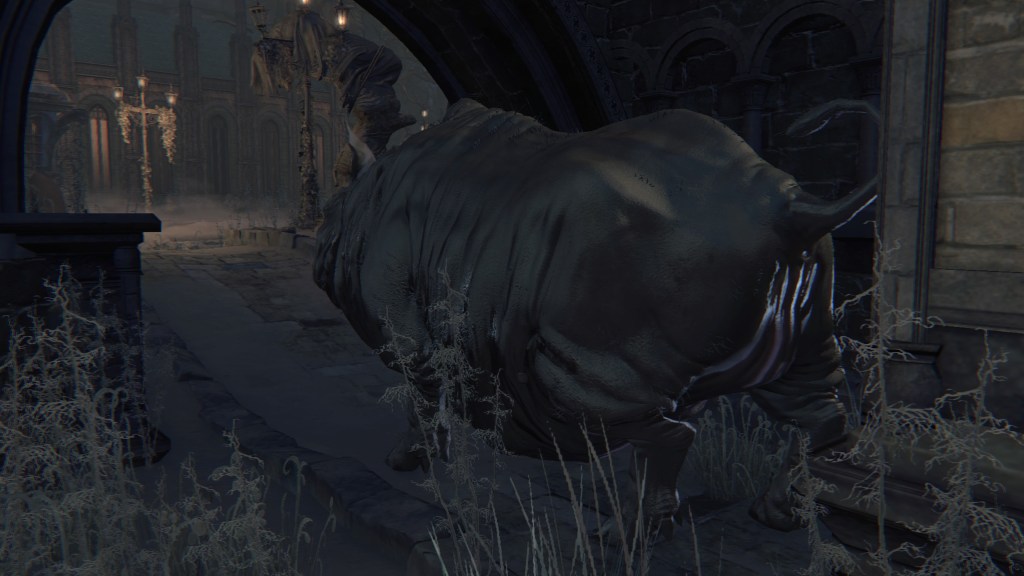
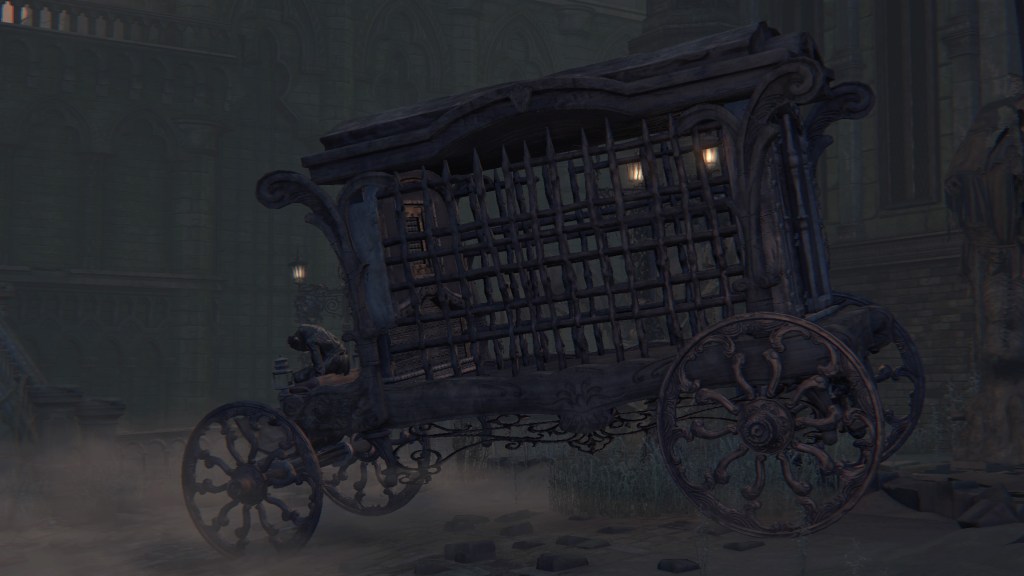
Exploring Yahar’gul before the red moon, we come across two ordinary maneater pigs: one coming up the slope from a burst-apart cage wagon, another lurking in the alley across from a similarly broken wagon. These wild beasts were brought into town like circus animals, only to break free of their confines. They weren’t alone, since the same wagons fill the streets. One in particular still has its dead driver, a Yahar’gul hunter judging by his armor. Perhaps the Mensis stooges were bringing in human captives by the cartload. However, it is plain that their task has been to capture more than just bipedal test subjects. They might have even searched closer to home, as there is a suspicious lack of crows fattened on the city’s endless supply of carrion in town. The only dogs are likewise the kidnappers’ own breed, not the ones seen in the Nightmare or the rest of Yharnam — and hunters stop needing a hunting dog once beasts are no longer their prey. Factored together, Yahar’gul has probably been supplying Mensis with all these animals for experiments on top of their regular haul.
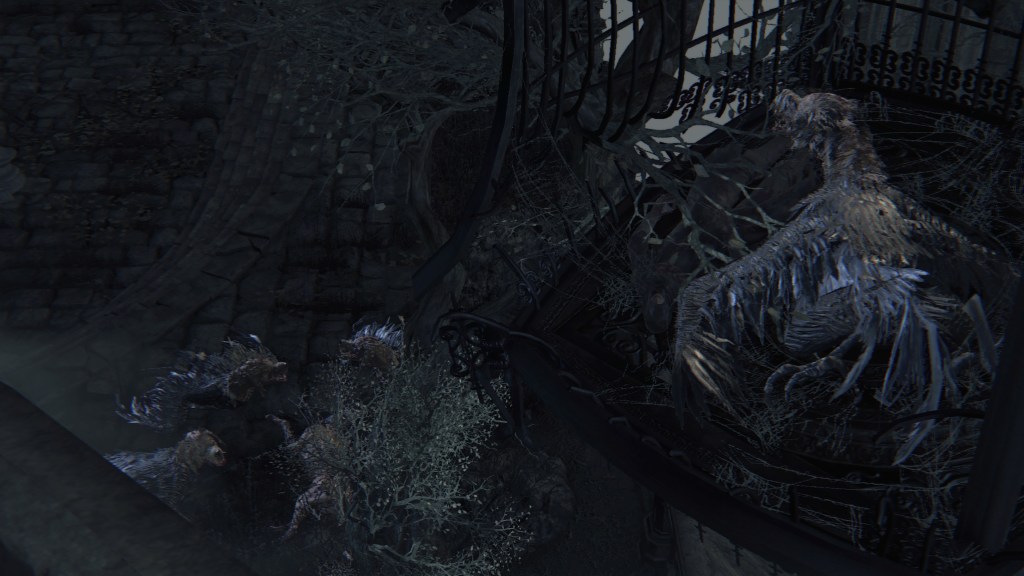

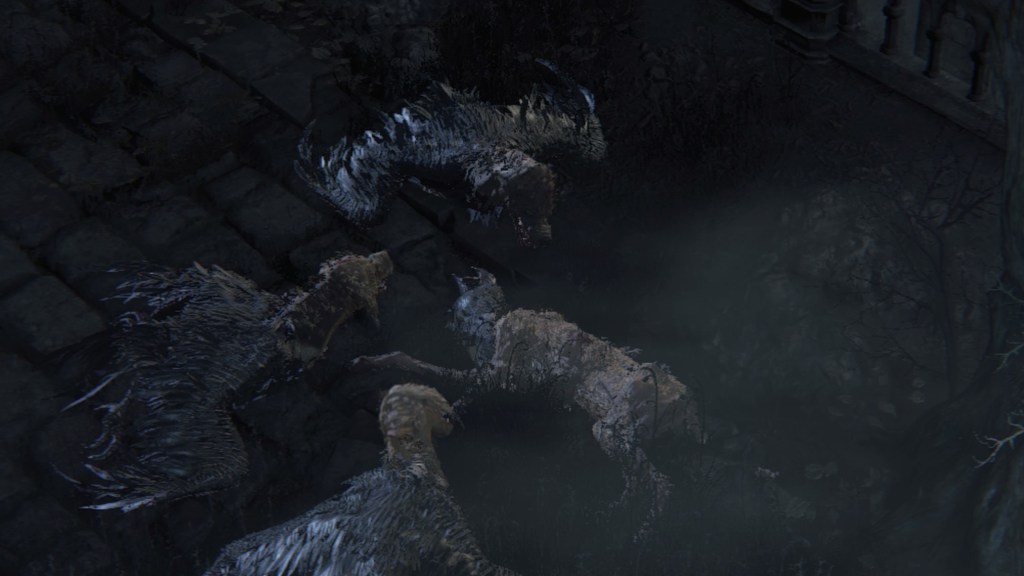

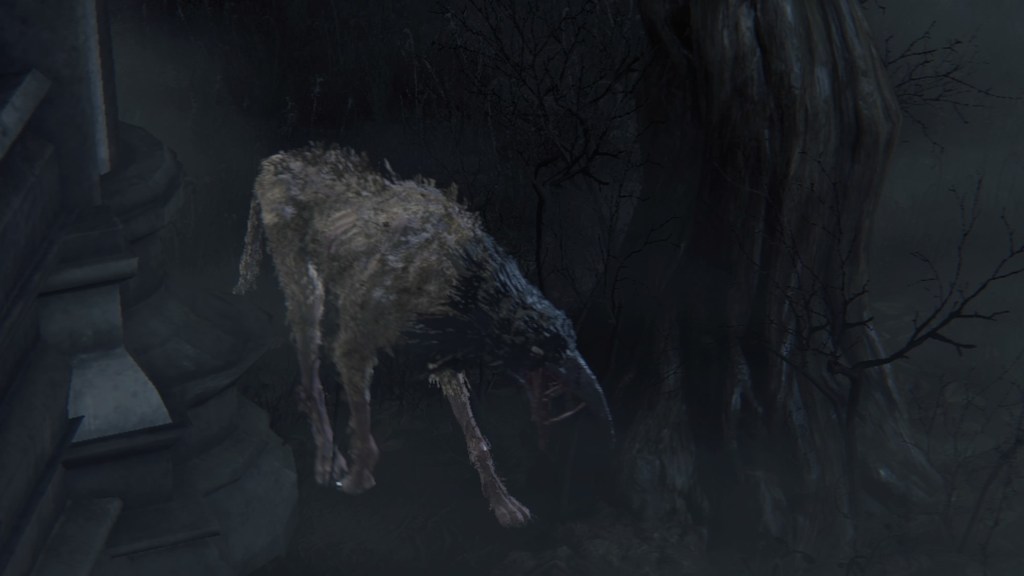





In short, the winter lanterns are the culmination of numerous experiments, Mensis scholars starting with animals before applying those principles to themselves. Despite the slight change in plans, they were measured in their response. But as we can see, every attempt has been utter disaster. Even though the upper great bridge is out of the Brain of Mensis’ sight, it is nonetheless filled with stone face pillars, the winter lanterns walking amongst them. More pillars overrun the first church’s rafters normally accessed via the middle bridge; there, where the Brain’s vile gaze still does not reach, another lantern roams. Without a doubt, those experiments have cost Mensis as many lives as the Brain itself. Half of them look to have been expelled to the frontier as a result — a couple subsequently fell into the Hunter’s Nightmare and now terrorize snail women within the Fishing Hamlet’s cave system. Out there, the rejects can wander aimlessly without causing further damage to their former colleagues. This was evidently the policy up until their most recent batch, and it wasn’t just limited to the winter lanterns.

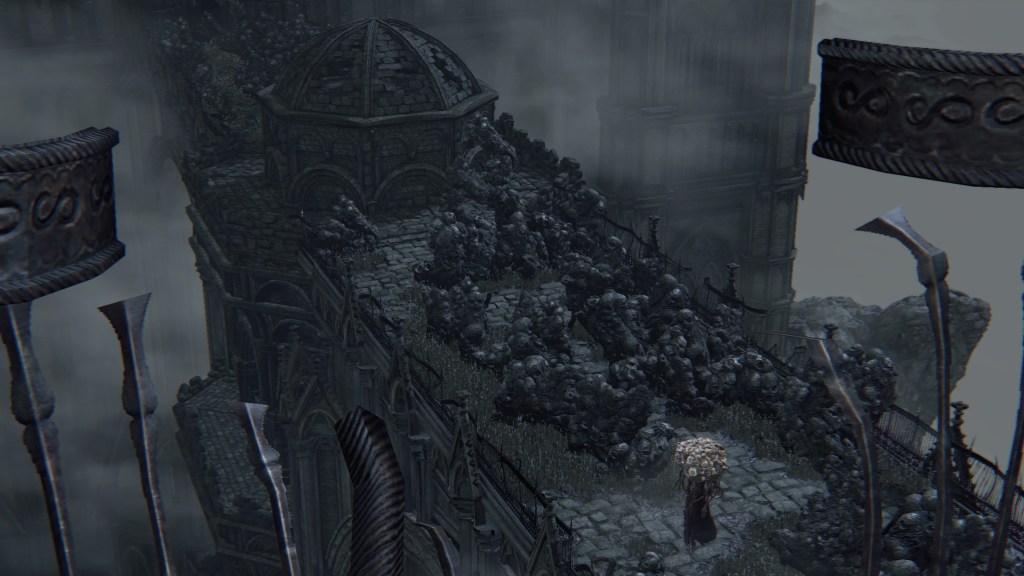
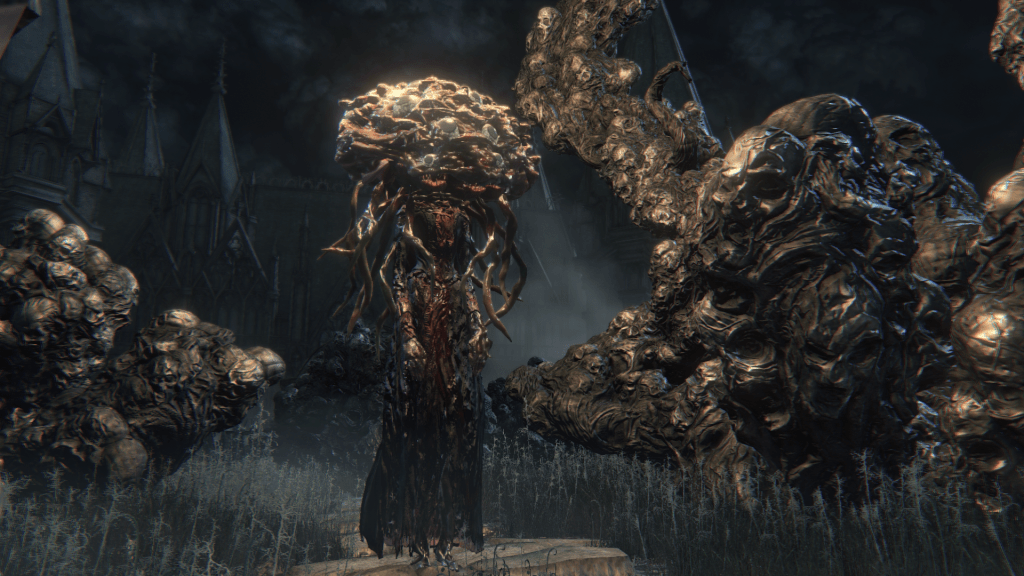

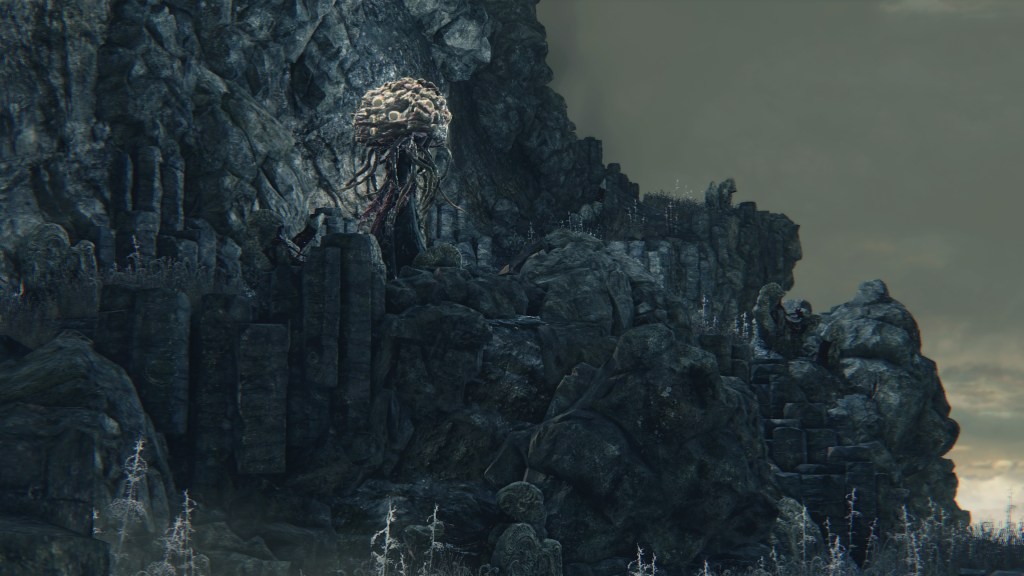

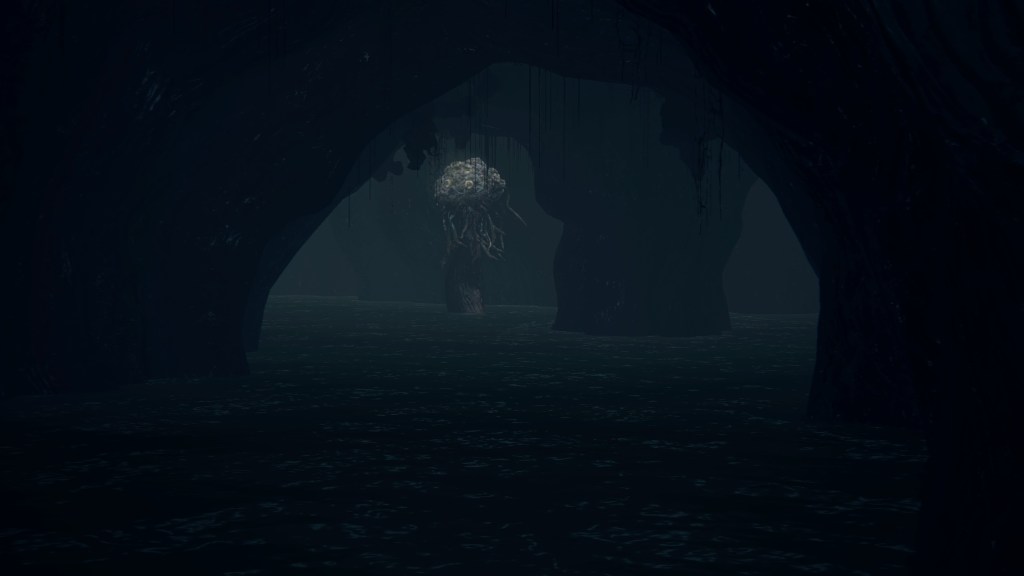
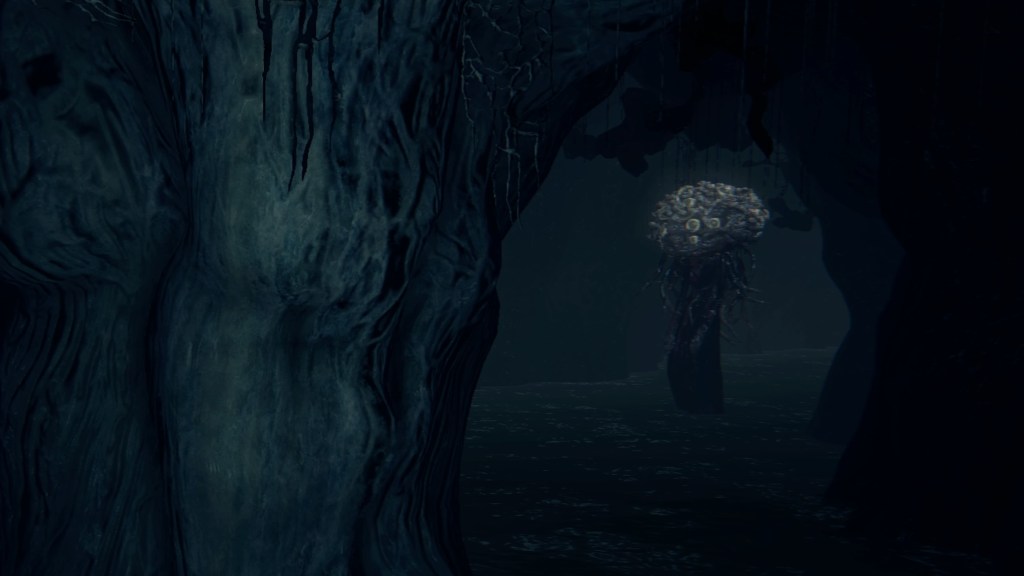

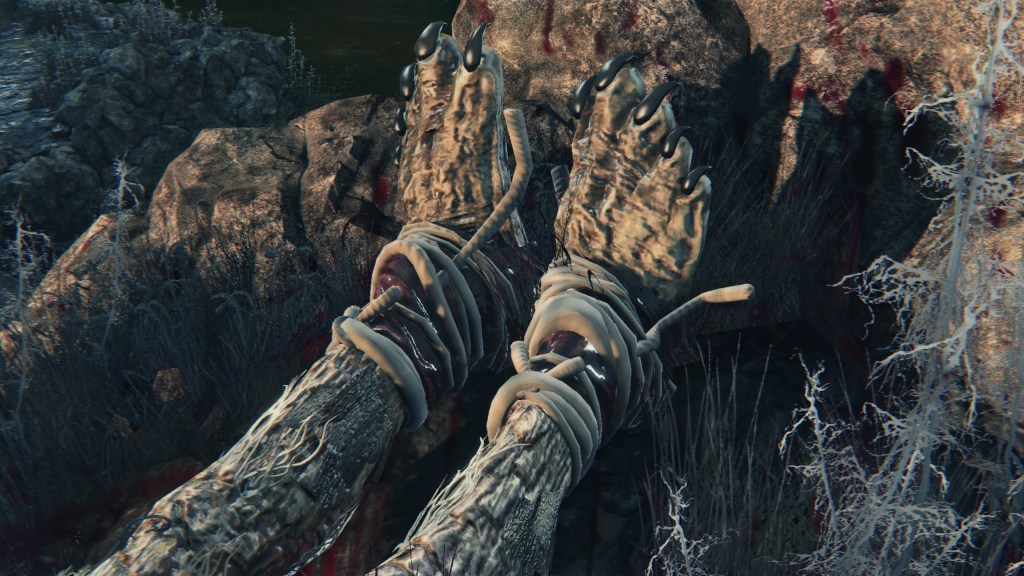
The giant lost child is a hulking humanoid with a deformed head, fattened feet, patches of fur, and a multitude of bodily scars. Its name is more accurately a “foundling giant”, (捨て子の巨人) the term for foundling more literally “abandoned child” rather than just lost. And where do we find the enemy? Solely in the Nightmare of Mensis, everywhere except within the twin churches. This suggests that the giants were abandoned by the School. We are able to loot lead elixir from their corpses, meaning that they have suffered the nightmarish despair needed to produce it — and as Iosefka’s imposter proves with Gascoigne’s youngest daughter, that is a possible product of inhumane experiments on innocent men. True enough, we can collect that same elixir from a cleric corpse in the second church. The creature’s feet are also wrapped in rope, perfect for a human subject tied down as they are transformed into a monster. Taken together, the giant appears to be another failed experiment kicked out into the wilderness.
That begs the question as to the nature of the experiment, which is simple to surmise. Based on the victim’s fur, claws, and strength to hurl a boulder, their mutations are likely a result of the beast scourge. The beast blood pellet is another drug we can acquire from the dead clerics in their church lab, so Mensis are perfectly capable of inducing the disease. But looking at the results of the blood evolution, they seem to have been tinkering with the process so that the infected subjects maintain some element of their humanity. In other words, they were trying to create a beast whose mind and body wouldn’t degenerate, in accordance with the School’s theory on transcendence. The giants’ scars are probably the byproduct of confirming this process, cutting open the subject to closely examine the disease’s progress. We do find chests containing an inflicted organ and yellow backbones at the second church, so they were definitely surgically removing body parts from infected there to study. And once they got their observations, the feral subjects could be dumped outside and forgotten.
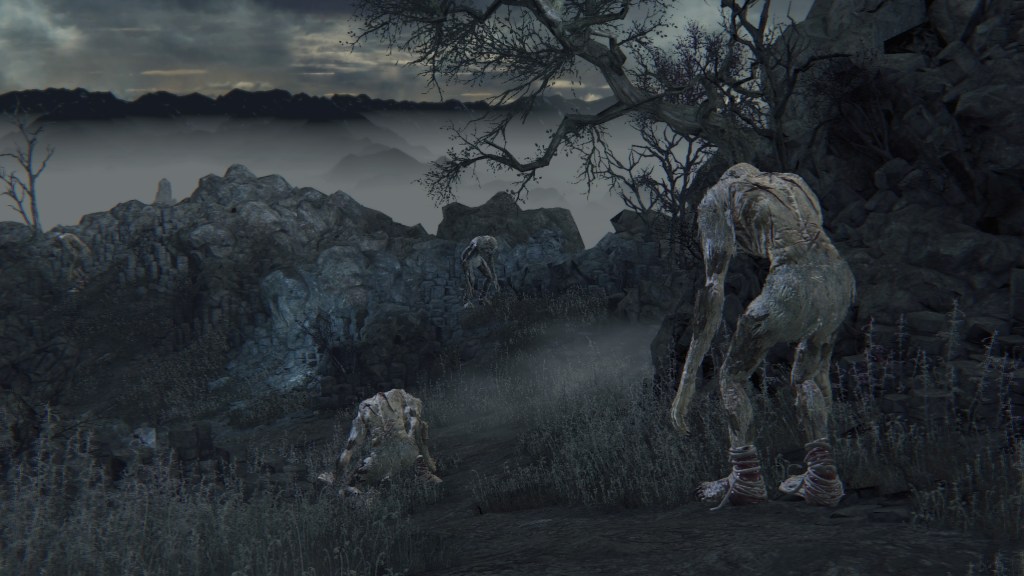
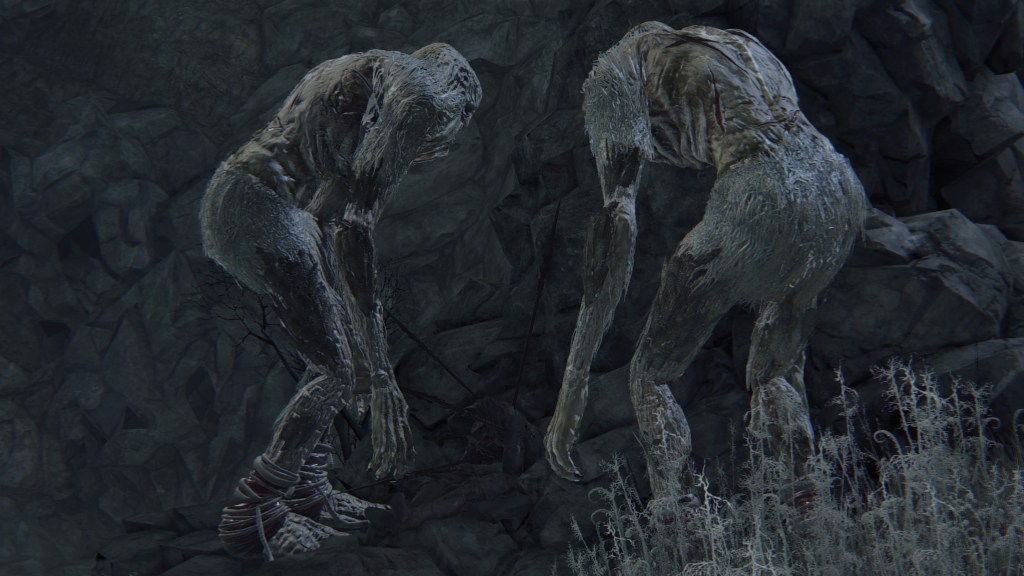


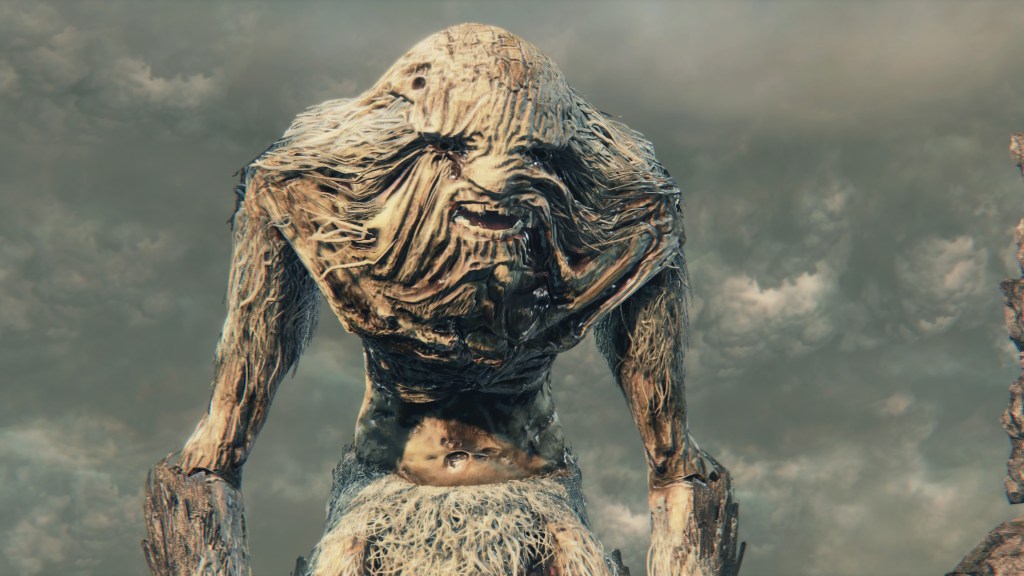
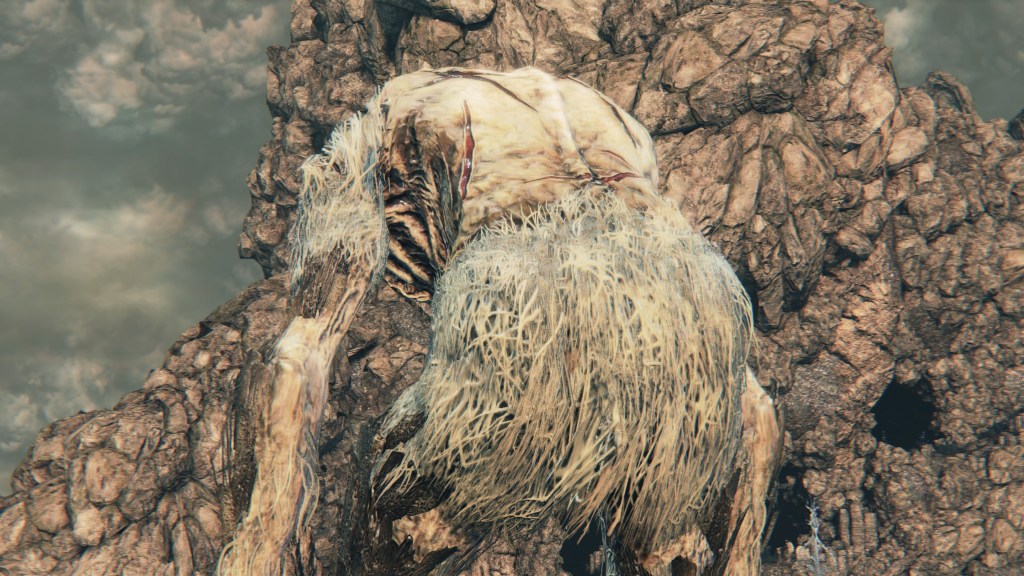
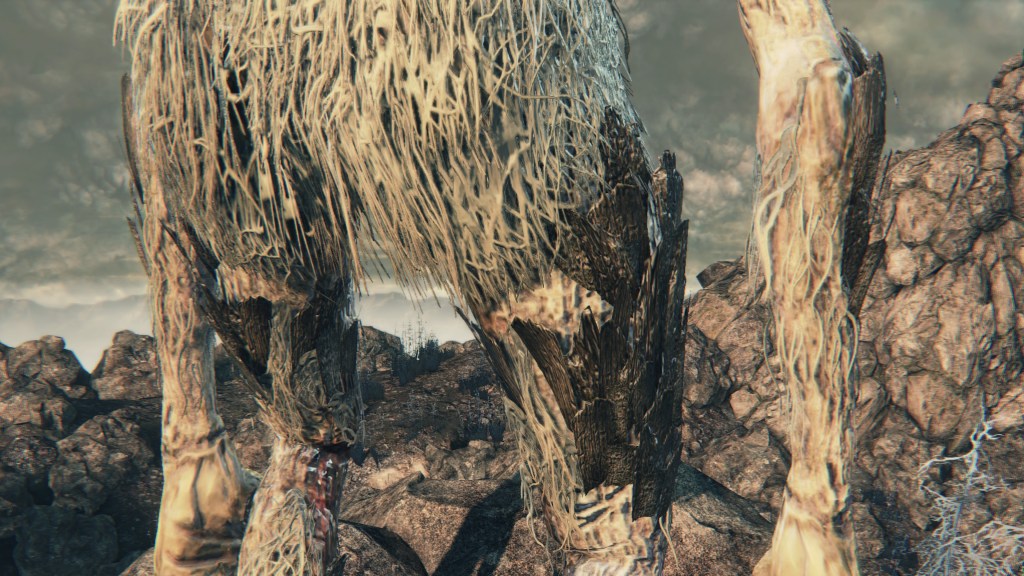


From this, the ongoing failures with the Brain of Mensis had prompted the School to review their own assumptions. They felt compelled to better grasp their understanding of transcendence, to see what exactly caused man to surpass the beastly idiocy as the blood induced his evolution. Perhaps the giants were never expected to succeed, but they were supposed to help Mensis more fully approximate a process they previously only conceptualized in abstract. Human bone piles litter the area around Mergo’s baby carriage, indicating that the Wet Nurse has slain countless who have come near her child before us. Just outside the boss room sit another assembly of mummified prisoners in Mensis Cages, a clear sign of the School’s attempts at correspondence with her from afar; all manifestly rebuffed. It is certain that the Great One has no interest in dealing with Micolash and his cohorts further, now that she has her infant. They are tolerated in her “cradle” for Mergo as per their arrangement, but she will kill them all the same should they cross the line and disturb the crying babe she is trying to put to sleep.
That isn’t to say that all their interactions with the Great One have been negative. Various cleric bodies around the twin churches possess kin coldblood, so there are enlightening experiences still occurring among the scholars. We even see the end result for some. Unlike the spiders in the Chalice Dungeons, the “nightmare apostles” lurking in the first church are the Wet Nurse’s kin specifically. Internally, the enemy is named “death and darkness kin” (死と闇の眷属) where “death and darkness” is a label attached to the Wet Nurse, presumably referencing her deadly flurries with multiple blades and pitch-black fog she can conjure. Therefore, in the context of the Nightmare of Mensis, the spider kin must be intended to come from the spider-like Great One in the same area. The human heads of some among them further affirm their origin as the resident Mensis scholars. While doubtless not her intention, the Wet Nurse provided at least those academics the insight they so craved.
Given that they are called apostles, these clergymen have decided to serve their Great One the same as Rom’s children. But unlike the vacuous spider, Mergo’s Wet Nurse doesn’t care for a posse, so their only possible service is guard duty. Mergo’s attendants aren’t stationed in the first church, so the apostles have taken it upon themselves to guard the building. The lesser kin who couldn’t fully discard humanity have been left to patrol the small chamber on the upper level. Meanwhile, only a handful of the others guard the mid-level rafters, almost certainly due to the winter lantern. The rest hang from webs in the lower-level oratory, ready to “greet” unwelcome guests — including one especially large spider, possibly their leader. Suffice to say, the apostles’ allegiance to Mensis is all but abandoned, most likely hoping that the Wet Nurse will award them new insight to further their evolution should they please her. However, this highlights the Great One’s indifference to Mensis’ plight. Her sole concern is protecting Mergo, hence she has allowed the bottom floor to her church to collapse beneath their feet.
In fairness, her paranoia is justified. Next to the lift leading up to the babe lies a chest containing Iosefka’s Blood Vial. This is odd, since the good doctor bears no obvious connection to the School of Mensis. Yet the otherwise random placement may be a clue. Ignoring the name and description, what is the item’s concept? High-quality blood in an admittedly crude vial. Great Ones, of course, have blood of the highest quality, and crudeness is the Mensis aesthetic. The developers thus probably intend for the item in that chest to represent Mergo’s blood, choosing Iosefka’s vial specifically because its menu graphic best matches the reimagined origin of the three obtainable at the game’s launch. With all their other experiments, an infant Great One’s essence is an unignorable point to study. And if the bones are any indication, there was much sacrifice to get their hands on that blood sample — no wonder the Wet Nurse resorts to ingesting the child when we get too close.

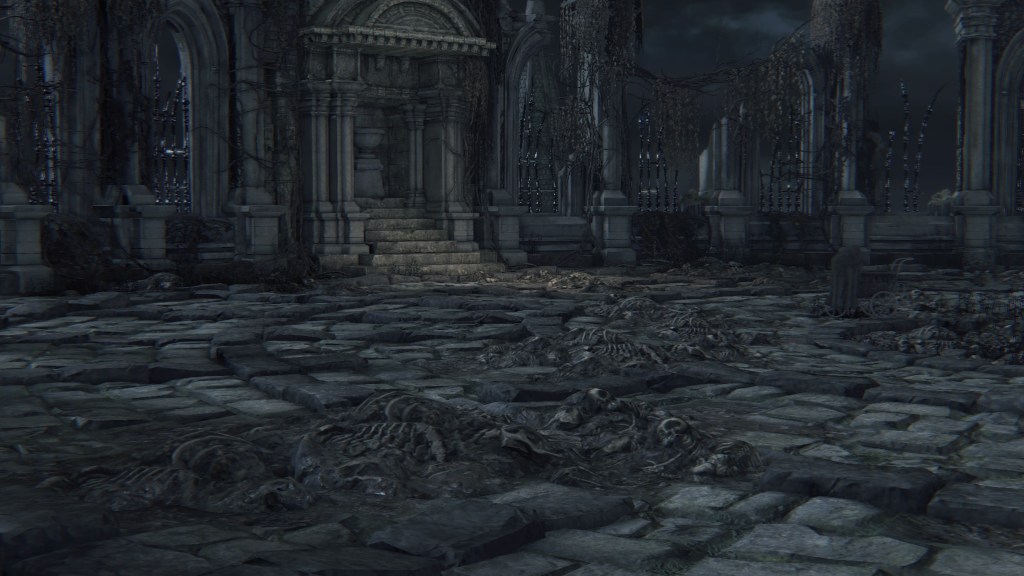
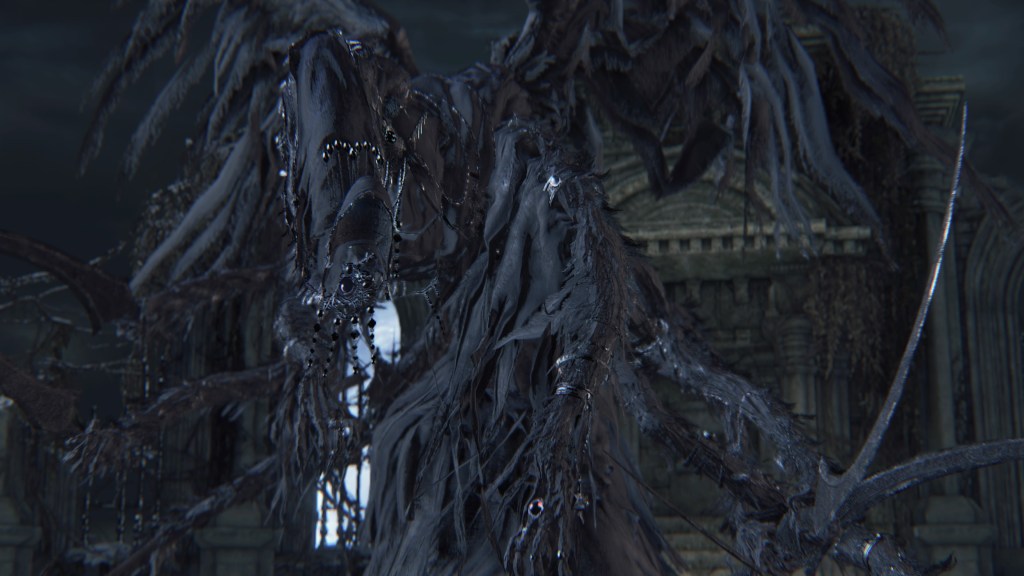


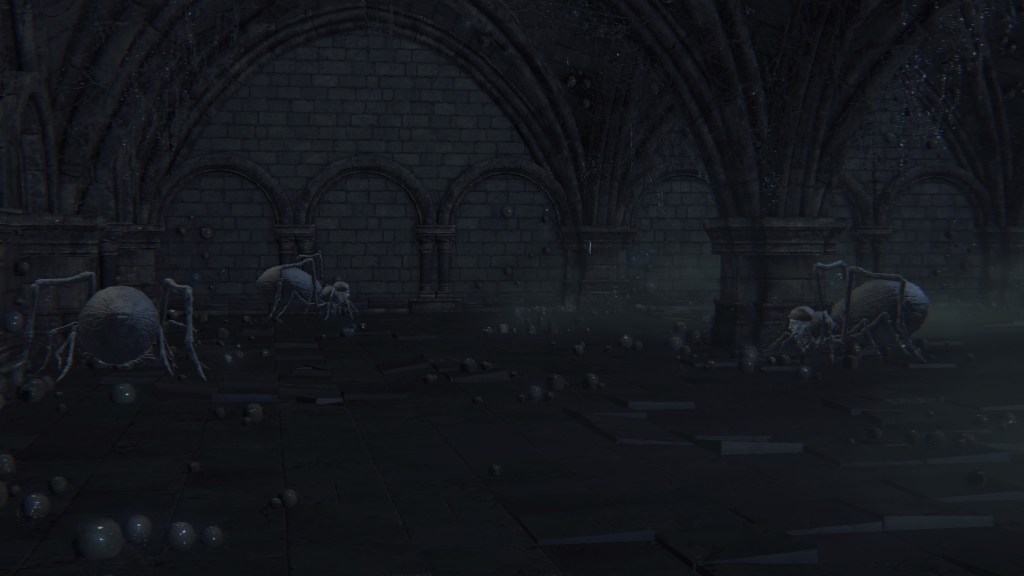
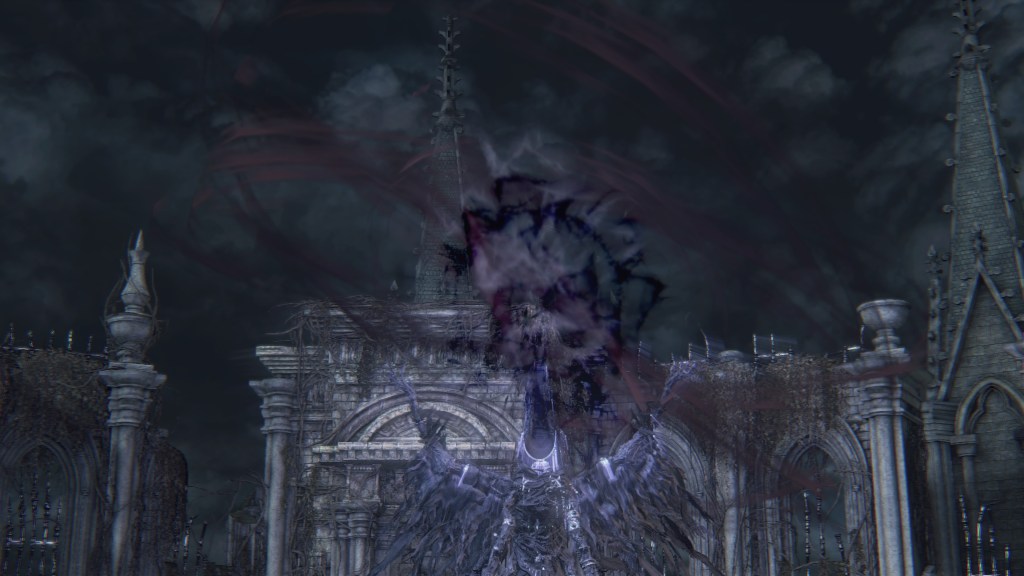
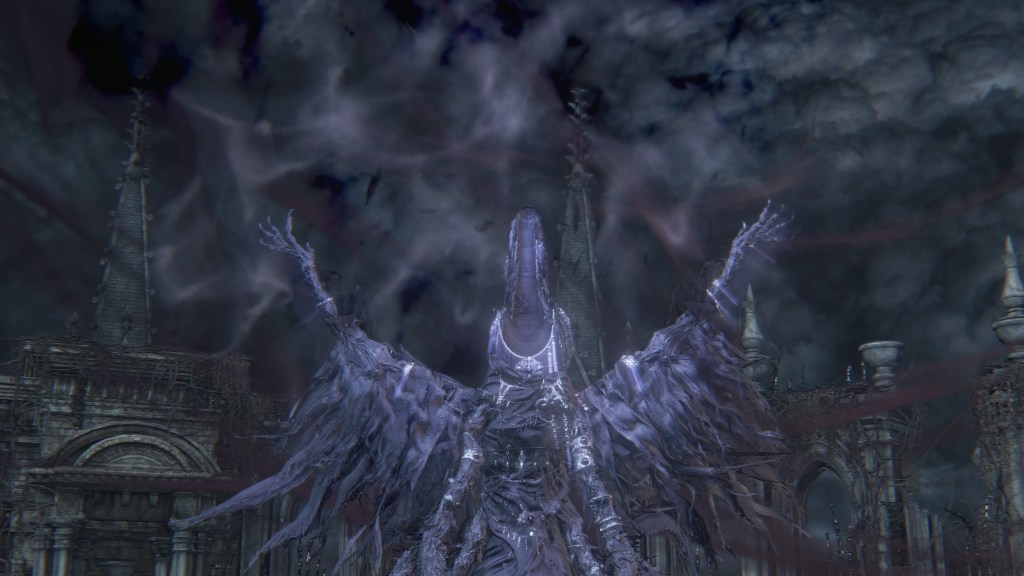


Put simply, neither Great Ones are much of an option for aid in their renewed research. Micolash and his surviving subordinates were left to rely on themselves and a rotten brain throughout this whole ordeal. And so, they have been spinning their wheels in the Nightmare, performing repeated test after test with no better result. Again, had they realized that the whole premise to their theory was fallacious, they might have been able to make real progress. But after coming so far, there was no way the scholars could fathom the possibility. With how much the School staked on one-upping the Choir, their pride wouldn’t allow it. How could they be wrong when they had so much success up until this point? They just needed to add a few pieces of the puzzle, fill in the gaps in the road to godhood. Meanwhile, the waking world continued reeling from the fallout of their wasted effort.
God is Dead
As we can experience firsthand, the abductions have persisted. The aforesaid experiments required more subjects to be delivered, and the carriages on the road to Advent Plaza show how Yahar’gul facilitated that. However, the hidden town cannot be shuffling all these prisoners over to the Nightmare. Adella heard her fellow captives’ distant wails after witnessing them get taken away, suggesting that there are horrific ceremonies being performed with them there in town. Although we are unable to come across these experiments during our prison escape, we do witness some of the results following the red moon. Certain mummified bodies appear kneeling in the streets, contorted back in a pool of glowing liquid setting them aflame. The liquid dissipates as more flesh is burned, and the waxy crater containing it is the same underneath the church’s warp basins. Perhaps the clerics were testing the limits of cross-planar movement without an apparatus. Regardless, this horrific display is just one example of their work this night, and it is barely a sideshow.


Bell ringers throughout town summon men, women, and dogs, the enemies bursting into form from the ground via spontaneous blood and collapsing back into liquid after death almost as quickly. Unlike their counterparts in the Chalice Dungeons, the Yahar’gul clergywomen do not conjure these thralls infinitely, though they will reconstitute those slain. Disrupting their connection with the summoner still momentarily disorients the summons and weakens their defenses. And going by the enemies summoned, these are most likely the kidnapping victims. This includes the Hemwick gravekeepers present, standing in for the Yharnam women abducted in this context. It seems that, even in death, the clerics have found use for their test subjects, resurrecting the souls with their own blood in ghoulish fashion.
Such research seems to have been the domain of the clergywomen more broadly. Eye collectors in the church are happy to extract bloodshot eyeballs — more than stony lookalikes, at least. Under the School of Mensis’ influence, these bloodied clerics seem to have been dissecting the live prisoners, no doubt curious to examine Willem’s concept of insight. More information on enlightenment, especially in the course of blood evolution, would be a key asset to Mensis’ research. But notably, this leaves the men solely as muscle, snatching and securing specimens. The women were allowed to take the lead in the experiments, whether for practical or cultural reason. It is certainly not for their protection. One eye collector has ended up in the Hunter’s Nightmare, apparently greedy enough to try taking her prize after the victim had already transformed into a beast. And from what we witness, fatal accidents were to be expected.

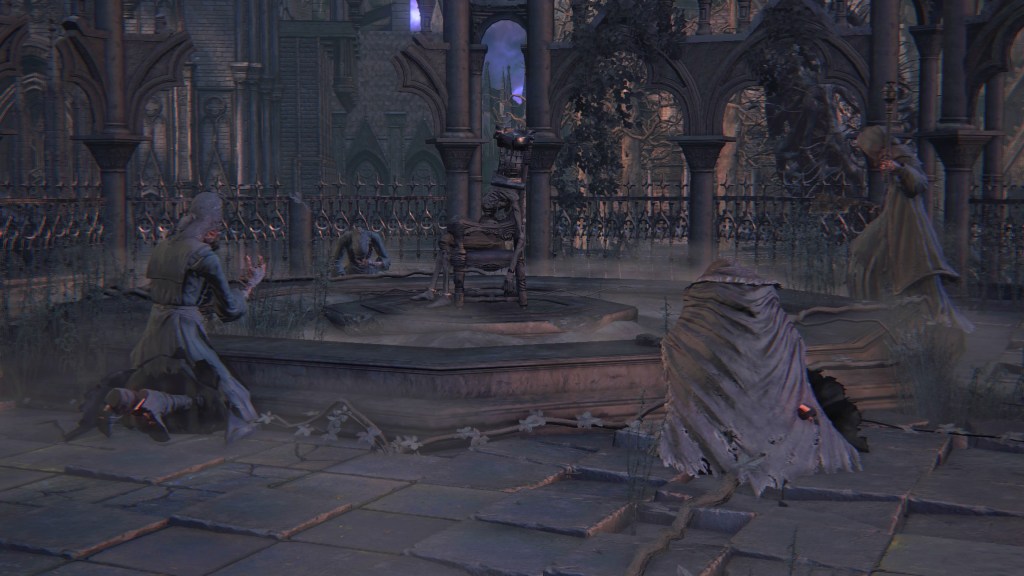

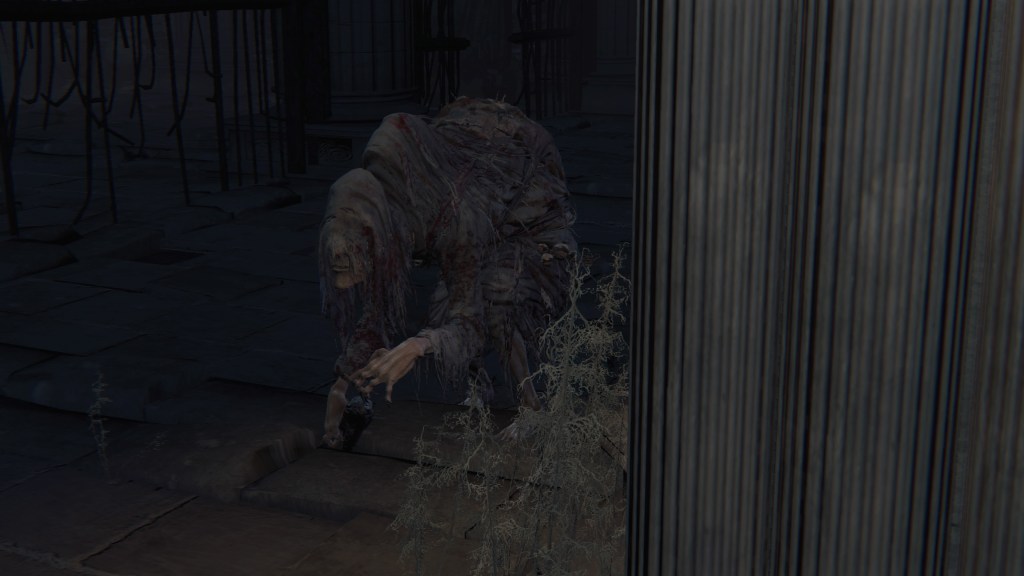


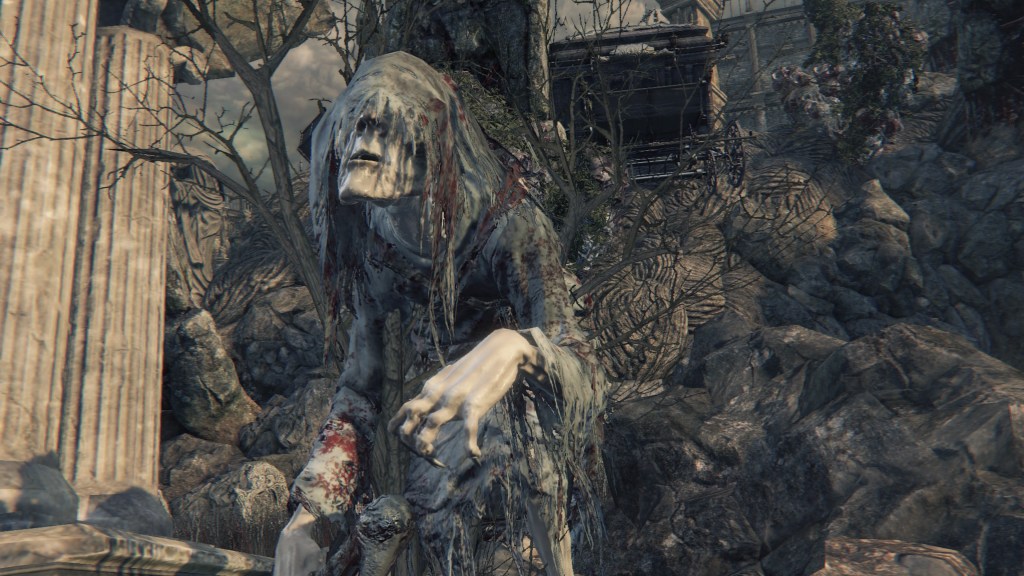
Prowling about Yahar’gul that moonlit night is an unconventional type of scourge beast, to say the least. The infected has grown almost no fur, the body more human in many ways. However, it also looks more twisted and grotesque. The hulking flesh appears to have burst open; skin rent apart, organs exposed, sinew strained. There are also uneven bone growths atop the head, not to mention lines of ginormous teeth extending all the way down the throat and past the sternum. If the open maw with no lower jaw wasn’t already unnatural, the beast’s forelegs sprouted from the thigh and shin of the existing human limbs. Compared to any other victim of the disease, such a person underwent the most uneven transformation. We can infer the cause from the beast blood pellets on the remains, but that still doesn’t explain why such degeneration has only occurred in Yahar’gul. Why does it look like a corpse? In all likelihood, this was the result of inducing the scourge when the body was already a corpse.
The clerics are certainly performing a kind of necromancy, as in town also roam the cramped caskets. Unlike their dungeon counterparts, these mountains of corpses have all burst out of box coffins they were stuffed in. One even leaps out of a hearse after evidently great effort breaking free, rocking the vehicle until — conveniently — we pass. Another hearse is found further down the street they meander, so there is no doubt that they were all stored, ready to be taken away, since before the red moon. And by all observation, they were once human, which may be the reason for them producing beast and kinhunter gems both; balances their nature out. The only conclusion then is that Yahar’gul collected a bunch of dead prisoners in a mass and revived them together through their ceremonies. Whether dissatisfied with the results or not seeing immediate further use for them, they were shelved. Nevertheless, their existence proves that the clergy have been tinkering with bodies after death.

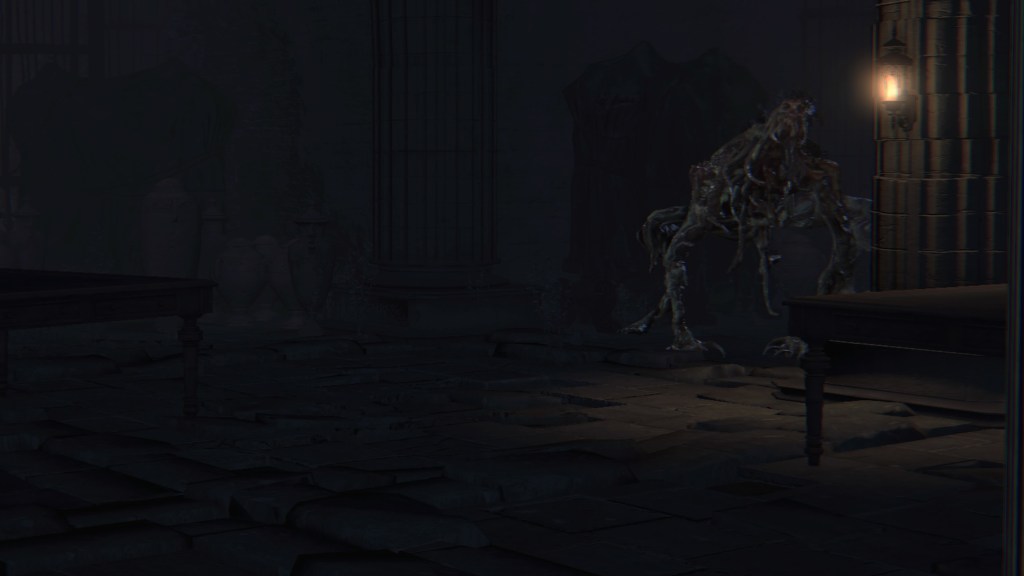


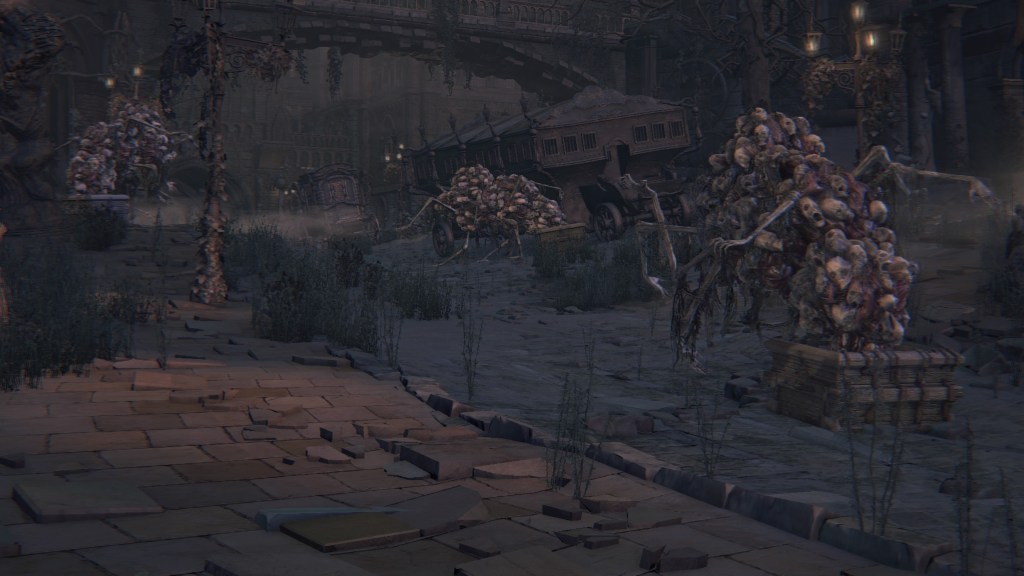

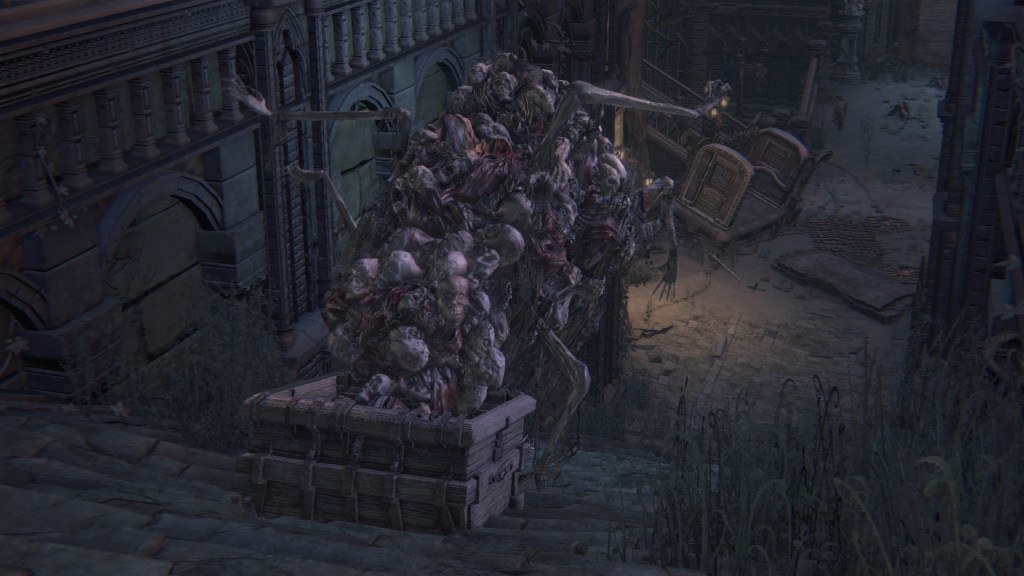
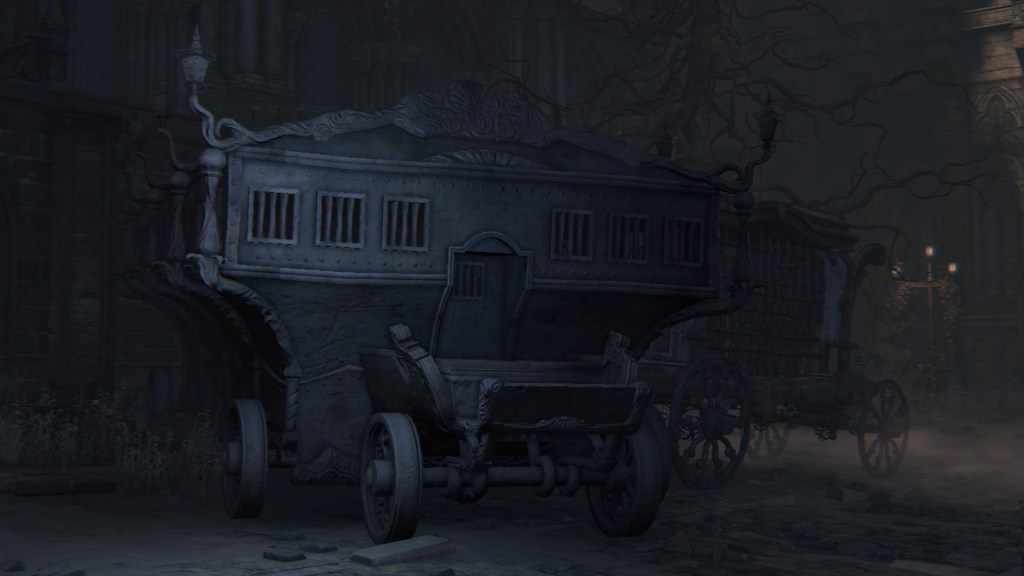
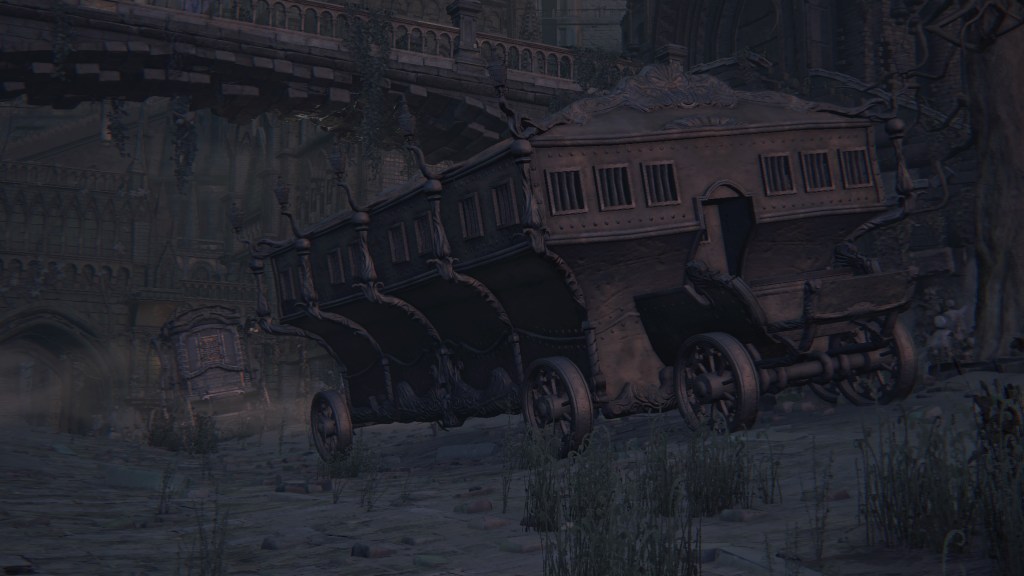
With that established, we can fathom the process and motivation behind Yahar’gul’s unique brand of scourge beast. More than likely, they killed the test subjects shortly before or after feeding them the beast blood, stimulating their own blood to revive but unevenly — a corrupted will logically has a better sense of itself in a living host it has continually operated rather than one whose life force has inevitably waned faster in some areas than others. Again, when considering the rituals performed in the Nightmare, this is yet another clear trial for Mensis’ theory. They have failed with making the living reach beyond the beastly idiocy; why not try the dead? Whether it is one or a collection of dead bodies, perhaps eternal sleep is needed before man can surpass the base beast and become an enlightened resident of the dream realms.
All of this culminates with the creation of the One Reborn in Advent Plaza. This is where “Reborn Plaza” (再誕の広場) gets its name, special bell ringers in red spawning the reborn one (再誕者) from a shadowy cosmic mass above the square right before our eyes. The name and appearance betray the boss as another collection of cadavers, one body still retaining its wooden collar as a former prisoner. And despite the rickety look, the reconstituted entity is powerful. The bare flesh is surprisingly resistant to the arcane, dripping with mucilage it occasionally vomits to deal arcane damage. The boss can also conjure similar dark clouds in arcane arts — in particular, the upper body stemming prominently from its “shoulders” likes to rain down more body parts or generate explosive balls of energy to fire. Its only major weakness is electric bolts, presumably because shocks to the various nervous systems disrupt the arcane power barely holding everything together. If not for its grotesque appearance, one might mistake it for a higher being, and that is very much the intention.
The One Reborn bears a vague similarity to Amygdala in form, which is especially apparent when comparing their concept arts. The boss likewise has “failed-to-be false god” (なりそこないの邪神) as its internal name, meaning that the subtle resemblance isn’t incidental. Yahar’gul’s clergywomen were attempting to recreate the patron deity of their church out of corpses. This might be why the cutscene before the battle is angled so that the dark cosmic portal the boss emerges from overlaps with the red moon; trying to replace one Great One with another. But despite what it is called internally, the game’s trophies don’t even label it a failed-to-be Great One, making it just a poor imitation of their god’s form. Nonetheless, the attempt makes the clerics’ inspiration easy to parse: they have been trying to reverse-engineer the Brain of Mensis. The School realized that the brain was made from dead bodies, so have tried to replicate the results with humans. If the current Great One doesn’t work, they can just create another. All this reviving the dead has simply been researching that end.
This certainly brings a new meaning to their statues combining the masses to achieve divine correspondence, which Yahar’gul itself is aware. The sculptures on the street in the church district have all been covered in a shroud, as if to obscure that image. This may be more thematic on the developers’ part, since we can’t witness the unveiled statues before lifting Rom’s “veil” over the town. But with a few of the myriad statues flanking Micolash’s ritual site also shrouded, it is possible that this is more of a grassroots practice. Assuming it is more than theme, the only reason for Mensis to “hide” these statues is because they know that Rom is hiding their ceremonies, so they in turn hide their latest efforts circumventing the need for cosmic contact. In the end, all of their efforts have stemmed from misunderstanding the fundamental issue — it is not the specific Great One, it is their entire premise.
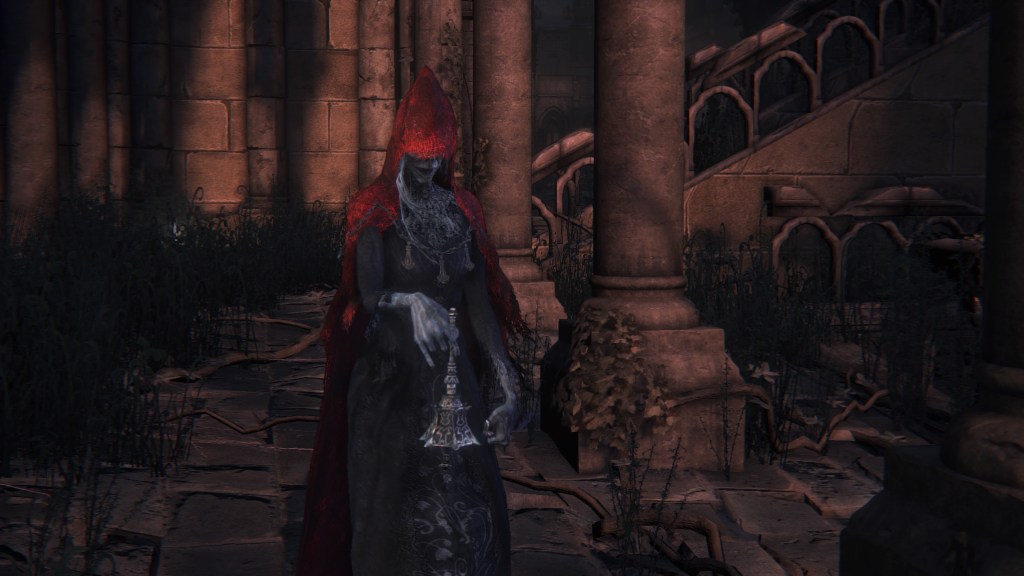

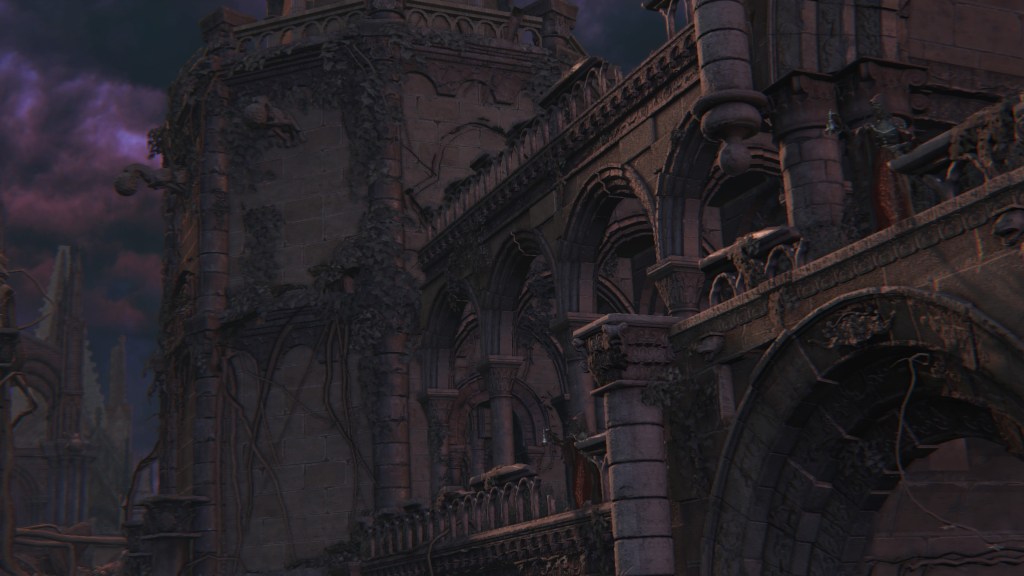


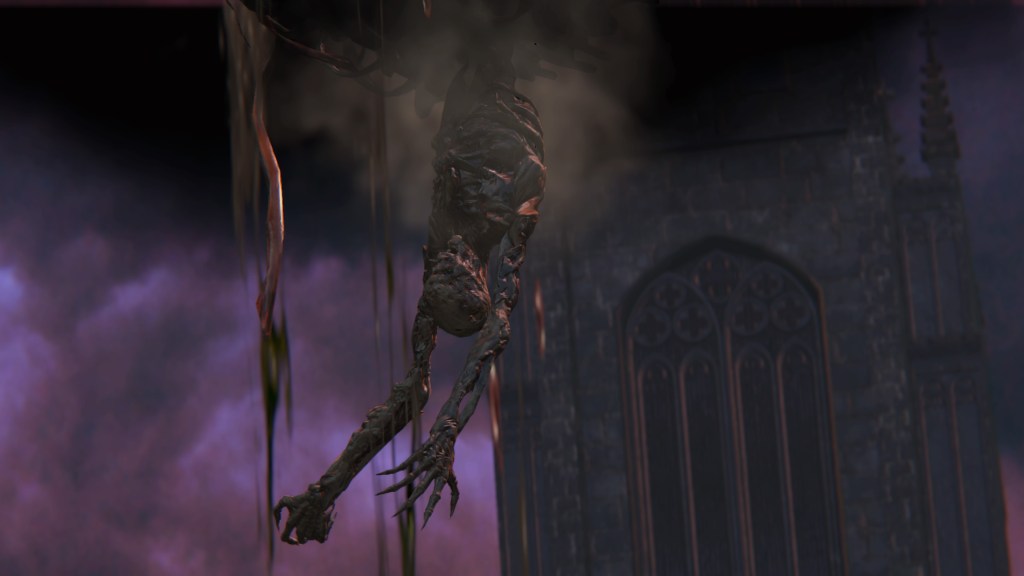
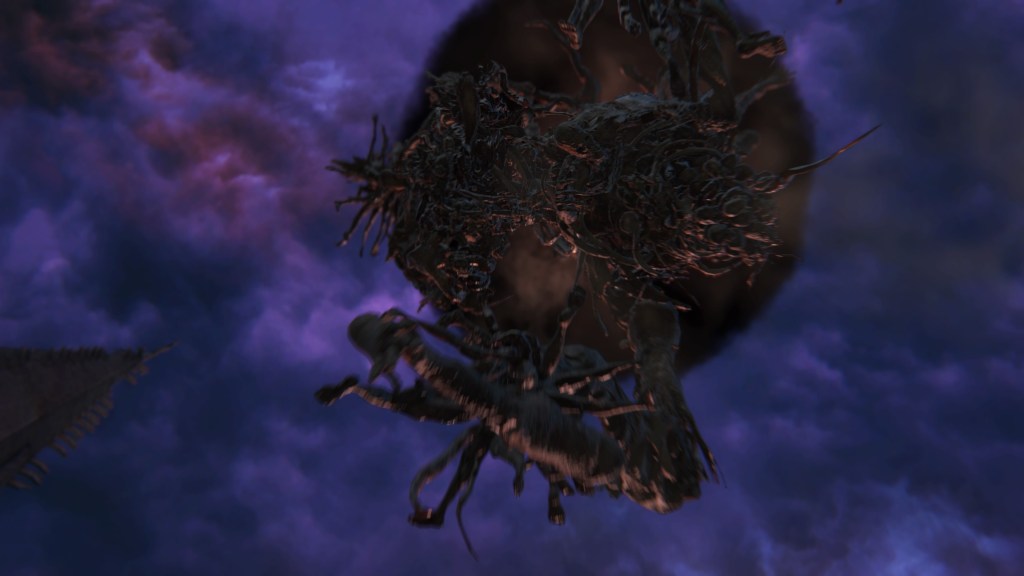


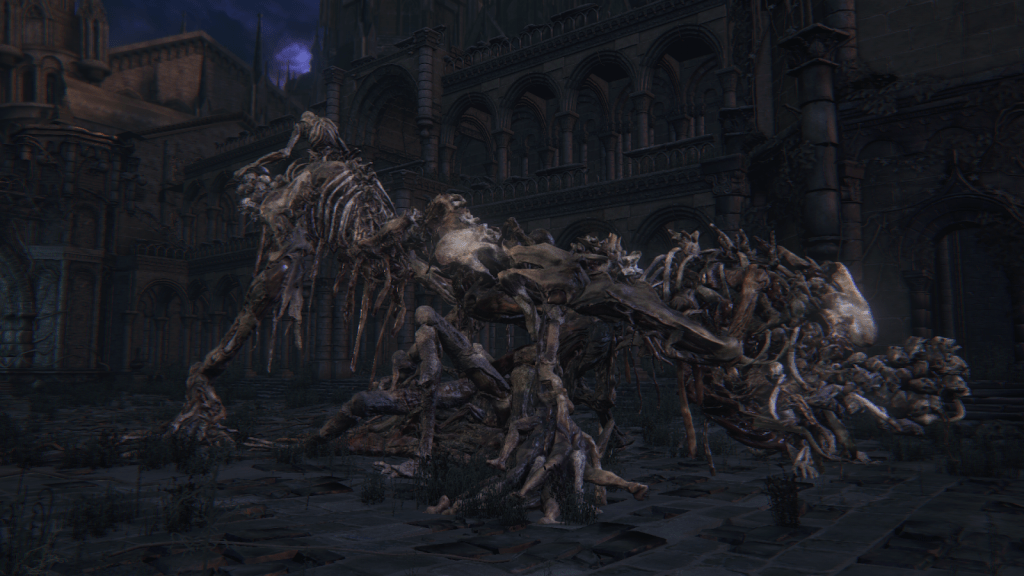


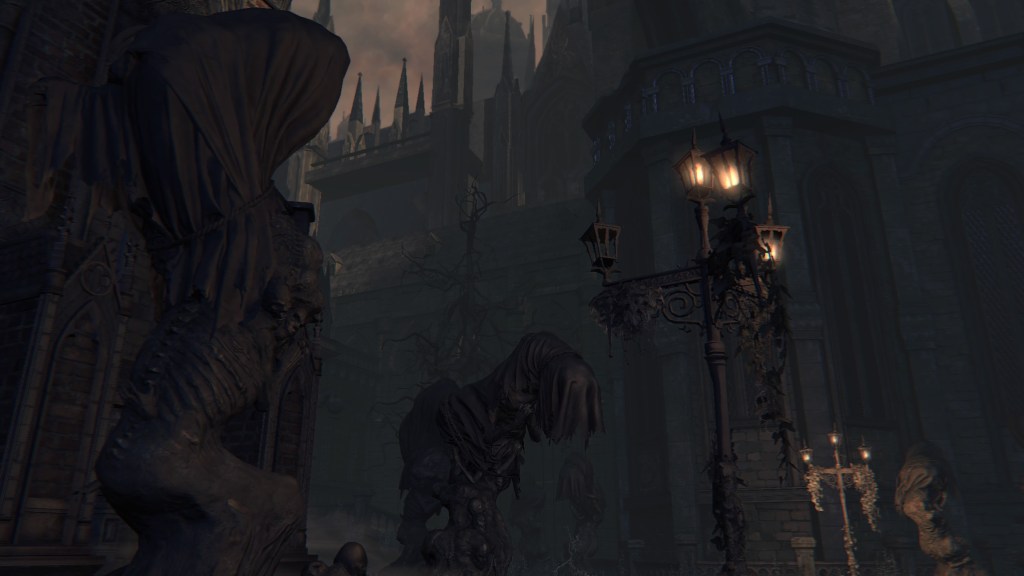
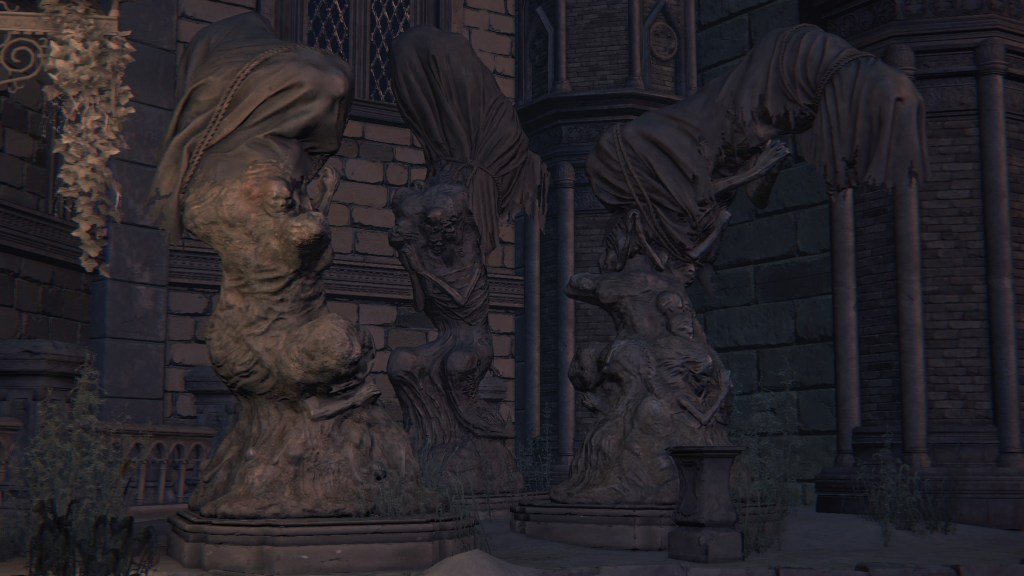
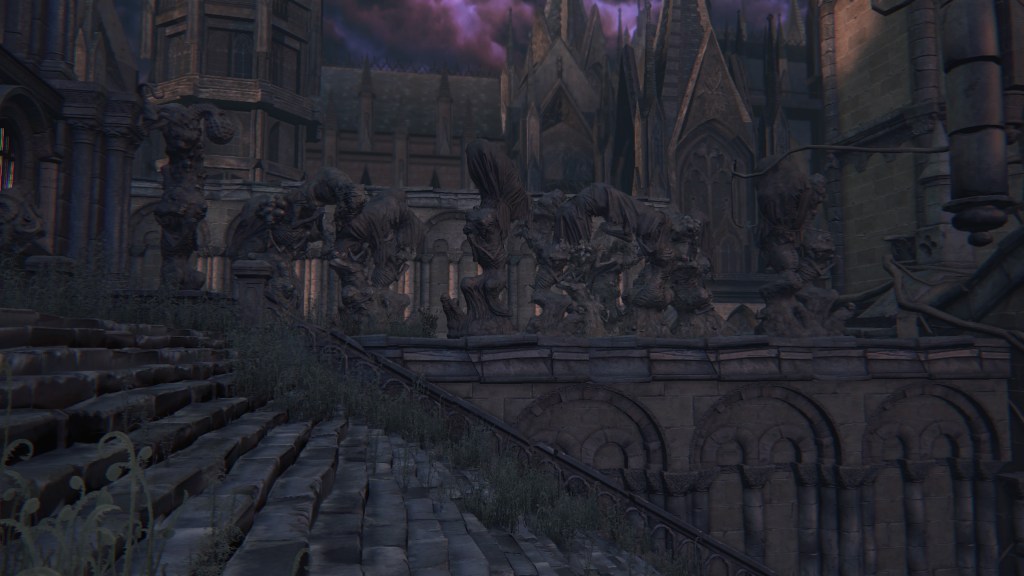

Descent and Decline
Putting aside their persistent experimentation, Yahar’gul still had to contend with Yharnam in the aftermath of the Mergo ritual. Its hunters seem to have taken the brunt of the fallout. None of them remain connected to the Hunter’s Dream, and it is not for lack of history. The three securing the city’s church after the red moon must be responsible for breaking the lantern there, meaning that they are familiar with how hunters of the dream operate. In all likelihood, Gehrman expelled them by the conclusion of the Old Yharnam Incident, learning that they had been hunting for people instead of beasts that entire time. He was already doing the same with others, and their contributions to the disaster merited his wrath far more — if not for them, the Healing Church wouldn’t have been sacrificing the Hunter’s Dream to save face. Not every hunter seems to have been satisfied with this outcome, however.
As we explore Yahar’gul’s jails, we come across two different hunter’s notes left near two different hunter corpses. The first we can read reports how the “madmen” and their rituals are being hidden for beckoning the moon, leaving no choice but to break that concealment by Rom. The second, available after the red moon, presciently demands a stop to Mensis’ rituals before everyone ends up a beast. Taken together, these are hunters who chose to pursue the renegade Church faction after the Old Yharnam Incident, leading to Gehrman cutting them off; leaving them helpless when they got locked up while investigating. This isn’t surprising. Considering how Mensis caused the biggest influx of beasts in recent memory, it is understandable that some hunters would deem them a greater priority than the endemic beast problem. Unfortunately for those hunters, they were too few to realistically deal with the threat, and none were equipped for the task regardless.
Madmen and their rituals call the moon, and so they are being hidden. Have only to break the concealment.
Stop the Mensis rituals. Otherwise, eventually all will become beasts.
Past the pair of Yahar’gul hunters guarding way to the old hidden church, two dismantlers loiter in front the actual building. It is possible that the hulking armored axe men were deployed by the Choir, hoping to cut off the town from the rest of Yharnam. But if so, it hasn’t been very effective. Alternatively, the School of Mensis took control of them and keeps them as watchdogs. Already, we see two wear clerics in black in a standoff with them, observing the fearsome abominations from a safe distance atop the cliffs — if the holy cloth removed from their backs is any indication, such a dangerous yet tedious duty on the fringes has left them less than motivated. Regardless of who is behind their presence, just getting into the church is no easy feat. Should an aspiring hunter make it the front door, there are still many more horrors to potentially face before finding away through the locked doors.
There are numerous corpses with frenzied blood or madman’s knowledge on the Nightmare Frontier. Based on the cleric models, some may belong to the School’s more adventurous researchers, overwhelmed by the answers in the outer reaches of reborn Loran. Other bodies similarly possess lead elixir, the same owned by two live hunters in the area. Both are your typical hunter, belonging to the Healing Church and Gehrman’s workshop respectively. Their hostility, along with the elixir, suggests that they too cracked in despair. From this example, many individuals probably ended up in the Nightmare while investigating Yahar’gul, courtesy of the Amygdala minding the entrance. Perhaps it was innocent curiosity, or perhaps they likewise sought to infiltrate the hidden town; mayhaps at the direction of a certain deceptive spider. Whatever their exact motivation and circumstance, these hunters were whisked away to a world they didn’t know existed and were mentally incapable of withstanding.



If they were hoping to take down the School, they needn’t bother. Mensis was falling apart all on its own. When we are abducted, the hidden town is already littered with bodies, not all civilian, and new ones seem to be added all the time. Two kidnappers in the city church come upon a dead citizen with Moon rune while on patrol, evidently taken by surprise. A different kidnapper, with his dogs, stand over the fallen hunter carrying the Tonitrus. Looking at the frenzied blood, madness has already been taking hold of experimenter and experimental subject alike. Anyone still sane would recognize that Yahar’gul is in no better shape than the rest of Yharnam. Indeed, a regular note left in the chancel compels us to find and silence baby to stop the rituals in the Nightmare. Clearly, even the experiments’ facilitators aren’t all on board with the latest arcane ceremonies, hoping to cut the School’s one tie with the Great One supplying them a dream and bring an end to this folly.
The Nightmare’s rituals coincide with a baby. Find the baby. Stop its cry.
A good example of this is Defector Antal, though it might be more accurate to call him a deserter. Rihan (離反) just denotes turning away from the group you are a part of, so Antal hasn’t necessarily joined another faction — he simply cannot abide by Yahar’gul’s madness any longer. For that reason, he is happy to help us escape prison when Paarl blocks our way, and later offers to assist with the One Reborn so we can enter the Nightmare and put an end to these foolish experiments once and for all. Based on the Church Pick and flamesprayer he uses, he still remembers a nobler time when his kind hated the beasts and romanticized hunting them as holy purification. After witnessing the grim reality of Mensis’ work, he has become disillusioned with the School if not the Healing Church in total. Thus, he appears to have been secretly undermining the town clergy from within. True to his Latin name, he desires final “daybreak” more than anyone.
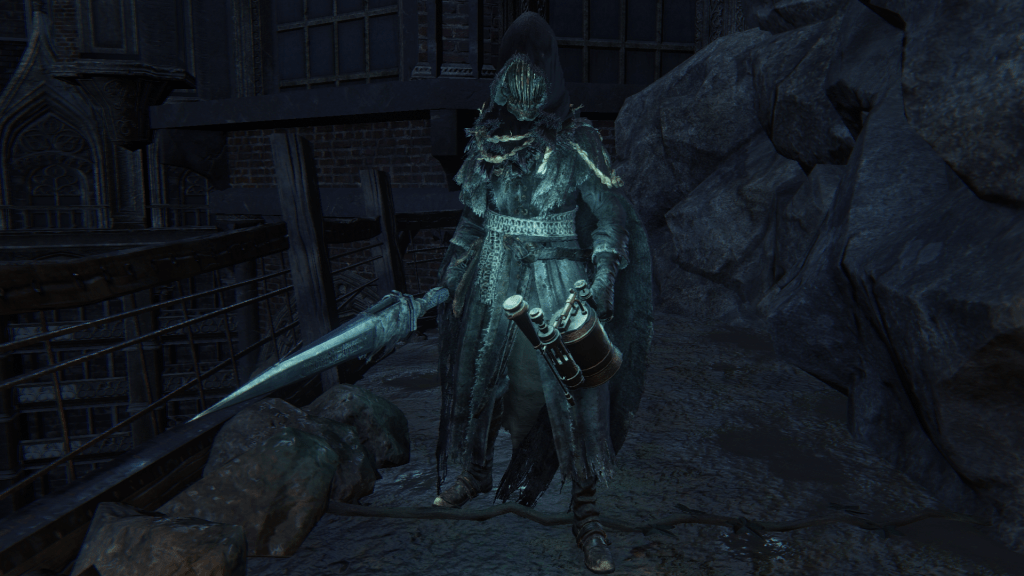
But the night must crescendo before it can break dawn, and so the red moon accelerates Yahar’gul’s decline. The kidnappers are all dead, the creations run amok, with only the bell ringers still persisting with the rituals. Yet loyal hunters have tried getting a handle on the situation at the church, but experiments still roam through the emptied dungeons hunting for more prey. Additional corpses with madman’s knowledge and a bolt damp blood gem inspire little confidence in the town’s future. Just as this latest red moon brings an end to Yharnam, their beckoning rituals have brought an end to Yahar’gul. Antal has seen the writing on the wall for a while, so navigates this chaos to entrust us with the final death knell. But even without our help, the Nightmare of Mensis would no longer have a supplier, not that the School would care either way at this point.
With Mensis’ continued failure both in and out of the Nightmare, it was inevitable that the scholars themselves succumb to madness. Bodies with frenzied blood lay not just outside the twin churches, but also within. Clerics weren’t falling victim to simply the Brain, but the horrors of their nightmarish work in general, which is consistent with Edgar’s current state. Micolash has been the biggest casualty. The man certainly gained great knowledge from the nightmare library. Our boss fight has his perform arcane arts resembling Augur of Ebrietas and A Call Beyond; he also initially hoodwinks us with a doppelganger. But most unsettling are the puppeteered remains he lets fight on his behalf while fleeing through the halls. Given their model’s aged appearance, these corpses are probably his fellow scholars, now ripped to pieces — but by what? Their experiments, or Micolash?

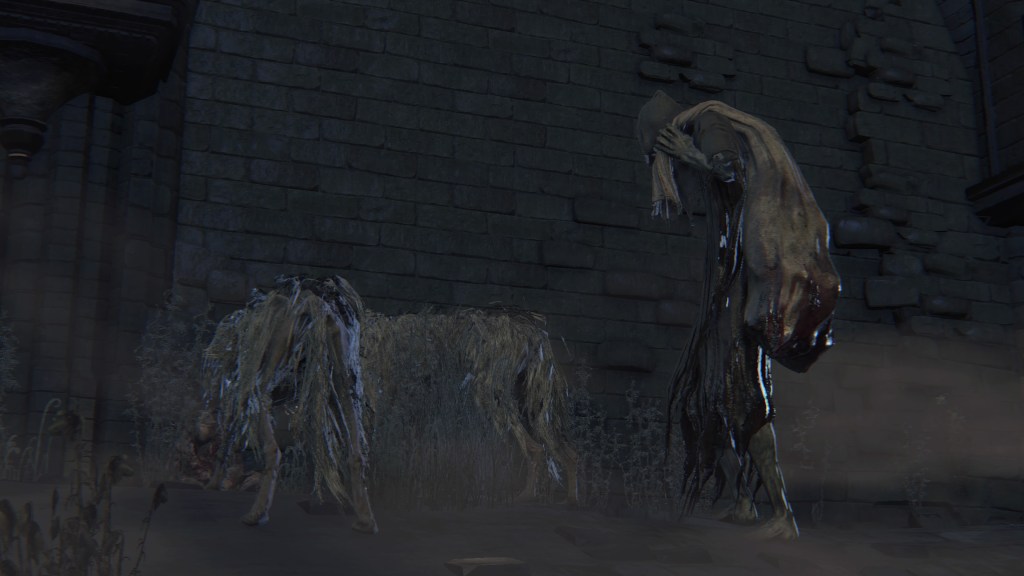


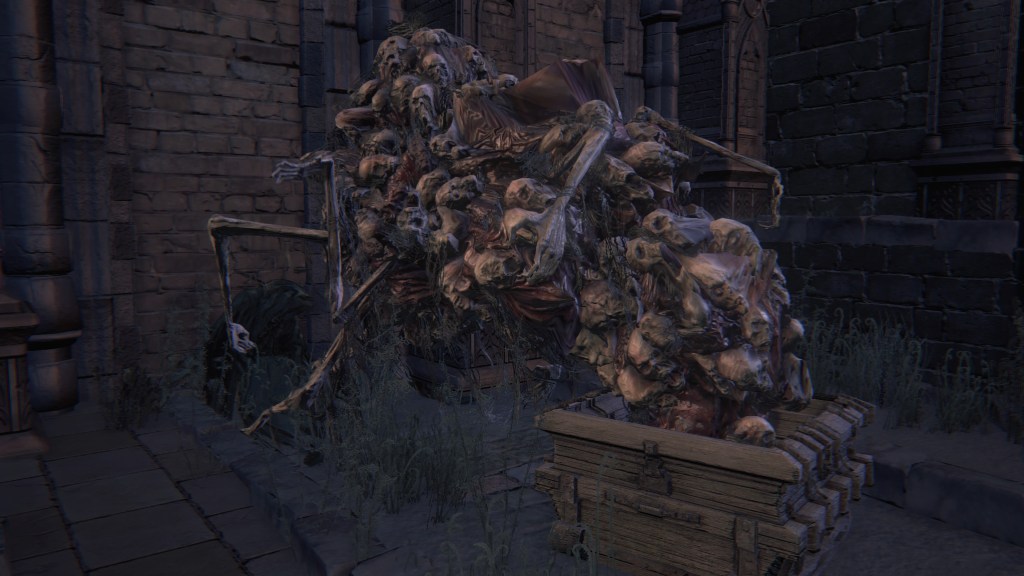



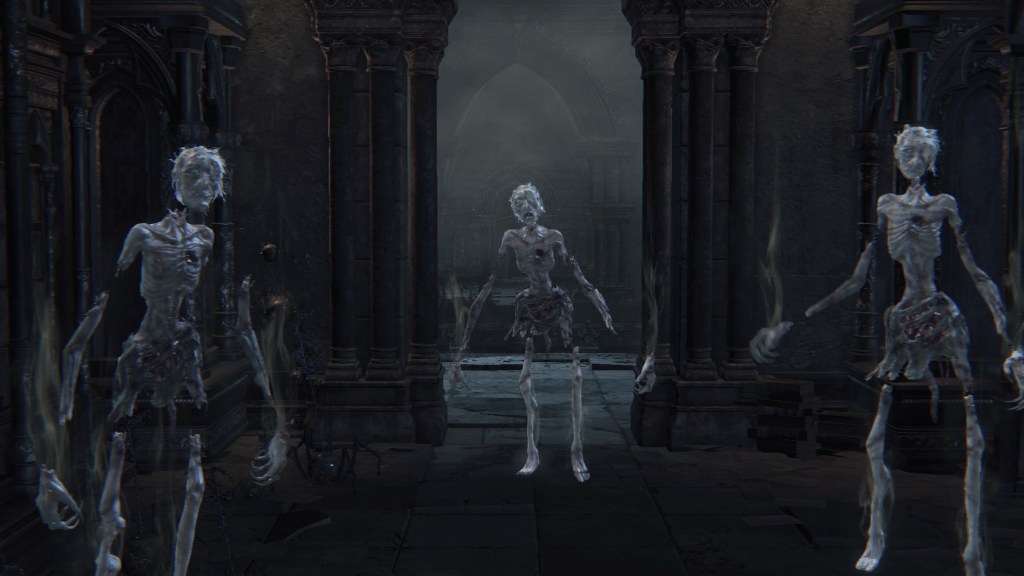

Perhaps an increasing number voiced skepticism as they poured over every book in the archive, finding no answers with their current theory. But Micolash wouldn’t have it. From the moment we cross paths, the master of the Nightmare is appealing to Kos for eyes despite surely knowing that she is dead. This move is pure desperation. The man never gave her much thought until this moment. Now, when he has nowhere else to turn to, he throws out names into the ether, certain one of them has to be right; so long as god answers, Micolash doesn’t care about the courtesies. It is a Great One he knows helped man once, so he is pinning all his hopes on her. Even though Kos fails to respond for obvious reasons, the man still refuses to give up Mensis’ dream for enlightenment, claiming that they are unstoppable.
Delusional as he reveals himself to be in this battle, any objecting to this continued insanity must have met his swift ire. They have a dream world as well as contact with the gods. How can they turn back after coming so far? The answer has to be somewhere in this dream of theirs, both literal and figurative. If it is nightmare, then he will make sure it never ends, preserving his life above all else. His priorities are so distorted, his first concern after his “real” body is hunted isn’t that he will face death as a mummified corpse in the waking world — but that he might forget everything after waking up, as if this were a typical dream. Had there been colleagues still sane enough to see reason, they weren’t getting through to Micolash. His name is likely taken from the clockmaker behind the famed astronomical clocktower in Prague, Mikuláš of Kadaň. And like a clock, Micolash will never escape his fate, going round and round in circles expecting a different result. He can measure the cosmos but will never truly reach it.
 Lokey Lore