
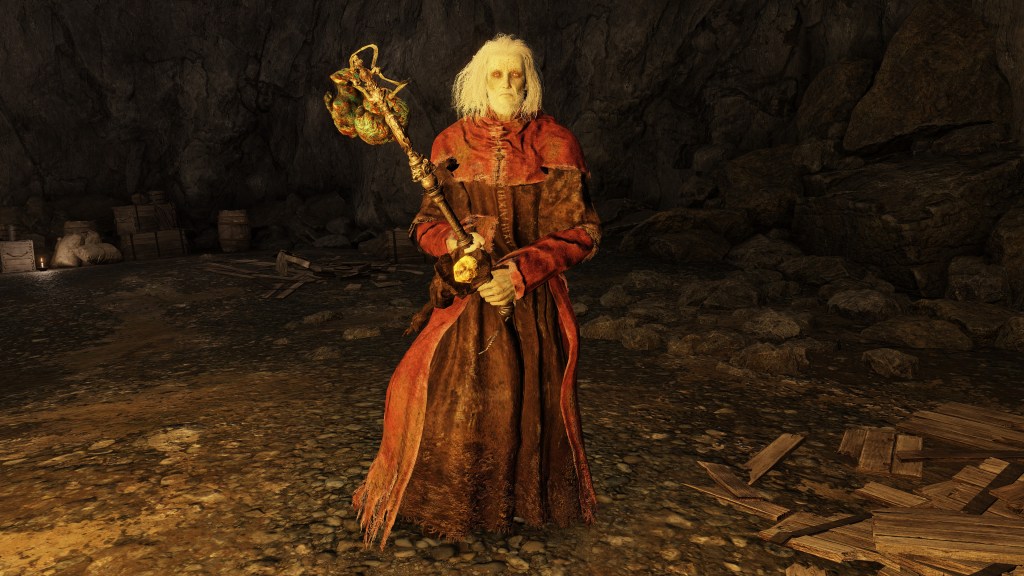
Although now a necromancer, Garris was once just any other sorcerer living in Sellia. Perhaps the man of reason had unconventional sympathies to his Erdtree’s overlords, given his known arts require faith. Maybe he even came from a faith background — his name is more accurately Gareth, (ガレス) a knight of Arthurian legend, and he was once called the “great noble” (大貴族) per a scrapped description for his golden weapon featuring fancy gems flanked by crowned lions. However, nothing in the final game save that regal weapon of choice indicates a connection to Erdtree nobility or Godfrey’s knights of the round specifically, and it is possible that his coming to faith was a more recent development. After all, we know that the sorcerer stayed in Sellia because he was later exiled as one of its heretical sages, adopting the group’s characteristic robe which he wears to this day. And this heresy was most likely because of the tragic loss of his wife and two children.
Weapon attaching red copper-made heads with chains. Festival tool made by Gareth, great noble.
They appear like the heads of his family, his wife and two children, so Gareth went mad and ultimately fell to a heretical sage.
The man wields a flail called Family Heads because the chains swing copper facsimiles of the three, the skill used to call forth their wrathful spirits from those rattled craniums. Considering that Garris is credited with reviving the old conjury to call such vengeful spirits as a sorcery, it is obvious that he is dead-set on resurrecting his family. Perhaps they were all caught up in some terrible accident. Whatever the details, it left an understandably distraught husband and father looking for any way to bring them back. The answer he found in the ancient arts of pagans dedicated to the Deathbird. The Death Rite Bird encountered east of Sellia does confirm their continued presence in the region, giving a local sorcerer plenty to opportunity to observe and potentially reverse-engineer their techniques. Thus did one man become a “death arts expert” (死術師) learning all there was to know about its power.


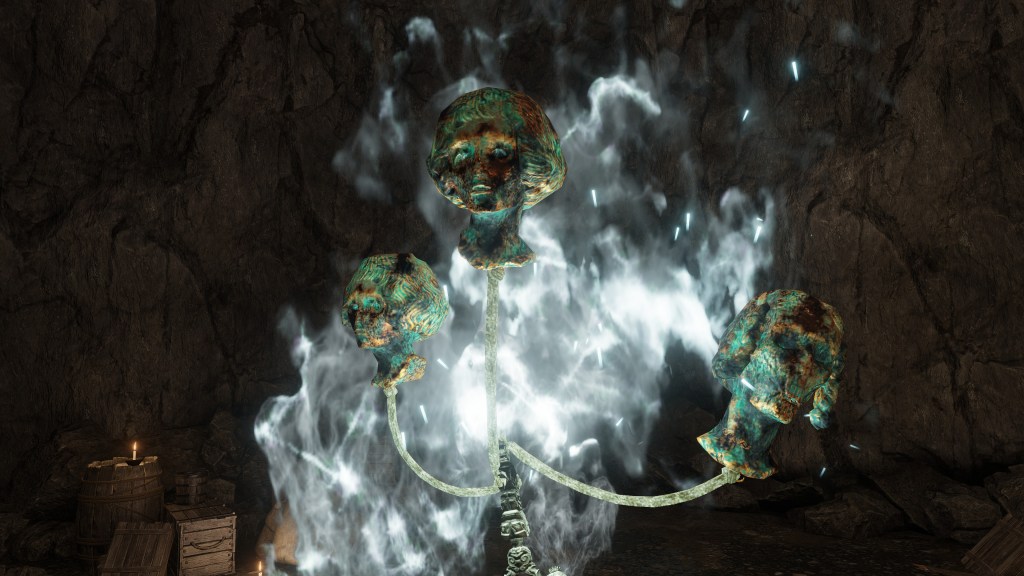

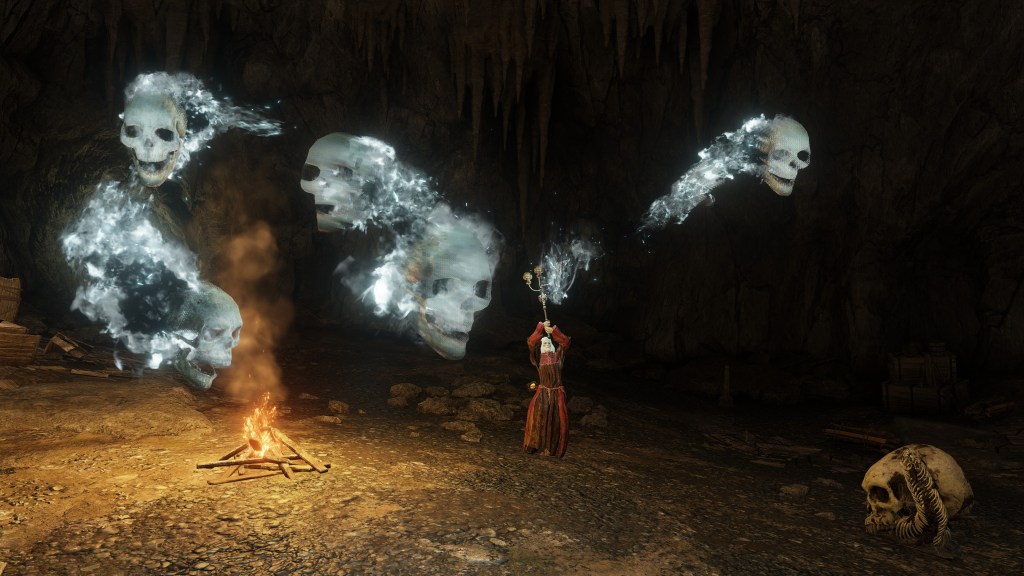
Battle art that calls pursuing vengeful spirits while slowly swinging the red copper heads. For the anguish of his wife and children invites a haunting.
Garris wasn’t unique in this regard. We can acquire sorceries for Ancient Death Rancor and Explosive Ghostflame from Death Rite Birds at Academy Gate Town and Ordina respectively. Evidently, both Liurnia and the Consecrated Snowfield produced the odd sorcerer curious about the power of death, these two getting too close to their research subject for their own good. Perhaps the former wished to revive the whole Gate Town, ravaged by civil war, while the latter sought a flame to burn the Erdtree and hasten the Haligtree’s supremacy. Whatever their individual motives, they both ended up joining the dead, unlike Garris. He continued to develop his specialty, trying to bring the family to his side. If it wasn’t the arguable attempt to desecrate the dead, it was the definite reliance on both intelligence and faith which got the sorcerer banished from Sellia. Still, the sage was allowed to persist with his heresy, at least until the Shattering came to his doorstep.
With a poison swamp spreading from Radahn and Malenia’s battle, Garris couldn’t linger in the sages’ town for long. Before the place became knee-deep in Scarlet Rot, Garris abandoned the settlement to continue his research elsewhere. In contrast to Gowry, the necromancer didn’t care to remain in Caelid. His second exodus took him all the way to Altus Plateau, where he now dens in a cavern at the foot of Mt. Gelmir. This Sage’s Cave and the sage residing within tell much about the journey up until that point. Just one example is the Prince of Death’s Staff wielded in his other hand, tipped with corrupted amber taken from Godwyn’s cadaver. This implies that Garris came face-to-face with the soulless demigod, and he most likely did — with one of the faces, at least. After all, a scarab rolls up the text for Rancorcall, the sorcery he revived, in the lead-up to Godwyn’s other self in Stormveil Castle. From this, the sorcerer derived his staff from this facsimile manifesting at the heart of Godrick’s territory.


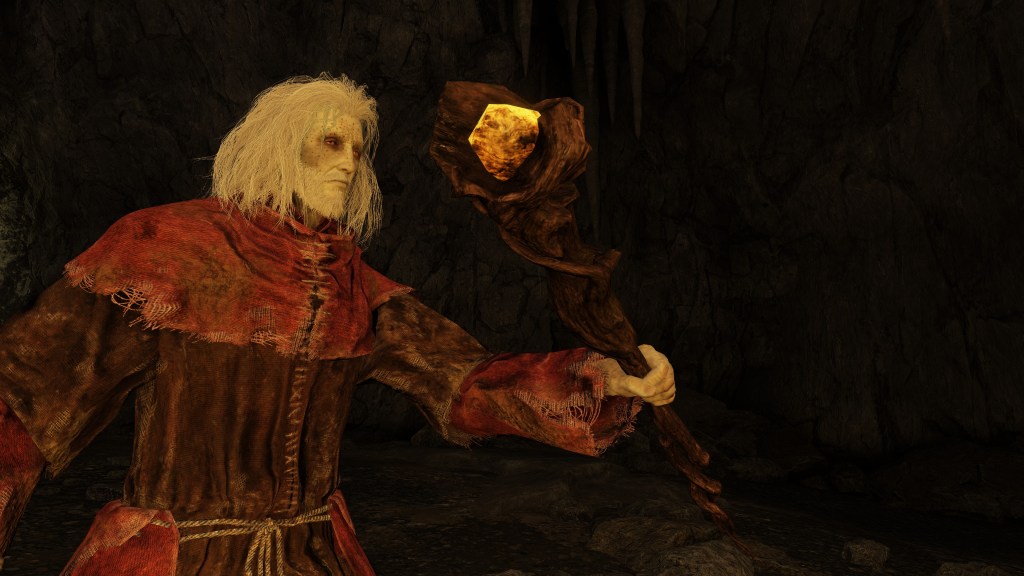
How and why he infiltrated such a secure facility to begin with is easy enough to surmise. After departing from Caelid, Garris couldn’t help but notice the destruction afflicting the western end to the castle walls as he passed through Limgrave. Recognizing a liable connection to death, he presumably approached Godrick’s forces with an offer to solve the degradation — and they would be all too happy to see that “curse” lifted. Once inside, the sage just needed to trace the “thorn vines” to the literal root of the problem and start his research, creating a staff from Godwyn’s clone in the process. Obviously, Garris didn’t solve the problem before departing the castle; he might have even slipped out without much fanfare. But regardless of whether he was welcomed or snuck in at the beginning, this encounter with Godwyn left a huge impact on the necromancer’s mastery of death.
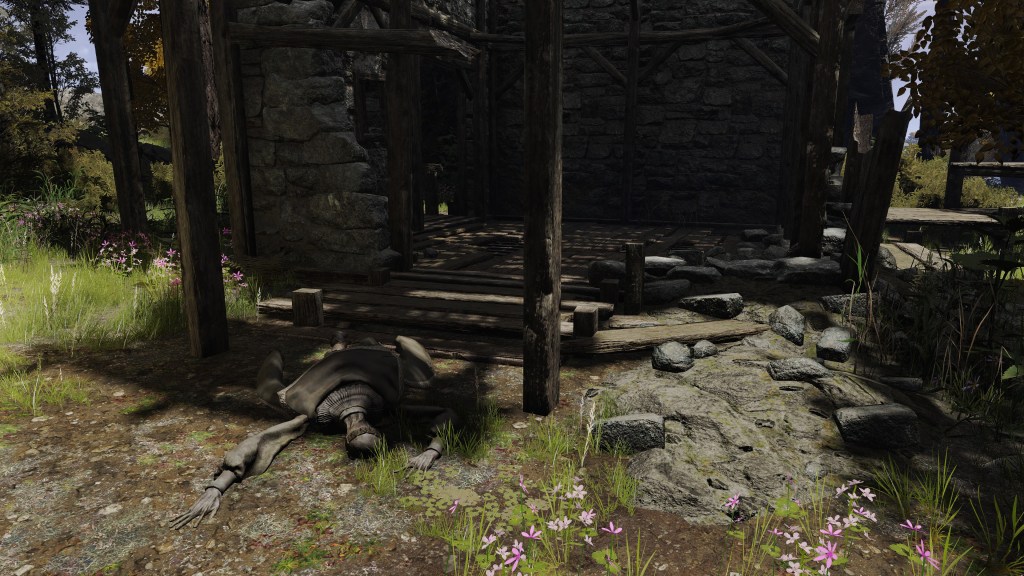
Next was his passage through Liurnia. One possibility is that he stayed at the Revenger’s Shack. Although most might associate the name with Edgar, the area is identified as such even before the knight goes mad with revenge. By that same token, there is a body already lying in front of the dilapidated hovel before Morne’s commander ever moves in and adds a multitude more. Unlike most corpses of its type, this noble’s body has no item for us to loot, strangely enough — almost as if the deceased was previously looted by someone. And when it comes to revenge, Garris may well have a bone to pick with a Liurnian, assuming that the person was involved in the deaths of his family. Since he was in the area, the sorcerer simply took the time to track down his nemesis to that secluded home. Based on the configuration of the corpse, the owner had stepped out from his front porch to greet a visitor, where he was murdered. Garris would then have simply picked any valuables off the body and moved in for a brief stint before heading to Altus, leaving the home to fall into disrepair by the time we arrive.
Whether or not he had been out for revenge, his location at the shack would place him at the crossroads between the Albinauric village and the Cuckoo encampment. This is notable, since a number of first-generation Albinaurics can be found in the Sage’s Cave. In all likelihood, Garris had recruited a number at the village as research aides. With the Cuckoos bearing down on them and their contact with Caria blockaded, some of the Albinaurics would feasibly be tempted to join. Like Miquella, Garris was promising them an escape from hell, escorting them all the way. Under his protection, it is understandable that a few might agree to serve as he made his way to the plateau. In that case, the Revenger’s Shack provides potential justification for the sorcerer crossing paths with the village. Either way, they likely assisted him with settling into the cave, moving in all sorts of supplies; some of which have already been used for experiments, going by the piled remnants of boxes and barrels in the master’s chambers. From this new home base, Garris and the Albinaurics explored death’s potential.





Of course, the sage setting up shop beneath Gelmir was also a deliberate choice. Among the many chests found around the cave, three closest to the sage hold the armor and weapon of a raptor assassin. Garris thus seems to be aware of the volcano’s history with the Deathbirds, collecting what scant relics remain from the area. The sorcerer has certainly explored deep into the crags, the most obvious indicator being the metal used for the Family Heads — the same red copper (赤銅) as the Man-Serpent’s Shield. This implies that the weapon was also forged in Gelmir’s magma, which requires he travel at least beyond Fort Laeidd to access. With or without the snake-men’s cooperation, Garris found the local materials suitable to a vessel for his family’s spirits to reside. The sorcerer has taken the time to learn everything about Gelmir, using everything at his disposal to advance his craft as a necromancer.
Weapon with red copper-made heads attached with chains. Choice weapon of the necromancer Garris.
Those heads are made to resemble his wife and two children.
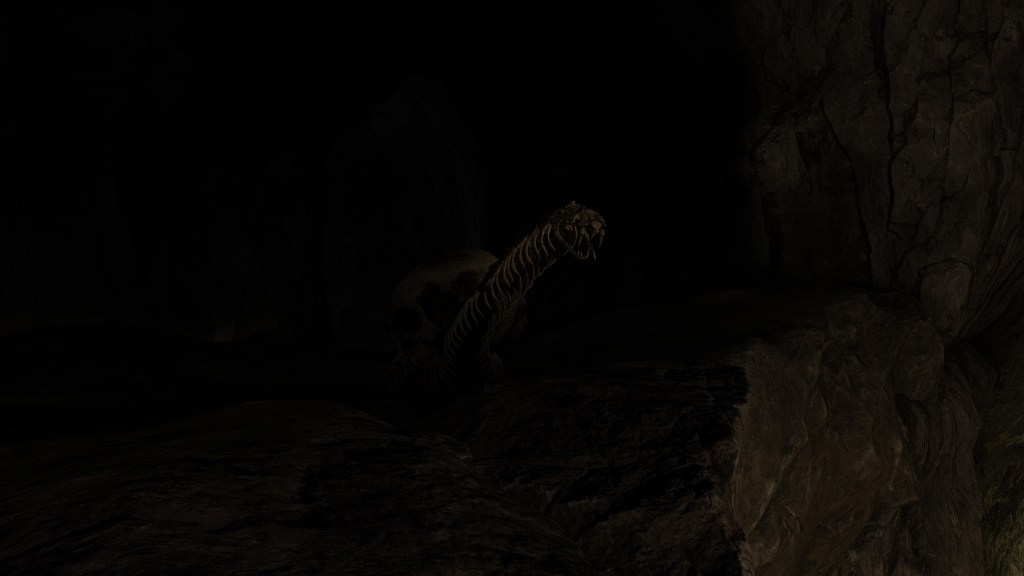
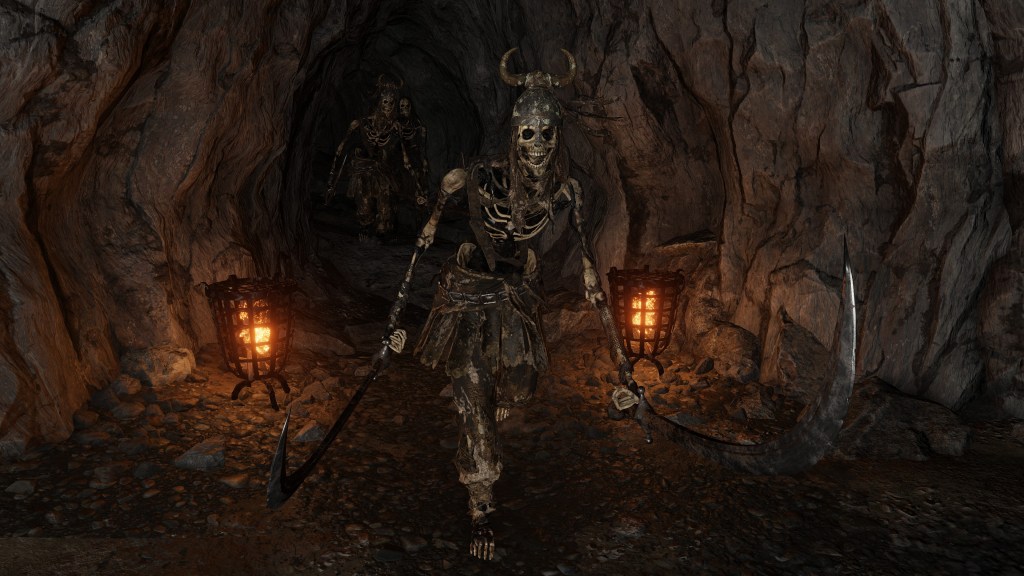
The sage’s research at home and in the field has borne fruits for us to witness. Garris utilizes his new staff to perform Tibia’s Summons, the same sorcery we acquire from the mariner haunting nearby Wyndham. There is also the skeletal serpent snail accompanying the man; the animal infests the walls of Volcano Manor, and the shell of Garris’ “pet” specifically is a giant’s skull, which Wyndham shows were also buried in the vicinity. With a new one slinking out of the shadows after the last has been killed until their master is dead, it clearly wasn’t just a flail that the man got out of his surveys. From his combined studies of Deathbirds and Godwyn, Garris has attained a greater grasp on death. And with it, we see that he has succeeded in reanimating numerous skeletons, not just the snail snake. The human bones patrol his cave, ready to stop any from reaching their master, a true necromancer. This naturally begs the question of where the sage procured all the bones for such rituals. In truth, they basically fell into his lap.






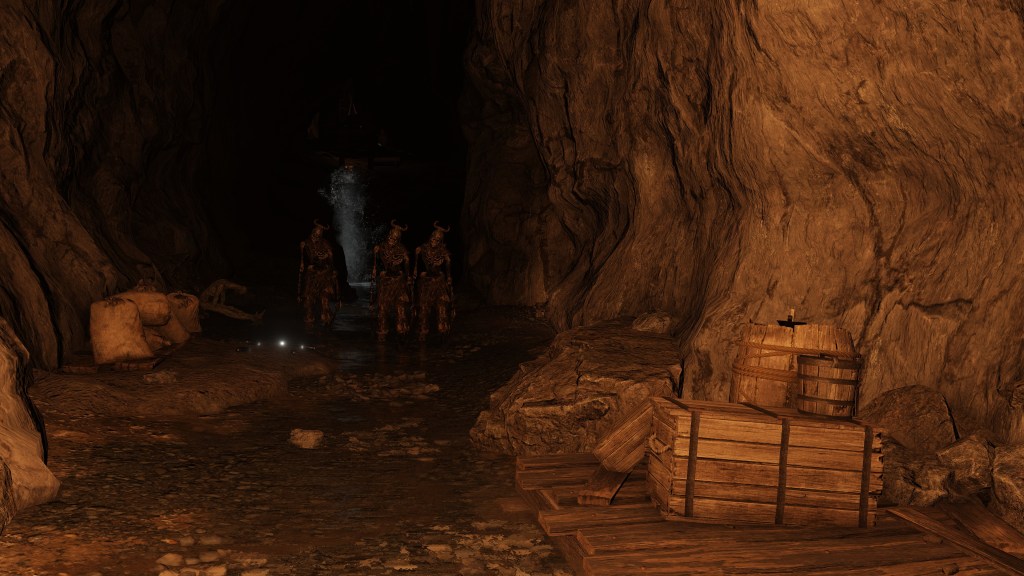
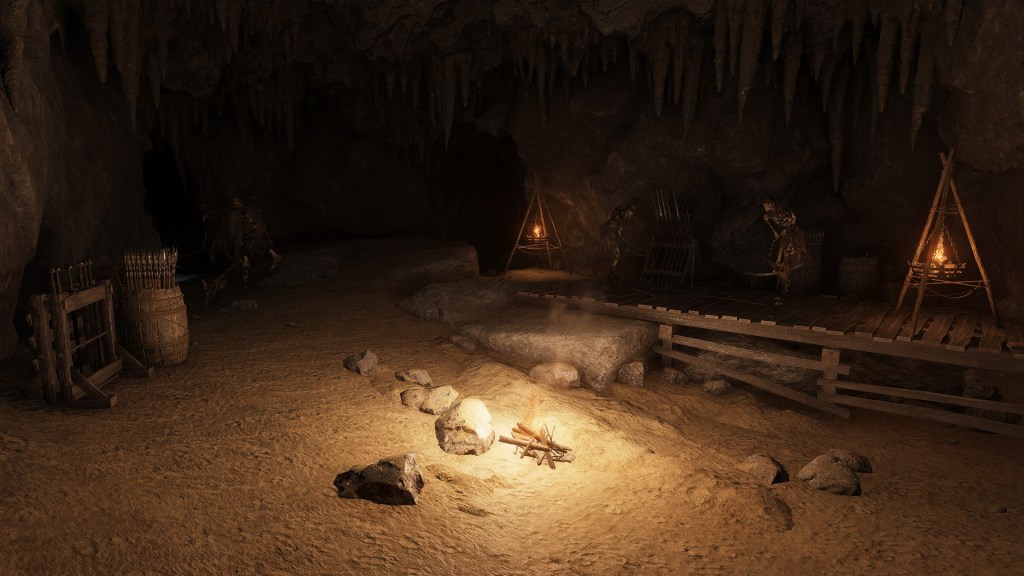
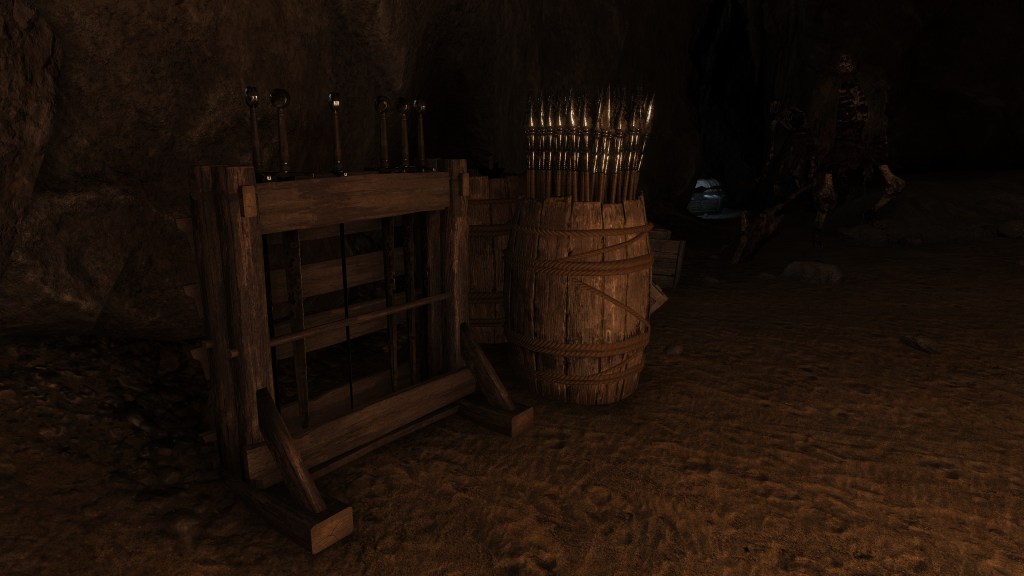
Past the first skeleton spearman overlooking the waterfall, we begin seeing elements of residence like wooden platforms and braziers. Among them sit two chests containing rejuvenating boluses and a lost ash of war, two corpses with unremarkable golden runes laying beyond them. Between the braziers, a small side branch in this passage hides more woodwork and chests behind an illusory wall, along with an array of bandit skeletons plus another spearmen. This complements the black hood of a thief found inside one of those four chests, the other three storing a silver-pickled fowl-foot, Candletree Wooden Shield, and nascent butterfly. Moving onto the next chamber, we come upon a camp with Farum armament racks and another group of skeletons, this one featuring two crossbowmen and even an executioner. Chests there and in the passage beyond hold a stonesword key, some golden greatarrows, and a handful of dragonwound grease. Past that are the chests and chambers for Garris’ party, but we need no more evidence. It is easy to imagine the scenario from this setup.
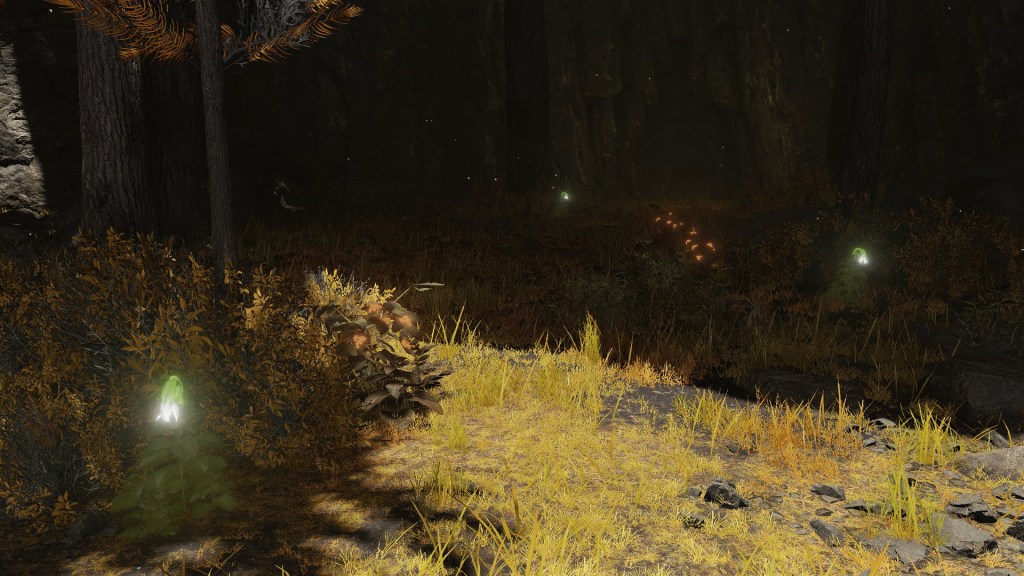
The bandit groups’ shield and butterflies are associated with Miquella while their boluses and pickled foot are missionary crafts. In short, fervent followers of the ever-young demigod killed and robbed an Erdtree missionary. On the run for their crime, the bandits fled to the fringes of the plateau, where they found the Sage’s Cave beyond Trina’s lilies to drag in more victims as their base. Little did they know that it was already occupied, Garris and his Albinauric help making swift work of turning the fugitives into undead thralls. The group was then shuffled into a side area and hidden by the time the next group arrived. Stonesword keys are used for infiltration, whereas golden greatarrows and dragonwound grease are associated with knights of the royal capital. Add in the Farum armaments, and these were plainly Morgott’s forces, likely tasked to capture and summarily punish the apostates. The unit tracked them to the cave, only to see that they narrowly “missed” the bandits and decide to settle in for the night without exploring the cave more thoroughly — a fatal mistake as their current so proves.







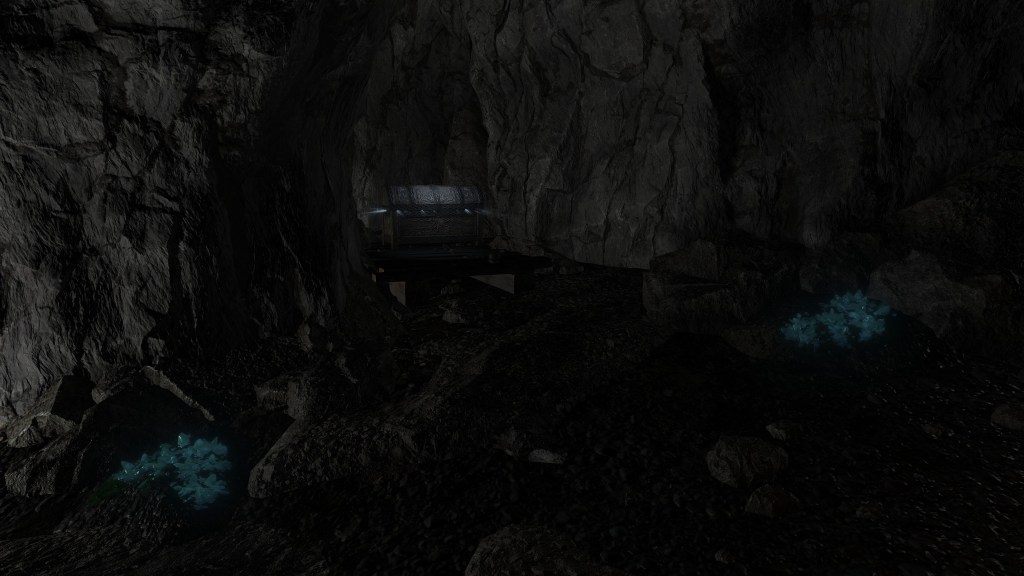
In short, the skeletons came to Garris. Maybe the sage learned a thing or two about assassination from his research of Gelmir, but he clearly managed to catch both groups unawares and cleanly exterminate them, doing the raptor assassins proud. Yet while he may appreciate the specimens waltzing right up to his doorstep, it is obvious that the man is concerned with how not-so-hidden his hidden base actually is. The sorcerer has erected several more illusory walls to hide the full extent of the caverns, and the evidence of human habitation with it. There is even a wall for the small nook securing the stonesword key chest, a transparent attempt to discourage anyone from even thinking to uncover secrets behind barriers. Garris is undeniably fed up with unexpected guests. Unfortunately for him, another had apparently slipped in while he was busy setting up these safeguards.
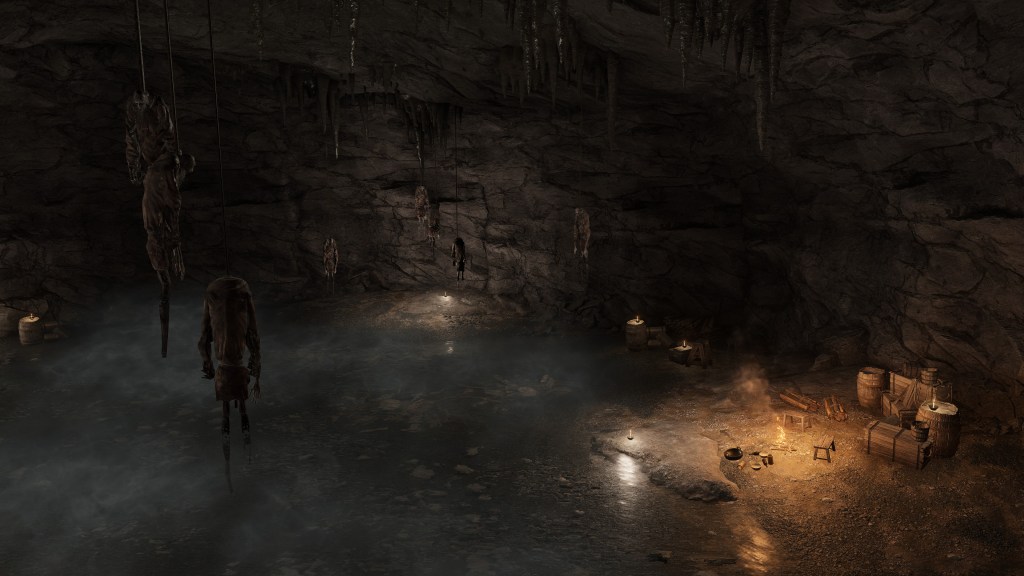
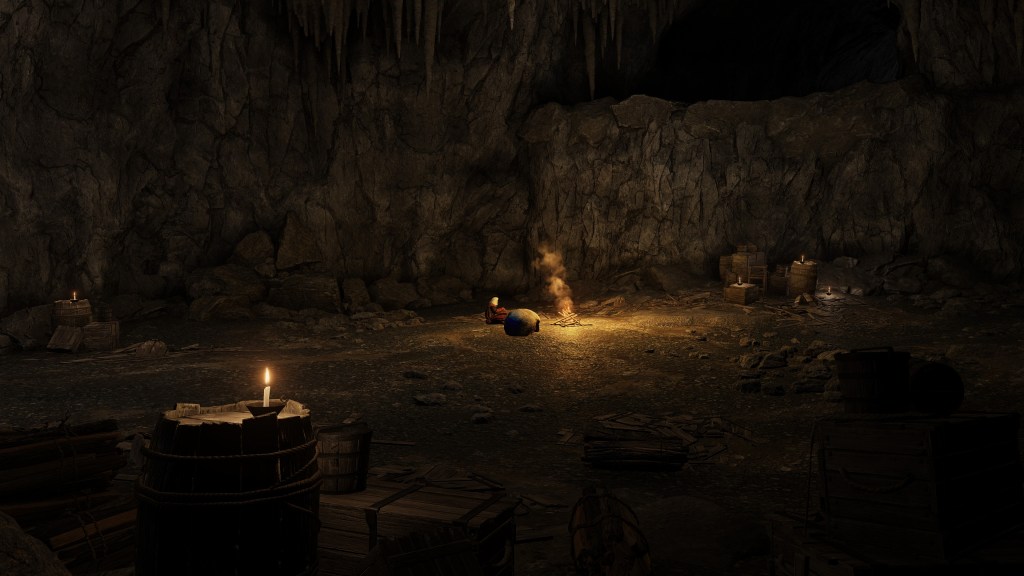
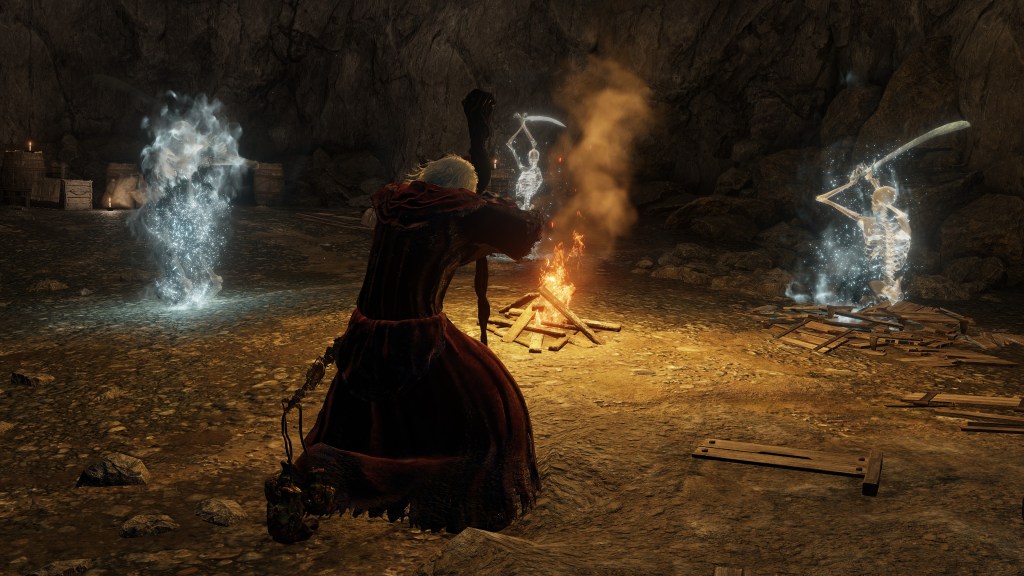
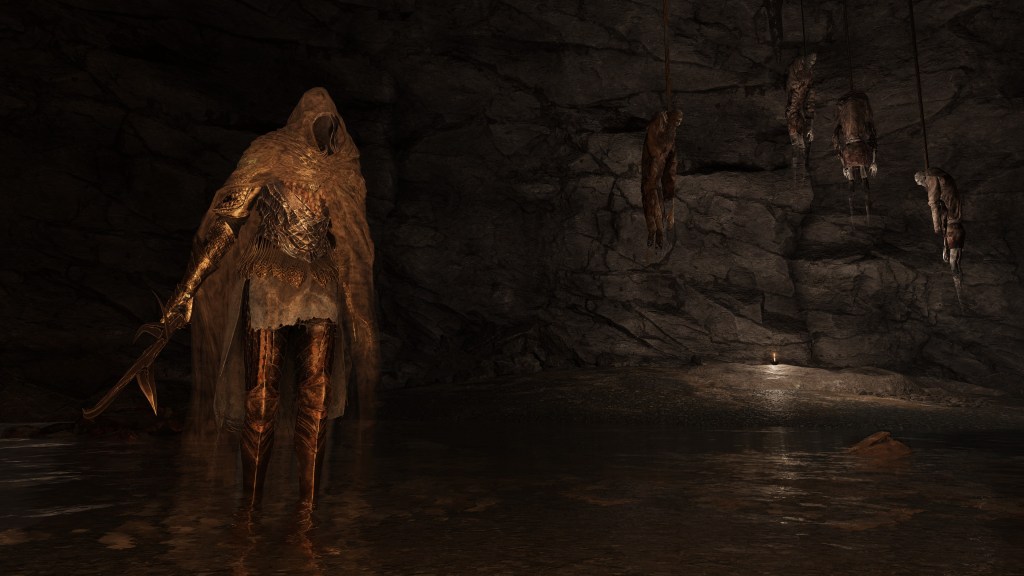
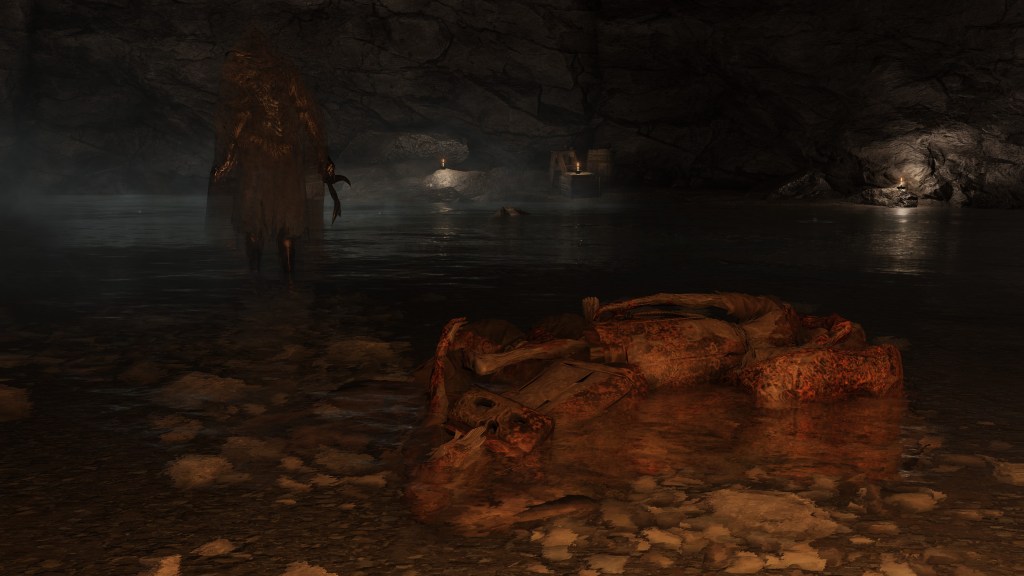
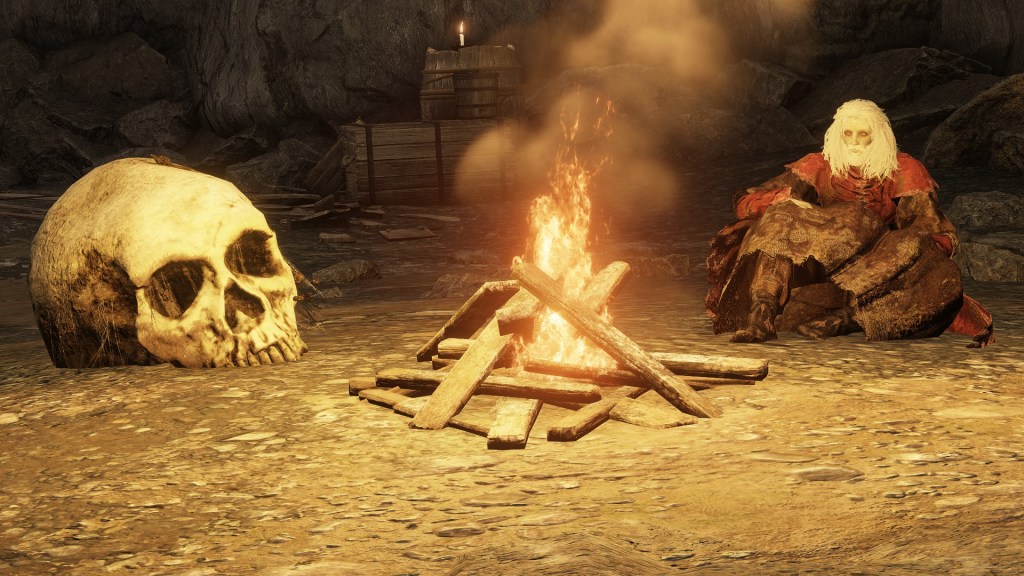
The Sage’s Cave is home to not just one but two boss encounters. Besides Garris and his pet, there is also an invisible Black Knife assassin in the deepest recess of the cave, behind the waterfall. The chamber was used by the necromancer up until recently; the small campfire is surrounded by personal belongings and supplies, a small corpse pile featuring conscripted commoners off in another corner. By all indications, Garris was still experimenting with the bodies from Morgott’s unit when the assassin moved in. She has definitely made herself at home, stringing up the bodies of the Albinaurics as a warning to intruders. The necromancer, meanwhile, is camping all by his lonesome at a larger makeshift bonfire in a separate chamber, the boss room blocked by two layers of illusions. This setup suggests that his work was interrupted by the assassin, forcing him to take refuge in another part of the cave when we arrive. Put simply, the sage was being stalked from before the walls went up.
As with the others, the Black Knife fugitive stumbled upon the cave and sought refuge, using her invisibility cloak to pass by Garris and his skeletons unnoticed. After confirming the accommodations, she presumably went in for the kill, but it didn’t go as expected. It is only thanks to the water flow above dripping through the rock to form an extensive pool that we can notice the boss’ movements, and the same was likely true for Garris. Those unavoidable splashes might have saved the sorcerer’s life, allowing him to escape as the mysterious assailant slew his Albinauric aides. The man probably didn’t even realize what had attacked him. From the necromancer’s perspective, it would look as if the party was assaulted by a poltergeist or phantom — which would explain his choice to hide behind illusions rather than confront the invader. In other words, Garris simply believes that he has been haunted. Having immersed himself so deep in paganism, the sorcerer has become superstitious. He doubtless fears that his work has unwittingly angered some immaterial entity and thus cowers in his ignorance.



Granted, he wouldn’t be baseless in that assessment. His obsession with mastering death seems to have made him lose sight of his original objective: resurrecting his family. Even now, he causes them anguish whenever he invokes his flail’s skill. Why employ them in this way? Because he is willing to do anything to get a response, even if it means adding to their suffering. The man is truly deranged and has been since he came to this land and manufactured that weapon. It is why he has no problem killing and reviving total strangers who aren’t even necessarily hostile to him. The necromancer has lost that human touch, even for those he is desperate to return to bygone days. This can’t be lost on him, since he knows how to weaponize the wrath of these cursed souls. He thereby must recognize how his careless desecration of the dead might call forth more than just vengeful spirits. In this case, he is wrong and just ceding territory to a real assassin, but it speaks volumes to his mindset. Love and loss can twist even the wisest man, until he sees no difference between the living and the dead.
 Lokey Lore